𝗣𝗔𝗥𝗧 𝟮 The Empty Place Card Told Me Exactly What My Family Thought I Was Worth
𝗣𝗔𝗥𝗧 𝟮
The table grew just a little quieter.
My family knew how to perform curiosity as a weapon.
“I teach,” I said.
Dad nodded slowly. “Teach.”
“Yes.”
“That’s what you’re doing now?”
“Yes.”
Mom quickly dabbed her mouth with her napkin. “It’s stable.”
Melody gave a soft laugh.
“It’s cute,” she said. “She likes it.”
I felt something tighten beneath my ribs.
I did teach.
That was not a lie.
I taught strategy. Command responsibility. Joint operations. Crisis decision-making. I had taught officers who would go on to lead battalions, ships, wings, and task forces. I had stood in lecture halls beside maps of conflicts that still kept people awake at night and asked future commanders whether they understood the human cost behind every clean arrow drawn across a screen.
But my family heard “teach” and imagined a woman who had failed into something small.
I let them.
I had learned years earlier that some people do not misunderstand you by accident. They misunderstand you because the smaller version of you is easier for them to manage.
Dad chuckled.
“Used to be you were going to be somebody.”
The fork in my hand paused.
Across the table, one of Melody’s lieutenants glanced down.
Melody pretended to adjust her napkin, smiling to herself.
I placed my fork carefully beside my plate.
“I’m doing fine.”
“Fine,” Dad repeated, loud enough for everyone to hear. “Fine is what people say when they don’t want questions.”
“Maybe,” I said. “Or maybe fine means fine.”
His eyebrows rose slightly.
He did not like calm resistance.
He preferred tears, anger, or silence. Anything he could dismiss.
Melody leaned back in her chair.
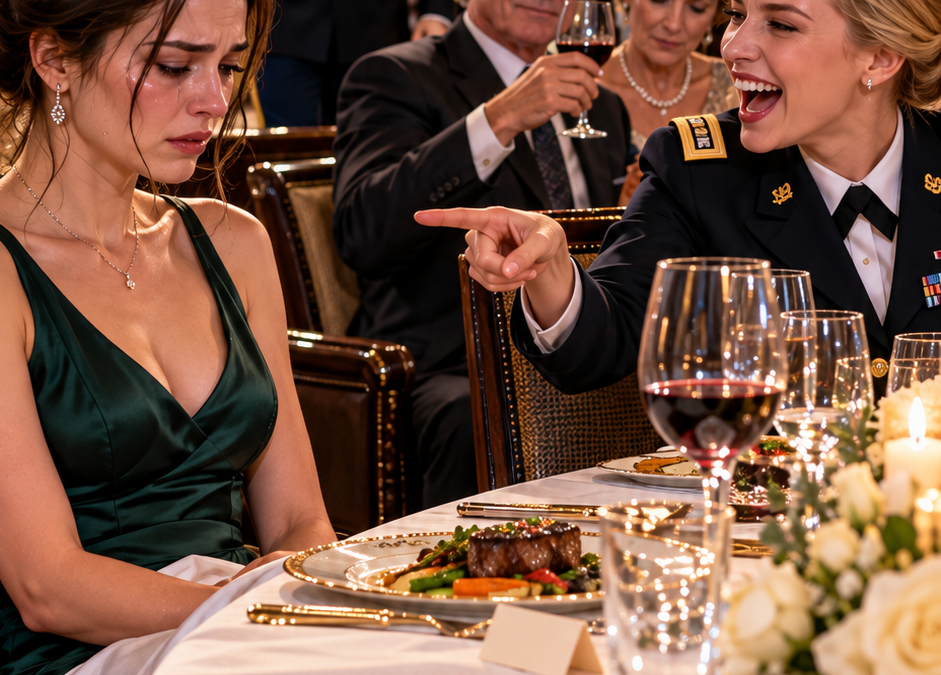
“Seriously, Lena,” she said, lifting her water glass. “Can you even afford a place like this?”
There it was.
The question hit the table, sharp and gleaming.
No one spoke.
My mother inhaled softly but did not correct her.
Dad’s mouth twitched.
Aunt Carol closed her eyes, as though praying for patience.
I looked at my sister.
She was still smiling.
Not because she wanted an answer.
Because she believed she already knew it.
I thought about the deposit I had authorized. The card on file. The bottle of wine Dad had ordered without looking at the price. The steak Melody had chosen after making a theatrical comment about “celebrating properly.” The dessert tray my mother had requested in advance.
I had paid for all of it.
And my sister, sitting beneath a tiny flag with Captain Strickland printed in front of her plate, was asking whether I belonged in the room.
I could have ended it right there.
I could have said, Actually, Melody, I’m paying.
I could have watched my father’s expression change and my mother’s face tighten.
But humiliating people is easy.
It is also rarely satisfying for longer than a breath.
So I said, “I manage.”
Melody laughed.
“Of course you do.”
Then the private dining room door opened.
Every officer at the table straightened.
The change was immediate.
Subtle to civilians, unmistakable to anyone who had spent time around rank. Shoulders squared. Conversations stopped. Eyes shifted toward the doorway.
A decorated commander stepped inside.
Colonel Adrian Mercer.
I had known him for seven years.
He had served under me twice, argued with me once in a briefing so disastrous that I later promoted him for having the courage to be right in public, and sent me a bottle of terrible gas-station coffee as a joke after I told him his battalion staff brewed coffee that tasted like regret.
He wore his dress uniform with the ease of a man who did not need clothing to create authority.
Melody’s face lit up.
“Colonel Mercer,” she said, starting to rise.
He glanced toward her.
Then his eyes moved past her.
Landed on me.
And everything in his expression changed.
Not shock.
Recognition.
Respect.
He walked straight past Melody.
Straight past my father.
Straight past the tiny flag and the printed place card that said Captain Strickland.
He stopped beside my chair.
“Welcome back, General,” he said. “Your usual briefing?”
The room froze.
Melody’s water glass stopped halfway to her mouth.
Dad blinked.
Mom looked at me as if I had become someone else between one breath and the next.
I set my napkin on the table and stood.
“Colonel Mercer.”
He gave the slightest nod.
“Ma’am.”
Behind him, one of Melody’s lieutenants stood so quickly his chair nearly scraped the floor.
The other officers followed.
Melody rose last.
Her face had gone pale beneath her makeup.
“General?” she said.
Her voice cracked on the word.
Colonel Mercer looked briefly toward her, then back at me.
“I apologize, ma’am. I didn’t mean to interrupt your family dinner. The manager said you were in the private room, and I assumed you were ready for the base readiness update.”
“That meeting is tomorrow morning.”
His mouth tightened.
“Then I’m early.”
“You’re rarely early by accident.”
“No, ma’am.”
I knew that tone.
Something had changed.
Work had entered the room, and work did not care about family drama.
“What happened?” I asked.
He glanced at the civilians around the table.
“Nothing that cannot wait until you decide whether this room is still private.”
That sentence did what rank alone had not.
It made my family understand that Colonel Mercer was not performing courtesy.
He was deferring to me.
Dad slowly stood.
“Wait a minute,” he said. “General?”
I turned toward him.
His eyes moved over my blazer, my simple blouse, my empty place card. I could see him trying to reconcile the woman he had been mocking with the title he had just heard from a full colonel.
“Lena,” he said, quieter now, “what is he talking about?”
Before I could answer, Melody spoke.
“There must be some mistake.”
No one moved.
She looked at Mercer.
“Sir, this is my sister.”
“I’m aware, Captain Strickland.”
Her throat worked.
“She teaches.”
“Yes,” he said. “She does.”
The words were polite.
They were also devastating.
Because he said them like teaching was not a consolation prize.
Like it was a responsibility.
Like anyone who thought otherwise had just revealed more about themselves than about me.
Dad looked from Mercer to me.
“What kind of general?”
Aunt Carol made a strangled sound into her napkin.
I answered before anyone else could.
“Brigadier.”
The silence that followed felt almost physical.
My mother whispered, “Brigadier General?”
“Yes.”
Melody lowered herself slowly into her chair.
Her face had changed completely. The smugness was gone, replaced by something raw and exposed. Not merely embarrassment. Something closer to betrayal, as if my rank were a secret I had kept specifically to injure her.
Dad’s voice hardened.
“Why didn’t you tell us?”
I almost laughed.
Not because it was funny.
Because after all those years, that was the question he chose.
“I did tell you pieces of my life,” I said. “You stopped listening whenever they didn’t match the version of me you preferred.”
“That’s not fair.”
“No,” I said. “It isn’t.”
He flinched.
Colonel Mercer remained still beside me.
The officers from Melody’s unit looked like they would rather face artillery than witness this conversation.
I turned to Mercer.
“Give us five minutes, Colonel. I’ll meet you in the side room.”
“Yes, ma’am.”
He hesitated, then added, “It’s good to have you back.”
“Thank you.”
He left.
The door closed behind him.
No one touched their food.
For the first time all evening, my family had no script.
Melody found her voice first.
“You’re a general?”
“Yes.”
“How?”
I looked at her.
“How?”
“I mean—” She stopped, then tried again. “Since when?”
“Fourteen months.”
“Fourteen months?” Her voice rose. “You’ve been a general for fourteen months and didn’t tell us?”
“I was promoted while deployed.”
Mom pressed a hand to her chest.
“You were deployed?”
I looked at her for a long moment.
“Yes.”
Her face reddened.
“When?”
“Last year.”
“I thought you were teaching.”
“I was. Then I wasn’t. Then I came back and taught again.”
Dad sat down slowly.
“Why would you let us think—”
He stopped.
Good.
I wanted him to hear the sentence before finishing it.
Why would you let us think you were ordinary?
Why would you let us think you were less than your sister?
Why would you let us embarrass ourselves?
I folded my hands.
“Let you think what?”
He looked away.
Melody’s eyes glittered.
“So you came here to make me look stupid.”
“No.”
“Don’t lie.”
“I didn’t come here for that.”
“Then why didn’t you say something when Dad gave the toast? When everyone was talking about my promotion? You just sat there like some martyr waiting for the perfect moment.”
I felt the old anger stir.
The younger-sister anger.
The childhood anger.
The anger of standing in hallways holding certificates while Melody cried and somehow became the one comforted.
But I had not survived twenty years of service by letting old wounds command my mouth.
“I came here because Mom invited me,” I said. “I came because you were promoted, and that matters. I came because despite everything, I wanted to celebrate you.”
Melody let out a sharp laugh.
“You expect me to believe that?”
“No. I expect nothing from you.”
That landed harder than I intended.
Her mouth closed.
Aunt Carol finally spoke.
“She paid for dinner.”
Every head turned toward her.
I closed my eyes.
“Aunt Carol.”
“No,” she said. “I’m old, I’m tired, and I have watched this family chew on the same daughter long enough.”
Dad frowned.
“What are you talking about?”
Aunt Carol pointed her fork at him.
“I’m talking about the fact that this meal was arranged on Lena’s card. I heard the hostess confirm it when I came in late. Your daughter paid for the steak Melody used to insult her.”
My mother’s face crumpled in mortification.
Dad looked at me.
“That’s true?”
“It doesn’t matter.”
“It matters to me,” Aunt Carol snapped.
Melody stared at her plate.
“You paid?” she whispered.
“Yes.”
“Why?”
The question was so small that for a moment she sounded like the child who used to crawl into my bed during thunderstorms.
“Because it was your night,” I said.
Her eyes lifted.
There was no triumph in them now.
Only confusion.
Maybe guilt.
Maybe the first fragile crack in the story she had told herself about me.
Dad pushed his chair back.
“I need a minute.”
“Sit down,” Aunt Carol said.
His eyes widened.
No one spoke to my father that way.
Aunt Carol did.
And she did not blink.
“You have had fifty-eight years of minutes. Sit down and listen.”
To my astonishment, he sat.
The door opened quietly, and our server stepped in.
She took in the room, the untouched plates, the tension, and the fact that half the officers were sitting as though awaiting judgment.
“Would anyone care for more wine?”
“No,” said nearly everyone at once.
She nodded. “Of course.”
Then she looked at me.
“General, the side room is ready whenever you are.”
Melody flinched again at the title.
The server left.
I remained standing.
“I need to take the briefing.”
Dad looked up sharply.
“You’re leaving?”
“Yes.”
“But we’re in the middle of—”
“Dinner?” I asked.
He had no answer.
Mom reached across the table.
“Lena, please. Don’t go like this.”
“Like what?”
“With everyone upset.”
I looked at her hand, then at her face.
My mother had always wanted peace.
Not justice.
Not honesty.
Peace.
Peace meant Melody could say whatever she wanted if no one raised their voice afterward.
Peace meant Dad could wound people at the table as long as everyone kept passing the potatoes.
Peace meant I had to swallow pain quickly so no one else would feel uncomfortable watching me choke on it.
“I didn’t create this,” I said softly.
Mom’s eyes filled.
“No,” she whispered. “You didn’t.”
It was the first honest thing she had said all night.
Melody stood abruptly.
“I worked hard for this promotion.”
I turned back to her.
“I know.”
“No, you don’t. Everyone thinks things come easy to me because Dad praises me, but I worked hard.”
“I believe you.”
Her face twisted.
“Don’t say it like that.”
“Like what?”
“Like you’re being generous.”
“I’m not. I’m saying I believe you worked hard.”
She breathed through her nose, trying to hold herself together.
“Then why does it feel like you came here and took the whole room from me?”
There it was.
The real accusation.
Not that I had lied.
Not that I had been cruel.
That I had become visible in a room where she expected to be the only one seen.
I looked at my little sister and felt something shift inside me.
For years, I had blamed Melody for enjoying the imbalance between us. And she had enjoyed it. She had used it. She had sharpened it when it benefited her.
But she had also been raised inside the same machine.
She had been taught that love was a spotlight, and if the light moved away from her, she was losing something essential.
That did not excuse her.
But it helped me understand why she looked so frightened now.
“Melody,” I said, “I did not take your promotion. I did not take your work. I did not take your rank. All I did was stand up when someone addressed me by mine.”
She stared at me.
“You could have told us.”
“Yes.”
“Why didn’t you?”
I looked around the table.
At my father, still angry but no longer certain.
At my mother, ashamed.
At the officers pretending not to listen.
At the blank place card in front of my chair.
Finally, I picked it up and held it between two fingers.
“Because when I arrived, this was waiting for me.”
No one spoke.
“I wanted to see if anyone noticed.”
Melody looked at the blank card.
Dad’s jaw tightened.
Mom covered her mouth.
“No one did,” I said.
I placed the card back on the table.
“That answered the question I came here with.”
Aunt Carol’s eyes softened.
“What question, honey?”
I looked at my family.
“Whether anything had changed.”
The silence after that was different.
Heavier.
Real.
I turned toward the door.
“Enjoy the rest of dinner. It’s covered.”
“Lena,” Dad said.
I stopped.
His voice had lost its edge.
For once, he did not sound like the man who controlled the room.
He sounded like a father who had misplaced something precious and was only now noticing the empty space.
“What were you going to say?” I asked.
He swallowed.
“I don’t know.”
I nodded.
“That’s probably the most honest place to start.”
Then I left.
Colonel Mercer waited in the side room with a folder, a tablet, and the expression of a man who knew better than to ask personal questions in uniform.
“Ma’am.”
I closed the door behind me.
“What do we have?”
He briefed me cleanly.
A training incident. A readiness concern. Nothing catastrophic, but serious enough that he had made the right call finding me. For fifteen minutes, I became the version of myself my family had never bothered to know.
Focused.
Decisive.
Useful.
We reviewed the facts, identified immediate steps, and assigned follow-up actions. Mercer took notes. I asked questions. The world narrowed into something I understood.
Problems with names.
Decisions with consequences.
No room for passive cruelty disguised as family tradition.
When the briefing ended, Mercer closed the folder.
“Permission to speak freely, ma’am?”
“Granted.”
“I apologize if my arrival complicated your evening.”
I almost smiled.
“Colonel, my evening was complicated before you entered it.”
His expression did not change, but his eyes warmed.
“Understood.”
“You did nothing wrong.”
“With respect, ma’am, neither did you.”
I looked at him.
He held my gaze for one second, then stepped back into professional distance.
“Your car is out front?”
“Yes.”
“Security can escort you if needed.”
“That won’t be necessary.”
“Very well.”
He opened the door.
When I returned to the private dining room to retrieve my purse, the table had changed.
No one was eating.
The officers had mostly excused themselves, probably with great relief. Brent and Vanessa were gone. Aunt Carol remained, arms crossed, looking like she had appointed herself guardian of the room.
My parents were still seated.
Melody stood near the window, staring out at the parking lot.
I walked to my chair.
My purse was hanging from the back.
The blank place card was no longer blank.
Someone had written on it in blue ink.
Helena.
Not General.
Not Brigadier.
Just Helena.
I touched the card.
My mother spoke from the other end of the table.
“I wrote it.”
I looked at her.
Her eyes were red.
“I should have written it before you arrived.”
“Yes,” I said.
She flinched, but she nodded.
Dad cleared his throat.
“I didn’t know.”
I picked up my purse.
“What didn’t you know?”
His mouth tightened.
“How far you’d gone.”
I looked at him for a long moment.
“Dad, that’s the problem. You thought distance from your approval meant I hadn’t gone anywhere.”
He stared at me.
For the first time, he had no immediate answer.
I continued.
“I didn’t become successful tonight when Colonel Mercer said my rank out loud. I was already successful when I was sitting at this table and you were laughing at me.”
Aunt Carol whispered, “Amen.”
Dad looked down.
His shoulders seemed smaller.
“I’m sorry,” he said.
I had imagined those words from him many times.
In some versions, I cried.
In others, I shouted.
In reality, I felt cautious.
Sorry could mean many things.
Sorry I hurt you.
Sorry I got caught.
Sorry the room turned against me.
Sorry I no longer control the story.
“Thank you for saying that,” I replied.
His eyes lifted.
“That’s it?”
“For now.”
He looked wounded by the boundary, which told me he needed it.
Melody turned from the window.
Her makeup had smudged beneath one eye.
“I hated you,” she said.
Mom inhaled sharply.
“Melody.”
“No.” Melody shook her head. “I did.”
I stayed still.
My sister looked at me with a rawness I had never seen from her.
“I hated that you left. I hated that you didn’t call. I hated that every time Mom got sad, everyone acted like it was because you were too busy being above us.”
“I never thought I was above you.”
“You acted like you were.”
“I acted like I was trying to survive.”
She looked away.
“I know that now.”
I did not soften immediately.
I could not.
Too many years had trained me to distrust sudden understanding.
“You made jokes tonight,” I said. “Not because I hurt you. Because you thought you could.”
She swallowed.
“Yes.”
“And because Dad would laugh.”
Her eyes flickered toward him.
“Yes.”
Dad closed his eyes.
Melody pressed her lips together.
“I’m sorry.”
The words came out stiffly, like she was not used to carrying them.
But they came.
I looked at my sister in her perfect uniform, her new captain’s bars still shining, and saw not an enemy, not a child, not the golden daughter, but a woman standing at the edge of a lesson she should have learned years ago.
“I accept that you said it,” I told her.
Her face tightened.
“That’s not the same as forgiveness.”
“No.”
She nodded slowly.
“I guess not.”
I put the place card into my purse.
Mom noticed.
“You’re keeping it?”
“Yes.”
“Why?”
I looked at her.
“Because it tells the whole story.”
Her eyes filled again.
I did not comfort her.
That, too, was new.
I said good night to Aunt Carol, who hugged me without asking and whispered, “I always knew you were a force.”
I almost laughed.
“Did you?”
“Oh, honey,” she said. “Some people are candles. Some people are lighthouses. Your father just kept facing the wrong direction.”
That one stayed with me.
I left the restaurant alone.
Outside, the night air was cool, and the base lights glowed in the distance. For a moment, I stood beside my car and let myself breathe.
Through the windows, I could see my family still inside the private dining room.
For years, I had imagined a moment when they would finally see me clearly.
I thought it would feel victorious.
It didn’t.
It felt quiet.
It felt like setting down a weight I had mistaken for part of my own body.
My phone buzzed before I opened my car door.
A message from Melody.
I thought about ignoring it.
Then I read it.
I don’t know how to fix tonight. But I know I broke part of it. I’m sorry.
I stared at the screen.
A second message appeared.
And thank you for dinner. I didn’t deserve that.
I looked back through the window.
Melody was standing alone now, phone in hand, not looking at me.
I typed slowly.
You deserved to be celebrated for your promotion. You did not deserve permission to humiliate me.
Three dots appeared.
Disappeared.
Appeared again.
Finally, she replied.
I know.
It was not enough to repair us.
But it was enough for one night.
I drove home through streets I knew too well and thought about the blank place card sitting in my purse.
When I reached my apartment, I placed it on my kitchen table.
Helena.
Written too late.
Written after the title.
Written after the shock.
Written after a room full of people discovered that the daughter they had dismissed had become someone they were expected to respect.
But still written.
The next morning, I arrived at the base before sunrise.
Colonel Mercer was already waiting outside the briefing room with coffee.
“Good morning, General.”
“Morning, Colonel.”
He handed me the cup.
I took one sip and grimaced.
“This is terrible.”
“Yes, ma’am.”
“Did you make it?”
“No, ma’am. That would be an insult to my bad coffee.”
I almost smiled.
Inside, officers were gathering. Maps glowed on screens. Reports waited in folders. Decisions needed to be made.
The work continued.
It always did.
But before I stepped into the room, my phone buzzed again.
This time, it was my father.
I stared at his name longer than I should have.
The message was short.
I would like to hear about what you teach, if you’re willing to tell me.
I read it twice.
Then I put the phone away.
Not because I planned to ignore him forever.
Because for once, he could wait.
For once, my life did not need to rearrange itself around my family’s readiness to value it.
I walked into the briefing room.
Every officer stood.
I moved to the head of the table.
“At ease.”
Chairs shifted. Pens were lifted. Screens changed.
Colonel Mercer looked toward me.
“Your usual briefing, ma’am?”
I opened the folder in front of me.
“Yes,” I said. “Short, clean, and no theater.”
A few people smiled.
I looked around the room at faces waiting for direction, people who knew exactly who I was because my work had already told them.
Not my family’s approval.
Not my sister’s comparison.
Not my father’s pride.
My work.
My choices.
My name.
And for the first time in years, I understood something that felt almost like peace.
The blank card had hurt because it told me what my family thought I was worth.
But it had never told the truth.
I had spent my whole life waiting for them to write my name correctly.
Now I finally knew I could write it myself.
𝗧𝗛𝗘 𝗘𝗡𝗗
The Empty Place Card Told Me Exactly What My Family Thought I Was Worth
My sister laughed at me over a steak I had secretly paid for and asked, “Can you even afford a place like this?”
The whole table heard her.
My father smiled into his wine like she had said something clever. My mother looked down at her plate, pretending the butter knife required her full attention. The officers seated around us shifted just enough for me to know they were uncomfortable, but not enough to risk getting involved in someone else’s family humiliation.
I sat there with my hands folded in my lap, feeling the heat of the private dining room lights on the back of my neck, and reminded myself not to react.
Not yet.
Less than an hour later, my sister’s commander would walk into that same room, pass right by the woman everyone had gathered to celebrate, stop beside my chair, and say, “Welcome back, General. Your usual briefing?”
And Melody would choke on her water so violently that one of her own lieutenants reached for her napkin.
But before that happened, my family spent dinner reminding me exactly where they believed I belonged.
My name is Helena Strickland, though most people who knew me before I left home still called me Lena. I had not sat down to dinner with my parents and my younger sister in nearly five years. Not for a holiday. Not for a birthday. Not for one of my mother’s Sunday lunches where everyone pretended old wounds had disappeared simply because someone baked rolls.
Five years was a long time to stay away from blood.
It was also not nearly long enough to forget why I had left.
Melody chose the restaurant.
Of course she did.
It was one of those expensive places near the base where the lights stayed low, the glasses sparkled even before anyone poured wine into them, and the servers moved so quietly you barely heard their shoes against the polished floor. The kind of place where the menu used words like reduction and confit, and a side of potatoes cost more than some soldiers spent on lunch for a week.
My sister had called it the perfect place to celebrate her promotion to captain.
My parents agreed immediately.
Dad said, “Only the best for my girl.”
Mom said, “She deserves something elegant.”
No one asked whether I was coming.
I received the invitation through a group text two days later, buried between messages about what time the cake would arrive and whether Melody preferred white roses or red ones for the table.
Mom wrote, Lena, if you’re available, we’d love to have you there.
If you’re available.
As if I were a distant cousin.
As if I had not spent the first eighteen years of my life in the same house, at the same table, under the same roof where Melody learned very early that being adored was as natural to her as breathing.
I almost deleted the message.
Then I thought about the silence between us.
I thought about how easily silence becomes a wall, and how walls become permanent if no one ever walks toward them.
So I replied, I’ll be there.
A few minutes later, my mother sent a heart emoji.
My sister said nothing.
The reservation was for seven.
I arrived at six-forty because I had spent most of my adult life believing early was on time and on time was late.
A young hostess greeted me near the front.
“Good evening. Name?”
“Strickland.”
Her expression shifted at once, not dramatically, but with the practiced alertness of someone who had been briefed.
“Of course, ma’am. The private dining room is ready.”
“Has the party arrived?”
“Not yet.”
“Good.”
She started to lead me back, then paused.
“Would you still like the bill handled the way you arranged?”
“Yes.”
“All charges to the card on file, and no mention at the table unless asked directly.”
“That’s right.”
She nodded. “Understood.”
I had called the restaurant three days earlier.
The manager recognized my name before I finished explaining what I needed. I had hosted briefings there before. Not family dinners. Not celebrations. Work. Quiet meetings with commanders who needed space away from conference rooms and fluorescent lights. I knew the restaurant because the military knew the restaurant, and the restaurant knew how to keep rank discreet unless rank needed to be acknowledged.
I told them my sister was celebrating a promotion.
I told them my family would be ordering freely.
I told them to put everything on my card.
I did not do it to impress them.
I did not do it because I thought money could buy closeness.
I did it because, after five years of barely speaking, some foolish part of me still wanted to make the evening easier. I wanted Melody to have her celebration without watching my father calculate prices or my mother quietly panic over the bill. I wanted to give them something good and not announce that it came from me.
That was the old habit.
Give quietly.
Absorb quietly.
Leave quietly.
The private dining room was already set when I walked in.
Twelve places around a long table. White linen. Crystal glasses. Folded napkins. A low arrangement of white roses and eucalyptus in the center. The restaurant had placed a small American flag beside Melody’s seat at my mother’s request.
The place cards sat neatly in front of each plate.
Captain Strickland.
Mr. Strickland.
Diane.
Aunt Carol.
Brent.
Vanessa.
Lieutenant Price.
Lieutenant Moreno.
Captain Ellis.
Even my cousin’s date, a woman I had never met, had a name printed in elegant black script.
Then I saw mine.
Blank.
I stood behind the chair and stared at that small folded piece of cardstock for longer than I should have.
Nothing written on it.
Not Lena.
Not Helena.
Not Ms. Strickland.
Not even Guest.
Just empty space.
It should not have hurt.
I had commanded rooms full of people who outranked me. I had walked into hostile briefings and congressional inquiries with less emotional reaction than that blank card produced in me.
But there are wounds only family can reopen with something as small as an omission.
The hostess noticed where I was looking.
“I’m sorry, ma’am. Would you like me to correct that?”
I touched the top edge of the blank card.
“No.”
“Are you sure?”
“Yes.”
I sat down.
Posture was free.
My black blazer was older than I liked to admit. It was tailored well, but it fit more tightly across my shoulders than it had before my last deployment. I had meant to replace it months earlier, but time had become something I spent carefully. I left it open, smoothed my blouse, and looked around the room.
For a moment, before anyone else arrived, I let myself remember a different version of my family.
Dad teaching Melody how to ride a bike while I watched from the porch because I had already taught myself.
Mom telling relatives that Melody had a voice like an angel while I stood beside the piano holding the sheet music.
Melody crying over a B-plus and receiving ice cream, while I brought home awards my father glanced at and set beside the mail.
None of it had felt cruel when I was a child.
It felt normal.
That was the terrible thing about growing up invisible. At first, you think everyone lives that way. You think love is supposed to arrive in uneven portions. You think you are being mature when you learn not to ask for your share.
Then you leave home, and the world teaches you what accountability looks like.
The Army taught me that.
Not gently.
Never gently.
But clearly.
In uniform, if I failed, someone told me exactly how. If I succeeded, someone wrote it down. If I led well, soldiers followed. If I led badly, consequences found me. The system was imperfect because people were imperfect, but it had one mercy my family never offered.
It required proof.
At home, Melody’s worth had always been assumed.
Mine had to be defended.
The door opened at seven-oh-four.
My parents entered first.
Dad had the same broad shoulders and satisfied walk I remembered. He was retired now, though he carried himself like a man who believed every room still needed his opinion before it could proceed. My mother followed half a step behind him, elegant in a navy dress, her smile already arranged before she saw me.
“Lena,” she said, as though surprised.
“Hi, Mom.”
She kissed the air near my cheek.
Dad clapped a hand onto my shoulder hard enough to make my old injury twinge.
“Well, look who made it.”
“I said I would.”
“People say a lot of things.”
He laughed, like that made it harmless.
Then Melody entered.
My sister looked flawless.
Her uniform was immaculate. Her hair was pulled into a tight bun. Her boots gleamed under the restaurant lights. Every ribbon sat perfectly aligned, every detail polished to inspection standard. She had served in the Guard for four years, and that evening she carried herself as though every military victory in American history had somehow been leading to her promotion.
I would have been proud of her if pride had been allowed to exist without performance.
She saw me, paused, and smiled.
Not warmly.
Triumphantly.
“Lena. You came.”
“I did.”
“That’s nice.”
She turned immediately toward Dad, and his face transformed.
“My girl,” he said, opening his arms.
She stepped into them.
“My girl made it.”
He said it loudly. He wanted the room to hear. He wanted the officers behind her to hear. He wanted the world to understand that the Strickland family had produced someone important.
Melody soaked it in.
I drank my water.
More guests arrived. A few officers from Melody’s unit. My cousin Brent and his date. Aunt Carol, who squeezed my hand and whispered, “Good to see you, sweetheart,” with enough sincerity that I almost forgot how tense I was.
Everyone found their seats.
No one mentioned my blank place card.
That almost made it worse.
Dad raised his glass before appetizers arrived.
“To Captain Melody Strickland,” he said, his voice swelling with practiced emotion. “A woman of discipline, courage, and commitment. You have made this family proud.”
“Hear, hear,” someone said.
Glasses lifted.
I lifted mine too.
Melody smiled like she was accepting an award.
“Thank you, Daddy.”
Daddy.
She was thirty-one years old and still knew exactly when to sound like his little girl.
Dad turned to the officers. “You know, Melody always had leadership in her. Even as a child. Always organizing everyone. Always in charge.”
I nearly smiled.
Melody’s version of being “in charge” had often meant pointing at me and declaring which chores were mine.
“She had standards,” Mom added.
“She had opinions,” Aunt Carol muttered into her wine.
I looked at her.
She winked.
For the first time that evening, I nearly laughed.
Then Dad looked at me.
“So, Lena,” he said, cutting into the bread as if preparing to cut into me next. “What are you doing these days again?”
The table grew just a little quieter.
My family knew how to perform curiosity as a weapon.
“I teach,” I said.
Dad nodded slowly. “Teach.”
“Yes.”
“That’s what you’re doing now?”
“Yes.”
Mom quickly dabbed her mouth with her napkin. “It’s stable.”
Melody gave a soft laugh.
“It’s cute,” she said. “She likes it.”
I felt something tighten beneath my ribs.
I did teach.
That was not a lie.
I taught strategy. Command responsibility. Joint operations. Crisis decision-making. I had taught officers who would go on to lead battalions, ships, wings, and task forces. I had stood in lecture halls beside maps of conflicts that still kept people awake at night and asked future commanders whether they understood the human cost behind every clean arrow drawn across a screen.
But my family heard “teach” and imagined a woman who had failed into something small.
I let them.
I had learned years earlier that some people do not misunderstand you by accident. They misunderstand you because the smaller version of you is easier for them to manage.
Dad chuckled.
“Used to be you were going to be somebody.”
The fork in my hand paused.
Across the table, one of Melody’s lieutenants glanced down.
Melody pretended to adjust her napkin, smiling to herself.
I placed my fork carefully beside my plate.
“I’m doing fine.”
“Fine,” Dad repeated, loud enough for everyone to hear. “Fine is what people say when they don’t want questions.”
“Maybe,” I said. “Or maybe fine means fine.”
His eyebrows rose slightly.
He did not like calm resistance.
He preferred tears, anger, or silence. Anything he could dismiss.
Melody leaned back in her chair.
“Seriously, Lena,” she said, lifting her water glass. “Can you even afford a place like this?”
There it was.
The question hit the table, sharp and gleaming.
No one spoke.
My mother inhaled softly but did not correct her.
Dad’s mouth twitched.
Aunt Carol closed her eyes, as though praying for patience.
I looked at my sister.
She was still smiling.
Not because she wanted an answer.
Because she believed she already knew it.
I thought about the deposit I had authorized. The card on file. The bottle of wine Dad had ordered without looking at the price. The steak Melody had chosen after making a theatrical comment about “celebrating properly.” The dessert tray my mother had requested in advance.
I had paid for all of it.
And my sister, sitting beneath a tiny flag with Captain Strickland printed in front of her plate, was asking whether I belonged in the room.
I could have ended it right there.
I could have said, Actually, Melody, I’m paying.
I could have watched my father’s expression change and my mother’s face tighten.
But humiliating people is easy.
It is also rarely satisfying for longer than a breath.
So I said, “I manage.”
Melody laughed.
“Of course you do.”
Then the private dining room door opened.
Every officer at the table straightened.
The change was immediate.
Subtle to civilians, unmistakable to anyone who had spent time around rank. Shoulders squared. Conversations stopped. Eyes shifted toward the doorway.
A decorated commander stepped inside.
Colonel Adrian Mercer.
I had known him for seven years.
He had served under me twice, argued with me once in a briefing so disastrous that I later promoted him for having the courage to be right in public, and sent me a bottle of terrible gas-station coffee as a joke after I told him his battalion staff brewed coffee that tasted like regret.
He wore his dress uniform with the ease of a man who did not need clothing to create authority.
Melody’s face lit up.
“Colonel Mercer,” she said, starting to rise.
He glanced toward her.
Then his eyes moved past her.
Landed on me.
And everything in his expression changed.
Not shock.
Recognition.
Respect.
He walked straight past Melody.
Straight past my father.
Straight past the tiny flag and the printed place card that said Captain Strickland.
He stopped beside my chair.
“Welcome back, General,” he said. “Your usual briefing?”
The room froze.
Melody’s water glass stopped halfway to her mouth.
Dad blinked.
Mom looked at me as if I had become someone else between one breath and the next.
I set my napkin on the table and stood.
“Colonel Mercer.”
He gave the slightest nod.
“Ma’am.”
Behind him, one of Melody’s lieutenants stood so quickly his chair nearly scraped the floor.
The other officers followed.
Melody rose last.
Her face had gone pale beneath her makeup.
“General?” she said.
Her voice cracked on the word.
Colonel Mercer looked briefly toward her, then back at me.
“I apologize, ma’am. I didn’t mean to interrupt your family dinner. The manager said you were in the private room, and I assumed you were ready for the base readiness update.”
“That meeting is tomorrow morning.”
His mouth tightened.
“Then I’m early.”
“You’re rarely early by accident.”
“No, ma’am.”
I knew that tone.
Something had changed.
Work had entered the room, and work did not care about family drama.
“What happened?” I asked.
He glanced at the civilians around the table.
“Nothing that cannot wait until you decide whether this room is still private.”
That sentence did what rank alone had not.
It made my family understand that Colonel Mercer was not performing courtesy.
He was deferring to me.
Dad slowly stood.
“Wait a minute,” he said. “General?”
I turned toward him.
His eyes moved over my blazer, my simple blouse, my empty place card. I could see him trying to reconcile the woman he had been mocking with the title he had just heard from a full colonel.
“Lena,” he said, quieter now, “what is he talking about?”
Before I could answer, Melody spoke.
“There must be some mistake.”
No one moved.
She looked at Mercer.
“Sir, this is my sister.”
“I’m aware, Captain Strickland.”
Her throat worked.
“She teaches.”
“Yes,” he said. “She does.”
The words were polite.
They were also devastating.
Because he said them like teaching was not a consolation prize.
Like it was a responsibility.
Like anyone who thought otherwise had just revealed more about themselves than about me.
Dad looked from Mercer to me.
“What kind of general?”
Aunt Carol made a strangled sound into her napkin.
I answered before anyone else could.
“Brigadier.”
The silence that followed felt almost physical.
My mother whispered, “Brigadier General?”
“Yes.”
Melody lowered herself slowly into her chair.
Her face had changed completely. The smugness was gone, replaced by something raw and exposed. Not merely embarrassment. Something closer to betrayal, as if my rank were a secret I had kept specifically to injure her.
Dad’s voice hardened.
“Why didn’t you tell us?”
I almost laughed.
Not because it was funny.
Because after all those years, that was the question he chose.
“I did tell you pieces of my life,” I said. “You stopped listening whenever they didn’t match the version of me you preferred.”
“That’s not fair.”
“No,” I said. “It isn’t.”
He flinched.
Colonel Mercer remained still beside me.
The officers from Melody’s unit looked like they would rather face artillery than witness this conversation.
I turned to Mercer.
“Give us five minutes, Colonel. I’ll meet you in the side room.”
“Yes, ma’am.”
He hesitated, then added, “It’s good to have you back.”
“Thank you.”
He left.
The door closed behind him.
No one touched their food.
For the first time all evening, my family had no script.
Melody found her voice first.
“You’re a general?”
“Yes.”
“How?”
I looked at her.
“How?”
“I mean—” She stopped, then tried again. “Since when?”
“Fourteen months.”
“Fourteen months?” Her voice rose. “You’ve been a general for fourteen months and didn’t tell us?”
“I was promoted while deployed.”
Mom pressed a hand to her chest.
“You were deployed?”
I looked at her for a long moment.
“Yes.”
Her face reddened.
“When?”
“Last year.”
“I thought you were teaching.”
“I was. Then I wasn’t. Then I came back and taught again.”
Dad sat down slowly.
“Why would you let us think—”
He stopped.
Good.
I wanted him to hear the sentence before finishing it.
Why would you let us think you were ordinary?
Why would you let us think you were less than your sister?
Why would you let us embarrass ourselves?
I folded my hands.
“Let you think what?”
He looked away.
Melody’s eyes glittered.
“So you came here to make me look stupid.”
“No.”
“Don’t lie.”
“I didn’t come here for that.”
“Then why didn’t you say something when Dad gave the toast? When everyone was talking about my promotion? You just sat there like some martyr waiting for the perfect moment.”
I felt the old anger stir.
The younger-sister anger.
The childhood anger.
The anger of standing in hallways holding certificates while Melody cried and somehow became the one comforted.
But I had not survived twenty years of service by letting old wounds command my mouth.
“I came here because Mom invited me,” I said. “I came because you were promoted, and that matters. I came because despite everything, I wanted to celebrate you.”
Melody let out a sharp laugh.
“You expect me to believe that?”
“No. I expect nothing from you.”
That landed harder than I intended.
Her mouth closed.
Aunt Carol finally spoke.
“She paid for dinner.”
Every head turned toward her.
I closed my eyes.
“Aunt Carol.”
“No,” she said. “I’m old, I’m tired, and I have watched this family chew on the same daughter long enough.”
Dad frowned.
“What are you talking about?”
Aunt Carol pointed her fork at him.
“I’m talking about the fact that this meal was arranged on Lena’s card. I heard the hostess confirm it when I came in late. Your daughter paid for the steak Melody used to insult her.”
My mother’s face crumpled in mortification.
Dad looked at me.
“That’s true?”
“It doesn’t matter.”
“It matters to me,” Aunt Carol snapped.
Melody stared at her plate.
“You paid?” she whispered.
“Yes.”
“Why?”
The question was so small that for a moment she sounded like the child who used to crawl into my bed during thunderstorms.
“Because it was your night,” I said.
Her eyes lifted.
There was no triumph in them now.
Only confusion.
Maybe guilt.
Maybe the first fragile crack in the story she had told herself about me.
Dad pushed his chair back.
“I need a minute.”
“Sit down,” Aunt Carol said.
His eyes widened.
No one spoke to my father that way.
Aunt Carol did.
And she did not blink.
“You have had fifty-eight years of minutes. Sit down and listen.”
To my astonishment, he sat.
The door opened quietly, and our server stepped in.
She took in the room, the untouched plates, the tension, and the fact that half the officers were sitting as though awaiting judgment.
“Would anyone care for more wine?”
“No,” said nearly everyone at once.
She nodded. “Of course.”
Then she looked at me.
“General, the side room is ready whenever you are.”
Melody flinched again at the title.
The server left.
I remained standing.
“I need to take the briefing.”
Dad looked up sharply.
“You’re leaving?”
“Yes.”
“But we’re in the middle of—”
“Dinner?” I asked.
He had no answer.
Mom reached across the table.
“Lena, please. Don’t go like this.”
“Like what?”
“With everyone upset.”
I looked at her hand, then at her face.
My mother had always wanted peace.
Not justice.
Not honesty.
Peace.
Peace meant Melody could say whatever she wanted if no one raised their voice afterward.
Peace meant Dad could wound people at the table as long as everyone kept passing the potatoes.
Peace meant I had to swallow pain quickly so no one else would feel uncomfortable watching me choke on it.
“I didn’t create this,” I said softly.
Mom’s eyes filled.
“No,” she whispered. “You didn’t.”
It was the first honest thing she had said all night.
Melody stood abruptly.
“I worked hard for this promotion.”
I turned back to her.
“I know.”
“No, you don’t. Everyone thinks things come easy to me because Dad praises me, but I worked hard.”
“I believe you.”
Her face twisted.
“Don’t say it like that.”
“Like what?”
“Like you’re being generous.”
“I’m not. I’m saying I believe you worked hard.”
She breathed through her nose, trying to hold herself together.
“Then why does it feel like you came here and took the whole room from me?”
There it was.
The real accusation.
Not that I had lied.
Not that I had been cruel.
That I had become visible in a room where she expected to be the only one seen.
I looked at my little sister and felt something shift inside me.
For years, I had blamed Melody for enjoying the imbalance between us. And she had enjoyed it. She had used it. She had sharpened it when it benefited her.
But she had also been raised inside the same machine.
She had been taught that love was a spotlight, and if the light moved away from her, she was losing something essential.
That did not excuse her.
But it helped me understand why she looked so frightened now.
“Melody,” I said, “I did not take your promotion. I did not take your work. I did not take your rank. All I did was stand up when someone addressed me by mine.”
She stared at me.
“You could have told us.”
“Yes.”
“Why didn’t you?”
I looked around the table.
At my father, still angry but no longer certain.
At my mother, ashamed.
At the officers pretending not to listen.
At the blank place card in front of my chair.
Finally, I picked it up and held it between two fingers.
“Because when I arrived, this was waiting for me.”
No one spoke.
“I wanted to see if anyone noticed.”
Melody looked at the blank card.
Dad’s jaw tightened.
Mom covered her mouth.
“No one did,” I said.
I placed the card back on the table.
“That answered the question I came here with.”
Aunt Carol’s eyes softened.
“What question, honey?”
I looked at my family.
“Whether anything had changed.”
The silence after that was different.
Heavier.
Real.
I turned toward the door.
“Enjoy the rest of dinner. It’s covered.”
“Lena,” Dad said.
I stopped.
His voice had lost its edge.
For once, he did not sound like the man who controlled the room.
He sounded like a father who had misplaced something precious and was only now noticing the empty space.
“What were you going to say?” I asked.
He swallowed.
“I don’t know.”
I nodded.
“That’s probably the most honest place to start.”
Then I left.
Colonel Mercer waited in the side room with a folder, a tablet, and the expression of a man who knew better than to ask personal questions in uniform.
“Ma’am.”
I closed the door behind me.
“What do we have?”
He briefed me cleanly.
A training incident. A readiness concern. Nothing catastrophic, but serious enough that he had made the right call finding me. For fifteen minutes, I became the version of myself my family had never bothered to know.
Focused.
Decisive.
Useful.
We reviewed the facts, identified immediate steps, and assigned follow-up actions. Mercer took notes. I asked questions. The world narrowed into something I understood.
Problems with names.
Decisions with consequences.
No room for passive cruelty disguised as family tradition.
When the briefing ended, Mercer closed the folder.
“Permission to speak freely, ma’am?”
“Granted.”
“I apologize if my arrival complicated your evening.”
I almost smiled.
“Colonel, my evening was complicated before you entered it.”
His expression did not change, but his eyes warmed.
“Understood.”
“You did nothing wrong.”
“With respect, ma’am, neither did you.”
I looked at him.
He held my gaze for one second, then stepped back into professional distance.
“Your car is out front?”
“Yes.”
“Security can escort you if needed.”
“That won’t be necessary.”
“Very well.”
He opened the door.
When I returned to the private dining room to retrieve my purse, the table had changed.
No one was eating.
The officers had mostly excused themselves, probably with great relief. Brent and Vanessa were gone. Aunt Carol remained, arms crossed, looking like she had appointed herself guardian of the room.
My parents were still seated.
Melody stood near the window, staring out at the parking lot.
I walked to my chair.
My purse was hanging from the back.
The blank place card was no longer blank.
Someone had written on it in blue ink.
Helena.
Not General.
Not Brigadier.
Just Helena.
I touched the card.
My mother spoke from the other end of the table.
“I wrote it.”
I looked at her.
Her eyes were red.
“I should have written it before you arrived.”
“Yes,” I said.
She flinched, but she nodded.
Dad cleared his throat.
“I didn’t know.”
I picked up my purse.
“What didn’t you know?”
His mouth tightened.
“How far you’d gone.”
I looked at him for a long moment.
“Dad, that’s the problem. You thought distance from your approval meant I hadn’t gone anywhere.”
He stared at me.
For the first time, he had no immediate answer.
I continued.
“I didn’t become successful tonight when Colonel Mercer said my rank out loud. I was already successful when I was sitting at this table and you were laughing at me.”
Aunt Carol whispered, “Amen.”
Dad looked down.
His shoulders seemed smaller.
“I’m sorry,” he said.
I had imagined those words from him many times.
In some versions, I cried.
In others, I shouted.
In reality, I felt cautious.
Sorry could mean many things.
Sorry I hurt you.
Sorry I got caught.
Sorry the room turned against me.
Sorry I no longer control the story.
“Thank you for saying that,” I replied.
His eyes lifted.
“That’s it?”
“For now.”
He looked wounded by the boundary, which told me he needed it.
Melody turned from the window.
Her makeup had smudged beneath one eye.
“I hated you,” she said.
Mom inhaled sharply.
“Melody.”
“No.” Melody shook her head. “I did.”
I stayed still.
My sister looked at me with a rawness I had never seen from her.
“I hated that you left. I hated that you didn’t call. I hated that every time Mom got sad, everyone acted like it was because you were too busy being above us.”
“I never thought I was above you.”
“You acted like you were.”
“I acted like I was trying to survive.”
She looked away.
“I know that now.”
I did not soften immediately.
I could not.
Too many years had trained me to distrust sudden understanding.
“You made jokes tonight,” I said. “Not because I hurt you. Because you thought you could.”
She swallowed.
“Yes.”
“And because Dad would laugh.”
Her eyes flickered toward him.
“Yes.”
Dad closed his eyes.
Melody pressed her lips together.
“I’m sorry.”
The words came out stiffly, like she was not used to carrying them.
But they came.
I looked at my sister in her perfect uniform, her new captain’s bars still shining, and saw not an enemy, not a child, not the golden daughter, but a woman standing at the edge of a lesson she should have learned years ago.
“I accept that you said it,” I told her.
Her face tightened.
“That’s not the same as forgiveness.”
“No.”
She nodded slowly.
“I guess not.”
I put the place card into my purse.
Mom noticed.
“You’re keeping it?”
“Yes.”
“Why?”
I looked at her.
“Because it tells the whole story.”
Her eyes filled again.
I did not comfort her.
That, too, was new.
I said good night to Aunt Carol, who hugged me without asking and whispered, “I always knew you were a force.”
I almost laughed.
“Did you?”
“Oh, honey,” she said. “Some people are candles. Some people are lighthouses. Your father just kept facing the wrong direction.”
That one stayed with me.
I left the restaurant alone.
Outside, the night air was cool, and the base lights glowed in the distance. For a moment, I stood beside my car and let myself breathe.
Through the windows, I could see my family still inside the private dining room.
For years, I had imagined a moment when they would finally see me clearly.
I thought it would feel victorious.
It didn’t.
It felt quiet.
It felt like setting down a weight I had mistaken for part of my own body.
My phone buzzed before I opened my car door.
A message from Melody.
I thought about ignoring it.
Then I read it.
I don’t know how to fix tonight. But I know I broke part of it. I’m sorry.
I stared at the screen.
A second message appeared.
And thank you for dinner. I didn’t deserve that.
I looked back through the window.
Melody was standing alone now, phone in hand, not looking at me.
I typed slowly.
You deserved to be celebrated for your promotion. You did not deserve permission to humiliate me.
Three dots appeared.
Disappeared.
Appeared again.
Finally, she replied.
I know.
It was not enough to repair us.
But it was enough for one night.
I drove home through streets I knew too well and thought about the blank place card sitting in my purse.
When I reached my apartment, I placed it on my kitchen table.
Helena.
Written too late.
Written after the title.
Written after the shock.
Written after a room full of people discovered that the daughter they had dismissed had become someone they were expected to respect.
But still written.
The next morning, I arrived at the base before sunrise.
Colonel Mercer was already waiting outside the briefing room with coffee.
“Good morning, General.”
“Morning, Colonel.”
He handed me the cup.
I took one sip and grimaced.
“This is terrible.”
“Yes, ma’am.”
“Did you make it?”
“No, ma’am. That would be an insult to my bad coffee.”
I almost smiled.
Inside, officers were gathering. Maps glowed on screens. Reports waited in folders. Decisions needed to be made.
The work continued.
It always did.
But before I stepped into the room, my phone buzzed again.
This time, it was my father.
I stared at his name longer than I should have.
The message was short.
I would like to hear about what you teach, if you’re willing to tell me.
I read it twice.
Then I put the phone away.
Not because I planned to ignore him forever.
Because for once, he could wait.
For once, my life did not need to rearrange itself around my family’s readiness to value it.
I walked into the briefing room.
Every officer stood.
I moved to the head of the table.
“At ease.”
Chairs shifted. Pens were lifted. Screens changed.
Colonel Mercer looked toward me.
“Your usual briefing, ma’am?”
I opened the folder in front of me.
“Yes,” I said. “Short, clean, and no theater.”
A few people smiled.
I looked around the room at faces waiting for direction, people who knew exactly who I was because my work had already told them.
Not my family’s approval.
Not my sister’s comparison.
Not my father’s pride.
My work.
My choices.
My name.
And for the first time in years, I understood something that felt almost like peace.
The blank card had hurt because it told me what my family thought I was worth.
But it had never told the truth.
I had spent my whole life waiting for them to write my name correctly.
Now I finally knew I could write it myself.








