𝗣𝗔𝗥𝗧 𝟮 The Empty Chair Beside Ranger’s Bed Was the One Thing No One Dared to Touch
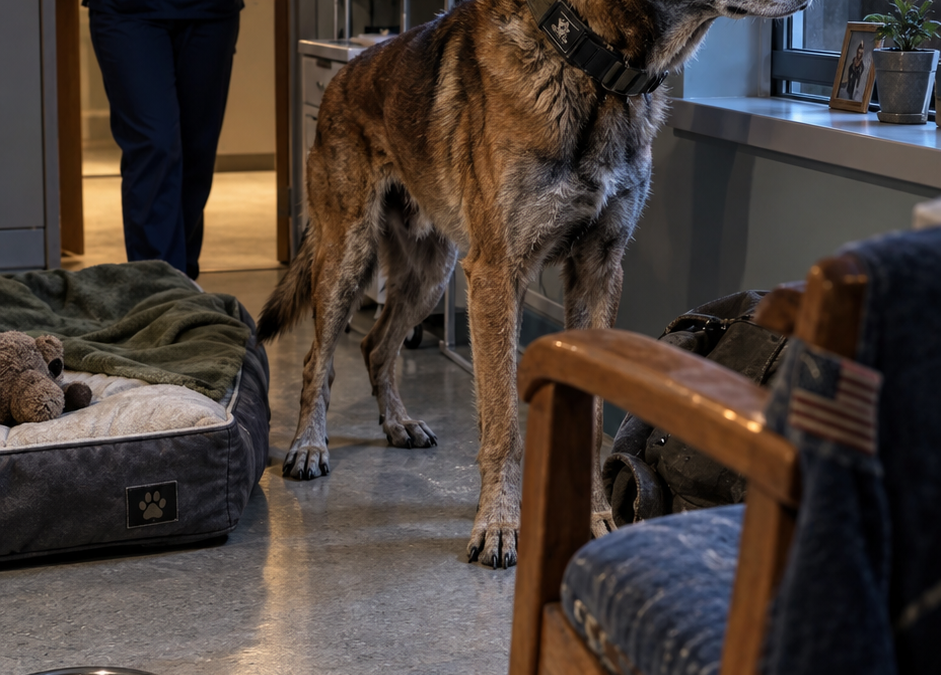
𝗣𝗔𝗥𝗧 𝟮
The room smelled like antiseptic, damp fur, and clean cotton.
Ranger looked at me once.
That was all.
His eyes returned to the chair.
A supply cart rattled somewhere in the corridor.
His ears lifted.
His head turned.
But not toward the sound.
Toward the chair.
Only after checking the empty seat did he look at the doorway.
Then back at the chair.
I went still.
Mark noticed.
“What?”
“Nothing yet.”
“That sounded like something.”
“I’m watching.”
Another set of footsteps passed.
Same sequence.
Chair.
Door.
Chair.
I looked at Mark.
“Has that chair been there the whole time?”
“I think so.”
“You think?”
“I wasn’t here at intake.”
“Did anybody move it?”
“Not that I know of.”
Ranger’s front legs started folding.
I held my breath.
His chest lowered.
His chin nearly reached the floor.
For one second, I thought exhaustion had finally won.
Then a door clicked shut down the hallway.
Ranger’s eyes opened.
His body tightened.
He dragged himself upright.
Chair first.
Door second.
I stared at him.
Then at the chair.
“Don’t move it.”
Mark looked confused.
“The chair?”
“Yes.”
“Why?”
“I don’t know.”
“That is not reassuring.”
“It isn’t supposed to be.”
I stepped backward.
“And don’t let anyone sit there.”
He stared at me.
“Clare.”
“I know.”
“You’re asking me to protect a chair because a sleep-deprived dog keeps looking at it.”
“I’m asking you not to change the environment while I figure out whether the behavior repeats.”
Mark considered that.
Then nodded.
“Fair.”
That was one reason I liked working with him.
He did not need every observation to arrive with a theory attached.
I pulled a small stool toward the wall.
Far from the chair.
Sat.
Ranger watched the movement briefly.
Then looked back at the empty seat.
Rain tapped against the window.
The ventilation system whispered overhead.
Five minutes passed.
Then ten.
Ranger remained standing.
His body swayed once.
I leaned forward automatically.
Stopped myself.
He steadied.
Looked at the chair.
Waited.
Something in my chest tightened.
I had seen people fight sleep before.
Soldiers.
Veterans.
Patients terrified that closing their eyes would return them somewhere they did not want to go.
But Ranger did not look afraid of sleep itself.
He looked responsible.
That distinction would matter later.
At 3:06, his exhaustion stopped being something we could simply observe.
His right hind leg began trembling so hard that one shoulder touched the wall.
I stood.
Ranger corrected himself before I could reach him.
Mark entered with the tablet.
“They called back.”
“What did veterinary say?”
“Repeat vitals.”
He looked at Ranger.
“If the trend worsens, they want to consider additional sedation.”
I understood.
Nobody was being cruel.
Nobody was trying to drug a dog into silence because his behavior was inconvenient.
Three nights without meaningful rest after surgery was dangerous.
There comes a point where observation becomes neglect if you keep watching a patient deteriorate while waiting for a beautiful explanation.
I knew that.
Which was exactly why I needed to be disciplined about what I did next.
Not romantic.
Not sentimental.
Precise.
Mark brought the cuff.
Ranger tolerated the assessment until Mark stepped between him and the chair.
The change was immediate.
Ranger leaned sideways.
Neck extending around Mark’s hip.
Breathing faster.
Trying to see past him.
“Mark.”
“What?”
“Half step left.”
“I need to hold—”
“You still can.”
He shifted left.
The chair returned to Ranger’s line of sight.
Within seconds, the dog’s breathing slowed.
Mark looked at me.
Then at the monitor.
“Okay.”
I said nothing.
“I saw that.”
“Good.”
“That doesn’t tell us why.”
“I know.”
The readings were not catastrophic.
That would have been simpler.
They were just worse.
Heart rate elevated.
Blood pressure drifting.
Temperature acceptable.
Respiratory rate higher than the previous set.
Exactly what you might expect from an exhausted postoperative animal who had been standing for hours.
Mark sent the numbers.
We waited.
The reply came several minutes later.
If unable to settle, prepare for medication adjustment.
I read it twice.
Sedation could make Ranger unconscious.
It could give his body hours of rest.
It might also solve nothing about why he kept forcing himself upright every time the environment changed.
I watched him.
Head low.
Eyes fixed on the chair.
“Call them.”
Mark looked at me.
“You want sedation?”
“I want to ask for time.”
“Clare.”
“One monitored block.”
“Based on what?”
“His behavior changes when he loses sight of that chair.”
“He’s postoperative and sleep deprived. Behavior can mean anything.”
“I know.”
I picked up the phone.
“That’s why I’m not going to tell them what it means.”
The veterinary consultant answered after two rings.
I gave the numbers first.
Heart rate.
Respiration.
Pressure trend.
Pain score estimate.
Food intake.
Hydration.
Then I described the behavior.
No interpretation.
“Repeated sequence after hallway noise. He visually checks the chair before the doorway. When staff block his view of the chair, respiratory rate rises. When line of sight is restored, it decreases.”
The veterinarian was quiet.
I continued.
“I’m asking for a monitored observation period before escalating sedation.”
“How long?”
“Two hours.”
“Clare, he cannot continue like this indefinitely.”
“I agree.”
“If his vital signs deteriorate?”
“We follow your plan.”
“If he becomes unsafe?”
“We call immediately.”
“Pain indicators?”
“Still controlled within current parameters.”
Another pause.
“One block.”
“Thank you.”
“Repeat full set in two hours.”
“Understood.”
I hung up.
Mark leaned against the counter.
“You just volunteered for the worst two hours of your week.”
“I was already here.”
“That isn’t what I meant.”
I gave him a look.
He almost smiled.
Around four, Ranger finally lowered himself.
No command.
No encouragement.
His legs simply folded beneath him.
He lay on the rubber floor beside the chair.
Thirty seconds.
Forty.
One minute.
His breathing lengthened.
His eyelids dropped halfway.
Neither Mark nor I moved.
Then footsteps approached.
Ranger’s eyes opened.
His head lifted.
Chair.
Door.
Back to chair.
He pushed himself up again.
The movement hurt to watch.
His legs had almost nothing left.
Still he stood.
I looked at the transfer folder.
Something had begun bothering me.
Ranger’s room contained almost nothing personal.
No blanket from home.
No toy.
No harness.
Everything was clinical.
Clean.
Neutral.
Animals often arrived with familiar belongings, but postoperative rooms were strict about what stayed inside.
I opened the inventory page.
Harness.
Leash.
Grooming brush.
Two feeding bowls.
One canvas field jacket.
Removed from clinical area at intake.
My finger stopped.
“Mark.”
He leaned over.
“What?”
“Where do personal belongings go?”
“Storage.”
“Downstairs?”
“Yes.”
I closed the folder.
“Cover my rooms ten minutes.”
He looked at the entry.
“You think a jacket explains three nights without sleep?”
“I think we’ve spent three nights asking why he won’t sleep.”
I looked at Ranger.
“I want to know what he thinks he’s still working for.”
The storage room was in the basement.
It smelled like cardboard, cold concrete, and floor wax.
Rows of labeled bins lined metal shelves.
I found Ranger’s in the second aisle.
Harness folded on top.
Leash.
Brush.
A sealed bag containing an old training ball.
Underneath them was the jacket.
Faded canvas.
Dark green.
Worn at the cuffs.
White inventory tag clipped to the collar.
PERSONAL ITEM – REMOVED FROM CLINICAL SPACE.
I stood there longer than I expected.
I did not know whose jacket it was.
That mattered.
It would have been easy to invent a story.
His handler.
A trainer.
An owner.
A familiar person.
Maybe none of those.
Observation becomes dangerous when people begin decorating uncertainty with emotion.
So I checked the property number.
Matched it to Ranger’s transfer documents.
Signed the temporary release.
Picked up the jacket.
Did not search the pockets.
Did not put it on.
Did not smell it.
It was evidence of familiarity.
Not an invitation into somebody else’s history.
When I returned upstairs, Mark waited outside Ranger’s room.
He looked at the jacket.
“That’s it?”
“It transferred with him.”
“You going to put it on the chair?”
“No.”
“Why not?”
“Because I don’t know what either thing means yet.”
I carried the jacket inside at waist level.
Ranger noticed it before I reached the middle of the room.
His ears lifted.
His nose moved.
Once.
Again.
He stared.
Then took one unsteady step.
I stopped.
Lowered the jacket slowly.
Not pushing it toward him.
Letting him decide.
Ranger crossed the remaining distance.
His nose touched the cuff.
He inhaled.
Moved along the sleeve.
Another breath.
And something changed.
Not excitement.
No wagging.
No whining.
His shoulders simply dropped.
The muscles along his back loosened.
His body looked, for the first time that night, like it had remembered another state besides vigilance.
Mark whispered, “Okay.”
I held up one finger.
Ranger lifted his head.
Immediately looked at the chair.
I followed his gaze.
Jacket.
Chair.
Two pieces.
No answer yet.
I placed the jacket on a clean surface several feet from the chair.
Within scent range.
Not on the cushion.
Ranger walked toward it.
Then lowered himself.
No command.
His breathing slowed.
His body rested.
His head remained raised toward the empty seat.
Mark stepped in.
“I’ll update the note.”
“What are you writing?”
“Recognized familiar property.”
“Observed.”
He nodded.
“Settled without prompting.”
“Yes.”
“Continued visual attention to chair.”
“Exactly.”
When veterinary called, I again gave Ranger’s numbers before behavior.
Then described the jacket response.
“You’re not saying it solved the sleep problem?”
“No.”
“Did he sleep?”
“No.”
“Then what changed?”
“He voluntarily lay down.”
“How long?”
“Twelve minutes so far.”
Silence.
“Keep the environment stable.”
“Okay.”
“Continue to hold additional sedation unless parameters worsen.”
“Understood.”
That call mattered.
Not because we had abandoned medicine.
Because the medical plan became more specific.
We were no longer trying to suppress every behavior before understanding what the behavior was attached to.
At 5:02, Ranger had been down for twelve minutes.
Eyes still open.
Mark stood outside the doorway.
“Should we put the jacket on the chair?”
I considered it.
“No.”
“Why?”
“We still don’t know what the chair means.”
He nodded.
A supply cart rolled down the hall.
Mark quietly intercepted it and moved it to the opposite route.
Inside, Ranger’s ears lifted.
His eyes went to the chair.
Then the doorway.
He stayed down.
The jacket had helped.
Not enough for sleep.
Enough for rest.
That difference mattered.
At 5:18, Mark brought me the overnight care sheet.
“You wanted stable environment.”
“Yes.”
“What stays?”
I looked into the room.
“Lights low after morning assessment.”
He wrote.
“One person in at a time.”
Wrote.
“No repeated commands.”
Wrote.
“Don’t move the chair.”
He glanced at me.
Then wrote.
“And the jacket?”
“Leave where it is.”
By then, the staff had begun asking before changing the room.
I had to be careful with that.
Trust can become authority faster than people realize.
I was a nurse.
Not Ranger’s veterinarian.
Not his trainer.
Not his handler.
I could observe.
Protect the environment.
Report patterns.
Advocate for time.
I could not turn my observations into orders outside my role.
So every modification went through the veterinary plan.
Once approved, we implemented it consistently.
A technician replaced Ranger’s water without calling him.
Mark closed the hallway door before moving a noisy cart.
The lights stayed low.
Nobody sat in the chair.
Around six, Ranger rose.
Crossed to his orthopedic bed.
Circled once.
Lay down.
I almost smiled.
Mark appeared.
I raised one hand.
Wait.
Ranger stretched onto his side.
His jaw loosened.
Eyes closing.
Ten seconds.
Twenty.
Morning light began filtering through the blinds.
Then his eyes opened.
Head lifted.
Straight toward the chair.
He did not stand this time.
But sleep was gone.
Mark exhaled.
“We were close.”
“We learned something.”
“What?”
“We can make him comfortable enough to lie down.”
I looked at Ranger.
“That isn’t the same as making him feel finished.”
Emily Hart arrived for day shift.
She was gentle with animals in a way that usually worked.
That morning, it almost became the wrong kind of gentle.
She entered.
Crouched.
Extended a hand.
“Hey, buddy.”
Ranger turned his head away.
Looked at the chair.
Emily moved closer.
I touched her forearm.
“Give him space.”
She stopped.
“I’m trying to reassure him.”
“I know.”
“Is that bad?”
“Just watch.”
A sound came from the corridor.
Ranger’s ears lifted.
Chair.
Door.
Chair.
Emily slowly lowered her hand.
“He isn’t looking for us.”
“No.”
“What is he looking for?”
I glanced at the jacket.
Then the chair.
“I don’t know yet.”
That answer irritated people less now.
Maybe because we had already seen that not knowing could still produce useful care.
Emily stood.
“I’ll tell day shift not to crowd him.”
“Good.”
At handoff, Mark explained the routine.
Emily repeated it to the next technician.
Nobody mentioned intuition.
Nobody said Ranger was grieving.
Nobody said the chair represented anyone.
We simply documented what happened.
By then, Ranger’s exhausted body could rest.
His mind still would not surrender the watch.
The answer came from a line I nearly missed.
I was reviewing his transfer paperwork after breakfast when one sentence caught me.
Evening rest routine maintained with Staff Sergeant Daniel Cole positioned on K9’s left until release command.
I read it again.
Daniel Cole.
Ranger lay on the bed.
Chair to his left.
My heartbeat changed.
“Mark.”
He came over.
I turned the page.
His eyes found the name.
“Handler?”
“Looks like.”
We kept reading.
Cole’s name appeared throughout Ranger’s rehabilitation notes.
Training.
Deployment transition.
Retirement preparation.
Then the last entry.
Three words.
Handler deceased.
I stopped.
No details.
No date beyond the transfer period.
No explanation I needed.
Ranger’s property inventory suddenly looked different.
The jacket.
Cole’s.
The evening routine.
Cole seated on Ranger’s left.
A release command ending the dog’s watch.
The empty chair.
I looked through the doorway.
Ranger stared at it.
Three nights.
Every sound.
Chair first.
Door second.
He had not been checking furniture.
He had been checking a position.
A person had always occupied that position before Ranger was told his responsibility was over for the night.
That person was dead.
Mark read over my shoulder.
“So he’s waiting for the command.”
“Maybe.”
“Can we find it?”
“Probably.”
His finger moved toward the handling section.
“Don’t.”
He stopped.
“I wasn’t going to say it.”
“I know.”
“But if that’s what he’s waiting for…”
He didn’t finish.
I understood.
A command might work.
Years of conditioning.
One word.
Maybe Ranger would lie down.
Maybe he would finally sleep.
The temptation was enormous.
So was the danger of misunderstanding what the word meant.
Ranger had not learned a sound in isolation.
He had learned a sequence.
Cole beside him.
Familiar scent.
Familiar presence.
Then release.
A stranger saying the last word would reproduce the command without the relationship that gave it meaning.
Emily entered with the care sheet.
“Want me to move the chair?”
Her shoe came within inches of the front leg.
Ranger’s head snapped up.
“Stop.”
Emily froze.
“Leave it.”
She stepped back.
Ranger watched until she moved away.
Then lowered his head.
Mark looked at me.
“Nobody sits there.”
“Right.”
Emily frowned.
“Even if sitting there could help him sleep?”
“Yes.”
“Why?”
“Because then we’re pretending somebody came back.”
She went quiet.
“Cole didn’t.”
That was the first time I said his name aloud.
Ranger’s ear moved.
My chest tightened.
I didn’t say it again.
The jacket stayed nearby.
The chair stayed empty.
Nobody borrowed Cole’s place.
Nobody used his release command.
Not yet.
Maybe never.
That decision extended beyond me.
Veterinary.
Behavioral rehabilitation.
Ranger’s transition plan.
Those people had to decide how old commands should be used after a handler’s death.
My job was not to invent a substitute.
It was to keep Ranger medically safe long enough for the right people to make that decision.
Still, the question changed.
For three nights, everyone had asked:
How do we make him sleep?
Now I asked something harder.
Who had the right to tell him his watch was over?
By late morning, veterinary approved continued observation.
Ranger had managed short periods of physical rest.
Vitals were beginning to improve.
Not enough.
But enough to buy time.
Mark found the release command in the routine documentation.
His finger rested near the entry.
“I know the word now.”
I closed the folder.
“Good.”
“You don’t want to know?”
“No.”
He looked surprised.
“Why?”
“Because I don’t need it.”
“But if something happens—”
“That’s not mine to improvise.”
Mark nodded slowly.
Emily stood near the counter.
“So what is ours?”
“The environment.”
I looked at both of them.
“We can own that.”
The next mistake proved why that mattered.
A rehabilitation aide entered with equipment.
Needed space near the window.
He moved the chair maybe six inches.
Ranger was on his feet instantly.
Nails striking the floor.
Body rigid.
Eyes fixed on the moving chair.
“Stop.”
The aide froze.
“I just need—”
“I know.”
I took the chair carefully.
Returned it to the exact position.
Ranger tracked every inch.
When the wooden leg reached the floor marker again, his shoulders lowered.
The aide whispered, “Sorry.”
“You didn’t know.”
I placed a removable marker beneath the rear leg.
“Equipment goes on the other side.”
He nodded.
No blame.
No drama.
We learned.
That afternoon, I returned from rounds and heard Emily briefing another nurse.
“Leave the chair.”
“Why?”
“Because moving it changes Ranger’s behavior.”
“Can I use his old command?”
“Not unless veterinary includes it in the current plan.”
“Can I sit there?”
“No.”
“Why?”
Emily paused.
Then answered exactly right.
“Because it isn’t ours.”
I stayed outside.
She didn’t need me.
That felt good.
Near noon, Ranger tried again.
He lay on his bed.
Head sank slowly onto the blanket.
Eyes closed halfway.
Then opened.
Chair.
Always chair.
I stood in the doorway.
Looked at his bed.
Then the floor between him and the seat.
Then back to the chair.
For days, we had focused on what was missing from the chair.
Cole.
The person.
The command.
The presence Ranger expected.
We had correctly decided not to fill that absence with imitation.
But the bed belonged to Ranger.
The chair did not have to move.
The bed could.
I looked at the locking wheels under its frame.
And felt something settle into place.
Maybe the problem was not that the chair was empty.
Maybe the problem was how far Ranger believed he still had to remain from the position he was guarding.
I did not touch anything immediately.
I checked the care plan.
Called veterinary.
Explained the idea without pretending it was treatment.
“We would leave the chair exactly where it is. Empty. Move only Ranger’s bed closer if medically safe.”
The consultant asked about lines.
None attached.
Mobility restriction.
No issue.
Postoperative positioning.
The bed could be moved.
“Try it.”
That was all.
I found Mark.
“Need help.”
“With?”
“The bed.”
He followed me.
Inside, Ranger lay awake.
Head raised.
Chair across the rubber floor.
We checked the brakes.
Cleared the path.
Made sure nothing would shift beneath Ranger dangerously.
Mark moved toward the foot of the bed.
“Wait.”
I crouched.
Not close to Ranger.
Just visible.
I gave him time to register us.
No command.
No touch.
When his breathing settled, I stood.
Released the first lock.
Click.
Ranger’s ears moved.
Second.
Click.
Third.
Fourth.
His head lifted.
I put my hands on the frame.
Mark steadied the opposite side.
We moved slowly.
The wheels whispered across rubber.
Ranger stayed on the mattress.
Watching.
Chair closer.
Six feet.
Five.
Four.
His nose moved.
Three.
Two.
I slowed.
Stopped with the bed beside the chair.
Close enough that Ranger could reach the scratched wooden leg without leaving the blanket.
Locked the wheels.
Four quiet clicks.
Nobody spoke.
Sunlight rested across the faded cushion.
Cole’s jacket remained on the clean surface nearby.
Ranger stared at the chair.
Five seconds.
Ten.
Nothing.
My heart sank.
Then Ranger shifted.
Slowly.
Dragged himself closer to the mattress edge.
Extended his neck.
His nose touched the wooden arm.
He breathed.
Once.
Again.
Then lowered his muzzle against the scratched chair leg.
I stepped back.
That was all I had changed.
Distance.
Not meaning.
Not history.
Not the chair.
Not the absence.
Just distance.
Ranger inhaled.
His shoulders dropped.
The rigid line through his neck softened.
His front paws stretched forward instead of bracing beneath him.
Mark moved toward the observation sheet.
I shook my head.
Not yet.
Emily appeared at the doorway.
Stopped.
Ranger’s nose lifted once.
Toward Cole’s jacket.
Then back to the chair.
His eyelids lowered.
A cart rolled far down the corridor.
Ranger’s ears flicked.
For three nights, that sound had brought him upright.
This time, his head barely moved.
He checked the chair.
Still there.
Still empty.
Then he exhaled.
His eyes closed.
Fully.
I stopped breathing for a second.
Thirty seconds.
One minute.
Two.
Ranger’s jaw loosened against the wooden leg.
The tremor in his hind leg stopped.
His breathing changed.
Not exhaustion.
Sleep.
Real sleep.
Deepening.
Slow.
Even.
Mark’s eyes filled.
He looked away.
Emily backed into the hall and pulled the corridor door almost closed.
No celebration.
No whisper of we did it.
Nobody touched Ranger.
The moment belonged to him.
We began protecting the sleep we had spent three nights trying to force.
Mark finally wrote:
Bed positioned adjacent to familiar chair. Patient settled spontaneously. Sleep onset observed without additional medication.
Then:
Do not disturb unless medically necessary.
I read it.
Nodded.
Sat on the stool several feet away.
Ranger’s chest rose.
Fell.
Rose.
Fell.
The chair remained empty.
That was what broke me.
Not visibly.
I did not cry.
But something inside me gave way.
Because Daniel Cole was still gone.
We had not solved grief.
We had not fooled Ranger.
We had not recreated his handler.
We had simply stopped demanding that the dog keep watch from across the room.
He could rest beside the place where Cole belonged without pretending Cole had returned.
There was something unbearably human about that.
Ranger slept almost two hours.
The whole wing adjusted around him.
Emily stopped carts.
Mark moved assessments.
Veterinary postponed nonessential handling.
Nobody woke him for convenience.
When he finally stirred, it happened slowly.
Eyes opening.
Muzzle lifting from beside the chair leg.
He looked at the seat.
Then toward the jacket.
Caught the scent.
Stayed down.
Mark checked the monitor from a distance.
“Numbers are better.”
“Send them.”
“Already did.”
That was another good sign.
People had stopped waiting for me to make every decision.
A rehabilitation aide appeared.
“Do we postpone?”
“Ask veterinary.”
He nodded.
No one treated me like Ranger’s new authority.
I wanted that.
When veterinary approved a later rehab session, Emily updated the whiteboard.
She erased:
RESTLESS OVERNIGHT
and wrote:
PROTECT SLEEP. MINIMIZE NONESSENTIAL DISTURBANCE.
I noticed.
“That’s better.”
She capped the marker.
“More accurate.”
By afternoon, Ranger woke fully.
He stretched.
Front leg.
Other.
Yawned.
The chair remained beside him.
He no longer stared at it.
That was the first real change.
Mark entered with water.
Stopped several feet away.
For a second, he looked toward me.
Then caught himself.
Looked at Ranger.
Waited.
Ranger’s ears remained relaxed.
Mark moved in.
Changed the water.
Left.
I smiled.
Not because he had learned to obey me.
Because he had learned to observe.
That evening, Emily found me charting.
“Night shift asked what happens if Ranger starts standing again.”
“Observe first.”
“And if he stays restless?”
“Protect the environment.”
“If the medical status worsens?”
“Call veterinary.”
“And the chair?”
“Leave it unless Ranger gives them a reason to change something.”
Emily nodded.
“I’ll tell them.”
“Show them.”
That mattered more.
Instructions decay when people pass them as rules.
Understanding transfers better when people see why.
At handoff, Emily walked the incoming team through everything.
Chair marker.
Bed position.
Jacket.
Quiet equipment route.
No casual use of legacy commands.
One person at a time.
Observe before intervening.
She never mentioned my name.
Good.
The method belonged to Ranger’s care now.
Not to me.
When I returned to his room later, afternoon light stretched across the floor.
Ranger was awake.
Calm.
Resting beside the chair.
I stayed outside.
For the first time since I had noticed his fixation, I did not need to sit on the stool.
Did not need to protect the silence personally.
The team knew how.
Three mornings later, I came in early.
Ranger was awake.
Sunlight across the room.
The bed still beside the chair.
Cole’s canvas jacket on the clean shelf nearby.
The chair empty.
Always empty.
Ranger looked at me.
Ears lifted once.
Then he looked toward the hallway.
Emily stood there with his rehabilitation leash.
She entered slowly.
Stopped several feet away.
“Morning, Ranger.”
Nothing more.
No coaxing.
No baby voice.
Ranger watched her.
Then stood.
Walked toward her.
She clipped the leash.
Mark approached with the chart.
“Cleared for full hall walk.”
“Good.”
He looked toward me.
“Anything you want changed?”
I didn’t take the chart.
“What did Emily observe?”
Mark paused.
Then looked at her.
“How’s he moving?”
Emily watched Ranger take several steps.
“Stiff initially. Better once moving.”
“Any left-side hesitation?”
“No.”
Mark wrote.
I said nothing.
That was better.
Emily opened the door.
Ranger stepped into the corridor.
Slow.
Steady.
Leash loose.
At the corner, he stopped.
Turned his head.
Back toward the room.
Through the doorway, he could see the faded blue cushion.
Cole’s jacket.
The place he had watched for three sleepless nights.
My fingers tightened around the counter.
I did not call him.
Emily waited.
No command.
No one took Cole’s place.
Ranger stood there.
Looked at the chair.
Then turned forward.
And walked.
That was the moment I knew something had truly changed.
Not because he forgot.
Because he remembered and still moved.
Emily followed him around the corner.
Mark closed the chart.
“He didn’t need the command.”
“No.”
The shift continued.
Medication.
Calls.
Linens.
Documentation.
Ordinary work.
Nobody gathered around Ranger’s room.
Nobody turned his progress into a ceremony.
When he returned from rehab, I was helping another patient.
Emily brought him inside.
Unclipped the leash.
Waited.
Ranger drank.
Crossed to his bed.
Lay down beside the chair.
By the time I returned, he was asleep.
No muzzle against the wooden leg.
A small space between him and the chair.
That space moved me more than the sleep itself.
He had needed contact before.
Now proximity was enough.
Maybe someday proximity would no longer be necessary either.
We did not rush that.
Veterinary kept the arrangement.
Behavioral staff reviewed his old routines.
They eventually decided not to use Cole’s release command casually.
It remained documented.
Available if clinically appropriate.
But not turned into a trick for staff.
The chair stayed through the recovery period.
The jacket too.
Ranger gradually began sleeping even when the bed was moved a few inches farther away for cleaning.
Then a foot.
Then two.
Nothing dramatic.
No one tested him for the sake of proving progress.
We changed only what care required.
He showed us what he could tolerate.
A week later, I came in and found the chair moved six inches for floor maintenance.
My stomach tightened.
Then I saw Ranger.
Still asleep.
I looked at Mark.
He whispered, “He watched them move it.”
“And?”
“Stayed down.”
I smiled.
“Good.”
The next day, it moved back.
Not because Ranger demanded it.
Because there was no reason to change everything at once.
Progress is not the same as erasing what helped.
That lesson followed me outside the K9 wing too.
I had spent my first year in nursing believing competent care meant solving every problem quickly.
Identify issue.
Intervene.
Reassess.
Move forward.
Ranger taught me that sometimes the most important intervention is refusing to fill a silence too quickly.
An empty chair is not automatically a problem.
Sometimes the distance to it is.
Sometimes the memory attached to it is.
Sometimes the patient has to decide when the absence becomes survivable.
Two weeks later, Ranger transferred out of the postoperative wing.
The morning he left, I was off duty.
I came in anyway.
I told myself I needed to return a borrowed chart binder.
Mark did not believe me.
Neither did Emily.
Ranger wore his old harness.
Not the full working configuration.
Just enough of it for familiarity.
The canvas jacket had been packed into his transfer belongings.
The chair remained in the room.
He stood near the doorway.
Looked stronger.
Still old.
Still recovering.
But his legs no longer shook.
A rehabilitation specialist held the leash.
“Ready?”
Ranger looked back.
At the chair.
I felt my chest tighten.
He stared for several seconds.
Then walked toward it.
Sniffed the arm.
The scratch along the leg.
The cushion.
He stood still.
Nobody moved.
Nobody called him.
Nobody said Cole’s command.
Ranger lowered his nose one last time.
Then turned.
Walked back to the doorway.
The specialist stepped into the hall.
Ranger followed.
No hesitation.
I remained beside the nurse’s station.
He passed me.
Stopped.
Looked up.
I crouched slightly.
Not touching.
“Take care of yourself, old man.”
Ranger sniffed my hand.
Once.
Then kept walking.
He did not look back again.
After he left, Room 4 felt strangely large.
The chair remained beside the bed.
The bed was empty.
Mark entered.
“You moving it?”
I looked at the chair.
“Yes.”
He smiled.
“Finally.”
We moved the bed first.
Back to its original position.
Then I lifted the chair.
For a second, my hands stayed on the wooden arms.
The cushion was warm from the sunlight.
The scratch along the leg shallow.
Nothing remarkable.
An ordinary institutional chair.
I thought about Daniel Cole.
A man I had never met.
A man I knew almost nothing about.
Only that he had spent years beside Ranger.
That he had sat to the dog’s left at night.
That at some point, after the work was done, he gave a command that told Ranger he no longer had to guard the world.
Then he died.
And Ranger spent three nights in a strange room waiting for someone to tell him his watch was over.
I carried the chair back to the wall.
Not like a relic.
Just furniture again.
That felt right.
Months passed.
Ranger moved into a long-term veteran K9 transition program.
He slept normally.
Completed rehabilitation.
No additional sedation had been required after that night, though veterinary staff remained clear that medication would have been appropriate if his health had demanded it.
I appreciated that distinction.
The story was not that sedation had been wrong.
The story was that we had found another piece of the problem before we needed to escalate.
Medical judgment and behavioral understanding had worked together.
Not competed.
Mark eventually transferred to another unit.
Emily stayed.
I remained at Fort Mercer.
New dogs arrived.
Different problems.
A Labrador terrified of metal bowls after a blast injury.
A German shepherd who refused ramps unless somebody walked backward in front of him.
A retired patrol dog who would not settle if his harness hung where he could see it.
Every case was different.
I tried not to turn Ranger into a universal lesson.
That would have been another form of guessing.
But his room changed how I asked questions.
When something seemed irrational, I stopped asking first:
How do we stop this?
I started asking:
What is the sequence?
What happens immediately before?
What changes after?
What does the patient keep checking?
What are we moving that we do not realize matters?
What part belongs to medicine?
What part belongs to memory?
And what part belongs to us simply having the humility to wait?
Nearly a year after Ranger left, I received a photograph.
No note.
Just a photograph from the transition program.
Ranger lying on a blanket near a large window.
Gray around his muzzle.
Eyes closed.
Beside him was a canvas jacket.
Folded.
No chair.
I stared at that photograph for a long time.
Then turned it over.
Someone had written one sentence.
He chooses the jacket now. Sleeps anywhere.
I kept the photograph inside my locker.
Not on display.
Some stories feel smaller when turned into decoration.
A few months later, I met the man who had known Daniel Cole.
His name was Marcus Hale.
Former handler.
Retired staff sergeant.
He came to Fort Mercer for another dog’s transition meeting.
We were talking at the nurse’s station when he noticed Ranger’s photograph inside my open locker.
He stopped.
“Where did you get that?”
“You know him?”
He looked at me.
“Ranger?”
“Yes.”
He smiled sadly.
“Everybody in our unit knew Ranger.”
“And Cole?”
The smile disappeared.
“Danny.”
That was the first time I heard anyone call him that.
“He was my team leader.”
I hesitated.
“I’m sorry.”
Hale looked at the photograph.
“He died before Ranger’s final placement.”
“I know.”
“How did Ranger do here?”
I could have told the story dramatically.
Three nights.
No sleep.
Sedation considered.
Empty chair.
Instead, I told him plainly.
“He had trouble settling.”
Hale nodded immediately.
“Night watch.”
I looked at him.
“You know?”
“Danny had a routine.”
“Sit on his left?”
Hale’s eyes sharpened.
“Yes.”
My heartbeat changed.
“Why?”
“He started it after Ranger’s second deployment.”
Hale rested both hands on the counter.
“The dog wouldn’t shut off after missions. Cole would sit next to him until he stopped scanning.”
“And the release command?”
Hale nodded.
“Every night.”
I looked down.
“We found the routine in his records.”
“Did you use it?”
“No.”
Hale looked surprised.
“Why not?”
“Because Cole wasn’t there.”
For several seconds, Hale said nothing.
Then his eyes filled.
He looked away.
“That sounds like something Danny would’ve appreciated.”
I swallowed.
“We moved Ranger’s bed beside an empty chair.”
Hale laughed once through his nose.
“Of course you did.”
“You expected that?”
“No.”
He looked at the photo again.
“But I understand it.”
“What was the chair?”
“Anything.”
I frowned.
“Anything?”
Hale nodded.
“Danny sat wherever Ranger could see him. Folding chair. Ammo crate. Floor.”
He looked toward the window.
“It wasn’t furniture.”
That confirmed what I had eventually understood.
“It was position.”
“It was him.”
Hale’s voice cracked slightly.
Then:
“Ranger always slept after Danny sat down.”
I leaned against the counter.
“Why?”
Hale smiled sadly.
“Because if Danny was sitting, Ranger knew everybody was home.”
That sentence stayed with me.
Everybody was home.
For three nights at Fort Mercer, Ranger had been waiting for home to become complete.
It never would.
We could not give him that.
What we gave him instead was permission to rest beside the empty place without pretending it wasn’t empty.
Hale asked if he could have a copy of the photograph.
I printed one.
Before leaving, he looked at me.
“Thank you.”
I shook my head.
“We didn’t do anything extraordinary.”
“You let him miss somebody.”
I went still.
Hale continued.
“People get uncomfortable with grief when it lasts longer than they expect.”
He looked at Ranger’s picture.
“They start trying to replace things.”
I thought of the chair.
The command.
The temptation to sit where Cole had sat.
“You didn’t.”
“No.”
“That’s something.”
After he left, I sat at the nurse’s station for several minutes.
You let him miss somebody.
Maybe that was the part I had never put into words.
We had spent so much energy asking how to make Ranger sleep that we almost treated his loyalty like pathology.
His body needed intervention.
Absolutely.
His grief did not need to be corrected.
It needed room.
Those two truths could exist at the same time.
That became the part of his story I carried forward.
Years later, I trained new nurses at Fort Mercer.
I never gave them Ranger’s case as a sentimental legend.
I used it as a clinical exercise.
Postoperative dog.
Three nights minimal sleep.
Vitals trending.
Sedation under consideration.
Repetitive environmental fixation.
What do you do?
Some said medicate.
Some said remove the object.
Some said bring in a handler.
Some wanted to use the old command.
I never told them immediately what happened.
I asked:
“What do you know?”
Then:
“What are you assuming?”
Then:
“What can you safely change without pretending you understand more than you do?”
Those questions mattered.
Eventually, I would tell them about the empty chair.
The jacket.
Daniel Cole.
The bed wheels.
The sleep.
But I always ended with the same point.
Ranger did not prove that intuition is better than medicine.
He proved that observation improves medicine when we are disciplined enough not to confuse observation with certainty.
The veterinary team protected his body.
The nursing team protected the environment.
Ranger showed us what mattered by what he did.
Nobody had to become everything.
Nobody had to replace Cole.
That was why it worked.
The last time I saw Ranger was nearly two years after his surgery.
The transition program held a memorial event for retired working dogs.
He came with his foster family.
Older.
Much grayer.
Slow in the hips.
Still unmistakably Ranger.
I was standing near the back when he entered.
For a moment, I wondered whether he would remember me.
He walked past two people.
Stopped.
Looked up.
I crouched.
“Hey, old man.”
His ears lifted.
He sniffed my hand.
Then moved closer.
Not dramatically.
No jumping.
No whining.
He simply stood beside me.
I scratched the side of his neck.
His foster handler smiled.
“He does that when he remembers somebody.”
“I’m not sure I did enough to be remembered.”
The handler looked at me.
“He sleeps twelve hours now.”
I laughed.
“That much?”
“He’s retired.”
“Fair.”
The man continued.
“Still likes something on his left side.”
“What?”
“Usually the jacket.”
My chest tightened.
“Sometimes a wall.”
He looked down at Ranger.
“Doesn’t need it every night anymore.”
That mattered.
Ranger leaned briefly against my leg.
Then moved toward the grass.
A few minutes later, he lay beneath a tree.
No chair.
No jacket.
Just sunlight.
He closed his eyes.
People moved around him.
Voices.
Footsteps.
Doors.
Life.
Ranger slept.
I stood there longer than necessary.
Thinking about that first night.
His trembling legs.
The chair across the room.
The temptation to sedate before we understood the pattern.
The temptation to fill the empty seat.
The moment his bed finally reached the chair.
The first deep breath.
Daniel Cole was still gone.
Nothing we ever did changed that.
Ranger had not needed us to erase the absence.
He needed us to stop making him guard it from across the room.
That difference became the clearest thing I ever learned from him.
Sometimes healing is not replacing what is missing.
Sometimes it is bringing the place of rest close enough to the loss that a tired body no longer has to stand between them.
And sometimes the kindest thing you can do for someone who has kept watch too long is not tell them to forget.
It is stay quiet, protect the room, and let them discover for themselves that they are finally allowed to sleep.
Have you finished reading the story and want to read it again?
The Empty Chair Beside Ranger’s Bed Was the One Thing No One Dared to Touch
For three nights, Ranger refused to sleep even when his legs could barely hold him.
Every sound in the hallway made him look toward the same empty chair before he checked the door.
By the time the veterinarian mentioned stronger sedation, I had begun to wonder what the old military dog believed he was still waiting for.
My name is Clare Bennett, and at 2:17 in the morning, Fort Mercer Veterans Recovery Center was quiet enough for me to hear Ranger breathing from halfway down the corridor.
Fort Mercer was primarily a rehabilitation facility for wounded and retired service members, but one wing had been converted years earlier for retired military working dogs whose medical needs were too complicated for an ordinary boarding facility.
It was small.
Eight recovery rooms.
A veterinary treatment suite.
A rehabilitation space with rubber flooring, low ramps, harness systems, and enough specialized equipment to make the place look more like a physical therapy clinic than a kennel.
The dogs who came through that wing had spent years doing things most civilian pets would never be asked to understand.
Explosive detection.
Search.
Patrol.
Tracking.
Medical support.
Some retired into families.
Some stayed with former handlers.
Others arrived at Fort Mercer because age, injury, or circumstance had made their transition harder.
Ranger belonged to the last group.
Eleven-year-old Belgian Malinois.
Retired.
Postoperative day four after surgery to repair damage around an old service injury.
He should have been sleeping more than almost any patient on the wing.
Instead, he had barely slept at all.
Twenty minutes here.
Seven minutes there.
A short collapse into exhaustion before some sound pulled him upright again.
Three nights.
By the time I reached his doorway that morning, his body looked like it had forgotten what rest was.
Ranger stood near the window.
His bed was against the opposite wall.
Clean blanket.
Orthopedic mattress.
Water within reach.
Nothing obviously wrong with the room.
Except the dog.
His shoulders sagged.
His eyes were red around the edges.
His hind legs trembled continuously.
And he was staring at a chair.
Just a chair.
Wooden arms.
Blue cushion faded from years of use.
One scratch running down the right front leg.
It sat a few feet from the window, angled slightly toward Ranger’s bed.
Nobody sat in it.
Nobody had since the dog arrived.
Ranger watched it as though the empty seat contained information the rest of us could not see.
His rear legs buckled.
I moved automatically.
“Ranger—”
He caught himself before I reached him.
His chest dipped almost to the floor.
Then he pushed himself upright.
Slowly.
Painfully.
The first thing he did was look at the chair.
Not me.
Not the doorway.
The chair.
Mark Ellis stood at the counter outside the room holding Ranger’s chart.
Mark was another overnight nurse, ten years older than I was and considerably better at remembering when he had last eaten.
I kept watching Ranger.
“Still nothing?”
Mark lowered his voice.
“Maybe twenty minutes total since yesterday morning.”
“Twenty?”
“Could be less.”
Ranger shifted his weight.
His nails made a faint scraping sound against the rubber floor.
Mark sighed.
“He lies down. Something moves in the hall, somebody closes a door, somebody laughs at the station. He gets right back up.”
“What does veterinary say?”
“They’re worried.”
“So am I.”
“Pain medication is already adjusted.”
I nodded.
That had been done during the previous shift.
“Vitals?”
“Not terrible yet.”
The word yet mattered.
Four days after surgery, rest was not optional.
Healing required sleep.
Pain tolerance deteriorated without it.
Stress hormones climbed.
Appetite suffered.
Heart rate changed.
Immune recovery slowed.
An old dog could deteriorate quickly once exhaustion started feeding every other problem.
The veterinary team had already reduced unnecessary stimulation.
Lights lower overnight.
No loud carts past the room.
One staff member entering at a time.
Pain control reviewed.
Food timing adjusted.
Nothing worked.
I stepped inside.
Not directly toward Ranger.
I moved along the wall and stopped several feet away.
The room smelled like antiseptic, damp fur, and clean cotton.
Ranger looked at me once.
That was all.
His eyes returned to the chair.
A supply cart rattled somewhere in the corridor.
His ears lifted.
His head turned.
But not toward the sound.
Toward the chair.
Only after checking the empty seat did he look at the doorway.
Then back at the chair.
I went still.
Mark noticed.
“What?”
“Nothing yet.”
“That sounded like something.”
“I’m watching.”
Another set of footsteps passed.
Same sequence.
Chair.
Door.
Chair.
I looked at Mark.
“Has that chair been there the whole time?”
“I think so.”
“You think?”
“I wasn’t here at intake.”
“Did anybody move it?”
“Not that I know of.”
Ranger’s front legs started folding.
I held my breath.
His chest lowered.
His chin nearly reached the floor.
For one second, I thought exhaustion had finally won.
Then a door clicked shut down the hallway.
Ranger’s eyes opened.
His body tightened.
He dragged himself upright.
Chair first.
Door second.
I stared at him.
Then at the chair.
“Don’t move it.”
Mark looked confused.
“The chair?”
“Yes.”
“Why?”
“I don’t know.”
“That is not reassuring.”
“It isn’t supposed to be.”
I stepped backward.
“And don’t let anyone sit there.”
He stared at me.
“Clare.”
“I know.”
“You’re asking me to protect a chair because a sleep-deprived dog keeps looking at it.”
“I’m asking you not to change the environment while I figure out whether the behavior repeats.”
Mark considered that.
Then nodded.
“Fair.”
That was one reason I liked working with him.
He did not need every observation to arrive with a theory attached.
I pulled a small stool toward the wall.
Far from the chair.
Sat.
Ranger watched the movement briefly.
Then looked back at the empty seat.
Rain tapped against the window.
The ventilation system whispered overhead.
Five minutes passed.
Then ten.
Ranger remained standing.
His body swayed once.
I leaned forward automatically.
Stopped myself.
He steadied.
Looked at the chair.
Waited.
Something in my chest tightened.
I had seen people fight sleep before.
Soldiers.
Veterans.
Patients terrified that closing their eyes would return them somewhere they did not want to go.
But Ranger did not look afraid of sleep itself.
He looked responsible.
That distinction would matter later.
At 3:06, his exhaustion stopped being something we could simply observe.
His right hind leg began trembling so hard that one shoulder touched the wall.
I stood.
Ranger corrected himself before I could reach him.
Mark entered with the tablet.
“They called back.”
“What did veterinary say?”
“Repeat vitals.”
He looked at Ranger.
“If the trend worsens, they want to consider additional sedation.”
I understood.
Nobody was being cruel.
Nobody was trying to drug a dog into silence because his behavior was inconvenient.
Three nights without meaningful rest after surgery was dangerous.
There comes a point where observation becomes neglect if you keep watching a patient deteriorate while waiting for a beautiful explanation.
I knew that.
Which was exactly why I needed to be disciplined about what I did next.
Not romantic.
Not sentimental.
Precise.
Mark brought the cuff.
Ranger tolerated the assessment until Mark stepped between him and the chair.
The change was immediate.
Ranger leaned sideways.
Neck extending around Mark’s hip.
Breathing faster.
Trying to see past him.
“Mark.”
“What?”
“Half step left.”
“I need to hold—”
“You still can.”
He shifted left.
The chair returned to Ranger’s line of sight.
Within seconds, the dog’s breathing slowed.
Mark looked at me.
Then at the monitor.
“Okay.”
I said nothing.
“I saw that.”
“Good.”
“That doesn’t tell us why.”
“I know.”
The readings were not catastrophic.
That would have been simpler.
They were just worse.
Heart rate elevated.
Blood pressure drifting.
Temperature acceptable.
Respiratory rate higher than the previous set.
Exactly what you might expect from an exhausted postoperative animal who had been standing for hours.
Mark sent the numbers.
We waited.
The reply came several minutes later.
If unable to settle, prepare for medication adjustment.
I read it twice.
Sedation could make Ranger unconscious.
It could give his body hours of rest.
It might also solve nothing about why he kept forcing himself upright every time the environment changed.
I watched him.
Head low.
Eyes fixed on the chair.
“Call them.”
Mark looked at me.
“You want sedation?”
“I want to ask for time.”
“Clare.”
“One monitored block.”
“Based on what?”
“His behavior changes when he loses sight of that chair.”
“He’s postoperative and sleep deprived. Behavior can mean anything.”
“I know.”
I picked up the phone.
“That’s why I’m not going to tell them what it means.”
The veterinary consultant answered after two rings.
I gave the numbers first.
Heart rate.
Respiration.
Pressure trend.
Pain score estimate.
Food intake.
Hydration.
Then I described the behavior.
No interpretation.
“Repeated sequence after hallway noise. He visually checks the chair before the doorway. When staff block his view of the chair, respiratory rate rises. When line of sight is restored, it decreases.”
The veterinarian was quiet.
I continued.
“I’m asking for a monitored observation period before escalating sedation.”
“How long?”
“Two hours.”
“Clare, he cannot continue like this indefinitely.”
“I agree.”
“If his vital signs deteriorate?”
“We follow your plan.”
“If he becomes unsafe?”
“We call immediately.”
“Pain indicators?”
“Still controlled within current parameters.”
Another pause.
“One block.”
“Thank you.”
“Repeat full set in two hours.”
“Understood.”
I hung up.
Mark leaned against the counter.
“You just volunteered for the worst two hours of your week.”
“I was already here.”
“That isn’t what I meant.”
I gave him a look.
He almost smiled.
Around four, Ranger finally lowered himself.
No command.
No encouragement.
His legs simply folded beneath him.
He lay on the rubber floor beside the chair.
Thirty seconds.
Forty.
One minute.
His breathing lengthened.
His eyelids dropped halfway.
Neither Mark nor I moved.
Then footsteps approached.
Ranger’s eyes opened.
His head lifted.
Chair.
Door.
Back to chair.
He pushed himself up again.
The movement hurt to watch.
His legs had almost nothing left.
Still he stood.
I looked at the transfer folder.
Something had begun bothering me.
Ranger’s room contained almost nothing personal.
No blanket from home.
No toy.
No harness.
Everything was clinical.
Clean.
Neutral.
Animals often arrived with familiar belongings, but postoperative rooms were strict about what stayed inside.
I opened the inventory page.
Harness.
Leash.
Grooming brush.
Two feeding bowls.
One canvas field jacket.
Removed from clinical area at intake.
My finger stopped.
“Mark.”
He leaned over.
“What?”
“Where do personal belongings go?”
“Storage.”
“Downstairs?”
“Yes.”
I closed the folder.
“Cover my rooms ten minutes.”
He looked at the entry.
“You think a jacket explains three nights without sleep?”
“I think we’ve spent three nights asking why he won’t sleep.”
I looked at Ranger.
“I want to know what he thinks he’s still working for.”
The storage room was in the basement.
It smelled like cardboard, cold concrete, and floor wax.
Rows of labeled bins lined metal shelves.
I found Ranger’s in the second aisle.
Harness folded on top.
Leash.
Brush.
A sealed bag containing an old training ball.
Underneath them was the jacket.
Faded canvas.
Dark green.
Worn at the cuffs.
White inventory tag clipped to the collar.
PERSONAL ITEM – REMOVED FROM CLINICAL SPACE.
I stood there longer than I expected.
I did not know whose jacket it was.
That mattered.
It would have been easy to invent a story.
His handler.
A trainer.
An owner.
A familiar person.
Maybe none of those.
Observation becomes dangerous when people begin decorating uncertainty with emotion.
So I checked the property number.
Matched it to Ranger’s transfer documents.
Signed the temporary release.
Picked up the jacket.
Did not search the pockets.
Did not put it on.
Did not smell it.
It was evidence of familiarity.
Not an invitation into somebody else’s history.
When I returned upstairs, Mark waited outside Ranger’s room.
He looked at the jacket.
“That’s it?”
“It transferred with him.”
“You going to put it on the chair?”
“No.”
“Why not?”
“Because I don’t know what either thing means yet.”
I carried the jacket inside at waist level.
Ranger noticed it before I reached the middle of the room.
His ears lifted.
His nose moved.
Once.
Again.
He stared.
Then took one unsteady step.
I stopped.
Lowered the jacket slowly.
Not pushing it toward him.
Letting him decide.
Ranger crossed the remaining distance.
His nose touched the cuff.
He inhaled.
Moved along the sleeve.
Another breath.
And something changed.
Not excitement.
No wagging.
No whining.
His shoulders simply dropped.
The muscles along his back loosened.
His body looked, for the first time that night, like it had remembered another state besides vigilance.
Mark whispered, “Okay.”
I held up one finger.
Ranger lifted his head.
Immediately looked at the chair.
I followed his gaze.
Jacket.
Chair.
Two pieces.
No answer yet.
I placed the jacket on a clean surface several feet from the chair.
Within scent range.
Not on the cushion.
Ranger walked toward it.
Then lowered himself.
No command.
His breathing slowed.
His body rested.
His head remained raised toward the empty seat.
Mark stepped in.
“I’ll update the note.”
“What are you writing?”
“Recognized familiar property.”
“Observed.”
He nodded.
“Settled without prompting.”
“Yes.”
“Continued visual attention to chair.”
“Exactly.”
When veterinary called, I again gave Ranger’s numbers before behavior.
Then described the jacket response.
“You’re not saying it solved the sleep problem?”
“No.”
“Did he sleep?”
“No.”
“Then what changed?”
“He voluntarily lay down.”
“How long?”
“Twelve minutes so far.”
Silence.
“Keep the environment stable.”
“Okay.”
“Continue to hold additional sedation unless parameters worsen.”
“Understood.”
That call mattered.
Not because we had abandoned medicine.
Because the medical plan became more specific.
We were no longer trying to suppress every behavior before understanding what the behavior was attached to.
At 5:02, Ranger had been down for twelve minutes.
Eyes still open.
Mark stood outside the doorway.
“Should we put the jacket on the chair?”
I considered it.
“No.”
“Why?”
“We still don’t know what the chair means.”
He nodded.
A supply cart rolled down the hall.
Mark quietly intercepted it and moved it to the opposite route.
Inside, Ranger’s ears lifted.
His eyes went to the chair.
Then the doorway.
He stayed down.
The jacket had helped.
Not enough for sleep.
Enough for rest.
That difference mattered.
At 5:18, Mark brought me the overnight care sheet.
“You wanted stable environment.”
“Yes.”
“What stays?”
I looked into the room.
“Lights low after morning assessment.”
He wrote.
“One person in at a time.”
Wrote.
“No repeated commands.”
Wrote.
“Don’t move the chair.”
He glanced at me.
Then wrote.
“And the jacket?”
“Leave where it is.”
By then, the staff had begun asking before changing the room.
I had to be careful with that.
Trust can become authority faster than people realize.
I was a nurse.
Not Ranger’s veterinarian.
Not his trainer.
Not his handler.
I could observe.
Protect the environment.
Report patterns.
Advocate for time.
I could not turn my observations into orders outside my role.
So every modification went through the veterinary plan.
Once approved, we implemented it consistently.
A technician replaced Ranger’s water without calling him.
Mark closed the hallway door before moving a noisy cart.
The lights stayed low.
Nobody sat in the chair.
Around six, Ranger rose.
Crossed to his orthopedic bed.
Circled once.
Lay down.
I almost smiled.
Mark appeared.
I raised one hand.
Wait.
Ranger stretched onto his side.
His jaw loosened.
Eyes closing.
Ten seconds.
Twenty.
Morning light began filtering through the blinds.
Then his eyes opened.
Head lifted.
Straight toward the chair.
He did not stand this time.
But sleep was gone.
Mark exhaled.
“We were close.”
“We learned something.”
“What?”
“We can make him comfortable enough to lie down.”
I looked at Ranger.
“That isn’t the same as making him feel finished.”
Emily Hart arrived for day shift.
She was gentle with animals in a way that usually worked.
That morning, it almost became the wrong kind of gentle.
She entered.
Crouched.
Extended a hand.
“Hey, buddy.”
Ranger turned his head away.
Looked at the chair.
Emily moved closer.
I touched her forearm.
“Give him space.”
She stopped.
“I’m trying to reassure him.”
“I know.”
“Is that bad?”
“Just watch.”
A sound came from the corridor.
Ranger’s ears lifted.
Chair.
Door.
Chair.
Emily slowly lowered her hand.
“He isn’t looking for us.”
“No.”
“What is he looking for?”
I glanced at the jacket.
Then the chair.
“I don’t know yet.”
That answer irritated people less now.
Maybe because we had already seen that not knowing could still produce useful care.
Emily stood.
“I’ll tell day shift not to crowd him.”
“Good.”
At handoff, Mark explained the routine.
Emily repeated it to the next technician.
Nobody mentioned intuition.
Nobody said Ranger was grieving.
Nobody said the chair represented anyone.
We simply documented what happened.
By then, Ranger’s exhausted body could rest.
His mind still would not surrender the watch.
The answer came from a line I nearly missed.
I was reviewing his transfer paperwork after breakfast when one sentence caught me.
Evening rest routine maintained with Staff Sergeant Daniel Cole positioned on K9’s left until release command.
I read it again.
Daniel Cole.
Ranger lay on the bed.
Chair to his left.
My heartbeat changed.
“Mark.”
He came over.
I turned the page.
His eyes found the name.
“Handler?”
“Looks like.”
We kept reading.
Cole’s name appeared throughout Ranger’s rehabilitation notes.
Training.
Deployment transition.
Retirement preparation.
Then the last entry.
Three words.
Handler deceased.
I stopped.
No details.
No date beyond the transfer period.
No explanation I needed.
Ranger’s property inventory suddenly looked different.
The jacket.
Cole’s.
The evening routine.
Cole seated on Ranger’s left.
A release command ending the dog’s watch.
The empty chair.
I looked through the doorway.
Ranger stared at it.
Three nights.
Every sound.
Chair first.
Door second.
He had not been checking furniture.
He had been checking a position.
A person had always occupied that position before Ranger was told his responsibility was over for the night.
That person was dead.
Mark read over my shoulder.
“So he’s waiting for the command.”
“Maybe.”
“Can we find it?”
“Probably.”
His finger moved toward the handling section.
“Don’t.”
He stopped.
“I wasn’t going to say it.”
“I know.”
“But if that’s what he’s waiting for…”
He didn’t finish.
I understood.
A command might work.
Years of conditioning.
One word.
Maybe Ranger would lie down.
Maybe he would finally sleep.
The temptation was enormous.
So was the danger of misunderstanding what the word meant.
Ranger had not learned a sound in isolation.
He had learned a sequence.
Cole beside him.
Familiar scent.
Familiar presence.
Then release.
A stranger saying the last word would reproduce the command without the relationship that gave it meaning.
Emily entered with the care sheet.
“Want me to move the chair?”
Her shoe came within inches of the front leg.
Ranger’s head snapped up.
“Stop.”
Emily froze.
“Leave it.”
She stepped back.
Ranger watched until she moved away.
Then lowered his head.
Mark looked at me.
“Nobody sits there.”
“Right.”
Emily frowned.
“Even if sitting there could help him sleep?”
“Yes.”
“Why?”
“Because then we’re pretending somebody came back.”
She went quiet.
“Cole didn’t.”
That was the first time I said his name aloud.
Ranger’s ear moved.
My chest tightened.
I didn’t say it again.
The jacket stayed nearby.
The chair stayed empty.
Nobody borrowed Cole’s place.
Nobody used his release command.
Not yet.
Maybe never.
That decision extended beyond me.
Veterinary.
Behavioral rehabilitation.
Ranger’s transition plan.
Those people had to decide how old commands should be used after a handler’s death.
My job was not to invent a substitute.
It was to keep Ranger medically safe long enough for the right people to make that decision.
Still, the question changed.
For three nights, everyone had asked:
How do we make him sleep?
Now I asked something harder.
Who had the right to tell him his watch was over?
By late morning, veterinary approved continued observation.
Ranger had managed short periods of physical rest.
Vitals were beginning to improve.
Not enough.
But enough to buy time.
Mark found the release command in the routine documentation.
His finger rested near the entry.
“I know the word now.”
I closed the folder.
“Good.”
“You don’t want to know?”
“No.”
He looked surprised.
“Why?”
“Because I don’t need it.”
“But if something happens—”
“That’s not mine to improvise.”
Mark nodded slowly.
Emily stood near the counter.
“So what is ours?”
“The environment.”
I looked at both of them.
“We can own that.”
The next mistake proved why that mattered.
A rehabilitation aide entered with equipment.
Needed space near the window.
He moved the chair maybe six inches.
Ranger was on his feet instantly.
Nails striking the floor.
Body rigid.
Eyes fixed on the moving chair.
“Stop.”
The aide froze.
“I just need—”
“I know.”
I took the chair carefully.
Returned it to the exact position.
Ranger tracked every inch.
When the wooden leg reached the floor marker again, his shoulders lowered.
The aide whispered, “Sorry.”
“You didn’t know.”
I placed a removable marker beneath the rear leg.
“Equipment goes on the other side.”
He nodded.
No blame.
No drama.
We learned.
That afternoon, I returned from rounds and heard Emily briefing another nurse.
“Leave the chair.”
“Why?”
“Because moving it changes Ranger’s behavior.”
“Can I use his old command?”
“Not unless veterinary includes it in the current plan.”
“Can I sit there?”
“No.”
“Why?”
Emily paused.
Then answered exactly right.
“Because it isn’t ours.”
I stayed outside.
She didn’t need me.
That felt good.
Near noon, Ranger tried again.
He lay on his bed.
Head sank slowly onto the blanket.
Eyes closed halfway.
Then opened.
Chair.
Always chair.
I stood in the doorway.
Looked at his bed.
Then the floor between him and the seat.
Then back to the chair.
For days, we had focused on what was missing from the chair.
Cole.
The person.
The command.
The presence Ranger expected.
We had correctly decided not to fill that absence with imitation.
But the bed belonged to Ranger.
The chair did not have to move.
The bed could.
I looked at the locking wheels under its frame.
And felt something settle into place.
Maybe the problem was not that the chair was empty.
Maybe the problem was how far Ranger believed he still had to remain from the position he was guarding.
I did not touch anything immediately.
I checked the care plan.
Called veterinary.
Explained the idea without pretending it was treatment.
“We would leave the chair exactly where it is. Empty. Move only Ranger’s bed closer if medically safe.”
The consultant asked about lines.
None attached.
Mobility restriction.
No issue.
Postoperative positioning.
The bed could be moved.
“Try it.”
That was all.
I found Mark.
“Need help.”
“With?”
“The bed.”
He followed me.
Inside, Ranger lay awake.
Head raised.
Chair across the rubber floor.
We checked the brakes.
Cleared the path.
Made sure nothing would shift beneath Ranger dangerously.
Mark moved toward the foot of the bed.
“Wait.”
I crouched.
Not close to Ranger.
Just visible.
I gave him time to register us.
No command.
No touch.
When his breathing settled, I stood.
Released the first lock.
Click.
Ranger’s ears moved.
Second.
Click.
Third.
Fourth.
His head lifted.
I put my hands on the frame.
Mark steadied the opposite side.
We moved slowly.
The wheels whispered across rubber.
Ranger stayed on the mattress.
Watching.
Chair closer.
Six feet.
Five.
Four.
His nose moved.
Three.
Two.
I slowed.
Stopped with the bed beside the chair.
Close enough that Ranger could reach the scratched wooden leg without leaving the blanket.
Locked the wheels.
Four quiet clicks.
Nobody spoke.
Sunlight rested across the faded cushion.
Cole’s jacket remained on the clean surface nearby.
Ranger stared at the chair.
Five seconds.
Ten.
Nothing.
My heart sank.
Then Ranger shifted.
Slowly.
Dragged himself closer to the mattress edge.
Extended his neck.
His nose touched the wooden arm.
He breathed.
Once.
Again.
Then lowered his muzzle against the scratched chair leg.
I stepped back.
That was all I had changed.
Distance.
Not meaning.
Not history.
Not the chair.
Not the absence.
Just distance.
Ranger inhaled.
His shoulders dropped.
The rigid line through his neck softened.
His front paws stretched forward instead of bracing beneath him.
Mark moved toward the observation sheet.
I shook my head.
Not yet.
Emily appeared at the doorway.
Stopped.
Ranger’s nose lifted once.
Toward Cole’s jacket.
Then back to the chair.
His eyelids lowered.
A cart rolled far down the corridor.
Ranger’s ears flicked.
For three nights, that sound had brought him upright.
This time, his head barely moved.
He checked the chair.
Still there.
Still empty.
Then he exhaled.
His eyes closed.
Fully.
I stopped breathing for a second.
Thirty seconds.
One minute.
Two.
Ranger’s jaw loosened against the wooden leg.
The tremor in his hind leg stopped.
His breathing changed.
Not exhaustion.
Sleep.
Real sleep.
Deepening.
Slow.
Even.
Mark’s eyes filled.
He looked away.
Emily backed into the hall and pulled the corridor door almost closed.
No celebration.
No whisper of we did it.
Nobody touched Ranger.
The moment belonged to him.
We began protecting the sleep we had spent three nights trying to force.
Mark finally wrote:
Bed positioned adjacent to familiar chair. Patient settled spontaneously. Sleep onset observed without additional medication.
Then:
Do not disturb unless medically necessary.
I read it.
Nodded.
Sat on the stool several feet away.
Ranger’s chest rose.
Fell.
Rose.
Fell.
The chair remained empty.
That was what broke me.
Not visibly.
I did not cry.
But something inside me gave way.
Because Daniel Cole was still gone.
We had not solved grief.
We had not fooled Ranger.
We had not recreated his handler.
We had simply stopped demanding that the dog keep watch from across the room.
He could rest beside the place where Cole belonged without pretending Cole had returned.
There was something unbearably human about that.
Ranger slept almost two hours.
The whole wing adjusted around him.
Emily stopped carts.
Mark moved assessments.
Veterinary postponed nonessential handling.
Nobody woke him for convenience.
When he finally stirred, it happened slowly.
Eyes opening.
Muzzle lifting from beside the chair leg.
He looked at the seat.
Then toward the jacket.
Caught the scent.
Stayed down.
Mark checked the monitor from a distance.
“Numbers are better.”
“Send them.”
“Already did.”
That was another good sign.
People had stopped waiting for me to make every decision.
A rehabilitation aide appeared.
“Do we postpone?”
“Ask veterinary.”
He nodded.
No one treated me like Ranger’s new authority.
I wanted that.
When veterinary approved a later rehab session, Emily updated the whiteboard.
She erased:
RESTLESS OVERNIGHT
and wrote:
PROTECT SLEEP. MINIMIZE NONESSENTIAL DISTURBANCE.
I noticed.
“That’s better.”
She capped the marker.
“More accurate.”
By afternoon, Ranger woke fully.
He stretched.
Front leg.
Other.
Yawned.
The chair remained beside him.
He no longer stared at it.
That was the first real change.
Mark entered with water.
Stopped several feet away.
For a second, he looked toward me.
Then caught himself.
Looked at Ranger.
Waited.
Ranger’s ears remained relaxed.
Mark moved in.
Changed the water.
Left.
I smiled.
Not because he had learned to obey me.
Because he had learned to observe.
That evening, Emily found me charting.
“Night shift asked what happens if Ranger starts standing again.”
“Observe first.”
“And if he stays restless?”
“Protect the environment.”
“If the medical status worsens?”
“Call veterinary.”
“And the chair?”
“Leave it unless Ranger gives them a reason to change something.”
Emily nodded.
“I’ll tell them.”
“Show them.”
That mattered more.
Instructions decay when people pass them as rules.
Understanding transfers better when people see why.
At handoff, Emily walked the incoming team through everything.
Chair marker.
Bed position.
Jacket.
Quiet equipment route.
No casual use of legacy commands.
One person at a time.
Observe before intervening.
She never mentioned my name.
Good.
The method belonged to Ranger’s care now.
Not to me.
When I returned to his room later, afternoon light stretched across the floor.
Ranger was awake.
Calm.
Resting beside the chair.
I stayed outside.
For the first time since I had noticed his fixation, I did not need to sit on the stool.
Did not need to protect the silence personally.
The team knew how.
Three mornings later, I came in early.
Ranger was awake.
Sunlight across the room.
The bed still beside the chair.
Cole’s canvas jacket on the clean shelf nearby.
The chair empty.
Always empty.
Ranger looked at me.
Ears lifted once.
Then he looked toward the hallway.
Emily stood there with his rehabilitation leash.
She entered slowly.
Stopped several feet away.
“Morning, Ranger.”
Nothing more.
No coaxing.
No baby voice.
Ranger watched her.
Then stood.
Walked toward her.
She clipped the leash.
Mark approached with the chart.
“Cleared for full hall walk.”
“Good.”
He looked toward me.
“Anything you want changed?”
I didn’t take the chart.
“What did Emily observe?”
Mark paused.
Then looked at her.
“How’s he moving?”
Emily watched Ranger take several steps.
“Stiff initially. Better once moving.”
“Any left-side hesitation?”
“No.”
Mark wrote.
I said nothing.
That was better.
Emily opened the door.
Ranger stepped into the corridor.
Slow.
Steady.
Leash loose.
At the corner, he stopped.
Turned his head.
Back toward the room.
Through the doorway, he could see the faded blue cushion.
Cole’s jacket.
The place he had watched for three sleepless nights.
My fingers tightened around the counter.
I did not call him.
Emily waited.
No command.
No one took Cole’s place.
Ranger stood there.
Looked at the chair.
Then turned forward.
And walked.
That was the moment I knew something had truly changed.
Not because he forgot.
Because he remembered and still moved.
Emily followed him around the corner.
Mark closed the chart.
“He didn’t need the command.”
“No.”
The shift continued.
Medication.
Calls.
Linens.
Documentation.
Ordinary work.
Nobody gathered around Ranger’s room.
Nobody turned his progress into a ceremony.
When he returned from rehab, I was helping another patient.
Emily brought him inside.
Unclipped the leash.
Waited.
Ranger drank.
Crossed to his bed.
Lay down beside the chair.
By the time I returned, he was asleep.
No muzzle against the wooden leg.
A small space between him and the chair.
That space moved me more than the sleep itself.
He had needed contact before.
Now proximity was enough.
Maybe someday proximity would no longer be necessary either.
We did not rush that.
Veterinary kept the arrangement.
Behavioral staff reviewed his old routines.
They eventually decided not to use Cole’s release command casually.
It remained documented.
Available if clinically appropriate.
But not turned into a trick for staff.
The chair stayed through the recovery period.
The jacket too.
Ranger gradually began sleeping even when the bed was moved a few inches farther away for cleaning.
Then a foot.
Then two.
Nothing dramatic.
No one tested him for the sake of proving progress.
We changed only what care required.
He showed us what he could tolerate.
A week later, I came in and found the chair moved six inches for floor maintenance.
My stomach tightened.
Then I saw Ranger.
Still asleep.
I looked at Mark.
He whispered, “He watched them move it.”
“And?”
“Stayed down.”
I smiled.
“Good.”
The next day, it moved back.
Not because Ranger demanded it.
Because there was no reason to change everything at once.
Progress is not the same as erasing what helped.
That lesson followed me outside the K9 wing too.
I had spent my first year in nursing believing competent care meant solving every problem quickly.
Identify issue.
Intervene.
Reassess.
Move forward.
Ranger taught me that sometimes the most important intervention is refusing to fill a silence too quickly.
An empty chair is not automatically a problem.
Sometimes the distance to it is.
Sometimes the memory attached to it is.
Sometimes the patient has to decide when the absence becomes survivable.
Two weeks later, Ranger transferred out of the postoperative wing.
The morning he left, I was off duty.
I came in anyway.
I told myself I needed to return a borrowed chart binder.
Mark did not believe me.
Neither did Emily.
Ranger wore his old harness.
Not the full working configuration.
Just enough of it for familiarity.
The canvas jacket had been packed into his transfer belongings.
The chair remained in the room.
He stood near the doorway.
Looked stronger.
Still old.
Still recovering.
But his legs no longer shook.
A rehabilitation specialist held the leash.
“Ready?”
Ranger looked back.
At the chair.
I felt my chest tighten.
He stared for several seconds.
Then walked toward it.
Sniffed the arm.
The scratch along the leg.
The cushion.
He stood still.
Nobody moved.
Nobody called him.
Nobody said Cole’s command.
Ranger lowered his nose one last time.
Then turned.
Walked back to the doorway.
The specialist stepped into the hall.
Ranger followed.
No hesitation.
I remained beside the nurse’s station.
He passed me.
Stopped.
Looked up.
I crouched slightly.
Not touching.
“Take care of yourself, old man.”
Ranger sniffed my hand.
Once.
Then kept walking.
He did not look back again.
After he left, Room 4 felt strangely large.
The chair remained beside the bed.
The bed was empty.
Mark entered.
“You moving it?”
I looked at the chair.
“Yes.”
He smiled.
“Finally.”
We moved the bed first.
Back to its original position.
Then I lifted the chair.
For a second, my hands stayed on the wooden arms.
The cushion was warm from the sunlight.
The scratch along the leg shallow.
Nothing remarkable.
An ordinary institutional chair.
I thought about Daniel Cole.
A man I had never met.
A man I knew almost nothing about.
Only that he had spent years beside Ranger.
That he had sat to the dog’s left at night.
That at some point, after the work was done, he gave a command that told Ranger he no longer had to guard the world.
Then he died.
And Ranger spent three nights in a strange room waiting for someone to tell him his watch was over.
I carried the chair back to the wall.
Not like a relic.
Just furniture again.
That felt right.
Months passed.
Ranger moved into a long-term veteran K9 transition program.
He slept normally.
Completed rehabilitation.
No additional sedation had been required after that night, though veterinary staff remained clear that medication would have been appropriate if his health had demanded it.
I appreciated that distinction.
The story was not that sedation had been wrong.
The story was that we had found another piece of the problem before we needed to escalate.
Medical judgment and behavioral understanding had worked together.
Not competed.
Mark eventually transferred to another unit.
Emily stayed.
I remained at Fort Mercer.
New dogs arrived.
Different problems.
A Labrador terrified of metal bowls after a blast injury.
A German shepherd who refused ramps unless somebody walked backward in front of him.
A retired patrol dog who would not settle if his harness hung where he could see it.
Every case was different.
I tried not to turn Ranger into a universal lesson.
That would have been another form of guessing.
But his room changed how I asked questions.
When something seemed irrational, I stopped asking first:
How do we stop this?
I started asking:
What is the sequence?
What happens immediately before?
What changes after?
What does the patient keep checking?
What are we moving that we do not realize matters?
What part belongs to medicine?
What part belongs to memory?
And what part belongs to us simply having the humility to wait?
Nearly a year after Ranger left, I received a photograph.
No note.
Just a photograph from the transition program.
Ranger lying on a blanket near a large window.
Gray around his muzzle.
Eyes closed.
Beside him was a canvas jacket.
Folded.
No chair.
I stared at that photograph for a long time.
Then turned it over.
Someone had written one sentence.
He chooses the jacket now. Sleeps anywhere.
I kept the photograph inside my locker.
Not on display.
Some stories feel smaller when turned into decoration.
A few months later, I met the man who had known Daniel Cole.
His name was Marcus Hale.
Former handler.
Retired staff sergeant.
He came to Fort Mercer for another dog’s transition meeting.
We were talking at the nurse’s station when he noticed Ranger’s photograph inside my open locker.
He stopped.
“Where did you get that?”
“You know him?”
He looked at me.
“Ranger?”
“Yes.”
He smiled sadly.
“Everybody in our unit knew Ranger.”
“And Cole?”
The smile disappeared.
“Danny.”
That was the first time I heard anyone call him that.
“He was my team leader.”
I hesitated.
“I’m sorry.”
Hale looked at the photograph.
“He died before Ranger’s final placement.”
“I know.”
“How did Ranger do here?”
I could have told the story dramatically.
Three nights.
No sleep.
Sedation considered.
Empty chair.
Instead, I told him plainly.
“He had trouble settling.”
Hale nodded immediately.
“Night watch.”
I looked at him.
“You know?”
“Danny had a routine.”
“Sit on his left?”
Hale’s eyes sharpened.
“Yes.”
My heartbeat changed.
“Why?”
“He started it after Ranger’s second deployment.”
Hale rested both hands on the counter.
“The dog wouldn’t shut off after missions. Cole would sit next to him until he stopped scanning.”
“And the release command?”
Hale nodded.
“Every night.”
I looked down.
“We found the routine in his records.”
“Did you use it?”
“No.”
Hale looked surprised.
“Why not?”
“Because Cole wasn’t there.”
For several seconds, Hale said nothing.
Then his eyes filled.
He looked away.
“That sounds like something Danny would’ve appreciated.”
I swallowed.
“We moved Ranger’s bed beside an empty chair.”
Hale laughed once through his nose.
“Of course you did.”
“You expected that?”
“No.”
He looked at the photo again.
“But I understand it.”
“What was the chair?”
“Anything.”
I frowned.
“Anything?”
Hale nodded.
“Danny sat wherever Ranger could see him. Folding chair. Ammo crate. Floor.”
He looked toward the window.
“It wasn’t furniture.”
That confirmed what I had eventually understood.
“It was position.”
“It was him.”
Hale’s voice cracked slightly.
Then:
“Ranger always slept after Danny sat down.”
I leaned against the counter.
“Why?”
Hale smiled sadly.
“Because if Danny was sitting, Ranger knew everybody was home.”
That sentence stayed with me.
Everybody was home.
For three nights at Fort Mercer, Ranger had been waiting for home to become complete.
It never would.
We could not give him that.
What we gave him instead was permission to rest beside the empty place without pretending it wasn’t empty.
Hale asked if he could have a copy of the photograph.
I printed one.
Before leaving, he looked at me.
“Thank you.”
I shook my head.
“We didn’t do anything extraordinary.”
“You let him miss somebody.”
I went still.
Hale continued.
“People get uncomfortable with grief when it lasts longer than they expect.”
He looked at Ranger’s picture.
“They start trying to replace things.”
I thought of the chair.
The command.
The temptation to sit where Cole had sat.
“You didn’t.”
“No.”
“That’s something.”
After he left, I sat at the nurse’s station for several minutes.
You let him miss somebody.
Maybe that was the part I had never put into words.
We had spent so much energy asking how to make Ranger sleep that we almost treated his loyalty like pathology.
His body needed intervention.
Absolutely.
His grief did not need to be corrected.
It needed room.
Those two truths could exist at the same time.
That became the part of his story I carried forward.
Years later, I trained new nurses at Fort Mercer.
I never gave them Ranger’s case as a sentimental legend.
I used it as a clinical exercise.
Postoperative dog.
Three nights minimal sleep.
Vitals trending.
Sedation under consideration.
Repetitive environmental fixation.
What do you do?
Some said medicate.
Some said remove the object.
Some said bring in a handler.
Some wanted to use the old command.
I never told them immediately what happened.
I asked:
“What do you know?”
Then:
“What are you assuming?”
Then:
“What can you safely change without pretending you understand more than you do?”
Those questions mattered.
Eventually, I would tell them about the empty chair.
The jacket.
Daniel Cole.
The bed wheels.
The sleep.
But I always ended with the same point.
Ranger did not prove that intuition is better than medicine.
He proved that observation improves medicine when we are disciplined enough not to confuse observation with certainty.
The veterinary team protected his body.
The nursing team protected the environment.
Ranger showed us what mattered by what he did.
Nobody had to become everything.
Nobody had to replace Cole.
That was why it worked.
The last time I saw Ranger was nearly two years after his surgery.
The transition program held a memorial event for retired working dogs.
He came with his foster family.
Older.
Much grayer.
Slow in the hips.
Still unmistakably Ranger.
I was standing near the back when he entered.
For a moment, I wondered whether he would remember me.
He walked past two people.
Stopped.
Looked up.
I crouched.
“Hey, old man.”
His ears lifted.
He sniffed my hand.
Then moved closer.
Not dramatically.
No jumping.
No whining.
He simply stood beside me.
I scratched the side of his neck.
His foster handler smiled.
“He does that when he remembers somebody.”
“I’m not sure I did enough to be remembered.”
The handler looked at me.
“He sleeps twelve hours now.”
I laughed.
“That much?”
“He’s retired.”
“Fair.”
The man continued.
“Still likes something on his left side.”
“What?”
“Usually the jacket.”
My chest tightened.
“Sometimes a wall.”
He looked down at Ranger.
“Doesn’t need it every night anymore.”
That mattered.
Ranger leaned briefly against my leg.
Then moved toward the grass.
A few minutes later, he lay beneath a tree.
No chair.
No jacket.
Just sunlight.
He closed his eyes.
People moved around him.
Voices.
Footsteps.
Doors.
Life.
Ranger slept.
I stood there longer than necessary.
Thinking about that first night.
His trembling legs.
The chair across the room.
The temptation to sedate before we understood the pattern.
The temptation to fill the empty seat.
The moment his bed finally reached the chair.
The first deep breath.
Daniel Cole was still gone.
Nothing we ever did changed that.
Ranger had not needed us to erase the absence.
He needed us to stop making him guard it from across the room.
That difference became the clearest thing I ever learned from him.
Sometimes healing is not replacing what is missing.
Sometimes it is bringing the place of rest close enough to the loss that a tired body no longer has to stand between them.
And sometimes the kindest thing you can do for someone who has kept watch too long is not tell them to forget.
It is stay quiet, protect the room, and let them discover for themselves that they are finally allowed to sleep.








