𝗙𝗨𝗟𝗟 𝗦𝗧𝗢𝗥𝗬 The Dogs Remembered the Truth No One Wanted Me to Find
𝗣𝗙𝗨𝗟𝗟 𝗦𝗧𝗢𝗥𝗬
Cross shifted behind him.
Whitfield remained silent.
I looked from one man to the next.
“You brought me here because seven handlers failed with three dogs who never actually attacked any of them. You removed familiar equipment, changed routines, ignored context, and called grief aggression. Then you created an enclosure test with no defined behavioral criteria.”
One of the contractors cleared his throat.
“We did have criteria.”
“What were they?”
He looked at Hargrove.
That answered the question.
I turned to Cross.
“What do you really want?”
Cross did not respond immediately.
He was a tall man in his late fifties, gray at the temples, the kind of man who probably never raised his voice because he rarely needed to.
Finally, he said, “We want to know why they won’t work.”
“They will.”
“You’ve known them less than twelve hours.”
“I know what they’re waiting for.”
General Whitfield finally spoke.
“Chief Dole.”
I looked at him.
“Yes.”
His expression remained unreadable.
“Then you understand the problem.”
“No, General. I understand the symptom.”
That made the corridor quiet.
Thor barked once from inside the kennel.
Not loudly.
A single sharp sound.
Every dog handler in the corridor looked toward him.
Thor was staring toward the equipment room again.
I followed his gaze.
“What’s in there?”
Parker answered. “Old gear. Retired training equipment. Some of Dole’s kit was boxed there after the incident.”
Hargrove’s head turned.
“You told me that equipment was transferred.”
Parker looked uncomfortable.
“Most of it was.”
“Most?”
“Some pieces were held because nobody finalized disposition paperwork.”
I started toward the door.
Hargrove moved half a step.
“Captain.”
I stopped.
“Yes?”
“That room isn’t part of your assignment.”
Thor barked again.
Ares stood.
So did Zeus.
All three dogs faced the same door.
I looked back at Hargrove.
“I think the dogs disagree.”
Cross said nothing.
But he moved aside.
That was permission enough.
The equipment room smelled like dust, canvas, old rubber, machine oil, and the kind of institutional neglect that develops when nobody wants responsibility for abandoned things.
Metal shelves lined three walls.
Training bite sleeves.
Harnesses.
Leashes.
Field packs.
Plastic bins with handwritten labels.
Parker entered behind me.
“Dole’s things are probably on the back shelf.”
“You’ve been in here before?”
“Once.”
“When?”
“The day they inventoried his gear.”
“Were the dogs present?”
“No.”
I found a gray plastic case marked DOLE, M.
Inside were boots, gloves, two folded uniforms, a faded ball cap, and a small wooden box.
Thor whined from the corridor.
So softly I barely heard it.
I did not open the case further.
Instead, I looked around.
“Bring him.”
Parker hesitated.
“Just Thor?”
“Just Thor.”
He opened the kennel.
Thor walked directly past us.
He didn’t go to the gray case.
He went to a low steel cabinet beneath the back shelf.
Then he sat.
Parker and I exchanged a look.
“What’s in there?” I asked.
“No idea.”
The cabinet had a paper inventory seal across the handle.
The seal was dated eight months earlier.
Two days after Marcus Dole died.
I crouched.
Someone had written three initials in the corner.
B.H.
Brett Hargrove.
Parker saw them too.
“Colonel Hargrove signed the inventory?”
“Looks that way.”
The corridor door opened behind us.
Hargrove walked in.
He saw Thor sitting by the cabinet.
Then he saw my hand near the seal.
“Leave that closed.”
His voice wasn’t threatening.
It was tired.
That was more interesting.
I stood.
“Why?”
“Because this is becoming something it was never intended to become.”
“What was it intended to become?”
“A behavioral assessment.”
Thor remained seated.
He didn’t look at Hargrove.
He stared at the cabinet.
Whitfield and Cross entered behind him.
Nobody looked particularly happy anymore.
Whitfield pointed toward the seal.
“What is in there, Colonel?”
Hargrove rubbed one hand across his jaw.
“Recovered training media.”
“What media?”
“Footage.”
Parker looked at him.
“From Afghanistan?”
Hargrove nodded.
The room seemed to get smaller.
I glanced toward Whitfield.
“You signed the casualty findings.”
His mouth tightened.
“Yes.”
“Did you see this footage?”
“No.”
Hargrove turned toward me.
“It wasn’t considered relevant.”
The phrase landed badly.
Cross stepped closer.
“You had operational footage related to Dole’s final rotation and didn’t provide it to the review?”
“It wasn’t from the day he died.”
“That wasn’t my question.”
Hargrove looked at the cabinet.
Then at me.
“There are things about deployments that don’t fit neatly into after-action reports, Captain.”
“I’m familiar.”
“The footage showed training disagreements. Nothing more.”
“Between whom?”
He didn’t answer.
Thor stood and touched his nose to the cabinet handle.
Whitfield spoke quietly.
“Open it.”
Hargrove looked at him.
“Sir—”
“That is not a suggestion.”
The seal cracked when Parker pulled the handle.
Inside were four hard drives in evidence bags and several labeled memory cards.
One drive had MARCUS DOLE / KAF / TEAM K9 written across it in black marker.
Another had TEST / SENSOR EVAL.
Cross picked up the second one.
“What sensor evaluation?”
Hargrove exhaled.
“A pilot program.”
“For?”
“Canine-mounted surveillance.”
I stared at him.
“How much of Marcus’s last deployment was part of a pilot program?”
“Very little.”
“How much?”
“Three weeks.”
Parker looked between us.
“You put cameras on the dogs?”
“Not exactly,” Hargrove said. “They were testing modular tracking harnesses. GPS, biometric monitoring, low-light camera capability.”
“And Chief Dole objected?”
Hargrove’s silence answered before he did.
“He had concerns.”
“What concerns?”
“That the harness configuration distracted the dogs.”
Thor shifted beside me.
Suddenly, I remembered what I had noticed the first time I saw him.
The faint line beneath his chest where the fur was thinner.
Not an injury.
Wear.
From equipment.
“What happened to the harnesses?” I asked.
“Disposed of.”
“When?”
“After the deployment.”
“Why?”
“They were prototypes.”
Cross was staring at the evidence bags now.
“You said this footage was reviewed.”
“It was.”
“By whom?”
Hargrove looked directly at him.
“Me.”
A long silence followed.
Thor walked back toward the corridor.
This time Ares and Zeus came forward behind the kennel door.
All three dogs were looking at something hanging on the wall.
An old canvas leash.
No.
Not the leash.
The metal clip attached to it.
I stepped closer.
The clip had a narrow black plastic housing bolted near the swivel.
I touched it.
Parker frowned.
“That isn’t standard.”
“No.”
Hargrove went pale.
Only slightly.
But I saw it.
“What?” I asked.
He stared at the clip.
“That shouldn’t be here.”
Cross turned sharply.
“What is it?”
“A receiver.”
“For the tracking harness?”
Hargrove nodded.
I unhooked the leash.
The housing had no battery, no light, no obvious controls.
But Thor’s entire posture changed.
His ears lowered.
Zeus backed away.
Ares began pacing.
There it was.
The behavior everyone had labeled aggression.
Not aggression.
Association.
Memory.
I put the leash on the floor.
Thor immediately moved between it and the other dogs.
Protective.
“That device means something to them,” I said.
Hargrove looked genuinely shaken now.
“I was told all prototype components were returned.”
“By whom?”
He hesitated.
“Lieutenant Commander Adrian Vale.”
The name meant nothing to me.
It meant something to Whitfield.
His eyes sharpened.
“Vale ran the pilot?”
“Yes.”
“I thought Vale was logistics.”
“He transferred six months ago.”
“To where?”
“Norfolk.”
Cross took out his phone.
“I want everything connected to that program pulled.”
Hargrove closed his eyes for a moment.
When he opened them, the defensiveness was gone.
“I should have pushed harder.”
Nobody answered.
He looked at Whitfield.
“Marcus complained twice that the dogs were receiving irregular cues.”
“What kind?”
“He thought somebody was triggering a vibration function remotely.”
Parker frowned.
“Those harnesses could vibrate?”
“As a handler cue,” Hargrove said. “Low-level tactile signal. Not meant as punishment.”
“But Marcus didn’t control it?”
“He said he didn’t.”
The old anger I had felt reading Marcus Dole’s report returned, but now it had somewhere to go.
The official findings had described a breakdown in canine reliability during the weeks before his death.
Marcus had been criticized for inconsistent control.
Maybe the dogs had not been inconsistent.
Maybe they had been receiving two sets of instructions.
“Did you put that in the investigation?” I asked.
Hargrove looked toward the floor.
“No.”
“Why?”
“Because the program manager demonstrated that unauthorized access was theoretically impossible.”
“Theoretically.”
“Yes.”
“That word gets people killed.”
He did not argue.
“I know.”
It came out quietly.
Not as an excuse.
As an admission.
Whitfield walked away from us and stood near the doorway. For the first time, he looked less like a general and more like an older man realizing an old decision might have been built on incomplete information.
“I signed the report,” he said.
“I know.”
“I was told every technical concern had been eliminated.”
“Apparently not.”
His shoulders dropped a fraction.
Marcus had served under him.
That mattered.
Maybe not enough eight months earlier.
But it mattered now.
“What happened the day Marcus died?” Parker asked.
Whitfield looked at me, perhaps wondering whether I already knew.
I did.
At least the official version.
Marcus’s unit had been supporting a joint training-and-security mission near Kandahar. During movement back toward the airfield, communications became unreliable. Marcus separated briefly from the primary vehicle element while retrieving Thor, who had stopped responding to commands.
Then there had been an accident involving a damaged service road and a vehicle rollover.
No enemy contact.
No attack.
No heroic last stand.
Just a bad road, poor visibility, confusion, and a sequence of decisions that ended with Marcus not coming home.
Thor survived.
So did Ares and Zeus.
The report concluded that Marcus had deviated unnecessarily from standard movement procedure because he had lost control of Thor.
That single sentence had followed Marcus into death.
Lost control.
I looked at Thor.
He had never looked uncontrolled to me.
“He went back because Thor stopped,” I said.
Whitfield nodded.
“That was the conclusion.”
“Where did Thor stop?”
“Near a maintenance structure.”
“Was he wearing the prototype harness?”
Nobody answered.
Then Hargrove said, “Yes.”
My skin prickled.
“And was the remote receiver active?”
“We don’t know.”
“You just said the program manager proved unauthorized access was impossible.”
“That was after.”
“After Marcus died.”
“Yes.”
The room was quiet except for the ventilation fan.
Cross broke the silence.
“I want the drives copied and sent for technical review.”
Hargrove nodded.
“And until then?” Cross asked.
“The dogs remain here.”
“No.”
He raised an eyebrow.
I surprised myself with how quickly the answer came.
“No more rotation of strangers. No more evaluation games. No more forcing them back into work until we understand what happened.”
“They belong to the Navy,” Cross said.
“They’re not equipment.”
“They are working animals.”
“Then treat them like working animals instead of defective inventory.”
Parker looked down, hiding what might have been a smile.
Cross studied me for a long moment.
Then he said, “Seventy-two hours.”
“For what?”
“You get seventy-two hours to evaluate them your way.”
“And after that?”
“We decide whether rehabilitation is realistic.”
“What happens if you decide it isn’t?”
His silence was careful.
“Retirement options would be considered.”
That answer was better than the one I had feared.
“Fine.”
Cross started toward the door.
I stopped him.
“One condition.”
He looked back.
“No hidden observers.”
“Agreed.”
“No experimental equipment.”
“Agreed.”
“No one gives them a command except Parker or me.”
Parker looked surprised.
Cross didn’t.
“Agreed.”
Hargrove shifted.
“What about me?”
I looked at him.
“For now?”
He waited.
“You answer questions.”
The next three days changed very little from the outside.
That was intentional.
I woke before sunrise.
I sat with the dogs.
We walked.
We stopped.
We waited.
Sometimes they followed commands.
Sometimes they didn’t.
I wrote down the difference.
Patterns appeared.
Ares responded best outdoors.
Zeus disliked narrow passages whenever someone walked behind him.
Thor froze at electronic beeps above a certain pitch.
Nobody had noticed because everyone had been evaluating obedience instead of context.
On the second afternoon, Parker brought me coffee while I sat outside the training yard.
“You ever going to sleep indoors?” he asked.
“My truck has fewer meetings.”
“That’s not what I asked.”
I took the coffee.
“Is my room still available?”
“Has been since Thursday.”
“Maybe tonight.”
He sat beside me.
For a while, we watched Ares nose through grass near the fence.
Then Parker said, “You knew Dole?”
“No.”
“You talk about him like you did.”
“I knew people like him.”
“That’s different.”
“Not always.”
He nodded toward my jacket.
“Shadow?”
I looked at him.
“How’d you know his name?”
“You said it in your sleep yesterday.”
I stared.
“You were asleep in a chair outside the kennel.”
“That is deeply embarrassing.”
“You snore, too.”
“I do not.”
“The dogs seemed to find it reassuring.”
I laughed before I meant to.
It felt strange.
Not bad.
Just unfamiliar.
Parker waited until the smile faded.
“What happened to him?”
“Shadow?”
He nodded.
I looked toward Thor.
“There was an explosion during a patrol. Shadow was hurt badly.”
Parker didn’t ask for details.
I appreciated that.
“He stayed calm,” I said. “Calmer than I did. Kept watching me like he was checking whether I was okay.”
“They do that.”
“Yes.”
“And afterward?”
“Afterward I became very good at being busy.”
Parker understood that, too.
“Eighteen years?”
“Eighteen.”
“You planning to go back?”
“To active duty?”
“Yes.”
“I don’t know.”
That was the first time I had said it aloud.
My administrative leave had felt temporary because I had refused to imagine any other version of my life.
No uniform.
No deployments.
No orders.
No next assignment.
The thought frightened me more than I wanted to admit.
Parker watched Ares.
“My dad retired after twenty-six years in the Marines.”
“How did he handle it?”
“Bought a fishing boat.”
“Did he fish?”
“No.”
I smiled.
“Then what did he do with it?”
“Sat in it in the driveway.”
“That sounds healthy.”
“For six months. Then my mother told him if he was going to sit around looking miserable, he could at least do it somewhere with fish.”
“And?”
“Now he teaches veterans how to fly-fish.”
I looked at him.
“You practicing for a second career in inspirational speeches?”
“Absolutely not.”
“Good.”
“My point is people sometimes think the next life has to resemble the last one.”
I took another drink.
“And maybe it doesn’t.”
“Maybe.”
Ares suddenly froze.
His head turned toward the administration building.
A faint electronic chirp sounded from somewhere inside.
Thor, fifty feet away, did the same.
Then Zeus.
All three dogs simultaneously faced the building.
Parker stood.
“You saw that.”
“Yes.”
The chirp came again.
A maintenance technician emerged carrying a handheld scanner.
The dogs relaxed the moment he switched it off.
I put down my coffee.
“That sound.”
Parker nodded.
“Same frequency range?”
“Could be.”
We found Hargrove twenty minutes later.
He listened while Parker described what we had seen.
Then he opened a technical folder Cross’s staff had sent that morning.
The prototype harness system used an audible confirmation tone during pairing.
Not identical to the maintenance scanner.
Close.
Close enough.
“What would pairing sound like?” I asked.
Hargrove turned his laptop around.
“Like this.”
He pressed play.
A short rising chirp filled the office.
Thor barked from two corridors away.
None of us moved.
Hargrove stopped the audio.
“My God.”
“What?”
He looked at me.
“Marcus mentioned this.”
“When?”
“In an email.”
“Where is it?”
“I remember reading it overseas. He said Thor reacted badly every time Vale synchronized the harnesses.”
“Why wasn’t it in the file?”
“I don’t know.”
Cross, who had joined remotely by secure video, leaned toward his camera.
“Find it.”
Hargrove searched his archived mail.
Nothing.
Parker tried the unit server.
Nothing.
The message existed in Hargrove’s memory and nowhere else.
At least not where it should have been.
That evening, Cross’s technical team called.
The hard drives from the equipment room had been partially wiped.
Not recently.
Eight months earlier.
The same week Marcus died.
But one memory card contained recoverable video.
The footage had been recorded six days before the accident.
We watched it in a small conference room.
Marcus Dole appeared on screen wearing dusty field gear, kneeling beside Thor.
He looked younger than I expected.
Thirty-eight, maybe.
Tired eyes.
Easy smile.
The camera angle came from Ares’s harness.
Someone off screen asked Marcus to repeat a corridor drill.
Marcus shook his head.
“No.”
A male voice answered.
“We need a clean run.”
“You need a clean system.”
“Dole.”
“Thor is getting cues I’m not sending.”
“You’re imagining it.”
Marcus stood.
The camera shifted as Ares moved.
“I know my dogs.”
The unseen man laughed lightly.
“That sentence is why handlers make bad test engineers.”
Marcus’s expression hardened.
“No. That sentence is why test engineers shouldn’t pretend dogs are machines.”
The video ended twenty seconds later.
Parker looked at Hargrove.
“Vale?”
Hargrove nodded.
Whitfield sat very still.
Cross asked the technical analyst to replay the last ten seconds.
She did.
This time, I noticed something.
“Stop.”
The image froze.
Marcus stood in the foreground.
Behind him was a metal workbench.
On it sat a laptop.
Beside the laptop was a small radio.
The screen showed three lines.
ARES.
ZEUS.
THOR.
Beside each name was a green indicator.
Connected.
“Can you enlarge that?”
The analyst zoomed.
The image pixelated.
Still readable.
Under Thor’s name was a field labeled SECONDARY CONTROL.
Parker leaned forward.
“What does that mean?”
Hargrove’s face went completely still.
“I don’t know.”
“That isn’t a convincing answer,” I said.
“No, Captain. I mean I genuinely don’t know. That function was never in the documentation I received.”
Cross turned toward someone off camera.
“Get Vale.”
The call ended forty minutes later without him.
Lieutenant Commander Adrian Vale was no longer in Norfolk.
He had left active duty five months earlier.
His forwarding information listed a civilian research company in Virginia.
The company had closed.
Cross explained that small defense subcontractors disappeared all the time through mergers, acquisitions, bankruptcy, or simple failure.
No conspiracy required.
Still, the unanswered questions were growing.
That night, I finally slept indoors.
Parker had left a clean blanket on the chair in my room.
No note.
I knew it was him because the blanket smelled faintly of the same industrial detergent used in the kennel laundry.
I dreamed about Shadow again.
But this time, he wasn’t dying.
He was running through tall grass somewhere I didn’t recognize.
When I woke before dawn, I realized I had slept almost six hours.
That was more than I had slept uninterrupted in months.
I dressed and walked to the kennels.
Thor was awake.
“Morning.”
His tail moved once.
Ares stretched.
Zeus yawned.
I opened Thor’s gate.
He stepped out and stood beside me.
No command.
No hesitation.
“Want to show me something?”
He looked toward the equipment room.
Of course he did.
We went inside.
The gray case with Marcus’s belongings had been moved to an evidence table.
I sat beside it.
“You miss him.”
Thor looked at me.
“I know.”
He moved toward the case.
This time, I opened the wooden box.
Inside were ordinary things.
Photographs.
A cheap compass.
Two challenge coins.
A folded birthday card.
A child’s drawing of three dogs beneath a crooked yellow sun.
At the bottom lay a photograph of Marcus with a woman around his age. They stood on a porch beside the three Malinois.
On the back someone had written:
Marcus and Ellie. Sunday before deployment.
Parker entered behind me.
“His wife?”
“I don’t know.”
He looked at the photo.
“I can find out.”
We did.
Elena “Ellie” Dole was Marcus’s younger sister.
She lived outside Sacramento.
She had been listed in his personnel file as next of kin.
Nobody had contacted her about the behavioral evaluations.
Nobody had asked whether Marcus had ever discussed the harness program with her.
Cross called her at 0930.
By 1100, he asked me to join.
Ellie’s face appeared on a secure video screen.
She had Marcus’s eyes.
That was the first thing I noticed.
Same steady look.
Same slight narrowing when listening carefully.
“Captain Mercer?”
“Yes, ma’am.”
“Please don’t call me ma’am. Marcus used to do that when he wanted to annoy me.”
I smiled.
“Ellie, then.”
She glanced toward someone outside her camera.
“My husband’s making coffee. I told him this might take a while.”
Cross explained the recovered footage as gently as possible.
Ellie listened without interrupting.
When he finished, she looked down.
“Marcus told me something was wrong.”
Hargrove straightened.
“When?”
“About two weeks before he died.”
“What did he say?”
“He said somebody was making his dogs second-guess him.”
The room went silent.
Ellie continued.
“I thought he meant another handler.”
“Did he mention Adrian Vale?” Cross asked.
“Yes.”
Hargrove closed his eyes briefly.
“What exactly did Marcus tell you?”
Ellie looked toward the ceiling, remembering.
“He said Vale was obsessed with redundancy. He wanted the dogs responsive to remote cues if a handler became incapacitated.”
“That sounds like the secondary-control function,” I said.
Ellie nodded slowly.
“Marcus hated it.”
“Why?”
“Because Vale tested it without telling him.”
There it was.
Not sabotage at first.
Not some elaborate villain’s plan.
Something simpler.
Something more believable.
A test engineer convinced data justified secrecy.
A handler convinced trust required consistency.
And three dogs trapped between them.
“Did Marcus report it?” Cross asked.
“He said he was going to.”
“To whom?”
“He didn’t say.”
She paused.
“Wait.”
We waited.
Ellie turned away from the screen.
“David? Can you bring me Marcus’s blue notebook?”
Two minutes later, she returned carrying a weathered notebook with an elastic band around it.
“I forgot about this.”
My pulse quickened.
“What is it?”
“He mailed a box home before the accident. Mostly personal things. This was inside.”
She opened it.
Most pages were filled with small handwriting.
Dates.
Training notes.
Dog weights.
Food adjustments.
Observations.
Marcus had documented everything.
Ellie flipped toward the back.
Then stopped.
“Oh.”
“What?”
“There’s a page folded over.”
She read silently.
Her expression changed.
Not fear.
Recognition.
“Captain Mercer,” she said, “I think you need to hear this.”
I moved closer to the screen.
Ellie read.
“August seventeenth. Thor stopped at maintenance building again after secondary signal. Ares tracked same direction. Zeus resisted corridor entry. Vale says system glitch. I don’t believe dogs are confused. I think they’re trying to tell me the signal is coming from somewhere specific.”
Parker looked at me.
My thoughts went immediately to the official report.
Thor had stopped beside a maintenance structure the day Marcus died.
“What else?” I asked.
Ellie turned the page.
Her eyes widened slightly.
“There’s a hand-drawn map.”
“Of what?”
“Kandahar, I think.”
She held it toward the camera.
Hargrove leaned forward.
The sketch showed a cluster of buildings.
One had been circled twice.
MAINT.
Beside it, Marcus had written:
SECONDARY SIGNAL ORIGIN?
And underneath:
If I’m right, dogs aren’t failing the system.
The system is failing them.
No one spoke.
Ellie looked down at the final line.
“There’s one more thing.”
“What?”
She swallowed.
“He wrote a name.”
Cross’s expression sharpened.
“Vale?”
Ellie shook her head.
“No.”
She turned the notebook toward the camera.
Beneath Marcus’s final sentence, in smaller handwriting, was another note:
Ask Hargrove why Whitfield never got my first report.
I looked across the table.
Colonel Brett Hargrove had gone completely pale.
General Whitfield slowly turned toward him.
And for the first time since I arrived at Coronado, I realized the mystery wasn’t simply what Marcus Dole had discovered.
It was who had known enough to stop asking questions.
“Hargrove,” Whitfield said quietly.
The colonel did not move.
Cross ended the call with Ellie only after assuring her the notebook would be collected through proper evidence channels and copied in her presence. She asked one thing before signing off.
“What happens to Marcus’s dogs?”
Nobody answered quickly enough.
So I did.
“They are not being destroyed.”
Ellie’s eyes filled.
“Thank you.”
When the screen went dark, Whitfield still had not looked away from Hargrove.
The conference room felt too small for the silence inside it.
Cross folded his hands on the table.
“Colonel.”
Hargrove inhaled slowly.
“I didn’t bury his report.”
“No one accused you yet,” I said.
He looked at me.
“That’s what you’re thinking.”
“It’s what Marcus wrote.”
Whitfield’s voice lowered.
“Did Chief Dole submit a report to me?”
Hargrove’s jaw flexed.
“Yes.”
The single word seemed to pull the air out of the room.
Whitfield stared at him.
“When?”
“Two days before the accident.”
“And I never received it.”
“No, sir.”
Cross leaned back.
“Why?”
Hargrove closed his eyes.
When he opened them again, he looked less like a colonel defending his career and more like a man who had been waiting eight months for the floor beneath him to collapse.
“Because I stopped it.”
Parker muttered something under his breath.
Whitfield did not blink.
“You stopped it.”
“Yes, sir.”
“Explain.”
Hargrove placed both hands flat on the table.
“Marcus submitted a formal concern about the prototype harness program. He believed secondary-control signals were being triggered without his authorization. He believed the signals were confusing the dogs, especially Thor. He included observations, training failures, and the location of the maintenance structure.”
“And you withheld it.”
“Yes.”
“Why?”
“Because Vale was already under pressure to deliver clean data. The program had funding tied to performance milestones. He told me Dole was overreacting. He said handlers often resisted new systems because they felt technology threatened their authority.”
I felt my hands close slowly into fists under the table.
“You believed Vale.”
“I believed the documentation.”
“No,” I said. “You believed the documentation you wanted.”
Hargrove looked at me sharply, but he did not argue.
Cross asked, “Were you aware of the secondary-control function?”
“Not in the way it appears on that footage. I knew there was remote redundancy in development. I was told it had not been activated in field testing.”
“By Vale?”
“Yes.”
“And when Dole reported that it had?”
“I told Vale to answer the allegation before I forwarded the report.”
Whitfield’s voice was cold.
“Why was I not informed immediately?”
Hargrove swallowed.
“Because I thought I was protecting the program from an unsupported complaint.”
I stood.
Thor barked from the kennel wing.
Once.
Sharp.
As though the dogs had heard enough.
I looked at Hargrove.
“Marcus died before you got your clean answer.”
His face tightened.
“Yes.”
“Then you signed an inventory seal over the evidence.”
“I secured the drives.”
“You hid them.”
“I secured them.”
“You withheld them from the review.”
His voice broke slightly.
“Yes.”
There it was.
Not a full confession to murder.
Not yet.
But enough.
Enough to explain why Marcus’s report had never reached Whitfield.
Enough to explain why the official findings blamed a dead handler instead of an experimental system.
Enough to explain why three dogs had spent eight months being punished for remembering what everyone else tried to forget.
Whitfield stood.
“Colonel Hargrove, you are relieved of any role concerning this review, the dogs, or the investigation into Chief Dole’s death.”
Hargrove looked up.
“Sir—”
“Do not make me repeat myself.”
Hargrove’s mouth closed.
Cross gestured to the security officer near the door.
“Colonel, you’ll remain available for questioning.”
Hargrove stood slowly.
Before he left, he looked at me.
“I did not want Marcus dead.”
I believed him.
That made it worse in some ways.
People think tragedies always require villains with sharp smiles and cruel hearts. Sometimes they require cowardice, ambition, embarrassment, and one man deciding that paperwork can wait until tomorrow.
“I know,” I said.
His shoulders fell.
“But you let the truth die with him.”
Hargrove walked out.
Parker followed him with his eyes until the door closed.
Then he exhaled.
“What now?”
I looked toward the kennel wing.
“Now we find Vale.”
It took two days.
Cross’s people found Adrian Vale working under contract for a private technology firm outside Richmond. He had not disappeared. He had not fled the country. He had simply moved into the civilian world with a clean résumé and a program history that described the canine harness trial as “inconclusive.”
That word almost made me break a pen in half.
Inconclusive.
Marcus was dead.
Ares, Zeus, and Thor had spent eight months trapped in grief and mistrust.
But the report said inconclusive.
Vale was brought in for questioning through channels I was not allowed to witness. I heard enough afterward to understand the shape of it.
He admitted that secondary-control capability existed.
He denied using it improperly.
Then the recovered video, Marcus’s notebook, Ellie’s statement, and a partial technical log from one of the hard drives cornered him into a different story.
He had activated secondary cues during training without Marcus’s knowledge.
He called them “stress-condition simulations.”
He claimed he wanted to determine whether the dogs could respond to remote signals if a handler was incapacitated.
When asked why the handler had not been told, Vale allegedly said, “Because knowing would compromise the data.”
That sentence stayed with me.
Because knowing would compromise the data.
Marcus had not been a variable.
The dogs were not hardware.
Trust was not interference.
Yet Vale had treated all of them as obstacles between himself and a successful field trial.
The technical review uncovered something worse.
The maintenance structure in Kandahar had housed a relay unit used during the pilot test. According to Vale, it was supposed to be inactive the day Marcus died. But logs recovered from the memory card showed intermittent pairing attempts in the same window of time when Thor stopped responding.
No one could prove that the secondary signal directly caused the vehicle accident.
War, weather, poor visibility, terrain, and human decisions all played their part.
But the old report had been wrong.
Marcus had not simply lost control of Thor.
Thor had stopped near a signal source Marcus had already identified.
Marcus had gone back because he trusted his dog.
And because no one had trusted him.
Two weeks after I entered that enclosure, Brigadier General Whitfield called a formal review session at the Coronado Annex.
This time, there were no whispers behind glass.
No locked gate.
No contractors pretending fear was science.
Ares, Zeus, and Thor sat beside me in the training yard.
Parker stood to my left.
Cross stood beside Whitfield.
Hargrove was not present.
Neither was Vale.
Whitfield held a folder in both hands.
His face looked older than it had when I first arrived.
“Captain Mercer,” he said, “Staff Sergeant Parker.”
We both came to attention.
“The preliminary supplemental findings are complete. The prior conclusion that Chief Petty Officer Marcus Dole deviated from procedure due to handler error is unsupported by the full record.”
I felt Thor shift beside my leg.
Whitfield continued.
“Evidence now indicates Chief Dole had repeatedly documented concerns regarding unauthorized or irregular secondary cues associated with the prototype harness system. Those concerns were not properly elevated. Technical records show intermittent signal activity near the location where Thor stopped responding on the day of the accident.”
His voice tightened slightly.
“The Navy will amend the record. Chief Dole’s service will no longer be defined by the phrase ‘lost control.’”
For a moment, I could not breathe.
Lost control.
Those words had followed Marcus into death.
Now, finally, they were being taken off him.
Whitfield lowered the folder.
“I signed the original report. I did so based on incomplete information, but the signature was mine. That responsibility remains mine.”
No one spoke.
Then he turned toward the dogs.
“It appears Chief Dole knew his team better than we did.”
Ares lifted his head.
Zeus blinked.
Thor leaned lightly against my leg.
I looked down at him.
“You heard that?” I whispered.
His tail moved once.
I did not know whether dogs understood vindication.
I knew they understood tone.
And I knew Thor recognized when a room had stopped blaming his handler.
After the review, Cross asked me to walk with him.
We stopped near the perimeter fence, where the Pacific wind carried the smell of salt and fuel across the compound.
“You proved your point,” he said.
“The dogs proved it.”
“You helped us see it.”
I looked toward the kennel yard.
Ares was nosing through grass.
Zeus was lying in a patch of sunlight.
Thor sat beside Parker, pretending not to enjoy having his ears scratched.
“What happens to them?” I asked.
“That depends partly on your recommendation.”
“My recommendation is no return to operational deployment.”
Cross looked at me.
“You believe they can work.”
“I believe they can heal. That’s not the same thing.”
He considered that.
“And if the Navy retires them?”
“Then they need placement with someone who understands them. Not a ceremonial adoption. Not a press release. A real plan.”
Cross almost smiled.
“You have someone in mind?”
I looked back at Thor.
He was watching me.
Of course he was.
“I might.”
Cross folded his arms.
“You are still on administrative leave.”
“I’m aware.”
“Your review is pending.”
“I’m aware of that, too.”
“And yet you want responsibility for three military working dogs with trauma histories connected to a compromised experimental program.”
“When you say it that way, it sounds inconvenient.”
“It sounds insane.”
“That too.”
Cross studied me for a long time.
“What about your own recovery, Captain?”
The question irritated me because it was fair.
For months after Shadow died, I had confused endurance with healing.
I showed up.
I followed orders.
I wore the uniform correctly.
I slept badly, avoided quiet rooms, and kept moving because stopping meant remembering the weight of Shadow’s head in my lap and the moment his body finally went still.
I had told myself I was functional.
Maybe I was.
But functional is not the same as whole.
“I don’t know what my recovery looks like yet,” I said.
Cross nodded.
“That may be the most honest answer you’ve given me.”
“Don’t get used to it.”
This time, he did smile.
Three days later, Ellie Dole arrived at Coronado.
She stepped out of a rental car wearing jeans, a dark sweater, and sunglasses she removed the moment she saw the kennels.
I met her near the training yard.
For a second, neither of us spoke.
Then she said, “Where are they?”
I opened the gate.
Ares saw her first.
He froze.
Zeus stood.
Thor lifted his head.
Ellie covered her mouth.
“Oh,” she whispered.
Thor moved before I gave any signal.
He crossed the yard slowly, as though afraid she might disappear if he rushed.
Ellie sank to her knees.
“Hey, big guy.”
Thor stopped in front of her.
He smelled her hands.
Her sleeves.
Her face.
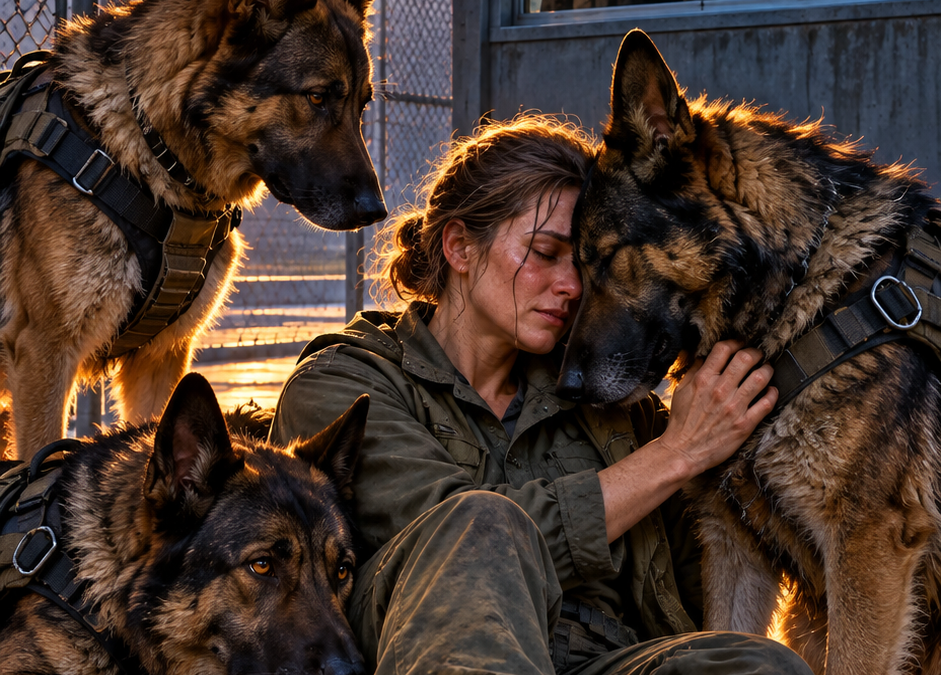
Then he pressed his forehead against her shoulder exactly the way he had pressed it against mine.
Ellie broke.
She wrapped her arms around his neck and sobbed into his fur.
Ares approached next.
Then Zeus.
The three dogs crowded around her, not frantic, not confused.
Remembering.
Parker turned away, pretending to check something by the fence.
I didn’t blame him.
My own vision blurred.
Ellie stayed with them for nearly an hour.
She told them Marcus had loved them.
She told them he had been proud of them.
She told Thor he had done nothing wrong.
I do not know how much of the language they understood.
But I know what happened afterward.
Thor slept that afternoon stretched on his side in the sun.
Not curled tight.
Not facing the door.
Fully asleep.
For the first time since I had arrived, he looked peaceful.
When Ellie prepared to leave, she hugged me.
“Marcus would have liked you,” she said.
I swallowed hard.
“I would have liked him.”
“He believed dogs told the truth if people were patient enough to listen.”
I looked toward the yard.
“He was right.”
She pulled away and wiped her face.
“What will happen to them?”
“The final paperwork isn’t done.”
“But?”
“But I’m going to fight like hell for retirement placement.”
“With you?”
I didn’t answer quickly enough.
Ellie smiled through her tears.
“That means yes.”
“It means I’m considering it.”
“Captain Mercer.”
“Yes?”
“Marcus mailed me that notebook because some part of him knew someone might need it. I think maybe he would like knowing the person who finally listened to his dogs was someone who needed them, too.”
I looked away.
“People keep saying things like that to me.”
“Annoying, isn’t it?”
“Extremely.”
She laughed.
It sounded like her brother’s smile had looked on the recovered video.
Warm.
Tired.
Real.
The final decision came three weeks later.
Ares, Zeus, and Thor were medically and behaviorally retired from operational service.
The amended report removed the language blaming Marcus Dole for loss of control. A separate investigation into the prototype program continued, and disciplinary action moved through channels slower than justice should ever move but faster than I had feared.
Hargrove’s career did not survive intact.
Vale’s did not either.
Whitfield personally called Ellie to explain the amended findings before they were released to anyone else.
She told me afterward that he apologized.
Not in the polished way of men reading prepared statements.
Actually apologized.
She said it helped.
Not enough.
But some.
As for me, my psychological review concluded that I was not unfit, but I was also not ready to return to the same operational tempo that had nearly hollowed me out.
For the first time in my adult life, I accepted a recommendation to step away from deployment cycles.
I thought it would feel like failure.
It didn’t.
It felt like standing at the edge of a road I had marched for eighteen years and realizing there was another road running beside it.
Quieter.
Unfamiliar.
Still mine.
The Navy approved a specialized rehabilitation placement for the dogs while their permanent adoption status was processed.
The placement address was a small property outside Fallbrook with secure fencing, open space, and a converted garage that smelled, according to Parker, “much better than most government buildings.”
It was mine.
Or technically, it was leased under a temporary agreement while paperwork crawled through a dozen offices.
But the first morning I opened the back gate and watched Ares, Zeus, and Thor run across the yard, it felt like the first true home I had entered in years.
Ares checked the fence line.
Zeus inspected the shade beneath a pepper tree.
Thor walked beside me.
Always beside me.
Parker visited the second weekend with a truck full of supplies I had not asked for.
Dog beds.
Food bins.
Training cones.
A repaired canvas leash with the old receiver removed.
“You bring gifts to everyone you barely know?” I asked.
“Only terrifying Navy captains with three retired Malinois.”
“I’m not terrifying.”
Ares barked once.
Parker pointed at him.
“He disagrees.”
I laughed.
It came more easily now.
Not all the time.
Some nights I still woke reaching for Shadow.
Sometimes Thor woke too and came to the side of my bed without being called.
He would rest his head on the mattress and wait until my breathing slowed.
I never thanked him out loud.
I didn’t have to.
He understood.
Six months after the morning I entered the enclosure, a small memorial was held at the Coronado Annex for Chief Petty Officer Marcus Dole.
This time, Ellie stood in the front row.
Whitfield spoke briefly.
Cross attended.
Parker stood beside me.
The amended citation was read aloud, acknowledging Marcus’s professional judgment, his documented concerns, and his loyalty to his working dogs.
No one used the phrase lost control.
Not once.
At the end of the ceremony, Ellie placed Marcus’s old ball cap beneath the memorial plaque.
Then she turned toward me.
“Can they come up?”
I looked at Cross.
He nodded.
Ares, Zeus, and Thor walked forward together.
No commands.
No pulling.
No panic.
Thor stopped in front of the plaque.
His nose touched the base.
Then he sat.
Ares sat beside him.
Zeus followed.
Three dogs.
Still.
Steady.
Remembering.
The crowd went silent.
Not the frightened silence from behind the reinforced glass.
A different silence.
The kind people enter when they finally understand they are standing in the presence of something they should have respected all along.
I looked at Marcus’s name engraved in dark metal.
Then at Thor.
For eight months, people had mistaken grief for aggression.
They had mistaken loyalty for dysfunction.
They had mistaken memory for disobedience.
I knew something about that.
For months after Shadow died, I had believed my pain made me less useful, less reliable, less worthy of the uniform I had worn most of my adult life.
But grief is not weakness.
Grief is proof that trust once existed.
And trust, when honored properly, can lead the living back home.
After the ceremony, Whitfield approached me.
“Captain Mercer.”
“General.”
He looked toward the dogs.
“You were right about them.”
“They were right about Marcus.”
“Yes,” he said quietly. “They were.”
He hesitated.
Then he added, “You were also right about us.”
I did not ask which part.
He knew.
So did I.
Parker joined me as Whitfield walked away.
“You okay?” he asked.
“No.”
He nodded.
“Fair.”
I looked at the dogs.
“But I think I will be.”
That evening, I drove home with three retired military working dogs sleeping in the back of my truck.
Ares snored.
Zeus twitched in a dream.
Thor rested his head against the seatback and watched the road through half-closed eyes.
The sun was setting over the California hills, turning the sky gold and pink in a way I used to think was too peaceful to trust.
I thought about Shadow.
For once, the memory did not arrive as an explosion or a scream.
It came softly.
His head in my lap.
His eyes on mine.
That final lesson he gave me before he left.
Trust is not obedience.
Trust is what survives after everything else is taken away.
I reached back at a red light and rested my hand on Thor’s head.
He leaned into my palm.
When the light changed, I drove on.
Not toward the life I had lost.
Not back into the war I understood better than peace.
Forward.
Toward a small house with a secure fence, three dogs who had remembered the truth, and a future I was finally brave enough to enter without orders.
The men behind the glass had expected blood that morning.
They had expected panic.
They had expected three broken dogs and one broken captain to prove their worst assumptions correct.
Instead, Ares, Zeus, and Thor showed them what Marcus Dole had known all along.
They were not dangerous because they remembered.
They survived because they remembered.
And so did I.








