𝗙𝗨𝗟𝗟 𝗦𝗧𝗢𝗥𝗬 The Dog in the Trash Was So Cold I Was Afraid to Touch Her
𝗙𝗨𝗟𝗟 𝗦𝗧𝗢𝗥𝗬
I didn’t know whether she could hear me. I spoke anyway.
As the journey continued, I began to examine the limited parts of her body that were visible without disturbing her.
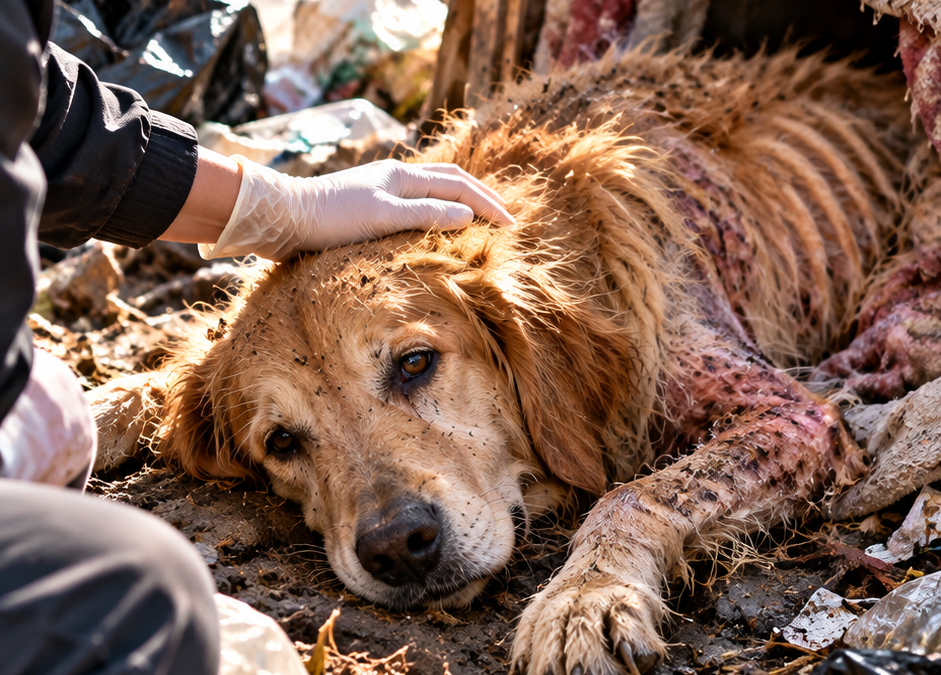
Her coat was filthy. Fleas moved through the fur, and her skin showed the unmistakable consequences of prolonged neglect. There was almost no healthy flesh covering her ribs.
Then I looked more closely at her front left leg.
What I saw made my stomach tighten.
Something was terribly wrong with it.
The limb was positioned awkwardly, and even beneath the dirt and matted fur, I could see evidence of extensive damage.
I didn’t attempt to examine it further in the moving vehicle.
She needed a veterinarian, pain relief, and proper treatment.
Still, I couldn’t stop looking at her.
How long had she been suffering?
How long had she been unable to move normally?
Had she once belonged to someone who fed her, called her name, and watched her run?
Or had she spent so much of her life struggling to survive that kindness was something she barely remembered?
I knew those questions might never have answers.
That uncertainty made the sight of her even harder to bear.
There is something particularly painful about rescuing an animal whose history has disappeared. You can see the damage. You can treat the infections and repair what can be repaired. But you cannot ask the animal who hurt her, how she escaped, or how many times she had searched for help before finally collapsing.
Santa was carrying an entire history of suffering inside her exhausted body.
We were only beginning to discover how much.
When we finally reached the veterinary clinic, I felt an enormous rush of relief.
It lasted only a moment.
The veterinary team took one look at Santa and immediately understood that we were dealing with a critical case.
We carried her inside and placed her on the examination table.
“She’s extremely weak,” I explained. “We found her lying among trash. She was cold when we reached her, and she’s barely responding.”
The veterinarian began assessing her.
I stepped back to give the team room, but I couldn’t bring myself to move far from the table.
Under the clinic lights, Santa looked even smaller than she had outdoors.
Without the shadows and surrounding debris, there was nothing to conceal her condition. Her ribs protruded sharply, her abdomen appeared sunken, and her coat was infested with fleas.
She was estimated to be approximately three years old.
Three years.
I remember being stunned by that number.
She wasn’t an elderly dog reaching the natural end of a long life. She was a young adult, an animal who should have had the strength to run, explore, play, and enjoy years of healthy living.
Instead, she was lying on a treatment table, struggling to maintain the most basic functions of life.
The veterinary examination also helped us understand her background.
Santa was a hunting dog, the kind of animal often bred or kept for physical endurance and activity.
Her condition suggested she had been abandoned after becoming severely ill or injured.
We had no way of reconstructing every event that brought her to that backyard, but the evidence of prolonged neglect was impossible to ignore.
As the veterinary team continued its assessment, the seriousness of her leg injury became unmistakable.
Her front left leg was devastated.
The tissue had deteriorated badly. There was extensive infection, and maggots had invaded the damaged flesh.
I had seen neglected wounds before, but I still found myself struggling to absorb what was in front of me.
I looked at Santa’s face.
She remained almost completely still.
The veterinarian examined the leg carefully, then explained that the damage was too advanced for the limb to be saved.
Amputation would be necessary.
I stared at the injured leg, trying to imagine how Santa had managed to survive with it for as long as she apparently had.
Every movement must have been painful.
Even lying down could not have brought her complete relief.
I felt an overwhelming mixture of sadness and anger.
I was angry that she had been allowed to reach this condition. Angry that an animal who depended on human care had apparently received so little of it. Angry that the first people to truly recognize the seriousness of her suffering had found her almost motionless in a pile of garbage.
But anger was not what Santa needed from me.
She needed treatment.
And before we could begin addressing everything that was wrong with her, we needed to understand how much her body could withstand.
The veterinary team decided that one of the first steps would be a careful bath.
For us, it was more than a matter of cleaning away dirt.
It was an opportunity to remove the accumulated filth, begin addressing the external parasites, and see the full extent of Santa’s physical condition.
We called it her dignity bath.
I have always believed there is something deeply meaningful about the first time a severely neglected animal receives gentle, attentive care. It does not erase what happened. It does not cure an infection or repair a broken body.
But it changes the way the animal is treated.
For the first time in an unknown period, Santa was no longer an unwanted creature lying in waste. She was a patient whose comfort mattered, whose pain deserved attention, and whose body would be handled with respect.
We worked carefully.
Her weakness made every movement a concern. The badly damaged leg required particular attention, and we had to be mindful of her compromised condition throughout the process.
As the dirt washed away, more of her skin became visible.
The fleas were everywhere.
I remember looking at the extent of the infestation and wondering how much blood such a small, weakened body could afford to lose.
Santa was already severely malnourished. Her limited physical reserves had been depleted by what appeared to be prolonged deprivation, and now she was also carrying the burden of extensive parasitic infestation.
She had almost nothing left with which to defend herself.
I gently worked around a patch of dirty fur while a teammate supported her.
“You’re doing so well,” I whispered.
Santa gave no obvious indication that she understood.
But I kept talking to her.
When we had finished, she looked painfully vulnerable.
There was no thick layer of filth to conceal the outline of her body. No dirt to hide the damaged skin. No distraction from the severity of her condition.
I felt tears gathering in my eyes.
Not because the sight was unfamiliar, but because it was difficult to reconcile what I was seeing with the ordinary life this dog should have been living.
She should have been sleeping somewhere warm.
She should have been eating regular meals and receiving veterinary attention long before an injury became catastrophic.
Instead, we were struggling to keep her alive long enough for surgery.
The blood tests confirmed that Santa’s problems extended far beyond her visible injuries.
She was severely weakened by malnutrition and parasites. Her blood values were alarming, leaving the veterinary team deeply concerned about her ability to survive the procedures she needed.
Antibiotics and pain medication were started as part of her treatment.
I remember feeling a small measure of relief when I knew her pain was finally being addressed.
It was one of the few things we could do immediately.
We couldn’t return the strength she had lost in a single afternoon. We couldn’t instantly restore her damaged blood values or repair the harm caused by long-standing neglect.
But at least she no longer had to endure that terrible wound without medical attention.
I watched her resting on the table while the team discussed the next steps.
Her front leg would need to be amputated.
That was already a serious operation for an animal in her condition.
But we were about to discover that the visible wound was only part of the crisis.
During the examination, the veterinary team noticed a purulent discharge.
The finding immediately raised concern about a reproductive tract infection.
Further investigation, including an ultrasound, revealed that Santa had pyometra, a severe infection of the uterus.
I listened as the veterinarian explained the situation.
Santa’s uterus was infected, and without urgent surgery, the condition could become fatal.
I looked from the veterinarian to Santa.
For a few seconds, I couldn’t find anything to say.
She had been abandoned. She had endured prolonged hunger and a devastating leg injury. Her body was covered in parasites, and she had been found so cold and weak that we had initially feared she was already dead.
Now we were being told there was another serious infection inside her body.
It felt unbearably unfair.
“How much more can she take?” I asked quietly.
The veterinarian didn’t offer an easy answer.
Santa needed an emergency spay to remove the infected uterus. She also needed the destroyed front leg amputated because the damaged tissue had become a dangerous source of infection.
Both problems were urgent.
And Santa was far too weak to be considered a routine surgical patient.
The veterinary team continued reviewing her test results.
Her blood values were so poor that a transfusion was necessary before she could safely face the operations.
Without it, her chances of surviving surgery would be dangerously compromised.
I remember standing beside the examination table and feeling as though the room had become smaller.
We had brought her there hoping the veterinarians could save her life.
Now we were facing the possibility that she might not survive the treatment required to do so.
I looked down at Santa.
Her breathing had become steadier under medical care, but she was still profoundly weak.
I placed my hand beside her head.
“Listen to me, sweetheart,” I whispered. “You’ve already made it this far.”
She didn’t move.
“We’re not leaving you.”
The words were meant for her, but perhaps I needed to hear them just as badly.
There are moments in rescue work when hope becomes a deliberate decision rather than a feeling.
It would have been easy to look at Santa’s test results, her ruined leg, and her severe internal infection and imagine that the outcome had already been decided.
But the veterinary team was still working.
Santa was still breathing.
And no one involved in her care was ready to give up.
The blood transfusion became the next critical step.
I waited while the veterinary team prepared everything necessary, painfully aware that time was working against us.
We understood why Santa needed the transfusion. Her condition had deteriorated so badly that her blood could no longer adequately support the demands of major surgery without intervention.
Her body needed help before it could face the trauma of two operations.
The medical team monitored her closely as treatment proceeded.
I watched from a distance whenever necessary, trying not to interfere.
I had imagined this rescue as an urgent journey from a backyard to a veterinary clinic. I had known there would be examinations, medication, and possibly surgery.
But I hadn’t imagined how many different ways one neglected animal could be close to death at the same time.
Every new discovery seemed to reveal another burden Santa had been carrying in silence.
I found myself thinking about the woman who had built the shelter.
She had seen a dog lying motionless behind her backyard and recognized that something was terribly wrong. She could not have known about the destroyed leg beneath the filth, the dangerous internal infection, or the compromised blood values.
She had simply seen an animal who needed help.
I wondered whether she realized that her decision to make that call had given Santa access to the only treatment capable of saving her.
The thought helped me through the waiting.
Eventually, the veterinary team determined that Santa had received the necessary support and that surgery could proceed.
I wanted to feel relieved.
Instead, I felt the full weight of what was about to happen.
Two major procedures.
One desperately weak dog.
A possibility of survival, but no guarantee.
I moved close enough to see Santa before she was taken for surgery.
Her body was cleaner now, and medication had begun relieving some of her suffering. Yet she still looked fragile enough that I could hardly imagine her making it through an operating room.
I gently touched her head.
“You don’t have to fight alone anymore.”
A teammate came to stand beside me.
Neither of us spoke for a moment.
Then she said what we were both thinking.
“I really hope she makes it.”
I nodded.
“So do I.”
As Santa was taken away, I watched until she disappeared from sight.
Then there was nothing left for me to do but wait.
Waiting during a rescue is a strange kind of helplessness.
At the beginning, there are always things that demand your attention. You make calls, gather equipment, coordinate transportation, comfort frightened animals, and explain the situation to veterinary professionals.
You are so busy responding to the emergency that you have little time to think about what might happen.
But once an animal enters surgery, the activity stops.
The veterinarians and medical staff take over. You are left with your thoughts, your fears, and the knowledge that the outcome is now beyond your control.
I kept thinking about Santa lying in the backyard.
I remembered how little her chest had moved.
I remembered the awful cold beneath my hand and the way she hadn’t reacted when we first approached.
I could still see the ants crawling over her skin.
I thought about how she must have struggled to survive before finally collapsing.
And I wondered whether anyone had noticed her condition before she reached that point.
Perhaps she had been seen limping somewhere and dismissed as another stray. Perhaps she had been too frightened or exhausted to approach anyone. Perhaps people had assumed she belonged to somebody nearby.
I knew I was imagining possibilities that we could never confirm.
But the uncertainty was painful.
Santa had suffered long enough for an infection to destroy an entire leg.
She had become malnourished enough for her strength to disappear and sick enough for her blood values to become critical.
Whatever had happened before we found her, it had not happened in a single afternoon.
That knowledge was difficult to accept.
A teammate sat down beside me.
“Try to rest for a minute.”
I shook my head.
“I don’t think I can.”
“She’s in the right place now.”
“I know.”
But I was still frightened.
I had seen animals survive terrible injuries. I had also seen animals whose suffering had progressed too far before help reached them.
I didn’t know which story Santa’s would become.
The emergency spay was necessary to remove the infected uterus and address the pyometra threatening her life.
The amputation was equally important. Her front left leg could no longer be saved, and leaving the destroyed tissue in place would have allowed another severe source of infection to remain.
I understood the medical reasoning.
Emotionally, however, it was difficult to imagine Santa waking up without one of her legs.
I thought about all the things that ordinary dogs do without hesitation.
Running toward a person they love.
Chasing another dog across a yard.
Jumping up at the sound of food being prepared.
Stretching after a long nap.
Santa had been deprived of those simple pleasures for an unknown period.
Now, if she survived, she would have to learn to experience them on three legs.
But that was a problem for another day.
First, she needed to wake up.
When the veterinary team finally brought us news, I was almost afraid to listen.
Santa had survived both procedures.
For a moment, I simply stared at the person delivering the update.
“Both?”
“Both.”
I felt my shoulders drop.
The relief was so powerful that I had to sit down.
One of my teammates covered her face with her hands. Another let out a long breath, as though she had been holding it for the entire operation.
I couldn’t stop thinking about the dog who had barely moved when we found her.
She had survived the journey.
She had endured the necessary stabilization and blood transfusion.
And now she had survived the operations intended to remove the two most dangerous sources of infection.
It was an extraordinary step forward.
But the veterinary team reminded us that her recovery was still in its earliest stage.
Santa remained severely weakened. She needed continued monitoring, appropriate medication, careful nutrition, and time for her body to recover from the enormous strain it had endured.
Surviving surgery did not mean she was suddenly well.
I understood.
Still, when I was finally allowed to see her again, I couldn’t hold back my tears.
She lay quietly, recovering from the procedures.
Her injured front leg was gone.
The infected uterus had been removed.
And for the first time since we had encountered her, the two conditions most immediately threatening her life had been treated.
I sat beside her and watched her breathing.
It was different from the frantic attention I had paid to every breath in the rescue vehicle.
Back then, each movement of her chest had been proof that we were not too late.
Now I was watching a patient who had been given a real chance to recover.
I gently rested my hand near her head.
“You did it, Santa.”
I knew she couldn’t understand the significance of the moment.
She had no idea how frightened we had been or how complicated her treatment had become.
But she was still here.
And for that evening, it was enough.
The following days brought a different kind of challenge.
We had spent the first part of Santa’s rescue trying to keep her alive. Now we needed to support her recovery without expecting too much too quickly.
Her body had been through an enormous ordeal. Healing from two major operations would have been demanding even for a healthy dog, and Santa had entered surgery severely malnourished and weakened by parasites and infection.
She needed medical supervision and a carefully managed recovery.
She also needed something that could never be measured in a blood test.
She needed to feel safe.
I remember how strange it was to see her resting in a clean, protected environment after finding her among the trash.
There were no ants crawling over her.
There was no wind blowing across her exposed body.
No pile of debris surrounding her.
She had a clean place to lie down, veterinary staff checking her condition, and people who noticed every small change in her behavior.
I watched her sleeping and wondered whether the difference meant anything to her yet.
Animals do not understand explanations the way humans do. We could not tell Santa that the worst immediate dangers had been treated, that she would receive regular meals, or that we intended to remain involved in her recovery.
We had to demonstrate those things through our actions.
Each time someone approached her gently, she experienced another moment without fear.
Each time she received food, her body had an opportunity to rebuild.
Each time medication relieved her discomfort, she gained a little more freedom from the suffering that had dominated her life.
At first, her progress was measured in the smallest possible changes.
We watched for signs that she was becoming more comfortable.
We monitored her appetite and her response to treatment.
We paid attention to her energy, her movements, and the healing of her surgical wounds.
There was no dramatic transformation overnight.
She was still thin.
She was still weak.
And she was now learning how to exist without a front leg.
Yet something about her had changed.
She no longer seemed completely absent from the world around her.
I began to see moments when her eyes followed a person moving nearby.
She appeared more aware of our voices.
Her body still needed rest, but she was no longer the motionless animal we had found behind the backyard.
Those small changes meant more to me than I can easily explain.
People sometimes imagine that the most emotional moment in animal rescue is the instant an animal is lifted into safety.
For Santa, that moment had been frightening and uncertain.
The emotions I felt during her rescue were dominated by fear.
But watching her become gradually more aware of her surroundings brought a different kind of feeling.
For the first time, I could imagine a future for her.
I could imagine her standing again.
I could imagine her eating without pain, sleeping in a comfortable place, and discovering that human hands could bring something other than suffering.
I even dared to imagine her running.
Then I looked at her thin body and reminded myself that recovery would take patience.
We couldn’t ask her to become the dog we hoped she would be before her body was ready.
Three days after her surgeries, Santa had recovered sufficiently to be discharged from the veterinary clinic and move into a foster home.
I remember how emotional that transition felt.
Only a few days earlier, I had been terrified that she might die during the journey to the veterinarian.
Now we were preparing a safe place where she could continue healing outside the clinic.
Her foster caregiver was ready to provide the quiet attention Santa needed.
We discussed her recovery, the importance of following the veterinary team’s instructions, and the need to be careful as she adjusted to moving on three legs.
Santa still looked delicate.
Her surgical wounds were healing, but she had a long way to go before she would be physically strong.
I watched as she was settled into her new environment.
Everything was unfamiliar to her.
The clean bedding.
The sounds of a household.
The routine of people coming and going without threatening her.
I wondered whether she had ever experienced a home where her needs were met consistently.
We couldn’t know.
What mattered now was that she would.
Her foster caregiver approached her gently and allowed her time to become comfortable.
“Hello, beautiful girl.”
Santa watched quietly.
There was still exhaustion in her movements, but she seemed increasingly interested in the people around her.
I stood nearby, reluctant to leave.
It had been such a short time since we found her, yet I felt fiercely protective of her.
I remembered the moment we had lifted her from the ground and how frightened I had been that she might stop breathing in my arms.
Now another person was preparing to care for her.
Someone who would notice whether she ate her meals, whether she was resting comfortably, and whether she was gradually regaining the strength she had lost.
I knew Santa needed that stability.
I also knew I needed to learn to step back.
Rescue work often involves becoming deeply attached to an animal at the very moment that animal is most vulnerable. You spend hours worrying about every breath and every medical update.
Then, if everything goes well, your role begins to change.
The goal is no longer to keep the animal alive from one moment to the next.
The goal is to help her become healthy enough that she no longer needs an emergency team watching over her.
As I prepared to leave, I knelt beside Santa.
“You’re going to be all right here.”
She looked toward me.
I smiled.
“You have someone who’ll take care of you.”
I touched her gently.
And for the first time since her rescue, I allowed myself to believe those words might be true.
What happened during Santa’s early days in foster care surprised all of us.
She started eating with enthusiasm.
It sounds like such a small thing when you describe it that way.
A dog ate her food.
But anyone who saw Santa when we found her would understand why those first enthusiastic meals were so important.
Her body had been reduced to skin and bone. She had arrived at the clinic too weak to respond normally to the people around her, and her medical condition had been so critical that she needed a blood transfusion before surgery.
Now she was showing a clear interest in food.
Her foster caregiver shared updates as Santa began responding to the stability of her new environment.
“She’s really eating,” she told us.
I remember the relief I felt when I heard those words.
Santa was no longer simply accepting the minimum care required to keep her alive.
She was beginning to participate in her own recovery.
She approached meals with an appetite we hadn’t dared expect so soon.
Her strength gradually improved.
Her eyes, once dull and distant, became more alert.
When I saw her again, I noticed the difference almost immediately.
She looked at me.
Not with the vacant exhaustion I remembered from the backyard, but with genuine interest.
I crouched down in front of her.
“Well, look at you.”
Santa watched me, her body still thin but noticeably more responsive.
“You recognize me, sweetheart?”
Of course, I couldn’t know exactly what she recognized.
Perhaps my voice sounded familiar. Perhaps she was simply curious about another person entering her space.
But I didn’t need to know.
Seeing her interested in anything beyond survival was enough.
Her foster caregiver smiled.
“She’s getting stronger every day.”
I looked at Santa’s food bowl and then back at her.
“Apparently, she’s making up for lost time.”
We laughed.
It was one of the first times I had been able to laugh while talking about Santa.
Until then, every conversation about her had involved something frightening.
Would she survive the drive?
How extensive was the infection?
Could she tolerate surgery?
Would she recover from the operations?
Now we were talking about her appetite and how interested she seemed in her surroundings.
The change was almost difficult to comprehend.
I watched her settle back onto her bedding.
She still moved carefully, particularly when adjusting her position.
Her missing front leg meant that even simple movements required a different kind of balance.
But she was beginning to learn.
And she seemed increasingly willing to try.
Learning to walk on three legs was not easy for Santa.
Her body had already been weakened by prolonged neglect, and she was recovering from major surgery. She couldn’t simply stand up and move normally as though nothing had happened.
Every step required strength she was still rebuilding.
Every movement demanded that she adjust to a body that no longer worked the way it once had.
During the early stages, she sometimes lost her balance.
She would try to move forward, shift her weight incorrectly, and stumble.
Those moments were difficult to watch.
I knew she needed opportunities to practice as her medical recovery allowed, but part of me wanted to protect her from every possible fall.
Her foster caregiver understood the importance of patience.
She remained close while Santa experimented with standing and moving.
“Easy, girl.”
Santa would pause, reposition herself, and try again.
Sometimes she managed only a few steps before needing to rest.
Other times, her determination surprised us.
There is something extraordinary about watching an animal adapt to a disability without understanding the human concept of disability.
Santa didn’t know she was supposed to inspire anyone.
She didn’t understand that people considered her recovery remarkable.
She simply wanted to move.
If she saw something interesting across the room, she attempted to reach it.
If her caregiver approached with food, she wanted to come closer.
If she heard an unfamiliar sound, she lifted her head and became curious.
Her body had changed, but her ordinary canine desires were beginning to return.
She wanted comfort, food, companionship, and the freedom to explore.
I watched her take several careful steps one day and felt a surge of emotion.
“That’s it, Santa.”
She stopped and looked toward me.
“You’re doing beautifully.”
Then she tried another step.
And another.
She wasn’t graceful yet.
She was still learning how to distribute her weight and maintain her balance.
But she was moving under her own power.
I thought about her lying motionless among the trash.
The contrast was overwhelming.
The first time I had touched her, I had been terrified by how cold she felt. I had wondered whether she would even survive long enough to reach the veterinary clinic.
Now she was learning how to walk again.
It wasn’t a miracle that happened all at once.
It was the result of medical treatment, careful nursing, proper nutrition, and the patient work of a foster caregiver who celebrated improvements that other people might have overlooked.
There were difficult moments.
Santa sometimes stumbled.
Sometimes she became tired and needed to rest.
There were days when her progress seemed slower than we hoped.
But the important thing was that she kept trying.
She hadn’t survived everything she had endured merely to spend the rest of her life lying still.
Little by little, she was reclaiming the ability to move through the world.
Her follow-up veterinary appointments became another source of encouragement.
The medical team examined her surgical wounds and monitored how her body was responding to treatment and improved nutrition.
We knew that surviving the operations had only been the beginning.
Her recovery needed to be confirmed through proper healing, not simply through the fact that she seemed happier.
I remember feeling nervous before one of her examinations.
Santa had been eating well, becoming more active, and adjusting to three-legged movement, but I still carried the memory of her original condition.
Part of me feared that another hidden problem might emerge.
I had seen how quickly our relief at identifying her damaged leg had been overshadowed by the discovery of pyometra.
Now I wanted the veterinarians to tell us that her progress was genuine.
When the examination showed that her wounds were healing cleanly, I felt another enormous wave of relief.
The treatment was working.
The infections that had endangered her life were no longer dominating every decision about her care.
As her recovery progressed, the time came for her stitches to be removed.
I watched the veterinary staff handle her carefully.
Santa was still a patient who needed attention, but she no longer looked like the helpless animal who had arrived at the clinic.
She was more alert.
She showed an interest in her surroundings.
And she had begun to display the personality that prolonged suffering had hidden from us.
The veterinary team was pleased with her progress.
I remember hearing the positive assessment and thinking about how different our emotions had been during her first examination.
Back then, every discovery had seemed to make the situation worse.
Now each appointment was confirming that Santa’s body was repairing itself.
She was no longer fighting several immediate threats to her life.
She was healing.
I gently stroked her head after the examination.
“You have no idea how proud everyone is of you.”
She looked up at me.
I smiled.
“Or maybe you do.”
I knew I was projecting human emotions onto her, but I didn’t mind.
Santa had become something more than a difficult rescue case to everyone involved in her recovery.
She was an individual whose progress mattered to us.
When she ate well, we were happy.
When she learned to balance more confidently, we were excited.
When the veterinarians confirmed that her wounds were healing properly, we celebrated.
We had spent the first days of her rescue fearing that we might lose her at any moment.
Now we were watching her become a healthy dog.
And with every improvement, the memory of that terrible backyard seemed a little farther away.
One of the most beautiful parts of Santa’s recovery was watching her become interested in other dogs.
During the emergency, she had been too weak to react normally to anything around her.
Even after surgery, her attention had initially been focused on food, rest, and the effort required to move.
But as her strength returned, so did her curiosity.
She began paying more attention to the animals around her.
She watched their movements.
She responded to their presence.
And gradually, she began to participate in the ordinary social life she had been unable to enjoy while fighting for survival.
I remember how emotional I felt the first time I saw her moving confidently enough to engage with another dog.
She was still adjusting to her body, but the uncertainty that had characterized her first attempts at walking was fading.
Her movements were becoming more natural.
She knew where to place her remaining front paw.
She had developed a better sense of balance.
And she was no longer treating every movement as a difficult task.
Her foster caregiver watched her with the kind of pride usually reserved for an important family milestone.
“Look at her now.”
I didn’t need to be told twice.
Santa was moving around with growing confidence.
She paused beside another dog, then followed as the other animal moved away.
I laughed.
“She’s not planning to sit still anymore, is she?”
Her caregiver shook her head.
“Not if she can help it.”
The more comfortable Santa became, the more her personality emerged.
The quiet, almost unresponsive dog we had lifted from the trash was revealing herself as an energetic, social animal.
She enjoyed her food.
She responded to affection.
She wanted to explore.
And she was discovering that having three legs did not prevent her from participating in the activities that made life enjoyable.
I found myself watching her with a mixture of happiness and disbelief.
It wasn’t that I had doubted the ability of three-legged dogs to live active, fulfilling lives.
I had known many animals who adapted beautifully after amputation.
What astonished me was remembering just how close Santa had been to death when we found her.
The dog in front of me was full of energy.
The dog in my memory had barely been able to breathe.
Sometimes those two images seemed impossible to reconcile.
But both were Santa.
And the distance between them represented everything that had happened since the day a concerned woman had asked us for help.
As the weeks passed, Santa continued gaining strength.
Her body began to recover from the prolonged malnutrition that had left her so thin.
Her coat and skin were receiving the care they needed.
She had regular meals, a protected place to sleep, appropriate veterinary attention, and people who treated her with patience.
Her new routine was wonderfully ordinary.
And after everything she had endured, ordinary life was exactly what she deserved.
There were mornings when her foster caregiver would find her eager to begin the day.
There were opportunities to move around, interact with other dogs, and receive affection from the people caring for her.
Santa no longer spent her days lying helplessly in one place.
She had reasons to get up.
She had things to explore.
She had people to greet.
And eventually, she began to run.
The first time I saw Santa running confidently, I felt something inside me give way.
I had imagined that moment during the early days of her recovery, but imagining it was nothing like witnessing it.
There she was, moving with the unmistakable enthusiasm of a dog who wanted to enjoy herself.
She had only three legs.
She had scars from two major operations.
And none of those things seemed capable of diminishing her delight in being alive.
She moved across the ground with an energy I would never have thought possible when we first carried her away from the backyard.
Another dog moved nearby, and Santa followed.
She wasn’t lying still.
She wasn’t trembling from weakness.
She wasn’t looking at us through exhausted eyes, too depleted to respond.
She was playing.
I stood watching, unable to speak for a moment.
Then I felt tears running down my face.
I had cried during Santa’s rescue because I was frightened.
I had cried when I learned that she needed two operations because I feared her body was too weak to survive them.
I had cried after surgery because she had made it through.
But these tears were different.
For the first time, I wasn’t crying because I was afraid of losing her.
I was crying because I could see what we had nearly lost.
I watched Santa turn and run in another direction.
She looked so alive.
That sounds like an obvious thing to say about a dog who has recovered from illness.
But it was the only description that fully captured what I felt.
She was alive in a way that went far beyond the shallow breathing I had watched during that terrible drive.
She was interested in the world.
She was confident enough to play.
She had the strength to move wherever she wanted.
And she was surrounded by people who were genuinely happy to see her enjoying herself.
I crouched when she came closer.
“Santa!”
She approached with the enthusiastic, slightly uneven movement of a dog who had completely accepted her new way of walking.
I stroked her head.
“Look at you, beautiful girl.”
She stood beside me for a moment before turning her attention back toward the other dogs.
I laughed through my tears.
“All right. Go play.”
And she did.
I watched her move away, thinking about the countless small decisions that had led to this moment.
A woman had noticed her lying behind a backyard.
Instead of ignoring her, she had built a shelter and contacted our rescue team.
We had brought Santa to the veterinary clinic despite her critical condition.
The veterinarians had identified not only her devastating leg injury but also the dangerous infection hidden inside her body.
They had provided the transfusion she needed and performed the operations that saved her life.
Afterward, her foster caregiver had given her a safe place to recover.
She had received patient assistance as she learned to walk again.
And through all of it, Santa had continued trying.
Her recovery had not been easy.
No amount of happiness could erase the suffering she had endured before we found her, and no story of survival could make her neglect acceptable.
She had lost a leg that might not have been lost if the original injury had received timely treatment.
She had faced a dangerous uterine infection that required emergency surgery.
She had nearly died while lying among garbage, too weak to seek help for herself.
Those things remained part of her history.
But I no longer saw them as the whole of her story.
When I looked at Santa running, I saw the life that existed beyond her suffering.
A life filled with food, comfort, companionship, movement, and the uncomplicated happiness of an animal who finally felt secure.
For so long, she had needed people to protect her.
Now she was becoming strong enough to enjoy the freedom that protection had given her.
I have often thought about the moment when the homeowners first discovered her.
They had stood behind their backyard, watching an unnaturally still dog and wondering whether she was already dead.
I understand why they hesitated.
Santa’s condition was frightening. Even experienced rescuers were shocked by what we found when we arrived.
But the woman who made the shelter and called for help had done something important before anyone knew Santa’s name or understood the seriousness of her injuries.
She had decided that the life lying in front of her mattered.
That decision was the beginning of Santa’s recovery.
The rest required an entire team.
Veterinary professionals who understood the urgency of her condition.
Rescuers who transported her and remained involved in her treatment.
A foster caregiver willing to help a severely weakened dog through a difficult recovery.
And people who recognized that surviving an emergency was only the first step toward rebuilding a life.
Santa needed all of them.
But what she ultimately gained was something much simpler.
She gained the opportunity to be a dog again.
Today, when I think of Santa, I don’t first remember her damaged leg or her frighteningly weak breathing.
I remember her running.
I remember the way she learned to balance on three legs, how eagerly she began eating after surgery, and how her eyes changed as she grew stronger.
I remember watching her interact with other dogs and realizing that the frightened, exhausted creature we had rescued was finally becoming comfortable with the world.
She lives surrounded by safety and care.
Her days are no longer defined by hunger, exposure, infection, or the pain of an untreated injury.
She has food, affection, companionship, and the freedom to move without the terrible suffering that once trapped her.
I sometimes wonder what she remembers of the backyard where we found her.
Perhaps animals experience the past differently from us. Perhaps she has no reason to revisit those terrible hours now that her life has changed.
I hope that is true.
I hope she never again knows what it feels like to lie cold and helpless while the world continues around her.
I hope every hand that touches her from now on is gentle.
I hope she spends the rest of her life expecting meals, comfortable places to sleep, and people who are happy to see her.
Most of all, I hope she never has to fight that desperately for another breath.
Because I still remember the first one I saw.
That almost invisible movement of her chest.
The tiny sign of life that told us we weren’t too late.
I remember being afraid to touch her because her body felt so cold.
And I remember how helpless I felt as we carried her toward the vehicle, knowing that even our best efforts might not be enough.
But when I see Santa now, those memories no longer end with fear.
They end with the sight of a three-legged dog running happily toward the people who love her, completely unaware that her ordinary, joyful life is the very thing we once feared she would never have.
That is the Santa I know now.
And it is the life she should have had all along.








