𝗙𝗨𝗟𝗟 𝗦𝗧𝗢𝗥𝗬 The Dog Dying Beside the Highway Was Begging for Something I Was Terrified I Couldn’t Give Him
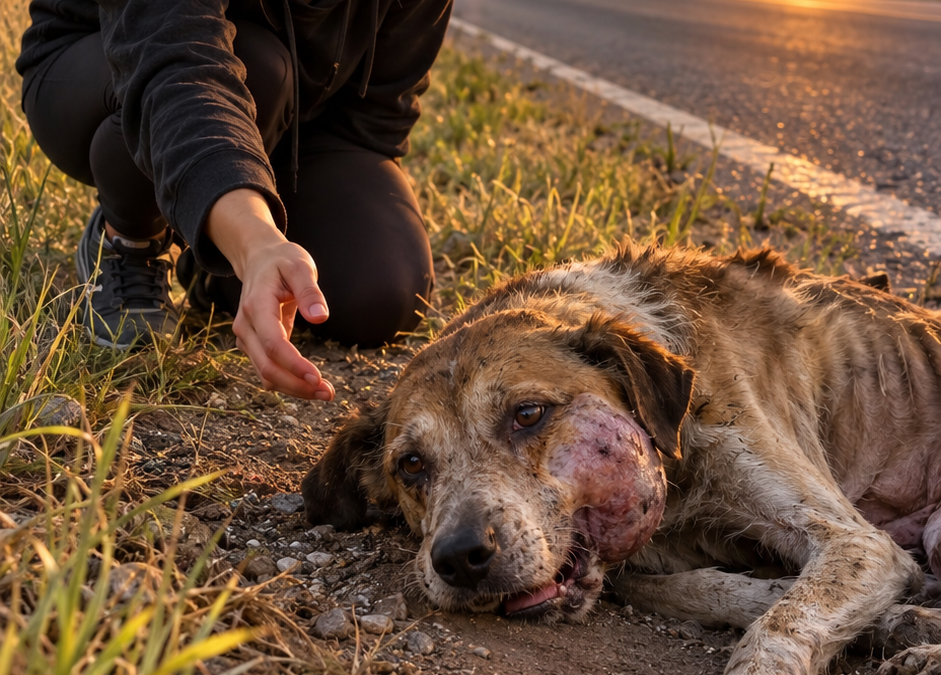
𝗙𝗨𝗟𝗟 𝗦𝗧𝗢𝗥𝗬
He whimpered as I began lifting him.
I stopped immediately.
“I’m sorry. I know it hurts.”
I adjusted my grip and tried again, moving as gently as I could.
This time, I managed to gather him securely.
His head rested awkwardly against my arm, and I could feel how completely exhausted he was.
He didn’t fight.
He didn’t struggle to escape.
He simply allowed me to carry him away from the roadside.
The weight of his body surprised me. He wasn’t an enormous dog, but supporting him while protecting the painful growth made every step feel delicate.
I kept whispering to him as I walked.
“Almost there.”
“You’re doing so well.”
“I’ve got you.”
At the car, I lowered him onto the blanket and made sure he could lie in a position that didn’t put unnecessary pressure on his face.
He immediately closed his eyes.
For a terrible second, I thought he’d stopped breathing.
I leaned closer.
His chest rose.
Then fell.
I let out the breath I’d been holding.
“Stay with me.”
I closed the door, climbed behind the wheel, and started driving.
I don’t remember much of the scenery between that stretch of highway and the veterinary clinic.
I remember the road seemed impossibly long.
I remember gripping the steering wheel so tightly that my fingers hurt.
And I remember constantly glancing toward the back seat, terrified that the next time I looked, he wouldn’t be breathing.
Every few minutes, I spoke to him.
“Hey, buddy. We’re getting closer.”
Sometimes he opened his eyes.
Sometimes he remained completely still.
Once, he made a faint sound that was barely louder than a breath.
I felt tears gathering.
“Please. Just a little longer.”
I was a stranger to him.
Only a short time earlier, I’d been driving toward an ordinary destination, thinking about ordinary things. I hadn’t expected to stop on an empty highway or carry a suffering dog into my car.
Yet somewhere during those first few minutes, something had changed.
He was no longer simply an injured animal I’d happened to find.
He was a life I’d taken responsibility for.
And I couldn’t bear the thought of failing him.
When the veterinary clinic finally came into view, I almost cried with relief.
I pulled into the parking lot, hurried inside, and told the receptionist I’d called about the dog with the facial tumor.
The veterinary team came immediately.
Together, we carefully transferred him from my car into the clinic.
The moment the veterinarian saw his face, her expression became serious.
“How long has he been like this?”
“I don’t know.”
“Do you know who owns him?”
I shook my head.
“I found him on the highway. He was lying beside the road, and he couldn’t get up.”
She examined him carefully.
The dog whimpered when she touched an area near the swelling.
“Easy, sweetheart,” she said.
I stood beside the examination table, watching her movements.
Under the bright clinic lights, his condition looked even worse.
The tumor dominated his face. His exhausted body seemed almost overwhelmed by the weight of it, and his eyes followed the people moving around him without any real energy.
The veterinarian listened to his heart, assessed his breathing, and began coordinating the tests and supportive care he needed.
A technician asked me several questions.
Had I seen him eat?
Had he been walking when I found him?
Was there any indication that he’d been hit by a car?
I answered as honestly as I could.
I hadn’t seen him eat.
He’d tried to get up but collapsed.
I hadn’t witnessed an accident.
I knew almost nothing about him.
And that ignorance frightened me.
For all I knew, he’d been living with the tumor for months.
Perhaps longer.
There was no way to tell how much suffering he’d endured before I stopped beside him.
I watched the veterinary team work and wished desperately that I could give them some useful piece of information.
An owner to contact.
A medical history.
A previous diagnosis.
Anything that might help them understand how his condition had become so severe.
But I had nothing.
All I could offer was the dog himself and the promise that I would do whatever I reasonably could to help him.
The veterinarian came over after her initial assessment.
“He’s in critical condition.”
I looked past her toward the examination table.
The dog was lying on his side, his eyes partly closed.
“What can we do?”
She explained that the enormous growth needed urgent medical intervention.
The tumor was placing an extraordinary burden on him, and his weakened condition made the situation even more dangerous.
Surgery would be complicated.
There would be risks associated with anesthesia, the location and size of the mass, and the strain his body had already endured.
But without an operation, his chances were extremely poor.
I listened until she finished.
Then I asked the question I was afraid to hear answered.
“Do you think he’ll survive?”
She paused.
“I can’t promise that.”
I looked down.
“We need to stabilize him as much as possible, evaluate what we’re dealing with, and decide how to proceed safely. But he needs surgery. It’s his chance.”
I looked toward him again.
He was lying so quietly.
It was difficult to reconcile that helpless body with the enormous struggle he must have endured just to remain alive.
I had no way of knowing how long he’d been alone or how many people might have passed him on that highway.
But now he was in a clinic.
He had medical professionals working to help him.
And he had me.
“Do whatever you can,” I said.
The veterinarian nodded.
“We will.”
I stepped toward the examination table and gently touched the uninjured side of his head.
“Did you hear that, buddy?”
He opened one eye.
“You’re going to have some people looking after you now.”
My voice broke.
I swallowed and tried again.
“I need you to keep fighting.”
The next several hours were among the most emotionally exhausting of my life.
The veterinary team worked to stabilize him and assess the tumor before proceeding with surgery.
I remained at the clinic, answering questions whenever someone needed information and waiting anxiously for updates.
There were practical matters to consider.
Medical decisions had to be made.
Treatment had to be arranged.
And because I had found him alone, there was no familiar owner sitting beside me who could explain his history or reassure him with a voice he knew.
I felt the weight of that responsibility more strongly with every passing minute.
At one point, a technician approached me.
“Would you like to sit down?”
I hadn’t realized I’d been standing in the same place for so long.
I nodded and lowered myself into a chair.
“Is he okay?”
“They’re taking care of him.”
I looked toward the treatment area.
It wasn’t the answer I’d wanted, but I knew nobody could offer more certainty yet.
I spent the waiting period thinking about the moment I’d first seen him.
If I’d been looking at my phone’s navigation screen, perhaps I wouldn’t have noticed the movement beside the road.
If another car had been behind me, perhaps I wouldn’t have been able to stop as quickly.
If he’d been lying a little farther from the pavement, I might have mistaken him for a discarded object and continued driving.
The possibilities frightened me.
But I kept returning to the only thing that mattered.
I had stopped.
He was here.
And now he was receiving the medical attention he’d so desperately needed.
Eventually, the veterinarian returned to explain the surgical plan.
She was careful not to minimize the risks.
The tumor’s size and location made the operation complex, and his overall condition meant that the team would need to monitor him closely.
I listened to every word.
At the end, I asked whether there was any reasonable alternative that could save him.
She explained that surgery offered his only meaningful chance.
I looked toward the treatment area.
“Then let’s give him that chance.”
Before they took him into surgery, I was allowed to spend another moment with him.
He was resting quietly.
The enormous swelling still distorted his face, and I could see how thoroughly exhausted he was.
I knelt beside him.
“Hey, sweetheart.”
His eyes shifted toward me.
I gently stroked his neck.
“I don’t know what you’ve been through.”
His breathing remained slow and labored.
“I don’t know who left you out there or how long you’ve been hurting.”
I paused, struggling to control my voice.
“But I know you’re not going back to that road.”
I wanted to promise him that the surgery would work.
I wanted to tell him that he’d wake up feeling better, that the tumor would be gone, and that the rest of his life would be filled with comfort.
But the veterinarian’s warning was still fresh in my mind.
There were no guarantees.
So I made the one promise I knew I could keep.
“I’m going to be here when you wake up.”
I stayed beside him until the team was ready.
Then I stepped back and watched them take him away.
The doors closed.
And suddenly, there was nothing left for me to do.
I sat in the waiting room with my hands folded tightly in my lap.
The clinic continued operating around me.
People arrived with pets.
Phones rang.
A small dog barked somewhere down the hallway.
A receptionist spoke quietly to someone about an appointment.
Life continued in the most ordinary way imaginable.
But for me, everything had narrowed to the room where a team of veterinarians was trying to save a dog I’d met only hours earlier.
I stared at the clock.
Every passing minute felt significant.
I tried to distract myself by looking at my phone, but I couldn’t focus long enough to read a single message.
Instead, I kept seeing his face.
The enormous swelling.
The frightened eyes.
The terrible cry he’d made when I approached him.
I thought about what the veterinarian had said.
Surgery was his only chance.
I wondered what would happen if it failed.
Would he ever know that someone had cared enough to stop?
Would those few hours of comfort and medical attention be all I could give him?
I pressed my palms together and stared at the floor.
“Please make it,” I whispered.
I wasn’t certain who I was speaking to.
Perhaps nobody.
Perhaps the dog himself.
But I needed to say it.
I needed to believe that the little bit of hope we’d found beside that highway wasn’t going to disappear behind the operating-room doors.
The surgery was complicated and required the veterinary team’s full attention.
They worked carefully to remove the enormous growth while managing the risks created by its location and the dog’s weakened condition.
I knew they were doing everything possible.
But knowing that didn’t make the waiting any easier.
At one point, I stood and walked toward the window.
Outside, the sun had begun lowering toward the horizon.
Cars moved through the parking lot.
Someone walked past the entrance holding a small dog in their arms.
I watched them disappear inside and felt an unexpected ache in my chest.
I wondered whether the dog on the operating table had ever belonged to someone who loved him.
Perhaps he’d once slept on a couch.
Perhaps he’d waited beside a front door for his owner to return.
Perhaps he’d been called by a name that nobody at the clinic knew.
Or perhaps he’d spent most of his life outdoors, surviving without the stability of a home.
I couldn’t know.
And I realized I didn’t need to invent an explanation for his suffering.
Whatever his past had been, his present was clear.
He needed medical care.
He needed relief from his pain.
And if he survived, he would need someone willing to help him recover.
I turned away from the window.
I already knew who that person would be.
When the veterinarian finally came into the waiting room, I stood so quickly that my chair scraped against the floor.
“How is he?”
She looked exhausted but relieved.
“The surgery went well.”
For a second, I couldn’t move.
“He’s alive?”
“Yes. We were able to remove the tumor.”
I covered my mouth.
The words seemed almost too extraordinary to believe.
After everything I’d seen—the enormous growth, his collapse beside the highway, the way he’d cried when he tried to move—the tumor was finally gone.
But the veterinarian wasn’t finished.
“He still needs close monitoring. He’s been through a major operation, and recovery will take time.”
I nodded quickly.
“Of course.”
“He’s not out of danger simply because the surgery was successful.”
“I understand.”
And I did.
At least intellectually.
But emotionally, I was still caught on those first two words.
Surgery successful.
He was alive.
I felt tears running down my face.
The veterinarian gave me a moment.
Then she explained what the next stage of care would involve.
He would need medication, proper nutrition, rest, wound care, and ongoing monitoring.
As his condition improved, he would gradually need appropriate exercise to rebuild the strength he’d lost.
Recovery would be a process, not an overnight transformation.
There might be difficult days.
His body had endured significant physical stress, and we would need to watch carefully for complications.
I listened to everything she said.
Then I asked whether I could see him.
“When he’s ready, yes.”
I sat down again.
This time, the waiting felt different.
I was still frightened.
I knew complications could arise, and the veterinarian had been careful to explain that the next several days would be important.
But something enormous had changed.
The tumor that had caused him so much suffering had been removed.
He’d survived the operation.
For the first time since finding him, I allowed myself to imagine him walking without that terrible weight distorting his face.
I imagined him eating comfortably.
Sleeping peacefully.
Lifting his head without crying.
I imagined him looking at me with eyes no longer overshadowed by pain.
And then I cried harder.
When I was finally allowed to see him, he was still recovering from anesthesia.
His face looked different.
There was surgical swelling and the unmistakable evidence of a serious operation, but the huge mass was no longer there.
I stopped beside him.
“Oh, sweetheart.”
He was quiet, his breathing carefully monitored by the veterinary team.
I placed my hand gently against his neck.
“You made it.”
His eyes remained partly closed.
I didn’t expect him to respond.
I only wanted him to know that the person who’d carried him away from the highway had come back.
“I’m right here.”
I sat beside him as long as the staff permitted, speaking softly whenever he stirred.
There wasn’t much to say.
The most important things had already happened.
He’d reached the clinic alive.
The veterinary team had successfully completed the operation.
And now we had to help his body recover.
I had imagined that the moment the tumor was removed, I would feel nothing but happiness.
Instead, I felt a strange combination of relief, exhaustion, and fear.
He looked so fragile.
Even without the enormous mass, the ordeal had left him weak.
I wanted to reach forward and gather him into my arms the way I had on the highway, but I knew he needed careful postoperative care.
So I kept my hand where he could feel it and whispered to him.
“One day at a time, buddy.”
I wasn’t speaking only to him.
I needed to hear those words myself.
The first stage of recovery demanded patience.
The veterinary team monitored him closely, making sure he was responding appropriately after the operation.
He needed pain management, medication, carefully managed nutrition, and time to recover from the strain of surgery.
I stayed involved in every aspect of his care.
Whenever I visited, I asked how he’d slept.
Whether he’d eaten.
Whether his pain seemed better controlled.
Whether the surgical site was healing as expected.
I wanted to understand everything, but I was also afraid of asking too many questions.
The staff never made me feel foolish for worrying.
They understood what he’d been through.
And they understood why I was so determined to see him recover.
The first time I watched him take food after the surgery, I felt a wave of emotion so strong that I had to look away.
It wasn’t an enormous meal.
He was still weak, and his intake needed to be managed carefully.
But he was eating.
Without that gigantic tumor dominating his face, he finally had the opportunity to regain some of the ordinary functions that had become so difficult for him.
I watched him lower his head toward the food.
“That’s it, sweetheart.”
He took another small mouthful.
I smiled.
“Look at you.”
It would have seemed ridiculous to anyone who hadn’t seen him lying beside the highway.
A dog eating a little food.
Nothing remarkable.
But I remembered the way his head had collapsed into the dirt.
I remembered how his mouth had hung open and how difficult even breathing had appeared.
Now he was eating under the watchful care of veterinary professionals.
And every mouthful felt like progress.
There were difficult moments, too.
He sometimes seemed exhausted after doing very little.
He needed rest, and there were times when he appeared uncomfortable despite the care he was receiving.
I found myself worrying whenever his behavior changed.
Was he in pain?
Was he healing properly?
Had something gone wrong?
I learned to communicate those concerns to the veterinary team rather than allowing fear to take over.
They examined him, adjusted his care when necessary, and explained what they were monitoring.
Slowly, I began to understand that recovery didn’t mean waking up better every morning.
Some days brought visible progress.
Other days required patience.
And sometimes, the most important achievement was simply that he remained stable and comfortable while his body continued healing.
I began calling him Buddy.
It wasn’t an elaborate name, and I hadn’t spent hours choosing it.
One afternoon, while sitting beside him, I’d reached out and said, “How’s my buddy doing today?”
His eyes had moved toward me.
I said it again.
“Hey, Buddy.”
Something about the name felt right.
He’d been an unknown dog on an empty highway when I found him.
I had no idea what name he’d been given before.
But I wanted him to have something familiar to hear whenever I approached.
Something gentle.
Something that belonged to the new life he was beginning.
“You’re my Buddy now,” I whispered.
He rested his head against the bedding.
I smiled.
“Whether you like it or not.”
The days gradually settled into a routine.
Medication.
Meals.
Rest.
Veterinary checkups.
Gentle affection.
And, when the time was right, the first careful steps toward rebuilding his strength.
I remained his caretaker throughout that process.
At first, much of my role involved simply making sure he was comfortable and following the instructions provided by the veterinary team.
I learned to pay attention to his body language.
The difference between ordinary tiredness and signs that he might be uncomfortable.
The way he looked at his food when he was interested in eating.
The subtle changes in his posture when he wanted to adjust his position.
And the little moments when he began responding to my voice with more enthusiasm.
I talked to him constantly.
“Good morning, Buddy.”
“How are we feeling today?”
“Are you ready for breakfast?”
Sometimes he responded with nothing more than a slow blink.
Other times, his tail gave a faint movement against his bedding.
Those small gestures meant everything to me.
I remembered how he’d looked at me when I first approached him.
His face had been so distorted by the tumor that I’d struggled to understand his expression.
Now, as the surgical swelling gradually subsided, I was beginning to see what his face actually looked like.
His eyes were softer than I’d realized.
His muzzle was becoming more recognizable.
And when he looked toward me, I no longer saw only the enormous growth that had once dominated his appearance.
I saw Buddy.
A gentle dog who’d endured terrible suffering.
A dog who had survived major surgery.
And a dog who was slowly beginning to understand that he no longer had to face everything alone.
When he was well enough to leave the clinic for the next stage of recovery, I brought him home.
I had prepared a quiet place where he could rest without unnecessary disturbance.
A comfortable bed.
Clean water.
Food appropriate for his recovery.
And enough space for him to move without having to struggle around furniture or navigate anything dangerous.
I wanted everything to be easy for him.
After what he’d endured, even a simple task shouldn’t have to become another battle.
I settled him onto his bed and sat nearby.
He looked around slowly.
New surroundings.
New smells.
A room he’d never seen before.
For a moment, I wondered whether the unfamiliar environment would frighten him.
I reached out and gently touched his shoulder.
“You’re home, Buddy.”
He looked at me.
I smiled.
“I know. It’s a lot to take in.”
He lowered his head onto the bedding.
I sat beside him for a long time.
The house was quiet.
Outside, the ordinary sounds of the afternoon continued.
A car passed in the distance.
The wind moved through the trees.
Somewhere nearby, a bird called.
Buddy remained on his bed, resting after the journey.
I watched him and realized how completely my life had changed.
Only a short time earlier, I’d been driving alone along a country highway.
Now there was a recovering dog in my home, a schedule of medications to follow, veterinary appointments to remember, and a growing responsibility that I had never anticipated.
But looking at him, I couldn’t imagine having made any other decision.
I wanted him here.
I wanted to see what would happen when his body finally recovered enough for him to enjoy being alive.
And I wanted him to experience the comfort of having someone who would be there when he needed help.
The first nights were difficult for me.
Buddy needed plenty of rest, but I found myself waking frequently to check on him.
Sometimes I heard him shift on his bedding and immediately sat up.
Was he comfortable?
Was something hurting him?
Did he need water?
Was he trying to get up?
I knew I couldn’t spend every minute hovering over him.
He needed peace, and I needed to remain calm enough to care for him properly.
But the memory of finding him collapsed beside the road was still painfully fresh.
I was afraid of waking up and discovering that something had gone wrong.
One night, I woke to the faint sound of movement.
I hurried to check on him.
Buddy was awake, looking toward the doorway.
“Hey, sweetheart.”
I crouched beside his bed.
“Are you okay?”
He lifted his head slightly.
I checked that he was comfortable and that everything he needed was within reach.
Then I sat on the floor beside him.
He watched me.
I gently rubbed his shoulder.
“You’re safe.”
I must have repeated those words a hundred times during his recovery.
Not because I believed he understood their literal meaning, but because I wanted my voice to become something familiar and reassuring.
He eventually lowered his head again.
I stayed until he settled.
Then I realized something that brought an unexpected smile to my face.
He had fallen asleep while I was touching him.
It was a small sign of trust.
But after seeing how frightened and distressed he’d been at the roadside, I couldn’t stop thinking about it.
This dog who’d once cried in agony whenever he tried to move was now sleeping peacefully while someone sat beside him.
I leaned toward him.
“Goodnight, Buddy.”
He didn’t stir.
And for once, I went back to bed feeling more hopeful than afraid.
The following weeks were filled with tiny milestones.
The first time he approached his food with real interest.
The first morning he raised his head when he heard me enter the room.
The first time he stood without appearing completely overwhelmed by the effort.
The first time his tail began moving before I even touched him.
I celebrated all of them.
Sometimes I laughed at myself for becoming so emotional over things most dog owners witnessed every day.
But I couldn’t help it.
Every improvement reminded me of how close he’d come to losing everything.
His recovery wasn’t dramatic.
There was no single morning when he suddenly woke up strong and healthy.
His body needed time to heal from the operation and recover from the strain he’d endured before I found him.
We continued attending veterinary appointments.
I followed the medication instructions carefully and made sure he received proper nutrition.
When the veterinarian said he was ready for gentle activity, we began introducing short periods of appropriate exercise.
At first, walking even a short distance seemed to demand concentration.
Buddy moved cautiously, as though he wasn’t entirely certain what his body could manage.
I stayed beside him.
“Easy, sweetheart.”
We took a few steps.
Then we stopped.
I let him rest whenever he needed to.
We weren’t trying to accomplish anything impressive.
We were simply rebuilding the strength that illness and suffering had taken away.
Some days, he seemed eager to explore.
Other days, he preferred resting.
I learned to respect both.
His recovery belonged to him.
My job was to provide the care and support he needed while he worked his way back toward health.
I remember one particular morning when we stepped outside together.
The air was cool, and the sunlight was just beginning to reach the grass.
Buddy stood beside me, looking around.
For a while, he didn’t move.
He simply raised his head and seemed to take in the unfamiliar surroundings.
I watched him carefully.
“Want to see a little more?”
He took a step.
Then another.
His movements were still slow, but there was something different about the way he carried himself.
He wasn’t merely trying to reach the next place where he could collapse and rest.
He appeared interested in where he was going.
He lowered his nose toward the grass and sniffed.
Then he moved forward again.
I felt tears gathering.
It was such an ordinary thing.
A dog exploring a yard.
But I remembered the way he’d tried to stand beside the highway and immediately fallen back into the dirt.
Now he was walking beside me, investigating the world with the quiet curiosity of an animal beginning to feel better.
I followed him as far as his recovery allowed.
When he grew tired, we returned inside.
He settled onto his bed and looked up at me.
“That was a pretty good morning, wasn’t it?”
His tail moved.
I laughed.
“Yeah. I thought so, too.”
As Buddy became stronger, I began noticing changes that went far beyond his physical condition.
He started seeking me out.
At first, he seemed content to remain wherever I’d placed his bed, watching me from a distance.
Then, little by little, he began following me around the house.
If I walked into another room, he’d lift his head.
Sometimes he stood and followed.
Other times, he simply watched until I returned.
I didn’t want him exhausting himself unnecessarily, so I made sure he had comfortable places to rest and encouraged him to take things slowly.
But I loved knowing that he wanted to be near me.
One afternoon, I was sitting quietly when I felt something touch my knee.
I looked down.
Buddy had approached without my noticing.
He stood beside me, looking up.
“Well, hello.”
I reached toward him.
He leaned gently against my hand.
I smiled.
“Did you come all this way just to see me?”
His tail began moving.
I scratched the side of his neck.
“That’s a very long journey, sweetheart.”
It was only a few feet from his bed.
But considering where we’d started, those few feet felt like an extraordinary distance.
He remained beside me for several minutes.
Then he lowered himself onto the floor near my chair.
I looked at him and felt a warmth in my chest that had nothing to do with relief or fear.
It was affection.
Simple, uncomplicated affection.
Buddy wasn’t just recovering in my home anymore.
He was becoming part of it.
I began looking forward to the little sounds of his presence.
The movement of his paws across the floor.
The soft sigh he made when settling into a comfortable position.
The faint sound of his tail brushing against his bedding when I spoke to him.
Those noises gradually became part of the rhythm of my day.
I discovered that he seemed to enjoy quiet companionship.
He didn’t need constant attention.
Sometimes he simply wanted to rest somewhere nearby, occasionally lifting his head to make sure I was still there.
And whenever I sat beside him, he seemed perfectly content to accept whatever gentle affection I offered.
I often wondered what his life had been like before the highway.
But I stopped dwelling on the possibilities.
I couldn’t change whatever had happened to him.
I couldn’t identify the exact moment when the tumor had begun growing or explain why he’d reached such a desperate condition before receiving treatment.
And I couldn’t undo the pain he’d endured.
What I could do was make sure his future looked different.
That became the center of everything.
I wanted Buddy to associate people with kindness.
To expect food when he was hungry.
To rest comfortably when he was tired.
To understand that a gentle hand wasn’t something he needed to fear.
And to learn that there was someone who would notice when he was uncomfortable and do everything possible to help.
As the months passed, his transformation became increasingly remarkable.
The enormous tumor that had once distorted his face was gone.
The surgical site healed under veterinary supervision, and the swelling gradually subsided.
His natural facial features emerged.
I found myself staring at him sometimes, astonished by how different he looked.
When I’d first seen him, the tumor had been so large that it seemed to define his entire appearance.
Now there was no visible trace of the massive growth that had brought him so close to death.
Instead, I saw a peaceful, expressive face and eyes that seemed increasingly bright and curious.
He began moving with more confidence.
His appetite improved.
He developed the energy to enjoy longer periods of appropriate activity.
And his entire demeanor changed as he grew comfortable in his new surroundings.
One afternoon, I came across an old photograph from the day of his rescue.
For several seconds, I couldn’t speak.
The dog in the picture was lying beside the highway with that enormous swelling across his face.
He looked exhausted.
Defeated.
And terribly alone.
I stared at the image, remembering every detail of that afternoon.
The heat rising from the pavement.
The sound of his cry.
The way he’d lifted his head and then collapsed again.
I remembered carrying him into my car, terrified that I’d hurt him while trying to help.
And I remembered sitting in the veterinary clinic while the surgeon explained that the operation was his only chance of survival.
I looked up from the photograph.
Buddy was resting nearby.
His face was relaxed.
His body looked healthier and stronger.
And when I said his name, he lifted his head immediately.
“Buddy.”
His tail began wagging.
I looked back at the photograph.
Then at him.
I couldn’t stop the tears.
“Look how far you’ve come.”
He stood and approached me.
I lowered the photograph and reached for him.
He rested his head against my leg.
I gently stroked his neck.
“You have absolutely no idea how much you scared me.”
His tail moved again.
I laughed through my tears.
“No idea at all.”
I sat with him for a long time that afternoon.
I thought about the veterinarian who’d been honest with me when I’d asked whether he would survive.
I thought about the medical team who’d performed such a complicated operation and cared for him afterward.
And I thought about the countless ordinary moments of recovery that had followed.
The medication schedules.
The careful meals.
The short walks.
The sleepless nights when I’d been afraid something might go wrong.
The relief of every encouraging veterinary appointment.
And the gradual return of the affectionate, curious dog who’d been hidden beneath so much pain.
Buddy’s life had changed in ways I couldn’t have imagined when I first saw him lying beside the highway.
But somewhere along the way, mine had changed, too.
I no longer thought of him simply as the dog I’d rescued.
He was the dog who greeted me when I came home.
The dog who followed me from room to room.
The dog who rested beside my chair and lifted his head whenever I spoke.
He had become my companion.
And the bond that had begun beside that lonely stretch of highway was growing stronger every day.
There was one moment during his recovery that I remember particularly clearly.
It happened after he’d regained enough strength to enjoy spending more time outside.
We were walking together on a quiet afternoon.
The weather was beautiful, and Buddy seemed unusually interested in exploring.
He moved ahead of me, sniffed the grass, and then turned back as though checking where I was.
I smiled.
“I’m coming.”
He waited.
When I reached him, he moved forward again.
For a while, we walked in comfortable silence.
Then he stopped beside me.
I looked down.
He raised his face toward mine.
For a brief moment, I saw the dog he’d become without the enormous tumor that had once hidden so much of his expression.
His eyes were bright.
His posture was relaxed.
And when I reached down, he leaned into my hand.
I crouched beside him.
“Do you know something?”
He looked at me.
“I almost missed you that day.”
His ears shifted slightly.
“I was driving along, thinking about everything except what might be lying beside the road.”
I gently rubbed his shoulder.
“And there you were.”
He moved closer.
I wrapped my arms around him carefully.
“I am so glad I stopped.”
For several seconds, I simply held him.
I thought about how frightened I’d been when he first let me touch him.
Back then, I hadn’t known whether he would survive long enough to reach the veterinary clinic.
Now he was standing beside me, healthy enough to enjoy an afternoon walk.
The distance between those two moments seemed almost impossible to measure.
I rested my forehead gently against his.
“You’re home now.”
His tail began wagging.
I smiled.
“You’re not going anywhere.”
I couldn’t know what he understood, but I knew what I meant.
Buddy wasn’t a temporary responsibility I planned to hand over as soon as he recovered.
I had become attached to him in a way I hadn’t anticipated.
And as his health improved, there was no longer any question in my mind about where he belonged.
He belonged with me.
The medical emergency that had brought us together had gradually become a life shared through ordinary routines.
I no longer woke every night in fear.
I no longer felt my stomach tighten every time he shifted on his bed.
Instead, I woke to the familiar sounds of a dog who knew where his breakfast would come from and seemed genuinely pleased to see me.
Buddy developed his own little habits.
He liked staying near me when I was home.
He became increasingly enthusiastic about our walks.
And whenever I returned after being away, he greeted me with a happiness that made even difficult days feel lighter.
I found myself smiling at things I would once have considered unremarkable.
The way he settled into his favorite resting place.
The way he looked at me when I spoke.
The way he sometimes seemed to expect me to understand exactly what he wanted without providing a single useful clue.
I talked to him as though he were an old friend.
“You’re getting pretty comfortable around here.”
His tail would move.
“Remember when you wouldn’t even get up?”
He’d look at me.
“Now you think you own the entire house.”
I’d laugh and scratch his head.
And every time I touched him, I felt grateful that the operation had given him the chance to experience this new life.
Months after the rescue, I took Buddy outside one morning and watched him move confidently across the yard.
The enormous facial tumor was gone.
His pain had eased.
His body was stronger.
And his eyes carried a brightness I couldn’t have imagined during those first frightening hours.
I stood near the doorway and watched him explore.
He paused to investigate something in the grass.
Then he lifted his head and looked toward me.
“Good morning, Buddy.”
His tail wagged.
I smiled.
“Beautiful day, isn’t it?”
He started toward me.
As he approached, I remembered the dog lying helpless beside the highway.
The terrible swelling.
The broken cry.
The way his body had trembled beneath my hand.
For a moment, the memory was so vivid that I felt the old fear rising again.
Then Buddy reached me and pressed his head against my leg.
I looked down at his healed face.
The fear dissolved.
He was here.
Alive.
Comfortable.
Loved.
I knelt and wrapped my arms around him.
He remained close, his body relaxed against mine.
I thought about how little we’d known about each other when we first met.
He hadn’t known whether I was safe.
I hadn’t known whether I could save him.
He hadn’t known that the stranger approaching him beside the highway would become his caretaker.
And I certainly hadn’t known that a brief stop on an ordinary drive would change the shape of my everyday life.
But all of those things had happened.
I had carried him away from the roadside.
The veterinary team had performed the complicated operation that saved his life.
We’d worked through the long months of recovery together.
And somewhere between the first painful days and the ordinary routines of our new life, we’d developed a bond that neither illness nor fear could define.
Buddy had become my family.
I gently stroked the side of his face.
There was no enormous swelling beneath my hand.
No desperate cry when he moved his head.
Only the familiar warmth of a healthy dog enjoying affection.
I looked into his eyes.
“Do you remember the day we met?”
He stared at me with that wonderfully uncomplicated expression dogs sometimes have when they’re waiting for their humans to do something interesting.
I laughed.
“No? Probably just as well.”
I scratched behind his ear.
“I remember enough for both of us.”
He leaned against me.
And I realized that the memory no longer hurt quite as much as it once had.
For a long time, thinking about the highway had brought back the fear of losing him.
I’d imagined him lying there alone, his swollen face resting against the dirt, and felt a terrible sadness for everything he’d endured before I found him.
But now I could remember that day without seeing only the suffering.
I could also remember the moment he allowed me to touch him.
The way he rested in my arms when I carried him toward the car.
The relief of hearing that the surgery had been successful.
And the quiet happiness of watching him take his first confident steps during recovery.
I thought about the veterinary team who’d given him his chance.
Their skill, persistence, and careful attention had turned an almost hopeless situation into a recovery that still amazed me.
I knew compassion alone hadn’t removed his tumor.
He’d needed urgent medical intervention, a complicated operation, and months of consistent care.
But compassion had brought him to the place where that treatment was possible.
One person had stopped.
And because I’d stopped, Buddy had reached the clinic before it was too late.
The rest had required patience, medical expertise, and the stubborn determination to keep caring for him even when progress was slow.
I looked down at him again.
He had settled comfortably beside me, apparently satisfied that he’d received the attention he wanted.
I smiled.
“Come on, sweetheart.”
He lifted his head.
“Let’s go home.”
He stood and followed me toward the house.
I watched him walk through the doorway, his tail moving as he headed toward his favorite resting place.
Then he turned to see whether I was coming.
I laughed.
“I’m right here.”
I stepped inside and closed the door.
That evening, Buddy settled beside me as the sunlight began fading outside the windows.
He was comfortable, his breathing steady and peaceful.
I looked at him and thought about the distance we’d traveled together.
Not in miles.
The highway and veterinary clinic were only places.
The real journey had been from agony to comfort, from uncertainty to trust, and from a lonely roadside to a home where he would never again have to wonder whether someone cared about his suffering.
I couldn’t give Buddy back the time he’d spent in pain.
I couldn’t erase whatever had happened before I found him.
And I couldn’t promise that life would never bring another illness or difficult day.
But I could give him the future we’d fought so hard to reach.
A safe home.
The care he needed.
A place beside me.
And the certainty that he would never have to face another crisis alone if I could help it.
I reached down and gently touched his head.
Buddy opened his eyes.
“Goodnight, sweetheart.”
His tail moved once against the floor.
Then he closed his eyes and went back to sleep.
I sat there watching him for a moment, remembering the first time I’d seen those same eyes struggling to focus on me from the side of the road.
Back then, I’d been terrified that he wouldn’t survive another hour.
Now I was watching him sleep peacefully in the home we shared.
The tumor was gone.
His recovery had given him back the simple pleasures of being alive.
And the dog who’d once cried helplessly beside an empty highway had become the companion who filled my house with warmth, affection, and the familiar sound of paws following me from room to room.
He was no longer waiting for someone to stop.
He was no longer fighting alone.
He was home.
And so was I.
THE END








