𝗙𝗨𝗟𝗟 𝗦𝗧𝗢𝗥𝗬 The Doctor Ordered Me Away From a Dying Veteran, but the Silver Ring on My Hand Held a Promise No One in the Room Understood
𝗙𝗨𝗟𝗟 𝗦𝗧𝗢𝗥𝗬
I stopped.
Dr. Mason stopped too.
Thomas Callahan had just spoken my grandfather’s name.
For half a second, no one moved.
Then Mason lowered his voice.
“You still need to return to your assignment.”
I looked at him.
He was not cruel.
That was important.
It would have been easier if he were.
He was making the correct operational decision based on the information he had.
I had three patients.
Thomas had Kelly.
The floor did not stop functioning because a dying man had recognized my grandfather’s ring.
“I understand.”
I left.
But something had changed.
Thomas was no longer merely another patient on the unit.
He had become a question with a heartbeat.
And that heartbeat was running out of time.
I forced myself back into the work.
Medication check in 218.
Repositioning in 220.
A pain reassessment.
A call light.
Another medication.
Documentation.
Blood pressure.
Urine output.
The ordinary architecture of nursing.
I let it hold me together.
Emotion was not permission to become careless.
Every few minutes, though, my eyes returned to Room 214.
Its door remained partly open.
Kelly was inside.
She leaned toward Thomas, listened, adjusted something near his shoulder, then stepped into the hall.
She looked directly at me.
“He keeps asking for you.”
I put down the chart I was holding.
“Did he say why?”
“He says Evan.”
My stomach tightened.
“Then he points toward the door.”
Kelly looked at my hand.
I looked down too.
The ring suddenly felt heavier.
I turned it once with my thumb.
For the first time in years, I noticed something that should probably have bothered me long ago.
My grandfather had never been a jewelry man.
Not really.
He stopped wearing a watch when I was a teenager because he said clocks were everywhere.
Near the end of his life, swelling had made him take off his wedding band.
But this silver ring stayed.
Always.
At breakfast.
While working in the yard.
At family dinners.
During hospital appointments.
He never explained it.
And when I asked as a child why he wore it, he would cover it with his other hand and change the subject.
Mason approached the workstation.
He followed my gaze toward Room 214.
“You’re not going back in unless Kelly needs help.”
I met his eyes.
“Understood.”
The word cost more now.
Thomas was dying.
That changed the meaning of waiting.
This was no longer about whether I would eventually receive an explanation.
Eventually might not exist.
A few minutes passed.
Then Kelly called from the doorway.
“Clare.”
Mason looked up.
Kelly added, “Not Nurse Whitaker. Clare.”
I entered immediately.
Thomas had slipped lower against the pillows.
Kelly had already raised the head of his bed, moistened his lips, reduced the light, and removed the unnecessary noise of extra equipment.
She was good.
That mattered too.
This was not a story where everyone else had failed and only I understood the patient.
Kelly understood him.
Maybe that was why she understood what I needed to do next.
“He settles when he sees your hand,” she said.
I moved closer.
Not too close.
I did not present the ring like some artifact.
I simply rested my hand on the blanket where Thomas could see it.
His eyes found the silver immediately.
His jaw unclenched.
His breathing slowed.
A little.
That was enough.
“Thomas,” I said quietly. “You don’t have to tell me everything.”
His eyes moved to mine.
“Just tell me what you need.”
He tried to lift his hand.
Couldn’t.
I brought mine closer.
His thumb touched the ring.
Instead of rubbing across the outer surface, this time he pressed against the inner edge.
His expression changed.
“Turn it.”
I hesitated.
Kelly stayed silent.
I slipped the ring off.
It had been on my hand for years.
The pale strip of skin beneath it looked strangely vulnerable.
I rotated the band.
The interior was scratched, dulled, worn almost smooth.
Then the overhead light caught letters I had never noticed clearly.
T. CALLAHAN.
I stopped breathing.
For a moment I truly forgot how.
Thomas saw the engraving.
His eyes closed.
One tear slipped toward his temple.
Kelly pulled a chair beside the bed.
“Sit.”
I looked at her.
“I’ll cover your lights for five minutes.”
That was the first moment anyone on the unit stopped treating my presence in the room as an exception.
I sat.
Thomas opened his eyes.
“Evan kept it.”
I closed my fingers around the ring.
“Kept what?”
He stared at me.
“My promise.”
The words were barely sound.
But they changed everything.
I opened my hand again and looked at the engraving.
Thomas Callahan.
Not Evan Whitaker.
Not some family heirloom with a mysterious inscription.
Thomas.
My grandfather had spent decades wearing another man’s ring.
“Why?” I asked.
Thomas drew a shallow breath.
His mouth tightened with effort.
I leaned closer.
“You don’t have to tell me everything. Just what I need to understand.”
His eyes dropped to the ring.
“He wore it.”
“My grandfather?”
A faint nod.
“After we came home.”
I rubbed my thumb across the engraving.
“Why would Evan wear a ring with your name inside it?”
Thomas coughed.
Kelly reached toward the bedside cup.
He shook his head.
Words.
He wanted words.
We waited.
Eventually his breathing settled enough for one more sentence.
“That was mine.”
I looked at him.
The ring rested in my palm.
“You gave it to him?”
Thomas shook his head.
“No.”
A pause.
“He took it because I couldn’t carry it.”
I felt something tighten in my chest.
“What happened?”
Thomas opened his hand.
I placed the ring in it.
His fingers closed around the silver.
He looked calmer with it there.
Not healthier.
Not stronger.
Just less alone.
“I was supposed to come back for him.”
The sentence went through me slowly.
I thought of my grandfather sitting at the kitchen table.
The way he turned this ring whenever conversation drifted near the years he never discussed.
The way he had pressed it into my hand three weeks before dying.
Keep this one, Clare.
I had heard affection in those words.
Now they sounded more like instruction.
“Did he think you didn’t come back?” I asked.
Thomas looked at me.
His eyes filled.
“That’s what I need to know.”
The question changed shape inside me.
This was not about who Evan Whitaker had been to Thomas.
Thomas was asking what Evan had believed about him.
Whether he had spent decades believing a dying friendship ended in abandonment.
I slipped the ring back onto my finger.
Thomas watched.
“Then we start there.”
He stopped reaching.
That was how I knew I had finally understood.
He was not asking me to admire the ring.
He was asking me to carry a question.
I sat for another minute.
Then stood.
Thomas caught my sleeve.
Weakly.
“Don’t go.”
The shame on his face was immediate.
As if needing another person had become something he had spent a lifetime apologizing for.
“I have patients.”
His hand dropped.
“I know.”
I placed my hand over his.
“I’m coming back.”
That was the first promise I made to Thomas Callahan.
Outside, Kelly was finishing a medication task for one of my patients.
“I’ve got 218,” she said. “You take 220. Then go back.”
“Five minutes.”
“Do the job right.”
She did not smile.
“I’ll page you if Thomas changes.”
I completed what needed to be completed.
Not quickly.
Correctly.
That distinction mattered.
I documented my assessment.
Checked the medication.
Answered the question the patient’s daughter had been waiting to ask.
Then I returned to 214.
Thomas saw me the moment I entered.
He did not reach for the ring.
He waited.
Trust sometimes looks exactly like that.
I sat.
“Tell me what happened before Evan got the ring.”
Thomas closed his eyes.
For several breaths, I thought he might not answer.
Then he said, “It was mine before we deployed.”
“My father gave it to me.”
I looked at the band.
Its surface had been worn by two men before it ever reached me.
“Why did Evan have it?”
“When we got separated…”
Thomas stopped.
Breathed.
“I gave it to him.”
“Why?”
His eyes opened.
“So somebody would know I meant to return.”
That sentence was the first clean edge of the story.
I could finally see its shape.
The ring had not been a gift.
It had been collateral.
Proof.
A promise held in metal.
“You told him you would come back for it.”
Thomas nodded.
His eyes filled again.
For decades, he had remembered that promise not as hope but accusation.
I looked down at the ring.
Evan had kept it.
Not in a drawer.
Not in a box.
He wore it.
Every day.
That had to mean something.
But I stopped myself.
Meaning was dangerous when someone was desperate enough to accept anything.
I had been a nurse too long to confuse interpretation with fact.
“Then that’s what I need to understand,” I said. “Not whether Evan remembered you.”
Thomas looked at me.
“Why he kept something you were supposed to take back.”
His breathing caught.
There was fear in his face now.
A different kind.
The fear of finally receiving an answer after decades of surviving the question.
“There’s someone who knows,” he whispered.
“Who?”
“My daughter.”
Footsteps sounded outside before I could ask anything else.
A woman appeared in the doorway.
Late fifties.
Coat folded over one arm.
Face tight from the drive, the phone call, the knowledge that she was walking into a room where her father might die before she had decided what she wanted her final words to be.
Thomas turned his head.
“Emily.”
She crossed to him immediately.
Then saw me.
More precisely, she saw the ring.
Her steps stopped.
“Where did you get that?”
I looked down.
For one second, I considered removing it.
Showing her the engraving.
Explaining why I was sitting beside her father when I was not his assigned nurse.
I decided against it.
Thomas had very little energy left.
His room would not become a courtroom where I proved my right to occupy a chair.
“My grandfather gave it to me.”
Emily looked toward Thomas.
“Dad?”
He tried to answer.
Couldn’t.
She rushed to the bed.
I stepped back.
That mattered.
There are moments when being useful means moving closer.
Others when usefulness means surrendering the space without making someone ask.
Emily took Thomas’s hand.
I quietly checked the oxygen tubing from a distance.
Still clear.
Thomas’s eyes followed me.
Emily noticed.
“Do you know her?”
His fingers moved weakly toward my side of the bed.
“Evan.”
Emily froze.
The suspicion in her face changed.
Not disappeared.
Shifted.
“He hasn’t said that name in years.”
I stayed where I was.
“Who was Evan to him?” I asked.
Emily looked at her father.
“The one person he never talked about.”
She pulled the chair closer.
“When I was a kid, I thought Evan died in the war. Later I thought Dad blamed him for something.”
Thomas shook his head.
Tiny movement.
But definite.
Emily saw it.
I did too.
“He doesn’t blame Evan,” I said.
She turned toward me.
I touched the ring.
“He’s afraid Evan blamed him.”
Thomas’s grip tightened around his daughter’s hand.
His eyes closed.
Confirmation.
Emily stared at me.
“How do you know that?”
“He told me.”
She looked at the ring.
“And that?”
I removed it.
Held it in my palm.
“Your father’s name is engraved inside.”
Emily stared.
“T. Callahan.”
Her face went pale.
“That ring was his.”
“He says it was.”
Thomas opened his eyes.
“Mine.”
Emily covered her mouth.
Then she whispered, “I remember it.”
I looked at her.
“There’s a picture.”
She sat slowly.
“Grandma had one. Dad was wearing this before he deployed.”
Her eyes stayed fixed on the ring.
“After he came home, it was gone.”
Silence filled the room.
The ring was no longer only evidence of something between Thomas and Evan.
Its absence had existed inside Thomas’s family too.
Two households had been shaped by the same piece of silver without ever knowing what the other household knew.
Thomas’s breathing became more uneven.
Longer pauses.
Emily noticed me watching.
“Is he getting worse?”
“Yes.”
I would not lie.
“Should I get the doctor?”
“Kelly and Dr. Mason know his status.”
I looked at Thomas.
“Right now, staying may matter more.”
Emily studied me.
Then moved her chair just enough to open space beside the bed.
“Then stay.”
I did not move.
“As his nurse,” I said. “Not because of the ring.”
Something broke open in her expression.
She nodded.
I returned to Thomas.
He looked between us.
Then whispered, “Evan came back.”
I felt my hand go still.
Emily leaned closer.
“What does that mean?”
Thomas swallowed.
“I didn’t.”
The wound beneath the story finally appeared.
He was not afraid Evan had died waiting.
He was afraid Evan had survived.
Afraid the man he had promised to return for had lived long enough to interpret the failure.
“You didn’t go back,” I said softly.
Thomas looked straight at me.
No excuse.
No defense.
“I tried.”
Emily flinched.
I remained still.
“Then tell me only what matters now.”
His eyes stayed on mine.
“What do you need Evan to have known?”
Thomas turned toward the ring.
“That I didn’t choose to leave him.”
His voice almost disappeared.
Emily squeezed his hand.
“Dad, nobody needs the whole story.”
Thomas looked at her.
For decades, silence had probably protected him.
Protected her.
Protected whatever version of the past allowed the family to continue.
Now silence was heavier than truth.
“They pulled us out.”
He stopped for breath.
“Different route. Different truck.”
His fingers curled against the blanket.
“I kept saying Evan was still back there.”
Another breath.
“Nobody turned around.”
I could see the scene without details.
I did not want details.
Neither did Thomas.
This was not about reconstructing a battle.
It was about the moral injury left after it.
“And when you could go back?” I asked.
“Too late.”
Emily lowered her head.
“I searched.”
Thomas’s voice had become a whisper.
“Wrote letters. Asked everyone.”
He looked at me.
“Nothing.”
I understood then why the ring had become punishment in his mind.
He had handed Evan proof of an intention.
Then failed to fulfill it.
Eventually he learned Evan survived.
Somewhere.
Long enough to wear the ring.
Long enough to remember.
Thomas’s eyes searched mine.
“Did he hate me?”
The question was so quiet Emily closed her eyes.
My first instinct was immediate.
No.
Of course not.
My grandfather had never spoken Thomas’s name with anger.
But my grandfather had barely spoken Thomas’s name at all.
I had promised accuracy.
So I gave it.
“I don’t know.”
Thomas’s face tightened.
I continued.
“And I won’t invent an answer because you’re running out of time.”
Emily looked at me sharply.
For a second, I wondered if she would ask me to leave.
Thomas reacted differently.
His jaw relaxed.
Almost imperceptibly.
He believed me.
That was the terrible privilege of refusing cheap comfort.
I turned the ring around my finger.
A memory surfaced.
My grandfather.
Kitchen table.
Morning light.
I must have been fourteen.
Maybe fifteen.
I had asked why he never took off the strange ring.
He covered it with his opposite hand.
“Some promises belong to the person who made them.”
At the time, I thought he meant himself.
Now I wasn’t sure.
I looked at Thomas.
“He gave this to me three weeks before he died.”
Thomas’s breathing paused.
“Did he say why?”
“Not really.”
I touched the ring.
“He told me to keep it.”
Thomas looked devastated.
I raised a hand slightly.
“There was something else.”
He waited.
“Years earlier, I asked why he wore it.”
Thomas stared at me.
“He said, ‘Some promises belong to the person who made them.’”
The room went still.
Emily looked at her father.
Thomas’s hand began to shake.
“Maybe he meant me.”
“Maybe.”
I would not turn possibility into certainty.
“But there’s something we can say.”
Thomas looked up.
“You gave Evan the ring because you intended to return.”
He nodded.
“He kept it for decades.”
A tear moved slowly down Thomas’s cheek.
“That isn’t proof of forgiveness.”
“No.”
I let that sit.
“But it isn’t nothing.”
Thomas reached toward my hand.
I moved closer.
His fingers touched the ring.
Emily placed her hand over his.
Three hands around one old piece of silver.
Thomas stopped asking for a verdict.
For the first time, he seemed willing to stay inside uncertainty.
Then another memory surfaced.
This one newer.
Three weeks before Evan died.
The same morning he handed me the ring.
There had been words after Keep this one.
I had almost forgotten them because they made no sense at the time.
He had looked at me for a long time and said, “If the name ever finds you, don’t let him carry it alone.”
I had assumed illness had blurred his thinking.
Now my heart began pounding.
“There’s something else.”
Thomas’s eyes opened.
Emily’s fingers tightened.
“My grandfather said something before he died.”
I looked at Thomas.
“I think it was meant for you.”
Before I could continue, Mason entered.
He took one look at the monitor.
The pauses between Thomas’s breaths had grown longer.
“Clare.”
His voice was quiet.
“You need to step out. Family can stay. Kelly stays.”
Emily stood.
“She’s keeping him calm.”
“I understand.”
Mason looked at me.
“But Thomas is actively declining, and Clare has other patients.”
The order was still reasonable.
That made it hurt more.
Thomas heard the word out.
His eyes widened.
His hand lifted.
Reaching.
I looked at Mason.
Then at Thomas.
The ring sat between us like a message I had carried unknowingly for years.
I could shout it from the doorway.
Rush the words before anyone stopped me.
But Evan had not placed this ring in my hand so I could treat his final message like a line I needed to squeeze in before my shift moved on.
I covered Thomas’s hand.
“I’m not leaving without finishing what he asked me to carry.”
Mason’s expression hardened.
“Clare.”
“One minute.”
The monitor continued its slow rhythm.
Kelly stood near Thomas’s shoulder.
She did not ask me to move.
Emily stayed on his other side.
Then footsteps moved through the hallway.
A group from the hospital’s evening veterans remembrance ceremony was passing toward the elevators.
At the center walked General Robert Mercer in dress uniform.
I barely noticed him.
Mason did.
“We’ll discuss this outside.”
He lowered his voice.
“Nurse Whitaker, step away from the patient.”
I released Thomas only because I refused to let an argument happen over his bed.
I stood.
Behind me, Thomas made a faint sound.
My hand rose instinctively.
Thumb brushing the ring.
General Mercer had already passed the doorway.
Then he stopped.
I saw it from the corner of my eye.
He turned.
Not toward my face.
Toward my hand.
His expression changed.
He stepped backward.
The hallway seemed to narrow.
Mercer walked to the doorway.
“Excuse me.”
Mason moved aside.
The general pointed carefully.
“That ring.”
I looked down.
“Sir?”
“May I see it?”
I hesitated.
Then removed it.
Held it in my palm.
Mercer did not take it.
He leaned closer.
Turned the band slightly with one fingertip.
The engraving appeared.
T. CALLAHAN.
General Mercer went completely still.
Behind me, Thomas whispered, “Robert.”
Mercer looked toward the bed.
For the first time, I saw rank disappear from his face.
He was suddenly simply an old man hearing another old man call his name.
He entered the room.
Mason spoke.
“General, we were asking Nurse Whitaker to—”
“Don’t.”
Mercer did not raise his voice.
One word.
Nothing theatrical.
He looked at the ring.
Then at Thomas.
Then at me.
“Evan Whitaker wore that after the evacuation.”
My chest tightened.
“You knew him?”
Mercer looked back at Thomas.
“I knew both of them.”
Thomas’s face broke.
Not physically.
Something deeper.
Emily covered his hand.
Mercer stepped away from the doorway, clearing the path between me and the bed.
“I saw Evan wearing that ring when he came back looking for Tom.”
Thomas closed his eyes.
A sound left him.
Half breath.
Half sob.
Mason looked at me.
Then at Thomas.
Then nodded once and stepped aside.
No apology.
No argument.
The clinical boundary had changed because the situation had changed.
That was enough.
I returned to Thomas’s bedside.
He looked terrified.
Not of death.
Of the next sentence.
I put the ring back on my finger.
Then took his hand.
“Evan left me a message.”
Thomas’s eyes filled.
I leaned close.
“He said, ‘If the name ever finds you, don’t let him carry it alone.’”
Thomas stopped trying to speak.
I swallowed.
“There was more.”
The room seemed to hold its breath with him.
“Before he died, he told me that if I ever met Thomas Callahan, I was to tell him one thing.”
Thomas’s fingers tightened around mine.
I looked directly at him.
“You came back for me.”
His face changed.
I had never seen sixty years leave a person before.
But that was what it looked like.
His mouth opened.
No words came.
His shoulders dropped.
His fingers loosened.
Emily bent over his hand and began crying silently.
Mercer lowered his head.
I stayed where Mason had once ordered me not to stay.
And nobody asked me to leave.
Thomas did not answer with words.
For a while, he simply breathed.
Slowly.
Quietly.
Without fighting the oxygen.
Without fighting the bed.
Without fighting the past.
His thumb rested against my ring.
Emily wiped her face.
“All those years.”
Thomas looked at her.
“I’m sorry.”
She shook her head.
But I saw his hand tense.
He was about to turn his final minutes into another apology.
I did not interrupt.
This part did not belong to me.
I simply opened my hand beneath his.
He could hold on.
Or let go.
Thomas looked at our hands.
Then released mine.
Reached for his daughter.
Emily took him with both hands.
That was the moment I knew I could move back.
I slid my chair away slightly.
Emily caught my wrist.
“Stay.”
I stayed.
Thomas looked at me.
“He knew?”
I understood.
“Yes.”
My voice barely carried.
“He knew you came back for him.”
Thomas closed his eyes.
His chest rose.
Fell.
Waited longer than before.
Then rose again.
Emily bowed her head over his hand.
General Mercer turned toward the window.
Not leaving.
Giving privacy.
I watched Thomas’s face instead of the monitor.
There was nothing left for me to repair.
Nothing left for me to solve.
Sometimes nurses are trained so relentlessly to intervene that doing nothing can feel like failure.
But there is a difference between doing nothing and not interfering.
Thomas had arrived at a kind of peace.
My job was not to fill it with medical activity simply because stillness made the rest of us uncomfortable.
His eyes opened again.
He looked at the ring.
“He kept it.”
“Yes.”
Thomas looked at Emily.
“Tell her.”
Emily frowned.
“Tell me what?”
His voice had almost disappeared.
“I tried.”
She pressed his hand to her cheek.
“I know, Dad.”
Thomas watched her.
This time, he believed her.
His shoulders settled deeper into the pillow.
I placed two fingers lightly against his wrist.
Not looking for a miracle.
Only remaining present.
His breaths moved farther apart.
Emily knew.
I did not have to explain.
Mercer knew too.
The room became incredibly quiet.
Thomas inhaled.
Exhaled.
Then nothing.
I waited.
Another second.
Another.
No rise of his chest.
I called Kelly softly.
She returned.
Dr. Mason followed.
He performed the assessment.
The formal steps.
The necessary confirmation.
Then he pronounced Thomas Callahan dead.
No one rushed Emily away.
No one immediately moved the bed.
No one filled the room with equipment.
We let her hold her father’s hand.
Minutes passed.
Finally, Emily stood.
Her eyes moved to my ring.
She touched the worn edge.
“I spent most of my life thinking whatever happened back then took my father away from us.”
She looked toward Thomas.
“Maybe part of him was just waiting for someone to tell him the story ended differently.”
I looked at him.
Then removed the ring.
I placed it in Emily’s palm.
She stared at it.
“No.”
She tried to hand it back.
I closed her fingers around it.
“Just for tonight.”
Her face folded.
She returned to the bed.
Opened Thomas’s hand.
Placed the ring against his palm.
For the first time in decades, Thomas Callahan held the ring that had once been his.
Emily folded his fingers over it.
I stood several feet away.
The object had traveled from Thomas to Evan.
From Evan to me.
Now back to Thomas.
For one quiet minute, the promise completed its circle.
Then Emily lifted the ring from her father’s hand.
She walked back to me.
I held out my palm.
She did not place it there.
Instead, she took my right hand and slid the ring onto my finger herself.
Then closed my fingers.
No one said thank you.
I was grateful for that.
Some moments are too large for gratitude.
“Keep it,” she whispered.
I looked at the ring.
For the first time, I understood that keeping it had never meant preserving grief.
It meant carrying what had finally been released from grief.
Emily returned to her father.
I started toward the hallway.
“Clare.”
I turned.
She was staring at my hand.
“He used to do that.”
I looked down.
Without realizing it, I had been rotating the ring slowly with my thumb.
“Do what?”
“Rub it like that.”
Her voice softened.
“Whenever he wanted to say something and couldn’t.”
I stopped moving the ring.
For a few seconds, neither of us spoke.
Emily walked over.
She turned my palm upward.
Touched the worn silver.
“Keep it where he could see it.”
I understood.
Do not hide it.
Do not turn it inward because the history hurt.
Let the promise exist in daylight.
I nodded.
Emily released me.
When I stepped into the corridor, Mason was waiting.
He moved aside before I had to ask.
A clear path back to my patients.
No apology.
No lecture.
No defense of his earlier order.
I appreciated that more than I would have appreciated a speech.
He had been right before.
The circumstances had changed.
Good medicine requires enough humility to change with them.
As I passed him, he said quietly, “You caught the oxygen line.”
I stopped.
“Yes.”
“And you were right to fix it.”
I looked at him.
“But you were right that Kelly needed to take over.”
A faint nod.
Neither of us needed the other to have been wrong.
He looked toward Thomas’s room.
“Some things don’t fit assignment boards very well.”
“No.”
Then I went back to work.
Kelly set a chart beside me.
“218 needs her medication.”
“I’ve got it.”
My hands returned to familiar tasks.
Scan.
Confirm.
Check.
Explain.
Listen.
Document.
A few minutes later, while adjusting an IV line, my thumb moved automatically toward the silver ring.
I stopped.
Then left it alone.
The engraving rested on the inside as it always had.
Thomas’s name hidden against my skin.
But the ring itself remained visible.
Not as proof that I had belonged beside his bed.
Not as proof that General Mercer had recognized it.
Not even as proof that my grandfather had forgiven an old friend.
It was something quieter.
Proof that a promise can survive misunderstanding.
Proof that silence does not always mean rejection.
Proof that a person can spend half a lifetime believing one version of a story while another version waits patiently inside something as small as a ring.
My shift continued.
There were no dramatic announcements.
No one gathered around me at the nurses’ station.
General Mercer eventually left.
Emily stayed with her father.
Mason returned to his patients.
Kelly resumed hers.
The floor kept moving.
Hospitals are good at that.
Life ends in one room.
Someone laughs in another.
A baby cries three floors away.
A family receives good news.
Another family makes funeral calls.
A nurse washes her hands.
A monitor begins alarming.
A medication becomes due.
The world does not stop.
Near the end of my shift, I passed Room 214 one last time.
The door was open.
Thomas had already been prepared for transfer.
Emily stood beside him alone.
She looked up when she saw me.
Neither of us spoke.
She touched her own thumb and forefinger together in the same small motion Thomas had used against the ring.
I looked at mine.
She smiled through exhaustion.
Not happiness.
Something gentler.
Release.
Then I continued walking.
At the nurses’ station, I sat to finish my notes.
The chart asked for objective facts.
Oxygen flow obstruction corrected.
Patient comfort improved.
Family present.
Patient expired with family at bedside.
Those sentences were true.
They were also almost nothing.
Charts rarely have a place for the part that matters most.
There was no field for:
A dying man recognized the promise he thought he had broken.
No box for:
A daughter learned her father had not spent decades forgetting his friend, but fearing he had failed him.
No checkbox for:
An old ring carried words across half a century.
And nowhere to document:
A nurse discovered that the quietest object she owned had been carrying someone else’s unfinished goodbye.
So I wrote only what belonged in the medical record.
Then I closed the chart.
My grandfather’s ring caught the fluorescent light.
I thought of him at the kitchen table.
Older.
Tired.
Turning the band.
Keep this one, Clare.
At last, I understood.
He had never asked me to keep the ring because it belonged to him.
He asked me to keep it because one day it might find its way back to the story it came from.
And somehow, it had.
Thomas Callahan had not died waiting for forgiveness.
He had died knowing the promise he believed he had broken had been understood for what it truly was.
An intention interrupted.
A return attempted.
A friendship remembered.
I stood.
Clipped my pen into my scrub pocket.
And went to check on the next patient.
The ring stayed on my hand.
Visible.
No longer heavy.
No longer mysterious.
Just silver warmed by skin, holding two names, two lives, and one promise that had finally reached the person who needed to hear its ending.
Have you finished reading the story and want to read it again?
The Doctor Ordered Me Away From a Dying Veteran, but the Silver Ring on My Hand Held a Promise No One in the Room Understood
“Step away from him, Nurse Whitaker. Now.”
My hands stopped inches above Thomas Callahan’s oxygen tubing.
But the dying man was already reaching for me.
His fingers closed around my right hand with almost no strength behind them, yet somehow the grip held me more effectively than Dr. Mason’s order had stopped me.
I looked down.
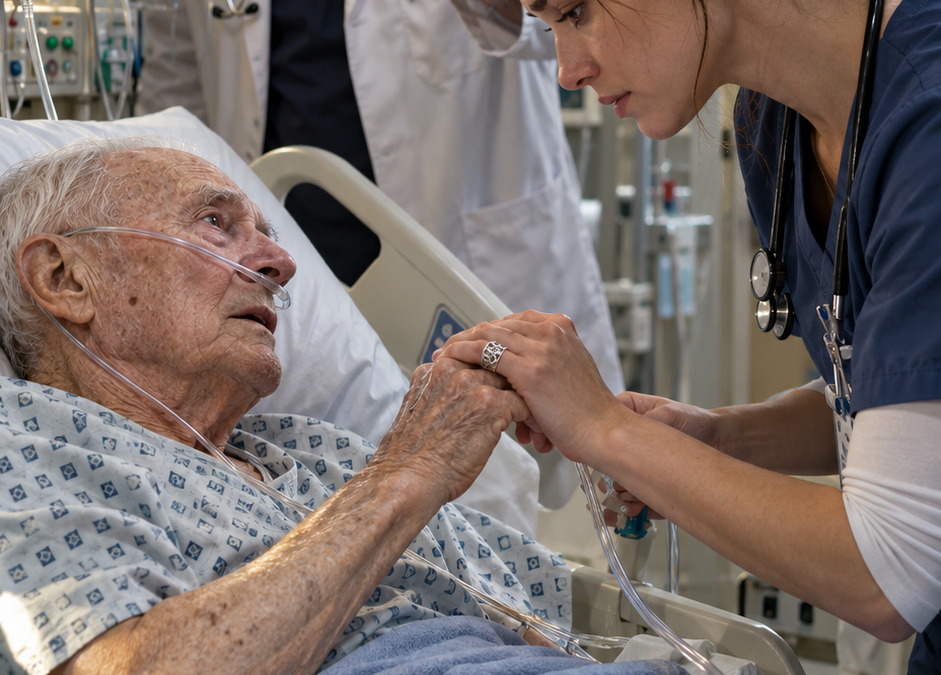
Thomas’s thumb rested against the old silver ring on my finger.
My grandfather’s ring.
At least, that was what I had always believed.
“His oxygen saturation is dropping,” I said.
I kept my voice low because Thomas was already working too hard to breathe.
The monitor showed his saturation sliding from ninety to eighty-seven. His heart rate was climbing. His breaths had shortened over the past minute, his shoulders rising harder with each one.
Dr. Mason stepped closer.
“He’s comfort care. His assigned nurse is coming.”
“I know.”
“You have three other patients.”
“I know that too.”
Thomas was not mine.
That mattered.
Hospital assignments existed because confusion killed people. Nurses could not simply abandon their patients every time another room became difficult.
I had been walking past Room 214 when I heard the change in the monitor.
Not an alarm dramatic enough to empty the hallway.
Just a rhythm that was wrong.
I had looked through the open doorway and seen Thomas fighting for air.
So I had gone in.
Now Mason was right about the boundary.
What he did not understand was that the immediate problem had not been solved yet.
I traced Thomas’s oxygen line with my eyes.
The nasal cannula remained in place.
The flow rate was correct.
No obvious kink.
I watched his chest for two breaths.
Then three.
His right side rose slightly less than the left, but not enough to explain such a sudden deterioration by itself.
Thomas squeezed my hand.
His thumb pressed harder against my ring.
“Mr. Callahan, I need you to let me check one thing.”
He did not release me.
So I used my left hand.
I followed the tubing from his face to the wall outlet.
A loop had slipped between the mattress and the side rail.
Condensation had collected at the lowest point.
Thomas shifted beneath the blanket.
The loop flattened.
There.
I lifted the tubing free.
A small pocket of water moved through the line.
The flow steadied.
“Keep this above the rail,” I told the nursing assistant who had just entered behind Mason. “Moisture is collecting in the low point.”
She immediately clipped the tubing higher.
I raised Thomas’s head slightly while supporting his shoulder.
“Easy.”
His breathing began to change.
Not dramatically.
Nothing about dying becomes miraculous because one nurse notices one piece of tubing.
But the unnecessary struggle eased.
Eighty-eight.
Eighty-nine.
Ninety.
Ninety-one.
I watched the numbers and felt no relief.
They had bought him comfort.
Maybe minutes.
That was enough.
When someone is dying, you stop measuring the value of care only by whether it extends life.
Sometimes good care is removing one unnecessary battle.
Thomas had enough battles already.
Mason looked from the monitor to the corrected tubing.
“All right. It’s fixed.”
His voice softened.
His decision did not.
“Now step out. Kelly can take over.”
I nodded.
He was right.
Clinically, I had no reason to stay.
Then Thomas pulled my hand toward his chest.
It was barely a movement.
An inch.
Maybe two.
But deliberate.
I looked down.
His thumb moved slowly across the flattened face of my ring.
The silver had been worn smooth along one side from decades of use.
My grandfather, Evan Whitaker, had placed it in my palm three weeks before he died.
He had been sitting in the same kitchen chair he used every morning, his body smaller than I remembered it from childhood, his hands swollen enough that removing the ring had taken nearly a minute.
“Keep this one, Clare.”
That was all he said.
No speech.
No story.
I had asked him once if he was sure.
He had closed my fingers over it.
“Keep it.”
My grandfather had never liked questions about the past.
So I had learned not to force them.
Now Thomas Callahan stared at that ring as though every wall in Room 214 had disappeared.
His breathing changed again.
Not the oxygen problem.
He was trying to speak.
I leaned closer.
“Don’t force it.”
His lips moved anyway.
No sound.
He swallowed.
Tried again.
“Ev—”
I froze.
Mason stepped forward.
“That’s enough. He needs quiet.”
Thomas resisted when Mason tried to separate our hands.
Almost nothing remained in his grip, but he used all of it.
His eyes stayed fixed on the ring.
I felt something inside me shift.
Ten seconds earlier, I had been the nearest nurse.
Now I was carrying something he recognized.
“Mr. Callahan,” I said. “Are you trying to tell me something?”
His fingers tightened once.
Mason glanced toward the hall.
“Clare.”
Kelly, Thomas’s assigned nurse, was approaching.
“Out.”
I slowly opened Thomas’s hand.
His thumb remained caught against the ring for one final second before slipping away.
I stood.
I did not argue.
I did not tell Mason that I had fixed the oxygen line.
I did not use that as leverage to stay somewhere I was no longer clinically needed.
At the doorway, I looked back.
Thomas had turned his head toward me.
The movement clearly hurt.
One hand had lifted from the blanket.
Three inches.
Maybe four.
Reaching.
Toward me.
Toward the ring.
And then, through a breath that sounded too thin to carry anything meaningful, he said one word.
“Evan.”
I stopped.
Dr. Mason stopped too.
Thomas Callahan had just spoken my grandfather’s name.
For half a second, no one moved.
Then Mason lowered his voice.
“You still need to return to your assignment.”
I looked at him.
He was not cruel.
That was important.
It would have been easier if he were.
He was making the correct operational decision based on the information he had.
I had three patients.
Thomas had Kelly.
The floor did not stop functioning because a dying man had recognized my grandfather’s ring.
“I understand.”
I left.
But something had changed.
Thomas was no longer merely another patient on the unit.
He had become a question with a heartbeat.
And that heartbeat was running out of time.
I forced myself back into the work.
Medication check in 218.
Repositioning in 220.
A pain reassessment.
A call light.
Another medication.
Documentation.
Blood pressure.
Urine output.
The ordinary architecture of nursing.
I let it hold me together.
Emotion was not permission to become careless.
Every few minutes, though, my eyes returned to Room 214.
Its door remained partly open.
Kelly was inside.
She leaned toward Thomas, listened, adjusted something near his shoulder, then stepped into the hall.
She looked directly at me.
“He keeps asking for you.”
I put down the chart I was holding.
“Did he say why?”
“He says Evan.”
My stomach tightened.
“Then he points toward the door.”
Kelly looked at my hand.
I looked down too.
The ring suddenly felt heavier.
I turned it once with my thumb.
For the first time in years, I noticed something that should probably have bothered me long ago.
My grandfather had never been a jewelry man.
Not really.
He stopped wearing a watch when I was a teenager because he said clocks were everywhere.
Near the end of his life, swelling had made him take off his wedding band.
But this silver ring stayed.
Always.
At breakfast.
While working in the yard.
At family dinners.
During hospital appointments.
He never explained it.
And when I asked as a child why he wore it, he would cover it with his other hand and change the subject.
Mason approached the workstation.
He followed my gaze toward Room 214.
“You’re not going back in unless Kelly needs help.”
I met his eyes.
“Understood.”
The word cost more now.
Thomas was dying.
That changed the meaning of waiting.
This was no longer about whether I would eventually receive an explanation.
Eventually might not exist.
A few minutes passed.
Then Kelly called from the doorway.
“Clare.”
Mason looked up.
Kelly added, “Not Nurse Whitaker. Clare.”
I entered immediately.
Thomas had slipped lower against the pillows.
Kelly had already raised the head of his bed, moistened his lips, reduced the light, and removed the unnecessary noise of extra equipment.
She was good.
That mattered too.
This was not a story where everyone else had failed and only I understood the patient.
Kelly understood him.
Maybe that was why she understood what I needed to do next.
“He settles when he sees your hand,” she said.
I moved closer.
Not too close.
I did not present the ring like some artifact.
I simply rested my hand on the blanket where Thomas could see it.
His eyes found the silver immediately.
His jaw unclenched.
His breathing slowed.
A little.
That was enough.
“Thomas,” I said quietly. “You don’t have to tell me everything.”
His eyes moved to mine.
“Just tell me what you need.”
He tried to lift his hand.
Couldn’t.
I brought mine closer.
His thumb touched the ring.
Instead of rubbing across the outer surface, this time he pressed against the inner edge.
His expression changed.
“Turn it.”
I hesitated.
Kelly stayed silent.
I slipped the ring off.
It had been on my hand for years.
The pale strip of skin beneath it looked strangely vulnerable.
I rotated the band.
The interior was scratched, dulled, worn almost smooth.
Then the overhead light caught letters I had never noticed clearly.
T. CALLAHAN.
I stopped breathing.
For a moment I truly forgot how.
Thomas saw the engraving.
His eyes closed.
One tear slipped toward his temple.
Kelly pulled a chair beside the bed.
“Sit.”
I looked at her.
“I’ll cover your lights for five minutes.”
That was the first moment anyone on the unit stopped treating my presence in the room as an exception.
I sat.
Thomas opened his eyes.
“Evan kept it.”
I closed my fingers around the ring.
“Kept what?”
He stared at me.
“My promise.”
The words were barely sound.
But they changed everything.
I opened my hand again and looked at the engraving.
Thomas Callahan.
Not Evan Whitaker.
Not some family heirloom with a mysterious inscription.
Thomas.
My grandfather had spent decades wearing another man’s ring.
“Why?” I asked.
Thomas drew a shallow breath.
His mouth tightened with effort.
I leaned closer.
“You don’t have to tell me everything. Just what I need to understand.”
His eyes dropped to the ring.
“He wore it.”
“My grandfather?”
A faint nod.
“After we came home.”
I rubbed my thumb across the engraving.
“Why would Evan wear a ring with your name inside it?”
Thomas coughed.
Kelly reached toward the bedside cup.
He shook his head.
Words.
He wanted words.
We waited.
Eventually his breathing settled enough for one more sentence.
“That was mine.”
I looked at him.
The ring rested in my palm.
“You gave it to him?”
Thomas shook his head.
“No.”
A pause.
“He took it because I couldn’t carry it.”
I felt something tighten in my chest.
“What happened?”
Thomas opened his hand.
I placed the ring in it.
His fingers closed around the silver.
He looked calmer with it there.
Not healthier.
Not stronger.
Just less alone.
“I was supposed to come back for him.”
The sentence went through me slowly.
I thought of my grandfather sitting at the kitchen table.
The way he turned this ring whenever conversation drifted near the years he never discussed.
The way he had pressed it into my hand three weeks before dying.
Keep this one, Clare.
I had heard affection in those words.
Now they sounded more like instruction.
“Did he think you didn’t come back?” I asked.
Thomas looked at me.
His eyes filled.
“That’s what I need to know.”
The question changed shape inside me.
This was not about who Evan Whitaker had been to Thomas.
Thomas was asking what Evan had believed about him.
Whether he had spent decades believing a dying friendship ended in abandonment.
I slipped the ring back onto my finger.
Thomas watched.
“Then we start there.”
He stopped reaching.
That was how I knew I had finally understood.
He was not asking me to admire the ring.
He was asking me to carry a question.
I sat for another minute.
Then stood.
Thomas caught my sleeve.
Weakly.
“Don’t go.”
The shame on his face was immediate.
As if needing another person had become something he had spent a lifetime apologizing for.
“I have patients.”
His hand dropped.
“I know.”
I placed my hand over his.
“I’m coming back.”
That was the first promise I made to Thomas Callahan.
Outside, Kelly was finishing a medication task for one of my patients.
“I’ve got 218,” she said. “You take 220. Then go back.”
“Five minutes.”
“Do the job right.”
She did not smile.
“I’ll page you if Thomas changes.”
I completed what needed to be completed.
Not quickly.
Correctly.
That distinction mattered.
I documented my assessment.
Checked the medication.
Answered the question the patient’s daughter had been waiting to ask.
Then I returned to 214.
Thomas saw me the moment I entered.
He did not reach for the ring.
He waited.
Trust sometimes looks exactly like that.
I sat.
“Tell me what happened before Evan got the ring.”
Thomas closed his eyes.
For several breaths, I thought he might not answer.
Then he said, “It was mine before we deployed.”
“My father gave it to me.”
I looked at the band.
Its surface had been worn by two men before it ever reached me.
“Why did Evan have it?”
“When we got separated…”
Thomas stopped.
Breathed.
“I gave it to him.”
“Why?”
His eyes opened.
“So somebody would know I meant to return.”
That sentence was the first clean edge of the story.
I could finally see its shape.
The ring had not been a gift.
It had been collateral.
Proof.
A promise held in metal.
“You told him you would come back for it.”
Thomas nodded.
His eyes filled again.
For decades, he had remembered that promise not as hope but accusation.
I looked down at the ring.
Evan had kept it.
Not in a drawer.
Not in a box.
He wore it.
Every day.
That had to mean something.
But I stopped myself.
Meaning was dangerous when someone was desperate enough to accept anything.
I had been a nurse too long to confuse interpretation with fact.
“Then that’s what I need to understand,” I said. “Not whether Evan remembered you.”
Thomas looked at me.
“Why he kept something you were supposed to take back.”
His breathing caught.
There was fear in his face now.
A different kind.
The fear of finally receiving an answer after decades of surviving the question.
“There’s someone who knows,” he whispered.
“Who?”
“My daughter.”
Footsteps sounded outside before I could ask anything else.
A woman appeared in the doorway.
Late fifties.
Coat folded over one arm.
Face tight from the drive, the phone call, the knowledge that she was walking into a room where her father might die before she had decided what she wanted her final words to be.
Thomas turned his head.
“Emily.”
She crossed to him immediately.
Then saw me.
More precisely, she saw the ring.
Her steps stopped.
“Where did you get that?”
I looked down.
For one second, I considered removing it.
Showing her the engraving.
Explaining why I was sitting beside her father when I was not his assigned nurse.
I decided against it.
Thomas had very little energy left.
His room would not become a courtroom where I proved my right to occupy a chair.
“My grandfather gave it to me.”
Emily looked toward Thomas.
“Dad?”
He tried to answer.
Couldn’t.
She rushed to the bed.
I stepped back.
That mattered.
There are moments when being useful means moving closer.
Others when usefulness means surrendering the space without making someone ask.
Emily took Thomas’s hand.
I quietly checked the oxygen tubing from a distance.
Still clear.
Thomas’s eyes followed me.
Emily noticed.
“Do you know her?”
His fingers moved weakly toward my side of the bed.
“Evan.”
Emily froze.
The suspicion in her face changed.
Not disappeared.
Shifted.
“He hasn’t said that name in years.”
I stayed where I was.
“Who was Evan to him?” I asked.
Emily looked at her father.
“The one person he never talked about.”
She pulled the chair closer.
“When I was a kid, I thought Evan died in the war. Later I thought Dad blamed him for something.”
Thomas shook his head.
Tiny movement.
But definite.
Emily saw it.
I did too.
“He doesn’t blame Evan,” I said.
She turned toward me.
I touched the ring.
“He’s afraid Evan blamed him.”
Thomas’s grip tightened around his daughter’s hand.
His eyes closed.
Confirmation.
Emily stared at me.
“How do you know that?”
“He told me.”
She looked at the ring.
“And that?”
I removed it.
Held it in my palm.
“Your father’s name is engraved inside.”
Emily stared.
“T. Callahan.”
Her face went pale.
“That ring was his.”
“He says it was.”
Thomas opened his eyes.
“Mine.”
Emily covered her mouth.
Then she whispered, “I remember it.”
I looked at her.
“There’s a picture.”
She sat slowly.
“Grandma had one. Dad was wearing this before he deployed.”
Her eyes stayed fixed on the ring.
“After he came home, it was gone.”
Silence filled the room.
The ring was no longer only evidence of something between Thomas and Evan.
Its absence had existed inside Thomas’s family too.
Two households had been shaped by the same piece of silver without ever knowing what the other household knew.
Thomas’s breathing became more uneven.
Longer pauses.
Emily noticed me watching.
“Is he getting worse?”
“Yes.”
I would not lie.
“Should I get the doctor?”
“Kelly and Dr. Mason know his status.”
I looked at Thomas.
“Right now, staying may matter more.”
Emily studied me.
Then moved her chair just enough to open space beside the bed.
“Then stay.”
I did not move.
“As his nurse,” I said. “Not because of the ring.”
Something broke open in her expression.
She nodded.
I returned to Thomas.
He looked between us.
Then whispered, “Evan came back.”
I felt my hand go still.
Emily leaned closer.
“What does that mean?”
Thomas swallowed.
“I didn’t.”
The wound beneath the story finally appeared.
He was not afraid Evan had died waiting.
He was afraid Evan had survived.
Afraid the man he had promised to return for had lived long enough to interpret the failure.
“You didn’t go back,” I said softly.
Thomas looked straight at me.
No excuse.
No defense.
“I tried.”
Emily flinched.
I remained still.
“Then tell me only what matters now.”
His eyes stayed on mine.
“What do you need Evan to have known?”
Thomas turned toward the ring.
“That I didn’t choose to leave him.”
His voice almost disappeared.
Emily squeezed his hand.
“Dad, nobody needs the whole story.”
Thomas looked at her.
For decades, silence had probably protected him.
Protected her.
Protected whatever version of the past allowed the family to continue.
Now silence was heavier than truth.
“They pulled us out.”
He stopped for breath.
“Different route. Different truck.”
His fingers curled against the blanket.
“I kept saying Evan was still back there.”
Another breath.
“Nobody turned around.”
I could see the scene without details.
I did not want details.
Neither did Thomas.
This was not about reconstructing a battle.
It was about the moral injury left after it.
“And when you could go back?” I asked.
“Too late.”
Emily lowered her head.
“I searched.”
Thomas’s voice had become a whisper.
“Wrote letters. Asked everyone.”
He looked at me.
“Nothing.”
I understood then why the ring had become punishment in his mind.
He had handed Evan proof of an intention.
Then failed to fulfill it.
Eventually he learned Evan survived.
Somewhere.
Long enough to wear the ring.
Long enough to remember.
Thomas’s eyes searched mine.
“Did he hate me?”
The question was so quiet Emily closed her eyes.
My first instinct was immediate.
No.
Of course not.
My grandfather had never spoken Thomas’s name with anger.
But my grandfather had barely spoken Thomas’s name at all.
I had promised accuracy.
So I gave it.
“I don’t know.”
Thomas’s face tightened.
I continued.
“And I won’t invent an answer because you’re running out of time.”
Emily looked at me sharply.
For a second, I wondered if she would ask me to leave.
Thomas reacted differently.
His jaw relaxed.
Almost imperceptibly.
He believed me.
That was the terrible privilege of refusing cheap comfort.
I turned the ring around my finger.
A memory surfaced.
My grandfather.
Kitchen table.
Morning light.
I must have been fourteen.
Maybe fifteen.
I had asked why he never took off the strange ring.
He covered it with his opposite hand.
“Some promises belong to the person who made them.”
At the time, I thought he meant himself.
Now I wasn’t sure.
I looked at Thomas.
“He gave this to me three weeks before he died.”
Thomas’s breathing paused.
“Did he say why?”
“Not really.”
I touched the ring.
“He told me to keep it.”
Thomas looked devastated.
I raised a hand slightly.
“There was something else.”
He waited.
“Years earlier, I asked why he wore it.”
Thomas stared at me.
“He said, ‘Some promises belong to the person who made them.’”
The room went still.
Emily looked at her father.
Thomas’s hand began to shake.
“Maybe he meant me.”
“Maybe.”
I would not turn possibility into certainty.
“But there’s something we can say.”
Thomas looked up.
“You gave Evan the ring because you intended to return.”
He nodded.
“He kept it for decades.”
A tear moved slowly down Thomas’s cheek.
“That isn’t proof of forgiveness.”
“No.”
I let that sit.
“But it isn’t nothing.”
Thomas reached toward my hand.
I moved closer.
His fingers touched the ring.
Emily placed her hand over his.
Three hands around one old piece of silver.
Thomas stopped asking for a verdict.
For the first time, he seemed willing to stay inside uncertainty.
Then another memory surfaced.
This one newer.
Three weeks before Evan died.
The same morning he handed me the ring.
There had been words after Keep this one.
I had almost forgotten them because they made no sense at the time.
He had looked at me for a long time and said, “If the name ever finds you, don’t let him carry it alone.”
I had assumed illness had blurred his thinking.
Now my heart began pounding.
“There’s something else.”
Thomas’s eyes opened.
Emily’s fingers tightened.
“My grandfather said something before he died.”
I looked at Thomas.
“I think it was meant for you.”
Before I could continue, Mason entered.
He took one look at the monitor.
The pauses between Thomas’s breaths had grown longer.
“Clare.”
His voice was quiet.
“You need to step out. Family can stay. Kelly stays.”
Emily stood.
“She’s keeping him calm.”
“I understand.”
Mason looked at me.
“But Thomas is actively declining, and Clare has other patients.”
The order was still reasonable.
That made it hurt more.
Thomas heard the word out.
His eyes widened.
His hand lifted.
Reaching.
I looked at Mason.
Then at Thomas.
The ring sat between us like a message I had carried unknowingly for years.
I could shout it from the doorway.
Rush the words before anyone stopped me.
But Evan had not placed this ring in my hand so I could treat his final message like a line I needed to squeeze in before my shift moved on.
I covered Thomas’s hand.
“I’m not leaving without finishing what he asked me to carry.”
Mason’s expression hardened.
“Clare.”
“One minute.”
The monitor continued its slow rhythm.
Kelly stood near Thomas’s shoulder.
She did not ask me to move.
Emily stayed on his other side.
Then footsteps moved through the hallway.
A group from the hospital’s evening veterans remembrance ceremony was passing toward the elevators.
At the center walked General Robert Mercer in dress uniform.
I barely noticed him.
Mason did.
“We’ll discuss this outside.”
He lowered his voice.
“Nurse Whitaker, step away from the patient.”
I released Thomas only because I refused to let an argument happen over his bed.
I stood.
Behind me, Thomas made a faint sound.
My hand rose instinctively.
Thumb brushing the ring.
General Mercer had already passed the doorway.
Then he stopped.
I saw it from the corner of my eye.
He turned.
Not toward my face.
Toward my hand.
His expression changed.
He stepped backward.
The hallway seemed to narrow.
Mercer walked to the doorway.
“Excuse me.”
Mason moved aside.
The general pointed carefully.
“That ring.”
I looked down.
“Sir?”
“May I see it?”
I hesitated.
Then removed it.
Held it in my palm.
Mercer did not take it.
He leaned closer.
Turned the band slightly with one fingertip.
The engraving appeared.
T. CALLAHAN.
General Mercer went completely still.
Behind me, Thomas whispered, “Robert.”
Mercer looked toward the bed.
For the first time, I saw rank disappear from his face.
He was suddenly simply an old man hearing another old man call his name.
He entered the room.
Mason spoke.
“General, we were asking Nurse Whitaker to—”
“Don’t.”
Mercer did not raise his voice.
One word.
Nothing theatrical.
He looked at the ring.
Then at Thomas.
Then at me.
“Evan Whitaker wore that after the evacuation.”
My chest tightened.
“You knew him?”
Mercer looked back at Thomas.
“I knew both of them.”
Thomas’s face broke.
Not physically.
Something deeper.
Emily covered his hand.
Mercer stepped away from the doorway, clearing the path between me and the bed.
“I saw Evan wearing that ring when he came back looking for Tom.”
Thomas closed his eyes.
A sound left him.
Half breath.
Half sob.
Mason looked at me.
Then at Thomas.
Then nodded once and stepped aside.
No apology.
No argument.
The clinical boundary had changed because the situation had changed.
That was enough.
I returned to Thomas’s bedside.
He looked terrified.
Not of death.
Of the next sentence.
I put the ring back on my finger.
Then took his hand.
“Evan left me a message.”
Thomas’s eyes filled.
I leaned close.
“He said, ‘If the name ever finds you, don’t let him carry it alone.’”
Thomas stopped trying to speak.
I swallowed.
“There was more.”
The room seemed to hold its breath with him.
“Before he died, he told me that if I ever met Thomas Callahan, I was to tell him one thing.”
Thomas’s fingers tightened around mine.
I looked directly at him.
“You came back for me.”
His face changed.
I had never seen sixty years leave a person before.
But that was what it looked like.
His mouth opened.
No words came.
His shoulders dropped.
His fingers loosened.
Emily bent over his hand and began crying silently.
Mercer lowered his head.
I stayed where Mason had once ordered me not to stay.
And nobody asked me to leave.
Thomas did not answer with words.
For a while, he simply breathed.
Slowly.
Quietly.
Without fighting the oxygen.
Without fighting the bed.
Without fighting the past.
His thumb rested against my ring.
Emily wiped her face.
“All those years.”
Thomas looked at her.
“I’m sorry.”
She shook her head.
But I saw his hand tense.
He was about to turn his final minutes into another apology.
I did not interrupt.
This part did not belong to me.
I simply opened my hand beneath his.
He could hold on.
Or let go.
Thomas looked at our hands.
Then released mine.
Reached for his daughter.
Emily took him with both hands.
That was the moment I knew I could move back.
I slid my chair away slightly.
Emily caught my wrist.
“Stay.”
I stayed.
Thomas looked at me.
“He knew?”
I understood.
“Yes.”
My voice barely carried.
“He knew you came back for him.”
Thomas closed his eyes.
His chest rose.
Fell.
Waited longer than before.
Then rose again.
Emily bowed her head over his hand.
General Mercer turned toward the window.
Not leaving.
Giving privacy.
I watched Thomas’s face instead of the monitor.
There was nothing left for me to repair.
Nothing left for me to solve.
Sometimes nurses are trained so relentlessly to intervene that doing nothing can feel like failure.
But there is a difference between doing nothing and not interfering.
Thomas had arrived at a kind of peace.
My job was not to fill it with medical activity simply because stillness made the rest of us uncomfortable.
His eyes opened again.
He looked at the ring.
“He kept it.”
“Yes.”
Thomas looked at Emily.
“Tell her.”
Emily frowned.
“Tell me what?”
His voice had almost disappeared.
“I tried.”
She pressed his hand to her cheek.
“I know, Dad.”
Thomas watched her.
This time, he believed her.
His shoulders settled deeper into the pillow.
I placed two fingers lightly against his wrist.
Not looking for a miracle.
Only remaining present.
His breaths moved farther apart.
Emily knew.
I did not have to explain.
Mercer knew too.
The room became incredibly quiet.
Thomas inhaled.
Exhaled.
Then nothing.
I waited.
Another second.
Another.
No rise of his chest.
I called Kelly softly.
She returned.
Dr. Mason followed.
He performed the assessment.
The formal steps.
The necessary confirmation.
Then he pronounced Thomas Callahan dead.
No one rushed Emily away.
No one immediately moved the bed.
No one filled the room with equipment.
We let her hold her father’s hand.
Minutes passed.
Finally, Emily stood.
Her eyes moved to my ring.
She touched the worn edge.
“I spent most of my life thinking whatever happened back then took my father away from us.”
She looked toward Thomas.
“Maybe part of him was just waiting for someone to tell him the story ended differently.”
I looked at him.
Then removed the ring.
I placed it in Emily’s palm.
She stared at it.
“No.”
She tried to hand it back.
I closed her fingers around it.
“Just for tonight.”
Her face folded.
She returned to the bed.
Opened Thomas’s hand.
Placed the ring against his palm.
For the first time in decades, Thomas Callahan held the ring that had once been his.
Emily folded his fingers over it.
I stood several feet away.
The object had traveled from Thomas to Evan.
From Evan to me.
Now back to Thomas.
For one quiet minute, the promise completed its circle.
Then Emily lifted the ring from her father’s hand.
She walked back to me.
I held out my palm.
She did not place it there.
Instead, she took my right hand and slid the ring onto my finger herself.
Then closed my fingers.
No one said thank you.
I was grateful for that.
Some moments are too large for gratitude.
“Keep it,” she whispered.
I looked at the ring.
For the first time, I understood that keeping it had never meant preserving grief.
It meant carrying what had finally been released from grief.
Emily returned to her father.
I started toward the hallway.
“Clare.”
I turned.
She was staring at my hand.
“He used to do that.”
I looked down.
Without realizing it, I had been rotating the ring slowly with my thumb.
“Do what?”
“Rub it like that.”
Her voice softened.
“Whenever he wanted to say something and couldn’t.”
I stopped moving the ring.
For a few seconds, neither of us spoke.
Emily walked over.
She turned my palm upward.
Touched the worn silver.
“Keep it where he could see it.”
I understood.
Do not hide it.
Do not turn it inward because the history hurt.
Let the promise exist in daylight.
I nodded.
Emily released me.
When I stepped into the corridor, Mason was waiting.
He moved aside before I had to ask.
A clear path back to my patients.
No apology.
No lecture.
No defense of his earlier order.
I appreciated that more than I would have appreciated a speech.
He had been right before.
The circumstances had changed.
Good medicine requires enough humility to change with them.
As I passed him, he said quietly, “You caught the oxygen line.”
I stopped.
“Yes.”
“And you were right to fix it.”
I looked at him.
“But you were right that Kelly needed to take over.”
A faint nod.
Neither of us needed the other to have been wrong.
He looked toward Thomas’s room.
“Some things don’t fit assignment boards very well.”
“No.”
Then I went back to work.
Kelly set a chart beside me.
“218 needs her medication.”
“I’ve got it.”
My hands returned to familiar tasks.
Scan.
Confirm.
Check.
Explain.
Listen.
Document.
A few minutes later, while adjusting an IV line, my thumb moved automatically toward the silver ring.
I stopped.
Then left it alone.
The engraving rested on the inside as it always had.
Thomas’s name hidden against my skin.
But the ring itself remained visible.
Not as proof that I had belonged beside his bed.
Not as proof that General Mercer had recognized it.
Not even as proof that my grandfather had forgiven an old friend.
It was something quieter.
Proof that a promise can survive misunderstanding.
Proof that silence does not always mean rejection.
Proof that a person can spend half a lifetime believing one version of a story while another version waits patiently inside something as small as a ring.
My shift continued.
There were no dramatic announcements.
No one gathered around me at the nurses’ station.
General Mercer eventually left.
Emily stayed with her father.
Mason returned to his patients.
Kelly resumed hers.
The floor kept moving.
Hospitals are good at that.
Life ends in one room.
Someone laughs in another.
A baby cries three floors away.
A family receives good news.
Another family makes funeral calls.
A nurse washes her hands.
A monitor begins alarming.
A medication becomes due.
The world does not stop.
Near the end of my shift, I passed Room 214 one last time.
The door was open.
Thomas had already been prepared for transfer.
Emily stood beside him alone.
She looked up when she saw me.
Neither of us spoke.
She touched her own thumb and forefinger together in the same small motion Thomas had used against the ring.
I looked at mine.
She smiled through exhaustion.
Not happiness.
Something gentler.
Release.
Then I continued walking.
At the nurses’ station, I sat to finish my notes.
The chart asked for objective facts.
Oxygen flow obstruction corrected.
Patient comfort improved.
Family present.
Patient expired with family at bedside.
Those sentences were true.
They were also almost nothing.
Charts rarely have a place for the part that matters most.
There was no field for:
A dying man recognized the promise he thought he had broken.
No box for:
A daughter learned her father had not spent decades forgetting his friend, but fearing he had failed him.
No checkbox for:
An old ring carried words across half a century.
And nowhere to document:
A nurse discovered that the quietest object she owned had been carrying someone else’s unfinished goodbye.
So I wrote only what belonged in the medical record.
Then I closed the chart.
My grandfather’s ring caught the fluorescent light.
I thought of him at the kitchen table.
Older.
Tired.
Turning the band.
Keep this one, Clare.
At last, I understood.
He had never asked me to keep the ring because it belonged to him.
He asked me to keep it because one day it might find its way back to the story it came from.
And somehow, it had.
Thomas Callahan had not died waiting for forgiveness.
He had died knowing the promise he believed he had broken had been understood for what it truly was.
An intention interrupted.
A return attempted.
A friendship remembered.
I stood.
Clipped my pen into my scrub pocket.
And went to check on the next patient.
The ring stayed on my hand.
Visible.
No longer heavy.
No longer mysterious.
Just silver warmed by skin, holding two names, two lives, and one promise that had finally reached the person who needed to hear its ending.








