𝗙𝗨𝗟𝗟 𝗦𝗧𝗢𝗥𝗬 The Ditch They Fined Me For Was the Only Thing Keeping Their Neighborhood Above Water
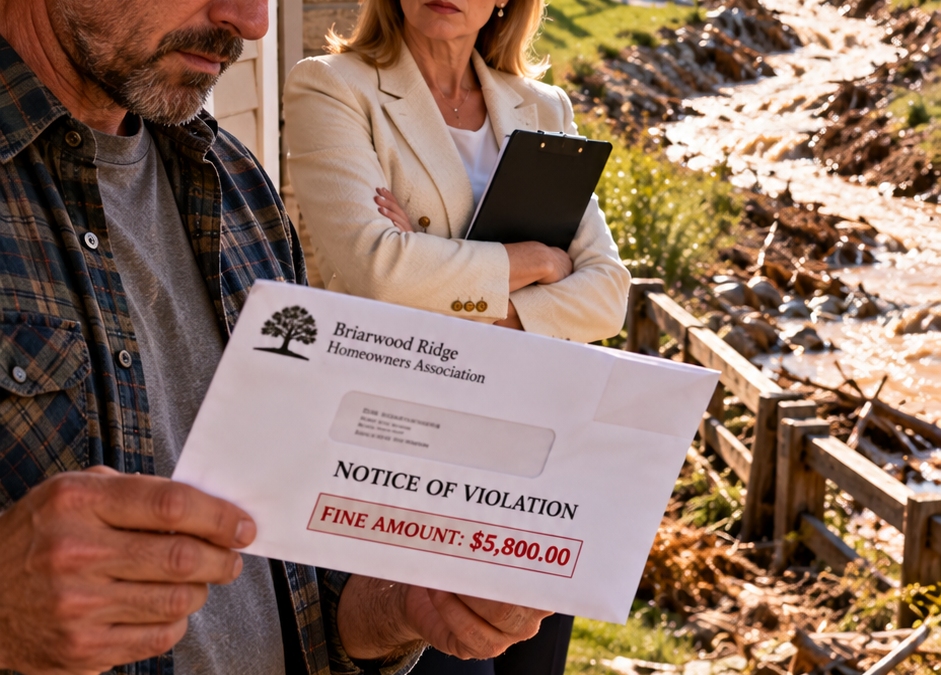
𝗙𝗨𝗟𝗟 𝗦𝗧𝗢𝗥𝗬
The paper was thick. The tape was carefully placed. My name was typed, not handwritten. Everything about it had been prepared by someone who wanted the envelope to feel official.
I pulled it from the door and opened it on the porch.
The first line read:
NOTICE OF VIOLATION: DRAINAGE CHANNEL NONCOMPLIANCE
I kept reading.
By the time I reached the amount, I felt my jaw tighten.
$5,800.
The HOA was fining me $5,800 for failure to maintain a drainage ditch according to Briarwood Ridge community storm water standards.
I read it again.
Then a third time.
Not because it was complicated.
Because it was insane.
The notice claimed the ditch behind my property was part of the “Briarwood Ridge storm water management corridor.” It said I had failed to keep it clear, graded, compliant, and aesthetically maintained. It demanded immediate corrective action, payment of the fine, and submission of a maintenance plan to the HOA architectural and infrastructure committee.
A maintenance plan.
For my ditch.
On my land.
I looked toward the eastern fence line where Briarwood Ridge sat beyond the trees.
For a moment, I just listened.
No engines. No voices. No wind. Only the faint creak of the porch boards under my boots.
Then I laughed once.
Not because it was funny.
Because sometimes nonsense is so complete that anger has to wait its turn.
The next morning, Victoria arrived.
Of course she did.
She came down my driveway in a dark SUV and parked near the barn without waiting for permission. She stepped out wearing a navy blazer, cream blouse, and rubber boots that looked like they had been purchased that week specifically so she could stand near mud without appearing unprepared.
She had two folders tucked under one arm.
That was Victoria’s version of a weapon.
I was near the lower fence when she found me. The ditch lay behind me, shallow and quiet that morning, with thin water moving through the center from rain earlier in the week.
Victoria did not greet me.
She pointed toward the ditch.
“That is the problem.”
I leaned one arm on the fence post.
“Good morning to you too.”
She ignored that.
“You received the notice?”
“I did.”
“Then you understand the matter.”
“No,” I said. “I understand the bill. The matter still makes no sense.”
Her expression tightened.
“The drainage channel is out of compliance.”
“With whose rules?”
“With Briarwood Ridge storm water standards.”
“I am not in Briarwood Ridge.”
“The drainage channel affects Briarwood Ridge.”
“Rain affects Briarwood Ridge. That doesn’t mean you can fine the sky.”
She gave me the patient smile of someone who had already decided I was difficult.
“Mr. Ward, this ditch carries runoff from the community.”
“Some runoff, yes.”
“Then it must be maintained properly.”
“It is maintained.”
“Not according to our standards.”
“Your standards do not apply to my ranch.”
Victoria opened one folder and pulled out a printed photograph. It showed the ditch after a storm, brown water high against the bank, debris gathered near the bend.
She held it up as if she had caught me committing a crime.
“This was documented last month.”
“I know,” I said. “I cleared that debris the next day.”
“The condition should not have existed.”
“That debris came from your side.”
“That is an allegation.”
“It was a sprinkler head, two HOA mulch bags, and a section of pipe with a Briarwood maintenance sticker still on it.”
Her eyes flickered.
Only for a second.
Then she recovered.
“Regardless of source, the channel is your responsibility.”
“According to what document?”
“The HOA has always managed the storm water system.”
“Managed what part?”
“The system connected to this drainage corridor.”
I looked at the ditch, then back at her.
“Victoria, what authority does the HOA have over this ditch?”
She lifted her chin.
“The association has storm water rights.”
“What kind of rights?”
“Rights of management and compliance.”
“That sounds invented.”
Her lips pressed together.
“It is not invented.”
“Then show me the recorded document.”
She looked down at the folder.
Not opening it this time.
That told me enough.
“You don’t have it with you,” I said.
“The HOA records are clear.”
“Then bring the record.”
She took one step closer to the fence.
“Every property owner connected to the storm water system has a duty to keep it compliant.”
“I own a ranch outside your subdivision.”
“You benefit from the drainage system.”
“No,” I said. “Your neighborhood benefits from my ditch.”
That finally cracked her composure.
“The board will not tolerate obstruction or neglect.”
“Neither will I.”
She stared at me.
“You have fourteen days to pay the fine and submit a corrective plan. If you fail to comply, additional fines will accrue.”
“On what authority?”
“The notice states the authority.”
“The notice states your opinion.”
“You should be careful.”
I straightened.
The air between us changed.
Not dramatically. There was no shouting, no slammed gate, no theatrical threat. But the conversation crossed a line when she said that.
People like Victoria use soft warnings because they want deniability. They want you to feel threatened without giving you a clean sentence to quote later.
I had spent too many years around land disputes to miss it.
“I am being careful,” I said. “That is why I am asking for documents.”
She slid the photograph back into her folder.
“You will receive further correspondence.”
“I’m sure I will.”
She turned and walked back toward her SUV.
Before she got in, she looked once more toward the ditch.
“You may think that channel is yours,” she said, “but Briarwood Ridge depends on it.”
I held her gaze.
“Then Briarwood Ridge should have treated it better.”
She drove away without answering.
That night, I pulled every property document I owned from the fireproof file box in my office.
The deed. The survey. The closing documents. The title policy. Old correspondence from the county. A folded drainage exhibit from the year Briarwood Ridge was first approved. I spread everything across the kitchen table and made coffee strong enough to keep me awake through the details.
The house was quiet except for the hum of the refrigerator and the paper shifting under my hands.
I started with the deed.
My parcel description ran cleanly down to the drainage channel, across the lower boundary, and around the back acreage. The ditch was not described as HOA land. It was inside my property.
That much I expected.
Then I opened the old survey.
I traced the boundary with one finger, following the line from the road, down past the pasture, around the low bend, and along the ditch.
There it was.
The drainage channel lay clearly inside my ranch.
But near the margin, I saw a note I had not paid close attention to in years.
Storm water access and conveyance permission benefiting Briarwood Ridge subdivision, subject to recorded conditions, Book 782, Page 114.
I sat back.
The words were small, but they changed the shape of the dispute.
Permission.
Not ownership.
Access and conveyance.
Not control.
Subject to recorded conditions.
That phrase mattered most.
I found the old drainage exhibit next. It referenced the same recording information. I had seen it years earlier, during closing, but at the time the attorney explained it simply: the subdivision had a limited right to send ordinary storm water runoff through the existing channel as long as certain conditions were met.
Back then, it had not worried me.
The ditch already carried water. The subdivision had drainage infrastructure designed to meter and direct runoff. The arrangement seemed practical. The key word, my attorney had told me, was limited.
Now that word glowed on the page.
Limited.
I made copies of everything.
Then I read the HOA violation notice again.
Victoria had not used the word permission.
She had written as if the HOA possessed authority over the ditch itself. As if their access rights had somehow grown into management power over my land. As if their dependence on my drainage channel gave them the right to fine me for owning it.
That was not a misunderstanding.
That was a reach.
The next morning, Victoria returned with two men.
One was an HOA board member named Paul Jennings, a retired accountant who always looked uncomfortable when standing in daylight. The other was a contractor in a bright safety vest who kept glancing at the ditch like he had already estimated the bill in his head.
Victoria carried a different folder this time.
Thicker.
She approached while I was repairing a section of pasture fence.
“Mr. Ward,” she said. “We need to discuss corrective work.”
“No, we need to discuss authority.”
Paul cleared his throat. “The board believes this can still be resolved cooperatively.”
“That depends on your definition of cooperative.”
Victoria opened her folder and handed me a printed estimate.
The number at the bottom was just over $12,000.
I stared at it.
“What is this?”
“A preliminary remediation estimate,” she said.
“For what?”
“Regrading, clearing, bank stabilization, vegetation control, and compliance restoration.”
“Compliance with what?”
“Storm water standards.”
I looked at the contractor.
“Did you prepare this?”
He nodded reluctantly. “Based on the scope I was given.”
“Did you inspect the upstream system?”
He looked at Victoria.
“That wasn’t part of the request.”
I handed the estimate back.
“No.”
Victoria’s eyes narrowed.
“No?”
“No. I’m not paying twelve thousand dollars to repair a system your neighborhood is overwhelming.”
Paul shifted.
“Mr. Ward, the runoff passes through your property.”
“Under limited permission.”
Victoria’s head lifted.
“So you found the agreement.”
“I found the recorded permission.”
“Then you understand you cannot interfere with storm water flow.”
“I understand more than that.”
She looked annoyed.
“The HOA has a right to use the channel.”
“Conditionally.”
Paul frowned. “Conditionally?”
I looked at him.
“You don’t know your own agreement?”
Victoria cut in.
“The agreement permits storm water conveyance.”
“It permits ordinary runoff if the subdivision maintains its upstream infrastructure.”
Her expression went still.
That was the first time I knew she had not read it carefully.
She had known enough to claim a right.
Not enough to understand the burden attached to it.
“You are misinterpreting,” she said.
“Then show me the clause that lets you fine me.”
“The fine relates to noncompliance.”
“Again, with what authority?”
“The HOA will pursue legal action if you interfere with storm water flow.”
“I’m not interfering with anything. I’m asking why your failed system is sending excessive runoff and debris into my ditch.”
Victoria’s voice dropped.
“You should not make accusations you cannot prove.”
That was a gift.
Because proof was exactly where this was going.
I folded the estimate and handed it back to her.
“I’m going to the county.”
Victoria’s face tightened.
“That is unnecessary.”
“Then you shouldn’t mind.”
Paul looked between us.
“I think county clarification may be helpful.”
Victoria turned toward him sharply.
He looked away.
The contractor took one step back, smart enough to recognize a fight that did not belong to him.
Victoria closed her folder.
“You have fourteen days,” she said.
“For what?”
“To comply before further action.”
I looked past her toward the ditch.
Water moved slowly through the channel, harmless that morning, but I could see the scars along the bank from the last big storm. I could see where the flow had bitten into my soil. I could see broken reeds flattened by water that had come too fast, too hard, and too dirty.
“No,” I said. “You have fourteen days to start telling the truth.”
She left furious.
I went to the county office the same afternoon.
The storm water division sat in a low brick building behind the courthouse, the kind of place nobody visits unless something has gone wrong. Inside, it smelled faintly of copier toner, old carpet, and rain jackets drying too slowly.
Daniel Moreno met me at the counter.
I knew him by sight. He had been with the county for years, first in public works, then storm water compliance. He was in his early fifties, with silver at his temples, calm eyes, and a voice that made bureaucratic sentences sound less painful than they were.
“What can I do for you, Jack?”
I placed the HOA notice on the counter.
He read the top line.
Then he read the fine amount.
His eyebrows lifted.
“That’s ambitious.”
“That’s one word for it.”
He motioned me toward his office.
I laid out my deed, survey, drainage exhibit, and the violation notice on his desk. Daniel took his time with each page. He did not perform outrage. Good county people rarely do. They know records are patient, and if you read them properly, they usually speak loud enough.
When he reached the recorded drainage permission, he leaned closer.
“Book 782, Page 114,” he murmured.
“Can you pull the original?”
“Give me a minute.”
He turned to his computer and searched the county records. The printer beside his desk clicked and hummed. A few pages slid out.
Daniel read the original document silently.
His expression changed halfway down the second page.
“There it is,” he said.
“What?”
He turned the page toward me and tapped a paragraph.
“The HOA has limited storm water conveyance permission through the existing channel on your property. But they are required to maintain upstream detention, sediment control, and inlet structures to prevent increased burden on the downstream private channel.”
I looked at the paragraph.
There it was in plain language.
Not elegant. Not dramatic.
But clear.
Briarwood Ridge could send ordinary storm water through the channel only if its own infrastructure was properly maintained and only if the discharge did not materially increase erosion, debris load, obstruction, or maintenance burden on my property.
Daniel kept reading.
Then he tapped another section.
“And here’s the termination provision.”
I leaned in.
“If the benefiting party fails to maintain upstream infrastructure after written notice of documented deficiency, and such failure causes material burden or damage to the private channel, the property owner may withdraw conveyance permission following county verification and notice procedures.”
I read that paragraph twice.
Then I looked at Daniel.
“So they can lose permission.”
“If the conditions are met, yes.”
“Have they been met?”
He sat back.
“We would need to inspect.”
“Then let’s inspect.”
Daniel looked at the clock.
“I can come out tomorrow morning.”
I gathered the papers carefully.
Before I left, he said, “Jack, don’t do anything physical to block the flow.”
“I wasn’t planning to.”
“Good. Keep everything documented. Photos, dates, rainfall, debris, bank erosion. If the HOA is overloading your channel, we need evidence.”
“You’ll have it.”
“I suspect you already do.”
He was right.
The next morning, Daniel arrived in a county truck with a tablet, measuring rod, camera, and a pair of mud boots that looked like they had earned their condition honestly.
We started at my ditch.
He photographed the channel, the eroded bank near the bend, the debris caught in the fence line, and the widened cut where high water had eaten into the soil. He measured sediment depth in three places. He checked the culvert under the ranch path. He took notes without much commentary.
Then we followed the drainage route upstream toward Briarwood Ridge.
That was where the story changed from dispute to evidence.
The first inlet was partially blocked by leaves and trash. Not normal storm debris from one rain, but compacted buildup. The grate had not been cleared in months. Maybe longer.
The second inlet was worse.
Mud had settled thick inside the catch basin. Water marks stained the concrete well above the intended flow line. Grass clippings and mulch had formed a mat near the outlet. Daniel photographed everything.
“This should have been cleaned,” he said.
“How often?”
“After major storms at minimum. Regularly during wet season.”
“Does it look regular?”
He did not answer immediately.
Then he said, “No.”
We moved farther uphill.
Behind the Briarwood Ridge clubhouse, a detention basin sat half-choked with cattails and sediment. Its outlet structure was partially obstructed. One side had eroded where water had bypassed the designed control point and cut a shortcut toward the drainage swale leading to my land.
Daniel stood there for a long time, looking at it.
“This is not functioning as designed.”
I folded my arms.
“That water comes to me.”
“Yes,” he said. “More directly than it should.”
Near the walking trail, we found another problem. A maintenance crew had piled landscaping debris near a shallow swale. During storms, that debris washed downhill. Some of it had likely ended up in my ditch.
Daniel photographed that too.
By noon, he had enough.
We stood near the property line where the HOA’s system emptied toward my channel. The sun had burned through the clouds, and the wet ground smelled sour with mud.
Daniel looked at his notes.
“The issue is not that your ditch is neglected.”
“I know.”
“Their upstream system is failing maintenance.”
“I know that too.”
He glanced at me.
“But now the county knows.”
That sentence gave me the first real breath I had taken since finding the notice on my door.
Daniel prepared a preliminary inspection memo within forty-eight hours.
It was not emotional. That made it stronger.
The memo stated that the drainage channel on my property was privately owned. It confirmed Briarwood Ridge’s conveyance permission was limited and conditional. It documented upstream maintenance failures, including obstructed inlets, sediment buildup, debris accumulation, impaired detention basin function, and increased downstream burden. It found that the HOA’s neglected infrastructure was contributing to excessive runoff force, debris load, and erosion within my private channel.
Then came the line that mattered most.
The observed downstream impacts are not attributable to failure by the private property owner to maintain the channel, but to deficiencies in the benefiting party’s upstream storm water infrastructure.
I printed that sentence and set it beside the $5,800 fine.
The contrast was beautiful.
Victoria had tried to turn their failure into my violation.
The county had put the responsibility back where it belonged.
The next HOA meeting was scheduled for the following Tuesday.
I had no interest in attending their meetings, but Daniel was presenting the county findings, and I wanted every board member to watch the record unfold in public.
The meeting took place in the Briarwood Ridge clubhouse, a building with polished floors, soft chairs, framed community photos, and a long table where the board sat as if presiding over something more serious than lawn violations and pool passes.
Residents filled most of the room.
Drainage had become a neighborhood issue, and people wanted answers. Some had water in their yards. Some had muddy sidewalks. Some had heard rumors that the ranch owner—me—was refusing to fix the ditch and threatening to block the neighborhood’s runoff.
Victoria sat at the center of the board table.
She looked composed.
That was her talent.
Composure without honesty.
Paul Jennings sat two seats away, flipping nervously through a packet. The other board members avoided looking at me when I entered. Daniel sat near the front with a county folder on his lap.
Victoria opened the meeting with procedural language.
I let her talk.
She referred to “ongoing storm water concerns.” She said the HOA had attempted to work with neighboring property owners. She said certain maintenance obligations had been disputed. She said the board was committed to protecting residents from flooding.
She did not mention the $5,800 fine.
Not at first.
Then she introduced Daniel.
He stood, adjusted his glasses, and walked to the front.
His presentation lasted less than fifteen minutes.
That was all it took.
He displayed the county map first. My property boundary appeared clearly, with the drainage channel inside it. Then he showed the recorded storm water conveyance permission. He explained that Briarwood Ridge did not own the ditch. The HOA did not control it. The HOA did not have general management authority over it.
They had a limited right to send qualifying storm water through it under specific conditions.
The room changed when he said that.
Residents shifted in their seats. Someone whispered, “Wait, we don’t own it?” A man in the second row leaned forward. A woman near the back raised her phone to take a picture of the slide.
Victoria’s face remained still.
But her hands tightened around her pen.
Daniel continued.
He explained the maintenance obligations attached to the permission. Upstream detention facilities. Sediment controls. Inlets. Outlet structures. Debris prevention. Flow regulation.
Then he showed the inspection photos.
Blocked grate.
Sediment-filled basin.
Eroded bypass.
Landscape debris near the swale.
Outlet obstruction.
My damaged ditch bank.
The room grew quieter with each image.
This was not theory anymore.
This was their infrastructure, neglected in color.
Daniel pointed to the final slide.
“Based on the inspection, the downstream burden appears to be caused by deficiencies in Briarwood Ridge’s upstream storm water system, not by a failure of the downstream private owner to maintain the drainage channel.”
Paul closed his eyes briefly.
One resident said, “So why was he fined?”
The question came from the back.
Victoria looked toward the voice.
“We will address enforcement matters after the county presentation.”
Daniel said, “I can only speak to the county records and inspection findings. The drainage channel is private property. The HOA’s rights are limited. Any enforcement action should be consistent with the recorded agreement.”
A man stood near the aisle.
“My backyard floods every time it rains. Are you saying the HOA hasn’t maintained the system?”
Daniel answered carefully.
“I’m saying the inspection documented maintenance deficiencies in HOA-controlled upstream infrastructure.”
That was county language for yes.
The room understood.
Victoria tried to recover control.
“Thank you, Mr. Moreno. The board appreciates the county’s preliminary input.”
Daniel did not sit down.
“There is one more item.”
Victoria’s eyes flicked toward him.
He opened the recorded agreement.
“The agreement includes a termination provision. If the benefiting party fails to maintain upstream infrastructure after documented deficiency, and that failure materially burdens the private channel, the property owner may withdraw conveyance permission following county verification and notice.”
The room went very still.
That was the moment the board understood what Victoria’s fine had awakened.
Until then, they thought they were arguing about $5,800.
They were not.
They were arguing about the legal right to use the one drainage channel their neighborhood depended on.
I stood.
Victoria looked at me as if she could stop me by staring.
She could not.
“My name is Jack Ward,” I said. “My ranch borders Briarwood Ridge to the west. The drainage ditch behind my property is mine. It has always been mine. Your HOA has been allowed to send limited storm water through that channel under recorded conditions. Those conditions required your system to be maintained.”
I held up the violation notice.
“Instead of maintaining your system, the HOA fined me $5,800 for the damage your neglected infrastructure caused.”
People turned toward the board.
I placed the notice on the table in front of Victoria.
Then I placed Daniel’s inspection memo beside it.
“These two documents cannot both be true,” I said. “The county record shows which one is.”
Victoria’s voice was tight.
“Mr. Ward, this is not the proper format for—”
“No,” I said. “Sending me a false fine for private property was not the proper format.”
A murmur moved through the room.
Paul leaned toward his microphone.
“Let’s allow him to finish.”
Victoria shot him a look sharp enough to cut paper.
I continued.
“Under the recorded drainage agreement and based on the county’s documented findings, I am formally notifying Briarwood Ridge HOA that its storm water conveyance permission through my private drainage channel is being withdrawn according to the recorded terms, subject to the required notice period and county procedures.”
For a moment, no one moved.
Then several people started talking at once.
“What does that mean?”
“Can he do that?”
“Where will the water go?”
“What happens if it rains?”
Victoria stood.
“This is an outrageous threat.”
“It is not a threat,” I said. “It is the agreement you failed to read.”
Daniel spoke before she could respond.
“The recorded agreement does contain the provision he referenced. The county will follow its process, but the provision exists.”
A woman in the front row turned toward Victoria.
“You told us the ditch was part of our system.”
Victoria said, “It is part of the drainage network.”
“That’s not what he asked,” another resident said.
The room was slipping away from her.
I saw it happen the same way I had seen water escape a clogged basin. Slowly at first, then all at once.
Paul took the microphone again.
“Victoria, did legal review the fine before it was issued?”
She sat down.
“That matter is privileged.”
“That sounds like no,” someone muttered.
A man near the back stood.
“My house is one of the ones that floods. Are you telling me the board spent time fining a rancher instead of fixing the drainage system?”
Victoria said, “The board has acted in good faith.”
I looked at the residents.
“Good faith would have started with maintaining your own inlets.”
Daniel gathered his papers, but he remained standing near the front in case more technical questions came. He answered several. He explained that Briarwood Ridge would need to submit a corrective drainage plan. He explained that if access through my ditch was withdrawn or restricted, the HOA would need an alternative lawful discharge route, upgraded detention capacity, or an engineered solution on land it controlled.
Every answer made the board look worse.
Because every answer had a cost attached.
By the end of the meeting, the $5,800 fine had become almost laughable.
Not because it was small to me.
Because it had exposed a problem that would cost the HOA far more than $5,800 to solve.
After the meeting, Victoria approached me near the clubhouse doors.
For once, she did not have a folder in her hand.
That made her look less certain.
“This could have been handled privately,” she said.
I looked at her.
“You taped the fine to my front door.”
“The board was enforcing standards.”
“No. The board was shifting blame.”
Her eyes hardened.
“You are putting the neighborhood at risk.”
“The neighborhood put itself at risk by neglecting its drainage system.”
“People’s homes could flood.”
“Then fix your system.”
“We need that channel.”
“You needed it enough to depend on it. Not enough to respect the conditions attached to it.”
She stepped closer.
“You cannot simply cut off storm water flow.”
“I am following the recorded procedure.”
“You are exploiting a technicality.”
I almost laughed.
A recorded condition protecting private land from upstream abuse was not a technicality. It was the entire point of the agreement.
“Victoria, you fined me for a ditch you don’t own because your system failed. You are not upset about a technicality. You are upset because the document says no to you.”
For the first time, she looked genuinely afraid.
Not of me.
Of the cost.
That fear spread quickly.
Within a week, the HOA attorney sent a letter withdrawing the $5,800 fine “pending further review.”
My attorney responded that pending was not good enough. The fine was invalid because the HOA lacked authority over the private drainage channel and because the county inspection contradicted the stated basis of the violation.
Three days later, the fine was formally rescinded.
No apology.
But rescinded.
Then came the bigger negotiations.
The HOA wanted temporary continued use of the ditch while they developed a corrective plan. My attorney told them continued use would require strict conditions: immediate upstream cleanup, sediment removal, basin restoration, regular inspections, debris control, written acknowledgment of my ownership, reimbursement for documented damage, and a binding timeline for construction of an alternative drainage solution.
Victoria resisted.
The board overruled her.
That was when I knew her power was breaking.
Two months later, Briarwood Ridge hired an engineering firm.
Real engineers this time, not board members with maps and confidence. They surveyed the upstream system, modeled storm flow, and confirmed what Daniel had already shown: the subdivision had been sending more water, at higher velocity, with more debris into my ditch than the original permission allowed.
The solution was expensive.
They had to restore the detention basin, replace undersized outlet controls, install sediment traps, regrade a swale near the walking trail, and design a new drainage path across HOA-controlled common area that would eventually reduce dependence on my channel.
Residents were furious when they saw the projected cost.
Not at me.
At the board.
The special assessment meeting was brutal, according to Paul, who had started calling me occasionally with updates once he realized honesty was safer than silence. Residents demanded to know why routine maintenance had been deferred. Why inspection reports had not been done. Why old maps had been treated like legal documents. Why the board had fined a private landowner instead of disclosing the infrastructure failure.
Victoria tried to defend the board’s actions.
This time, almost nobody listened.
One resident stood and read aloud from the county memo. Another asked whether the HOA’s insurance had been notified. Someone else asked whether board members could be personally liable for knowingly ignoring the recorded drainage conditions.
That question ended the meeting’s polite portion.
Victoria resigned two weeks later.
The official notice called it a personal decision.
Nobody believed that.
Her resignation did not fix the ditch.
Paper never does the physical work.
Crews came in over the next several months. They cleaned the inlets. They dredged sediment from the detention basin. They hauled away rotted landscaping debris that should never have been piled near a drainage swale. They rebuilt the eroded bypass and installed proper outlet protection. They placed monitoring markers near the discharge point so flow impacts could be measured after major storms.
For the first time in years, the upstream system began functioning the way it had been designed to function.
My ditch noticed before anyone else did.
After the first big rain that spring, I walked down behind the pasture expecting the usual damage.
The water was high, but not violent. It moved fast in the center but did not chew at the bank the way it had before. There was debris, but not the piles of HOA trash I had been pulling out for months. The bend held. The fence line stayed clear.
I stood there in the rain with my coat soaked through, watching brown water do what it was supposed to do.
For a man who owns land, few things are more satisfying than water behaving.
Daniel came out the next day for a follow-up inspection.
He walked the channel with me, checking the bank, culvert, and flow line. He took photos again, but this time his notes were shorter.
“Better,” he said.
“Much.”
“Still want to withdraw permission permanently?”
I looked upstream.
That was the question I had been turning over for weeks.
The agreement gave me the right to withdraw. The HOA had violated the conditions. The county had verified the deficiencies. My attorney believed I had a strong position if I wanted to end their use entirely.
Part of me wanted to.
Not because I hated the residents.
Because I was tired of my land being treated like an emergency backup plan for other people’s failures.
But I also understood water.
Blocking a lawful drainage route without a transition could create harm, even if the HOA deserved the consequences. The goal was not revenge. The goal was control, respect, and a system that did not sacrifice my ranch because a board found maintenance inconvenient.
So I chose a middle path.
Temporary conditional permission would continue only under a new written agreement, with strict inspection rights, maintenance obligations, flow limits, reimbursement provisions, and automatic suspension if the HOA failed again.
And most importantly, Briarwood Ridge had to keep building its own long-term drainage solution on its own land.
Daniel nodded when I told him.
“That’s reasonable.”
“It doesn’t feel generous.”
“It doesn’t need to. It needs to be enforceable.”
That was Daniel’s gift.
He understood that fairness without enforcement is just hope wearing a nice shirt.
The final agreement took another month.
This time, every word mattered.
The HOA acknowledged in writing that the drainage ditch was private property located on my ranch. It acknowledged that its storm water conveyance rights were limited, conditional, and revocable under recorded terms. It withdrew the fine permanently. It reimbursed my documented cleanup and erosion repair costs. It agreed to quarterly upstream inspections for two years, then annual inspections after that. It agreed to maintain sediment controls and detention facilities. It agreed not to issue any future violation, fine, or directive concerning my ditch.
And it committed to constructing a drainage improvement project on HOA-controlled land.
When I signed, I did not feel triumphant.
I felt careful.
That is what property disputes teach you. Winning does not mean relaxing. It means the record is finally strong enough to stand when someone else decides to test it.
The construction project began that summer.
Residents complained about the noise, the cost, the torn-up walking trail, and the temporary fencing around the detention basin. I understood their frustration. Nobody likes paying for invisible systems. People will spend thousands on landscaping they can admire from the porch, but drainage? Drainage only gets attention when it fails.
Still, the work mattered.
The HOA rebuilt what it had neglected.
They installed new inlet protection, improved the basin outlet, and redirected part of the flow through a reinforced swale on common property. They added access points for maintenance crews so no one could claim the system was too difficult to service. They adopted an inspection schedule and, according to Paul, actually funded it.
Imagine that.
Maintaining the system they depended on.
By fall, the difference was obvious.
My ditch still carried water. It always would. That was its job. But it no longer carried the HOA’s neglect like a punishment. The flow after storms was cleaner, slower, and closer to what the original agreement had allowed.
The land began to heal.
Grass returned along the bank. The eroded bend stabilized. I repaired the fence line for the last time that year and did not have to pull a single broken sprinkler head out of the channel afterward.
One afternoon, months after Victoria resigned, I found Paul standing near my front gate.
He had called first.
That alone put him miles ahead of Victoria.
I walked down to meet him.
He looked tired but relieved.
“The board approved the final drainage closeout report,” he said.
“Good.”
“We also approved a corrected infrastructure map.”
“That should help.”
“It removes your ditch from HOA-maintained assets.”
“It was never in them.”
“I know.”
He handed me a copy.
The map showed Briarwood Ridge’s actual drainage infrastructure in blue. My property line was clearly marked. My ditch was labeled private downstream channel subject to limited recorded conveyance agreement.
Dry language.
Accurate language.
The best kind.
Paul shifted his weight.
“I wanted to say something else.”
I waited.
“I voted for the fine.”
I looked at him.
He did not look away.
“Victoria told us legal had confirmed authority. She said the ditch was part of the HOA drainage corridor. I didn’t check. I should have.”
“Yes, you should have.”
He nodded.
“I’m sorry.”
I studied him for a moment.
There are apologies people offer because they want forgiveness quickly. This did not sound like that. It sounded like a man tired of defending something he knew had been wrong.
“Don’t let the next president use a map as a deed,” I said.
He gave a small, embarrassed smile.
“We’ve learned that lesson.”
“I hope so.”
He left the corrected map with me.
I filed it behind the agreement.
That folder had become thick by then. Deed, survey, drainage permission, violation notice, county memo, inspection photographs, attorney letters, rescission, new agreement, corrected map.
A complete record.
A paper wall.
The kind Victoria should have respected before she taped a $5,800 fine to my door.
Winter came quietly.
The first heavy storm arrived in December, with rain that hammered the roof all night and turned the pasture dark by morning. I woke before sunrise and listened to water rushing somewhere beyond the house.
Old habit pulled me out of bed.
I put on boots, rain gear, and a headlamp, then walked down toward the ditch.
The sky was still black. The beam from my headlamp caught silver streaks of rain. Mud sucked at my boots near the lower gate. The air smelled raw and cold.
When I reached the ditch, I stood under the dripping branches and watched.
Water ran strong through the channel, but it stayed where it belonged. The bank held. The bend held. The culvert cleared. No trash jammed the fence. No violent surge tore at the soil. Upstream, beyond the property line, the HOA’s restored system was finally doing its job before the water reached me.
I turned off the headlamp for a moment.
In the dark, I could hear the flow better.
Steady.
Controlled.
Alive, but not destructive.
That sound brought me more peace than silence would have.
Because silence can hide neglect.
Good drainage makes noise.
It tells you the system is working.
The next morning, I found a small envelope in my mailbox.
No HOA logo on the outside.
Inside was a handwritten note from a Briarwood Ridge resident named Marcy Ellis. I knew the name only because her house was one of the lower lots that used to flood.
The note was short.
Mr. Ward, our yard stayed dry during last night’s storm for the first time in three years. I know there was conflict, but I wanted to say thank you for forcing the issue. We were told the problem was your ditch. It wasn’t. I’m sorry we believed that.
I stood at the mailbox longer than I expected.
That note did not erase what happened.
But it mattered.
Not because I needed gratitude from the neighborhood. I did not.
It mattered because truth had finally traveled farther than Victoria’s version.
That was all I had wanted from the beginning.
The ditch had never been the villain. I had never been the obstruction. My ranch had not caused Briarwood Ridge’s flooding. Their own neglected system had.
And once the records were opened, the whole story changed.
Victoria had believed the $5,800 fine would pressure me into fixing her problem. She thought I would see the amount, worry about legal trouble, and pay for repairs the HOA should have handled years earlier. She thought “storm water compliance” sounded intimidating enough to cover the weakness in her claim.
But she misunderstood the land.
She misunderstood the agreement.
And she misunderstood me.
I was not against drainage. I was not against cooperation. I was not even against helping water move safely through the place it had always moved.
I was against being blamed for someone else’s neglect.
I was against the HOA treating permission like ownership.
I was against a board pointing at my ranch and calling it infrastructure because they did not want to pay for their own.
That is the thing about property rights. People like to talk about them when they want to protect what belongs to them, but they become strangely flexible when what belongs to someone else is useful.
A ditch is easy to dismiss.
It is not a house. It is not a barn. It is not a front gate with a name on it. It is just a low channel in the ground, muddy after rain and dry when the weather holds.
But that low channel carried more than water.
It carried the line between permission and control.
Between cooperation and exploitation.
Between what the HOA had a right to use and what it had no right to command.
Victoria missed that line completely.
The county did not.
The records did not.
And after that winter storm, even Briarwood Ridge could not pretend anymore.
Months later, I saw Victoria one last time.
She was standing near the clubhouse parking lot while I drove past on the county road with fencing supplies in the bed of my truck. She looked different without the board title attached to her. Still polished. Still stiff. But smaller somehow, as if the room around her no longer adjusted to make space for her certainty.
She saw me through the windshield.
I did not slow down.
She looked away first.
That was enough.
I went home, unloaded the supplies, and walked the back fence near sunset. The ditch was dry then, lined with winter grass and scattered stones. Nothing dramatic. Nothing impressive. Just a quiet channel waiting for the next rain.
I stopped at the bend where the erosion had once been worst.
New grass had rooted there. The bank was firm under my boot. On the far side, a few small animal tracks crossed the mud near the waterline.
The land was repairing itself.
Slowly.
Correctly.
Without a committee.
I stood there until the sky turned orange behind the bare trees.
Then I turned toward the house.
Behind me, the ditch remained where it had always been, inside my boundary, doing the work it had always done. The difference was that now everyone knew the truth.
The HOA did not own it.
Their map did not control it.
Their fine did not define it.
They had been granted a limited permission, and when they violated the conditions attached to that permission, the agreement they ignored became the very thing that stopped them.
That was the lesson Victoria should have learned before taping a notice to my door.
A neighborhood can depend on your land without owning it.
A board can issue a fine without having the authority to enforce it.
And a drainage ditch, no matter how ordinary it looks, can carry enough truth to wash an entire lie downstream.
𝗧𝗛𝗘 𝗘𝗡𝗗
The Ditch They Fined Me For Was the Only Thing Keeping Their Neighborhood Above Water
The notice on my door looked ordinary until I saw the amount printed at the bottom.
Victoria stood behind it with the confidence of a woman who believed a fine could turn my land into her responsibility.
By the time the county opened the old drainage records, her $5,800 demand had become the smallest problem the HOA had created for itself.
The drainage ditch behind my property had been there longer than I had.
It was not pretty. It was not meant to be. In dry months, it looked like a shallow scar running through the lower part of my ranch, full of pale grass, cracked mud, and stones that shifted under your boots. After a hard rain, it became something else entirely. Water rushed through it with purpose, brown and fast, carrying leaves, silt, twigs, and whatever else the hills gave up during a storm.
I respected that ditch.
A person who owns land learns to respect water. Water does not care about fences, signs, board meetings, neighborhood standards, or polite notices taped to doors. It follows grade. It finds weakness. It remembers every low place.
That ditch carried storm water safely away from my ranch, my barn, my pasture, and the neighboring lowlands. It had done that job for decades. My father knew it. The man who owned the ranch before him knew it. The county knew it. The original surveyor who mapped the drainage channel knew it.
The HOA next door did not.
Or maybe they knew just enough to be dangerous.
My ranch sat west of Briarwood Ridge, a subdivision that had been built long after my family’s fences were already gray with age. The neighborhood had stone pillars at the entrance, ornamental trees along the main road, and a homeowners association that seemed to believe every inch of land visible from its sidewalks somehow belonged to its jurisdiction.
I had dealt with them before.
Complaints about dust from my gravel drive. Complaints about the look of my barn roof. Complaints about my equipment shed being visible from their walking trail. They once sent me a letter asking me to “harmonize” my fence line with the community aesthetic.
I mailed it back with one sentence written across the bottom.
My fence predates your community.
That kept them quiet for a while.
Then Victoria Hale became HOA president.
Victoria was different from the others. She was not just fussy. She was strategic. She knew how to make overreach sound like policy. She knew how to turn a preference into a standard, a standard into a violation, and a violation into an invoice.
She carried herself like every conversation had already been decided before she entered it.
The first time I met her, she stood at the edge of my pasture in a cream-colored coat, holding a tablet, telling me the HOA had concerns about “water management compliance.”
I asked her what that had to do with me.
She gave me a thin smile and said, “Storm water does not stop at property lines.”
I told her neither did legal liability.
She did not smile after that.
For months, I heard little things through neighbors and contractors. Briarwood Ridge had drainage problems. Water pooled near the back row of houses after storms. The walking trail washed out twice. A section near their clubhouse stayed muddy even during dry weeks. One homeowner complained that his backyard turned into a pond every time it rained more than an inch.
None of that surprised me.
The subdivision had been built fast. Developers love drainage plans until the lots are sold. After that, every pipe, swale, basin, grate, and culvert becomes someone else’s maintenance burden. If those systems are neglected long enough, the water finds its own way.
In Briarwood Ridge, that way was toward my land.
My ditch had always carried some runoff from the area. That part was not new. The original development agreement had allowed a limited amount of ordinary storm water to pass through the channel, back when the subdivision was approved. I knew something like that existed, but I had never needed to study it closely because, for years, the flow stayed manageable.
Then it changed.
After heavy rain, the ditch began filling faster than it should have. The water ran higher, dirtier, and more violently. It carved at the banks. It pushed debris into the bend near my lower fence. It left trash tangled in the grass—plastic mulch bags, broken sprinkler heads, a child’s orange ball, even pieces of black corrugated pipe.
I repaired what I could.
I cleared brush. I pulled debris. I reinforced the bank near the pasture. I paid a local equipment operator to reshape one eroded section after a storm took a bite out of it.
I did that because the ditch was on my land.
I did not do it because the HOA had authority over it.
There is a difference.
That difference became the center of everything one Thursday afternoon.
I had spent the morning fixing a gate latch on the south pasture. By the time I walked back to the house, my gloves were stiff with dust and my shoulders ached from lifting the old metal frame into place. I wanted coffee, a shower, and maybe twenty quiet minutes before I checked the feed inventory.
Instead, I found a white envelope taped to my front door.
It had the Briarwood Ridge HOA logo printed in the corner.
I stood there for a second, looking at it.
There are certain things you know before you open them.
The paper was thick. The tape was carefully placed. My name was typed, not handwritten. Everything about it had been prepared by someone who wanted the envelope to feel official.
I pulled it from the door and opened it on the porch.
The first line read:
NOTICE OF VIOLATION: DRAINAGE CHANNEL NONCOMPLIANCE
I kept reading.
By the time I reached the amount, I felt my jaw tighten.
$5,800.
The HOA was fining me $5,800 for failure to maintain a drainage ditch according to Briarwood Ridge community storm water standards.
I read it again.
Then a third time.
Not because it was complicated.
Because it was insane.
The notice claimed the ditch behind my property was part of the “Briarwood Ridge storm water management corridor.” It said I had failed to keep it clear, graded, compliant, and aesthetically maintained. It demanded immediate corrective action, payment of the fine, and submission of a maintenance plan to the HOA architectural and infrastructure committee.
A maintenance plan.
For my ditch.
On my land.
I looked toward the eastern fence line where Briarwood Ridge sat beyond the trees.
For a moment, I just listened.
No engines. No voices. No wind. Only the faint creak of the porch boards under my boots.
Then I laughed once.
Not because it was funny.
Because sometimes nonsense is so complete that anger has to wait its turn.
The next morning, Victoria arrived.
Of course she did.
She came down my driveway in a dark SUV and parked near the barn without waiting for permission. She stepped out wearing a navy blazer, cream blouse, and rubber boots that looked like they had been purchased that week specifically so she could stand near mud without appearing unprepared.
She had two folders tucked under one arm.
That was Victoria’s version of a weapon.
I was near the lower fence when she found me. The ditch lay behind me, shallow and quiet that morning, with thin water moving through the center from rain earlier in the week.
Victoria did not greet me.
She pointed toward the ditch.
“That is the problem.”
I leaned one arm on the fence post.
“Good morning to you too.”
She ignored that.
“You received the notice?”
“I did.”
“Then you understand the matter.”
“No,” I said. “I understand the bill. The matter still makes no sense.”
Her expression tightened.
“The drainage channel is out of compliance.”
“With whose rules?”
“With Briarwood Ridge storm water standards.”
“I am not in Briarwood Ridge.”
“The drainage channel affects Briarwood Ridge.”
“Rain affects Briarwood Ridge. That doesn’t mean you can fine the sky.”
She gave me the patient smile of someone who had already decided I was difficult.
“Mr. Ward, this ditch carries runoff from the community.”
“Some runoff, yes.”
“Then it must be maintained properly.”
“It is maintained.”
“Not according to our standards.”
“Your standards do not apply to my ranch.”
Victoria opened one folder and pulled out a printed photograph. It showed the ditch after a storm, brown water high against the bank, debris gathered near the bend.
She held it up as if she had caught me committing a crime.
“This was documented last month.”
“I know,” I said. “I cleared that debris the next day.”
“The condition should not have existed.”
“That debris came from your side.”
“That is an allegation.”
“It was a sprinkler head, two HOA mulch bags, and a section of pipe with a Briarwood maintenance sticker still on it.”
Her eyes flickered.
Only for a second.
Then she recovered.
“Regardless of source, the channel is your responsibility.”
“According to what document?”
“The HOA has always managed the storm water system.”
“Managed what part?”
“The system connected to this drainage corridor.”
I looked at the ditch, then back at her.
“Victoria, what authority does the HOA have over this ditch?”
She lifted her chin.
“The association has storm water rights.”
“What kind of rights?”
“Rights of management and compliance.”
“That sounds invented.”
Her lips pressed together.
“It is not invented.”
“Then show me the recorded document.”
She looked down at the folder.
Not opening it this time.
That told me enough.
“You don’t have it with you,” I said.
“The HOA records are clear.”
“Then bring the record.”
She took one step closer to the fence.
“Every property owner connected to the storm water system has a duty to keep it compliant.”
“I own a ranch outside your subdivision.”
“You benefit from the drainage system.”
“No,” I said. “Your neighborhood benefits from my ditch.”
That finally cracked her composure.
“The board will not tolerate obstruction or neglect.”
“Neither will I.”
She stared at me.
“You have fourteen days to pay the fine and submit a corrective plan. If you fail to comply, additional fines will accrue.”
“On what authority?”
“The notice states the authority.”
“The notice states your opinion.”
“You should be careful.”
I straightened.
The air between us changed.
Not dramatically. There was no shouting, no slammed gate, no theatrical threat. But the conversation crossed a line when she said that.
People like Victoria use soft warnings because they want deniability. They want you to feel threatened without giving you a clean sentence to quote later.
I had spent too many years around land disputes to miss it.
“I am being careful,” I said. “That is why I am asking for documents.”
She slid the photograph back into her folder.
“You will receive further correspondence.”
“I’m sure I will.”
She turned and walked back toward her SUV.
Before she got in, she looked once more toward the ditch.
“You may think that channel is yours,” she said, “but Briarwood Ridge depends on it.”
I held her gaze.
“Then Briarwood Ridge should have treated it better.”
She drove away without answering.
That night, I pulled every property document I owned from the fireproof file box in my office.
The deed. The survey. The closing documents. The title policy. Old correspondence from the county. A folded drainage exhibit from the year Briarwood Ridge was first approved. I spread everything across the kitchen table and made coffee strong enough to keep me awake through the details.
The house was quiet except for the hum of the refrigerator and the paper shifting under my hands.
I started with the deed.
My parcel description ran cleanly down to the drainage channel, across the lower boundary, and around the back acreage. The ditch was not described as HOA land. It was inside my property.
That much I expected.
Then I opened the old survey.
I traced the boundary with one finger, following the line from the road, down past the pasture, around the low bend, and along the ditch.
There it was.
The drainage channel lay clearly inside my ranch.
But near the margin, I saw a note I had not paid close attention to in years.
Storm water access and conveyance permission benefiting Briarwood Ridge subdivision, subject to recorded conditions, Book 782, Page 114.
I sat back.
The words were small, but they changed the shape of the dispute.
Permission.
Not ownership.
Access and conveyance.
Not control.
Subject to recorded conditions.
That phrase mattered most.
I found the old drainage exhibit next. It referenced the same recording information. I had seen it years earlier, during closing, but at the time the attorney explained it simply: the subdivision had a limited right to send ordinary storm water runoff through the existing channel as long as certain conditions were met.
Back then, it had not worried me.
The ditch already carried water. The subdivision had drainage infrastructure designed to meter and direct runoff. The arrangement seemed practical. The key word, my attorney had told me, was limited.
Now that word glowed on the page.
Limited.
I made copies of everything.
Then I read the HOA violation notice again.
Victoria had not used the word permission.
She had written as if the HOA possessed authority over the ditch itself. As if their access rights had somehow grown into management power over my land. As if their dependence on my drainage channel gave them the right to fine me for owning it.
That was not a misunderstanding.
That was a reach.
The next morning, Victoria returned with two men.
One was an HOA board member named Paul Jennings, a retired accountant who always looked uncomfortable when standing in daylight. The other was a contractor in a bright safety vest who kept glancing at the ditch like he had already estimated the bill in his head.
Victoria carried a different folder this time.
Thicker.
She approached while I was repairing a section of pasture fence.
“Mr. Ward,” she said. “We need to discuss corrective work.”
“No, we need to discuss authority.”
Paul cleared his throat. “The board believes this can still be resolved cooperatively.”
“That depends on your definition of cooperative.”
Victoria opened her folder and handed me a printed estimate.
The number at the bottom was just over $12,000.
I stared at it.
“What is this?”
“A preliminary remediation estimate,” she said.
“For what?”
“Regrading, clearing, bank stabilization, vegetation control, and compliance restoration.”
“Compliance with what?”
“Storm water standards.”
I looked at the contractor.
“Did you prepare this?”
He nodded reluctantly. “Based on the scope I was given.”
“Did you inspect the upstream system?”
He looked at Victoria.
“That wasn’t part of the request.”
I handed the estimate back.
“No.”
Victoria’s eyes narrowed.
“No?”
“No. I’m not paying twelve thousand dollars to repair a system your neighborhood is overwhelming.”
Paul shifted.
“Mr. Ward, the runoff passes through your property.”
“Under limited permission.”
Victoria’s head lifted.
“So you found the agreement.”
“I found the recorded permission.”
“Then you understand you cannot interfere with storm water flow.”
“I understand more than that.”
She looked annoyed.
“The HOA has a right to use the channel.”
“Conditionally.”
Paul frowned. “Conditionally?”
I looked at him.
“You don’t know your own agreement?”
Victoria cut in.
“The agreement permits storm water conveyance.”
“It permits ordinary runoff if the subdivision maintains its upstream infrastructure.”
Her expression went still.
That was the first time I knew she had not read it carefully.
She had known enough to claim a right.
Not enough to understand the burden attached to it.
“You are misinterpreting,” she said.
“Then show me the clause that lets you fine me.”
“The fine relates to noncompliance.”
“Again, with what authority?”
“The HOA will pursue legal action if you interfere with storm water flow.”
“I’m not interfering with anything. I’m asking why your failed system is sending excessive runoff and debris into my ditch.”
Victoria’s voice dropped.
“You should not make accusations you cannot prove.”
That was a gift.
Because proof was exactly where this was going.
I folded the estimate and handed it back to her.
“I’m going to the county.”
Victoria’s face tightened.
“That is unnecessary.”
“Then you shouldn’t mind.”
Paul looked between us.
“I think county clarification may be helpful.”
Victoria turned toward him sharply.
He looked away.
The contractor took one step back, smart enough to recognize a fight that did not belong to him.
Victoria closed her folder.
“You have fourteen days,” she said.
“For what?”
“To comply before further action.”
I looked past her toward the ditch.
Water moved slowly through the channel, harmless that morning, but I could see the scars along the bank from the last big storm. I could see where the flow had bitten into my soil. I could see broken reeds flattened by water that had come too fast, too hard, and too dirty.
“No,” I said. “You have fourteen days to start telling the truth.”
She left furious.
I went to the county office the same afternoon.
The storm water division sat in a low brick building behind the courthouse, the kind of place nobody visits unless something has gone wrong. Inside, it smelled faintly of copier toner, old carpet, and rain jackets drying too slowly.
Daniel Moreno met me at the counter.
I knew him by sight. He had been with the county for years, first in public works, then storm water compliance. He was in his early fifties, with silver at his temples, calm eyes, and a voice that made bureaucratic sentences sound less painful than they were.
“What can I do for you, Jack?”
I placed the HOA notice on the counter.
He read the top line.
Then he read the fine amount.
His eyebrows lifted.
“That’s ambitious.”
“That’s one word for it.”
He motioned me toward his office.
I laid out my deed, survey, drainage exhibit, and the violation notice on his desk. Daniel took his time with each page. He did not perform outrage. Good county people rarely do. They know records are patient, and if you read them properly, they usually speak loud enough.
When he reached the recorded drainage permission, he leaned closer.
“Book 782, Page 114,” he murmured.
“Can you pull the original?”
“Give me a minute.”
He turned to his computer and searched the county records. The printer beside his desk clicked and hummed. A few pages slid out.
Daniel read the original document silently.
His expression changed halfway down the second page.
“There it is,” he said.
“What?”
He turned the page toward me and tapped a paragraph.
“The HOA has limited storm water conveyance permission through the existing channel on your property. But they are required to maintain upstream detention, sediment control, and inlet structures to prevent increased burden on the downstream private channel.”
I looked at the paragraph.
There it was in plain language.
Not elegant. Not dramatic.
But clear.
Briarwood Ridge could send ordinary storm water through the channel only if its own infrastructure was properly maintained and only if the discharge did not materially increase erosion, debris load, obstruction, or maintenance burden on my property.
Daniel kept reading.
Then he tapped another section.
“And here’s the termination provision.”
I leaned in.
“If the benefiting party fails to maintain upstream infrastructure after written notice of documented deficiency, and such failure causes material burden or damage to the private channel, the property owner may withdraw conveyance permission following county verification and notice procedures.”
I read that paragraph twice.
Then I looked at Daniel.
“So they can lose permission.”
“If the conditions are met, yes.”
“Have they been met?”
He sat back.
“We would need to inspect.”
“Then let’s inspect.”
Daniel looked at the clock.
“I can come out tomorrow morning.”
I gathered the papers carefully.
Before I left, he said, “Jack, don’t do anything physical to block the flow.”
“I wasn’t planning to.”
“Good. Keep everything documented. Photos, dates, rainfall, debris, bank erosion. If the HOA is overloading your channel, we need evidence.”
“You’ll have it.”
“I suspect you already do.”
He was right.
The next morning, Daniel arrived in a county truck with a tablet, measuring rod, camera, and a pair of mud boots that looked like they had earned their condition honestly.
We started at my ditch.
He photographed the channel, the eroded bank near the bend, the debris caught in the fence line, and the widened cut where high water had eaten into the soil. He measured sediment depth in three places. He checked the culvert under the ranch path. He took notes without much commentary.
Then we followed the drainage route upstream toward Briarwood Ridge.
That was where the story changed from dispute to evidence.
The first inlet was partially blocked by leaves and trash. Not normal storm debris from one rain, but compacted buildup. The grate had not been cleared in months. Maybe longer.
The second inlet was worse.
Mud had settled thick inside the catch basin. Water marks stained the concrete well above the intended flow line. Grass clippings and mulch had formed a mat near the outlet. Daniel photographed everything.
“This should have been cleaned,” he said.
“How often?”
“After major storms at minimum. Regularly during wet season.”
“Does it look regular?”
He did not answer immediately.
Then he said, “No.”
We moved farther uphill.
Behind the Briarwood Ridge clubhouse, a detention basin sat half-choked with cattails and sediment. Its outlet structure was partially obstructed. One side had eroded where water had bypassed the designed control point and cut a shortcut toward the drainage swale leading to my land.
Daniel stood there for a long time, looking at it.
“This is not functioning as designed.”
I folded my arms.
“That water comes to me.”
“Yes,” he said. “More directly than it should.”
Near the walking trail, we found another problem. A maintenance crew had piled landscaping debris near a shallow swale. During storms, that debris washed downhill. Some of it had likely ended up in my ditch.
Daniel photographed that too.
By noon, he had enough.
We stood near the property line where the HOA’s system emptied toward my channel. The sun had burned through the clouds, and the wet ground smelled sour with mud.
Daniel looked at his notes.
“The issue is not that your ditch is neglected.”
“I know.”
“Their upstream system is failing maintenance.”
“I know that too.”
He glanced at me.
“But now the county knows.”
That sentence gave me the first real breath I had taken since finding the notice on my door.
Daniel prepared a preliminary inspection memo within forty-eight hours.
It was not emotional. That made it stronger.
The memo stated that the drainage channel on my property was privately owned. It confirmed Briarwood Ridge’s conveyance permission was limited and conditional. It documented upstream maintenance failures, including obstructed inlets, sediment buildup, debris accumulation, impaired detention basin function, and increased downstream burden. It found that the HOA’s neglected infrastructure was contributing to excessive runoff force, debris load, and erosion within my private channel.
Then came the line that mattered most.
The observed downstream impacts are not attributable to failure by the private property owner to maintain the channel, but to deficiencies in the benefiting party’s upstream storm water infrastructure.
I printed that sentence and set it beside the $5,800 fine.
The contrast was beautiful.
Victoria had tried to turn their failure into my violation.
The county had put the responsibility back where it belonged.
The next HOA meeting was scheduled for the following Tuesday.
I had no interest in attending their meetings, but Daniel was presenting the county findings, and I wanted every board member to watch the record unfold in public.
The meeting took place in the Briarwood Ridge clubhouse, a building with polished floors, soft chairs, framed community photos, and a long table where the board sat as if presiding over something more serious than lawn violations and pool passes.
Residents filled most of the room.
Drainage had become a neighborhood issue, and people wanted answers. Some had water in their yards. Some had muddy sidewalks. Some had heard rumors that the ranch owner—me—was refusing to fix the ditch and threatening to block the neighborhood’s runoff.
Victoria sat at the center of the board table.
She looked composed.
That was her talent.
Composure without honesty.
Paul Jennings sat two seats away, flipping nervously through a packet. The other board members avoided looking at me when I entered. Daniel sat near the front with a county folder on his lap.
Victoria opened the meeting with procedural language.
I let her talk.
She referred to “ongoing storm water concerns.” She said the HOA had attempted to work with neighboring property owners. She said certain maintenance obligations had been disputed. She said the board was committed to protecting residents from flooding.
She did not mention the $5,800 fine.
Not at first.
Then she introduced Daniel.
He stood, adjusted his glasses, and walked to the front.
His presentation lasted less than fifteen minutes.
That was all it took.
He displayed the county map first. My property boundary appeared clearly, with the drainage channel inside it. Then he showed the recorded storm water conveyance permission. He explained that Briarwood Ridge did not own the ditch. The HOA did not control it. The HOA did not have general management authority over it.
They had a limited right to send qualifying storm water through it under specific conditions.
The room changed when he said that.
Residents shifted in their seats. Someone whispered, “Wait, we don’t own it?” A man in the second row leaned forward. A woman near the back raised her phone to take a picture of the slide.
Victoria’s face remained still.
But her hands tightened around her pen.
Daniel continued.
He explained the maintenance obligations attached to the permission. Upstream detention facilities. Sediment controls. Inlets. Outlet structures. Debris prevention. Flow regulation.
Then he showed the inspection photos.
Blocked grate.
Sediment-filled basin.
Eroded bypass.
Landscape debris near the swale.
Outlet obstruction.
My damaged ditch bank.
The room grew quieter with each image.
This was not theory anymore.
This was their infrastructure, neglected in color.
Daniel pointed to the final slide.
“Based on the inspection, the downstream burden appears to be caused by deficiencies in Briarwood Ridge’s upstream storm water system, not by a failure of the downstream private owner to maintain the drainage channel.”
Paul closed his eyes briefly.
One resident said, “So why was he fined?”
The question came from the back.
Victoria looked toward the voice.
“We will address enforcement matters after the county presentation.”
Daniel said, “I can only speak to the county records and inspection findings. The drainage channel is private property. The HOA’s rights are limited. Any enforcement action should be consistent with the recorded agreement.”
A man stood near the aisle.
“My backyard floods every time it rains. Are you saying the HOA hasn’t maintained the system?”
Daniel answered carefully.
“I’m saying the inspection documented maintenance deficiencies in HOA-controlled upstream infrastructure.”
That was county language for yes.
The room understood.
Victoria tried to recover control.
“Thank you, Mr. Moreno. The board appreciates the county’s preliminary input.”
Daniel did not sit down.
“There is one more item.”
Victoria’s eyes flicked toward him.
He opened the recorded agreement.
“The agreement includes a termination provision. If the benefiting party fails to maintain upstream infrastructure after documented deficiency, and that failure materially burdens the private channel, the property owner may withdraw conveyance permission following county verification and notice.”
The room went very still.
That was the moment the board understood what Victoria’s fine had awakened.
Until then, they thought they were arguing about $5,800.
They were not.
They were arguing about the legal right to use the one drainage channel their neighborhood depended on.
I stood.
Victoria looked at me as if she could stop me by staring.
She could not.
“My name is Jack Ward,” I said. “My ranch borders Briarwood Ridge to the west. The drainage ditch behind my property is mine. It has always been mine. Your HOA has been allowed to send limited storm water through that channel under recorded conditions. Those conditions required your system to be maintained.”
I held up the violation notice.
“Instead of maintaining your system, the HOA fined me $5,800 for the damage your neglected infrastructure caused.”
People turned toward the board.
I placed the notice on the table in front of Victoria.
Then I placed Daniel’s inspection memo beside it.
“These two documents cannot both be true,” I said. “The county record shows which one is.”
Victoria’s voice was tight.
“Mr. Ward, this is not the proper format for—”
“No,” I said. “Sending me a false fine for private property was not the proper format.”
A murmur moved through the room.
Paul leaned toward his microphone.
“Let’s allow him to finish.”
Victoria shot him a look sharp enough to cut paper.
I continued.
“Under the recorded drainage agreement and based on the county’s documented findings, I am formally notifying Briarwood Ridge HOA that its storm water conveyance permission through my private drainage channel is being withdrawn according to the recorded terms, subject to the required notice period and county procedures.”
For a moment, no one moved.
Then several people started talking at once.
“What does that mean?”
“Can he do that?”
“Where will the water go?”
“What happens if it rains?”
Victoria stood.
“This is an outrageous threat.”
“It is not a threat,” I said. “It is the agreement you failed to read.”
Daniel spoke before she could respond.
“The recorded agreement does contain the provision he referenced. The county will follow its process, but the provision exists.”
A woman in the front row turned toward Victoria.
“You told us the ditch was part of our system.”
Victoria said, “It is part of the drainage network.”
“That’s not what he asked,” another resident said.
The room was slipping away from her.
I saw it happen the same way I had seen water escape a clogged basin. Slowly at first, then all at once.
Paul took the microphone again.
“Victoria, did legal review the fine before it was issued?”
She sat down.
“That matter is privileged.”
“That sounds like no,” someone muttered.
A man near the back stood.
“My house is one of the ones that floods. Are you telling me the board spent time fining a rancher instead of fixing the drainage system?”
Victoria said, “The board has acted in good faith.”
I looked at the residents.
“Good faith would have started with maintaining your own inlets.”
Daniel gathered his papers, but he remained standing near the front in case more technical questions came. He answered several. He explained that Briarwood Ridge would need to submit a corrective drainage plan. He explained that if access through my ditch was withdrawn or restricted, the HOA would need an alternative lawful discharge route, upgraded detention capacity, or an engineered solution on land it controlled.
Every answer made the board look worse.
Because every answer had a cost attached.
By the end of the meeting, the $5,800 fine had become almost laughable.
Not because it was small to me.
Because it had exposed a problem that would cost the HOA far more than $5,800 to solve.
After the meeting, Victoria approached me near the clubhouse doors.
For once, she did not have a folder in her hand.
That made her look less certain.
“This could have been handled privately,” she said.
I looked at her.
“You taped the fine to my front door.”
“The board was enforcing standards.”
“No. The board was shifting blame.”
Her eyes hardened.
“You are putting the neighborhood at risk.”
“The neighborhood put itself at risk by neglecting its drainage system.”
“People’s homes could flood.”
“Then fix your system.”
“We need that channel.”
“You needed it enough to depend on it. Not enough to respect the conditions attached to it.”
She stepped closer.
“You cannot simply cut off storm water flow.”
“I am following the recorded procedure.”
“You are exploiting a technicality.”
I almost laughed.
A recorded condition protecting private land from upstream abuse was not a technicality. It was the entire point of the agreement.
“Victoria, you fined me for a ditch you don’t own because your system failed. You are not upset about a technicality. You are upset because the document says no to you.”
For the first time, she looked genuinely afraid.
Not of me.
Of the cost.
That fear spread quickly.
Within a week, the HOA attorney sent a letter withdrawing the $5,800 fine “pending further review.”
My attorney responded that pending was not good enough. The fine was invalid because the HOA lacked authority over the private drainage channel and because the county inspection contradicted the stated basis of the violation.
Three days later, the fine was formally rescinded.
No apology.
But rescinded.
Then came the bigger negotiations.
The HOA wanted temporary continued use of the ditch while they developed a corrective plan. My attorney told them continued use would require strict conditions: immediate upstream cleanup, sediment removal, basin restoration, regular inspections, debris control, written acknowledgment of my ownership, reimbursement for documented damage, and a binding timeline for construction of an alternative drainage solution.
Victoria resisted.
The board overruled her.
That was when I knew her power was breaking.
Two months later, Briarwood Ridge hired an engineering firm.
Real engineers this time, not board members with maps and confidence. They surveyed the upstream system, modeled storm flow, and confirmed what Daniel had already shown: the subdivision had been sending more water, at higher velocity, with more debris into my ditch than the original permission allowed.
The solution was expensive.
They had to restore the detention basin, replace undersized outlet controls, install sediment traps, regrade a swale near the walking trail, and design a new drainage path across HOA-controlled common area that would eventually reduce dependence on my channel.
Residents were furious when they saw the projected cost.
Not at me.
At the board.
The special assessment meeting was brutal, according to Paul, who had started calling me occasionally with updates once he realized honesty was safer than silence. Residents demanded to know why routine maintenance had been deferred. Why inspection reports had not been done. Why old maps had been treated like legal documents. Why the board had fined a private landowner instead of disclosing the infrastructure failure.
Victoria tried to defend the board’s actions.
This time, almost nobody listened.
One resident stood and read aloud from the county memo. Another asked whether the HOA’s insurance had been notified. Someone else asked whether board members could be personally liable for knowingly ignoring the recorded drainage conditions.
That question ended the meeting’s polite portion.
Victoria resigned two weeks later.
The official notice called it a personal decision.
Nobody believed that.
Her resignation did not fix the ditch.
Paper never does the physical work.
Crews came in over the next several months. They cleaned the inlets. They dredged sediment from the detention basin. They hauled away rotted landscaping debris that should never have been piled near a drainage swale. They rebuilt the eroded bypass and installed proper outlet protection. They placed monitoring markers near the discharge point so flow impacts could be measured after major storms.
For the first time in years, the upstream system began functioning the way it had been designed to function.
My ditch noticed before anyone else did.
After the first big rain that spring, I walked down behind the pasture expecting the usual damage.
The water was high, but not violent. It moved fast in the center but did not chew at the bank the way it had before. There was debris, but not the piles of HOA trash I had been pulling out for months. The bend held. The fence line stayed clear.
I stood there in the rain with my coat soaked through, watching brown water do what it was supposed to do.
For a man who owns land, few things are more satisfying than water behaving.
Daniel came out the next day for a follow-up inspection.
He walked the channel with me, checking the bank, culvert, and flow line. He took photos again, but this time his notes were shorter.
“Better,” he said.
“Much.”
“Still want to withdraw permission permanently?”
I looked upstream.
That was the question I had been turning over for weeks.
The agreement gave me the right to withdraw. The HOA had violated the conditions. The county had verified the deficiencies. My attorney believed I had a strong position if I wanted to end their use entirely.
Part of me wanted to.
Not because I hated the residents.
Because I was tired of my land being treated like an emergency backup plan for other people’s failures.
But I also understood water.
Blocking a lawful drainage route without a transition could create harm, even if the HOA deserved the consequences. The goal was not revenge. The goal was control, respect, and a system that did not sacrifice my ranch because a board found maintenance inconvenient.
So I chose a middle path.
Temporary conditional permission would continue only under a new written agreement, with strict inspection rights, maintenance obligations, flow limits, reimbursement provisions, and automatic suspension if the HOA failed again.
And most importantly, Briarwood Ridge had to keep building its own long-term drainage solution on its own land.
Daniel nodded when I told him.
“That’s reasonable.”
“It doesn’t feel generous.”
“It doesn’t need to. It needs to be enforceable.”
That was Daniel’s gift.
He understood that fairness without enforcement is just hope wearing a nice shirt.
The final agreement took another month.
This time, every word mattered.
The HOA acknowledged in writing that the drainage ditch was private property located on my ranch. It acknowledged that its storm water conveyance rights were limited, conditional, and revocable under recorded terms. It withdrew the fine permanently. It reimbursed my documented cleanup and erosion repair costs. It agreed to quarterly upstream inspections for two years, then annual inspections after that. It agreed to maintain sediment controls and detention facilities. It agreed not to issue any future violation, fine, or directive concerning my ditch.
And it committed to constructing a drainage improvement project on HOA-controlled land.
When I signed, I did not feel triumphant.
I felt careful.
That is what property disputes teach you. Winning does not mean relaxing. It means the record is finally strong enough to stand when someone else decides to test it.
The construction project began that summer.
Residents complained about the noise, the cost, the torn-up walking trail, and the temporary fencing around the detention basin. I understood their frustration. Nobody likes paying for invisible systems. People will spend thousands on landscaping they can admire from the porch, but drainage? Drainage only gets attention when it fails.
Still, the work mattered.
The HOA rebuilt what it had neglected.
They installed new inlet protection, improved the basin outlet, and redirected part of the flow through a reinforced swale on common property. They added access points for maintenance crews so no one could claim the system was too difficult to service. They adopted an inspection schedule and, according to Paul, actually funded it.
Imagine that.
Maintaining the system they depended on.
By fall, the difference was obvious.
My ditch still carried water. It always would. That was its job. But it no longer carried the HOA’s neglect like a punishment. The flow after storms was cleaner, slower, and closer to what the original agreement had allowed.
The land began to heal.
Grass returned along the bank. The eroded bend stabilized. I repaired the fence line for the last time that year and did not have to pull a single broken sprinkler head out of the channel afterward.
One afternoon, months after Victoria resigned, I found Paul standing near my front gate.
He had called first.
That alone put him miles ahead of Victoria.
I walked down to meet him.
He looked tired but relieved.
“The board approved the final drainage closeout report,” he said.
“Good.”
“We also approved a corrected infrastructure map.”
“That should help.”
“It removes your ditch from HOA-maintained assets.”
“It was never in them.”
“I know.”
He handed me a copy.
The map showed Briarwood Ridge’s actual drainage infrastructure in blue. My property line was clearly marked. My ditch was labeled private downstream channel subject to limited recorded conveyance agreement.
Dry language.
Accurate language.
The best kind.
Paul shifted his weight.
“I wanted to say something else.”
I waited.
“I voted for the fine.”
I looked at him.
He did not look away.
“Victoria told us legal had confirmed authority. She said the ditch was part of the HOA drainage corridor. I didn’t check. I should have.”
“Yes, you should have.”
He nodded.
“I’m sorry.”
I studied him for a moment.
There are apologies people offer because they want forgiveness quickly. This did not sound like that. It sounded like a man tired of defending something he knew had been wrong.
“Don’t let the next president use a map as a deed,” I said.
He gave a small, embarrassed smile.
“We’ve learned that lesson.”
“I hope so.”
He left the corrected map with me.
I filed it behind the agreement.
That folder had become thick by then. Deed, survey, drainage permission, violation notice, county memo, inspection photographs, attorney letters, rescission, new agreement, corrected map.
A complete record.
A paper wall.
The kind Victoria should have respected before she taped a $5,800 fine to my door.
Winter came quietly.
The first heavy storm arrived in December, with rain that hammered the roof all night and turned the pasture dark by morning. I woke before sunrise and listened to water rushing somewhere beyond the house.
Old habit pulled me out of bed.
I put on boots, rain gear, and a headlamp, then walked down toward the ditch.
The sky was still black. The beam from my headlamp caught silver streaks of rain. Mud sucked at my boots near the lower gate. The air smelled raw and cold.
When I reached the ditch, I stood under the dripping branches and watched.
Water ran strong through the channel, but it stayed where it belonged. The bank held. The bend held. The culvert cleared. No trash jammed the fence. No violent surge tore at the soil. Upstream, beyond the property line, the HOA’s restored system was finally doing its job before the water reached me.
I turned off the headlamp for a moment.
In the dark, I could hear the flow better.
Steady.
Controlled.
Alive, but not destructive.
That sound brought me more peace than silence would have.
Because silence can hide neglect.
Good drainage makes noise.
It tells you the system is working.
The next morning, I found a small envelope in my mailbox.
No HOA logo on the outside.
Inside was a handwritten note from a Briarwood Ridge resident named Marcy Ellis. I knew the name only because her house was one of the lower lots that used to flood.
The note was short.
Mr. Ward, our yard stayed dry during last night’s storm for the first time in three years. I know there was conflict, but I wanted to say thank you for forcing the issue. We were told the problem was your ditch. It wasn’t. I’m sorry we believed that.
I stood at the mailbox longer than I expected.
That note did not erase what happened.
But it mattered.
Not because I needed gratitude from the neighborhood. I did not.
It mattered because truth had finally traveled farther than Victoria’s version.
That was all I had wanted from the beginning.
The ditch had never been the villain. I had never been the obstruction. My ranch had not caused Briarwood Ridge’s flooding. Their own neglected system had.
And once the records were opened, the whole story changed.
Victoria had believed the $5,800 fine would pressure me into fixing her problem. She thought I would see the amount, worry about legal trouble, and pay for repairs the HOA should have handled years earlier. She thought “storm water compliance” sounded intimidating enough to cover the weakness in her claim.
But she misunderstood the land.
She misunderstood the agreement.
And she misunderstood me.
I was not against drainage. I was not against cooperation. I was not even against helping water move safely through the place it had always moved.
I was against being blamed for someone else’s neglect.
I was against the HOA treating permission like ownership.
I was against a board pointing at my ranch and calling it infrastructure because they did not want to pay for their own.
That is the thing about property rights. People like to talk about them when they want to protect what belongs to them, but they become strangely flexible when what belongs to someone else is useful.
A ditch is easy to dismiss.
It is not a house. It is not a barn. It is not a front gate with a name on it. It is just a low channel in the ground, muddy after rain and dry when the weather holds.
But that low channel carried more than water.
It carried the line between permission and control.
Between cooperation and exploitation.
Between what the HOA had a right to use and what it had no right to command.
Victoria missed that line completely.
The county did not.
The records did not.
And after that winter storm, even Briarwood Ridge could not pretend anymore.
Months later, I saw Victoria one last time.
She was standing near the clubhouse parking lot while I drove past on the county road with fencing supplies in the bed of my truck. She looked different without the board title attached to her. Still polished. Still stiff. But smaller somehow, as if the room around her no longer adjusted to make space for her certainty.
She saw me through the windshield.
I did not slow down.
She looked away first.
That was enough.
I went home, unloaded the supplies, and walked the back fence near sunset. The ditch was dry then, lined with winter grass and scattered stones. Nothing dramatic. Nothing impressive. Just a quiet channel waiting for the next rain.
I stopped at the bend where the erosion had once been worst.
New grass had rooted there. The bank was firm under my boot. On the far side, a few small animal tracks crossed the mud near the waterline.
The land was repairing itself.
Slowly.
Correctly.
Without a committee.
I stood there until the sky turned orange behind the bare trees.
Then I turned toward the house.
Behind me, the ditch remained where it had always been, inside my boundary, doing the work it had always done. The difference was that now everyone knew the truth.
The HOA did not own it.
Their map did not control it.
Their fine did not define it.
They had been granted a limited permission, and when they violated the conditions attached to that permission, the agreement they ignored became the very thing that stopped them.
That was the lesson Victoria should have learned before taping a notice to my door.
A neighborhood can depend on your land without owning it.
A board can issue a fine without having the authority to enforce it.
And a drainage ditch, no matter how ordinary it looks, can carry enough truth to wash an entire lie downstream.








