The Developer Treated My Family’s Farm Road Like It Was Already His
𝗙𝗨𝗟𝗟 𝗦𝗧𝗢𝗥𝗬
There it was in black ink.
My land, treated as their access.
I felt something cold move through me.
Not fear exactly.
Something harder.
“You need to stop these trucks,” I said.
“We can’t shut down the site because of a misunderstanding.”
“This is not a misunderstanding.”
“The approvals are already in place.”
“Then the approvals are wrong.”
Dana’s eyes narrowed. “Mr. Harlan—”
“Whitaker,” I corrected.
She glanced at her notes. “Mr. Whitaker, delays are expensive. I suggest we resolve this cooperatively.”
“That means what?”
“It means we can review your concerns while work continues.”
“No.”
She blinked. “No?”
“No trucks use this road until you prove you have a legal right.”
Dana laughed then.
Not loudly.
Just enough to tell me she thought I was being naive.
“You can’t simply block an approved subdivision entrance.”
“I’m not blocking an approved entrance,” I said. “I’m standing on my own road.”
The first truck driver muttered something under his breath.
Dana rolled up the site plan with more force than necessary. “I’m going to contact our legal team.”
“Good,” I said. “Tell them to bring title documents.”
She gave me one last hard look, then told the drivers to hold where they were while she made calls.
I walked back to the house and called the county transportation office.
A man named Gerald Pike answered after I was transferred twice. His voice had the slow tired quality of someone who had already dealt with three problems before breakfast.
I explained that construction trucks were using my farm road as access to the Heritage Ridge development and that the developer was claiming the road was public because it appeared on a county map.
Pike did not dismiss me.
That mattered.
Instead, he asked for my parcel number.
I gave it to him.
Then he asked for the deed description, the road name if one existed, and whether the county had ever maintained it.
“No official name,” I said. “No county maintenance. My family has maintained it ourselves.”
“Any recorded dedication?”
“Not from us.”
“Any known public right-of-way?”
“Not that I’ve ever seen.”
He paused. I heard keyboard clicks through the phone.
“This may take some checking,” he said. “Can you send the deed and any survey records?”
“I can send them today.”
“Do that. I’ll pull the road file.”
By noon, I had scanned and emailed every document I had: the current deed, my father’s old survey, parcel maps, tax records, and a folder of maintenance receipts because my father had saved everything from culvert pipe invoices to gravel delivery tickets.
By evening, I had also started a log.
Time. Vehicle type. Company name. Direction of travel. License plates when I could get them. Photos and video. I did not block the road again. I did not threaten drivers. I did not touch equipment.
I documented.
My father used to say a man defending land should keep his temper in one hand and his paperwork in the other.
That night, I understood exactly what he meant.
The next morning, a county surveyor arrived at my farm.
His name was Everett Cole. He drove an older county pickup and brought enough equipment to make the developer’s confidence look flimsy by comparison. Tripod, measuring rods, records case, GPS unit, maps rolled in tubes. He wore a faded cap and moved with the quiet patience of someone who trusted monuments more than arguments.
Dana arrived ten minutes later with two men I did not know.
One wore polished boots too clean for a job site.
The other carried a tablet and kept tapping the screen nervously.
Everett shook my hand first.
Then he nodded to Dana.
“I’m here for field verification,” he said.
Dana’s tone was polite but tight. “We believe the issue is straightforward.”
Everett looked down the gravel lane. “Most people do until we find the first corner.”
That was the first thing I liked about him.
He started at the front of the property near the county blacktop. He located the old entrance, checked the fence line, then walked the road slowly. Not like someone strolling. Like someone reading a language written in soil, stone, wire, and iron.
He found the first boundary monument near a cluster of cedar trees: an old iron pin set low in the ground, half hidden by grass. My father had shown it to me when I was young. Back then, I thought it was just a rusty piece of metal. Now I watched Everett uncover it like it was a witness.
He compared the monument with my deed.
Then with the county road records.
Then with a map Dana’s team provided.
His expression grew more serious with every page.
Dana noticed.
“What are you seeing?” she asked.
Everett did not answer immediately.
He walked another hundred yards, found an old stone marker near the ditch, and checked the alignment again.
The gravel road stayed inside my parcel.
Not beside it.
Not along a dedicated county strip.
Inside it.
Finally, he stood near the equipment shed, looking down at the documents in his hands.
“This doesn’t look like a public road,” he said.
Dana folded her arms. “It appears on the county map.”
Everett glanced at her. “So do old lanes, utility tracks, abandoned alignments, proposed connections, and private access roads. A line on a map is not a conveyance.”
I felt my shoulders loosen for the first time since the trucks appeared.
Dana’s face tightened. “The subdivision approval references this access.”
“That may be a separate problem,” Everett said.
One of the men with Dana spoke up. “The county approved the development plan.”
Everett nodded. “Approval of a development plan does not necessarily create ownership or access rights across someone else’s parcel.”
Dana’s voice sharpened. “Are you saying our approval is invalid?”
“I’m saying I need to verify the recorded right-of-way before anyone assumes this is a lawful public entrance.”
He turned to me.
“Mr. Whitaker, do you have any record of a dedication?”
“No.”
“Any access easement granted to the developer?”
“No.”
“Any agreement allowing construction traffic?”
“No.”
Everett wrote that down.
Dana looked at me as if I had personally invented property law to inconvenience her.
“This is going to create a serious delay,” she said.
“I imagine so,” I replied.
By the end of that day, the county had not yet issued a formal decision, and the developer had not voluntarily stopped using the road. Trucks kept coming.
Not as many.
But enough.
A gravel hauler came through at 7:12 the next morning. A flatbed carrying drainage pipe came at 8:03. Two pickup trucks with contractor logos came at 8:44. A concrete mixer arrived at 10:17, realized I was filming from the barn, and slowed down like guilt had weight.
I documented all of it.
Dana sent me an email that afternoon.
It was carefully worded, probably by someone from legal.
She said Sterling Vale Communities “disputed any characterization of the road as exclusively private” and “reserved all rights associated with existing public access and approved development infrastructure.”
I printed the email, placed it in the folder, and wrote across the top in pencil:
They still have no deed.
Then I called the developer’s main office and requested their title documents.
At first, they tried to redirect me to the county planning department.
I refused.
Then they sent me a packet by email that looked impressive if you did not know what you were reading.
Cover letter. Development approval. Engineering drawings. Traffic study. Environmental forms. Preliminary title summary. Site plan exhibits. A highlighted line saying the subdivision would access the county road network by way of “existing gravel road connection.”
But buried inside the packet was the problem.
The access reference did not match my deed.
The title summary described a road corridor that had been proposed decades earlier, not the actual gravel farm road on my land. The language was vague where it needed to be exact. It referred to “existing access reflected on county mapping,” not a recorded public right-of-way, not an easement, not a dedication, not a deed.
I knew enough to know what I was seeing.
I also knew enough not to trust myself as the final judge.
So I took the packet to the county office the next morning.
Gerald Pike met me in a small conference room with fluorescent lights and a table covered in maps. Everett Cole was there too, along with a woman from planning whose name was Marsha Lane. Dana arrived twenty minutes later with the same clean-booted man and a folder twice as thick as mine.
Everybody was polite.
Nobody was relaxed.
Gerald started the meeting by laying out the issue.
“The development plan references access via the gravel road along Mr. Whitaker’s parcel. The question is whether that road is public, privately owned with public rights, privately owned with easement rights, or privately owned without developer access rights.”
Dana said, “Our position is that the road has historically functioned as access.”
Gerald looked at her. “Function is not the same as recorded status.”
Dana’s jaw tightened.
Marsha from planning spoke carefully. “The subdivision received conditional approval based on representations that lawful access existed.”
That sentence made Dana shift in her chair.
Gerald turned to me. “Has anyone in your family ever signed a recorded dedication for this road?”
“No.”
“Any transfer to the county?”
“No.”
“Any easement to Sterling Vale or its predecessors?”
“No.”
“Any written agreement allowing construction traffic?”
“No.”
Gerald looked back at Dana. “Can your team produce a recorded dedication, right-of-way deed, easement, or other access instrument?”
Dana opened her folder.
For the next ten minutes, she and her colleague handed over documents. Some were useful. Most were not.
A subdivision approval.
A planning memo.
A traffic review.
A road map.
A historic county map.
A proposed connector plan from decades earlier.
Everett studied that last one with particular interest.
“This,” he said, tapping the old proposed connector plan, “is not an as-built road record.”
Dana leaned forward. “But it shows the intended connection.”
“Intended by whom?”
“The county, apparently.”
Everett shook his head. “Proposed routes are not the same as accepted public roads.”
Gerald pulled another record from a folder and placed it beside the old map.
“This project appears to have been proposed in the late 1970s as a possible public connector between the county blacktop and the northern agricultural tracts,” he said. “But I do not see evidence it was completed, accepted, or dedicated.”
I felt a slow chill as the pieces came together.
The road had once been proposed as a public connection.
Someone, somewhere, had seen that old proposal.
Then decades later, someone else treated it as if it had become reality.
My private farm road had been mistaken for an unfinished government idea.
Dana pushed back. “The road has been visible and used for years.”
I said, “Used by my family.”
“And others,” she said quickly.
“Occasional use does not equal ownership.”
Gerald nodded. “Mr. Whitaker is correct. Casual or mistaken use does not automatically establish a public road. We need recorded authority or a legally recognized public right.”
Dana’s colleague finally spoke. “The developer has already mobilized. Foundations are scheduled. Utility trenching is underway.”
Gerald’s face did not change.
“Then the access issue needs to be resolved immediately.”
That was the first time someone from the county said it like a problem belonging to the developer, not to me.
The next two days were tense.
Construction traffic continued in reduced form, but I could tell the drivers had been warned. They avoided eye contact. Some turned around when they saw me recording. One supervisor stopped near the entrance and told me I was “making enemies.”
I asked his name.
He drove away.
I added that to the log.
On the third day, the county requested a full field verification.
This time, two survey vehicles came.
Everett brought another surveyor, a younger man named Nolan, and they worked the road from entrance to far edge. They set temporary markers, checked old monuments, measured the ditch line, verified the shoulder, and compared everything with the recorded parcel description.
Dana came too, along with a man I finally learned was the developer’s regional director, Blaine Mercer.
Blaine had the smoothest voice of anyone there and the coldest eyes.
“Mr. Whitaker,” he said, extending his hand. “We should have spoken sooner.”
I shook his hand because refusing would have made me look petty.
“Yes,” I said. “You should have.”
He smiled as if that amused him. “I understand you feel protective of your property.”
“I own it.”
“Of course.”
There was something about the way he said of course that made it sound temporary.
He looked down the gravel road. “We’re prepared to be reasonable.”
“You can start by stopping the trucks.”
“We have contractual obligations.”
“You don’t have a road.”
His smile finally faded.
Dana stepped in quickly. “We’re still determining that.”
“No,” I said. “The county is determining that.”
Everett called us over before Blaine could answer.
He had placed markers along the boundary. Bright flags now showed what my family had known for generations and what the developer had ignored: the road was not a public strip neatly separate from my land. It cut through my parcel.
The official county right-of-way ended at the blacktop.
It did not continue down my farm road.
Gerald Pike arrived shortly after with a formal notice.
He handed copies to me, Dana, and Blaine.
The document stated that, pending final review, unauthorized construction traffic on the disputed road was to stop unless and until lawful access rights were established.
I read the sentence twice.
Then I looked up.
For the first time in days, the road was quiet.
Blaine read the notice with no expression.
Dana looked like she had swallowed something bitter.
“This will shut down the project,” she said.
Gerald corrected her. “It will shut down use of this disputed road. Your project team is responsible for establishing lawful access.”
Blaine folded the notice neatly.
“We’ll be in touch,” he said to me.
“I’m sure you will.”
By the next morning, the trucks were gone.
That should have felt like victory.
Instead, it felt like standing in the silence after a storm and wondering whether the next one was already forming.
For three days, no heavy equipment crossed my farm road. Dust settled on the leaves. The ruts near the entrance dried in the sun. Birds came back to the fence line. I walked the whole length of the road one evening with my dog, Milo, a stiff old border collie who had opinions about everything and approved of very little.
He sniffed tire tracks, sneezed, and looked at me like I had allowed barbarians through the gate.
“I know,” I told him. “I’m working on it.”
On the fourth day, Blaine Mercer called.
His voice was warmer now, which made me trust him less.
“Mr. Whitaker, Sterling Vale would like to discuss a mutually beneficial access agreement.”
I was standing in the equipment shed, looking at a cracked hydraulic hose I had meant to replace two weeks earlier.
“Permanent access?” I asked.
“That would be ideal.”
“For construction traffic or for the completed subdivision?”
“For both, potentially.”
I looked out through the open shed door toward the road.
My road.
The same road where my father had taught me to drive a tractor. The same road my mother had walked when she needed quiet after cancer treatments. The same road my grandfather had graded himself with a blade so old nobody remembered where he bought it.
“How many homes?” I asked, though I knew.
“Forty-two.”
“So every resident, guest, delivery truck, service vehicle, moving truck, contractor, school bus, and emergency vehicle would use my old farm road as the main entrance.”
“That is one possible arrangement.”
“No.”
There was a pause.
“We are prepared to compensate you.”
“I’m listening.”
That didn’t mean yes.
It meant I wanted to know how little they thought my land was worth.
He named a number.
It was not small, exactly.
But it was small compared to what they had already risked and tiny compared to what permanent subdivision access would do to my property.
“No,” I said.
“We can improve the road, maintain it, and provide indemnity.”
“No.”
“We can structure annual payments.”
“No.”
His voice cooled. “You may want to consider the broader implications.”
“There it is.”
“Excuse me?”
“The polite threat.”
“I’m not threatening you.”
“You’re telling me your problem should become my burden because it is expensive for you.”
Blaine sighed. “Mr. Whitaker, developments require access. Communities grow. Roads evolve.”
“Not across my farm because someone misread a map.”
“This could become a legal dispute.”
“It already is.”
Another pause.
Then he said, “You have counsel?”
“I will by the end of the day.”
I did.
Her name was Marissa Cole, and she came recommended by a neighbor who had fought a utility easement case and won. She was direct, organized, and had the kind of calm that made aggressive people sound even louder by comparison.
When I laid the documents across her conference table, she didn’t react dramatically.
She read.
That was better.
She read the deed. The old survey. The county notice. The developer packet. My vehicle log. The emails. The field verification notes. The proposed connector map from the 1970s. Then she leaned back and looked at me.
“They treated a proposed public road as an existing public right.”
“That’s what it looks like.”
“And then began construction traffic before confirming the actual recorded access.”
“Yes.”
She tapped my vehicle log. “This is excellent.”
“My father taught me to write things down.”
“Your father was right.”
“What happens now?”
“We preserve the record, send a demand letter, require all communications and title basis from the developer, and coordinate with the county review. We also warn them that further use may be treated as trespass.”
“They already stopped.”
“Good. We make sure they stay stopped.”
Her letter went out the next morning.
It was sharp, professional, and much less polite than my phone calls had been. It demanded that Sterling Vale cease use of the road, identify any claimed legal basis for access, preserve all internal communications regarding road status, compensate for physical damage caused by construction traffic, and stop representing the farm road as public unless they could produce recorded authority.
Dana stopped emailing me after that.
Blaine stopped calling me directly.
Everything went through lawyers.
It is amazing how fast people discover procedure when their shortcuts stop working.
The final county review took several weeks.
During that time, the Heritage Ridge project sat in an awkward half-motion. Work continued in areas accessible from the north, but the main flow of trucks had been disrupted. Equipment staged near the subdivision sat idle some days. Contractors grumbled in town. Rumors spread faster than facts.
One version said I was blocking affordable housing, which was funny because nothing about Heritage Ridge was affordable.
Another said I had waited until construction started so I could extort the developer.
That one made me angry.
I had not hidden the road.
I had not moved the boundary.
I had not forged the deed.
They had built their plan on an assumption, and now they wanted to call my proof opportunism.
The worst rumor came from someone at the feed store who asked whether I was “against progress.”
I told him I was against trespass.
He did not have much to say after that.
A month after the first truck crossed my land, the county scheduled a formal review meeting.
It was held in a larger room this time.
Gerald Pike was there. Everett Cole was there. Marsha Lane from planning. Two county attorneys. Dana. Blaine. Sterling Vale’s outside counsel. Marissa. Me.
The table was long enough that it felt like distance had become part of the argument.
Gerald began with the findings.
The county had reviewed recorded right-of-way documents, dedication records, parcel deeds, historical maps, survey monuments, maintenance records, tax records, planning approvals, and the proposed connector file from the 1970s.
The conclusion was clear.
The gravel farm road was not a county road.
There was no recorded dedication from my family.
There was no deed transferring it to the county.
There was no public right-of-way record covering the road corridor.
There was no access easement benefiting Sterling Vale.
The old proposed connector had never been completed, accepted, or recorded as a public road.
The subdivision approvals had relied on an access representation that was unsupported by the actual property records.
Blaine’s lawyer tried to soften it.
“We believe there are historical use arguments that may warrant further analysis.”
One county attorney responded, “Those may be arguments for a court, but the county will not treat the road as public based on the current record.”
Dana sat very still.
I wondered if she remembered laughing when I said a map was not ownership.
Gerald continued.
“Sterling Vale must establish lawful access before using the Whitaker farm road for construction traffic or subdivision access. Any revised access plan must be submitted for review.”
Blaine asked, “Can construction traffic resume under temporary permit while access is negotiated?”
“No,” Gerald said.
One word.
Clean.
Beautiful.
No.
I felt it settle in my chest.
Not triumph exactly.
Relief with teeth.
Marissa leaned slightly toward me and whispered, “That’s the sentence.”
She was right.
That was the sentence everything turned on.
After the meeting, Blaine approached us in the hallway with his attorney close behind.
“Mr. Whitaker,” he said, “we remain interested in resolving this commercially.”
Marissa answered before I could.
“My client is not currently interested in granting permanent subdivision access across his farm road.”
Blaine looked at me. “You understand that a redesigned entrance will be costly.”
I met his eyes. “Yes.”
“It may alter the project significantly.”
“Yes.”
He waited for sympathy.
I gave him none.
Finally, he said, “All right.”
It was the first honest thing I had heard from him.
The next few months were a lesson in how quickly certainty collapses when it was never supported by ownership.
Sterling Vale redesigned the subdivision entrance.
They acquired a different strip of land from the north, widened an existing county-maintained road, adjusted drainage plans, revised emergency access layouts, and submitted new engineering documents. It cost them time. It cost them money. It delayed lot sales and irritated investors. I knew all of that because people in a small county talk even when they should not.
Good.
They should have checked before the first truck rolled.
Meanwhile, Marissa pursued compensation for the damage already done to my road.
The construction traffic had cut deep ruts near the entrance, crushed part of the shoulder near the ditch, damaged the old culvert edge, and left gravel displaced along the pasture fence. Sterling Vale initially argued the road had been in poor condition already. Marissa responded with dated photos, maintenance receipts, and my vehicle log.
My father’s habit of saving receipts from gravel deliveries became evidence.
The settlement was not enormous, but it was enough to repair the damage properly. I had new gravel brought in, the culvert reinforced, the shoulders reshaped, and a drainage dip corrected near the oak tree. I also installed a gate at the front entrance—not a decorative one, not a hostile one, just a simple steel farm gate with a private property sign.
For the first time in years, the road looked cared for again.
Milo approved.
He stood beside me while I latched the gate and gave the road one solemn bark, as if announcing the end of foolishness.
Heritage Ridge was eventually completed.
All forty-two homes.
They built their new entrance on the north side, with a proper turn lane, signage, lighting, sidewalks, landscaping, and a name carved into stone. It looked expensive. It looked planned. It looked like it should have been there from the beginning.
Residents moved in.
Children rode bikes.
Delivery vans came and went.
Landscapers buzzed along the streets.
And not one of them needed to cross my farm road.
That was the part I liked best.
The world did not end because my private property remained private.
Homes were still built. Families still moved in. The developer still made money. The county still grew. The subdivision still existed.
They simply had to do it without pretending my land was available because it was convenient.
One evening, about a year after the first dump truck arrived, I drove past the new subdivision entrance on my way back from town. The stone sign was lit from below. Fresh sod rolled green along both sides of the road. A moving truck turned in carefully while a child leaned out of the passenger window, pointing at the houses.
For a moment, I felt no anger.
Just distance.
Their road was theirs.
Mine was mine.
That was all I had ever wanted.
When I got home, I parked near the barn and walked down the old farm road as the sun dropped behind the trees. The gravel crunched under my boots. The new gate stood quiet at the entrance. The repaired culvert carried a thin line of water from the last rain. The fields beyond the shed were gold in the evening light.
I thought about my grandfather.
About my father.
About how both of them had worked this road without ever imagining that one day I would need to defend it from people who thought a line on a map could erase a family’s ownership.
That is the thing about old farms.
Their value is not always obvious from a survey summary or development packet. Sometimes it is buried in the practical things: a lane, a gate, a ditch, a corner pin, a faded deed in a folder, a receipt for gravel bought in 1994.
But those things matter.
They are the difference between permission and assumption.
Between access and trespass.
Between a developer’s plan and a landowner’s rights.
People like Dana and Blaine saw the road and imagined opportunity. They saw gravel and thought entrance. They saw age and thought abandonment. They saw no locked gate and thought nobody would object.
They mistook quiet for available.
That was their real mistake.
Because the road had never been abandoned.
It had been waiting.
Waiting under dust, under weeds, under decades of habit and memory.
Waiting for the day someone tried to turn it into something it was not.
And when that day came, the answer was not shouted from a truck window or argued in the dirt.
It was written in the deed.
The old farm road was private.
It always had been.
And a road does not become public just because strangers start driving on it.
𝗧𝗛𝗘 𝗘𝗡𝗗
The Developer Treated My Family’s Farm Road Like It Was Already His
The first dump truck came through before sunrise, rolling over my gravel road like my land had already been sold out from under me.
By noon, a developer’s representative was standing in my yard with a site plan that turned my family’s farm road into the front door of forty-two new houses.
What she didn’t know was that old deeds can stay quiet for decades and still speak louder than every map in the county office.
I had waited years for that old farm road to be useful again.
That was the strange part.
Most people saw it as nothing but a narrow gravel strip cutting along the edge of my back pasture, half shaded by oaks, rough in places where rain had eaten shallow ruts into the shoulder. It started near the county blacktop, slipped past the hay barn, crossed behind the equipment shed, and ran toward the back fields where my father used to keep implements lined up like soldiers waiting for orders.
To me, that road was memory.
It was the sound of my grandfather’s tractor crawling through fog before daylight. It was my father’s pickup bouncing over washboard gravel with a thermos between his knees. It was me at twelve years old sitting on the tailgate, boots swinging, thinking the farm would always feel larger than the world beyond it.
For years, the road had barely been used.
The back fields had gone into hay, then into rest. The old equipment sheds stood empty except for rusted parts, feed tubs, and one broken cultivator nobody had the heart to scrap. The road remained, though. My family had always maintained it enough to keep it passable. A load of gravel here. A culvert cleaned there. Branches cut back after storms. Nothing fancy. Just enough to preserve what belonged to us.
Then the land around us began changing.
It started with survey flags on the old McAllister parcel north of my farm. Then came the rezoning signs. Then the public hearing notices. Then the glossy renderings of what the developer called Heritage Ridge, a planned subdivision of forty-two new homes with walking trails, landscaped entrances, stormwater ponds, and “rural character preserved.”
That phrase bothered me from the first time I read it.
Developers love rural character after they remove the rural part.
Still, I wasn’t trying to stop the project. The McAllister family had sold their land, and that was their right. People get old. Farms get expensive. Children move away. Taxes don’t care about sentiment. I understood all of that.
But I did not understand the first dump truck.
It was a little after six in the morning when I heard it.
Not from the road out front.
From behind the house.
At first, half awake, I thought thunder had rolled across the valley. Then the sound came again, closer this time, low and mechanical, followed by the grind of heavy tires over gravel.
I sat up in bed.
My bedroom window faced the east pasture, and beyond that I could see a pale line of dust rising behind the equipment shed.
No one should have been back there.
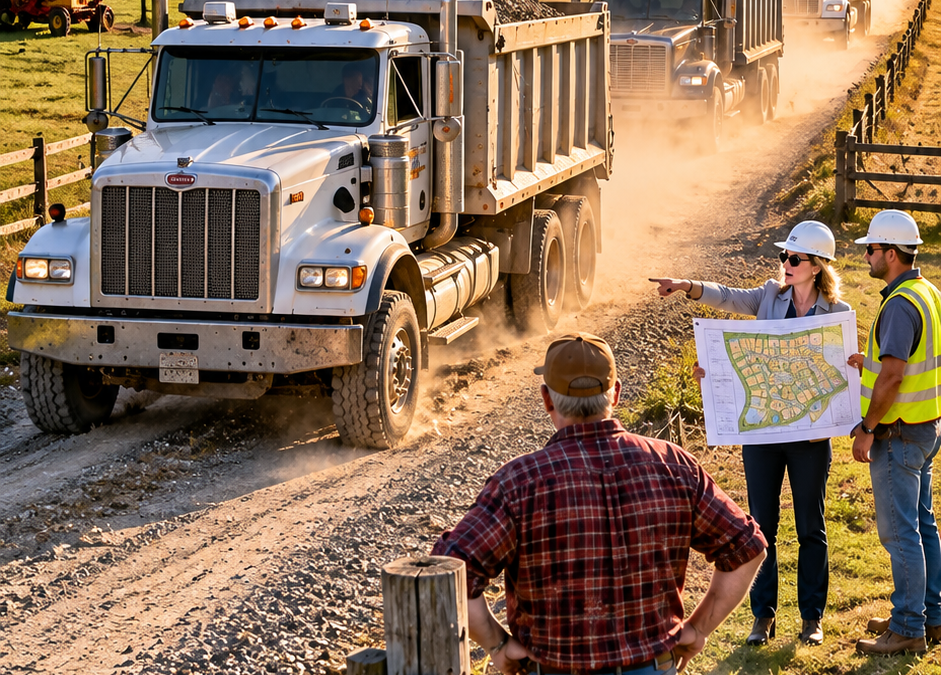
I pulled on jeans, boots, and an old flannel, then stepped onto the porch with my coffee still untouched on the kitchen counter. Another truck came into view before I reached the yard. It was a large construction dump truck, loaded with gravel, crawling along my farm road toward the McAllister parcel.
Behind it came another.
Then a concrete truck.
For a few seconds, I simply watched.
There are moments when your mind knows something is wrong before anger catches up. Mine stood there measuring the impossible: the road, the trucks, the dust, the way the drivers looked straight ahead as if they had driven that route a hundred times with permission.
Then anger arrived.
I walked fast toward the road, waving one arm.
The second dump truck slowed but did not stop until I stepped into the gravel lane ahead of it. The driver leaned out of his window, irritated.
“You need to move,” he called.
I stared up at him. “You need to tell me why you’re on my property.”
He frowned. “This is the access road.”
“No,” I said. “This is my farm road.”
He looked behind him at the line of vehicles already stacking up. “I just go where dispatch sends me.”
“Then dispatch sent you wrong.”
The driver held up both hands like he didn’t want trouble. “Talk to the site office. We were told this is the public route.”
Public.
That word landed in the road between us like something thrown.
I looked down the gravel strip my family had maintained for decades. The weeds along the edges were weeds I had sprayed. The culvert had been cleared by my hands. The low dip near the oak had been filled with stone I paid for. My father had rebuilt the gatepost at the entrance twenty-two years earlier after a storm knocked it crooked.
Public?
I told the driver to wait and walked back toward the house.
By the time I returned with my deed folder, a white SUV had pulled up behind the line of trucks. A woman in a navy blazer stepped out carrying a rolled site plan under one arm and wearing the brisk expression of someone who had already decided what answer she was going to accept.
She introduced herself as Dana Whitlock, project liaison for the developer, Sterling Vale Communities.
“I understand there’s some confusion,” she said.
I held the deed folder against my side. “There is no confusion on my end.”
She gave me a practiced smile. “Our contractors are using the approved construction access.”
“Your contractors are crossing my property.”
“This road is shown on the county map.”
“That doesn’t make it yours.”
Dana looked past me toward the road, then back at me as if she were trying to decide how much patience I deserved.
“The road has existed for decades,” she said. “Everyone has used it.”
I almost laughed.
“Everyone?”
She lifted the rolled plan and pointed vaguely toward the north. “Local traffic, farm traffic, prior owners, service vehicles. It’s an established route.”
“It is an established private farm road.”
“The subdivision was approved with this as the main entrance.”
That was when the day changed.
Not because of the trucks.
Not because of the dust.
Because she said it with such certainty.
Forty-two homes were being built around my family’s road, and someone had already decided the road would become their front door.
I opened the deed folder and pulled out the recorded property description.
“This road lies inside my parcel boundary,” I said. “My family has used it to reach back fields and equipment sheds. We have never dedicated it to the county. We have never granted your company an access easement. We have never sold it, transferred it, or opened it to public ownership.”
Dana glanced at the papers but did not take them.
“The county map shows it.”
“That is the first thing you’ve said that worries me.”
She frowned. “Excuse me?”
“A map showing a road is not the same thing as a recorded right to use it.”
Her smile disappeared.
Behind her, one of the truck drivers climbed down from his cab and leaned against the door, watching. Another truck idled, brakes hissing. Dust hung in the morning light.
Dana unrolled the site plan across the hood of her SUV and weighted the corners with her phone, keys, and a tape measure. The drawing showed lots, drainage, utility easements, road alignments, and a bold entrance arrow coming straight down my farm road.
There it was in black ink.
My land, treated as their access.
I felt something cold move through me.
Not fear exactly.
Something harder.
“You need to stop these trucks,” I said.
“We can’t shut down the site because of a misunderstanding.”
“This is not a misunderstanding.”
“The approvals are already in place.”
“Then the approvals are wrong.”
Dana’s eyes narrowed. “Mr. Harlan—”
“Whitaker,” I corrected.
She glanced at her notes. “Mr. Whitaker, delays are expensive. I suggest we resolve this cooperatively.”
“That means what?”
“It means we can review your concerns while work continues.”
“No.”
She blinked. “No?”
“No trucks use this road until you prove you have a legal right.”
Dana laughed then.
Not loudly.
Just enough to tell me she thought I was being naive.
“You can’t simply block an approved subdivision entrance.”
“I’m not blocking an approved entrance,” I said. “I’m standing on my own road.”
The first truck driver muttered something under his breath.
Dana rolled up the site plan with more force than necessary. “I’m going to contact our legal team.”
“Good,” I said. “Tell them to bring title documents.”
She gave me one last hard look, then told the drivers to hold where they were while she made calls.
I walked back to the house and called the county transportation office.
A man named Gerald Pike answered after I was transferred twice. His voice had the slow tired quality of someone who had already dealt with three problems before breakfast.
I explained that construction trucks were using my farm road as access to the Heritage Ridge development and that the developer was claiming the road was public because it appeared on a county map.
Pike did not dismiss me.
That mattered.
Instead, he asked for my parcel number.
I gave it to him.
Then he asked for the deed description, the road name if one existed, and whether the county had ever maintained it.
“No official name,” I said. “No county maintenance. My family has maintained it ourselves.”
“Any recorded dedication?”
“Not from us.”
“Any known public right-of-way?”
“Not that I’ve ever seen.”
He paused. I heard keyboard clicks through the phone.
“This may take some checking,” he said. “Can you send the deed and any survey records?”
“I can send them today.”
“Do that. I’ll pull the road file.”
By noon, I had scanned and emailed every document I had: the current deed, my father’s old survey, parcel maps, tax records, and a folder of maintenance receipts because my father had saved everything from culvert pipe invoices to gravel delivery tickets.
By evening, I had also started a log.
Time. Vehicle type. Company name. Direction of travel. License plates when I could get them. Photos and video. I did not block the road again. I did not threaten drivers. I did not touch equipment.
I documented.
My father used to say a man defending land should keep his temper in one hand and his paperwork in the other.
That night, I understood exactly what he meant.
The next morning, a county surveyor arrived at my farm.
His name was Everett Cole. He drove an older county pickup and brought enough equipment to make the developer’s confidence look flimsy by comparison. Tripod, measuring rods, records case, GPS unit, maps rolled in tubes. He wore a faded cap and moved with the quiet patience of someone who trusted monuments more than arguments.
Dana arrived ten minutes later with two men I did not know.
One wore polished boots too clean for a job site.
The other carried a tablet and kept tapping the screen nervously.
Everett shook my hand first.
Then he nodded to Dana.
“I’m here for field verification,” he said.
Dana’s tone was polite but tight. “We believe the issue is straightforward.”
Everett looked down the gravel lane. “Most people do until we find the first corner.”
That was the first thing I liked about him.
He started at the front of the property near the county blacktop. He located the old entrance, checked the fence line, then walked the road slowly. Not like someone strolling. Like someone reading a language written in soil, stone, wire, and iron.
He found the first boundary monument near a cluster of cedar trees: an old iron pin set low in the ground, half hidden by grass. My father had shown it to me when I was young. Back then, I thought it was just a rusty piece of metal. Now I watched Everett uncover it like it was a witness.
He compared the monument with my deed.
Then with the county road records.
Then with a map Dana’s team provided.
His expression grew more serious with every page.
Dana noticed.
“What are you seeing?” she asked.
Everett did not answer immediately.
He walked another hundred yards, found an old stone marker near the ditch, and checked the alignment again.
The gravel road stayed inside my parcel.
Not beside it.
Not along a dedicated county strip.
Inside it.
Finally, he stood near the equipment shed, looking down at the documents in his hands.
“This doesn’t look like a public road,” he said.
Dana folded her arms. “It appears on the county map.”
Everett glanced at her. “So do old lanes, utility tracks, abandoned alignments, proposed connections, and private access roads. A line on a map is not a conveyance.”
I felt my shoulders loosen for the first time since the trucks appeared.
Dana’s face tightened. “The subdivision approval references this access.”
“That may be a separate problem,” Everett said.
One of the men with Dana spoke up. “The county approved the development plan.”
Everett nodded. “Approval of a development plan does not necessarily create ownership or access rights across someone else’s parcel.”
Dana’s voice sharpened. “Are you saying our approval is invalid?”
“I’m saying I need to verify the recorded right-of-way before anyone assumes this is a lawful public entrance.”
He turned to me.
“Mr. Whitaker, do you have any record of a dedication?”
“No.”
“Any access easement granted to the developer?”
“No.”
“Any agreement allowing construction traffic?”
“No.”
Everett wrote that down.
Dana looked at me as if I had personally invented property law to inconvenience her.
“This is going to create a serious delay,” she said.
“I imagine so,” I replied.
By the end of that day, the county had not yet issued a formal decision, and the developer had not voluntarily stopped using the road. Trucks kept coming.
Not as many.
But enough.
A gravel hauler came through at 7:12 the next morning. A flatbed carrying drainage pipe came at 8:03. Two pickup trucks with contractor logos came at 8:44. A concrete mixer arrived at 10:17, realized I was filming from the barn, and slowed down like guilt had weight.
I documented all of it.
Dana sent me an email that afternoon.
It was carefully worded, probably by someone from legal.
She said Sterling Vale Communities “disputed any characterization of the road as exclusively private” and “reserved all rights associated with existing public access and approved development infrastructure.”
I printed the email, placed it in the folder, and wrote across the top in pencil:
They still have no deed.
Then I called the developer’s main office and requested their title documents.
At first, they tried to redirect me to the county planning department.
I refused.
Then they sent me a packet by email that looked impressive if you did not know what you were reading.
Cover letter. Development approval. Engineering drawings. Traffic study. Environmental forms. Preliminary title summary. Site plan exhibits. A highlighted line saying the subdivision would access the county road network by way of “existing gravel road connection.”
But buried inside the packet was the problem.
The access reference did not match my deed.
The title summary described a road corridor that had been proposed decades earlier, not the actual gravel farm road on my land. The language was vague where it needed to be exact. It referred to “existing access reflected on county mapping,” not a recorded public right-of-way, not an easement, not a dedication, not a deed.
I knew enough to know what I was seeing.
I also knew enough not to trust myself as the final judge.
So I took the packet to the county office the next morning.
Gerald Pike met me in a small conference room with fluorescent lights and a table covered in maps. Everett Cole was there too, along with a woman from planning whose name was Marsha Lane. Dana arrived twenty minutes later with the same clean-booted man and a folder twice as thick as mine.
Everybody was polite.
Nobody was relaxed.
Gerald started the meeting by laying out the issue.
“The development plan references access via the gravel road along Mr. Whitaker’s parcel. The question is whether that road is public, privately owned with public rights, privately owned with easement rights, or privately owned without developer access rights.”
Dana said, “Our position is that the road has historically functioned as access.”
Gerald looked at her. “Function is not the same as recorded status.”
Dana’s jaw tightened.
Marsha from planning spoke carefully. “The subdivision received conditional approval based on representations that lawful access existed.”
That sentence made Dana shift in her chair.
Gerald turned to me. “Has anyone in your family ever signed a recorded dedication for this road?”
“No.”
“Any transfer to the county?”
“No.”
“Any easement to Sterling Vale or its predecessors?”
“No.”
“Any written agreement allowing construction traffic?”
“No.”
Gerald looked back at Dana. “Can your team produce a recorded dedication, right-of-way deed, easement, or other access instrument?”
Dana opened her folder.
For the next ten minutes, she and her colleague handed over documents. Some were useful. Most were not.
A subdivision approval.
A planning memo.
A traffic review.
A road map.
A historic county map.
A proposed connector plan from decades earlier.
Everett studied that last one with particular interest.
“This,” he said, tapping the old proposed connector plan, “is not an as-built road record.”
Dana leaned forward. “But it shows the intended connection.”
“Intended by whom?”
“The county, apparently.”
Everett shook his head. “Proposed routes are not the same as accepted public roads.”
Gerald pulled another record from a folder and placed it beside the old map.
“This project appears to have been proposed in the late 1970s as a possible public connector between the county blacktop and the northern agricultural tracts,” he said. “But I do not see evidence it was completed, accepted, or dedicated.”
I felt a slow chill as the pieces came together.
The road had once been proposed as a public connection.
Someone, somewhere, had seen that old proposal.
Then decades later, someone else treated it as if it had become reality.
My private farm road had been mistaken for an unfinished government idea.
Dana pushed back. “The road has been visible and used for years.”
I said, “Used by my family.”
“And others,” she said quickly.
“Occasional use does not equal ownership.”
Gerald nodded. “Mr. Whitaker is correct. Casual or mistaken use does not automatically establish a public road. We need recorded authority or a legally recognized public right.”
Dana’s colleague finally spoke. “The developer has already mobilized. Foundations are scheduled. Utility trenching is underway.”
Gerald’s face did not change.
“Then the access issue needs to be resolved immediately.”
That was the first time someone from the county said it like a problem belonging to the developer, not to me.
The next two days were tense.
Construction traffic continued in reduced form, but I could tell the drivers had been warned. They avoided eye contact. Some turned around when they saw me recording. One supervisor stopped near the entrance and told me I was “making enemies.”
I asked his name.
He drove away.
I added that to the log.
On the third day, the county requested a full field verification.
This time, two survey vehicles came.
Everett brought another surveyor, a younger man named Nolan, and they worked the road from entrance to far edge. They set temporary markers, checked old monuments, measured the ditch line, verified the shoulder, and compared everything with the recorded parcel description.
Dana came too, along with a man I finally learned was the developer’s regional director, Blaine Mercer.
Blaine had the smoothest voice of anyone there and the coldest eyes.
“Mr. Whitaker,” he said, extending his hand. “We should have spoken sooner.”
I shook his hand because refusing would have made me look petty.
“Yes,” I said. “You should have.”
He smiled as if that amused him. “I understand you feel protective of your property.”
“I own it.”
“Of course.”
There was something about the way he said of course that made it sound temporary.
He looked down the gravel road. “We’re prepared to be reasonable.”
“You can start by stopping the trucks.”
“We have contractual obligations.”
“You don’t have a road.”
His smile finally faded.
Dana stepped in quickly. “We’re still determining that.”
“No,” I said. “The county is determining that.”
Everett called us over before Blaine could answer.
He had placed markers along the boundary. Bright flags now showed what my family had known for generations and what the developer had ignored: the road was not a public strip neatly separate from my land. It cut through my parcel.
The official county right-of-way ended at the blacktop.
It did not continue down my farm road.
Gerald Pike arrived shortly after with a formal notice.
He handed copies to me, Dana, and Blaine.
The document stated that, pending final review, unauthorized construction traffic on the disputed road was to stop unless and until lawful access rights were established.
I read the sentence twice.
Then I looked up.
For the first time in days, the road was quiet.
Blaine read the notice with no expression.
Dana looked like she had swallowed something bitter.
“This will shut down the project,” she said.
Gerald corrected her. “It will shut down use of this disputed road. Your project team is responsible for establishing lawful access.”
Blaine folded the notice neatly.
“We’ll be in touch,” he said to me.
“I’m sure you will.”
By the next morning, the trucks were gone.
That should have felt like victory.
Instead, it felt like standing in the silence after a storm and wondering whether the next one was already forming.
For three days, no heavy equipment crossed my farm road. Dust settled on the leaves. The ruts near the entrance dried in the sun. Birds came back to the fence line. I walked the whole length of the road one evening with my dog, Milo, a stiff old border collie who had opinions about everything and approved of very little.
He sniffed tire tracks, sneezed, and looked at me like I had allowed barbarians through the gate.
“I know,” I told him. “I’m working on it.”
On the fourth day, Blaine Mercer called.
His voice was warmer now, which made me trust him less.
“Mr. Whitaker, Sterling Vale would like to discuss a mutually beneficial access agreement.”
I was standing in the equipment shed, looking at a cracked hydraulic hose I had meant to replace two weeks earlier.
“Permanent access?” I asked.
“That would be ideal.”
“For construction traffic or for the completed subdivision?”
“For both, potentially.”
I looked out through the open shed door toward the road.
My road.
The same road where my father had taught me to drive a tractor. The same road my mother had walked when she needed quiet after cancer treatments. The same road my grandfather had graded himself with a blade so old nobody remembered where he bought it.
“How many homes?” I asked, though I knew.
“Forty-two.”
“So every resident, guest, delivery truck, service vehicle, moving truck, contractor, school bus, and emergency vehicle would use my old farm road as the main entrance.”
“That is one possible arrangement.”
“No.”
There was a pause.
“We are prepared to compensate you.”
“I’m listening.”
That didn’t mean yes.
It meant I wanted to know how little they thought my land was worth.
He named a number.
It was not small, exactly.
But it was small compared to what they had already risked and tiny compared to what permanent subdivision access would do to my property.
“No,” I said.
“We can improve the road, maintain it, and provide indemnity.”
“No.”
“We can structure annual payments.”
“No.”
His voice cooled. “You may want to consider the broader implications.”
“There it is.”
“Excuse me?”
“The polite threat.”
“I’m not threatening you.”
“You’re telling me your problem should become my burden because it is expensive for you.”
Blaine sighed. “Mr. Whitaker, developments require access. Communities grow. Roads evolve.”
“Not across my farm because someone misread a map.”
“This could become a legal dispute.”
“It already is.”
Another pause.
Then he said, “You have counsel?”
“I will by the end of the day.”
I did.
Her name was Marissa Cole, and she came recommended by a neighbor who had fought a utility easement case and won. She was direct, organized, and had the kind of calm that made aggressive people sound even louder by comparison.
When I laid the documents across her conference table, she didn’t react dramatically.
She read.
That was better.
She read the deed. The old survey. The county notice. The developer packet. My vehicle log. The emails. The field verification notes. The proposed connector map from the 1970s. Then she leaned back and looked at me.
“They treated a proposed public road as an existing public right.”
“That’s what it looks like.”
“And then began construction traffic before confirming the actual recorded access.”
“Yes.”
She tapped my vehicle log. “This is excellent.”
“My father taught me to write things down.”
“Your father was right.”
“What happens now?”
“We preserve the record, send a demand letter, require all communications and title basis from the developer, and coordinate with the county review. We also warn them that further use may be treated as trespass.”
“They already stopped.”
“Good. We make sure they stay stopped.”
Her letter went out the next morning.
It was sharp, professional, and much less polite than my phone calls had been. It demanded that Sterling Vale cease use of the road, identify any claimed legal basis for access, preserve all internal communications regarding road status, compensate for physical damage caused by construction traffic, and stop representing the farm road as public unless they could produce recorded authority.
Dana stopped emailing me after that.
Blaine stopped calling me directly.
Everything went through lawyers.
It is amazing how fast people discover procedure when their shortcuts stop working.
The final county review took several weeks.
During that time, the Heritage Ridge project sat in an awkward half-motion. Work continued in areas accessible from the north, but the main flow of trucks had been disrupted. Equipment staged near the subdivision sat idle some days. Contractors grumbled in town. Rumors spread faster than facts.
One version said I was blocking affordable housing, which was funny because nothing about Heritage Ridge was affordable.
Another said I had waited until construction started so I could extort the developer.
That one made me angry.
I had not hidden the road.
I had not moved the boundary.
I had not forged the deed.
They had built their plan on an assumption, and now they wanted to call my proof opportunism.
The worst rumor came from someone at the feed store who asked whether I was “against progress.”
I told him I was against trespass.
He did not have much to say after that.
A month after the first truck crossed my land, the county scheduled a formal review meeting.
It was held in a larger room this time.
Gerald Pike was there. Everett Cole was there. Marsha Lane from planning. Two county attorneys. Dana. Blaine. Sterling Vale’s outside counsel. Marissa. Me.
The table was long enough that it felt like distance had become part of the argument.
Gerald began with the findings.
The county had reviewed recorded right-of-way documents, dedication records, parcel deeds, historical maps, survey monuments, maintenance records, tax records, planning approvals, and the proposed connector file from the 1970s.
The conclusion was clear.
The gravel farm road was not a county road.
There was no recorded dedication from my family.
There was no deed transferring it to the county.
There was no public right-of-way record covering the road corridor.
There was no access easement benefiting Sterling Vale.
The old proposed connector had never been completed, accepted, or recorded as a public road.
The subdivision approvals had relied on an access representation that was unsupported by the actual property records.
Blaine’s lawyer tried to soften it.
“We believe there are historical use arguments that may warrant further analysis.”
One county attorney responded, “Those may be arguments for a court, but the county will not treat the road as public based on the current record.”
Dana sat very still.
I wondered if she remembered laughing when I said a map was not ownership.
Gerald continued.
“Sterling Vale must establish lawful access before using the Whitaker farm road for construction traffic or subdivision access. Any revised access plan must be submitted for review.”
Blaine asked, “Can construction traffic resume under temporary permit while access is negotiated?”
“No,” Gerald said.
One word.
Clean.
Beautiful.
No.
I felt it settle in my chest.
Not triumph exactly.
Relief with teeth.
Marissa leaned slightly toward me and whispered, “That’s the sentence.”
She was right.
That was the sentence everything turned on.
After the meeting, Blaine approached us in the hallway with his attorney close behind.
“Mr. Whitaker,” he said, “we remain interested in resolving this commercially.”
Marissa answered before I could.
“My client is not currently interested in granting permanent subdivision access across his farm road.”
Blaine looked at me. “You understand that a redesigned entrance will be costly.”
I met his eyes. “Yes.”
“It may alter the project significantly.”
“Yes.”
He waited for sympathy.
I gave him none.
Finally, he said, “All right.”
It was the first honest thing I had heard from him.
The next few months were a lesson in how quickly certainty collapses when it was never supported by ownership.
Sterling Vale redesigned the subdivision entrance.
They acquired a different strip of land from the north, widened an existing county-maintained road, adjusted drainage plans, revised emergency access layouts, and submitted new engineering documents. It cost them time. It cost them money. It delayed lot sales and irritated investors. I knew all of that because people in a small county talk even when they should not.
Good.
They should have checked before the first truck rolled.
Meanwhile, Marissa pursued compensation for the damage already done to my road.
The construction traffic had cut deep ruts near the entrance, crushed part of the shoulder near the ditch, damaged the old culvert edge, and left gravel displaced along the pasture fence. Sterling Vale initially argued the road had been in poor condition already. Marissa responded with dated photos, maintenance receipts, and my vehicle log.
My father’s habit of saving receipts from gravel deliveries became evidence.
The settlement was not enormous, but it was enough to repair the damage properly. I had new gravel brought in, the culvert reinforced, the shoulders reshaped, and a drainage dip corrected near the oak tree. I also installed a gate at the front entrance—not a decorative one, not a hostile one, just a simple steel farm gate with a private property sign.
For the first time in years, the road looked cared for again.
Milo approved.
He stood beside me while I latched the gate and gave the road one solemn bark, as if announcing the end of foolishness.
Heritage Ridge was eventually completed.
All forty-two homes.
They built their new entrance on the north side, with a proper turn lane, signage, lighting, sidewalks, landscaping, and a name carved into stone. It looked expensive. It looked planned. It looked like it should have been there from the beginning.
Residents moved in.
Children rode bikes.
Delivery vans came and went.
Landscapers buzzed along the streets.
And not one of them needed to cross my farm road.
That was the part I liked best.
The world did not end because my private property remained private.
Homes were still built. Families still moved in. The developer still made money. The county still grew. The subdivision still existed.
They simply had to do it without pretending my land was available because it was convenient.
One evening, about a year after the first dump truck arrived, I drove past the new subdivision entrance on my way back from town. The stone sign was lit from below. Fresh sod rolled green along both sides of the road. A moving truck turned in carefully while a child leaned out of the passenger window, pointing at the houses.
For a moment, I felt no anger.
Just distance.
Their road was theirs.
Mine was mine.
That was all I had ever wanted.
When I got home, I parked near the barn and walked down the old farm road as the sun dropped behind the trees. The gravel crunched under my boots. The new gate stood quiet at the entrance. The repaired culvert carried a thin line of water from the last rain. The fields beyond the shed were gold in the evening light.
I thought about my grandfather.
About my father.
About how both of them had worked this road without ever imagining that one day I would need to defend it from people who thought a line on a map could erase a family’s ownership.
That is the thing about old farms.
Their value is not always obvious from a survey summary or development packet. Sometimes it is buried in the practical things: a lane, a gate, a ditch, a corner pin, a faded deed in a folder, a receipt for gravel bought in 1994.
But those things matter.
They are the difference between permission and assumption.
Between access and trespass.
Between a developer’s plan and a landowner’s rights.
People like Dana and Blaine saw the road and imagined opportunity. They saw gravel and thought entrance. They saw age and thought abandonment. They saw no locked gate and thought nobody would object.
They mistook quiet for available.
That was their real mistake.
Because the road had never been abandoned.
It had been waiting.
Waiting under dust, under weeds, under decades of habit and memory.
Waiting for the day someone tried to turn it into something it was not.
And when that day came, the answer was not shouted from a truck window or argued in the dirt.
It was written in the deed.
The old farm road was private.
It always had been.
And a road does not become public just because strangers start driving on it.








