𝗙𝗨𝗟𝗟 𝗦𝗧𝗢𝗥𝗬 The Detective Aimed His Gun at Me as Though He Already Knew How This Would End
𝗙𝗨𝗟𝗟 𝗦𝗧𝗢𝗥𝗬
Bennett stepped forward.
“Ryan, it’s a key fob.”
Mercer ignored him.
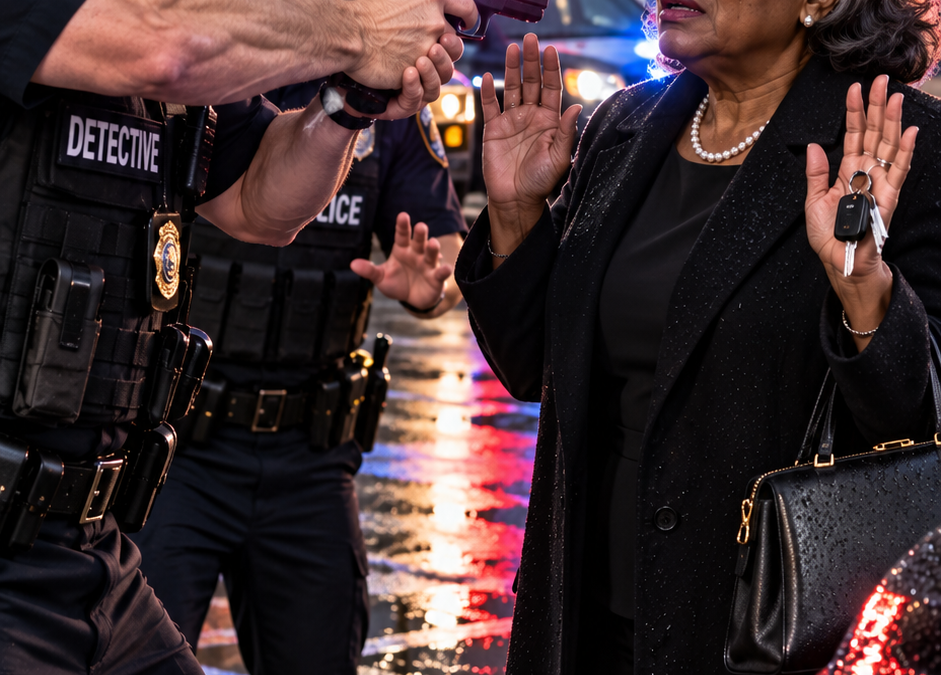
He seized my arm and forced me toward the Lexus.
My hip struck the vehicle first.
Then my upper body hit the wet hood.
Pain traveled through my shoulder.
The metal was cold beneath my hands.
My pearls swung forward and struck the edge of the car.
For a moment, I was more frightened of the necklace breaking than I could reasonably explain.
Perhaps it was because the pearls were the only familiar thing I could touch while everything else seemed to be slipping beyond my control.
Mercer took my handbag.
“Don’t move.”
“I am not resisting.”
He opened the purse and began searching through my belongings.
I heard the familiar sounds of a woman’s private life being handled by somebody who regarded her privacy as an inconvenience.
Keys.
Receipts.
A small notebook.
My reading glasses.
Then a leather credential wallet.
Mercer opened it.
I watched his expression change.
Inside was my official judicial identification.
My photograph.
My name.
My position.
The Honorable Evelyn Brooks, Circuit Court Judge.
Mercer went completely still.
Bennett moved closer and looked at the credential.
His face lost color.
For a moment, nobody spoke.
Then Mercer lowered his weapon.
I slowly straightened.
My shoulder ached.
My coat was damp where it had pressed against the Lexus.
But my pearls were still intact.
I adjusted them carefully.
Then I looked directly at Mercer.
“Detective, I suggest you think very carefully about what you write in your report tonight.”
He opened his mouth.
I didn’t wait for an explanation.
I took back my purse, gathered my keys, and left.
I had no idea then that the false report would be only the beginning.
Three hours later, my daughter saw a seventeen-second video of the encounter.
Claire Brooks was thirty-six, an investigative reporter living in Richmond, with my dark eyes and her father’s stubborn refusal to accept an answer simply because somebody important had given it.
She had spent fifteen years in television journalism.
She trusted documents, recordings, and evidence more than polished public statements.
Unfortunately, she didn’t always extend that patience to me.
We hadn’t spoken properly in almost three months.
Our last conversation had ended in an argument about Henry.
It was an argument we’d been having in different forms since his death.
Claire believed I’d spent too much of his final illness at the courthouse.
She wasn’t entirely wrong.
I believed she’d never understood how helpless I felt watching the man I loved disappear a little more each day.
I wasn’t entirely wrong, either.
Neither of us had been willing to acknowledge the truth in the other’s pain.
So we’d allowed the distance between us to grow.
Then somebody sent Claire the video.
It showed me standing beside my Lexus with both hands raised while Mercer pointed a pistol toward my chest.
There was no explanation of what had happened before the recording began.
No indication that I was safe.
Just her mother standing at gunpoint.
She abandoned the broadcast she’d been preparing and drove toward Ashford.
I was sitting at my kitchen table when the police department released its public statement at 9:18 that evening.
I read it twice.
According to the statement, officers had encountered an armed individual matching the description of a robbery suspect who resisted a lawful investigatory stop.
I placed my tablet on the table.
Then I looked at my car keys.
They were lying beside my telephone.
The same keys Mercer had briefly claimed were a weapon.
No gun.
No resistance.
No robbery.
And now the department was publicly describing an incident that bore almost no resemblance to what had happened.
I touched Henry’s pearls.
For the first time, I understood that Mercer might not merely be trying to justify a bad decision.
He might be counting on the department to help him rewrite it.
Claire arrived after midnight.
She came through my front door carrying an overnight bag and the angry expression I remembered from her teenage years.
“Mom.”
I stood.
She dropped the bag and hugged me.
For several seconds, neither of us said anything.
Then she stepped back and examined my face.
“Are you hurt?”
“My shoulder’s sore.”
“He could have killed you.”
“I know.”
“Why didn’t you call me?”
I looked away.
She noticed.
“Mom.”
“I didn’t want you worrying.”
She gave a short, disbelieving laugh.
“So you let me find out from the internet?”
I had no good answer.
She paced around the kitchen.
“We need to release everything. Your statement. The student video. His name. His badge number.”
“Claire—”
“No. He pointed a gun at you, and now his department is calling you an armed suspect.”
I looked toward Henry’s photograph on the shelf.
“I know exactly what they’re doing.”
“Then why are you so calm?”
I sat down.
“Because I don’t yet know how much of the lie belongs to Mercer and how much belongs to the people protecting him.”
Claire stared at me.
She wanted immediate action.
I wanted evidence.
Neither of us realized how important that difference would become.
Saturday morning, I had been awake for nearly three hours when my home telephone rang.
It was Chief Douglas Cain.
He had commanded the Ashford Police Department for eleven years.
He was fifty-eight, silver-haired, broad through the chest, and possessed of the smooth confidence of a man who rarely needed to raise his voice to make people uncomfortable.
Under his leadership, police budgets had grown and the city’s reported crime figures had improved.
City officials regarded him as indispensable.
Cain appeared to agree.
“Judge Brooks,” he began pleasantly. “I was hoping we could speak before this unfortunate misunderstanding gets further out of hand.”
I looked at the department’s statement on my tablet.
“An unfortunate misunderstanding?”
“Detective Mercer made a judgment call based on the information available at the time. We’ll conduct an internal review. I’m confident we can resolve this professionally without creating an unnecessary public spectacle.”
I looked through the kitchen window.
Claire’s car was parked crookedly in my driveway.
She had arrived too frightened and angry to bother straightening it.
“Chief Cain, who reviewed Detective Mercer’s body-camera footage?”
There was a brief pause.
Too brief to be described as hesitation by somebody who wasn’t accustomed to listening for it.
Too long to escape my attention.
“We experienced a technical failure.”
I slowly leaned back.
After Mercer had forced me against the Lexus, I’d heard him speaking quietly to Bennett near the cruiser.
He thought I was too shaken to listen.
His question had been simple.
“You shut yours off, too, right?”
I remembered every word.
“Interesting,” I said.
Cain’s voice sharpened slightly.
“What is?”
“That a technical failure seems to know precisely when to occur.”
Silence.
Then his tone changed.
“Judge Brooks, I’m extending professional courtesy.”
“No, Chief. You’re trying to determine how much I know.”
I ended the call.
Claire was standing in the kitchen doorway.
She had heard enough.
“That was the police chief?”
“Yes.”
“What did he want?”
“To make this disappear.”
She looked toward my tablet.
“We should release the video today.”
“No.”
“Mom!”
I turned toward her.
“A video can expose one man’s conduct. But if the department has already prepared a false account, we need to know who authorized it and what they’re trying to protect.”
She folded her arms.
“And if we wait too long?”
“Then we make certain the evidence can’t disappear while we’re waiting.”
That afternoon, my attorney, Rachel Whitmore, came to the house.
Rachel was fifty-two, compact, with auburn hair cut neatly at her jaw and an extraordinary ability to read legal documents without being distracted by the confidence of the people who had written them.
She’d represented judges, prosecutors, and public employees for nearly twenty years.
An early career mistake involving an overlooked timestamp had made her almost obsessive about chronology.
She trusted documents.
More specifically, she trusted what happened when independently created documents were forced to agree.
She placed Mercer’s incident report beside the dispatch records on my dining room table.
“Read this.”
I examined his account.
He claimed I’d behaved aggressively.
He said I’d reached suddenly into my purse.
He described an object he’d reasonably believed could have been a firearm.
Then he claimed officers had been responding to an anonymous robbery bulletin involving a Black woman in a dark vehicle.
I looked toward Rachel.
“Where’s the bulletin?”
She slid the dispatch log toward me.
I read the entries.
4:31 p.m., traffic stop.
4:39, noise complaint.
4:45, welfare check.
Nothing about an armed pharmacy robbery.
Nothing matching the description Mercer claimed he’d received.
Nothing that explained why he had selected me in the college parking lot.
I felt the first unmistakable chill of recognition.
“He invented the justification afterward.”
Rachel folded her hands.
“That’s what the available records suggest.”
I stared at Mercer’s signature.
Then I remembered something.
He’d testified in my courtroom three times.
The first time, I’d questioned inconsistencies between his arrest report and body-camera timestamps.
The second time, I’d refused to accept his explanation for a warrantless search.
Six weeks earlier, during a third proceeding, I’d directed that part of the record be forwarded to Internal Affairs after his sworn testimony contradicted another officer’s recording.
I had treated those matters as ordinary judicial responsibilities.
I hadn’t imagined Mercer would interpret my decisions as a personal attack.
Now, looking at a fabricated robbery bulletin, I couldn’t dismiss the possibility that the encounter had been something other than an unfortunate coincidence.
Rachel noticed my expression.
“What?”
I told her about the earlier cases.
She listened carefully.
Then she opened her notebook.
“That needs to be documented.”
While Rachel and I examined the dispatch records, Claire was visiting a garage across town.
Bell Automotive occupied a narrow two-bay building that smelled of engine oil, rubber, and hot metal.
Its owner, Marcus Bell, was forty-five, heavyset, with a shaved head, a graying beard, and forearms shaped by twenty years of difficult mechanical work.
Claire had found his name in a previous complaint involving Mercer.
At first, Marcus seemed reluctant to speak.
He’d spent two years trying to forget what happened.
But when Claire showed him the student video of Mercer threatening me, his expression changed.
“Same detective?”
“Yes.”
Marcus wiped his hands on a red shop rag.
Then he told her his story.
Two years earlier, he’d been carrying eighteen thousand dollars in cash to purchase a used alignment machine from a retiring mechanic.
Mercer stopped him.
Officers searched his truck.
They found no drugs.
No weapon.
Nothing connecting the money to a crime.
But they seized the cash anyway, classifying it as suspected drug proceeds.
“Were you charged?” Claire asked.
Marcus gave a short laugh.
“No.”
“Did you get your money back?”
“Not a dollar.”
He looked toward the unfinished pickup truck behind him.
“That machine would’ve changed everything for this business.”
Claire began following the records.
By sunset, she had identified forty-seven people associated with property seizures involving Mercer or officers who frequently worked with him.
Forty-seven people who had lost cash, vehicles, or other property under circumstances that raised serious questions.
Some had never been charged with a crime.
Others had spent months or years trying to recover what had been taken.
I studied Claire’s notes that evening.
The extent of the complaints disturbed me.
But the most important question remained unanswered.
Where had the money gone?
Across town, Noah Bennett was asking himself a different question.
He had been Mercer’s partner during my stop.
He’d watched Mercer mistake—or claim to mistake—my key fob for a gun.
He’d heard me ask why I was being detained.
He’d seen my judicial identification.
And he’d heard Mercer ask whether his own body camera had been turned off.
Noah hadn’t turned it off.
His camera had continued recording.
More importantly, the cruiser’s forward-facing camera had captured the encounter.
Noah knew the video existed.
He also knew that admitting it existed might destroy the career he’d spent three years building.
His girlfriend, Emily, was six months pregnant.
They had a mortgage, ordinary household expenses, and a child on the way.
Noah’s father was a retired deputy who’d been proud beyond words when his son graduated from the police academy.
Now Noah lay awake beside Emily, unable to stop hearing Mercer shout that I had a gun.
Emily finally turned toward him.
“You haven’t slept.”
“I’m fine.”
“Noah.”
He looked at the ceiling.
She rested one hand on her pregnant stomach.
“If you saw something wrong yesterday, what did you do?”
He didn’t answer.
That silence would eventually force him to decide what kind of father he wanted to become.
Early Sunday morning, he entered the department’s vehicle recording archive.
He located the file from cruiser 2147.
Then he inserted a blank USB drive.
He watched the progress bar move toward one hundred percent.
When the transfer finished, he removed the drive and closed his fist around it.
For the first time since the parking lot encounter, he possessed evidence that could directly contradict Mercer’s report.
But he still didn’t know whether he had the courage to use it.
That evening, I returned home after meeting Rachel.
Claire had left the kitchen light on.
There was an envelope on the table.
No stamp.
No address.
No explanation.
I initially assumed Claire had left me something related to her investigation.
Then I opened it.
Inside was a photograph.
It showed Claire walking up my front steps the previous night.
The image had been taken from across the street.
Whoever held the camera had been watching my house.
I turned the photograph over.
Four words had been written in black marker.
Judges have families, too.
I stood completely still.
For the first time since Mercer pointed his weapon at me, I felt something colder than anger.
Fear.
Not for myself.
For Claire.
I looked toward the hallway.
The house was silent.
Somebody had approached my home, entered without permission, and left a warning designed to tell me that the people responsible could reach my daughter.
I checked the doors.
Then I called Claire.
When she saw the photograph, her face drained of color.
“We’re going to the police.”
“No.”
“Mom, somebody broke into your house!”
“I know.”
“Then why aren’t you calling them?”
I touched Henry’s pearls.
“Because we don’t know which officers might be involved.”
She stared at me.
I could see her searching for an argument.
Then her eyes moved toward my hand.
I was gripping the necklace so tightly that my knuckles had turned pale.
Her expression softened.
“You’re scared.”
I nodded.
“Yes.”
It was the first time I’d admitted it aloud.
Claire stepped forward and hugged me.
For a moment, I let myself be her mother instead of a judge trying to reconstruct an organized threat from incomplete evidence.
Then I pulled back.
“We need to secure the photograph and document exactly how it was found.”
She nodded.
“And we need to determine what they don’t want us discovering.”
The next morning, Claire took the forty-seven names to Daniel Cho, the courthouse’s senior data analyst.
Daniel was forty-one, Korean American, thin and slightly stooped from years spent examining multiple computer monitors.
He wore rectangular glasses and spoke with the precision of a man who believed every number deserved an explanation.
Ten years earlier, he’d discovered a clerical error that caused an innocent defendant to spend an additional weekend in jail.
He’d corrected it on Monday.
But he never forgot the man’s face.
Since then, Daniel had treated timestamps, ledger entries, and case numbers as though somebody’s life might depend on getting them right.
Claire placed the list in front of him.
“Can you trace these?”
He examined the names.
“Mostly forfeiture cases?”
“Yes.”
“And Mercer appears in twenty-eight?”
“Correct.”
Daniel removed his glasses.
“That’s unusual.”
For seven hours, they searched public records, court filings, and financial documentation.
The list of questionable seizures began growing.
Cash taken from vehicles.
Cars impounded under suspicious circumstances.
Property classified as suspected criminal proceeds even when no charges followed.
The same three officers appeared repeatedly.
Mercer was one of them.
Then Daniel discovered that money from many of the cases had moved through the same organization.
The Ashford Public Safety Foundation.
On paper, the foundation supported youth programs, officer wellness, neighborhood security cameras, and community outreach.
Its website contained smiling photographs of police officers standing beside children.
Its annual statements emphasized community trust.
But the financial records told a different story.
Daniel found repeated payments to Whitaker Towing.
Then substantial invoices from Sentinel Ridge Security.
Then hundreds of thousands of dollars transferred over several years to Cain Property Management LLC.
Claire leaned toward the monitor.
“Cain?”
Daniel nodded.
Chief Douglas Cain’s brother-in-law owned Whitaker Towing.
His cousin was a managing partner at Sentinel Ridge.
Cain Property Management belonged to his older brother.
Claire sat down slowly.
“This isn’t just an officer taking money from people.”
Daniel opened another spreadsheet.
“No.”
He turned the monitor toward her.
“It looks like an entire revenue system.”
The implications were horrifying.
If the records meant what they appeared to mean, ordinary police encounters had been used to generate property seizures.
Money then moved through a public safety foundation and into businesses connected to the police chief’s family.
I thought about Marcus Bell.
Eighteen thousand dollars.
No charges.
No money returned.
I thought about the other forty-six names.
Then I thought about the photograph of Claire left inside my locked house.
Somebody wasn’t merely protecting Mercer from embarrassment.
Somebody might be protecting a financial arrangement worth far more than his career.
That afternoon, Claire received another telephone call.
It was Marcus Bell.
His voice was shaking with anger.
Two city vehicles had arrived at Bell Automotive.
A fire inspector and a licensing officer had cited an expired extinguisher inspection, improper solvent storage, and an insufficiently illuminated exit sign.
By midafternoon, a red notice had been taped to his front door.
His business license was temporarily suspended.
Claire listened while he described the inspection.
Then she brought the information to me.
The timing was difficult to ignore.
Marcus had agreed to discuss his seizure complaint.
Now the city had discovered enough violations to close his business almost immediately.
I wasn’t prepared to declare every citation illegitimate without examining it.
But I knew intimidation could hide behind procedures just as easily as it could hide behind threats.
Somebody appeared to be reminding Marcus that cooperating with an investigation could become expensive.
That evening, I asked Claire to contact his attorney.
I wanted the inspection records preserved.
I also wanted Marcus to know he wasn’t going to face the problem alone.
Meanwhile, Noah Bennett had driven to the courthouse three times.
The first time, he parked across the street for eleven minutes with the USB drive in his coat pocket.
Then he drove away.
The second time, he reached the parking garage before seeing two patrol officers near the entrance.
He turned around again.
The third time, he climbed the courthouse steps.
He could see me through the glass doors, speaking with a clerk.
For several seconds, he stood there.
Then he thought about his mortgage.
Emily.
Their unborn daughter.
His father’s pride.
His badge.
And the career he might lose if Mercer and Cain discovered he had copied the video.
He turned away.
I didn’t know any of this at the time.
I only knew that when I returned to the courthouse later that evening, an unmarked envelope had been placed in the internal mail slot.
Inside was a USB drive.
No note.
No explanation.
I called Claire.
Then I contacted Rachel so we could preserve the original material appropriately.
We watched the recording together.
The cruiser’s forward-facing camera showed the college parking lot from a fixed angle.
Mercer approaching.
My hands rising.
His demands.
The purse.
Then the moment I’d been waiting to see.
My key fob caught the afternoon light.
Mercer’s eyes moved directly toward it.
He paused.
Then he shouted that I had a gun.
Claire stopped breathing.
“He knew.”
I couldn’t answer immediately.
The recording continued.
Minutes later, Mercer leaned toward Bennett beside the cruiser.
His voice was clearly audible.
“We’ll make the report fit.”
Claire slammed her palm against the table.
“That’s it. We release this tonight.”
“No.”
She stared at me.
“What more do you need?”
“The rest of the evidence.”
“This proves he lied!”
“Yes.”
“And that isn’t enough?”
“Not anymore.”
Something changed in her expression.
She looked exhausted.
Angry.
And suddenly much younger than thirty-six.
“Of course not,” she whispered.
I frowned.
“Claire—”
“Nothing is ever enough for you.”
I stared at her.
She continued.
“Dad died waiting for you to stop saving everybody else.”
The words struck me harder than Mercer’s gun ever had.
For several seconds, I couldn’t speak.
Henry’s photograph stood on the shelf behind her.
He was smiling in it.
Healthy.
The photograph had been taken before chemotherapy hollowed his cheeks and transformed our lives into a sequence of hospital appointments, scans, and hopeful conversations that became progressively harder to believe.
Claire’s eyes filled.
“You were always at court.”
I looked down.
“Yes.”
“Why?”
For four years, I’d avoided giving her an honest answer.
I had told myself she wouldn’t understand.
I had told myself my work was important.
I had told myself I was doing the best I could during an impossible time.
But standing in my kitchen, I finally understood that none of those explanations addressed the pain she’d carried since her father’s death.
“Because I was a coward.”
Claire frowned.
“What?”
I touched the pearls at my throat.
“I knew how to sit in a courtroom. I knew how to evaluate evidence. I knew what rules applied and how to make decisions.”
My voice began to shake.
“At home, I watched your father get weaker every day, and there was nothing I could do to stop it.”
Claire stared at me.
“I couldn’t fix him,” I whispered. “And I couldn’t bear being somewhere I had no answers.”
Tears began slipping down her cheeks.
I continued.
“So I stayed at work because the courthouse was the one place where I still understood what I was supposed to do.”
For several seconds, neither of us moved.
Then Claire reached across the table.
I took her hand.
And for the first time in months, we stopped arguing about which of us had suffered more and began admitting how badly we’d both been hurt.
At 11:47 that night, Daniel called.
His voice sounded different.
More urgent.
“Judge Brooks, I found something else.”
Claire put him on speaker.
He’d uncovered a sealed personnel complaint from three years earlier.
The complainant was Sergeant Thomas Reed.
Reed had been forty-nine, a patrol supervisor with twenty-two years on the force and a reputation for refusing favors.
He’d reported concerns involving the Ashford Public Safety Foundation and irregular forfeiture transfers.
“What happened to his complaint?” I asked.
“Closed without action.”
“And Reed?”
Daniel hesitated.
“Three weeks later, his car went off Route Seventeen.”
Claire looked at me.
“An accident?”
“Officially, he lost control of the vehicle.”
Daniel sent us the file.
I stared at Reed’s photograph.
A gray mustache.
A serious expression.
The face of a man who’d apparently tried to report wrongdoing through the channels he was supposed to trust.
I didn’t know whether his death had been an accident.
The records before us couldn’t establish that.
But I knew the complaint, the financial transfers, and the subsequent death required independent examination.
Then I looked toward the threatening photograph still sitting inside an evidence sleeve on my table.
“Claire,” I said quietly, “this may be bigger than money.”
By Tuesday morning, November 26, I had begun to understand how dangerous the situation had become.
I was leaving the courthouse after reviewing a sentencing memorandum when Calvin Price, the senior security supervisor, called out behind me.
“Judge Brooks! Don’t touch your vehicle.”
I stopped immediately.
Calvin was fifty-nine, barrel-chested and nearly bald, with an old knee injury that had ended his twenty-four-year career with the county sheriff’s office.
He was methodical, impatient with excuses, and unusually careful about security procedures.
I’d known him for years.
The expression on his face frightened me before he said another word.
Two younger security officers were standing beside my Lexus.
The trunk was open.
On the rubber cargo mat lay a small black revolver inside a clear evidence bag.
Its serial number had been filed away.
I stared at it.
“Where did that come from?”
Calvin shook his head.
“Anonymous call reported a weapon inside an employee vehicle. Our team found it during the security response.”
I looked toward the courthouse entrance.
Three television vans were already parked at the curb.
Reporters were setting up cameras.
A photographer was aiming a long lens toward my vehicle.
Too fast.
The gun had barely been discovered, yet the media appeared prepared for an announcement.
Thirty seconds later, a black Ashford Police SUV entered the parking lot.
Mercer climbed out.
He wore a charcoal jacket over his service weapon.
His confidence had returned.
The fear I’d seen when he discovered my judicial identification was completely gone.
“Morning, Judge.”
I said nothing.
He glanced toward the revolver.
“Looks like we finally found the gun.”
Calvin turned sharply.
“Nobody has established that this weapon is connected to your earlier stop.”
Mercer’s expression changed.
“I’m making an observation.”
I studied him.
He hadn’t asked where the gun had been discovered.
He hadn’t asked which security officer found it.
He hadn’t asked whether it had been processed or examined.
Yet he was already connecting it to an incident that had occurred four days earlier.
“Detective,” I said, “how did you learn about this?”
He shrugged.
“Police channels.”
Calvin’s eyes narrowed.
Courthouse security operated primarily through the county sheriff’s communications system, not Ashford police radio.
I noticed the inconsistency.
But I didn’t challenge Mercer in the parking lot.
Not yet.
The person who planted the gun had made one mistake.
The Ashford Police Department didn’t control courthouse surveillance.
Calvin took me into the security office.
Six monitors covered the wall.
The system recorded entrances, loading areas, elevators, and parking lanes continuously.
Maya Torres, the courthouse IT technician, pulled up the overnight footage.
She was thirty-two, short and athletic, with dark curly hair tied high behind her head and the brisk efficiency of somebody who disliked being asked questions a computer could answer more accurately.
She located my vehicle.
Then she began reviewing the recording.
My Lexus had entered the lot the previous morning.
It had remained there during the day.
I’d left briefly and returned for an evening docket.
The cameras tracked the vehicle throughout.
Then Maya accelerated the overnight footage.
Midnight.
One o’clock.
Two.
At 3:12 a.m., a white tow truck entered through the service gate.
“Stop,” I said.
She froze the image.
The company name was printed clearly across the door.
Whitaker Towing.
The same company Daniel had linked to Cain’s brother-in-law.
A man wearing a hooded work jacket climbed out.
He walked directly toward my Lexus.
Opened the trunk.
Leaned inside for approximately seven seconds.
Then returned to the truck.
No disabled vehicle.
No towing operation.
No legitimate reason for him to be there.
Calvin sat forward.
“That truck was never authorized onto county property.”
I looked through the office window toward the revolver.
For the first time since Mercer had stopped me at the college, I felt something close to certainty.
Somebody had planted evidence.
And they had chosen the wrong parking lot in which to do it.
I turned toward Calvin.
“Do not allow Ashford Police Department personnel to take custody of that weapon. Preserve every recording and document the complete chain of custody.”
He nodded.
“Already in progress.”
While Calvin and Maya secured the surveillance records, Noah Bennett was sitting inside the police department’s Internal Affairs office.
Captain Leonard Shaw sat across from him.
Shaw was fifty-four, heavy around the middle, with thinning blond hair and pale blue eyes.
He had survived multiple changes in departmental leadership by knowing when to avoid difficult questions.
He preferred quiet conversations and paperwork that never explicitly committed him to anything controversial.
A printed archive access log lay on the table.
“Someone copied the cruiser recording from unit 2147,” Shaw said.
Noah kept his face still.
“You accessed that archive.”
“Part of routine paperwork.”
Shaw looked at him for a long time.
Then the office door opened.
Chief Cain entered.
He placed a single sheet of paper in front of Noah.
“We’re not interested in destroying your career, Bennett.”
Noah looked down.
The document was a prepared statement.
It claimed I’d threatened Mercer after the stop, telling him I would use my judicial position to have him fired.
It was a lie.
Noah knew it.
Cain leaned against the table.
“We’re interested in accuracy.”
Noah stared at the statement.
“I didn’t hear this.”
Cain’s expression remained pleasant.
“You have a baby coming.”
Noah’s hand moved toward his wallet.
Inside was an ultrasound photograph Emily had given him three weeks earlier.
Their daughter.
A tiny profile.
A small nose.
One hand raised beside her face.
“You sign,” Cain said, “and you keep your badge.”
He paused.
“You refuse, and I begin an integrity investigation. Think about your family.”
Noah stared at the document for almost a minute.
Then he signed it.
He made it twenty feet down the hallway before the nausea overwhelmed him.
He locked himself inside a restroom stall and vomited until there was nothing left.
Afterward, he sat on the closed toilet with his elbows on his knees.
He removed the ultrasound photograph from his wallet.
“What am I supposed to teach you?” he whispered.
That evening, while Noah was confronting what he’d done, Marcus Bell’s garage began filling with people.
Word about the inspection had spread.
Twenty neighbors arrived first.
Then thirty.
A retired electrician replaced the faulty exit sign.
Two local mechanics reorganized the chemical storage cabinet.
A church group collected money for the inspection fees.
Somebody brought barbecue.
Somebody else arrived with folding tables.
Marcus stood in the middle of Bell Automotive, staring at people repairing the problems that had been used to close his business.
For two years, he’d felt powerless.
He’d lost eighteen thousand dollars.
He’d complained.
He’d been ignored.
And now, because he’d finally agreed to speak publicly, he believed powerful people were trying to destroy what little he had left.
But that evening, surrounded by neighbors who’d decided he wasn’t going to face the situation alone, he began to understand that the story wasn’t finished.
Claire spent the same evening at my dining room table.
Her laptop contained enough material to publish the largest investigation of her career.
The student video.
The false dispatch report.
Forty-seven forfeiture cases.
The foundation’s financial records.
The towing company connections.
The courthouse footage showing a Whitaker truck approaching my Lexus hours before the revolver was discovered.
She looked at the documents for a long time.
Then she closed the laptop.
“Not yet.”
I looked at her.
She gave me a small, tired smile.
“I finally understand what you’ve been trying to tell me.”
I reached for her hand.
For the first time, she wasn’t trying to expose the loudest person in the room.
She was trying to understand the system that had made his behavior possible.
At 10:23 that night, Noah Bennett called the Virginia Attorney General’s office.
Assistant Attorney General Rebecca Sloan answered from home.
Rebecca was forty-six, tall, with straight chestnut hair and fifteen years of experience handling public corruption cases.
Her father had been a state trooper.
She understood what good officers sacrificed to serve their communities.
She also understood how much damage corrupt officers could cause when their colleagues were afraid to challenge them.
“My name is Officer Noah Bennett,” he said.
His voice was shaking.
“I need whistleblower protection.”
Two hours later, he sat across from Rebecca in an empty conference room.
He placed three items on the table.
The cruiser video.
A copy of the false statement he’d signed.
And an audio recording from a meeting two days earlier.
Rebecca pressed play.
Chief Cain’s voice filled the room.
“Brooks isn’t the problem. The precedent is. If she wins, everyone we took money from comes back.”
Rebecca stopped the recording.
Noah stared at the table.
He had finally told the truth.
But telling the truth hadn’t erased the statement he’d signed.
He knew that.
And for the first time, he was prepared to accept it.
When Rebecca eventually contacted Rachel, the missing pieces began falling into place.
Mercer hadn’t simply invented a story because he’d made an embarrassing mistake in a parking lot.
Cain’s organization had been taking money and property from people for years.
The foundation provided a mechanism for moving that money into businesses connected to the chief’s family.
Complaints had been buried.
An officer who questioned the transfers had died after filing a sealed report.
And now a judge who’d challenged Mercer’s testimony had become a threat to the entire arrangement.
I wasn’t dangerous to them because I wore a judicial robe.
I was dangerous because my case might give other victims a reason to demand their money back.
By dawn on November 28, the investigators were ready.
The counterattack didn’t begin with a dramatic press conference.
It began with paperwork.
Search warrants.
Preservation orders.
Subpoenas.
Judicial signatures obtained outside the circle of influence Cain had spent years cultivating.
While most of Ashford was asleep on Thanksgiving morning, Virginia State Police and federal investigators moved into position.
One team entered Ashford Police Department.
Another arrived at Whitaker Towing.
Federal personnel entered the Ashford Public Safety Foundation carrying evidence boxes.
A fourth team went to Cain’s home.
Special Agent Michael Grant coordinated the operation with Rebecca.
He was forty-eight, tall and lean, with close-cropped gray hair and eighteen years of public corruption experience.
Earlier in his career, he’d watched a county sheriff escape prosecution after investigators moved too quickly and failed to preserve a crucial financial record.
He’d never forgotten the mistake.
This time, every location was secured within the same operational window.
Nobody would have advance warning to destroy evidence or contact another target.
Mercer arrived for work at 6:18 that morning carrying coffee.
He stopped when he saw yellow evidence tape across his locker.
Two state investigators stood beside it.
“What the hell is this?”
One of them displayed the warrant.
“Step away from the locker, Detective.”
Mercer looked toward Cain’s office.
Empty.
Then toward Shaw’s.
Also empty.
He reached for his telephone.
Cain didn’t answer.
Across town, investigators had discovered why.
When officers entered Cain’s home, they found an empty bedroom and an open safe.
Approximately seventy thousand dollars in cash was missing.
His passport was gone.
Cain had disappeared.
At the Public Safety Foundation, investigators discovered a desktop computer with its internal drive smashed.
At police headquarters, another storage device had been removed from Cain’s office server and partially drilled through.
The damage might have destroyed years of financial evidence if Daniel Cho hadn’t discovered something important forty-eight hours earlier.
Ashford’s municipal accounting system automatically mirrored selected records to a city server every night at two o’clock.
The backups remained intact.
Daniel sat beside Rebecca in a secure state office while the recovered folders populated the screen.
Payments.
Seizure logs.
Foundation invoices.
Internal correspondence.
Towing records.
Financial transfers.
Cain had destroyed the machines.
He hadn’t destroyed the history.
By noon, the courthouse steps were crowded.
An extraordinary public evidentiary proceeding had been arranged as the investigation moved forward.
Reporters filled the entrance.
Victims stood outside clutching folders and photographs.
Some had been waiting years for somebody to listen.
I entered through a side door wearing a navy suit and Henry’s pearls.
For the first time in more than thirty years, I wasn’t walking toward the bench.
I was walking toward the witness chair.
That distinction mattered.
I had no gavel.
No authority over the room.
No special right to decide whose testimony should be believed.
I would answer questions like everyone else.
Mercer sat at the opposite table with counsel.
His jaw was tight.
His eyes remained fixed on me.
He testified first.
“I believed she had a firearm,” he said. “Her movement was sudden. I responded according to my training.”
Rebecca stood.
“Detective Mercer, you maintain that you couldn’t identify the object in Judge Brooks’s hand?”
“Correct.”
She turned toward the large monitor.
“Then let’s examine the recording.”
The cruiser footage filled the screen.
I saw myself standing in the college parking lot.
My hands rising.
Mercer approaching.
My purse being taken.
Then the key fob caught the afternoon light.
The image showed his eyes moving directly toward it.
He paused.
Then came the shout.
“Gun!”
Nobody in the room moved.
Rebecca let the video continue.
Minutes later, Mercer’s recorded voice emerged from the speakers.
“We’ll make the report fit.”
For the first time, I saw his expression change without any attempt to conceal it.
I’d watched thousands of witnesses realize they’d lost control of a story.
The moment was almost always recognizable.
The eyes stopped meeting other people’s.
The shoulders tightened.
And the confident explanation suddenly became much more complicated.
Then Noah Bennett entered.
Cain had told the department’s attorneys that Noah would support Mercer’s account.
Mercer looked toward him expectantly.
Noah took the oath with a visibly trembling hand.
Emily sat in the back row, one hand resting over her pregnant stomach.
Rebecca approached.
“Officer Bennett, did Judge Brooks possess a firearm during the parking lot encounter?”
Noah looked at Mercer.
Then at the empty seat reserved for Chief Cain.
Finally, he looked toward Rebecca.
“No.”
“Did Detective Mercer honestly mistake her key fob for a firearm?”
Noah swallowed.
“Detective Mercer lied.”
The words filled the room.
No shouting.
No dramatic gesture.
Just a young officer stating the truth he’d spent days trying to avoid.
He described the altered reports.
The instructions concerning body cameras.
The pressure to conceal evidence.
The false statement he’d signed.
And Cain’s threat to his career.
Then he looked down.
“I knew it was wrong.”
His voice shook.
“I was afraid losing my badge would cost me my future. I didn’t understand that keeping it that way was costing me who I was.”
I watched Emily wipe tears from her cheeks.
I thought about the child she was carrying.
And I hoped Noah would remember that moment when his daughter was old enough to ask what it meant to do the right thing.
Marcus Bell testified next.
He wore his cleanest work shirt, although grease remained beneath his fingernails.
He described the eighteen thousand dollars taken from him without criminal charges.
He described the equipment he could no longer purchase.
Then he described watching inspectors close his garage after he’d agreed to cooperate with Claire.
Other victims followed.
Rosa Delgado, a fifty-one-year-old restaurant owner, described losing nine thousand four hundred dollars in payroll cash.
Denise Parker, an emergency room nurse, testified about losing access to her car for seven months after lending it to a nephew.
Carl Jennings, a sixty-year-old long-haul truck driver, described cash taken during a roadside search.
Anthony Webb, a thirty-nine-year-old Army veteran with a damaged left knee, explained how complaints disappeared whenever they reached Cain’s office.
One witness became five.
Five represented forty-seven documented cases.
And forty-seven suggested the possibility of many more.
I sat listening.
For days, I’d been consumed by what Mercer had done to me.
The gun.
The false report.
The threat against Claire.
The weapon planted in my vehicle.
But now I understood that I hadn’t been the only victim.
I was simply the person Cain’s organization had failed to frighten into silence.
At 4:36 that afternoon, Mercer was taken into custody outside the hearing room in connection with the criminal investigation.
Reporters surged toward him.
He turned back when he saw me.
“You ruined my life!”
I stopped.
For a moment, I thought about answering with everything I’d been holding inside since that Friday afternoon.
Then I looked at the man who’d pointed a pistol at my chest.
“No, Detective.”
My voice remained steady.
“I documented what you did with yours.”
But one important person was still missing.
Chief Douglas Cain had vanished.
Investigators located his SUV near a private airfield outside Ashford.
His passport was gone, and the cash missing from his safe suggested he might be preparing to flee the country.
Then a financial alert showed that his credit card had been used to purchase gasoline forty miles west of the city.
Claire noticed immediately.
She called Daniel.
“He’s not going to the airfield.”
Daniel opened the county property records.
After several minutes, he found what she was looking for.
A hunting lodge near the Blue Ridge foothills.
It had belonged to Cain’s father and was now held through a family trust.
Virginia State Police surrounded the lodge before sunset.
There was no dramatic gunfight.
No helicopter assault.
No heroic final stand.
For twenty-three minutes, the building remained quiet.
Then the front door opened.
Douglas Cain stepped onto the porch.
The silver-haired police chief who had spent eleven years ordering other people to comply slowly raised both hands above his head.
I watched the live feed from the courthouse security room.
For several seconds, I couldn’t look away.
The image reminded me of another parking lot.
Another person standing with raised hands.
Another moment when somebody holding authority decided what happened next.
But the difference was fundamental.
I’d been innocent.
Cain was being taken into custody on the strength of evidence investigators had spent days carefully preserving.
For the first time since Mercer approached me at the college, I felt the enormous exhaustion of a person who’d been afraid for so long that fear had begun to feel ordinary.
Claire stood beside me.
She slipped her hand into mine.
“It’s over,” she whispered.
I looked toward the screen.
“No.”
I squeezed her hand.
“But now it can finally begin.”
Six months later, Ashford looked much the same from a distance.
The courthouse clock still struck every hour.
Commuters filled Main Street before eight.
Bell Automotive still smelled of oil and hot metal.
Families still hurried through grocery stores, argued over parking spaces, and complained about the weather.
But beneath the city’s ordinary routines, something important had changed.
Mercer no longer carried a badge.
He appeared in federal court wearing a dark suit that seemed strangely uncomfortable on a man who’d spent twelve years relying on the authority of his uniform.
He pleaded guilty to civil rights violations, evidence tampering, false statements, and conspiracy.
Cain fought longer.
His attorneys challenged evidence, questioned witnesses, and argued over financial records.
But investigators had assembled a case supported by the municipal backups, forfeiture records, bank transactions, Noah’s recordings, and testimony from dozens of victims.
Cain was ultimately convicted of racketeering, obstruction, conspiracy, and multiple offenses connected to the forfeiture network.
The organization he’d spent years building had fallen apart because the records survived his attempt to destroy them.
The money began returning to the people from whom it had been improperly taken.
Millions of dollars in seized property were subject to restitution and recovery orders.
The original forty-seven cases identified by Claire and Daniel were reopened, with additional cases still under examination.
Marcus Bell received his eighteen thousand dollars and compensation for the damage done to his business.
When Bell Automotive reopened, Marcus stood beneath a new sign outside the front office.
He looked much as he had before the scandal.
Shaved head.
Gray beard.
Heavy mechanic’s hands.
But something about his posture had changed.
He no longer glanced nervously toward the street every time a police cruiser passed.
Claire gave him a small wooden plaque.
It read:
Justice Took the Long Road Home.
He placed it behind the counter.
He told me he touched it every morning before opening the garage.
Noah’s ending was more complicated.
It needed to be.
He’d eventually told the truth.
But that didn’t erase the false statement he’d signed when Cain threatened his career.
He was suspended, temporarily stripped of police authority, and subjected to an administrative review.
He accepted the sanctions without protest.
His cooperation and the evidence he supplied were considered during the decision not to prosecute him.
But for months, he woke each morning without a badge beside his wallet.
Emily refused to let him treat the consequences as proof that he was a victim.
She loved him.
She also expected him to understand why telling the truth after lying didn’t magically restore somebody’s integrity.
In September, their daughter was born on a rainy morning.
Seven pounds.
A tiny nose.
Pale eyes.
A patch of dark hair standing almost straight up at the crown.
They named her Hope Bennett.
Noah cried while holding her.
Later, he told me he’d spent months wondering whether he’d ever deserve to explain to his daughter what it meant to be honest.
When she was placed in his arms, he finally understood that the explanation would matter much less than the example he set for her.
One year after my encounter with Mercer, Noah joined a professional standards division within Virginia law enforcement after completing the necessary review and rebuilding his professional standing.
He wasn’t there because anybody considered him a hero.
He was there because he understood how an ordinary officer could tell himself one small lie, then another, until silence became participation.
He taught younger officers something he’d learned at enormous personal cost.
“You don’t lose your integrity all at once. You trade it away in pieces.”
Claire’s life changed, too.
Her investigation, Badges Without Boundaries, became a six-part series tracing Ashford’s forfeiture scheme from questionable street stops to the foundation’s accounts and the protection supplied by powerful officials.
It won a statewide journalism award.
Claire placed the award plaque in a drawer.
The achievement she cared about most happened on Sundays.
Every Sunday at six o’clock, she came to my house for dinner or insisted that I come to hers.
No laptops.
No case files.
No interviews.
At least, that was the rule.
I broke it frequently.
Claire never hesitated to remind me.
One Sunday evening, I brought out Henry’s old wooden jewelry box.
The walnut case was worn along the corners from decades of use.
Inside lay the necklace Claire had watched me wear through nearly every important moment of my adult life.
“Mom?”
I looked up.
“Why do you still wear those every day?”
I ran my finger along the pearls.
“Your father gave them to me the day I became a judge.”
Claire smiled.
“That sounds like Dad.”
“He told me something that morning.”
“What?”
I looked at her.
“He said power should never make you forget who you were before you had it.”
For several seconds, neither of us spoke.
Henry had been gone four years.
For a long time, remembering him had felt like reopening a wound that had never fully healed.
But that evening, sitting beside our daughter and touching the necklace he’d given me, I realized his memory didn’t have to remain connected only to the pain of losing him.
It could also remind us of everything he’d left behind.
On June 2, 2025, I returned to the bench.
“All rise.”
The courtroom stood as I entered wearing my black judicial robe.
Henry’s pearls rested at my throat.
I moved more slowly than I had before the incident.
Not because I’d become physically weak.
Because six months away had changed the way I understood the room.
For more than two decades, the bench had represented responsibility.
Now I understood more clearly than ever how easily responsibility could become power, and how dangerous power became when the person holding it stopped questioning themselves.
Claire sat in the back row.
Marcus Bell was beside her, wearing a suit that looked deeply uncomfortable on him.
Several other people who had been affected by Cain’s forfeiture scheme had come to observe the proceedings.
I gave them no special acknowledgment.
I didn’t need to.
My first case involved a seventeen-year-old boy named Jordan Ellis.
He was thin and tall, with nervous brown eyes and a suit borrowed from an uncle that was too large in the shoulders.
He’d been arrested after breaking into a closed electronics store with two older teenagers.
He had no previous record.
His father had disappeared when he was nine, and his mother worked double shifts at a nursing home.
Jordan had admitted what he’d done before officers finished questioning him.
The prosecutor requested detention.
I read the file twice.
Then I looked toward the boy standing before me.
For one brief moment, I remembered wet pavement.
Mercer’s pistol.
My own hands raised.
And the terrifying realization that somebody holding authority could decide what kind of story your life would become before you had the opportunity to explain yourself.
Then I returned my attention to the facts of Jordan’s case.
“Mr. Ellis, what you did was serious.”
He lowered his eyes.
“Yes, Your Honor.”
“The property owner suffered a loss, and you’re responsible for the harm your actions caused.”
He nodded.
I studied him carefully.
“But punishment and destruction aren’t the same thing.”
His eyes lifted.
After considering his history, his admission, and the available rehabilitative options, I ordered diversion, restitution, community service, and participation in a vocational training program.
Jordan stared at me as though he wasn’t certain he’d heard correctly.
I leaned forward.
“This is an opportunity. What happens next depends on what you choose to do with it.”
“Yes, Your Honor.”
“Give the people who’ve placed their trust in you a reason to believe they made the right decision.”
His voice cracked slightly.
“I will.”
I concluded the proceeding.
As the courtroom emptied, I remained seated for a few moments.
I thought about Mercer.
Cain.
Noah.
Marcus Bell.
The people who had spent years trying to recover money that never should have been taken from them.
Then I looked toward Claire.
She was waiting by the back doors.
I gathered my papers and stood.
That afternoon, I walked toward the same courthouse parking lot where somebody had planted a revolver in my car months earlier.
A new security camera overlooked the employee entrance.
The department had strengthened its evidence-preservation procedures.
Claire was waiting beside the Lexus.
I stopped halfway across the lot.
A young patrol officer was helping an elderly woman load groceries into her trunk.
She was tiny, white-haired, and walking with a cane.
The officer waited patiently while she rearranged every bag because apparently none of them was positioned exactly where she wanted it.
He didn’t rush her.
He didn’t raise his voice.
He simply waited.
I watched for a moment.
Then I smiled.
Not because Ashford had become perfect.
No city ever becomes perfect.
Systems require constant scrutiny.
People still make mistakes.
Some will still abuse authority when they believe nobody is watching.
And even the best policies become meaningless if the people responsible for enforcing them stop caring about the individuals those policies are meant to protect.
But for the first time in months, I could see ordinary signs of improvement without immediately wondering what new deception might be hiding behind them.
Claire opened the passenger door.
“Dinner? Your place or mine?”
“Mine.”
“And you’re not allowed to talk about court.”
I raised an eyebrow.
“That’s going to be difficult.”
She laughed.
I climbed into the Lexus.
For a moment, I looked toward the parking space where the revolver had been discovered.
Then I adjusted Henry’s pearls.
Months earlier, Mercer had pointed a gun at me because he believed he could control the encounter and invent whatever explanation he needed afterward.
His chief had believed the same principle could protect an entire organization built on taking money from people who lacked the resources to fight back.
But they had underestimated the people whose lives they’d damaged.
Marcus had told his story.
Daniel had followed the records.
Noah had finally chosen the truth over the badge he was afraid to lose.
Claire had refused to abandon the investigation—or her mother.
And the evidence had survived every attempt to make it disappear.
I started the engine.
Claire adjusted the radio.
Then we pulled away from the courthouse.
There were no sirens.
No shouting.
No guns.
No red and blue lights reflecting across wet pavement.
Just my daughter sitting beside me, complaining that I was driving too slowly and asking whether I’d remembered to buy everything we needed for dinner.
For the first time in a very long while, an ordinary afternoon felt like more than enough.








