𝗙𝗨𝗟𝗟 𝗦𝗧𝗢𝗥𝗬 The Deputy Laughed at What He Found in My Glove Box Without Knowing Whose Name Was in My Phone
𝗙𝗨𝗟𝗟 𝗦𝗧𝗢𝗥𝗬
The rest of the squad laid down suppressive fire while I moved around the rocks toward the position overlooking our route.
I had no grand plan.
I wanted to stop the men firing at my brothers long enough for our wounded to be evacuated.
What followed would eventually be described in official reports, investigated by commanders, and reconstructed in more detail than I ever wanted to remember.
I moved along the flank of the ridgeline and neutralized the enemy position that had pinned us down.
Our unit regained enough freedom of movement to evacuate the wounded.
Whitaker survived.
So did Ellis.
That mattered more to me than anything written afterward.
When our deployment ended, I returned home with scars on my hands and memories I couldn’t always explain.
I didn’t consider myself extraordinary.
I knew what had happened.
I also knew how many men had contributed to bringing everyone home.
But my commanding officer saw the action differently.
He recommended me for the Medal of Honor.
I resisted the attention at first.
It felt wrong to be celebrated for surviving an afternoon that other Marines would carry for the rest of their lives.
Eventually, an older officer told me something I never forgot.
“Lancaster, the medal isn’t yours alone. Every man who stood beside you that day is represented in it.”
That changed the way I understood the honor.
When I stood at the White House and the President placed the pale blue ribbon around my neck, I wasn’t thinking about the cameras.
I was thinking about Whitaker and Ellis.
I was thinking about the men who hadn’t returned from other missions.
And I was thinking about my mother.
Dorothy sat in the front row wearing her best dress, crying into the same hands that had packed my lunch the day I left for boot camp.
When the ceremony ended, she embraced me so tightly that I thought she might never let go.
Then she touched the medal.
“Baby, I wish your granddaddy could’ve seen this.”
I smiled.
“He would’ve complained that my uniform wasn’t pressed properly.”
She laughed through her tears.
A few minutes later, General Raymond Caldwell approached me.
He was a four-star Marine general whose career had taken him through decades of operations and command assignments.
I had met him during earlier deployments, but that day he spoke to me differently.
He placed a hand on my shoulder.
“You’re the best of us, Lancaster.”
I didn’t know how to answer.
He noticed.
“Don’t let that make you uncomfortable. Let it remind you what you’re responsible for.”
Over the following years, Caldwell became more than a senior officer I admired.
He became a mentor.
He called on my birthdays, wrote letters after promotions, and checked on my mother whenever he passed through Virginia.
When I struggled with the memories of Afghanistan, he didn’t tell me to forget what had happened.
He reminded me that surviving carried responsibilities of its own.
I served three more years after receiving the medal.
Then I left active duty.
I still loved the Corps.
I always would.
But I had started thinking about the boys growing up in Ridgeway, particularly those who reminded me of myself.
Kids whose fathers weren’t around.
Kids whose mothers worked two jobs.
Kids who heard so often that they were going nowhere that eventually they began to believe it.
I wanted them to experience the same sense of purpose that had changed my life.
So I began volunteering at the Haverford County Community Center.
Every Tuesday and Thursday, I stood in front of a room full of teenagers and taught them discipline, responsibility, teamwork, and how to remain calm when someone else was trying to provoke them.
Some arrived because their parents insisted.
Others came because they had been suspended from school or were beginning to get into trouble.
A few simply wanted somewhere to go after classes ended.
I didn’t expect them to respect me because I had served in the military.
Respect had to be earned in that room.
I listened to them.
I remembered their names.
I showed up when I promised I would.
And when one of them made a mistake, I tried to teach him how to accept responsibility without believing the mistake defined his entire future.
That Friday evening, I had brought my Medal of Honor to the center.
One of the boys, Marcus, had asked whether I really possessed one.
He was fourteen, skinny, loud, and convinced that every adult exaggerated accomplishments to make children listen.
I brought the medal because I wanted to show them something important.
Not what a decoration could do for a person’s reputation.
What it represented.
I told them about Whitaker and Ellis.
I explained that neither man had stopped being afraid simply because I had reached him.
We had all been frightened.
We had simply kept doing what needed to be done.
Afterward, Marcus asked if receiving the medal meant I never got scared anymore.
I laughed.
“Son, I still get scared.”
“Of what?”
“Failing somebody who trusts me.”
That answer seemed to stay with him.
When the session ended, I placed the medal inside its black presentation case and locked it in my truck’s glove compartment.
I packed the leftover worksheets, markers, name tags, and training supplies into a box behind the passenger seat.
Then I headed home.
Construction on Route Fifteen had been causing delays all week, so I took the road through Briarwood Estates.
It was a wealthy neighborhood with enormous houses, carefully maintained lawns, and trees illuminated by expensive landscape lighting.
I had driven through it before.
I wasn’t speeding.
My headlights were on.
I was listening to an audiobook when I noticed red and blue lights in my rearview mirror.
At first, I assumed the deputy was responding to a call somewhere ahead.
I eased toward the right shoulder.
Then a second cruiser appeared behind the first.
Both vehicles stopped.
I realized they wanted me.
I pulled over completely, switched off my engine, turned on the interior light, and placed both hands at the top of the steering wheel.
I wasn’t frightened yet.
I had spent years teaching young Marines that uncertainty was easier to manage when they controlled their own behavior.
That was what I intended to do.
Deputy Grady approached my driver’s window with his flashlight aimed directly at my face.
His other hand rested on his holster.
The beam was so bright that I had to squint.
“License and registration.”
“Yes, officer. My wallet is in my back pocket. I’m going to reach for it slowly.”
“You’d better.”
I retrieved my wallet and handed him my driver’s license.
Then I took the registration from the visor.
He examined both documents as though he was disappointed to find they matched.
“Miles Lancaster.”
“Yes, sir.”
“Where are you coming from?”
“The Haverford County Community Center.”
“What were you doing there?”
“Volunteering. I run a youth mentorship program.”
He leaned toward the window.
“You expect me to believe that?”
I kept my hands visible.
“It’s the truth.”
“What are you doing in Briarwood?”
“Taking a shortcut around the construction on Route Fifteen.”
He glanced at my gray hoodie.
“Through this neighborhood. After dark.”
“Yes, officer.”
He studied me for several seconds.
Then he stepped away and contacted dispatch.
The response came back quickly.
My driver’s license was valid.
My registration matched the truck.
There were no outstanding warrants or stolen vehicle reports.
I expected him to return my documents.
Instead, he approached the window again.
“Step out of the vehicle.”
I looked at him.
“May I ask why, officer?”
“You’re part of an active investigation.”
“What investigation?”
His expression hardened.
“You want to play lawyer with me, boy?”
“No, sir. I’m asking why I’ve been stopped.”
“I said get out.”
I slowly released my seat belt.
As I opened the door, I made sure both hands remained visible.
The evening air was cool.
Red and blue lights reflected across the windows of nearby houses.
Deputy Holt stood near the passenger side of my truck.
He looked younger than Grady and considerably less certain of himself.
“Hands on the hood,” Grady ordered.
I complied.
“Spread your feet.”
I obeyed again.
Then he kicked my ankle.
I felt the impact through my boot but refused to turn around.
He began questioning me about the recent vehicle break-ins in Briarwood.
I told him I didn’t know anything about them.
He asked whether I had been checking which houses were empty.
I explained again that I was driving home.
He suggested that my work with teenagers involved teaching them to steal.
I stopped answering questions that had no relationship to anything I had done.
That’s when his voice became openly hostile.
“What’s the matter? Don’t like being questioned?”
“I’m cooperating, Deputy.”
“Don’t tell me what you’re doing.”
I stared at the hood.
He leaned close enough that I could smell chewing tobacco on his breath.
“You’re a big guy. Black truck. Black hoodie. Driving around where you don’t belong.”
“I haven’t broken any laws.”
He pressed harder against my back.
“Big, Black, and dangerous. That’s what you did.”
I heard Holt shift behind us.
I told Grady I was a Marine.
He mocked me.
Then he called me a dog.
I wanted to turn around.
I wanted to look him in the eyes and demand that he explain why wearing a badge gave him permission to speak to another human being that way.
But I knew the danger of allowing anger to control the encounter.
So I stayed still.
A silver Lexus passed us slowly.
An elderly couple looked through the windows.
The woman stared at me.
Her husband kept driving.
Grady waved them along.
“Nothing to see, folks. Routine stop.”
I wondered what he thought a routine stop was supposed to look like.
He told me he was going to search my truck.
I asked on what grounds.
He claimed he smelled marijuana.
I told him there was none in the vehicle and that I didn’t use drugs.
He smiled.
“Well, my nose says different.”
I looked toward Holt.
He avoided my eyes.
Grady opened the driver’s door and began searching.
He pulled my gym bag from behind the seat and threw it onto the road.
The zipper burst open.
My towel, water bottle, and change of clothes spilled across the asphalt.
He stepped on my shirt as he walked past it.
Then he threw my jacket into the dirt, emptied the center console, and scattered my phone charger and other belongings across the floor.
When he reached the box containing supplies from the community center, he tipped it over.
Markers rolled beneath the seats.
Name tags scattered.
Worksheets I had printed that morning slid across the back seat and onto the road.
I had spent part of the afternoon asking teenagers to write down one thing they wanted to accomplish before the end of the school year.
Now their papers were blowing across the roadside while a deputy searched my vehicle for drugs that weren’t there.
It was difficult to explain why watching those papers scatter hurt so much.
Maybe because the kids had trusted me with things they rarely said aloud.
Marcus wanted to graduate without another suspension.
Another boy wanted to help his mother pay the electric bill.
One girl wanted to become a nurse.
Grady was stepping on their words without knowing they existed.
Holt approached me quietly.
“You said you were a Marine?”
“Yes.”
“What unit?”
“Second Battalion, Sixth Marines.”
“How many deployments?”
“Four. Two to Iraq, two to Afghanistan.”
He looked toward my truck.
Then back at me.
Something in his expression suggested that he was beginning to understand how wrong the stop had become.
But he still didn’t intervene.
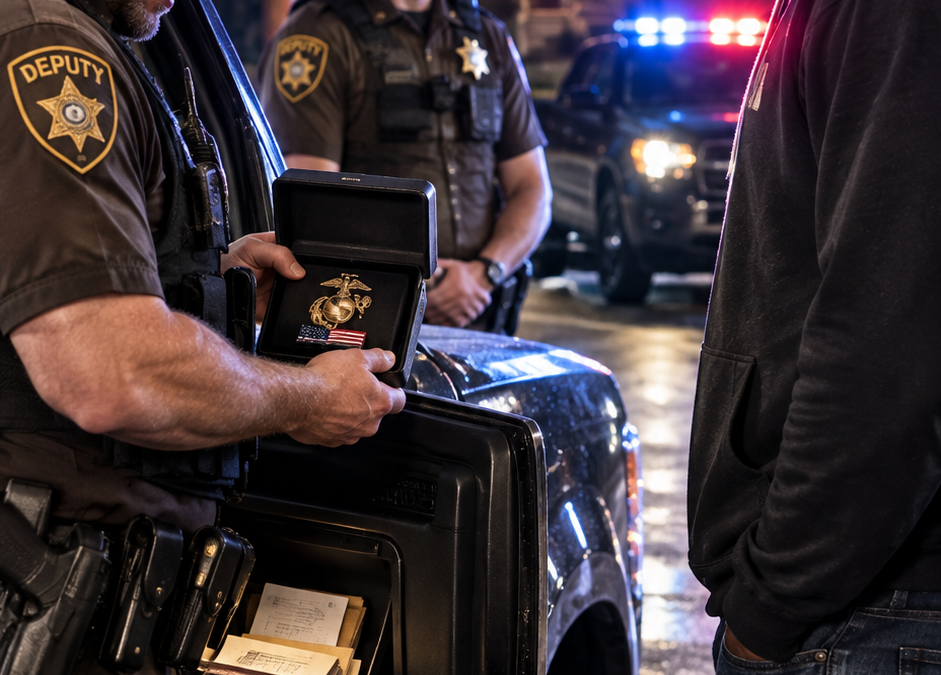
Grady opened my glove compartment.
He removed the owner’s manual, a flashlight, and a tire pressure gauge.
Then he found the black presentation case.
I watched him turn it over.
He opened it.
Inside, resting against dark blue velvet, was the Medal of Honor.
He stared at it.
“What the hell is this?”
I turned my head.
“That’s the Medal of Honor, Deputy.”
He looked at me.
“What?”
“It was presented to me by the President of the United States.”
For a moment, he seemed genuinely surprised.
Then he laughed.
“Holt! Come look at this.”
The younger deputy approached.
Grady held up the open case.
“Our friend here says the President gave him a little necklace.”
Holt looked inside.
His face changed.
I saw recognition followed almost immediately by alarm.
“Russ, I think that’s real.”
Grady snorted.
“Real?”
He shook his head.
“Looks like some kind of gang medallion. Probably worth fifty bucks at a pawn shop.”
He snapped the case shut and tossed it toward the glove compartment.
It struck the edge and fell into the passenger footwell.
I closed my eyes.
For an instant, I wasn’t standing beside my truck anymore.
I was back at the White House, watching my mother touch that medal with trembling fingers.
I remembered Whitaker’s blood on my uniform.
I remembered Ellis struggling to breathe.
I remembered the men who had risked their lives to cover me while I moved across that valley.
Grady had no idea what he had just thrown onto the floor.
But the worst part wasn’t his ignorance.
It was how little he cared after I told him.
He walked back toward me.
“I think you stole this truck.”
“The registration is in my name.”
“And I think you’re casing houses.”
“I haven’t committed a crime.”
“And that medal is probably as fake as your Marine story.”
I looked directly at him.
“I’d like to speak with your supervisor.”
He smiled.
“You’re looking at him. I’m the senior officer on shift.”
Then he grabbed my arm.
The pain came suddenly.
He twisted my wrist behind my back and drove me against the truck.
My cheek struck the metal.
“Stop resisting!”
I wasn’t moving.
My arms were limp.
My legs were steady.
I was doing everything he told me to do.
“Deputy, I’m not resisting.”
“Shut up!”
He pressed harder.
I could feel the edge of the hood against my ribs.
Holt stepped forward.
“Russ, he’s not doing anything.”
Grady turned toward him.
“Then cuff him.”
Holt hesitated.
“Russ—”
“I said cuff him. Now.”
The younger deputy removed his handcuffs.
His hands were shaking.
I looked at him.
For several seconds, neither of us spoke.
I wanted him to understand that the decision he was about to make belonged to him.
He could follow Grady’s instruction.
Or he could acknowledge what he had seen.
He chose the handcuffs.
The metal closed around my wrists.
Grady pulled me away from the truck and pushed me into the back seat of his cruiser.
The door slammed.
Through the window, I watched him return to my vehicle.
The driver’s door remained open.
My gym bag lay on the asphalt.
A few of the worksheets from the mentorship program were drifting across the road.
I stared at them until the cruiser began moving.
I had carried wounded Marines through gunfire with these hands.
Now they were locked behind my back because a deputy had decided I looked like a criminal.
For the first time that night, I felt genuinely afraid.
Not of Grady.
Of what would happen to someone less experienced, less disciplined, or less fortunate than I was.
Someone who panicked when ordered out of a car.
Someone who didn’t know how to remain motionless while another person twisted his arm.
Someone who wouldn’t have a general’s telephone number saved in his contacts.
At the Haverford County Sheriff’s Station, Grady booked me on allegations of resisting arrest, suspicious activity, and possession of suspected stolen property.
I listened without arguing.
The deputy processing my paperwork looked confused by the charges.
He asked whether the truck had been reported stolen.
Grady said the investigation was ongoing.
I was placed in a holding cell.
The fluorescent lights hummed overhead.
The air smelled faintly of disinfectant and stale coffee.
My wrists were red where the handcuffs had rubbed against my skin.
I sat on the metal bench and waited.
Eventually, a deputy approached and allowed me to make a telephone call.
I considered calling my mother.
Then I imagined her receiving that call.
Dorothy had spent decades worrying whenever the news reported fighting overseas.
I couldn’t bear the thought of making her worry again before I even understood what was going to happen.
Instead, I selected a number saved under one word.
General.
The line rang twice.
“Lancaster?”
“Sir, it’s Miles.”
“What’s wrong?”
“I’m at the Haverford County Sheriff’s Station. I’ve been arrested.”
Silence.
Then Caldwell asked, very quietly, “For what?”
“Driving through Briarwood Estates, apparently. They searched my truck without cause. The deputy found my medal and called it a gang medallion.”
Another silence.
“He charged me with resisting arrest and suspicious activity. I didn’t resist, sir.”
I heard Caldwell exhale.
“Are you injured?”
“My wrists are bruised. Nothing serious.”
“Have you spoken to an attorney?”
“Not yet.”
“Don’t answer any more questions about the incident without counsel.”
“Yes, sir.”
“I’m coming.”
The line disconnected.
I returned the phone and sat back down.
I hadn’t asked Caldwell to come personally.
I assumed he would contact an attorney or someone who could help establish what had happened.
What I didn’t know was that he had attended a veterans’ fundraiser near Charlottesville earlier that evening.
He was already traveling back toward Norfolk when I called.
Haverford County was less than an hour from his location.
He told his driver to turn around.
Forty-eight minutes later, headlights swept across the front windows of the sheriff’s station.
A black government SUV pulled into the parking lot.
A second vehicle followed.
General Raymond Caldwell stepped out wearing his Marine dress uniform.
Four silver stars gleamed on his shoulders.
Two aides accompanied him.
Inside the station, Grady was still completing his report.
According to what I learned later, he had been joking with another deputy about the supposed fake medal he found in my truck.
Holt sat several desks away.
He hadn’t joined the laughter.
But he hadn’t corrected the account, either.
The front doors opened.
Caldwell entered.
The deputy at the reception desk stood so suddenly that her chair rolled backward.
Grady looked up.
The pen slipped from his fingers.
One of Caldwell’s aides presented his credentials to the desk sergeant.
“General Raymond Caldwell, United States Marine Corps. We’re here regarding Miles Lancaster.”
The sergeant glanced toward the holding area.
Caldwell’s expression remained controlled.
“I understand you’re holding one of my Marines. I’d like to see him immediately.”
The sergeant hurried toward the cells.
I was sitting on the bench when the door opened.
“Come with me.”
He placed the handcuffs back on my wrists before escorting me through the corridor.
I didn’t know Caldwell was already standing outside.
When I entered the main area, I stopped.
There he was.
Dress uniform immaculate.
Shoulders square.
Four stars shining beneath the fluorescent lights.
He looked at my wrists.
Then at my face.
For a moment, I saw an expression I had never seen on him before.
He looked wounded.
Not personally offended.
Not simply angry.
Wounded in the way a commander looks when he discovers that someone he promised to protect has suffered an indignity he cannot undo.
“Staff Sergeant Lancaster.”
“Sir.”
I straightened instinctively.
Caldwell took one step back.
Then he came to attention.
His right hand rose to his brow.
He saluted me.
I stood motionless.
I had seen that gesture countless times at military events.
The Medal of Honor carries a tradition unlike ordinary military decorations. Senior officers, including generals, customarily salute recipients as a gesture of respect for the extraordinary actions the medal represents.
But receiving that salute while standing in handcuffs inside a county sheriff’s station was something I had never imagined.
For three seconds, Caldwell held it.
I couldn’t return the gesture.
My hands were restrained behind my back.
And somehow that made the moment hurt even more.
The room went silent.
When Caldwell lowered his hand, he looked directly at Grady.
“Who arrested this man?”
Grady stepped forward.
“I did, sir. Deputy Russell Grady.”
“Why?”
“We were conducting increased patrols because of recent break-ins. He was driving suspiciously through the neighborhood.”
“What traffic violation did he commit?”
Grady hesitated.
“He matched the general profile of—”
“What description?”
Caldwell’s voice remained steady.
“What dispatch report identified a Black man driving a black Ford F-150 as a suspect?”
Grady looked toward Holt.
Holt lowered his eyes.
“There wasn’t a specific vehicle description, sir.”
Caldwell turned back toward Grady.
“Then explain why he’s standing here in handcuffs.”
Grady began describing my supposed refusal to obey instructions.
I listened as he turned the encounter into something I barely recognized.
He said I had been evasive.
He said I had questioned lawful commands.
He claimed he smelled marijuana and that I became physically resistant during the search.
When he finished, Caldwell requested preservation of both deputies’ body camera recordings, the dispatch communications, and all records associated with the stop.
He also asked that the sheriff be contacted immediately.
The desk sergeant arranged for the footage to be reviewed.
We moved into a small office with a monitor.
Grady stood near the wall.
Holt remained close to the doorway.
I sat beside Caldwell while the recording began.
Watching yourself being humiliated is a strange experience.
Memory allows you to look away from certain details.
Video doesn’t.
I watched Grady approach my window with his hand near his holster.
I watched myself provide my license and registration.
I heard dispatch confirm that my truck and documents were clean.
Then I heard the order to step outside.
The footage showed my hands remaining visible.
It showed me complying with every physical instruction.
It recorded Grady making racial remarks and calling me a dog.
I saw my gym bag thrown onto the road.
I watched the worksheets scatter.
Then the black presentation case appeared.
Grady opened it.
He laughed at my Medal of Honor.
He called it a gang medallion.
And he tossed it into the truck.
Beside me, Caldwell’s jaw tightened.
The recording continued.
Grady twisted my arm and shoved me against the hood.
“Stop resisting!”
On the screen, my body remained completely still.
Holt’s voice followed.
“He’s not resisting. He’s not doing anything.”
Then Grady ordered him to apply the handcuffs.
Holt obeyed.
The recording ended.
Nobody spoke.
Caldwell stood.
He turned toward Grady.
“You called his Medal of Honor a gang medallion.”
Grady swallowed.
“I didn’t know it was real, sir.”
Caldwell looked at him for several seconds.
“This Marine went into enemy fire to rescue two wounded men. He returned to that same exposed ground knowing what could happen to him.”
Grady stared at the floor.
“The President recognized his actions with the highest military decoration this country awards.”
Caldwell paused.
“And you treated him like an animal on the side of a road.”
Grady’s voice cracked.
“Sir, I didn’t know who he was.”
Caldwell stepped closer.
“You didn’t need to know who he was.”
The room was absolutely silent.
“You needed to follow the law.”
That was the sentence I remembered most clearly.
Not the salute.
Not the four stars.
Not even Grady’s expression when he realized the man standing in front of him wasn’t going to accept another excuse.
Because Caldwell understood something that mattered far more than my military record.
I should never have needed a Medal of Honor to be treated lawfully.
The encounter would have been just as wrong if I had been an unemployed construction worker, a teenager returning from school, or a father driving home from a late shift.
My decorations made the incident visible.
They didn’t make my rights more important than anyone else’s.
Sheriff Tom Whitfield arrived shortly afterward.
He was wearing khakis and a polo shirt, and he looked as though someone had dragged him out of bed.
He had run the department for twelve years.
Grady had served under him for most of that time.
I later learned that three excessive-force complaints had been filed against Grady during the preceding seven years.
All three had been dismissed without external review.
Whitfield had been satisfied with Grady’s arrest statistics and the praise he received from residents who appreciated his aggressive patrol style.
He had paid considerably less attention to the people complaining about how those results were obtained.
Now he watched the body camera footage with Caldwell standing beside him.
When the recording ended, he looked at Grady.
“Turn in your badge and weapon.”
Grady stared.
“Tom, come on. Fifteen years.”
“You’re suspended without pay pending investigation.”
“You know how I work.”
Whitfield’s face tightened.
“That’s becoming the problem.”
Grady slowly removed his badge.
Then he surrendered his service weapon.
I watched both items being placed on the desk.
Holt was suspended as well.
The recording established that he had recognized the medal, questioned his partner’s actions, and acknowledged that I wasn’t resisting.
It also established that he had ultimately applied the handcuffs.
His hesitation mattered.
But so did his decision.
The sheriff arranged for my release, and the unsupported charges were withdrawn.
Before I left, arrangements were made to secure the original recordings and preserve the evidence.
Caldwell insisted that an attorney review the entire incident before anyone began speaking publicly on my behalf.
When we finally stepped outside, the night air felt unusually cold.
I stopped on the sidewalk.
For the first time in several hours, I took a breath that didn’t seem trapped inside my chest.
Caldwell placed a hand on my shoulder.
“You handled yourself with extraordinary discipline.”
I looked across the parking lot.
My truck had been recovered, and my belongings had been placed back inside.
Someone had cleaned up the mess Grady made.
But the thought of those scattered worksheets wouldn’t leave me.
“Sir, all I kept thinking about was the kids at the center.”
“What about them?”
“What do I tell them when I see them again?”
He looked at me.
“Tell them the truth.”
I shook my head.
“How do I teach them to respect authority after something like this?”
Caldwell took a moment before answering.
“Teach them the difference between respecting the law and accepting the misuse of authority.”
I thought about Marcus asking whether the Medal of Honor meant I was never afraid.
I had told him that I feared failing people who trusted me.
Now I understood that the boys at the center needed more than another lesson about discipline.
They needed to know what to do when being disciplined and respectful wasn’t enough to keep them safe.
Caldwell didn’t return home immediately.
Over the following days, he helped connect me with appropriate military legal assistance and encouraged me to report the incident through the proper channels.
The Department of Justice received a referral.
The Marine Corps Inspector General was informed.
Attorneys began reviewing my options.
But the event that brought the incident to national attention came from an unexpected source.
Someone inside the sheriff’s department copied the body camera footage and sent it to an investigative reporter named Dana Prescott.
She worked for the Richmond Chronicle and had spent years covering police misconduct in central Virginia.
Her story appeared on Monday morning.
The headline identified me as a Medal of Honor recipient who had been arrested while driving through a predominantly white neighborhood.
The photograph showed Grady pressing my face against the hood of my truck.
By that afternoon, major news organizations were broadcasting the footage.
The clip that spread most widely showed Grady holding my medal.
He called it a gang medallion.
Then he laughed.
People wanted interviews.
Veterans contacted me.
Civil rights organizations offered assistance.
Strangers sent letters to my mother’s house.
Some people expressed outrage at the way I had been treated.
Others wanted to know why I had been driving through Briarwood in the first place.
That question told me how much work remained.
I had taken a public road home.
That should have been enough.
My mother watched the footage before I managed to reach her.
When I called, she answered on the first ring.
“Miles.”
“Hey, Mama.”
She didn’t speak for several seconds.
Then she asked whether I was hurt.
“My wrists are bruised. I’m all right.”
“I saw that man put his hands on you.”
“I know.”
“I saw what he said.”
I closed my eyes.
“I’m sorry you had to watch it.”
She took a shaky breath.
“Baby, I’ve been afraid of something like this since you were old enough to drive.”
I had survived deployments she could barely stand to watch on the evening news.
I had been injured in places she would never visit.
But hearing that she had feared an encounter on an American road more than she had ever admitted broke something inside me.
“I wish I could’ve been there,” she whispered.
“Mama, there wasn’t anything you could’ve done.”
“I could’ve stood beside you.”
That was my mother.
She had never cared how many medals I received or how many senior officers knew my name.
When she imagined her grown son being hurt, she still wanted to be the woman who could stand between him and the world.
By Wednesday, the Department of Justice had opened a federal investigation.
Its scope expanded beyond my arrest to include the Haverford County Sheriff’s Department’s broader practices.
Investigators examined eighteen months of traffic stop data.
They reviewed dispatch records, body camera footage, demographic information, and complaints that had previously been dismissed.
The preliminary numbers raised serious concerns.
Grady had conducted 214 traffic stops during the period under review.
Of those, 167 involved Black or Latino drivers, approximately seventy-eight percent.
The county’s minority population was roughly twenty-two percent.
Statistics alone could not explain every stop.
But the accompanying recordings and reports revealed a disturbing pattern.
Grady repeatedly used the same justifications.
Suspicious behavior.
Possible drug odor.
Vehicles matching vague descriptions.
Drivers making movements he considered dangerous.
The phrases changed very little from one incident to another.
The people he stopped changed.
And many of them described experiences frighteningly similar to mine.
Investigators reopened the three earlier excessive-force complaints.
All had been filed by Black men.
Two complainants reported being pressured to withdraw their allegations.
The paperwork associated with the third complaint had disappeared from the department’s files.
Additional recordings implicated two deputies who had supported Grady’s reports despite footage contradicting their accounts.
Both were placed on administrative leave.
The investigation lasted four months.
During that time, I continued working with the teenagers at the community center.
At first, they were almost afraid to talk to me about what had happened.
Marcus finally raised his hand during one Thursday session.
“Mr. Lancaster, can I ask you something?”
“Go ahead.”
“Why didn’t you fight back?”
The room became quiet.
I looked at the boys and girls sitting around the tables.
“Because fighting back physically could have made the situation much more dangerous.”
“But you could’ve beaten him.”
“That wasn’t the point.”
Marcus frowned.
“He called you a dog.”
“I heard him.”
“So you just let him?”
I sat on the edge of the table.
“I decided that I wanted to go home alive. I also wanted everyone to understand what actually happened.”
I let them think about that.
“Being able to fight doesn’t mean fighting is always the right decision. Sometimes the smartest thing you can do is protect yourself until you have a safer way to challenge what’s happening.”
One of the younger boys asked what he should do if a police officer stopped him.
We spent the rest of the session discussing how to remain calm, keep hands visible, understand instructions, and request assistance.
I also explained something I wished I had never needed to teach.
Cooperating with an officer didn’t mean surrendering every legal right.
And wearing a badge didn’t make every decision automatically correct.
By the end of the session, Marcus was unusually quiet.
As he packed his bag, he approached me.
“Mr. Lancaster?”
“What’s up?”
“My little brother wants to come next week.”
I smiled.
“Bring him.”
That was the first moment since my arrest when I felt certain that something worthwhile might grow out of what had happened.
Several months after the traffic stop, a federal grand jury returned an indictment against Grady.
Federal marshals arrested him at his home early on a Tuesday morning.
He was charged with willful deprivation of civil rights under color of law and offenses connected to the search, use of force, and false account of my detention.
The image of him being escorted to a government vehicle in handcuffs appeared on the evening news.
I didn’t celebrate it.
I knew what those handcuffs felt like.
I also knew the difference between being restrained without justification and being arrested pursuant to charges supported by an investigation.
The trial lasted nine days.
Grady’s defense argued that he had been responding to a series of neighborhood break-ins and had reasonably suspected my truck might be connected.
His attorney emphasized the darkness, my clothing, and the possibility of danger during a traffic stop.
The prosecution focused on the records.
There had been no dispatch description matching me or my vehicle.
My registration and license were valid.
There was no evidence I had violated a traffic law or committed a crime.
The recordings showed me complying with the deputy’s instructions.
They also captured his racial remarks, the unsupported marijuana claim, the search of my truck, and his use of force while I remained still.
The jury heard evidence relating to the previous complaints within the limits established by the judge.
They also examined the department’s failure to investigate those complaints properly.
When I testified, I described the encounter as accurately as I could.
I didn’t exaggerate.
I didn’t pretend I had been perfectly calm inside.
I explained that I had been angry, frightened, and deeply humiliated.
But I had controlled my behavior because I wanted to survive the encounter without anyone getting hurt.
Grady’s attorney questioned why I had contacted General Caldwell rather than simply accepting the charges and hiring a local attorney.
I answered that Caldwell was someone I trusted and that I needed immediate assistance after being detained under circumstances I believed were unlawful.
Then the attorney asked whether I thought my Medal of Honor entitled me to special treatment.
I looked toward the jury.
“No.”
I let the answer settle.
“I expected the same lawful treatment every driver should receive.”
The jury deliberated for three hours.
Grady was found guilty on all counts submitted to them.
He stood motionless as the verdict was read.
His wife sat behind him, crying.
I watched without feeling the satisfaction I had once imagined a conviction might bring.
The verdict established accountability for what he had done.
It didn’t erase the hours I had spent in his custody.
And it couldn’t give back the dignity of the other men whose complaints had been ignored.
Two weeks later, the judge sentenced him to four years in federal prison.
His conviction ended his law enforcement career.
Three days after the verdict, Sheriff Whitfield resigned.
He delivered a brief public statement thanking the community for its support.
He didn’t apologize to me.
He didn’t mention the men whose complaints his department had dismissed.
He walked away from the podium without answering questions.
The Department of Justice’s investigation had documented serious failures in the department’s complaint handling, supervision, and efforts to identify discriminatory enforcement patterns.
Whitfield faced a civil lawsuit arising from his handling of my arrest.
He was not criminally charged.
Holt was not criminally charged either.
The footage showed that he had questioned Grady more than once.
He had recognized the medal.
He had acknowledged that I wasn’t resisting.
But he had still put the handcuffs on me.
The department terminated his employment.
Through his attorney, Holt released a statement accepting responsibility for failing to intervene when he knew the detention was wrong.
He described the moment when he chose to follow his senior partner’s instructions rather than challenge what was happening in front of him.
He said he would carry that failure for the rest of his life.
I believed him.
But belief didn’t require me to excuse the decision.
I filed a civil rights lawsuit against Haverford County.
The case eventually settled out of court for $2.8 million.
The amount attracted enormous attention.
Reporters wanted to know whether I intended to buy a new house, travel, or invest the money.
I understood the curiosity.
But I had never considered my arrest an opportunity to become wealthy.
I allocated one-third of the settlement to expanding the youth mentorship program at the community center.
Another third established the Dorothy Lancaster Future Leaders Scholarship for first-generation college students from Ridgeway.
The remaining funds supported a veterans organization and a legal defense fund assisting people affected by police misconduct.
When I told my mother about the scholarship, she cried.
“Why would you name it after me?”
“Because you’re the reason I had a future, Mama.”
She shook her head.
“I just packed your lunches and made sure you did your homework.”
I smiled.
“You did a little more than that.”
Three months after the settlement, I received an invitation to testify before a House subcommittee examining policing practices.
I accepted.
Caldwell accompanied me.
We sat together in a wood-paneled hearing room in Washington.
He wore his dress uniform.
I spoke for twelve minutes without notes.
I described the traffic stop, the search, the treatment of my Medal of Honor, and the hours I spent inside the holding cell.
I explained how easily an officer’s unsupported suspicion had become an arrest report.
I also described the importance of preserving the body camera footage and examining complaints that had previously been dismissed.
Then I told the committee something I had been trying to explain since the first newspaper article appeared.
“I didn’t need the Medal of Honor to deserve basic dignity. No one does.”
I paused.
“The fact that I had one, and it still wasn’t enough, should tell us something important about what happened on that road.”
The room became quiet.
I looked toward Caldwell.
He gave me a small nod.
For years, I had associated that medal with the men I rescued in Helmand Province.
Now strangers associated it with a police officer who had thrown it into the footwell of my truck.
I knew which memory I wanted to preserve.
The following year, the community center’s mentorship program expanded beyond Haverford County.
What had begun as two afternoon sessions each week became a structured program operating across three counties.
Sixty-two students enrolled during one semester.
We added academic support, leadership workshops, career preparation, and practical lessons about civil rights.
Every student received a small laminated card containing general guidance about encounters with law enforcement.
We discussed remaining calm, keeping hands visible, asking for identification, and seeking legal assistance when necessary.
But I never presented those precautions as a guarantee.
My own experience had demonstrated that a person could comply with every instruction and still be mistreated.
The responsibility to act lawfully remained with the person exercising authority.
I wanted the students to understand both sides of that truth.
Sometimes parents attended the workshops.
Sometimes police officers volunteered to answer questions.
I insisted that every discussion begin with the same principle.
Respect had to include accountability.
One afternoon, Marcus stayed behind after everyone else had left.
He was taller now.
He had improved his grades and hadn’t been suspended all semester.
He stood beside the table, turning his laminated card over in his hands.
“Mr. Lancaster?”
“Yeah?”
“I’ve been thinking about joining the Marines.”
I looked at him.
“Why?”
He shrugged.
“I want to do something that matters.”
I remembered walking into the recruiter’s office at eighteen.
I remembered the bus station and my mother’s handwriting on that folded napkin.
I placed my hand on Marcus’s shoulder.
“Then make sure you’re choosing it for the right reasons.”
He smiled.
“That’s what you always tell us.”
“Some lessons are worth repeating.”
The Dorothy Lancaster Future Leaders Scholarship awarded its first three grants the following spring.
Two recipients were young women from Ridgeway.
The third was a young man from Haverford County who wanted to study criminal justice.
My mother attended the ceremony in her best dress.
When her name was announced, she covered her mouth with both hands.
I watched her cry and remembered the White House.
But this time, she wasn’t standing in a room celebrating my accomplishments.
She was surrounded by young people who would be able to pursue their own because of the sacrifices she had made.
After the ceremony, she embraced me.
“I don’t know what I did to deserve all this.”
I kissed her cheek.
“You raised three boys without giving up on any of us.”
She looked at the students gathering for photographs.
“Then those babies better finish college.”
I laughed.
“Yes, ma’am.”
Holt eventually left Virginia for a while.
After his termination, he withdrew from public life and later enrolled in a social work program at Virginia Commonwealth University.
He eventually began working with a nonprofit that provided training in de-escalation, implicit bias, and intervention.
His workshop was called The Cost of Silence.
He used his failure during my arrest to explain why officers needed to intervene when a colleague crossed the line.
I heard about his work from someone who attended one of the sessions.
For a long time, I wasn’t sure how I felt about it.
Part of me remembered him standing beside my truck, recognizing the Medal of Honor, and choosing to close the handcuffs anyway.
Another part of me understood that admitting a serious failure could become meaningful if it prevented someone else from making the same decision.
I never contacted him.
I didn’t need to.
His responsibility was to make his future actions different from his past.
The county also began changing.
Following Whitfield’s resignation, Angela Davis Moore was elected sheriff in a special election.
She became the first Black sheriff in Haverford County’s history.
Her administration introduced mandatory body camera procedures, independent civilian oversight with subpoena authority, and external review of racial-profiling complaints.
Those changes couldn’t undo what had happened to me or the men before me.
But they created ways for future complaints to be examined without depending entirely on the same supervisors whose decisions were being questioned.
General Caldwell retired the following year after forty-one years of military service.
I attended his retirement ceremony.
He stood before a room filled with Marines, senior officers, veterans, and families who had known him throughout his career.
When he spoke about leadership, he mentioned the importance of remaining accountable even when authority made it easy to avoid criticism.
Then he looked toward me.
He told the audience that one of the most difficult displays of discipline he had witnessed hadn’t occurred on a battlefield.
It had happened in a sheriff’s station, where a Marine stood in handcuffs after being treated unjustly and still refused to surrender his self-control.
I lowered my head.
I appreciated his words.
But I also knew that my composure had depended on lessons learned from people who would never stand at a podium or receive a medal.
My mother.
My drill instructors.
The Marines who trusted me in Afghanistan.
The teenagers who expected me to practice what I taught them.
They had all been present in some way on that October evening.
Today, I still live in Ridgeway.
I still drive through the same streets my mother walked before dawn on her way to the elementary school cafeteria.
I still volunteer at the community center.
And I still keep the Medal of Honor inside its black presentation case.
The case bears a small scuff from the night Grady threw it into my truck.
I could have replaced it.
I chose not to.
Every time I notice that mark, I think about the distance between what the medal represents and what happened on the roadside.
It reminds me of the men I pulled from the valley.
It reminds me of the mother who packed my lunch.
And it reminds me that no decoration, rank, or title should determine whether a person deserves to be treated with dignity.
One evening, after a mentorship session, Marcus asked if I ever thought about the deputy who arrested me.
I was packing supplies into the same box Grady had overturned that night.
“Sometimes,” I admitted.
“Does it still make you angry?”
I considered the question.
“Sometimes.”
“What do you do about it?”
I looked around the room.
The tables were covered with homework, college brochures, and the notebooks of students who were beginning to imagine futures larger than the ones they had once believed possible.
“This,” I told him.
He glanced around.
“The program?”
“The work.”
I closed the supply box.
“Anger can tell you something needs to change. But it can’t do the changing for you.”
Marcus nodded slowly.
Then he helped me carry the box to my truck.
We loaded the supplies into the back seat, and I checked that everything was secure before closing the door.
For a moment, I found myself looking at the glove compartment.
I remembered the deputy’s laughter.
The cold handcuffs.
The fluorescent lights inside the holding cell.
And General Caldwell raising his hand in salute while I stood there unable to return it.
That night, the salute had restored something I thought had been taken from me.
But the months that followed taught me something more important.
My dignity had never belonged to Russell Grady in the first place.
He had possessed the authority to arrest me.
He had possessed the physical power to restrain me.
For several hours, he had controlled where I could go and whether I could contact the people who cared about me.
But he had never possessed the authority to decide my worth.
When Marcus climbed into his mother’s car and waved goodbye, I raised my hand and watched them drive away.
Then I opened my wallet.
Behind my driver’s license, carefully folded and protected inside a transparent sleeve, was an old paper napkin.
The writing had faded.
The paper was fragile at the creases.
But fourteen years after my mother first handed it to me, those four words still meant more than anything I had ever worn on my uniform.
I’m proud of you.
I folded the wallet closed, started my truck, and drove home.








