𝗙𝗨𝗟𝗟 𝗦𝗧𝗢𝗥𝗬 The Deputy at My Father’s Cabin Had No Idea Who Was Coming Up the Driveway
𝗙𝗨𝗟𝗟 𝗦𝗧𝗢𝗥𝗬
My mother, Lorraine, used to say that Dad could forgive somebody for borrowing his tools without asking, but he would argue for forty minutes if a stranger told him where he was allowed to park his truck.
She understood him better than anyone.
They had been married for decades when she died nine years earlier.
Her death changed the cabin.
The furniture remained in the same places.
Her photographs stayed on the walls.
Her favorite coffee mug still occupied the second shelf above the kitchen sink.
But the house had lost the warmth that came from hearing her voice.
Dad never complained about being lonely.
That wasn’t his way.
Instead, he repaired things that didn’t need repairing.
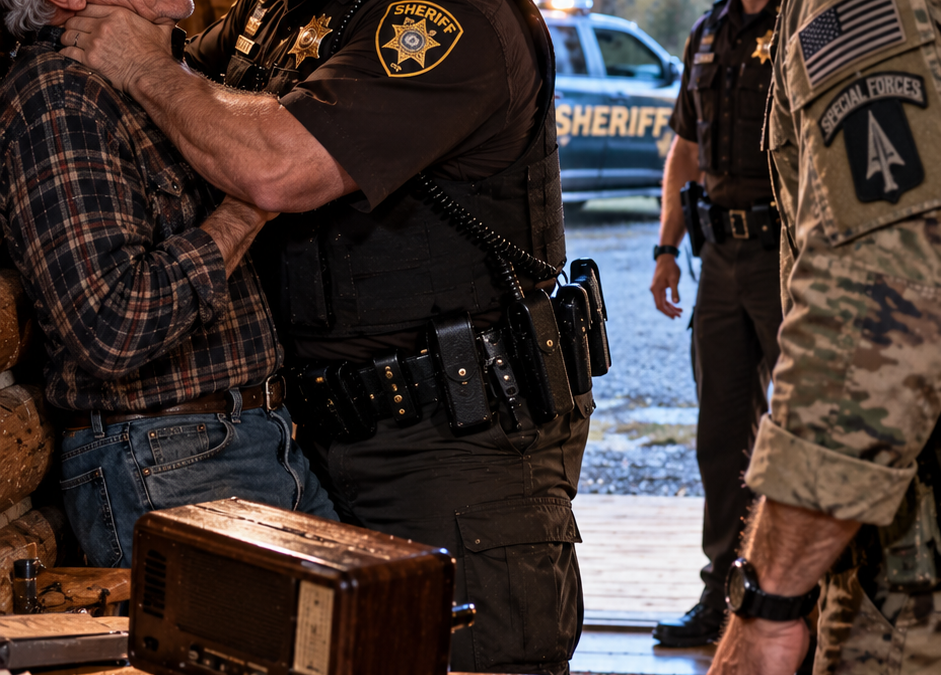
He spent entire afternoons tinkering with an old Philco radio that had belonged to his father.
Sometimes, when we spoke on the phone, he described the radio’s problems with so much enthusiasm that I suspected he was less interested in making it work than in having something to keep his hands occupied.
I should have visited more often.
I knew that.
For five years, one assignment had followed another.
There were deployments, training commitments, operations, and enough administrative responsibilities to convince me that postponing another trip home was reasonable.
Dad never complained.
“Do your job, son,” he would tell me.
“We’ll get together when you have time.”
He always said it like time was something we could store in a cupboard and retrieve whenever life became less complicated.
Then one morning, I realized he was seventy-four.
My mother had already been gone for nine years.
And I couldn’t remember the last time Dad and I had spent an entire day together without my checking a watch or answering a call.
So I arranged time off and decided to surprise him.
In the Bronco’s rear cargo area was an old fishing rod wrapped inside a canvas case.
It had belonged to him when I was a teenager.
The cork handle had split, two guides were missing, and the reel had rusted almost solid.
I had spent three months having it restored.
I imagined arriving at the cabin, finding Dad sitting on the porch with a glass of sweet tea, and handing him the rod.
He would examine it carefully.
Then he would complain about how much money I must have spent repairing something that could have been replaced for eighty dollars.
I had been smiling at that thought when I turned onto the narrow road leading toward our property.
Three miles away, everything changed.
I saw the sheriff’s cruiser before I saw the cabin.
It was parked beside Dad’s old pickup.
The driver’s door stood open.
I slowed.
My father had never had much patience for unexpected visits from county officials, but a patrol vehicle outside the house didn’t automatically mean something was wrong.
I parked the Bronco near the porch.
Then I heard shouting.
“Sir, I’m asking you one last time. Sign the paper.”
My father’s voice answered.
“I’m not signing anything.”
“Then you’re making this harder than it needs to be.”
“You came into my house without a warrant.”
I moved toward the porch.
“We received a report about an illegal firearm.”
“You didn’t come here looking for a gun.”
I reached the open doorway.
Then I heard my father gasp.
I stepped inside.
And I saw Harland’s hand around his throat.
What I didn’t know that afternoon was that the confrontation had been carefully prepared.
Two weeks earlier, a company called Black Ridge Development had made its fourth offer for our family’s land.
The newest proposal was for $1.2 million.
Dad refused.
Three days later, county inspectors began arriving.
First, they claimed his septic system violated regulations.
Then they issued a citation concerning an old outbuilding.
After that came a complaint about an abandoned vehicle, even though the tractor they had cited was still being used to maintain the property.
Dad had challenged every notice.
He saved the paperwork.
He wrote down dates.
And when inspectors appeared without appointments, he demanded that they explain exactly which rule he had supposedly broken.
Then Lieutenant Wade Harland arrived with Deputy Ryan Keller.
Harland had served in the Black Pine County Sheriff’s Department for eighteen years.
People who admired him described him as decisive.
People who had encountered him during contentious investigations tended to use different words.
According to records we later obtained, he had repeatedly appeared in enforcement actions involving landowners who refused to sell property to Black Ridge.
Ryan Keller was considerably younger.
He was twenty-seven and had graduated from the police academy less than a year earlier.
His older brother had died while serving as a volunteer firefighter, and Ryan had entered law enforcement believing that public service meant protecting people who couldn’t protect themselves.
He had no idea how badly that belief was about to be tested.
Before they entered our cabin, Harland switched off his body camera.
Ryan noticed.
“Equipment problem, Lieutenant?”
“No.”
“Should I turn mine off?”
Harland looked at him.
“You heard me.”
Then he walked toward the porch.
Ryan followed.
But before crossing the threshold, he quietly activated his own camera.
That decision saved my father from having the entire encounter rewritten by the men who had created it.
Inside the cabin, Harland claimed the department had received an anonymous report about an unregistered handgun connected to a burglary.
Dad asked to see a warrant.
Harland didn’t have one.
Instead, he took out an easement agreement and demanded Dad’s signature.
My father recognized what was happening.
He had been refusing Black Ridge’s purchase offers for months.
Now a sheriff’s lieutenant was standing in his kitchen with the very document the developer wanted signed.
Dad told Harland to leave.
Harland threatened additional citations.
Dad refused again.
Only then did Harland begin talking about the supposed firearm investigation.
When Dad reached for his telephone to call an attorney, Harland grabbed it.
Dad demanded that he return the phone and leave the house.
The lieutenant shoved him backward.
Then he caught my father by the throat and forced him against the log wall.
That was the moment I arrived.
After I separated them, Harland reached toward his belt.
“Back away. He assaulted an officer.”
I looked toward Ryan.
“You saw what happened.”
Ryan stood very still.
His expression told me that he was frightened of his superior.
But I also noticed that his camera was recording.
“Deputy,” I said, “my father’s having trouble breathing. Call an ambulance.”
Harland stepped closer.
“You’re not giving orders here.”
I ignored him.
“Dad, sit down.”
My father tried to answer.
Instead, he coughed so violently that he had to brace himself against the table.
I moved toward him.
Harland took a step after me.
“Don’t turn your back on me.”
I looked over my shoulder.
“If you touch him again, there will be witnesses.”
He glanced at Ryan.
For the first time, uncertainty appeared in his expression.
Then he reached for his radio and called for backup.
Four minutes later, another cruiser arrived.
Then two more.
Before long, our narrow driveway was filled with red and blue lights.
Across the valley, our neighbor Martha Bell was standing at her kitchen window with her telephone pressed against the glass.
Martha was sixty-nine, a widow with silver curls and the sort of sharp eyes that made it nearly impossible to keep a secret anywhere within view of her property.
She had known my parents for decades.
When she noticed the first patrol vehicle, she began watching.
When more cruisers arrived, she started recording.
She also noticed a black SUV parked half a mile down the road.
Its engine was running.
Someone remained inside.
Before the afternoon ended, the vehicle disappeared.
At the time, she didn’t understand why that mattered.
Neither did I.
Sheriff Douglas Vance arrived last.
He was fifty-eight, neatly dressed, with silver hair, pale blue eyes, and the carefully pleasant manner of a man who had spent twelve years shaking hands at county events while learning exactly how to avoid answering uncomfortable questions.
He walked into the cabin without appearing particularly concerned about the number of deputies gathered outside.
“What happened?”
Harland answered immediately.
“Mr. Carter became combative during a lawful investigation. His son interfered when I attempted to detain him.”
Ryan opened his mouth.
Vance looked at him.
The young deputy closed it again.
My father struggled to stand.
“He came into my house without a warrant and put his hands around my throat.”
Vance glanced briefly at the red marks forming beneath Dad’s jaw.
“We’ll sort everything out.”
I had heard that sentence before.
In my experience, it often meant someone in authority had already decided which version of events would be most convenient.
“Then start by getting him medical attention,” I said.
Vance turned toward me.
“And you are?”
“Caleb Carter. His son.”
Harland spoke from behind him.
“Military.”
Vance glanced at my jacket.
“That doesn’t change the situation.”
“I didn’t say it did.”
I pointed toward Dad.
“He’s seventy-four years old. Your lieutenant had one hand around his throat when I walked in.”
Vance studied me.
Then he instructed two deputies to conduct what he called a protective sweep.
I watched one officer move toward the living room.
He crouched beside the old sofa.
When his hand emerged, he was holding a short-barreled .38 revolver.
“Sheriff.”
The room went quiet.
Vance looked at the weapon.
“Mr. Carter, is this yours?”
“No,” Dad answered immediately.
“Absolutely not,” I added.
My father had never liked handguns.
His only firearm was an old Winchester Model 70 hunting rifle that he kept secured upstairs, with purchase paperwork dating back to 1987.
The revolver in the deputy’s hand was something neither of us had ever seen.
“That gun has never been inside this house,” Dad said.
Vance ignored him.
He instructed one deputy to secure the weapon and another to separate my father and me.
Then he announced that we could both be detained.
Dad for assaulting an officer and possessing a suspicious firearm.
Me for interfering with law enforcement.
I stared at him.
For a moment, I couldn’t believe he was willing to take the confrontation that far.
Then Ryan spoke.
“Sheriff.”
Nobody answered.
He swallowed.
“My body camera was recording.”
Every head in the room turned.
Vance looked at him.
“Your camera was on inside the residence?”
“Yes, sir.”
“The entire time?”
“Yes.”
For several seconds, nobody moved.
Then Vance extended his hand.
“Give it to me.”
Ryan hesitated.
“Sir, department policy says footage involving a use-of-force incident should be preserved through evidence procedures.”
Vance’s expression hardened.
“Camera. Now.”
Ryan unclipped it.
He handed it over.
I watched that exchange more carefully than anything else that happened during the next several minutes.
Vance had barely acknowledged the injuries around my father’s throat.
But the possibility of a recording seemed to concern him enormously.
An ambulance arrived shortly afterward.
Dad insisted he was fine.
Then he tried to swallow.
The pain stopped him midsentence.
I helped him onto the stretcher.
At Blackpine Regional Hospital, Dr. Natalie Brooks examined him.
She was an experienced emergency physician who had spent years treating mining accidents, highway injuries, and elderly patients who insisted there was no reason to worry even when the evidence strongly suggested otherwise.
After reviewing the scans, she explained that Dad had no fracture or major airway damage.
Then she looked directly at him.
“You were lucky.”
Dad grumbled.
“I’d feel luckier if somebody would let me go home.”
She didn’t smile.
“Neck injuries can be dangerous even when the first examination is reassuring. We’re going to make sure you’re stable.”
While examining his arms, she noticed older bruises.
Yellow and purple marks around his upper arm.
“These aren’t from today.”
Dad looked away.
I felt something cold settle in my stomach.
“Dad?”
He didn’t answer.
“Dad, who did that?”
He stared toward the hospital window.
Finally, he spoke.
“Harland shoved me against my truck a couple of months ago.”
I looked at him.
He continued before I could respond.
“I was arguing with a county inspector. Harland came over and told me to stop interfering.”
“And he grabbed you?”
“Yes.”
“You didn’t tell me.”
“What would you have done from overseas?”
I had no answer.
That frightened me more than I wanted to admit.
For years, I had convinced myself that remaining committed to my military career was the same thing as fulfilling every responsibility in my life.
My father never asked for help.
I rarely offered it without being prompted.
And somewhere along the way, I had allowed his independence to become an excuse for my absence.
Now he was lying in a hospital bed with bruises around his throat because men who wanted our family’s land had learned that he was usually alone.
Later that evening, Martha brought a bag of paperwork from the cabin.
I spread the documents across a small table beside Dad’s hospital bed.
Seventeen citations.
Four months.
Septic violations.
Weeds.
Equipment storage complaints.
An allegedly unlicensed structure.
A notice claiming Dad’s mailbox obstructed visibility along the county road.
One citation caught my attention.
June twelfth.
The report stated that my father had personally refused an inspection that afternoon.
I looked up.
“Dad, weren’t you in Charleston on June twelfth?”
He frowned.
“Cardiology appointment.”
“Didn’t you stay overnight?”
“Of course I did. You called me while I was eating that terrible hospital food.”
I examined the document again.
It contained an official signature confirming that the inspector had spoken directly with Isaiah Carter at our property.
My father had been more than a hundred miles away.
Someone had created an official record of a confrontation that never happened.
I placed the citation beside the others.
Then I looked at Dad.
“How long has this been going on?”
He didn’t answer immediately.
Finally, he said something that would change the entire direction of my life.
“Son, I’m not the only one they’ve been doing this to.”
The following morning, I turned our kitchen table into an evidence board.
Dad sat near the window wearing a soft cervical collar, drinking coffee he claimed tasted worse because I had made it.
The bruises beneath his jaw had darkened overnight.
He looked older than he had when I arrived.
But what disturbed me most was how unsurprised he seemed by everything.
I laid out the seventeen citations.
Four purchase offers from Black Ridge Development.
Property tax records.
Survey maps.
Certified letters.
Photographs of boundary stakes.
Dad’s handwritten notes about inspectors, deputies, and company representatives.
“You should have called me months ago,” I said.
He lowered his cup.
“And told you what? That rich men wanted my dirt and a few county boys suddenly forgot how the law works?”
“Yes.”
“You were overseas doing your job.”
“I could’ve come home.”
He looked at me.
“You’re home now.”
Those three words should have comforted me.
Instead, they made me realize how much time I had already lost.
I opened Black Ridge’s newest purchase proposal.
The cover letter described a limited mountain retreat development involving low-impact luxury cabins.
It sounded harmless enough.
Then I examined the attached plans.
The proposed development was called Summit Crown Resort.
The estimated cost was $180 million.
The project included a 140-room hotel, an eighteen-hole golf course, a private hunting club, eighty-six luxury mountain homes, and a thirty-acre artificial lake fed by a diverted creek.
I examined the construction schedule.
Then the transportation plan.
Hundreds of concrete trucks, earthmoving machines, steel deliveries, and oversized utility vehicles would need access to the Upper Ridge.
The existing county road approached from the east.
But it narrowed sharply between two rock faces before climbing at a grade approaching twelve percent.
Heavy equipment couldn’t negotiate that route without extensive blasting and reconstruction.
The western approach was different.
Wide.
Gradual.
Direct.
And it crossed our property.
I pulled an old topographic map from Dad’s records.
Then I found a yellowed survey dated May 1948.
My grandfather hadn’t purchased only the sixty-two acres surrounding our cabin.
He had also acquired a sixty-foot-wide access corridor running from Blackpine Road toward the Upper Ridge.
I traced the line with my finger.
Suddenly, everything made sense.
The development company didn’t simply want my father’s cabin.
It needed the corridor.
Without that route, Summit Crown would have to redesign the project or spend an enormous amount creating another access road.
I looked at Dad.
“This is what they’re after.”
He nodded.
“Took you long enough.”
Then he told me about Black Ridge’s third visit.
A company representative had come to the cabin carrying an envelope.
Inside was fifty thousand dollars in cash.
No receipt.
No contract.
Just a so-called goodwill payment if Dad signed the easement agreement before the company’s attorneys returned.
I stared at him.
“What did you do?”
“Put it back in his hand.”
Of course he had.
That was Isaiah Carter.
A man who had driven a school bus for thirty-one years, repaired his own appliances, and refused to purchase new boots while the old ones still had usable soles.
But put an envelope containing fifty thousand dollars in front of him and ask him to betray a principle, and he would send it straight back across the table.
By noon, I was sitting across from Evelyn Price at the Black Pine County Records Office.
Evelyn was an investigative reporter for the Black Pine Sentinel.
She was thirty-eight, observant, and had been following Black Ridge’s land acquisitions for nearly a year.
Martha had contacted her after recording the deputies at our property.
Evelyn examined the 1948 survey.
Then she studied the resort’s transportation plan.
“Without your father’s corridor, their project has a serious access problem.”
“Exactly.”
She looked toward me.
“Then he’s not simply refusing to sell land they want.”
I nodded.
“He’s holding the road they need.”
Behind the records counter sat Helen Dawson.
Helen was sixty-seven and had worked in county records for thirty-nine years.
She spoke quietly, wore thick reading glasses, and possessed the kind of institutional memory that made computers look unnecessary.
When Evelyn requested every land transfer involving Black Ridge during the previous eighteen months, Helen studied us for several seconds.
Then she disappeared into the records room.
She returned carrying two boxes.
Eleven elderly property owners had sold land to Black Ridge or its affiliated companies.
Six had received repeated county citations shortly before selling.
Three had been arrested.
Two had entered foreclosure.
One man, seventy-one-year-old Walter Pierce, had sold thirty-four acres and left West Virginia within two weeks.
No forwarding address appeared in the county file.
Evelyn stopped writing.
For a moment, she simply stared at the documents.
“I’ve been following this company for almost a year,” she said. “Every sale had an explanation. Tax problems. Family issues. Code violations. Bad timing.”
She tapped the stack.
“Individually, none of them proved much.”
I looked at the files spread across the counter.
“Together?”
Her expression hardened.
“They’re making people too afraid to keep their land.”
Helen glanced toward the hallway.
Then she unlocked a cabinet beneath the records counter.
She removed a thin folder stamped Removed from Public Access.
Inside were older easement maps, internal routing memoranda, and a preliminary transportation study.
Our family’s corridor was highlighted in yellow.
Black Ridge had known from the beginning that my father’s land was essential.
Someone had attempted to make that fact difficult to discover.
As I examined the documents, I began understanding how carefully the pressure had been designed.
A developer could offer money.
When the owner refused, county inspectors could begin finding problems.
If citations didn’t work, law enforcement could become involved.
A frightened or financially exhausted landowner might eventually decide that selling was easier than continuing to fight.
And each time somebody surrendered, the company acquired another piece of the route needed for its resort.
It was a strategy built around isolation.
They wanted every owner to believe the trouble was happening only to them.
That evening, Martha came to our cabin carrying a casserole.
She placed it on the kitchen counter but didn’t remove her coat.
Dad noticed immediately.
“What’s wrong, Martha?”
She sat down.
For several seconds, she stared at her hands.
Then she told us she had sold twelve acres the previous spring.
Dad looked surprised.
“You told me you wanted to keep that field.”
“I did.”
Her voice trembled.
“Harland came to my house two days before I signed. He said my son Marcus had missed a probation appointment years ago.”
She swallowed.
“He told me things could get complicated if somebody decided to reopen old files.”
I felt my jaw tighten.
“So you sold.”
She nodded.
“I was afraid they’d take my son.”
Dad reached across the table and covered her hand.
For a moment, neither spoke.
Then Martha looked at him.
“They did it to me first, Isaiah.”
My father squeezed her fingers.
“You should’ve told me.”
She gave a broken little laugh.
“So should you.”
We sat quietly around the table.
For the first time, I understood how effectively the people behind Black Ridge had isolated their targets.
They had persuaded good neighbors to conceal their troubles from one another.
They had transformed ordinary county procedures into something people feared.
And they had used that fear to acquire land that families had spent generations protecting.
Across town, Evelyn was examining campaign finance records.
By midnight, she had identified more than $240,000 in contributions from Black Ridge executives, contractors, and affiliated political action committees to political organizations supporting Sheriff Douglas Vance.
The contributions alone didn’t establish bribery.
But combined with the suspicious enforcement actions, property transfers, and hidden transportation documents, they gave investigators an important set of relationships to examine.
Evelyn called me the following morning.
“This was never about one old man,” she said.
I looked through the kitchen window toward the road crossing our property.
“No,” I answered.
“It wasn’t.”
At 6:17 the next morning, I received a call from an unfamiliar number.
The voice belonged to Ryan Keller.
“Don’t call this number back.”
I stepped onto the porch.
“What do you want?”
“To show you something.”
“Then come to the house.”
“No.”
He paused.
“Old Harrow Creek Depot. Eleven o’clock. Come alone.”
The line disconnected.
I stared at the phone.
Ryan had stood inside our cabin and watched his superior strangle my father.
He had also recorded the encounter.
Now he was contacting me from an unfamiliar number and demanding a private meeting.
I considered refusing.
Then I thought about the camera Vance had taken from him.
At eleven, I arrived at the abandoned freight depot.
The railroad had closed that section of track decades earlier.
Maple trees and kudzu crowded the old platform, and the roof had rusted so badly that parts of it seemed to be held together by stubbornness alone.
Ryan was waiting beside his car.
He wore jeans, work boots, and a gray sweatshirt.
Without his uniform, he looked considerably younger.
He kept checking the road behind me.
“Vance suspended me,” he said.
“Why?”
“Administrative review.”
I folded my arms.
“Because your camera was recording?”
He nodded.
“Harland thinks I’m going to talk.”
I looked at him.
“Are you?”
He removed a flash drive from his pocket.
“I already am.”
We sat inside my Bronco and connected the drive to my laptop.
The recording began before Harland and Ryan entered Dad’s cabin.
The lieutenant was sitting behind the wheel of the cruiser when his phone rang.
Ryan’s body camera captured the conversation through the vehicle’s speaker.
The caller’s voice was faint but understandable.
“If Carter signs tonight, the road package closes Friday.”
Harland looked toward the cabin.
“He’ll sign.”
The caller said something I couldn’t make out.
Harland answered.
“You worry about your people. I’ll worry about mine.”
Then the recording showed them approaching the house.
The footage confirmed that Harland hadn’t begun with a firearm investigation.
He entered the cabin and demanded Dad’s signature on the easement agreement.
When my father refused, Harland threatened additional citations.
When Dad refused again, the lieutenant introduced the supposed anonymous gun report.
The rest was worse to watch than I expected.
Harland grabbed my father’s telephone.
He shoved him backward.
Then his hand closed around Dad’s throat.
I watched my father struggle against the wall.
I watched Ryan stand motionless.
And finally, I watched myself enter the room.
When the recording ended, neither of us spoke for several seconds.
Then Ryan looked at the floor.
“I should’ve stopped him.”
I closed the laptop.
“Yes.”
He flinched.
I wasn’t interested in pretending he had behaved perfectly simply because he had finally decided to tell the truth.
He had seen a seventy-four-year-old man being assaulted.
For several seconds, he had done nothing.
That failure mattered.
But so did his decision to preserve the recording.
“You can’t change what happened,” I told him. “You can decide what you’re going to do next.”
Ryan opened his backpack again.
He removed a photograph taken hurriedly from a computer monitor.
It showed a spreadsheet from the sheriff’s administrative office.
Rows of property owners filled the screen.
Beside each name was a status.
Cooperative.
Pressure.
Legal.
Arrest.
Near the bottom was my father’s name.
Isaiah Carter.
Final pressure.
I stared at the photograph.
Ryan explained that he had seen the list while delivering paperwork to Vance several weeks earlier.
At the time, he had assumed it was part of a code enforcement operation.
After the confrontation at the cabin, he understood what he had been looking at.
“There were more names below your father’s,” he said. “I couldn’t photograph them without somebody seeing me.”
I studied the screen.
My first instinct was anger.
The second was considerably more useful.
Evidence had a way of outlasting anger.
I looked at Ryan.
“Don’t release the footage publicly yet.”
He seemed surprised.
“Why?”
“Because Harland thinks Vance has the only copy. Black Ridge probably believes the same thing.”
“And?”
“If they think they still control the evidence, they may try to protect themselves.”
Ryan stared at me.
I continued.
“And people make mistakes when they start protecting secrets.”
Evelyn agreed with that approach.
She published a carefully limited article that afternoon.
It established that my father had been hospitalized following an encounter with sheriff’s deputies.
It documented the seventeen citations against our property and identified several suspicious land acquisitions involving elderly owners.
It referred to Martha’s eyewitness recording.
But it said nothing about Ryan’s body camera footage, the phone conversation, or the spreadsheet.
By evening, Evelyn received an encrypted email.
The sender claimed to know what Black Ridge’s security payments really represented.
His name was Nathan Wells.
He was forty-one and had worked as a senior accountant for the development company for six years.
He had spent much of his career making financial records balance while trying not to ask questions about transactions that didn’t make sense.
Now he was frightened.
Evelyn’s article had convinced him that the accounting irregularities he had ignored were connected to something far more serious than creative bookkeeping.
He claimed that payments to Vance and several intermediaries had been concealed under descriptions such as security consulting, site protection, and community risk mitigation.
He promised there were invoices.
He wasn’t ready to meet.
But he was ready to stop pretending the numbers were ordinary.
Meanwhile, I installed six motion-activated cameras around our property.
Two covered the driveway.
One watched the barn.
Another faced the woods.
One overlooked the access corridor.
The last was concealed beneath the porch.
Dad complained the entire time.
“Son, I lived here seventy-four years without turning my house into a military installation.”
“And last week somebody tried to strangle you in your kitchen.”
He looked away.
I tightened the final mounting bracket.
“I’m not leaving you alone with men who think nobody’s watching.”
He didn’t argue again.
At 2:13 the following morning, one of the cameras triggered.
I was sleeping in the guest room when the alert reached my phone.
I opened the live feed.
A figure emerged from the trees behind the barn.
Wade Harland.
He wore civilian clothes and gloves.
His flashlight was partly wrapped in black tape, narrowing the beam so it wouldn’t illuminate the entire yard.
He checked the workshop window.
Then he moved toward Dad’s document shed.
He tried the lock twice.
When a dog began barking at a distant farmhouse, he retreated into the woods.
I watched the recording three times.
Then I saved copies.
I didn’t wake Dad.
He had suffered enough that week.
But Harland had just confirmed something important.
He wasn’t returning to investigate a gun.
He was looking for documents.
The next day, Martha arrived with three additional landowners.
Harold Finch was seventy-two, a retired coal electrician with swollen hands and a permanent limp.
Gloria Massie was sixty-eight, a former elementary school secretary who spoke politely until the subject turned to county inspectors.
Thomas Reed was seventy-five, a widowed cattle farmer whose careful manner concealed a great deal of anger.
All three told variations of the same story.
Unexpected inspections.
Repeated citations.
Unexplained threats.
Purchase offers that became increasingly aggressive whenever they refused to sell.
Martha had persuaded them to come because she had finally realized that remaining silent wasn’t protecting anybody.
We spent the afternoon comparing their documents.
By the time they left, our kitchen table held enough evidence to make me wonder how many other families had already surrendered.
That evening, I reviewed the Black Ridge invoices Evelyn and Helen had helped obtain.
One payment stood out.
Eighty-four thousand dollars to Dunar Earthworks.
The description read Preliminary Western Access Preparation.
The authorization predated Dad’s latest refusal to sell.
Black Ridge had already paid a contractor to prepare a road across land it didn’t own.
I placed the invoice beside Ryan’s spreadsheet and the original body camera recording.
Evelyn stared at the documents.
“We have enough to make them nervous.”
I shook my head.
“Not yet.”
“What else do you want?”
I looked toward the window.
“I want the people behind it. Not just the man who showed up at my father’s door.”
The following morning, Evelyn published the full body camera recording, the photograph of the sheriff’s spreadsheet, Martha’s video, and the supporting property records.
The headline was simple.
What Happened to Isaiah Carter?
The footage did the rest.
Within an hour, local television stations were broadcasting it.
By noon, newsrooms in Charleston, Huntington, and Morgantown were replaying the same sequence.
My father standing inside his own home.
Harland demanding his signature.
The supposed firearm investigation appearing only after Dad refused.
And the lieutenant’s hand closing around a seventy-four-year-old man’s throat.
By afternoon, the video had spread far beyond Black Pine County.
The public reaction was immediate.
But what mattered most wasn’t the number of people watching.
It was what happened when other landowners finally realized they weren’t alone.
Families began calling Evelyn.
Some had kept threatening voicemails.
Others had photographs, inspection notices, and records of property transactions they had never been able to explain.
One farmer arrived carrying three citation books held together with rubber bands.
A widow brought seventeen threatening messages she had been too frightened to delete.
Fear was becoming evidence.
Ryan appeared on television that afternoon.
He wasn’t wearing his uniform.
He looked exhausted.
“I was there,” he said. “I knew what Lieutenant Harland was doing was wrong, and I was afraid to stop him.”
The reporters went quiet.
Ryan swallowed.
“That’s something I have to live with.”
Dad watched the interview from his armchair.
He didn’t say anything until Ryan came to the cabin later that evening.
The young man stood near the doorway, looking as though he would rather have faced an entire courtroom than my father.
Dad studied him.
Then he spoke.
“Next time fear tells you to stay quiet, remember what silence almost cost me.”
Ryan nodded.
“I’m sorry, sir.”
Dad stood slowly.
He held out his hand.
Ryan shook it.
My father didn’t call him brave.
He didn’t pretend the recording erased his failure to intervene.
He simply acknowledged that Ryan had finally made a decision that mattered.
By noon, Nathan Wells had sent Evelyn twelve gigabytes of Black Ridge’s financial records.
The files included invoices, payment schedules, correspondence, and records of transactions routed through multiple intermediaries.
Payments labeled security consulting matched dates when elderly landowners had received enforcement actions.
Money categorized as community risk mitigation had passed through businesses connected to Vance’s political supporters.
One consulting company existed almost entirely on paper.
Its mailing address matched a warehouse owned by Vance’s brother-in-law.
Nathan understood what producing those records could mean for him.
He was frightened for himself and for his nine-year-old daughter.
Federal authorities arranged temporary protection while investigators examined the documents.
Helen Dawson personally delivered certified copies of the hidden property records.
Martha stood outside the courthouse beside other affected landowners and described the threats they had faced.
By evening, a temporary FBI office had been established near the courthouse.
Special Agent Maya Reynolds coordinated the federal investigation.
She had spent fifteen years examining public corruption cases and understood that people who had been intimidated for months rarely responded well to aggressive questioning.
She listened.
She collected documents.
She arranged interviews.
And she began reconstructing the relationships among Black Ridge, the county enforcement offices, and the sheriff’s department.
State police investigators joined her.
For the first time, the people who had been threatening my father were facing a process they couldn’t control simply by deciding which paperwork would be allowed to exist.
Sheriff Vance responded badly.
He locked himself inside his office and began deleting records.
Emails.
Enforcement requests.
Communications with Black Ridge.
Payment schedules.
Internal files connected to property inspections.
He ordered a deputy to destroy an old backup drive.
What he didn’t know was that federal technicians had already obtained a forensic copy of the county server through an earlier preservation process.
Every deleted file became another part of the evidence showing what he had attempted to erase.
At Black Ridge headquarters, Charles Ror was beginning to understand that his development project had become a criminal investigation.
He was fifty-six, meticulously groomed, and accustomed to making uncomfortable problems disappear through lawyers, settlements, and financial pressure.
He booked a private flight from a regional airport, describing the trip as an emergency meeting with investors.
Federal agents met him before he reached the aircraft.
He wasn’t arrested that afternoon.
But he was informed of the investigation and the legal obligations associated with it.
His freedom to treat Black Pine County as a problem he could simply leave behind was becoming considerably more complicated.
Vance made one final telephone call to Harland.
“There are documents at Carter’s place,” he told him. “Anything tying us to those access agreements needs to disappear.”
Harland understood.
Shortly after midnight, three men approached our property through the woods.
Harland led them.
The other two were deputies who had worked under him for years and whose names appeared repeatedly on enforcement reports involving Black Ridge.
They carried pry bars, gasoline, and an electrician’s tool bag.
Their plan was crude.
Break into the document barn.
Destroy the contents.
Damage the wiring.
Then allow the destruction to resemble an electrical fire.
Fortunately, I had expected desperation to produce exactly that kind of decision.
Days earlier, I had moved the important original documents to a secure location.
What remained inside the barn were copies.
And cameras.
My father was inside the cabin wearing his old flannel shirt.
Martha sat beside him.
Evelyn was there, too, holding a camera and trying unsuccessfully to convince Dad that he should remain away from the windows.
Ryan had already contacted state police and provided the property coordinates.
I waited outside in the darkness.
At 12:47 a.m., Harland forced the barn door.
One deputy carried the gasoline inside.
The second moved toward the electrical panel.
I watched them through the camera feed.
Then I activated the floodlights.
Six powerful lights illuminated the yard.
Harland froze.
The deputies turned in different directions.
Cameras stared back at them from the barn, porch, workshop, trees, and fence line.
I stepped into the light on the opposite side of the yard.
I wasn’t carrying a weapon.
There was no reason to turn an evidence operation into a gunfight.
“You came back.”
Harland dropped the pry bar.
His eyes moved toward the barn.
Then toward the cameras.
“You don’t know what this is.”
I looked at the gasoline can.
“I think a jury will.”
He glanced toward the porch.
Dad had stepped outside.
Martha stood beside him.
Evelyn was recording.
For a moment, Harland looked exactly like the man I had seen in our cabin weeks earlier.
Large.
Aggressive.
Accustomed to giving commands.
But this time, he couldn’t decide what the evidence would show.
I took one step toward him.
“The first time you came here, you thought nobody was watching.”
His expression changed.
Then we heard sirens.
They were still some distance away, approaching from Blackpine Road.
Harland turned.
For several seconds, I could see him calculating whether he could escape through the woods.
Then he ran.
He reached the driveway before the first state police vehicle appeared.
He turned toward the western trail.
More lights emerged between the trees.
The other two deputies had already stopped moving.
Harland tried another direction.
Then another.
The floodlights illuminated the barn, the gasoline, the broken lock, and every mistake he had brought onto our land.
By the time officers reached him, there was nowhere left to run.
I remained where I was.
I had spent more than twenty years training myself to recognize the moment a dangerous situation had finally passed.
That night, it didn’t feel like victory.
It felt like the first time in months I could imagine leaving the cabin without wondering whether somebody would come back to hurt my father.
When the officers took Harland into custody, Dad stepped off the porch.
He stood beside me for a long moment.
Then he looked toward the barn.
“Well,” he said, “guess we’re going to have to fix that door.”
I laughed.
It was the first time I had laughed without forcing it since coming home.
Fourteen months later, Black Pine County looked almost the same from the highway.
The same Appalachian ridges rose above the valley.
The same church bells rang on Sunday mornings.
The same old men drank coffee before sunrise at Miller’s Diner.
But the institutions that had protected Black Ridge’s coercive land acquisitions were being dismantled through criminal proceedings, independent reviews, and the testimony of people who had finally stopped being afraid.
Douglas Vance stood in federal court without his badge.
The trial established that he had participated in a conspiracy involving bribery, obstruction, civil rights violations, and the manipulation of enforcement actions to pressure property owners.
Prosecutors presented recovered emails, financial records, suspicious payments, and communications connecting the sheriff’s department to Black Ridge.
The forensic copy of the county server became one of the strongest pieces of evidence.
It preserved records Vance had attempted to delete.
The jury convicted him.
Harland’s case developed even more quickly.
The body camera footage, surveillance recordings from our property, financial records, and testimony from the other deputies left little room for the account he had originally given.
He was convicted of assaulting my father, extortion, fabricating evidence, conspiracy, and attempting to destroy evidence.
The two deputies who had accompanied him onto our property accepted plea agreements and testified about earlier operations involving other landowners.
Charles Ror and three senior Black Ridge executives were indicted on fraud, bribery, conspiracy, and racketeering-related charges.
The Summit Crown Resort project collapsed.
Investors withdrew.
Construction financing disappeared.
The county revoked its preliminary approvals.
Eventually, somebody removed the enormous billboard overlooking Blackpine Road.
It had promised an exclusive mountain retreat built around luxury, privacy, and access to unspoiled wilderness.
When the billboard came down, the mountains remained.
So did our land.
The restitution process took considerably longer.
Investigators reviewed dozens of property transfers.
Some had involved documented intimidation, fraudulent enforcement actions, or threats.
Transactions supported by sufficient evidence were challenged, and some were voided.
A restitution fund financed through seized assets and settlements helped affected families recover property or receive compensation.
Martha recovered most of the twelve acres she had surrendered.
The morning she received the final documents, she arrived at our cabin carrying the same casserole dish she had brought when she first confessed what Harland had done to her.
She was crying before she reached the porch.
“They gave it back,” she told Dad.
He examined the deed.
Then he folded it carefully and handed it to her.
“No, Martha.”
He smiled.
“You took it back.”
Evelyn’s investigation eventually became a twelve-part newspaper series titled The Land They Took.
She received a major investigative reporting award from the West Virginia Press Association.
When somebody asked why she kept the plaque in a desk drawer instead of displaying it, she said the recognition belonged to the people who had finally found the courage to tell their stories.
Ryan Keller refused interviews that described him as a hero.
He resigned permanently from the Black Pine County Sheriff’s Department.
Six months later, he enrolled in the West Virginia State Police Academy.
He started over.
No special treatment.
No shortcut based on his previous badge.
When a reporter asked why he wanted to return to law enforcement after everything that had happened, Ryan said he still believed in public service.
But he understood something about it that he hadn’t understood before.
A uniform didn’t excuse silence when another officer crossed the line.
It made the obligation to intervene more important.
Dad never reconsidered selling.
Black Ridge disappeared, but other developers eventually called.
One offered $1.8 million.
Another proposed that Dad retain ten acres around the cabin while selling the rest.
He listened politely.
Then he hung up.
I happened to be sitting beside him during the second call.
“You didn’t even let him finish.”
Dad shrugged.
“He was getting boring.”
I laughed harder than I had in years.
That spring, I formally retired from the Army after more than two decades of service.
Some of the men I had served beside were surprised.
I had spent so much of my adult life moving from one assignment to another that I had begun confusing movement with purpose.
There was always another mission.
Another responsibility.
Another reason to postpone coming home.
Standing beside my father’s hospital bed had destroyed that illusion.
There would always be work somewhere in the world.
There wouldn’t always be another year with Isaiah Carter.
So I came home.
For good.
Our first project was the old barn Harland had tried to burn.
Dad wanted to repair the door, replace a few boards, and return it to storing equipment.
I had other ideas.
With help from veterans, retired tradesmen, and local volunteers, we stripped the building down to its beams and rebuilt it into a free community workshop.
We called it the Carter Workshop.
Inside were woodworking benches, mechanic bays, welding equipment, shelves of donated tools, and enough unfinished projects to keep half the county occupied.
Veterans taught engine repair.
Retired carpenters taught woodworking.
Teenagers learned to fix bicycles, rebuild carburetors, sharpen tools, and build furniture.
Dad taught everybody.
He was merciless about crooked measurements.
One afternoon, a sixteen-year-old boy held up a badly cut board and asked whether it was close enough.
Dad examined it.
“Close enough for what?”
“The bench.”
Dad handed it back.
“Wood doesn’t care about your feelings. Measure it again.”
The boy laughed.
I stood behind them, laughing too.
Sometimes I watched my father moving around the workshop and wondered how close I had come to losing him.
Not because of the physical confrontation alone.
But because I had spent years assuming there would always be another opportunity to come home.
Now I made sure there was time.
One cold October morning, I walked toward the creek carrying two fishing rods.
The mountains had turned gold, orange, and deep red.
Fallen leaves covered the narrow trail behind the cabin.
Dad followed more slowly than he once had, but the cervical collar was gone.
The bruises had healed.
Nobody was standing in his driveway threatening to arrest him.
And nobody was telling him where he could stand on land his family had owned since 1948.
When we reached the water, I handed him one of the rods.
He looked down.
The cork handle had been replaced.
The guides gleamed in the morning light.
The reel turned smoothly beneath his fingers.
For a moment, he simply stared.
Then he looked at me.
“You kept this?”
I smiled.
“Had it restored.”
He examined the rod carefully.
“How much?”
I laughed.
“You don’t want to know.”
“I absolutely want to know.”
“You’ll complain.”
“I’m already complaining.”
He ran his thumb over the repaired handle.
Then he looked toward the creek.
For several seconds, neither of us spoke.
Five years of missed visits stood between us.
So did more than twenty years of military service, my mother’s death, and all the conversations we had postponed because we believed there would always be another day.
Dad finally broke the silence.
“Took you five years to come home.”
I picked up my own fishing rod.
“I’m planning on staying a while.”
He nodded.
“Good.”
We walked toward the water together.
No sirens followed us.
No patrol cruiser blocked the driveway.
No camera needed to record what happened next.
There was only the sound of the creek moving over stone and the rustle of autumn leaves across the Appalachian forest.
At the entrance to our property, the old wooden sign still stood beside Blackpine Road.
My grandfather had put it there decades earlier.
CARTER FAMILY LAND — EST. 1948.
I had sanded the wood, repaired a cracked corner, and repainted the lettering.
Then I added four words beneath the original sign.
Dad complained about them, of course.
He said I was wasting perfectly good paint on something everybody in the county already knew.
But he never asked me to remove them.
NOT FOR SALE.
That morning, as we stood beside the creek with the restored fishing rods, I finally understood what my grandfather had left us.
It wasn’t simply sixty-two acres, an old cabin, and a narrow road running toward the mountains.
It was a place where my father had built a life with the woman he loved.
A place where I had learned to fish, repair engines, and recognize the difference between standing your ground and allowing pride to make your decisions.
And now it was a place where other families could bring their children to learn something useful without worrying about whether they had enough money to pay.
For years, I had believed the most important work I could do was somewhere far away.
It took one terrible afternoon in my father’s living room to remind me that sometimes the people who need you most are waiting at the end of the road you keep promising to travel.
I looked toward Dad.
He was studying the creek, choosing the exact place where he intended to cast his line.
“Come on, son,” he said. “Fish aren’t going to wait all morning.”
I smiled and followed him.
For once, neither of us had anywhere else we needed to be.








