𝗙𝗨𝗟𝗟 𝗦𝗧𝗢𝗥𝗬 The Deer Were Not the Trespassers on My Pasture
𝗙𝗨𝗟𝗟 𝗦𝗧𝗢𝗥𝗬
I looked out my kitchen window at three deer grazing beside the creek, their ears turning lazily in the afternoon light.
“They are not in your homes.”
“They are visible from the homes.”
“So are clouds.”
“Mr. Morrison.”
“Karen.”
“This does not need to become contentious.”
“It became contentious when you mailed me a letter about deer walking on my land.”
She sighed, the way people sigh when they want the record to show they tried being reasonable.
“We only want to ensure safety and property standards.”
“You don’t have authority over my pasture.”
“We may need to verify that.”
That sentence stayed with me.
Not because I was worried.
Because I knew the tone.
It was the sound of someone preparing to invent confidence before checking the documents.
The confrontation happened four days later.
It was a cool morning, clean and bright, the kind of morning when the mountains look close enough to touch. I was repairing a hinge on the south gate when I heard several vehicles stop near the pasture road.
I looked up and saw Karen walking toward the fence with a tablet in one hand and a group of residents behind her.
There were eight or nine of them.
Some looked angry. Some looked curious. A few looked embarrassed to be there. One man held a coffee cup and wore the expression of someone who had joined the group before understanding what the group intended to do.
Karen stopped at the fence line and pointed across the pasture.
“There,” she said loudly. “You can see exactly what we’re talking about.”
I followed her finger.
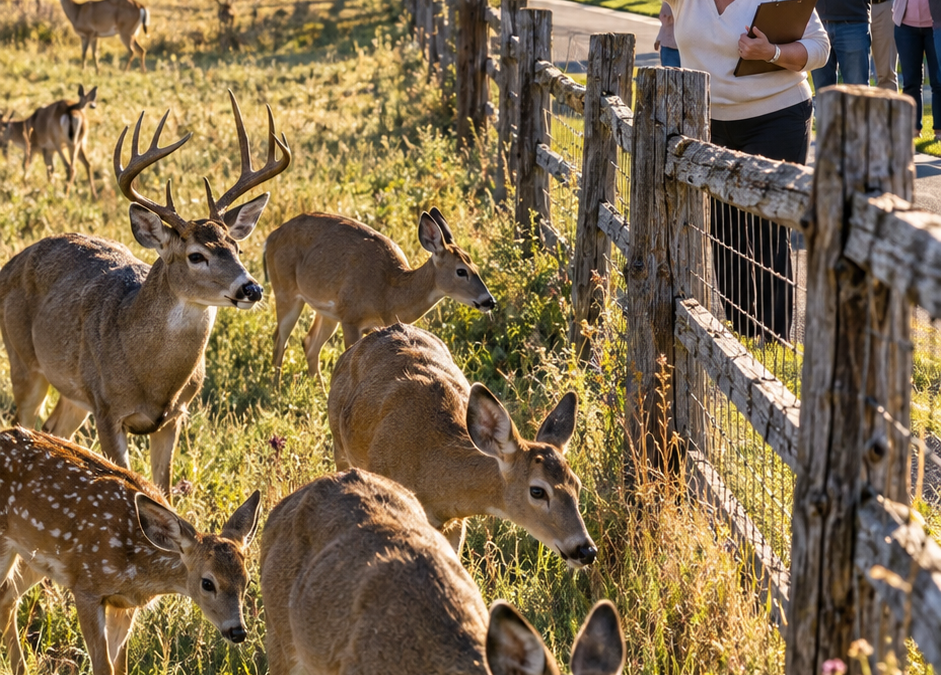
A small herd of deer had emerged from the timber and was moving through the field toward the creek. Two does, three younger deer, and an old buck I had seen many times before. They were calm, stepping through the grass with the quiet confidence of animals following a route older than the road beneath Karen’s shoes.
“They’re deer,” I said.
Karen turned toward me.
“Those animals don’t belong here.”
For a moment, I honestly thought I had misheard her.
“Excuse me?”
She lifted her chin.
“Those animals don’t belong here. Residents are concerned, and the HOA will not allow unsafe wildlife conditions to continue.”
Behind her, one woman nodded quickly. Another resident stared at the ground.
I wiped my hands on a rag and walked closer to the fence.
“Karen, what authority does your HOA have over this pasture?”
She smiled as if she had been hoping I would ask.
Then she opened her tablet.
“The property is part of the greater Oakridge Hollow development area.”
“No, it isn’t.”
She turned the screen toward me.
A colored map showed Oakridge Hollow in pale blue. My pasture sat near the eastern edge, shaded in a lighter color that blended awkwardly with the community boundary. A bold label read: Future Open Space Integration Zone.
I stared at it.
Then I looked at Karen.
“What is this?”
“It’s the neighborhood development map.”
“It’s not a survey.”
“It shows the planning area.”
“It shows a wish.”
A few residents shifted behind her.
Karen’s eyes narrowed.
“This land is visually and environmentally connected to the community. The board has an obligation to address conditions affecting residents.”
“You have an obligation to read the deed before pointing at my pasture.”
Her smile disappeared.
“Jack, please don’t make this personal.”
“It became personal when you stood at my fence and told me wildlife on my land didn’t belong here.”
“These animals are lowering property values.”
That sentence came from a man behind her.
He was tall, maybe in his forties, wearing a golf shirt and expensive sunglasses. I had seen him jogging along the neighborhood path before. He spoke like someone repeating a line from a meeting.
I looked at him.
“How much did the deer lower your appraisal?”
He blinked.
“That’s not the point.”
“It sounds exactly like the point you tried to make.”
Karen stepped in.
“Several residents have expressed concern that the deer create disease risk, landscape damage, and an impression that the area is unmanaged.”
“Then tell them not to move next to a pasture.”
The woman who had nodded earlier crossed her arms.
“My children play outside.”
“Good.”
“I don’t want wild animals near them.”
“They are deer, not wolves.”
“They could carry ticks.”
“So can your lawn.”
Karen raised one hand.
“This is not productive.”
“No, it isn’t. Because you came here with a neighborhood map and a conclusion instead of a legal boundary.”
She pointed toward the old fence running through the property.
“That fence is not necessarily the legal boundary.”
I almost smiled.
The fence she pointed at had been built by my father and grandfather together. I knew every crooked post, every sagging wire, every cedar brace. It had stood through storms that knocked roofs off sheds. It was not perfect, but it was not random.
“That fence has been there longer than your HOA.”
“That does not make it legal.”
“No,” I said. “But the survey pins beneath it do.”
The residents behind her murmured.
Karen looked irritated.
“If you have documentation, you may provide it to the board.”
“I don’t report to your board.”
“You may need to.”
“No.”
The word came out flat enough that everyone heard it.
Karen’s face tightened.
“We are trying to handle this cooperatively.”
“No, Karen. Cooperation starts with asking. You arrived with an audience and accused deer of trespassing on land you don’t own.”
She closed the tablet cover.
“You will receive formal notice.”
“I’ll read it.”
“You should take it seriously.”
“I take documents seriously. That’s why yours worries me.”
She turned away first.
That was the only victory I had that morning.
The residents followed her back toward the road in a loose, uncertain line. The man with the sunglasses looked over his shoulder once, as if he wanted to say something else but no longer trusted the ground beneath him.
I stayed by the fence until they left.
The deer had barely reacted. They crossed the lower pasture, paused near the creek, and disappeared into the cottonwoods as quietly as they had come.
I wished, not for the first time, that people could learn from animals how to move through land without pretending they owned every inch of what they saw.
The notice arrived that afternoon.
Karen did not mail it.
She delivered it herself.
I was in the barn oiling a latch when her SUV came up the gravel approach. She stepped out carrying a white envelope with the HOA seal printed across the front.
“Mr. Morrison,” she said.
“Karen.”
“I’m serving official notice on behalf of the Oakridge Hollow Homeowners Association.”
“That’s a dramatic way to hand someone paper.”
She ignored that.
I took the envelope and opened it while she stood there.
The notice was titled: Demand for Removal of Unauthorized Animals and Correction of Nuisance Wildlife Condition.
I read it slowly.
The HOA alleged that my pasture was part of or adjacent to a regulated development impact area. It claimed the presence of deer constituted a nuisance affecting residents’ enjoyment, safety, and property values. It demanded that I “remove, relocate, restrain, or otherwise prevent” the animals from crossing the open pasture visible from the Oakridge Hollow residential lots.
I looked up.
“You want me to remove wild deer.”
“We want the nuisance condition corrected.”
“They are not livestock.”
“You are allowing them to gather.”
“I am allowing grass to grow. The deer make their own choices.”
“You may be feeding or attracting them.”
“I am not.”
“The board will investigate.”
“The board can investigate its own property.”
Her expression sharpened.
“Failure to comply may result in enforcement action, contractor intervention, barriers, recovery of costs, and referral to appropriate authorities.”
I read that sentence again.
Then I smiled.
Not because it was funny.
Because Karen had made the same mistake on paper that she had made at the fence.
She had written as if authority already existed.
People who actually have authority usually cite it carefully. People who do not have authority often compensate by sounding more official.
Karen noticed my smile.
“I’m glad you find this amusing.”
“I find it informative.”
“It is a legal notice.”
“It is an HOA notice.”
“The distinction may not help you.”
“It already has.”
She stared at me.
I folded the notice and placed it back in the envelope.
“Karen, before your board hires contractors or builds barriers on land it does not own, you should review the recorded boundaries.”
“We have reviewed the development map.”
“Then review something better.”
Her eyes narrowed.
“You have seven days to respond.”
“I won’t need seven.”
She got back into her SUV and left.
That night, I opened the oldest records I had.
The house had a small office off the kitchen, built by my father after he got tired of spreading tax papers across the dinner table. The room still smelled faintly of cedar, dust, and pipe tobacco, even though no one had smoked in it for years. Along one wall sat three metal filing cabinets. My father had labeled them in block letters: LAND, TAX, WATER, LIVESTOCK, EQUIPMENT, LEGAL.
I opened LAND first.
Then LEGAL.
Then the fireproof box under the desk.
One by one, I laid the records out.
Original family deed.
Subsequent transfers.
Surveys from 1953, 1978, and 1999.
Boundary adjustment records.
Agricultural classification documents.
County correspondence from when Oakridge Hollow was first approved.
Aerial photographs.
Tax maps.
My father had kept everything.
At times, that habit had driven my mother nearly insane.
“Your father saves paper like other men save money,” she used to say.
That night, I was grateful for every yellowed page.
The pasture was ours.
Every survey said so.
The old fence stood inside the property line, not outside it. The creek bottom, the cottonwood strip, the open field, and the ridge path where the deer entered all belonged to my parcel. Oakridge Hollow ended well short of the pasture, separated by a buffer strip and a drainage easement that had nothing to do with HOA control.
Karen’s map was not just imprecise.
It was misleading.
The shaded “integration zone” appeared to come from an old developer concept plan, created before final plats were recorded. It showed possible open-space connections, trails, and visual corridors that had never become property rights. The developer had apparently imagined, years ago, that my family might sell or grant access.
We had not.
A dream on an old planning map had become, in Karen’s hands, a claim.
But the most important document was one I had almost forgotten.
It was folded inside a plastic sleeve marked AG RIGHTS.
My grandfather had negotiated it when the county changed zoning classifications decades earlier. The deed contained a protected agricultural land use provision preserving grazing, pasture maintenance, fencing, animal husbandry, crop activity, and traditional rural land uses despite future nearby residential development. It also protected the landowner from nuisance claims arising from normal agricultural and rural conditions, so long as those activities complied with applicable law.
My father had underlined one sentence in pencil.
Future adjoining residential development shall not impair established agricultural use rights appurtenant to the Morrison parcel.
I sat back in my chair.
There it was.
The sentence Karen had not known existed.
The HOA could complain about what residents saw from their windows. It could hold meetings, print notices, and point at maps on tablets. But it could not rewrite the land’s recorded history because a few homeowners disliked deer in a pasture.
I called my attorney the next morning.
Her name was Denise Carter, and she had represented farmers and small landowners for thirty years. She did not waste words, and she had the rare ability to sound bored by foolishness without missing a detail.
I emailed her Karen’s notice and my deed documents.
She called back before lunch.
“Jack,” she said, “this notice is ridiculous.”
“That was my impression.”
“They are demanding removal of wild deer?”
“Yes.”
“From your pasture?”
“Yes.”
“Are you feeding them?”
“No.”
“Containing them?”
“No.”
“Selling tickets?”
“No.”
“Training them to attack HOA board members?”
“Not successfully.”
She snorted.
“Their authority problem is obvious. Boundary issue aside, they cannot order you to remove naturally occurring wildlife from property they don’t control.”
“They think the pasture is part of their development area.”
“Is it?”
“No.”
“Then we prove it.”
“I want this settled before they send contractors.”
“They mentioned contractors?”
“In the notice.”
Denise’s voice cooled.
“Then we move quickly. Get a licensed surveyor. Confirm the boundaries. I’ll draft a response preserving your rights and warning them not to enter the property.”
“I already have someone in mind.”
“Good. And Jack?”
“Yes?”
“If they step onto your land to build barriers, call me before you do anything dramatic.”
“I’m not dramatic.”
“You are a Morrison. That is not the same thing.”
She was not wrong.
I called Samuel Fitch that afternoon.
Sam was a land surveyor with a reputation for precision and a personality that seemed designed to irritate impatient people. He spoke slowly, checked everything twice, and trusted old monuments more than modern assumptions. My father had used him once years earlier during a dispute with a timber company.
When I explained the situation, Sam was quiet for a moment.
“The HOA is claiming your pasture?”
“They’re claiming control over it.”
“Based on what?”
“A development map.”
He sighed.
“I hate development maps.”
“Can you come out?”
“Tomorrow morning.”
By then, Karen was not waiting.
Denise’s letter had not yet gone out when I heard from Mrs. Palmer, the retired teacher who took photographs by the fence.
She called me that evening.
“Jack, I thought you should know something.”
“What is it?”
“There was an HOA board discussion today.”
“How do you know?”
“My neighbor is on the events committee. People talk.”
“What did Karen say?”
Mrs. Palmer hesitated.
“She told them the animals had to be removed before someone got hurt. She said if you refused, the board should consider contractors to reinforce the boundary and prevent wildlife from entering the community-view area.”
“Contractors.”
“Yes.”
“Did she say where they would build?”
“She mentioned barriers near the old fence.”
My hand tightened around the phone.
“The old fence is on my land.”
“I know.”
Her voice softened.
“Some of us know, Jack. Not everyone believes her.”
That mattered more than I expected.
“Thank you for telling me.”
“Be careful. Karen does not like being contradicted.”
“I’ve noticed.”
After the call, I stood on the porch and looked toward the dark pasture.
The deer were not visible, but I knew their path. Over the ridge, down through the brush, across the grass, into the creek bottom. They followed hunger, water, weather, and instinct. Nothing about their movement was political until Karen made it so.
The next morning, Sam Fitch arrived with his survey equipment.
He stepped out of his truck wearing a canvas vest, dusty boots, and the expression of a man already disappointed in everyone involved.
“Morning, Jack.”
“Sam.”
He looked toward Oakridge Hollow.
“This about the neighborhood?”
“Yes.”
“Of course it is.”
I handed him copies of the deed, old surveys, and Karen’s notice.
He read the notice first.
His eyebrows rose.
“They want you to remove deer?”
“That’s the demand.”
“Did you train them to read HOA covenants?”
“Not yet.”
“Then this should be interesting.”
Karen arrived twenty minutes later.
I had not invited her.
She came anyway.
Her SUV stopped near the road, and this time she brought two board members, the man with the sunglasses, and a younger woman I recognized from a house along the fence line. Behind them, several other residents lingered at a distance.
Karen walked toward us with her tablet.
“I understand you requested a survey,” she said.
“Yes.”
“The HOA should have been notified formally.”
“You’re here.”
“That is not the same.”
“It will have to do.”
Sam looked at her.
“Ma’am, are you claiming an ownership interest in this pasture?”
Karen gave him her official smile.
“The association is reviewing whether the land falls within the development impact area and whether conditions on the property affect the community.”
“That was not my question.”
Her smile faltered.
“I’m sorry?”
“Are you claiming ownership?”
“The development map identifies this area as connected to Oakridge Hollow.”
Sam looked at me.
“I see.”
Karen turned back to him.
“We expect a professional review.”
“That is why I’m here.”
“And we expect consideration of the HOA’s records.”
“Show me recorded documents.”
Karen opened her tablet.
Sam did not move.
“I said recorded documents,” he repeated. “Plats, deeds, easements, boundary agreements. Concept drawings are not boundary evidence unless they were incorporated into recorded instruments.”
Karen’s eyes narrowed.
“The map was part of the development planning process.”
“I’m sure it was.”
His tone made clear what he thought of that.
For the next several hours, Sam worked.
He moved across the pasture with equipment, measuring points, checking bearings, locating old markers, and comparing the physical evidence against recorded surveys. He found the first iron pin near the south corner, half-buried beneath grass. He found the second near a cedar post my grandfather had set. He found a stone marker older than the neighborhood, older than the paved road, maybe older than anyone standing there.
Karen grew impatient after the first hour.
“How much longer will this take?” she asked.
Sam did not look up.
“As long as it takes.”
“The HOA has meetings scheduled.”
“Boundaries are not affected by your calendar.”
One of the board members coughed into his hand.
I looked away so I would not smile.
The residents watched from the road.
Some whispered. Some took photos. The man in sunglasses kept checking his phone, perhaps hoping property law would change before sunset.
The deer appeared around midafternoon.
That was the strangest part.
While humans argued about their right to control the field, the animals came through as if invited by irony itself.
First one doe stepped from the timber.
Then another.
Then two younger deer behind them.
They paused when they saw the people near the fence, ears high, bodies alert. For a moment, everyone watched them. Even Karen stopped talking.
The animals stood in the grass, sunlight along their backs, delicate and alert and utterly uninterested in the concept of HOA jurisdiction.
Then the old buck emerged behind them.
He was not large by trophy standards, but he carried himself with the tired confidence of something that had survived enough seasons to know when panic was unnecessary. He looked toward us briefly, then lowered his head to graze.
The younger woman behind Karen whispered, “They’re beautiful.”
Karen shot her a look.
The woman flushed and looked away.
I felt anger rise in me then, not hot but deep.
This was what bothered me most.
Not just the notice.
Not just the arrogance.
It was the way Karen had taken something ordinary and peaceful and made people afraid of it. She had turned deer into a violation, pasture into a threat, and old land into a problem that needed management.
Sam continued working.
Near sunset, he stood by the oldest fence line and wiped dust from a metal marker with his glove.
Then he checked his tablet.
Then the old survey.
Then the marker again.
He looked at me.
“This is it.”
I walked over.
Karen followed quickly.
“What did you find?” she asked.
Sam straightened.
“The original boundary marker.”
Karen looked down at it as if it had personally offended her.
“And?”
“And it is exactly where Mr. Morrison’s deed and prior surveys indicate.”
He pointed across the land.
“The Morrison parcel extends through this pasture. The Oakridge Hollow subdivision boundary ends well west of here. This fence is not the HOA boundary. It is an internal agricultural fence inside Morrison land.”
Karen’s face tightened.
“That can’t be correct.”
“It is correct.”
“Our map shows—”
“Your map is not controlling.”
“It identifies this area.”
“It misleads this area,” Sam said.
The board member beside her shifted uncomfortably.
Sam unfolded a printed overlay on the hood of his truck and showed the recorded plat beside the development concept map. The difference was obvious. The concept map shaded the pasture as future open space integration. The recorded plat stopped far short of it. No transfer. No easement. No common area. No HOA control.
Karen stared at the papers.
For once, she did not speak immediately.
The man with sunglasses leaned over the map.
“So the pasture isn’t part of Oakridge?”
“No,” Sam said.
“But it affects our view.”
Sam looked at him.
“That is not a boundary category.”
A resident behind him laughed quietly.
Karen turned sharply, and the laugh died.
I reached into my folder and removed the deed with the agricultural provision.
“There’s more,” I said.
Karen looked at me.
I handed her the document.
“This is the recorded deed language preserving agricultural rights on this parcel.”
She took it reluctantly.
Her eyes moved across the page.
Then slower.
Then back again.
I knew when she reached the underlined sentence because her face changed.
Future adjoining residential development shall not impair established agricultural use rights appurtenant to the Morrison parcel.
She looked up.
“This refers to agricultural use.”
“Yes.”
“Wild deer are not agriculture.”
“I never said they were. But your notice also complains about rural conditions, pasture use, fencing, and unmanaged land adjacent to your homes. That provision protects the historic use of this property from exactly that kind of complaint.”
Denise had explained it to me that morning.
I repeated her words carefully.
“You cannot move into a residential development beside protected agricultural land and then use HOA rules to erase the conditions that came with living beside it.”
Karen gripped the papers.
“The HOA still has concerns about safety.”
“Then contact the proper wildlife authority. But don’t pretend safety gives you ownership.”
As if the day had been scripted, another truck arrived then.
A state wildlife officer stepped out wearing a green uniform and a practical expression. His name was Officer Reeves. Denise had suggested I request an inspection, and he had agreed to stop by if he could.
Karen watched him approach with visible confusion.
“Who called wildlife?” she asked.
“I did,” I said.
“For what purpose?”
“To answer your claim that I’m maintaining an illegal wildlife condition.”
Officer Reeves greeted me, then introduced himself to the group.
“I understand there are concerns about deer activity.”
Karen immediately stepped forward.
“Yes. Residents are concerned that Mr. Morrison is allowing deer to gather near the neighborhood. We need them removed.”
Officer Reeves looked across the pasture.
“Are they captive?”
“No.”
“Is he feeding them?”
Karen hesitated.
“We suspect—”
Officer Reeves turned to me.
“Are you feeding them?”
“No.”
“Salt blocks?”
“No.”
“Corn piles?”
“No.”
“Fencing them in?”
“No.”
“Importing them?”
“No.”
He nodded.
Then he walked the pasture edge, checked the creek area, looked for feed sites, examined the fence, and studied the deer trail near the timber. Karen followed him for several minutes before realizing he was not interested in her interpretation of the HOA handbook.
When he returned, he spoke plainly.
“These deer appear to be naturally occurring wildlife using established habitat and travel corridors. I see no evidence Mr. Morrison is illegally introducing, confining, baiting, or maintaining them.”
Karen crossed her arms.
“They are close to residential homes.”
“That happens where residential homes are built near habitat.”
“Can they be removed?”
“Not because residents dislike seeing them.”
The younger woman near Karen looked down, hiding a smile.
Officer Reeves continued.
“If deer are entering yards, residents can use lawful deterrents on their own property, remove attractants, protect landscaping, and follow local guidance. But I don’t see a basis to require this landowner to remove wild deer from his own pasture.”
Karen’s face had gone still.
She was losing every document, every expert, every fact, one by one.
But pride is a stubborn animal too.
She turned to Sam.
“I want a copy of your survey findings.”
“You’ll get the report when it’s prepared.”
She turned to Officer Reeves.
“I want your findings in writing.”
“You can request the inspection note.”
Then she turned to me.
“This does not mean the HOA is satisfied.”
I took my deed from her hand.
“No, Karen. It means the HOA is out of bounds.”
The words hit harder than I expected.
Not because I raised my voice.
Because everyone standing there understood that boundaries were the entire point.
Property boundaries.
Legal boundaries.
Personal boundaries.
And Karen had crossed all three.
The next week was quieter but not peaceful.
Karen tried to regroup.
The HOA sent a second letter, softer in tone but still full of implication. It stated that the association remained concerned about “wildlife proximity,” “resident safety,” and “external land conditions affecting community enjoyment.” Denise answered with a letter that was much less soft.
She attached the surveyor’s preliminary findings, the recorded deed, the agricultural rights provision, and Officer Reeves’s inspection note. She demanded withdrawal of the violation notice, written confirmation that the HOA claimed no authority over my pasture, and assurance that no contractors, board representatives, patrol staff, or residents would enter my property to build barriers, remove wildlife, alter fencing, or interfere with land use.
She also included one sentence I read three times because it sounded exactly like something my father would have appreciated.
The Association’s preference for a different view does not create jurisdiction over land it does not own.
Karen did not respond personally.
The HOA attorney did.
That told me enough.
Two days later, an emergency board meeting was held.
I did not attend. I was not invited, and I would not have gone if I had been. But Mrs. Palmer called me afterward.
“You may want to sit down,” she said.
“I’m already sitting.”
“It was ugly.”
“What happened?”
“Karen tried to explain that the issue was about safety, not ownership.”
“I’m sure.”
“Then Samuel Fitch’s map was displayed.”
“Oh.”
“Yes. Oh.”
She said several board members immediately began asking why Karen had issued a violation notice before confirming the boundary. One asked whether the HOA’s insurance would cover contractor trespass if barriers had been installed. Another wanted to know who approved language threatening cost recovery against a nonmember landowner.
“What did Karen say?” I asked.
“She said she acted on the information available.”
“And?”
“And Peter Wallace asked why the available information did not include the recorded plat.”
I smiled.
I did not know Peter well, but in that moment, I liked him.
Mrs. Palmer continued.
“Then Officer Reeves’s note was read. That changed the room. People were upset that the board had been told you were creating some kind of illegal animal problem.”
“I never touched the deer.”
“We know that now.”
That sentence had sadness in it.
We know that now.
As if knowing had required permission from a surveyor and a wildlife officer, even though the truth had been standing in the field all along.
“What happens next?” I asked.
“The board voted to withdraw the notice.”
I closed my eyes.
There it was.
Not victory exactly.
Relief.
“Anything else?”
“They are reviewing Karen’s authority to issue notices involving neighboring properties.”
“That should be short.”
Mrs. Palmer laughed.
“Jack.”
“Yes?”
“I’m sorry more of us didn’t ask questions sooner.”
I looked out the window toward the pasture.
“So am I.”
The formal withdrawal arrived three days later.
It was mailed, not hand-delivered.
That was wise.
The letter stated that Oakridge Hollow Homeowners Association was withdrawing its prior notice regarding alleged nuisance wildlife conditions on my property. It acknowledged that current information indicated the pasture was not part of HOA-owned property or common area. It further stated that the association would not pursue enforcement action regarding naturally occurring wildlife crossing my pasture.
The language was cautious.
It did not apologize.
It did not mention Karen’s shouting, the crowd she brought to my fence, the misleading map, or the threat of contractor barriers.
But it withdrew the notice.
That was enough for the legal dispute.
Not for the feeling.
A man can win the paperwork and still feel the bruise of being treated like a trespasser on his own inheritance.
For days after the withdrawal, I found myself walking the fence line more than usual.
Checking markers.
Studying posts.
Looking toward the neighborhood.
Not because I expected Karen to appear again, though part of me did. But because the conflict had made familiar land feel temporarily contested, and I needed to remind myself that it was still mine.
The old fence ran over uneven ground, cedar posts weathered silver, wire sagging in places, repaired with staples, knots, and stubbornness. My father’s hand was in that fence. My grandfather’s too. Mine now. Every repair carried a memory.
At the south corner, I found the old marker Sam had uncovered and cleaned. I crouched beside it.
It was not impressive.
Just metal and stone, half-hidden by grass, dull in the afternoon light.
But it had done what official voices failed to do.
It told the truth without raising its voice.
The residents learned the full story slowly.
Some came by directly.
Mrs. Palmer brought banana bread and apologized again, though she had done nothing wrong. The younger woman who had whispered that the deer were beautiful stopped at the fence one evening and introduced herself as Megan. She said Karen had made it sound like I was attracting dangerous animals.
“I should have asked,” she said.
“Yes,” I replied.
She looked embarrassed, but I did not soften it.
Some lessons need to land.
The man with sunglasses never apologized, but he did start walking on the opposite side of the road when he passed my property. That was fine with me.
One afternoon, two boys from the neighborhood stood near the fence watching the deer.
Their mother hovered behind them, uncertain.
I was carrying feed buckets back to the barn when one of the boys called, “Mister, are those your deer?”
I stopped.
“No,” I said. “They belong to themselves.”
He thought about that.
“Then why do they come here?”
“Because the land lets them.”
His mother smiled faintly.
That was the kind of answer my father would have given, and realizing that made my throat tighten.
Karen disappeared from the fence after that.
She still drove past sometimes. Her SUV slowed once near the pasture road, then continued. She did not wave. Neither did I.
The HOA board sent one more communication weeks later. It was addressed to residents, not me. It clarified that adjacent private lands were not subject to HOA enforcement unless there was a recorded right, agreement, or applicable law. It reminded residents not to enter neighboring properties, interfere with fences, or attempt to control wildlife outside their own lots.
It was the most useful thing the board had written in years.
It was also, though no one said it, a public correction of Karen’s mistake.
At the next HOA meeting, I heard she faced serious questions about her handling of the issue. She remained president for a while, but something had shifted. People who once accepted her confidence as proof began asking for documents. Board members requested legal review before sending notices. Residents learned that a map on a tablet could look official and still be wrong.
Good.
A community should not be run by the person most willing to sound certain.
It should be run by facts, process, and respect for the lines that protect everyone.
By late autumn, the pasture turned gold.
The grass dried and bent under the wind. The cottonwoods dropped leaves into the creek. The deer grew thicker coats and moved earlier in the evening. Sometimes I would stand on the porch with coffee and watch them cross in the fading light.
They did not know they had been the center of a legal dispute.
They did not know Karen had called them a nuisance.
They did not know men in meeting rooms had debated whether they belonged.
They belonged because they had always belonged.
That was the simplicity Karen could not understand.
Not everything visible from a subdivision is part of the subdivision. Not every inconvenience is a violation. Not every fear becomes authority because someone prints it on letterhead.
One evening, I walked through the pasture alone.
The sun was low, and the air smelled of dry grass and cold water. My boots followed a path worn partly by me, partly by deer, partly by years. Near the creek, I stopped where the herd often crossed.
The old buck stood at the edge of the cottonwoods.
He saw me.
I saw him.
Neither of us moved.
For a moment, the neighborhood behind me disappeared. No stone sign. No HOA letters. No maps. No Karen. Just land, animal, water, and the kind of silence that existed before anyone tried to regulate it.
Then the buck turned and stepped into the trees.
I stayed there until he was gone.
When I returned to the house, I placed the withdrawal notice inside the folder with the deed, the survey, and the agricultural rights provision. The folder was thicker now. That seemed to be the way of land ownership. Every generation added paper to defend what the previous generation had already proved.
I ran my fingers over my father’s old handwriting on the file tab.
LAND.
Such a small word for something people spend their lives misunderstanding.
Land is not just acreage. It is not just a view from someone else’s window. It is not empty space waiting for a committee to define it. Land carries work, grief, habit, history, mistakes, promises, and lines that matter even when someone powerful would rather ignore them.
Karen had arrived at my fence shouting that the animals did not belong.
But she had never asked the question that mattered.
Who did the land belong to?
One property deed answered her.
One survey confirmed it.
One wildlife officer stripped away the last excuse.
And after all her letters, maps, threats, and meetings, the truth was still exactly where it had been before she arrived.
In the old fence.
In the boundary markers.
In the records my family kept.
In the pasture where the deer still crossed at dusk, calm and unbothered, following a path older than every house in Oakridge Hollow.
The HOA finally stayed on its side of the boundary.
And my land, quiet again, kept its own counsel.
𝗧𝗛𝗘 𝗘𝗡𝗗
The Deer Were Not the Trespassers on My Pasture
Karen came to my fence that morning acting like the land had been waiting for her permission.
Behind her, half the neighborhood watched a small herd of deer move through my pasture as if they were witnessing a crime.
By the time she shouted that the animals did not belong there, I already knew she had made one dangerous mistake: she had confused a community map with the truth.
My name is Jack Morrison, and I had lived on that land long before Oakridge Hollow ever had a name.
Before the stone entrance sign. Before the matching mailboxes. Before the clubhouse with its fake cedar beams and polished windows. Before the HOA board started printing newsletters about “community harmony” and “shared standards.” Before people moved into houses with mountain views and then complained that the mountains still behaved like mountains.
My family had been on that property for three generations.
My grandfather bought the first section in the 1940s, back when the road was still dirt and the nearest grocery store was forty minutes away if the weather cooperated. My father added pasture after the war, repaired the old barn, and planted a line of cottonwoods along the creek. By the time the developers showed up, our land had already survived drought, floods, hailstorms, cattle prices, tax changes, and every kind of promise a man in polished shoes can make when he wants old ground for new money.
I did not hate the neighborhood when it came.
That surprises people.
I did not stand at the fence with a shotgun muttering about outsiders. I understood that land changes. Families sell. Towns grow. Pastures become cul-de-sacs. I had seen it happening for years.
But I did expect one simple thing.
Stay on your side of the line, and I would stay on mine.
For a while, that was enough.
The residents of Oakridge Hollow waved when they passed. Some brought their children near the fence to look at the deer at sunset. A retired teacher named Mrs. Palmer sometimes asked permission to take photographs from the public road, and I always said yes. A boy from one of the first houses used to stand quietly by the fence and sketch the old barn in a notebook. I never bothered him.
The deer had been there longer than all of us.
They crossed the pasture in early morning and near dusk, moving along the same natural path from the wooded ridge to the creek bottom. Some years there were only a few. Some years, more. They slipped through breaks in brush, stepped over low places in the fence, and grazed lightly before moving on. They were not mine. I did not feed them, pen them, tag them, breed them, or call them.
They were simply part of the land.
My father used to say, “A deer trail is older than a survey if you know how to look at it.”
He did not mean that trails replaced boundaries. He meant that the land had its own memory, and a wise person paid attention before deciding he owned more than he did.
Karen Whitmore had never learned that.
She became HOA president two years after Oakridge Hollow finished its last phase. By then, the neighborhood had grown confident. The gates were up. The covenants had been revised. The patrol truck had magnetic signs on the doors. The board had committees for landscaping, architecture, security, events, and something called “neighborhood character,” which I suspected meant they had run out of real problems.
Karen ran the HOA like she was correcting a world that had been poorly arranged before her arrival.
She had sharp gray eyes, perfect hair, and a voice that sounded calm until you realized calmness was part of the threat. She never shouted at first. She preferred to explain, with a patient little smile, why her position was not really a position at all but simply the reasonable conclusion of responsible leadership.
People like that are exhausting.
They do not argue with your facts.
They act disappointed that you brought facts into the room.
The first time Karen and I truly crossed paths was over my fence.
Not because it was falling down.
Not because it crossed their land.
Because, in her words, it was “visually inconsistent with the adjacent community aesthetic.”
I told her the fence had been standing there since 1968 and that it was more consistent than most people I knew.
She did not laugh.
After that, I received three letters.
One about tall grass near the pasture line.
One about the old equipment shed being visible from the neighborhood walking path.
One about “unregulated animal activity adjacent to residential homes.”
That last phrase told me where things were headed.
I called the HOA office and asked what animal activity they meant.
The receptionist put me on hold.
Karen came on the line herself.
“Mr. Morrison,” she said, like she had been waiting for me. “We’ve received several resident concerns about wildlife entering the common-view area.”
“Common-view area?”
“The open pasture behind the east homes.”
“My pasture.”
“It is adjacent to the community.”
“That does not make it common.”
“I understand this is sensitive for you.”
“No, Karen. It’s simple for me.”
She paused.
“Residents have reported deer gathering near the fence.”
“They’ve done that for decades.”
“Some families are uncomfortable.”
“With deer?”
“With unmanaged wildlife near homes.”
I looked out my kitchen window at three deer grazing beside the creek, their ears turning lazily in the afternoon light.
“They are not in your homes.”
“They are visible from the homes.”
“So are clouds.”
“Mr. Morrison.”
“Karen.”
“This does not need to become contentious.”
“It became contentious when you mailed me a letter about deer walking on my land.”
She sighed, the way people sigh when they want the record to show they tried being reasonable.
“We only want to ensure safety and property standards.”
“You don’t have authority over my pasture.”
“We may need to verify that.”
That sentence stayed with me.
Not because I was worried.
Because I knew the tone.
It was the sound of someone preparing to invent confidence before checking the documents.
The confrontation happened four days later.
It was a cool morning, clean and bright, the kind of morning when the mountains look close enough to touch. I was repairing a hinge on the south gate when I heard several vehicles stop near the pasture road.
I looked up and saw Karen walking toward the fence with a tablet in one hand and a group of residents behind her.
There were eight or nine of them.
Some looked angry. Some looked curious. A few looked embarrassed to be there. One man held a coffee cup and wore the expression of someone who had joined the group before understanding what the group intended to do.
Karen stopped at the fence line and pointed across the pasture.
“There,” she said loudly. “You can see exactly what we’re talking about.”
I followed her finger.
A small herd of deer had emerged from the timber and was moving through the field toward the creek. Two does, three younger deer, and an old buck I had seen many times before. They were calm, stepping through the grass with the quiet confidence of animals following a route older than the road beneath Karen’s shoes.
“They’re deer,” I said.
Karen turned toward me.
“Those animals don’t belong here.”
For a moment, I honestly thought I had misheard her.
“Excuse me?”
She lifted her chin.
“Those animals don’t belong here. Residents are concerned, and the HOA will not allow unsafe wildlife conditions to continue.”
Behind her, one woman nodded quickly. Another resident stared at the ground.
I wiped my hands on a rag and walked closer to the fence.
“Karen, what authority does your HOA have over this pasture?”
She smiled as if she had been hoping I would ask.
Then she opened her tablet.
“The property is part of the greater Oakridge Hollow development area.”
“No, it isn’t.”
She turned the screen toward me.
A colored map showed Oakridge Hollow in pale blue. My pasture sat near the eastern edge, shaded in a lighter color that blended awkwardly with the community boundary. A bold label read: Future Open Space Integration Zone.
I stared at it.
Then I looked at Karen.
“What is this?”
“It’s the neighborhood development map.”
“It’s not a survey.”
“It shows the planning area.”
“It shows a wish.”
A few residents shifted behind her.
Karen’s eyes narrowed.
“This land is visually and environmentally connected to the community. The board has an obligation to address conditions affecting residents.”
“You have an obligation to read the deed before pointing at my pasture.”
Her smile disappeared.
“Jack, please don’t make this personal.”
“It became personal when you stood at my fence and told me wildlife on my land didn’t belong here.”
“These animals are lowering property values.”
That sentence came from a man behind her.
He was tall, maybe in his forties, wearing a golf shirt and expensive sunglasses. I had seen him jogging along the neighborhood path before. He spoke like someone repeating a line from a meeting.
I looked at him.
“How much did the deer lower your appraisal?”
He blinked.
“That’s not the point.”
“It sounds exactly like the point you tried to make.”
Karen stepped in.
“Several residents have expressed concern that the deer create disease risk, landscape damage, and an impression that the area is unmanaged.”
“Then tell them not to move next to a pasture.”
The woman who had nodded earlier crossed her arms.
“My children play outside.”
“Good.”
“I don’t want wild animals near them.”
“They are deer, not wolves.”
“They could carry ticks.”
“So can your lawn.”
Karen raised one hand.
“This is not productive.”
“No, it isn’t. Because you came here with a neighborhood map and a conclusion instead of a legal boundary.”
She pointed toward the old fence running through the property.
“That fence is not necessarily the legal boundary.”
I almost smiled.
The fence she pointed at had been built by my father and grandfather together. I knew every crooked post, every sagging wire, every cedar brace. It had stood through storms that knocked roofs off sheds. It was not perfect, but it was not random.
“That fence has been there longer than your HOA.”
“That does not make it legal.”
“No,” I said. “But the survey pins beneath it do.”
The residents behind her murmured.
Karen looked irritated.
“If you have documentation, you may provide it to the board.”
“I don’t report to your board.”
“You may need to.”
“No.”
The word came out flat enough that everyone heard it.
Karen’s face tightened.
“We are trying to handle this cooperatively.”
“No, Karen. Cooperation starts with asking. You arrived with an audience and accused deer of trespassing on land you don’t own.”
She closed the tablet cover.
“You will receive formal notice.”
“I’ll read it.”
“You should take it seriously.”
“I take documents seriously. That’s why yours worries me.”
She turned away first.
That was the only victory I had that morning.
The residents followed her back toward the road in a loose, uncertain line. The man with the sunglasses looked over his shoulder once, as if he wanted to say something else but no longer trusted the ground beneath him.
I stayed by the fence until they left.
The deer had barely reacted. They crossed the lower pasture, paused near the creek, and disappeared into the cottonwoods as quietly as they had come.
I wished, not for the first time, that people could learn from animals how to move through land without pretending they owned every inch of what they saw.
The notice arrived that afternoon.
Karen did not mail it.
She delivered it herself.
I was in the barn oiling a latch when her SUV came up the gravel approach. She stepped out carrying a white envelope with the HOA seal printed across the front.
“Mr. Morrison,” she said.
“Karen.”
“I’m serving official notice on behalf of the Oakridge Hollow Homeowners Association.”
“That’s a dramatic way to hand someone paper.”
She ignored that.
I took the envelope and opened it while she stood there.
The notice was titled: Demand for Removal of Unauthorized Animals and Correction of Nuisance Wildlife Condition.
I read it slowly.
The HOA alleged that my pasture was part of or adjacent to a regulated development impact area. It claimed the presence of deer constituted a nuisance affecting residents’ enjoyment, safety, and property values. It demanded that I “remove, relocate, restrain, or otherwise prevent” the animals from crossing the open pasture visible from the Oakridge Hollow residential lots.
I looked up.
“You want me to remove wild deer.”
“We want the nuisance condition corrected.”
“They are not livestock.”
“You are allowing them to gather.”
“I am allowing grass to grow. The deer make their own choices.”
“You may be feeding or attracting them.”
“I am not.”
“The board will investigate.”
“The board can investigate its own property.”
Her expression sharpened.
“Failure to comply may result in enforcement action, contractor intervention, barriers, recovery of costs, and referral to appropriate authorities.”
I read that sentence again.
Then I smiled.
Not because it was funny.
Because Karen had made the same mistake on paper that she had made at the fence.
She had written as if authority already existed.
People who actually have authority usually cite it carefully. People who do not have authority often compensate by sounding more official.
Karen noticed my smile.
“I’m glad you find this amusing.”
“I find it informative.”
“It is a legal notice.”
“It is an HOA notice.”
“The distinction may not help you.”
“It already has.”
She stared at me.
I folded the notice and placed it back in the envelope.
“Karen, before your board hires contractors or builds barriers on land it does not own, you should review the recorded boundaries.”
“We have reviewed the development map.”
“Then review something better.”
Her eyes narrowed.
“You have seven days to respond.”
“I won’t need seven.”
She got back into her SUV and left.
That night, I opened the oldest records I had.
The house had a small office off the kitchen, built by my father after he got tired of spreading tax papers across the dinner table. The room still smelled faintly of cedar, dust, and pipe tobacco, even though no one had smoked in it for years. Along one wall sat three metal filing cabinets. My father had labeled them in block letters: LAND, TAX, WATER, LIVESTOCK, EQUIPMENT, LEGAL.
I opened LAND first.
Then LEGAL.
Then the fireproof box under the desk.
One by one, I laid the records out.
Original family deed.
Subsequent transfers.
Surveys from 1953, 1978, and 1999.
Boundary adjustment records.
Agricultural classification documents.
County correspondence from when Oakridge Hollow was first approved.
Aerial photographs.
Tax maps.
My father had kept everything.
At times, that habit had driven my mother nearly insane.
“Your father saves paper like other men save money,” she used to say.
That night, I was grateful for every yellowed page.
The pasture was ours.
Every survey said so.
The old fence stood inside the property line, not outside it. The creek bottom, the cottonwood strip, the open field, and the ridge path where the deer entered all belonged to my parcel. Oakridge Hollow ended well short of the pasture, separated by a buffer strip and a drainage easement that had nothing to do with HOA control.
Karen’s map was not just imprecise.
It was misleading.
The shaded “integration zone” appeared to come from an old developer concept plan, created before final plats were recorded. It showed possible open-space connections, trails, and visual corridors that had never become property rights. The developer had apparently imagined, years ago, that my family might sell or grant access.
We had not.
A dream on an old planning map had become, in Karen’s hands, a claim.
But the most important document was one I had almost forgotten.
It was folded inside a plastic sleeve marked AG RIGHTS.
My grandfather had negotiated it when the county changed zoning classifications decades earlier. The deed contained a protected agricultural land use provision preserving grazing, pasture maintenance, fencing, animal husbandry, crop activity, and traditional rural land uses despite future nearby residential development. It also protected the landowner from nuisance claims arising from normal agricultural and rural conditions, so long as those activities complied with applicable law.
My father had underlined one sentence in pencil.
Future adjoining residential development shall not impair established agricultural use rights appurtenant to the Morrison parcel.
I sat back in my chair.
There it was.
The sentence Karen had not known existed.
The HOA could complain about what residents saw from their windows. It could hold meetings, print notices, and point at maps on tablets. But it could not rewrite the land’s recorded history because a few homeowners disliked deer in a pasture.
I called my attorney the next morning.
Her name was Denise Carter, and she had represented farmers and small landowners for thirty years. She did not waste words, and she had the rare ability to sound bored by foolishness without missing a detail.
I emailed her Karen’s notice and my deed documents.
She called back before lunch.
“Jack,” she said, “this notice is ridiculous.”
“That was my impression.”
“They are demanding removal of wild deer?”
“Yes.”
“From your pasture?”
“Yes.”
“Are you feeding them?”
“No.”
“Containing them?”
“No.”
“Selling tickets?”
“No.”
“Training them to attack HOA board members?”
“Not successfully.”
She snorted.
“Their authority problem is obvious. Boundary issue aside, they cannot order you to remove naturally occurring wildlife from property they don’t control.”
“They think the pasture is part of their development area.”
“Is it?”
“No.”
“Then we prove it.”
“I want this settled before they send contractors.”
“They mentioned contractors?”
“In the notice.”
Denise’s voice cooled.
“Then we move quickly. Get a licensed surveyor. Confirm the boundaries. I’ll draft a response preserving your rights and warning them not to enter the property.”
“I already have someone in mind.”
“Good. And Jack?”
“Yes?”
“If they step onto your land to build barriers, call me before you do anything dramatic.”
“I’m not dramatic.”
“You are a Morrison. That is not the same thing.”
She was not wrong.
I called Samuel Fitch that afternoon.
Sam was a land surveyor with a reputation for precision and a personality that seemed designed to irritate impatient people. He spoke slowly, checked everything twice, and trusted old monuments more than modern assumptions. My father had used him once years earlier during a dispute with a timber company.
When I explained the situation, Sam was quiet for a moment.
“The HOA is claiming your pasture?”
“They’re claiming control over it.”
“Based on what?”
“A development map.”
He sighed.
“I hate development maps.”
“Can you come out?”
“Tomorrow morning.”
By then, Karen was not waiting.
Denise’s letter had not yet gone out when I heard from Mrs. Palmer, the retired teacher who took photographs by the fence.
She called me that evening.
“Jack, I thought you should know something.”
“What is it?”
“There was an HOA board discussion today.”
“How do you know?”
“My neighbor is on the events committee. People talk.”
“What did Karen say?”
Mrs. Palmer hesitated.
“She told them the animals had to be removed before someone got hurt. She said if you refused, the board should consider contractors to reinforce the boundary and prevent wildlife from entering the community-view area.”
“Contractors.”
“Yes.”
“Did she say where they would build?”
“She mentioned barriers near the old fence.”
My hand tightened around the phone.
“The old fence is on my land.”
“I know.”
Her voice softened.
“Some of us know, Jack. Not everyone believes her.”
That mattered more than I expected.
“Thank you for telling me.”
“Be careful. Karen does not like being contradicted.”
“I’ve noticed.”
After the call, I stood on the porch and looked toward the dark pasture.
The deer were not visible, but I knew their path. Over the ridge, down through the brush, across the grass, into the creek bottom. They followed hunger, water, weather, and instinct. Nothing about their movement was political until Karen made it so.
The next morning, Sam Fitch arrived with his survey equipment.
He stepped out of his truck wearing a canvas vest, dusty boots, and the expression of a man already disappointed in everyone involved.
“Morning, Jack.”
“Sam.”
He looked toward Oakridge Hollow.
“This about the neighborhood?”
“Yes.”
“Of course it is.”
I handed him copies of the deed, old surveys, and Karen’s notice.
He read the notice first.
His eyebrows rose.
“They want you to remove deer?”
“That’s the demand.”
“Did you train them to read HOA covenants?”
“Not yet.”
“Then this should be interesting.”
Karen arrived twenty minutes later.
I had not invited her.
She came anyway.
Her SUV stopped near the road, and this time she brought two board members, the man with the sunglasses, and a younger woman I recognized from a house along the fence line. Behind them, several other residents lingered at a distance.
Karen walked toward us with her tablet.
“I understand you requested a survey,” she said.
“Yes.”
“The HOA should have been notified formally.”
“You’re here.”
“That is not the same.”
“It will have to do.”
Sam looked at her.
“Ma’am, are you claiming an ownership interest in this pasture?”
Karen gave him her official smile.
“The association is reviewing whether the land falls within the development impact area and whether conditions on the property affect the community.”
“That was not my question.”
Her smile faltered.
“I’m sorry?”
“Are you claiming ownership?”
“The development map identifies this area as connected to Oakridge Hollow.”
Sam looked at me.
“I see.”
Karen turned back to him.
“We expect a professional review.”
“That is why I’m here.”
“And we expect consideration of the HOA’s records.”
“Show me recorded documents.”
Karen opened her tablet.
Sam did not move.
“I said recorded documents,” he repeated. “Plats, deeds, easements, boundary agreements. Concept drawings are not boundary evidence unless they were incorporated into recorded instruments.”
Karen’s eyes narrowed.
“The map was part of the development planning process.”
“I’m sure it was.”
His tone made clear what he thought of that.
For the next several hours, Sam worked.
He moved across the pasture with equipment, measuring points, checking bearings, locating old markers, and comparing the physical evidence against recorded surveys. He found the first iron pin near the south corner, half-buried beneath grass. He found the second near a cedar post my grandfather had set. He found a stone marker older than the neighborhood, older than the paved road, maybe older than anyone standing there.
Karen grew impatient after the first hour.
“How much longer will this take?” she asked.
Sam did not look up.
“As long as it takes.”
“The HOA has meetings scheduled.”
“Boundaries are not affected by your calendar.”
One of the board members coughed into his hand.
I looked away so I would not smile.
The residents watched from the road.
Some whispered. Some took photos. The man in sunglasses kept checking his phone, perhaps hoping property law would change before sunset.
The deer appeared around midafternoon.
That was the strangest part.
While humans argued about their right to control the field, the animals came through as if invited by irony itself.
First one doe stepped from the timber.
Then another.
Then two younger deer behind them.
They paused when they saw the people near the fence, ears high, bodies alert. For a moment, everyone watched them. Even Karen stopped talking.
The animals stood in the grass, sunlight along their backs, delicate and alert and utterly uninterested in the concept of HOA jurisdiction.
Then the old buck emerged behind them.
He was not large by trophy standards, but he carried himself with the tired confidence of something that had survived enough seasons to know when panic was unnecessary. He looked toward us briefly, then lowered his head to graze.
The younger woman behind Karen whispered, “They’re beautiful.”
Karen shot her a look.
The woman flushed and looked away.
I felt anger rise in me then, not hot but deep.
This was what bothered me most.
Not just the notice.
Not just the arrogance.
It was the way Karen had taken something ordinary and peaceful and made people afraid of it. She had turned deer into a violation, pasture into a threat, and old land into a problem that needed management.
Sam continued working.
Near sunset, he stood by the oldest fence line and wiped dust from a metal marker with his glove.
Then he checked his tablet.
Then the old survey.
Then the marker again.
He looked at me.
“This is it.”
I walked over.
Karen followed quickly.
“What did you find?” she asked.
Sam straightened.
“The original boundary marker.”
Karen looked down at it as if it had personally offended her.
“And?”
“And it is exactly where Mr. Morrison’s deed and prior surveys indicate.”
He pointed across the land.
“The Morrison parcel extends through this pasture. The Oakridge Hollow subdivision boundary ends well west of here. This fence is not the HOA boundary. It is an internal agricultural fence inside Morrison land.”
Karen’s face tightened.
“That can’t be correct.”
“It is correct.”
“Our map shows—”
“Your map is not controlling.”
“It identifies this area.”
“It misleads this area,” Sam said.
The board member beside her shifted uncomfortably.
Sam unfolded a printed overlay on the hood of his truck and showed the recorded plat beside the development concept map. The difference was obvious. The concept map shaded the pasture as future open space integration. The recorded plat stopped far short of it. No transfer. No easement. No common area. No HOA control.
Karen stared at the papers.
For once, she did not speak immediately.
The man with sunglasses leaned over the map.
“So the pasture isn’t part of Oakridge?”
“No,” Sam said.
“But it affects our view.”
Sam looked at him.
“That is not a boundary category.”
A resident behind him laughed quietly.
Karen turned sharply, and the laugh died.
I reached into my folder and removed the deed with the agricultural provision.
“There’s more,” I said.
Karen looked at me.
I handed her the document.
“This is the recorded deed language preserving agricultural rights on this parcel.”
She took it reluctantly.
Her eyes moved across the page.
Then slower.
Then back again.
I knew when she reached the underlined sentence because her face changed.
Future adjoining residential development shall not impair established agricultural use rights appurtenant to the Morrison parcel.
She looked up.
“This refers to agricultural use.”
“Yes.”
“Wild deer are not agriculture.”
“I never said they were. But your notice also complains about rural conditions, pasture use, fencing, and unmanaged land adjacent to your homes. That provision protects the historic use of this property from exactly that kind of complaint.”
Denise had explained it to me that morning.
I repeated her words carefully.
“You cannot move into a residential development beside protected agricultural land and then use HOA rules to erase the conditions that came with living beside it.”
Karen gripped the papers.
“The HOA still has concerns about safety.”
“Then contact the proper wildlife authority. But don’t pretend safety gives you ownership.”
As if the day had been scripted, another truck arrived then.
A state wildlife officer stepped out wearing a green uniform and a practical expression. His name was Officer Reeves. Denise had suggested I request an inspection, and he had agreed to stop by if he could.
Karen watched him approach with visible confusion.
“Who called wildlife?” she asked.
“I did,” I said.
“For what purpose?”
“To answer your claim that I’m maintaining an illegal wildlife condition.”
Officer Reeves greeted me, then introduced himself to the group.
“I understand there are concerns about deer activity.”
Karen immediately stepped forward.
“Yes. Residents are concerned that Mr. Morrison is allowing deer to gather near the neighborhood. We need them removed.”
Officer Reeves looked across the pasture.
“Are they captive?”
“No.”
“Is he feeding them?”
Karen hesitated.
“We suspect—”
Officer Reeves turned to me.
“Are you feeding them?”
“No.”
“Salt blocks?”
“No.”
“Corn piles?”
“No.”
“Fencing them in?”
“No.”
“Importing them?”
“No.”
He nodded.
Then he walked the pasture edge, checked the creek area, looked for feed sites, examined the fence, and studied the deer trail near the timber. Karen followed him for several minutes before realizing he was not interested in her interpretation of the HOA handbook.
When he returned, he spoke plainly.
“These deer appear to be naturally occurring wildlife using established habitat and travel corridors. I see no evidence Mr. Morrison is illegally introducing, confining, baiting, or maintaining them.”
Karen crossed her arms.
“They are close to residential homes.”
“That happens where residential homes are built near habitat.”
“Can they be removed?”
“Not because residents dislike seeing them.”
The younger woman near Karen looked down, hiding a smile.
Officer Reeves continued.
“If deer are entering yards, residents can use lawful deterrents on their own property, remove attractants, protect landscaping, and follow local guidance. But I don’t see a basis to require this landowner to remove wild deer from his own pasture.”
Karen’s face had gone still.
She was losing every document, every expert, every fact, one by one.
But pride is a stubborn animal too.
She turned to Sam.
“I want a copy of your survey findings.”
“You’ll get the report when it’s prepared.”
She turned to Officer Reeves.
“I want your findings in writing.”
“You can request the inspection note.”
Then she turned to me.
“This does not mean the HOA is satisfied.”
I took my deed from her hand.
“No, Karen. It means the HOA is out of bounds.”
The words hit harder than I expected.
Not because I raised my voice.
Because everyone standing there understood that boundaries were the entire point.
Property boundaries.
Legal boundaries.
Personal boundaries.
And Karen had crossed all three.
The next week was quieter but not peaceful.
Karen tried to regroup.
The HOA sent a second letter, softer in tone but still full of implication. It stated that the association remained concerned about “wildlife proximity,” “resident safety,” and “external land conditions affecting community enjoyment.” Denise answered with a letter that was much less soft.
She attached the surveyor’s preliminary findings, the recorded deed, the agricultural rights provision, and Officer Reeves’s inspection note. She demanded withdrawal of the violation notice, written confirmation that the HOA claimed no authority over my pasture, and assurance that no contractors, board representatives, patrol staff, or residents would enter my property to build barriers, remove wildlife, alter fencing, or interfere with land use.
She also included one sentence I read three times because it sounded exactly like something my father would have appreciated.
The Association’s preference for a different view does not create jurisdiction over land it does not own.
Karen did not respond personally.
The HOA attorney did.
That told me enough.
Two days later, an emergency board meeting was held.
I did not attend. I was not invited, and I would not have gone if I had been. But Mrs. Palmer called me afterward.
“You may want to sit down,” she said.
“I’m already sitting.”
“It was ugly.”
“What happened?”
“Karen tried to explain that the issue was about safety, not ownership.”
“I’m sure.”
“Then Samuel Fitch’s map was displayed.”
“Oh.”
“Yes. Oh.”
She said several board members immediately began asking why Karen had issued a violation notice before confirming the boundary. One asked whether the HOA’s insurance would cover contractor trespass if barriers had been installed. Another wanted to know who approved language threatening cost recovery against a nonmember landowner.
“What did Karen say?” I asked.
“She said she acted on the information available.”
“And?”
“And Peter Wallace asked why the available information did not include the recorded plat.”
I smiled.
I did not know Peter well, but in that moment, I liked him.
Mrs. Palmer continued.
“Then Officer Reeves’s note was read. That changed the room. People were upset that the board had been told you were creating some kind of illegal animal problem.”
“I never touched the deer.”
“We know that now.”
That sentence had sadness in it.
We know that now.
As if knowing had required permission from a surveyor and a wildlife officer, even though the truth had been standing in the field all along.
“What happens next?” I asked.
“The board voted to withdraw the notice.”
I closed my eyes.
There it was.
Not victory exactly.
Relief.
“Anything else?”
“They are reviewing Karen’s authority to issue notices involving neighboring properties.”
“That should be short.”
Mrs. Palmer laughed.
“Jack.”
“Yes?”
“I’m sorry more of us didn’t ask questions sooner.”
I looked out the window toward the pasture.
“So am I.”
The formal withdrawal arrived three days later.
It was mailed, not hand-delivered.
That was wise.
The letter stated that Oakridge Hollow Homeowners Association was withdrawing its prior notice regarding alleged nuisance wildlife conditions on my property. It acknowledged that current information indicated the pasture was not part of HOA-owned property or common area. It further stated that the association would not pursue enforcement action regarding naturally occurring wildlife crossing my pasture.
The language was cautious.
It did not apologize.
It did not mention Karen’s shouting, the crowd she brought to my fence, the misleading map, or the threat of contractor barriers.
But it withdrew the notice.
That was enough for the legal dispute.
Not for the feeling.
A man can win the paperwork and still feel the bruise of being treated like a trespasser on his own inheritance.
For days after the withdrawal, I found myself walking the fence line more than usual.
Checking markers.
Studying posts.
Looking toward the neighborhood.
Not because I expected Karen to appear again, though part of me did. But because the conflict had made familiar land feel temporarily contested, and I needed to remind myself that it was still mine.
The old fence ran over uneven ground, cedar posts weathered silver, wire sagging in places, repaired with staples, knots, and stubbornness. My father’s hand was in that fence. My grandfather’s too. Mine now. Every repair carried a memory.
At the south corner, I found the old marker Sam had uncovered and cleaned. I crouched beside it.
It was not impressive.
Just metal and stone, half-hidden by grass, dull in the afternoon light.
But it had done what official voices failed to do.
It told the truth without raising its voice.
The residents learned the full story slowly.
Some came by directly.
Mrs. Palmer brought banana bread and apologized again, though she had done nothing wrong. The younger woman who had whispered that the deer were beautiful stopped at the fence one evening and introduced herself as Megan. She said Karen had made it sound like I was attracting dangerous animals.
“I should have asked,” she said.
“Yes,” I replied.
She looked embarrassed, but I did not soften it.
Some lessons need to land.
The man with sunglasses never apologized, but he did start walking on the opposite side of the road when he passed my property. That was fine with me.
One afternoon, two boys from the neighborhood stood near the fence watching the deer.
Their mother hovered behind them, uncertain.
I was carrying feed buckets back to the barn when one of the boys called, “Mister, are those your deer?”
I stopped.
“No,” I said. “They belong to themselves.”
He thought about that.
“Then why do they come here?”
“Because the land lets them.”
His mother smiled faintly.
That was the kind of answer my father would have given, and realizing that made my throat tighten.
Karen disappeared from the fence after that.
She still drove past sometimes. Her SUV slowed once near the pasture road, then continued. She did not wave. Neither did I.
The HOA board sent one more communication weeks later. It was addressed to residents, not me. It clarified that adjacent private lands were not subject to HOA enforcement unless there was a recorded right, agreement, or applicable law. It reminded residents not to enter neighboring properties, interfere with fences, or attempt to control wildlife outside their own lots.
It was the most useful thing the board had written in years.
It was also, though no one said it, a public correction of Karen’s mistake.
At the next HOA meeting, I heard she faced serious questions about her handling of the issue. She remained president for a while, but something had shifted. People who once accepted her confidence as proof began asking for documents. Board members requested legal review before sending notices. Residents learned that a map on a tablet could look official and still be wrong.
Good.
A community should not be run by the person most willing to sound certain.
It should be run by facts, process, and respect for the lines that protect everyone.
By late autumn, the pasture turned gold.
The grass dried and bent under the wind. The cottonwoods dropped leaves into the creek. The deer grew thicker coats and moved earlier in the evening. Sometimes I would stand on the porch with coffee and watch them cross in the fading light.
They did not know they had been the center of a legal dispute.
They did not know Karen had called them a nuisance.
They did not know men in meeting rooms had debated whether they belonged.
They belonged because they had always belonged.
That was the simplicity Karen could not understand.
Not everything visible from a subdivision is part of the subdivision. Not every inconvenience is a violation. Not every fear becomes authority because someone prints it on letterhead.
One evening, I walked through the pasture alone.
The sun was low, and the air smelled of dry grass and cold water. My boots followed a path worn partly by me, partly by deer, partly by years. Near the creek, I stopped where the herd often crossed.
The old buck stood at the edge of the cottonwoods.
He saw me.
I saw him.
Neither of us moved.
For a moment, the neighborhood behind me disappeared. No stone sign. No HOA letters. No maps. No Karen. Just land, animal, water, and the kind of silence that existed before anyone tried to regulate it.
Then the buck turned and stepped into the trees.
I stayed there until he was gone.
When I returned to the house, I placed the withdrawal notice inside the folder with the deed, the survey, and the agricultural rights provision. The folder was thicker now. That seemed to be the way of land ownership. Every generation added paper to defend what the previous generation had already proved.
I ran my fingers over my father’s old handwriting on the file tab.
LAND.
Such a small word for something people spend their lives misunderstanding.
Land is not just acreage. It is not just a view from someone else’s window. It is not empty space waiting for a committee to define it. Land carries work, grief, habit, history, mistakes, promises, and lines that matter even when someone powerful would rather ignore them.
Karen had arrived at my fence shouting that the animals did not belong.
But she had never asked the question that mattered.
Who did the land belong to?
One property deed answered her.
One survey confirmed it.
One wildlife officer stripped away the last excuse.
And after all her letters, maps, threats, and meetings, the truth was still exactly where it had been before she arrived.
In the old fence.
In the boundary markers.
In the records my family kept.
In the pasture where the deer still crossed at dusk, calm and unbothered, following a path older than every house in Oakridge Hollow.
The HOA finally stayed on its side of the boundary.
And my land, quiet again, kept its own counsel.








