𝗙𝗨𝗟𝗟 𝗦𝗧𝗢𝗥𝗬 The Dead Apple Trees Were Hiding Something Tessa Never Expected Me to Dig Up
𝗣𝗔𝗥𝗧 𝟮
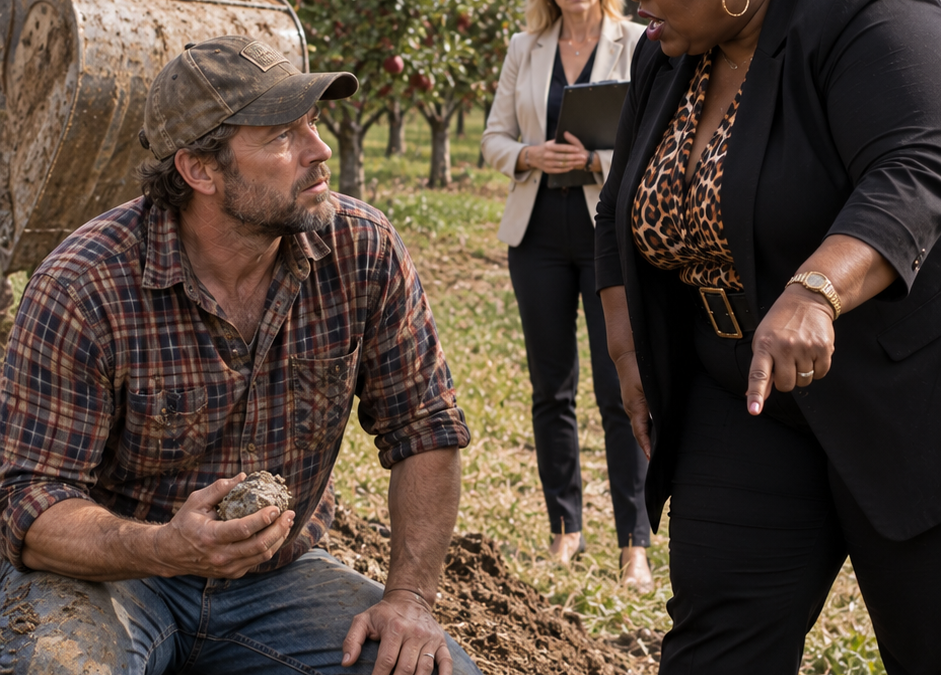
Her expression barely moved.
“The association holds utility rights through this corridor.”
“No, it doesn’t.”
“Nolan, I am not going to stand here and debate infrastructure law with you.”
She said my name the way a school administrator might speak to a difficult teenager.
I glanced back at the pipe.
“This is inside my boundary.”
“It is within an established utility easement.”
“Show me.”
The community manager looked uncomfortable.
Tessa did not.
She went back to the SUV, opened the rear door, and returned with a folder.
She did not hand it to me.
She flipped it open herself.
“There.”
The page referenced a utility easement authorizing water, electric, and sewer infrastructure.
I read the heading.
Then I read it again.
“That’s not my parcel.”
Tessa’s eyes stayed on mine.
“It is part of the utility mapping for this area.”
“The address is almost two miles from here.”
“You grow apples, Nolan.”
Her voice went flat.
“Please don’t pretend you understand infrastructure mapping better than the engineers who designed the system.”
There are moments when anger is useful.
That was not one of them.
I took out my phone.
Turned on the camera.
Held it where she could see it.
“Could you repeat that?”
Her mouth closed.
I continued.
“Specifically, I’d like you to confirm on video that Silver Ridge Estates installed this sewer line beneath my property and that you’re claiming an easement gives you the legal right to do it.”
No answer.
The community manager looked away.
Then I noticed the pipe.
Not visually.
Through my hand.
I had rested my fingers against its surface.
There was movement.
A faint vibration.
Steady.
The kind of low pulse you feel in a working line.
I moved my hand.
Placed it back.
Still there.
My stomach tightened.
This was not an empty future line.
Something was moving through it.
Right then.
Under my orchard.
“Tessa.”
She said nothing.
“This line is active.”
Her expression changed for less than a second.
It was enough.
To understand why that mattered, you have to go back eighteen months.
That was when the newest phase of Silver Ridge Estates first broke ground.
Tessa came to my house a few weeks after construction started.
She had recently been elected HOA president, although she worked closely with the developer because the new phase had not yet been fully turned over to residents.
She carried rolled engineering drawings.
I made coffee.
We sat at my kitchen table.
She spread the drawings flat.
A proposed sewer corridor ran along the northern part of my orchard.
It was more than thirty feet wide.
“That’s the preferred alignment,” she told me.
“Preferred by whom?”
“The project engineers.”
It would have required removing mature trees.
Some were over twenty years old.
Those trees were not decorative.
They were production.
Income.
Root systems.
Years of pruning.
Years before replacement trees would reach equivalent yield.
Tessa slid an offer across the table.
The amount would barely have covered removing and replacing the trees, much less the permanent loss of use created by a sewer easement.
“No.”
She blinked.
“You haven’t really looked at the number.”
“I looked at the route.”
“The easement payment can be adjusted.”
“The answer is still no.”
She leaned back.
“Why?”
That question irritated me more than the low offer.
Because it assumed no had to be justified.
Still, I explained.
Construction would compact the soil.
Heavy equipment would tear through root systems.
The line would restrict future trenching and planting.
And the proposed route passed uncomfortably close to my irrigation well.
“What happens when that pipe leaks?” I asked.
“It won’t.”
“Every pipe can leak.”
“Our engineers have designed—”
“I spent my whole life around this ground. You’re asking me to put a permanent sewer corridor beside the well that irrigates my fruit.”
She gave me a patient smile.
“So what do you suggest?”
“The public road east of the development.”
Her expression changed.
“That requires a pump station.”
“I know.”
“And nearly seven hundred additional feet of line.”
“I know.”
“That would delay completion at least eight months.”
“Probably.”
She stared at me.
“You understand these homes are going to increase property values throughout the area.”
“I’m not selling my orchard.”
“That doesn’t mean you won’t benefit.”
“Higher land value doesn’t give you a right to use my land.”
Her jaw tightened.
“Nolan, communities require infrastructure.”
“Then build it on land the community owns.”
She rolled the drawings up harder than necessary.
That should have been the end of it.
Instead, it was the beginning.
The complaints started within weeks.
My tractor was too loud before sunrise during harvest.
Fruit trucks tracked dirt onto a shared public road.
My storage shed was an eyesore.
My irrigation created “visual spray interference” for homes that were not even occupied yet.
The HOA asked me to install decorative fencing along my eastern boundary.
Their preferred style looked like something designed to keep Labradors inside suburban yards, not protect a working orchard from deer.
Every letter was written as though Silver Ridge had authority over my land.
Every response I sent included some variation of the same facts.
My parcel was not part of the development.
No covenants applied.
County agricultural ordinances protected normal farm operations.
Their architectural rules stopped at their property line.
Eventually the letters slowed.
I assumed somebody’s lawyer had explained jurisdiction.
I was wrong.
Around that same period, I remembered seeing Tessa near the eastern slope with Cole Danner, who represented the development investors.
They stood looking across my orchard.
I was repairing irrigation farther uphill and could not hear everything.
But I heard Tessa say,
“If we go straight through that slope, we eliminate the pump station entirely.”
At the time, I thought it was just another idea.
An engineer points to a shorter line.
Somebody explains why it cannot be used.
The project moves on.
I had no reason to think anyone would actually bury it.
After discovering the pipe, I remembered my trail cameras.
I use them mostly for deer.
They help me see where animals enter the orchard at night and which rows need better fencing.
One camera covered the eastern windbreak.
I pulled the memory cards.
What I saw changed everything.
At 2:07 in the morning on a Monday, heavy equipment entered from Silver Ridge.
Excavator.
Trencher.
Dump truck.
A utility crew from Mallerie Underground Works.
They removed part of my fence.
Laid steel plates over softer ground.
And drove into the orchard.
Night one, they opened the trench.
Night two, they laid pipe.
Night three, they continued the route and backfilled.
By the fourth morning, the trench was closed.
Topsoil spread.
Fence restored.
Grass seed and mulch scattered over the disturbed strip.
The timestamps matched a week I had been away taking a sorting machine to a repair shop two counties west.
They knew I was gone.
The route ran nearly seven hundred feet through the exact corridor I had refused.
I watched the footage three times.
There is an anger so hot it makes people reckless.
Mine went the opposite direction.
It became cold.
I called Reed Mallerie.
Owner of the excavation company.
At first, he would barely talk.
“We’re under contract.”
“On my property.”
“I can’t discuss client work.”
I emailed him still frames from the trail cameras.
Time.
Date.
His company logo visible on the equipment.
He called back twenty minutes later.
“We were given documentation.”
“What documentation?”
“Recorded utility corridor.”
“Recording number?”
He read it to me.
I wrote it down.
Pulled the county record online.
The easement existed.
For a completely different parcel.
Nearly two miles away.
I called Reed again.
“That document has nothing to do with my land.”
Silence.
“That’s what we were given.”
“By whom?”
“Silver Ridge.”
“Who specifically?”
Another pause.
“Tessa Langford.”
I hired Gavin Reddick the next morning.
Gavin was a licensed surveyor who had worked agricultural boundaries long enough to understand that farmers usually care less about elegant drawings than where the iron pins actually sit.
He spent two days mapping the line.
There was no ambiguity.
The pipe crossed three orchard blocks.
Entirely within my boundary.
No sewer easement.
No general utility corridor.
No recorded right-of-way.
Nothing.
The nearest legitimate easement was a narrow water conveyance strip along the northern boundary.
Different location.
Different purpose.
Different instrument.
The sewer line also passed less than one hundred feet from my primary irrigation well.
That frightened me more than the trespass itself.
A broken fence can be fixed.
Trees can eventually be replanted.
A contaminated agricultural well can destroy customer confidence long after testing says the water is safe again.
Gavin documented the physical damage.
Seventeen apple trees with major root loss.
Nine pear trees showing soil compaction stress.
Two crushed irrigation laterals.
One natural drainage swale flattened by heavy equipment.
Then we found an inspection point.
Or what should have been one.
It had been buried under fresh topsoil.
No visible lid.
No marker.
We located it by following the engineering geometry and probing.
Someone had intentionally concealed access after construction.
I sent a formal cease-and-desist notice.
HOA.
Developer.
Contractor.
County planning office.
Every photograph.
Survey.
Trail-camera images.
Property documents.
Tessa responded within hours.
She acknowledged the line was active.
Then wrote that operations could not be “reversed over a handful of fruit trees.”
She offered money.
Not damages.
A retroactive easement.
Sign now.
Make the trespass legal afterward.
I refused.
The next letter threatened to hold me responsible for losses or service interruptions affecting residents if I interfered with the pipeline.
That was almost impressive.
They had secretly installed an active sewer under my land.
Now I was somehow responsible for keeping it running.
Gavin and I opened the buried inspection point.
The readings were wrong for a dormant line.
Too much flow.
Too steady.
Multiple inputs.
He listened to the pipe.
Then looked at me.
“This isn’t a handful of test connections.”
“How many?”
“I can’t tell from here.”
“Occupied houses?”
“Looks like it.”
That afternoon we compared the folder Tessa had shown me with the actual county records.
The first page was legitimate Silver Ridge paperwork.
The attached easement page was legitimate too.
But they belonged to different files.
Someone had physically assembled documents from two unrelated records and presented them as one.
To someone unfamiliar with land records, it looked plausible.
County seal.
Legal language.
Utility terminology.
But the parcel description was wrong.
The recording reference was wrong.
The geography was wrong.
We pulled my full chain of title.
Decades.
Nothing.
No sewer right.
No condemnation petition.
No temporary construction easement.
No agreement signed by me.
No as-built plan showing the pipeline’s actual route.
On paper, the pipe did not exist.
I met Tessa at the association office with my attorney.
Cole Danner was there too.
Tessa called the mismatched easement page an “administrative error.”
My attorney asked who created the packet.
“We’ll have to investigate.”
“Who represented to the contractor that it applied to Mr. Weller’s property?”
“The project had always contemplated infrastructure through that general area.”
I leaned forward.
“Who gets to decide the intended future use of my land?”
She looked at me.
“The reality now is that families are connected.”
“How many?”
She hesitated.
“One hundred sixty homes.”
That was the first time I heard the number.
“One hundred sixty?”
“These are occupied households.”
“And you connected them before you resolved the easement?”
“Nolan, do you honestly want to tell 160 families they can’t use their toilets because you’re angry about some trees?”
There it was.
The shield.
Residents.
Families.
Children.
People who had nothing to do with the decision suddenly placed between Tessa and accountability.
“I didn’t connect their houses,” I said.
“You knew development was occurring.”
“I refused this route.”
“The system cannot simply be shut down.”
My attorney interrupted.
“Then this should be easy. Produce the operating permit.”
Silence.
“Commissioning approval.”
Nothing.
“Pressure-testing documentation.”
Cole shifted in his chair.
“Final inspection sign-off.”
Tessa folded her hands.
“Some paperwork is still being processed.”
“Treatment capacity approval?”
No answer.
My attorney closed his notebook.
“That is what I thought.”
Cole offered more money later that afternoon.
Enough to replace the lost trees.
Loss-of-production payment.
Permanent easement compensation.
And, bizarrely, lifetime access to the Silver Ridge clubhouse.
I stared at him.
“You’re offering me a gym membership?”
“It has a pool too.”
My attorney looked down to hide a smile.
I did not laugh.
“If this line is legal, why are you paying me to legalize it?”
Cole’s expression hardened.
“We’re trying to resolve the situation.”
“So am I.”
I sent everything to the state environmental quality agency.
Photos.
Survey.
Video.
Mismatched deeds.
Flow observations.
HOA correspondence.
Tessa’s admission that the pipe was operational.
Two days later, Elise Marin called me.
She was an environmental engineer assigned to wastewater compliance.
Her first question was simple.
“Mr. Weller, do you know what this pipeline was permitted as?”
“A sewer line?”
“No.”
I waited.
“The permit package shows a future stub.”
“A what?”
“A capped line segment reserved for a later development phase. Both ends closed. No live wastewater.”
I looked out my kitchen window toward the dead trees.
“It’s carrying something.”
“That’s why I’m calling.”
She scheduled an inspection.
Before hanging up, she asked,
“Are you certain the flow is residential?”
“I assumed it was.”
“Don’t assume.”
That question bothered me all night.
Elise arrived Thursday with two state technicians.
Tessa arrived less than ten minutes later with the association attorney.
She stepped out demanding to know under what authority the state intended to open the line.
Elise did not react.
“This is an inspection involving suspected unauthorized wastewater conveyance.”
“You need a court order.”
“No.”
“Our counsel disagrees.”
Elise turned to the attorney.
The attorney did not support Tessa’s statement.
That was the first bad sign for her.
Elise asked for pre-operational test records.
Tessa had none.
Pressure test.
None.
Commissioning certificate.
None.
Authorization to introduce domestic sewage.
None.
The technicians lifted the inspection cover.
Flow immediately registered.
Not a trickle.
Continuous.
They monitored the pattern.
Morning spike.
Midday reduction.
Evening increase.
Residential.
Then they used tracing dye at selected upstream points inside Silver Ridge.
Minutes later, color appeared at the inspection point beneath my orchard.
The physical connection was proven.
After that, the inspectors started comparing records.
Official county data showed the newest 160 houses as either being served by temporary approved arrangements or awaiting final system certification depending on their construction stage.
The ground showed something entirely different.
One hundred sixty service laterals.
Connected.
Active.
Discharging.
Every one feeding the unauthorized line.
Elise went manhole by manhole.
Connection after connection.
Ten.
Twenty.
Fifty.
Eighty.
One hundred.
Tessa stopped following the count somewhere around ninety.
The final number was 160.
One hundred sixty illegal connections into a pipe whose permit allowed zero.
Tessa tried calling it an “extended testing phase.”
Elise looked at her.
“Occupied households are not a testing medium.”
The technicians opened another manhole inside the development.
Fully connected services.
Some laterals had been concealed beneath new landscaping.
Not temporary.
Not incomplete.
Operational.
Elise wrote the violation notice on site.
No new connections.
No additional occupancy relying on that system.
Emergency operating measures at developer expense.
Full inspection of the illegal line.
Soil and groundwater evaluation near my well.
Disclosure of internal communications related to the route.
Tessa started talking about appeal rights.
Then she turned toward me.
“This is what you wanted.”
I almost answered angrily.
Elise did it first.
“Mr. Weller did not install 160 unauthorized sewer connections.”
Tessa stared at her.
Elise continued.
“Whoever authorized opening this system created this problem.”
No one answered.
One technician was inspecting the control cabinet.
He called Elise over.
Inside was a dated label on the valve assembly.
Commissioning date.
Except it was not the official commissioning date.
It showed the valve had been opened nearly four months earlier.
The state demanded complete system records.
What emerged afterward made the trespass look almost simple.
According to the approved plan, the line beneath my orchard was supposed to be a capped future stub.
It should never have carried sewage.
After the county’s initial inspection team left the site, another crew returned.
The caps were removed.
A functioning valve was installed.
The line was tied into Silver Ridge’s internal network.
The downstream end was connected to a receiving pipe leading toward the treatment system.
Then the valve was opened.
Four months early.
Without authorization.
That explained the delay between construction and visible tree damage.
For a while, the buried pipe had simply been there.
Then homes filled.
Flow increased.
Vibration increased.
Soil settled.
Moisture conditions changed around disturbed sections.
Compacted trenches shifted.
Roots already weakened by excavation began failing.
Then the trees finally showed me what had been hidden.
The state found three other serious technical problems.
First, the treatment facility was not approved for the additional load from 160 occupied houses.
Flow estimates submitted earlier appeared lower than actual projections.
Avoiding the necessary capacity upgrade had saved substantial fees.
Second, the rerouted pipeline had never completed the required pressure testing.
Live sewage had been moving for months through sections no regulator had properly accepted.
Third, the slope through my orchard created hydraulic conditions different from the original approved alignment.
Wastewater moved faster downhill.
That increased stress at certain downstream joints.
Joints that had never been fully tested.
Elise did not order an instant shutdown.
I respected her for that.
A full immediate closure might have left 160 families with no usable sanitation.
Those residents had bought houses assuming somebody else had handled permits.
They had not chosen the route.
They had not entered my orchard at night.
They had not falsified documents.
So the state imposed temporary emergency operations.
Pump trucks.
Holding tanks.
Continuous flow and leak monitoring.
Developer paid.
No cost passed to homeowners.
A relocation plan was due within ten days.
Tessa responded by proposing that I sell the easement retroactively.
Again.
This time the offer was much larger.
I declined.
“Nolan,” she said during one meeting, “at some point money has to matter.”
“It does.”
“Then name the number.”
“You still don’t understand.”
She leaned back.
“What don’t I understand?”
“My customers buy food from this land.”
I pointed toward the orchard through the conference-room window.
“You ran an untested sewer beside my irrigation well for months without telling me. Even if there is no contamination, I have to be able to look a grocery buyer in the eye and say I did everything possible to protect that water.”
“We’ll monitor it.”
“No.”
“Nolan—”
“The pipe leaves.”
Her attorney whispered something to her.
She ignored him.
“You’re being unreasonable.”
“I proposed the public-road route eighteen months ago.”
“That route costs nearly two million dollars.”
“That was true then too.”
The board began falling apart.
Several directors had believed Tessa when she said the sewer was fully permitted.
Some thought the dispute with me involved only a missing signature.
Others had no idea 160 homes were already connected.
Tessa called a closed meeting and attempted to push through a special assessment to cover remediation costs.
The board secretary refused to certify the minutes.
No proper vote.
No full disclosure.
That was when Reed Mallerie called me again.
His voice sounded different this time.
“I need to show you something before somebody convinces me not to.”
We met at the county planning office.
Me.
My attorney.
Elise.
Reed.
He brought emails.
Original files.
Server backups.
Site logs.
Tessa had known.
Not suspected.
Known.
One email discussed my refusal directly.
She wrote that I would probably sue if I discovered the line.
Then came the sentence that changed everything.
By the time litigation moved far enough to matter, she wrote, the pipe would already be “comfortably underground” and much harder to remove.
Reed looked sick while Elise read it.
Another email outlined the financial reason for the shortcut.
Nearly seven hundred feet less pipe.
No new pump station.
No relocation of an expensive decorative wall.
Months shaved off construction.
Estimated savings close to $1.8 million.
An investor deadline was approaching.
Reed had asked for proof of right-of-way before trenching.
Tessa sent the same false easement packet she later showed me.
She also instructed Reed not to contact me directly.
At one point Reed noticed that survey stakes appeared outside the permitted corridor.
He emailed Tessa and Cole Danner.
Cole replied.
“Route issues can be reconciled after installation once field conditions establish a reality that cannot easily be undone.”
I read that line twice.
There it was.
The strategy in plain English.
Build first.
Create dependence.
Make removal expensive.
Then negotiate with the landowner after the fact.
One more email was worse personally.
Tessa wrote about me.
Not my parcel.
Me.
She said I was “the kind of man who thinks owning a tractor makes him important.”
Then she wrote that once I understood the cost of fighting a development legally, I would eventually sign whatever they placed in front of me.
I sat there quietly.
My attorney asked if I wanted a minute.
“No.”
I kept reading.
Reed’s site logs contained night-work instructions.
Construction was scheduled specifically to avoid “conflict with agricultural activity.”
Which meant me.
The nights chosen overlapped the delivery trip I had discussed publicly with a local equipment shop.
They had not simply hoped I would miss the trench.
They planned around my absence.
Then investigators found the money.
Tessa owned a private consulting company.
That company had a contract tied to the development expansion.
If all 160 homes were connected before the close of the fiscal quarter, her company qualified for a substantial completion bonus.
That altered the entire motive structure.
This was no longer simply an aggressive HOA president trying to save her community money.
She personally benefited from beating the deadline.
When those records became public, Silver Ridge held an emergency meeting.
I attended.
So did Reed.
So did several state representatives.
Tessa accused Reed of manufacturing emails to protect himself.
Reed had prepared for that.
Server records.
Metadata.
Electronic signatures.
Original change-order histories.
Cole attempted to claim land-rights decisions had been Tessa’s responsibility.
His name appeared copied on almost every important email.
The board suspended Tessa.
She stood before the room and insisted she had made difficult decisions to protect Silver Ridge from a greedy orchard owner and excessive government interference.
A resident near the front raised his hand.
“You knew our houses were on an unapproved sewer?”
Tessa paused.
“Operational details were still being finalized.”
“That isn’t what I asked.”
The resident stood.
“My daughter lives in one of those houses. Did you know?”
Tessa said nothing.
The room changed.
That silence hurt her more than any document.
Soon after, the association’s insurance carrier warned that deliberate trespass might fall outside coverage.
That meant some costs could potentially reach individuals responsible for the decisions rather than being absorbed by insurance.
For the first time, I think people inside Silver Ridge realized how dangerous Tessa’s approach had been for them too.
Still, she and Cole kept trying to save the illegal route.
Proposal one:
Pay me everything.
Trees.
Harvest losses.
Permanent easement.
Large lump sum.
No.
Proposal two:
Transfer the sewer to a public utility and classify it as essential infrastructure.
The utility authority refused.
They would not inherit an unpermitted line sitting on private property without legitimate right-of-way.
Proposal three:
Ask the court for temporary continued operation because 160 occupied homes relied on it.
That one was different.
I did not oppose a short transition period.
I told the judge exactly why.
“The homeowners didn’t dig this trench.”
Tessa looked toward me.
I continued.
“They bought houses. They were told the system was legal. I don’t want families losing sanitation overnight because other people lied to them.”
The judge asked,
“So your objection is not to emergency temporary operation?”
“No.”
“What is your objection?”
“Making temporary dependence permanent by using those families as leverage against my property rights.”
That ended Tessa’s favorite argument.
I was not trying to punish residents.
I wanted the unlawful system replaced without creating a public-health problem.
The court allowed only limited temporary operation under strict monitoring.
Developer-funded pump trucks.
Emergency storage.
Leak detection.
Firm relocation schedule.
No extensions without documented progress.
The state approved the permanent solution soon afterward.
A new sewer route along the public road east of Silver Ridge.
Exactly where I had suggested eighteen months earlier.
It required the pump station.
The extra pipe.
Upgrades to the receiving main.
Proper capacity fees for all 160 homes.
Full inspections.
Real permits.
Real right-of-way.
The expensive version.
The legal version.
The version that should have been built first.
The bank financing the next development phase froze disbursements.
Title insurers began reviewing pending transactions because utility records could no longer be trusted at face value.
Cole was removed from project management.
An independent firm was appointed.
Then, one afternoon, Tessa came to the orchard.
Alone.
I was repairing trellis wire on a young pear block.
Her SUV stopped outside the fence.
She waited.
I walked over.
“You’re putting hundreds of families’ home values at risk,” she said.
No hello.
No apology.
Nothing.
“I’m not.”
“This project is collapsing because you won’t compromise.”
“I proposed the route the state approved before you dug anything.”
“You could have signed the easement.”
“You could have accepted no.”
Her face tightened.
“We would have lost eight months.”
“And now?”
She said nothing.
“How much time have you lost now?”
“That isn’t the point.”
“It’s exactly the point.”
She stared toward the rows behind me.
“All of this over trees.”
“No.”
I shook my head.
“Not over trees.”
“Then what?”
“You decided the answer was yes after I told you no.”
She looked at me for several seconds.
Then she got back into her SUV.
That was the last real conversation we ever had.
Before removal began, inspectors found something else.
A small leak.
It was near a joint close to the protective area around my irrigation well.
Not catastrophic.
Not even enough to create visible surface contamination.
But it was real.
My mouth went dry when Elise told me.
Testing began immediately.
Well water.
Soil.
Groundwater.
Nearby drainage.
The results showed no measurable contamination of my well.
I remember sitting on an overturned harvest bin when Elise gave me the result.
“Clean?”
“Clean.”
“You’re sure?”
“We ran multiple panels.”
I closed my eyes.
For the first time since finding the pipe, I felt something inside me unclench.
Elise sat beside me.
“You were right to insist on monitoring.”
“It should never have been there.”
“No.”
The leak changed the removal plan.
Some people had argued that the illegal line could be capped and abandoned in place.
The state rejected that.
Every section crossing my orchard would be excavated and removed.
This time the work happened in daylight.
With permission.
With inspectors.
Surveyors.
Environmental engineers.
Agricultural soil specialists.
Water-quality technicians.
Insurance representatives.
Attorneys.
Every step documented.
Watching the trench reopen was harder than I expected.
It was like seeing the injury properly for the first time.
Roots had been sliced clean.
Topsoil mixed with poor fill.
Irrigation lines crushed and patched.
Drainage altered.
Some pipe connections differed from the approved engineering drawings.
Markers that should have remained visible had been buried.
Even identification printing on some pipe sections had been turned downward.
Maybe coincidence.
Maybe not.
By then, nobody involved assumed coincidence without checking.
Tessa appeared outside the fence on the first day of excavation.
She no longer had authority over the work.
A local reporter stood beside her.
I heard her describe the dispute as a “technical disagreement that had been unnecessarily escalated.”
I went back to work.
Elise’s preliminary state findings came later.
One hundred sixty unauthorized connections.
Operation months before commissioning.
Falsified location records.
No legitimate right-of-way.
Inadequate capacity authorization.
Incomplete pressure testing.
Misleading submissions.
A leak near a protected agricultural well.
The state forwarded records relating to the mismatched easement documents and Tessa’s bonus arrangement to its civil investigations division.
The HOA removed her permanently.
Her consulting contract was terminated.
Cole lost his project role.
The lender put an independent firm in charge of completing Silver Ridge.
The settlement came months later.
The responsible parties had to restore my orchard.
Not cosmetically.
Agriculturally.
That distinction mattered.
Soil decompaction.
Drainage reconstruction.
Irrigation replacement.
Topsoil restoration.
Tree replacement.
Monitoring.
They compensated me for lost production while replacement trees matured.
That number was based on actual yield history, not someone’s guess about what an apple tree was worth at a nursery.
They paid my legal fees.
Survey costs.
Testing costs.
And funded long-term monitoring of the irrigation well.
They also agreed that neither the developer nor the HOA would seek another utility easement through my orchard.
Ever.
The replacement sewer line would be constructed entirely outside my property.
People heard there was a settlement and assumed I had suddenly become wealthy.
I did not.
Most of the money had a job before it arrived.
Trees take years.
Production loss continues long after the excavator leaves.
Soil recovery is not instant.
Customers need reassurance.
Infrastructure damage is expensive in boring ways.
I did not buy a new truck.
I did not build a bigger house.
I rebuilt the orchard.
During the final day of pipe removal, Reed was there.
He had been cooperating with investigators by then.
A section of pipe came out of the trench and rolled slightly.
Reed crouched.
“Look at this.”
Stamped into the plastic was a manufacturing date.
I stared at it.
The pipe had been ordered before Tessa ever came to my kitchen pretending to negotiate for the easement.
Before she offered me money.
Before I said no.
They had already purchased material for the route.
That meant the conversation at my table had not been the beginning of a decision.
The decision had apparently been made before Tessa asked permission.
She had not come to find out whether I agreed.
She had come hoping I would make the existing plan easier.
I stood over that section of pipe feeling surprisingly little anger.
By then, I was tired of anger.
The date simply confirmed what I had learned about her from the beginning.
She treated consent as a scheduling issue.
A year later, the new sewer system went online.
Public-road alignment.
Pump station operating.
Receiving main upgraded.
Capacity fees paid.
All 160 homes properly connected.
Inspected.
Documented.
Permitted.
The line was more expensive.
Longer.
Less convenient.
And entirely legal.
Nobody had to sneak onto anybody’s farm at two in the morning.
Nobody had to invent an easement.
Nobody had to hide a manhole.
Nobody had to threaten families with losing bathroom service.
It just worked.
That is the strange thing about doing infrastructure correctly.
The final result often looks boring.
Water goes where it should.
Waste goes where it should.
Property records match the ground.
People barely notice.
Silver Ridge eventually received a new HOA board.
The first time the new president contacted me, I almost laughed.
Not because of what she asked.
Because of how she asked.
“We need surveyors near the east boundary next Thursday. They should not need to enter your property, but if that changes, can we call you first?”
“Yes.”
That was it.
Months of disaster avoided in twelve seconds.
Tessa sold her house before the civil investigation involving her had fully concluded.
I never saw her again.
The orchard took longer to recover.
The damaged apple trees came out.
So did the pears that never recovered from compaction.
I replanted.
Young trees look almost ridiculous beside mature orchard rows.
Thin trunks.
Small crowns.
Support stakes taller than the trees themselves.
For the first couple of years, they produce promises instead of fruit.
Then one spring I walked the old pipeline corridor and saw white blossoms along the new apple branches.
Not many.
Enough.
Elise returned that spring for a final scheduled round of well sampling.
I watched the technicians draw the samples.
Labels.
Coolers.
Chain-of-custody paperwork.
The same kind of dull procedure that had protected me through the entire ordeal.
A week later she called.
“Everything is clean.”
I let out a breath.
“Still?”
“Still.”
When she came by later to close out the monitoring file, we walked through the new trees.
She stopped where the inspection point had once been buried.
There was nothing there anymore.
Just soil.
Grass.
Young roots.
“Did you keep any of the pipe?” she asked.
“No.”
“Not even a short section?”
“Why would I?”
“Some people keep souvenirs.”
I looked down the row.
“I’ve spent enough time looking at that pipe.”
“What did you keep?”
“The final survey.”
She smiled.
“That makes sense.”
The final survey sits in my office.
Not framed.
Not displayed.
Just filed properly.
It shows the orchard boundary.
The irrigation well.
The restored drainage.
The legal utility locations.
And no red diagonal sewer line cutting through my trees.
That is the version of the property that should have existed all along.
Sometimes I think about what Tessa believed would happen.
The emails made it clear.
She thought the physical fact of a buried pipeline would become more powerful than the legal fact that it did not belong there.
Once installed, people would depend on it.
Once people depended on it, removal would be expensive.
Once removal became expensive, I would look like the unreasonable one.
That was the strategy.
Build dependence faster than I could build a case.
She misunderstood two things.
The first was land.
The second was me.
Tessa saw work clothes.
Grease.
An old pickup.
A man who pruned his own trees and repaired his own pumps.
She assumed that meant I would be intimidated by engineering language.
County seals.
Lawyers.
Developer money.
One hundred sixty households.
She called me a farmer as though the word meant I could not read.
But farmers spend their lives reading systems.
Soil.
Weather.
Water.
Disease.
Yield.
Labor.
Markets.
Land records.
You do not keep thirty-eight acres productive for decades by failing to notice patterns.
And the pattern of dead trees was the first thing she could not control.
She had hidden the pipe.
She had hidden the construction at night.
She had hidden the manhole.
She had buried the route.
She had buried the real easement problem under a false document.
She had hidden the connections from regulators.
But she could not hide what the system was doing to the land.
Roots died.
Soil shifted.
Flow vibrated through the pipe.
Usage rose morning and evening.
One hundred sixty homes flushed toilets, ran showers, washed dishes, and sent the evidence downhill beneath my orchard every single day.
The more useful the secret pipeline became, the more impossible it became to keep secret.
That irony stayed with me.
Tessa’s entire plan depended on the line being too important to remove.
But importance creates evidence.
Flow.
Maintenance.
Capacity.
Failures.
Records.
People.
You can hide a piece of plastic underground.
You cannot hide an operating wastewater system forever.
There is another part I think about.
The residents.
For a while, Tessa tried to position them between us.
If I insisted on my property rights, she said, families would suffer.
At first that argument made me angry.
Later, it mostly made me sad.
Because it treated the homeowners the same way she treated my orchard.
As something useful to leverage.
Those families deserved a permitted sewer.
They deserved accurate closing documents.
They deserved to know their wastewater system had enough capacity.
They deserved not to wake up one morning and discover their homes had become bargaining chips in a fight they never knew existed.
That is why I never asked for an immediate shutdown.
Some people thought that made me soft.
It did not.
There is a difference between refusing to be exploited and wanting innocent people harmed.
I wanted the people responsible to pay.
Not the family whose biggest mistake was trusting the paperwork they received at closing.
When the temporary pump trucks started appearing inside Silver Ridge, several residents came to talk to me.
The first was a young father named Mark.
He stood outside my gate with his hands in his jacket pockets.
“My house is one of the 160.”
“I know.”
“Tessa said you were trying to get our sewer disconnected.”
“I’m trying to get the illegal line removed from my property.”
He nodded slowly.
“What happens to us?”
“The state has emergency measures in place. The developer has to build a legal replacement.”
“So you’re not trying to shut us off?”
“No.”
He looked embarrassed.
“That isn’t what we were told.”
“I figured.”
A week later, an older couple came.
Then another homeowner.
Some apologized.
I told them they did not owe me one.
Most had never known.
That distinction mattered.
Eventually the story inside Silver Ridge changed.
It stopped being farmer versus neighborhood.
It became residents asking their own board why they had been put at risk.
That was when Tessa really lost control.
Not when I found the pipe.
Not when Elise counted the hookups.
When the people she claimed to be protecting realized she had made decisions without telling them.
I never celebrated what happened to her.
There is a temptation in stories like this to make the end about humiliation.
Somebody loses a title.
Gets exposed.
Moves away.
People clap.
That was never the ending I cared about.
The ending I wanted was quieter.
A legal sewer line.
Clean well water.
Restored soil.
Healthy trees.
A property boundary nobody had to debate anymore.
I got that.
Late one afternoon after the last state monitoring visit, I walked the replanted row alone.
The sun was low behind me.
Silver Ridge rooftops caught orange light beyond the eastern fence.
The new sewer route was out by the road, invisible and working.
Exactly where I had told Tessa it should go before any of this began.
There was no sound from it.
No drama.
Just functioning infrastructure on land where it had a legal right to exist.
I stopped beside one of the young apple trees.
A few white blossoms were still clinging to the branches.
I touched one lightly.
My grandfather never saw Silver Ridge.
Never saw the pipe.
Never met Tessa.
But I could hear what he would have said.
Probably nothing profound.
He was not that kind of man.
He would have looked at the trees.
Looked at the survey stakes.
Then asked whether I had fixed the drainage correctly.
That was his way.
Land does not care much about speeches.
It responds to what you actually do.
Cut a root and the tree remembers.
Compact the soil and water moves differently.
Dig a trench and the ground settles.
Restore it properly and, slowly, life comes back.
Tessa believed soil was useful because it could hide what she had done.
For a while, she was right.
It hid seven hundred feet of pipe.
It hid the trench scars.
It hid the crushed irrigation.
It hid the access point.
It hid the false route from anybody who never thought to look below the grass.
But the land also revealed everything.
The dead trees drew the line.
The damp soil exposed the trench.
The vibration revealed the flow.
The flow led inspectors upstream.
The connections led to permits.
The permits led to records.
The records led to emails.
And the emails led straight back to the people who thought burying something made it untouchable.
That is why I never kept a piece of the old pipe.
The pipe was not the lesson.
The lesson was the row of trees above it.
Those trees died because somebody believed getting away with something for a few months was the same as making it legitimate.
It is not.
A thing does not become yours because you buried it on somebody else’s land.
An unauthorized line does not become legal because families depend on it.
A false easement does not become real because it carries a county seal from another parcel.
A board president does not gain authority because she speaks first.
And a farmer does not become powerless because somebody mistakes dirt on his boots for ignorance.
The new trees are taller now.
Still not mature.
Still years away from matching the production I lost.
But every spring, there are more blossoms.
The first year there were only a few.
The second year enough that I could see the row from the lane.
One day they will be full-sized apple trees again.
Customers will buy fruit from them without knowing what once ran beneath their roots.
I am fine with that.
The best restoration is the kind that eventually stops looking like restoration.
Silver Ridge is quieter too.
The new board calls before survey crews approach my fence.
Their contractors stay where their plans say they should.
I stay on my side.
They stay on theirs.
It turns out coexistence is remarkably easy when nobody is trying to steal seven hundred feet of permission.
The final survey remains in my office.
Every once in a while, usually when I am searching for some other document, I see it.
Thirty-eight acres.
Straight boundaries.
Irrigation well.
Drainage.
Orchard rows.
No sewer line.
No emergency annotation.
No disputed corridor.
Just my land looking on paper the way it should have looked all along.
Tessa once believed that if she could get the pipeline buried before I noticed, the ground itself would become her strongest argument.
She thought concrete decisions were harder to reverse than legal ones.
She thought once 160 homes depended on what she had done, everybody else would be forced to accept it.
What she never understood was that those 160 homes were not protection.
They were evidence.
Every shower.
Every sink.
Every washing machine.
Every toilet.
Day after day, all of it moved through the secret she had buried beneath my trees.
And in the end, the thing Tessa thought would make the truth impossible to remove was the very thing that made the truth impossible to hide.
Have you finished reading the story and want to read it again?
The Dead Apple Trees Were Hiding Something Tessa Never Expected Me to Dig Up
The first thing that bothered me was how straight the damage was.
Trees do not usually die in a perfect diagonal line.
By the time I put the excavator bucket into the soil, I already knew somebody had been beneath my orchard.
My name is Nolan Weller.
For twenty years, I have grown apples, pears, and cherries on thirty-eight acres my grandfather cleared with a mule, a crosscut saw, and the kind of stubbornness that apparently runs in families.
I sell fruit to independent grocers and a handful of small cideries two counties over. I know which parts of the orchard hold frost longer in April. I know where the soil stays wet after a three-day rain. I know which apple trees will lean east when the fruit gets heavy and which old pear trees can survive almost anything as long as you keep their roots undisturbed.
I also know where my property lines are.
Not approximately.
Not according to some marketing map.
I walk them.
My grandfather did the same thing. My father did too.
When you make your living from land, boundaries are not abstract lines drawn by people in offices. They are where you stop plowing. Where someone else starts paying taxes. Where your drainage becomes somebody else’s responsibility. Where permission begins to matter.
For most of my life, that knowledge was simple.
Then Silver Ridge Estates arrived.
The newest phase of the development went in east of my orchard, beyond an old fence line and a natural slope that dropped gently from my higher ground toward the public road.
I had no objection to houses.
People need places to live.
The pasture had been sitting unused for years, and the developer owned it.
My only expectation was that they would build on their land and I would keep farming mine.
Tessa Langford apparently considered that expectation unreasonable.
The morning everything surfaced was late in May.
That is supposed to be one of the prettiest times in my orchard.
Blossoms mostly gone.
New leaves fully opened.
Bees still working the last flowering trees.
Young fruit beginning to form.
That year, one section looked wrong.
Seventeen apple trees on the eastern side had begun dropping leaves.
Not randomly.
Not in clusters.
A diagonal band.
At first I thought maybe there was an old drainage problem underneath them. Root rot can move strangely depending on the soil. Certain fungal problems follow moisture.
But disease does not normally draw a ruler-straight line through an orchard.
Neither does frost.
Neither does drought.
I walked the row twice.
The ground felt softer beneath my boots than the surrounding soil.
There was a strip of grass through the trees that looked younger than everything beside it.
Too green.
Too even.
Several trunks leaned slightly where they had never leaned before.
I crouched near one of the dying apples and pushed my fingers into the soil.
Loose.
Recently disturbed.
That was when the uneasiness became something else.
I brought out my small excavator.
I expected to find an old field drain.
Maybe collapsed clay tile from my grandfather’s time.
The first bucket came up mostly topsoil.
The second brought pale subsoil.
On the third pass, the teeth scraped stone.
Not native stone.
Crushed gravel.
Compacted bedding material.
My hands stopped on the controls.
There was no reason for engineered gravel to be three feet beneath my apple trees.
I climbed down and dug carefully with a shovel.
Under the gravel was a large-diameter plastic pipe.
Modern.
Clean.
Running northeast to southwest.
Straight toward Silver Ridge Estates.
I stood there with the shovel in my hand for a long time.
I had never signed an easement.
Never approved a utility corridor.
Never allowed anyone to bury so much as a drainage culvert through that part of the orchard.
Yet beneath a row of trees my family had been tending for decades sat a pipe large enough to serve far more than one house.
I took photographs.
Wide shots.
Close-ups.
Depth measurements.
The trench profile.
The gravel.
The pipe markings I could see.
Then a white SUV appeared along the access road.
Silver Ridge Estates Homeowners Association was printed on the door.
Tessa Langford stepped out before the vehicle had fully settled.
The community manager came around the passenger side.
Tessa was already talking.
“Fill that back in.”
I looked at her.
She pointed toward the excavation.
“You need to stop tampering with public sanitation infrastructure.”
I set the shovel down.
“Public infrastructure?”
“Yes.”
“Whose land is it under?”
Her expression barely moved.
“The association holds utility rights through this corridor.”
“No, it doesn’t.”
“Nolan, I am not going to stand here and debate infrastructure law with you.”
She said my name the way a school administrator might speak to a difficult teenager.
I glanced back at the pipe.
“This is inside my boundary.”
“It is within an established utility easement.”
“Show me.”
The community manager looked uncomfortable.
Tessa did not.
She went back to the SUV, opened the rear door, and returned with a folder.
She did not hand it to me.
She flipped it open herself.
“There.”
The page referenced a utility easement authorizing water, electric, and sewer infrastructure.
I read the heading.
Then I read it again.
“That’s not my parcel.”
Tessa’s eyes stayed on mine.
“It is part of the utility mapping for this area.”
“The address is almost two miles from here.”
“You grow apples, Nolan.”
Her voice went flat.
“Please don’t pretend you understand infrastructure mapping better than the engineers who designed the system.”
There are moments when anger is useful.
That was not one of them.
I took out my phone.
Turned on the camera.
Held it where she could see it.
“Could you repeat that?”
Her mouth closed.
I continued.
“Specifically, I’d like you to confirm on video that Silver Ridge Estates installed this sewer line beneath my property and that you’re claiming an easement gives you the legal right to do it.”
No answer.
The community manager looked away.
Then I noticed the pipe.
Not visually.
Through my hand.
I had rested my fingers against its surface.
There was movement.
A faint vibration.
Steady.
The kind of low pulse you feel in a working line.
I moved my hand.
Placed it back.
Still there.
My stomach tightened.
This was not an empty future line.
Something was moving through it.
Right then.
Under my orchard.
“Tessa.”
She said nothing.
“This line is active.”
Her expression changed for less than a second.
It was enough.
To understand why that mattered, you have to go back eighteen months.
That was when the newest phase of Silver Ridge Estates first broke ground.
Tessa came to my house a few weeks after construction started.
She had recently been elected HOA president, although she worked closely with the developer because the new phase had not yet been fully turned over to residents.
She carried rolled engineering drawings.
I made coffee.
We sat at my kitchen table.
She spread the drawings flat.
A proposed sewer corridor ran along the northern part of my orchard.
It was more than thirty feet wide.
“That’s the preferred alignment,” she told me.
“Preferred by whom?”
“The project engineers.”
It would have required removing mature trees.
Some were over twenty years old.
Those trees were not decorative.
They were production.
Income.
Root systems.
Years of pruning.
Years before replacement trees would reach equivalent yield.
Tessa slid an offer across the table.
The amount would barely have covered removing and replacing the trees, much less the permanent loss of use created by a sewer easement.
“No.”
She blinked.
“You haven’t really looked at the number.”
“I looked at the route.”
“The easement payment can be adjusted.”
“The answer is still no.”
She leaned back.
“Why?”
That question irritated me more than the low offer.
Because it assumed no had to be justified.
Still, I explained.
Construction would compact the soil.
Heavy equipment would tear through root systems.
The line would restrict future trenching and planting.
And the proposed route passed uncomfortably close to my irrigation well.
“What happens when that pipe leaks?” I asked.
“It won’t.”
“Every pipe can leak.”
“Our engineers have designed—”
“I spent my whole life around this ground. You’re asking me to put a permanent sewer corridor beside the well that irrigates my fruit.”
She gave me a patient smile.
“So what do you suggest?”
“The public road east of the development.”
Her expression changed.
“That requires a pump station.”
“I know.”
“And nearly seven hundred additional feet of line.”
“I know.”
“That would delay completion at least eight months.”
“Probably.”
She stared at me.
“You understand these homes are going to increase property values throughout the area.”
“I’m not selling my orchard.”
“That doesn’t mean you won’t benefit.”
“Higher land value doesn’t give you a right to use my land.”
Her jaw tightened.
“Nolan, communities require infrastructure.”
“Then build it on land the community owns.”
She rolled the drawings up harder than necessary.
That should have been the end of it.
Instead, it was the beginning.
The complaints started within weeks.
My tractor was too loud before sunrise during harvest.
Fruit trucks tracked dirt onto a shared public road.
My storage shed was an eyesore.
My irrigation created “visual spray interference” for homes that were not even occupied yet.
The HOA asked me to install decorative fencing along my eastern boundary.
Their preferred style looked like something designed to keep Labradors inside suburban yards, not protect a working orchard from deer.
Every letter was written as though Silver Ridge had authority over my land.
Every response I sent included some variation of the same facts.
My parcel was not part of the development.
No covenants applied.
County agricultural ordinances protected normal farm operations.
Their architectural rules stopped at their property line.
Eventually the letters slowed.
I assumed somebody’s lawyer had explained jurisdiction.
I was wrong.
Around that same period, I remembered seeing Tessa near the eastern slope with Cole Danner, who represented the development investors.
They stood looking across my orchard.
I was repairing irrigation farther uphill and could not hear everything.
But I heard Tessa say,
“If we go straight through that slope, we eliminate the pump station entirely.”
At the time, I thought it was just another idea.
An engineer points to a shorter line.
Somebody explains why it cannot be used.
The project moves on.
I had no reason to think anyone would actually bury it.
After discovering the pipe, I remembered my trail cameras.
I use them mostly for deer.
They help me see where animals enter the orchard at night and which rows need better fencing.
One camera covered the eastern windbreak.
I pulled the memory cards.
What I saw changed everything.
At 2:07 in the morning on a Monday, heavy equipment entered from Silver Ridge.
Excavator.
Trencher.
Dump truck.
A utility crew from Mallerie Underground Works.
They removed part of my fence.
Laid steel plates over softer ground.
And drove into the orchard.
Night one, they opened the trench.
Night two, they laid pipe.
Night three, they continued the route and backfilled.
By the fourth morning, the trench was closed.
Topsoil spread.
Fence restored.
Grass seed and mulch scattered over the disturbed strip.
The timestamps matched a week I had been away taking a sorting machine to a repair shop two counties west.
They knew I was gone.
The route ran nearly seven hundred feet through the exact corridor I had refused.
I watched the footage three times.
There is an anger so hot it makes people reckless.
Mine went the opposite direction.
It became cold.
I called Reed Mallerie.
Owner of the excavation company.
At first, he would barely talk.
“We’re under contract.”
“On my property.”
“I can’t discuss client work.”
I emailed him still frames from the trail cameras.
Time.
Date.
His company logo visible on the equipment.
He called back twenty minutes later.
“We were given documentation.”
“What documentation?”
“Recorded utility corridor.”
“Recording number?”
He read it to me.
I wrote it down.
Pulled the county record online.
The easement existed.
For a completely different parcel.
Nearly two miles away.
I called Reed again.
“That document has nothing to do with my land.”
Silence.
“That’s what we were given.”
“By whom?”
“Silver Ridge.”
“Who specifically?”
Another pause.
“Tessa Langford.”
I hired Gavin Reddick the next morning.
Gavin was a licensed surveyor who had worked agricultural boundaries long enough to understand that farmers usually care less about elegant drawings than where the iron pins actually sit.
He spent two days mapping the line.
There was no ambiguity.
The pipe crossed three orchard blocks.
Entirely within my boundary.
No sewer easement.
No general utility corridor.
No recorded right-of-way.
Nothing.
The nearest legitimate easement was a narrow water conveyance strip along the northern boundary.
Different location.
Different purpose.
Different instrument.
The sewer line also passed less than one hundred feet from my primary irrigation well.
That frightened me more than the trespass itself.
A broken fence can be fixed.
Trees can eventually be replanted.
A contaminated agricultural well can destroy customer confidence long after testing says the water is safe again.
Gavin documented the physical damage.
Seventeen apple trees with major root loss.
Nine pear trees showing soil compaction stress.
Two crushed irrigation laterals.
One natural drainage swale flattened by heavy equipment.
Then we found an inspection point.
Or what should have been one.
It had been buried under fresh topsoil.
No visible lid.
No marker.
We located it by following the engineering geometry and probing.
Someone had intentionally concealed access after construction.
I sent a formal cease-and-desist notice.
HOA.
Developer.
Contractor.
County planning office.
Every photograph.
Survey.
Trail-camera images.
Property documents.
Tessa responded within hours.
She acknowledged the line was active.
Then wrote that operations could not be “reversed over a handful of fruit trees.”
She offered money.
Not damages.
A retroactive easement.
Sign now.
Make the trespass legal afterward.
I refused.
The next letter threatened to hold me responsible for losses or service interruptions affecting residents if I interfered with the pipeline.
That was almost impressive.
They had secretly installed an active sewer under my land.
Now I was somehow responsible for keeping it running.
Gavin and I opened the buried inspection point.
The readings were wrong for a dormant line.
Too much flow.
Too steady.
Multiple inputs.
He listened to the pipe.
Then looked at me.
“This isn’t a handful of test connections.”
“How many?”
“I can’t tell from here.”
“Occupied houses?”
“Looks like it.”
That afternoon we compared the folder Tessa had shown me with the actual county records.
The first page was legitimate Silver Ridge paperwork.
The attached easement page was legitimate too.
But they belonged to different files.
Someone had physically assembled documents from two unrelated records and presented them as one.
To someone unfamiliar with land records, it looked plausible.
County seal.
Legal language.
Utility terminology.
But the parcel description was wrong.
The recording reference was wrong.
The geography was wrong.
We pulled my full chain of title.
Decades.
Nothing.
No sewer right.
No condemnation petition.
No temporary construction easement.
No agreement signed by me.
No as-built plan showing the pipeline’s actual route.
On paper, the pipe did not exist.
I met Tessa at the association office with my attorney.
Cole Danner was there too.
Tessa called the mismatched easement page an “administrative error.”
My attorney asked who created the packet.
“We’ll have to investigate.”
“Who represented to the contractor that it applied to Mr. Weller’s property?”
“The project had always contemplated infrastructure through that general area.”
I leaned forward.
“Who gets to decide the intended future use of my land?”
She looked at me.
“The reality now is that families are connected.”
“How many?”
She hesitated.
“One hundred sixty homes.”
That was the first time I heard the number.
“One hundred sixty?”
“These are occupied households.”
“And you connected them before you resolved the easement?”
“Nolan, do you honestly want to tell 160 families they can’t use their toilets because you’re angry about some trees?”
There it was.
The shield.
Residents.
Families.
Children.
People who had nothing to do with the decision suddenly placed between Tessa and accountability.
“I didn’t connect their houses,” I said.
“You knew development was occurring.”
“I refused this route.”
“The system cannot simply be shut down.”
My attorney interrupted.
“Then this should be easy. Produce the operating permit.”
Silence.
“Commissioning approval.”
Nothing.
“Pressure-testing documentation.”
Cole shifted in his chair.
“Final inspection sign-off.”
Tessa folded her hands.
“Some paperwork is still being processed.”
“Treatment capacity approval?”
No answer.
My attorney closed his notebook.
“That is what I thought.”
Cole offered more money later that afternoon.
Enough to replace the lost trees.
Loss-of-production payment.
Permanent easement compensation.
And, bizarrely, lifetime access to the Silver Ridge clubhouse.
I stared at him.
“You’re offering me a gym membership?”
“It has a pool too.”
My attorney looked down to hide a smile.
I did not laugh.
“If this line is legal, why are you paying me to legalize it?”
Cole’s expression hardened.
“We’re trying to resolve the situation.”
“So am I.”
I sent everything to the state environmental quality agency.
Photos.
Survey.
Video.
Mismatched deeds.
Flow observations.
HOA correspondence.
Tessa’s admission that the pipe was operational.
Two days later, Elise Marin called me.
She was an environmental engineer assigned to wastewater compliance.
Her first question was simple.
“Mr. Weller, do you know what this pipeline was permitted as?”
“A sewer line?”
“No.”
I waited.
“The permit package shows a future stub.”
“A what?”
“A capped line segment reserved for a later development phase. Both ends closed. No live wastewater.”
I looked out my kitchen window toward the dead trees.
“It’s carrying something.”
“That’s why I’m calling.”
She scheduled an inspection.
Before hanging up, she asked,
“Are you certain the flow is residential?”
“I assumed it was.”
“Don’t assume.”
That question bothered me all night.
Elise arrived Thursday with two state technicians.
Tessa arrived less than ten minutes later with the association attorney.
She stepped out demanding to know under what authority the state intended to open the line.
Elise did not react.
“This is an inspection involving suspected unauthorized wastewater conveyance.”
“You need a court order.”
“No.”
“Our counsel disagrees.”
Elise turned to the attorney.
The attorney did not support Tessa’s statement.
That was the first bad sign for her.
Elise asked for pre-operational test records.
Tessa had none.
Pressure test.
None.
Commissioning certificate.
None.
Authorization to introduce domestic sewage.
None.
The technicians lifted the inspection cover.
Flow immediately registered.
Not a trickle.
Continuous.
They monitored the pattern.
Morning spike.
Midday reduction.
Evening increase.
Residential.
Then they used tracing dye at selected upstream points inside Silver Ridge.
Minutes later, color appeared at the inspection point beneath my orchard.
The physical connection was proven.
After that, the inspectors started comparing records.
Official county data showed the newest 160 houses as either being served by temporary approved arrangements or awaiting final system certification depending on their construction stage.
The ground showed something entirely different.
One hundred sixty service laterals.
Connected.
Active.
Discharging.
Every one feeding the unauthorized line.
Elise went manhole by manhole.
Connection after connection.
Ten.
Twenty.
Fifty.
Eighty.
One hundred.
Tessa stopped following the count somewhere around ninety.
The final number was 160.
One hundred sixty illegal connections into a pipe whose permit allowed zero.
Tessa tried calling it an “extended testing phase.”
Elise looked at her.
“Occupied households are not a testing medium.”
The technicians opened another manhole inside the development.
Fully connected services.
Some laterals had been concealed beneath new landscaping.
Not temporary.
Not incomplete.
Operational.
Elise wrote the violation notice on site.
No new connections.
No additional occupancy relying on that system.
Emergency operating measures at developer expense.
Full inspection of the illegal line.
Soil and groundwater evaluation near my well.
Disclosure of internal communications related to the route.
Tessa started talking about appeal rights.
Then she turned toward me.
“This is what you wanted.”
I almost answered angrily.
Elise did it first.
“Mr. Weller did not install 160 unauthorized sewer connections.”
Tessa stared at her.
Elise continued.
“Whoever authorized opening this system created this problem.”
No one answered.
One technician was inspecting the control cabinet.
He called Elise over.
Inside was a dated label on the valve assembly.
Commissioning date.
Except it was not the official commissioning date.
It showed the valve had been opened nearly four months earlier.
The state demanded complete system records.
What emerged afterward made the trespass look almost simple.
According to the approved plan, the line beneath my orchard was supposed to be a capped future stub.
It should never have carried sewage.
After the county’s initial inspection team left the site, another crew returned.
The caps were removed.
A functioning valve was installed.
The line was tied into Silver Ridge’s internal network.
The downstream end was connected to a receiving pipe leading toward the treatment system.
Then the valve was opened.
Four months early.
Without authorization.
That explained the delay between construction and visible tree damage.
For a while, the buried pipe had simply been there.
Then homes filled.
Flow increased.
Vibration increased.
Soil settled.
Moisture conditions changed around disturbed sections.
Compacted trenches shifted.
Roots already weakened by excavation began failing.
Then the trees finally showed me what had been hidden.
The state found three other serious technical problems.
First, the treatment facility was not approved for the additional load from 160 occupied houses.
Flow estimates submitted earlier appeared lower than actual projections.
Avoiding the necessary capacity upgrade had saved substantial fees.
Second, the rerouted pipeline had never completed the required pressure testing.
Live sewage had been moving for months through sections no regulator had properly accepted.
Third, the slope through my orchard created hydraulic conditions different from the original approved alignment.
Wastewater moved faster downhill.
That increased stress at certain downstream joints.
Joints that had never been fully tested.
Elise did not order an instant shutdown.
I respected her for that.
A full immediate closure might have left 160 families with no usable sanitation.
Those residents had bought houses assuming somebody else had handled permits.
They had not chosen the route.
They had not entered my orchard at night.
They had not falsified documents.
So the state imposed temporary emergency operations.
Pump trucks.
Holding tanks.
Continuous flow and leak monitoring.
Developer paid.
No cost passed to homeowners.
A relocation plan was due within ten days.
Tessa responded by proposing that I sell the easement retroactively.
Again.
This time the offer was much larger.
I declined.
“Nolan,” she said during one meeting, “at some point money has to matter.”
“It does.”
“Then name the number.”
“You still don’t understand.”
She leaned back.
“What don’t I understand?”
“My customers buy food from this land.”
I pointed toward the orchard through the conference-room window.
“You ran an untested sewer beside my irrigation well for months without telling me. Even if there is no contamination, I have to be able to look a grocery buyer in the eye and say I did everything possible to protect that water.”
“We’ll monitor it.”
“No.”
“Nolan—”
“The pipe leaves.”
Her attorney whispered something to her.
She ignored him.
“You’re being unreasonable.”
“I proposed the public-road route eighteen months ago.”
“That route costs nearly two million dollars.”
“That was true then too.”
The board began falling apart.
Several directors had believed Tessa when she said the sewer was fully permitted.
Some thought the dispute with me involved only a missing signature.
Others had no idea 160 homes were already connected.
Tessa called a closed meeting and attempted to push through a special assessment to cover remediation costs.
The board secretary refused to certify the minutes.
No proper vote.
No full disclosure.
That was when Reed Mallerie called me again.
His voice sounded different this time.
“I need to show you something before somebody convinces me not to.”
We met at the county planning office.
Me.
My attorney.
Elise.
Reed.
He brought emails.
Original files.
Server backups.
Site logs.
Tessa had known.
Not suspected.
Known.
One email discussed my refusal directly.
She wrote that I would probably sue if I discovered the line.
Then came the sentence that changed everything.
By the time litigation moved far enough to matter, she wrote, the pipe would already be “comfortably underground” and much harder to remove.
Reed looked sick while Elise read it.
Another email outlined the financial reason for the shortcut.
Nearly seven hundred feet less pipe.
No new pump station.
No relocation of an expensive decorative wall.
Months shaved off construction.
Estimated savings close to $1.8 million.
An investor deadline was approaching.
Reed had asked for proof of right-of-way before trenching.
Tessa sent the same false easement packet she later showed me.
She also instructed Reed not to contact me directly.
At one point Reed noticed that survey stakes appeared outside the permitted corridor.
He emailed Tessa and Cole Danner.
Cole replied.
“Route issues can be reconciled after installation once field conditions establish a reality that cannot easily be undone.”
I read that line twice.
There it was.
The strategy in plain English.
Build first.
Create dependence.
Make removal expensive.
Then negotiate with the landowner after the fact.
One more email was worse personally.
Tessa wrote about me.
Not my parcel.
Me.
She said I was “the kind of man who thinks owning a tractor makes him important.”
Then she wrote that once I understood the cost of fighting a development legally, I would eventually sign whatever they placed in front of me.
I sat there quietly.
My attorney asked if I wanted a minute.
“No.”
I kept reading.
Reed’s site logs contained night-work instructions.
Construction was scheduled specifically to avoid “conflict with agricultural activity.”
Which meant me.
The nights chosen overlapped the delivery trip I had discussed publicly with a local equipment shop.
They had not simply hoped I would miss the trench.
They planned around my absence.
Then investigators found the money.
Tessa owned a private consulting company.
That company had a contract tied to the development expansion.
If all 160 homes were connected before the close of the fiscal quarter, her company qualified for a substantial completion bonus.
That altered the entire motive structure.
This was no longer simply an aggressive HOA president trying to save her community money.
She personally benefited from beating the deadline.
When those records became public, Silver Ridge held an emergency meeting.
I attended.
So did Reed.
So did several state representatives.
Tessa accused Reed of manufacturing emails to protect himself.
Reed had prepared for that.
Server records.
Metadata.
Electronic signatures.
Original change-order histories.
Cole attempted to claim land-rights decisions had been Tessa’s responsibility.
His name appeared copied on almost every important email.
The board suspended Tessa.
She stood before the room and insisted she had made difficult decisions to protect Silver Ridge from a greedy orchard owner and excessive government interference.
A resident near the front raised his hand.
“You knew our houses were on an unapproved sewer?”
Tessa paused.
“Operational details were still being finalized.”
“That isn’t what I asked.”
The resident stood.
“My daughter lives in one of those houses. Did you know?”
Tessa said nothing.
The room changed.
That silence hurt her more than any document.
Soon after, the association’s insurance carrier warned that deliberate trespass might fall outside coverage.
That meant some costs could potentially reach individuals responsible for the decisions rather than being absorbed by insurance.
For the first time, I think people inside Silver Ridge realized how dangerous Tessa’s approach had been for them too.
Still, she and Cole kept trying to save the illegal route.
Proposal one:
Pay me everything.
Trees.
Harvest losses.
Permanent easement.
Large lump sum.
No.
Proposal two:
Transfer the sewer to a public utility and classify it as essential infrastructure.
The utility authority refused.
They would not inherit an unpermitted line sitting on private property without legitimate right-of-way.
Proposal three:
Ask the court for temporary continued operation because 160 occupied homes relied on it.
That one was different.
I did not oppose a short transition period.
I told the judge exactly why.
“The homeowners didn’t dig this trench.”
Tessa looked toward me.
I continued.
“They bought houses. They were told the system was legal. I don’t want families losing sanitation overnight because other people lied to them.”
The judge asked,
“So your objection is not to emergency temporary operation?”
“No.”
“What is your objection?”
“Making temporary dependence permanent by using those families as leverage against my property rights.”
That ended Tessa’s favorite argument.
I was not trying to punish residents.
I wanted the unlawful system replaced without creating a public-health problem.
The court allowed only limited temporary operation under strict monitoring.
Developer-funded pump trucks.
Emergency storage.
Leak detection.
Firm relocation schedule.
No extensions without documented progress.
The state approved the permanent solution soon afterward.
A new sewer route along the public road east of Silver Ridge.
Exactly where I had suggested eighteen months earlier.
It required the pump station.
The extra pipe.
Upgrades to the receiving main.
Proper capacity fees for all 160 homes.
Full inspections.
Real permits.
Real right-of-way.
The expensive version.
The legal version.
The version that should have been built first.
The bank financing the next development phase froze disbursements.
Title insurers began reviewing pending transactions because utility records could no longer be trusted at face value.
Cole was removed from project management.
An independent firm was appointed.
Then, one afternoon, Tessa came to the orchard.
Alone.
I was repairing trellis wire on a young pear block.
Her SUV stopped outside the fence.
She waited.
I walked over.
“You’re putting hundreds of families’ home values at risk,” she said.
No hello.
No apology.
Nothing.
“I’m not.”
“This project is collapsing because you won’t compromise.”
“I proposed the route the state approved before you dug anything.”
“You could have signed the easement.”
“You could have accepted no.”
Her face tightened.
“We would have lost eight months.”
“And now?”
She said nothing.
“How much time have you lost now?”
“That isn’t the point.”
“It’s exactly the point.”
She stared toward the rows behind me.
“All of this over trees.”
“No.”
I shook my head.
“Not over trees.”
“Then what?”
“You decided the answer was yes after I told you no.”
She looked at me for several seconds.
Then she got back into her SUV.
That was the last real conversation we ever had.
Before removal began, inspectors found something else.
A small leak.
It was near a joint close to the protective area around my irrigation well.
Not catastrophic.
Not even enough to create visible surface contamination.
But it was real.
My mouth went dry when Elise told me.
Testing began immediately.
Well water.
Soil.
Groundwater.
Nearby drainage.
The results showed no measurable contamination of my well.
I remember sitting on an overturned harvest bin when Elise gave me the result.
“Clean?”
“Clean.”
“You’re sure?”
“We ran multiple panels.”
I closed my eyes.
For the first time since finding the pipe, I felt something inside me unclench.
Elise sat beside me.
“You were right to insist on monitoring.”
“It should never have been there.”
“No.”
The leak changed the removal plan.
Some people had argued that the illegal line could be capped and abandoned in place.
The state rejected that.
Every section crossing my orchard would be excavated and removed.
This time the work happened in daylight.
With permission.
With inspectors.
Surveyors.
Environmental engineers.
Agricultural soil specialists.
Water-quality technicians.
Insurance representatives.
Attorneys.
Every step documented.
Watching the trench reopen was harder than I expected.
It was like seeing the injury properly for the first time.
Roots had been sliced clean.
Topsoil mixed with poor fill.
Irrigation lines crushed and patched.
Drainage altered.
Some pipe connections differed from the approved engineering drawings.
Markers that should have remained visible had been buried.
Even identification printing on some pipe sections had been turned downward.
Maybe coincidence.
Maybe not.
By then, nobody involved assumed coincidence without checking.
Tessa appeared outside the fence on the first day of excavation.
She no longer had authority over the work.
A local reporter stood beside her.
I heard her describe the dispute as a “technical disagreement that had been unnecessarily escalated.”
I went back to work.
Elise’s preliminary state findings came later.
One hundred sixty unauthorized connections.
Operation months before commissioning.
Falsified location records.
No legitimate right-of-way.
Inadequate capacity authorization.
Incomplete pressure testing.
Misleading submissions.
A leak near a protected agricultural well.
The state forwarded records relating to the mismatched easement documents and Tessa’s bonus arrangement to its civil investigations division.
The HOA removed her permanently.
Her consulting contract was terminated.
Cole lost his project role.
The lender put an independent firm in charge of completing Silver Ridge.
The settlement came months later.
The responsible parties had to restore my orchard.
Not cosmetically.
Agriculturally.
That distinction mattered.
Soil decompaction.
Drainage reconstruction.
Irrigation replacement.
Topsoil restoration.
Tree replacement.
Monitoring.
They compensated me for lost production while replacement trees matured.
That number was based on actual yield history, not someone’s guess about what an apple tree was worth at a nursery.
They paid my legal fees.
Survey costs.
Testing costs.
And funded long-term monitoring of the irrigation well.
They also agreed that neither the developer nor the HOA would seek another utility easement through my orchard.
Ever.
The replacement sewer line would be constructed entirely outside my property.
People heard there was a settlement and assumed I had suddenly become wealthy.
I did not.
Most of the money had a job before it arrived.
Trees take years.
Production loss continues long after the excavator leaves.
Soil recovery is not instant.
Customers need reassurance.
Infrastructure damage is expensive in boring ways.
I did not buy a new truck.
I did not build a bigger house.
I rebuilt the orchard.
During the final day of pipe removal, Reed was there.
He had been cooperating with investigators by then.
A section of pipe came out of the trench and rolled slightly.
Reed crouched.
“Look at this.”
Stamped into the plastic was a manufacturing date.
I stared at it.
The pipe had been ordered before Tessa ever came to my kitchen pretending to negotiate for the easement.
Before she offered me money.
Before I said no.
They had already purchased material for the route.
That meant the conversation at my table had not been the beginning of a decision.
The decision had apparently been made before Tessa asked permission.
She had not come to find out whether I agreed.
She had come hoping I would make the existing plan easier.
I stood over that section of pipe feeling surprisingly little anger.
By then, I was tired of anger.
The date simply confirmed what I had learned about her from the beginning.
She treated consent as a scheduling issue.
A year later, the new sewer system went online.
Public-road alignment.
Pump station operating.
Receiving main upgraded.
Capacity fees paid.
All 160 homes properly connected.
Inspected.
Documented.
Permitted.
The line was more expensive.
Longer.
Less convenient.
And entirely legal.
Nobody had to sneak onto anybody’s farm at two in the morning.
Nobody had to invent an easement.
Nobody had to hide a manhole.
Nobody had to threaten families with losing bathroom service.
It just worked.
That is the strange thing about doing infrastructure correctly.
The final result often looks boring.
Water goes where it should.
Waste goes where it should.
Property records match the ground.
People barely notice.
Silver Ridge eventually received a new HOA board.
The first time the new president contacted me, I almost laughed.
Not because of what she asked.
Because of how she asked.
“We need surveyors near the east boundary next Thursday. They should not need to enter your property, but if that changes, can we call you first?”
“Yes.”
That was it.
Months of disaster avoided in twelve seconds.
Tessa sold her house before the civil investigation involving her had fully concluded.
I never saw her again.
The orchard took longer to recover.
The damaged apple trees came out.
So did the pears that never recovered from compaction.
I replanted.
Young trees look almost ridiculous beside mature orchard rows.
Thin trunks.
Small crowns.
Support stakes taller than the trees themselves.
For the first couple of years, they produce promises instead of fruit.
Then one spring I walked the old pipeline corridor and saw white blossoms along the new apple branches.
Not many.
Enough.
Elise returned that spring for a final scheduled round of well sampling.
I watched the technicians draw the samples.
Labels.
Coolers.
Chain-of-custody paperwork.
The same kind of dull procedure that had protected me through the entire ordeal.
A week later she called.
“Everything is clean.”
I let out a breath.
“Still?”
“Still.”
When she came by later to close out the monitoring file, we walked through the new trees.
She stopped where the inspection point had once been buried.
There was nothing there anymore.
Just soil.
Grass.
Young roots.
“Did you keep any of the pipe?” she asked.
“No.”
“Not even a short section?”
“Why would I?”
“Some people keep souvenirs.”
I looked down the row.
“I’ve spent enough time looking at that pipe.”
“What did you keep?”
“The final survey.”
She smiled.
“That makes sense.”
The final survey sits in my office.
Not framed.
Not displayed.
Just filed properly.
It shows the orchard boundary.
The irrigation well.
The restored drainage.
The legal utility locations.
And no red diagonal sewer line cutting through my trees.
That is the version of the property that should have existed all along.
Sometimes I think about what Tessa believed would happen.
The emails made it clear.
She thought the physical fact of a buried pipeline would become more powerful than the legal fact that it did not belong there.
Once installed, people would depend on it.
Once people depended on it, removal would be expensive.
Once removal became expensive, I would look like the unreasonable one.
That was the strategy.
Build dependence faster than I could build a case.
She misunderstood two things.
The first was land.
The second was me.
Tessa saw work clothes.
Grease.
An old pickup.
A man who pruned his own trees and repaired his own pumps.
She assumed that meant I would be intimidated by engineering language.
County seals.
Lawyers.
Developer money.
One hundred sixty households.
She called me a farmer as though the word meant I could not read.
But farmers spend their lives reading systems.
Soil.
Weather.
Water.
Disease.
Yield.
Labor.
Markets.
Land records.
You do not keep thirty-eight acres productive for decades by failing to notice patterns.
And the pattern of dead trees was the first thing she could not control.
She had hidden the pipe.
She had hidden the construction at night.
She had hidden the manhole.
She had buried the route.
She had buried the real easement problem under a false document.
She had hidden the connections from regulators.
But she could not hide what the system was doing to the land.
Roots died.
Soil shifted.
Flow vibrated through the pipe.
Usage rose morning and evening.
One hundred sixty homes flushed toilets, ran showers, washed dishes, and sent the evidence downhill beneath my orchard every single day.
The more useful the secret pipeline became, the more impossible it became to keep secret.
That irony stayed with me.
Tessa’s entire plan depended on the line being too important to remove.
But importance creates evidence.
Flow.
Maintenance.
Capacity.
Failures.
Records.
People.
You can hide a piece of plastic underground.
You cannot hide an operating wastewater system forever.
There is another part I think about.
The residents.
For a while, Tessa tried to position them between us.
If I insisted on my property rights, she said, families would suffer.
At first that argument made me angry.
Later, it mostly made me sad.
Because it treated the homeowners the same way she treated my orchard.
As something useful to leverage.
Those families deserved a permitted sewer.
They deserved accurate closing documents.
They deserved to know their wastewater system had enough capacity.
They deserved not to wake up one morning and discover their homes had become bargaining chips in a fight they never knew existed.
That is why I never asked for an immediate shutdown.
Some people thought that made me soft.
It did not.
There is a difference between refusing to be exploited and wanting innocent people harmed.
I wanted the people responsible to pay.
Not the family whose biggest mistake was trusting the paperwork they received at closing.
When the temporary pump trucks started appearing inside Silver Ridge, several residents came to talk to me.
The first was a young father named Mark.
He stood outside my gate with his hands in his jacket pockets.
“My house is one of the 160.”
“I know.”
“Tessa said you were trying to get our sewer disconnected.”
“I’m trying to get the illegal line removed from my property.”
He nodded slowly.
“What happens to us?”
“The state has emergency measures in place. The developer has to build a legal replacement.”
“So you’re not trying to shut us off?”
“No.”
He looked embarrassed.
“That isn’t what we were told.”
“I figured.”
A week later, an older couple came.
Then another homeowner.
Some apologized.
I told them they did not owe me one.
Most had never known.
That distinction mattered.
Eventually the story inside Silver Ridge changed.
It stopped being farmer versus neighborhood.
It became residents asking their own board why they had been put at risk.
That was when Tessa really lost control.
Not when I found the pipe.
Not when Elise counted the hookups.
When the people she claimed to be protecting realized she had made decisions without telling them.
I never celebrated what happened to her.
There is a temptation in stories like this to make the end about humiliation.
Somebody loses a title.
Gets exposed.
Moves away.
People clap.
That was never the ending I cared about.
The ending I wanted was quieter.
A legal sewer line.
Clean well water.
Restored soil.
Healthy trees.
A property boundary nobody had to debate anymore.
I got that.
Late one afternoon after the last state monitoring visit, I walked the replanted row alone.
The sun was low behind me.
Silver Ridge rooftops caught orange light beyond the eastern fence.
The new sewer route was out by the road, invisible and working.
Exactly where I had told Tessa it should go before any of this began.
There was no sound from it.
No drama.
Just functioning infrastructure on land where it had a legal right to exist.
I stopped beside one of the young apple trees.
A few white blossoms were still clinging to the branches.
I touched one lightly.
My grandfather never saw Silver Ridge.
Never saw the pipe.
Never met Tessa.
But I could hear what he would have said.
Probably nothing profound.
He was not that kind of man.
He would have looked at the trees.
Looked at the survey stakes.
Then asked whether I had fixed the drainage correctly.
That was his way.
Land does not care much about speeches.
It responds to what you actually do.
Cut a root and the tree remembers.
Compact the soil and water moves differently.
Dig a trench and the ground settles.
Restore it properly and, slowly, life comes back.
Tessa believed soil was useful because it could hide what she had done.
For a while, she was right.
It hid seven hundred feet of pipe.
It hid the trench scars.
It hid the crushed irrigation.
It hid the access point.
It hid the false route from anybody who never thought to look below the grass.
But the land also revealed everything.
The dead trees drew the line.
The damp soil exposed the trench.
The vibration revealed the flow.
The flow led inspectors upstream.
The connections led to permits.
The permits led to records.
The records led to emails.
And the emails led straight back to the people who thought burying something made it untouchable.
That is why I never kept a piece of the old pipe.
The pipe was not the lesson.
The lesson was the row of trees above it.
Those trees died because somebody believed getting away with something for a few months was the same as making it legitimate.
It is not.
A thing does not become yours because you buried it on somebody else’s land.
An unauthorized line does not become legal because families depend on it.
A false easement does not become real because it carries a county seal from another parcel.
A board president does not gain authority because she speaks first.
And a farmer does not become powerless because somebody mistakes dirt on his boots for ignorance.
The new trees are taller now.
Still not mature.
Still years away from matching the production I lost.
But every spring, there are more blossoms.
The first year there were only a few.
The second year enough that I could see the row from the lane.
One day they will be full-sized apple trees again.
Customers will buy fruit from them without knowing what once ran beneath their roots.
I am fine with that.
The best restoration is the kind that eventually stops looking like restoration.
Silver Ridge is quieter too.
The new board calls before survey crews approach my fence.
Their contractors stay where their plans say they should.
I stay on my side.
They stay on theirs.
It turns out coexistence is remarkably easy when nobody is trying to steal seven hundred feet of permission.
The final survey remains in my office.
Every once in a while, usually when I am searching for some other document, I see it.
Thirty-eight acres.
Straight boundaries.
Irrigation well.
Drainage.
Orchard rows.
No sewer line.
No emergency annotation.
No disputed corridor.
Just my land looking on paper the way it should have looked all along.
Tessa once believed that if she could get the pipeline buried before I noticed, the ground itself would become her strongest argument.
She thought concrete decisions were harder to reverse than legal ones.
She thought once 160 homes depended on what she had done, everybody else would be forced to accept it.
What she never understood was that those 160 homes were not protection.
They were evidence.
Every shower.
Every sink.
Every washing machine.
Every toilet.
Day after day, all of it moved through the secret she had buried beneath my trees.
And in the end, the thing Tessa thought would make the truth impossible to remove was the very thing that made the truth impossible to hide.








