𝗣𝗔𝗥𝗧 𝟮 The Day My Four-Star Father Put Me on Trial, the Truth Was Still Locked Behind One Missing Minute
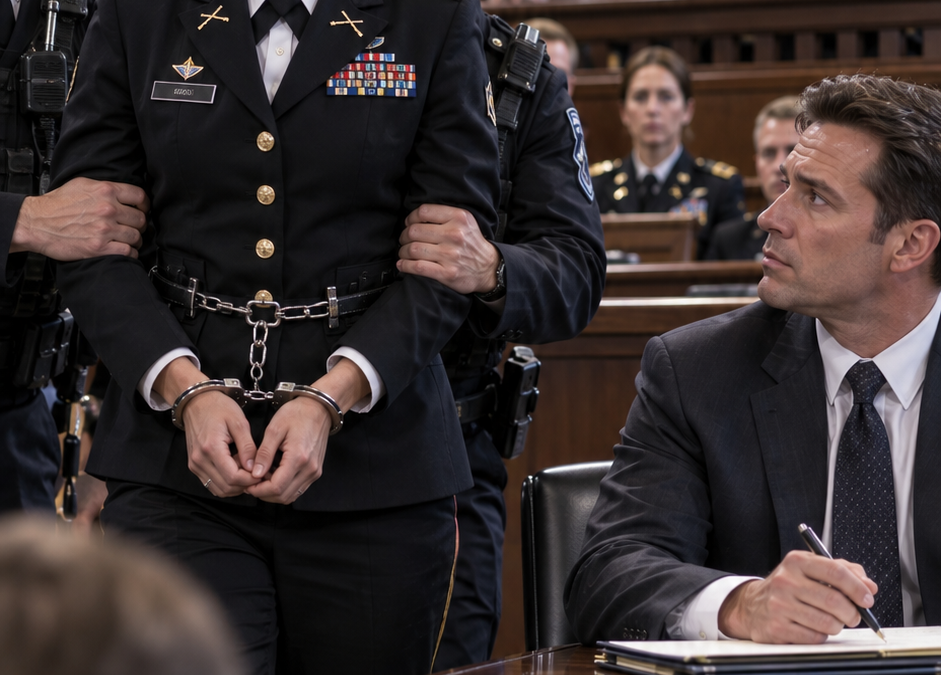
𝗣𝗔𝗥𝗧 𝟮
The clerk began reading the charges.
Failure to follow operational instructions.
Unauthorized departure from an assigned communications position.
Improper possession and handling of protected digital material.
Negligent decisions associated with the presumed deaths of three United States service members.
Presumed.
That word mattered.
Almost nobody used it anymore.
News anchors said dead.
Commentators said killed.
My father had said lost.
The investigation had used the colder phrase: unrecovered personnel, survival unlikely.
But the court still had to say presumed.
I held on to that word.
Behind me, someone whispered, “She left them.”
Another voice answered, “My brother trained with those guys.”
A third muttered, “She shouldn’t still be wearing that uniform.”
Judge Harrison struck the bench.
“That is enough.”
Silence returned.
I kept my eyes on the table.
I had heard worse.
People had stood outside military facilities with signs bearing my photograph.
Television hosts who had never read an operational order had spent entire segments explaining what courage should have looked like at 0217 local time.
A retired official demanded that I be discharged before the investigation ended.
Someone mailed a letter to my apartment containing only five words.
You left them there to die.
I kept that one.
Not because I wanted to punish myself.
Because I needed to remember what silence cost.
My father had gone on television during the second week of the investigation.
He sat beneath two American flags and looked directly into the camera.
“If my own daughter failed her duty, then she must answer for it.”
The clip played for days.
People called him honorable.
Principled.
Courageous.
A father placing duty above blood.
I had watched that interview alone in my apartment.
When he finished, I turned off the television.
Then I sat in darkness and whispered to the blank screen.
“You know what happened.”
That was the part I could never forgive through logic.
Arthur might not have known everything.
But he knew enough.
He knew the official story was incomplete.
He knew what had been sealed.
He knew who controlled access.
And still he let the country build a version of me that he understood was missing its most important piece.
Judge Harrison looked toward Colonel Rebecca Holt.
“Government may proceed.”
Holt stood.
She was excellent.
I had never blamed her for that.
Prosecutors are supposed to use the evidence they have.
My anger belonged elsewhere.
“Twelve weeks ago,” she began, “an American special operations team entered a restricted area under a classified mission authority.”
A map appeared on the courtroom screen.
Several sections were redacted.
“The mission had clear instructions.”
She faced the panel.
“Captain Elena Vance had a defined role. Maintain communications. Remain at the assigned relay position. Await extraction.”
Another image appeared.
A timeline.
“At 0217 local time, Captain Vance left her position.”
Holt paused.
“Minutes later, communications degraded.”
Another document.
“Enemy movement was detected.”
Another.
“Three service members became unreachable.”
Behind me, fabric moved.
I did not need to turn around.
Sarah Miller sat in the first row holding a folded American flag.
Her husband, Sergeant Cole Miller, was one of the three men.
For twelve weeks, she had refused every interview.
She had never attacked me publicly.
Never defended me either.
The first time we crossed paths after the operation, I tried to speak.
She looked straight through me.
That hurt more than the protest signs.
Strangers were angry at a story.
Sarah was grieving a husband.
Colonel Holt continued.
“By sunrise, Captain Vance was located several miles from her assigned position.”
The panel watched me.
“She possessed protected digital information not listed on her authorized equipment manifest.”
Holt let that settle.
“Three soldiers disappeared.”
Then she looked directly at me.
“Captain Vance survived.”
That sentence was designed to hurt.
It did.
Not because it was unfair.
Because survival often feels incriminating when other people do not come home beside you.
I remembered sunrise.
The blood dried into the fabric beneath my body armor.
The mud inside my boots.
My hands shaking only after I realized nobody was shooting at me anymore.
A helicopter crew pulling me aboard.
Someone asking where the rest of the team was.
Me answering with the only words I could safely give.
Not yet.
Not yet.
Not yet.
Holt faced the panel again.
“The government will show that Captain Vance substituted her personal judgment for lawful orders and that those choices contributed directly to catastrophic consequences.”
She returned to the prosecution table.
Judge Harrison looked toward Daniel.
“Defense opening.”
Daniel stood.
I knew his prepared argument.
Incomplete records.
Conflicting communications.
Restricted intelligence.
Unresolved chain-of-command questions.
Reasonable doubt.
It was good.
It was not enough.
As he collected his notes, I leaned toward him.
“Ask why the satellite record begins at 0216.”
He froze.
“What?”
“The government timeline starts at 0217.”
“I know.”
“The satellite record starts one minute earlier.”
Daniel frowned.
“Why does that matter?”
I looked toward the evidence screen.
“Ask.”
“Elena—”
“Please.”
Something in my voice stopped him.
For six weeks I had given him almost nothing he could not discover independently.
This was different.
Daniel turned toward Judge Harrison.
“Your Honor, before my opening, defense requests clarification regarding the operational timeline.”
Holt stood immediately.
“Objection.”
Judge Harrison looked over his glasses.
“On what basis?”
Daniel held up a document.
“The government repeatedly identifies 0217 as the decisive point at which Captain Vance left her communications position.”
“That is correct,” Holt said.
“Yet the associated satellite activity begins at 0216.”
The courtroom shifted.
Not dramatically.
Just enough.
One missing minute sounds insignificant until an entire accusation depends on what happened immediately afterward.
Judge Harrison looked toward the display.
“Colonel Holt?”
“That record requires classified context.”
Daniel nodded.
“Then the context appears relevant.”
Holt’s expression tightened.
Arthur’s did too.
Barely.
Most people would not have noticed.
I had spent my childhood watching my father across dinner tables, ceremonies, hospitals, and airport terminals.
I knew the muscle that tightened near his jaw when he realized a situation was moving somewhere he did not control.
Judge Harrison studied the document.
“Both parties will provide complete explanations regarding the temporal discrepancy.”
Holt tried again.
“Your Honor, portions of the source material—”
“Can be reviewed in camera if necessary.”
He looked toward the prosecution.
“But the court will not accept a timeline whose first critical minute cannot be explained.”
For the first time in twelve weeks, the story moved.
Only an inch.
But it moved.
During lunch recess, reporters surrounded the courthouse entrance.
“Captain Vance, did you abandon the team?”
“Captain, what happened at 0216?”
“Did General Vance interfere with the investigation?”
“Are you accusing your father of suppressing evidence?”
Military police moved me through the crowd.
I said nothing.
Across the corridor, Arthur stood with aides around him.
He watched me.
I looked back.
Daniel noticed.
“He wants you to react.”
“I know.”
“Why?”
“Because anger makes people careless.”
He looked at me strangely.
“You talk like this entire trial is an operation.”
I turned toward the hallway window.
“No.”
Outside, Washington traffic moved beneath a gray afternoon sky.
“I prepared for the truth.”
The afternoon witnesses made me look worse.
An investigator described my communications post.
A signals specialist confirmed I had left it.
An operations officer testified that no written order authorized my movement.
Maps appeared.
Routes.
Time stamps.
Radio logs.
Each fact was technically accurate.
Together, they formed a lie.
That is what frightened me most about institutional failure.
The most dangerous falsehoods are not built from fabricated evidence.
They are built from selected truth.
Colonel Holt displayed a communication report.
“This confirms Captain Vance departed the assigned relay point contrary to operational instructions.”
Daniel rose.
“Who created the report?”
“Operational review personnel.”
“Who approved it?”
Holt hesitated.
“Command authority.”
“Specifically?”
Arthur’s counsel stood.
“Objection. Argumentative and outside—”
Judge Harrison lifted one hand.
“Answer the question.”
Holt looked down at the report.
“General Arthur Vance.”
The courtroom turned toward my father.
He remained still.
Daniel continued.
“Was the full satellite record attached to this review?”
“No.”
“Was it available?”
Holt paused.
“Yes.”
“Why was it omitted?”
“Classification restrictions.”
“And who held release authority over that material?”
No one needed to look toward Arthur this time.
The answer already existed in the room.
“General Vance’s command.”
Judge Harrison leaned back.
Arthur finally spoke.
“My responsibility was to preserve operational security.”
His voice was calm.
Perfectly reasonable.
I looked at him.
He did not look back.
That evening, Daniel and I worked in a secure conference room until after midnight.
He had folders across the entire table.
I sat near the window with untouched coffee cooling beside me.
He read silently for almost twenty minutes.
Then stopped.
“Elena.”
I looked up.
His expression had changed.
He pushed a document toward me.
I did not need to read it.
I knew exactly which one he had found.
“The evacuation route.”
I said nothing.
Daniel stared.
“You knew where they were.”
“Yes.”
“You left the communications post because you were moving toward them.”
“Yes.”
“The report says you moved away from the designated extraction corridor.”
“The designated corridor was compromised.”
“How did you know?”
“The communications pattern changed.”
“That’s not enough.”
“It was when paired with what happened at 0216.”
Daniel looked down.
The satellite record.
A narrow window of movement.
A signal anomaly.
A transmission that should not have existed on the friendly channel.
He looked back at me.
“You believed the network had been manipulated.”
“I believed someone was using our communication architecture to locate the team.”
“And instead of calling command—”
“I stopped transmitting.”
Daniel pushed himself away from the table.
“Jesus Christ.”
“I couldn’t know which part was compromised.”
“You left alone.”
“Yes.”
“You had rescue coordinates on protected storage.”
“Yes.”
“That’s the digital material they charged you with mishandling.”
“Yes.”
His chair scraped backward.
“Elena, why didn’t you tell me this six weeks ago?”
I looked at him.
“Because six weeks ago, the recovery site was still active.”
He stopped.
I saw understanding arrive slowly.
Then all at once.
“The three men.”
I said nothing.
Daniel stared at me.
“They weren’t confirmed dead.”
“No.”
“Were they alive?”
My throat tightened.
I had imagined this moment repeatedly.
The first time I could tell someone who had spent weeks believing I might be guilty.
“Yes.”
Daniel sat down hard.
For several seconds, he simply stared at the table.
“All three?”
“Yes.”
His face changed.
Not joy yet.
Shock.
“How?”
I finally gave him the part of the story I had carried alone.
The team had been compromised.
Not fully surrounded.
Not yet.
But their communications had become a beacon.
I recognized the pattern because intelligence training taught me to look for timing rather than content.
Someone was reacting too quickly to transmissions.
Every time our people spoke, enemy movement changed.
So I stopped answering.
I abandoned the relay position.
I carried the protected drive because it contained terrain overlays and emergency coordinates that could not safely move over the network.
I reached the team.
Cole Miller was wounded.
The other two men were exhausted and nearly out of options.
We moved toward a contingency location deliberately excluded from the primary operation file.
Not because I was improvising heroically.
Because contingency planning exists for exactly the moment when the primary plan becomes dangerous.
From there, I split off.
The team remained hidden.
I carried the compromised equipment away.
Enemy movement followed me.
That was why I was found miles from them.
That was why I survived alone.
That was why, when command demanded their location, I refused to broadcast it.
Daniel stared at me.
“You made yourself the decoy.”
“I made the equipment the decoy.”
“You were carrying it.”
I looked at him.
“Yes.”
He rubbed both hands over his face.
“And then you came home and let everybody call you a coward.”
“I came home and let three men remain invisible.”
“For twelve weeks?”
“They needed extraction through another channel.”
“And your father knew?”
The question hurt.
“He knew there was an unresolved compartment.”
“That isn’t what I asked.”
I looked toward the dark window.
“He knew enough to know the public story was incomplete.”
Daniel became very still.
“And he still approved the review.”
“Yes.”
“Why?”
“Ask him.”
The final hearing filled every seat.
By then, reporters were no longer asking whether I had abandoned the men.
They were asking why the court had been shown an incomplete record.
The difference was enormous.
Colonel Holt looked exhausted.
I almost felt sorry for her.
She had built a case from evidence someone else had curated.
Now every piece had to be reexamined.
Daniel presented the satellite record first.
Then the communications anomalies.
Then the emergency route.
Then medical extraction documentation filed under a compartment so restricted that even the original investigative team had never seen it.
Judge Harrison read each page carefully.
Arthur sat across from me.
His face had lost the absolute calm he wore on the first morning.
Not panic.
A general does not reach four stars without learning how to hide panic.
But certainty was gone.
Daniel stood.
“Defense calls Sergeant Cole Miller.”
For a second, nobody understood.
Sarah did.
She lifted her head.
The courtroom doors opened.
Three men walked inside.
The sound Sarah made is something I will remember longer than any verdict.
It wasn’t a scream.
It wasn’t a word.
It was the sound of grief realizing it had been wrong.
Her folded flag slipped from her hands.
Cole stopped.
He looked toward her.
“Sarah.”
She stood so quickly her chair struck the bench behind her.
For twelve weeks she had carried herself like someone who believed any additional movement might break what remained of her.
Now she ran.
Court security started forward.
Judge Harrison raised one hand.
“Let her through.”
Sarah reached Cole.
She touched his face first.
Both sides.
As if her hands needed proof.
Then his shoulders.
Then his chest.
Then she hit him.
Once.
Hard.
“You were dead.”
Cole caught her wrists.
“I know.”
“You were dead.”
“I know.”
Then she collapsed against him.
The courtroom disappeared for me.
The reporters.
The prosecution.
My father.
The charges.
All of it.
I watched Sarah hold her husband.
And finally, finally, I let myself breathe.
Daniel leaned toward me.
“You saved them.”
I shook my head.
“I brought them home.”
That distinction mattered.
Heroes act alone in stories.
Real survival is almost always collective.
Cole stayed alive because his teammates kept pressure on his wound.
The other men moved him.
I found them.
Someone elsewhere created the contingency route months earlier.
Another team eventually extracted them.
Medics stabilized them.
Intelligence officers kept the compartment sealed.
Dozens of people carried pieces of that survival.
I carried one.
Important.
Not solitary.
After Sarah returned to her seat, Cole testified.
His account destroyed the central accusation.
No abandonment.
No reckless desertion.
No unexplained protected material.
My movement had been directly connected to locating and shielding the team.
The three “dead” men had survived because their position remained undisclosed while the compromised network was isolated.
Judge Harrison asked one question after another.
Then he turned toward Arthur.
“General Vance.”
My father stood.
“Sir.”
“You approved an operational review that excluded compartmented information material to Captain Vance’s conduct.”
“Yes.”
“You also possessed authority over access to that information.”
“Yes.”
“Did you know the omission could materially alter how her actions were interpreted?”
A long silence.
“Yes.”
The courtroom reacted.
Judge Harrison struck the bench once.
“Quiet.”
Arthur remained standing.
“Why permit disciplinary findings to proceed?”
My father looked older than he had twelve weeks earlier.
“Because the compartment remained active.”
“That explains classification.”
“Yes, sir.”
“It does not fully explain the public characterization.”
Arthur did not answer immediately.
Judge Harrison waited.
Finally my father said, “No.”
That single word did more damage than any accusation Daniel could have made.
The formal findings came later.
The charges against me were dismissed.
Not reduced.
Not negotiated.
Dismissed.
The command review itself was referred for further investigation.
Judge Harrison made clear that operational security did not permit selective presentation of evidence in a way that transformed protected facts into misleading conclusions.
I listened.
I should have felt vindicated.
Instead, I watched Sarah holding Cole’s hand.
That was enough.
Outside, reporters formed a wall.
Microphones.
Cameras.
Questions shouted from every direction.
“Captain Vance, do you want an apology from the Army?”
“Did your father betray you?”
“Were you used as a scapegoat?”
“Do you intend to resign?”
“What should happen to General Vance?”
I stopped once.
Only once.
“I was never fighting for my reputation.”
The microphones pushed closer.
I looked toward the flag above the building.
“I was protecting people who could not safely speak for themselves.”
Then I walked away.
Arthur found me before I reached the vehicle.
No aides.
No lawyers.
No cameras close enough to hear.
For the first time that day, he looked like my father.
Not General Vance.
Not four stars.
Just Arthur.
“Elena.”
I stopped.
He struggled for words.
That was unusual.
“I should have believed you.”
I looked at him.
“Yes.”
His face tightened.
No anger.
The pain of hearing a simple truth without anywhere to hide from it.
“I thought protecting the institution meant protecting the operation.”
“You protected the image of the operation.”
He lowered his eyes.
“And I forgot the people inside it.”
“No.”
I wanted him to understand this precisely.
“You remembered the people inside it.”
He looked up.
“You just decided one of them could absorb the damage.”
His mouth opened.
Closed.
I had spent twelve weeks imagining everything I might say to him.
Most of it had been angrier.
The reality felt quieter.
“You knew the story was incomplete.”
“Yes.”
“You watched them call me a coward.”
He said nothing.
“You went on television.”
His eyes dropped.
“I believed I had to separate being your father from being responsible for the command.”
“And you separated the wrong thing.”
He looked at me.
I felt tears threatening for the first time since the hearing began.
“I did not need a general.”
My voice nearly broke.
“I needed my father to remember that his daughter had earned enough trust for one question.”
Arthur’s face changed.
“What question?”
“Is there something I don’t know?”
Silence.
“That was all.”
He looked toward the ground.
“I’m sorry.”
It was not enough.
But it was real.
I nodded once.
“That is something you’re going to have to live with.”
He accepted it.
No argument.
No appeal.
That mattered.
The morning after the verdict did not feel like victory.
I woke before dawn because my body had forgotten how to sleep normally.
For twelve weeks, every morning had begun with the possibility that another headline might appear before breakfast.
Now the headlines had changed.
MISUNDERSTOOD OFFICER CLEARED.
SECRET RESCUE REVEALED.
COMMAND QUESTIONS AFTER VANCE CASE COLLAPSES.
Some of the same television hosts who demanded my punishment now called my silence courageous.
I turned them off.
Public opinion had rotated so quickly that it almost offended me more than the hatred.
Yesterday I was a coward.
Today I was a hero.
I was neither version.
I was tired.
My phone filled with messages.
People who had disappeared when the investigation began suddenly remembered my number.
Former colleagues wrote things like, Knew there had to be more.
Most of them had not said that when it mattered.
I did not respond.
Daniel met me later at the defense building carrying two coffees.
He handed one over.
“Black.”
I looked at him.
“You remembered.”
“I spent six weeks watching you consume coffee as though sugar were classified information.”
I took a sip.
We walked together.
Something had changed in the hallways.
People no longer stared with suspicion.
Now they stared with uncertainty.
Sometimes admiration.
I disliked both.
Daniel noticed.
“You thought this would feel different.”
“Didn’t you?”
“Yes.”
He considered.
“I thought the truth coming out would fix something.”
“Nothing is fixed.”
He laughed softly.
“That may be the most Elena Vance answer I’ve heard.”
I stopped beside a window.
“The charges are gone. The three men are alive. Those things matter.”
“But?”
I looked down toward the street.
“But the people who believed I was guilty still believed it.”
Daniel leaned against the wall.
“They were working with incomplete information.”
“So were you.”
He went quiet.
“You defended me anyway.”
“That was my job.”
“No.”
I looked at him.
“You questioned the evidence.”
He frowned.
“That is also my job.”
“Exactly.”
The hardest part had never been that strangers hated me.
The hardest part was how few people asked whether the simple story might be wrong.
Later that week, I returned to the training facility.
The gates looked the same.
Concrete buildings.
Wind snapping the flags.
Young officers moving between classrooms.
But people noticed me.
A lieutenant approached near the field.
“Captain Vance?”
“Yes?”
He looked embarrassed.
“I wanted to say something.”
I waited.
“I judged you.”
I appreciated the directness.
“Most people did.”
“I repeated things.”
He swallowed.
“About you.”
I said nothing.
“I thought staying quiet was safer than questioning what command had already decided.”
That interested me.
“What changed?”
“The evidence.”
I shook my head.
He looked confused.
“The evidence changed what you believed.”
“Yes.”
“That is not the important part.”
“What is?”
“Whether next time you ask questions before somebody’s life is destroyed.”
The young officer looked down.
I softened slightly.
“Being wrong isn’t the worst thing you can be.”
His eyes returned to mine.
“Refusing to examine why you were wrong is worse.”
He nodded.
“Thank you.”
I walked away.
I did not need every person who had doubted me to apologize.
I needed the institution to become a little harder to fool with an incomplete story.
Three days later, Arthur requested a private meeting.
I stared at the message for almost ten minutes.
Daniel happened to be in the office.
“You going?”
“I don’t know.”
“You don’t owe him that.”
“I know.”
He waited.
I put my phone down.
“That’s probably why I should.”
Arthur chose a small conference room rather than his command office.
No flags.
No photographs with presidents.
No plaques.
No display of rank.
He was already there when I arrived.
No uniform jacket.
No medals.
White shirt.
Dark trousers.
For the first time in years, I saw how much gray had entered his hair.
He stood.
“Thank you for coming.”
“You asked.”
We sat.
For a while, neither of us spoke.
Then he said, “I spent my career believing leadership meant being willing to make decisions other people couldn’t.”
I listened.
“I believed doubt was something commanders processed privately.”
He rubbed his hands together.
“If subordinates saw uncertainty, they might lose confidence.”
“You taught me that.”
“I know.”
He looked down.
“And somewhere along the way, I confused appearing certain with being right.”
I felt no satisfaction.
Only exhaustion.
“When the preliminary reports arrived, I saw the same evidence everyone saw.”
“You saw the evidence your own system allowed them to see.”
He nodded.
“Yes.”
“You also knew the sealed compartment existed.”
“Yes.”
“You knew the review could not tell the full story.”
“Yes.”
“And you approved it.”
His jaw tightened.
“Yes.”
I waited.
Arthur finally looked at me.
“I told myself I was protecting the operation.”
“No.”
He accepted the interruption.
“I know.”
“What were you protecting?”
He took a long breath.
“The institution.”
I shook my head.
“The institution would have survived saying, ‘We cannot discuss all operational details.’”
He looked away.
“What you protected was certainty.”
That hurt him.
I could see it.
Good.
Some truths should.
“I thought if command appeared divided, the mission would become vulnerable.”
“And I became acceptable collateral.”
He closed his eyes.
“Yes.”
There it was.
Not a justification.
Admission.
I had spent months waiting for one.
It did not feel satisfying.
“I should have called you.”
“Yes.”
“I should have asked what I was missing.”
“Yes.”
“I should have trusted you.”
I looked away.
My throat closed.
He noticed.
“Elena.”
For twelve weeks, I had heard strangers tell me what kind of officer I was.
Coward.
Traitor.
Reckless.
Arrogant.
The words had hurt.
But none compared with this.
“I needed my father.”
My voice broke despite everything I did to stop it.
Arthur did not move.
“I watched you stand in front of the country and talk about me like I was an abstract case.”
He swallowed.
“You said family connections could not interfere with justice.”
“I believed—”
“I know what you believed.”
I looked at him.
“But I was your daughter before I was your scandal.”
His eyes filled.
I had almost never seen my father cry.
Not at funerals.
Not when his mother died.
Not when he returned from his longest deployment.
Now he looked down at his hands.
“I am sorry.”
Two words.
Small.
Late.
Necessary.
I nodded.
“Thank you for saying it.”
He looked up.
“That’s all?”
“For now.”
He seemed almost relieved by the boundary.
Maybe because it gave him something honest to work with.
Forgiveness was not an order I could obey.
A month later, Sarah Miller asked to meet me.
We chose a small gathering organized for the families involved in the operation.
No press.
No uniforms required.
Cole stood across the room speaking with Luke Harris and one of the other survivors.
He looked thinner than before the mission.
Alive nevertheless.
Sarah approached me slowly.
“I owe you an apology.”
“No.”
She frowned.
“I do.”
“You believed your husband was dead.”
“I blamed you.”
“You were grieving.”
“That doesn’t make everything okay.”
“No.”
I appreciated that she did not ask me to pretend otherwise.
Her eyes filled.
“When Cole walked through those courtroom doors, I was happier than I have ever been.”
She laughed once through tears.
“Then almost immediately, I felt guilty.”
“Why?”
“Because I remembered every terrible thing I thought about you.”
“Thinking something in pain is not the same as choosing what to do with it.”
“I wouldn’t look at you.”
“I remember.”
She winced.
“I’m sorry.”
This time I accepted it.
“Thank you.”
Sarah studied me.
“Why didn’t you hate us?”
I looked across the room at Cole.
Because I had asked myself that too.
“I think because I understood what everyone was reacting to.”
“What?”
“Loss.”
She nodded.
“Even your father?”
That answer came slower.
“No.”
Sarah waited.
“I understood him too.”
“Is that different?”
“Yes.”
“Why?”
“Because understanding somebody is not the same as excusing them.”
Cole approached later.
He held out his hand.
I took it.
“You saved my life.”
“I helped.”
“Elena.”
His tone stopped me.
“We were done.”
I looked at him.
“You came through that terrain alone. You found us. You got us moving.”
“You kept each other alive before I arrived.”
“Both can be true.”
I smiled faintly.
“That sounds suspiciously mature.”
“Nearly dying improved me.”
Sarah slapped his arm.
He laughed.
Then his expression became serious.
“You carried all of that after we disappeared.”
“I carried what I needed to.”
“You let them destroy you.”
“No.”
He frowned.
“They tried.”
I looked around the room.
“They didn’t get to decide who I was.”
That was something I had only recently begun to believe.
The investigation into command failures lasted months.
Procedures changed.
Operational reviews involving compartmented programs received additional independent oversight.
Legal offices were given clearer mechanisms for challenging evidence gaps caused by classification.
Public statements during unresolved investigations became more restricted.
None of that erased what happened to me.
That was not why it mattered.
Institutions rarely apologize well.
They repair through procedure.
Sometimes a better checklist is the closest thing someone else will receive to justice.
I accepted that.
One afternoon, months after the trial, I returned to the courtroom.
It was empty.
No reporters.
No security escort.
No restraints around my wrists.
I stood behind the defense table.
My fingers touched the polished wood.
I remembered the first day.
The whispers.
Sarah holding the folded flag.
My father sitting across from me in full uniform.
Daniel asking why I was not more frightened.
The timeline beginning at 0217.
One missing minute.
That minute had seemed almost laughably small.
Yet hidden inside it was the difference between abandonment and rescue.
Between guilt and sacrifice.
Between three dead men and three living ones.
The courtroom doors opened.
Daniel walked in.
“You know most people process trauma somewhere less theatrical.”
I smiled.
“You followed me.”
“I was curious.”
“About?”
He came to stand beside me.
“Whether you finally feel like you won.”
I looked toward the witness stand.
“No.”
He sighed.
“I knew you were going to say that.”
“Then why ask?”
“Hope.”
I laughed softly.
He leaned against the rail.
“Why doesn’t it feel like victory?”
I considered the question seriously.
“Because the truth didn’t arrive without damage.”
Daniel waited.
“My father lost something.”
“His reputation?”
“No.”
I shook my head.
“Certainty.”
“That might be healthy.”
“Maybe.”
I looked toward the gallery.
“Sarah lost twelve weeks with a husband she believed was dead.”
Daniel said nothing.
“I lost trust in people I thought would ask harder questions.”
“And?”
“I think a victory where everybody walks away untouched only exists in stories.”
Daniel smiled faintly.
“You know this is a story someone is going to tell for decades.”
“They’ll tell it badly.”
“They always do.”
I laughed.
Outside, the afternoon sun reflected off the courthouse steps.
People walked by without recognizing me.
I liked that.
For months, strangers had treated my name like public property.
Elena Vance.
The traitor.
The general’s daughter.
The disgraced captain.
The secret hero.
People always want a simple label.
A clean story.
I no longer did.
That evening, I went home and opened the drawer where I had kept copies of the case documents.
I placed the final folder inside.
Not hidden.
Not destroyed.
Finished.
On top of the cabinet sat a photograph taken at the family gathering.
Cole.
Sarah.
Luke.
The third survivor.
Their families.
Everyone alive.
My phone buzzed.
A message from Arthur.
I know I cannot repair what I did by saying I am sorry.
I read the sentence twice.
Another appeared.
But I am trying to become someone you can trust again.
For several minutes, I did not answer.
Outside my apartment, Washington moved as though none of this had happened.
Cars stopped at lights.
People carried groceries.
Someone walked a dog along the sidewalk.
Life is indifferent that way.
During the trial, I had sometimes resented it.
How could the city keep functioning while my entire identity was being dismantled on television?
Now the ordinary noise comforted me.
The world did not revolve around my pain.
That meant eventually I could step outside it.
I typed two words to my father.
Keep trying.
Then I set down the phone.
The sky beyond the window had turned orange.
It reminded me of the morning I was extracted.
I could still remember the rotor wash tearing at my clothes.
The medic kneeling beside me.
Someone shouting questions I could barely hear.
Where is the team?
Why did you leave the relay?
What happened?
I had looked back toward the mountains where three men were still hidden.
Alive.
Invisible.
Depending on me not to make them easier to find.
So I said nothing useful.
That silence followed me home.
Into interviews.
Into investigations.
Into court.
Into every night when I wanted to call Sarah and tell her Cole was still fighting.
Into every moment when my father appeared on television and I wanted to scream that he knew better.
Into every headline.
Every whisper.
Every person who looked at me as though I had abandoned men I had nearly died trying to protect.
People think courage is loud.
Sometimes it is.
Sometimes courage is running toward gunfire.
Sometimes it is dragging someone out of danger.
Sometimes it is standing in front of a judge and telling the truth when nobody wants it.
But sometimes courage looks like silence.
Ugly, lonely silence.
Silence that costs you your reputation.
Silence that makes people hate you.
Silence that even the people you love misinterpret.
I would never romanticize it.
There were nights I almost broke.
Nights I sat on my kitchen floor because the apartment felt too empty to stand inside.
Nights I replayed my father’s interview and wondered whether duty was simply a word powerful people used when they wanted someone else to absorb pain.
Nights I thought about Sarah holding that folded flag.
I came close more than once to telling her.
Just one sentence.
He’s alive.
But one sentence becomes another.
Where?
How?
Have you seen him?
When is he coming home?
Who knows?
And somewhere between love and relief, information escapes.
I could not risk it.
Not while the route remained vulnerable.
Not while the operation remained active.
So I became the woman everyone believed had walked away.
And I waited.
The strangest thing was that when the truth finally came out, the moment I had imagined most was not Judge Harrison dismissing the charges.
It was not my father admitting he was wrong.
It was not reporters changing their language.
It was Sarah dropping that flag.
Cole walking through the doors.
Her hands touching his face.
That was when I knew the twelve weeks had been worth surviving.
Not because suffering automatically becomes meaningful when the ending is good.
That would be too simple.
It was worth it because the objective had always been clear.
Bring them home.
Everything else had been noise.
Months later, I returned once more to the training center.
The same young lieutenant I had spoken with before was instructing a group of officers.
He saw me and nodded.
I nodded back.
No conversation.
He did not need another lesson.
Neither did I.
I walked past the field and stopped near the flagpole.
Wind moved through the fabric overhead.
For most of my life, I had believed duty meant endurance.
My father taught me that.
Hold the line.
Carry the weight.
Do not complain about the cost if the mission requires it.
I still believed some of that.
But the trial had taught me something Arthur never had.
Duty without humility becomes dangerous.
So does loyalty.
So does certainty.
People who believe they are protecting institutions can destroy the people those institutions exist to serve.
People who believe they already know the truth stop looking for missing minutes.
And sometimes the person everyone condemns is simply the person carrying information nobody else is allowed to see yet.
I looked up at the flag.
I did not feel triumphant.
I felt clear.
There was a difference.
I had not won because the court finally believed me.
I had not won because my father apologized.
I had not won because strangers rewrote their opinions.
I had survived something that taught me how little public judgment had to do with private truth.
That knowledge was not comforting.
But it was freeing.
I would continue serving.
That surprised some people.
Daniel asked once why I did not walk away.
“After everything they did to you?”
He meant the institution.
I understood.
My answer was simple.
“Because Cole is alive.”
Daniel looked confused.
“So?”
“So the institution also contains the medic who kept him stable. The pilot who flew the extraction. The analyst who protected the compartment. The judge who demanded the missing record. You.”
I shrugged.
“Institutions are people.”
“And your father?”
“He is one of them too.”
Daniel smiled sadly.
“You still believe in it.”
“No.”
He waited.
“I believe it can be better than what it was.”
That was harder.
Belief without disappointment is easy.
Belief after disappointment requires choice.
Years from now, people might remember the case by the dramatic parts.
The four-star general.
The accused daughter.
The courtroom.
The missing satellite minute.
The doors opening.
Three soldiers walking in alive.
Those things make a good story.
But when I remember it, I remember smaller things.
The metal clasp of my restraints touching the chair.
Sarah’s fingers crushing the folded flag.
Daniel asking me over and over what I was not telling him.
My father’s jaw tightening when 0216 appeared on the screen.
The sound Sarah made when Cole said her name.
Arthur sitting without his uniform jacket and finally looking like a man instead of an institution.
And two words on my phone.
Keep trying.
Healing rarely arrives as a verdict.
It arrives through small permissions.
A conversation you are finally ready to have.
An apology you are not yet ready to accept completely.
A photograph you can look at without remembering who everyone thought was dead.
A morning when you wake up and realize you did not dream about the courtroom.
My father and I never returned to what we were.
I stopped wanting that.
What we had before depended partly on assumptions neither of us had examined.
He believed that because I was strong, I could endure whatever duty required.
I believed that because he loved me, he would always recognize when duty was being used to hurt me.
We were both wrong.
What we built afterward was smaller.
Slower.
More honest.
Sometimes he called.
Sometimes I answered.
Sometimes I did not.
He never complained.
On my birthday that year, a package arrived.
No grand gift.
No military memorabilia.
Inside was an old photograph.
I was eight years old.
Missing one front tooth.
Sitting on a bicycle.
Arthur stood behind me with one hand beneath the seat.
On the back, he had written a sentence.
I should have known you could balance without me.
I sat at my kitchen table for a long time holding that photograph.
Then I cried harder than I had cried during the entire trial.
Not because the sentence fixed anything.
Because for once, my father understood the wound.
He had spent my childhood preparing me to stand on my own.
Then, when I did exactly that, he mistook independence for disobedience.
I called him that evening.
He answered on the first ring.
“Hi.”
“Hi.”
Silence.
Then I said, “I got the picture.”
“I wasn’t sure if I should send it.”
“I’m glad you did.”
Another silence.
“Elena?”
“Yes?”
“I’m still trying.”
I looked toward the photograph.
“I know.”
That was enough.
Some stories end with vindication.
Mine did not.
Vindication happened in the middle.
The charges disappeared.
The truth became public.
The men came home.
Those were events.
The ending came later.
Quietly.
It came when I understood that I did not need the people who condemned me to understand every choice I had made.
I did not need strangers to erase their old headlines.
I did not need my father’s apology to become a different version of the past.
I needed only to know why I had remained silent.
Three men had been alive.
Three families eventually got them back.
And when the entire country demanded I defend myself, I chose to protect them first.
I would make that choice again.
Not because I enjoyed the cost.
Not because martyrdom is noble.
Not because being misunderstood somehow made me stronger.
I would make it again because duty, at its best, is not loyalty to appearances.
It is loyalty to people.
That was what my father had forgotten.
It was what the court eventually discovered.
It was what I had known from the moment I walked away from that communications post at 0217.
I was never abandoning my team.
I was going to find them.
And long before the courtroom finally understood the difference, I did.
Have you finished reading the story and want to read it again?
The Day My Four-Star Father Put Me on Trial, the Truth Was Still Locked Behind One Missing Minute
My father knew the courtroom believed I had abandoned three men.
He also knew there was one minute missing from the story everyone had been told.
And for twelve weeks, I let the world hate me because telling the truth too soon could have killed the people I was accused of leaving behind.
“Keep smiling, General.”
I said it quietly as the military police escorted me toward the defense table.
The restraints around my wrists were unnecessary.
Everyone in that courtroom knew it.
I was a commissioned officer, not an escape risk. I had reported voluntarily to every hearing, answered every summons, and spent the previous three months living under restrictions so severe that my daily movements could have been plotted on graph paper.
But someone had decided that optics mattered.
Captain Elena Vance needed to look dangerous.
Or disgraced.
Maybe both.
So I entered the courtroom with steel around my wrists while cameras waited outside and reporters filled the rear benches.
My father sat across the room in dress uniform.
General Arthur Vance.
Four stars.
Thirty-six years of service.
Enough ribbons across his chest that under the courtroom lights they seemed to create their own glare.
To most people in that room, he represented everything I had betrayed.
Duty.
Discipline.
Honor.
Country.
To me, he was still the man who had taught me to ride a bicycle by running behind me with one hand on the seat.
The man who had missed half my birthdays because some crisis had taken him overseas.
The man who had taught me that a Vance never asked someone else to carry a burden she could carry herself.
That lesson had become cruelly relevant.
Arthur’s eyes met mine.
Just for a second, something changed in his face.
Not guilt.
Not yet.
Fear.
Then the general returned.
His jaw hardened.
His shoulders settled.
His expression became the one millions of Americans had already seen on television.
Calm.
Principled.
Unmoved by personal attachment.
“This room already knows what you are,” he said.
His voice never rose.
That made it worse.
I sat down.
The metal clasp on the restraint belt touched the chair with a quiet tap.
Major Daniel Reynolds leaned toward me.
“Please stop provoking him.”
I placed my hands on the table.
“I’m not provoking him.”
“You just told a four-star general to keep smiling.”
“He happens to be my father.”
“That somehow makes it worse.”
I looked toward Arthur.
“No. It makes it accurate.”
Reynolds exhaled through his nose.
He had represented me for six weeks.
In that time, he had learned that I rarely answered the question underneath the question.
I wasn’t trying to frustrate him.
I was trying to protect him.
There were things Daniel did not know.
Things I could not tell him yet.
That was the most difficult part of being defended by a good man.
He thought my silence meant I did not trust him.
The truth was that I trusted him enough not to make him responsible for information that could still get people killed.
He opened the legal pad in front of him.
“Last chance before the judge comes in. Anything you haven’t told me?”
“Yes.”
He stared at me.
I looked forward.
“When can we force them to open the sealed operational record?”
His shoulders dropped.
“The same answer I gave you yesterday.”
“And the day before.”
“And every day for three weeks.”
“When the judge authorizes it.”
I nodded.
Daniel watched me.
“You always do that.”
“Do what?”
“Ask me a question you already know the answer to.”
“I like consistency.”
“You terrify me.”
“That makes two of us.”
He almost smiled.
Then the courtroom doors opened.
“All rise.”
Everyone stood.
Judge Marcus Harrison entered.
He was a retired Army attorney whose reputation had been built less on aggression than on patience.
People who lied to him usually destroyed themselves because he gave them enough silence to continue talking.
I respected that.
“Be seated.”
The room settled.
Judge Harrison surveyed the gallery.
Then the prosecution.
Then me.
Then my father.
“This proceeding will not become a public performance.”
His gaze moved toward the reporters.
“Nor will it become a family dispute conducted under military jurisdiction.”
Daniel leaned toward me.
“That one was for you.”
“If it was, he should have used my name.”
Daniel closed his eyes briefly.
The clerk began reading the charges.
Failure to follow operational instructions.
Unauthorized departure from an assigned communications position.
Improper possession and handling of protected digital material.
Negligent decisions associated with the presumed deaths of three United States service members.
Presumed.
That word mattered.
Almost nobody used it anymore.
News anchors said dead.
Commentators said killed.
My father had said lost.
The investigation had used the colder phrase: unrecovered personnel, survival unlikely.
But the court still had to say presumed.
I held on to that word.
Behind me, someone whispered, “She left them.”
Another voice answered, “My brother trained with those guys.”
A third muttered, “She shouldn’t still be wearing that uniform.”
Judge Harrison struck the bench.
“That is enough.”
Silence returned.
I kept my eyes on the table.
I had heard worse.
People had stood outside military facilities with signs bearing my photograph.
Television hosts who had never read an operational order had spent entire segments explaining what courage should have looked like at 0217 local time.
A retired official demanded that I be discharged before the investigation ended.
Someone mailed a letter to my apartment containing only five words.
You left them there to die.
I kept that one.
Not because I wanted to punish myself.
Because I needed to remember what silence cost.
My father had gone on television during the second week of the investigation.
He sat beneath two American flags and looked directly into the camera.
“If my own daughter failed her duty, then she must answer for it.”
The clip played for days.
People called him honorable.
Principled.
Courageous.
A father placing duty above blood.
I had watched that interview alone in my apartment.
When he finished, I turned off the television.
Then I sat in darkness and whispered to the blank screen.
“You know what happened.”
That was the part I could never forgive through logic.
Arthur might not have known everything.
But he knew enough.
He knew the official story was incomplete.
He knew what had been sealed.
He knew who controlled access.
And still he let the country build a version of me that he understood was missing its most important piece.
Judge Harrison looked toward Colonel Rebecca Holt.
“Government may proceed.”
Holt stood.
She was excellent.
I had never blamed her for that.
Prosecutors are supposed to use the evidence they have.
My anger belonged elsewhere.
“Twelve weeks ago,” she began, “an American special operations team entered a restricted area under a classified mission authority.”
A map appeared on the courtroom screen.
Several sections were redacted.
“The mission had clear instructions.”
She faced the panel.
“Captain Elena Vance had a defined role. Maintain communications. Remain at the assigned relay position. Await extraction.”
Another image appeared.
A timeline.
“At 0217 local time, Captain Vance left her position.”
Holt paused.
“Minutes later, communications degraded.”
Another document.
“Enemy movement was detected.”
Another.
“Three service members became unreachable.”
Behind me, fabric moved.
I did not need to turn around.
Sarah Miller sat in the first row holding a folded American flag.
Her husband, Sergeant Cole Miller, was one of the three men.
For twelve weeks, she had refused every interview.
She had never attacked me publicly.
Never defended me either.
The first time we crossed paths after the operation, I tried to speak.
She looked straight through me.
That hurt more than the protest signs.
Strangers were angry at a story.
Sarah was grieving a husband.
Colonel Holt continued.
“By sunrise, Captain Vance was located several miles from her assigned position.”
The panel watched me.
“She possessed protected digital information not listed on her authorized equipment manifest.”
Holt let that settle.
“Three soldiers disappeared.”
Then she looked directly at me.
“Captain Vance survived.”
That sentence was designed to hurt.
It did.
Not because it was unfair.
Because survival often feels incriminating when other people do not come home beside you.
I remembered sunrise.
The blood dried into the fabric beneath my body armor.
The mud inside my boots.
My hands shaking only after I realized nobody was shooting at me anymore.
A helicopter crew pulling me aboard.
Someone asking where the rest of the team was.
Me answering with the only words I could safely give.
Not yet.
Not yet.
Not yet.
Holt faced the panel again.
“The government will show that Captain Vance substituted her personal judgment for lawful orders and that those choices contributed directly to catastrophic consequences.”
She returned to the prosecution table.
Judge Harrison looked toward Daniel.
“Defense opening.”
Daniel stood.
I knew his prepared argument.
Incomplete records.
Conflicting communications.
Restricted intelligence.
Unresolved chain-of-command questions.
Reasonable doubt.
It was good.
It was not enough.
As he collected his notes, I leaned toward him.
“Ask why the satellite record begins at 0216.”
He froze.
“What?”
“The government timeline starts at 0217.”
“I know.”
“The satellite record starts one minute earlier.”
Daniel frowned.
“Why does that matter?”
I looked toward the evidence screen.
“Ask.”
“Elena—”
“Please.”
Something in my voice stopped him.
For six weeks I had given him almost nothing he could not discover independently.
This was different.
Daniel turned toward Judge Harrison.
“Your Honor, before my opening, defense requests clarification regarding the operational timeline.”
Holt stood immediately.
“Objection.”
Judge Harrison looked over his glasses.
“On what basis?”
Daniel held up a document.
“The government repeatedly identifies 0217 as the decisive point at which Captain Vance left her communications position.”
“That is correct,” Holt said.
“Yet the associated satellite activity begins at 0216.”
The courtroom shifted.
Not dramatically.
Just enough.
One missing minute sounds insignificant until an entire accusation depends on what happened immediately afterward.
Judge Harrison looked toward the display.
“Colonel Holt?”
“That record requires classified context.”
Daniel nodded.
“Then the context appears relevant.”
Holt’s expression tightened.
Arthur’s did too.
Barely.
Most people would not have noticed.
I had spent my childhood watching my father across dinner tables, ceremonies, hospitals, and airport terminals.
I knew the muscle that tightened near his jaw when he realized a situation was moving somewhere he did not control.
Judge Harrison studied the document.
“Both parties will provide complete explanations regarding the temporal discrepancy.”
Holt tried again.
“Your Honor, portions of the source material—”
“Can be reviewed in camera if necessary.”
He looked toward the prosecution.
“But the court will not accept a timeline whose first critical minute cannot be explained.”
For the first time in twelve weeks, the story moved.
Only an inch.
But it moved.
During lunch recess, reporters surrounded the courthouse entrance.
“Captain Vance, did you abandon the team?”
“Captain, what happened at 0216?”
“Did General Vance interfere with the investigation?”
“Are you accusing your father of suppressing evidence?”
Military police moved me through the crowd.
I said nothing.
Across the corridor, Arthur stood with aides around him.
He watched me.
I looked back.
Daniel noticed.
“He wants you to react.”
“I know.”
“Why?”
“Because anger makes people careless.”
He looked at me strangely.
“You talk like this entire trial is an operation.”
I turned toward the hallway window.
“No.”
Outside, Washington traffic moved beneath a gray afternoon sky.
“I prepared for the truth.”
The afternoon witnesses made me look worse.
An investigator described my communications post.
A signals specialist confirmed I had left it.
An operations officer testified that no written order authorized my movement.
Maps appeared.
Routes.
Time stamps.
Radio logs.
Each fact was technically accurate.
Together, they formed a lie.
That is what frightened me most about institutional failure.
The most dangerous falsehoods are not built from fabricated evidence.
They are built from selected truth.
Colonel Holt displayed a communication report.
“This confirms Captain Vance departed the assigned relay point contrary to operational instructions.”
Daniel rose.
“Who created the report?”
“Operational review personnel.”
“Who approved it?”
Holt hesitated.
“Command authority.”
“Specifically?”
Arthur’s counsel stood.
“Objection. Argumentative and outside—”
Judge Harrison lifted one hand.
“Answer the question.”
Holt looked down at the report.
“General Arthur Vance.”
The courtroom turned toward my father.
He remained still.
Daniel continued.
“Was the full satellite record attached to this review?”
“No.”
“Was it available?”
Holt paused.
“Yes.”
“Why was it omitted?”
“Classification restrictions.”
“And who held release authority over that material?”
No one needed to look toward Arthur this time.
The answer already existed in the room.
“General Vance’s command.”
Judge Harrison leaned back.
Arthur finally spoke.
“My responsibility was to preserve operational security.”
His voice was calm.
Perfectly reasonable.
I looked at him.
He did not look back.
That evening, Daniel and I worked in a secure conference room until after midnight.
He had folders across the entire table.
I sat near the window with untouched coffee cooling beside me.
He read silently for almost twenty minutes.
Then stopped.
“Elena.”
I looked up.
His expression had changed.
He pushed a document toward me.
I did not need to read it.
I knew exactly which one he had found.
“The evacuation route.”
I said nothing.
Daniel stared.
“You knew where they were.”
“Yes.”
“You left the communications post because you were moving toward them.”
“Yes.”
“The report says you moved away from the designated extraction corridor.”
“The designated corridor was compromised.”
“How did you know?”
“The communications pattern changed.”
“That’s not enough.”
“It was when paired with what happened at 0216.”
Daniel looked down.
The satellite record.
A narrow window of movement.
A signal anomaly.
A transmission that should not have existed on the friendly channel.
He looked back at me.
“You believed the network had been manipulated.”
“I believed someone was using our communication architecture to locate the team.”
“And instead of calling command—”
“I stopped transmitting.”
Daniel pushed himself away from the table.
“Jesus Christ.”
“I couldn’t know which part was compromised.”
“You left alone.”
“Yes.”
“You had rescue coordinates on protected storage.”
“Yes.”
“That’s the digital material they charged you with mishandling.”
“Yes.”
His chair scraped backward.
“Elena, why didn’t you tell me this six weeks ago?”
I looked at him.
“Because six weeks ago, the recovery site was still active.”
He stopped.
I saw understanding arrive slowly.
Then all at once.
“The three men.”
I said nothing.
Daniel stared at me.
“They weren’t confirmed dead.”
“No.”
“Were they alive?”
My throat tightened.
I had imagined this moment repeatedly.
The first time I could tell someone who had spent weeks believing I might be guilty.
“Yes.”
Daniel sat down hard.
For several seconds, he simply stared at the table.
“All three?”
“Yes.”
His face changed.
Not joy yet.
Shock.
“How?”
I finally gave him the part of the story I had carried alone.
The team had been compromised.
Not fully surrounded.
Not yet.
But their communications had become a beacon.
I recognized the pattern because intelligence training taught me to look for timing rather than content.
Someone was reacting too quickly to transmissions.
Every time our people spoke, enemy movement changed.
So I stopped answering.
I abandoned the relay position.
I carried the protected drive because it contained terrain overlays and emergency coordinates that could not safely move over the network.
I reached the team.
Cole Miller was wounded.
The other two men were exhausted and nearly out of options.
We moved toward a contingency location deliberately excluded from the primary operation file.
Not because I was improvising heroically.
Because contingency planning exists for exactly the moment when the primary plan becomes dangerous.
From there, I split off.
The team remained hidden.
I carried the compromised equipment away.
Enemy movement followed me.
That was why I was found miles from them.
That was why I survived alone.
That was why, when command demanded their location, I refused to broadcast it.
Daniel stared at me.
“You made yourself the decoy.”
“I made the equipment the decoy.”
“You were carrying it.”
I looked at him.
“Yes.”
He rubbed both hands over his face.
“And then you came home and let everybody call you a coward.”
“I came home and let three men remain invisible.”
“For twelve weeks?”
“They needed extraction through another channel.”
“And your father knew?”
The question hurt.
“He knew there was an unresolved compartment.”
“That isn’t what I asked.”
I looked toward the dark window.
“He knew enough to know the public story was incomplete.”
Daniel became very still.
“And he still approved the review.”
“Yes.”
“Why?”
“Ask him.”
The final hearing filled every seat.
By then, reporters were no longer asking whether I had abandoned the men.
They were asking why the court had been shown an incomplete record.
The difference was enormous.
Colonel Holt looked exhausted.
I almost felt sorry for her.
She had built a case from evidence someone else had curated.
Now every piece had to be reexamined.
Daniel presented the satellite record first.
Then the communications anomalies.
Then the emergency route.
Then medical extraction documentation filed under a compartment so restricted that even the original investigative team had never seen it.
Judge Harrison read each page carefully.
Arthur sat across from me.
His face had lost the absolute calm he wore on the first morning.
Not panic.
A general does not reach four stars without learning how to hide panic.
But certainty was gone.
Daniel stood.
“Defense calls Sergeant Cole Miller.”
For a second, nobody understood.
Sarah did.
She lifted her head.
The courtroom doors opened.
Three men walked inside.
The sound Sarah made is something I will remember longer than any verdict.
It wasn’t a scream.
It wasn’t a word.
It was the sound of grief realizing it had been wrong.
Her folded flag slipped from her hands.
Cole stopped.
He looked toward her.
“Sarah.”
She stood so quickly her chair struck the bench behind her.
For twelve weeks she had carried herself like someone who believed any additional movement might break what remained of her.
Now she ran.
Court security started forward.
Judge Harrison raised one hand.
“Let her through.”
Sarah reached Cole.
She touched his face first.
Both sides.
As if her hands needed proof.
Then his shoulders.
Then his chest.
Then she hit him.
Once.
Hard.
“You were dead.”
Cole caught her wrists.
“I know.”
“You were dead.”
“I know.”
Then she collapsed against him.
The courtroom disappeared for me.
The reporters.
The prosecution.
My father.
The charges.
All of it.
I watched Sarah hold her husband.
And finally, finally, I let myself breathe.
Daniel leaned toward me.
“You saved them.”
I shook my head.
“I brought them home.”
That distinction mattered.
Heroes act alone in stories.
Real survival is almost always collective.
Cole stayed alive because his teammates kept pressure on his wound.
The other men moved him.
I found them.
Someone elsewhere created the contingency route months earlier.
Another team eventually extracted them.
Medics stabilized them.
Intelligence officers kept the compartment sealed.
Dozens of people carried pieces of that survival.
I carried one.
Important.
Not solitary.
After Sarah returned to her seat, Cole testified.
His account destroyed the central accusation.
No abandonment.
No reckless desertion.
No unexplained protected material.
My movement had been directly connected to locating and shielding the team.
The three “dead” men had survived because their position remained undisclosed while the compromised network was isolated.
Judge Harrison asked one question after another.
Then he turned toward Arthur.
“General Vance.”
My father stood.
“Sir.”
“You approved an operational review that excluded compartmented information material to Captain Vance’s conduct.”
“Yes.”
“You also possessed authority over access to that information.”
“Yes.”
“Did you know the omission could materially alter how her actions were interpreted?”
A long silence.
“Yes.”
The courtroom reacted.
Judge Harrison struck the bench once.
“Quiet.”
Arthur remained standing.
“Why permit disciplinary findings to proceed?”
My father looked older than he had twelve weeks earlier.
“Because the compartment remained active.”
“That explains classification.”
“Yes, sir.”
“It does not fully explain the public characterization.”
Arthur did not answer immediately.
Judge Harrison waited.
Finally my father said, “No.”
That single word did more damage than any accusation Daniel could have made.
The formal findings came later.
The charges against me were dismissed.
Not reduced.
Not negotiated.
Dismissed.
The command review itself was referred for further investigation.
Judge Harrison made clear that operational security did not permit selective presentation of evidence in a way that transformed protected facts into misleading conclusions.
I listened.
I should have felt vindicated.
Instead, I watched Sarah holding Cole’s hand.
That was enough.
Outside, reporters formed a wall.
Microphones.
Cameras.
Questions shouted from every direction.
“Captain Vance, do you want an apology from the Army?”
“Did your father betray you?”
“Were you used as a scapegoat?”
“Do you intend to resign?”
“What should happen to General Vance?”
I stopped once.
Only once.
“I was never fighting for my reputation.”
The microphones pushed closer.
I looked toward the flag above the building.
“I was protecting people who could not safely speak for themselves.”
Then I walked away.
Arthur found me before I reached the vehicle.
No aides.
No lawyers.
No cameras close enough to hear.
For the first time that day, he looked like my father.
Not General Vance.
Not four stars.
Just Arthur.
“Elena.”
I stopped.
He struggled for words.
That was unusual.
“I should have believed you.”
I looked at him.
“Yes.”
His face tightened.
No anger.
The pain of hearing a simple truth without anywhere to hide from it.
“I thought protecting the institution meant protecting the operation.”
“You protected the image of the operation.”
He lowered his eyes.
“And I forgot the people inside it.”
“No.”
I wanted him to understand this precisely.
“You remembered the people inside it.”
He looked up.
“You just decided one of them could absorb the damage.”
His mouth opened.
Closed.
I had spent twelve weeks imagining everything I might say to him.
Most of it had been angrier.
The reality felt quieter.
“You knew the story was incomplete.”
“Yes.”
“You watched them call me a coward.”
He said nothing.
“You went on television.”
His eyes dropped.
“I believed I had to separate being your father from being responsible for the command.”
“And you separated the wrong thing.”
He looked at me.
I felt tears threatening for the first time since the hearing began.
“I did not need a general.”
My voice nearly broke.
“I needed my father to remember that his daughter had earned enough trust for one question.”
Arthur’s face changed.
“What question?”
“Is there something I don’t know?”
Silence.
“That was all.”
He looked toward the ground.
“I’m sorry.”
It was not enough.
But it was real.
I nodded once.
“That is something you’re going to have to live with.”
He accepted it.
No argument.
No appeal.
That mattered.
The morning after the verdict did not feel like victory.
I woke before dawn because my body had forgotten how to sleep normally.
For twelve weeks, every morning had begun with the possibility that another headline might appear before breakfast.
Now the headlines had changed.
MISUNDERSTOOD OFFICER CLEARED.
SECRET RESCUE REVEALED.
COMMAND QUESTIONS AFTER VANCE CASE COLLAPSES.
Some of the same television hosts who demanded my punishment now called my silence courageous.
I turned them off.
Public opinion had rotated so quickly that it almost offended me more than the hatred.
Yesterday I was a coward.
Today I was a hero.
I was neither version.
I was tired.
My phone filled with messages.
People who had disappeared when the investigation began suddenly remembered my number.
Former colleagues wrote things like, Knew there had to be more.
Most of them had not said that when it mattered.
I did not respond.
Daniel met me later at the defense building carrying two coffees.
He handed one over.
“Black.”
I looked at him.
“You remembered.”
“I spent six weeks watching you consume coffee as though sugar were classified information.”
I took a sip.
We walked together.
Something had changed in the hallways.
People no longer stared with suspicion.
Now they stared with uncertainty.
Sometimes admiration.
I disliked both.
Daniel noticed.
“You thought this would feel different.”
“Didn’t you?”
“Yes.”
He considered.
“I thought the truth coming out would fix something.”
“Nothing is fixed.”
He laughed softly.
“That may be the most Elena Vance answer I’ve heard.”
I stopped beside a window.
“The charges are gone. The three men are alive. Those things matter.”
“But?”
I looked down toward the street.
“But the people who believed I was guilty still believed it.”
Daniel leaned against the wall.
“They were working with incomplete information.”
“So were you.”
He went quiet.
“You defended me anyway.”
“That was my job.”
“No.”
I looked at him.
“You questioned the evidence.”
He frowned.
“That is also my job.”
“Exactly.”
The hardest part had never been that strangers hated me.
The hardest part was how few people asked whether the simple story might be wrong.
Later that week, I returned to the training facility.
The gates looked the same.
Concrete buildings.
Wind snapping the flags.
Young officers moving between classrooms.
But people noticed me.
A lieutenant approached near the field.
“Captain Vance?”
“Yes?”
He looked embarrassed.
“I wanted to say something.”
I waited.
“I judged you.”
I appreciated the directness.
“Most people did.”
“I repeated things.”
He swallowed.
“About you.”
I said nothing.
“I thought staying quiet was safer than questioning what command had already decided.”
That interested me.
“What changed?”
“The evidence.”
I shook my head.
He looked confused.
“The evidence changed what you believed.”
“Yes.”
“That is not the important part.”
“What is?”
“Whether next time you ask questions before somebody’s life is destroyed.”
The young officer looked down.
I softened slightly.
“Being wrong isn’t the worst thing you can be.”
His eyes returned to mine.
“Refusing to examine why you were wrong is worse.”
He nodded.
“Thank you.”
I walked away.
I did not need every person who had doubted me to apologize.
I needed the institution to become a little harder to fool with an incomplete story.
Three days later, Arthur requested a private meeting.
I stared at the message for almost ten minutes.
Daniel happened to be in the office.
“You going?”
“I don’t know.”
“You don’t owe him that.”
“I know.”
He waited.
I put my phone down.
“That’s probably why I should.”
Arthur chose a small conference room rather than his command office.
No flags.
No photographs with presidents.
No plaques.
No display of rank.
He was already there when I arrived.
No uniform jacket.
No medals.
White shirt.
Dark trousers.
For the first time in years, I saw how much gray had entered his hair.
He stood.
“Thank you for coming.”
“You asked.”
We sat.
For a while, neither of us spoke.
Then he said, “I spent my career believing leadership meant being willing to make decisions other people couldn’t.”
I listened.
“I believed doubt was something commanders processed privately.”
He rubbed his hands together.
“If subordinates saw uncertainty, they might lose confidence.”
“You taught me that.”
“I know.”
He looked down.
“And somewhere along the way, I confused appearing certain with being right.”
I felt no satisfaction.
Only exhaustion.
“When the preliminary reports arrived, I saw the same evidence everyone saw.”
“You saw the evidence your own system allowed them to see.”
He nodded.
“Yes.”
“You also knew the sealed compartment existed.”
“Yes.”
“You knew the review could not tell the full story.”
“Yes.”
“And you approved it.”
His jaw tightened.
“Yes.”
I waited.
Arthur finally looked at me.
“I told myself I was protecting the operation.”
“No.”
He accepted the interruption.
“I know.”
“What were you protecting?”
He took a long breath.
“The institution.”
I shook my head.
“The institution would have survived saying, ‘We cannot discuss all operational details.’”
He looked away.
“What you protected was certainty.”
That hurt him.
I could see it.
Good.
Some truths should.
“I thought if command appeared divided, the mission would become vulnerable.”
“And I became acceptable collateral.”
He closed his eyes.
“Yes.”
There it was.
Not a justification.
Admission.
I had spent months waiting for one.
It did not feel satisfying.
“I should have called you.”
“Yes.”
“I should have asked what I was missing.”
“Yes.”
“I should have trusted you.”
I looked away.
My throat closed.
He noticed.
“Elena.”
For twelve weeks, I had heard strangers tell me what kind of officer I was.
Coward.
Traitor.
Reckless.
Arrogant.
The words had hurt.
But none compared with this.
“I needed my father.”
My voice broke despite everything I did to stop it.
Arthur did not move.
“I watched you stand in front of the country and talk about me like I was an abstract case.”
He swallowed.
“You said family connections could not interfere with justice.”
“I believed—”
“I know what you believed.”
I looked at him.
“But I was your daughter before I was your scandal.”
His eyes filled.
I had almost never seen my father cry.
Not at funerals.
Not when his mother died.
Not when he returned from his longest deployment.
Now he looked down at his hands.
“I am sorry.”
Two words.
Small.
Late.
Necessary.
I nodded.
“Thank you for saying it.”
He looked up.
“That’s all?”
“For now.”
He seemed almost relieved by the boundary.
Maybe because it gave him something honest to work with.
Forgiveness was not an order I could obey.
A month later, Sarah Miller asked to meet me.
We chose a small gathering organized for the families involved in the operation.
No press.
No uniforms required.
Cole stood across the room speaking with Luke Harris and one of the other survivors.
He looked thinner than before the mission.
Alive nevertheless.
Sarah approached me slowly.
“I owe you an apology.”
“No.”
She frowned.
“I do.”
“You believed your husband was dead.”
“I blamed you.”
“You were grieving.”
“That doesn’t make everything okay.”
“No.”
I appreciated that she did not ask me to pretend otherwise.
Her eyes filled.
“When Cole walked through those courtroom doors, I was happier than I have ever been.”
She laughed once through tears.
“Then almost immediately, I felt guilty.”
“Why?”
“Because I remembered every terrible thing I thought about you.”
“Thinking something in pain is not the same as choosing what to do with it.”
“I wouldn’t look at you.”
“I remember.”
She winced.
“I’m sorry.”
This time I accepted it.
“Thank you.”
Sarah studied me.
“Why didn’t you hate us?”
I looked across the room at Cole.
Because I had asked myself that too.
“I think because I understood what everyone was reacting to.”
“What?”
“Loss.”
She nodded.
“Even your father?”
That answer came slower.
“No.”
Sarah waited.
“I understood him too.”
“Is that different?”
“Yes.”
“Why?”
“Because understanding somebody is not the same as excusing them.”
Cole approached later.
He held out his hand.
I took it.
“You saved my life.”
“I helped.”
“Elena.”
His tone stopped me.
“We were done.”
I looked at him.
“You came through that terrain alone. You found us. You got us moving.”
“You kept each other alive before I arrived.”
“Both can be true.”
I smiled faintly.
“That sounds suspiciously mature.”
“Nearly dying improved me.”
Sarah slapped his arm.
He laughed.
Then his expression became serious.
“You carried all of that after we disappeared.”
“I carried what I needed to.”
“You let them destroy you.”
“No.”
He frowned.
“They tried.”
I looked around the room.
“They didn’t get to decide who I was.”
That was something I had only recently begun to believe.
The investigation into command failures lasted months.
Procedures changed.
Operational reviews involving compartmented programs received additional independent oversight.
Legal offices were given clearer mechanisms for challenging evidence gaps caused by classification.
Public statements during unresolved investigations became more restricted.
None of that erased what happened to me.
That was not why it mattered.
Institutions rarely apologize well.
They repair through procedure.
Sometimes a better checklist is the closest thing someone else will receive to justice.
I accepted that.
One afternoon, months after the trial, I returned to the courtroom.
It was empty.
No reporters.
No security escort.
No restraints around my wrists.
I stood behind the defense table.
My fingers touched the polished wood.
I remembered the first day.
The whispers.
Sarah holding the folded flag.
My father sitting across from me in full uniform.
Daniel asking why I was not more frightened.
The timeline beginning at 0217.
One missing minute.
That minute had seemed almost laughably small.
Yet hidden inside it was the difference between abandonment and rescue.
Between guilt and sacrifice.
Between three dead men and three living ones.
The courtroom doors opened.
Daniel walked in.
“You know most people process trauma somewhere less theatrical.”
I smiled.
“You followed me.”
“I was curious.”
“About?”
He came to stand beside me.
“Whether you finally feel like you won.”
I looked toward the witness stand.
“No.”
He sighed.
“I knew you were going to say that.”
“Then why ask?”
“Hope.”
I laughed softly.
He leaned against the rail.
“Why doesn’t it feel like victory?”
I considered the question seriously.
“Because the truth didn’t arrive without damage.”
Daniel waited.
“My father lost something.”
“His reputation?”
“No.”
I shook my head.
“Certainty.”
“That might be healthy.”
“Maybe.”
I looked toward the gallery.
“Sarah lost twelve weeks with a husband she believed was dead.”
Daniel said nothing.
“I lost trust in people I thought would ask harder questions.”
“And?”
“I think a victory where everybody walks away untouched only exists in stories.”
Daniel smiled faintly.
“You know this is a story someone is going to tell for decades.”
“They’ll tell it badly.”
“They always do.”
I laughed.
Outside, the afternoon sun reflected off the courthouse steps.
People walked by without recognizing me.
I liked that.
For months, strangers had treated my name like public property.
Elena Vance.
The traitor.
The general’s daughter.
The disgraced captain.
The secret hero.
People always want a simple label.
A clean story.
I no longer did.
That evening, I went home and opened the drawer where I had kept copies of the case documents.
I placed the final folder inside.
Not hidden.
Not destroyed.
Finished.
On top of the cabinet sat a photograph taken at the family gathering.
Cole.
Sarah.
Luke.
The third survivor.
Their families.
Everyone alive.
My phone buzzed.
A message from Arthur.
I know I cannot repair what I did by saying I am sorry.
I read the sentence twice.
Another appeared.
But I am trying to become someone you can trust again.
For several minutes, I did not answer.
Outside my apartment, Washington moved as though none of this had happened.
Cars stopped at lights.
People carried groceries.
Someone walked a dog along the sidewalk.
Life is indifferent that way.
During the trial, I had sometimes resented it.
How could the city keep functioning while my entire identity was being dismantled on television?
Now the ordinary noise comforted me.
The world did not revolve around my pain.
That meant eventually I could step outside it.
I typed two words to my father.
Keep trying.
Then I set down the phone.
The sky beyond the window had turned orange.
It reminded me of the morning I was extracted.
I could still remember the rotor wash tearing at my clothes.
The medic kneeling beside me.
Someone shouting questions I could barely hear.
Where is the team?
Why did you leave the relay?
What happened?
I had looked back toward the mountains where three men were still hidden.
Alive.
Invisible.
Depending on me not to make them easier to find.
So I said nothing useful.
That silence followed me home.
Into interviews.
Into investigations.
Into court.
Into every night when I wanted to call Sarah and tell her Cole was still fighting.
Into every moment when my father appeared on television and I wanted to scream that he knew better.
Into every headline.
Every whisper.
Every person who looked at me as though I had abandoned men I had nearly died trying to protect.
People think courage is loud.
Sometimes it is.
Sometimes courage is running toward gunfire.
Sometimes it is dragging someone out of danger.
Sometimes it is standing in front of a judge and telling the truth when nobody wants it.
But sometimes courage looks like silence.
Ugly, lonely silence.
Silence that costs you your reputation.
Silence that makes people hate you.
Silence that even the people you love misinterpret.
I would never romanticize it.
There were nights I almost broke.
Nights I sat on my kitchen floor because the apartment felt too empty to stand inside.
Nights I replayed my father’s interview and wondered whether duty was simply a word powerful people used when they wanted someone else to absorb pain.
Nights I thought about Sarah holding that folded flag.
I came close more than once to telling her.
Just one sentence.
He’s alive.
But one sentence becomes another.
Where?
How?
Have you seen him?
When is he coming home?
Who knows?
And somewhere between love and relief, information escapes.
I could not risk it.
Not while the route remained vulnerable.
Not while the operation remained active.
So I became the woman everyone believed had walked away.
And I waited.
The strangest thing was that when the truth finally came out, the moment I had imagined most was not Judge Harrison dismissing the charges.
It was not my father admitting he was wrong.
It was not reporters changing their language.
It was Sarah dropping that flag.
Cole walking through the doors.
Her hands touching his face.
That was when I knew the twelve weeks had been worth surviving.
Not because suffering automatically becomes meaningful when the ending is good.
That would be too simple.
It was worth it because the objective had always been clear.
Bring them home.
Everything else had been noise.
Months later, I returned once more to the training center.
The same young lieutenant I had spoken with before was instructing a group of officers.
He saw me and nodded.
I nodded back.
No conversation.
He did not need another lesson.
Neither did I.
I walked past the field and stopped near the flagpole.
Wind moved through the fabric overhead.
For most of my life, I had believed duty meant endurance.
My father taught me that.
Hold the line.
Carry the weight.
Do not complain about the cost if the mission requires it.
I still believed some of that.
But the trial had taught me something Arthur never had.
Duty without humility becomes dangerous.
So does loyalty.
So does certainty.
People who believe they are protecting institutions can destroy the people those institutions exist to serve.
People who believe they already know the truth stop looking for missing minutes.
And sometimes the person everyone condemns is simply the person carrying information nobody else is allowed to see yet.
I looked up at the flag.
I did not feel triumphant.
I felt clear.
There was a difference.
I had not won because the court finally believed me.
I had not won because my father apologized.
I had not won because strangers rewrote their opinions.
I had survived something that taught me how little public judgment had to do with private truth.
That knowledge was not comforting.
But it was freeing.
I would continue serving.
That surprised some people.
Daniel asked once why I did not walk away.
“After everything they did to you?”
He meant the institution.
I understood.
My answer was simple.
“Because Cole is alive.”
Daniel looked confused.
“So?”
“So the institution also contains the medic who kept him stable. The pilot who flew the extraction. The analyst who protected the compartment. The judge who demanded the missing record. You.”
I shrugged.
“Institutions are people.”
“And your father?”
“He is one of them too.”
Daniel smiled sadly.
“You still believe in it.”
“No.”
He waited.
“I believe it can be better than what it was.”
That was harder.
Belief without disappointment is easy.
Belief after disappointment requires choice.
Years from now, people might remember the case by the dramatic parts.
The four-star general.
The accused daughter.
The courtroom.
The missing satellite minute.
The doors opening.
Three soldiers walking in alive.
Those things make a good story.
But when I remember it, I remember smaller things.
The metal clasp of my restraints touching the chair.
Sarah’s fingers crushing the folded flag.
Daniel asking me over and over what I was not telling him.
My father’s jaw tightening when 0216 appeared on the screen.
The sound Sarah made when Cole said her name.
Arthur sitting without his uniform jacket and finally looking like a man instead of an institution.
And two words on my phone.
Keep trying.
Healing rarely arrives as a verdict.
It arrives through small permissions.
A conversation you are finally ready to have.
An apology you are not yet ready to accept completely.
A photograph you can look at without remembering who everyone thought was dead.
A morning when you wake up and realize you did not dream about the courtroom.
My father and I never returned to what we were.
I stopped wanting that.
What we had before depended partly on assumptions neither of us had examined.
He believed that because I was strong, I could endure whatever duty required.
I believed that because he loved me, he would always recognize when duty was being used to hurt me.
We were both wrong.
What we built afterward was smaller.
Slower.
More honest.
Sometimes he called.
Sometimes I answered.
Sometimes I did not.
He never complained.
On my birthday that year, a package arrived.
No grand gift.
No military memorabilia.
Inside was an old photograph.
I was eight years old.
Missing one front tooth.
Sitting on a bicycle.
Arthur stood behind me with one hand beneath the seat.
On the back, he had written a sentence.
I should have known you could balance without me.
I sat at my kitchen table for a long time holding that photograph.
Then I cried harder than I had cried during the entire trial.
Not because the sentence fixed anything.
Because for once, my father understood the wound.
He had spent my childhood preparing me to stand on my own.
Then, when I did exactly that, he mistook independence for disobedience.
I called him that evening.
He answered on the first ring.
“Hi.”
“Hi.”
Silence.
Then I said, “I got the picture.”
“I wasn’t sure if I should send it.”
“I’m glad you did.”
Another silence.
“Elena?”
“Yes?”
“I’m still trying.”
I looked toward the photograph.
“I know.”
That was enough.
Some stories end with vindication.
Mine did not.
Vindication happened in the middle.
The charges disappeared.
The truth became public.
The men came home.
Those were events.
The ending came later.
Quietly.
It came when I understood that I did not need the people who condemned me to understand every choice I had made.
I did not need strangers to erase their old headlines.
I did not need my father’s apology to become a different version of the past.
I needed only to know why I had remained silent.
Three men had been alive.
Three families eventually got them back.
And when the entire country demanded I defend myself, I chose to protect them first.
I would make that choice again.
Not because I enjoyed the cost.
Not because martyrdom is noble.
Not because being misunderstood somehow made me stronger.
I would make it again because duty, at its best, is not loyalty to appearances.
It is loyalty to people.
That was what my father had forgotten.
It was what the court eventually discovered.
It was what I had known from the moment I walked away from that communications post at 0217.
I was never abandoning my team.
I was going to find them.
And long before the courtroom finally understood the difference, I did.








