𝗙𝗨𝗟𝗟 𝗦𝗧𝗢𝗥𝗬 The Day Crestwood’s Beautiful Gate Finally Met My Father’s Property Line
𝗙𝗨𝗟𝗟 𝗦𝗧𝗢𝗥𝗬
The landscaping workers stopped unloading.
The security guard lowered his radio.
I looked at the enormous gate standing where my father’s fence used to be and felt the anger in me settle into something colder.
“How far west?” I asked.
Aaron zoomed closer.
“I cannot certify distance from this map.” He looked toward the buried corner. “For that, we need the county survey.”
Vanessa glanced at the gate.
For the first time, she was not looking at it like an entrance.
She was looking at it like evidence.
Aaron called county survey.
That alone was enough to make Vanessa stop the landscaping crew.
“Nobody is admitting the entrance is misplaced,” she said.
I looked at the limestone pillars sitting where my fence had been.
“Nobody asked you to admit anything.”
Harold pointed toward the fresh soil.
“Just find the marker.”
Vanessa called someone named Derek.
Ten minutes later, a white Crestwood construction pickup arrived. Derek Lawson stepped out wearing a reflective vest and the tired expression of a superintendent who had been pulled into something above his pay grade. Vanessa immediately asked him for the boundary layout.
Derek opened a tablet.
“This is the field plan.”
The drawing showed the entrance, but Aaron noticed the problem first.
“Where is the survey layer?”
Derek zoomed out.
“That is all I was issued.”
“No property monuments?”
“No.”
“No bearings?”
Derek shook his head.
Aaron looked at Vanessa.
“Who prepared this?”
“Our engineering consultant,” she said.
“Then we need their stamped boundary plan.”
Vanessa made another call.
While she waited, I walked along the new stone wall. It extended nearly seventy feet from the gate. My old fence had followed the same direction, except it had stood several feet east of the wall. Harold saw it too.
“They didn’t just take the corner,” he said.
I stopped.
“What?”
He pointed toward a cedar near the edge of my pasture.
“Your fence used to run beside that cedar.”
The cedar was now behind Crestwood’s wall.
Inside their landscaping.
I felt my jaw tighten.
Then I noticed pieces of old barbed wire lying beside a dumpster near the construction area. I walked over and pulled one free. A weathered wooden fence staple was still attached.
“Derek.”
He came over slowly.
I held up the wire.
“Did your crew remove my fence?”
He looked toward Vanessa.
“We removed an abandoned fence along the entrance alignment.”
“Who told you it was abandoned?”
“The developer.”
Vanessa stepped forward.
“The fence was inside our construction area.”
“That is not an answer.”
Before she could respond, another vehicle arrived.
County surveyor Rachel Monroe stepped out carrying a locator and field case. She did not care about Crestwood’s glossy plan. She did not care about Vanessa’s folder. She did not care how much the limestone cost or how impressive the gate looked from the road.
She wanted recorded documents.
Aaron gave her the parcel numbers.
Rachel searched the county database.
“My property was surveyed in 2008,” I told her.
She nodded.
“I have it.”
Vanessa moved closer.
“Crestwood has a newer survey recording number.”
Rachel looked at her.
“Give it to me.”
Vanessa looked at Derek.
Derek looked at his tablet.
Neither had one.
Rachel raised an eyebrow.
“Survey company?”
“Weston Land Group,” Vanessa said.
Rachel searched again.
Then stopped.
“I have a subdivision plat from Weston.”
Vanessa smiled.
“There.”
Rachel kept reading.
“That is not a boundary survey transferring this strip.”
The smile disappeared.
Rachel turned the screen toward us. Crestwood’s recorded plat showed its western property line running east of a narrow triangular piece belonging to my parcel.
The exact triangle where the entrance appeared to sit.
Vanessa pointed at a dashed line.
“That is our entrance.”
Rachel nodded.
“It is a proposed access alignment.”
“Exactly.”
“No,” Rachel said. “An alignment is not ownership.”
Aaron almost smiled.
“Same problem, different map.”
Rachel walked toward the northern pillar and swept the locator over the landscaping.
Nothing.
She moved again.
Nothing.
Then the detector sounded.
A strong tone came from beneath a decorative boulder beside the pillar.
Derek frowned.
“That rock weighs two thousand pounds.”
Rachel looked at him.
“When was it placed?”
“Last month.”
“What is underneath it?”
“No idea.”
Harold laughed without humor.
“I do.”
Vanessa turned toward him.
He pointed at the boulder.
“Michael’s corner marker.”
Derek called for a skid steer.
Vanessa objected immediately.
“You are not dismantling finished landscaping based on a neighbor’s memory.”
Rachel looked at her with no expression.
“I am not asking permission to verify a recorded county monument.”
Twenty minutes later, the machine lifted the boulder.
Rachel brushed away fresh mulch. Then soil. Then more soil.
Metal appeared.
A capped iron pin.
She cleaned the top.
The stamp number matched my 2008 survey.
Nobody said anything.
Not Vanessa.
Not Derek.
Not the guard.
Not even Harold.
Rachel set her equipment over the pin and took the first measurement. Then a second. She walked toward the southern side of the entrance. Her expression became serious.
“How bad?” I asked.
She looked from the pin to the limestone gate.
“This monument marks your boundary.”
Vanessa folded her arms.
Rachel pointed straight through the center of Crestwood’s luxury entrance.
“If the companion monument confirms this line, the northern pillar is on Michael’s parcel.”
Derek stared at the stonework.
Then Rachel added, “And judging from this preliminary measurement, it may not be the only part.”
Rachel needed the southern monument before she would say anything final.
That monument was supposed to sit near the drainage culvert. The problem was Crestwood had poured a decorative retaining wall across that entire area.
Derek looked uncomfortable.
“That wall was built from the approved landscape plan.”
Rachel did not look up.
“Approved landscaping does not move recorded boundaries.”
She swept the locator along the wall.
Nothing.
Then again.
A weak signal.
She stopped beside a section of fresh concrete. Harold pointed.
“Michael’s old fence turned right there.”
I remembered it too. A steel T-post. A narrow ditch. My father stacking feed pallets nearby because he hated leaving things where rainwater could rot them.
Now there was polished stone, irrigation tubing, and three ornamental shrubs.
Rachel marked the spot.
“I need access beneath this cap.”
Vanessa shook her head.
“You are not cutting into a finished entrance.”
Rachel stood.
“I am verifying a county-recorded monument.”
Vanessa crossed her arms.
“This gate cost over two hundred thousand dollars.”
I looked at her.
“Then you should have checked where you put it.”
Derek called the masonry contractor.
While we waited, a black SUV arrived. A man stepped out and introduced himself as Paul Mercer, Crestwood’s civil engineer. Vanessa immediately handed him the field plan.
“Tell them the entrance is correct.”
Paul studied it.
Then asked Derek for the construction control sheet.
Derek opened another file.
Paul’s face changed.
“This is not mine.”
Vanessa frowned.
“Your company prepared the entrance.”
“We prepared the approved design,” he said.
He zoomed in.
“This layout has a shifted baseline.”
Rachel stepped closer.
“How far?”
Paul measured digitally.
“About nine feet west.”
I looked toward my pasture.
“Nine feet into my land.”
Paul did not answer immediately.
Then he opened his original stamped plan.
His entrance centerline sat east of the recorded parcel boundary.
The contractor field version did not.
Vanessa stared at him.
“Why would anyone shift it?”
Derek looked toward the stone wall.
“To straighten the entrance.”
Paul’s expression hardened.
“The approved alignment curves slightly because of the property line.”
Rachel nodded.
“Exactly.”
Then Derek remembered something.
“We got a revision.”
Vanessa turned toward him.
“What revision?”
He searched his email.
There it was.
An entrance alignment field adjustment sent three weeks before construction.
Requested by Vanessa Cole.
Reason: Improve visual approach and symmetry.
Paul read it twice.
“I rejected this.”
Vanessa looked at him sharply.
“No, you did not.”
He opened his sent folder.
His reply was immediate.
Do not shift west. Property boundary conflict. Maintain stamped alignment.
Harold let out a low whistle.
Vanessa’s expression tightened.
“That was a preliminary concern.”
Paul looked at her.
“It was a direct instruction.”
Then the masonry contractor arrived.
Rachel supervised as workers carefully removed one stone cap. Beneath it was concrete, fresh and hard. She swept the locator again.
Strong signal.
They chipped away a small section.
A steel pin appeared.
Rachel cleaned the stamped cap.
The number matched the companion monument from my survey.
She set her instrument. Measured north. Measured south. Measured the gate.
Nobody moved.
Finally, Rachel lowered the equipment.
“Boundary confirmed.”
Vanessa looked at her.
Then at the entrance.
Rachel pointed.
“The northern pillar is eleven feet inside Michael’s parcel.”
Derek went pale.
“The southern pillar?” Paul asked.
“Nine feet.”
“What about the gate itself?”
Rachel took another reading.
Then she looked straight at Vanessa.
“The entire gate crosses Michael’s land.”
Silence.
Not part of it.
Not a few feet of landscaping.
Not one pillar.
The whole entrance.
Paul slowly opened the approved plan again. His curved design stayed inside Crestwood. The built version did not.
Then Aaron noticed tire tracks beyond the pillars.
“Rachel.”
She looked.
The paved approach extended across my triangular parcel before connecting back to Crestwood.
She measured again.
I already knew from her face.
“At the widest point,” she said, “nearly fifteen feet.”
Vanessa stepped forward.
“This can be corrected with an easement.”
I looked at her.
“Who said I am giving you one?”
Her expression froze.
Behind us, the automatic gate opened for a resident. A luxury SUV rolled through, crossing my property as if it belonged to Crestwood.
Rachel watched it pass.
Then she said quietly, “Until ownership and access are resolved, you may have a bigger problem than misplaced stonework.”
Because Crestwood had not just built its entrance on my land.
It had already sold homes while promising residents the right to drive through it.
Vanessa’s attorney arrived forty minutes later.
His name was Grant Holloway. He wore an expensive suit, stepped carefully around the mud, and did not waste time arguing with Rachel’s measurements. That told me he was smarter than Vanessa.
He asked a different question.
“Does Mr. Turner object to temporary residential passage while we review this?”
I looked at the line of vehicles already using my property.
“I object to pretending this was temporary.”
Vanessa folded her arms.
“We have forty-two occupied homes.”
“And another entrance,” Paul Mercer said.
That mattered.
Crestwood’s approved subdivision plan showed a primary entrance on the eastern county road. The luxury western gate had been added later as a premium entrance. Not emergency access. Not required access. A sales feature.
Grant looked at Vanessa.
“You told me this was necessary for subdivision circulation.”
“It improves circulation,” she said.
“That is different.”
Then a Crestwood resident stopped beside us. Her name was Lisa Bennett. She lowered her window.
“Why is the gate closed?”
Derek had disabled it while Rachel surveyed.
Vanessa answered quickly.
“Temporary technical issue.”
Rachel looked at me.
I said nothing.
Lisa noticed the county equipment.
“Is this about the property line?”
Vanessa’s face changed.
“Why would you ask that?”
Lisa parked.
“Because buyers asked about it last year.”
Grant turned toward her.
“What buyers?”
“My husband and I.”
She opened her phone.
“Our closing attorney noticed the western entrance crossed a separate parcel. Sales told us Crestwood had secured permanent access.”
Grant held out his hand.
“May I see that?”
The message was from Crestwood’s sales director.
West Gate access rights have been resolved with adjacent owner.
I stared at Vanessa.
“Resolved with me?”
She looked toward the subdivision.
“I did not write that email.”
Paul asked the obvious question.
“Was an easement ever obtained?”
Grant searched his title documents.
“No recorded easement appears here.”
Rachel checked county records.
“Nothing under Michael’s parcel either.”
Then Lisa found another attachment.
A glossy sales brochure.
Private West Gate. Permanent Resident Access.
Harold laughed once.
“They sold access before they owned access.”
Vanessa snapped, “Marketing language is not a deed.”
“No,” I said. “But somebody told marketing they had one.”
Then Derek approached carrying a construction binder.
“I found the pre-construction meeting notes.”
Paul took them.
One line was highlighted.
West entry property acquisition pending. Do not commence hardscape.
Date: eight months earlier.
Vanessa’s signature appeared at the bottom.
Grant looked at her.
“You signed this.”
“I signed meeting attendance.”
Paul turned the page.
A second note appeared.
Owner representative to confirm acquisition before release.
Beside it: V. Cole.
Derek swallowed.
“We received release six weeks later.”
“From whom?” Rachel asked.
Derek pulled out the authorization.
Vanessa Cole: Proceed. Property issue resolved.
Nobody spoke.
Grant read it slowly.
Then he looked at his client.
“What exactly was resolved?”
Vanessa’s voice became defensive.
“We believed Michael’s triangle was an obsolete mapping remnant.”
Rachel stared at her.
“Based on what?”
“A consultant review.”
“Which consultant?”
Vanessa hesitated.
Then a county planning truck arrived.
Planner Susan Grant stepped out with Crestwood’s development file. Rachel had requested it. Susan spread the approved plans across Derek’s tailgate.
The western entrance was not merely curved away from my boundary.
A bold note sat beside it.
No construction on Turner parcel without recorded easement or acquisition.
Grant Holloway closed his eyes.
Susan pointed at the approval stamp.
“Crestwood acknowledged this condition.”
Vanessa said nothing.
Susan turned another page.
Attached was a letter from six months earlier. County Planning had asked whether Crestwood had acquired my land.
The answer was typed clearly.
Acquisition complete. Final recording forthcoming.
Signed: Vanessa Cole.
I felt something colder than anger move through me.
She had not mistaken the line.
She had told the county the property had been acquired, then built before anyone checked.
Susan looked at me.
“Mr. Turner, did you ever sign a purchase agreement?”
“No.”
“Grant an easement?”
“No.”
“Accept payment?”
“Not one dollar.”
Rachel looked toward the limestone pillars.
Susan looked toward the paved approach.
Then she pulled a red notice from her folder.
Vanessa stepped forward.
“What are you doing?”
Susan walked to the gate control box and attached the notice where every arriving resident could see it.
STOP WORK AND ACCESS REVIEW. PROPERTY RIGHTS UNVERIFIED.
The automatic gate remained open, but the construction site behind it went silent.
And suddenly, Crestwood’s two-hundred-thousand-dollar entrance was not welcoming anyone.
It was displaying the county’s evidence.
The red notice changed the mood faster than the survey did.
Residents stopped treating us like people discussing a boundary. They started asking why their luxury entrance might be sitting on somebody else’s land.
Lisa Bennett was first.
“Did Crestwood know before we closed?”
Grant Holloway answered carefully.
“We are reviewing the timeline.”
Lisa held up the sales email.
“I closed four months ago. This says permanent access was secured.”
Vanessa stepped forward.
“The eastern entrance remains available.”
“That is not what you sold us.”
Two more residents parked nearby.
Then another.
Within twenty minutes, eight homeowners were standing beside the gate.
Harold leaned toward me.
“This is getting crowded.”
It got worse.
A black pickup arrived carrying an older man named Samuel Pierce. Rachel recognized him immediately.
“Sam.”
He smiled.
“County called me.”
Samuel had performed the 2008 survey of my property. He opened a weathered field book.
“I set both monuments.”
Vanessa looked exhausted.
“We already confirmed them.”
Samuel nodded.
“I am here because Rachel asked whether that triangular parcel was intentional.”
He turned several pages.
“It was.”
I looked at him.
“Why?”
“Road frontage,” he said. “Your father deliberately retained the triangle when he sold acreage east of the ranch.”
Samuel pointed toward County Road 18.
“Your father wanted to preserve control of this access point.”
That sentence landed harder than anything else that day.
Crestwood had not built over some meaningless mapping fragment.
My father had specifically kept that ground.
Samuel showed us his original sketch.
Turner retained access tract.
Grant read it.
“Was this recorded?”
Rachel nodded.
“Referenced in the deed.”
Vanessa looked at Susan.
“Why was that not shown on our acquisition map?”
Paul Mercer answered before Susan could.
“It was.”
He opened his original engineering file.
A yellow-shaded triangle appeared.
Turner parcel excluded from construction.
Then Derek found something else.
His project server contained an earlier entrance rendering. The first version curved around the triangle exactly as Paul’s approved plan did. The later luxury rendering was straight, symmetrical, more dramatic. Two massive pillars centered perfectly on the approach.
Harold looked between them.
“They moved the entrance because it looked better.”
Paul’s jaw tightened.
“That is exactly what the revision request said.”
Then Lisa noticed the developer’s marketing photograph.
The straight gate was featured on the brochure cover.
She read the caption aloud.
“Premium western arrival experience.”
I looked at Vanessa.
“My property became your sales picture.”
She did not answer.
A landscaping supervisor named Kevin Marks arrived to collect his crew. When he saw Samuel, he stopped.
“I remember that yellow parcel.”
Vanessa turned.
“What?”
Kevin pulled up an old site photograph from before construction. Yellow stakes had marked my triangle.
TURNER PROPERTY. NO ENTRY.
Rachel enlarged the image.
“Where are those stakes now?”
Kevin looked uncomfortable.
“We were told to remove them.”
“By whom?”
He glanced at Vanessa.
“Development office.”
Grant immediately asked him to be specific.
Kevin searched his messages, then handed over his phone.
The instruction came from Vanessa.
Remove old exclusion stakes. New entry limits govern.
Rachel’s expression hardened.
“Did anyone replace them with surveyed boundary stakes?”
“No.”
Paul looked furious.
“There were no approved new entry limits.”
Then Susan’s phone rang.
County Planning had found the acquisition file Crestwood submitted before construction. She listened, then her eyes narrowed.
“Send it.”
A document arrived.
It was labeled Turner Access Tract Acquisition Status.
My name appeared at the top.
Beside it: Owner contacted. Agreement anticipated.
I stared at the page.
“Nobody contacted me.”
Grant looked at Vanessa.
“Who prepared this?”
She did not answer.
Susan scrolled lower.
Another line appeared.
Construction release may proceed pending recording. Authorized by Vanessa Cole.
Lisa stepped backward.
“So they started before they owned it.”
Samuel closed his field book.
“They started on land they were specifically told not to enter.”
Rachel walked to the northern pillar. She placed a blue survey flag beside its limestone base. Another at the southern pillar. Another beside the gate motor. Another along the decorative wall.
Every flag was on my side.
Residents watched the blue line grow.
When Rachel finished, she stood in the center of the entrance.
“The county survey is complete.”
Vanessa looked at her.
Rachel pointed from pillar to pillar.
“The gate control equipment, both entrance monuments, and most of the western approach are inside the Turner parcel. Not close. Not disputed. Inside.”
Then Susan looked toward Crestwood’s silent construction equipment.
“Until this is resolved, no further development work may rely on this entrance.”
Behind the luxury sign, machines began shutting down one after another.
For the first time, the entrance Crestwood built to impress buyers was stopping the development it was supposed to sell.
The next vehicle through Crestwood’s eastern entrance belonged to the sheriff’s office.
Deputy Marcus Hale parked beside Rachel’s blue survey line. Susan had called because the dispute was no longer about unfinished construction.
Crestwood had removed my fence, removed boundary stakes, installed permanent structures, and opened my property to residential traffic.
Marcus listened without interrupting.
Then he asked Vanessa one question.
“Do you have any recorded document giving Crestwood rights to this parcel?”
Grant Holloway answered for her.
“Not currently.”
Marcus nodded.
“Purchase contract?”
“No.”
“Easement?”
“No.”
“Written permission from Mr. Turner?”
“No.”
Marcus looked at me.
“Did you authorize any of this?”
“Nothing.”
He wrote that down.
Then Derek Lawson’s phone rang. He stepped away. When he returned, he looked worried.
“Our concrete contractor found something.”
“What?” Paul asked.
“An old site video.”
The contractor had filmed the entrance before excavation for insurance documentation. Derek played it on his tablet.
My wooden fence was visible.
So were Samuel’s yellow exclusion stakes.
Then the camera moved toward the northern corner.
There was my metal survey marker, completely exposed.
Vanessa watched without expression.
The video continued.
A voice said, “Developer wants this entire line cleared before Monday.”
Another voice asked, “What about the Turner property stakes?”
The answer came immediately.
“Office says they are obsolete.”
Marcus paused the video.
“Who said that?”
Derek swallowed.
“The superintendent at the time.”
“Where is he?”
“Retired.”
Paul looked at Derek.
“Who gave him field direction?”
Derek did not answer.
He did not need to.
Then a gray sedan arrived. A woman stepped out carrying a laptop bag. Her name was Clare Donovan. She worked for the title company that insured Crestwood’s parent parcel.
Grant looked surprised.
“Why are you here?”
“County Planning contacted our office.”
Clare opened the title commitment.
“Exception 17.”
She turned the screen toward us.
Turner retained access tract excluded from insured estate.
Grant’s face tightened.
“That was in the developer title report?”
“Yes.”
“Since when?”
“Before acquisition.”
Vanessa finally spoke.
“We believed it could be acquired later.”
Clare looked at her.
“Then why was Planning told acquisition was complete?”
Nobody answered.
Clare opened another file.
Three months before construction, Crestwood had asked the title company to insure the western entrance.
Clare’s office refused.
The reason was written plainly.
Applicant does not hold title or recorded access rights across Turner tract.
Lisa Bennett stared at Vanessa.
“You knew before you sold us homes.”
Vanessa’s voice sharpened.
“I knew there was a title issue being resolved.”
Clare shook her head.
“Our file says unresolved.”
Marcus asked for copies.
Grant did not object.
Then Susan received another message. County Building had reviewed Crestwood’s active permits. Several Phase Three inspections listed the western gate as construction access.
Susan frowned.
“That is a problem.”
Paul looked at her.
“How big?”
“If the access shown on those permits is not legally available, we need to verify whether those permits remain compliant.”
Vanessa stepped toward her.
“You cannot shut down Phase Three over an entrance alignment.”
Susan remained calm.
“I am not shutting anything down yet.”
Then her radio crackled.
An inspector at Phase Three had found trucks entering through the western gate that morning.
After the stop notice.
Susan looked at Derek.
“Who authorized that?”
Derek checked the logistics chat.
His face went pale.
A message had been sent twenty minutes after the county notice was posted.
Keep West Gate active for deliveries until formally blocked.
Sender: Vanessa Cole.
Marcus looked at her.
“Did you send this?”
Grant immediately said, “Vanessa, do not answer.”
Susan did not need an answer.
She called the inspector.
“Stop western access immediately.”
Minutes later, a county truck arrived carrying barricades. Workers placed them across the paved approach. The bronze Crestwood Estates sign still gleamed above the landscaping, but nobody was driving beneath it now.
Then Marcus noticed something on the construction video.
“Back it up.”
Derek replayed the footage.
Marcus pointed at a yellow stake near the old fence.
Someone had written on it in black marker:
DO NOT DISTURB — PRIVATE PROPERTY.
The camera moved.
A person stepped into frame.
The stake was pulled from the ground.
Harold leaned closer.
“Who is that?”
Derek froze the image.
Nobody spoke.
The navy blazer.
The blonde hair.
The sunglasses.
Vanessa.
Marcus looked from the screen to her.
Suddenly Crestwood’s claim that this had been a surveying mistake became much harder to believe.
Marcus watched the construction video twice.
Vanessa never denied being the person removing the yellow stake.
Grant Holloway simply said, “My client will not answer questions about that footage without further review.”
Marcus nodded.
“That is fine.”
Then he saved the contractor’s contact information.
Rachel stood beside the blue boundary flags.
“The important thing is the monument never moved.”
Samuel agreed.
“The evidence was here the entire time.”
Paul looked toward the luxury gate.
“So was the approved alignment.”
That was when Derek’s project coordinator called. She had found the revision archive, not the current server. The backup.
Derek opened it on his tablet.
There were six versions of the western entrance.
Versions one through four curved east. All stayed inside Crestwood.
Version five changed everything.
The centerline moved west.
The pillars became symmetrical.
The approach straightened.
The Turner triangle disappeared from the drawing.
Paul stared at it.
“Who edited this?”
Derek checked the metadata.
His expression changed.
“External markup submitted by development.”
Vanessa remained silent.
Derek opened the transmittal from Vanessa Cole.
Request clean West Entry presentation. Remove legacy property graphics from construction display. Use straightened arrival axis.
Paul shook his head.
“I never approved this for construction.”
Derek scrolled farther.
There was Paul’s rejection.
Boundary conflict. Presentation revision only, not for field use.
Then another message.
Vanessa to construction team:
Use presentation alignment for field layout. Engineering comments to follow.
Grant’s face tightened.
“Vanessa.”
She looked at him.
“Not here.”
But Lisa Bennett had heard enough.
“You sold us a gate based on a drawing your engineer rejected.”
Vanessa turned toward her.
“The design was intended to be resolved.”
“With whose land?” I asked.
She looked away.
Then county building inspector Robert Ellis arrived. He had reviewed the Phase Three permits. Three active building sections depended on construction traffic using the western approach.
Robert walked to Susan.
“Until they submit a lawful access plan, those sections stop receiving inspections.”
Vanessa spun around.
“You cannot suspend home construction.”
Robert handed Derek three notices.
“Not the homes permanently.” He pointed toward the barricaded gate. “But you cannot base approved construction logistics on property the developer does not control.”
Within minutes, Derek’s radio started talking.
Concrete delivery canceled.
Framing trucks redirected.
Heavy equipment stopped.
Crestwood’s polished entrance had now disrupted the development schedule.
Then Clare Donovan received a call from her title office. She listened for nearly a minute.
“We found the acquisition correspondence.”
Grant looked at her.
“What correspondence?”
Clare opened an archived email.
Six months before construction, Vanessa had contacted the title company.
Her message asked:
Can Crestwood begin entry construction before Turner tract acquisition if we expect to secure it later?
Clare’s predecessor had answered:
No. Possession or anticipated acquisition does not create property rights. Do not construct until title or recorded easement is obtained.
Marcus read the email.
Then he looked at Vanessa.
“That was the third warning. Engineering, County Planning, title. All before construction.”
Samuel pointed toward the stone wall.
“There is one more thing.”
He opened his 2008 notes.
My father’s retained triangle was not just frontage.
A narrow drainage easement crossed its eastern edge.
County drainage access.
Rachel checked the record.
Samuel was right.
The new decorative wall partially blocked it.
Susan immediately called Public Works.
Aaron walked over and inspected the wall.
“That drainage swale has to remain accessible.”
Derek stared at Vanessa.
“So even if Michael sold the triangle tomorrow—”
“The wall still needs modification,” Aaron said.
The entrance was not merely on my property.
Part of it conflicted with county drainage rights too.
Vanessa’s shoulders finally dropped.
Then a black luxury sedan stopped behind the barricades. A man stepped out, and Derek went rigid.
“That’s Jonathan Reed.”
“Who?” I asked.
“Crestwood’s owner.”
Jonathan Reed looked at the sheriff’s cruiser, the county notices, the blue survey flags, the residents, the title officer, the engineer, the planner, and finally the two-hundred-thousand-dollar entrance sitting on my land.
He turned to Vanessa.
“I was told this was a minor boundary question.”
Nobody answered.
Jonathan looked at Marcus.
“Is it?”
Marcus handed him the survey summary.
“No, sir.”
Clare handed him the title warning.
Paul gave him the rejected revision.
Susan gave him the county letter.
Jonathan read them one by one.
Finally, he looked at Vanessa.
“Did you know we did not own this land?”
Grant stepped forward.
“Jonathan, we should discuss this privately.”
Jonathan did not move.
He kept looking at Vanessa.
And for the first time since I came home, the person asking her that question was not a neighbor, surveyor, contractor, county official, or sheriff.
It was the man who had paid for the gate.
Jonathan Reed did not raise his voice.
That made Vanessa look even more uncomfortable.
“I asked you a question.”
Grant Holloway stepped closer.
“Jonathan, this should happen with counsel present.”
“You are counsel.”
Grant paused.
Jonathan pointed at Clare’s title warning.
“Did she receive this?”
Clare answered, “Yes.”
He held up Paul’s rejected revision.
“And this?”
Paul nodded.
“Yes.”
Then Susan handed him the county correspondence. Jonathan read the line stating Crestwood could not build across my parcel without acquisition or recorded access.
His jaw tightened.
“Who told Planning acquisition was complete?”
Susan pointed to the signature.
“Vanessa Cole.”
Jonathan looked at her.
“Why?”
Vanessa finally answered.
“Because we expected Michael to sell.”
I almost laughed.
“You never asked me.”
She turned toward me.
“We attempted contact.”
“How?”
Silence.
Grant looked at Vanessa.
“Do you have documentation?”
She did not.
Jonathan asked Clare whether anyone had ordered an appraisal of my triangle.
“No,” Clare said.
“Purchase offer?”
“No.”
“Draft easement?”
“No.”
He stared at Vanessa.
“So we did not expect to buy it.” He pointed toward the gate. “We expected to build first and negotiate afterward.”
Vanessa’s expression hardened.
“The western entrance was essential to the launch schedule.”
Paul shook his head.
“No. It was essential to the marketing schedule.”
Lisa Bennett folded her arms.
“That is what buyers were told.”
Then Derek received another message from the project server.
“Jonathan.”
He turned.
“I found the budget revision.”
The original curved entrance inside Crestwood’s property cost approximately one hundred sixty thousand dollars.
The straight luxury version cost more than two hundred thousand.
But there was another number.
Lot premium impact: +$1.4M estimated.
Harold whistled.
Jonathan stared at the screen.
The straight gate was not cheaper.
It was not safer.
It simply created a grander entrance beside Crestwood’s highest-priced lots.
Vanessa had risked someone else’s land for a better sales image.
Jonathan handed the tablet back.
“You are removed from this project effective immediately.”
Vanessa blinked.
“You cannot make that decision in the field.”
“I own the company.”
Grant said nothing.
Vanessa looked around.
Residents.
County officials.
Contractors.
Surveyors.
The sheriff.
Nobody came to her defense.
Jonathan turned to me.
“Mr. Turner, Crestwood will remove every structure located on your property.”
I looked at the limestone pillars.
“The wall too.”
“If the survey says it is yours, yes.”
Rachel answered, “It does.”
“And restore the fence?”
“Yes,” Jonathan said.
“The drainage area?”
Aaron nodded.
“That needs correction regardless.”
Jonathan looked at Paul.
“Can the approved entrance be built entirely on Crestwood property?”
Paul opened his original plan and traced the curved alignment.
“Yes. It always could.”
That was the part that seemed to anger Jonathan most.
Nothing about this disaster had been necessary.
Then Susan explained what the county required before construction could resume.
Remove unauthorized structures.
Restore drainage access.
Submit the original stamped alignment.
Verify every permanent improvement against Rachel’s survey.
Use the eastern entrance for construction traffic.
Jonathan agreed to all of it.
Vanessa stepped forward.
“You are destroying a completed entrance because of a technical boundary.”
I looked at her.
“Eleven feet is not technical when it is someone else’s eleven feet.”
Rachel added quietly, “And the entire gate is across the Turner parcel.”
Jonathan nodded.
“Then it comes out.”
Derek called the masonry contractor.
Paul began marking the approved replacement alignment.
Workers arrived with temporary fencing.
The bronze Crestwood sign was disconnected first.
Then the gate motors.
Then the decorative lights.
Residents watched from the other side of the barricades.
By late afternoon, a crane had straps around the northern limestone pillar.
Vanessa stood beside her Range Rover.
She watched the pillar rise from my land.
For months, that entrance had been the centerpiece of Crestwood’s marketing.
Now it was hanging six feet above the ground.
Jonathan walked over to me.
“I should have verified this personally.”
“You had people for that.”
He looked toward Vanessa.
“Apparently, I had paperwork for it.”
The crane swung the pillar east onto Crestwood property where it belonged.
Then Marcus approached.
“We have what we need for the property damage report.”
I nodded.
Behind him, workers uncovered the line where my old fence had stood. Samuel pointed.
“Your father kept this triangle for a reason.”
I looked at the blue survey flags.
Then at the luxury gate being dismantled piece by piece.
“He wanted control of his own frontage.”
Samuel smiled.
“Looks like he still has it.”
The second pillar began to rise.
And with it went the last argument that Crestwood’s entrance was somehow too permanent to move.
Six weeks later, Crestwood still had a luxury entrance.
It just was not on my property anymore.
Paul Mercer’s original curved design had been built exactly where it should have been from the beginning. Inside Crestwood. The new limestone pillars stood eleven feet east of the old location. The decorative wall followed the recorded boundary. The gate opened without crossing a single inch of the Turner parcel.
Somehow, residents still managed to drive home.
Harold stopped beside me one morning while workers finished landscaping.
“Looks pretty good.”
“It does.”
“You mad about that?”
I smiled.
“Why would I care what they build on their own land?”
That had always been the point.
I had not wanted to stop Crestwood.
I wanted Crestwood to stop treating my property like an empty space on its design plan.
Rachel returned for the final survey inspection. She checked both original monuments. Neither had moved. New witness posts were installed nearby so nobody could bury them under landscaping again.
Samuel Pierce watched her finish.
“Your father would have appreciated those.”
“I think he would appreciate the fence more.”
Crestwood had rebuilt that too.
New posts.
New wire.
Same boundary.
They restored the drainage strip, removed the concrete around the southern marker, and replaced the soil disturbed by construction. Jonathan Reed paid for all of it. He also covered my independent survey review and the documented property damage.
There was not much argument.
There was not much left to argue about.
County Planning released the stop notices after Susan confirmed the replacement entrance matched the approved plan. Phase Three inspections resumed. Construction trucks used the eastern entrance. No homes disappeared. No neighborhood became inaccessible. The catastrophe Vanessa had predicted never happened.
Lisa Bennett came by while Rachel was packing her equipment.
“You know what is funny?”
“What?”
“The new entrance looks almost identical.”
Paul overheard her.
“It is almost identical.”
Lisa pointed at the curve.
“Except that.”
Paul nodded.
“Nine feet of curve would have prevented everything.”
Harold laughed.
“Nine feet and permission.”
That was closer.
Crestwood residents eventually received a formal explanation from the developer. The western entrance had been constructed outside the approved property boundary. The affected structures had been removed. The corrected entrance complied with the recorded survey.
Vanessa Cole’s name was not mentioned.
But she never returned.
Jonathan later told me she was no longer employed by Crestwood Development. I did not ask for details.
The county and sheriff’s office handled their reports separately.
My concern ended at the blue survey line.
One afternoon, Jonathan walked over from the new entrance. He carried a framed copy of the corrected site plan.
“I thought you might want this.”
I looked at it.
“No offense, Jonathan, but I have a better one.”
I pulled Samuel’s old survey from my truck.
He laughed.
“Fair enough.”
Then he became serious.
“We changed our field release process.”
“How?”
“No permanent construction until title, survey, and engineering all match.”
“Sounds expensive.”
“Less expensive than building a gate twice.”
We shook hands.
Not because we had become friends.
Because the problem had finally been corrected.
By late summer, Crestwood’s marketing signs returned.
Luxury homes.
Landscaped streets.
Private western entrance.
But the photographs were different. The gate curved slightly east before meeting County Road 18. Most people would never notice why.
I noticed every time I drove past.
My triangular parcel remained simple.
Grass.
Fence.
Drainage strip.
Two survey monuments.
Nothing luxurious.
Nothing impressive.
But it was mine.
One evening, Harold and I stood beside the restored fence, watching Crestwood’s entrance lights come on.
“Hard to believe that whole gate used to be over here.”
He pointed at my grass.
I nodded.
“They thought once it was built, moving it would be too difficult.”
Harold looked toward the new pillars.
“Turns out stone moves.”
“So do gates,” I said.
He smiled.
“But property lines?”
I looked down at the survey monument my father had protected for years.
“No.”
That was what Crestwood learned.
A polished entrance does not create ownership.
A construction schedule does not move a boundary.
A marketing brochure does not replace a deed.
And spending two hundred thousand dollars on somebody else’s property does not make the property yours.
They built their luxury entrance across my land.
Then the county survey put the entire gate on my parcel.
So they moved it.
Not because I was louder.
Not because I had more money.
Not because I frightened them.
They moved it because the evidence had been there from the beginning, buried under fresh mulch, hidden beneath a decorative boulder, covered by concrete, ignored by emails, erased from presentation drawings, and dismissed by people who thought symmetry mattered more than ownership.
But evidence has patience.
So did my father’s line.
When the blue survey flags finally crossed that beautiful black gate, every argument stopped at exactly the same place.
My property line.
𝗧𝗛𝗘 𝗘𝗡𝗗
The Day Crestwood’s Beautiful Gate Finally Met My Father’s Property Line
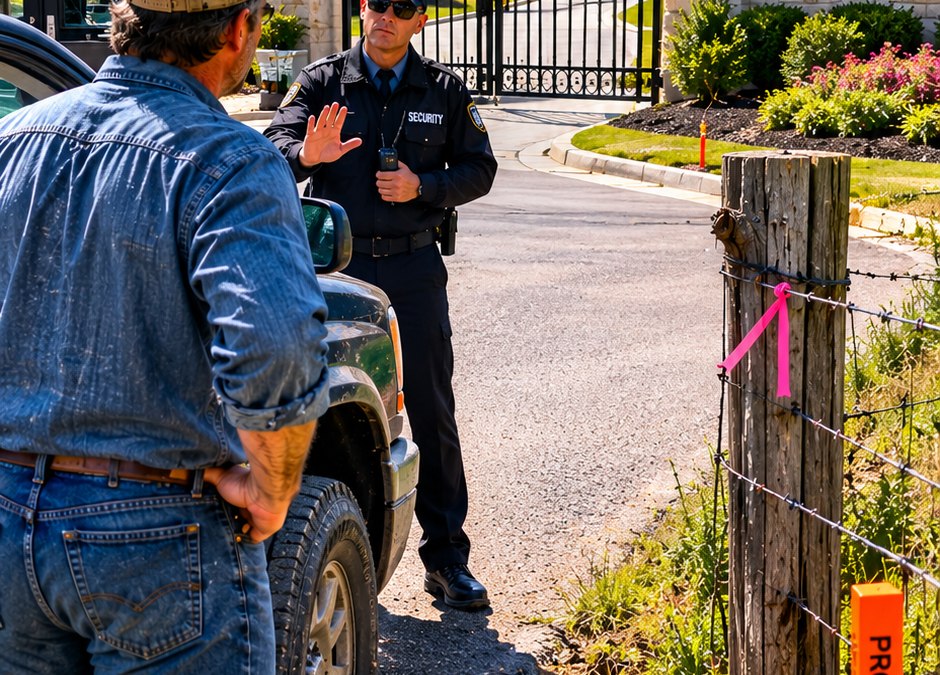
The security guard told me I could not park on land my family had owned for forty-seven years. Behind him, two limestone pillars stood where my father’s fence had once marked the edge of our ranch. By the time the county survey line cut straight through Crestwood’s beautiful black gate, every polished lie they had built around it stopped being useful.
My name is Michael Turner, and for most of my life, that narrow triangle of land beside County Road 18 meant almost nothing to anybody except my family.
It was not pretty land. Not in the way developers use the word. It was a sliver of grass, fence, drainage ditch, road frontage, and stubborn history tucked along the western edge of my ranch. People drove past it every day without slowing down. No one stopped to take pictures of it. No one pointed at it and said, “Now there is something worth protecting.”
But my father had protected it anyway.
He used to walk that boundary with me when I was young, one hand in his jacket pocket, the other pointing toward survey pins, fence posts, drainage lines, and old markers most people would never notice. He believed land was not truly yours unless you knew where it began and where it ended. He believed a man who ignored his property line was inviting someone else to rewrite it.
When I was seventeen, he showed me the iron marker near the western corner.
It was rusted, ugly, and half-hidden in weeds beside the old fence.
“Never let anyone move this,” he said.
I remember laughing because, at seventeen, everything old seemed less important than adults claimed it was.
“It’s just a pin,” I told him.
He looked at me the way fathers look at sons who have not yet been humbled by paperwork.
“No,” he said. “It’s the difference between what’s yours and what somebody else wants.”
I did not understand the full weight of that sentence until decades later, when I came home after four days away and found a luxury subdivision entrance sitting on top of it.
I had gone to help my brother repair equipment in another county. He ran cattle farther north, and one of his tractors had broken down during hay season. I left on a Monday morning, expecting to be gone two days. It turned into four because nothing involving old machinery ever ends when men promise it will.
By the time I drove back toward my ranch that Friday afternoon, I was exhausted, dusty, and thinking only about getting home, checking the pasture, and sleeping without hearing my brother curse at a hydraulic line.
Then I turned onto County Road 18 and saw the gate.
At first, my brain refused to make sense of it.
Two massive limestone pillars rose beside the road where my old pasture fence should have been. Between them stood a black wrought-iron gate at least twenty feet wide, polished and dramatic, with decorative scrollwork across the top. Fresh landscaping wrapped around both pillars. Young maple trees leaned in perfect rows beside a new stone wall. Bronze lights sat at the base, angled upward to make the limestone glow after sunset.
A polished sign had been mounted near the entrance.
Crestwood Estates — Residents Only.
I stopped my truck in the road.
For a few seconds, I just stared.
My fence was gone.
The old corner post was gone.
The dirt access strip beside my western pasture was gone.
In its place stood a luxury entrance built like it belonged on the cover of a real estate magazine.
A security guard stepped out of a small booth and walked toward me with one hand raised.
“You can’t park there anymore, sir,” he said. “This is the private entrance to Crestwood Estates.”
He said it while standing on land my father had warned me never to let anyone take.
I looked past him at the pillars.
Then I looked back at the guard.
“Who built this?”
He frowned like the question confused him.
“The developer.”
“On whose property?”
“Crestwood’s.”
“No.”
I stepped out of my pickup.
“This is mine.”
The guard’s hand went to his radio.
Before he could speak, a silver Range Rover rolled through the gate from inside the subdivision. The driver braked beside us. A woman in a navy blazer stepped out with the clean, practiced confidence of someone who had been expecting a problem but not a defeat.
She introduced herself as Vanessa Cole, development director for Crestwood Estates.
“Mr. Turner,” she said. “We’ve been expecting concerns.”
That word stayed with me.
Concerns.
Not outrage.
Not property damage.
Not trespass.
Concerns.
I pointed at the limestone pillars.
“You built a gate on my land.”
Vanessa barely looked at them.
“The entrance was constructed within the approved development boundary.”
“Show me.”
She opened a leather folder and removed a glossy site plan. The paper looked expensive enough to impress buyers and useless enough to ignore boundaries. It showed Crestwood’s western entrance connecting to County Road 18 in a straight, dramatic line. A thick gray approach crossed the same ground where we stood.
The plan labeled it: Main Entry.
I looked at the map.
Then I looked at her.
“Where is the property line?”
“The entrance is within our parcel.”
“That is not what I asked.”
Her expression tightened.
“We have surveyed plans.”
“Then show me the survey.”
Behind us, a landscaping truck pulled up. Two workers climbed out and began unloading young maple trees from the back. One of them grabbed a shovel and walked toward the fresh soil near the northern pillar.
I turned toward them.
“Don’t plant those.”
Vanessa raised her voice.
“Continue working.”
The men stopped anyway.
One looked from her to me.
“Who owns the strip?”
“I do,” I said.
Vanessa stepped closer.
“Crestwood does.”
The worker slowly set his shovel down.
“I’m calling my supervisor.”
That was the first sign that the polished version of Crestwood’s story was not strong enough for people who actually had to put tools in the ground.
A minute later, my neighbor Harold Price pulled over.
Harold had lived across County Road 18 for thirty-two years. He was the kind of neighbor who knew which families owned which fields because he had watched the fences go up, come down, and get repaired after storms. He stepped out of his old pickup and stared at the gate with his mouth slightly open.
“Michael,” he said, “when did you sell them that corner?”
“I didn’t.”
Harold turned to Vanessa.
“Then why is there an entrance here?”
“It is not his corner,” Vanessa said.
Harold laughed once, sharp and humorless.
“I’ve lived across this road thirty-two years. That fence was Michael’s father’s.”
Vanessa’s confidence did not disappear.
But it changed.
She took out her phone.
“Our surveyor established the construction limits.”
I walked to the northern pillar.
The limestone column stood exactly where my old wooden corner post had been. That post had been weathered, ugly, leaning slightly to the south, and more valuable than anything Crestwood had put in its place because it marked a boundary my family understood.
Now it was gone.
So was the rusted metal marker beside it.
My chest tightened.
I crouched by the new landscaping and pushed aside fresh mulch. Dark soil had been spread thick around the pillar. Decorative stones had been placed with care, like the ground beneath them had no history.
“Where is the old survey pin?” I asked.
Vanessa folded her arms.
“There was no relevant marker here.”
Harold stepped closer.
“Yes, there was.”
That was when a county utility truck slowed beside us.
The driver was Aaron Wells from County Public Works. He had inspected drainage along County Road 18 for years. He knew the culverts, swales, road shoulders, and frontage strips better than most survey assistants in the county. He lowered his window, saw the gate, then saw me.
“Michael,” he said, “did you authorize this?”
“No.”
Aaron parked immediately.
He walked toward the southern pillar, studying the layout with the kind of frown county men get when expensive private construction appears where public records say it should not.
“This looks wrong, Vanessa.”
“The entrance passed construction inspection,” she said.
Aaron shook his head.
“Inspection does not determine ownership.”
He pulled up the county parcel map on his tablet. The screen loaded slowly, then he zoomed in. Crestwood’s western boundary appeared. So did my parcel.
Aaron stared at the map.
Then he stared at the gate.
Vanessa leaned toward him.
“What?”
He did not answer right away.
I watched his finger trace the boundary.
Finally, he said, “I would not schedule another delivery.”
Her face hardened.
“Why?”
Aaron pointed toward the limestone pillars.
“Because according to this map, your entrance may be west of Crestwood’s property line.”
The landscaping workers stopped unloading.
The security guard lowered his radio.
I looked at the enormous gate standing where my father’s fence used to be and felt the anger in me settle into something colder.
“How far west?” I asked.
Aaron zoomed closer.
“I cannot certify distance from this map.” He looked toward the buried corner. “For that, we need the county survey.”
Vanessa glanced at the gate.
For the first time, she was not looking at it like an entrance.
She was looking at it like evidence.
Aaron called county survey.
That alone was enough to make Vanessa stop the landscaping crew.
“Nobody is admitting the entrance is misplaced,” she said.
I looked at the limestone pillars sitting where my fence had been.
“Nobody asked you to admit anything.”
Harold pointed toward the fresh soil.
“Just find the marker.”
Vanessa called someone named Derek.
Ten minutes later, a white Crestwood construction pickup arrived. Derek Lawson stepped out wearing a reflective vest and the tired expression of a superintendent who had been pulled into something above his pay grade. Vanessa immediately asked him for the boundary layout.
Derek opened a tablet.
“This is the field plan.”
The drawing showed the entrance, but Aaron noticed the problem first.
“Where is the survey layer?”
Derek zoomed out.
“That is all I was issued.”
“No property monuments?”
“No.”
“No bearings?”
Derek shook his head.
Aaron looked at Vanessa.
“Who prepared this?”
“Our engineering consultant,” she said.
“Then we need their stamped boundary plan.”
Vanessa made another call.
While she waited, I walked along the new stone wall. It extended nearly seventy feet from the gate. My old fence had followed the same direction, except it had stood several feet east of the wall. Harold saw it too.
“They didn’t just take the corner,” he said.
I stopped.
“What?”
He pointed toward a cedar near the edge of my pasture.
“Your fence used to run beside that cedar.”
The cedar was now behind Crestwood’s wall.
Inside their landscaping.
I felt my jaw tighten.
Then I noticed pieces of old barbed wire lying beside a dumpster near the construction area. I walked over and pulled one free. A weathered wooden fence staple was still attached.
“Derek.”
He came over slowly.
I held up the wire.
“Did your crew remove my fence?”
He looked toward Vanessa.
“We removed an abandoned fence along the entrance alignment.”
“Who told you it was abandoned?”
“The developer.”
Vanessa stepped forward.
“The fence was inside our construction area.”
“That is not an answer.”
Before she could respond, another vehicle arrived.
County surveyor Rachel Monroe stepped out carrying a locator and field case. She did not care about Crestwood’s glossy plan. She did not care about Vanessa’s folder. She did not care how much the limestone cost or how impressive the gate looked from the road.
She wanted recorded documents.
Aaron gave her the parcel numbers.
Rachel searched the county database.
“My property was surveyed in 2008,” I told her.
She nodded.
“I have it.”
Vanessa moved closer.
“Crestwood has a newer survey recording number.”
Rachel looked at her.
“Give it to me.”
Vanessa looked at Derek.
Derek looked at his tablet.
Neither had one.
Rachel raised an eyebrow.
“Survey company?”
“Weston Land Group,” Vanessa said.
Rachel searched again.
Then stopped.
“I have a subdivision plat from Weston.”
Vanessa smiled.
“There.”
Rachel kept reading.
“That is not a boundary survey transferring this strip.”
The smile disappeared.
Rachel turned the screen toward us. Crestwood’s recorded plat showed its western property line running east of a narrow triangular piece belonging to my parcel.
The exact triangle where the entrance appeared to sit.
Vanessa pointed at a dashed line.
“That is our entrance.”
Rachel nodded.
“It is a proposed access alignment.”
“Exactly.”
“No,” Rachel said. “An alignment is not ownership.”
Aaron almost smiled.
“Same problem, different map.”
Rachel walked toward the northern pillar and swept the locator over the landscaping.
Nothing.
She moved again.
Nothing.
Then the detector sounded.
A strong tone came from beneath a decorative boulder beside the pillar.
Derek frowned.
“That rock weighs two thousand pounds.”
Rachel looked at him.
“When was it placed?”
“Last month.”
“What is underneath it?”
“No idea.”
Harold laughed without humor.
“I do.”
Vanessa turned toward him.
He pointed at the boulder.
“Michael’s corner marker.”
Derek called for a skid steer.
Vanessa objected immediately.
“You are not dismantling finished landscaping based on a neighbor’s memory.”
Rachel looked at her with no expression.
“I am not asking permission to verify a recorded county monument.”
Twenty minutes later, the machine lifted the boulder.
Rachel brushed away fresh mulch. Then soil. Then more soil.
Metal appeared.
A capped iron pin.
She cleaned the top.
The stamp number matched my 2008 survey.
Nobody said anything.
Not Vanessa.
Not Derek.
Not the guard.
Not even Harold.
Rachel set her equipment over the pin and took the first measurement. Then a second. She walked toward the southern side of the entrance. Her expression became serious.
“How bad?” I asked.
She looked from the pin to the limestone gate.
“This monument marks your boundary.”
Vanessa folded her arms.
Rachel pointed straight through the center of Crestwood’s luxury entrance.
“If the companion monument confirms this line, the northern pillar is on Michael’s parcel.”
Derek stared at the stonework.
Then Rachel added, “And judging from this preliminary measurement, it may not be the only part.”
Rachel needed the southern monument before she would say anything final.
That monument was supposed to sit near the drainage culvert. The problem was Crestwood had poured a decorative retaining wall across that entire area.
Derek looked uncomfortable.
“That wall was built from the approved landscape plan.”
Rachel did not look up.
“Approved landscaping does not move recorded boundaries.”
She swept the locator along the wall.
Nothing.
Then again.
A weak signal.
She stopped beside a section of fresh concrete. Harold pointed.
“Michael’s old fence turned right there.”
I remembered it too. A steel T-post. A narrow ditch. My father stacking feed pallets nearby because he hated leaving things where rainwater could rot them.
Now there was polished stone, irrigation tubing, and three ornamental shrubs.
Rachel marked the spot.
“I need access beneath this cap.”
Vanessa shook her head.
“You are not cutting into a finished entrance.”
Rachel stood.
“I am verifying a county-recorded monument.”
Vanessa crossed her arms.
“This gate cost over two hundred thousand dollars.”
I looked at her.
“Then you should have checked where you put it.”
Derek called the masonry contractor.
While we waited, a black SUV arrived. A man stepped out and introduced himself as Paul Mercer, Crestwood’s civil engineer. Vanessa immediately handed him the field plan.
“Tell them the entrance is correct.”
Paul studied it.
Then asked Derek for the construction control sheet.
Derek opened another file.
Paul’s face changed.
“This is not mine.”
Vanessa frowned.
“Your company prepared the entrance.”
“We prepared the approved design,” he said.
He zoomed in.
“This layout has a shifted baseline.”
Rachel stepped closer.
“How far?”
Paul measured digitally.
“About nine feet west.”
I looked toward my pasture.
“Nine feet into my land.”
Paul did not answer immediately.
Then he opened his original stamped plan.
His entrance centerline sat east of the recorded parcel boundary.
The contractor field version did not.
Vanessa stared at him.
“Why would anyone shift it?”
Derek looked toward the stone wall.
“To straighten the entrance.”
Paul’s expression hardened.
“The approved alignment curves slightly because of the property line.”
Rachel nodded.
“Exactly.”
Then Derek remembered something.
“We got a revision.”
Vanessa turned toward him.
“What revision?”
He searched his email.
There it was.
An entrance alignment field adjustment sent three weeks before construction.
Requested by Vanessa Cole.
Reason: Improve visual approach and symmetry.
Paul read it twice.
“I rejected this.”
Vanessa looked at him sharply.
“No, you did not.”
He opened his sent folder.
His reply was immediate.
Do not shift west. Property boundary conflict. Maintain stamped alignment.
Harold let out a low whistle.
Vanessa’s expression tightened.
“That was a preliminary concern.”
Paul looked at her.
“It was a direct instruction.”
Then the masonry contractor arrived.
Rachel supervised as workers carefully removed one stone cap. Beneath it was concrete, fresh and hard. She swept the locator again.
Strong signal.
They chipped away a small section.
A steel pin appeared.
Rachel cleaned the stamped cap.
The number matched the companion monument from my survey.
She set her instrument. Measured north. Measured south. Measured the gate.
Nobody moved.
Finally, Rachel lowered the equipment.
“Boundary confirmed.”
Vanessa looked at her.
Then at the entrance.
Rachel pointed.
“The northern pillar is eleven feet inside Michael’s parcel.”
Derek went pale.
“The southern pillar?” Paul asked.
“Nine feet.”
“What about the gate itself?”
Rachel took another reading.
Then she looked straight at Vanessa.
“The entire gate crosses Michael’s land.”
Silence.
Not part of it.
Not a few feet of landscaping.
Not one pillar.
The whole entrance.
Paul slowly opened the approved plan again. His curved design stayed inside Crestwood. The built version did not.
Then Aaron noticed tire tracks beyond the pillars.
“Rachel.”
She looked.
The paved approach extended across my triangular parcel before connecting back to Crestwood.
She measured again.
I already knew from her face.
“At the widest point,” she said, “nearly fifteen feet.”
Vanessa stepped forward.
“This can be corrected with an easement.”
I looked at her.
“Who said I am giving you one?”
Her expression froze.
Behind us, the automatic gate opened for a resident. A luxury SUV rolled through, crossing my property as if it belonged to Crestwood.
Rachel watched it pass.
Then she said quietly, “Until ownership and access are resolved, you may have a bigger problem than misplaced stonework.”
Because Crestwood had not just built its entrance on my land.
It had already sold homes while promising residents the right to drive through it.
Vanessa’s attorney arrived forty minutes later.
His name was Grant Holloway. He wore an expensive suit, stepped carefully around the mud, and did not waste time arguing with Rachel’s measurements. That told me he was smarter than Vanessa.
He asked a different question.
“Does Mr. Turner object to temporary residential passage while we review this?”
I looked at the line of vehicles already using my property.
“I object to pretending this was temporary.”
Vanessa folded her arms.
“We have forty-two occupied homes.”
“And another entrance,” Paul Mercer said.
That mattered.
Crestwood’s approved subdivision plan showed a primary entrance on the eastern county road. The luxury western gate had been added later as a premium entrance. Not emergency access. Not required access. A sales feature.
Grant looked at Vanessa.
“You told me this was necessary for subdivision circulation.”
“It improves circulation,” she said.
“That is different.”
Then a Crestwood resident stopped beside us. Her name was Lisa Bennett. She lowered her window.
“Why is the gate closed?”
Derek had disabled it while Rachel surveyed.
Vanessa answered quickly.
“Temporary technical issue.”
Rachel looked at me.
I said nothing.
Lisa noticed the county equipment.
“Is this about the property line?”
Vanessa’s face changed.
“Why would you ask that?”
Lisa parked.
“Because buyers asked about it last year.”
Grant turned toward her.
“What buyers?”
“My husband and I.”
She opened her phone.
“Our closing attorney noticed the western entrance crossed a separate parcel. Sales told us Crestwood had secured permanent access.”
Grant held out his hand.
“May I see that?”
The message was from Crestwood’s sales director.
West Gate access rights have been resolved with adjacent owner.
I stared at Vanessa.
“Resolved with me?”
She looked toward the subdivision.
“I did not write that email.”
Paul asked the obvious question.
“Was an easement ever obtained?”
Grant searched his title documents.
“No recorded easement appears here.”
Rachel checked county records.
“Nothing under Michael’s parcel either.”
Then Lisa found another attachment.
A glossy sales brochure.
Private West Gate. Permanent Resident Access.
Harold laughed once.
“They sold access before they owned access.”
Vanessa snapped, “Marketing language is not a deed.”
“No,” I said. “But somebody told marketing they had one.”
Then Derek approached carrying a construction binder.
“I found the pre-construction meeting notes.”
Paul took them.
One line was highlighted.
West entry property acquisition pending. Do not commence hardscape.
Date: eight months earlier.
Vanessa’s signature appeared at the bottom.
Grant looked at her.
“You signed this.”
“I signed meeting attendance.”
Paul turned the page.
A second note appeared.
Owner representative to confirm acquisition before release.
Beside it: V. Cole.
Derek swallowed.
“We received release six weeks later.”
“From whom?” Rachel asked.
Derek pulled out the authorization.
Vanessa Cole: Proceed. Property issue resolved.
Nobody spoke.
Grant read it slowly.
Then he looked at his client.
“What exactly was resolved?”
Vanessa’s voice became defensive.
“We believed Michael’s triangle was an obsolete mapping remnant.”
Rachel stared at her.
“Based on what?”
“A consultant review.”
“Which consultant?”
Vanessa hesitated.
Then a county planning truck arrived.
Planner Susan Grant stepped out with Crestwood’s development file. Rachel had requested it. Susan spread the approved plans across Derek’s tailgate.
The western entrance was not merely curved away from my boundary.
A bold note sat beside it.
No construction on Turner parcel without recorded easement or acquisition.
Grant Holloway closed his eyes.
Susan pointed at the approval stamp.
“Crestwood acknowledged this condition.”
Vanessa said nothing.
Susan turned another page.
Attached was a letter from six months earlier. County Planning had asked whether Crestwood had acquired my land.
The answer was typed clearly.
Acquisition complete. Final recording forthcoming.
Signed: Vanessa Cole.
I felt something colder than anger move through me.
She had not mistaken the line.
She had told the county the property had been acquired, then built before anyone checked.
Susan looked at me.
“Mr. Turner, did you ever sign a purchase agreement?”
“No.”
“Grant an easement?”
“No.”
“Accept payment?”
“Not one dollar.”
Rachel looked toward the limestone pillars.
Susan looked toward the paved approach.
Then she pulled a red notice from her folder.
Vanessa stepped forward.
“What are you doing?”
Susan walked to the gate control box and attached the notice where every arriving resident could see it.
STOP WORK AND ACCESS REVIEW. PROPERTY RIGHTS UNVERIFIED.
The automatic gate remained open, but the construction site behind it went silent.
And suddenly, Crestwood’s two-hundred-thousand-dollar entrance was not welcoming anyone.
It was displaying the county’s evidence.
The red notice changed the mood faster than the survey did.
Residents stopped treating us like people discussing a boundary. They started asking why their luxury entrance might be sitting on somebody else’s land.
Lisa Bennett was first.
“Did Crestwood know before we closed?”
Grant Holloway answered carefully.
“We are reviewing the timeline.”
Lisa held up the sales email.
“I closed four months ago. This says permanent access was secured.”
Vanessa stepped forward.
“The eastern entrance remains available.”
“That is not what you sold us.”
Two more residents parked nearby.
Then another.
Within twenty minutes, eight homeowners were standing beside the gate.
Harold leaned toward me.
“This is getting crowded.”
It got worse.
A black pickup arrived carrying an older man named Samuel Pierce. Rachel recognized him immediately.
“Sam.”
He smiled.
“County called me.”
Samuel had performed the 2008 survey of my property. He opened a weathered field book.
“I set both monuments.”
Vanessa looked exhausted.
“We already confirmed them.”
Samuel nodded.
“I am here because Rachel asked whether that triangular parcel was intentional.”
He turned several pages.
“It was.”
I looked at him.
“Why?”
“Road frontage,” he said. “Your father deliberately retained the triangle when he sold acreage east of the ranch.”
Samuel pointed toward County Road 18.
“Your father wanted to preserve control of this access point.”
That sentence landed harder than anything else that day.
Crestwood had not built over some meaningless mapping fragment.
My father had specifically kept that ground.
Samuel showed us his original sketch.
Turner retained access tract.
Grant read it.
“Was this recorded?”
Rachel nodded.
“Referenced in the deed.”
Vanessa looked at Susan.
“Why was that not shown on our acquisition map?”
Paul Mercer answered before Susan could.
“It was.”
He opened his original engineering file.
A yellow-shaded triangle appeared.
Turner parcel excluded from construction.
Then Derek found something else.
His project server contained an earlier entrance rendering. The first version curved around the triangle exactly as Paul’s approved plan did. The later luxury rendering was straight, symmetrical, more dramatic. Two massive pillars centered perfectly on the approach.
Harold looked between them.
“They moved the entrance because it looked better.”
Paul’s jaw tightened.
“That is exactly what the revision request said.”
Then Lisa noticed the developer’s marketing photograph.
The straight gate was featured on the brochure cover.
She read the caption aloud.
“Premium western arrival experience.”
I looked at Vanessa.
“My property became your sales picture.”
She did not answer.
A landscaping supervisor named Kevin Marks arrived to collect his crew. When he saw Samuel, he stopped.
“I remember that yellow parcel.”
Vanessa turned.
“What?”
Kevin pulled up an old site photograph from before construction. Yellow stakes had marked my triangle.
TURNER PROPERTY. NO ENTRY.
Rachel enlarged the image.
“Where are those stakes now?”
Kevin looked uncomfortable.
“We were told to remove them.”
“By whom?”
He glanced at Vanessa.
“Development office.”
Grant immediately asked him to be specific.
Kevin searched his messages, then handed over his phone.
The instruction came from Vanessa.
Remove old exclusion stakes. New entry limits govern.
Rachel’s expression hardened.
“Did anyone replace them with surveyed boundary stakes?”
“No.”
Paul looked furious.
“There were no approved new entry limits.”
Then Susan’s phone rang.
County Planning had found the acquisition file Crestwood submitted before construction. She listened, then her eyes narrowed.
“Send it.”
A document arrived.
It was labeled Turner Access Tract Acquisition Status.
My name appeared at the top.
Beside it: Owner contacted. Agreement anticipated.
I stared at the page.
“Nobody contacted me.”
Grant looked at Vanessa.
“Who prepared this?”
She did not answer.
Susan scrolled lower.
Another line appeared.
Construction release may proceed pending recording. Authorized by Vanessa Cole.
Lisa stepped backward.
“So they started before they owned it.”
Samuel closed his field book.
“They started on land they were specifically told not to enter.”
Rachel walked to the northern pillar. She placed a blue survey flag beside its limestone base. Another at the southern pillar. Another beside the gate motor. Another along the decorative wall.
Every flag was on my side.
Residents watched the blue line grow.
When Rachel finished, she stood in the center of the entrance.
“The county survey is complete.”
Vanessa looked at her.
Rachel pointed from pillar to pillar.
“The gate control equipment, both entrance monuments, and most of the western approach are inside the Turner parcel. Not close. Not disputed. Inside.”
Then Susan looked toward Crestwood’s silent construction equipment.
“Until this is resolved, no further development work may rely on this entrance.”
Behind the luxury sign, machines began shutting down one after another.
For the first time, the entrance Crestwood built to impress buyers was stopping the development it was supposed to sell.
The next vehicle through Crestwood’s eastern entrance belonged to the sheriff’s office.
Deputy Marcus Hale parked beside Rachel’s blue survey line. Susan had called because the dispute was no longer about unfinished construction.
Crestwood had removed my fence, removed boundary stakes, installed permanent structures, and opened my property to residential traffic.
Marcus listened without interrupting.
Then he asked Vanessa one question.
“Do you have any recorded document giving Crestwood rights to this parcel?”
Grant Holloway answered for her.
“Not currently.”
Marcus nodded.
“Purchase contract?”
“No.”
“Easement?”
“No.”
“Written permission from Mr. Turner?”
“No.”
Marcus looked at me.
“Did you authorize any of this?”
“Nothing.”
He wrote that down.
Then Derek Lawson’s phone rang. He stepped away. When he returned, he looked worried.
“Our concrete contractor found something.”
“What?” Paul asked.
“An old site video.”
The contractor had filmed the entrance before excavation for insurance documentation. Derek played it on his tablet.
My wooden fence was visible.
So were Samuel’s yellow exclusion stakes.
Then the camera moved toward the northern corner.
There was my metal survey marker, completely exposed.
Vanessa watched without expression.
The video continued.
A voice said, “Developer wants this entire line cleared before Monday.”
Another voice asked, “What about the Turner property stakes?”
The answer came immediately.
“Office says they are obsolete.”
Marcus paused the video.
“Who said that?”
Derek swallowed.
“The superintendent at the time.”
“Where is he?”
“Retired.”
Paul looked at Derek.
“Who gave him field direction?”
Derek did not answer.
He did not need to.
Then a gray sedan arrived. A woman stepped out carrying a laptop bag. Her name was Clare Donovan. She worked for the title company that insured Crestwood’s parent parcel.
Grant looked surprised.
“Why are you here?”
“County Planning contacted our office.”
Clare opened the title commitment.
“Exception 17.”
She turned the screen toward us.
Turner retained access tract excluded from insured estate.
Grant’s face tightened.
“That was in the developer title report?”
“Yes.”
“Since when?”
“Before acquisition.”
Vanessa finally spoke.
“We believed it could be acquired later.”
Clare looked at her.
“Then why was Planning told acquisition was complete?”
Nobody answered.
Clare opened another file.
Three months before construction, Crestwood had asked the title company to insure the western entrance.
Clare’s office refused.
The reason was written plainly.
Applicant does not hold title or recorded access rights across Turner tract.
Lisa Bennett stared at Vanessa.
“You knew before you sold us homes.”
Vanessa’s voice sharpened.
“I knew there was a title issue being resolved.”
Clare shook her head.
“Our file says unresolved.”
Marcus asked for copies.
Grant did not object.
Then Susan received another message. County Building had reviewed Crestwood’s active permits. Several Phase Three inspections listed the western gate as construction access.
Susan frowned.
“That is a problem.”
Paul looked at her.
“How big?”
“If the access shown on those permits is not legally available, we need to verify whether those permits remain compliant.”
Vanessa stepped toward her.
“You cannot shut down Phase Three over an entrance alignment.”
Susan remained calm.
“I am not shutting anything down yet.”
Then her radio crackled.
An inspector at Phase Three had found trucks entering through the western gate that morning.
After the stop notice.
Susan looked at Derek.
“Who authorized that?”
Derek checked the logistics chat.
His face went pale.
A message had been sent twenty minutes after the county notice was posted.
Keep West Gate active for deliveries until formally blocked.
Sender: Vanessa Cole.
Marcus looked at her.
“Did you send this?”
Grant immediately said, “Vanessa, do not answer.”
Susan did not need an answer.
She called the inspector.
“Stop western access immediately.”
Minutes later, a county truck arrived carrying barricades. Workers placed them across the paved approach. The bronze Crestwood Estates sign still gleamed above the landscaping, but nobody was driving beneath it now.
Then Marcus noticed something on the construction video.
“Back it up.”
Derek replayed the footage.
Marcus pointed at a yellow stake near the old fence.
Someone had written on it in black marker:
DO NOT DISTURB — PRIVATE PROPERTY.
The camera moved.
A person stepped into frame.
The stake was pulled from the ground.
Harold leaned closer.
“Who is that?”
Derek froze the image.
Nobody spoke.
The navy blazer.
The blonde hair.
The sunglasses.
Vanessa.
Marcus looked from the screen to her.
Suddenly Crestwood’s claim that this had been a surveying mistake became much harder to believe.
Marcus watched the construction video twice.
Vanessa never denied being the person removing the yellow stake.
Grant Holloway simply said, “My client will not answer questions about that footage without further review.”
Marcus nodded.
“That is fine.”
Then he saved the contractor’s contact information.
Rachel stood beside the blue boundary flags.
“The important thing is the monument never moved.”
Samuel agreed.
“The evidence was here the entire time.”
Paul looked toward the luxury gate.
“So was the approved alignment.”
That was when Derek’s project coordinator called. She had found the revision archive, not the current server. The backup.
Derek opened it on his tablet.
There were six versions of the western entrance.
Versions one through four curved east. All stayed inside Crestwood.
Version five changed everything.
The centerline moved west.
The pillars became symmetrical.
The approach straightened.
The Turner triangle disappeared from the drawing.
Paul stared at it.
“Who edited this?”
Derek checked the metadata.
His expression changed.
“External markup submitted by development.”
Vanessa remained silent.
Derek opened the transmittal from Vanessa Cole.
Request clean West Entry presentation. Remove legacy property graphics from construction display. Use straightened arrival axis.
Paul shook his head.
“I never approved this for construction.”
Derek scrolled farther.
There was Paul’s rejection.
Boundary conflict. Presentation revision only, not for field use.
Then another message.
Vanessa to construction team:
Use presentation alignment for field layout. Engineering comments to follow.
Grant’s face tightened.
“Vanessa.”
She looked at him.
“Not here.”
But Lisa Bennett had heard enough.
“You sold us a gate based on a drawing your engineer rejected.”
Vanessa turned toward her.
“The design was intended to be resolved.”
“With whose land?” I asked.
She looked away.
Then county building inspector Robert Ellis arrived. He had reviewed the Phase Three permits. Three active building sections depended on construction traffic using the western approach.
Robert walked to Susan.
“Until they submit a lawful access plan, those sections stop receiving inspections.”
Vanessa spun around.
“You cannot suspend home construction.”
Robert handed Derek three notices.
“Not the homes permanently.” He pointed toward the barricaded gate. “But you cannot base approved construction logistics on property the developer does not control.”
Within minutes, Derek’s radio started talking.
Concrete delivery canceled.
Framing trucks redirected.
Heavy equipment stopped.
Crestwood’s polished entrance had now disrupted the development schedule.
Then Clare Donovan received a call from her title office. She listened for nearly a minute.
“We found the acquisition correspondence.”
Grant looked at her.
“What correspondence?”
Clare opened an archived email.
Six months before construction, Vanessa had contacted the title company.
Her message asked:
Can Crestwood begin entry construction before Turner tract acquisition if we expect to secure it later?
Clare’s predecessor had answered:
No. Possession or anticipated acquisition does not create property rights. Do not construct until title or recorded easement is obtained.
Marcus read the email.
Then he looked at Vanessa.
“That was the third warning. Engineering, County Planning, title. All before construction.”
Samuel pointed toward the stone wall.
“There is one more thing.”
He opened his 2008 notes.
My father’s retained triangle was not just frontage.
A narrow drainage easement crossed its eastern edge.
County drainage access.
Rachel checked the record.
Samuel was right.
The new decorative wall partially blocked it.
Susan immediately called Public Works.
Aaron walked over and inspected the wall.
“That drainage swale has to remain accessible.”
Derek stared at Vanessa.
“So even if Michael sold the triangle tomorrow—”
“The wall still needs modification,” Aaron said.
The entrance was not merely on my property.
Part of it conflicted with county drainage rights too.
Vanessa’s shoulders finally dropped.
Then a black luxury sedan stopped behind the barricades. A man stepped out, and Derek went rigid.
“That’s Jonathan Reed.”
“Who?” I asked.
“Crestwood’s owner.”
Jonathan Reed looked at the sheriff’s cruiser, the county notices, the blue survey flags, the residents, the title officer, the engineer, the planner, and finally the two-hundred-thousand-dollar entrance sitting on my land.
He turned to Vanessa.
“I was told this was a minor boundary question.”
Nobody answered.
Jonathan looked at Marcus.
“Is it?”
Marcus handed him the survey summary.
“No, sir.”
Clare handed him the title warning.
Paul gave him the rejected revision.
Susan gave him the county letter.
Jonathan read them one by one.
Finally, he looked at Vanessa.
“Did you know we did not own this land?”
Grant stepped forward.
“Jonathan, we should discuss this privately.”
Jonathan did not move.
He kept looking at Vanessa.
And for the first time since I came home, the person asking her that question was not a neighbor, surveyor, contractor, county official, or sheriff.
It was the man who had paid for the gate.
Jonathan Reed did not raise his voice.
That made Vanessa look even more uncomfortable.
“I asked you a question.”
Grant Holloway stepped closer.
“Jonathan, this should happen with counsel present.”
“You are counsel.”
Grant paused.
Jonathan pointed at Clare’s title warning.
“Did she receive this?”
Clare answered, “Yes.”
He held up Paul’s rejected revision.
“And this?”
Paul nodded.
“Yes.”
Then Susan handed him the county correspondence. Jonathan read the line stating Crestwood could not build across my parcel without acquisition or recorded access.
His jaw tightened.
“Who told Planning acquisition was complete?”
Susan pointed to the signature.
“Vanessa Cole.”
Jonathan looked at her.
“Why?”
Vanessa finally answered.
“Because we expected Michael to sell.”
I almost laughed.
“You never asked me.”
She turned toward me.
“We attempted contact.”
“How?”
Silence.
Grant looked at Vanessa.
“Do you have documentation?”
She did not.
Jonathan asked Clare whether anyone had ordered an appraisal of my triangle.
“No,” Clare said.
“Purchase offer?”
“No.”
“Draft easement?”
“No.”
He stared at Vanessa.
“So we did not expect to buy it.” He pointed toward the gate. “We expected to build first and negotiate afterward.”
Vanessa’s expression hardened.
“The western entrance was essential to the launch schedule.”
Paul shook his head.
“No. It was essential to the marketing schedule.”
Lisa Bennett folded her arms.
“That is what buyers were told.”
Then Derek received another message from the project server.
“Jonathan.”
He turned.
“I found the budget revision.”
The original curved entrance inside Crestwood’s property cost approximately one hundred sixty thousand dollars.
The straight luxury version cost more than two hundred thousand.
But there was another number.
Lot premium impact: +$1.4M estimated.
Harold whistled.
Jonathan stared at the screen.
The straight gate was not cheaper.
It was not safer.
It simply created a grander entrance beside Crestwood’s highest-priced lots.
Vanessa had risked someone else’s land for a better sales image.
Jonathan handed the tablet back.
“You are removed from this project effective immediately.”
Vanessa blinked.
“You cannot make that decision in the field.”
“I own the company.”
Grant said nothing.
Vanessa looked around.
Residents.
County officials.
Contractors.
Surveyors.
The sheriff.
Nobody came to her defense.
Jonathan turned to me.
“Mr. Turner, Crestwood will remove every structure located on your property.”
I looked at the limestone pillars.
“The wall too.”
“If the survey says it is yours, yes.”
Rachel answered, “It does.”
“And restore the fence?”
“Yes,” Jonathan said.
“The drainage area?”
Aaron nodded.
“That needs correction regardless.”
Jonathan looked at Paul.
“Can the approved entrance be built entirely on Crestwood property?”
Paul opened his original plan and traced the curved alignment.
“Yes. It always could.”
That was the part that seemed to anger Jonathan most.
Nothing about this disaster had been necessary.
Then Susan explained what the county required before construction could resume.
Remove unauthorized structures.
Restore drainage access.
Submit the original stamped alignment.
Verify every permanent improvement against Rachel’s survey.
Use the eastern entrance for construction traffic.
Jonathan agreed to all of it.
Vanessa stepped forward.
“You are destroying a completed entrance because of a technical boundary.”
I looked at her.
“Eleven feet is not technical when it is someone else’s eleven feet.”
Rachel added quietly, “And the entire gate is across the Turner parcel.”
Jonathan nodded.
“Then it comes out.”
Derek called the masonry contractor.
Paul began marking the approved replacement alignment.
Workers arrived with temporary fencing.
The bronze Crestwood sign was disconnected first.
Then the gate motors.
Then the decorative lights.
Residents watched from the other side of the barricades.
By late afternoon, a crane had straps around the northern limestone pillar.
Vanessa stood beside her Range Rover.
She watched the pillar rise from my land.
For months, that entrance had been the centerpiece of Crestwood’s marketing.
Now it was hanging six feet above the ground.
Jonathan walked over to me.
“I should have verified this personally.”
“You had people for that.”
He looked toward Vanessa.
“Apparently, I had paperwork for it.”
The crane swung the pillar east onto Crestwood property where it belonged.
Then Marcus approached.
“We have what we need for the property damage report.”
I nodded.
Behind him, workers uncovered the line where my old fence had stood. Samuel pointed.
“Your father kept this triangle for a reason.”
I looked at the blue survey flags.
Then at the luxury gate being dismantled piece by piece.
“He wanted control of his own frontage.”
Samuel smiled.
“Looks like he still has it.”
The second pillar began to rise.
And with it went the last argument that Crestwood’s entrance was somehow too permanent to move.
Six weeks later, Crestwood still had a luxury entrance.
It just was not on my property anymore.
Paul Mercer’s original curved design had been built exactly where it should have been from the beginning. Inside Crestwood. The new limestone pillars stood eleven feet east of the old location. The decorative wall followed the recorded boundary. The gate opened without crossing a single inch of the Turner parcel.
Somehow, residents still managed to drive home.
Harold stopped beside me one morning while workers finished landscaping.
“Looks pretty good.”
“It does.”
“You mad about that?”
I smiled.
“Why would I care what they build on their own land?”
That had always been the point.
I had not wanted to stop Crestwood.
I wanted Crestwood to stop treating my property like an empty space on its design plan.
Rachel returned for the final survey inspection. She checked both original monuments. Neither had moved. New witness posts were installed nearby so nobody could bury them under landscaping again.
Samuel Pierce watched her finish.
“Your father would have appreciated those.”
“I think he would appreciate the fence more.”
Crestwood had rebuilt that too.
New posts.
New wire.
Same boundary.
They restored the drainage strip, removed the concrete around the southern marker, and replaced the soil disturbed by construction. Jonathan Reed paid for all of it. He also covered my independent survey review and the documented property damage.
There was not much argument.
There was not much left to argue about.
County Planning released the stop notices after Susan confirmed the replacement entrance matched the approved plan. Phase Three inspections resumed. Construction trucks used the eastern entrance. No homes disappeared. No neighborhood became inaccessible. The catastrophe Vanessa had predicted never happened.
Lisa Bennett came by while Rachel was packing her equipment.
“You know what is funny?”
“What?”
“The new entrance looks almost identical.”
Paul overheard her.
“It is almost identical.”
Lisa pointed at the curve.
“Except that.”
Paul nodded.
“Nine feet of curve would have prevented everything.”
Harold laughed.
“Nine feet and permission.”
That was closer.
Crestwood residents eventually received a formal explanation from the developer. The western entrance had been constructed outside the approved property boundary. The affected structures had been removed. The corrected entrance complied with the recorded survey.
Vanessa Cole’s name was not mentioned.
But she never returned.
Jonathan later told me she was no longer employed by Crestwood Development. I did not ask for details.
The county and sheriff’s office handled their reports separately.
My concern ended at the blue survey line.
One afternoon, Jonathan walked over from the new entrance. He carried a framed copy of the corrected site plan.
“I thought you might want this.”
I looked at it.
“No offense, Jonathan, but I have a better one.”
I pulled Samuel’s old survey from my truck.
He laughed.
“Fair enough.”
Then he became serious.
“We changed our field release process.”
“How?”
“No permanent construction until title, survey, and engineering all match.”
“Sounds expensive.”
“Less expensive than building a gate twice.”
We shook hands.
Not because we had become friends.
Because the problem had finally been corrected.
By late summer, Crestwood’s marketing signs returned.
Luxury homes.
Landscaped streets.
Private western entrance.
But the photographs were different. The gate curved slightly east before meeting County Road 18. Most people would never notice why.
I noticed every time I drove past.
My triangular parcel remained simple.
Grass.
Fence.
Drainage strip.
Two survey monuments.
Nothing luxurious.
Nothing impressive.
But it was mine.
One evening, Harold and I stood beside the restored fence, watching Crestwood’s entrance lights come on.
“Hard to believe that whole gate used to be over here.”
He pointed at my grass.
I nodded.
“They thought once it was built, moving it would be too difficult.”
Harold looked toward the new pillars.
“Turns out stone moves.”
“So do gates,” I said.
He smiled.
“But property lines?”
I looked down at the survey monument my father had protected for years.
“No.”
That was what Crestwood learned.
A polished entrance does not create ownership.
A construction schedule does not move a boundary.
A marketing brochure does not replace a deed.
And spending two hundred thousand dollars on somebody else’s property does not make the property yours.
They built their luxury entrance across my land.
Then the county survey put the entire gate on my parcel.
So they moved it.
Not because I was louder.
Not because I had more money.
Not because I frightened them.
They moved it because the evidence had been there from the beginning, buried under fresh mulch, hidden beneath a decorative boulder, covered by concrete, ignored by emails, erased from presentation drawings, and dismissed by people who thought symmetry mattered more than ownership.
But evidence has patience.
So did my father’s line.
When the blue survey flags finally crossed that beautiful black gate, every argument stopped at exactly the same place.
My property line.








