𝗙𝗨𝗟𝗟 𝗦𝗧𝗢𝗥𝗬 The Daughter They Called a Navy Failure Walked Into Court Wearing the Rank They Never Knew She Earned
𝗙𝗨𝗟𝗟 𝗦𝗧𝗢𝗥𝗬
That hurt more than I expected.
They had not come to my wedding.
They had not acknowledged their granddaughter.
But they were coming for Tom.
Of course they were.
The morning of the hearing, I buttoned my dress whites slowly.
Michael stood in the bedroom doorway, arms folded, watching me in the mirror.
“You’re pulling that button too hard.”
“I’m fine.”
“That button disagrees.”
I let go.
He stepped behind me and straightened the shoulder of my jacket with the tenderness of a man who knew the difference between touching a uniform and touching the person inside it.
“Rebecca.”
“I know.”
“You don’t have to prove anything to them.”
“I’m not.”
He raised one eyebrow.
I exhaled.
“I’m trying not to.”
“That’s more honest.”
Our daughter Emily appeared in the doorway, still in pajamas, hair wild from sleep.
“You look important.”
I turned.
“I’m just doing my job.”
She considered that with nine-year-old seriousness.
“Can both be true?”
Michael smiled.
I had no answer.
So I knelt carefully in my whites and kissed her forehead.
“Be good for your dad.”
“I’m always good.”
Michael coughed.
Emily glared at him.
That small normal moment nearly undid me.
Because once I walked into that courtroom, I would become Lieutenant Commander Mitchell before I became anything else.
Not Tom’s sister.
Not my parents’ daughter.
Not the woman abandoned on a porch twelve years earlier.
A witness.
An officer.
A person sworn to tell the truth whether the truth comforted anyone or not.
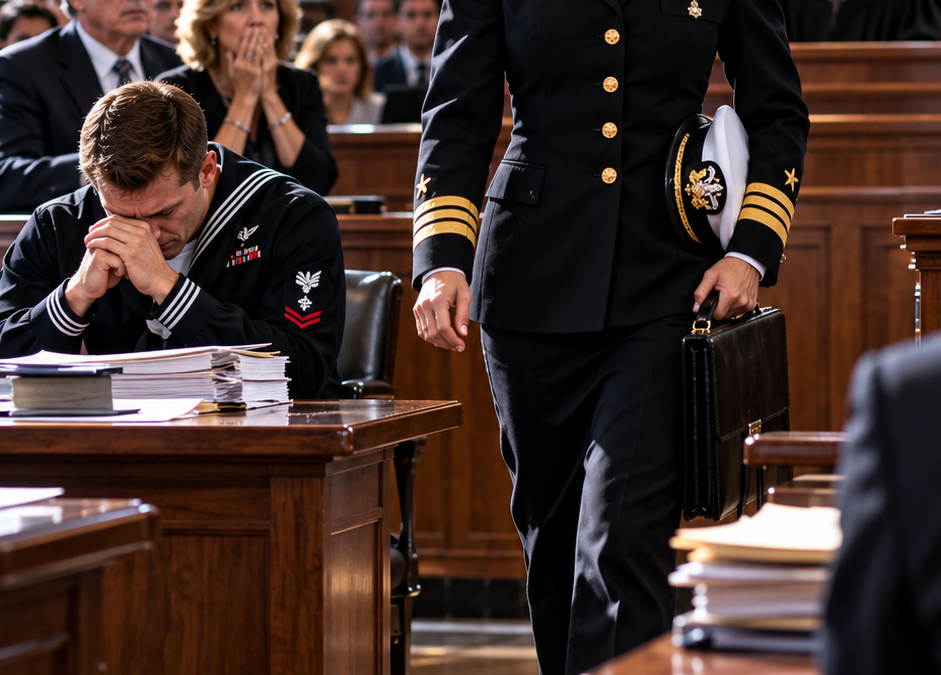
When I entered the courtroom, my parents were seated behind Tom.
Of course they were.
My mother’s hair had gone gray.
My father looked smaller than I remembered. Not weak. Not frail. Just reduced by time in a way I had not been present to witness.
Tom sat at the defense table in dress uniform, his attorney beside him. He turned when the door opened, expecting someone else.
Then he saw me.
For the first time in my life, his easy smile disappeared.
The room was called to order.
My mother looked toward the panel.
She saw me.
Her hand flew to her mouth.
My father noticed the stripes, ribbons, and insignia on my uniform and went completely still.
Not confused.
Worse.
Understanding.
Dad had never served, but he had grown up in Norfolk. Rank insignia were part of the landscape there. He knew what my shoulder boards meant.
Lieutenant commander.
Not a washout.
Not a quitter.
Not the daughter who had failed and invented a career to cover the shame.
A commissioned officer standing in a military courtroom.
The daughter they erased had not disappeared.
She had outranked the lie.
The government began with the audit record.
It sat beneath the courtroom lights, ordinary in every way except for what it contained.
A single line of text.
A timestamp.
A user credential.
A digital certification.
Thomas Mitchell.
My brother.
For several seconds, no one spoke.
The silence was different from the silence on my parents’ porch. That silence had been personal, heavy with disappointment and judgment.
This one belonged to procedure.
Facts were being allowed to exist before anyone decided what they meant.
Tom’s attorney, Lieutenant Aaron Bell, leaned toward him and whispered something I could not hear.
Tom did not answer.
He stared at the document.
The military judge adjusted her glasses.
“Counsel?”
Lieutenant Bell stood.
“Ma’am, the defense does not dispute that Petty Officer Mitchell’s credentials appear on the record. We do dispute the government’s interpretation of the timing and intent.”
The prosecutor nodded once.
“Understood.”
No raised voices.
No dramatic objections.
Just professionals placing pieces on a table.
That made it harder somehow.
I had spent most of my adult life learning that truth rarely arrived with music behind it. Most of the time, truth came in spreadsheets, signatures, timestamps, inventories, and small inconsistencies someone had almost missed.
That was my world.
Logistics was not glamorous.
It was making sure what was supposed to be somewhere actually arrived there.
It was verifying that inspections happened before approvals.
It was confirming that the number on a page corresponded to something real.
It was understanding that a tiny shortcut could travel through a system and eventually become someone else’s enormous problem.
The prosecutor moved to the next document.
“Lieutenant Commander Mitchell, can you explain what this exhibit represents?”
I looked at the panel.
“It is an automated audit entry from the logistics approval system. Every certification creates a record. The system stores the account used, the time of entry, the document being certified, and whether supporting inspection records had already been uploaded.”
“And in this instance?”
“The certification occurred at 0914.”
“And the inspection?”
“The inspection record was uploaded at 1642.”
The prosecutor paused.
“More than seven hours later?”
“Yes.”
“Is that normal?”
“No.”
“Could an administrator accidentally reverse the order?”
“Not in the system itself. The timestamp is automatic.”
Tom shifted slightly.
I kept my eyes on the document.
Not on him.
That mattered.
I was not there as his sister.
I was not there as the daughter who had been erased.
I was there because somebody needed to explain what the records meant.
The prosecutor displayed another entry.
Then another.
Five total.
Different dates.
Same pattern.
Certification first.
Inspection later.
In two cases, the inspection had been completed the following day.
Lieutenant Bell rose for cross-examination. He was younger than I had expected, perhaps thirty, with the careful manner of someone who knew that appearing aggressive toward a witness would accomplish nothing.
“Lieutenant Commander Mitchell, you testified that these entries were irregular.”
“Yes.”
“But an irregular entry does not automatically prove dishonesty.”
“No.”
“An individual could believe an inspection had occurred even if the paperwork had not yet been entered.”
“That’s possible.”
“It could be delayed entry?”
“Yes.”
“It could be a misunderstanding between departments?”
“In isolated situations.”
He noticed the qualification.
“In isolated situations?”
“Yes.”
He glanced down at his notes.
“What changes when there are several?”
“A pattern becomes relevant.”
“But still not proof of intent by itself.”
“No.”
He nodded.
“Thank you.”
He returned to his table.
For one instant, Tom looked directly at me.
There was something unfamiliar in his expression.
Not anger.
Not even fear.
It looked almost like he wanted me to help him understand something.
Then he looked away.
The government called the next witness.
Chief Petty Officer Samuel Ruiz.
Ruiz had been Tom’s supervisor during part of the period under review. He was broad-shouldered, soft-spoken, and visibly uncomfortable with being there.
He described an operations tempo that had become increasingly difficult during the previous year.
Schedules changed.
Parts arrived late.
Inspection teams were short-staffed.
Command deadlines remained fixed.
“Were people under pressure?” the prosecutor asked.
“Yes, ma’am.”
“Did that pressure justify certifying incomplete inspections?”
“No, ma’am.”
“Did Petty Officer Mitchell ever discuss the situation with you?”
Ruiz hesitated.
“Sometimes.”
“What did he say?”
“That things were backing up.”
“Did he ask for additional personnel?”
“Once.”
“And?”
“We didn’t have them.”
I watched Tom.
That was the first piece that made him look less like the effortless golden son I remembered and more like a tired sailor trying to keep too many plates spinning.
It did not excuse the records.
But it complicated them.
That was what truth often did.
It complicated the story people preferred.
During a recess, I stepped into the corridor.
The courthouse smelled faintly of polished floor wax and coffee. I had barely reached the window when I heard my name.
“Rebecca.”
My mother.
I stopped.
For twelve years, I had imagined hearing her say my name again. In some versions, she was crying. In others, I was calm and indifferent. Sometimes I imagined walking past her without answering.
None of those rehearsed moments resembled reality.
She simply stood there in a navy-blue cardigan, both hands wrapped around a paper cup she clearly was not drinking.
My father stood a few feet behind her.
Older.
That was the first thing I noticed.
Not weak.
Not diminished.
Just older.
The deep lines beside his eyes were new. His shoulders had rounded slightly. His hair was mostly silver.
My mother looked at my uniform, then at my face.
“I didn’t know,” she said.
It would have been easy to say, You could have known.
I had mailed cards.
Invitations.
Photographs.
I had offered paperwork on their porch.
I had asked them to call my command.
But the hallway was not a courtroom, and I had no desire to put twelve years of pain on display beside a vending machine.
“I know,” I said.
Her eyes filled.
“Rebecca—”
“Mom, I’m still here in an official capacity.”
She nodded quickly.
“Yes. Of course.”
My father cleared his throat.
“Lieutenant commander.”
The words sounded awkward in his mouth.
Not because he did not understand the rank.
Because he understood it too well.
He looked at my shoulder boards again.
“How long?”
“Three years.”
His expression changed.
“You’ve been a lieutenant commander for three years?”
“Yes.”
“And before that…”
“I was still serving.”
He lowered his eyes.
My mother’s fingers tightened around the cup.
“We were told—”
The courtroom door opened.
“Proceedings will resume in five minutes.”
I looked toward it.
“I have to go.”
My mother nodded.
“Rebecca?”
I turned.
Her voice was barely above a whisper.
“Is Emily well?”
That stopped me.
They had received the photograph.
Maybe every card too.
“She’s nine,” I said. “She’s doing very well.”
My mother swallowed.
“She looked like you.”
I could not tell whether she was remembering the baby photograph or something else she had seen later.
Before I could ask, the clerk called us back.
The afternoon testimony focused on altered dates.
Those troubled me more than the premature certifications.
A rushed approval could be explained by pressure.
A late upload could be administrative.
Changing the date on an inspection form required an additional decision.
The government introduced four documents.
Three had been modified using Tom’s account.
One had been modified using the credentials of another petty officer, Mark Donnelly.
Donnelly was called next.
He sat stiffly in the witness chair.
“Did you alter this record?”
“No.”
“Did you give Petty Officer Mitchell permission to use your login?”
“No.”
“Did anyone else have access to your password?”
Donnelly hesitated.
“I wrote it down once.”
The prosecutor looked up.
“Where?”
“In my desk.”
“Why?”
“I know we’re not supposed to.”
The judge said nothing, but Donnelly looked even more uncomfortable.
“We were switching between systems constantly,” he continued. “Different passwords, different expiration schedules. I wrote one down inside a notebook.”
“Was that notebook accessible?”
“If somebody opened my desk.”
Lieutenant Bell was on his feet during cross-examination.
“Petty Officer Donnelly, you cannot say who used your account.”
“No, sir.”
“You cannot say my client knew your password.”
“No, sir.”
“You cannot say whether someone else used it.”
“No.”
Tom finally looked up.
A small amount of tension left his shoulders.
Not enough to relax.
Enough to suggest this mattered.
At the end of the day, proceedings were recessed until morning.
I gathered my papers slowly.
When I stood, my parents were still in the gallery. Tom was escorted to another room with his attorney.
My mother and father remained seated.
Neither approached me.
For that, strangely, I was grateful.
I did not know yet what I wanted from them.
An apology?
An explanation?
Acknowledgment?
All three seemed both necessary and insufficient.
Outside, Michael was waiting near the parking lot. He wore jeans and a faded Navy sweatshirt, hands in his pockets.
“You okay?”
“Yes.”
He gave me the look he had perfected over fourteen years of marriage.
The one that meant he knew yes could describe anything from perfectly fine to barely holding together.
“How okay?”
I exhaled.
“My mother asked about Emily.”
His expression softened.
“What did you say?”
“That she’s nine and doing well.”
“That’s true.”
“She said Emily looked like me.”
He understood immediately.
“So they got the picture.”
“Yes.”
“Maybe they got everything.”
That thought had already begun circling in my mind.
I looked back toward the courthouse.
“I always assumed they threw the cards away.”
“They might not have.”
“That doesn’t make it better.”
“No.”
Michael never hurried me toward forgiveness.
It was one of the reasons I trusted him.
He never said family is family as though biology erased choices. He also never encouraged me to turn hurt into identity.
He simply stood beside me while I decided what I could carry and what I needed to put down.
We drove home.
Emily was at the kitchen table building a model lighthouse for school. The cardboard tower leaned slightly to the left.
She held it up proudly.
“Structural engineering is harder than it looks.”
Michael inspected it.
“Needs more tape.”
“It has lots of tape.”
“Then it needs strategic tape.”
She rolled her eyes in a way that made me laugh.
That evening, after she went upstairs, I told Michael about the testimony.
“The modified dates bother you,” he said.
“Yes.”
“Because they’re harder to explain.”
“Exactly.”
“And you think there’s more.”
“There always is.”
He smiled faintly.
“You say that about every audit.”
“Because every audit begins when somebody notices the smallest thing.”
He reached across the table and covered my hand.
“And your parents?”
I looked toward the stairs.
“They believed Tom because believing Tom was easy.”
Michael waited.
“They had always believed him,” I continued. “Even when we were kids.”
A memory surfaced.
I was fifteen.
Tom was seventeen.
Dad’s favorite socket wrench set disappeared from the garage.
Tom said I had borrowed it for a school robotics project.
I had not.
Dad grounded me for lying.
Three weeks later, the wrench set appeared in Tom’s friend’s truck.
Nobody apologized.
Mom said, “At least it turned up.”
Small things teach children where they stand.
I had forgotten that memory until now.
Or perhaps I had packed it away because the larger betrayal made everything before it seem insignificant.
“Why did he tell them you quit?” Michael asked.
“I don’t know.”
“You never asked him?”
“I tried.”
Once.
A year after the porch, I called Tom from a pay phone while on temporary duty. He answered with music playing behind him.
“Why did you tell Mom and Dad I left the Navy?”
A pause.
Then a laugh.
“I didn’t.”
“They said you did.”
“They misunderstood.”
“Then call them.”
“I’m busy, Bec.”
“Tom.”
“Look, they were worried. You disappeared. You barely called.”
“I was at training.”
“Whatever. I’ve got to go.”
The line went dead.
I called my mother immediately afterward.
She did not answer.
I never called Tom again.
The next morning, I returned to court.
My parents were already seated.
Tom looked exhausted.
The government’s first witness was a civilian logistics analyst named Priya Shah. She had discovered the irregularities.
She explained that the system flagged a cluster of premature certifications because the shipment involved serialized components requiring two independent confirmations.
“What made you look deeper?” the prosecutor asked.
“One of the confirmation numbers didn’t exist.”
A document appeared on the screen.
A sequence of letters and numbers.
Priya pointed to the last four digits.
“Our confirmation numbers are generated sequentially by the inspection system. This number fell outside the sequence for that date.”
“Could that happen normally?”
“No.”
“Who entered it?”
“Petty Officer Mitchell’s account.”
Tom closed his eyes.
The defense asked whether someone else could have used his credentials.
“Yes,” Priya acknowledged. “If they had his authentication token.”
“Was remote access possible?”
“During that period, yes.”
That changed the room.
Not dramatically.
But noticeably.
The prosecution continued.
“Did you examine access records?”
“Yes.”
“And?”
“Three of the disputed entries were made from Terminal Four in the logistics office.”
“Could Petty Officer Mitchell have been at that terminal?”
“Yes.”
“Could someone else?”
“Yes.”
“Any others?”
“One entry was made remotely.”
The prosecutor looked toward Tom.
“When?”
Priya gave the date.
I remembered it from the case file.
Tom had been recorded as being on emergency leave that day.
The defense attorney stood.
“Petty Officer Mitchell was not on base.”
“That’s correct.”
“Do you know where he was?”
“No.”
Tom leaned toward his attorney.
They whispered.
The prosecutor requested a short recess.
In the corridor, I saw my father standing alone near the window.
For several moments, neither of us spoke.
Finally he said, “Your mother kept the cards.”
I looked at him.
“All of them?”
He nodded.
“She has a box.”
Something inside me shifted.
Not softened.
Shifted.
“Why?”
“I don’t know.”
“That isn’t true.”
He looked down.
“No. It isn’t.”
He rubbed his thumb over one knuckle.
“When the first one came, she wanted to open it. Tom said you were embarrassed. Said you were pretending everything was fine.”
I stared at him.
“And you believed that?”
“At first.”
“And later?”
My father’s mouth tightened.
“We kept telling ourselves there had to be an explanation.”
“There was. I gave it to you.”
“I know.”
His voice cracked slightly on the last word.
I had never heard my father sound uncertain when I was young. He had been the kind of man who could fix an engine, balance a checkbook, and give directions without consulting a map.
Certainty had been part of who he was.
Now he looked at me with the expression of someone realizing certainty could be one of the easiest places to hide from the truth.
“I should have called,” he said.
“Yes.”
“I should have checked.”
“Yes.”
He nodded.
No excuses.
That mattered.
Not enough.
But it mattered.
“Why didn’t you?” I asked.
He took a long breath.
“Pride.”
I waited.
“And fear.”
“Fear of what?”
“That we had been wrong.”
There it was.
Simple.
Ordinary.
Human.
No conspiracy.
No grand reason.
Just two parents who made a terrible decision and then spent years avoiding the evidence that might prove it.
“Once enough time had passed,” Dad said, “calling you meant admitting we should have called sooner.”
“So you let more time pass.”
“Yes.”
A clerk stepped into the corridor.
“Court will reconvene.”
Dad looked at me.
“I don’t expect that to make sense.”
“It makes sense.”
He looked surprised.
“Making sense isn’t the same as being acceptable.”
He nodded.
“No.”
We returned to court.
The remote entry became the focus of the afternoon.
Tom’s emergency leave had been approved because our grandmother, our mother’s mother, had suffered a stroke.
I had not known.
That realization landed quietly.
Grandma Helen had died seven years earlier. I learned about it six months after the funeral through an old classmate’s social media post. I remembered sitting alone in my office after hours, staring at the screen.
I had sent my grandmother birthday cards every year.
Apparently those had disappeared into the same silence.
Tom had gone home when she became ill.
The disputed certification had been entered remotely from an external device using his login credentials and authentication token.
Lieutenant Bell asked Priya whether the token could have been used by someone other than Tom.
“Yes.”
“How?”
“If Petty Officer Mitchell left his authenticated device accessible.”
“Was there a device associated with the login?”
“A command-issued laptop.”
“Do the records show its physical location?”
“Not precisely. Only the network connection.”
The prosecution introduced travel records.
Tom had checked into a hotel in Richmond that evening.
The login occurred at 10:43 p.m.
The hotel’s business network had been the connection point.
That seemed damaging until Bell asked one more question.
“Was Petty Officer Mitchell the only sailor from his unit staying at that hotel?”
Priya consulted the record.
“No.”
“Who else was there?”
She named two people.
One was Mark Donnelly, the petty officer whose credentials had been used on another altered document.
The other was Senior Chief Daniel Mercer.
At that name, Chief Ruiz, seated behind counsel, looked sharply toward the screen.
I noticed.
So did the prosecutor.
Senior Chief Mercer had retired six months earlier.
The next witness was not scheduled to appear until after lunch. Instead, the prosecution requested time to review newly relevant access records.
The judge approved.
During the break, Tom asked through his attorney whether he could speak to me.
The answer was no.
Not yet.
Our roles made informal discussion inappropriate.
But as he walked past me, escorted toward a consultation room, he said only one word.
“Rebecca.”
I looked at him.
“I didn’t tell them you quit.”
His attorney immediately touched his arm.
“Tom.”
He stopped talking.
I watched the door close behind him.
That sentence stayed with me all afternoon.
I had heard him deny it twelve years before.
At the time, I assumed denial was simply another lie.
Now I was not sure.
That did not mean I believed him.
It meant I had learned enough in my career to distrust certainty when evidence was incomplete.
That evening, Mom called.
I almost let it ring.
Michael was washing dishes. He glanced toward the phone but said nothing.
I answered.
“Hello?”
“Rebecca.”
Her voice was careful.
“I hope I’m not interrupting.”
“You’re not.”
A long pause.
“I wanted to tell you something before tomorrow.”
I sat at the kitchen table.
“All right.”
She drew a breath.
“The night you came home in uniform…”
I closed my eyes.
“I remember.”
“Tom wasn’t there.”
“I know.”
“He had called earlier.”
My fingers tightened around the phone.
“What did he say?”
“He said you had been released from training.”
“That I quit?”
Another pause.
“No.”
I opened my eyes.
“What exactly did he say?”
“He said, ‘Rebecca isn’t where she says she is anymore.’”
I felt a chill despite the warm kitchen.
“That could mean anything.”
“I know.”
“What else?”
“He said you had gotten into trouble and that you were ashamed. He said we shouldn’t embarrass you by demanding proof.”
I stood and walked toward the window. Outside, Emily’s bicycle lay on its side beside the garage.
“Mom, I offered you proof.”
“I know.”
“You refused to look.”
“I know.”
Her voice shook, but she continued.
“There’s more.”
I waited.
“When you came to the house, your father had received a letter two days earlier.”
“What letter?”
“We thought it was from the Navy.”
Every thought in my mind stopped.
“What?”
“It said you had been separated from service.”
My mouth went dry.
“I was never separated.”
“We know that now.”
“Where is the letter?”
“I still have it.”
“Why?”
“I kept everything.”
The box.
The cards.
The photograph.
And apparently a letter I had never known existed.
“Who sent it?”
“There was no personal name. Just an office heading.”
“Do you still have the envelope?”
“Yes.”
“Bring it tomorrow.”
“Rebecca—”
“Bring it.”
“I will.”
After we hung up, Michael looked at me.
“What happened?”
I told him.
He dried his hands and sat across from me.
“Could Tom have made it?”
“I don’t know.”
“Would twenty-year-old Tom have known enough to fake Navy separation paperwork?”
“Maybe. Maybe not.”
I thought about Tom at twenty.
Confident.
Popular.
Already accustomed to being believed.
But Navy administrative terminology was specific.
Codes.
Headers.
Phrases.
Someone unfamiliar with the system might imitate the appearance of an official letter, but a knowledgeable person could usually spot problems.
The next morning, my mother handed me a manila envelope outside the courtroom.
“I didn’t open the box last night,” she said. “I knew exactly where it was.”
The envelope was yellowed slightly at the edges.
My father stood beside her.
Neither spoke while I removed the letter.
At first glance, I understood why they had believed it.
Department heading.
Official-looking formatting.
My full name.
A statement that I had been administratively separated for failure to complete required accession standards.
My chest tightened.
Then my training took over.
I read it again.
Something was wrong.
Several things, actually.
The terminology was close.
Very close.
But not exact.
The routing code belonged to a logistics processing office, not personnel.
At the bottom was a reference number.
I stared at it.
The first four digits.
I had seen them before.
Not in my own records.
In the hearing.
I turned toward the courtroom doors.
“Where did this come from?”
My mother shook her head.
“It was mailed to the house.”
“The envelope.”
She handed it to me.
Postmarked Norfolk.
No return address.
I looked again at the routing code.
Then at the courtroom.
Logistics.
Not personnel.
My father noticed my expression.
“What is it?”
“This wasn’t produced by a personnel command.”
“What does that mean?”
“I don’t know yet.”
For once, those words did not frighten me.
They focused me.
Inside the courtroom, the prosecutor was reviewing the newly retrieved access logs.
Senior Chief Mercer’s name appeared again.
He had supervised Tom’s section when Tom first joined the unit years earlier. Before retirement, Mercer had held broad administrative permissions across several logistics systems.
The same family of systems whose routing codes appeared on the letter my parents received twelve years ago.
I did not mention the letter during proceedings.
It was unrelated evidence until properly examined.
But at lunch, I contacted my commanding officer and disclosed it.
By late afternoon, an administrative specialist confirmed what I suspected.
The routing code on the false separation notice belonged to Naval Supply Operations Center 41.
The center had been reorganized years ago.
Twelve years earlier, one junior sailor assigned there had recently gained access to its document templates.
Thomas Mitchell.
My brother.
I sat very still when I heard that.
For years, part of me had believed the question was simple.
Why had Tom lied?
Now there was a different question.
Had he lied?
Because the metadata review brought back something no one expected.
The template used to create the false separation letter had not been accessed under Tom’s account.
It had been accessed under the credentials of Senior Chief Daniel Mercer.
The same retired senior chief whose name had just surfaced in Tom’s current case.
And according to archived duty records, twelve years earlier, Daniel Mercer had been the petty officer responsible for training twenty-year-old Thomas Mitchell.
The prosecutor closed the file slowly.
“This may be unrelated,” she said.
“Maybe,” I answered.
But I no longer believed in coincidences merely because they were convenient.
For twelve years, I had thought my family had been destroyed by one sentence from my brother.
Now I was beginning to wonder whether Tom had been telling the truth about at least one thing.
Maybe he had never said I quit.
Maybe someone else had given my parents a reason to believe I had.
And if Daniel Mercer had been involved twelve years ago, why was his name appearing again beside another set of records that made Tom look guilty?
That evening, as I left the courthouse, Tom stood on the far side of the corridor with Lieutenant Bell.
For the first time since the hearing began, he did not look away.
He looked at the old envelope in my hand.
Then his face changed.
Not surprise.
Recognition.
And that was when I knew my brother had seen it before.
I slept badly that night.
Not because I was afraid Tom might be innocent.
Because I was afraid the truth would be messier than innocence or guilt.
By morning, the hearing had shifted. The judge allowed limited inquiry into Mercer’s access only as it related to the current logistics allegations. The false separation letter would not become a sideshow unless it proved connected.
That was proper.
Frustrating.
But proper.
The government called a digital forensics specialist, Lieutenant Commander Nadia Park.
She had the calm voice of someone who had spent years explaining complicated data to people who wanted simple answers.
She walked through system logs, credential access, remote authentication, and device histories.
The first three certifications still traced to Tom’s account from Terminal Four.
No one disputed that.
But the altered dates told a different story.
Two had been modified using administrative functions Tom should not have been able to access.
One used Donnelly’s credentials.
One used Tom’s account while his authentication token was active at the Richmond hotel.
Then Park displayed a separate table.
Administrative override access.
Daniel Mercer.
A murmur moved through the courtroom before the judge silenced it with one look.
The prosecutor approached the screen.
“Lieutenant Commander Park, what does this table show?”
“Administrative access events associated with Senior Chief Daniel Mercer’s credentials during the period in question.”
“Was Senior Chief Mercer still on active duty at that time?”
“Yes.”
“And these access events occurred when?”
“Several occurred within minutes of disputed changes to inspection forms.”
“Could that be coincidental?”
“It could be, but additional logs show that the same session queried user credential statuses for Petty Officer Mitchell and Petty Officer Donnelly.”
Lieutenant Bell stood.
“Ma’am, may we approach?”
The judge allowed it.
I watched from my seat, face still, hands folded.
Inside, my thoughts were moving too fast.
Mercer had not simply appeared around the edges.
He had been inside the records.
When proceedings resumed, the judge allowed the government to call Chief Ruiz again.
Ruiz looked even more uncomfortable than before.
“Chief,” the prosecutor said, “did you ever raise concerns about Senior Chief Mercer’s recordkeeping practices?”
Ruiz hesitated.
“Yes, ma’am.”
“When?”
“Informally, several times.”
“What concerned you?”
“He believed paperwork should catch up to operations.”
The sentence hung there.
Paperwork should catch up to operations.
Every logistics officer in the room understood the danger inside it.
The prosecutor’s voice remained even.
“What does that mean?”
“That if the command needed something moved or certified, he would approve based on expectation that the inspection would be completed. He said the process was too slow.”
“Did Petty Officer Mitchell follow that practice?”
Ruiz looked at Tom.
Then back at the prosecutor.
“At times, yes.”
Tom closed his eyes.
That mattered.
The prosecutor continued.
“Did you ever see Petty Officer Mitchell alter an inspection date?”
“No, ma’am.”
“Did you ever hear Senior Chief Mercer instruct anyone to alter a date?”
Ruiz swallowed.
“I heard him say, ‘Fix the paper so it matches what should have happened.’”
“When?”
“Last year.”
“Who was present?”
“Several people.”
“Petty Officer Mitchell?”
“Yes.”
“Did Petty Officer Mitchell respond?”
Ruiz hesitated.
“He said, ‘That’s not how the system works.’”
For the first time, I saw my mother cover her mouth for a different reason.
The defense called Tom after lunch.
It was a risk.
Everyone knew it.
Tom looked pale when he took the stand, but the old charm was gone. In its place sat something stripped down and far more human.
Lieutenant Bell began gently.
“Petty Officer Mitchell, did you certify inspections before the supporting inspection uploads were in the system?”
Tom took a breath.
“Yes.”
“Why?”
“Because I believed the inspections had occurred or were already in progress. Because we were behind. Because I was stupid enough to think the paperwork order didn’t matter if the physical work got done.”
My jaw tightened.
He did not look at me.
“Did anyone pressure you?”
“Yes.”
“Who?”
“Senior Chief Mercer.”
“What did he say?”
“That people who slowed down the system didn’t understand operational reality. That if I wanted to advance, I needed to stop acting like the Navy was a classroom.”
“Did he instruct you to falsify dates?”
Tom paused.
“Not in those exact words.”
“What words did he use?”
“Make the record match the mission.”
I had heard versions of that before.
Every institution has phrases that sound efficient until someone uses them to bury accountability.
Bell continued.
“Did you alter the inspection dates at issue?”
“No.”
“Did you create the false confirmation number?”
“No.”
“Did you use Petty Officer Donnelly’s credentials?”
“No.”
“Did you authorize anyone to use your credentials while you were on emergency leave?”
“No.”
Bell walked him through the Richmond hotel.
Grandma Helen’s stroke.
The laptop.
The hotel business center.
The fact that Tom had left his command-issued laptop bag in a conference room during a call with our mother because the hospital had just phoned with an update.
“Who else was in the hotel that night?”
Tom looked toward the prosecutor.
“Senior Chief Mercer. Donnelly. Me.”
“Did Senior Chief Mercer have access to your laptop?”
“He could have.”
“Why?”
“Because I was careless.”
Bell paused.
“Careless or complicit?”
“Careless.”
The word cost him something.
Good.
Some words should.
Then Bell asked the question I had been waiting for and dreading.
“Petty Officer Mitchell, twelve years ago, did you tell your parents your sister had quit the Navy?”
Tom looked toward the judge.
The prosecutor objected.
The judge sustained it as beyond the scope, but not before Tom’s face broke in a way I had never seen.
Not like a man caught.
Like a man who had carried a rot inside a sealed place for too long.
The judge instructed counsel to move on.
But the damage had been done.
During the next recess, Lieutenant Bell approached me with the prosecutor present.
“Lieutenant Commander Mitchell,” Bell said carefully, “my client is prepared to make a statement regarding the old document, but only through proper channels.”
The prosecutor looked at me.
“You do not have to be part of that.”
“I know.”
“You probably should not be part of the initial statement.”
“I know that too.”
I hated knowing.
But I stepped back.
That afternoon, outside my presence, Tom gave a sworn statement.
I did not see it until the next day, after the legal staff determined what could be disclosed to me as a potential witness regarding the old letter.
The statement was three pages.
I read it alone in a conference room.
Tom admitted that, twelve years earlier, he had complained to Senior Chief Mercer about me.
About my scholarship.
About our parents comparing us.
About the way I had left home and still somehow occupied space in every conversation.
He said Mercer told him women like me “usually washed out once the Navy stopped applauding potential.”
Tom denied believing him.
Then admitted he had wanted to.
That line stopped me.
I read it three times.
I wanted to believe her failure because it made my success feel safe.
There it was.
Not the whole story.
But enough of it.
Tom said Mercer later showed him a copy of the false separation letter as a joke.
A lesson.
A way to prove how easily families believed official paper.
Tom said he told Mercer to destroy it.
Mercer laughed.
Two days later, my parents received it.
Tom swore he did not mail it.
But he admitted that when our mother called him, frightened and confused, he did not tell her what he had seen.
He used vague words.
He implied trouble.
He let the lie breathe because it served him.
Then I came to the porch in uniform.
And he still said nothing.
By the time he understood what had happened, years had passed, and the truth had become too heavy for him to pick up.
I set the statement down.
For twelve years, I had imagined Tom as the architect of my exile.
Now I saw him more accurately.
He had not built the whole house.
But he had held the door closed.
That distinction mattered.
It did not absolve him.
The hearing concluded three days later.
The findings were not simple.
Tom was found responsible for negligent certification practices and failure to protect government systems.
He was not found responsible for intentional falsification of the altered dates or the fabricated confirmation number.
Senior Chief Daniel Mercer was referred for separate investigation, along with evidence that he had misused administrative credentials, manipulated logistics records, and created unauthorized correspondence years earlier using official templates.
The judge’s words were careful.
The consequences were real.
Tom’s career would not continue unchanged.
Maybe it would not continue at all.
But he was no longer the only name attached to the lie.
When the hearing adjourned, no one moved quickly.
My parents sat in the gallery, stunned by a truth that had become more complicated than either of their children being simply good or bad.
Tom stood at the defense table.
For a moment, he looked twelve years old.
Then he walked toward me.
His attorney stayed close, but did not stop him.
“Rebecca.”
I kept my face still.
“Yes.”
He swallowed.
“I didn’t make the letter.”
“I know.”
His eyes filled.
“But I knew enough.”
I said nothing.
“I wanted them to believe it,” he whispered. “Not forever. I told myself not forever.”
My throat tightened.
“That’s what people tell themselves when they don’t want to admit they’re choosing.”
He flinched.
Good.
“I was jealous,” he said. “I hated that you left and somehow still mattered. I hated that Mom kept saying you were brave. I hated that Dad would get quiet when your letters came. I thought if you came back embarrassed, everything would go back to normal.”
“It didn’t.”
“No.”
“You let them close the door.”
He looked down.
“Yes.”
“You let them miss my wedding.”
His face crumpled.
“Yes.”
“You let them miss Emily.”
“I know.”
“No,” I said, my voice finally breaking. “You don’t. You don’t know what it was like explaining to a child why Grandma and Grandpa never came. You don’t know what it was like mailing photographs into silence. You don’t know what it cost me to stop hoping.”
Tears slipped down his face.
For once, he did not try to charm them away.
“I’m sorry,” he said.
I had imagined those words for years.
I thought they would feel larger.
They did not.
They were necessary.
But small.
“I hear you,” I said.
He nodded as if that was more than he deserved.
It was.
My parents approached after Tom stepped away.
My mother held the box.
The one from their house.
Cards.
Invitations.
Photographs.
Every piece of proof they had refused to answer.
“I brought it,” she said.
Her voice shook.
“I don’t know why. I thought maybe… I don’t know what I thought.”
I looked at the box.
There was a Christmas card on top.
Emily had been three when we sent it.
She wore a red sweater and had one hand on Michael’s flight helmet, grinning like she had conquered aviation.
My mother touched the edge of the photo.
“I kept looking at her.”
I wanted to be angry.
I was angry.
But there was something else beneath it.
A grief I had not expected.
“You could have known her.”
Mom closed her eyes.
“I know.”
My father stood beside her, hands at his sides.
“I failed you,” he said.
The directness startled me.
He did not say we.
He said I.
“I believed what let me stay proud,” he continued. “I believed Tom because if I believed you, I had to admit I had closed the door on my daughter.”
My mother began to cry silently.
Dad’s voice roughened.
“I should have opened the door.”
I looked at both of them.
For twelve years, I had wanted them to understand.
Now they did.
It was not enough.
But it was something.
“I’m not ready to make this easy for you,” I said.
My mother nodded quickly.
“You don’t have to.”
“I won’t pretend those years can be repaired because you finally know the truth.”
Dad swallowed.
“I understand.”
“I have a husband you did not meet. A daughter you ignored. A life that kept going without you.”
Mom hugged the box to her chest.
“Can we meet her?”
The question was almost too much.
I looked toward the hallway where Michael waited, giving me distance but never absence.
“I don’t know yet.”
My mother nodded again.
A tear slipped down her cheek.
“All right.”
“But you can write to her,” I said.
Both of them looked at me.
“One letter,” I continued. “To Michael and me first. Not to her directly. You tell the truth. Not every detail, but enough. No excuses. No blaming Tom alone. No pretending you were tricked beyond your ability to choose.”
Dad’s eyes filled.
“We can do that.”
“If you can’t, then we stop here.”
“We can,” Mom whispered.
Tom stood several feet away, listening.
I looked at him.
“You too.”
He nodded.
“Yes.”
“And Tom?”
“Yes?”
“You don’t get to be the bridge.”
He looked confused.
“You don’t get to manage them. You don’t get to explain me to them or them to me. You don’t get to soften what happened so everyone can feel less guilty.”
He lowered his eyes.
“Okay.”
“For once, you step aside and let people speak for themselves.”
“I will.”
I believed him.
Not fully.
But enough to leave the courthouse without feeling like I had abandoned myself.
That night, at home, Emily sat beside me on the couch while Michael made popcorn in the kitchen.
She leaned against my shoulder.
“Was court hard?”
“Yes.”
“Did you win?”
I smiled faintly.
“It wasn’t that kind of court.”
“All courts are kind of that kind of court.”
Michael called from the kitchen, “She has a point.”
I looked at our daughter.
“I told the truth. Other people told some truth too. That’s probably the best answer.”
Emily considered that.
“Did Uncle Tom do the bad thing?”
“Some bad things,” I said. “Not all the bad things people thought.”
“That sounds complicated.”
“It is.”
She nodded.
Then asked, “Are Grandma and Grandpa real?”
The question hit so hard I could not answer for a moment.
Michael appeared in the doorway, popcorn bowl in hand, his expression soft.
I turned to Emily.
“Yes,” I said carefully. “They’re real.”
“Did they not like me?”
“No.” My voice broke, and I steadied it. “No, sweetheart. This was never because of you.”
“Was it because of you?”
For twelve years, a part of me had feared that.
Even after promotions.
Marriage.
Motherhood.
Even after building a life no lie could erase.
Some part of me had remained on that porch, holding paperwork no one wanted to read.
“No,” I said. “It wasn’t because of me either.”
She accepted that because children often understand truth faster when adults stop decorating it.
“Can I have popcorn?”
Michael handed her the bowl.
Life, in its mercy and cruelty, moved on.
Three weeks later, the first letter arrived.
My parents wrote it together.
It was four pages.
Not perfect.
Not clean.
But honest enough.
They told us they had believed something false because believing it had been easier than questioning the son they trusted and facing the daughter they did not understand.
They wrote that they had kept every card.
They wrote that they had no right to ask for forgiveness but hoped, someday, to meet Emily if we allowed it.
Tom’s letter came separately.
His was shorter.
Harder to read.
No polished emotion.
No attempt to make himself the victim of Mercer’s manipulation.
He wrote:
I did not create the whole lie, but I used it. I let it become useful to me. That makes me responsible for more than I wanted to admit.
I folded the letter and placed it in a drawer.
Not thrown away.
Not answered yet.
That was the place we were in.
Months passed.
The Mercer investigation widened.
Other records surfaced.
Old shortcuts.
Unauthorized templates.
Administrative overrides.
The false separation letter became part of a separate inquiry into misuse of official systems. It did not undo twelve years, but it did what official truth sometimes can do.
It put names on actions.
It separated assumption from evidence.
It made the lie stop floating like family weather and become something documented.
Something accountable.
Tom accepted administrative discipline for the certifications he had made prematurely. His career stalled. Whether it would recover was not my decision.
For once, I did not want it to be.
My parents met Emily on a Saturday in early spring.
Neutral ground.
A park near our house.
Michael came.
So did I.
Emily wore jeans, sneakers, and the serious expression she used when meeting adults she had already decided were on probation.
My mother cried before she reached us.
Emily looked up at me.
“Is she okay?”
“She’s emotional.”
“Is that allowed?”
“Today, yes.”
My father brought a small wooden box.
He had made it himself.
Inside were copies of every card I had sent them, arranged by year. Not the originals. Those, he said, belonged to me if I wanted them. But he had made copies because he wanted Emily to know they had existed.
Emily looked through them slowly.
“That’s me as a baby.”
“Yes,” Mom whispered.
“You kept it?”
“Yes.”
Emily glanced at me.
I did not rescue anyone from the discomfort.
My daughter deserved truth too.
“You kept it but didn’t write back?” she asked.
My father closed his eyes briefly.
“Yes.”
“That was mean.”
My mother let out a soft, broken laugh.
Not because it was funny.
Because it was exactly true.
“Yes,” she said. “It was.”
Emily nodded.
Then continued looking through the photographs.
That was the beginning.
Not forgiveness.
Not reunion.
Beginning.
A year later, I stood in dress whites again.
This time, not in a courtroom.
A promotion ceremony for someone else in my department. I had been asked to speak about integrity in logistics, the kind of topic that makes civilians’ eyes glaze over and keeps ships, aircraft, and people alive.
Emily sat in the front row beside Michael.
My parents sat three rows behind them.
Tom did not come.
He had written to ask if it would be all right.
I said no.
Not unkindly.
Just no.
Some bridges needed more time before they could hold weight.
After the ceremony, my father approached while Emily showed Michael a program she had folded into something that vaguely resembled an aircraft.
Dad looked at my uniform.
Then at me.
“I don’t think I ever told you,” he said.
“What?”
“That it suits you.”
For a second, I was back on the porch.
Dad, look at me.
This time, he did.
Not perfectly.
Not soon enough.
But fully.
“Thank you,” I said.
His eyes shone.
My mother joined us, holding a photograph from the ceremony. In it, Emily was saluting me again, much taller now than she had been at my promotion years earlier.
“She still does that?” Mom asked.
“Only when she wants something.”
Michael called from across the room, “She wants dinner.”
Emily yelled, “Strategic dinner.”
I laughed.
And this time, I did not cry alone afterward.
That night, after everyone left, I stood in our bedroom and hung my uniform carefully in the closet.
Michael leaned in the doorway.
“You okay?”
I thought about Tom.
About Mercer.
About my parents’ half-open door.
About a false letter with a logistics routing code.
About all the cards kept in a box but never answered.
About truth arriving late, incomplete, and still powerful enough to change the shape of what came next.
“Yes,” I said.
Michael raised an eyebrow.
I smiled.
“Actually yes.”
He crossed the room and kissed my forehead.
After he left, I touched the sleeve of my dress whites.
For twelve years, my parents had believed the uniform was part of a story I invented to cover failure.
They were wrong.
But the uniform had never needed them to believe in it to be real.
Neither had I.
That was the lesson I carried forward.
Not that truth always wins quickly.
It does not.
Not that family always heals once the facts are known.
Sometimes it does not.
But a lie, even one left alone for twelve years, is still vulnerable to one document opened under bright lights.
One timestamp.
One old envelope.
One daughter who kept serving anyway.
And one day, when the room was finally called to order, I walked in wearing the life they thought I had lost.
I stood straight.
I told the truth.
And this time, they had to look.








