𝗙𝗨𝗟𝗟 𝗦𝗧𝗢𝗥𝗬 The Cop Wouldn’t Let Me Answer the Call My Hospital Kept Making
𝗙𝗨𝗟𝗟 𝗦𝗧𝗢𝗥𝗬
I could feel the first signs of frustration.
I looked toward the valet podium, where Jordan was watching us.
“That young man handed me the keys. He can confirm that the rental was brought to me.”
Callaway didn’t turn around.
“I’ll decide who I need to talk to.”
Behind him, a second officer approached.
She was a young woman with dark hair secured behind her head and a calm, observant expression.
Her name was Elena Ruiz.
I would later learn that she had three years of patrol experience and had been helping Callaway manage traffic outside the hotel.
She had also noticed something her partner seemed determined to ignore.
The rental keys were clearly visible in my right hand.
I wasn’t running.
I hadn’t attempted to conceal the bag.
There was no broken window, damaged lock, or other obvious indication that the SUV had been stolen.
And the valet who had just handed me the vehicle was standing less than twenty yards away.
But Callaway had already decided I was suspicious.
And every attempt I made to explain the situation seemed to strengthen that decision.
“Whose vehicle is this?” he demanded.
“It’s rented under my name.”
“Registration?”
“The rental company is the registered owner. My agreement is inside.”
He glanced toward the open cargo compartment.
“Convenient.”
I looked at him carefully.
“Officer, I can provide identification and the rental agreement. But I need you to understand that the hospital is waiting for me.”
He waved his hand.
“Put the phone away before you make this harder.”
I slipped it into my coat.
Then I slowly reached toward the hospital identification clipped inside the left side of my jacket.
“My medical credentials are right here.”
Callaway’s shoulders tightened.
“Don’t reach for anything!”
I stopped immediately.
“It’s my hospital ID.”
“Hands where I can see them.”
I raised both hands.
“All right. They’re visible.”
He took another step toward me.
“What did I just tell you?”
“That you wanted to see my hands.”
“Then stop reaching.”
I looked down at the identification still clipped inside my coat.
“You asked me to explain what I’m doing. I’m trying to show you.”
He didn’t answer.
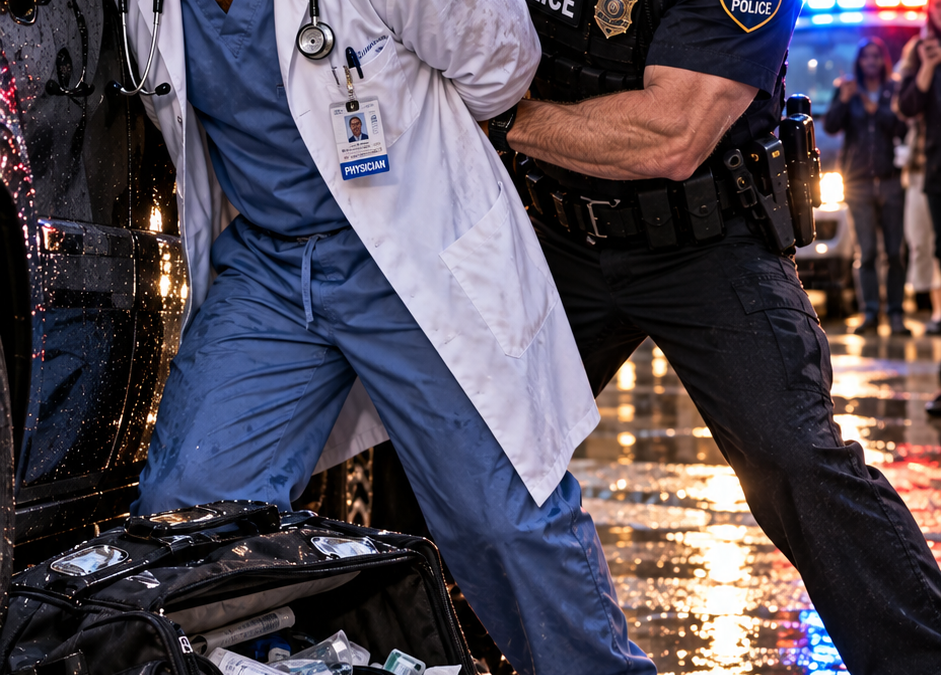
Instead, he reached toward my left hand and grabbed the strap of my medical bag.
“What’s in this thing?”
“Medical supplies. Please be careful with it.”
He pulled.
The strap dragged painfully across my fingers.
I released it rather than struggle.
He examined the bag for barely a second.
Then, without warning, he turned it upside down.
The contents spilled across the wet sidewalk.
My stethoscope struck the concrete near the curb.
Sealed gloves, gauze packets, instrument cases, and individually wrapped medical supplies scattered beneath the hotel canopy. A compact kit opened on impact, and several packages slid toward a shallow stream of rainwater running along the edge of the street.
For several seconds, I couldn’t move.
I stared at the equipment.
I had spent nearly twenty-five years caring for people during the worst moments of their lives.
I had operated on patients who insulted me before they understood how badly they were hurt. I had treated intoxicated drivers whose decisions had killed innocent people. I had worked through nights when exhausted nurses were crying in supply rooms because there wasn’t time for anyone to recover between emergencies.
I had never expected gratitude from every person I treated.
But I had always believed that explaining I was a physician responding to an emergency would at least persuade someone to listen.
Now my equipment was scattered across dirty pavement, and the man responsible appeared more irritated by my silence than concerned about what he’d done.
“What?” Callaway demanded. “Got something to say?”
I swallowed.
“Some of those supplies are sterile.”
He looked toward the pavement.
“Then you shouldn’t have made this difficult.”
I felt anger rising so abruptly that I had to concentrate on my breathing.
“My bag was in my hand, Officer. I wasn’t resisting you.”
“Don’t start arguing.”
“I’m explaining that the equipment may be contaminated.”
He widened his stance.
“Are you going to cooperate or not?”
I looked at the stethoscope lying near the curb.
A car was approaching the arrival lane.
Before I could say anything, Jordan hurried forward and stopped it from sliding into the traffic lane with the side of his shoe.
“Officer, that’s Dr. Hayes’s bag,” he said.
Callaway glanced at him.
“Stay back.”
Jordan raised both hands.
“I work here. I brought him the SUV.”
“I said stay back.”
Jordan stopped.
I could see that he was frightened.
He wasn’t trying to interfere with an arrest. He was a young employee attempting to explain something he had personally witnessed.
Yet Callaway treated him as another problem to control.
I looked down at the scattered equipment again.
My hospital identification had fallen from my coat and landed face down near the SUV’s rear tire.
I bent slightly toward it.
“Officer, my ID is right there. Please let me pick it up.”
Callaway moved immediately.
His hand caught my upper arm.
Before I could straighten, he pushed me toward the SUV.
My palms struck the damp black paint.
“Don’t move!”
For a brief instant, I was too shocked to speak.
The cold metal of the vehicle pressed against my hands. My shoulder tightened beneath his grip, and I could feel the handcuff case on his duty belt close to my arm.
“I was reaching for the identification you asked for.”
“You’re not going to tell me what you were doing.”
“I just told you.”
“One more move, and you’re going in handcuffs.”
I stopped speaking.
Not because I agreed with him.
Because I understood that the next few seconds could become dangerous if I allowed my frustration to determine my reaction.
My phone vibrated again.
It was pressed against my chest inside the coat.
I couldn’t see the screen, but I knew who was calling.
The hospital.
I pictured Aaron Patel standing near the trauma bay with the phone in his hand.
I pictured nurses preparing equipment, an anesthesiologist reviewing the patient’s condition, and a surgical team waiting for information they needed before proceeding.
I didn’t know how unstable the patient had become.
That uncertainty frightened me more than Callaway’s threats.
“Officer,” I said, “please let me answer the phone.”
“Not happening.”
“It’s my hospital.”
“You can make calls when we’re finished.”
I closed my eyes.
“Someone may not have that much time.”
He leaned closer.
“Everybody’s got a story.”
I turned my head slightly.
“Then verify mine.”
His hand tightened on my arm.
“Face the vehicle.”
I obeyed.
A few feet behind us, Elena had begun examining the contents of my bag.
I could hear her shoes moving across the pavement.
She bent beside the SUV’s rear tire and picked up the identification card.
When she turned it over, her expression changed.
“Brent.”
He didn’t move.
“What?”
“Look at this.”
She stepped closer.
I couldn’t see the card, but I knew exactly what it said.
Dr. Malcolm Hayes.
Chief of Trauma Surgery.
My photograph.
My hospital identification number.
And the official seal of the medical center that had been calling me repeatedly for nearly half an hour.
Elena held it toward Callaway.
“His identification matches what he’s been telling us.”
Callaway glanced at it.
“So he’s a doctor.”
“He said he was a doctor.”
“That doesn’t prove he rented the vehicle.”
I heard Elena pause.
“No. But it gives us a reason to verify the rental agreement rather than keep escalating this.”
Callaway released some of the pressure on my arm.
But he didn’t move away.
Instead, he requested a vehicle check through dispatch.
The registration came back to a national rental company.
He looked almost satisfied.
“See? Vehicle’s not registered to him.”
I couldn’t believe what I was hearing.
“Officer, that’s because it’s a rental.”
He ignored me.
“The registered owner is a company. Your name isn’t on the registration.”
“Of course it isn’t. The rental agreement establishes who’s authorized to drive it.”
Elena looked toward Jordan.
“The valet has the handoff record.”
Callaway shook his head.
“We’ll wait for the database.”
I turned my head as far as his grip allowed.
“How long will that take?”
“As long as it takes.”
My phone rang again.
I recognized the vibration pattern of an incoming call.
The sound seemed impossibly loud against my chest.
I thought about asking permission one more time.
Then I looked at Callaway’s expression and remained silent.
I had no way to know that Aaron had already tried calling me several times.
He had contacted the hotel’s front desk after recognizing that something was wrong.
And the woman who answered had immediately understood whom he was asking about.
Her name was Megan Foster.
She was the hotel’s front desk supervisor, thirty-two, composed and efficient, with shoulder-length brown hair and a reputation for managing difficult situations without losing her temper.
She had stepped outside after noticing the gathering crowd.
By then, she had seen my medical bag scattered across the sidewalk and Callaway holding me against the SUV.
She had taken out her phone and begun recording.
When Aaron called, she returned briefly to the front desk and confirmed that I was still outside.
“Dr. Hayes is here,” she told him, “but the police have stopped him.”
Aaron asked what she meant.
Megan looked through the glass.
“An officer has him against a vehicle. I don’t know why.”
I later learned that Aaron went quiet for several seconds.
Then he asked her to repeat exactly what she could see.
Within minutes, our trauma unit knew that I hadn’t been delayed by traffic.
I was less than a mile away, being detained beside the rental SUV I had been trying to drive back to the hospital.
Aaron contacted hospital emergency operations.
Karen Whitfield, our emergency operations administrator, immediately began arranging transportation and trying to establish why I couldn’t leave.
Karen was forty-seven and had spent two decades removing logistical obstacles during hospital emergencies.
She was the kind of administrator who knew which elevator was unreliable, which loading entrance could accommodate an ambulance, and which person to call when a bureaucratic problem threatened patient care.
She also knew that when a trauma surgeon was being requested repeatedly, she didn’t have time to wait for an ordinary administrative process to resolve itself.
She left for the hotel while dispatchers coordinated with emergency medical services.
Back outside, I knew none of this.
All I knew was that my phone had stopped ringing.
And the silence terrified me.
For a brief moment, I wondered whether the patient had died.
I pushed the thought away.
There was no evidence of that.
I had taught Aaron to make decisions based on the information in front of him, not on the worst outcome he could imagine.
Now I needed to follow my own advice.
Elena approached Jordan and asked about the SUV.
He immediately opened the valet tablet.
“I brought it from the garage myself. The guest’s reservation is right here.”
He showed her the record.
“Dr. Malcolm Hayes. Black rental SUV. I handed him the keys before your partner walked over.”
Elena studied the screen.
Then she looked at Callaway.
“Brent, the hotel record confirms the handoff.”
He glanced toward her.
“We’re still waiting on the rental company.”
I stared at the side of the SUV.
There was something deeply disturbing about the way every new fact seemed to become another obstacle rather than another reason to reconsider his assumptions.
I had the keys.
I had medical identification.
The valet recognized me.
The hotel had a record of the vehicle handoff.
The SUV showed no visible sign of forced entry.
And my phone was receiving repeated calls from a trauma center.
None of that had been enough.
Elena seemed to recognize the same problem.
She moved closer.
“Brent, there’s no reason to keep him against the vehicle while we verify the paperwork.”
He gave her a sharp look.
“I’ve got this under control.”
She didn’t answer immediately.
Then she looked at my hospital identification again.
I could see the conflict in her face.
She had arrived expecting a routine police inquiry.
Now she was standing beside a man who had been prevented from producing identification, had watched his medical equipment emptied onto the pavement, and was still being detained despite evidence supporting nearly everything he had said.
Later, she told investigators that she had known something was wrong before she recovered my ID.
The credential hadn’t created her doubts.
It had confirmed them.
I wished she had spoken more forcefully sooner.
But at that moment, I was simply grateful that someone was finally looking for evidence that might disprove the officer’s original assumption.
Around us, the crowd had grown.
Several hotel guests were standing beneath the canopy.
Robert and Elaine Miller, an elderly couple waiting for their valet vehicle, watched with the horrified expressions of people who had stumbled into a confrontation they didn’t understand.
Megan stood near the revolving doors, her phone raised.
Another guest was recording from beside the curb.
Jordan hovered near the valet station with his tablet still open.
And above all of us, the hotel’s exterior security cameras had been recording since before I stepped outside.
I didn’t know how important those recordings would become.
I was too focused on getting to the hospital.
Then both officers’ radios activated.
The first transmission concerned a critically injured Dallas police officer who had been transported to our trauma center after an incident earlier that afternoon.
Emergency physicians had stabilized him sufficiently for urgent surgery, and nearby units were being asked to assist with traffic management along the hospital route.
I heard enough to understand that the patient was a police officer.
I also recognized the medical center named in the transmission.
It was mine.
Elena looked toward her radio.
Then at my identification.
Callaway seemed briefly distracted.
But he still hadn’t released me.
A second transmission came through.
Dispatch identified the trauma surgeon being urgently requested by the hospital.
Dr. Malcolm Hayes.
For a moment, nobody moved.
Elena looked directly at me.
Then she looked at the card in her hand.
Callaway’s grip loosened.
His expression changed in a way I would remember long afterward.
The irritation disappeared.
So did the confidence.
For several seconds, he appeared genuinely unable to understand what he had just heard.
“Dispatch,” Elena said into her radio, “confirm the surgeon’s name.”
The response came back.
Dr. Malcolm Hayes.
Chief of Trauma Surgery.
The medical team was requesting immediate transportation assistance from downtown Dallas to the hospital.
Elena lowered her radio.
She looked at Callaway.
“Brent. It’s him.”
He stared at me.
I slowly turned away from the SUV.
He no longer tried to stop me.
“My phone,” I said.
I reached inside my coat and pulled it out.
Multiple missed calls.
Several urgent messages.
Another incoming call from the trauma center.
I answered immediately.
“Hayes.”
“Doctor, thank God.”
It was Aaron.
“I’m here,” I said. “Tell me where we are.”
He gave me the latest patient update.
The situation was still critical.
The operating room was ready.
He needed me to arrive immediately.
“I’m leaving now.”
“How soon?”
I looked at the police officer who had spent the past several minutes preventing me from reaching the hospital.
“Emergency transport is being arranged. I’ll be there as fast as possible.”
I ended the call.
Then I knelt beside my medical bag.
I began collecting the equipment that hadn’t been contaminated.
Elena immediately joined me.
“Doctor, let me help.”
I nodded.
“Anything that’s touched standing water stays behind.”
Jordan handed me the stethoscope he’d saved from the curb.
“Sir, I kept this out of the street.”
“Thank you.”
I examined it briefly.
It would need appropriate cleaning before I could use it again.
Several sealed packages were still dry.
Others were wet, torn, or scattered near the curb.
I separated what I could.
Callaway stood a few feet away.
“Doctor, I—”
I didn’t look up.
“Not now.”
My voice was sharper than I intended.
But I didn’t have another second to spend on him.
A siren sounded at the far end of the block.
An ambulance entered the intersection, its emergency lights reflecting across the wet pavement.
A dark hospital administrative sedan pulled in behind it.
Karen Whitfield stepped out before the vehicle had fully settled at the curb.
She spotted me immediately.
“Malcolm!”
I stood.
“Karen.”
She looked at the open medical bag.
Then at the supplies scattered across the sidewalk.
Then at the officers.
“What happened?”
“Later. How quickly can we get to the hospital?”
She understood immediately.
“The ambulance is ready.”
Paramedic Daniel Foster opened the side door.
His partner, Tasha Green, cleared space for my bag and confirmed the fastest available route.
I handed Karen the equipment that couldn’t be safely reused.
“Please have these replaced.”
“Already arranging it.”
I looked toward Elena.
She held out my hospital identification.
“I’m sorry, Doctor.”
I accepted it.
A thin scratch now crossed one corner beneath my photograph.
“Please preserve everything that happened here.”
She nodded.
“I will.”
Then I climbed into the ambulance.
Daniel secured the door.
Tasha moved toward the front.
The vehicle pulled away beneath flashing lights.
Through the rear window, I saw Callaway standing beside the SUV.
He looked smaller now.
Not because anyone had threatened him.
Because the emergency he had dismissed was finally being treated as real by the very system he had trusted to support his assumptions.
I turned away.
There was a patient waiting for me.
And that patient was all that mattered.
The ambulance moved through downtown Dallas with traffic officers clearing major intersections ahead of us.
I reviewed the updates Aaron had sent while Tasha maintained contact with the hospital.
Each new piece of information sharpened my understanding of the situation.
The injured officer’s name was Nathan Reed.
He was forty-two, a twelve-year veteran of the Dallas Police Department, and had suffered severe injuries during an incident earlier that afternoon.
I had never met him.
I didn’t know his family.
And until a few minutes earlier, I hadn’t even known the person my hospital was calling me back to treat was a police officer.
That knowledge didn’t change my responsibility.
Nathan Reed was a critically injured patient.
His life deserved the full attention and skill of every member of our medical team.
When we reached the hospital, Aaron was waiting near the secured emergency entrance.
He began speaking before I had fully stepped out of the ambulance.
“Malcolm, we’ve got the latest imaging and laboratory results. The operating room is ready.”
I followed him toward the surgical elevators.
“Has the anesthesiologist been updated?”
“Yes.”
“Any major changes since our last call?”
He gave me a concise summary.
I listened carefully.
For the first time since leaving the conference, I felt completely focused.
Not because I had forgotten the encounter outside the hotel.
Because the operating room required a different kind of attention.
There would be time to confront what happened later.
There might not be time to repair a mistake made now.
I changed into surgical scrubs, washed, and entered the operating area.
The familiar smell of antiseptic surrounded me.
Monitors illuminated the room.
Nurses moved efficiently around the operating table.
The anesthesiologist gave me a final update.
I looked at Nathan.
He was unconscious.
His life depended on people he’d never met making careful decisions under extraordinary pressure.
I thought briefly about his family.
Then I took my place beside the table.
“All right,” I said. “Let’s begin.”
The surgery lasted deep into the evening.
There were difficult moments.
Periods when every member of the team seemed to move faster while speaking less.
Moments when Aaron looked at me, waiting for a decision he understood would matter long after we left the room.
But we worked through each complication with the same discipline I had tried to teach him.
Identify the problem.
Confirm what we know.
Make the necessary decision.
Then reassess.
At one point, I realized that I hadn’t thought about Brent Callaway for nearly an hour.
It wasn’t forgiveness.
And it wasn’t indifference.
The person lying on the operating table needed me more than my anger did.
That was enough.
When the procedure finally ended, Nathan remained in critical condition.
But the immediate threat to his life had passed.
The room seemed to exhale.
Aaron stepped back from the table.
I looked at him.
“You did well.”
He shook his head.
“We needed you.”
“You kept him alive until I got here.”
For a moment, his expression changed.
Then he nodded.
I knew he had spent the afternoon imagining what might happen if I never arrived.
I didn’t ask him to explain.
He had enough to carry already.
I changed out of my surgical clothing and went to speak with Nathan’s family.
His wife, Lisa Reed, was sitting in the surgical waiting area beside his older brother.
She was forty, with shoulder-length blonde hair and the exhausted expression of someone whose entire world had narrowed to the door of a hospital waiting room.
She held Nathan’s wedding ring in her hand.
I recognized the gesture.
Families often cling to small objects when the person they love is somewhere they cannot follow.
A wedding ring.
A watch.
A folded shirt.
Something familiar enough to make an unimaginable situation feel briefly manageable.
She stood the moment she saw me.
“Dr. Hayes?”
“Yes.”
“Is my husband alive?”
I nodded.
“He survived the procedure. He’s still critically ill, but we’ve addressed the immediate surgical emergency.”
Her face changed.
Relief came first.
Then fear returned as she absorbed the rest of my answer.
“Does that mean he’s going to be okay?”
I pulled out a chair.
“Please sit with me.”
She sat.
I explained what we had done and what the team would be watching during the next several hours.
I didn’t promise her an outcome I couldn’t guarantee.
But I told her there were reasons to be hopeful.
She began crying.
Nathan’s brother put his arm around her.
For several minutes, I answered their questions.
Then Lisa looked at me.
“Thank you for coming.”
The words struck me unexpectedly.
She had no idea what had happened outside the hotel.
She didn’t know about the medical bag.
The handcuff threat.
The unanswered calls.
Or the police officer who had delayed the surgeon her husband’s team was requesting.
I looked at her.
“I’m glad I got here.”
She pressed Nathan’s wedding ring into her palm.
“So am I.”
When I finally left the waiting area, Karen was standing near the corridor.
She held a folder and a bottle of water.
“Drink something before you collapse.”
I accepted the bottle.
“How bad is it?”
She knew I wasn’t asking about the surgery.
Her expression tightened.
“Very bad.”
I leaned against the wall.
“Tell me.”
“The hotel preserved its surveillance footage. Sergeant Michael Warren responded to the scene after you left. Elena gave him a statement. Several witnesses have already offered their recordings.”
I closed my eyes.
“And Callaway?”
“Removed from the scene while his conduct is being reviewed.”
I looked down at my hands.
They were steady now.
During surgery, I hadn’t noticed the exhaustion building inside me.
But standing in that corridor, I felt the entire afternoon return at once.
The cold SUV beneath my palms.
The medical supplies striking wet concrete.
The repeated sound of my phone ringing.
And the helplessness of knowing that someone else’s assumptions were preventing me from reaching a patient.
Karen watched me carefully.
“Malcolm, you need to rest.”
I nodded.
But I couldn’t stop thinking about what might have happened if Nathan had deteriorated before I arrived.
We had been fortunate.
Fortune was not a reliable emergency response system.
I wanted to know exactly how the detention had continued for so long after the information needed to resolve it was already available.
Over the following days, I learned what Sergeant Michael Warren had done after the ambulance left the hotel.
He had arrived less than three minutes after my departure.
Warren was forty-six and had spent nineteen years in policing, seven of them as a patrol supervisor.
He was known for being patient during investigations and unusually demanding when it came to accurate documentation.
He noticed the scattered medical packaging immediately.
Some of it was still near the curb.
A stethoscope case lay beside the valet station.
Several guests remained beneath the canopy, holding their phones.
Brent Callaway stood near his cruiser.
Elena Ruiz was speaking with the hotel staff.
Warren’s first instruction was to preserve the scene.
He ordered Callaway and Elena not to interrupt, delete, review improperly, or alter their body-camera recordings.
Then he separated them and began taking statements.
He didn’t accept the first explanation offered by either officer.
He asked Jordan to show him the valet handoff record.
He spoke with Megan and identified the exterior hotel cameras.
He documented the position of the SUV and photographed the areas where my medical equipment had been scattered.
Most importantly, he asked Elena to describe the encounter in chronological order.
She explained that I’d been standing beside the SUV with the rental keys already in my hand.
She described Callaway preventing me from producing identification.
She acknowledged that she had watched him seize my medical bag and empty it onto the sidewalk.
Then she explained that she’d recovered my hospital ID before the radio announcement identified me as the surgeon urgently requested by the trauma center.
That detail mattered.
A great deal.
Because the radio transmission hadn’t suddenly transformed me into someone who deserved to be treated with dignity.
I had been the same person throughout the encounter.
The transmission merely confirmed information that had already been available.
The rental keys.
The valet handoff.
The medical bag.
My hospital identification.
The repeated emergency calls.
Warren recognized that immediately.
He also recognized the importance of the recordings.
The first hotel camera showed Jordan handing me the rental keys before Callaway approached.
A second camera captured me opening the cargo compartment and retrieving my bag.
Callaway’s body camera showed him taking the bag from my hand and dumping its contents onto the pavement.
Elena’s camera captured my identification being recovered near the SUV’s rear tire.
Megan’s phone showed the wider confrontation, including the moment Callaway pushed me against the vehicle.
Other witnesses had recorded different portions of the encounter.
Together, the recordings created a detailed timeline that didn’t depend on whether the officer remembered the incident accurately or described it convincingly in a report.
That was important to me.
I had spent my entire professional life relying on evidence to distinguish what people believed had happened from what actually occurred.
I couldn’t understand why Callaway hadn’t applied the same principle before deciding I was a suspect.
Several days after Nathan’s surgery, I met with David Rosen, the civil rights attorney who had agreed to represent me.
David was fifty-four, with graying black hair, rectangular glasses, and a restrained manner that made him appear almost indifferent until he began asking questions.
He had handled cases involving government misconduct for more than two decades.
He knew that a case built entirely around public outrage could collapse once the attention disappeared.
He preferred documents.
Recordings.
Witness statements.
And precise timelines.
We sat in a conference room with Karen beside us.
David had arranged the evidence chronologically.
He began with the hotel surveillance footage.
Then the valet record.
Then my hospital identification.
Then the body-camera recordings.
Finally, he played the radio transmission identifying me as the surgeon being urgently requested by the hospital.
When it ended, he looked at me.
“What outcome do you want?”
I stared at him.
For days, people had been asking whether I wanted Callaway fired.
Whether I intended to sue.
Whether I wanted to appear on television.
Whether I was going to demand a public apology.
David was the first person who asked what I actually wanted.
“I want a full investigation.”
He nodded.
“Anything else?”
“I want the department to understand that this wasn’t simply a case of an officer stopping the wrong person.”
Karen looked toward me.
I continued.
“He had several opportunities to verify who I was. He had the valet. He had the rental keys. He had my medical identification. He had another officer telling him to slow down.”
David wrote something on his legal pad.
“And the hospital calls?”
“I told him they were urgent.”
I felt my jaw tighten.
“He decided they weren’t important.”
David leaned back.
“Are you seeking compensation for the damaged equipment and the detention?”
“Yes. But I don’t want the entire discussion to become about the financial value of a stethoscope or a medical bag.”
“Then what should it be about?”
I looked toward the window.
“Judgment. Verification. The ability to recognize when new facts prove your first assumption was wrong.”
He nodded slowly.
“And the treatment of people who don’t happen to be trauma surgeons?”
I turned back toward him.
“Especially them.”
That was the part of the incident that troubled me most.
My professional identity had eventually forced Callaway to reconsider what he was doing.
His own police radio had made it impossible for him to ignore my explanation any longer.
But what if I had been a schoolteacher?
A mechanic?
A delivery driver collecting a rented van?
A tourist unfamiliar with the hotel?
What if I had been unemployed, frightened, and unable to speak calmly while an officer threw my belongings onto the pavement?
Would the detention have lasted longer?
Would I have been handcuffed?
Would anyone have believed me afterward?
I didn’t have answers to those questions.
But I knew a system that depended on a person’s professional status to correct an officer’s mistake was a system that needed serious attention.
The Dallas Police Department opened a formal administrative investigation.
Callaway was removed from patrol duties while the review proceeded and assigned away from public-facing enforcement responsibilities.
Investigators examined the body-camera footage, hotel surveillance, civilian recordings, radio communications, rental vehicle records, and witness statements.
They interviewed Jordan.
They interviewed Megan.
They interviewed Elena.
And they interviewed me.
I described every part of the encounter as accurately as I could.
I didn’t exaggerate Callaway’s actions.
He hadn’t drawn his weapon.
He hadn’t struck me.
And he hadn’t actually placed handcuffs on my wrists.
But he had prevented me from producing identification, seized and damaged my medical equipment, pushed me against the SUV, and continued the detention after multiple facts challenged his original suspicion.
Those distinctions mattered.
I didn’t want to replace his assumptions with assumptions of my own.
I wanted the record to describe precisely what had happened.
When investigators asked how the encounter had affected me, I thought about the wet sidewalk.
Then I thought about Lisa Reed holding her husband’s wedding ring.
“I spent the entire time worrying that someone at the hospital might die while I was standing there.”
The investigator nodded.
“Did Officer Callaway know you were responding to an emergency?”
“I told him repeatedly.”
“Did you explain that you were a trauma surgeon?”
“Yes.”
“Did he have an opportunity to verify that?”
I looked directly at the investigator.
“More than one.”
The departmental review eventually concluded that Callaway had failed to reassess the circumstances as evidence contradicting his original suspicion became available.
His decision to stop and question me was examined separately from the way he conducted the encounter afterward.
The central failure wasn’t simply that he had been mistaken about my connection to the SUV.
Officers encounter uncertainty every day.
They make inquiries.
They verify information.
They sometimes discover that suspicious circumstances have completely innocent explanations.
Callaway’s failure was allowing his first assumption to become more important than the facts that followed.
He treated my explanation as resistance.
He treated my attempt to identify myself as a threat.
And he treated an urgent medical call as an inconvenience that could wait until he decided the encounter was finished.
The department also reviewed Elena’s conduct.
She had preserved her camera footage, recovered my identification, sought independent verification, and given Warren an accurate account.
But investigators asked whether she should have intervened more forcefully when Callaway first seized my bag and prevented me from producing my credentials.
She didn’t pretend the question was unfair.
I met her several weeks later during a conference arranged as part of the review.
She entered the room wearing civilian clothes.
Without her uniform, she looked younger than I remembered.
She sat across from me and folded her hands.
“Dr. Hayes, I’ve wanted to apologize.”
I nodded.
“I’m listening.”
She looked down for a moment.
“I knew the situation wasn’t adding up. You had the keys. The valet was standing right there. You kept explaining that the hospital was calling you.”
“Yes.”
“And I let Brent keep controlling the encounter.”
I watched her carefully.
She wasn’t making excuses.
That mattered.
“I eventually recovered your ID and pushed for verification,” she continued. “But I should have spoken up sooner.”
I considered my response.
“Officer Ruiz, you helped resolve the situation. I appreciate that.”
She looked relieved.
“But you’re right. There was a point before the radio transmission when the available facts should have changed what was happening.”
She nodded.
“I know.”
I leaned forward.
“Your partner didn’t need another database return to understand that dumping medical equipment onto a sidewalk was unnecessary.”
She lowered her eyes.
“No, sir.”
“And he didn’t need to hear that my patient was a police officer to recognize that the repeated hospital calls might matter.”
For several seconds, neither of us spoke.
Then she looked up.
“I don’t want to make that mistake again.”
I believed her.
But I also knew that making better decisions would require more than feeling regret during an investigation.
It would require the courage to challenge another officer at the moment when doing so was uncomfortable.
“I hope you don’t,” I said.
She left the meeting with an expression I recognized from young surgeons who had experienced their first serious complication.
Not defeat.
The uncomfortable awareness that learning a difficult lesson sometimes begins with admitting you should have acted differently.
My meeting with Sergeant Warren was less emotional.
He brought a copy of the evidence preservation summary and explained the department’s review process.
I thanked him for securing the recordings before witnesses dispersed.
He shook his head.
“That’s what should happen at every incident, Doctor.”
“Does it?”
He considered the question.
“Not always as thoroughly as it should.”
I appreciated his answer.
He wasn’t pretending that the department’s systems were flawless.
And he wasn’t asking me to regard his work as extraordinary simply because he’d done it properly.
He understood that reliable investigations depend on preserving evidence before people have an opportunity to reshape their memories around the version of events they most want to believe.
The hotel made changes, too.
Valet employees received a clearer procedure for confirming vehicle handoffs when law enforcement questioned whether a guest was authorized to use a vehicle.
Security staff were instructed to preserve relevant footage immediately after serious incidents.
Megan helped establish a process that allowed hotel personnel to relay verified guest information without interfering with legitimate police work.
I appreciated those changes.
Jordan had been standing only a few yards away with the rental handoff record from the beginning.
A straightforward verification could have resolved the entire misunderstanding before my medical bag ever left my hand.
Instead, his attempts to explain were dismissed.
And I had spent precious minutes standing against a vehicle while the hospital repeatedly tried to reach me.
The damaged medical bag was replaced.
The contaminated supplies were discarded.
The hospital arranged replacements for the personal equipment that could no longer be safely used.
The financial loss was manageable.
What remained more difficult to process was the realization that the man who had treated me as a criminal had done so without first establishing that any crime had occurred.
I had spent nearly twenty-five years working in a profession where assumptions could kill.
If I assumed a patient was stable because he looked comfortable, I might miss the internal bleeding that would take his life an hour later.
If I assumed a young resident was wrong simply because she lacked my experience, I might ignore the observation that saved someone.
And if I assumed a patient in police custody was less deserving of care than the person lying beside him, I would have betrayed everything my profession required of me.
I wondered how different that afternoon would have been if Callaway had approached the rental SUV with a willingness to ask questions rather than a determination to establish control.
Perhaps he would have requested my identification.
Perhaps Jordan would have shown him the rental record.
Perhaps I would have reached the hospital without an ambulance.
Perhaps Nathan’s surgical team would have spent fewer minutes waiting for me.
We couldn’t recover those minutes.
But we could make changes that reduced the likelihood of another person losing them.
Several weeks after the surgery, I visited Nathan Reed in the rehabilitation wing.
I had been told he was beginning assisted walking exercises.
But I hadn’t expected to see him standing when I entered the room.
He was positioned between two parallel support bars, with a physical therapist standing beside him.
His movements were slow.
Every step required concentration.
But he was walking.
Lisa sat nearby.
When she saw me, she smiled.
“Malcolm.”
I approached.
“How’s our patient behaving?”
Nathan looked up.
“Depends who’s asking.”
I laughed.
“That’s a good sign.”
He carefully took another step.
Then stopped to catch his breath.
“Doctor, they told me you were coming.”
“I wanted to see how you’re doing.”
He glanced toward his therapist.
“She’s been trying to convince me walking five feet is an accomplishment.”
“It is.”
He shook his head.
“Feels ridiculous.”
I pulled up a chair.
“Trust me. After what you’ve been through, five feet is worth celebrating.”
Lisa smiled.
Nathan rested against the support bars.
Then his expression changed.
“Doctor, I heard what happened outside the hotel.”
I nodded.
“I figured you would eventually.”
He looked uncomfortable.
“I don’t know what to say.”
“You don’t need to say anything.”
“That officer delayed you while I was waiting for surgery.”
“Yes.”
He looked down.
“And he was wearing the same badge I wear.”
I considered that.
“Nathan, you didn’t stop me outside the hotel.”
“I know. But it bothers me.”
“It should bother anyone who cares about what happened.”
He nodded slowly.
Then he looked at me.
“Did you know I was a police officer when they called you?”
“No.”
“Not until the radio?”
“That’s right.”
He swallowed.
“Would it have changed anything?”
I understood exactly what he was asking.
“No.”
He looked up.
“Not the urgency. Not the care. Not what we did in surgery.”
For several seconds, he stared at me.
Then his eyes filled.
“Thank you.”
I shook my head.
“You’re welcome. But the team that kept you stable before I arrived deserves a great deal of credit.”
He smiled faintly.
“I’ll thank them, too.”
Lisa stood and came toward me.
She embraced me before I realized what she intended.
“Thank you for bringing him back to us.”
I closed my eyes.
For a moment, I thought about my own family.
My daughter, who had spent years accepting that her father might disappear into the hospital at any hour.
My wife, who had learned to recognize the expression on my face when a telephone call meant I would miss dinner again.
The countless holidays interrupted by emergencies.
The birthdays celebrated late.
The ordinary moments sacrificed because someone else’s family was having the worst day of their lives.
I looked at Lisa.
“I’m glad he’s still here.”
She nodded.
“So am I.”
Before I left, Nathan asked me one final question.
“Do you think I’ll get back to work?”
I glanced toward his therapist.
“That’s something we’ll evaluate as your recovery continues.”
He sighed.
“That’s doctor language for ‘we’ll see.'”
I smiled.
“Exactly.”
He laughed.
It was the first time I’d heard him laugh.
And after everything that had happened, that small sound meant more to me than I could easily explain.
Nathan eventually left the hospital with Lisa beside him.
His recovery continued gradually, with rehabilitation appointments and the challenges that follow any severe injury.
But he went home.
He was able to sit at his own kitchen table, sleep in his own bed, and begin rebuilding the ordinary routines that had almost been taken away.
I returned to trauma surgery.
There were new emergencies.
New patients.
New nights when the operating room lights stayed on until morning.
Sometimes I saw Callaway’s face when I closed my eyes after an exhausting shift.
Sometimes I heard his voice telling me that my emergency didn’t determine what happened outside the hotel.
But as the months passed, those memories became less overwhelming.
They didn’t disappear.
I simply learned how to carry them.
I also followed the departmental changes arising from the investigation.
Dallas expanded training emphasizing reassessment when new facts weaken an officer’s initial suspicion.
Supervisors reviewed procedures for handling professional identification and rental vehicle verification.
The department incorporated discussions about intervention when an officer’s partner begins escalating an encounter beyond what the available evidence supports.
Those reforms mattered to me more than a dramatic public confrontation with Callaway would have.
I didn’t want my experience reduced to a story about a police officer who humiliated the wrong person.
Because I wasn’t the wrong person to humiliate merely because I was a doctor.
I was a person who deserved to be treated fairly before anyone knew my occupation.
So was Jordan.
So were the hotel guests who had watched the incident.
And so was every traveler who had ever been questioned beside a rental vehicle without the professional title or institutional connections that eventually helped resolve my detention.
One afternoon, Karen stopped me outside the trauma center.
“Malcolm, have you replaced your hospital ID?”
I glanced down.
The identification card Elena had recovered from the pavement was clipped to my coat.
A thin scratch crossed one corner beneath my photograph.
Karen frowned.
“That thing looks terrible.”
I smiled.
“It still works.”
“We can print another one.”
“I know.”
She studied me.
Then her expression softened.
“You’re keeping it, aren’t you?”
I touched the scratched corner.
“Yes.”
“Why?”
I thought about the rain.
The medical supplies scattered across the sidewalk.
The young valet who had tried to explain what he’d witnessed.
Elena bending beside the rear tire.
And the moment Callaway heard my name over his radio.
“Because it reminds me of something.”
Karen raised an eyebrow.
“Something good, I hope.”
I looked toward the emergency department doors.
“Something important.”
She nodded.
Then her pager sounded, and she hurried away.
I remained in the corridor for another moment.
The scratched identification card rested against my coat.
It had eventually helped prove that I was Dr. Malcolm Hayes, chief of trauma surgery.
But the longer I thought about that afternoon, the more convinced I became that the card should never have been the deciding factor in whether I was treated with dignity.
It could establish my identity.
It could verify my employment.
It could help someone understand why the hospital was calling me repeatedly.
But it couldn’t make me more deserving of respect than the person standing beside me.
A teacher should have been able to explain why she was driving a rental car.
A mechanic should have been allowed to produce his identification without being pushed against a vehicle.
A delivery driver should have been able to answer a legitimate question without being treated as though his words were automatically suspicious.
And an unemployed stranger carrying an ordinary black bag should have received the same patience Callaway finally showed when his own radio announced my name.
That was the part I never wanted anyone to forget.
The confrontation ended when Callaway discovered who I was.
But the injustice began when he decided who he thought I was.
Months later, I attended another medical conference in downtown Dallas.
It was held at the same hotel.
I hadn’t requested the location.
When I saw the address on the invitation, I considered declining.
Then I decided that I wasn’t going to allow one afternoon to determine where I could go or what memories I associated with my professional life.
The conference ended shortly before five.
I walked through the familiar lobby toward the revolving doors.
Outside, the pavement was dry.
The valet lane was crowded.
Taxi drivers called to one another while hotel guests waited beneath the canopy.
I stopped for a moment near the place where my medical bag had been emptied.
I could still remember exactly where the stethoscope landed.
Where my identification lay near the rear tire.
Where Callaway had pushed me against the SUV.
Then I heard someone call my name.
“Dr. Hayes!”
I turned.
Jordan Price was standing near the valet podium.
He smiled when he recognized me.
“Good to see you again, sir.”
I walked toward him.
“Good to see you, Jordan.”
He looked toward the hotel entrance.
“Everything going all right?”
I smiled.
“Everything’s fine.”
He hesitated.
“That afternoon was something else.”
“It certainly was.”
He looked down.
“I wish I’d gotten to you sooner. I knew you were the guest who rented that SUV.”
I shook my head.
“You tried to tell him.”
“Didn’t feel like enough.”
I understood.
There were several people who had carried that same feeling away from the encounter.
Elena.
Megan.
The guests who watched.
People who had seen something wrong but weren’t certain when or how they should intervene.
I looked at Jordan.
“You did what you could. And your record helped establish what happened.”
He smiled faintly.
“Glad it helped.”
I shook his hand.
Then I walked toward my car.
It wasn’t a rental this time.
My own vehicle had finally been repaired.
I placed my medical bag carefully in the rear compartment.
The replacement was newer, with reinforced handles and a waterproof lining.
But inside, I had arranged my supplies almost exactly as they had been in the old one.
I closed the cargo door.
Then I checked my phone.
No emergency calls.
No urgent hospital messages.
Just a photograph my daughter had sent earlier that afternoon.
I stood beside the car and looked at it.
For the first time since the incident, I felt comfortable standing outside that hotel without looking over my shoulder.
As I drove away, I passed the intersection where the ambulance had entered the block months earlier.
I remembered watching Callaway’s expression change when dispatch announced my name.
I remembered climbing into the ambulance while traffic officers prepared to clear the route to the hospital.
And I remembered entering an operating room where Nathan Reed was waiting, unaware of the confrontation that had nearly kept me from reaching him.
It would have been easy to tell myself that the entire experience had ended well.
Nathan survived.
My professional reputation was intact.
The incident was documented.
The department reviewed what happened and introduced reforms.
But that version would have overlooked the most important lesson.
The outcome had depended on too many fortunate circumstances.
Jordan remembered the vehicle handoff.
Megan recorded the confrontation.
Elena preserved her body-camera footage.
The hotel cameras captured the events from multiple angles.
Warren secured the evidence promptly.
And the patient’s identity happened to make my name urgently important to the same police department whose officer was preventing me from leaving.
I couldn’t assume those circumstances would exist for the next person.
That was why the changes mattered.
Not because the incident had embarrassed one officer.
Not because a trauma surgeon had been delayed.
But because everyone deserved an encounter in which facts were examined before assumptions hardened into punishment.
I drove toward the hospital as the evening traffic began thickening.
Ahead of me, an ambulance moved through the intersection with its emergency lights flashing.
Cars slowly pulled aside.
I watched the vehicles make room.
Then I continued driving.
Somewhere inside that ambulance, another family was having a day they would remember for the rest of their lives.
And somewhere inside the hospital, another medical team was preparing to receive them.
I touched the scratched identification card clipped to my coat.
Then I turned into the hospital entrance.
There would always be emergencies.
There would always be moments when fear, uncertainty, and the pressure to act quickly threatened to overwhelm careful judgment.
But I had learned something outside that hotel that I intended to carry into every operating room, every difficult conversation, and every decision I made afterward.
The most dangerous mistake isn’t always failing to recognize someone important.
Sometimes it’s deciding that another person isn’t important enough to hear.
I parked, collected my medical bag, and walked through the emergency department doors.
A nurse looked up.
“Good evening, Dr. Hayes.”
“Good evening.”
“Ready for another shift?”
I looked toward the trauma bay.
“Always.”
Then I went back to work, grateful that Nathan Reed had returned to his family and determined that the next person standing helplessly in front of someone with authority would not have to depend on a radio announcement to be treated like a human being.








