𝗙𝗨𝗟𝗟 𝗦𝗧𝗢𝗥𝗬 The Cop Who Punched Me in a Parking Lot Had No Idea How Much I Had to Lose
𝗙𝗨𝗟𝗟 𝗦𝗧𝗢𝗥𝗬
He walked slowly around the front of my Ford, studying the license plate.
Then he returned.
“We’ve got a stolen vehicle report.”
I frowned.
“What vehicle are you looking for?”
He stopped in front of me.
“Excuse me?”
“I asked what vehicle you’re looking for. If you run my registration, you’ll see this truck belongs to me.”
His expression hardened.
“You doing a lot of talking for somebody being investigated.”
I felt my jaw tighten.
“I’m only asking what I’m being investigated for.”
“See, that’s your problem.”
He stepped closer.
“You military boys think wearing that uniform means everybody owes you something.”
I looked directly at him.
“I haven’t asked you for anything except an explanation.”
He laughed.
“You don’t have to say it. It’s written all over your face.”
I glanced toward my truck.
Through the passenger window, I could see Ethan’s blue birthday bag.
I thought about calling him and telling him I might be late.
Then I decided against it.
Surely this would be resolved as soon as the officer checked my registration.
I was wrong.
“Turn around,” Keen ordered.
I looked back at him.
“Am I being detained?”
He moved so close that I could smell coffee on his breath.
“You really want to find out how bad this can get?”
“I’m standing here cooperating.”
“Then stop acting like that uniform makes you important.”
I took a slow breath.
“It doesn’t make me important.”
“Good.”
His mouth twisted.
“Then learn your place.”
For fourteen years, I had worn the Army uniform with pride.
I knew what it represented to me.
Service.
Responsibility.
Discipline.
The men and women I had served beside.
The two soldiers I had pulled from that damaged transport vehicle.
But I also knew that the uniform didn’t place me above the law.
It didn’t give me the right to ignore police officers or demand special treatment.
All I wanted was to know why a police officer had blocked my truck and ordered me out.
Keen apparently considered that an unreasonable request.
A second patrol cruiser entered the parking lot.
I watched it approach with a sense of relief.
Maybe another officer would check the registration and resolve whatever confusion had brought us here.
The cruiser stopped several spaces away.
A younger officer stepped out.
He was tall and lean, with sandy blonde hair and a careful expression.
His name tag read Mark Holloway.
I later learned he was twenty-nine and had been with the Cedar Ridge Police Department for four years.
During his first year, he had participated in the arrest of an innocent man after officers responded to the wrong apartment.
That mistake had stayed with him.
Ever since, he had developed a habit of checking details before accepting another officer’s conclusions.
Unfortunately for both of us, he didn’t act quickly enough that afternoon.
Mark glanced at the alert on his patrol computer before approaching.
The vehicle police were searching for was a black Chevrolet Tahoe.
The reported driver was approximately twenty-five years old and wearing a gray hooded sweatshirt.
I was a thirty-six-year-old Black man in Army camouflage.
And my truck was a gray Ford F-150.
Almost nothing matched.
Mark looked at me.
Then at my truck.
“Travis, hold on.”
Keen ignored him.
“I said turn around.”
I remained still.
“Officer, can you explain why I’m being detained?”
He leaned toward me.
“Ask me that again, and I’ll put you on the ground.”
I felt my pulse quicken.
It wasn’t the threat alone.
It was the certainty in his voice.
He seemed to be waiting for me to make one movement he could interpret as resistance.
I had spent years training young soldiers to control their reactions under pressure.
Now I was standing in a shopping center parking lot, realizing that every movement I made could determine whether I got home to my son.
“That’s still not an answer,” I said.
Keen’s eyes narrowed.
“You think that Army patch is supposed to impress me?”
“No.”
“You think you’re better than me?”
“No.”
“Then why are you looking at me like that?”
I kept my voice even.
“Because I don’t understand what I’ve done wrong.”
Mark stepped forward.
“Travis, the vehicle doesn’t match. We’re looking for a black Tahoe.”
Keen didn’t even look at him.
“I’ve got this under control.”
“But the description—”
“I said I’ve got it.”
Then he turned toward me.
“Hands behind your back.”
I stared at him.
“Why am I being handcuffed?”
He shook his head.
“There it is again. The attitude.”
“Asking why I’m being handcuffed isn’t disrespect.”
He pointed toward my truck.
“Turn around voluntarily, or I’m going to make you.”
I knew the situation was becoming dangerous.
But I also knew that refusing the order would give him the confrontation he seemed determined to create.
I slowly turned toward my Ford.
“All right. I’m turning around.”
Mark moved behind me and reached for my right wrist.
I immediately felt the muscles in my injured shoulder tighten.
“Officer, my right shoulder has an old injury.”
Mark hesitated.
“Okay. Just keep your hands where I can see them.”
He pulled my right arm backward.
A sharp pain tore through my shoulder.
I flinched.
“Wait. That shoulder’s damaged.”
Before Mark could adjust his grip, Keen shoved me forward.
My chest struck the side of my truck.
“Stop resisting!”
“I’m not resisting!”
I tried to keep my feet beneath me.
“My shoulder’s injured. You’re twisting it.”
Keen pressed harder.
“Oh, now you want to tell us how to do our jobs?”
“No. I want you to stop hurting my shoulder.”
He leaned close to my ear.
“Then shut your mouth.”
I felt anger rising.
Not ordinary irritation.
The kind of anger that begins deep in your chest and makes your hands feel strangely light.
I had been trained to fight.
I knew how to break a grip, create distance, and defend myself against someone who attacked me.
But I also understood what would happen if I used those skills against an armed police officer while another officer was holding my arm.
The story would stop being about an unjustified detention.
It would become a story about a large, trained soldier attacking the police.
I could almost hear the report being written.
“Subject became aggressive.”
“Officer feared for his safety.”
“Force was necessary.”
I closed my eyes for half a second.
Then I opened them.
“Check my plate,” I said.
Keen went still.
“What did you just say?”
“Run my registration. It’ll tell you this truck belongs to me.”
He stepped directly in front of me.
“You don’t know when to shut up, do you?”
I looked at him.
“I know when something’s wrong.”
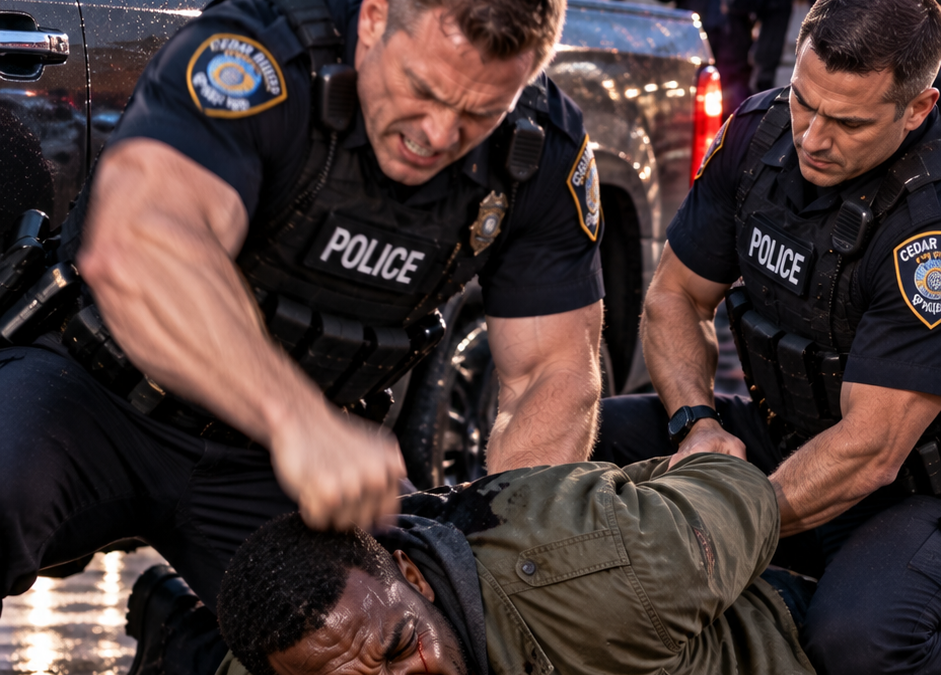
His fist struck me before I could finish breathing.
The punch landed on the left side of my face.
My head snapped sideways.
My right shoulder slammed against the truck.
For an instant, the world seemed to tilt.
I tasted blood.
A sharp ringing filled my ears.
Mark’s grip loosened.
“Travis! What the hell?”
Keen stepped closer.
“Come on, soldier.”
I slowly straightened.
Blood ran from the corner of my mouth.
“What’s that supposed to mean?”
He raised his chin.
“Hit me.”
I stared at him.
“What?”
“Come on. Show me what the Army taught you.”
I couldn’t believe what I was hearing.
He had just punched a man who was being restrained by another officer.
And now he was inviting me to strike him back.
I looked at Mark.
His face was pale.
He seemed as shocked as I was.
Then I looked toward my truck.
The blue birthday bag was still sitting on the passenger seat.
And suddenly, all I could think about was Ethan waiting at home.
Keen took another step.
“What’s wrong? Scared?”
I wiped blood from my lip with the back of my hand.
“No.”
“Then do something.”
I looked directly into his eyes.
“I’m not afraid of you.”
He smirked.
“Could’ve fooled me.”
“I’m choosing not to fight you.”
“Why?”
I tasted blood again.
“Because I have more control than the man standing in front of me.”
His expression changed.
For a moment, I thought he might hit me again.
Instead, he grabbed his handcuffs.
What neither of us knew was that a woman across the parking lot had seen the punch.
Her name was Nicole Harper.
She was thirty-eight years old, a dental hygienist, and the mother of a nine-year-old girl named Lily.
Nicole had just finished loading groceries into her silver minivan when she noticed the confrontation beside my truck.
She saw Keen standing close to me.
She saw Mark holding my arm.
Then she saw Keen punch me.
She immediately told her daughter to get inside the minivan and lock the doors.
Then she pulled out her phone.
By the time she began recording, Mark was checking my identification.
My wallet slipped from his hand.
A photograph fell onto the asphalt.
It was a picture of Ethan wearing his baseball uniform.
I had carried it in my wallet for almost a year.
On the back, he had written four words in blue ink.
“Come home safe, Dad.”
Mark picked it up.
He turned it over.
For several seconds, he stared at the message.
Then his radio crackled.
Dispatch had located the stolen vehicle.
A black Chevrolet Tahoe.
The driver matched the description.
And the vehicle had been recovered at another location.
Mark looked toward Keen.
“Travis, they found the Tahoe.”
Keen didn’t answer.
Mark continued.
“This isn’t our guy. Wrong vehicle. Wrong driver. Everything.”
I looked between them.
“You know you’ve stopped the wrong man.”
Keen stared at me for two seconds.
Then he grabbed my wrist.
“Turn around.”
I pulled my arm slightly away from the pressure on my injured shoulder.
“Officer, what are you doing?”
He snapped a handcuff around my wrist.
“Arresting you.”
“For what?”
“Disorderly conduct.”
I looked toward Mark.
He didn’t speak.
Keen tightened the second cuff.
“And resisting an officer.”
I couldn’t believe it.
He had punched me.
He knew the vehicle didn’t match.
Dispatch had confirmed that the suspect was somewhere else.
And he was still arresting me.
“Resisting?” I repeated.
He looked at the blood on my lip.
“That’s right.”
I felt the cold metal cutting into my wrist.
Then he pushed me toward the patrol car.
“Watch your head, soldier.”
Twenty minutes later, I sat behind the plastic partition of Keen’s cruiser.
My face throbbed.
My shoulder burned.
The handcuffs made it difficult to find a position that didn’t send pain down my arm.
Through the window, I could still see my truck.
The blue gift bag rested on the passenger seat.
I stared at it until the shopping center disappeared behind us.
I had promised Ethan I would be home for dinner.
Instead, I was being taken to jail.
And I had no idea how I would explain it to him.
By the time I was released, it was long past the hour when my son should have been asleep.
My sister Maya had arranged for someone to bring my truck home.
The birthday bag was still inside.
I carried it into the house but couldn’t bring myself to wake Ethan.
I placed it on the living room table and sat beside it.
For almost an hour, I stared at the wrapping paper.
Then I went to bed.
I barely slept.
Every time I moved, my injured shoulder reminded me of Keen’s hands and the metal of the handcuffs.
Every time I closed my eyes, I heard him telling me to fight back.
Saturday morning, I reported to the military clinic at Fort Liberty.
The doctor examined my face and shoulder, documented the injuries, and ordered imaging to determine whether the old muscle damage had been aggravated.
By eight twenty-six, I was sitting on the edge of an examination table with an ice pack against my cheek.
My lower lip had split.
A dark bruise was forming beneath my left eye.
My shoulder felt as though someone had driven a hook into it.
Then my phone vibrated.
Someone had sent me a link.
The Cedar Ridge Police Department had released an official statement about my arrest.
I opened it.
According to Officer Travis Keen, I had refused repeated lawful commands.
According to the report, I had become increasingly aggressive.
According to Keen, I had attempted to pull away from Officer Holloway and made a threatening movement toward him.
The statement described the punch as necessary physical force used to gain compliance.
I read it twice.
Then I lowered the phone.
“None of that happened.”
“No,” a voice answered from the doorway. “It didn’t.”
My older sister Maya stood there holding a laptop.
Maya was thirty-nine and had been practicing employment law in Raleigh for fifteen years.
She was the person our family called when someone received a frightening letter, signed a contract they didn’t understand, or found themselves being pushed around by a company that thought ordinary people couldn’t afford to fight back.
She was five feet seven, slender, with straight black hair and the kind of focused expression that made people think twice before lying to her.
She walked into the examination room and placed her laptop beside me.
“You’ve seen the statement?”
“I’ve seen the lie.”
She opened the computer.
“Nicole Harper posted the video before sunrise.”
I looked at the screen.
There I was.
Standing beside my Ford.
Mark was holding my arms behind my back.
Keen stepped forward.
His fist connected with my face.
I watched my own head snap sideways.
Then I saw the blood appear at the corner of my mouth.
I hadn’t raised a hand against him.
Not once.
The clip was eleven seconds long.
Eleven seconds of evidence that contradicted the police department’s statement.
Maya watched my expression.
“Nicole gave me permission to use the original recording. We should release the full file and challenge their statement immediately.”
I closed the laptop.
“No.”
She stared at me.
“Darius.”
“No.”
“He hit you while another officer was holding you.”
“I know. I was there.”
“And now they’re saying you attacked him.”
I looked at the phone in my hand.
“The punch is what happened to me.”
Maya waited.
I looked up.
“I want to know what happened before me.”
Her expression changed.
I explained what Keen had said about the stolen vehicle.
I told her Mark had warned him that the description didn’t match.
I described the radio confirmation that police had already found the Tahoe.
And I told her Keen had continued arresting me anyway.
Maya opened her notebook.
“Then we start with the dispatch records.”
Across Cedar Ridge, Mark Holloway was sitting at his kitchen table.
I didn’t know it at the time, but his wife later told me he hadn’t slept either.
Sarah Holloway was thirty-one, a third-grade teacher, and eight months pregnant with their first child.
She knew something was wrong the moment her husband came home.
He had barely spoken.
He sat at the kitchen table while his coffee went cold.
Finally, she asked him a question.
“Did the soldier hit Travis?”
Mark stared at the table.
“No.”
“Did he try to?”
Mark said nothing.
Sarah pulled out the chair across from him.
“Then why does the report say he did?”
He couldn’t answer.
He was thinking about his own hands wrapped around my wrists.
About the moment my shoulder tightened in pain.
About Keen’s fist striking my face.
And about the fact that he had watched it happen without stopping him.
Nicole’s video was spreading online.
Mark knew that if the recording showed enough, he wouldn’t simply appear beside Keen.
He would appear to be helping him.
And he was afraid.
By early afternoon, Maya had brought me home.
I opened the front door at 1:14.
Ethan was sitting on the living room couch.
The blue birthday bag was beside him.
Unopened.
He held his phone in both hands.
I knew what he had been watching before he said a word.
I could see it in his face.
“Dad?”
“Hey, buddy.”
He stood.
His eyes moved toward the bruise beneath my eye.
Then toward my swollen lip.
He didn’t ask whether I was hurt.
He asked something much harder.
“Why did you let him hit you?”
I stopped walking.
“What?”
“You always tell me to stand up for myself.”
“I do.”
“But you didn’t.”
I placed my keys on the table.
Then I sat beside him.
He was twelve that morning.
Old enough to understand humiliation.
Young enough to believe his father should be able to stop every bad thing from happening.
I looked at the video frozen on his phone.
“Ethan, if I’d hit that officer back, what would the video show?”
He frowned.
“You punching him.”
“And what would his report say?”
“That you attacked him.”
I nodded.
“Exactly.”
He looked down.
“So you just let people hurt you?”
I felt something painful tighten in my chest.
“No, son.”
I took his hand.
“Sometimes surviving a dangerous moment means refusing to give somebody the reaction they’re trying to force out of you.”
He didn’t answer.
“If I’d fought him, I might not be sitting here with you.”
Ethan looked at my face again.
I saw tears gathering in his eyes.
Then he leaned against me.
I wrapped my left arm around him, careful not to move my injured shoulder.
We sat there for a long time.
Neither of us mentioned the unopened birthday present.
That evening, Maya called.
She had obtained the first dispatch records.
Her voice sounded different.
“Darius, what time did Keen stop you?”
“Five eleven. I remember looking at the clock.”
She was quiet.
“Maya?”
“The stolen vehicle bulletin was transmitted at five eighteen.”
I sat up.
“What?”
“Seven minutes after Keen stopped you.”
I stared toward the kitchen.
The room suddenly seemed very quiet.
“He said he stopped me because they were looking for a stolen vehicle.”
“I know.”
“But the alert hadn’t been issued?”
“Not according to these records.”
I thought about his expression when he first approached my truck.
The way he had looked at my uniform.
The insults.
The questions that weren’t really questions.
The sudden insistence that I was being investigated.
I had assumed he’d mistaken me for someone else.
Now I wasn’t sure he’d been looking for anyone in particular.
Maya wasn’t finished.
“I also obtained part of his complaint history.”
I closed my eyes.
“How many?”
“Seventeen complaints over six years. Excessive force. Improper detention. Unlawful searches. Threatening conduct.”
My stomach tightened.
“What happened to them?”
“Thirteen were closed for insufficient evidence.”
I looked toward the living room.
Ethan was finally opening his birthday present.
He held the brown leather glove in his hands, examining the stitching.
He looked up and smiled when he noticed me watching.
I forced myself to smile back.
Then I turned away.
The punch in that parking lot was beginning to feel like the smallest part of what had happened.
Sunday morning, Maya arrived with copies of the complaint files.
She spread them across my dining room table.
Seventeen complaints.
Different names.
Different dates.
Different circumstances.
Thirteen ended with the same phrase.
“Insufficient evidence.”
I stood beside the kitchen counter, holding a mug of coffee.
“You think they’re connected?”
“I think thirteen people were told there wasn’t enough evidence,” she answered. “I want to know what they said before somebody decided that.”
We began with a man named Leon Briggs.
Leon owned a small auto repair shop on the south side of Cedar Ridge.
He was fifty-two, broad through the shoulders, with a shaved head, a gray beard, and hands permanently marked by grease.
Three years earlier, Keen had stopped him for a broken taillight.
Leon insisted the light was working.
Keen searched his vehicle.
He found nothing illegal.
But Leon’s Dodge Charger was seized as property supposedly connected to an investigation.
Leon was never charged with a crime.
His vehicle remained in storage while fees accumulated.
By the time the authorities finally authorized its release, Leon owed more in towing and storage charges than he could afford.
He never got the car back.
Maya visited him at his garage.
He was working beneath a raised pickup when she arrived.
“You’re Darius Cole’s sister?”
“Yes.”
He wiped his hands on a rag.
“I saw what happened to him.”
“I saw your complaint.”
His expression changed.
For several seconds, he said nothing.
Then he looked toward the office window.
“That man took my car.”
Maya opened her notebook.
“Who had custody of it?”
“Ridgeway Recovery and Towing.”
She wrote down the name.
It appeared again that afternoon.
And again the following day.
By Monday, Maya had reviewed five years of publicly available vehicle seizure and impound records.
More than 130 vehicles had been taken, held, or transferred following encounters involving Cedar Ridge police.
A striking number had passed through Ridgeway Recovery.
The owner was Gary Keen.
Travis Keen’s older brother.
When Maya told me, I sat down slowly.
“You’ve got to be kidding.”
“I wish I were.”
She called Benjamin Park, a county data analyst she had worked with on an earlier case.
Ben was thirty-four, thin, perpetually tired-looking, and so particular about numbers that Maya sometimes joked he could find a missing penny in a hurricane.
He had once identified a property tax error that overcharged dozens of elderly homeowners.
Ever since, he had been fascinated by the way small discrepancies could reveal much larger problems.
Maya met him after work in the county records room.
She gave him the vehicle list.
“I need to know where the money went.”
Ben adjusted his glasses.
“That’s not one question.”
“Good. I have several.”
For six hours, they reviewed impound records, towing invoices, auction notices, storage charges, and municipal payments.
The financial pattern became increasingly difficult to explain.
Police seized or impounded vehicles.
Ridgeway collected towing and storage fees.
Owners who couldn’t pay lost access to their cars.
Some vehicles were eventually sold at auction.
Ridgeway collected additional processing charges.
And portions of the money appeared to move through municipal accounts, including the Cedar Ridge Police Community Fund.
Ben found payments labeled administrative reimbursements, auction processing fees, and community partnership contributions.
He called Maya late that evening.
“This isn’t random.”
She asked what he meant.
Ben turned his computer screen toward her.
“It’s revenue.”
Across town, Mark Holloway was struggling with a different decision.
He had downloaded his official body-camera footage.
The recording showed me standing beside my truck.
It showed him taking my injured arm.
It showed me flinch.
Then it showed Keen step forward and punch me.
Mark watched the recording twice.
But he kept watching after I disappeared into the patrol car.
Because the camera had captured something else.
Keen approached him after the arrest.
His voice came through clearly.
“Just write that he pulled away.”
Mark froze the video.
His own face appeared near the edge of the frame.
He remembered saying nothing.
Now that silence was recorded.
He copied the footage onto a USB drive and hid it inside an old metal toolbox.
For several days, he couldn’t decide what to do with it.
He had preserved the truth.
But preserving the truth and having the courage to reveal it were two entirely different things.
Meanwhile, Leon Briggs began experiencing problems at his garage.
Two city vehicles arrived without warning.
A building inspector and a licensing officer stepped out carrying clipboards.
They cited him for an expired fire extinguisher inspection, improper solvent storage, and a damaged exit sign.
Some of the violations were legitimate maintenance issues.
But Leon had never received so many citations in a single visit.
By late afternoon, the fines totaled thousands of dollars.
He called Maya.
“They came to my shop.”
“Who?”
“City inspectors.”
She was quiet.
Leon looked at the red notice taped to his office window.
“They know I’ve been talking to you.”
Maya told him to preserve every citation and photograph the conditions exactly as the inspectors had found them.
She didn’t promise she could prove retaliation.
But she understood why he was frightened.
And so did I.
Leon had already lost a car after questioning Keen.
Now he was facing financial penalties at the business he had spent years building.
I began wondering how many other people had been taught that challenging Cedar Ridge police would cost them more than remaining silent.
Tuesday morning, my company commander called me into his office.
I arrived at 7:42.
He asked me to sit.
That was when I knew something was wrong.
He handed me a sheet of paper.
Administrative leave pending resolution of civilian legal proceedings.
I read it once.
Then again.
Fourteen years of service.
No disciplinary actions.
No failed evaluations.
No Article 15.
No formal reprimands.
And now I was being told to go home.
My commander watched me carefully.
“Darius, this isn’t punishment.”
I nodded.
“I understand, sir.”
“We need the civilian charges resolved before we can make a final decision about your duty status.”
“Yes, sir.”
He leaned forward.
“I know what you’ve given this unit.”
I looked at the paper.
“I know, sir.”
But knowing didn’t make it hurt any less.
I had built my adult life around military service.
The Army had given me structure when I needed it, purpose when I was uncertain, and brothers and sisters I would have trusted with my life.
Now a false police report threatened to destroy everything I had worked for.
I folded the order and placed it inside my jacket.
Then I drove home.
By noon, Maya called again.
Her voice was urgent.
“Where are you?”
“Home.”
“Stay there.”
I straightened.
“What happened?”
“The department released another statement.”
I closed my eyes.
“Now what?”
“They’re claiming narcotics were found inside your truck.”
For a moment, I couldn’t breathe.
“What?”
“Prescription opioids. No valid prescription associated with the evidence.”
I gripped the edge of the kitchen counter.
“That’s impossible.”
“I know.”
“No, Maya. You don’t understand. I don’t take anything stronger than ibuprofen.”
“Darius, listen to me.”
I looked toward the driveway.
My Ford had finally been returned the previous evening.
If the drug allegation was accepted, the consequences could be devastating.
My security clearance could be reviewed.
My military career could end.
And the resisting charge would become the smallest part of the legal battle ahead.
Maya arrived forty minutes later.
She spread two vehicle inventory forms across the kitchen table.
The first was the original inventory completed at Pine Creek.
Wallet.
Phone charger.
Sunglasses.
Training gloves.
Blue birthday gift bag.
Nothing else.
“No medication,” Maya said.
I looked at the second form.
It contained a new evidence entry created at 11:36 p.m.
Nearly six hours after my arrest.
The location was Ridgeway Recovery and Towing.
Maya tapped the page.
“They didn’t find drugs at the scene.”
I stared at her.
“They found them after your truck entered Gary Keen’s tow yard.”
I sat down.
For several seconds, I couldn’t speak.
A police officer had punched me.
He had arrested me after learning I wasn’t the suspect.
Now someone was claiming drugs had appeared in my truck hours after it was taken away.
I looked at Maya.
“How do we prove what happened?”
She closed the folder.
“We find out who had access to the vehicle.”
That afternoon, she returned to Pine Creek Shopping Center and requested preservation of the available exterior security footage.
The property manager cooperated.
Additional camera footage covering the nearby holding area helped investigators trace the movements of my truck after it entered Ridgeway custody.
At 10:43 p.m., a recording showed my Ford parked near a rear fence.
A man in a dark work jacket and baseball cap approached.
He unlocked the driver’s door.
Then he leaned inside.
Three minutes and seventeen seconds passed.
No police officer was visible.
No inventory procedure was being conducted.
The man finally stepped away.
Seventeen minutes later, a Cedar Ridge patrol cruiser entered the area.
Travis Keen stepped out.
The narcotics were officially documented afterward.
Maya copied the footage and immediately arranged for it to be preserved.
When she showed it to me, I watched the man entering my truck three times.
Each time, I felt more sick.
I thought about the baseball glove Ethan had carried around the house since Saturday.
I thought about him climbing into that same passenger seat.
And I thought about how easily somebody had entered our truck and attempted to turn it into evidence against me.
That evening, my mother arrived.
Gloria Cole was sixty-three and had spent thirty-two years working as an emergency room nurse.
She was five feet four, sturdy rather than delicate, with short silver-streaked hair and brown eyes that could detect a lie before you finished telling it.
She had seen people arrive at the hospital after terrible accidents.
She had comforted families receiving devastating news.
She had worked through holidays, snowstorms, and nights when the emergency room seemed to contain every form of human suffering at once.
Very little frightened her.
But when she walked into my kitchen and saw the bruise still fading beneath my eye, I saw something break in her expression.
“Sit down.”
“Mom, I’m fine.”
“That wasn’t a question.”
I sat.
She touched the side of my face gently.
“Does it still hurt?”
“Not much.”
She looked at my shoulder.
“And that?”
I shrugged.
She gave me the look she had been giving me since childhood whenever I tried to pretend an injury didn’t hurt.
I lowered my eyes.
“It’s bad.”
She nodded.
Then she sat beside me.
“Everybody keeps talking about Staff Sergeant Cole.”
I looked up.
“They’re trying to end my career.”
“I know.”
“Fourteen years, Mom.”
“I know.”
“I worked for everything I have.”
She took my hand.
“Darius, before you were Staff Sergeant Cole, you were my son.”
I felt my throat tighten.
“You have a uniform people respect. Maya understands the law. That woman had a camera. People are paying attention.”
She paused.
“What did Leon Briggs have?”
I didn’t answer.
Because I knew exactly what she meant.
Leon had no uniform.
No lawyer in the family.
No viral video.
Just a car that disappeared into paperwork and a complaint that somebody had stamped insufficient evidence.
My mother squeezed my hand.
“Don’t forget him while you’re trying to save yourself.”
I looked at her.
“I won’t.”
Across town, Mark Holloway was being called into Captain Richard Vance’s office.
Vance was fifty-five, broad-bellied, silver-haired, and known for speaking softly even when making threats.
He had spent twenty-eight years in law enforcement.
People who worked under him said he rarely raised his voice.
He didn’t need to.
He understood how to make consequences sound like choices.
A single-page statement waited on his desk when Mark arrived.
It said I had attempted to strike Keen.
Mark read it.
Then looked up.
“That didn’t happen.”
Vance folded his hands.
“Sign it, and this disappears.”
“For who?”
“For everyone.”
Mark stared at the paper.
His wife was eight months pregnant.
They had a mortgage.
They depended on his health insurance.
He knew that challenging a captain could end his career.
Vance glanced toward Mark’s open wallet on the desk.
An ultrasound photograph of his unborn daughter was tucked behind his driver’s license.
Vance looked back at him.
“Maybe you’re not the kind of officer this department needs.”
Mark understood the threat.
He picked up the pen.
And signed.
Forty minutes later, he sat alone in his car.
The false statement lay on the passenger seat.
He stared at his signature.
He had preserved the truth on a USB drive.
Now he had officially endorsed a lie that could destroy an innocent man’s future.
An hour passed.
Finally, he opened his center console.
He removed the USB drive.
Then he searched for a telephone number.
North Carolina State Bureau of Investigation.
His thumb hovered over the screen.
Then he called.
When someone answered, Mark swallowed.
“My name is Officer Mark Holloway.”
He looked back toward the police station.
“I need to report my own department.”
Thursday morning, Mark arrived at an unmarked state office forty miles from Cedar Ridge.
The USB drive rested between his hands.
Across from him sat Special Agent Rebecca Sloan.
She was forty-seven and had spent eighteen years investigating public corruption.
Early in her career, she had watched an investigation collapse because a frightened deputy destroyed the only surviving copy of a financial ledger.
Since then, Rebecca had developed one rule.
Never trust a single copy.
“What did you bring me?” she asked.
Mark placed three items on the table.
The body-camera file.
The false statement Vance had pressured him to sign.
And his phone.
“There’s something else.”
Rebecca looked up.
Mark opened an audio recording.
Captain Vance’s voice filled the room.
“Cole isn’t dangerous. He’s dangerous because people are watching.”
A pause.
Then Vance again.
“If this turns into a pattern, every seizure we’ve closed becomes a question.”
Rebecca stopped the recording.
She looked directly at Mark.
“You understand you signed a false statement?”
“Yes.”
“And cooperating now doesn’t erase that?”
“Yes.”
He swallowed.
“I’m not asking you to erase it.”
For the first time, Rebecca’s expression softened.
“Good.”
By noon, the investigation had expanded far beyond the punch in the parking lot.
Maya provided Nicole Harper’s original eleven-second video, the initial vehicle inventory, and the footage showing someone entering my truck at Ridgeway Recovery.
Ben Park supplied years of vehicle seizure and impound records.
Leon Briggs agreed to testify.
Then more people came forward.
A restaurant owner.
A construction worker.
A retired school custodian.
A home health aide.
Sixteen additional people described encounters involving questionable vehicle seizures, unexplained fees, or threats after they challenged police decisions.
Different vehicles.
Different stops.
The same towing company.
And increasingly, the same names appearing in the records.
Rebecca’s financial investigators followed the money.
Ridgeway Recovery had received hundreds of thousands of dollars in towing fees, storage charges, auction processing payments, and municipal contracts.
But several invoices led to consulting firms with no employees.
Maintenance companies with no equipment.
Security contractors whose listed addresses were private residences.
Two businesses were connected to relatives of Captain Richard Vance.
Others were linked to local officials involved in approving towing contracts and community fund expenditures.
As the evidence accumulated, the investigators began to understand the structure of the scheme.
Keen had generated vehicle stops and arrests that fed cars into the impound system.
Ridgeway collected fees.
Owners who couldn’t pay sometimes lost their vehicles.
Funds then moved through contracts, processing charges, and accounts connected to people who benefited from the arrangement.
The punch Keen threw at me hadn’t created the system.
It had exposed it.
The next major breakthrough came during a county hearing.
I arrived wearing a dark civilian suit.
For weeks, my name had appeared beside accusations of resisting arrest and drug possession.
I had been placed on administrative leave.
My military career remained uncertain.
And every time I walked into a room, I wondered whether somebody had seen the police department’s statements before hearing my side of the story.
That morning, I chose not to wear my Army uniform.
I didn’t want my rank to become the reason anyone believed me.
I wanted the evidence examined for what it showed.
Leon sat several rows behind Maya.
Nicole Harper was present, too.
Mark Holloway had agreed to testify.
Across the room, Keen sat beside his attorney.
He appeared composed.
When questioned about the parking lot confrontation, he repeated the same explanation he had given in his report.
I had been aggressive.
I had repeatedly challenged lawful commands.
I had pulled away from Mark.
And I had attempted to strike him.
Rebecca listened without interrupting.
Then she asked a simple question.
“Officer Keen, did Sergeant Cole attempt to hit you?”
“Yes.”
“Before you struck him?”
“Yes.”
She turned toward the monitor.
“Then we should be able to see it.”
The body-camera footage began.
I watched myself standing beside my Ford.
My hands were visible.
Mark took my right wrist.
I flinched when he pulled my injured shoulder backward.
Keen stepped toward me.
Then his fist struck my face.
The recording showed everything.
I never raised my hand.
I never lunged.
I never attempted to hit him.
Rebecca allowed the video to continue.
After I was placed in the patrol car, Keen approached Mark.
His voice filled the hearing room.
“Just write that he pulled away.”
Keen stopped moving.
I looked at him.
For the first time since that Friday afternoon, the confidence seemed to drain from his face.
Rebecca let the silence settle.
Then Mark took the witness chair.
His hands shook slightly when he swore to tell the truth.
His wife sat near the back of the room, one hand resting over her pregnant stomach.
Rebecca approached.
“Officer Holloway, did Sergeant Cole attempt to strike Officer Keen?”
“No.”
“Did he resist you?”
Mark looked toward me.
Then lowered his eyes.
“No.”
“Then why did you sign a statement saying he did?”
He took a breath.
“Because I was afraid.”
The room became very still.
Mark described Vance’s office.
The false statement.
The threat to his career.
The ultrasound photograph.
And the moment he realized he had become part of the wrongdoing he should have stopped.
“I eventually told the truth,” he said.
His voice broke.
“But I should have told it when it mattered most.”
I watched him.
I wanted to feel grateful.
Part of me did.
Without his recording, the case would have been much harder to prove.
But another part of me remembered standing beside my truck while he held my injured arm and watched Keen punch me.
I remembered the ride to jail.
The false report.
The administrative leave order.
And the fear in Ethan’s eyes when he watched the video.
Mark had finally done the right thing.
But doing the right thing late didn’t erase the harm caused by waiting.
While the hearing continued, SBI investigators executed search warrants across Cedar Ridge.
One team entered Ridgeway Recovery.
Another searched Captain Vance’s home.
Investigators opened Keen’s department locker.
A fourth team secured the Cedar Ridge Police Community Fund office.
Computers were collected.
Invoices were boxed.
Phones and storage devices were preserved.
At Ridgeway, investigators discovered that several financial folders had been deleted.
But Ben Park had already identified the county accounting backup.
Every night, the municipal system copied payment records to a separate server.
The deleted files were recovered.
One directory immediately attracted attention.
“Priority Holds.”
Inside was a list of high-value vehicles.
Names.
Dates.
Estimated auction values.
Leon Briggs’s Dodge Charger appeared on the list.
It had been marked months before he lost it.
Then Ben opened the newest entry.
Cole, Darius.
2019 Ford F-150.
The date beside it was the night of my arrest.
When Maya showed me the document, I stared at it for a long time.
“They were going to take my truck.”
She nodded.
The drug allegation had not simply been a reaction to the attention surrounding the punch.
Someone had attempted to move my vehicle into the same system that had already swallowed Leon’s car.
I thought about my Ford.
The truck I used to drive Ethan to baseball practice.
The truck my mother borrowed whenever she needed to transport gardening supplies.
The truck I had spent years paying off.
It was sitting in my driveway again.
But for several terrifying days, people I had never met had been treating it as an asset they could turn into money.
I finally understood why the complaints had continued for years without meaningful consequences.
Keen was not merely an aggressive officer with a bad temper.
He was part of something larger.
And the people protecting that system had considerable incentive to keep the truth buried.
The following months were exhausting.
Every week seemed to bring another interview, another request for records, or another conversation with an attorney.
Sometimes I wanted to stop answering the phone.
Sometimes I wanted to take Ethan somewhere far away from Cedar Ridge and pretend none of it had happened.
But then I would remember Leon standing beneath the inspection notices at his garage.
Or my mother’s question.
“What did he have?”
And I kept going.
The independent investigation eventually established enough evidence for criminal charges and disciplinary action.
Keen pleaded guilty to civil rights violations, falsifying an official report, and interfering with evidence connected to my arrest.
Captain Vance was indicted for his alleged role in the vehicle seizure conspiracy and the effort to conceal the misconduct.
Ridgeway Recovery lost its municipal towing contracts.
More than a hundred vehicle seizures were reopened for review.
Some owners recovered their cars.
Others received compensation.
Leon Briggs received payment for the value of his lost Dodge Charger, along with additional damages.
He used part of the money to install a second hydraulic lift in his garage.
When I visited him several months later, he was standing beneath a raised pickup, covered in grease and smiling.
“Come here, Sergeant. I want to show you something.”
He led me into his office.
Above the front desk hung a small wooden sign.
“Keep the Receipts.”
I laughed.
“That’s your new business motto?”
He grinned.
“Paper’s got a longer memory than people.”
Then his smile faded slightly.
“Never thought I’d get anything back.”
I looked around the garage.
The cracked concrete floors.
The aging radio.
The smell of oil and rubber.
The familiar noise of tools striking metal.
“You deserved better than what happened to you.”
He nodded.
“So did you.”
We shook hands.
I left his garage feeling something I hadn’t felt in months.
Relief that the case was finally producing consequences beyond my own situation.
Every charge against me was dismissed.
The allegation involving the prescription opioids was withdrawn after investigators concluded that the evidence had been introduced after my truck entered Ridgeway custody.
The Army completed its review and restored me to full duty.
My service record remained clean.
Fourteen years of work were no longer hanging beneath a false accusation.
When my commander called me into his office to tell me, I stood at attention.
He handed me the final paperwork.
“Welcome back, Sergeant Cole.”
I took the documents.
“Thank you, sir.”
He looked toward my shoulder.
“How’s the injury?”
“Improving.”
“And everything else?”
I considered the question.
“Still working on it, sir.”
He nodded.
“Fair enough.”
I could have returned to my previous routine and tried to forget the entire ordeal.
Part of me wanted exactly that.
But I had spent too much time thinking about the difference between having authority and knowing how to use it.
So when I was invited to participate in a joint training program involving military personnel and local law enforcement agencies, I accepted.
The sessions focused on de-escalation, stress control, recognizing bias, and the responsibility officers have to intervene when another officer crosses the line.
I didn’t participate because I believed every police officer was like Keen.
I knew better.
I had met investigators who risked their reputations to expose wrongdoing.
I had watched Rebecca Sloan refuse to accept easy explanations.
And I had seen Mark Holloway eventually choose to tell the truth even though doing so meant admitting his own misconduct.
But I had also learned that a decent person who remains silent while someone else abuses authority can become part of the problem.
That lesson stayed with me.
One afternoon, I entered a training room and found Mark standing near the back wall.
He looked different.
He had been suspended and formally disciplined for signing the false statement about me.
After the investigation, he was allowed to return to police work, but he no longer worked patrol.
He had transferred into standards and training.
Sarah had given birth to their daughter two months earlier.
Mark carried a photograph of the baby in the same wallet where he had once kept the ultrasound picture Vance used to intimidate him.
When the session ended and the room began emptying, he approached me.
“Darius.”
I turned.
“Mark.”
He stood awkwardly for a moment.
“I’ve been trying to figure out what to say.”
I waited.
He looked down.
“I’m sorry.”
I didn’t answer immediately.
He continued.
“I should’ve stopped it. I should’ve spoken when Travis hit you. And I should’ve told the truth before Vance ever put that statement in front of me.”
I looked at him.
I could see that he meant every word.
But I couldn’t tell him everything was fine.
It hadn’t been fine.
His silence had helped send me to jail.
His false statement had helped threaten my career.
And my son had spent months afraid that another police officer might hurt me whenever I left home.
I took a breath.
“Mark, I appreciate you eventually telling the truth.”
He nodded.
“But the next person might not have a sister who’s a lawyer. They might not have a witness with a camera. They might not have someone willing to examine the records.”
“I know.”
I looked directly at him.
“Make sure the next man doesn’t need an apology.”
His eyes filled.
He nodded again.
“I will.”
It wasn’t complete forgiveness.
I wasn’t ready for that.
But it was enough for both of us to move forward.
That weekend, I took Ethan to the baseball field on the east side of town.
We had never really celebrated his twelfth birthday the way we planned.
There had been too many attorneys, interviews, medical appointments, and conversations that began with someone saying, “Your father’s case.”
Now six months had passed.
Ethan had grown taller.
His baseball season was approaching.
And for the first time in what felt like forever, I had an entire afternoon with nothing more important to do than spend time with my son.
I brought the same blue gift bag that had once sat on the passenger seat of my Ford.
Ethan stared at it.
“You kept that?”
“I told you it was your birthday present.”
“Dad, my birthday was six months ago.”
“So?”
He laughed.
Then he opened the bag.
Inside was the brown leather glove.
He lifted it carefully, examining the stitching and the pocket.
For several seconds, he didn’t say anything.
Then he slipped it onto his left hand.
It fit almost perfectly.
We walked toward the outfield.
I carried a baseball in my left hand, still protecting my shoulder.
Ethan tossed the glove into the air and caught it.
Then he looked at me.
“Dad?”
“Yeah?”
“Can I ask you something?”
I smiled.
“Since when have you needed permission?”
He looked down at the grass.
“Do you still think you did the right thing?”
I stopped.
“About what?”
“Not fighting back.”
The question was different now.
The first time he had asked it, there had been disappointment in his voice.
He had been frightened and confused.
He wanted to know why his father hadn’t defended himself.
Now he sounded curious.
As though he had spent six months thinking about what strength actually meant.
I looked at him.
“Ethan, I didn’t stay calm because I was weak.”
I tossed the ball gently.
He caught it.
“I stayed calm because I wanted to come home to you.”
He looked down at the glove.
Then at me.
“But he still arrested you.”
“Yeah. He did.”
“And he still hurt you.”
“Yeah.”
I walked closer.
“Sometimes you can make every reasonable decision and somebody can still do something terrible to you. The important thing is knowing which choices you control.”
He thought about that.
“So you weren’t scared?”
I laughed softly.
“Son, I was terrified.”
His eyes widened.
“Really?”
“Absolutely.”
I placed my hand on his shoulder.
“I was afraid of getting hurt. I was afraid of losing my career. And I was afraid I might not get home in time to watch you open that glove.”
He swallowed.
“Then how’d you stay calm?”
“Because I kept thinking about you.”
For several seconds, he didn’t speak.
Then he stepped forward and hugged me.
I wrapped my left arm around him.
He held on tightly.
And for the first time since that Friday afternoon, I felt as though the worst part of what had happened was finally beginning to loosen its grip on us.
We spent the next two hours throwing baseballs.
My shoulder eventually started aching.
Ethan noticed and insisted that I sit on the bench while he practiced catching pop flies.
I watched him running across the grass, laughing whenever the ball bounced out of his glove.
The sun was beginning to set when we finally packed up.
On the drive home, he fell asleep in the passenger seat.
The baseball glove rested in his lap.
I looked at him at a red light.
Then I looked at the road ahead.
Six months earlier, I had been sitting in the back of a patrol car, staring through the window at a birthday present I wasn’t sure I’d ever get to give him.
Now he was asleep beside me.
Safe.
And I was taking him home.
Several months later, on a cool autumn afternoon, I found myself driving past Pine Creek Shopping Center again.
I hadn’t planned to stop.
I was on my way home from the base, and traffic had slowed near the entrance.
Without thinking, I turned into the parking lot.
It looked smaller than I remembered.
The same grocery store.
The same restaurants.
The same faded asphalt.
I drove slowly toward the area where Keen had stopped me.
For a moment, I could almost see the cruiser blocking my truck.
I remembered the cold air.
The pain in my shoulder.
The blood on my lip.
And Keen’s voice telling me to hit him.
Then something near the far end of the parking lot caught my attention.
A young patrol officer was kneeling beside a sedan with a flat tire.
An elderly man with white hair and a cane stood nearby.
The officer appeared to be struggling with the jack.
The old man said something that made him laugh.
Then the officer adjusted the equipment and returned to work.
No shouting.
No threats.
No handcuffs.
Just a police officer helping someone who needed assistance.
I watched for a moment.
I didn’t smile because I believed Cedar Ridge had been fixed forever.
Systems don’t become trustworthy simply because a few people are punished and new rules are written.
They have to be watched.
Questioned.
Corrected.
And sometimes challenged by people who are terrified of the consequences.
But watching that young officer kneeling beside the sedan reminded me that authority could still be used for something decent.
My phone vibrated.
A message from Ethan.
“Dad, game starts at six. Don’t be late.”
I smiled.
Then I typed back.
“Wouldn’t miss it.”
I started the truck and pulled out of the shopping center.
The parking lot disappeared behind me.
No flashing lights.
No sirens.
No handcuffs.
Just an ordinary Friday afternoon and a father trying to make it to his son’s baseball game on time.
For months, I had believed the punch was the moment that changed everything.
But looking back, I realized the real turning point came afterward.
When Nicole Harper chose to record what she witnessed.
When Maya refused to accept a police statement simply because it carried an official seal.
When Leon Briggs found the courage to tell his story again.
When Mark Holloway finally admitted that silence had made him complicit.
And when investigators examined the records closely enough to discover that one officer’s misconduct had been helping sustain a much larger system.
My uniform hadn’t protected me that afternoon.
My rank hadn’t stopped Keen from punching me.
And fourteen years of service hadn’t prevented a false police report from threatening my future.
But I had survived the moment when he tried to provoke me into fighting back.
I had come home to my son.
And the truth had finally given other families an opportunity to recover what had been taken from them.
As I turned onto the road leading toward Ethan’s baseball field, I reached across the seat and touched the empty blue gift bag I still kept folded inside the glove compartment.
I didn’t need it anymore.
Ethan had his baseball glove.
Leon had his garage.
And I had my life back.
For the first time in a long time, that was enough.








