𝗙𝗨𝗟𝗟 𝗦𝗧𝗢𝗥𝗬 The Cop Ordered Me Out of a Coffee Shop Without Knowing Why I Was Waiting at Table Seven
𝗙𝗨𝗟𝗟 𝗦𝗧𝗢𝗥𝗬
When our investigators interviewed her, she told us something that stayed with me.
“I can handle a developer wanting my property,” she said. “What I can’t handle is never knowing which government office is going to show up next.”
She had no idea how closely her business was connected to the case we were building.
Neither did I, until Aaron Bell contacted us.
Aaron worked in the city’s purchasing department.
He’d discovered unusual consulting contracts, suspicious payment approvals, and financial relationships between Northshore’s representatives and people inside Harbor Point’s municipal government.
When he began collecting copies, someone warned him to stop asking questions.
Then he received a message suggesting that his family might suffer if he continued.
By the time he reached the FBI, he was frightened enough to insist on meeting outside any government building.
I understood his fear.
People who expose corruption often discover that the individuals they trusted have more connections than they imagined.
So we arranged a controlled meeting at Lantern Coffee House.
The location gave Aaron a familiar public place to approach without drawing attention. Its front windows overlooked Northshore’s local office, and its rear delivery entrance provided another route if he believed someone was following him.
My team had surveillance positioned nearby.
We planned to protect Aaron, collect the final evidence, and execute federal warrants the following morning.
I was supposed to finish my coffee, meet him quietly, and leave.
Then Brent Callaway walked in.
He was thirty-seven, broad-shouldered, with closely cropped hair and the rigid confidence of an officer who had spent eleven years expecting people to obey him.
He stood beside table seven with his hands near his duty belt.
“Last warning.”
I looked at him.
“Officer, the owner has confirmed I’m welcome here. I haven’t threatened anyone, disturbed anyone, or committed a crime.”
He laughed.
“You think knowing a few legal phrases makes you special?”
“No. I think your reason for removing me matters.”
He leaned over the table.
“When I tell someone to move, they move.”
I glanced toward the street.
Across from the café, Northshore’s office occupied the second floor of a renovated brick building.
A man stood beneath its entrance canopy, looking directly toward us.
Preston Vale.
Northshore’s local property broker.
I’d recognized him from our surveillance files before he noticed me.
Now he was watching the confrontation unfold with an expression that looked disturbingly satisfied.
A moment later, he slipped his phone into his coat and moved toward the corner.
My stomach tightened.
I had been sitting at table seven for thirty minutes.
Preston had been watching long enough to know I wasn’t simply stopping for coffee.
And Callaway had arrived four minutes after someone reported a suspicious Black man.
I looked back at the officer.
“Who called you?”
He straightened.
“That’s police business.”
“Did the caller report a crime?”
“I don’t owe you an explanation.”
I checked the time.
Aaron was nearly due.
If he saw Callaway standing over me, he might panic.
If Preston recognized Aaron approaching, months of careful work could collapse.
And if the people we were investigating knew Aaron was cooperating with the FBI, his life could be in immediate danger.
I needed to end the confrontation without exposing the operation.
But Callaway had no intention of letting me.
“Ten seconds,” he said.
I remained seated.
“Am I being detained, or am I free to remain here as a paying customer?”
“You’re not free to do anything until I identify you.”
I could feel the federal credentials inside my jacket.
One movement would allow me to put them in his hand.
But I also knew what might happen afterward.
He might announce my name.
He might call his supervisor.
Someone listening to police radio traffic might recognize it.
And Aaron could walk into a trap before my team understood what had happened.
I looked toward the window again.
Preston Vale had disappeared.
I made a decision.
I would provide my driver’s license if necessary.
But I wasn’t going to reveal my federal assignment inside that crowded coffee shop unless the situation left me no other safe option.
Behind the counter, Hannah’s employee Emily Torres had taken out her phone.
Emily was twenty, a college student with dark curls and a quiet manner that concealed how observant she really was.
Her father, Luis, owned a small delivery business.
He’d suffered through repeated traffic stops, unexplained inspections, and temporary impoundments of his vans.
Emily recognized Callaway immediately.
And she began recording.
I didn’t know it then, but her decision would preserve some of the most important evidence in the entire investigation.
Callaway picked up my coffee.
“Last chance.”
He slammed the cup back onto its saucer.
Coffee spilled across the table and onto my newspaper.
Several customers turned.
Hannah stepped forward.
“Officer, that’s enough.”
He looked at her.
“One more word, and this place gets an emergency safety inspection.”
She stopped.
I looked at him carefully.
That was the second time he’d threatened her business.
And now I understood that his conduct wasn’t simply about racial prejudice.
He appeared comfortable using police authority to frighten an owner who had refused to sell her property.
My recorder captured every word.
Another patrol officer entered the café.
He was younger than Callaway, perhaps thirty-one, with a cautious expression and a name tag reading Noah Bennett.
Noah surveyed the room before approaching.
“What’s going on?”
Callaway pointed toward me.
“Disruptive customer. Refusing to leave.”
Noah looked at Hannah.
“Did you ask him to leave?”
“No.”
“Has he threatened anyone?”
“No.”
Noah turned back toward Callaway.
“What did the caller actually report?”
“Suspicious behavior.”
“What behavior?”
Callaway’s expression changed.
“Stand by the door and let me handle this.”
Noah hesitated.
Then he moved several feet away.
I watched him carefully.
He didn’t seem comfortable with what was happening.
But discomfort and intervention are two different things.
I’d spent years watching people struggle with the distance between them.
Callaway pointed at my jacket.
“Identification.”
I moved slowly.
“I’m reaching for my wallet.”
His hand shifted toward his holster.
I stopped immediately.
“Driver’s license,” I said. “Nothing else.”
“Then get it.”
I removed my wallet, opened the leather divider, and handed him my Virginia license.
My FBI credentials remained concealed behind the inner flap.
Callaway examined the license and radioed my information to dispatch.
The response came back clean.
No warrants.
No criminal history.
My vehicle was registered and insured.
There was no information connecting me to any reported offense.
That should have ended the encounter.
Instead, Callaway looked toward my briefcase.
“What’s inside the bag?”
“Personal documents.”
“I’m going to search it.”
“No.”
He stared at me.
“Excuse me?”
“You don’t have my consent to search my briefcase.”
He leaned closer.
“Your refusal makes me suspicious.”
“Refusing a search doesn’t establish a crime.”
He laughed sharply.
“You’re really enjoying this, aren’t you?”
“No, Officer. I’m trying to understand what law you believe I’ve broken.”
Behind the counter, Emily’s phone vibrated.
She slipped into the storage area and answered.
It was her father.
“Emily, I heard the police are at Lantern.”
“Yes.”
“Is Callaway there?”
She glanced toward the café.
“He’s confronting a customer.”
Luis went quiet.
Then his voice tightened.
“Don’t get involved. Come home.”
“Dad, he’s threatening Hannah.”
“That man has already cost us enough.”
Emily looked through the doorway.
She could see me sitting at table seven with my hands visible.
She could see Hannah standing helplessly near the counter.
And she could see customers watching an armed officer threaten a man who had done nothing but drink coffee.
“I’m recording,” she whispered.
“Emily, please.”
“I’ve already saved it.”
She ended the call.
Then she uploaded the recording to a private online folder before returning to work.
That small decision would eventually prevent Callaway and his supervisors from erasing what happened.
Outside, Aaron Bell had reached the opposite sidewalk.
He approached beneath a black umbrella, carrying the documents we’d arranged to collect.
Then he saw Callaway standing over me.
He recognized the danger immediately.
Aaron had spent months gathering evidence involving Northshore, city officials, and police officers.
He knew enough about the relationships among them to understand that a police confrontation at our meeting location might not be accidental.
He stopped.
Then he turned away.
Rather than enter the café, he slipped behind the building and placed a small red ledger inside one of the delivery crates near the rear entrance.
He left without approaching me.
I never saw him.
Inside Lantern, the confrontation continued.
Callaway had decided my refusal to surrender my briefcase was another reason to escalate.
He stepped closer.
“Stand up.”
I looked toward Noah.
“Officer Bennett, your colleague has a valid identification check and no complaint from the property owner. I would like a supervisor.”
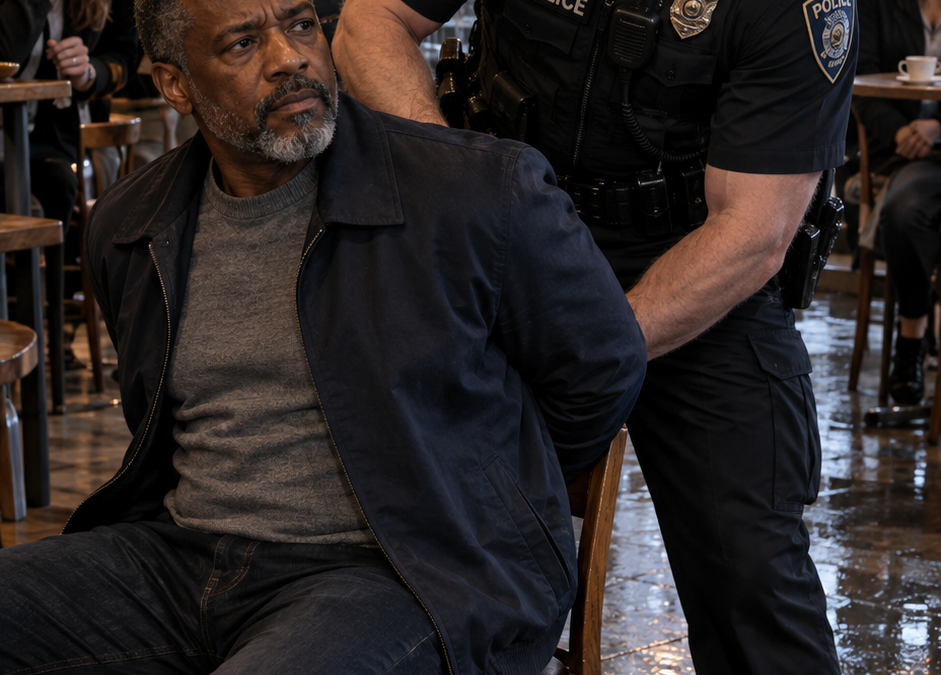
Callaway grabbed my arm.
“You’re disturbing the peace.”
I kept my other hand visible.
“I haven’t raised my voice or threatened anyone.”
“You’re under arrest.”
Noah moved forward.
“Brent, wait.”
“Stay out of it.”
Callaway twisted my arm behind my back.
I stood rather than allow him to drag me from the chair.
My wallet slipped from my hand and struck the floor.
The leather divider opened.
Noah bent to retrieve it.
For one instant, I saw him notice the gold seal on my concealed federal identification.
His expression changed.
“Brent, hold on. There’s—”
Callaway snatched the wallet from him.
He shoved it into my jacket without examining what Noah had seen.
Then he pulled my other arm behind my back.
The handcuffs closed.
Cold metal tightened against my wrists.
I felt the familiar frustration of knowing that the safest decision was to remain completely still while someone abused the authority entrusted to him.
But beneath that frustration was something worse.
Fear for Aaron.
Every additional minute increased the possibility that Preston Vale would recognize the compromised meeting and warn the people we were investigating.
I looked toward the window.
The street outside appeared ordinary.
Cars moved through the rain.
Pedestrians hurried beneath umbrellas.
Across the road, Northshore’s office windows reflected the pale morning sky.
Somewhere beyond those windows, people who had spent years coercing business owners might already be destroying evidence.
Callaway pushed me toward the door.
“Let’s go, tough guy.”
I turned my head slightly.
“Officer, I need you to understand that you’re interfering with a federal investigation.”
He laughed.
“Sure you are.”
“My credentials are in my wallet.”
“You think a little costume badge makes you important?”
“They can be verified.”
“I’m not calling anybody.”
I looked at Noah.
He was staring at Callaway with unmistakable concern.
Then I lowered my hands just enough to press the edge of my smartwatch twice with my thumb.
A silent emergency signal went to my operational team.
I’d used that signal during undercover assignments before.
It transmitted my location and indicated that I could no longer communicate safely.
I hoped Rachel Morgan would see it before Aaron’s disappearance became permanent.
Callaway pushed me through the café entrance.
Behind me, Hannah called out.
“He’s done nothing wrong!”
I heard Emily moving toward the doorway.
Then the rain and traffic swallowed their voices.
Callaway placed me in his patrol car.
As he shut the door, he leaned close enough for me to hear him through the open window.
“Maybe now you’ll learn that a badge doesn’t put you above my authority.”
I looked at him.
“You’re right about one thing.”
He smirked.
“What’s that?”
“A badge doesn’t put anybody above the law.”
He slammed the door.
I watched Lantern Coffee House disappear through the rear window as we drove toward Harbor Point Police Headquarters.
For the first time in sixteen years with the FBI, I was being transported in handcuffs by a police officer who refused to verify my identity.
But I wasn’t thinking about my career.
I was thinking about Aaron.
And the possibility that someone had used Callaway to make sure our meeting never happened.
At headquarters, Callaway led me into the processing area.
A booking camera watched from the ceiling.
He sat me in a hard plastic chair, opened a blank arrest report, and began typing.
I could see enough of the monitor to recognize what he was doing.
He was turning an ordinary cup of coffee into an imaginary violent confrontation.
He wrote that I had frightened customers.
That I’d refused repeated lawful instructions to leave private property.
That I’d acted aggressively.
That my movements made officers fear for their safety.
I watched his fingers moving across the keyboard.
Every false sentence made the eventual investigation more serious.
But it also created a record that could be compared with what had actually happened.
“Officer,” I said, “I’m requesting preservation of all relevant evidence.”
He stopped typing.
“What?”
“Your body-camera footage. The original dispatch call. Radio traffic. Booking video. Any available security footage from Lantern Coffee House.”
He laughed.
“You don’t get to give orders in here.”
“I’m notifying the department that those materials are relevant evidence.”
“Noted, counselor.”
He returned to his report.
I studied the booking camera above us.
Its small indicator was illuminated.
I hoped it was recording every word.
A few minutes later, a heavyset officer entered the processing area.
He had silver at his temples, a broad face, and the measured movements of someone who preferred giving orders without appearing hurried.
Sergeant Wade Harland.
I’d seen his photograph in our investigation files.
Several suspicious payments had been routed through companies connected to people close to him.
But until that moment, we hadn’t established how directly he was involved in Northshore’s operation.
Callaway handed him my arrest sheet.
“Disorderly conduct. Resisting.”
Harland glanced at the report.
Then he read my name.
Malcolm Hayes.
For an instant, something changed in his expression.
It was subtle.
But I saw it.
Three weeks earlier, Harland had received a confidential warning that federal investigators might be examining Northshore’s municipal contracts.
The message had identified me by name as a possible case coordinator.
It hadn’t included my photograph.
Now I was sitting in his processing area with handcuffs around my wrists.
Harland looked at me for several seconds.
I met his eyes.
And I knew he recognized my name.
That realization frightened me more than anything Callaway had done inside the café.
If Harland knew I was an FBI agent, the investigation was already compromised.
And Aaron Bell might be in immediate danger.
“My wallet,” I said.
Harland frowned.
“What about it?”
“Open the identification compartment.”
He hesitated.
Then he gestured toward the desk officer.
She retrieved my wallet from the property tray.
I instructed her to open the inner leather divider.
When she saw the federal credentials, she stopped moving.
“FBI,” she whispered.
Harland immediately reached for the wallet.
He examined the identification.
Then he looked at me.
“This could be counterfeit.”
“My verification number is printed beneath the photograph. Call it.”
He didn’t move.
Noah Bennett entered the processing area.
He saw the credentials in Harland’s hand.
“Sergeant, federal identification can be verified.”
Harland turned sharply.
“No outside calls until we know what we’re dealing with.”
Noah looked toward me.
Then at Callaway’s unfinished report.
I could see that he understood the encounter had become much more serious than his partner’s original explanation suggested.
Harland ordered Callaway to seize my phone, smartwatch, briefcase, and every document inside it.
My expression changed.
“Do not open that briefcase without appropriate federal authorization.”
He ignored me.
Then he took Noah into the hallway.
I couldn’t hear everything they said.
But I caught enough.
“You keep challenging me in front of prisoners,” Harland warned, “and your career ends before your next evaluation.”
Noah returned several minutes later.
His face was pale.
But when Callaway turned away, Noah raised his phone and quietly photographed the unfinished arrest report.
He also captured the visible timestamps.
Later, those photographs would establish that Callaway had written a version of events that could not be reconciled with dispatch records, camera footage, or Noah’s own arrival time.
Miles away, Rachel Morgan received my emergency signal.
Rachel was one of the best investigators I’d ever worked with.
She had spent years examining financial crimes and knew that corruption cases often became dangerous at the exact moment the people involved realized someone had started collecting evidence they couldn’t control.
She tried calling me.
No answer.
She checked the tracking information.
My location had moved from Lantern Coffee House to Harbor Point Police Headquarters.
Then it stopped.
She immediately contacted our surveillance teams.
The original plan had been to execute warrants the following morning, after Aaron delivered the final ledger.
That plan was no longer safe.
Rachel ordered the team to prepare for immediate action under the warrants and emergency procedures already available.
Three black SUVs left our field operations location carrying federal agents, evidence technicians, and the documents needed to secure the investigation.
But while Rachel was moving toward headquarters, something else was happening at Lantern Coffee House.
Two uniformed officers had entered the café.
They demanded Emily Torres’s phone.
One informed Hannah that her business would need to close immediately for an emergency safety inspection.
Hannah refused.
“What emergency?”
The officer gestured toward the café.
“Possible safety violations.”
She stared at him.
“You haven’t inspected anything.”
He told her the order came from above.
Emily stood behind the counter, her pulse pounding.
She had already uploaded her recording.
When the officer demanded her phone, she handed him an old device she kept beneath the register.
“I deleted the video.”
He took it.
He didn’t know that the original file was safely preserved elsewhere.
And he didn’t notice the red ledger Emily had found in the delivery crate near the back entrance.
She had discovered it shortly after Aaron slipped behind the building.
At first, she assumed someone had forgotten a notebook.
Then she opened it.
Inside were company names, payment dates, dollar amounts, and handwritten initials.
Several entries were labeled HPPD.
Others carried the initials WH, BC, and RV.
One line was marked “Lantern.”
Emily recognized the name immediately.
She moved the ledger beneath the counter.
Then her phone vibrated.
A message had arrived from an unfamiliar number she associated with Aaron Bell.
It contained only six digits.
She stared at it.
The sequence looked familiar, but she couldn’t immediately understand why Aaron had sent it.
Before she could investigate further, she heard vehicles approaching outside.
At police headquarters, Harland had just ordered me moved into an interview room when engines filled the front parking lot.
Noah looked through the glass entrance.
Three black SUVs had stopped across the main approach.
Men and women wearing dark federal jackets stepped out.
Rachel Morgan emerged from the lead vehicle holding a sealed warrant.
She walked directly toward the entrance with twelve federal agents behind her.
No shouting.
No dramatic threats.
Just a deliberate movement by people who already knew exactly what evidence they needed to preserve.
The atmosphere inside headquarters changed the moment they entered.
“No one leaves with a phone, document, storage device, or piece of evidence connected to this investigation,” Rachel announced.
She presented the relevant warrant.
“Secure the evidence room. Preserve all body-camera files, dispatch recordings, booking video, access logs, and materials associated with Malcolm Hayes’s arrest.”
Callaway stood beside the processing desk.
His face had lost its color.
Rachel looked through the open doorway toward the interview rooms.
“Where is Supervisory Special Agent Hayes?”
I watched Callaway’s expression.
Until that moment, some part of him had apparently believed my credentials were fake.
Now twelve federal agents had entered his station and were asking for me by name.
The illusion collapsed.
I was brought out of the interview room.
The handcuffs came off.
Red marks circled both wrists.
Rachel approached.
“Malcolm.”
“I’m all right.”
Her eyes moved toward the marks.
“We’ll document those.”
I nodded.
Then I looked toward Callaway and Harland.
Both men were standing near the processing desk.
I could have used that moment to humiliate them.
After what Callaway had said to me in the café, part of me wanted to.
I wanted him to feel the helplessness of having strangers decide what he was allowed to do.
I wanted Harland to experience the fear that Aaron Bell must have carried for months.
But we were not there to exchange abuses of authority.
We were there to preserve evidence and protect people whose lives might already be in danger.
“Follow the warrants,” I told Rachel. “Document everything. They receive the same legal protections as anyone else.”
She nodded.
“We’re already securing the records.”
Then her expression changed.
“Malcolm, Aaron never checked in.”
I felt my stomach tighten.
“How long?”
“His phone went dark eighteen minutes after your emergency signal.”
I looked toward the windows.
He had seen the police intervention.
He had abandoned the meeting.
And now he’d disappeared.
“Find him,” I said.
Rachel nodded.
“We’re working on it.”
The next twenty minutes changed the direction of the entire investigation.
Hannah arrived at headquarters with Emily beside her.
Emily was carrying the red ledger inside a clear plastic food container.
She looked frightened.
“I’m sorry,” she said when she saw me. “I found this behind the café. I think somebody left it there.”
I recognized the description immediately.
Aaron.
A federal evidence specialist photographed the ledger, placed it in a protective sleeve, and began documenting its custody.
Two financial analysts started reviewing the entries.
Within minutes, they identified payment dates that matched suspicious transfers from Northshore into consulting companies connected to relatives of Harbor Point officers.
The initials WH appeared beside payments labeled inspection assistance, traffic enforcement, and owner pressure.
RV appeared beside larger transfers routed through a coastal security company.
One payment had been made two days before Hannah received her first building citation.
Hannah studied a copy of the original emergency call record.
The caller was Preston Vale.
She put her hand over her mouth.
“He’s the man who tried to buy my building.”
I looked at her.
“How many offers did he make?”
“Three.”
“Did he threaten you?”
Her eyes filled.
“He told me Northshore would own the entire block whether I cooperated or not.”
I looked back at the call record.
Preston hadn’t simply noticed a stranger sitting in a coffee shop.
He’d been watching me across the street.
And he’d used Callaway to remove me before Aaron could deliver the evidence.
The arrest had served two purposes.
It humiliated a Black customer whom Callaway believed he could intimidate without consequences.
And it disrupted an FBI operation threatening Northshore’s carefully constructed business arrangement.
I wondered whether Callaway understood both purposes when he entered the café.
The answer would come later.
For now, Aaron remained missing.
Luis Torres arrived shortly afterward.
He’d come to take Emily home.
When he saw federal agents sealing evidence inside the police station, he stopped near the entrance.
For years, Luis had avoided formal complaints because every attempt to challenge an inspection or impoundment seemed to produce another problem for his business.
Rachel approached him.
“Mr. Torres, do you have information about the officers connected to these payments?”
He looked toward Emily.
She took his hand.
“Dad.”
He swallowed.
“They made me pay every month.”
Rachel waited.
“They called it a road compliance fee. Said my delivery vans would keep getting inspected if I didn’t pay.”
His voice tightened.
“When I stopped paying, they held two of my vans. My customers canceled contracts. I almost lost the company.”
He gave Rachel the names of two officers who had collected payments.
Then he described envelopes being left inside a locker at the municipal garage.
Emily stood beside him, gripping his hand so tightly that her knuckles turned white.
I realized she had spent months watching her father struggle without understanding that his financial problems were being deliberately manufactured.
Now she had recorded one of the officers involved.
And her decision had placed her family directly inside the investigation.
I approached her.
“Emily, you did the right thing preserving that recording.”
She looked toward Callaway.
“Is he going to come after us?”
“No one can promise you’ll never face intimidation,” I said. “But we’re taking your safety seriously.”
Rachel immediately began arranging protective measures.
Then Emily remembered the six-digit message.
She showed it to one of our analysts.
At first, the number appeared meaningless.
Then she explained that it resembled an old item code from the café’s payment system.
One analyst separated the digits into the format used by Harbor Point’s former municipal grid.
The reference pointed toward an abandoned ferry terminal at the eastern edge of the city.
We pulled the nearest available traffic-camera footage.
The first image showed Aaron walking beneath his black umbrella.
The second showed a dark SUV stopping beside him.
In the third, two men were forcing him into the back seat.
For several seconds, I couldn’t speak.
I had spent months convincing Aaron that cooperating with us was the safest way to expose what he’d discovered.
Now he was being taken somewhere by people who might already know exactly what evidence he possessed.
I turned toward Rachel.
“We need him alive.”
She was already reaching for her radio.
At 11:38 that night, three FBI vehicles stopped behind a row of condemned warehouses near the abandoned ferry terminal.
Rainwater collected in the cracked parking lot. The old loading ramps had rusted shut, and only one working streetlight illuminated the entrance road.
I remained at our temporary command center, watching the operation unfold on a secured tactical display.
Rachel was positioned near the terminal with the agents assigned to the rescue.
Through a broken warehouse window, they could see two armed men moving around a seated figure.
The figure was Aaron.
His hands were tied to a metal chair.
A folding table stood in front of him.
On it lay a typed statement.
We learned afterward that the statement claimed the red ledger was fabricated.
It claimed I had pressured Aaron to invent evidence.
And it denied that Northshore had bribed any public official.
One of the men pushed a pen toward him.
“Sign it, and you leave Virginia tonight.”
Aaron looked at the paper.
“And if I don’t?”
The man glanced toward the dark river beyond the warehouse wall.
Aaron understood.
So did Rachel.
She gave the signal.
Federal agents entered from two directions.
The side door opened under a hydraulic ram.
Commands filled the warehouse.
One detective reached toward his waistband, then stopped when he saw multiple agents covering him.
The second dropped to his knees.
The operation ended without a shot being fired.
Both men were detained.
Aaron was cut free and immediately examined by medical personnel.
When Rachel reached him, he was shaking badly.
“My backpack,” he whispered.
She crouched beside him.
“Where is it?”
“They took it.”
Agents found the bag beneath a workbench.
Inside was an encrypted hard drive.
It contained recordings of meetings involving Police Chief Russell Vance, Sergeant Wade Harland, and Preston Vale.
I watched the first verified recording at headquarters shortly after Aaron was secured.
Chief Vance was discussing lists of local business owners.
People behind on taxes.
People struggling with loans.
People with unresolved permit issues.
Preston would identify which properties Northshore wanted.
Vance would provide access to information that helped them identify vulnerable owners.
Harland would coordinate inspections, traffic stops, code complaints, and police pressure until resisting owners became desperate enough to sell.
It was more systematic than we’d feared.
And it explained why the same businesses kept appearing in unrelated municipal records.
The scheme wasn’t simply about collecting bribes.
It was about using public authority to make privately owned property financially unbearable to keep.
That night, federal search teams moved across Harbor Point under separate warrants.
Agents searched Northshore’s offices, Harland’s home, Chief Vance’s residence, and restricted sections of police headquarters.
At Northshore, investigators found property maps annotated with instructions.
“Vulnerable.”
“Apply pressure.”
“Police contact.”
At Vance’s home, they recovered bank records showing payments routed through a private coastal security company.
In Harland’s garage, investigators discovered complaint files that had disappeared from the department’s digital system.
Some had been written by people whose names I’d encountered during our preliminary investigation.
Others were new.
Every file represented someone who had tried to tell the truth and been ignored.
A shop owner who questioned a suspicious traffic stop.
A delivery driver whose vehicle had been impounded.
A restaurant manager who reported an officer threatening her permit.
And a family whose small hardware store had closed after months of inspections and escalating fees.
For years, these people had believed their troubles were isolated.
The recovered records showed they were pieces of the same operation.
Emily’s recording became one of the clearest examples of the method.
It showed Callaway threatening Hannah’s business license even though she hadn’t committed a violation.
His body camera captured my calm questions, Hannah’s objections, and the absence of any disturbance that justified what he later wrote.
The café cameras showed that Preston had been watching from across the street.
And the dispatch record preserved his original complaint.
Callaway initially claimed he had only followed instructions.
He denied knowing about the bribes.
He said Harland had told him certain businesses required additional attention.
But investigators found payments associated with three property sales connected to his enforcement activity.
The money had moved through a business registered to his brother-in-law.
Each transfer was labeled performance compensation.
When investigators presented the records, Callaway stopped claiming his conduct had been an ordinary response to a concerned citizen.
His prejudice had made him easy to use.
His willingness to threaten innocent people had made him valuable.
And the payments showed that he had benefited from a system designed to make vulnerable business owners surrender their property.
The morning after Aaron’s rescue, Noah Bennett entered the federal courthouse through a protected entrance.
He provided photographs of Callaway’s unfinished arrest report.
He also gave investigators access-log information showing that Harland had attempted to enter Callaway’s body-camera file before its upload was complete.
The attempted access mattered.
It suggested that Harland had anticipated the need to control or alter evidence almost immediately after I arrived at headquarters.
Noah also supplied a list of misconduct complaints that Harland had ordered closed without meaningful investigation.
Several described nearly identical encounters.
Suspicious-person calls with no identifiable offense.
Demands for identification.
Threats against business licenses.
Arrests after people questioned police authority.
I met Noah after he completed his testimony.
He looked exhausted.
“I should’ve stopped Brent in the café.”
I studied him.
“You questioned the complaint.”
“I didn’t stop the arrest.”
“No.”
He lowered his head.
“I saw your credentials when I picked up the wallet. I knew something was wrong.”
I waited.
Then he looked at me.
“I was afraid Harland would destroy my career.”
“I understand why you were afraid.”
He seemed surprised.
“But your fear didn’t make the arrest right,” I continued. “And it didn’t make the false report true.”
“I know.”
I thought about the moment he’d photographed Callaway’s screen.
“You eventually preserved evidence that couldn’t be explained away. That matters.”
He nodded.
Then he asked the question I’d been expecting.
“Is that enough?”
I considered it.
“Enough to change what already happened? No. Enough to begin acting differently? That depends on what you do next.”
He was quiet for a long time.
Then he nodded again.
“I won’t forget that.”
By the afternoon, Lantern Coffee House had reopened.
The emergency inspection was canceled.
Outstanding city penalties against Hannah were suspended pending review.
Luis received confirmation that his commercial permits had been restored.
Two delivery vans held in the municipal lot were returned to his company.
Emily and her family received protective assistance while the investigation continued.
Aaron remained under federal protection.
He’d survived the kidnapping, but the experience had shaken him deeply.
When I finally met him in a secured interview room, he stood the moment I entered.
“I’m sorry.”
I looked at him.
“For what?”
“I didn’t make it to the table.”
I felt a painful tightening in my chest.
“Aaron, you kept yourself alive. That’s what mattered.”
He shook his head.
“I should’ve known Preston was watching.”
“You recognized the danger and left the ledger where someone could find it. You gave us enough information to locate you.”
He looked down.
“They told me nobody would believe me.”
I pulled out a chair.
“Sit with me.”
We sat opposite one another.
His hands were still trembling.
For six months, he had lived with the knowledge that the records he was collecting could destroy powerful people.
He’d worried about his wife.
His children.
His job.
His mortgage.
And the possibility that every person he reported to might have a connection to someone he was investigating.
Now those fears had become real.
He’d been kidnapped by detectives who were supposed to protect the city.
And they’d tried to force him to sign a false statement accusing the FBI of fabricating the case.
I looked at him.
“You don’t have to carry this by yourself anymore.”
He covered his face.
For several minutes, I simply sat with him.
There are moments in an investigation when the most important thing an agent can do is stop asking questions.
That was one of them.
The initial federal court proceedings began that evening.
Harbor Point residents filled the courtroom.
Hannah sat beside Luis and Emily.
Aaron entered through a protected side door.
Noah remained near the back, still wearing his police uniform.
Chief Russell Vance, Sergeant Wade Harland, Preston Vale, and the detectives involved in Aaron’s kidnapping appeared before the magistrate.
The charges included allegations of conspiracy, extortion, obstruction, bribery, kidnapping, and civil rights violations.
For years, individual business owners had tried to describe what was happening to them.
Their complaints had been separated, dismissed, or buried.
Now the financial records, witness testimony, recordings, and recovered files were finally being examined together.
I watched Hannah from across the courtroom.
She sat with her hands folded in her lap.
Her café had nearly been taken from her.
Her employees had been threatened.
Her business had been subjected to repeated inspections because she refused to sell a building her father had worked his entire life to establish.
Yet she’d stood beside me when Callaway ordered me to leave.
She hadn’t known I was an FBI agent.
She’d defended me because I was her customer and because what was happening was wrong.
That mattered more to me than she understood.
The proceedings that followed took months.
Financial analysts traced the payments through shell companies, municipal accounts, and contracts connected to Northshore.
Property records were reviewed one by one.
Investigators identified business owners who had sold under coercive pressure and others who had paid improper fees because they believed resistance would only make their situation worse.
The documented financial harm approached six million dollars.
The amount included improper payments, losses connected to coerced property transactions, and business damage that would require separate review before compensation could be determined.
But the financial total was only part of what had been taken.
Luis had spent months wondering whether he could keep his delivery company open.
Hannah had lived with the fear that her father’s café would disappear.
Aaron had nearly lost his life.
And countless residents had learned to treat every inspection notice, police cruiser, and official letter as a possible threat.
The criminal cases proceeded independently of the civil claims and property reviews.
Chief Vance and Sergeant Harland eventually pleaded guilty under federal agreements.
Their testimony confirmed the relationships between Northshore, the police department, and city officials who had helped pressure business owners into selling.
Preston Vale chose to stand trial.
The evidence against him included bank transfers, recorded meetings, Aaron’s ledger, property maps, and testimony from people he’d threatened.
His attorneys argued that Northshore had simply pursued aggressive real estate acquisitions.
The prosecution presented the payments and coordinated enforcement actions that accompanied those acquisitions.
The trial made public what Harbor Point’s business owners had been trying to explain for years.
Callaway lost his badge.
His law enforcement certification was revoked, and the criminal proceedings established his role in the false arrest report and the violations of my civil rights.
The same body-camera footage he’d assumed would support his version of events became evidence contradicting it.
I attended part of the proceedings.
But I refused to make the case about whether he’d recognized the wrong person in Lantern Coffee House.
He had treated me the way he believed he could treat someone without power.
My federal identification hadn’t changed that fact.
It had merely complicated his ability to escape the consequences.
The city created a compensation program for business owners, drivers, and families harmed by the scheme.
Property transactions connected to Northshore were reviewed individually.
Some owners recovered buildings they had surrendered under pressure.
Others received compensation reflecting the financial losses they could establish.
Harbor Point Police Department entered three years of independent oversight.
A new early-warning system tracked unusual patterns involving officer complaints, searches, stops, and use of force.
A civilian review board received access to relevant disciplinary records and body-camera evidence under the oversight agreement.
Supervisors could no longer quietly close serious civil rights complaints without leaving a reviewable record.
I knew none of those changes guaranteed perfect policing.
No system could promise that every future officer would make the right decision.
But the old arrangement had allowed misconduct to disappear because the people responsible for reviewing it were often the same people benefiting from it.
Independent oversight gave residents another place to bring concerns when the department failed to listen.
Noah Bennett remained on the force.
He wasn’t treated as a flawless hero, and he didn’t ask to be.
He acknowledged that he should have intervened more decisively inside Lantern.
But his decision to preserve evidence and cooperate with investigators helped expose the false arrest and the attempted cover-up.
He later joined the department’s new internal whistleblower protection program.
When we spoke about the appointment, he told me he wanted young officers to understand that loyalty to a colleague could never require lying for them.
I believed he meant it.
And I hoped the officers he trained would learn that lesson before they stood in a courtroom explaining why they’d remained silent.
Luis rebuilt his delivery company.
The compensation he received allowed him to replace damaged equipment, recover lost contracts, and purchase two newer trucks.
He hired several workers who had lost jobs when Northshore’s pressure campaign forced local businesses to close.
Emily finished her college year with honors.
Our Richmond office offered her a summer internship in its civil rights division.
She accepted.
When she told me, she looked almost embarrassed.
“I only recorded what I saw.”
I smiled.
“You preserved evidence that other people were trying to erase.”
She looked toward her father, who was standing nearby.
“I just didn’t want him to keep getting away with it.”
I nodded.
“That’s a good reason to start learning how investigations work.”
Aaron returned home after the trials.
For the first time in months, his family could answer the door without immediately wondering who might be standing on the other side.
He eventually joined a nonprofit organization that helped government employees report corruption safely.
He told me that he wanted other whistleblowers to have protections he’d been too frightened to ask for when the investigation began.
And Hannah kept her coffee shop.
When Northshore’s claim against her building collapsed, residents formed a neighborhood investment group to help her purchase the property outright.
The day the transaction closed, she called me.
“Malcolm, I own it.”
I was sitting in my office.
“The building?”
“The whole building.”
Her voice broke.
“My father opened this place thirty years ago. I finally own the land beneath it.”
I closed my eyes.
“I’m glad, Hannah.”
She laughed through her tears.
“Come have coffee. On me.”
I smiled.
“I’ll be there.”
Ten months after the federal indictments, I returned to Waterman Street.
It was a clear spring morning.
The rain and gray skies that had defined the day of my arrest were gone.
Sunlight fell across the brick storefronts, and pedestrians moved between businesses that had once stood empty beneath Northshore’s acquisition signs.
Several of those signs had disappeared.
A bookstore had reopened near the corner.
A family-owned restaurant was renovating its front windows.
And Lantern Coffee House stood exactly where it had been the morning Brent Callaway decided I didn’t belong.
I entered at 8:15.
The same time I’d arrived ten months earlier.
The café was crowded.
Hannah stood behind the counter, speaking with a customer.
When she saw me, her face lit up.
“Malcolm!”
I approached.
“Good morning.”
“Black coffee?”
“You remembered.”
“How could I forget?”
She reached for a cup.
“It’s free.”
I placed several bills beside the register.
“An honest business deserves to be paid.”
She laughed.
“You’re impossible.”
“That’s what my team keeps telling me.”
She handed me the coffee.
Then she nodded toward the seating area.
“Your table’s waiting.”
I turned.
Table seven was empty.
A small folded newspaper rested on the chair beside it.
For a moment, I stopped walking.
I remembered Callaway standing over me.
The spilled coffee.
The handcuffs.
The uncertainty about Aaron.
And the terrible realization that someone had arranged for an officer to interrupt a federal operation simply by reporting that a Black man was sitting in a coffee shop.
Now the same table stood beneath the same warm hanging lights.
But everything around it felt different.
I sat down.
Emily approached wearing a visitor badge from the Richmond FBI office.
“Good morning, Supervisory Special Agent Hayes.”
I looked up.
“That sounds very official.”
She grinned.
“I’ve been practicing.”
I laughed.
“How’s the internship?”
“Amazing. Also, a lot more paperwork than I expected.”
“Welcome to federal investigations.”
She pointed through the window.
Across the street, Luis was loading packages into two clean delivery trucks.
Farther down the sidewalk, Noah stood beside a small group of high school students, explaining how residents could file complaints and request access to public records.
Beneath the café’s awning, Aaron sat beside his wife.
He had both hands wrapped around a warm cup of coffee.
For the first time since I’d met him, he wasn’t watching every vehicle that passed.
Emily followed my gaze.
“He’s here every Thursday now.”
I smiled.
“Good.”
She returned to the counter.
I unfolded my newspaper.
Then I looked at the cup in front of me.
Ten months earlier, Callaway had lifted a similar cup from this table and slammed it down because he believed my presence was something he could control.
He’d treated Hannah’s business as though it belonged to the police department.
He’d ignored the owner, fabricated a disturbance, seized my property, and signed a false report.
And he’d done it without knowing the people protecting his misconduct were about to be exposed.
I lifted the cup.
For the first time, I finished my coffee at table seven.
When I stood to leave, I noticed a small wooden sign hanging on the brick wall behind Hannah’s counter.
Every person who enters here deserves dignity.
I read it twice.
Then I looked toward the front windows.
Hannah was laughing with one of her regular customers.
Luis waved from across the street.
Aaron’s wife was showing him something on her phone, and he smiled without looking over his shoulder.
These were ordinary moments.
A coffee shop opening for business.
A delivery driver loading his trucks.
A couple sharing breakfast.
A young woman beginning a career.
But for the people of Old Harbor, ordinary moments had become precious after years of inspections, threats, impoundments, and financial pressure.
I had carried an FBI badge into Lantern Coffee House that rainy Thursday morning.
It hadn’t protected me from being insulted.
It hadn’t prevented Callaway from handcuffing me.
And it hadn’t guaranteed that Aaron would reach our meeting alive.
What changed the outcome was the evidence people chose to preserve and the decisions they made after the danger became clear.
Hannah refused to pretend I was trespassing.
Emily kept recording.
Noah documented what his colleagues wanted hidden.
Luis described the payments he’d been frightened to report.
Aaron risked everything to preserve the financial records.
And Rachel’s team moved quickly enough to bring him home.
The corruption network had depended on people feeling isolated.
Each business owner was meant to believe their problems were theirs alone.
Each frightened witness was supposed to think nobody would believe them.
Each complaint was meant to disappear into paperwork.
But when the evidence was finally examined together, the pattern became impossible to ignore.
I placed my empty cup on the counter.
Hannah looked up.
“Leaving already?”
“I’ve got work.”
“Try not to get arrested on the way.”
I laughed.
“I’ll do my best.”
Then her expression softened.
“Malcolm, thank you.”
I shook my head.
“You saved your own business, Hannah. You refused to let them frighten you into giving it away.”
She looked around the café.
At the familiar tables.
The crowded counter.
The customers who’d returned even when police inspections threatened to shut the place down.
“My father would’ve loved seeing this.”
I smiled.
“I’m sure he would.”
As I stepped outside, the morning sunlight warmed the sidewalk.
I looked once more at the windows across the street where Preston Vale had watched me before making the call that changed everything.
His office was gone.
Northshore’s signs had disappeared.
And the business owners he’d tried to force out were rebuilding their neighborhood.
I walked toward my car with my briefcase in one hand and the folded newspaper in the other.
For years, the people behind Northshore believed that money could purchase authority and authority could silence anyone without enough power to resist.
They were wrong.
The evidence they tried to conceal had survived in recordings, financial records, witness statements, and a small red ledger hidden inside a café delivery crate.
In the end, the most important person in that coffee shop hadn’t been the one carrying a badge.
It had been the person willing to recognize that the man sitting quietly at table seven deserved to be treated with dignity before anyone knew who he was.
And for the first time in a long time, the people of Old Harbor could sit down, order coffee, and enjoy an ordinary morning without wondering which powerful stranger would arrive to tell them they no longer belonged.








