𝗣𝗔𝗥𝗧 𝟮 The Colonel Made Three Thousand Soldiers Watch Him Break Me, Never Knowing Why I Needed Him to Believe I Was Powerless
𝗣𝗔𝗥𝗧 𝟮
His voice pulled me back to the parade field.
A quiet shock moved through the formation.
Major Henderson stepped down from the reviewing stand.
He was Garrett’s executive officer.
Tall.
Angular.
Careful around superiors.
Cruel around people who could not retaliate.
I had learned everything important about him within four days.
He approached me.
I watched his gloved hand rise toward the captain’s bars on my collar.
“Don’t touch me, Major.”
He froze.
My voice was quiet.
That made people listen harder.
Henderson leaned close.
“Stand down, Vance.”
I could smell coffee on his breath.
“You brought this on yourself.”
“I said don’t touch me.”
Garrett seized the microphone.
“Captain Vance, you are out of order. Submit to disciplinary separation immediately or military police will remove you.”
Two MPs stepped forward.
I recognized both.
They had been in the basement.
One had held my shoulders.
The other had held my legs after I stopped cooperating.
That was the moment I knew we had enough.
Not suspicions.
Not circumstantial connections.
Not another set of missing manifests.
Enough.
I looked at Garrett.
And smiled.
My lip split again.
I tasted blood.
“Colonel Garrett.”
My voice carried without a microphone because three thousand people had gone completely silent.
“You have sixty seconds to step down from that platform, place your hands behind your head, and surrender yourself to Staff Sergeant Diaz.”
For one perfect second, nobody understood what they had heard.
Then whispers moved through the ranks.
Garrett’s face darkened.
“What did you say?”
“You heard me.”
He looked almost offended by reality itself.
“Arrest her!”
The MPs moved.
Then the sound came.
Low at first.
A pulse beneath the wind.
Thump.
Thump.
Thump.
Heads turned toward the northern tree line.
The sound grew until I could feel it through the soles of my boots.
Three black MH-60 helicopters rose over the trees.
They came in low.
No ceremonial approach.
No gentle descent toward designated landing zones.
Searchlights cut across the field and flooded the tarmac with white-gold light.
The first Black Hawk dropped onto the grass.
Then the second.
Then the third.
Rotor wash exploded across the parade field.
Dust and dead grass filled the air.
Coats snapped.
Soldiers turned their faces from the debris.
The side doors opened before the aircraft fully settled.
Army CID operators and federal marshals poured out.
They moved toward predetermined positions.
Perimeter.
Vehicle access.
Headquarters.
Communications.
Reviewing platform.
Garrett still held the microphone.
“What is the meaning of this?”
Nobody answered him.
A man in a dark civilian overcoat stepped from the lead helicopter.
Director Arthur Vance.
No relation by blood despite the shared surname, though after fifteen years working together he had become something closer to family than most people in Washington ever managed.
Beside him walked the Vice Chief of Staff of the Army and another four-star general.
Garrett stared at them.
Then at me.
For the first time that morning, he understood that he had never known who was standing in front of him.
Arthur stopped two paces away.
His eyes went directly to my face.
Professional control failed him for half a second.
“Elena.”
“I’m fine.”
His expression said he knew I was lying.
He opened his coat and removed a leather-bound folder.
I took it.
Inside was the signed executive warrant.
Fully executed.
Unredacted.
Authorized by the President three hours earlier based on the evidence transmitted from Fort Campbell during the previous forty-eight hours.
I reached inside my torn jacket and removed the encrypted recorder I had carried against my body throughout the interrogation.
It had captured everything.
Henderson’s questions.
The threats.
The names.
Garrett entering the room.
His order to keep going.
His discussion of missing inventory.
His confidence that nobody in Washington could touch him.
I wiped blood from my lip.
Then I looked at him.
“Your sixty seconds are up.”
The field became so quiet I could hear the Black Hawks idling behind me.
Garrett held the microphone tighter.
“This is a mutiny.”
“No.”
I walked toward him.
“This is an arrest.”
Arthur stepped forward.
“Colonel Richard Garrett, by authority of the executive warrant issued by the Commander-in-Chief, your command authority is suspended effective immediately.”
A gasp moved through the brigade.
“You are being detained pending federal charges involving theft of military property, weapons diversion, conspiracy, obstruction, and the deaths of United States military personnel.”
Garrett’s face changed.
Not fear yet.
Disbelief.
Powerful men often experience disbelief before fear.
They spend so many years arranging systems around themselves that consequences begin to feel like violations of natural law.
“This is outrageous.”
He pointed toward Arthur.
“I have thirty years in uniform.”
General Thomas Montgomery stepped forward.
He had known Garrett for decades.
“Richard.”
Garrett looked at him.
“Shut your mouth.”
Garrett actually stepped backward.
Montgomery continued.
“The people you expected to protect you are not returning your calls. Your Miami buyers were picked up after midnight. Federal teams are serving warrants on your shell companies now.”
Garrett’s breathing became shallow.
Then Henderson broke.
He dropped to his knees on the reviewing platform.
“Sir—I was following orders.”
Garrett turned toward him.
Henderson raised both hands.
“The routing came from Garrett. The manifests came from Garrett. I didn’t know about Kandahar. I swear I didn’t know about Specialist Leo Vance.”
My brother’s name crossed the parade field.
For five years I had trained myself not to react when I heard it unexpectedly.
I failed.
Not outwardly.
My face stayed still.
But inside, I was back in Ohio.
Back in my mother’s kitchen.
The clock above the sink.
Leo’s daughter coloring at the table.
The knock at the front door.
My mother opening it.
Two uniforms.
One folded flag.
One sentence.
We regret to inform you.
I tightened my hand around the executive warrant.
“Staff Sergeant Diaz.”
Marcus snapped forward.
“Ma’am.”
“Disarm Colonel Garrett.”
Marcus looked at me.
Something moved behind his eyes.
Not revenge.
Release.
“Yes, ma’am.”
He took several soldiers with him and climbed the platform steps.
Garrett stared at him.
“Sergeant, I am your commanding officer.”
Marcus stopped in front of him.
“Not anymore, sir.”
He removed Garrett’s sidearm.
For a moment Garrett seemed to consider resisting.
Then he looked around.
Three thousand soldiers.
Federal agents.
Two four-star generals.
The men he had commanded.
The officers he had frightened.
The young enlisted people who had believed his word could destroy their careers.
Nobody moved to save him.
Slowly, he placed his hands behind his head.
Marcus cuffed him.
The metallic click seemed impossibly loud.
As Garrett was brought down the steps, he stopped near me.
His face was inches from mine.
“You think you won?”
I said nothing.
“Look at yourself.”
His eyes moved across my bruises.
“You destroyed yourself for this.”
I leaned closer despite the fire in my ribs.
“No, Richard.”
His eyes narrowed.
“I let you believe you were destroying me.”
For the first time, something like fear reached him.
“My brother’s name was Leo.”
He flinched almost imperceptibly.
“Remember it.”
A marshal moved Garrett forward.
I watched him go.
And then my body decided the operation was finished before my mind did.
The field tilted.
Searchlights stretched into streaks.
My knees gave way.
Marcus caught me before I hit the ground.
“I’ve got you.”
“I’m fine.”
“No, ma’am.”
His voice softened.
“You’re not.”
He guided me onto an equipment crate.
Arthur crouched in front of me.
“The evidence is secured.”
“The drives?”
“Recovered.”
“The manifests?”
“Recovered.”
“Armory?”
“Lockdown teams are moving now.”
Only then did I allow myself to breathe.
It hurt enough to make my vision flash white.
“I want a civilian medic.”
Arthur frowned.
“Hospital.”
“No base hospital.”
“Elena—”
“We don’t know who Garrett compromised.”
He knew I was right.
They took me to a secure briefing room inside Hangar 3.
That was where Doc Miller found me.
Thomas Miller had served as a combat medic before becoming a civilian contractor.
He entered carrying an old canvas medical bag and the expression of a man personally offended by unnecessary injury.
He looked at my face.
Then at Arthur.
“Out of my way.”
A four-star general moved.
That told me everything about Doc Miller.
He checked my pupils.
Touched the swelling around my eye.
I flinched.
“That hurts?”
“Yes.”
“Good. Means you’re still capable of honesty.”
“Occasionally.”
His mouth twitched.
Then he examined my ribs.
When he saw the bruising, his humor disappeared.
“They kicked you after you went down.”
It was not a question.
“Yes.”
Marcus stood near the door.
I saw his expression change.
Doc pressed carefully along my side.
“Three fractures. Maybe a fourth crack. I want imaging, but your breathing is stable.”
He looked at me.
“You got lucky.”
“Not luck.”
He frowned.
“I protected my head and abdomen.”
“You planned how to take a beating?”
“I planned how to survive one.”
He stared at me.
Then slowly shook his head.
“You Washington people are strange.”
“Occupational hazard.”
He wrapped my ribs while I gripped the edge of the chair.
When he finished, Marcus approached.
“Counsel.”
“Yes?”
“Why didn’t you tell me?”
His guilt had been growing since the parade field.
“If I had known who you were, I could have helped.”
“No.”
His brow tightened.
“If you had known, you would have behaved differently.”
He stopped.
“Garrett watched everyone. Your ignorance protected the operation.”
“That’s supposed to make me feel better?”
“No.”
I looked directly at him.
“But this might.”
He waited.
“I watched you for three weeks.”
Marcus said nothing.
“You refused to approve inventory discrepancies Henderson told you to ignore. You protected your soldiers when you thought doing so might cost you promotion. You challenged orders when you believed they were unsafe.”
His eyes shifted away.
“I needed to know whether there were still people inside Garrett’s organization who remembered what the uniform meant.”
I paused.
“You were one of them.”
Marcus swallowed.
For a man who had survived three combat tours, praise seemed to frighten him more than gunfire.
Before either of us could say more, Arthur returned with an encrypted satellite phone.
“Elena.”
His expression told me who was calling.
I took the phone.
“This is Counsel Vance.”
The President’s voice came through the line.
“Give me the ground reality.”
“Garrett is in custody. Henderson is cooperating. We have the duplicate manifests and encrypted drives. The immediate logistics network is compromised and being isolated.”
“And you?”
I looked at my reflection in the hangar window.
Swollen eye.
Split lip.
Bandaged ribs.
“The cost was acceptable.”
The silence on the line lasted several seconds.
“No,” he said finally. “It was necessary. That does not make it acceptable.”
My throat tightened.
Then he said Leo’s name.
“Elena, your brother would be proud.”
That was the sentence that nearly broke me.
Not Garrett.
Not the basement.
Not three thousand people watching me bleed.
Leo.
I turned my face away as one tear escaped my good eye.
“Thank you, Mr. President.”
“Get treated properly. That’s an order.”
“Yes, sir.”
“And Elena?”
“Sir?”
“Finish the job.”
“I intend to.”
When the call ended, I asked Arthur to bring me Lily Chen.
She entered ten minutes later holding her patrol cap against her chest.
The girl looked terrified.
She saluted.
I lowered her arm.
“Sit.”
She sat at the edge of the chair.
For several seconds she could not look at me.
Then she whispered, “I’m sorry.”
“For what?”
Her eyes filled.
“If I hadn’t found the logs, they wouldn’t have done this to you.”
I leaned forward despite the pain.
“Look at me.”
She did.
“What happened to me was not your fault.”
Her lip trembled.
“I knew Garrett’s men were coming. I knew what they would do if they caught me with those files.”
“But—”
“I chose to stay.”
She began crying silently.
“You were twenty-one years old and trapped inside a chain of command that had spent months teaching you that telling the truth could destroy your life.”
I pointed gently toward the door.
“Garrett is in custody because you noticed numbers that did not belong.”
She shook her head.
“No, ma’am.”
“Yes.”
I softened my voice.
“You are not the reason I was hurt. You are one of the reasons this ended.”
Her shoulders broke.
She covered her face.
Marcus moved behind her and placed one hand on her shoulder.
I let her cry.
People imagine safety feels peaceful.
Often it does not.
Sometimes safety is the moment your body finally realizes it is allowed to collapse.
When Lily could breathe again, I looked at Arthur.
“Transfer her to Washington.”
Lily’s head snapped up.
“What?”
“To my office.”
“Ma’am?”
“You understand procurement records. You notice patterns. And apparently you have more integrity than half the people who outrank you.”
For the first time, she smiled.
“You’re serious?”
“Completely.”
“I don’t know what to say.”
“Say yes.”
“Yes, ma’am.”
“Good.”
I thought the worst part was over.
I was wrong.
Special Agent Sarah Jenkins arrived with the next problem.
She dropped a binder onto the table.
“Garrett’s final shipment is still on the installation.”
My exhaustion disappeared.
“What shipment?”
“Sixty crates listed as decommissioned ordnance. The paperwork says they move at eighteen hundred.”
“What is actually inside?”
“Shoulder-fired weapons. Thermal targeting systems. Other classified equipment.”
Marcus swore under his breath.
“Where?”
“Sector 4.”
I looked at the manifest.
Garrett had signed it.
A retirement package.
One last shipment before the network collapsed.
Sarah explained the jurisdictional problem.
We had Garrett.
We had evidence.
We did not yet have clean authority to seize every piece of hardware in a live military munitions sector while the command transition was still being processed.
“Who guards Sector 4?” I asked.
Marcus answered immediately.
“Third Platoon. My people.”
“Will they follow your order?”
“They’ll follow a lawful security order.”
“That’s all I need.”
We went to the server room.
Sarah connected directly to the logistics system.
Garrett’s people had attempted remote wipes.
Most failed because Henderson, out of paranoia, had maintained physical backups.
That decision would probably put him in prison.
It also saved our case.
Sarah suddenly stopped typing.
“I found something.”
On the screen was a security schedule for Bunker 402.
Every night at 2200, the sensors around one section of the perimeter shut down for twenty minutes under the label maintenance diagnostic.
I stared at it.
“The truck at eighteen hundred is a decoy.”
Sarah turned toward me.
“What?”
“The manifest is supposed to be discovered.”
The answer became obvious as I said it.
“We chase the documented convoy to the south gate. The real shipment leaves at ten through the blind sector.”
Marcus muttered, “Son of a bitch.”
I stood.
Pain exploded through my ribs.
I ignored it.
“Move the federal perimeter to Sector 4. Keep the south gate response minimal. I want Garrett’s people believing their plan survived him.”
Sarah looked at me.
“You should be in a hospital.”
“So everyone keeps saying.”
At 1900, freezing fog rolled across Fort Campbell.
By 2100, I was sitting inside an unmarked Suburban near Bunker 402.
Marcus sat behind the wheel.
Sarah sat in the back with tactical communications.
Federal marshals and CID teams waited beyond the fog.
Third Platoon controlled the legitimate access roads without being told the full scope of the operation.
We sat in darkness.
My body shook from cold and exhaustion.
Marcus noticed.
“Counsel.”
“No.”
“I didn’t say anything.”
“You were going to.”
“I was going to tell you Doc Miller will kill me if you collapse.”
“Then don’t tell him.”
Marcus almost smiled.
At 2158, two heat signatures appeared.
Vehicles.
No headlights.
One flatbed.
One cargo van.
They approached Bunker 402.
Six men emerged.
Even through thermal optics, Marcus recognized several.
Senior logistics personnel.
Men Garrett had trusted.
Men soldiers beneath them had probably trusted too.
They opened the bunker.
Sarah waited.
I watched four figures enter.
Two lowered the flatbed ramps.
“Now.”
Sarah keyed the radio.
“Execute.”
Searchlights ignited.
Fog turned silver.
Federal loudspeakers ordered the men down.
For a fraction of a second, nobody moved.
Then one of Garrett’s men fired at a searchlight.
The night erupted.
I stayed behind the vehicle at first.
Gunfire cracked through the fog.
Marcus moved with the tactical team.
Sarah took cover behind the engine block.
Then I saw someone break from the cargo van.
Large man.
Distinct limp.
Running west.
I knew that walk.
I had watched archived footage of it for months.
Master Sergeant Robert Vance.
No relation.
The logistics chief whose authorization appeared on the final clearance connected to Leo’s convoy.
I stepped into the fog.
“Robert!”
He stopped.
Turned.
Saw me.
Even at a distance, I watched recognition hit his face.
He raised his rifle.
“You should be dead.”
My blood turned cold.
Not because I was afraid.
Because guilty men sometimes confess when they think they are about to lose everything.
“We took care of your brother,” he shouted, “and we should have finished you last night.”
There it was.
Five years condensed into one sentence.
I raised my pistol.
“Drop the weapon.”
His rifle shifted toward me.
“Garrett is finished. Henderson is cooperating.”
“You think that protects you?”
“No.”
I stepped closer.
“It protects everyone else from you.”
His finger moved.
Before he could fire, a single shot came from the left.
His rifle spun from his hands.
He fell to his knees.
Sarah emerged through the fog with her weapon trained on him.
“I keep telling you,” she said, “I hate missing important meetings.”
By midnight, Sector 4 was secure.
All six men were in custody.
The cargo van contained dozens of crates tied directly to the missing inventory Lily had discovered.
The remaining bunker inventory matched our duplicate manifests.
For the first time, the case no longer depended on inference.
We had the men.
The goods.
The records.
The confessions.
And the chain connecting them.
Doc Miller found me sitting on the rear bumper of an ambulance.
He checked my pulse.
“You’re impossible.”
“I’ve heard.”
“One-twenty.”
“Still alive.”
“Mild fever.”
“I’m cold.”
“Your ribs are clicking.”
“That sounds less ideal.”
He glared.
“You are going to a hospital.”
“After the transition briefing.”
“I hate lawyers.”
“You were a Ranger.”
“That has nothing to do with my poor judgment.”
Marcus approached.
“Sector is secure.”
I looked at him.
“Every crate?”
“Accounted for.”
“Good.”
He hesitated.
Then said, “Your brother can rest now.”
The words struck somewhere deeper than pain.
I looked away toward the bunker.
“Not yet.”
Marcus frowned.
“Garrett still thinks somebody is going to save him.”
At 0130, I walked into brigade headquarters.
Federal marshals had transformed the building.
Files covered desks.
Clerks moved carefully between investigators.
People who had once treated Garrett’s office like a throne room now avoided even looking through its open doors.
Garrett sat inside the conference room.
No trench coat.
No sidearm.
No polished command presence.
His wrists were secured to the table.
I entered alone.
He looked at my face and smiled weakly.
“You look worse.”
“You look unemployed.”
His smile disappeared.
I sat across from him.
For several seconds neither of us spoke.
Finally, he said, “You think this ends because you found a few crates?”
“No.”
“Do you understand how many people are involved?”
“Yes.”
“You don’t.”
He leaned toward me.
“Senators. Contractors. officers you salute. People inside agencies you think are helping you.”
“Then they should be worried.”
He laughed.
“You still believe in the machine.”
I looked at him.
“No.”
That answer surprised him.
“I believe in people.”
He scoffed.
“People are the machine.”
“Exactly.”
I leaned forward.
“And machines can be repaired by removing broken parts.”
“You’re naive.”
“No, Richard.”
I thought about Leo.
“I stopped being naive five years ago.”
Garrett’s face hardened.
“You want revenge.”
“For Leo?”
“Yes.”
I considered the question.
“Five years ago, yes.”
He seemed pleased.
“Now?”
“Now I want evidence.”
I placed a file on the table.
“Henderson is cooperating.”
His eyes flickered.
“Robert confessed.”
That landed harder.
“The Sector 4 shipment is in federal custody.”
Garrett stared.
“The blind spot in the security network is documented.”
Silence.
“Your Miami buyers are detained.”
His face drained.
“And the political offices you expected to interfere have already been placed under preservation orders.”
For the first time, Garrett looked old.
“You destroyed your career for this.”
“No.”
“You think Washington will reward you?”
“I don’t care.”
“They’ll use you.”
“They already did.”
He stared at me.
“The difference is I volunteered.”
His voice dropped.
“You’re going to spend the rest of your life looking over your shoulder.”
I stood.
“No.”
“Every dark parking lot. Every stranger. Every—”
“I don’t have to look over my shoulder, Richard.”
I moved closer.
“Because I learned how to stand in the dark.”
His breathing changed.
“My brother’s name was Leo.”
Garrett looked away.
I caught his chin with my voice.
“Look at me.”
He did.
“You turned his death into paperwork.”
My throat tightened.
“You took a husband from his wife. A father from his daughter. A son from my mother.”
Garrett said nothing.
“For five years, my family wondered whether Leo made some mistake that sent him down that road.”
I felt my good eye burn.
“Now we know.”
Garrett’s lips tightened.
“You think that brings him back?”
“No.”
That was the truth that hurt most.
“It never will.”
I stepped away.
“But it gives his daughter something your report stole from her.”
“What?”
“The truth.”
I walked toward the door.
Behind me, Garrett shouted my name.
I did not turn.
At 0400, a government transport aircraft waited on the runway.
Doc Miller found me at the boarding stairs.
He gave Arthur three prescriptions and enough instructions to qualify as a briefing.
Then he looked at me.
“Do you ever follow medical advice?”
“I followed some.”
“You followed none.”
“I sat down twice.”
“That was unconsciousness.”
Marcus approached after Doc left.
His tactical vest was gone.
His uniform was clean.
For the first time since I had met him, he looked tired enough to admit he was human.
“The interim commander has officially assumed authority,” he said.
“Good.”
“He signed commendations for Third Platoon.”
“Good.”
Marcus hesitated.
I knew what he was waiting for.
“Colonel Albright asked me for a recommendation for a senior logistics leadership position.”
Marcus’s brow tightened.
“I gave him your name.”
He stopped breathing for half a second.
“Ma’am…”
“You held the line before you knew anyone important was watching.”
His eyes dropped.
“That matters to me.”
“I just did my job.”
“Most important acts of integrity are performed by people who say exactly that.”
His throat moved.
Then Marcus raised his hand.
The salute was perfect.
Not because of technique.
Because I knew what it cost him emotionally to give it.
I returned it.
“Take care of them.”
“Yes, ma’am.”
At the top of the stairs, Lily waited inside.
She was wearing a clean uniform.
A tablet rested in her hands.
She started to stand.
“At ease.”
She sat again.
“I was looking at the Washington procurement system.”
“Already?”
“I couldn’t sleep.”
I smiled.
“You’ll fit in.”
The aircraft began taxiing.
Lily looked out the window as Fort Campbell slid past us.
“Ma’am?”
“Yes?”
“Will people know what happened?”
“Some of it.”
“All of it?”
“No.”
She looked disappointed.
“Operations like this rarely become public in the way people imagine.”
“So Garrett might still have people defending him.”
“Probably.”
“That doesn’t bother you?”
I thought about it.
“No.”
“Why?”
“Because justice and applause are different things.”
She looked down at the tablet.
I continued.
“You found the missing numbers when nobody was applauding.”
She looked back at me.
“That’s the work that matters.”
The aircraft accelerated.
As the wheels left Kentucky, I closed my eye.
For five years, every road I traveled had seemed to lead back to Leo.
Every investigation.
Every file.
Every sleepless night.
Every conversation I abandoned because I could not explain why I was distracted.
Every relationship that withered because part of me remained trapped inside a redacted report.
Now Fort Campbell disappeared beneath clouds.
And for the first time, I felt the weight shift.
Not disappear.
Grief does not disappear.
It changes shape.
By 0900, I was walking through the West Wing.
Arthur walked beside me carrying the prosecution files.
My dress uniform was gone.
I wore a navy blazer large enough to hide the rib wrap.
A medical patch covered my injured eye.
People looked.
Nobody asked.
At the Oval Office door, I stopped.
“I want the first ten minutes alone.”
Arthur handed me the briefcase.
“Your father would have been proud.”
I looked at him.
“Don’t.”
His face softened.
“Not unless you want me to cry before I get through the door.”
He nodded.
The Marine guard opened it.
The President stood from behind the Resolute Desk when he saw me.
His eyes went immediately to the medical patch.
“My God.”
“I’m fine.”
“You have a remarkable commitment to that lie.”
I almost smiled.
He led me toward the sofa.
“The Attorney General has the preliminary indictment package.”
I placed the recovered drive on the table.
“This contains the final routing evidence.”
He looked at it.
“And Leo?”
I took a breath.
“Robert Vance confessed.”
The President waited.
“He confirmed Garrett received payment to clear the logistics sector before Leo’s convoy was redirected.”
My voice almost failed.
“He knew the route was compromised.”
The President sat very still.
For five years, I had imagined this moment.
I thought I would feel triumph.
I felt grief.
Just grief.
Clean and enormous.
The President lowered his eyes.
“I’m sorry.”
I looked toward the windows.
“He was twenty-six.”
“I know.”
“He had a little girl.”
“I know.”
“He told her he was building a treehouse when he came home.”
My voice broke.
“He never came home.”
The President said nothing.
That was a gift.
Powerful people often ruin grief by trying to improve it.
He let mine remain what it was.
Eventually he said, “You brought the people responsible into the light.”
A tear slipped down my cheek.
“This won’t give my mother those five years back.”
“No.”
“Or Leo.”
“No.”
I wiped my face.
“But his daughter will know he didn’t fail.”
The President nodded.
“That matters.”
“Yes.”
It did.
More than I had understood.
He ordered me to take medical leave.
I argued.
He reminded me the order came from the Commander-in-Chief.
I informed him that abusing presidential authority to enforce bed rest was constitutionally questionable.
He told me to sue him.
For the first time in days, I laughed.
Two days later, I went to Arlington alone.
Late afternoon.
Cold.
Quiet.
The endless white stones stood beneath a pale winter sky.
I walked through Section 60 slowly.
My ribs hurt.
My face still looked like someone else’s.
I had left the official files in Washington.
No warrant.
No evidence bags.
No agents.
No generals.
No President.
Just me.
And two small silver captain’s bars inside my coat pocket.
I stopped at Leo’s grave.
For several seconds, I could not move.
Then I knelt.
“Hey.”
My voice sounded too loud.
I touched the cold stone.
“I’m sorry it took so long.”
Wind moved through the trees.
I opened the small velvet box.
Inside were the captain’s bars Henderson had tried to remove from my uniform on the parade field.
They were scratched.
One still carried a dark smear near the edge that I had not cleaned away.
I placed them on Leo’s headstone.
“It’s done.”
That was all I managed at first.
My throat closed.
I bowed my head.
“They’re in custody.”
My fingers traced his name.
“The convoy order was deliberate.”
There.
I had said it.
Words I had spent five years chasing.
“You didn’t make a mistake.”
Tears blurred my vision.
“You weren’t careless.”
My hand trembled against the marble.
“You didn’t fail them.”
I bent until my forehead rested lightly against the stone.
“And you didn’t fail us.”
The grief came then.
Not the controlled tear I had allowed in front of the President.
Not the silent pain I had buried through briefings and arrests.
This was ugly grief.
Five years of it.
My shoulders shook.
Every movement hurt my ribs.
I did not care.
I remembered Leo at twelve, throwing snowballs at me and running before I could hit him back.
Leo at seventeen, stealing my car.
Leo in uniform the first time, standing in our mother’s kitchen like he had grown six inches overnight.
Leo holding his infant daughter so carefully that we all laughed at him.
Leo telling me over the phone that he had found something weird in the fuel records.
“Probably nothing,” he had said.
It had not been nothing.
I had spent years believing justice would make that memory easier.
It did not.
Justice did not erase the knock on my mother’s door.
It did not build the treehouse.
It did not give a little girl another morning with her father.
What it did was smaller.
And maybe more honest.
It put the truth back where a lie had been.
Eventually, I sat back.
The sun had nearly disappeared.
“I kept thinking catching Garrett would feel like winning.”
My voice was hoarse.
“It doesn’t.”
I looked at Leo’s name.
“It feels like reaching the end of a road and realizing I still have to walk home.”
The wind moved softly around me.
For years, I had imagined Leo as he had appeared in his casualty photograph.
Uniform.
Formal.
Frozen in time.
Now another memory came instead.
Leo laughing.
Flour on his shirt because he had tried to make pancakes for his daughter.
That was the brother I wanted back.
Not the evidence.
Not the victim.
Leo.
I smiled through tears.
“You would hate how dramatic all of this became.”
I could almost hear him.
Elena, you brought helicopters?
I laughed once.
The sound broke in the middle.
“Yes.”
I looked at the bars on the headstone.
“Three of them.”
For the first time in five years, remembering my brother did not immediately lead me back to Garrett.
That realization stopped me.
Garrett had occupied too much space inside our grief.
I had allowed him to.
Necessary perhaps.
But still true.
I stood slowly.
Pain moved through my side.
I waited until it passed.
Then I looked across the rows of white stones.
Thousands of names.
Thousands of families.
Thousands of stories that could never be reduced honestly to reports or casualty statistics.
That was what Garrett had forgotten.
He had looked at inventory and seen money.
At authority and seen protection.
At soldiers and seen pieces.
At Leo and seen a problem.
At Lily and seen another problem.
At me and seen somebody weak enough to break.
He had been wrong each time.
But the lesson I carried away from Fort Campbell was not that corrupt men always lose.
History would never support something so comforting.
Sometimes they win for years.
Sometimes institutions protect them because admitting the truth would be embarrassing.
Sometimes good people stay silent because they are afraid.
Sometimes justice arrives bruised, late, and exhausted.
What mattered was that somebody eventually refused the silence.
Lily had refused.
Marcus had refused.
Sarah had refused.
Henderson, however late and selfishly, finally refused.
I had refused.
And Leo had refused first.
That was why he died.
It was also why the truth survived him.
I touched the headstone one last time.
“I have to go.”
The words hurt in a way I had not expected.
For five years, leaving his grave always felt like abandoning him.
This time it felt different.
I was not leaving Leo behind.
I was finally leaving Garrett behind.
“I love you.”
I turned.
Walked down the gravel path.
My steps were slow because my ribs still needed time.
But they were steady.
At the bottom of the hill, I stopped once and looked back.
The captain’s bars caught the last light of the setting sun.
Two small pieces of silver against white marble.
Garrett had tried to strip them from me because he believed rank was the source of my power.
He had never understood.
My authority had never come from metal on my collar.
Lily’s courage had not come from rank.
Marcus’s integrity had not come from rank.
Leo’s honor had not come from rank.
The things that mattered most had existed long before anyone important noticed them.
I slipped my hands into my coat pockets and continued toward the waiting car.
Washington was ahead.
Investigations.
Indictments.
Political pressure.
People who would insist Garrett had been an isolated case.
Others who would want files sealed because transparency was inconvenient.
There would be another ledger.
Another dark hallway.
Another person convinced nobody could reach them.
I knew that now.
But something inside me had changed.
For five years, I had been hunting backward.
Toward Leo.
Toward Kandahar.
Toward the truth of what had happened.
Now I could move forward.
Not because grief was finished.
Because grief no longer needed to be my only compass.
At the car, I looked once more across Arlington.
The sky had become purple and gold.
Almost the same colors that had hung above Fort Campbell when three thousand soldiers watched me stand battered beneath the floodlights.
That morning Garrett had believed he was showing the brigade what weakness looked like.
He had been wrong about that too.
Weakness was never the bruises.
It was the silence that had allowed him to create them.
And strength was never my willingness to endure pain.
It was Lily opening those inventory files when everyone around her had taught her to look away.
It was Marcus refusing to sign a false report even when promotion depended on obedience.
It was Sarah following the numbers beyond the point where politics told her to stop.
It was Leo asking why the fuel did not match.
The people who frightened Garrett most had never been the people with the highest rank.
They were the people who still believed the truth mattered after the system gave them every reason to stop believing.
I opened the car door.
Before getting inside, I whispered one last thing toward the hill.
“Rest now, Leo.”
Then I left.
For the first time in five years, I did not look back.
Have you finished reading the story and want to read it again?
The Colonel Made Three Thousand Soldiers Watch Him Break Me, Never Knowing Why I Needed Him to Believe I Was Powerless
The December wind at Fort Campbell cut through my torn dress uniform as if the fabric were paper.
At 0500, three thousand soldiers stood in formation beneath stadium floodlights, their breath rising in white clouds against a sky the color of a healing bruise. Nobody spoke. Nobody shifted. Nobody dared look at me for more than a second.
I stood alone in the center of the parade field.
My left eye had swollen shut sometime during the night.
Blood had dried beneath my lower lip, though the cut opened again whenever the cold made my jaw tighten. Every breath dragged against the damage along my ribs, reminding me exactly where the boots had landed after I hit the concrete floor in the logistics depot basement.
I could feel thousands of eyes on me.
Some held disgust.
Some confusion.
A few held pity.
The one emotion I could not afford to see was recognition.
“Look at her.”
Colonel Richard Garrett’s voice exploded through the loudspeakers.
Feedback screamed across the field before the system settled.
He stood above me on the reviewing platform in a pristine winter coat, silver hair perfectly combed, posture straight enough for a recruiting poster.
If you had seen him from a distance, you might have believed you were looking at the embodiment of military discipline.
I knew better.
I had spent five years learning better.
“Look carefully,” Garrett continued. “This is what happens when one officer decides she is more important than the institution she serves.”
I kept my chin level.
The pain in my ribs pulsed with my heartbeat.
“Honor,” Garrett said, “depends on obedience. Readiness depends on trust. And trust collapses when individuals decide to bypass the chain of command for their own ambitions.”
His voice carried over the entire brigade.
He wanted them to remember this.
Not merely my punishment.
My humiliation.
There is a difference.
Punishment corrects behavior.
Humiliation teaches everyone watching that the person inflicting it owns the room.
Garrett had always understood that distinction.
That was why men and women under his command were afraid of him.
That was also why I was standing there.
At the head of Alpha Company, Staff Sergeant Marcus Diaz stared straight ahead.
From the outside, he looked perfectly disciplined.
I knew him well enough to see the truth.
His fists were clenched.
The muscle along his jaw kept jumping.
Marcus knew what had happened to me eight hours earlier.
He had tried to intervene when Garrett’s people took me into the basement.
Major Henderson had threatened him with a court-martial.
Marcus had a family.
Twenty years invested in the Army.
Soldiers who depended on him.
He had been forced to choose between charging through a locked door and destroying his ability to protect those people afterward.
He hated himself for choosing restraint.
Three rows behind him stood Private First Class Lily Chen.
Twenty-one years old.
Too thin for the oversized cold-weather jacket around her shoulders.
Her gaze remained fixed on the gravel.
Her hands trembled.
She knew something nobody else in formation knew.
The bruises on my face were supposed to be hers.
Garrett’s men had gone to the logistics depot looking for Lily because she had discovered inventory discrepancies involving missing night-vision equipment.
I had intercepted them.
When I realized she still had a chance to escape through the rear loading area, I made sure Garrett’s men believed I had the duplicate manifests.
They stopped chasing Lily.
They took me instead.
That decision bought her nine minutes.
Nine minutes had been enough.
“Captain Vance,” Garrett said, drawing out the rank with contempt, “believed that an administrative reassignment gave her license to question operational procedures she did not understand.”
A few officers near the platform stared at me.
To them, I really was Captain Elena Vance.
A difficult logistics officer transferred in from Washington.
A bureaucrat with an unimpressive recent record.
A woman who had arrived three weeks earlier and immediately started asking questions nobody wanted answered.
That identity had taken months to build.
The disciplinary reports were manufactured.
The mediocre performance history was manufactured.
The demotion in prestige was manufactured.
Even the personnel disputes had been carefully planted.
My authority was the only thing that was real.
Nobody on that field knew that three weeks earlier I had been sitting inside the White House.
Nobody knew the title Captain Vance was camouflage.
My actual position was Special Military Counsel to the President, operating under a classified executive mandate with direct investigative authority from the Commander-in-Chief.
Months earlier, fragments had begun reaching Washington from Fort Campbell.
Missing federal property.
Weapons discrepancies.
Altered shipping manifests.
Supply clerks transferring suddenly.
Others leaving service.
And three deaths classified as suicides or accidents.
Every internal inquiry collapsed.
Witnesses recanted.
Records disappeared.
Inspectors received perfectly prepared answers.
Garrett had spent years surrounding himself with officers, senior NCOs, contractors, and political allies who understood the same rule.
Protect Garrett and Garrett would protect you.
The President had looked across the desk at me and said, “I can send another investigative team.”
“They’ll see it coming.”
“I know.”
“Then send someone they won’t see.”
His expression had hardened.
“You?”
“Yes.”
“Elena, if what your office suspects is true, this isn’t procurement fraud anymore.”
“I know.”
“It may involve weapons trafficking.”
“I know.”
“And people have already died.”
I had held his gaze.
“One of them was my brother.”
Five years earlier, my younger brother Leo had been serving in Kandahar.
Specialist Leo Vance.
Twenty-six years old.
A wife waiting in Ohio.
A daughter barely old enough to say Daddy without turning the word into two soft syllables.
Leo had worked around logistics.
He noticed fuel movements that did not match mission requirements.
Then he noticed missing equipment.
He told a superior.
Two days before he was scheduled to rotate home, his convoy route changed.
No proper escort.
No documented reason.
No supporting element.
His vehicle was sent through an uncleared sector.
It never came back.
The report called it an operational oversight.
I read those words until I hated the English language.
Operational oversight.
Two sterile words for the hole my mother’s scream tore through our family when casualty officers walked onto her porch.
I was a military attorney then.
I believed records told the truth if you dug deeply enough.
So I dug.
And someone kept filling the holes behind me.
Files disappeared.
Names were redacted.
Witnesses suddenly remembered less.
I kept going.
Years later, one name repeatedly emerged somewhere near the edge of every compromised supply chain.
Richard Garrett.
I could never prove he had ordered Leo’s route changed.
Not from Washington.
So I stopped trying to see Garrett from the outside.
I went inside.
“Strip her insignia.”
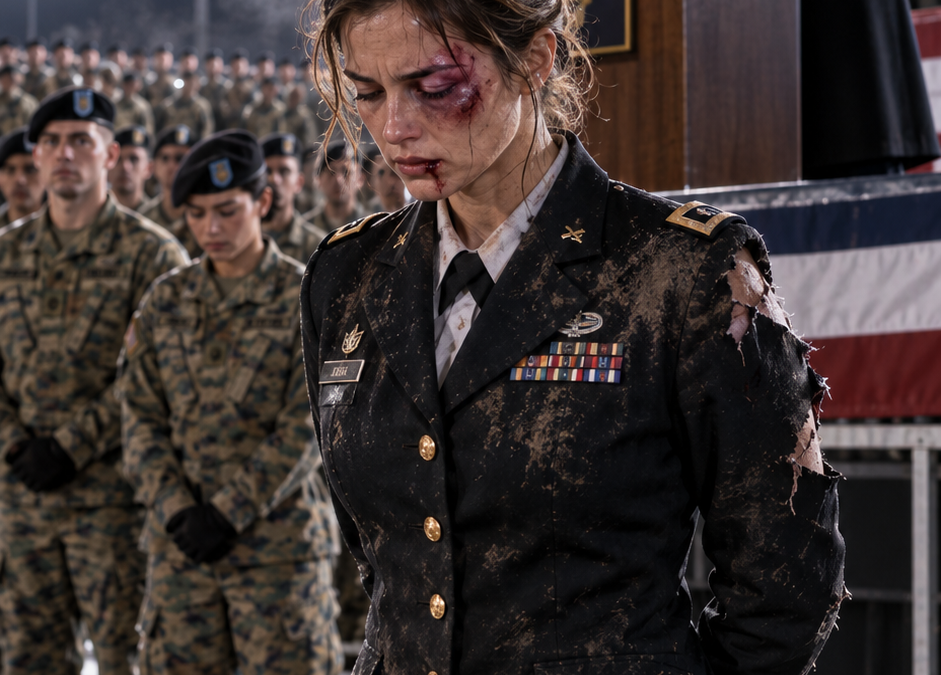
His voice pulled me back to the parade field.
A quiet shock moved through the formation.
Major Henderson stepped down from the reviewing stand.
He was Garrett’s executive officer.
Tall.
Angular.
Careful around superiors.
Cruel around people who could not retaliate.
I had learned everything important about him within four days.
He approached me.
I watched his gloved hand rise toward the captain’s bars on my collar.
“Don’t touch me, Major.”
He froze.
My voice was quiet.
That made people listen harder.
Henderson leaned close.
“Stand down, Vance.”
I could smell coffee on his breath.
“You brought this on yourself.”
“I said don’t touch me.”
Garrett seized the microphone.
“Captain Vance, you are out of order. Submit to disciplinary separation immediately or military police will remove you.”
Two MPs stepped forward.
I recognized both.
They had been in the basement.
One had held my shoulders.
The other had held my legs after I stopped cooperating.
That was the moment I knew we had enough.
Not suspicions.
Not circumstantial connections.
Not another set of missing manifests.
Enough.
I looked at Garrett.
And smiled.
My lip split again.
I tasted blood.
“Colonel Garrett.”
My voice carried without a microphone because three thousand people had gone completely silent.
“You have sixty seconds to step down from that platform, place your hands behind your head, and surrender yourself to Staff Sergeant Diaz.”
For one perfect second, nobody understood what they had heard.
Then whispers moved through the ranks.
Garrett’s face darkened.
“What did you say?”
“You heard me.”
He looked almost offended by reality itself.
“Arrest her!”
The MPs moved.
Then the sound came.
Low at first.
A pulse beneath the wind.
Thump.
Thump.
Thump.
Heads turned toward the northern tree line.
The sound grew until I could feel it through the soles of my boots.
Three black MH-60 helicopters rose over the trees.
They came in low.
No ceremonial approach.
No gentle descent toward designated landing zones.
Searchlights cut across the field and flooded the tarmac with white-gold light.
The first Black Hawk dropped onto the grass.
Then the second.
Then the third.
Rotor wash exploded across the parade field.
Dust and dead grass filled the air.
Coats snapped.
Soldiers turned their faces from the debris.
The side doors opened before the aircraft fully settled.
Army CID operators and federal marshals poured out.
They moved toward predetermined positions.
Perimeter.
Vehicle access.
Headquarters.
Communications.
Reviewing platform.
Garrett still held the microphone.
“What is the meaning of this?”
Nobody answered him.
A man in a dark civilian overcoat stepped from the lead helicopter.
Director Arthur Vance.
No relation by blood despite the shared surname, though after fifteen years working together he had become something closer to family than most people in Washington ever managed.
Beside him walked the Vice Chief of Staff of the Army and another four-star general.
Garrett stared at them.
Then at me.
For the first time that morning, he understood that he had never known who was standing in front of him.
Arthur stopped two paces away.
His eyes went directly to my face.
Professional control failed him for half a second.
“Elena.”
“I’m fine.”
His expression said he knew I was lying.
He opened his coat and removed a leather-bound folder.
I took it.
Inside was the signed executive warrant.
Fully executed.
Unredacted.
Authorized by the President three hours earlier based on the evidence transmitted from Fort Campbell during the previous forty-eight hours.
I reached inside my torn jacket and removed the encrypted recorder I had carried against my body throughout the interrogation.
It had captured everything.
Henderson’s questions.
The threats.
The names.
Garrett entering the room.
His order to keep going.
His discussion of missing inventory.
His confidence that nobody in Washington could touch him.
I wiped blood from my lip.
Then I looked at him.
“Your sixty seconds are up.”
The field became so quiet I could hear the Black Hawks idling behind me.
Garrett held the microphone tighter.
“This is a mutiny.”
“No.”
I walked toward him.
“This is an arrest.”
Arthur stepped forward.
“Colonel Richard Garrett, by authority of the executive warrant issued by the Commander-in-Chief, your command authority is suspended effective immediately.”
A gasp moved through the brigade.
“You are being detained pending federal charges involving theft of military property, weapons diversion, conspiracy, obstruction, and the deaths of United States military personnel.”
Garrett’s face changed.
Not fear yet.
Disbelief.
Powerful men often experience disbelief before fear.
They spend so many years arranging systems around themselves that consequences begin to feel like violations of natural law.
“This is outrageous.”
He pointed toward Arthur.
“I have thirty years in uniform.”
General Thomas Montgomery stepped forward.
He had known Garrett for decades.
“Richard.”
Garrett looked at him.
“Shut your mouth.”
Garrett actually stepped backward.
Montgomery continued.
“The people you expected to protect you are not returning your calls. Your Miami buyers were picked up after midnight. Federal teams are serving warrants on your shell companies now.”
Garrett’s breathing became shallow.
Then Henderson broke.
He dropped to his knees on the reviewing platform.
“Sir—I was following orders.”
Garrett turned toward him.
Henderson raised both hands.
“The routing came from Garrett. The manifests came from Garrett. I didn’t know about Kandahar. I swear I didn’t know about Specialist Leo Vance.”
My brother’s name crossed the parade field.
For five years I had trained myself not to react when I heard it unexpectedly.
I failed.
Not outwardly.
My face stayed still.
But inside, I was back in Ohio.
Back in my mother’s kitchen.
The clock above the sink.
Leo’s daughter coloring at the table.
The knock at the front door.
My mother opening it.
Two uniforms.
One folded flag.
One sentence.
We regret to inform you.
I tightened my hand around the executive warrant.
“Staff Sergeant Diaz.”
Marcus snapped forward.
“Ma’am.”
“Disarm Colonel Garrett.”
Marcus looked at me.
Something moved behind his eyes.
Not revenge.
Release.
“Yes, ma’am.”
He took several soldiers with him and climbed the platform steps.
Garrett stared at him.
“Sergeant, I am your commanding officer.”
Marcus stopped in front of him.
“Not anymore, sir.”
He removed Garrett’s sidearm.
For a moment Garrett seemed to consider resisting.
Then he looked around.
Three thousand soldiers.
Federal agents.
Two four-star generals.
The men he had commanded.
The officers he had frightened.
The young enlisted people who had believed his word could destroy their careers.
Nobody moved to save him.
Slowly, he placed his hands behind his head.
Marcus cuffed him.
The metallic click seemed impossibly loud.
As Garrett was brought down the steps, he stopped near me.
His face was inches from mine.
“You think you won?”
I said nothing.
“Look at yourself.”
His eyes moved across my bruises.
“You destroyed yourself for this.”
I leaned closer despite the fire in my ribs.
“No, Richard.”
His eyes narrowed.
“I let you believe you were destroying me.”
For the first time, something like fear reached him.
“My brother’s name was Leo.”
He flinched almost imperceptibly.
“Remember it.”
A marshal moved Garrett forward.
I watched him go.
And then my body decided the operation was finished before my mind did.
The field tilted.
Searchlights stretched into streaks.
My knees gave way.
Marcus caught me before I hit the ground.
“I’ve got you.”
“I’m fine.”
“No, ma’am.”
His voice softened.
“You’re not.”
He guided me onto an equipment crate.
Arthur crouched in front of me.
“The evidence is secured.”
“The drives?”
“Recovered.”
“The manifests?”
“Recovered.”
“Armory?”
“Lockdown teams are moving now.”
Only then did I allow myself to breathe.
It hurt enough to make my vision flash white.
“I want a civilian medic.”
Arthur frowned.
“Hospital.”
“No base hospital.”
“Elena—”
“We don’t know who Garrett compromised.”
He knew I was right.
They took me to a secure briefing room inside Hangar 3.
That was where Doc Miller found me.
Thomas Miller had served as a combat medic before becoming a civilian contractor.
He entered carrying an old canvas medical bag and the expression of a man personally offended by unnecessary injury.
He looked at my face.
Then at Arthur.
“Out of my way.”
A four-star general moved.
That told me everything about Doc Miller.
He checked my pupils.
Touched the swelling around my eye.
I flinched.
“That hurts?”
“Yes.”
“Good. Means you’re still capable of honesty.”
“Occasionally.”
His mouth twitched.
Then he examined my ribs.
When he saw the bruising, his humor disappeared.
“They kicked you after you went down.”
It was not a question.
“Yes.”
Marcus stood near the door.
I saw his expression change.
Doc pressed carefully along my side.
“Three fractures. Maybe a fourth crack. I want imaging, but your breathing is stable.”
He looked at me.
“You got lucky.”
“Not luck.”
He frowned.
“I protected my head and abdomen.”
“You planned how to take a beating?”
“I planned how to survive one.”
He stared at me.
Then slowly shook his head.
“You Washington people are strange.”
“Occupational hazard.”
He wrapped my ribs while I gripped the edge of the chair.
When he finished, Marcus approached.
“Counsel.”
“Yes?”
“Why didn’t you tell me?”
His guilt had been growing since the parade field.
“If I had known who you were, I could have helped.”
“No.”
His brow tightened.
“If you had known, you would have behaved differently.”
He stopped.
“Garrett watched everyone. Your ignorance protected the operation.”
“That’s supposed to make me feel better?”
“No.”
I looked directly at him.
“But this might.”
He waited.
“I watched you for three weeks.”
Marcus said nothing.
“You refused to approve inventory discrepancies Henderson told you to ignore. You protected your soldiers when you thought doing so might cost you promotion. You challenged orders when you believed they were unsafe.”
His eyes shifted away.
“I needed to know whether there were still people inside Garrett’s organization who remembered what the uniform meant.”
I paused.
“You were one of them.”
Marcus swallowed.
For a man who had survived three combat tours, praise seemed to frighten him more than gunfire.
Before either of us could say more, Arthur returned with an encrypted satellite phone.
“Elena.”
His expression told me who was calling.
I took the phone.
“This is Counsel Vance.”
The President’s voice came through the line.
“Give me the ground reality.”
“Garrett is in custody. Henderson is cooperating. We have the duplicate manifests and encrypted drives. The immediate logistics network is compromised and being isolated.”
“And you?”
I looked at my reflection in the hangar window.
Swollen eye.
Split lip.
Bandaged ribs.
“The cost was acceptable.”
The silence on the line lasted several seconds.
“No,” he said finally. “It was necessary. That does not make it acceptable.”
My throat tightened.
Then he said Leo’s name.
“Elena, your brother would be proud.”
That was the sentence that nearly broke me.
Not Garrett.
Not the basement.
Not three thousand people watching me bleed.
Leo.
I turned my face away as one tear escaped my good eye.
“Thank you, Mr. President.”
“Get treated properly. That’s an order.”
“Yes, sir.”
“And Elena?”
“Sir?”
“Finish the job.”
“I intend to.”
When the call ended, I asked Arthur to bring me Lily Chen.
She entered ten minutes later holding her patrol cap against her chest.
The girl looked terrified.
She saluted.
I lowered her arm.
“Sit.”
She sat at the edge of the chair.
For several seconds she could not look at me.
Then she whispered, “I’m sorry.”
“For what?”
Her eyes filled.
“If I hadn’t found the logs, they wouldn’t have done this to you.”
I leaned forward despite the pain.
“Look at me.”
She did.
“What happened to me was not your fault.”
Her lip trembled.
“I knew Garrett’s men were coming. I knew what they would do if they caught me with those files.”
“But—”
“I chose to stay.”
She began crying silently.
“You were twenty-one years old and trapped inside a chain of command that had spent months teaching you that telling the truth could destroy your life.”
I pointed gently toward the door.
“Garrett is in custody because you noticed numbers that did not belong.”
She shook her head.
“No, ma’am.”
“Yes.”
I softened my voice.
“You are not the reason I was hurt. You are one of the reasons this ended.”
Her shoulders broke.
She covered her face.
Marcus moved behind her and placed one hand on her shoulder.
I let her cry.
People imagine safety feels peaceful.
Often it does not.
Sometimes safety is the moment your body finally realizes it is allowed to collapse.
When Lily could breathe again, I looked at Arthur.
“Transfer her to Washington.”
Lily’s head snapped up.
“What?”
“To my office.”
“Ma’am?”
“You understand procurement records. You notice patterns. And apparently you have more integrity than half the people who outrank you.”
For the first time, she smiled.
“You’re serious?”
“Completely.”
“I don’t know what to say.”
“Say yes.”
“Yes, ma’am.”
“Good.”
I thought the worst part was over.
I was wrong.
Special Agent Sarah Jenkins arrived with the next problem.
She dropped a binder onto the table.
“Garrett’s final shipment is still on the installation.”
My exhaustion disappeared.
“What shipment?”
“Sixty crates listed as decommissioned ordnance. The paperwork says they move at eighteen hundred.”
“What is actually inside?”
“Shoulder-fired weapons. Thermal targeting systems. Other classified equipment.”
Marcus swore under his breath.
“Where?”
“Sector 4.”
I looked at the manifest.
Garrett had signed it.
A retirement package.
One last shipment before the network collapsed.
Sarah explained the jurisdictional problem.
We had Garrett.
We had evidence.
We did not yet have clean authority to seize every piece of hardware in a live military munitions sector while the command transition was still being processed.
“Who guards Sector 4?” I asked.
Marcus answered immediately.
“Third Platoon. My people.”
“Will they follow your order?”
“They’ll follow a lawful security order.”
“That’s all I need.”
We went to the server room.
Sarah connected directly to the logistics system.
Garrett’s people had attempted remote wipes.
Most failed because Henderson, out of paranoia, had maintained physical backups.
That decision would probably put him in prison.
It also saved our case.
Sarah suddenly stopped typing.
“I found something.”
On the screen was a security schedule for Bunker 402.
Every night at 2200, the sensors around one section of the perimeter shut down for twenty minutes under the label maintenance diagnostic.
I stared at it.
“The truck at eighteen hundred is a decoy.”
Sarah turned toward me.
“What?”
“The manifest is supposed to be discovered.”
The answer became obvious as I said it.
“We chase the documented convoy to the south gate. The real shipment leaves at ten through the blind sector.”
Marcus muttered, “Son of a bitch.”
I stood.
Pain exploded through my ribs.
I ignored it.
“Move the federal perimeter to Sector 4. Keep the south gate response minimal. I want Garrett’s people believing their plan survived him.”
Sarah looked at me.
“You should be in a hospital.”
“So everyone keeps saying.”
At 1900, freezing fog rolled across Fort Campbell.
By 2100, I was sitting inside an unmarked Suburban near Bunker 402.
Marcus sat behind the wheel.
Sarah sat in the back with tactical communications.
Federal marshals and CID teams waited beyond the fog.
Third Platoon controlled the legitimate access roads without being told the full scope of the operation.
We sat in darkness.
My body shook from cold and exhaustion.
Marcus noticed.
“Counsel.”
“No.”
“I didn’t say anything.”
“You were going to.”
“I was going to tell you Doc Miller will kill me if you collapse.”
“Then don’t tell him.”
Marcus almost smiled.
At 2158, two heat signatures appeared.
Vehicles.
No headlights.
One flatbed.
One cargo van.
They approached Bunker 402.
Six men emerged.
Even through thermal optics, Marcus recognized several.
Senior logistics personnel.
Men Garrett had trusted.
Men soldiers beneath them had probably trusted too.
They opened the bunker.
Sarah waited.
I watched four figures enter.
Two lowered the flatbed ramps.
“Now.”
Sarah keyed the radio.
“Execute.”
Searchlights ignited.
Fog turned silver.
Federal loudspeakers ordered the men down.
For a fraction of a second, nobody moved.
Then one of Garrett’s men fired at a searchlight.
The night erupted.
I stayed behind the vehicle at first.
Gunfire cracked through the fog.
Marcus moved with the tactical team.
Sarah took cover behind the engine block.
Then I saw someone break from the cargo van.
Large man.
Distinct limp.
Running west.
I knew that walk.
I had watched archived footage of it for months.
Master Sergeant Robert Vance.
No relation.
The logistics chief whose authorization appeared on the final clearance connected to Leo’s convoy.
I stepped into the fog.
“Robert!”
He stopped.
Turned.
Saw me.
Even at a distance, I watched recognition hit his face.
He raised his rifle.
“You should be dead.”
My blood turned cold.
Not because I was afraid.
Because guilty men sometimes confess when they think they are about to lose everything.
“We took care of your brother,” he shouted, “and we should have finished you last night.”
There it was.
Five years condensed into one sentence.
I raised my pistol.
“Drop the weapon.”
His rifle shifted toward me.
“Garrett is finished. Henderson is cooperating.”
“You think that protects you?”
“No.”
I stepped closer.
“It protects everyone else from you.”
His finger moved.
Before he could fire, a single shot came from the left.
His rifle spun from his hands.
He fell to his knees.
Sarah emerged through the fog with her weapon trained on him.
“I keep telling you,” she said, “I hate missing important meetings.”
By midnight, Sector 4 was secure.
All six men were in custody.
The cargo van contained dozens of crates tied directly to the missing inventory Lily had discovered.
The remaining bunker inventory matched our duplicate manifests.
For the first time, the case no longer depended on inference.
We had the men.
The goods.
The records.
The confessions.
And the chain connecting them.
Doc Miller found me sitting on the rear bumper of an ambulance.
He checked my pulse.
“You’re impossible.”
“I’ve heard.”
“One-twenty.”
“Still alive.”
“Mild fever.”
“I’m cold.”
“Your ribs are clicking.”
“That sounds less ideal.”
He glared.
“You are going to a hospital.”
“After the transition briefing.”
“I hate lawyers.”
“You were a Ranger.”
“That has nothing to do with my poor judgment.”
Marcus approached.
“Sector is secure.”
I looked at him.
“Every crate?”
“Accounted for.”
“Good.”
He hesitated.
Then said, “Your brother can rest now.”
The words struck somewhere deeper than pain.
I looked away toward the bunker.
“Not yet.”
Marcus frowned.
“Garrett still thinks somebody is going to save him.”
At 0130, I walked into brigade headquarters.
Federal marshals had transformed the building.
Files covered desks.
Clerks moved carefully between investigators.
People who had once treated Garrett’s office like a throne room now avoided even looking through its open doors.
Garrett sat inside the conference room.
No trench coat.
No sidearm.
No polished command presence.
His wrists were secured to the table.
I entered alone.
He looked at my face and smiled weakly.
“You look worse.”
“You look unemployed.”
His smile disappeared.
I sat across from him.
For several seconds neither of us spoke.
Finally, he said, “You think this ends because you found a few crates?”
“No.”
“Do you understand how many people are involved?”
“Yes.”
“You don’t.”
He leaned toward me.
“Senators. Contractors. officers you salute. People inside agencies you think are helping you.”
“Then they should be worried.”
He laughed.
“You still believe in the machine.”
I looked at him.
“No.”
That answer surprised him.
“I believe in people.”
He scoffed.
“People are the machine.”
“Exactly.”
I leaned forward.
“And machines can be repaired by removing broken parts.”
“You’re naive.”
“No, Richard.”
I thought about Leo.
“I stopped being naive five years ago.”
Garrett’s face hardened.
“You want revenge.”
“For Leo?”
“Yes.”
I considered the question.
“Five years ago, yes.”
He seemed pleased.
“Now?”
“Now I want evidence.”
I placed a file on the table.
“Henderson is cooperating.”
His eyes flickered.
“Robert confessed.”
That landed harder.
“The Sector 4 shipment is in federal custody.”
Garrett stared.
“The blind spot in the security network is documented.”
Silence.
“Your Miami buyers are detained.”
His face drained.
“And the political offices you expected to interfere have already been placed under preservation orders.”
For the first time, Garrett looked old.
“You destroyed your career for this.”
“No.”
“You think Washington will reward you?”
“I don’t care.”
“They’ll use you.”
“They already did.”
He stared at me.
“The difference is I volunteered.”
His voice dropped.
“You’re going to spend the rest of your life looking over your shoulder.”
I stood.
“No.”
“Every dark parking lot. Every stranger. Every—”
“I don’t have to look over my shoulder, Richard.”
I moved closer.
“Because I learned how to stand in the dark.”
His breathing changed.
“My brother’s name was Leo.”
Garrett looked away.
I caught his chin with my voice.
“Look at me.”
He did.
“You turned his death into paperwork.”
My throat tightened.
“You took a husband from his wife. A father from his daughter. A son from my mother.”
Garrett said nothing.
“For five years, my family wondered whether Leo made some mistake that sent him down that road.”
I felt my good eye burn.
“Now we know.”
Garrett’s lips tightened.
“You think that brings him back?”
“No.”
That was the truth that hurt most.
“It never will.”
I stepped away.
“But it gives his daughter something your report stole from her.”
“What?”
“The truth.”
I walked toward the door.
Behind me, Garrett shouted my name.
I did not turn.
At 0400, a government transport aircraft waited on the runway.
Doc Miller found me at the boarding stairs.
He gave Arthur three prescriptions and enough instructions to qualify as a briefing.
Then he looked at me.
“Do you ever follow medical advice?”
“I followed some.”
“You followed none.”
“I sat down twice.”
“That was unconsciousness.”
Marcus approached after Doc left.
His tactical vest was gone.
His uniform was clean.
For the first time since I had met him, he looked tired enough to admit he was human.
“The interim commander has officially assumed authority,” he said.
“Good.”
“He signed commendations for Third Platoon.”
“Good.”
Marcus hesitated.
I knew what he was waiting for.
“Colonel Albright asked me for a recommendation for a senior logistics leadership position.”
Marcus’s brow tightened.
“I gave him your name.”
He stopped breathing for half a second.
“Ma’am…”
“You held the line before you knew anyone important was watching.”
His eyes dropped.
“That matters to me.”
“I just did my job.”
“Most important acts of integrity are performed by people who say exactly that.”
His throat moved.
Then Marcus raised his hand.
The salute was perfect.
Not because of technique.
Because I knew what it cost him emotionally to give it.
I returned it.
“Take care of them.”
“Yes, ma’am.”
At the top of the stairs, Lily waited inside.
She was wearing a clean uniform.
A tablet rested in her hands.
She started to stand.
“At ease.”
She sat again.
“I was looking at the Washington procurement system.”
“Already?”
“I couldn’t sleep.”
I smiled.
“You’ll fit in.”
The aircraft began taxiing.
Lily looked out the window as Fort Campbell slid past us.
“Ma’am?”
“Yes?”
“Will people know what happened?”
“Some of it.”
“All of it?”
“No.”
She looked disappointed.
“Operations like this rarely become public in the way people imagine.”
“So Garrett might still have people defending him.”
“Probably.”
“That doesn’t bother you?”
I thought about it.
“No.”
“Why?”
“Because justice and applause are different things.”
She looked down at the tablet.
I continued.
“You found the missing numbers when nobody was applauding.”
She looked back at me.
“That’s the work that matters.”
The aircraft accelerated.
As the wheels left Kentucky, I closed my eye.
For five years, every road I traveled had seemed to lead back to Leo.
Every investigation.
Every file.
Every sleepless night.
Every conversation I abandoned because I could not explain why I was distracted.
Every relationship that withered because part of me remained trapped inside a redacted report.
Now Fort Campbell disappeared beneath clouds.
And for the first time, I felt the weight shift.
Not disappear.
Grief does not disappear.
It changes shape.
By 0900, I was walking through the West Wing.
Arthur walked beside me carrying the prosecution files.
My dress uniform was gone.
I wore a navy blazer large enough to hide the rib wrap.
A medical patch covered my injured eye.
People looked.
Nobody asked.
At the Oval Office door, I stopped.
“I want the first ten minutes alone.”
Arthur handed me the briefcase.
“Your father would have been proud.”
I looked at him.
“Don’t.”
His face softened.
“Not unless you want me to cry before I get through the door.”
He nodded.
The Marine guard opened it.
The President stood from behind the Resolute Desk when he saw me.
His eyes went immediately to the medical patch.
“My God.”
“I’m fine.”
“You have a remarkable commitment to that lie.”
I almost smiled.
He led me toward the sofa.
“The Attorney General has the preliminary indictment package.”
I placed the recovered drive on the table.
“This contains the final routing evidence.”
He looked at it.
“And Leo?”
I took a breath.
“Robert Vance confessed.”
The President waited.
“He confirmed Garrett received payment to clear the logistics sector before Leo’s convoy was redirected.”
My voice almost failed.
“He knew the route was compromised.”
The President sat very still.
For five years, I had imagined this moment.
I thought I would feel triumph.
I felt grief.
Just grief.
Clean and enormous.
The President lowered his eyes.
“I’m sorry.”
I looked toward the windows.
“He was twenty-six.”
“I know.”
“He had a little girl.”
“I know.”
“He told her he was building a treehouse when he came home.”
My voice broke.
“He never came home.”
The President said nothing.
That was a gift.
Powerful people often ruin grief by trying to improve it.
He let mine remain what it was.
Eventually he said, “You brought the people responsible into the light.”
A tear slipped down my cheek.
“This won’t give my mother those five years back.”
“No.”
“Or Leo.”
“No.”
I wiped my face.
“But his daughter will know he didn’t fail.”
The President nodded.
“That matters.”
“Yes.”
It did.
More than I had understood.
He ordered me to take medical leave.
I argued.
He reminded me the order came from the Commander-in-Chief.
I informed him that abusing presidential authority to enforce bed rest was constitutionally questionable.
He told me to sue him.
For the first time in days, I laughed.
Two days later, I went to Arlington alone.
Late afternoon.
Cold.
Quiet.
The endless white stones stood beneath a pale winter sky.
I walked through Section 60 slowly.
My ribs hurt.
My face still looked like someone else’s.
I had left the official files in Washington.
No warrant.
No evidence bags.
No agents.
No generals.
No President.
Just me.
And two small silver captain’s bars inside my coat pocket.
I stopped at Leo’s grave.
For several seconds, I could not move.
Then I knelt.
“Hey.”
My voice sounded too loud.
I touched the cold stone.
“I’m sorry it took so long.”
Wind moved through the trees.
I opened the small velvet box.
Inside were the captain’s bars Henderson had tried to remove from my uniform on the parade field.
They were scratched.
One still carried a dark smear near the edge that I had not cleaned away.
I placed them on Leo’s headstone.
“It’s done.”
That was all I managed at first.
My throat closed.
I bowed my head.
“They’re in custody.”
My fingers traced his name.
“The convoy order was deliberate.”
There.
I had said it.
Words I had spent five years chasing.
“You didn’t make a mistake.”
Tears blurred my vision.
“You weren’t careless.”
My hand trembled against the marble.
“You didn’t fail them.”
I bent until my forehead rested lightly against the stone.
“And you didn’t fail us.”
The grief came then.
Not the controlled tear I had allowed in front of the President.
Not the silent pain I had buried through briefings and arrests.
This was ugly grief.
Five years of it.
My shoulders shook.
Every movement hurt my ribs.
I did not care.
I remembered Leo at twelve, throwing snowballs at me and running before I could hit him back.
Leo at seventeen, stealing my car.
Leo in uniform the first time, standing in our mother’s kitchen like he had grown six inches overnight.
Leo holding his infant daughter so carefully that we all laughed at him.
Leo telling me over the phone that he had found something weird in the fuel records.
“Probably nothing,” he had said.
It had not been nothing.
I had spent years believing justice would make that memory easier.
It did not.
Justice did not erase the knock on my mother’s door.
It did not build the treehouse.
It did not give a little girl another morning with her father.
What it did was smaller.
And maybe more honest.
It put the truth back where a lie had been.
Eventually, I sat back.
The sun had nearly disappeared.
“I kept thinking catching Garrett would feel like winning.”
My voice was hoarse.
“It doesn’t.”
I looked at Leo’s name.
“It feels like reaching the end of a road and realizing I still have to walk home.”
The wind moved softly around me.
For years, I had imagined Leo as he had appeared in his casualty photograph.
Uniform.
Formal.
Frozen in time.
Now another memory came instead.
Leo laughing.
Flour on his shirt because he had tried to make pancakes for his daughter.
That was the brother I wanted back.
Not the evidence.
Not the victim.
Leo.
I smiled through tears.
“You would hate how dramatic all of this became.”
I could almost hear him.
Elena, you brought helicopters?
I laughed once.
The sound broke in the middle.
“Yes.”
I looked at the bars on the headstone.
“Three of them.”
For the first time in five years, remembering my brother did not immediately lead me back to Garrett.
That realization stopped me.
Garrett had occupied too much space inside our grief.
I had allowed him to.
Necessary perhaps.
But still true.
I stood slowly.
Pain moved through my side.
I waited until it passed.
Then I looked across the rows of white stones.
Thousands of names.
Thousands of families.
Thousands of stories that could never be reduced honestly to reports or casualty statistics.
That was what Garrett had forgotten.
He had looked at inventory and seen money.
At authority and seen protection.
At soldiers and seen pieces.
At Leo and seen a problem.
At Lily and seen another problem.
At me and seen somebody weak enough to break.
He had been wrong each time.
But the lesson I carried away from Fort Campbell was not that corrupt men always lose.
History would never support something so comforting.
Sometimes they win for years.
Sometimes institutions protect them because admitting the truth would be embarrassing.
Sometimes good people stay silent because they are afraid.
Sometimes justice arrives bruised, late, and exhausted.
What mattered was that somebody eventually refused the silence.
Lily had refused.
Marcus had refused.
Sarah had refused.
Henderson, however late and selfishly, finally refused.
I had refused.
And Leo had refused first.
That was why he died.
It was also why the truth survived him.
I touched the headstone one last time.
“I have to go.”
The words hurt in a way I had not expected.
For five years, leaving his grave always felt like abandoning him.
This time it felt different.
I was not leaving Leo behind.
I was finally leaving Garrett behind.
“I love you.”
I turned.
Walked down the gravel path.
My steps were slow because my ribs still needed time.
But they were steady.
At the bottom of the hill, I stopped once and looked back.
The captain’s bars caught the last light of the setting sun.
Two small pieces of silver against white marble.
Garrett had tried to strip them from me because he believed rank was the source of my power.
He had never understood.
My authority had never come from metal on my collar.
Lily’s courage had not come from rank.
Marcus’s integrity had not come from rank.
Leo’s honor had not come from rank.
The things that mattered most had existed long before anyone important noticed them.
I slipped my hands into my coat pockets and continued toward the waiting car.
Washington was ahead.
Investigations.
Indictments.
Political pressure.
People who would insist Garrett had been an isolated case.
Others who would want files sealed because transparency was inconvenient.
There would be another ledger.
Another dark hallway.
Another person convinced nobody could reach them.
I knew that now.
But something inside me had changed.
For five years, I had been hunting backward.
Toward Leo.
Toward Kandahar.
Toward the truth of what had happened.
Now I could move forward.
Not because grief was finished.
Because grief no longer needed to be my only compass.
At the car, I looked once more across Arlington.
The sky had become purple and gold.
Almost the same colors that had hung above Fort Campbell when three thousand soldiers watched me stand battered beneath the floodlights.
That morning Garrett had believed he was showing the brigade what weakness looked like.
He had been wrong about that too.
Weakness was never the bruises.
It was the silence that had allowed him to create them.
And strength was never my willingness to endure pain.
It was Lily opening those inventory files when everyone around her had taught her to look away.
It was Marcus refusing to sign a false report even when promotion depended on obedience.
It was Sarah following the numbers beyond the point where politics told her to stop.
It was Leo asking why the fuel did not match.
The people who frightened Garrett most had never been the people with the highest rank.
They were the people who still believed the truth mattered after the system gave them every reason to stop believing.
I opened the car door.
Before getting inside, I whispered one last thing toward the hill.
“Rest now, Leo.”
Then I left.
For the first time in five years, I did not look back.








