𝗣𝗔𝗥𝗧 𝟮 The Colonel Kept Asking Where I Learned to Treat Wounds No Ordinary Nurse Should Recognize
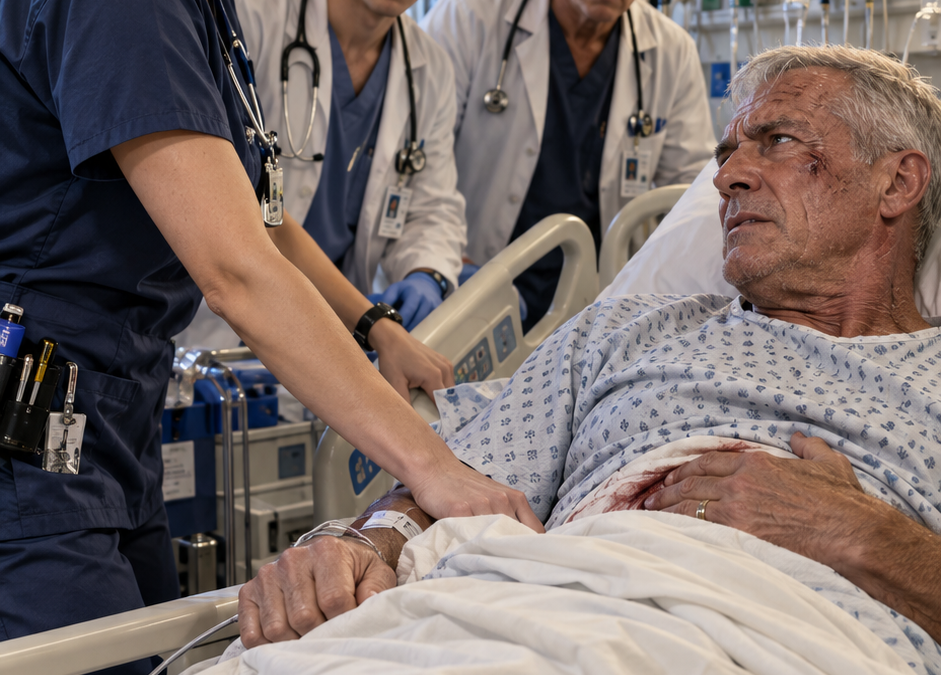
𝗣𝗔𝗥𝗧 𝟮
The transport order changed.
I nodded and returned my attention to the support.
James was no longer watching the doctor.
He was watching my hands.
That bothered me more than I wanted it to.
Not because he had identified anything.
Because he was close enough to identification to start searching.
The worst part of a buried life is not that people forget it.
The worst part is when someone sees the outline beneath the ground.
Reynolds had barely finished the next reassessment when James shifted his legs toward the edge of the bed.
“Colonel.”
He stopped.
Only because my voice reached him before his feet reached the floor.
“Imaging is ready,” he said. “I can walk.”
Reynolds glanced toward the order.
“Wheelchair would be fine.”
“Unnecessary.”
James planted one hand beside him and pushed upward.
Pain caught him halfway.
His breath shortened.
His shoulders locked.
He stayed upright through it anyway.
I did not tell him he was being stubborn.
That word is rarely useful with people whose stubbornness once kept them alive.
He looked toward me.
“What would you call this in the field?”
The question was deliberate now.
Not curiosity.
Pressure.
I checked the support.
“I’d call him a patient who hasn’t told me what changed.”
His eyes narrowed.
“Nothing changed.”
“Then give me the sequence.”
“The sequence?”
“What happened before the pain increased?”
He hesitated.
“I shifted forward.”
“Before that?”
“Took a deeper breath.”
“Before that?”
He stared at me.
I waited.
Finally, he said, “Pressure under the ribs.”
“Then?”
“Pulled into my back.”
“How long before you moved?”
“Thirty seconds. Maybe less.”
Reynolds looked up from the chart.
That detail had not been documented.
James noticed.
He gave me a dry look.
“That what you wanted?”
“It’s what happened.”
I turned toward Reynolds.
“The movement isn’t starting the symptoms. He’s moving after they begin.”
Reynolds canceled the simple transport instruction.
“We reassess here first.”
James eased himself back.
He was not happy.
But the irritation was different now.
He was no longer irritated because I had delayed him.
He was irritated because his own description had justified the delay.
“You talk like a field medic.”
I checked his breathing.
“Tell me whether the pressure changes when you exhale.”
“You keep doing that.”
“Doing what?”
“Answering a different question.”
I met his eyes.
“Because yours isn’t the question affecting your care right now.”
Something almost like amusement touched his expression.
It vanished when he breathed.
He exhaled slowly.
“The pressure eases near the end.”
I gave Reynolds the observation and adjusted the support.
James watched me.
“Limited equipment. Movement control. Sequence instead of isolated symptoms.”
His tone remained calm.
“That isn’t ordinary bedside habit.”
“It’s useful bedside habit.”
“Where did you learn it?”
I looked at him.
This time I made the boundary explicit.
“Colonel, you can ask me about anything I’m doing to you. You can refuse anything I recommend. But I’m not discussing my history while I’m responsible for your care.”
He held my gaze.
Something changed between us.
Not warmth.
Not trust.
Not yet.
Structure.
He understood boundaries.
He had spent his life inside them.
Rules of engagement.
Authority.
Jurisdiction.
Responsibility.
Now I had given him mine.
He looked away first.
“Fine.”
He drew one careful breath.
“There’s something else.”
I waited.
“When the pressure starts, my right shoulder feels heavy.”
“Heavy how?”
“Not weak.”
His fingers moved downward slightly.
“Loaded.”
That word caught my attention.
“Loaded.”
“Like carrying gear too long and realizing the strap’s been cutting into you for an hour.”
I kept my face neutral.
But my mind sharpened.
“That description matters.”
He looked toward the door.
“Give Reynolds exactly that language when he comes back.”
“You understand what I mean by loaded?”
“I understand what you told me.”
I wrote his description exactly.
I did not translate it into weakness.
I did not make it cleaner.
Cleaner is not always more accurate.
When Reynolds returned, James did not ask about combat medicine.
He repeated the symptom.
I added the timing.
The positional pattern.
The order of events.
Reynolds modified the assessment.
And something important happened without either of us naming it.
James started participating differently.
If he wanted my judgment, he had to give me information.
Not the information he thought made him look strong.
Not the information he considered worth reporting.
The information that actually happened.
Reynolds turned his tablet toward him.
“One more time for the handoff.”
James glanced toward me.
“Nurse Carter has it.”
My eyes lifted.
Reynolds paused.
James settled against the pillow.
I stepped beside the bed.
“I’ll give the observations. Anything you felt that I didn’t observe comes from you.”
James nodded.
“Understood.”
I opened the chart.
“Pressure beneath the right ribs precedes movement. It extends toward the back. He describes right shoulder heaviness as loaded, not weak. Symptoms ease near the end of expiration. Upright movement aggravated the pattern after it had already started.”
Reynolds looked at James.
“Anything missing?”
“No.”
I closed the chart.
Reynolds began typing.
“Don’t summarize loaded as weakness,” I said.
He looked up.
“You think the distinction matters?”
“I don’t know yet. That’s why I don’t want to erase it.”
James’s eyes shifted toward me.
Reynolds deleted what he had begun writing.
“Fair.”
A transport aide appeared with another wheelchair.
James automatically reached for the bed rail.
I did not tell him not to move.
I looked at him.
His hand stayed there.
Then relaxed.
“Does moving now interfere with what you need?” he asked.
No challenge.
No test.
A real question.
I checked the order.
“Not if the team already has the sequence and you tell them before you change position if the pressure returns.”
James looked toward the aide.
“Give me a second.”
Then back to me.
“The shoulder heaviness started before the sharp pain this morning too.”
I reached for the chart again.
“How long?”
“Ten minutes. Maybe fifteen.”
“And you didn’t mention it because?”
He knew exactly what I was asking.
“It wasn’t limiting anything.”
I entered the timing.
“That goes with you.”
Reynolds read the new note.
“Emily, stay on the handoff through the next evaluation. They need these descriptions preserved.”
I did not automatically agree.
“I’ll stay with the observations. Diagnosis remains yours.”
“Agreed.”
James watched that exchange closely.
He was learning me the way soldiers learn terrain.
Where the ground held.
Where it did not.
What I would assume responsibility for.
What I would return to someone else.
He transferred to the wheelchair carefully.
He did not force himself upright.
He waited until I had watched his first breath and posture.
I gave him no praise.
He did not need it.
At the elevator, he began describing the shoulder sensation before anyone asked.
Reynolds recorded it exactly.
I stood beside him listening.
For a moment, I remembered another kind of elevator.
Except it had not been an elevator.
Steel floor.
Red light.
Engine vibration.
A man trying to convince me his hand still worked because he could move three fingers.
Another voice in my headset asking how long we had.
I pushed the memory away.
The doors opened.
Imaging was bright, cool, and ordinary.
I preferred ordinary.
The technician positioned James.
“Colonel, I need you flatter for the next sequence.”
James started to comply.
Then stopped.
His eyes found mine.
I was already watching him.
“Loaded?”
“Shoulder first.”
He breathed carefully.
“Then pressure.”
I looked at Reynolds.
“That’s the sequence we brought down. If we flatten him immediately, we lose the distinction between the symptom starting and position making it worse.”
The technician glanced toward us.
“I can capture the first set where he is. Standard series needs him lower afterward.”
“Start here,” Reynolds said.
The equipment moved around James instead of James moving around the equipment.
It seemed like a small thing.
Most important medical decisions do.
No alarms.
No shouting.
No heroic gestures.
Just someone noticing which variable should move first.
The initial images were obtained.
Then the table lowered in stages.
At the second change, James’s right shoulder pulled back.
“There.”
I looked at him.
“That’s the load?”
“Yes.”
I marked the position and time.
“Pressure?”
“Not yet.”
Several seconds passed.
He inhaled.
His fingers tightened.
“Now.”
I recorded it.
The technician looked toward Reynolds.
“We have enough to compare positions.”
James began pushing himself higher.
“Wait.”
He stopped.
I stepped closer.
“You said the shoulder heaviness started ten or fifteen minutes before the sharp pain this morning.”
“Yes.”
“If you keep dismissing it because you can function through it, we lose the earliest part of the pattern.”
His expression hardened.
“I wasn’t dismissing it.”
“You left it out because it wasn’t limiting you.”
Silence.
Reynolds said nothing.
James looked at his hand.
Opened it.
Closed it.
Then rested it flat against his thigh.
“In my job, something that doesn’t stop you isn’t always worth reporting.”
“Here it is.”
I did not lecture him.
I did not tell him hospitals were different from war.
People like James already understood that at an intellectual level.
The problem was deeper.
Bodies remember professions long after uniforms come off.
A soldier learns to divide discomfort into two categories.
Stops the mission.
Does not stop the mission.
Medicine needed more categories than that.
“If it starts,” I said, “you tell us.”
The next positional adjustment was small.
The heaviness returned.
James spoke immediately.
“Shoulder.”
I marked the time.
He waited.
“Pressure starting.”
The technician captured the sequence.
Reynolds stopped the remaining routine positioning.
“We have the pattern. No reason to keep reproducing it.”
James sat up slowly.
This time he told me exactly when the discomfort eased.
I removed a monitoring lead.
He watched me.
“You knew I was doing that.”
“Doing what?”
“Deciding what mattered before I reported it.”
“I knew what you weren’t telling us.”
He let out a short breath.
Then something in his posture changed.
Not weakness.
Permission.
“If I start treating tolerable like it means irrelevant again, don’t let me.”
My hand stopped.
He had just offered me a kind of authority that many patients wanted nurses to take.
Watch me.
Correct me.
Decide for me when my judgment becomes inconvenient.
It would have been easy to accept.
Easy is dangerous.
“No.”
His brow tightened.
“No?”
“I won’t decide whether you report what you feel.”
He looked genuinely surprised.
“I thought that was what you just said I was doing wrong.”
“It was.”
“Then stop me when I do it.”
“I’ll tell you when something you report matters clinically. I’ll tell you when continuing something stops being useful. But if you feel something, you decide whether you say it.”
His jaw shifted.
“You caught what I left out.”
“Because eventually you gave me enough to catch it.”
The answer frustrated him.
I could see that.
He wanted a guardrail.
I was giving him responsibility.
Reynolds approached with preliminary notes.
“One controlled positional assessment before we decide whether we’ve characterized this well enough.”
James looked toward the table.
“How uncomfortable?”
“Possibly enough to reproduce the pattern.”
His eyes came to me automatically.
I gave him nothing.
No nod.
No warning.
No permission.
“Your call.”
He studied me.
“You’ll tell me if continuing stops giving you useful information?”
“Yes.”
“But you won’t tell me what I can tolerate.”
“No.”
He looked back at the table.
“Good.”
He repositioned himself.
The technician began at the angle that had produced only shoulder heaviness earlier.
Several seconds passed.
His shoulder tightened.
I saw it.
I said nothing.
James looked toward me.
I waited.
“Loaded.”
I marked the time.
The table moved slightly farther.
His breathing shortened.
His hand closed around the edge.
“Pressure under the ribs.”
Reynolds watched the data.
“We can hold here.”
The discomfort sharpened across James’s face.
I knew the expression.
I had seen it on people trained not to make pain visible because somebody else needed to know they were still useful.
His shoulders squared.
His mouth tightened.
He began to disappear behind endurance.
My hand rested near the control.
Not on it.
James looked at my fingers.
Then at Reynolds.
“Is this still giving you something?”
Reynolds checked the screen.
“Yes.”
James nodded.
“Another few seconds.”
Four seconds later, his left hand lifted.
“Enough.”
The technician stopped immediately.
I returned the table toward neutral.
No one asked whether he could have lasted longer.
That question no longer mattered.
When James sat upright, his face had gone pale.
He looked at me.
“You could’ve stopped it before I did.”
“Yes.”
“You didn’t.”
I removed the blood pressure cuff.
“You asked me not to let you confuse tolerable with irrelevant. You didn’t ask me to make your choices.”
He stared at me.
For the first time since he had asked where I learned combat medicine, I saw the question changing inside him.
He was no longer wondering only about technique.
He was wondering about philosophy.
Who had taught me that strength was not the same thing as usefulness?
Who had taught me that keeping someone alive did not mean taking every decision away from them?
Who had taught me that a medic could be responsible for stopping an intervention without becoming responsible for another person’s will?
Reynolds set the tablet down.
“This gives us what we need to plan one final targeted assessment.”
Then he looked at me.
“Emily, I need to know whether you’re willing to stay involved.”
James remained silent.
This time the decision belonged to me.
And I felt that more sharply than I expected.
Because there had been years when decisions had been made for me before I ever entered the room.
Go.
Stay.
Move.
Wait.
Stabilize.
Evacuate.
Hold.
Release.
There had always been a command structure.
There had always been someone else’s mission sitting above my judgment.
Hospital work was different.
Sometimes painfully different.
Here, when I accepted responsibility, I had to choose it.
“I’ll stay.”
Reynolds nodded.
I continued.
“Under one condition.”
He waited.
“I’m responsible for identifying when the assessment stops producing clinically useful information. When I call that point, we stop. We don’t continue because Colonel Whitaker can tolerate more.”
Reynolds considered it.
Then modified the order.
“Agreed.”
I entered my name beside the observation role.
James watched my thumb press the screen.
“So you’re calling the limit.”
“I’m calling the limit of the test.”
“And I call mine.”
“Yes.”
A small nod.
“That works.”
The technician reviewed the planned positions.
“One controlled sequence.”
James was offered a break.
He looked at me.
I gave him no answer.
“I’m ready.”
I moved to the side of the table.
Not near the controls.
Those belonged to the technician.
Not beside Reynolds’s screen.
Diagnosis belonged to him.
I stood where I could see James’s face, right shoulder, breathing, and monitor without changing position.
Beside the patient.
That was where my responsibility lived.
Before they began, James flexed his right hand.
“If I say I can keep going after you’ve got what you need?”
“That won’t change what we need.”
“If Reynolds wants another few seconds?”
I looked toward Reynolds.
He gave a small nod.
“Then I’ll tell him whether those seconds still have clinical value.”
James breathed out.
“Understood.”
The table began moving.
At the first angle, nothing happened.
At the second, his right shoulder tightened.
“Loaded.”
No prompting.
I marked the time.
The next increment.
His breathing changed.
“Pressure starting.”
Reynolds watched the measurements.
“Hold there.”
The technician stopped.
I watched James.
His fingers curled.
Then deliberately opened.
Discomfort was present.
Information was still changing.
I remained silent.
Reynolds spoke after several seconds.
“I’m seeing the response. I may need one more position.”
“Finish this hold first.”
He glanced at me.
Then nodded.
The hold continued.
The readings developed.
I could feel the weight of the responsibility I had accepted.
Every second now belonged to a judgment I could not hand back simply because someone senior wanted more.
That was another lesson I had not learned in a classroom.
Responsibility means nothing when everyone agrees with you.
It becomes responsibility when stopping makes you inconvenient.
The trace began leveling.
James remained controlled.
He could continue.
Reynolds was still watching for more.
I studied the screen.
Then James.
Then the clock.
The readings stopped changing before he did.
That was the line.
“Stop the assessment.”
The technician reached for the control.
Reynolds kept watching.
“He’s tolerating it. Give me another ten seconds.”
I felt something old and cold settle into place inside me.
“No.”
Reynolds looked over.
“We have the response.”
James turned his head toward me.
The technician hesitated.
“Return him to neutral.”
Reynolds watched the screen one final second.
Then released it.
“Neutral.”
The table moved back.
James exhaled as the pressure eased.
I marked the stop time and watched until the tension left his right shoulder.
Reynolds scrolled through the captured data.
“That’s enough. We got the transition.”
I stepped away.
No triumph.
No satisfaction.
The boundary had existed because it was useful.
Now the test was finished.
So was my authority over that part of it.
James sat up.
“I could’ve done the ten seconds.”
“I know.”
“You stopped anyway.”
“The information had stopped changing.”
He looked at Reynolds.
“And she was right?”
Reynolds answered without hesitation.
“We had what we needed.”
James turned back to me.
The room grew still again.
I recognized the moment before he spoke.
This time, when he asked, there was no pressure in his voice.
No attempt to force open a door.
“Where did you learn combat medicine?”
I folded the blood pressure cuff once.
Placed it on the cart.
I could have redirected him again.
I could have told him the assessment was complete and his question remained irrelevant to the care plan.
I could have protected the life I had built by refusing to touch the life that came before it.
All of those choices would have been valid.
But something had changed.
Not because he had earned my story.
No one earns another person’s wounds by asking correctly.
What he had earned was my belief that he understood the difference between an answer and an invitation.
I looked directly at him.
“Raven Six.”
James Whitaker went completely still.
It happened so subtly Reynolds probably would have missed it if he had not been watching both of us.
James’s hand loosened from the edge of the table.
His face changed.
Not shock exactly.
Recognition.
Raven Six was not a rank.
Not a medal.
Not a certification.
It was an old operational identifier attached to a combat medical element whose work had traveled through military medicine in fragments.
Case lessons.
Evacuation decisions.
Protocols revised because someone somewhere had learned what failed when resources became thin and time became cruel.
People remembered outcomes.
They rarely remembered faces.
That had always been fine with me.
James knew the name.
More importantly, he knew what not to ask next.
Reynolds started to speak.
“What does—”
James lifted one hand.
Not sharply.
Not as an order.
Just enough.
“That’s enough.”
The words hit me harder than I expected.
Not because he knew.
Because he stopped.
He had used the exact boundary I had used minutes earlier.
We had enough.
Do not keep extracting just because more might exist.
I held his gaze.
Then handed Reynolds the completed observation record.
James did not ask where I had served.
He did not ask what Raven Six had done.
He did not ask why an old operational call sign belonged to a nurse in navy-blue scrubs standing beside an imaging table.
He shifted slightly so I could pass.
That restraint stayed with me.
Longer than the recognition itself.
Reynolds reviewed the assessment.
“We have what we need to choose the next step.”
He explained the options.
The least invasive approach first.
What symptoms would justify changing direction.
What would end activity instead of merely modifying it.
James listened.
When Reynolds reached the activity limits, James said, “Ask Nurse Carter.”
Reynolds looked at me.
So did James.
But his expression held no demand.
He simply wanted my judgment where my judgment belonged.
I closed the supply drawer.
“Pain alone isn’t the only line. If the shoulder heaviness returns before the rib pressure, the sequence matters. If the pattern changes, report the change instead of deciding whether it’s serious enough to deserve attention.”
James nodded.
“And if I can tolerate it?”
“That tells us what you can tolerate.”
I paused.
“It doesn’t tell us whether continuing is useful.”
His mouth tightened.
He had heard the sentence enough times now that it had become part of the plan.
“Use that as the limit,” he told Reynolds.
Reynolds entered it.
A resident came through with discharge instructions.
“Do you want me to simplify the home activity section?”
“No,” James said.
The resident looked confused.
James pointed toward my note.
“Keep her wording.”
I reviewed the printed instructions myself.
One phrase bothered me.
Activity as tolerated.
Too vague.
I crossed it out.
Replaced it with the symptom sequence we had established.
Shoulder heaviness.
Then right-sided pressure.
Then positional aggravation.
Report change in sequence.
Stop activity when the pattern progresses rather than waiting for incapacity.
I handed the packet to James.
“This part is yours now.”
He took it.
His eyes paused on my signature beneath the nursing observations.
Emily Carter, RN.
Not Raven Six.
Emily Carter.
Then he folded the paperwork and put it inside his uniform jacket.
“Understood.”
Reynolds left to finalize orders.
The resident followed.
For a moment, James and I were alone beside the table.
He opened his mouth.
Stopped.
I knew what was there.
The past.
The call sign.
Questions that could have multiplied for hours.
Instead, he stood slowly.
He rested one hand against the table.
Waited through the first breath.
Then looked at me.
“Shoulder’s clear.”
Another breath.
“Rib pressure’s almost gone.”
I entered it into the chart.
He had reported the symptom before deciding whether it deserved reporting.
That mattered more to me than whether he ever asked about Raven Six again.
At the doorway, James stepped aside.
I walked through first.
He followed.
For several minutes we moved through the hospital like any nurse escorting any patient toward discharge.
That normality felt strange.
Years earlier, hearing the call sign spoken aloud would have tightened something in my chest.
Now I had been the one to say it.
And nothing had collapsed.
No doors had opened behind me.
No voices had followed.
The past remained where it was.
Named.
Not resurrected.
At the corridor junction, I stopped near the nurses’ station.
James continued toward the lobby.
Three steps later, he slowed.
I saw his hand touch the inside of his jacket where the instructions were folded.
He could have left.
A large part of me expected him to.
Then he turned halfway back.
“Carter.”
I looked at him.
He hesitated.
“If I ever need to know more about Raven Six…”
My fingers tightened around the chart.
There it was.
Not a demand.
Not exactly a question.
A door left slightly open.
I could have shut it.
Maybe I should have.
There are parts of a life you bury not because they were shameful but because they are too heavy to carry into every new room.
Raven Six belonged to another version of me.
She lived beneath red lights and headset static.
She learned to count blood loss without staring at blood.
She learned that people in pain often lied for reasons they thought were noble.
She learned how quickly courage could become self-destruction if nobody gave it a boundary.
She knew the sound of aircraft before seeing them.
She knew the silence after radio traffic disappeared.
She knew what it felt like to finish treating one person while already being called toward another.
Emily Carter worked twelve-hour shifts.
Emily Carter checked medication lists.
Emily Carter argued with physicians when necessary and thanked transport staff when they caught mistakes.
Emily Carter drank coffee too late in the afternoon.
Emily Carter wanted ordinary problems.
Ordinary rooms.
Ordinary endings.
I looked toward the glass doors behind James.
“You don’t need unit history to understand what happened in that room.”
“I know.”
“And you don’t need my service record to trust my judgment.”
He nodded once.
“I know that too.”
That answer mattered.
More than curiosity would have.
More than admiration.
More than recognition.
For most of my life, when people discovered what I had done, they wanted to rearrange me around it.
Suddenly every ordinary sentence became evidence of some hidden toughness.
Every quiet moment became mystery.
Every decision became proof that Raven Six was still standing behind my eyes.
I was tired of being interpreted through the hardest years of my life.
James did not do that.
He stood at a respectful distance.
Waited.
I made a choice.
Not because he deserved more.
Because I wanted to give something.
“Emily.”
His brow tightened slightly.
“What?”
“When I’m not your nurse.”
For the first time all day, he looked caught completely off guard.
“Emily?”
I nodded.
His expression shifted.
No triumph.
No attempt to turn the opening into something larger.
“All right.”
He started toward the doors.
I could have let him leave.
Instead, I spoke.
“Colonel.”
He turned.
For a fraction of a second, the word Raven almost came after it.
I stopped myself.
That name belonged to orders spoken through static.
To hands moving beneath red light.
To a woman who had learned to become calm because panic consumed oxygen other people needed.
She was not gone.
But she did not have to enter every room with me.
“Follow the plan,” I said.
James touched the instructions inside his jacket.
“I will.”
Then he left.
The automatic doors opened.
Closed behind him.
I remained where I was for one breath.
Only one.
Then I returned to the nurses’ station.
The chart waited on the counter.
Near the bottom of the assessment form sat an empty field.
ADDITIONAL SERVICE HISTORY.
My pen hovered above it.
There were years I could have put there.
Units.
Training.
Places.
Things that still woke me sometimes in the seconds before dawn when the world was quiet enough for old sounds to return.
None of them were necessary.
I drew one line through the empty field and initialed it.
My hand did not shake.
A call light sounded down the hall.
Room 214.
My next patient.
I clipped the pen into my scrub pocket and picked up the chart.
Behind the glass doors, Colonel James Whitaker crossed the lobby carrying a care plan that asked him to do something perhaps harder for him than enduring pain.
Notice it.
Name it.
Report it before it became disabling.
Trust that information did not become weakness simply because it admitted a limit.
And I returned to work carrying something quieter.
For years, I had believed protecting my present required denying my past any language at all.
That afternoon taught me something different.
A history could be named without being surrendered.
A person could recognize the soldier I had been without claiming access to her.
And sometimes the most important boundary was not refusing to answer.
It was choosing exactly how much truth belonged in the room.
I pushed open the door to 214.
A woman looked up from the bed, anxious and pale.
“Are you my nurse?”
I smiled and stepped inside.
“Yes, ma’am.”
My badge rested against my navy-blue scrubs.
Emily Carter.
That was the only name this room needed.
And for the first time in a very long while, that felt like enough.
Have you finished reading the story and want to read it again?
The Colonel Kept Asking Where I Learned to Treat Wounds No Ordinary Nurse Should Recognize
“Stop. Don’t sit him up.”
My hand closed around the bed rail just as the resident reached for the control.
Colonel James Whitaker had spent the previous ten minutes insisting that he did not need another night of observation. He had delivered the argument the way career officers delivered most things they had already decided were true—calmly, efficiently, and with the faint irritation of a man forced to explain the obvious to people who should have understood it the first time.
Then the color drained out of his face.
His sentence broke in the middle.
One hand went beneath his right ribs.
The other seized the sheet.
“Colonel?”
The resident leaned toward him.
James tried to answer.
Only a shallow breath came out.
I was already moving.
“Leave the bed where it is.”
The resident looked at me.
“He said he feels faint.”
“I heard him.”
I lowered the head of the bed slightly instead of raising it, then moved close enough to see James’s breathing without staring at the monitor.
Years in hospitals teach you to respect machines.
Other years teach you not to worship them.
The numbers had changed only a little.
James had changed a lot.
His breaths were short and guarded. Every inhalation stopped before his chest could fully expand. His right shoulder had stiffened. The muscles beneath his jaw were tight.
He was not simply hurting.
His body was protecting something.
“Where’s the pain?”
He pointed under his ribs.
“Chest pressure?”
He shook his head.
His breathing became faster.
The resident reached for the oxygen setup.
“Call Dr. Reynolds back.”
She hesitated.
“Now.”
She moved.
I kept my eyes on James.
“Colonel, look at me.”
His gaze locked onto mine.
“Don’t force a deep breath.”
His eyebrows pulled together.
For men like him, being told not to force something sounded suspiciously like being told he could not do it.
“I can breathe.”
“I know.”
I kept my voice level.
“Small breaths. Give me what you can without fighting for more.”
He stared at me for half a second longer.
Then he obeyed.
That told me more than an argument would have.
James Whitaker did not look like a man accustomed to following bedside instructions from a nurse without demanding reasons.
His grip on the sheet loosened by a fraction.
Dr. Michael Reynolds came back through the door quickly.
“What changed?”
“Sudden increase in right-sided pain. Shallow respirations. Worse with movement. He started guarding before the monitor changed.”
Reynolds moved to the bedside.
James tried to straighten.
“I can sit up.”
“Not yet.”
He looked at me.
There was no challenge in my voice.
That made him more irritated, not less.
Men who were used to winning arguments knew how to fight resistance.
Calm certainty gave them nothing to push against.
Another wave of pain tightened his jaw.
I watched the sequence.
Breath.
Guarding.
Shoulder.
Attempted movement.
More pain.
I reached toward the stabilization support stored with the trauma supplies.
The resident had returned and stood near the doorway watching me.
I positioned the support to reduce movement across the injured area while Reynolds continued his examination.
James instinctively braced one arm against the mattress.
I stopped his wrist with two fingers.
“Don’t fight the bed.”
His eyes snapped toward mine.
That was the first moment I knew he had heard more than the words.
Not recognized me.
Not yet.
But recognized something.
“Better or worse?” I asked.
He took one careful breath.
Then another.
“Better.”
Reynolds glanced at the support.
“Keep that there.”
“I intend to.”
The deterioration eased gradually.
James’s breathing slowed enough for him to speak in complete sentences again.
Reynolds ordered a focused reassessment and stepped into the hall to coordinate with imaging.
The resident followed.
For a few seconds, the room quieted.
I secured the support, loosened it slightly, watched James breathe again, and finally reached for the chart.
“You’ve done that before,” he said.
I wrote down the time the symptoms had changed.
“I’ve treated chest injuries before.”
“That isn’t what I said.”
My pen stopped.
Barely.
Less than a second.
But he noticed.
Of course he did.
James Whitaker had spent most of his adult life around people trained to work in places where equipment failed, evacuation took too long, and a bad decision could turn an injury into a death before anyone arrived to correct it.
He knew the difference between someone repeating a protocol and someone making decisions beneath the protocol.
I had not chased his monitor.
I had not sat him upright simply because he insisted he could tolerate it.
I had controlled unnecessary movement.
Collected the pattern.
Used only what the moment required.
And when the deterioration eased, I had stopped.
No flourish.
No explanation.
No performance.
That was the part he recognized.
He studied me.
“Where did you learn combat medicine?”
The room seemed to become very quiet.
Not actually quiet.
Hospitals never are.
A pump clicked somewhere near the wall.
Shoes moved past the doorway.
A cart rattled down the corridor.
But inside me, an old silence opened.
The kind that used to arrive after radio traffic stopped.
After someone said wait.
After everyone had done everything they could do and there was nothing left except listen.
My thumb moved once along the edge of the clipboard.
A small mistake.
I hated that he saw it.
I checked the support at his side.
“Right now, what matters is whether that pain returns when you move.”
His expression tightened.
“That wasn’t my question.”
“I know.”
I finished the observation and set my pen down.
He waited.
So did I.
I had learned years ago that silence was only uncomfortable if you believed you owed someone whatever answer would end it.
I owed James Whitaker good nursing care.
I owed him accurate observation.
I owed him respect.
I did not owe him my history.
Reynolds came back before James could ask again.
“Update?”
I gave it cleanly.
What had changed.
What I had done.
How James had responded.
Nothing more.
Reynolds checked the transport order.
“Imaging can take him now.”
I looked past him.
A wheelchair waited outside.
“Not in that.”
Reynolds followed my gaze.
James did too.
One second passed.
“Stretcher,” Reynolds said.
The transport order changed.
I nodded and returned my attention to the support.
James was no longer watching the doctor.
He was watching my hands.
That bothered me more than I wanted it to.
Not because he had identified anything.
Because he was close enough to identification to start searching.
The worst part of a buried life is not that people forget it.
The worst part is when someone sees the outline beneath the ground.
Reynolds had barely finished the next reassessment when James shifted his legs toward the edge of the bed.
“Colonel.”
He stopped.
Only because my voice reached him before his feet reached the floor.
“Imaging is ready,” he said. “I can walk.”
Reynolds glanced toward the order.
“Wheelchair would be fine.”
“Unnecessary.”
James planted one hand beside him and pushed upward.
Pain caught him halfway.
His breath shortened.
His shoulders locked.
He stayed upright through it anyway.
I did not tell him he was being stubborn.
That word is rarely useful with people whose stubbornness once kept them alive.
He looked toward me.
“What would you call this in the field?”
The question was deliberate now.
Not curiosity.
Pressure.
I checked the support.
“I’d call him a patient who hasn’t told me what changed.”
His eyes narrowed.
“Nothing changed.”
“Then give me the sequence.”
“The sequence?”
“What happened before the pain increased?”
He hesitated.
“I shifted forward.”
“Before that?”
“Took a deeper breath.”
“Before that?”
He stared at me.
I waited.
Finally, he said, “Pressure under the ribs.”
“Then?”
“Pulled into my back.”
“How long before you moved?”
“Thirty seconds. Maybe less.”
Reynolds looked up from the chart.
That detail had not been documented.
James noticed.
He gave me a dry look.
“That what you wanted?”
“It’s what happened.”
I turned toward Reynolds.
“The movement isn’t starting the symptoms. He’s moving after they begin.”
Reynolds canceled the simple transport instruction.
“We reassess here first.”
James eased himself back.
He was not happy.
But the irritation was different now.
He was no longer irritated because I had delayed him.
He was irritated because his own description had justified the delay.
“You talk like a field medic.”
I checked his breathing.
“Tell me whether the pressure changes when you exhale.”
“You keep doing that.”
“Doing what?”
“Answering a different question.”
I met his eyes.
“Because yours isn’t the question affecting your care right now.”
Something almost like amusement touched his expression.
It vanished when he breathed.
He exhaled slowly.
“The pressure eases near the end.”
I gave Reynolds the observation and adjusted the support.
James watched me.
“Limited equipment. Movement control. Sequence instead of isolated symptoms.”
His tone remained calm.
“That isn’t ordinary bedside habit.”
“It’s useful bedside habit.”
“Where did you learn it?”
I looked at him.
This time I made the boundary explicit.
“Colonel, you can ask me about anything I’m doing to you. You can refuse anything I recommend. But I’m not discussing my history while I’m responsible for your care.”
He held my gaze.
Something changed between us.
Not warmth.
Not trust.
Not yet.
Structure.
He understood boundaries.
He had spent his life inside them.
Rules of engagement.
Authority.
Jurisdiction.
Responsibility.
Now I had given him mine.
He looked away first.
“Fine.”
He drew one careful breath.
“There’s something else.”
I waited.
“When the pressure starts, my right shoulder feels heavy.”
“Heavy how?”
“Not weak.”
His fingers moved downward slightly.
“Loaded.”
That word caught my attention.
“Loaded.”
“Like carrying gear too long and realizing the strap’s been cutting into you for an hour.”
I kept my face neutral.
But my mind sharpened.
“That description matters.”
He looked toward the door.
“Give Reynolds exactly that language when he comes back.”
“You understand what I mean by loaded?”
“I understand what you told me.”
I wrote his description exactly.
I did not translate it into weakness.
I did not make it cleaner.
Cleaner is not always more accurate.
When Reynolds returned, James did not ask about combat medicine.
He repeated the symptom.
I added the timing.
The positional pattern.
The order of events.
Reynolds modified the assessment.
And something important happened without either of us naming it.
James started participating differently.
If he wanted my judgment, he had to give me information.
Not the information he thought made him look strong.
Not the information he considered worth reporting.
The information that actually happened.
Reynolds turned his tablet toward him.
“One more time for the handoff.”
James glanced toward me.
“Nurse Carter has it.”
My eyes lifted.
Reynolds paused.
James settled against the pillow.
I stepped beside the bed.
“I’ll give the observations. Anything you felt that I didn’t observe comes from you.”
James nodded.
“Understood.”
I opened the chart.
“Pressure beneath the right ribs precedes movement. It extends toward the back. He describes right shoulder heaviness as loaded, not weak. Symptoms ease near the end of expiration. Upright movement aggravated the pattern after it had already started.”
Reynolds looked at James.
“Anything missing?”
“No.”
I closed the chart.
Reynolds began typing.
“Don’t summarize loaded as weakness,” I said.
He looked up.
“You think the distinction matters?”
“I don’t know yet. That’s why I don’t want to erase it.”
James’s eyes shifted toward me.
Reynolds deleted what he had begun writing.
“Fair.”
A transport aide appeared with another wheelchair.
James automatically reached for the bed rail.
I did not tell him not to move.
I looked at him.
His hand stayed there.
Then relaxed.
“Does moving now interfere with what you need?” he asked.
No challenge.
No test.
A real question.
I checked the order.
“Not if the team already has the sequence and you tell them before you change position if the pressure returns.”
James looked toward the aide.
“Give me a second.”
Then back to me.
“The shoulder heaviness started before the sharp pain this morning too.”
I reached for the chart again.
“How long?”
“Ten minutes. Maybe fifteen.”
“And you didn’t mention it because?”
He knew exactly what I was asking.
“It wasn’t limiting anything.”
I entered the timing.
“That goes with you.”
Reynolds read the new note.
“Emily, stay on the handoff through the next evaluation. They need these descriptions preserved.”
I did not automatically agree.
“I’ll stay with the observations. Diagnosis remains yours.”
“Agreed.”
James watched that exchange closely.
He was learning me the way soldiers learn terrain.
Where the ground held.
Where it did not.
What I would assume responsibility for.
What I would return to someone else.
He transferred to the wheelchair carefully.
He did not force himself upright.
He waited until I had watched his first breath and posture.
I gave him no praise.
He did not need it.
At the elevator, he began describing the shoulder sensation before anyone asked.
Reynolds recorded it exactly.
I stood beside him listening.
For a moment, I remembered another kind of elevator.
Except it had not been an elevator.
Steel floor.
Red light.
Engine vibration.
A man trying to convince me his hand still worked because he could move three fingers.
Another voice in my headset asking how long we had.
I pushed the memory away.
The doors opened.
Imaging was bright, cool, and ordinary.
I preferred ordinary.
The technician positioned James.
“Colonel, I need you flatter for the next sequence.”
James started to comply.
Then stopped.
His eyes found mine.
I was already watching him.
“Loaded?”
“Shoulder first.”
He breathed carefully.
“Then pressure.”
I looked at Reynolds.
“That’s the sequence we brought down. If we flatten him immediately, we lose the distinction between the symptom starting and position making it worse.”
The technician glanced toward us.
“I can capture the first set where he is. Standard series needs him lower afterward.”
“Start here,” Reynolds said.
The equipment moved around James instead of James moving around the equipment.
It seemed like a small thing.
Most important medical decisions do.
No alarms.
No shouting.
No heroic gestures.
Just someone noticing which variable should move first.
The initial images were obtained.
Then the table lowered in stages.
At the second change, James’s right shoulder pulled back.
“There.”
I looked at him.
“That’s the load?”
“Yes.”
I marked the position and time.
“Pressure?”
“Not yet.”
Several seconds passed.
He inhaled.
His fingers tightened.
“Now.”
I recorded it.
The technician looked toward Reynolds.
“We have enough to compare positions.”
James began pushing himself higher.
“Wait.”
He stopped.
I stepped closer.
“You said the shoulder heaviness started ten or fifteen minutes before the sharp pain this morning.”
“Yes.”
“If you keep dismissing it because you can function through it, we lose the earliest part of the pattern.”
His expression hardened.
“I wasn’t dismissing it.”
“You left it out because it wasn’t limiting you.”
Silence.
Reynolds said nothing.
James looked at his hand.
Opened it.
Closed it.
Then rested it flat against his thigh.
“In my job, something that doesn’t stop you isn’t always worth reporting.”
“Here it is.”
I did not lecture him.
I did not tell him hospitals were different from war.
People like James already understood that at an intellectual level.
The problem was deeper.
Bodies remember professions long after uniforms come off.
A soldier learns to divide discomfort into two categories.
Stops the mission.
Does not stop the mission.
Medicine needed more categories than that.
“If it starts,” I said, “you tell us.”
The next positional adjustment was small.
The heaviness returned.
James spoke immediately.
“Shoulder.”
I marked the time.
He waited.
“Pressure starting.”
The technician captured the sequence.
Reynolds stopped the remaining routine positioning.
“We have the pattern. No reason to keep reproducing it.”
James sat up slowly.
This time he told me exactly when the discomfort eased.
I removed a monitoring lead.
He watched me.
“You knew I was doing that.”
“Doing what?”
“Deciding what mattered before I reported it.”
“I knew what you weren’t telling us.”
He let out a short breath.
Then something in his posture changed.
Not weakness.
Permission.
“If I start treating tolerable like it means irrelevant again, don’t let me.”
My hand stopped.
He had just offered me a kind of authority that many patients wanted nurses to take.
Watch me.
Correct me.
Decide for me when my judgment becomes inconvenient.
It would have been easy to accept.
Easy is dangerous.
“No.”
His brow tightened.
“No?”
“I won’t decide whether you report what you feel.”
He looked genuinely surprised.
“I thought that was what you just said I was doing wrong.”
“It was.”
“Then stop me when I do it.”
“I’ll tell you when something you report matters clinically. I’ll tell you when continuing something stops being useful. But if you feel something, you decide whether you say it.”
His jaw shifted.
“You caught what I left out.”
“Because eventually you gave me enough to catch it.”
The answer frustrated him.
I could see that.
He wanted a guardrail.
I was giving him responsibility.
Reynolds approached with preliminary notes.
“One controlled positional assessment before we decide whether we’ve characterized this well enough.”
James looked toward the table.
“How uncomfortable?”
“Possibly enough to reproduce the pattern.”
His eyes came to me automatically.
I gave him nothing.
No nod.
No warning.
No permission.
“Your call.”
He studied me.
“You’ll tell me if continuing stops giving you useful information?”
“Yes.”
“But you won’t tell me what I can tolerate.”
“No.”
He looked back at the table.
“Good.”
He repositioned himself.
The technician began at the angle that had produced only shoulder heaviness earlier.
Several seconds passed.
His shoulder tightened.
I saw it.
I said nothing.
James looked toward me.
I waited.
“Loaded.”
I marked the time.
The table moved slightly farther.
His breathing shortened.
His hand closed around the edge.
“Pressure under the ribs.”
Reynolds watched the data.
“We can hold here.”
The discomfort sharpened across James’s face.
I knew the expression.
I had seen it on people trained not to make pain visible because somebody else needed to know they were still useful.
His shoulders squared.
His mouth tightened.
He began to disappear behind endurance.
My hand rested near the control.
Not on it.
James looked at my fingers.
Then at Reynolds.
“Is this still giving you something?”
Reynolds checked the screen.
“Yes.”
James nodded.
“Another few seconds.”
Four seconds later, his left hand lifted.
“Enough.”
The technician stopped immediately.
I returned the table toward neutral.
No one asked whether he could have lasted longer.
That question no longer mattered.
When James sat upright, his face had gone pale.
He looked at me.
“You could’ve stopped it before I did.”
“Yes.”
“You didn’t.”
I removed the blood pressure cuff.
“You asked me not to let you confuse tolerable with irrelevant. You didn’t ask me to make your choices.”
He stared at me.
For the first time since he had asked where I learned combat medicine, I saw the question changing inside him.
He was no longer wondering only about technique.
He was wondering about philosophy.
Who had taught me that strength was not the same thing as usefulness?
Who had taught me that keeping someone alive did not mean taking every decision away from them?
Who had taught me that a medic could be responsible for stopping an intervention without becoming responsible for another person’s will?
Reynolds set the tablet down.
“This gives us what we need to plan one final targeted assessment.”
Then he looked at me.
“Emily, I need to know whether you’re willing to stay involved.”
James remained silent.
This time the decision belonged to me.
And I felt that more sharply than I expected.
Because there had been years when decisions had been made for me before I ever entered the room.
Go.
Stay.
Move.
Wait.
Stabilize.
Evacuate.
Hold.
Release.
There had always been a command structure.
There had always been someone else’s mission sitting above my judgment.
Hospital work was different.
Sometimes painfully different.
Here, when I accepted responsibility, I had to choose it.
“I’ll stay.”
Reynolds nodded.
I continued.
“Under one condition.”
He waited.
“I’m responsible for identifying when the assessment stops producing clinically useful information. When I call that point, we stop. We don’t continue because Colonel Whitaker can tolerate more.”
Reynolds considered it.
Then modified the order.
“Agreed.”
I entered my name beside the observation role.
James watched my thumb press the screen.
“So you’re calling the limit.”
“I’m calling the limit of the test.”
“And I call mine.”
“Yes.”
A small nod.
“That works.”
The technician reviewed the planned positions.
“One controlled sequence.”
James was offered a break.
He looked at me.
I gave him no answer.
“I’m ready.”
I moved to the side of the table.
Not near the controls.
Those belonged to the technician.
Not beside Reynolds’s screen.
Diagnosis belonged to him.
I stood where I could see James’s face, right shoulder, breathing, and monitor without changing position.
Beside the patient.
That was where my responsibility lived.
Before they began, James flexed his right hand.
“If I say I can keep going after you’ve got what you need?”
“That won’t change what we need.”
“If Reynolds wants another few seconds?”
I looked toward Reynolds.
He gave a small nod.
“Then I’ll tell him whether those seconds still have clinical value.”
James breathed out.
“Understood.”
The table began moving.
At the first angle, nothing happened.
At the second, his right shoulder tightened.
“Loaded.”
No prompting.
I marked the time.
The next increment.
His breathing changed.
“Pressure starting.”
Reynolds watched the measurements.
“Hold there.”
The technician stopped.
I watched James.
His fingers curled.
Then deliberately opened.
Discomfort was present.
Information was still changing.
I remained silent.
Reynolds spoke after several seconds.
“I’m seeing the response. I may need one more position.”
“Finish this hold first.”
He glanced at me.
Then nodded.
The hold continued.
The readings developed.
I could feel the weight of the responsibility I had accepted.
Every second now belonged to a judgment I could not hand back simply because someone senior wanted more.
That was another lesson I had not learned in a classroom.
Responsibility means nothing when everyone agrees with you.
It becomes responsibility when stopping makes you inconvenient.
The trace began leveling.
James remained controlled.
He could continue.
Reynolds was still watching for more.
I studied the screen.
Then James.
Then the clock.
The readings stopped changing before he did.
That was the line.
“Stop the assessment.”
The technician reached for the control.
Reynolds kept watching.
“He’s tolerating it. Give me another ten seconds.”
I felt something old and cold settle into place inside me.
“No.”
Reynolds looked over.
“We have the response.”
James turned his head toward me.
The technician hesitated.
“Return him to neutral.”
Reynolds watched the screen one final second.
Then released it.
“Neutral.”
The table moved back.
James exhaled as the pressure eased.
I marked the stop time and watched until the tension left his right shoulder.
Reynolds scrolled through the captured data.
“That’s enough. We got the transition.”
I stepped away.
No triumph.
No satisfaction.
The boundary had existed because it was useful.
Now the test was finished.
So was my authority over that part of it.
James sat up.
“I could’ve done the ten seconds.”
“I know.”
“You stopped anyway.”
“The information had stopped changing.”
He looked at Reynolds.
“And she was right?”
Reynolds answered without hesitation.
“We had what we needed.”
James turned back to me.
The room grew still again.
I recognized the moment before he spoke.
This time, when he asked, there was no pressure in his voice.
No attempt to force open a door.
“Where did you learn combat medicine?”
I folded the blood pressure cuff once.
Placed it on the cart.
I could have redirected him again.
I could have told him the assessment was complete and his question remained irrelevant to the care plan.
I could have protected the life I had built by refusing to touch the life that came before it.
All of those choices would have been valid.
But something had changed.
Not because he had earned my story.
No one earns another person’s wounds by asking correctly.
What he had earned was my belief that he understood the difference between an answer and an invitation.
I looked directly at him.
“Raven Six.”
James Whitaker went completely still.
It happened so subtly Reynolds probably would have missed it if he had not been watching both of us.
James’s hand loosened from the edge of the table.
His face changed.
Not shock exactly.
Recognition.
Raven Six was not a rank.
Not a medal.
Not a certification.
It was an old operational identifier attached to a combat medical element whose work had traveled through military medicine in fragments.
Case lessons.
Evacuation decisions.
Protocols revised because someone somewhere had learned what failed when resources became thin and time became cruel.
People remembered outcomes.
They rarely remembered faces.
That had always been fine with me.
James knew the name.
More importantly, he knew what not to ask next.
Reynolds started to speak.
“What does—”
James lifted one hand.
Not sharply.
Not as an order.
Just enough.
“That’s enough.”
The words hit me harder than I expected.
Not because he knew.
Because he stopped.
He had used the exact boundary I had used minutes earlier.
We had enough.
Do not keep extracting just because more might exist.
I held his gaze.
Then handed Reynolds the completed observation record.
James did not ask where I had served.
He did not ask what Raven Six had done.
He did not ask why an old operational call sign belonged to a nurse in navy-blue scrubs standing beside an imaging table.
He shifted slightly so I could pass.
That restraint stayed with me.
Longer than the recognition itself.
Reynolds reviewed the assessment.
“We have what we need to choose the next step.”
He explained the options.
The least invasive approach first.
What symptoms would justify changing direction.
What would end activity instead of merely modifying it.
James listened.
When Reynolds reached the activity limits, James said, “Ask Nurse Carter.”
Reynolds looked at me.
So did James.
But his expression held no demand.
He simply wanted my judgment where my judgment belonged.
I closed the supply drawer.
“Pain alone isn’t the only line. If the shoulder heaviness returns before the rib pressure, the sequence matters. If the pattern changes, report the change instead of deciding whether it’s serious enough to deserve attention.”
James nodded.
“And if I can tolerate it?”
“That tells us what you can tolerate.”
I paused.
“It doesn’t tell us whether continuing is useful.”
His mouth tightened.
He had heard the sentence enough times now that it had become part of the plan.
“Use that as the limit,” he told Reynolds.
Reynolds entered it.
A resident came through with discharge instructions.
“Do you want me to simplify the home activity section?”
“No,” James said.
The resident looked confused.
James pointed toward my note.
“Keep her wording.”
I reviewed the printed instructions myself.
One phrase bothered me.
Activity as tolerated.
Too vague.
I crossed it out.
Replaced it with the symptom sequence we had established.
Shoulder heaviness.
Then right-sided pressure.
Then positional aggravation.
Report change in sequence.
Stop activity when the pattern progresses rather than waiting for incapacity.
I handed the packet to James.
“This part is yours now.”
He took it.
His eyes paused on my signature beneath the nursing observations.
Emily Carter, RN.
Not Raven Six.
Emily Carter.
Then he folded the paperwork and put it inside his uniform jacket.
“Understood.”
Reynolds left to finalize orders.
The resident followed.
For a moment, James and I were alone beside the table.
He opened his mouth.
Stopped.
I knew what was there.
The past.
The call sign.
Questions that could have multiplied for hours.
Instead, he stood slowly.
He rested one hand against the table.
Waited through the first breath.
Then looked at me.
“Shoulder’s clear.”
Another breath.
“Rib pressure’s almost gone.”
I entered it into the chart.
He had reported the symptom before deciding whether it deserved reporting.
That mattered more to me than whether he ever asked about Raven Six again.
At the doorway, James stepped aside.
I walked through first.
He followed.
For several minutes we moved through the hospital like any nurse escorting any patient toward discharge.
That normality felt strange.
Years earlier, hearing the call sign spoken aloud would have tightened something in my chest.
Now I had been the one to say it.
And nothing had collapsed.
No doors had opened behind me.
No voices had followed.
The past remained where it was.
Named.
Not resurrected.
At the corridor junction, I stopped near the nurses’ station.
James continued toward the lobby.
Three steps later, he slowed.
I saw his hand touch the inside of his jacket where the instructions were folded.
He could have left.
A large part of me expected him to.
Then he turned halfway back.
“Carter.”
I looked at him.
He hesitated.
“If I ever need to know more about Raven Six…”
My fingers tightened around the chart.
There it was.
Not a demand.
Not exactly a question.
A door left slightly open.
I could have shut it.
Maybe I should have.
There are parts of a life you bury not because they were shameful but because they are too heavy to carry into every new room.
Raven Six belonged to another version of me.
She lived beneath red lights and headset static.
She learned to count blood loss without staring at blood.
She learned that people in pain often lied for reasons they thought were noble.
She learned how quickly courage could become self-destruction if nobody gave it a boundary.
She knew the sound of aircraft before seeing them.
She knew the silence after radio traffic disappeared.
She knew what it felt like to finish treating one person while already being called toward another.
Emily Carter worked twelve-hour shifts.
Emily Carter checked medication lists.
Emily Carter argued with physicians when necessary and thanked transport staff when they caught mistakes.
Emily Carter drank coffee too late in the afternoon.
Emily Carter wanted ordinary problems.
Ordinary rooms.
Ordinary endings.
I looked toward the glass doors behind James.
“You don’t need unit history to understand what happened in that room.”
“I know.”
“And you don’t need my service record to trust my judgment.”
He nodded once.
“I know that too.”
That answer mattered.
More than curiosity would have.
More than admiration.
More than recognition.
For most of my life, when people discovered what I had done, they wanted to rearrange me around it.
Suddenly every ordinary sentence became evidence of some hidden toughness.
Every quiet moment became mystery.
Every decision became proof that Raven Six was still standing behind my eyes.
I was tired of being interpreted through the hardest years of my life.
James did not do that.
He stood at a respectful distance.
Waited.
I made a choice.
Not because he deserved more.
Because I wanted to give something.
“Emily.”
His brow tightened slightly.
“What?”
“When I’m not your nurse.”
For the first time all day, he looked caught completely off guard.
“Emily?”
I nodded.
His expression shifted.
No triumph.
No attempt to turn the opening into something larger.
“All right.”
He started toward the doors.
I could have let him leave.
Instead, I spoke.
“Colonel.”
He turned.
For a fraction of a second, the word Raven almost came after it.
I stopped myself.
That name belonged to orders spoken through static.
To hands moving beneath red light.
To a woman who had learned to become calm because panic consumed oxygen other people needed.
She was not gone.
But she did not have to enter every room with me.
“Follow the plan,” I said.
James touched the instructions inside his jacket.
“I will.”
Then he left.
The automatic doors opened.
Closed behind him.
I remained where I was for one breath.
Only one.
Then I returned to the nurses’ station.
The chart waited on the counter.
Near the bottom of the assessment form sat an empty field.
ADDITIONAL SERVICE HISTORY.
My pen hovered above it.
There were years I could have put there.
Units.
Training.
Places.
Things that still woke me sometimes in the seconds before dawn when the world was quiet enough for old sounds to return.
None of them were necessary.
I drew one line through the empty field and initialed it.
My hand did not shake.
A call light sounded down the hall.
Room 214.
My next patient.
I clipped the pen into my scrub pocket and picked up the chart.
Behind the glass doors, Colonel James Whitaker crossed the lobby carrying a care plan that asked him to do something perhaps harder for him than enduring pain.
Notice it.
Name it.
Report it before it became disabling.
Trust that information did not become weakness simply because it admitted a limit.
And I returned to work carrying something quieter.
For years, I had believed protecting my present required denying my past any language at all.
That afternoon taught me something different.
A history could be named without being surrendered.
A person could recognize the soldier I had been without claiming access to her.
And sometimes the most important boundary was not refusing to answer.
It was choosing exactly how much truth belonged in the room.
I pushed open the door to 214.
A woman looked up from the bed, anxious and pale.
“Are you my nurse?”
I smiled and stepped inside.
“Yes, ma’am.”
My badge rested against my navy-blue scrubs.
Emily Carter.
That was the only name this room needed.
And for the first time in a very long while, that felt like enough.








