𝗙𝗨𝗟𝗟 𝗦𝗧𝗢𝗥𝗬 The Colonel Guarded One Empty Chair Like Rank Was a Wall, Never Realizing What That Moment Would Reveal About His Command
𝗣𝗔𝗥𝗧 𝟮
I could have ended it there.
One sentence would have done it.
I could have given him my name and rank and watched his entire body change.
I could have watched contempt turn into attention, irritation into fear, and entitlement into instant professionalism.
But that would have taught me nothing I did not already know.
So I said nothing.
Marcus leaned forward.
“Are you trying to be clever?”
I held his gaze for another second.
Then I picked up my tray and walked away.
His laughter followed me.
“There’s always somebody who doesn’t understand where they belong.”
I heard several uncertain chuckles.
Not many.
Enough.
Across the cafeteria, a group of young enlisted soldiers noticed me approaching.
Their conversation stopped.
A private first class immediately lifted his backpack from an empty chair.
“Ma’am, you can sit here.”
I stopped beside him.
“Is the seat taken?”
“No, ma’am.”
“Then thank you.”
I sat.
Nobody asked whether I had enough rank.
Nobody inspected my uniform before deciding whether I deserved basic courtesy.
Nobody pushed my tray.
That difference mattered.
The young soldier’s name tape read RUIZ.
Private First Class Daniel Ruiz.
He had no idea who I was.
That made his small act more valuable, not less.
The soldiers around the table were uncertain at first.
They knew I was an officer.
They could not place me.
They kept glancing at one another, probably wondering whether inviting me to sit had somehow violated a regulation none of them had heard about.
I picked up my fork.
“Relax.”
Nobody relaxed.
I smiled faintly.
“You’re making lunch feel like a promotion board.”
A specialist beside Daniel almost smiled.
The tension eased.
Across the room, Marcus had already returned to his conversation.
His laughter rose above the cafeteria noise.
I ate quietly.
Ten minutes later, the speaker overhead crackled.
“Attention.”
Every chair moved.
Boots hit the floor.
Conversation vanished.
I placed my fork beside my plate and stood with everyone else.
The side doors opened.
Major General Robert Caldwell entered with two senior officers behind him.
Marcus changed before my eyes.
The casual arrogance disappeared.
His shoulders straightened.
His expression became disciplined, alert, professionally neutral.
There it was.
The transformation I had spent all morning looking for.
Caldwell surveyed the room.
His gaze passed over the command table.
Then farther.
“Where is Brigadier General Bennett?”
Marcus stopped moving.
No one answered.
Caldwell’s gaze traveled toward the enlisted tables.
He saw me.
So did Marcus.
Recognition did not strike him all at once.
It arrived in pieces.
First confusion.
Then calculation.
Then disbelief.
Then memory.
The chair.
The tray.
His boot.
His words.
There’s always somebody who doesn’t understand where they belong.
Caldwell walked toward me.
The entire cafeteria seemed to hold its breath.
He stopped beside the table.
“General Bennett.”
I nodded.
“General Caldwell.”
“The command table is waiting for you.”
I looked past him.
Marcus was standing beside the same chair he had refused to let me use.
Then I looked at Daniel and the other young soldiers.
“No.”
Caldwell paused.
I pulled my chair back toward the enlisted table.
“I’m already sitting at the right table.”
Daniel looked as though he had forgotten how to breathe.
The specialist beside him stared at me.
Several soldiers instinctively straightened even more.
“At ease,” I said.
Daniel relaxed first.
The others followed.
Caldwell looked toward the command table.
Marcus had gone pale.
I picked up my fork.
“General, I haven’t finished lunch.”
Understanding passed across Caldwell’s face.
“Of course.”
He turned toward the room.
“Carry on.”
Two hundred people pretended to do exactly that.
Forks lifted.
Conversations restarted.
Almost nobody was actually eating.
Daniel stared at my shoulder.
Then at my face.
Then at his plate.
Then back at me.
“You’re going to hurt yourself thinking that hard,” I said.
His face went red.
“Ma’am?”
“You’ve looked at me about twelve times.”
“Sorry, ma’am.”
“You’re fine.”
The specialist beside him suppressed a laugh.
I pointed at Daniel’s plate.
“Your chicken is getting cold.”
“Yes, ma’am.”
The table slowly relaxed.
Caldwell remained beside me.
“You completed the morning walkthrough?”
“Yes.”
“And?”
I glanced toward Marcus.
“Useful.”
Caldwell followed my eyes.
Marcus immediately looked down.
Caldwell knew me well enough to recognize when I was being restrained.
“Anything I should know before the briefing?”
“Several things.”
Marcus’s hand tightened around his fork.
Caldwell nodded.
“Fourteen hundred hours?”
“I’ll be there.”
He started to leave.
“General.”
He turned.
“The briefing room can wait ten minutes.”
For the smallest moment, he almost smiled.
“Yes, ma’am.”
After he left, Daniel looked at me again.
I raised one eyebrow.
His attention snapped back to his food.
Across the room, I saw Marcus leaning toward Reynolds.
I could not hear the first question.
I could guess it.
Who is she?
Reynolds answered quietly.
Marcus’s jaw tightened.
A few moments later he turned to Lieutenant Colonel Steven Harris.
More whispered questions.
More uncomfortable answers.
I did not need to hear them.
I knew exactly what Marcus was doing.
He was rebuilding the morning in his head.
Not because the facts had changed.
Because my rank had changed their meaning for him.
That was the real problem.
Daniel eventually gathered enough courage to speak.
“Ma’am, may I ask something?”
“You may.”
“Were we supposed to know who you were?”
“No.”
Relief crossed his face.
“So we didn’t mess up.”
I looked at him.
“You gave a stranger a chair.”
He shrugged.
“It was empty.”
The words were so simple they nearly hurt.
It was empty.
No protocol.
No rank calculation.
No judgment about whether I belonged.
Just an empty chair and a person who needed one.
“That’s what I thought,” I said.
Specialist Tasha Green, seated across from me, looked toward Marcus.
“Ma’am, did Colonel Blake know you were coming?”
“No.”
She nodded slowly.
“Okay.”
“What does that tell you?”
Her eyes widened.
She had not expected the question.
After a moment, she said, “That he wasn’t performing for you.”
I became very still.
“Explain.”
Green glanced toward the command table.
“He thought you were somebody who couldn’t affect him.”
Daniel winced.
Green immediately said, “I’m sorry, ma’am.”
“For what?”
“For saying that.”
“Was it true?”
She hesitated.
“I think so.”
“Then don’t apologize for observing.”
I had spent twenty-seven years learning how people behaved around power.
Rank changed posture.
Reputation changed voices.
Authority changed rooms.
That was why I had asked Caldwell to keep my arrival quiet.
That afternoon I would officially assume command of Fort Ashford and its surrounding training complex—more than eleven thousand military and civilian personnel under one installation command.
Caldwell had resisted my request.
“You cannot quietly wander around an installation you’re about to command,” he had told me.
“I can for four hours.”
“Why?”
“Because everybody behaves correctly during ceremonies.”
He had stared at me.
I continued.
“I don’t need to know how Fort Ashford behaves while generals are watching.”
“What do you need?”
“I need to know how it behaves when people think generals aren’t.”
Eventually, he agreed.
That morning I had visited maintenance facilities, administrative offices, barracks, a clinic, training areas, and gate operations.
I spoke to mechanics.
I stood in line behind dependents.
I watched junior leaders answer questions without staffs whispering into their ears.
Most of what I saw was good.
Some things needed work.
Nothing had disturbed me like lunch.
Not because Marcus had insulted me.
I had survived worse things than a chair being pushed away.
What disturbed me was how effortless it had been for him.
There had been no emergency.
No operational pressure.
No threat.
No exhaustion.
No reason for impatience.
He had simply believed someone beneath him had entered a space he considered his.
And humiliation had come naturally.
That mattered.
Still, I refused to reduce a twenty-three-year career to three ugly minutes.
Leadership demanded more discipline than anger.
So I kept eating.
“Ruiz,” I said.
“Yes, ma’am?”
“How long have you been here?”
“Seven months.”
“What’s the best thing about Fort Ashford?”
He thought carefully.
“My squad leader.”
“Why?”
“He doesn’t embarrass people for mistakes.”
The answer landed badly.
Daniel realized it too.
“No, ma’am. I mean—”
I waited.
“He teaches before he punishes.”
“That’s better.”
I looked at Green.
“And the worst thing?”
Her face tightened.
“Ma’am?”
“You heard me.”
She glanced around.
“Some people care more about who is watching than what they’re doing.”
She regretted it immediately.
I did not.
“That problem exists everywhere.”
Green exhaled.
“The question,” I added, “is whether leadership rewards it.”
Across the room, Marcus stood.
Reynolds said something to him.
Marcus ignored it and started toward us.
Every soldier at my table straightened.
I remained seated.
He stopped beside me.
“General Bennett.”
“Colonel Blake.”
“I believe we should clarify what happened.”
I looked at the empty chair beside Daniel.
“Would you like to sit?”
Marcus stared at it.
The irony was impossible to miss.
After a moment, he sat.
“I was not aware of your identity.”
“I know.”
“That created an unfortunate misunderstanding.”
“What did you misunderstand?”
He paused.
“The seating situation.”
“What about it?”
“It is customary for senior leaders to sit together.”
“Is it mandatory?”
“No.”
“Was the chair reserved?”
“No.”
“Was I interrupting official business?”
He hesitated.
“No.”
“The issue,” he said, “was protocol.”
I looked at Daniel.
“Private Ruiz, do you know of a protocol prohibiting an officer from sitting at that table?”
“No, ma’am.”
I turned back to Marcus.
“Neither does he.”
“With respect, General, the situation looked different from my perspective.”
“That interests me.”
“I believed you were a lower-ranking officer trying to insert yourself into a senior group.”
“And that justified pushing my chair?”
“No.”
“My tray?”
“No.”
“Telling me publicly that I lacked sufficient rank to sit there?”
“That could have been phrased better.”
I held his gaze.
“Colonel, this is not about phrasing.”
He fell silent.
“You believed I had less power than you.”
His jaw tightened.
“That belief made disrespect feel safe.”
For the first time, he had no prepared answer.
“This,” I said quietly, “is the part we will discuss later.”
“Yes, ma’am.”
I picked up my fork.
“You should finish your lunch.”
He stood.
For one second he looked at the empty chair.
Then he walked away.
Daniel waited until Marcus was out of hearing range.
“That was intense.”
Green kicked him beneath the table.
He flinched.
“I heard that,” I said.
His face collapsed.
“Sorry, ma’am.”
I nearly smiled.
“Finish eating.”
At 1355, I walked into the command conference room.
Every officer stood.
This time my rank was visible.
A single star rested on each shoulder.
People who had barely noticed me that morning now watched every movement.
That contrast stayed with me.
Caldwell introduced me formally.
“Effective today, Brigadier General Emma Bennett assumes command of Fort Ashford and the surrounding training complex.”
He summarized my assignments.
Joint operations.
Logistics.
Combat support deployments.
Planning positions.
Overseas commands.
Marcus sat straight ahead, expression controlled.
When Caldwell finished, I stepped forward.
“I learned more this morning than I expected.”
I saw Marcus’s shoulders tighten.
“Some of it was impressive.”
I praised a maintenance sergeant who refused to release an unsafe vehicle.
A clinic receptionist who helped a confused military spouse.
A lieutenant who said, “I don’t know, ma’am, but I’ll find out,” instead of inventing an answer.
I also listed concerns.
Maintenance delays.
Barracks problems.
Slow administrative response.
Inconsistent disciplinary practices.
I never mentioned lunch.
Marcus began to relax.
Then I changed the slide.
Three words appeared behind me.
CULTURE FOLLOWS POWER.
The room went quiet.
“I want to talk about what happens when people believe rank protects them.”
Nobody moved.
“Authority creates distance. Sometimes we need that distance. Orders require clarity. Standards require enforcement. Command is not a popularity contest.”
I walked slowly along the table.
“But authority also creates temptation.”
I stopped.
“It can tempt leaders to confuse obedience with respect.”
Marcus looked directly at me.
“It can tempt people to believe courtesy should flow upward instead of outward.”
I did not say his name.
I did not need to.
“My command philosophy is simple.”
The next slide appeared.
COMPETENCE.
ACCOUNTABILITY.
DIGNITY.
I pointed to the last word.
“This gets misunderstood.”
I looked around the room.
“Dignity does not mean softness. It does not remove standards. It does not prevent correction. It does not require everyone to like one another.”
I paused.
“It means nobody becomes less human because their rank is lower.”
Marcus looked down at his notes.
“If someone only behaves professionally around powerful people, that person is not professional.”
No one moved.
“If kindness disappears when consequences disappear, it was never character.”
Then I moved on.
For forty minutes we discussed operations.
I challenged weak answers.
Accepted correction when I was wrong.
Asked for specifics.
Rejected vague language.
Marcus answered two questions competently.
I treated him exactly as I treated everyone else.
At the end, I closed my folder.
“Colonel Blake, remain.”
The room emptied quickly.
Soon only Marcus, Caldwell, Command Sergeant Major Denise Harper, and I remained.
“Sit wherever you prefer,” I told Marcus.
His mouth twitched at the irony.
He chose a chair across from me.
I opened a notebook.
“Give me your account of lunch.”
To his credit, he did not lie.
He admitted blocking the chair.
Moving the tray.
Using rank.
Shutting Reynolds down.
When he finished, I asked one question.
“Why?”
“I believed the table was reserved for senior leadership.”
“No.”
He looked up.
“That explains your first assumption. It does not explain your behavior.”
He stared at the tabletop.
“I was irritated.”
“Why?”
“I thought you were challenging me.”
“How?”
“By questioning my decision.”
“So a junior officer questioning an unnecessary humiliation irritated you.”
His jaw tightened.
“When you phrase it that way—”
“I am describing what happened.”
Silence.
I leaned forward.
“Would you have pushed General Caldwell’s tray?”
“No.”
“Blocked his chair?”
“No.”
“Told him he didn’t have enough rank?”
“No.”
I let the silence do the work.
Finally, he looked at me.
“I treated you differently because I believed you lacked authority over me.”
“Yes.”
The admission changed something.
“Tell me the actual failure.”
“Disrespect.”
“Partly.”
“Poor judgment.”
“Partly.”
He looked toward Caldwell.
Caldwell gave him nothing.
Marcus tried again.
“I used rank to enforce a personal preference.”
“Closer.”
He breathed out slowly.
Then, finally, he said it.
“I treated someone as lesser because I believed I could.”
“Yes.”
Harper spoke from beside the wall.
“And soldiers saw it.”
Marcus looked at her.
“They always see more than senior leaders think,” she said.
“I know.”
Harper shook her head.
“No, sir. You know now.”
I closed my notebook.
“I am not making a personnel decision today.”
Marcus looked surprised.
“One encounter deserves investigation, not theater.”
His relief lasted perhaps two seconds.
“This incident raises questions.”
I turned toward Harper.
“I want climate data, complaint trends, retention numbers, and leadership feedback from Colonel Blake’s organization.”
“Understood.”
Marcus stared at the folder in front of Harper.
“You remain in position during the review,” I told him. “You will not contact subordinates about their statements. You will not pressure anyone to defend you. You will not treat this as a loyalty test.”
“I won’t.”
“I hope not.”
The meeting ended.
Marcus stood.
Then he stopped at the door.
“General Bennett.”
I waited.
“I am sorry.”
He swallowed.
“Not because of who you are.”
That got my attention.
“Because of how I acted when I thought you were somebody else.”
For the first time all day, I believed I was hearing Marcus Blake instead of Colonel Blake.
“Thank you,” I said.
The climate review started the next morning.
By noon, I knew the cafeteria had not been an isolated event.
But the truth was more complicated than the rumors.
Marcus was competent.
Very competent.
His organization consistently met operational targets.
Inspection scores were strong.
Training performance was excellent.
He worked long hours.
He knew his people’s deployment histories.
He protected his unit from outside interference.
Some soldiers defended him fiercely.
“He makes us better.”
“He never asks us to work harder than he does.”
“He will fight for this unit.”
But retention lagged.
Junior officers transferred when given the opportunity.
And the same phrases appeared repeatedly in confidential statements.
“He humiliates people.”
“He treats disagreement as defiance.”
“He remembers mistakes longer than achievements.”
“You can bring him good news anytime. Bad news takes courage.”
Then I read one sentence twice.
“He respects rank more than people.”
Harper sat across from me.
“There it is.”
“Yes.”
“Matches lunch.”
“It matches part of lunch.”
She raised an eyebrow.
“You think there’s more?”
“There usually is.”
I closed the report.
“People rarely become this rigid without learning rigidity somewhere.”
“You planning to diagnose him?”
“No.”
“Good.”
“I’m planning to understand him before deciding what to do with him.”
The next afternoon I visited Marcus’s headquarters without warning.
Unfortunately, anonymity was gone.
Everyone knew me now.
Soldiers snapped to attention.
Officers straightened.
Conversation became unnaturally correct.
Marcus met me near operations.
“I wasn’t informed you were coming.”
“That was intentional.”
He looked around as people performed professionalism around us.
Then, unexpectedly, he said, “Now you understand my problem.”
“What problem?”
“Rank changes behavior.”
I studied him.
“Yes.”
“People show you what they think you want.”
“Which is why lunch mattered.”
His expression tightened.
“I know.”
In a training room, a young Lieutenant Parker briefed readiness figures.
His voice shook.
I noticed a discrepancy.
“What caused that gap?”
Parker hesitated.
Marcus immediately answered.
“The report was updated late.”
I raised one hand.
“I asked Lieutenant Parker.”
Marcus stopped.
Parker swallowed.
“We missed two maintenance closures, ma’am.”
“Why?”
“Tracking failure.”
“Whose?”
Parker looked at Marcus.
Just for a second.
That second told me almost everything.
“Mine,” Parker said.
“What did you do when you discovered it?”
“I corrected the tracker and added a second review.”
“Was anyone hurt?”
“No, ma’am.”
“Mission impact?”
“Minimal.”
“Then learn from it and move forward.”
Parker blinked.
“Yes, ma’am.”
In the hallway Marcus said, “You let him off easily.”
“Did I?”
“He made an error.”
“He corrected it.”
“He should understand consequences.”
“He does.”
Marcus shook his head.
“Fear improves attention.”
“Sometimes.”
My agreement surprised him.
“It also teaches concealment.”
He said nothing.
“If Parker fears you more than he fears the mistake, eventually he may hide the mistake from you.”
“He knows better.”
“Does he?”
I looked through the glass toward Parker.
“Yesterday several officers watched you push my tray.”
Marcus stiffened.
“None objected.”
“One did.”
“Eventually.”
He knew where I was going.
“Ask yourself why.”
“Because I outranked them.”
“Exactly.”
The visit continued.
Marcus was efficient.
Sharp.
Technically excellent.
He spotted equipment discrepancies quickly.
Remembered names.
Understood mission details.
He also interrupted almost everyone.
Corrected people before they finished.
Rarely thanked anyone.
Then, near the motor pool, everything changed.
A young sergeant came running.
“Colonel Blake, we have a fuel line rupture on vehicle twelve.”
Marcus’s entire posture shifted.
“Any injuries?”
“No, sir.”
“Fire risk?”
“Contained.”
“Environmental spill?”
“Minimal.”
“Shut the lane. Call fire response anyway.”
“Already done.”
“Good.”
He moved immediately.
Then remembered I was beside him.
I gestured forward.
“Lead.”
For the next twenty minutes, Marcus Blake was one of the best commanders I had watched all week.
No ego.
No unnecessary shouting.
He listened to a private without interrupting.
Trusted a sergeant’s assessment.
Asked precise questions.
Kept unnecessary personnel away.
Verified containment himself.
When the danger passed, I stood beside him near the motor pool.
“You handled that well.”
He looked surprised.
“Thank you.”
“Why?”
“Why what?”
“Why were you different?”
His brow tightened.
“I wasn’t.”
“Yes, you were.”
I counted it off.
“You listened. You trusted junior personnel. You didn’t humiliate anyone.”
“This was a safety emergency.”
“So?”
“There wasn’t time for ego.”
The sentence left his mouth before he understood it.
Then he heard himself.
He looked away.
“That sounds bad.”
“It sounds revealing.”
After several seconds, he said, “My father was a colonel.”
I waited.
“He believed embarrassment prevented mistakes.”
Marcus looked toward the motor pool.
“He used to say people remembered shame longer than instructions.”
“Did they?”
His mouth tightened.
“I did.”
There it was.
Not an excuse.
A pattern.
“And you adopted it.”
“It worked on me.”
“Did it?”
“I became successful.”
“That wasn’t my question.”
He stared at the ground.
Finally he said, “No.”
I waited.
“It made me afraid to be wrong.”
“And now?”
“Now I hate being questioned.”
He almost smiled.
“I suppose you noticed.”
“I noticed.”
He was quiet.
“For what it’s worth, I didn’t wake up that morning planning to humiliate you.”
“I know.”
“That doesn’t make it better.”
“No.”
“I really did think that table represented command authority.”
“A table?”
“Not literally.”
“It looked fairly literal when your boot was holding the chair.”
He winced.
“That will follow me forever.”
“Possibly.”
I softened my voice.
“Consequences are not always punishment.”
He considered that.
“Sometimes they’re memory.”
“Yes.”
That evening, I sat with Harper reviewing the climate reports.
“He has serious problems,” I said.
“Yes.”
“He also has value.”
“Yes.”
I tapped the retention data.
“If I remove him immediately, people will understand accountability.”
Harper nodded.
“If I keep him unchanged, they will understand tolerance.”
“Exactly.”
“There’s a third option,” she said.
“I know.”
“Harder.”
“Yes.”
“Riskier.”
“Yes.”
She smiled.
“That’s why you’re still here.”
The question was no longer whether Marcus had failed.
He had.
The question was whether correction would make him better or merely make him bitter.
Two days later, I called him into my office.
He arrived five minutes early.
Harper was present.
Caldwell joined through secure video.
I placed the climate report in front of Marcus.
He looked at it but did not touch it.
“Am I being relieved?”
“Not today.”
He looked more unsettled than relieved.
“Your operational competence is not in question.”
I pushed the folder closer.
“Your leadership climate is.”
He remained silent.
“You have officers who respect your ability and fear your reactions.”
His jaw tightened.
“Soldiers trust you during emergencies but avoid bringing you ordinary problems.”
He looked down.
“You have high standards.”
I paused.
“You also use humiliation as a leadership tool.”
Silence.
“That cannot continue.”
He breathed slowly.
“What are you ordering?”
“First, read every statement.”
His hand settled on the folder.
“Second, you meet with an external command coach.”
His face changed.
“A coach?”
“Yes.”
He clearly hated the idea.
“Third, you conduct listening sessions without your immediate staff present.”
“With my soldiers?”
“Yes.”
“They won’t speak freely.”
“Then your first job is creating a room where they can.”
“That could become a complaint session.”
“Possibly.”
“Some complaints will be unfair.”
“Certainly.”
He stared at me.
“Then what exactly am I supposed to do?”
“Listen without punishing honesty.”
He leaned back.
I continued.
“Fourth, your recommendation for brigade command is paused.”
That was the blow.
His face became completely still.
“For how long?”
“Ninety days minimum.”
“That opportunity may disappear.”
“Yes.”
“So the cafeteria incident cost me a command.”
“No.”
Anger appeared for the first time.
I leaned forward.
“The cafeteria incident exposed a leadership pattern.”
He said nothing.
“That pattern may cost you a command.”
The anger faded.
Pain remained.
“What happens after ninety days?”
“We review.”
“And if things improve?”
“I reconsider.”
“And if they don’t?”
“You know.”
He did.
Before he left, I added, “You owe Captain Reynolds a conversation.”
“Why him?”
“He challenged you at lunch.”
His face tightened.
“And you shut him down.”
“I remember.”
“He later told you to apologize.”
Marcus stared at me.
“How do you know that?”
I almost smiled.
“People talk.”
Harper added, “Good leaders do not punish the person willing to tell them they’re wrong.”
“I haven’t punished him.”
“Yet,” Harper said.
Marcus understood.
“I’ll speak with him.”
At the door, he stopped.
“General.”
“Yes?”
“You said consequences can become memory.”
“Yes.”
He lifted the climate folder.
“This one will.”
Half an hour later, Captain Reynolds received orders to report to Marcus.
He later told me he entered the office convinced his career was about to become extremely unpleasant.
Marcus made him close the door.
Then asked, “You told me to apologize.”
“Yes, sir.”
“You disagreed with me publicly.”
“Yes, sir.”
“Why?”
Reynolds apparently took several seconds before answering.
“Because I thought you were wrong.”
Marcus held out his hand.
Reynolds thought it was a test.
It was not.
Marcus shook his hand.
“You were right.”
Reynolds blinked.
“Sir?”
“Don’t make me repeat it.”
Then Marcus asked him the harder question.
“General Bennett believes I’ve trained people not to challenge me. Do you agree?”
Reynolds hesitated.
Marcus looked at him.
“That hesitation answered the question.”
So Reynolds told him.
“You correct people publicly too often.”
Marcus listened.
“You interrupt.”
He listened.
“You treat questions like resistance.”
He kept listening.
“And when you’re embarrassed, everyone nearby pays for it.”
That one hurt.
Marcus still asked, “Anything else?”
Reynolds said, “You don’t say thank you much.”
Marcus frowned.
“That’s your big finish?”
“You asked, sir.”
And Marcus laughed.
Not sarcastically.
Actually laughed.
Then he said, “Thank you.”
Change began slowly.
That was important.
I would not have trusted a miraculous transformation.
People do not spend decades building habits and discard them during one inspirational weekend.
Marcus slipped.
Often.
He interrupted people and caught himself.
He snapped during meetings.
He started asking one question at the end of every briefing.
“What am I missing?”
At first, nobody answered.
He waited anyway.
Reynolds spoke first.
Then Harris.
Then Parker.
Eventually others joined them.
One afternoon Marcus publicly started tearing into a major over a briefing error.
Halfway through, he stopped.
The entire room had gone silent.
He later told me he saw the same faces he had seen at lunch.
Waiting.
Protecting themselves.
He took a breath.
“Major, stay after.”
The major stiffened.
Marcus shook his head.
“No punishment. I handled that badly. We’ll discuss the problem privately.”
It was clumsy.
Uncomfortable.
Real.
Three weeks into the process, I quietly attended one of his listening sessions.
I sat in the back.
Marcus had not been warned.
A sergeant first class raised his hand.
“Sir, permission to speak freely?”
“You don’t need permission in this room.”
The sergeant hesitated.
“Sometimes you make people feel stupid for asking basic questions.”
Marcus’s face changed instantly.
I saw the old reaction arrive.
So did everyone else.
His jaw tightened.
His fingers pressed into the table.
For several seconds, Colonel Blake fought the man he had trained himself to be.
Then he asked, “Give me an example.”
The sergeant did.
A maintenance briefing.
A basic question.
Marcus had mocked him.
Marcus remembered it.
“I thought I was being funny.”
Nobody laughed.
He looked around.
“That answer is apparently worse.”
A few people smiled.
Then Marcus looked at the sergeant.
“It embarrassed you?”
“Yes, sir.”
Marcus nodded.
“I’m sorry.”
Nothing dramatic happened.
No applause.
No speech.
People simply relaxed.
That was enough.
Outside afterward, Marcus found me.
“You attended.”
“I did.”
“You could have warned me.”
“That would defeat the purpose.”
“You always say that.”
“Because you keep needing to hear it.”
He almost smiled.
Then his expression became serious.
“Was it good enough?”
“That’s the wrong question.”
“What’s the right question?”
“Was it real?”
He looked back toward the room.
“Yes.”
“Then keep going.”
Ninety days passed.
Retention improved modestly.
Complaints decreased.
Junior officers reported better access.
Operational performance stayed strong.
Marcus was not perfect.
I never expected him to be.
I wanted evidence that his conduct had changed even when nobody promised him a reward.
There was evidence.
Plenty of it.
Then the brigade command board reopened.
Marcus’s name returned to discussion.
Caldwell called me.
“You still supporting him?”
I looked at the latest climate reports.
“Yes.”
“After everything?”
“Because of everything.”
Caldwell went quiet.
“He made a serious leadership failure,” I said.
“Yes.”
“He accepted correction.”
“That doesn’t erase what he did.”
“I’m not asking it to.”
I looked out my office window.
“Accountability should create better leaders when possible.”
“And when it’s not possible?”
“Remove them.”
“You think Blake changed?”
I thought about the listening session.
“I think he’s changing.”
“Is that enough?”
“For consideration.”
The distinction mattered.
Caldwell eventually agreed.
Marcus’s recommendation moved forward.
I deliberately kept that information from him.
If he knew a promotion was waiting, every improvement could be contaminated by ambition.
I wanted to know who he would be when he believed nothing was coming.
He kept changing anyway.
That mattered more than any apology he had made to me.
Six months after our first lunch, Fort Ashford hosted a leadership luncheon in the same cafeteria.
White cloths covered the tables.
Senior officers gathered near the front.
Enlisted leaders filled the center.
Junior soldiers sat throughout the room.
I arrived after Marcus.
By then, Fort Ashford knew me well.
Soldiers knew I wandered into motor pools without notice.
Officers knew I read climate reports myself.
Junior leaders knew I remembered names.
They also knew I still ate in the cafeteria.
Often not at the command table.
Marcus noticed that.
When I reached the podium, I looked across the room.
“I’ll keep this short.”
Several soldiers smiled.
“That sounded like disbelief.”
Quiet laughter moved through the room.
I continued.
“Six months ago, I entered this cafeteria before most people knew who I was.”
I saw heads turn toward Marcus.
I raised one hand.
“This is not a public execution.”
Nervous laughter.
Even Marcus almost smiled.
“Colonel Blake and I have already discussed what happened.”
I looked at the room.
“What matters now is what happened afterward.”
I spoke about command climate.
Accountability.
Correction.
The difference between embarrassment and development.
Then I said, “Colonel Blake, please stand.”
Marcus rose.
General Caldwell stepped forward carrying a folder.
Confusion crossed Marcus’s face.
“Six months ago,” I said, “Colonel Blake demonstrated a serious leadership failure.”
The room became still.
“He used rank as a wall instead of a responsibility.”
Marcus did not look away.
“He has never disputed that.”
I paused.
“More importantly, he did not hide from what came afterward.”
I listed what he had done.
He listened.
Accepted oversight.
Changed routines.
Apologized.
Improved measurable climate indicators.
“None of that changes what happened.”
Marcus nodded almost imperceptibly.
“It changes what happened next.”
Caldwell opened the folder.
“Colonel Blake, headquarters has completed your brigade command review.”
Marcus stopped breathing.
Caldwell smiled.
“Congratulations.”
Marcus stared at him.
“You have been selected for command.”
Applause broke across the cafeteria.
Reynolds was one of the first people standing.
Harris joined him.
Harper.
Then almost everyone.
Marcus remained motionless for a second.
He looked at me.
I did not want him to misunderstand what was happening.
This was not forgiveness wrapped in promotion.
It was a second chance attached permanently to memory.
He walked forward and accepted the folder.
Then he looked at me.
“General.”
I extended my hand.
“Congratulations, Colonel.”
He shook it.
“I didn’t expect your recommendation.”
“You weren’t supposed to.”
“Why?”
“Because I needed to know whether you would change without knowing a reward existed.”
Recognition crossed his face.
“That sounds familiar.”
“It should.”
When the applause ended, I returned to the podium.
“One more thing.”
The room quieted.
“Leadership is not proven when everyone knows your title.”
I looked across the tables.
“It is proven when nobody important appears to be watching.”
Lunch began.
People moved toward seats.
Marcus remained near the podium for a moment before Reynolds approached him.
“Brigade commander.”
“Not yet.”
“Close enough.”
Marcus looked toward the command table.
Three chairs were open.
Then he noticed Daniel Ruiz.
Daniel was a specialist now, sitting with younger soldiers near the center of the cafeteria.
Marcus walked toward him.
Daniel stood.
“Sir.”
“At ease.”
Marcus looked at the empty chair beside him.
“Is anybody sitting here?”
“No, sir.”
Marcus pulled it out.
Then stopped.
From across the room, I knew exactly what he was remembering.
Metal scraping.
A tray sliding.
A boot blocking an empty chair.
You’re not sitting with us.
Marcus looked at Daniel.
“Mind if I join you?”
Daniel appeared genuinely surprised.
“No, sir.”
Marcus sat.
The young soldiers became rigid.
He looked around the table.
“This is going to be terrible.”
Daniel blinked.
“Sir?”
“If everyone sits like they’re waiting for inspection.”
A few soldiers smiled.
Marcus opened his lunch.
Daniel glanced toward the command table.
“Sir, aren’t you supposed to sit over there?”
Marcus looked toward it.
Then shook his head.
“Not today.”
Harper came to stand beside me.
“Well?”
I watched Marcus ask a private about training.
The private answered nervously.
Marcus listened.
He did not interrupt.
“He’s learning,” I said.
“Slowly.”
“Most worthwhile things happen slowly.”
Harper studied me.
“You really believe people change.”
“Sometimes.”
“That sounds cautious.”
“It is.”
I looked at Marcus again.
“Change isn’t a speech.”
Harper waited.
“It’s repeated behavior when nobody is applauding.”
Later that afternoon, Marcus found me outside headquarters.
His brigade command selection folder was tucked beneath one arm.
“General.”
I stopped.
“Yes?”
“I wanted to say something without an audience.”
I waited.
He looked across the parking lot.
“I spent months believing the worst part of that lunch was finding out who you were.”
I said nothing.
“It wasn’t.”
His voice lowered.
“The worst part was finding out who I was when I thought you were nobody.”
That sentence mattered more to me than his promotion.
“You should remember that.”
“I do.”
He looked at me.
“You could have ended my career.”
“Yes.”
The answer surprised him.
“I considered it.”
He absorbed that.
“What changed your mind?”
“You did.”
He frowned.
“Not at lunch.”
I shook my head.
“Afterward.”
I stepped closer.
“You accepted consequences without becoming vindictive. You listened when it hurt. You changed when no promotion was guaranteed.”
Marcus glanced at the folder.
“That part was intentional.”
“Yes.”
He laughed softly.
“I should have known.”
“Probably.”
Then he became serious.
“I won’t waste it.”
“Don’t promise me.”
He waited.
“Show your soldiers.”
Marcus nodded.
“Yes, ma’am.”
As he turned away, I stopped him.
“Colonel.”
He looked back.
“When you take brigade command, remember one thing.”
“Yes?”
“The least powerful person in the room usually knows the most about your character.”
His eyes moved toward the cafeteria building.
“I learned that one.”
“Good.”
Three weeks later, Marcus assumed brigade command.
I attended.
So did Reynolds.
Daniel Ruiz stood in formation.
Marcus spoke for only seven minutes.
No dramatic promises.
No attempt to rewrite history.
He spoke about standards and accountability.
Then he paused.
“There is one thing I want every leader here to understand.”
I watched him from the front row.
“Rank gives you authority.”
He looked across the formation.
“It does not give you permission to reduce somebody else’s dignity.”
Several officers exchanged glances.
Marcus continued.
“I learned that lesson publicly.”
A few people smiled.
“I deserved to.”
He did not hide from the sentence.
“My job is not to make people afraid of disappointing me.”
He paused.
“My job is to make them unwilling to disappoint the standard.”
Then he ended with four words.
“Take care of your people.”
After the ceremony, families gathered.
Soldiers took photographs.
I stayed near the edge of the parade field.
Daniel approached me.
“General Bennett?”
“Specialist Ruiz.”
He looked startled.
“You remember my name?”
“You gave me a chair.”
He smiled.
“That was a while ago.”
“Good decisions age well.”
He laughed.
Then his face became thoughtful.
“Can I ask you something?”
“You seem to enjoy doing that.”
“Did you know who Colonel Blake was before that lunch?”
“No.”
“So you really just walked over to that table?”
“Yes.”
“Why?”
I looked toward Marcus.
“I wanted lunch.”
Daniel laughed.
Then asked, “So everything happened because he thought you were ordinary?”
I considered the word.
“No.”
Daniel looked confused.
“It happened because he thought ordinary meant unimportant.”
His smile disappeared.
That distinction stayed with him.
“Don’t make that mistake,” I said.
“I won’t, ma’am.”
“I hope not.”
As the parade field emptied, Caldwell walked over.
“Ready to admit this turned out well?”
“Mostly.”
“That is almost optimism.”
“Don’t get used to it.”
He laughed.
Then looked toward Marcus.
“Blake got lucky.”
“No.”
Caldwell raised an eyebrow.
“He got accountable.”
“That’s different?”
“Very.”
Across the field, Marcus was speaking with a young private.
The soldier looked nervous.
Marcus waited for him to finish.
Then thanked him.
Caldwell saw it too.
“Maybe you were right.”
“About what?”
“People changing.”
I opened my vehicle door.
“I never said everyone changes.”
I looked back across the field.
“I said some people choose to.”
As we drove away from Fort Ashford’s headquarters, I found myself thinking about the chair again.
There had never been anything special about it.
Metal frame.
Plastic seat.
One of hundreds in the cafeteria.
That was exactly why it mattered.
One man had looked at an empty chair and seen something to defend from a person he considered beneath him.
A young private had looked at another empty chair and seen space he could offer to someone standing alone.
Within ten minutes, I had seen two versions of leadership.
One protected status.
The other made room.
Months later, the lesson had not changed.
The most important reversal had never been Marcus discovering my rank.
That surprise lasted seconds.
The real reversal took months.
It happened every time he stopped himself from humiliating someone.
Every time he listened to criticism.
Every time a junior officer told him the truth and survived the experience.
Every time Marcus chose to remember that authority was not proof that he mattered more.
Growth did not erase what happened.
It gave what happened somewhere useful to go.
My driver slowed at an intersection while several young soldiers crossed in front of us.
One noticed the general officer vehicle and immediately straightened.
I almost smiled.
Rank would always change behavior.
There was no eliminating that completely.
The real measure of character was what remained when the title disappeared.
I thought about Daniel.
It was empty.
Three words.
No strategy.
No ceremony.
No knowledge of who I was.
Just simple decency offered before anyone knew whether I could reward it.
“Sergeant,” I said.
My driver looked at me through the mirror.
“Yes, ma’am?”
“Tomorrow’s lunch.”
“Yes?”
“Cafeteria.”
He smiled.
“Command table?”
I looked out at Fort Ashford moving past the window.
“No.”
He waited.
“Whichever table has an empty chair.”
The vehicle continued down the afternoon road.
Behind me was an installation that still had problems, because every real organization does.
Marcus would make mistakes again.
So would I.
There would be complaints.
Hard conversations.
Failures.
Corrections.
Leadership was never a clean story where one lesson permanently solved a human being.
But somewhere on that base, a colonel who once measured people by how much authority they possessed had learned to measure his own authority by how he treated those who possessed none over him.
And that mattered.
Because respect means very little after you discover someone has power.
The real test is what you offer before you know who they are.
No one should need a star on their shoulder to earn a chair.
No one should need the ability to damage your career before you decide they deserve dignity.
And no leader should ever forget that the person with the least power in the room may be the one seeing them most clearly.
Have you finished reading the story and want to read it again?
The Colonel Guarded One Empty Chair Like Rank Was a Wall, Never Realizing What That Moment Would Reveal About His Command
He thought I was nobody.
I let him keep believing it.
By the time lunch was over, one empty chair had told me more about Fort Ashford than an entire morning of inspections.
“You’re not sitting with us.”
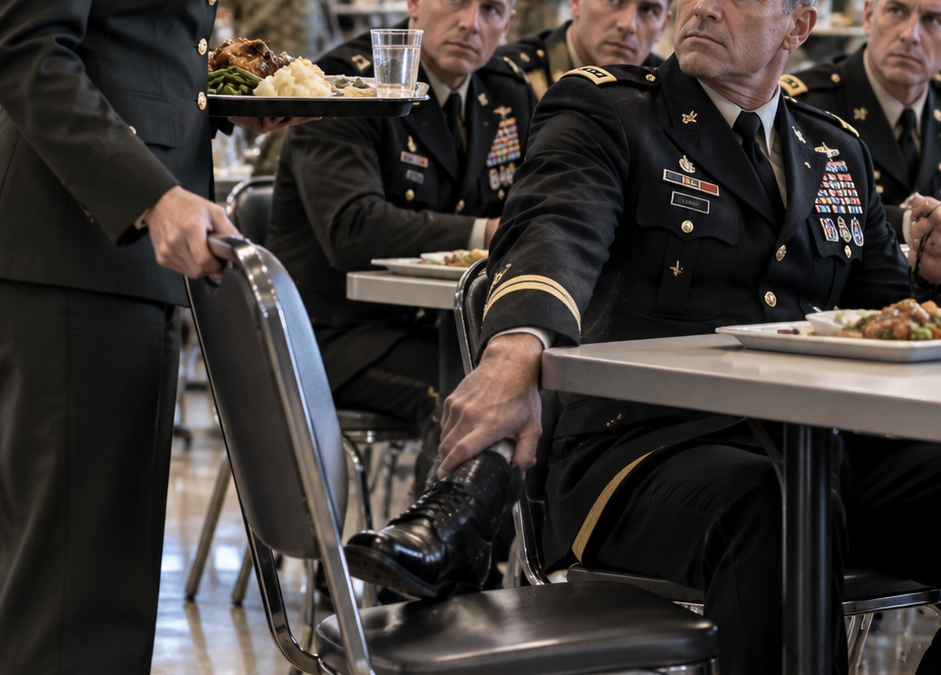
Colonel Marcus Blake shoved the chair back under the table with the heel of his boot before I could lower myself into it.
The metal legs scraped across the polished cafeteria floor hard enough to turn heads.
I remained standing.
One hand rested on the back of the chair. My lunch tray balanced in the other, carrying roasted chicken, mashed potatoes, green beans, and a paper cup of water that trembled slightly from the sudden movement.
Around the table were three empty seats.
I looked at them.
Then I looked at Marcus.
“There seems to be room.”
He leaned back in his chair as if I had amused him.
“I wasn’t talking about furniture.”
A major across from him lowered his fork.
A captain beside him stared at his plate.
Two lieutenant colonels exchanged the brief, uncomfortable glance people use when they know something is wrong but have already calculated the cost of saying so.
I had seen that look many times in twenty-seven years of military service.
It was the look of people waiting to see whether courage was required.
Marcus tapped one finger against the colonel insignia on his uniform.
“This is the command table.”
“I understand.”
“Do you?”
His smile widened.
“This table is for people with enough rank to belong here.”
I looked again at the empty chair.
“So the seat is available.”
A few people nearby heard me.
Marcus gave a short laugh.
“For officers who should be sitting here.”
I pulled the chair out again.
His boot shot forward.
The chair slammed back beneath the table.
“No.”
This time his voice carried.
The cafeteria did not become silent, but the noise changed. People kept talking because pretending not to hear was safer than admitting they were listening.
Marcus pointed across the room.
“There are tables over there.”
“With the junior personnel?”
“That would be more appropriate.”
I studied him.
“For what reason?”
His eyes moved openly over my uniform.
That morning I had deliberately made myself as unremarkable as possible.
No aide.
No entourage.
No welcoming party.
No ceremony.
No cluster of officers following three steps behind me.
I had spent the morning walking Fort Ashford almost anonymously, because I knew something every senior commander eventually learns: the moment people recognize authority, reality begins rearranging itself for you.
Doors open faster.
Voices become more respectful.
Problems disappear from sight.
Everyone suddenly remembers procedure.
I did not want procedure performed for me.
I wanted the truth.
Marcus saw none of the symbols he expected from someone important enough to concern him.
That appeared to settle the matter in his mind.
“Because,” he said, “this is the command table.”
I nodded slowly.
“I understand.”
He smiled as though he had won.
I did not leave.
Instead, I rested my tray lightly against the edge of the table.
Marcus pushed it back toward me.
The plastic slid several inches.
My spoon rattled.
The water cup tipped.
I caught it before it spilled.
Marcus’s smile deepened.
“I said no.”
That was when Captain Reynolds finally spoke.
“Sir, there really is space.”
Marcus turned his head.
The temperature at the table changed instantly.
“Captain Reynolds, did I ask for seating advice?”
Reynolds stiffened.
“No, sir.”
“Then eat.”
His eyes dropped.
That bothered me more than Marcus’s arrogance.
Marcus was one man.
But a room full of people teaching themselves silence around him was a culture.
I steadied my cup.
Before leaving, I asked, “Colonel Blake, are you the highest-ranking commander in this building today?”
Marcus crossed his arms.
“At the moment, yes.”
“Only at the moment?”
A lieutenant colonel looked up sharply.
Marcus’s smile disappeared.
“What exactly is that supposed to mean?”
I could have ended it there.
One sentence would have done it.
I could have given him my name and rank and watched his entire body change.
I could have watched contempt turn into attention, irritation into fear, and entitlement into instant professionalism.
But that would have taught me nothing I did not already know.
So I said nothing.
Marcus leaned forward.
“Are you trying to be clever?”
I held his gaze for another second.
Then I picked up my tray and walked away.
His laughter followed me.
“There’s always somebody who doesn’t understand where they belong.”
I heard several uncertain chuckles.
Not many.
Enough.
Across the cafeteria, a group of young enlisted soldiers noticed me approaching.
Their conversation stopped.
A private first class immediately lifted his backpack from an empty chair.
“Ma’am, you can sit here.”
I stopped beside him.
“Is the seat taken?”
“No, ma’am.”
“Then thank you.”
I sat.
Nobody asked whether I had enough rank.
Nobody inspected my uniform before deciding whether I deserved basic courtesy.
Nobody pushed my tray.
That difference mattered.
The young soldier’s name tape read RUIZ.
Private First Class Daniel Ruiz.
He had no idea who I was.
That made his small act more valuable, not less.
The soldiers around the table were uncertain at first.
They knew I was an officer.
They could not place me.
They kept glancing at one another, probably wondering whether inviting me to sit had somehow violated a regulation none of them had heard about.
I picked up my fork.
“Relax.”
Nobody relaxed.
I smiled faintly.
“You’re making lunch feel like a promotion board.”
A specialist beside Daniel almost smiled.
The tension eased.
Across the room, Marcus had already returned to his conversation.
His laughter rose above the cafeteria noise.
I ate quietly.
Ten minutes later, the speaker overhead crackled.
“Attention.”
Every chair moved.
Boots hit the floor.
Conversation vanished.
I placed my fork beside my plate and stood with everyone else.
The side doors opened.
Major General Robert Caldwell entered with two senior officers behind him.
Marcus changed before my eyes.
The casual arrogance disappeared.
His shoulders straightened.
His expression became disciplined, alert, professionally neutral.
There it was.
The transformation I had spent all morning looking for.
Caldwell surveyed the room.
His gaze passed over the command table.
Then farther.
“Where is Brigadier General Bennett?”
Marcus stopped moving.
No one answered.
Caldwell’s gaze traveled toward the enlisted tables.
He saw me.
So did Marcus.
Recognition did not strike him all at once.
It arrived in pieces.
First confusion.
Then calculation.
Then disbelief.
Then memory.
The chair.
The tray.
His boot.
His words.
There’s always somebody who doesn’t understand where they belong.
Caldwell walked toward me.
The entire cafeteria seemed to hold its breath.
He stopped beside the table.
“General Bennett.”
I nodded.
“General Caldwell.”
“The command table is waiting for you.”
I looked past him.
Marcus was standing beside the same chair he had refused to let me use.
Then I looked at Daniel and the other young soldiers.
“No.”
Caldwell paused.
I pulled my chair back toward the enlisted table.
“I’m already sitting at the right table.”
Daniel looked as though he had forgotten how to breathe.
The specialist beside him stared at me.
Several soldiers instinctively straightened even more.
“At ease,” I said.
Daniel relaxed first.
The others followed.
Caldwell looked toward the command table.
Marcus had gone pale.
I picked up my fork.
“General, I haven’t finished lunch.”
Understanding passed across Caldwell’s face.
“Of course.”
He turned toward the room.
“Carry on.”
Two hundred people pretended to do exactly that.
Forks lifted.
Conversations restarted.
Almost nobody was actually eating.
Daniel stared at my shoulder.
Then at my face.
Then at his plate.
Then back at me.
“You’re going to hurt yourself thinking that hard,” I said.
His face went red.
“Ma’am?”
“You’ve looked at me about twelve times.”
“Sorry, ma’am.”
“You’re fine.”
The specialist beside him suppressed a laugh.
I pointed at Daniel’s plate.
“Your chicken is getting cold.”
“Yes, ma’am.”
The table slowly relaxed.
Caldwell remained beside me.
“You completed the morning walkthrough?”
“Yes.”
“And?”
I glanced toward Marcus.
“Useful.”
Caldwell followed my eyes.
Marcus immediately looked down.
Caldwell knew me well enough to recognize when I was being restrained.
“Anything I should know before the briefing?”
“Several things.”
Marcus’s hand tightened around his fork.
Caldwell nodded.
“Fourteen hundred hours?”
“I’ll be there.”
He started to leave.
“General.”
He turned.
“The briefing room can wait ten minutes.”
For the smallest moment, he almost smiled.
“Yes, ma’am.”
After he left, Daniel looked at me again.
I raised one eyebrow.
His attention snapped back to his food.
Across the room, I saw Marcus leaning toward Reynolds.
I could not hear the first question.
I could guess it.
Who is she?
Reynolds answered quietly.
Marcus’s jaw tightened.
A few moments later he turned to Lieutenant Colonel Steven Harris.
More whispered questions.
More uncomfortable answers.
I did not need to hear them.
I knew exactly what Marcus was doing.
He was rebuilding the morning in his head.
Not because the facts had changed.
Because my rank had changed their meaning for him.
That was the real problem.
Daniel eventually gathered enough courage to speak.
“Ma’am, may I ask something?”
“You may.”
“Were we supposed to know who you were?”
“No.”
Relief crossed his face.
“So we didn’t mess up.”
I looked at him.
“You gave a stranger a chair.”
He shrugged.
“It was empty.”
The words were so simple they nearly hurt.
It was empty.
No protocol.
No rank calculation.
No judgment about whether I belonged.
Just an empty chair and a person who needed one.
“That’s what I thought,” I said.
Specialist Tasha Green, seated across from me, looked toward Marcus.
“Ma’am, did Colonel Blake know you were coming?”
“No.”
She nodded slowly.
“Okay.”
“What does that tell you?”
Her eyes widened.
She had not expected the question.
After a moment, she said, “That he wasn’t performing for you.”
I became very still.
“Explain.”
Green glanced toward the command table.
“He thought you were somebody who couldn’t affect him.”
Daniel winced.
Green immediately said, “I’m sorry, ma’am.”
“For what?”
“For saying that.”
“Was it true?”
She hesitated.
“I think so.”
“Then don’t apologize for observing.”
I had spent twenty-seven years learning how people behaved around power.
Rank changed posture.
Reputation changed voices.
Authority changed rooms.
That was why I had asked Caldwell to keep my arrival quiet.
That afternoon I would officially assume command of Fort Ashford and its surrounding training complex—more than eleven thousand military and civilian personnel under one installation command.
Caldwell had resisted my request.
“You cannot quietly wander around an installation you’re about to command,” he had told me.
“I can for four hours.”
“Why?”
“Because everybody behaves correctly during ceremonies.”
He had stared at me.
I continued.
“I don’t need to know how Fort Ashford behaves while generals are watching.”
“What do you need?”
“I need to know how it behaves when people think generals aren’t.”
Eventually, he agreed.
That morning I had visited maintenance facilities, administrative offices, barracks, a clinic, training areas, and gate operations.
I spoke to mechanics.
I stood in line behind dependents.
I watched junior leaders answer questions without staffs whispering into their ears.
Most of what I saw was good.
Some things needed work.
Nothing had disturbed me like lunch.
Not because Marcus had insulted me.
I had survived worse things than a chair being pushed away.
What disturbed me was how effortless it had been for him.
There had been no emergency.
No operational pressure.
No threat.
No exhaustion.
No reason for impatience.
He had simply believed someone beneath him had entered a space he considered his.
And humiliation had come naturally.
That mattered.
Still, I refused to reduce a twenty-three-year career to three ugly minutes.
Leadership demanded more discipline than anger.
So I kept eating.
“Ruiz,” I said.
“Yes, ma’am?”
“How long have you been here?”
“Seven months.”
“What’s the best thing about Fort Ashford?”
He thought carefully.
“My squad leader.”
“Why?”
“He doesn’t embarrass people for mistakes.”
The answer landed badly.
Daniel realized it too.
“No, ma’am. I mean—”
I waited.
“He teaches before he punishes.”
“That’s better.”
I looked at Green.
“And the worst thing?”
Her face tightened.
“Ma’am?”
“You heard me.”
She glanced around.
“Some people care more about who is watching than what they’re doing.”
She regretted it immediately.
I did not.
“That problem exists everywhere.”
Green exhaled.
“The question,” I added, “is whether leadership rewards it.”
Across the room, Marcus stood.
Reynolds said something to him.
Marcus ignored it and started toward us.
Every soldier at my table straightened.
I remained seated.
He stopped beside me.
“General Bennett.”
“Colonel Blake.”
“I believe we should clarify what happened.”
I looked at the empty chair beside Daniel.
“Would you like to sit?”
Marcus stared at it.
The irony was impossible to miss.
After a moment, he sat.
“I was not aware of your identity.”
“I know.”
“That created an unfortunate misunderstanding.”
“What did you misunderstand?”
He paused.
“The seating situation.”
“What about it?”
“It is customary for senior leaders to sit together.”
“Is it mandatory?”
“No.”
“Was the chair reserved?”
“No.”
“Was I interrupting official business?”
He hesitated.
“No.”
“The issue,” he said, “was protocol.”
I looked at Daniel.
“Private Ruiz, do you know of a protocol prohibiting an officer from sitting at that table?”
“No, ma’am.”
I turned back to Marcus.
“Neither does he.”
“With respect, General, the situation looked different from my perspective.”
“That interests me.”
“I believed you were a lower-ranking officer trying to insert yourself into a senior group.”
“And that justified pushing my chair?”
“No.”
“My tray?”
“No.”
“Telling me publicly that I lacked sufficient rank to sit there?”
“That could have been phrased better.”
I held his gaze.
“Colonel, this is not about phrasing.”
He fell silent.
“You believed I had less power than you.”
His jaw tightened.
“That belief made disrespect feel safe.”
For the first time, he had no prepared answer.
“This,” I said quietly, “is the part we will discuss later.”
“Yes, ma’am.”
I picked up my fork.
“You should finish your lunch.”
He stood.
For one second he looked at the empty chair.
Then he walked away.
Daniel waited until Marcus was out of hearing range.
“That was intense.”
Green kicked him beneath the table.
He flinched.
“I heard that,” I said.
His face collapsed.
“Sorry, ma’am.”
I nearly smiled.
“Finish eating.”
At 1355, I walked into the command conference room.
Every officer stood.
This time my rank was visible.
A single star rested on each shoulder.
People who had barely noticed me that morning now watched every movement.
That contrast stayed with me.
Caldwell introduced me formally.
“Effective today, Brigadier General Emma Bennett assumes command of Fort Ashford and the surrounding training complex.”
He summarized my assignments.
Joint operations.
Logistics.
Combat support deployments.
Planning positions.
Overseas commands.
Marcus sat straight ahead, expression controlled.
When Caldwell finished, I stepped forward.
“I learned more this morning than I expected.”
I saw Marcus’s shoulders tighten.
“Some of it was impressive.”
I praised a maintenance sergeant who refused to release an unsafe vehicle.
A clinic receptionist who helped a confused military spouse.
A lieutenant who said, “I don’t know, ma’am, but I’ll find out,” instead of inventing an answer.
I also listed concerns.
Maintenance delays.
Barracks problems.
Slow administrative response.
Inconsistent disciplinary practices.
I never mentioned lunch.
Marcus began to relax.
Then I changed the slide.
Three words appeared behind me.
CULTURE FOLLOWS POWER.
The room went quiet.
“I want to talk about what happens when people believe rank protects them.”
Nobody moved.
“Authority creates distance. Sometimes we need that distance. Orders require clarity. Standards require enforcement. Command is not a popularity contest.”
I walked slowly along the table.
“But authority also creates temptation.”
I stopped.
“It can tempt leaders to confuse obedience with respect.”
Marcus looked directly at me.
“It can tempt people to believe courtesy should flow upward instead of outward.”
I did not say his name.
I did not need to.
“My command philosophy is simple.”
The next slide appeared.
COMPETENCE.
ACCOUNTABILITY.
DIGNITY.
I pointed to the last word.
“This gets misunderstood.”
I looked around the room.
“Dignity does not mean softness. It does not remove standards. It does not prevent correction. It does not require everyone to like one another.”
I paused.
“It means nobody becomes less human because their rank is lower.”
Marcus looked down at his notes.
“If someone only behaves professionally around powerful people, that person is not professional.”
No one moved.
“If kindness disappears when consequences disappear, it was never character.”
Then I moved on.
For forty minutes we discussed operations.
I challenged weak answers.
Accepted correction when I was wrong.
Asked for specifics.
Rejected vague language.
Marcus answered two questions competently.
I treated him exactly as I treated everyone else.
At the end, I closed my folder.
“Colonel Blake, remain.”
The room emptied quickly.
Soon only Marcus, Caldwell, Command Sergeant Major Denise Harper, and I remained.
“Sit wherever you prefer,” I told Marcus.
His mouth twitched at the irony.
He chose a chair across from me.
I opened a notebook.
“Give me your account of lunch.”
To his credit, he did not lie.
He admitted blocking the chair.
Moving the tray.
Using rank.
Shutting Reynolds down.
When he finished, I asked one question.
“Why?”
“I believed the table was reserved for senior leadership.”
“No.”
He looked up.
“That explains your first assumption. It does not explain your behavior.”
He stared at the tabletop.
“I was irritated.”
“Why?”
“I thought you were challenging me.”
“How?”
“By questioning my decision.”
“So a junior officer questioning an unnecessary humiliation irritated you.”
His jaw tightened.
“When you phrase it that way—”
“I am describing what happened.”
Silence.
I leaned forward.
“Would you have pushed General Caldwell’s tray?”
“No.”
“Blocked his chair?”
“No.”
“Told him he didn’t have enough rank?”
“No.”
I let the silence do the work.
Finally, he looked at me.
“I treated you differently because I believed you lacked authority over me.”
“Yes.”
The admission changed something.
“Tell me the actual failure.”
“Disrespect.”
“Partly.”
“Poor judgment.”
“Partly.”
He looked toward Caldwell.
Caldwell gave him nothing.
Marcus tried again.
“I used rank to enforce a personal preference.”
“Closer.”
He breathed out slowly.
Then, finally, he said it.
“I treated someone as lesser because I believed I could.”
“Yes.”
Harper spoke from beside the wall.
“And soldiers saw it.”
Marcus looked at her.
“They always see more than senior leaders think,” she said.
“I know.”
Harper shook her head.
“No, sir. You know now.”
I closed my notebook.
“I am not making a personnel decision today.”
Marcus looked surprised.
“One encounter deserves investigation, not theater.”
His relief lasted perhaps two seconds.
“This incident raises questions.”
I turned toward Harper.
“I want climate data, complaint trends, retention numbers, and leadership feedback from Colonel Blake’s organization.”
“Understood.”
Marcus stared at the folder in front of Harper.
“You remain in position during the review,” I told him. “You will not contact subordinates about their statements. You will not pressure anyone to defend you. You will not treat this as a loyalty test.”
“I won’t.”
“I hope not.”
The meeting ended.
Marcus stood.
Then he stopped at the door.
“General Bennett.”
I waited.
“I am sorry.”
He swallowed.
“Not because of who you are.”
That got my attention.
“Because of how I acted when I thought you were somebody else.”
For the first time all day, I believed I was hearing Marcus Blake instead of Colonel Blake.
“Thank you,” I said.
The climate review started the next morning.
By noon, I knew the cafeteria had not been an isolated event.
But the truth was more complicated than the rumors.
Marcus was competent.
Very competent.
His organization consistently met operational targets.
Inspection scores were strong.
Training performance was excellent.
He worked long hours.
He knew his people’s deployment histories.
He protected his unit from outside interference.
Some soldiers defended him fiercely.
“He makes us better.”
“He never asks us to work harder than he does.”
“He will fight for this unit.”
But retention lagged.
Junior officers transferred when given the opportunity.
And the same phrases appeared repeatedly in confidential statements.
“He humiliates people.”
“He treats disagreement as defiance.”
“He remembers mistakes longer than achievements.”
“You can bring him good news anytime. Bad news takes courage.”
Then I read one sentence twice.
“He respects rank more than people.”
Harper sat across from me.
“There it is.”
“Yes.”
“Matches lunch.”
“It matches part of lunch.”
She raised an eyebrow.
“You think there’s more?”
“There usually is.”
I closed the report.
“People rarely become this rigid without learning rigidity somewhere.”
“You planning to diagnose him?”
“No.”
“Good.”
“I’m planning to understand him before deciding what to do with him.”
The next afternoon I visited Marcus’s headquarters without warning.
Unfortunately, anonymity was gone.
Everyone knew me now.
Soldiers snapped to attention.
Officers straightened.
Conversation became unnaturally correct.
Marcus met me near operations.
“I wasn’t informed you were coming.”
“That was intentional.”
He looked around as people performed professionalism around us.
Then, unexpectedly, he said, “Now you understand my problem.”
“What problem?”
“Rank changes behavior.”
I studied him.
“Yes.”
“People show you what they think you want.”
“Which is why lunch mattered.”
His expression tightened.
“I know.”
In a training room, a young Lieutenant Parker briefed readiness figures.
His voice shook.
I noticed a discrepancy.
“What caused that gap?”
Parker hesitated.
Marcus immediately answered.
“The report was updated late.”
I raised one hand.
“I asked Lieutenant Parker.”
Marcus stopped.
Parker swallowed.
“We missed two maintenance closures, ma’am.”
“Why?”
“Tracking failure.”
“Whose?”
Parker looked at Marcus.
Just for a second.
That second told me almost everything.
“Mine,” Parker said.
“What did you do when you discovered it?”
“I corrected the tracker and added a second review.”
“Was anyone hurt?”
“No, ma’am.”
“Mission impact?”
“Minimal.”
“Then learn from it and move forward.”
Parker blinked.
“Yes, ma’am.”
In the hallway Marcus said, “You let him off easily.”
“Did I?”
“He made an error.”
“He corrected it.”
“He should understand consequences.”
“He does.”
Marcus shook his head.
“Fear improves attention.”
“Sometimes.”
My agreement surprised him.
“It also teaches concealment.”
He said nothing.
“If Parker fears you more than he fears the mistake, eventually he may hide the mistake from you.”
“He knows better.”
“Does he?”
I looked through the glass toward Parker.
“Yesterday several officers watched you push my tray.”
Marcus stiffened.
“None objected.”
“One did.”
“Eventually.”
He knew where I was going.
“Ask yourself why.”
“Because I outranked them.”
“Exactly.”
The visit continued.
Marcus was efficient.
Sharp.
Technically excellent.
He spotted equipment discrepancies quickly.
Remembered names.
Understood mission details.
He also interrupted almost everyone.
Corrected people before they finished.
Rarely thanked anyone.
Then, near the motor pool, everything changed.
A young sergeant came running.
“Colonel Blake, we have a fuel line rupture on vehicle twelve.”
Marcus’s entire posture shifted.
“Any injuries?”
“No, sir.”
“Fire risk?”
“Contained.”
“Environmental spill?”
“Minimal.”
“Shut the lane. Call fire response anyway.”
“Already done.”
“Good.”
He moved immediately.
Then remembered I was beside him.
I gestured forward.
“Lead.”
For the next twenty minutes, Marcus Blake was one of the best commanders I had watched all week.
No ego.
No unnecessary shouting.
He listened to a private without interrupting.
Trusted a sergeant’s assessment.
Asked precise questions.
Kept unnecessary personnel away.
Verified containment himself.
When the danger passed, I stood beside him near the motor pool.
“You handled that well.”
He looked surprised.
“Thank you.”
“Why?”
“Why what?”
“Why were you different?”
His brow tightened.
“I wasn’t.”
“Yes, you were.”
I counted it off.
“You listened. You trusted junior personnel. You didn’t humiliate anyone.”
“This was a safety emergency.”
“So?”
“There wasn’t time for ego.”
The sentence left his mouth before he understood it.
Then he heard himself.
He looked away.
“That sounds bad.”
“It sounds revealing.”
After several seconds, he said, “My father was a colonel.”
I waited.
“He believed embarrassment prevented mistakes.”
Marcus looked toward the motor pool.
“He used to say people remembered shame longer than instructions.”
“Did they?”
His mouth tightened.
“I did.”
There it was.
Not an excuse.
A pattern.
“And you adopted it.”
“It worked on me.”
“Did it?”
“I became successful.”
“That wasn’t my question.”
He stared at the ground.
Finally he said, “No.”
I waited.
“It made me afraid to be wrong.”
“And now?”
“Now I hate being questioned.”
He almost smiled.
“I suppose you noticed.”
“I noticed.”
He was quiet.
“For what it’s worth, I didn’t wake up that morning planning to humiliate you.”
“I know.”
“That doesn’t make it better.”
“No.”
“I really did think that table represented command authority.”
“A table?”
“Not literally.”
“It looked fairly literal when your boot was holding the chair.”
He winced.
“That will follow me forever.”
“Possibly.”
I softened my voice.
“Consequences are not always punishment.”
He considered that.
“Sometimes they’re memory.”
“Yes.”
That evening, I sat with Harper reviewing the climate reports.
“He has serious problems,” I said.
“Yes.”
“He also has value.”
“Yes.”
I tapped the retention data.
“If I remove him immediately, people will understand accountability.”
Harper nodded.
“If I keep him unchanged, they will understand tolerance.”
“Exactly.”
“There’s a third option,” she said.
“I know.”
“Harder.”
“Yes.”
“Riskier.”
“Yes.”
She smiled.
“That’s why you’re still here.”
The question was no longer whether Marcus had failed.
He had.
The question was whether correction would make him better or merely make him bitter.
Two days later, I called him into my office.
He arrived five minutes early.
Harper was present.
Caldwell joined through secure video.
I placed the climate report in front of Marcus.
He looked at it but did not touch it.
“Am I being relieved?”
“Not today.”
He looked more unsettled than relieved.
“Your operational competence is not in question.”
I pushed the folder closer.
“Your leadership climate is.”
He remained silent.
“You have officers who respect your ability and fear your reactions.”
His jaw tightened.
“Soldiers trust you during emergencies but avoid bringing you ordinary problems.”
He looked down.
“You have high standards.”
I paused.
“You also use humiliation as a leadership tool.”
Silence.
“That cannot continue.”
He breathed slowly.
“What are you ordering?”
“First, read every statement.”
His hand settled on the folder.
“Second, you meet with an external command coach.”
His face changed.
“A coach?”
“Yes.”
He clearly hated the idea.
“Third, you conduct listening sessions without your immediate staff present.”
“With my soldiers?”
“Yes.”
“They won’t speak freely.”
“Then your first job is creating a room where they can.”
“That could become a complaint session.”
“Possibly.”
“Some complaints will be unfair.”
“Certainly.”
He stared at me.
“Then what exactly am I supposed to do?”
“Listen without punishing honesty.”
He leaned back.
I continued.
“Fourth, your recommendation for brigade command is paused.”
That was the blow.
His face became completely still.
“For how long?”
“Ninety days minimum.”
“That opportunity may disappear.”
“Yes.”
“So the cafeteria incident cost me a command.”
“No.”
Anger appeared for the first time.
I leaned forward.
“The cafeteria incident exposed a leadership pattern.”
He said nothing.
“That pattern may cost you a command.”
The anger faded.
Pain remained.
“What happens after ninety days?”
“We review.”
“And if things improve?”
“I reconsider.”
“And if they don’t?”
“You know.”
He did.
Before he left, I added, “You owe Captain Reynolds a conversation.”
“Why him?”
“He challenged you at lunch.”
His face tightened.
“And you shut him down.”
“I remember.”
“He later told you to apologize.”
Marcus stared at me.
“How do you know that?”
I almost smiled.
“People talk.”
Harper added, “Good leaders do not punish the person willing to tell them they’re wrong.”
“I haven’t punished him.”
“Yet,” Harper said.
Marcus understood.
“I’ll speak with him.”
At the door, he stopped.
“General.”
“Yes?”
“You said consequences can become memory.”
“Yes.”
He lifted the climate folder.
“This one will.”
Half an hour later, Captain Reynolds received orders to report to Marcus.
He later told me he entered the office convinced his career was about to become extremely unpleasant.
Marcus made him close the door.
Then asked, “You told me to apologize.”
“Yes, sir.”
“You disagreed with me publicly.”
“Yes, sir.”
“Why?”
Reynolds apparently took several seconds before answering.
“Because I thought you were wrong.”
Marcus held out his hand.
Reynolds thought it was a test.
It was not.
Marcus shook his hand.
“You were right.”
Reynolds blinked.
“Sir?”
“Don’t make me repeat it.”
Then Marcus asked him the harder question.
“General Bennett believes I’ve trained people not to challenge me. Do you agree?”
Reynolds hesitated.
Marcus looked at him.
“That hesitation answered the question.”
So Reynolds told him.
“You correct people publicly too often.”
Marcus listened.
“You interrupt.”
He listened.
“You treat questions like resistance.”
He kept listening.
“And when you’re embarrassed, everyone nearby pays for it.”
That one hurt.
Marcus still asked, “Anything else?”
Reynolds said, “You don’t say thank you much.”
Marcus frowned.
“That’s your big finish?”
“You asked, sir.”
And Marcus laughed.
Not sarcastically.
Actually laughed.
Then he said, “Thank you.”
Change began slowly.
That was important.
I would not have trusted a miraculous transformation.
People do not spend decades building habits and discard them during one inspirational weekend.
Marcus slipped.
Often.
He interrupted people and caught himself.
He snapped during meetings.
He started asking one question at the end of every briefing.
“What am I missing?”
At first, nobody answered.
He waited anyway.
Reynolds spoke first.
Then Harris.
Then Parker.
Eventually others joined them.
One afternoon Marcus publicly started tearing into a major over a briefing error.
Halfway through, he stopped.
The entire room had gone silent.
He later told me he saw the same faces he had seen at lunch.
Waiting.
Protecting themselves.
He took a breath.
“Major, stay after.”
The major stiffened.
Marcus shook his head.
“No punishment. I handled that badly. We’ll discuss the problem privately.”
It was clumsy.
Uncomfortable.
Real.
Three weeks into the process, I quietly attended one of his listening sessions.
I sat in the back.
Marcus had not been warned.
A sergeant first class raised his hand.
“Sir, permission to speak freely?”
“You don’t need permission in this room.”
The sergeant hesitated.
“Sometimes you make people feel stupid for asking basic questions.”
Marcus’s face changed instantly.
I saw the old reaction arrive.
So did everyone else.
His jaw tightened.
His fingers pressed into the table.
For several seconds, Colonel Blake fought the man he had trained himself to be.
Then he asked, “Give me an example.”
The sergeant did.
A maintenance briefing.
A basic question.
Marcus had mocked him.
Marcus remembered it.
“I thought I was being funny.”
Nobody laughed.
He looked around.
“That answer is apparently worse.”
A few people smiled.
Then Marcus looked at the sergeant.
“It embarrassed you?”
“Yes, sir.”
Marcus nodded.
“I’m sorry.”
Nothing dramatic happened.
No applause.
No speech.
People simply relaxed.
That was enough.
Outside afterward, Marcus found me.
“You attended.”
“I did.”
“You could have warned me.”
“That would defeat the purpose.”
“You always say that.”
“Because you keep needing to hear it.”
He almost smiled.
Then his expression became serious.
“Was it good enough?”
“That’s the wrong question.”
“What’s the right question?”
“Was it real?”
He looked back toward the room.
“Yes.”
“Then keep going.”
Ninety days passed.
Retention improved modestly.
Complaints decreased.
Junior officers reported better access.
Operational performance stayed strong.
Marcus was not perfect.
I never expected him to be.
I wanted evidence that his conduct had changed even when nobody promised him a reward.
There was evidence.
Plenty of it.
Then the brigade command board reopened.
Marcus’s name returned to discussion.
Caldwell called me.
“You still supporting him?”
I looked at the latest climate reports.
“Yes.”
“After everything?”
“Because of everything.”
Caldwell went quiet.
“He made a serious leadership failure,” I said.
“Yes.”
“He accepted correction.”
“That doesn’t erase what he did.”
“I’m not asking it to.”
I looked out my office window.
“Accountability should create better leaders when possible.”
“And when it’s not possible?”
“Remove them.”
“You think Blake changed?”
I thought about the listening session.
“I think he’s changing.”
“Is that enough?”
“For consideration.”
The distinction mattered.
Caldwell eventually agreed.
Marcus’s recommendation moved forward.
I deliberately kept that information from him.
If he knew a promotion was waiting, every improvement could be contaminated by ambition.
I wanted to know who he would be when he believed nothing was coming.
He kept changing anyway.
That mattered more than any apology he had made to me.
Six months after our first lunch, Fort Ashford hosted a leadership luncheon in the same cafeteria.
White cloths covered the tables.
Senior officers gathered near the front.
Enlisted leaders filled the center.
Junior soldiers sat throughout the room.
I arrived after Marcus.
By then, Fort Ashford knew me well.
Soldiers knew I wandered into motor pools without notice.
Officers knew I read climate reports myself.
Junior leaders knew I remembered names.
They also knew I still ate in the cafeteria.
Often not at the command table.
Marcus noticed that.
When I reached the podium, I looked across the room.
“I’ll keep this short.”
Several soldiers smiled.
“That sounded like disbelief.”
Quiet laughter moved through the room.
I continued.
“Six months ago, I entered this cafeteria before most people knew who I was.”
I saw heads turn toward Marcus.
I raised one hand.
“This is not a public execution.”
Nervous laughter.
Even Marcus almost smiled.
“Colonel Blake and I have already discussed what happened.”
I looked at the room.
“What matters now is what happened afterward.”
I spoke about command climate.
Accountability.
Correction.
The difference between embarrassment and development.
Then I said, “Colonel Blake, please stand.”
Marcus rose.
General Caldwell stepped forward carrying a folder.
Confusion crossed Marcus’s face.
“Six months ago,” I said, “Colonel Blake demonstrated a serious leadership failure.”
The room became still.
“He used rank as a wall instead of a responsibility.”
Marcus did not look away.
“He has never disputed that.”
I paused.
“More importantly, he did not hide from what came afterward.”
I listed what he had done.
He listened.
Accepted oversight.
Changed routines.
Apologized.
Improved measurable climate indicators.
“None of that changes what happened.”
Marcus nodded almost imperceptibly.
“It changes what happened next.”
Caldwell opened the folder.
“Colonel Blake, headquarters has completed your brigade command review.”
Marcus stopped breathing.
Caldwell smiled.
“Congratulations.”
Marcus stared at him.
“You have been selected for command.”
Applause broke across the cafeteria.
Reynolds was one of the first people standing.
Harris joined him.
Harper.
Then almost everyone.
Marcus remained motionless for a second.
He looked at me.
I did not want him to misunderstand what was happening.
This was not forgiveness wrapped in promotion.
It was a second chance attached permanently to memory.
He walked forward and accepted the folder.
Then he looked at me.
“General.”
I extended my hand.
“Congratulations, Colonel.”
He shook it.
“I didn’t expect your recommendation.”
“You weren’t supposed to.”
“Why?”
“Because I needed to know whether you would change without knowing a reward existed.”
Recognition crossed his face.
“That sounds familiar.”
“It should.”
When the applause ended, I returned to the podium.
“One more thing.”
The room quieted.
“Leadership is not proven when everyone knows your title.”
I looked across the tables.
“It is proven when nobody important appears to be watching.”
Lunch began.
People moved toward seats.
Marcus remained near the podium for a moment before Reynolds approached him.
“Brigade commander.”
“Not yet.”
“Close enough.”
Marcus looked toward the command table.
Three chairs were open.
Then he noticed Daniel Ruiz.
Daniel was a specialist now, sitting with younger soldiers near the center of the cafeteria.
Marcus walked toward him.
Daniel stood.
“Sir.”
“At ease.”
Marcus looked at the empty chair beside him.
“Is anybody sitting here?”
“No, sir.”
Marcus pulled it out.
Then stopped.
From across the room, I knew exactly what he was remembering.
Metal scraping.
A tray sliding.
A boot blocking an empty chair.
You’re not sitting with us.
Marcus looked at Daniel.
“Mind if I join you?”
Daniel appeared genuinely surprised.
“No, sir.”
Marcus sat.
The young soldiers became rigid.
He looked around the table.
“This is going to be terrible.”
Daniel blinked.
“Sir?”
“If everyone sits like they’re waiting for inspection.”
A few soldiers smiled.
Marcus opened his lunch.
Daniel glanced toward the command table.
“Sir, aren’t you supposed to sit over there?”
Marcus looked toward it.
Then shook his head.
“Not today.”
Harper came to stand beside me.
“Well?”
I watched Marcus ask a private about training.
The private answered nervously.
Marcus listened.
He did not interrupt.
“He’s learning,” I said.
“Slowly.”
“Most worthwhile things happen slowly.”
Harper studied me.
“You really believe people change.”
“Sometimes.”
“That sounds cautious.”
“It is.”
I looked at Marcus again.
“Change isn’t a speech.”
Harper waited.
“It’s repeated behavior when nobody is applauding.”
Later that afternoon, Marcus found me outside headquarters.
His brigade command selection folder was tucked beneath one arm.
“General.”
I stopped.
“Yes?”
“I wanted to say something without an audience.”
I waited.
He looked across the parking lot.
“I spent months believing the worst part of that lunch was finding out who you were.”
I said nothing.
“It wasn’t.”
His voice lowered.
“The worst part was finding out who I was when I thought you were nobody.”
That sentence mattered more to me than his promotion.
“You should remember that.”
“I do.”
He looked at me.
“You could have ended my career.”
“Yes.”
The answer surprised him.
“I considered it.”
He absorbed that.
“What changed your mind?”
“You did.”
He frowned.
“Not at lunch.”
I shook my head.
“Afterward.”
I stepped closer.
“You accepted consequences without becoming vindictive. You listened when it hurt. You changed when no promotion was guaranteed.”
Marcus glanced at the folder.
“That part was intentional.”
“Yes.”
He laughed softly.
“I should have known.”
“Probably.”
Then he became serious.
“I won’t waste it.”
“Don’t promise me.”
He waited.
“Show your soldiers.”
Marcus nodded.
“Yes, ma’am.”
As he turned away, I stopped him.
“Colonel.”
He looked back.
“When you take brigade command, remember one thing.”
“Yes?”
“The least powerful person in the room usually knows the most about your character.”
His eyes moved toward the cafeteria building.
“I learned that one.”
“Good.”
Three weeks later, Marcus assumed brigade command.
I attended.
So did Reynolds.
Daniel Ruiz stood in formation.
Marcus spoke for only seven minutes.
No dramatic promises.
No attempt to rewrite history.
He spoke about standards and accountability.
Then he paused.
“There is one thing I want every leader here to understand.”
I watched him from the front row.
“Rank gives you authority.”
He looked across the formation.
“It does not give you permission to reduce somebody else’s dignity.”
Several officers exchanged glances.
Marcus continued.
“I learned that lesson publicly.”
A few people smiled.
“I deserved to.”
He did not hide from the sentence.
“My job is not to make people afraid of disappointing me.”
He paused.
“My job is to make them unwilling to disappoint the standard.”
Then he ended with four words.
“Take care of your people.”
After the ceremony, families gathered.
Soldiers took photographs.
I stayed near the edge of the parade field.
Daniel approached me.
“General Bennett?”
“Specialist Ruiz.”
He looked startled.
“You remember my name?”
“You gave me a chair.”
He smiled.
“That was a while ago.”
“Good decisions age well.”
He laughed.
Then his face became thoughtful.
“Can I ask you something?”
“You seem to enjoy doing that.”
“Did you know who Colonel Blake was before that lunch?”
“No.”
“So you really just walked over to that table?”
“Yes.”
“Why?”
I looked toward Marcus.
“I wanted lunch.”
Daniel laughed.
Then asked, “So everything happened because he thought you were ordinary?”
I considered the word.
“No.”
Daniel looked confused.
“It happened because he thought ordinary meant unimportant.”
His smile disappeared.
That distinction stayed with him.
“Don’t make that mistake,” I said.
“I won’t, ma’am.”
“I hope not.”
As the parade field emptied, Caldwell walked over.
“Ready to admit this turned out well?”
“Mostly.”
“That is almost optimism.”
“Don’t get used to it.”
He laughed.
Then looked toward Marcus.
“Blake got lucky.”
“No.”
Caldwell raised an eyebrow.
“He got accountable.”
“That’s different?”
“Very.”
Across the field, Marcus was speaking with a young private.
The soldier looked nervous.
Marcus waited for him to finish.
Then thanked him.
Caldwell saw it too.
“Maybe you were right.”
“About what?”
“People changing.”
I opened my vehicle door.
“I never said everyone changes.”
I looked back across the field.
“I said some people choose to.”
As we drove away from Fort Ashford’s headquarters, I found myself thinking about the chair again.
There had never been anything special about it.
Metal frame.
Plastic seat.
One of hundreds in the cafeteria.
That was exactly why it mattered.
One man had looked at an empty chair and seen something to defend from a person he considered beneath him.
A young private had looked at another empty chair and seen space he could offer to someone standing alone.
Within ten minutes, I had seen two versions of leadership.
One protected status.
The other made room.
Months later, the lesson had not changed.
The most important reversal had never been Marcus discovering my rank.
That surprise lasted seconds.
The real reversal took months.
It happened every time he stopped himself from humiliating someone.
Every time he listened to criticism.
Every time a junior officer told him the truth and survived the experience.
Every time Marcus chose to remember that authority was not proof that he mattered more.
Growth did not erase what happened.
It gave what happened somewhere useful to go.
My driver slowed at an intersection while several young soldiers crossed in front of us.
One noticed the general officer vehicle and immediately straightened.
I almost smiled.
Rank would always change behavior.
There was no eliminating that completely.
The real measure of character was what remained when the title disappeared.
I thought about Daniel.
It was empty.
Three words.
No strategy.
No ceremony.
No knowledge of who I was.
Just simple decency offered before anyone knew whether I could reward it.
“Sergeant,” I said.
My driver looked at me through the mirror.
“Yes, ma’am?”
“Tomorrow’s lunch.”
“Yes?”
“Cafeteria.”
He smiled.
“Command table?”
I looked out at Fort Ashford moving past the window.
“No.”
He waited.
“Whichever table has an empty chair.”
The vehicle continued down the afternoon road.
Behind me was an installation that still had problems, because every real organization does.
Marcus would make mistakes again.
So would I.
There would be complaints.
Hard conversations.
Failures.
Corrections.
Leadership was never a clean story where one lesson permanently solved a human being.
But somewhere on that base, a colonel who once measured people by how much authority they possessed had learned to measure his own authority by how he treated those who possessed none over him.
And that mattered.
Because respect means very little after you discover someone has power.
The real test is what you offer before you know who they are.
No one should need a star on their shoulder to earn a chair.
No one should need the ability to damage your career before you decide they deserve dignity.
And no leader should ever forget that the person with the least power in the room may be the one seeing them most clearly.








