𝗙𝗨𝗟𝗟 𝗦𝗧𝗢𝗥𝗬 The Coat Came Off Before My Husband Understood What He Had Buried
𝗙𝗨𝗟𝗟 𝗦𝗧𝗢𝗥𝗬
Franklin presented records showing that Julian had managed the company finances during my deployments. He described my extended absences. He referred to temporary management authorizations I had signed before overseas assignments. He used phrases like continuity, operational necessity, and practical control.
Every word was chosen to sound boring.
That was the trick.
Most financial crimes did not arrive wearing masks. They arrived in folders, minutes, signatures, transfers, amendments, renewals, and filings nobody questioned until years later.
Franklin continued.
“Mrs. Vance was unavailable for many day-to-day decisions. Mr. Vance assumed responsibility for preserving the business, protecting employees, and managing marital assets during periods of uncertainty.”
Mrs. Vance.
Not General.
Not founder.
Not inventor.
Not combat veteran.
Mrs. Vance.
Julian glanced at me.
I felt the corner of his satisfaction like a hand at my throat.
Franklin turned toward the judge.
“The facts are clear. The assets currently in dispute are controlled by Mr. Vance through valid corporate and marital structures. Mrs. Vance may regret the natural consequences of authority she freely gave her husband, but regret is not fraud.”
Marcus rose.
“Your Honor, the plaintiff requests permission to make a limited foundational statement before we submit sealed materials previously approved for restricted disclosure.”
Franklin frowned.
Julian’s smile faded slightly.
Judge Price looked at me.
“General Vance?”
That was the first time the room shifted.
Reporters lifted their heads.
Nora’s eyes narrowed.
Julian looked at Franklin.
The judge had used my rank.
“Yes, Your Honor,” I said.
My voice did not shake.
I stood.
The gray coat felt heavy around my shoulders.
For years, I had worn it like camouflage. Plain. Soft. Civilian. The kind of coat people forgot the moment they looked away.
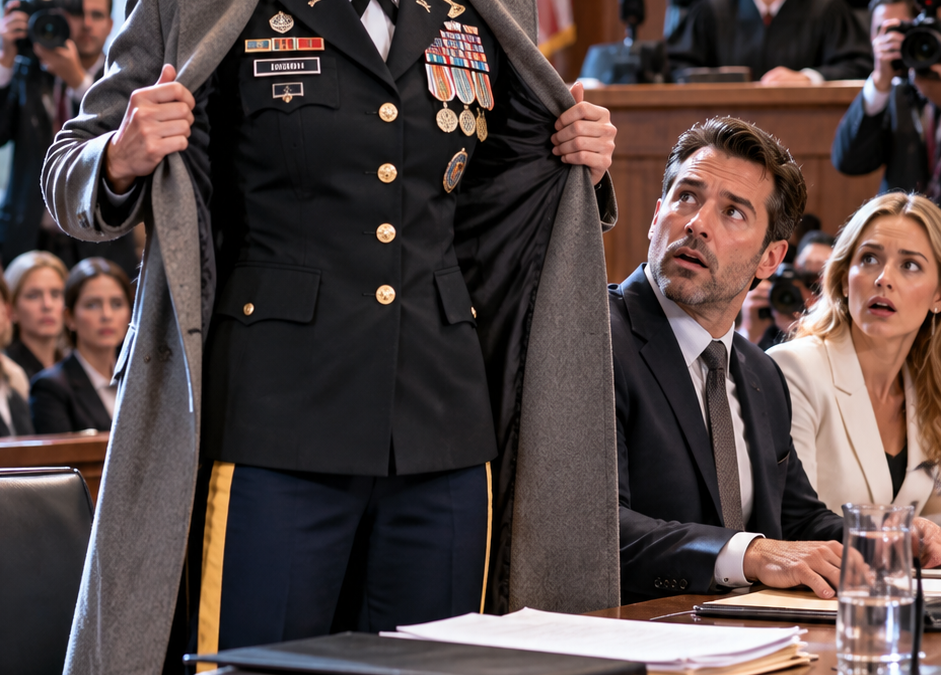
I unbuttoned it slowly.
Julian leaned back, irritation flashing across his face.
“Iris,” he whispered. “Don’t be dramatic.”
I let the coat slide from my shoulders.
A wave of gasps moved through the courtroom.
Beneath the coat was the formal dress uniform of a senior United States military officer. Rows of ribbons crossed my chest. Combat medals caught the courtroom lights. Silver stars gleamed on my shoulders.
Then people saw the scars.
Long, pale marks crossed my neck, shoulders, and arms. Some disappeared beneath the collar. Others ran down toward my wrists. Permanent reminders of injuries I had suffered during overseas combat operations.
Injuries Julian had spent years explaining away.
Nora’s face drained of color.
Julian stared at me.
For the first time since I had known him, he looked like a man realizing he had underestimated not my anger, but my patience.
“General Vance?” Judge Price asked.
“Yes, Your Honor.”
“My military record remained partially classified because of the operations I served in,” I said. “For years, protecting those missions mattered more to me than protecting my reputation.”
I turned toward Julian.
“But today, my silence only protects the guilty.”
His expression changed instantly.
“Iris,” he whispered. “Please. Don’t do this.”
That was the first time in our marriage I had ever heard genuine fear in his voice.
I pulled back my sleeve and exposed another scar.
“My husband told people these came from accidents,” I said. “They did not. I earned every one of them serving this country.”
The room was silent now.
Not curious.
Attentive.
There is a difference.
“After my injuries ended my operational career, I trusted Julian to help me recover and protect what we had built together. Instead, he exploited my classified deployments, moved assets while I was overseas, manipulated corporate records, and used the limits on what I could legally disclose to convince others I was unstable whenever I questioned him.”
Franklin shot to his feet.
“Your Honor—”
Marcus rose at the same time and placed a sealed evidence folder before the judge.
Judge Price’s eyes narrowed.
“What does this contain?”
“Financial records, sworn witness statements, forensic accounting reports, and Department of Defense authorization permitting limited disclosure of General Vance’s service because it directly relates to this case,” Marcus said. “It also contains evidence that Mr. Vance knowingly exploited classified military restrictions to conceal financial misconduct during her deployments.”
Julian stumbled backward half a step.
“That’s impossible.”
Franklin moved quickly.
“Your Honor, we respectfully request an immediate recess.”
I looked at Julian and saw panic replacing every trace of arrogance he had walked into that courtroom with.
I did not smile because I had won.
I had not.
Not yet.
But Julian had spent years believing restraint meant surrender, and now Judge Price’s hand rested on the sealed folder containing everything he thought I could never prove.
Slowly, she broke the seal.
The judge did not speak for nearly a minute.
In a courtroom, a minute of silence could become its own kind of weather.
Pages turned beneath Judge Price’s hands. Once. Twice. Then again.
Around me, the restless energy that had filled the gallery only moments before settled into something more focused. The reporters stopped whispering. Franklin Cross stood beside Julian with one palm pressed flat against the table, waiting for permission to interrupt.
Julian himself had gone very still.
That was what I noticed most.
Not fear.
Not guilt.
Stillness.
For years, whenever I challenged him about a missing payment, an unfamiliar corporate filing, or an account statement that no longer arrived at the house, Julian had moved quickly. He explained. Redirected. Reframed.
There was always an answer ready before I finished asking the question.
Now there was only silence.
Judge Price lifted her eyes.
“Mr. Hale.”
Marcus stood.
“Yes, Your Honor.”
“This filing refers to several financial instruments created during periods when General Vance was deployed outside the United States.”
“That is correct.”
“And you are asserting that her absence was material to the way those instruments were established?”
“Yes.”
Franklin rose immediately.
“Your Honor, if I may—”
“You may in a moment, Mr. Cross.”
He sat.
The judge returned to the papers.
I felt my fingers tighten once beneath the table.
Marcus noticed.
He did not look at me, but he moved his legal pad an inch closer until the corner touched my hand.
It was such a small gesture that no one else could have understood it.
I did.
Stay steady.
I had spent most of my adult life learning how to remain calm while other people reacted.
But this was different.
On deployment, calm had been a duty.
Here, it was personal.
Judge Price removed her glasses.
“General Vance, before we proceed, I want to make one thing clear. Your military service will be treated with appropriate respect, but it will not determine the outcome of a civil financial dispute.”
“I understand, Your Honor.”
“This court is interested in documentation, ownership, disclosure, and intent.”
“Yes, Your Honor.”
She nodded.
“Good.”
Then she turned toward Julian.
“Mr. Vance, you will receive the same consideration. Whatever impressions were created in this courtroom moments ago are not evidence.”
Julian swallowed.
“Yes, Your Honor.”
There it was.
The first thing that surprised me.
Fairness.
A small part of me had expected the uniform to change everything.
That was foolish.
The uniform did not prove Julian had taken anything from me.
It only explained why I had been gone.
Why certain truths about my life had been difficult to disclose.
Why the version of me Julian had presented to investors, friends, neighbors, and eventually the court had been incomplete.
The rest would have to be proved in paper.
And paper, Marcus once told me, had a longer memory than people.
Judge Price looked toward Franklin.
“Now, Mr. Cross.”
He rose carefully.
“My client disputes the characterization of these transactions as concealment or misconduct. Mr. Vance managed the company’s financial operations during General Vance’s extended absences. Many of the transfers being questioned were legitimate business decisions made under authority she granted him.”
I felt something inside me shift.
Not anger.
Recognition.
Authority she granted him.
There it was.
The sentence I had feared from the beginning.
Because it was partly true.
I had trusted Julian.
Not casually.
Completely.
When the company was small, before the polished offices and magazine profiles and charity dinners, Vance Medical Technologies had been three borrowed desks in a converted warehouse suite. Julian had been good at numbers. I had been good at people.
He understood cash flow, vendors, manufacturing timelines.
I understood hospital procurement, emergency medicine, field logistics, and what medical teams actually needed when equipment failed far from ideal conditions.
Our first product had grown from a problem I encountered overseas: a compact field-monitoring device that could keep functioning when power was unreliable and transport conditions were poor.
Julian had turned the idea into a company.
I had trusted him to turn the company into a future.
“General Vance signed broad management authorizations,” Franklin continued. “We have those documents.”
Marcus remained standing.
“So do we.”
Franklin looked at him.
“And?”
“And we also have the dates.”
That changed something in the room.
Judge Price leaned forward.
“What dates?”
Marcus opened a second file.
“Your Honor, General Vance signed temporary operational authority before three overseas assignments. Each authorization contained an expiration date tied to her expected return.”
Franklin’s jaw tightened.
Marcus continued.
“The documents subsequently used to transfer ownership interests were executed months after those authorities expired.”
“Renewals existed,” Franklin said.
Marcus nodded.
“Yes. That is the problem.”
He passed copies to the clerk.
The clerk handed them to Judge Price.
I already knew what they said.
I had spent six months learning every line.
My name appeared at the bottom of each renewal.
My signature.
Almost mine.
The first time I saw them, I stared until the letters blurred.
An imitation does not always look wrong.
Sometimes it looks almost right.
That is worse.
Julian knew how I signed my name when I was tired. He knew the way the I in Iris leaned forward. He knew I usually lifted my pen before the final e in Vance.
Who else would know something that small?
But the forensic document examiner had found what I never would have noticed.
The signatures had been built from older samples.
Not copied exactly.
Constructed.
Judge Price read several pages.
“Mr. Cross.”
“Yes, Your Honor.”
“Was your office aware of the handwriting analysis attached to this filing?”
A pause.
“We received it this morning.”
Marcus’s expression did not change.
That was also technically true.
They had received the final report that morning.
The preliminary findings had been disclosed weeks ago.
Judge Price looked displeased, but not dramatic.
“Then I suggest you use the recess I am about to grant to review it carefully.”
Julian turned toward Franklin.
“What recess?”
The whisper carried.
Judge Price heard it.
“Mr. Vance, this hearing will not conclude today.”
His face tightened.
“But—”
“Your financial disclosures are now in material dispute.”
The judge tapped the sealed folder.
“I am issuing a temporary preservation order over the contested marital and corporate assets identified in these filings. Neither party will transfer, encumber, liquidate, gift, pledge, or materially alter ownership of those assets without further order of this court.”
Julian stared.
The mansion.
The lake house.
The investment accounts.
The corporate shares.
Everything he had entered the room calling his was suddenly frozen in place.
Not mine.
Not his.
Untouchable.
For the first time that morning, I felt something loosen in my chest.
Not victory.
Safety.
There was a difference.
Judge Price continued.
“I am also appointing an independent forensic accountant. Both parties will cooperate fully.”
Franklin nodded.
“Understood.”
Marcus did the same.
Then the judge looked at me.
“General Vance.”
“Yes?”
“You understand that full cooperation may require disclosure of personal financial information unrelated to your military record.”
“I do.”
“And if protected service information becomes relevant, counsel will follow the authorized procedures described by the Department of Defense liaison.”
“Yes, Your Honor.”
“Very well.”
She looked at the clock.
“Court will recess until next Tuesday at ten.”
The gavel came down once.
That was all.
No cinematic declaration.
No confession.
No applause.
Just the quiet machinery of a process beginning to work.
Julian did not look at me as the judge left.
Nora did.
For one brief second.
Then she looked away.
The corridor outside the courtroom filled quickly.
Cameras gathered near the elevators, held back by court officers. Marcus guided me through a side passage toward a conference room reserved for attorneys.
I had put the gray coat back on.
It felt heavier now.
Inside the room, Marcus shut the door.
Only then did I let myself sit.
He poured a paper cup of water and handed it to me.
“You did well.”
“I answered three questions.”
“You answered them without trying to win the room.”
“I’ve never trusted rooms that wanted to be won.”
That earned the faintest smile.
Then he opened his briefcase.
“We need to talk about what happens next.”
“I know.”
“No, Iris. We need to talk about what happens emotionally next.”
I looked at him.
“That isn’t usually your department.”
“No. But I have watched enough divorce clients mistake a favorable order for an ending.”
He sat across from me.
“This is the beginning.”
The truth of that landed harder than I expected.
I looked toward the closed door.
“Did you see Julian?”
“Yes.”
“He looked surprised.”
Marcus waited.
I corrected myself.
“No. He looked confused.”
“That bothers you?”
“Yes.”
“Why?”
Because I knew Julian.
Or I had believed I did.
He could lie smoothly.
He could deny something obvious until you found yourself wondering whether you remembered it correctly.
But confusion was harder for him to imitate.
“He knew about the accounts,” I said slowly. “He knew about the ownership changes. But I don’t think he knew about all of those signatures.”
Marcus leaned back.
“That is possible.”
I looked at him.
“You think someone else created them.”
“I think we should follow the evidence instead of choosing the answer we dislike most.”
That was Marcus.
A maddeningly disciplined man.
It was also why I trusted him.
A knock sounded.
Marcus opened the door.
A woman in a navy suit stood outside. She was in her late fifties, silver hair cut neatly at her jaw.
“General Vance?”
“Yes.”
“My name is Dr. Helen Mercer.”
I stood so quickly the chair scraped.
“Helen Mercer?”
She smiled.
“You probably knew me as Dr. Mercer from the procurement board.”
I did.
Fifteen years earlier, Helen had been one of the first military physicians to take my field-monitoring prototype seriously. She had sat through an hour of engineering explanations, then asked one question.
Can a medic wearing gloves operate it in the dark?
That question had changed the entire design.
I had not seen her in nearly a decade.
“What are you doing here?”
Her smile faded.
“Marcus contacted me because my name appeared in one of the old company files.”
Marcus closed the door behind her.
Helen placed a thin folder on the table.
“I kept something I probably should have sent you years ago.”
My eyes moved to the folder.
“What?”
“A letter.”
The word seemed almost disappointing after everything that morning.
“A letter from whom?”
“Your father.”
I stopped breathing.
My father, Colonel Thomas Vale, had died eight years earlier.
He had known Julian.
He had liked him at first.
Then something changed during the final year of my father’s life. The two of them stopped talking. Whenever I asked why, Dad said only, “Business can make good people foolish.”
I assumed he meant himself.
My father had invested some of his retirement savings in our company. Not enough to control anything. Enough to care.
Helen sat.
“Thomas gave this to me shortly before his final surgery.”
“Why would he give you a letter for me?”
“He asked me not to deliver it unless something happened involving the company.”
I looked at Marcus.
He shook his head.
“I haven’t read it.”
Helen pushed the folder toward me.
“I didn’t know whether something had happened. I lost touch with you after Thomas died. Then your name appeared in the news last month.”
I stared at my father’s handwriting on the envelope.
IRIS.
One word.
Block letters.
He always printed names on envelopes because he believed cursive addresses looked untidy.
My fingertips rested against the paper.
Eight years.
For eight years, this letter had existed somewhere without me.
“Why now?” I asked.
Helen’s voice softened.
“Because I recognized the name of a company mentioned in one of the divorce filings.”
“Which company?”
“Northbridge Biomedical Holdings.”
Marcus looked up sharply.
That name had appeared repeatedly in our financial investigation.
Northbridge was a holding company that had acquired a large portion of my original shares in Vance Medical Technologies. On paper, it was controlled by a trust. The beneficiaries were obscured through several layers of corporate entities.
“We’ve been trying to identify who owns Northbridge,” Marcus said.
Helen nodded.
“Thomas knew.”
I opened the letter.
My father’s handwriting had become shaky by then.
But it was still unmistakably his.
Iris,
If Helen gives you this, then the problem I hoped would resolve itself probably did not.
First, understand that I should have spoken to you directly. I convinced myself I was protecting your marriage. That was cowardice dressed as restraint.
I closed my eyes.
That sounded exactly like him.
I continued.
Three months ago, I reviewed an investment restructuring Julian asked me to approve. He said it would protect the company if you were unavailable during deployment. The structure itself was ordinary. What troubled me was a reference to Northbridge Biomedical Holdings.
I asked Julian who controlled Northbridge.
He told me it was an outside strategic investor.
It is not.
My hands went cold.
I looked at Helen.
She nodded once.
I returned to the page.
Northbridge was formed using capital from the Vale Family Medical Trust—the trust your mother and I established for you years before your marriage.
I read that sentence twice.
Then a third time.
Marcus stood.
“Iris?”
I kept reading.
The money used to purchase your shares may have been yours already.
I could not prove Julian understood the source of the funds when the structure was created. I began asking questions. After that, he stopped returning my calls.
Please do not assume the worst before you know the facts.
But do not surrender your right to know them.
Your mother would tell you that trust does not mean refusing to look at the books.
She would be right.
Love,
Dad
For several seconds, no one spoke.
I lowered the paper.
“My mother?”
Helen nodded.
My mother, Margaret Vale, had died when I was twenty-six.
Before the deployments.
Before the company.
Before Julian.
“She helped establish the trust?”
“Apparently.”
“I didn’t know there was a trust.”
Marcus was already writing.
“Do you know the trustee?”
Helen reached into her folder.
“That is the other reason I came.”
She placed an old business card on the table.
Vale Family Medical Trust.
Trust Administrator: Samuel Rowan.
I stared.
Samuel Rowan.
The name meant something.
Not much.
A Christmas card once.
A man at my father’s funeral.
Gray hair. Quiet voice.
Someone I had thought was an old colleague.
Marcus picked up the card.
“Do you know where he is?”
Helen looked at me rather than him.
“Yes.”
“Where?”
“About ninety miles from here.”
Marcus stood.
“We need to contact him today.”
Helen hesitated.
“That may be more complicated than you think.”
“Why?”
“Because Samuel has been trying to contact Iris.”
I frowned.
“I’ve never heard from him.”
“He sent certified letters to the lake house for almost four years.”
The room seemed to tilt.
“The lake house?”
“Yes.”
“I never received them.”
Helen’s expression told me she already understood.
Marcus reached for his phone.
I lifted a hand.
“Not yet.”
He stopped.
I looked down at my father’s letter.
There were several possibilities.
Julian might have hidden the letters.
Someone at the house might have misplaced them.
The address might have been wrong.
The trust might have been misunderstood.
For once, I did not want the fastest interpretation.
I wanted the correct one.
“I’ll go see Samuel,” I said.
Marcus frowned.
“With me.”
“No.”
“Iris.”
“I don’t mean alone. Helen can come.”
Helen looked surprised.
I turned to her.
“If you’re willing.”
“Of course.”
Marcus crossed his arms.
“You are intentionally excluding your attorney from a meeting concerning disputed assets?”
“I’m meeting an old friend of my parents.”
“A trustee.”
“A human being first.”
Marcus exhaled.
“You are impossible.”
“So I’ve been told.”
“Frequently, I imagine.”
“Mostly by colonels.”
He handed me his card.
“Call me before you sign anything, agree to anything, promise anything, surrender anything, or decide to forgive anyone.”
I almost smiled.
“Is forgiveness legally binding now?”
“With you? I’m not taking chances.”
Samuel Rowan lived in a narrow white house at the edge of a town called Bellweather.
There was nothing remarkable about it.
A porch.
Two maple trees.
A wind chime that moved lazily in the September air.
Helen drove.
I spent most of the journey staring through the window at late-summer fields. My father’s letter rested in my bag. I could feel its presence without touching it.
“Your father worried about you,” Helen said eventually.
“Everyone says that after parents die.”
“He worried about whether you knew how to stop being responsible.”
I turned toward her.
“He said that?”
“More than once.”
“That sounds like criticism.”
“It was admiration with concern attached.”
I looked back through the window.
My parents had been different from each other.
Dad believed problems should be solved with lists.
Mom believed some problems should be allowed to sit at the kitchen table until they became less frightening.
I had inherited Dad’s lists.
I missed Mom’s kitchen table.
Samuel opened the door before we reached the porch.
He was older than I remembered.
Much older.
But his eyes were clear.
He looked at Helen.
Then at me.
For a moment, his face filled with something that hurt to see.
“Margaret’s eyes,” he said.
I did not know what to say.
He stepped aside.
“Come in, Iris.”
The house smelled like coffee and old wood.
There were photographs everywhere.
Not of me.
Of hospitals.
Clinics.
Medical teams.
My mother appeared in several.
“You knew her well,” I said.
Samuel followed my gaze.
“Your mother and I worked on rural health projects before she married your father.”
I had known my mother was a nurse.
I had known she volunteered.
I had not known this.
Samuel poured coffee for Helen and tea for me without asking.
“My mother drank tea.”
“Every afternoon.”
He sat opposite me.
“You have questions.”
“One to begin with.”
He nodded.
“What is Northbridge?”
Samuel folded his hands.
“A legal structure your parents created for you.”
“Why didn’t they tell me?”
“They planned to.”
“When?”
“When you were ready to leave the military or when you needed the funds for work they believed mattered.”
I frowned.
“My company?”
“Your medical technology work, yes.”
The answer came too easily.
I leaned forward.
“Did Julian know?”
Samuel’s face became careful.
“Eventually.”
“When?”
“After your father became ill. Thomas worried that if he died while you were deployed, the trust would become difficult to administer without a family representative. Julian offered to assist.”
“Assist how?”
“He brought documents showing that you wanted part of the trust invested in Vance Medical Technologies.”
I felt the old pressure beneath my ribs again.
“Were the documents genuine?”
“At the time, I believed they were.”
“And now?”
Samuel looked toward a locked cabinet beside his desk.
“Now I have doubts.”
He took out a thick binder.
“I began having doubts four years ago.”
“Why?”
“Because Northbridge received a dividend.”
“That would be normal.”
“Yes. But the dividend was redirected.”
“Where?”
“To another holding entity.”
“Controlled by Julian?”
“I don’t know.”
“You don’t know?”
“That is why I wrote to you.”
I sat back.
“What was the company called?”
Samuel opened the binder.
“Meridian Continuity Partners.”
The name meant nothing to me.
Helen leaned closer.
“What kind of company?”
“Consulting, according to its registration.”
“Who owns it?”
Samuel turned several pages.
“That is where things become unusual.”
He slid a document toward me.
Meridian had been incorporated six years ago.
Registered agent: Laura Bennett.
I read the name.
Nothing.
Then I saw the mailing address.
I knew that address.
It was not Julian’s.
It was not Nora’s.
It belonged to someone I had not spoken to in almost seven years.
Someone who had once stood beside me at my wedding.
My younger brother.
Daniel Vale.
I stared at the page.
“No.”
Samuel remained silent.
Helen looked from the paper to me.
“Iris?”
“My brother lives there.”
Samuel’s expression shifted.
“You didn’t know?”
“Know what?”
“That Daniel was connected to Meridian.”
The question felt absurd.
Daniel and I had not been close since our father’s death.
There had never been a single dramatic argument.
That almost made it worse.
We simply stopped calling.
First for weeks.
Then months.
Then years.
He had believed I chose Julian and the company over the family after Dad died.
I believed Daniel resented everything I had built.
Eventually, distance hardened around both interpretations.
“When was Meridian created?” I asked.
Samuel checked the file.
“Six years and four months ago.”
I calculated automatically.
Four months after Dad’s funeral.
“What does Daniel have to do with it?”
“I don’t know.”
“Did Julian send money to my brother?”
“I don’t know that either.”
Samuel opened another section.
“But I know this.”
He handed me copies of three letters.
Each addressed to me.
Each sent certified mail.
Each signed for.
Not by me.
The signature on every receipt was short.
Two letters.
NV.
Nora Vale?
No.
There was no Nora Vale.
Nora’s surname was Ellis.
I stared again.
NV.
Samuel said quietly, “I assumed it was someone from your household.”
Helen leaned over.
“That doesn’t look like Nora’s initials.”
I barely heard her.
Because another memory had returned.
A memory from years earlier.
My brother Daniel sitting on the back porch of my parents’ house with Julian. The two men had been arguing quietly. When I stepped outside, they stopped. Daniel left ten minutes later without saying goodbye.
I had asked Julian what happened.
“Nothing important,” he told me. “Daniel is worried about Dad’s estate. He thinks I’m interfering.”
Later, Daniel told me something different.
Ask your husband why he wants Dad’s trust documents.
I had been leaving for an assignment the next morning.
I did not ask.
I told myself I would deal with it when I returned.
I never did.
I looked at Samuel.
“I need copies of everything.”
“I already prepared them.”
Of course he had.
He passed me a sealed file.
“And Iris?”
“Yes?”
“There is one more thing.”
I waited.
“Daniel did not receive money from Meridian.”
“Then why is his address on the registration?”
“I don’t know.”
Samuel paused.
“But for the first two years Meridian existed, Daniel sent money into it.”
I stared at him.
“What?”
“Small amounts at first. Then larger ones.”
“For what?”
“That is what I hoped you could tell me.”
The drive home felt different from the drive out.
My father’s letter had given me one mystery.
Samuel’s records had given me another.
Julian had spent years making decisions about money without me.
That truth remained.
But now the neat story forming in my mind had developed edges I had not expected.
My brother was somewhere inside it.
Maybe knowingly.
Maybe not.
Maybe trying to protect something.
Maybe protecting Julian.
I did not know.
And I had promised myself that this time I would not replace ignorance with assumption.
At a red light, Helen glanced at me.
“Will you call Daniel?”
“Yes.”
“Tonight?”
I looked down at my phone.
Seven years of distance sat between my brother’s name and my thumb.
“Yes,” I said.
“This time, tonight.”
Daniel answered on the fourth ring.
“Iris?”
His voice was older.
That surprised me.
Somewhere in my mind, my younger brother had remained thirty-five forever.
“Hi, Daniel.”
Silence.
Then, carefully, “Are you okay?”
“I’m okay.”
“I saw the news.”
Of course he had.
“You saw the uniform?”
“I already knew about the uniform.”
Despite everything, I smiled faintly.
“Right.”
“You forgot I was at your promotion ceremony.”
“I didn’t forget.”
Another silence.
There were too many old rooms inside our conversations.
I chose one door.
“I met Samuel Rowan today.”
Nothing.
Not even a breath.
Then Daniel said, “You finally got the letters.”
“No.”
His voice changed.
“What do you mean, no?”
“I never got them.”
“Iris, he sent—”
“I know what he sent.”
A long pause.
“Oh.”
“Daniel, what is Meridian Continuity Partners?”
The line went quiet.
I thought the call had dropped.
Then he said, “Where are you?”
“At the hotel.”
“Alone?”
“Yes.”
“Is Julian there?”
“No.”
“Good.”
I closed my eyes.
“Daniel, I am not asking you to frighten me. I am asking you to tell me the truth.”
“I know.”
“Then tell me.”
His next words came slowly.
“Meridian was supposed to protect your patents.”
I sat upright.
“What?”
“Dad found out Julian was considering transferring some of the early intellectual property out of Vance Medical Technologies.”
“That makes no sense.”
“It made sense to Julian. The original patents were valuable. If the company failed, they could be sold separately.”
“Why would Dad know?”
“Because Julian asked him to sign something.”
My father’s investment.
His minority interest.
“He refused?”
“Yes.”
“And you?”
“Dad asked me to help create a structure that could buy the patents if Julian ever tried to move them.”
I gripped the phone.
“So Meridian was yours?”
“Not exactly.”
“Daniel.”
“It was supposed to be yours.”
“What does that mean?”
Another pause.
Then my brother said the sentence that carried me straight into the next chapter of everything I thought I knew.
“Iris, Meridian wasn’t created to hide money from you.”
His voice softened.
“It was created because Dad was afraid someone was going to take your life’s work away from you—and before he died, he made me promise not to tell you until I could prove who.”
I stood there in my hotel room, still wearing the dress uniform beneath the gray coat, with my father’s letter on the desk and Samuel’s sealed file beside it.
For a few seconds, I could not speak.
Daniel waited.
He had always been better at waiting than I was.
“What did you prove?” I asked.
He exhaled.
“Not enough at first.”
“At first?”
“I spent years watching filings from a distance. Meridian bought small defensive options around your early patents whenever they came available. Nothing illegal. Nothing aggressive. Just enough to block a clean transfer if Julian tried to move them into a separate entity.”
“You should have told me.”
“Yes.”
“No.” My voice sharpened. “Not yes like that. Not yes because it is obvious now. You should have told me because it was my work.”
“I know.”
“Dad had no right to make that decision for me. Neither did you.”
“I know.”
“Then why didn’t you?”
Daniel was silent for a long moment.
“Because when Dad died, you were gone.”
“I was deployed.”
“I know.”
“No. Say it correctly.”
He inhaled.
“You were deployed.”
That mattered.
Not gone.
Deployed.
Not absent by choice.
Serving.
“I was angry,” Daniel said. “Not at first. At first, I was scared. Dad was dead. Mom was already gone. You were overseas. Julian was standing in the middle of everything acting like he knew what Dad would have wanted. He had documents. He had access. He had confidence. And I had Dad’s promise sitting on my shoulders.”
I sat down slowly.
“Daniel.”
“I tried to talk to you when you came back.”
“I remember.”
“No, Iris. You remember the argument. You don’t remember how it started.”
I closed my eyes.
He was right.
I remembered Daniel accusing Julian of wanting trust documents. I remembered being exhausted. I remembered telling him I could not handle another family conflict after burying Dad and returning from deployment. I remembered Julian placing a hand on my back later and saying, “Your brother is grieving. Don’t take it personally.”
I had wanted to believe him.
So I did.
“What did Julian say to you?” I asked.
Daniel’s voice hardened.
“That Dad was confused near the end. That you knew about Northbridge. That you were embarrassed I wasn’t part of the company. That if I kept pushing, I would only make things harder for you.”
My stomach turned.
“And you believed him?”
“No.”
“Then why did you stop pushing?”
“Because he showed me a medical report.”
My hand tightened around the phone.
“What medical report?”
“Yours.”
The room went cold.
“He had no right.”
“I know that now.”
“What did it say?”
Daniel hesitated.
“That you were experiencing cognitive effects after injury. That stress could worsen symptoms. That major conflict could destabilize your recovery.”
I closed my eyes.
There it was.
Julian’s favorite weapon.
Concern.
“He told you I was fragile,” I said.
“He told me that forcing financial accusations into your life while you were recovering would hurt you.”
“And you believed that?”
“I believed enough of it to hesitate.”
The anger that rose in me was not clean. It moved through old grief, old guilt, old distance.
“Daniel, you knew me.”
“I knew the sister who used to let me sleep on her floor during thunderstorms. I knew the officer everyone else bragged about. I did not know the woman who came home from classified operations with scars nobody could explain and a husband answering every question for her.”
His voice cracked.
“I didn’t know how to reach you.”
For years, I had told myself Daniel chose distance because he resented my life.
Now I heard something worse.
He had stood outside my life knocking, and Julian had convinced both of us the door was safer closed.
“What about the certified letters?” I asked.
“Samuel sent them because I begged him to. I thought if you saw his name, you would read them. When you never answered, I thought you had chosen not to respond.”
“They were signed NV.”
“I know.”
“Who is NV?”
“I don’t know. That’s the part that never made sense.”
“Nora Ellis.”
“No. Wrong initials.”
“Unless she used Vance.”
Daniel went quiet.
“She used his name?”
“Not legally.”
“Could she have?”
I thought of Nora at my dinner table. Nora in my kitchen. Nora offering to pick up mail from the lake house before a storm because Julian and I were traveling.
Nora laughing while she said, “Don’t worry, Iris. I’ll keep an eye on things.”
My throat tightened.
“She had access.”
Daniel swore softly.
“She signed for my letters,” I said.
“Maybe.”
“No. We prove it.”
For the first time in the conversation, Daniel sounded almost like the brother I remembered.
“Yes,” he said. “We prove it.”
The next week did not feel like a divorce case anymore.
It felt like a recovery operation.
Marcus filed Samuel Rowan’s documents under seal and requested subpoenas for Meridian, Northbridge, lake house mail logs, property management records, and every document Julian had used to justify the transfer of my shares.
The court-appointed forensic accountant began digging.
Helen provided old procurement files showing how the original field-monitoring patents had been developed from my military medical experience, not Julian’s corporate strategy.
Daniel flew in two days before the resumed hearing.
I met him in the hotel lobby.
For a second, we stared at each other like strangers carrying the same childhood.
He had more gray in his hair.
I had more scars.
Then he said, “You look terrifying.”
I almost laughed.
“You look tired.”
“I am.”
“Good. That makes two of us.”
He stepped forward.
Slowly.
Not assuming.
I hugged him first.
His shoulders shook once.
Mine nearly did.
“I’m sorry,” he whispered.
“I am too.”
Neither apology was complete.
Neither fixed seven years.
But it opened a place to begin.
The resumed hearing drew even more reporters than the first.
Julian arrived with Franklin Cross and Nora.
Nora wore cream, soft and expensive, dressed like innocence had a tailoring budget.
Julian did not look at me.
That told me Marcus had rattled him.
Judge Price entered, and the court settled.
Marcus began with the handwriting report.
The expert testified that multiple renewal authorizations used to transfer my ownership interests had been constructed from authentic signatures available in old company documents. The pattern suggested someone with access to internal archives.
Julian’s attorney tried to imply administrative error.
The expert did not bend.
Then came the Northbridge records.
Samuel testified carefully. He explained the Vale Family Medical Trust. He explained the original purpose of Northbridge. He explained the certified letters sent to the lake house and signed by “NV.”
Franklin tried to suggest I had ignored the trust for years.
Samuel looked at him calmly.
“General Vance cannot ignore letters she never receives.”
Then Marcus called Daniel.
My brother walked to the witness stand with his jaw tight and his hands steady.
He testified that Meridian had been formed after our father raised concerns about Julian’s interest in transferring intellectual property. He explained that the company had not been created to hide assets from me, but to preserve a route for protecting my patents if Julian attempted to move them beyond my reach.
Franklin attacked him hard.
“You expect this court to believe you secretly created a company for your sister’s benefit, sent money into it for years, and never told her?”
Daniel looked toward me once.
Then back at Franklin.
“No. I expect the court to believe I made a bad decision for reasons that made sense to a grieving son at the time.”
Franklin’s expression tightened.
“So you admit concealment.”
“I admit silence,” Daniel said. “I do not admit theft.”
I felt those words in my chest.
Silence and theft were not the same.
But silence had made theft easier.
Then Marcus called Nora.
The room shifted.
Nora walked to the stand slowly, still wearing that soft expression. She took the oath without looking at me.
Marcus approached with a folder.
“Ms. Ellis, did you have access to the Vance lake house?”
“Yes.”
“How often?”
“Occasionally.”
“Did you ever receive mail there?”
“No.”
Marcus placed a copy of a certified mail receipt on the screen.
“Do you recognize this signature?”
“No.”
“Those initials appear to be NV. Do you know anyone with those initials?”
“No.”
Marcus tilted his head.
“You were in a relationship with Mr. Vance during this period?”
Franklin stood.
“Objection. Relevance.”
Marcus did not blink.
“Goes to access, identity, and motive regarding concealed notices tied to disputed assets.”
Judge Price looked at Nora.
“Answer.”
Nora swallowed.
“Yes.”
“You referred to yourself as Nora Vance in private correspondence, didn’t you?”
Her face changed.
Just slightly.
“No.”
Marcus clicked a remote.
An email appeared.
From Nora to Julian.
Subject line: Our house.
The highlighted sentence read:
One day I won’t have to sign things as Nora Ellis when everyone knows I’m the real Nora Vance.
The courtroom went still.
Julian closed his eyes.
Nora stared at the screen.
Marcus’s voice remained even.
“Ms. Ellis, did you sign for certified letters addressed to General Iris Vance using the initials NV?”
“No.”
Marcus clicked again.
A security image appeared from the lake house property office.
Nora at the front desk.
Signing a receipt.
The date matched one of Samuel’s letters.
The room stirred.
Nora’s face drained of color.
Marcus said, “Would you like to revise your answer?”
Nora looked at Julian.
That was her mistake.
Every person in the courtroom saw it.
Judge Price leaned forward.
“Ms. Ellis, you are under oath.”
Nora’s eyes filled.
“I didn’t know what they were.”
Marcus waited.
“I swear, I didn’t know. Julian told me they were nuisance letters from her brother. He said Iris got upset when Daniel interfered. He said I was helping keep her stable.”
The word stable landed like a slap.
Marcus looked toward Julian.
“Did Mr. Vance instruct you to sign Iris Vance’s name?”
“No. Not Iris. Just initials. He said it did not matter.”
“Did you give the letters to him?”
“Yes.”
“How many?”
“Three.”
“And what did he do with them?”
“I don’t know.”
“You never asked?”
Nora’s tears slipped down her cheeks.
“I trusted him.”
For one second, I almost pitied her.
Then I remembered her hand on my shoulder while she asked how I was sleeping.
Trust was not innocence when it required stepping over another woman’s life to reach the man who was using you.
Marcus returned to the table.
Then Franklin made the mistake that ended the case.
He called Julian.
I do not know why.
Maybe Julian insisted.
Maybe he believed he could still control a room once he entered it.
He had built a career on persuasion. Men like him often mistook their own charm for evidence.
At first, he performed well.
He admitted the affair with Nora but called it irrelevant.
He admitted managing assets but claimed I had authorized him.
He admitted seeing Samuel’s letters but said he believed they were unnecessary because I already knew about the trust.
Then Marcus stood for cross-examination.
“Mr. Vance, when did General Vance authorize the renewal documents extending your management authority?”
Julian folded his hands.
“During her recovery period.”
“Where?”
“At home.”
“Which home?”
“The lake house, I believe.”
Marcus lifted a page.
“General Vance was receiving inpatient treatment at Walter Reed on the date of this renewal.”
Julian blinked.
“I may be mistaken about the location.”
“Were you mistaken about her presence?”
“I handled many documents.”
“That was not my question.”
Julian’s jaw tightened.
“I do not recall.”
Marcus moved to the next document.
“This renewal was dated during a classified deployment window. Department of Defense travel verification confirms General Vance was outside the United States.”
Franklin stood.
“Objection to details of protected service—”
Marcus raised a hand.
“No operational details, Your Honor. Only presence or absence, authorized for disclosure.”
Judge Price nodded.
“Proceed.”
Marcus looked back at Julian.
“Did General Vance sign this in person?”
Julian said nothing.
“Mr. Vance?”
“I relied on administrative staff.”
“Which staff?”
“I do not remember.”
Marcus clicked the remote.
A metadata report appeared on the screen.
“The electronic version of this document was created on your personal laptop at 11:43 p.m.”
Julian’s face went pale.
Marcus continued.
“The signature image was imported from a scanned copy of a hospital consent form General Vance signed two years earlier.”
The room seemed to inhale.
I did not move.
Marcus’s voice remained calm.
“Did administrative staff also use your personal laptop at 11:43 p.m. to construct your wife’s signature from a medical document?”
Julian looked at Franklin.
Franklin did not save him.
No one could.
“I was trying to protect the company,” Julian said.
There it was.
The sentence every coward eventually reached.
Protect.
Judge Price’s expression hardened.
Marcus stepped closer.
“From whom?”
Julian looked at me.
From you, his eyes seemed to say.
But he was not brave enough to speak it.
“The company needed stability,” he said.
“No,” Marcus replied. “It needed honesty.”
Julian’s voice rose.
“You don’t understand what it was like. She disappeared for months. She came back injured, silent, impossible to reach. Investors were nervous. Employees were nervous. I kept everything together.”
I finally understood then.
Julian had not only wanted my money.
He had wanted my absence to become proof that I deserved to lose it.
Marcus looked at the judge.
“No further questions.”
Judge Price ordered another recess.
This one felt different.
Julian did not stand immediately.
Nora would not look at him.
Franklin spoke into his ear with a tight expression.
Daniel reached for my hand beneath the table.
I let him take it.
When court resumed, Judge Price’s orders came one by one.
The temporary preservation order remained in effect.
The disputed management renewals were referred for further investigation.
The court-appointed forensic accountant was granted expanded authority.
Control of my disputed shares would be placed under a neutral receiver pending final determination.
The lake house and related property records would be secured.
Julian was ordered to surrender devices relevant to the metadata findings.
Nora was ordered to produce communications with Julian concerning mail, property access, and documents signed under any name variation.
Then Judge Price looked at me.
“General Vance, this court does not restore trust. It restores rights where the law permits. Trust is beyond my jurisdiction.”
I nodded.
“I understand, Your Honor.”
But I did not, not fully, until months later.
The legal process unfolded slowly after that.
Civil litigation never moved at the pace pain wanted.
Julian fought, delayed, denied, reframed, and finally negotiated when the evidence left him fewer doors.
The forensic accountant traced transfers through Northbridge, Meridian, and entities Julian had used to move marital and corporate assets. Some of what he had taken came back. Some had been spent, leveraged, or damaged beyond simple recovery.
But the core was saved.
My original patents remained protected.
My founding shares were restored through court order and settlement.
The mansion was sold.
I did not want it.
Too many rooms remembered Nora’s laughter.
The lake house was placed into a trust temporarily, then transferred to me outright after the court found that Julian had used it as a base for concealed correspondence and asset manipulation.
I went there once after the order.
Not to reclaim it.
To empty it.
In the study, behind a cabinet Julian had always kept locked, Marcus and I found a box.
Inside were copies of Samuel’s certified letters.
My father’s name appeared in one.
Daniel’s in another.
There were also medical documents, deployment calendars, old signature samples, and printed emails between Julian and Nora.
On top sat a sticky note in Julian’s handwriting.
Keep her uncertain.
Three words.
That was when I finally cried.
Not in the courtroom.
Not when I saw the forged signatures.
Not when Nora admitted signing for my letters.
There, in the house where I had once believed I might rest after the war, I cried because I realized uncertainty had been the room Julian built around me.
Every missing statement.
Every softened explanation.
Every concerned glance.
Every time he told me I was remembering wrong.
He had not merely stolen assets.
He had stolen confidence from the places where I needed it most.
Daniel found me sitting on the floor.
He did not tell me to get up.
He sat beside me.
For a while, neither of us spoke.
Then he said, “I should have come harder.”
I wiped my face.
“I should have listened sooner.”
“We lost a lot of years.”
“Yes.”
“Do we get them back?”
“No.”
He nodded.
“Then what do we get?”
I looked at the box.
“The truth.”
It sounded small.
It was not.
Julian eventually resigned from Vance Medical Technologies under pressure from the board. The company returned to its original name temporarily while the receiver reviewed its structure. Later, after months of negotiation and a vote, we renamed it Vale Field Systems.
Not because of pride.
Because the work had begun before Julian.
With my mother’s trust.
My father’s warning.
My prototype.
The medics in the dark who needed a device that did not fail when conditions did.
Daniel joined the advisory board, not as a favor, not as family charity, but because he had spent years protecting what I had been too hurt and too manipulated to see clearly.
Helen became chair of the ethics committee.
Samuel retired properly after handing over every trust record in perfect order.
Marcus remained impossible.
At the final settlement hearing, Julian looked smaller.
Not physically.
Public disgrace had not ruined his posture. Men like Julian knew how to wear defeat expensively.
But the certainty was gone.
Nora did not attend.
Her attorney submitted documents separately. She had cooperated enough to avoid becoming the center of the case, but not enough to leave it untouched. Her reputation suffered. That was not my concern.
Julian asked to speak to me in the hallway afterward.
Marcus said, “No.”
I said, “Five minutes.”
Marcus looked at me as if I had suggested setting evidence on fire.
“Five,” I repeated.
Julian stood near a window overlooking the courthouse steps. Reporters waited below, though fewer now. Public attention had moved on to newer scandals, as it always does.
“I never meant for it to become this,” Julian said.
I almost laughed.
“What did you mean for it to become?”
He looked wounded by the question.
That was Julian too. Even exposed, he wanted sympathy for the discomfort of being understood.
“I built that company.”
“No,” I said. “You helped build it.”
His jaw tightened.
“You were gone.”
“I was serving.”
“You left me to handle everything.”
“I trusted you to handle it honestly.”
He looked away.
For a moment, silence stretched between us.
Then he said, “You changed after the injuries.”
“Yes.”
He seemed surprised I agreed.
“I did change. Pain changes people. War changes people. Betrayal changes people.”
“I didn’t know how to reach you.”
“So you erased me?”
His face tightened.
“I was afraid of losing everything.”
“You lost it when you decided it had to belong only to you.”
He looked at the floor.
“I loved you once.”
“I know.”
That was the cruelest truth.
He had.
In the beginning, Julian had loved me in the way ambitious men love what reflects well on them. My discipline, my mind, my service, my idea, my resilience. He loved standing beside those things.
But when my injuries made my life complicated, when my classified record limited what could be said, when recovery made me less useful as a symbol, he learned he preferred control to partnership.
“I loved you too,” I said.
His eyes lifted.
“But love did not make what you did less real.”
He swallowed.
“What happens to me now?”
“That is between you, your attorney, and every record you thought would stay buried.”
I turned to leave.
“Iris.”
I stopped.
He hesitated.
“I’m sorry.”
I looked back.
For years, I had imagined an apology as a key.
Something that could unlock the bitterness and let me walk lighter.
But standing there, I realized apologies were not keys.
They were receipts.
Proof that someone finally recognized a debt existed.
“I believe you are sorry,” I said.
His face softened with hope.
Then I finished.
“But I am not responsible for turning your regret into peace.”
I walked away.
One year later, I returned to the lake house alone.
It was early October. The air had cooled, and the water moved softly against the dock. I had thought I would sell it. For months, I wanted nothing to do with the place.
Then Daniel suggested something else.
“Make it useful,” he said.
That was such a Vale answer I laughed.
So we did.
The lake house became a recovery retreat for injured service members, military spouses, and medical workers burned out from crisis work. Not a luxury resort. Not a charity photo opportunity. A quiet place with good beds, strong coffee, private rooms, and a dock where nobody had to explain why silence felt safer than conversation.
We named it Margaret House after my mother.
At the dedication, I wore a simple navy dress.
No uniform.
No medals.
No gray coat.
Daniel stood beside me. Helen came. Samuel came with a cane and complained cheerfully about the stairs. Marcus attended and pretended he was only there to review liability forms.
Near sunset, I walked down to the dock alone.
For years, Julian had made me feel like every part of my life needed evidence.
My memory.
My pain.
My service.
My ownership.
My right to ask questions.
Now the proof existed in court orders, restored shares, corrected records, and signatures that no longer pretended to be mine.
But the deeper restoration had no document.
It was the quiet return of my own certainty.
I knew what had happened to me.
I knew what I had built.
I knew what I had survived.
That was not everything.
But it was enough to begin again.
Daniel joined me after a while.
He handed me a mug of tea.
“Mom’s kind,” he said.
I smiled.
“She would say you steeped it too long.”
“She would be right.”
We stood shoulder to shoulder, looking over the water.
“Do you ever miss him?” Daniel asked.
I knew who he meant.
Julian.
I thought about lying.
Then decided I was done with that, even in small forms.
“I miss who I thought he was,” I said.
Daniel nodded.
“That counts.”
“Yes,” I said. “But it does not call him back.”
The wind moved across the lake.
Behind us, through the windows, people gathered around the long dining table. Some were laughing. Some were quiet. All of them were safe for the night.
My father had told me not to surrender my right to know.
My mother had taught me, even from memory, that trust did not mean refusing to look at the books.
My brother had spent years protecting my work imperfectly, stubbornly, and late.
And I had finally stopped mistaking silence for strength.
The scars on my arms caught the last light as I lifted the mug.
For years, Julian had lied about them.
Now I did not need to explain them to everyone.
I only needed to stop letting anyone else define what they meant.
They were not evidence of weakness.
They were not accidents.
They were not shame.
They were part of the record.
So was the company.
So was the trust.
So was the marriage.
So was the betrayal.
So was the recovery.
Paper remembered a great deal.
But standing at the edge of the lake, I understood that bodies remembered too.
Mine remembered war.
It remembered pain.
It remembered hands steady beneath a gray coat while my husband promised I would leave with nothing.
Then it remembered standing.
The coat coming off.
The courtroom gasping.
The judge breaking the seal.
And the first breath I took when I realized the truth had survived every place Julian tried to bury it.
I did not leave with nothing.
I left with my name.
My work.
My brother.
My mother’s house.
My father’s warning.
My scars.
My record.
My life.
And for the first time in years, all of it belonged to me.








