𝗙𝗨𝗟𝗟 𝗦𝗧𝗢𝗥𝗬 The Clock Reached Noon Before My Family Understood What They Had Sworn Away
𝗙𝗨𝗟𝗟 𝗦𝗧𝗢𝗥𝗬
The courtroom breathed differently after that.
Vulnerable.
There it was.
The bridge between family betrayal and criminal motive.
They were not simply calling me a liar anymore.
They were calling me a predator.
I looked at the clock above the judge’s bench.
11:47 a.m.
My heartbeat did not change.
Aaron noticed.
“What are you waiting for?” he whispered.
Without taking my eyes off the clock, I answered with a calm smile.
“Authorization.”
He frowned.
“Authorization for what?”
I watched the second hand make its slow circle toward noon.
“In thirteen minutes,” I said, “classified becomes declassified.”
Aaron stared at me.
Before he could speak, the heavy courtroom doors rattled as someone reached for the handle from the other side.
The courtroom doors opened with the measured weight of something inevitable.
Every head turned except mine.
I kept my eyes on the clock above the judge’s bench, watching the second hand reach noon with a tiny, indifferent click. For weeks, every lie had been wrapped around that hour. Every accusation, every photograph dragged out of context, every smug look from Caleb, every tear my mother had performed for cameras had depended on my silence lasting forever.
It had not.
A tall woman in a navy suit stepped inside first, her gray hair pulled into a neat knot at the base of her neck. I recognized Colonel Elise Ward before anyone said her name.
Behind her walked Major Daniel Hayes.
Older than the version of him burned into my memories, but unmistakable. His right hand rested lightly on a sealed folder. His limp was more pronounced than I remembered, though I knew better than to look at it too long.
For the first time all morning, Caleb stopped smiling.
The judge leaned forward.
“Identify yourselves.”
Colonel Ward approached the rail.
“Colonel Elise Ward, United States Army, appearing pursuant to federal authorization and court order.”
A murmur swept through the room.
The prosecutor stood quickly.
“Your Honor, we were not notified—”
“You were notified that classified confirmation might be provided pending authorization,” Colonel Ward said calmly. “Authorization was granted at twelve hundred hours today.”
Daniel’s eyes found mine across the room.
He gave the smallest nod.
Not triumphant.
Not dramatic.
Just steady.
The same look he had given me in a desert hospital when I woke up and asked whether my team had made it out.
I finally exhaled.
Aaron rose beside me, surprise flickering across his face before training settled over it.
“Your Honor, the defense requests permission to enter these officials as witnesses.”
The judge looked from Colonel Ward to Daniel, then to my mother, whose expression had gone pale beneath her careful makeup.
“Granted,” he said.
The room changed after that.
Not loudly.
Not all at once.
But I felt the air shift.
People who had leaned forward to watch me fall now leaned back, uncertain of what they had been enjoying.
Colonel Ward was sworn in first.
The prosecutor tried to regain control.
“Colonel, can you confirm whether the defendant served in the United States Army?”
“Yes,” she said. “Captain Mara Bennett served honorably for twelve years.”
The words landed softly and broke something open.
My mother’s lips parted.
Caleb stared at the floor.
The juror in the front row who had glared at me all morning blinked as though waking from a dream.
Colonel Ward continued, “Captain Bennett’s assignments included classified operations under a restricted program. Portions of her record were sealed, which is why public database searches would appear incomplete.”
Aaron asked, “Were her decorations authentic?”
“Yes. Her Silver Star, Purple Heart, and campaign awards are genuine.”
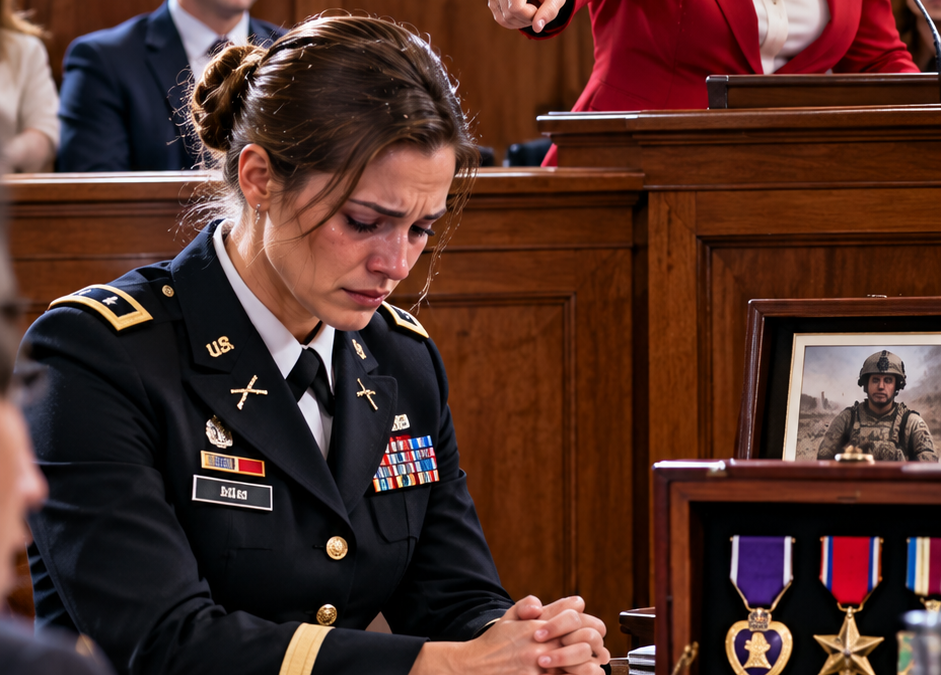
He gestured toward the display case.
“Including these?”
Colonel Ward examined them briefly.
“Including those.”
I did not look at my mother.
I did not trust myself to see whatever was on her face.
Daniel was called next.
He walked to the stand with that controlled limp he had refused to discuss for years. When he swore to tell the truth, his voice was low and clear.
Aaron handed him a photograph.
“Major Hayes, do you recognize this image?”
Daniel’s jaw tightened.
“Yes.”
“What does it show?”
He looked at me, then back to the jury.
“It shows Captain Bennett after the convoy incident outside Al-Mazir Province. She had reentered a damaged transport to retrieve encrypted equipment and help evacuate two wounded specialists.”
The courtroom went silent.
“She sustained blast injuries,” Daniel said. “The scars Mrs. Bennett called fake were documented by military physicians.”
My mother flinched then, but only slightly.
The prosecutor had no questions.
Perhaps there was nothing left to ask that would not make him look smaller.
By the time the court recessed, the hallway outside had become a storm of whispers and camera flashes. Reporters shouted my name. The same mouths that had described my disgrace now wanted my reaction to vindication.
Vindication was a word people used when they wanted a neat ending.
Nothing about this was neat.
Aaron guided me into a side conference room before reporters could reach us. The moment the door shut, he turned toward me.
“You knew.”
“I hoped.”
“That was more than hope.”
I sat in the nearest chair because my knees had finally begun to feel less certain.
“Authorization was never guaranteed. Colonel Ward told me they would try.”
Aaron dragged a hand over his face, then laughed once in disbelief.
“Mara, half the case just collapsed.”
“Half.”
His expression sharpened.
“You’re thinking about the will.”
“I’m thinking about my father.”
The room quieted around his name.
Aaron opened his briefcase and removed a folder.
“Your mother and brother lied under oath. That gives us leverage.”
“They didn’t just lie.”
I looked through the narrow glass panel in the door, where Caleb stood with his lawyer, speaking fast and angrily.
“They built something. Dad knew money was moving through shell companies. Caleb didn’t invent this alone.”
Aaron followed my gaze.
“You believe your mother knew about the financial transfers?”
“I believe my father did.”
Before he could answer, there was a soft knock.
Daniel stepped inside.
For a second, neither of us spoke.
He looked older, but not weaker. Time had carved lines beside his eyes and silvered his temples, yet he carried the same stillness that had once made chaos seem survivable.
“Mara,” he said.
“Daniel.”
Aaron glanced between us.
“I’ll give you a moment.”
When he left, Daniel stayed near the door, as though unsure whether he still had permission to come closer.
“You held up well,” he said.
“I had practice.”
His mouth moved like he almost smiled, but the effort faded.
“I’m sorry it took this long. The authorization hit delays.”
“You came.”
“I said I would.”
That simple sentence pulled me backward twelve years, to a night under a torn canvas shelter when I thought pain was the whole world and Daniel sat beside my cot reading field reports aloud just to keep me awake.
I folded my hands to hide their trembling.
“Did you know my father contacted the department before he died?”
Daniel’s expression changed.
There it was.
The first crack.
“What?” I asked.
He came closer and lowered his voice.
“Your father requested a secure review of Bennett Meridian’s internal contracts eight weeks before his death.”
My breath caught.
“He told me one week before.”
“He may have waited because he wasn’t sure whom to trust.”
The words hurt more than I expected.
Not because they were cruel.
Because they sounded exactly like Dad.
Careful.
Protective.
Lonely in rooms full of people who wanted something from him.
“Did he name Caleb?” I asked.
“No. But he flagged several transfers connected to Meridian Bridge Holdings.”
“That’s one of the shell companies.”
Daniel nodded.
“And there’s more. One of the accounts receiving funds was tied to a consultant with clearance access.”
“Who?”
He hesitated.
“Daniel.”
“Lena Ortiz.”
For a moment, the name meant nothing.
Then memory opened.
Lena had been my father’s final assistant. Warm smile, sharp suits, cinnamon tea always cooling beside her keyboard. She had sent flowers to his funeral and hugged my mother in the receiving line.
“No,” I whispered.
“I’m not accusing her,” Daniel said. “I’m saying her name appears in records she may not know about.”
That distinction mattered.
Daniel had always been careful with facts.
He did not throw blame like stones.
The door opened before I could respond.
Aaron returned, followed by an officer of the court.
“Judge wants everyone back,” Aaron said. “Now.”
The afternoon session did not last long.
The prosecutor requested time to reassess the charges. The judge, visibly irritated, dismissed the jury until the following morning and warned both sides not to speak to the press.
My mother kept her eyes forward the entire time.
Caleb whispered to his attorney with increasing urgency, but whatever confidence had carried him into that courtroom had drained away.
As we stood to leave, my mother finally turned.
For one second, I saw not the woman who had raised me or the witness who had erased me, but someone frightened by a door she could no longer close.
“Mara,” she said.
Caleb caught her wrist.
“Don’t.”
She pulled away from him, but the moment passed. Her face hardened again, and she walked out.
I wanted anger to rise.
It would have been easier.
Anger had edges.
This was something softer and more dangerous, a hollow ache where a daughter’s hope used to live.
That evening, I returned to my father’s house.
It was technically mine now, though nothing about it felt like belonging. The old cedar by the driveway leaned over the roof as it always had, dropping brown needles into the gutters. The porch light flickered twice before settling. Dad had meant to fix it.
Dad had meant to do many things.
Inside, the house smelled faintly of lemon polish and old books.
I stood in the foyer with my overnight bag and listened to silence.
When I was a child, my mother filled that silence with piano music, phone calls, instructions, opinions. Caleb filled it with motion, racing toy cars down the banister and blaming broken things on me.
Dad filled it differently.
He hummed while reading technical manuals. He tapped pens against blueprints. He asked questions as though every answer could become a bridge.
“Mara?” Aaron called from behind me.
I had forgotten he was there.
“You don’t have to stay here tonight,” he said.
“Yes, I do.”
Daniel stood on the porch beyond him, looking uncertain again. We had agreed they would both come by so we could search Dad’s study for the original estate records and any notes about Meridian Bridge.
The study was exactly as my father had left it, or as someone wanted it to appear.
His leather chair faced the window. The chessboard beside it held an unfinished game. A blue sweater hung over the back of the chair, sleeves folded neatly, though Dad had never folded anything neatly in his life.
I noticed that first.
“Someone’s been here,” I said.
Aaron looked around.
“How can you tell?”
“The sweater.”
Daniel moved toward the desk.
“Was it missing?”
“No. Wrong. He always threw it over one arm, inside out.”
Aaron paused.
“You remember that?”
“I remember things people think don’t matter.”
We began with the desk.
Aaron reviewed files while Daniel checked the bookshelf and I opened drawers that still smelled like pencil shavings. There were invoices, patent drafts, birthday cards Dad had never mailed.
In the bottom drawer, beneath a stack of technical journals, I found an envelope with my name written in my father’s tight, slanted hand.
My throat closed.
Aaron stepped closer.
“Do you want a minute?”
“No.”
But I held the envelope for several seconds before opening it.
Inside was a key and a single page.
Mara,
If you are reading this, then I either ran out of time or courage. I am sorry for both.
There are things I should have told you years ago. Not about your service. I was always proud of that, even when fear made me poor at showing it. This is about the company, your mother, and a decision I made before Caleb was born.
Trust documents, not memories. Memories can be trained to lie.
The key belongs to Box 417 at Harbor Union Bank.
Do not go alone.
Dad
I read it twice.
Then a third time.
Your mother, and a decision I made before Caleb was born.
Aaron carefully photographed the letter.
“We need that box.”
“Tonight,” I said.
“Banks are closed.”
“Then tomorrow morning.”
Daniel looked at the key in my palm.
“He said not to go alone.”
I met his eyes.
“I’m not alone.”
The next morning, the courthouse was louder.
News of the military testimony had spread. The reporters who had eagerly broadcast my supposed disgrace now shouted questions about vindication. I ignored them all.
Inside, the prosecutor formally moved to dismiss the charges related to falsified military service pending further review. The judge granted the request with a stern expression that suggested further review would not be pleasant for the state.
But the estate battle remained.
Caleb’s attorney pivoted quickly, claiming that while my service might be real, questions still existed about Dad’s mental state when he left me controlling shares.
Aaron countered that Caleb’s new will was suspicious, unsupported, and now tied to witnesses willing to lie under oath.
The judge scheduled an evidentiary hearing.
Then he looked directly at my mother.
“Mrs. Bennett, you are advised to obtain separate counsel.”
Her face went still.
Caleb turned toward her.
“Mother.”
But she was not looking at him.
She was looking at me.
For the first time since the trial began, there was no performance in her expression.
Only exhaustion.
After court, I expected her to leave with Caleb.
Instead, she stepped into the side hall where I stood waiting for Aaron.
“Mara,” she said.
Daniel, beside me, straightened.
“It’s all right,” I told him, though I was not sure it was.
My mother noticed him, and something like recognition passed through her eyes.
“Major Hayes.”
He gave a restrained nod.
“Mrs. Bennett.”
She turned back to me.
Up close, I could see the fine tremor in her left hand, the one she tucked beneath her purse strap whenever she wanted to appear composed.
“I need to speak with you,” she said.
“You had your chance on the stand.”
Her mouth tightened, but she absorbed it.
“Not here.”
“Then where?”
She glanced toward the lobby, where Caleb was arguing with his attorney near the elevators.
“The chapel across the street. Fifteen minutes.”
Daniel’s voice was quiet.
“Mara, that may not be wise.”
My mother looked at him.
“I am not asking you to trust me.”
“No,” I said. “You are asking me to walk into a room with someone who tried to erase my life.”
Pain flashed across her face so quickly I almost missed it.
“I know what I did,” she whispered.
That stopped me.
Not an excuse.
Not a denial.
Not another performance.
A confession, or the beginning of one.
Fifteen minutes later, I entered the small chapel with Daniel waiting outside and Aaron on speaker in my coat pocket, silent but listening. Sunlight moved through stained glass in softened colors, painting the pews in blue and gold.
My mother sat in the third row, hands clasped around a tissue she had twisted nearly to threads.
I sat one pew behind her.
She gave a humorless little laugh.
“Still tactical.”
“Still breathing.”
She closed her eyes.
For a long moment, neither of us spoke.
“I did not hate you,” she said finally.
I stared at the back of her carefully styled hair.
“That’s your opening?”
“It is the truth.”
“You lied under oath.”
“Yes.”
“You called my scars fake.”
Her shoulders moved, barely.
“Yes.”
“You let strangers look at me like I was something filthy.”
“I know.”
The softness of her answers unsettled me more than argument would have.
She turned slightly, not enough to face me fully.
“Caleb came to me two months after your father’s diagnosis. He said your father was confused, that you were pressuring him, that the company would collapse if control passed to you because of your restricted military past.”
I said nothing.
“I wanted to believe him,” she continued. “That is not an excuse. It is worse than an excuse. It means I chose the version of the truth that cost me less.”
“Cost you less?”
“If you were the problem, then I had not failed you.”
There it was, quiet and terrible.
I felt my fingers curl against the pew.
She looked down at the shredded tissue.
“When you enlisted, I told everyone you were being dramatic. When you stopped calling regularly, I told myself you were punishing me. When you came home injured, I could not bear that you had survived something I had refused to understand. So I made you distant. Cold. Difficult. It was easier.”
My chest tightened.
I had imagined many explanations.
Greed.
Ambition.
Caleb’s manipulation.
My mother’s old need to control every room she entered.
I had not expected shame.
“Why lie now?” I asked.
She turned then.
Her eyes were wet but clear.
“Because Caleb said if the court accepted your records, investigators would uncover what your father found.”
“What did Dad find?”
“I don’t know everything.”
“Then tell me what you know.”
“Your father changed after a meeting last spring. He came home ashen. He locked himself in the study and started reviewing old contracts. A week later, he asked me whether I remembered signing guardianship language when Caleb was born.”
The chapel seemed to tilt.
“Guardianship?” I repeated.
She nodded.
“I thought he was confused. Then he said Caleb’s birth records had been altered.”
I stopped breathing for a second.
“My birth records?” Caleb’s voice echoed suddenly from the aisle.
My mother gasped and turned.
Caleb stood at the chapel entrance, face drained of color.
None of us had heard him enter.
Daniel stepped in behind him, controlled but alert.
“He followed from the courthouse.”
Caleb ignored him. His eyes were fixed on our mother.
“What does that mean?”
Victoria rose slowly.
“Caleb—”
“What does that mean?”
For once, he did not sound smug.
He sounded young.
Almost frightened.
My mother gripped the pew.
“I don’t know.”
“You’re lying.”
“I am not.”
He laughed, sharp and broken.
“That’s new.”
The words struck her harder than any accusation I could have made.
Aaron’s voice crackled faintly from my pocket.
“Mara, leave. Now.”
But I did not move.
Caleb looked at me, and the resentment I knew so well flickered with something unfamiliar.
Panic, maybe.
Or betrayal.
“You did this,” he said.
“No,” I answered. “Dad did.”
He flinched at our father’s name.
“Dad was sick,” Caleb said. “He was confused.”
“Maybe. But he left me a key.”
My mother’s eyes widened.
“What key?”
I watched her carefully.
The surprise seemed real.
“Harbor Union,” I said. “Box 417.”
Caleb took one step back.
There.
Daniel saw it too.
“You know about it,” I said.
Caleb recovered quickly, but not quickly enough.
“I know Dad had boxes everywhere. He was paranoid.”
“No,” my mother whispered. “Richard closed all but one years ago.”
Caleb turned on her.
“Stop helping her.”
“I am trying,” she said, voice breaking, “to stop losing both my children.”
The sentence hung between us.
Both my children.
Caleb stared at her as though he wanted to challenge the word both, but something kept him silent.
We left the chapel separately. Daniel walked beside me to the car, scanning the street out of habit. Aaron, still on the phone, ordered me not to visit the bank without him.
I agreed, though my mind remained in the chapel with Caleb’s stunned face and my mother’s shaking hands.
At Harbor Union Bank, Box 417 waited behind two locks and a manager who treated court documents as though they might explode.
Aaron signed.
I signed.
Daniel remained near the wall, quiet and watchful.
The box was long, narrow, and heavier than I expected.
Inside lay three items: a sealed envelope, a flash drive, and a small hospital bracelet yellowed with age.
The bracelet was for a newborn.
BENNETT, CALEB M.
But beneath that printed name, almost faded, was another.
ORTIZ, MATEO L.
Aaron whispered, “Mara.”
I reached for the envelope with hands that no longer felt steady.
Inside was a letter, but not in my father’s handwriting.
It was from Lena Ortiz.
Richard,
I kept my promise for twenty-six years. I stayed away because you said it was best for him, and because Victoria agreed. But the money transfers have started again, and I think someone knows the adoption was never finalized correctly.
If Caleb discovers the truth from them instead of you, he will never forgive any of us.
You need to tell Mara too. She is the only one who will protect the company without destroying him.
Please, Richard. No more secrets.
Lena
No one spoke.
The room hummed softly with fluorescent light.
Caleb was not my mother’s biological son.
Lena was not just Dad’s assistant.
And my father had left me the company not because he trusted me more than Caleb, but because he feared what someone might do with the truth of Caleb’s life.
Aaron looked at the flash drive.
“We need to review this securely.”
Daniel nodded.
“Not here.”
I picked up the hospital bracelet.
For years, I had thought betrayal was a line: my mother on one side, Caleb on the other, me standing alone with the truth.
But the bracelet in my hand turned that line into a circle.
Everyone had been hiding something.
Everyone had been protecting someone.
And somewhere inside all of it was a boy named Mateo who had grown into my brother without ever knowing the first truth about himself.
My phone buzzed.
A message from an unknown number appeared on the screen.
Do not give Caleb the drive. Your father was wrong about who needed protection.
Then another message followed.
Ask Daniel what happened the night Lena disappeared.
I looked up slowly.
Daniel was watching the door, unaware of the words burning in my hand.
“Who is it?” Aaron asked.
I turned the screen toward him, but my eyes stayed on Daniel.
Because Lena Ortiz had sent flowers to my father’s funeral three months ago.
And according to the message on my phone, she was missing.
For several seconds, nobody moved.
Then Daniel looked at me.
“What?”
I held up the phone.
He read the messages.
The color left his face so quickly that Aaron stepped forward.
“What night?” I asked.
Daniel did not answer.
That silence hurt more than anything he could have said.
“What happened the night Lena disappeared?”
He closed his eyes once.
“When I received your father’s secure review request, Lena Ortiz’s name appeared almost immediately. Not as a suspect. As a point of access.”
“Access to what?”
“Contracts, clearance documentation, employee background files, and private family correspondence stored on Bennett Meridian’s legacy servers.”
Aaron’s voice sharpened.
“You investigated her?”
“Yes,” Daniel said. “Quietly.”
“And?”
“And she contacted me first.”
That stopped me.
“She contacted you?”
“She knew someone was using her credentials. She said she had tried to warn your father but did not know whom to trust after he died. She believed Caleb was being manipulated.”
“By whom?”
Daniel looked at the flash drive.
“She did not know.”
“Then why does the message say she disappeared?”
“Because after she met with me, she vanished for forty-six hours.”
I stepped closer.
“You never told me.”
“I was not authorized to involve you.”
The words landed badly.
He knew it the moment he said them.
My laugh was short and cold.
“Daniel, do not hide behind authorization with me.”
His jaw tightened, but he accepted the hit.
“I deserved that.”
“What happened?”
“We found her car abandoned two counties away. No blood. No signs of struggle. Her phone was destroyed. Forty-six hours later, she walked into a federal field office with bruises on her wrist, a fractured cheekbone, and a storage device sewn into the lining of her coat.”
Aaron looked toward the box.
“The flash drive?”
Daniel nodded.
“A duplicate. Your father’s was the original. Lena had copied part of it.”
My hand tightened around the hospital bracelet.
“Where is she now?”
“Protected location.”
“You knew she was alive?”
“Yes.”
“Did my father know?”
“No. He died before she resurfaced.”
“Did Caleb know?”
Daniel hesitated.
“I don’t know.”
That was honest.
Not enough.
But honest.
Aaron placed the flash drive into an evidence sleeve.
“We’re done here. We need a secure review, and we need to notify the court.”
“No,” I said.
Both men looked at me.
I stared at the hospital bracelet again.
“First, we tell Caleb.”
Aaron blinked.
“Mara—”
“He deserves to know before this becomes another weapon.”
“Caleb tried to send you to prison.”
“I know.”
“He helped accuse you of stolen valor.”
“I know.”
Daniel studied me.
“You are thinking about Lena’s letter.”
I nodded.
You need to tell Mara too. She is the only one who will protect the company without destroying him.
I hated that my father had known me that well.
I hated that it still mattered.
Caleb was waiting at the courthouse when we returned.
Not because we called him.
Because fear had dragged him there before truth could arrive.
He stood near the side entrance with his attorney, pale and restless. My mother sat on a bench several feet away, her hands clasped in her lap.
When Caleb saw me, he came forward.
“What was in the box?”
His attorney grabbed his arm.
“Do not ask questions outside counsel.”
Caleb shook him off.
“What was in it?”
I looked at Aaron.
He gave the smallest nod, though he clearly hated himself for it.
“Not here,” I said.
We used a conference room in the courthouse basement. Caleb’s attorney objected to everything and then stayed anyway. My mother came in last.
Daniel stood by the door.
I placed the hospital bracelet on the table.
Caleb stared at it.
At first, confusion.
Then irritation.
Then the moment his mind began recognizing shapes before meaning arrived.
“That’s mine,” he said.
“Yes.”
He leaned closer.
His eyes found the faded name beneath Bennett.
ORTIZ, MATEO L.
He stopped breathing.
My mother made a sound so small I almost missed it.
Caleb looked at her.
“What is that?”
Victoria covered her mouth.
“What is that?” he repeated.
No one answered quickly enough.
So I did.
“I think it is the name you were born with.”
He turned on me.
“No.”
“I’m not saying it to hurt you.”
“No.”
“Caleb—”
“Don’t.”
His voice cracked on the word.
Then he looked at our mother.
“Tell her she’s lying.”
Victoria’s hand shook.
“I can’t.”
The air left him.
He sat down hard.
For once, there was nothing smug about my brother. No polished cruelty. No practiced superiority. He looked like a man whose life had opened beneath his feet.
“My name is Caleb Bennett,” he said.
“It is,” I replied.
His eyes flashed.
“Don’t talk to me like I’m a child.”
“Then don’t ask me to pretend simple answers fix this.”
He stared at me.
Some of the old anger returned, but it was disorganized now.
Desperate.
Victoria leaned forward.
“We loved you.”
Caleb laughed.
It sounded like something breaking.
“That’s what you’re leading with?”
She flinched.
“You were a baby. Lena was young, alone, terrified. Your father wanted to help.”
“My father?”
The question struck the room silent.
Victoria closed her eyes.
“Richard raised you.”
“That was not my question.”
She opened her eyes.
“I don’t know who your biological father is.”
Caleb turned toward me.
“Did Dad know?”
“Yes,” I said.
“How?”
“Because Lena wrote to him.”
His face twisted.
“Lena. His assistant.”
“She was more than that.”
“My mother,” he said bitterly.
Victoria inhaled sharply.
Caleb looked at her.
“Is she?”
Victoria’s eyes filled.
“Yes.”
He stood so quickly his chair struck the wall.
His attorney told him to sit down.
Caleb did not even hear him.
“You all knew?”
“Not Mara,” Victoria said.
He turned to me again.
That seemed to hurt him more.
“You didn’t know?”
“No.”
“You always know things.”
The sentence was so childish and resentful that for one impossible second, I saw him at ten years old, furious because I had solved a puzzle first.
“I didn’t know this.”
His eyes moved to Daniel.
“Did you?”
“Not until recently,” Daniel said.
Caleb looked back at the bracelet.
For a long time, nobody spoke.
Then he whispered, “Why did Dad leave you the company?”
The question had changed.
It no longer sounded like accusation.
It sounded like pain trying to find a shape.
“Because someone was using your birth records and Lena’s credentials to move money through shell companies,” I said. “He thought control of the company might become a weapon against you. Against all of us.”
Caleb sat slowly.
“What money?”
Aaron answered this time.
“Transfers through Meridian Bridge Holdings and associated entities. We believe the forged will may be connected.”
Caleb looked stunned.
“I didn’t forge it.”
The room changed.
Aaron leaned forward.
“Then who gave it to you?”
Caleb rubbed both hands over his face.
“Lena.”
Daniel’s head turned sharply.
“What?”
“She mailed it to me. Or I thought she did. It came with a letter saying Dad had wanted me to have what was mine, that Mara had hidden things, that Mom knew the truth but was too afraid to fight.”
My mother whispered, “I never said that.”
Caleb looked at her with exhausted contempt.
“At this point, Mother, you could have said anything.”
Daniel stepped forward.
“Do you still have the letter?”
“Yes.”
“Envelope?”
“Yes.”
Aaron said, “We need it.”
Caleb looked at me.
For the first time, he seemed unsure whether I was enemy or anchor.
“If I give it to you, what happens to me?”
I thought about lying.
Then I thought about Dad’s letter.
Trust documents, not memories.
Memories can be trained to lie.
“I don’t know,” I said. “But if you keep hiding behind what you were told, you’ll become responsible for every lie you refuse to examine.”
He stared at me.
Then he nodded once.
“Fine.”
The flash drive gave us the first clean map.
Not all at once. It took two days, three forensic specialists, a federal liaison, and a court order. But when the files opened, the story inside was both uglier and simpler than we expected.
Lena Ortiz had not been stealing from Bennett Meridian.
She had been tracking the theft.
Years earlier, someone discovered that Caleb’s adoption paperwork had never been properly finalized. The error was old, buried in a hospital transition, a guardianship petition, and a private arrangement between Richard Bennett, Victoria Bennett, and Lena Ortiz.
At first, no one used it.
Then Caleb grew into an adult with a claim to family assets he did not understand, Lena became Dad’s assistant, and Bennett Meridian became valuable enough for old secrets to acquire market value.
The shell companies had not been created by Caleb.
They had not been created by my mother.
They had been created by Martin Sloane, Bennett Meridian’s former outside counsel.
Sloane had handled estate updates, adoption cleanup, corporate restructuring, and several defense compliance reviews. He knew too much about everyone and believed knowledge was a form of ownership.
He forged communications from Lena.
He manipulated Caleb.
He warned my mother that my sealed military record would destroy the company if exposed.
He moved money through Meridian Bridge and related entities using Lena’s credentials to make her look guilty.
And when Lena discovered it, he had her taken.
Not killed.
That would have created a body.
Sloane preferred leverage to endings.
Lena escaped because she had spent years underestimated by men who thought quiet women only organized calendars.
By the time federal agents arrested Sloane, Caleb had already handed over the forged letter he believed Lena had sent. The envelope carried traces that tied back to Sloane’s office.
The new will collapsed.
The criminal charges against me were dismissed.
The prosecutor made a public statement about newly verified military documentation and evidence manipulation. He did not apologize. Men in suits rarely do unless forced.
Judge Aldridge, who had watched the trial become something far larger than the docket promised, ordered a full evidentiary review of the estate, froze disputed corporate transfers, and referred perjury concerns for separate investigation.
My mother obtained counsel.
Caleb did too.
I did not feel triumphant.
I was too tired for triumph.
Lena Ortiz agreed to meet me three weeks later.
Not at the courthouse.
Not at the company.
At a small garden behind a rehabilitation center where she was recovering from injuries she refused to dramatize.
She looked smaller than I remembered, but her eyes were steady.
“You look like Richard,” she said.
“People usually say I look like my mother.”
“People who say that are looking at your face.”
I sat beside her on a bench.
For a while, we watched wind move through ornamental grass.
Then she said, “I am sorry.”
“For what?”
“For staying away from Caleb.”
I did not answer.
She nodded as if she had expected that.
“Victoria wanted to raise him. Richard wanted to protect him from scandal. I was twenty-one, alone, and convinced that loving him meant giving him the life I could not provide.”
Her hands folded in her lap.
“I told myself I would come back when he was older. Then every year made the lie harder to disturb.”
“Did Caleb know you at all?”
“As Lena,” she said softly. “Not as his mother.”
“That is cruel.”
“Yes.”
The honesty silenced me.
She looked toward the garden path.
“I do not expect forgiveness from him. Or from you.”
“Good.”
A faint smile touched her mouth.
“Richard said you were direct.”
“Dad said many things.”
“He was proud of you.”
The sentence entered me in a place still bruised by my mother’s testimony.
I looked away.
“He should have told me more.”
“Yes,” Lena said. “He should have.”
There it was again.
No defense.
No polishing the dead into saints.
Just truth.
“What happens now?” she asked.
I thought about Caleb.
My mother.
The company.
The trial.
Daniel.
The uniform I had nearly been buried beneath because I was not allowed to speak of it.
“I protect what is left,” I said.
“And Caleb?”
I looked at her.
“That depends on Caleb.”
She nodded.
Months passed before the estate case ended.
The original will was upheld. Dad’s controlling shares remained with me, but I placed a portion into a structured trust that allowed Caleb future financial benefit without giving him authority over defense contracts or corporate governance.
Not because he deserved it.
Because Dad had been trying to protect him from becoming a weapon in someone else’s hand.
Caleb did not thank me.
At first.
He spent weeks furious, humiliated, and lost. He refused to see Lena. He refused to speak to Victoria except through attorneys. He accused me of winning by destroying him.
I let him say it once.
The second time, I stopped him.
“You tried to destroy me with a lie.”
He looked away.
“Because I believed one.”
“No,” I said. “Because believing it gave you what you wanted.”
That landed.
He did not apologize that day.
But he stopped accusing me of victory.
My mother’s perjury case did not send her to prison. Her testimony was reviewed in light of Caleb’s manipulation, Sloane’s fraud, and her eventual cooperation. She accepted a plea related to false statements and obstruction. There were penalties, public shame, and the loss of every polished social circle she had once valued too much.
The first time she asked to see me afterward, I almost refused.
Then I went.
We met in Dad’s garden.
She looked older.
Not weak.
Just unpainted by control.
“I don’t know how to be your mother after what I did,” she said.
I sat across from her.
“You can start by not asking me to make you feel better.”
She nodded.
“I won’t.”
“Good.”
She looked at her hands.
“I was ashamed of you because I thought you had left me.”
“No,” I said. “You were ashamed of yourself and made me carry it.”
She closed her eyes.
“Yes.”
That answer mattered more than tears.
“I can’t forgive you yet,” I said.
“I know.”
“I don’t know if I ever will.”
Her mouth trembled.
“I know.”
“But I am willing to hear the truth when you are ready to keep telling it.”
She looked at me then.
For the first time in years, she did not try to become the injured person in the room.
“Thank you,” she whispered.
It was not enough.
It was a beginning.
Daniel stayed longer than he planned.
At first, he claimed it was because the investigation required coordination. Then because Colonel Ward needed him to finalize records. Then because Aaron wanted him available for statements.
Eventually, I found him on Dad’s porch one evening, watching the cedar tree sway in rain.
“You know you can leave now,” I said.
“I know.”
“You’re still here.”
“Yes.”
The rain tapped softly against the porch roof.
I stood beside him.
“I was angry that you knew things and didn’t tell me.”
“You should be.”
“I still am.”
“I know.”
That was Daniel.
No defense when defense would insult the wound.
“Why stay?” I asked.
He looked at me.
“Because last time, I watched you disappear into a classified file for twelve years.”
My throat tightened.
“That wasn’t your fault.”
“No. But I can still choose differently now.”
We stood there for a long time.
Nothing dramatic happened.
No confession.
No sudden answer to what we were.
But when his hand rested on the porch rail beside mine, neither of us moved away.
One year after the trial began, Bennett Meridian held its first board meeting under my control.
Not Caleb’s.
Not Sloane’s.
Not a forged will’s.
Mine.
We restructured the compliance department. We terminated every compromised contract. We created a protected reporting channel for employees handling classified-adjacent work. Lena, eventually, joined as an external advisor on internal ethics after Caleb agreed to meet her privately.
Their relationship was not repaired quickly.
How could it be?
He had spent his life as Caleb Bennett. Learning that he had once been Mateo Ortiz did not make either name false. It made both names part of him, whether he wanted them or not.
At the first meeting where Caleb returned to the company as a nonvoting beneficiary observer, he paused outside the conference room.
“I don’t know how to be in there,” he said.
I looked at him.
“Then start by listening.”
He gave a short laugh.
“Is that what you did in court?”
“No,” I said. “In court, I was counting.”
His face changed.
“To noon.”
“Yes.”
For a moment, neither of us spoke.
Then he said, “I’m sorry.”
I waited.
He swallowed.
“For saying you lied. For smiling while Mom testified. For wanting Dad to have chosen me so badly that I didn’t care what had to be false.”
There were cleaner apologies.
Prettier ones.
That one was ugly enough to be real.
“I believe you,” I said.
His eyes flickered.
“That’s it?”
“That’s it for today.”
He nodded.
“Okay.”
He entered the room.
I followed.
On the wall hung a photograph of Dad standing in the original Bennett Meridian warehouse, sleeves rolled up, smiling at a prototype that looked crude compared with what the company later became.
Under it, I had placed a line from his letter.
TRUST DOCUMENTS, NOT MEMORIES.
It sounded cold to some people.
It was not.
It meant truth needed somewhere to live outside the stories we told to survive ourselves.
When the meeting ended, I stayed behind.
Aaron gathered his papers near the door.
“You won,” he said.
I looked at him.
“Did I?”
He considered that.
“No,” he said finally. “But you kept what mattered.”
That was closer.
I went home that evening to Dad’s house.
The porch light no longer flickered. I had fixed it myself, mostly because Dad never had and partly because I needed one small thing to work because I touched it.
Inside, the study no longer looked staged. The sweater was gone. The chessboard remained, but I reset the pieces. Not to finish his game. To begin another.
On the desk sat the hospital bracelet, sealed safely in an archival case.
Caleb had asked me to keep it for now.
“I’m not ready,” he said.
I understood.
Beside it was my Silver Star.
My Purple Heart.
The burned unit patch.
The things my mother had called fake.
For months, I thought seeing them would reopen the wound.
Instead, they steadied me.
Not because medals proved who I was.
Because I no longer needed a courtroom to believe my own life.
I touched the edge of the burned patch.
Smoke.
Dust.
Daniel’s voice.
Stay awake.
I had stayed awake through more than one battlefield.
The courtroom had simply been another one.
My phone buzzed.
A message from Daniel.
Front porch.
I smiled despite myself.
When I opened the door, he stood under the cedar tree holding two coffees and looking as if he regretted not bringing an umbrella.
“You look ridiculous,” I said.
“You always did lead with warmth.”
I took one coffee.
“Why are you here?”
“Colonel Ward sent final documentation. Your unrestricted service summary is complete.”
He handed me an envelope.
I stared at it.
For twelve years, pieces of my life had existed behind seals, codes, redactions, and silence. Now a version of it could be spoken aloud.
Not all of it.
Enough.
I opened the envelope.
Captain Mara Bennett served honorably.
There were more words after that.
Dates.
Awards.
Authorized descriptions.
But I stopped at the first line.
Daniel stood quietly.
I read it again.
Captain Mara Bennett served honorably.
My mother’s voice had once filled a courtroom with the opposite.
She was never in the Army.
The scars, the medals, the whole story—she invented every bit of it.
For a while, I had feared the lie had entered something permanent.
But lies are loud.
Truth is patient.
It had waited until noon.
Then it walked through the doors.
I folded the paper carefully.
“Are you all right?” Daniel asked.
“No.”
He nodded.
“Fair.”
Then, after a moment, I said, “But I’m free.”
He looked at me then, and for the first time in a long time, I did not feel like the woman on the witness stand, the accused, the daughter erased by her own mother, the soldier trapped behind classified silence.
I felt like Mara Bennett.
Daughter of Richard Bennett.
Sister of Caleb Bennett, born Mateo Ortiz.
Soldier.
Survivor.
Executor.
Witness.
Not untouched.
Not unbroken.
But whole enough to tell the truth.
A year earlier, my mother had sworn I had never served my country.
Now the record said otherwise.
My brother had tried to take the company.
Now he sat in meetings learning how not to destroy what he did not yet understand.
My father had left me a key.
Now every locked box he feared had begun to open.
And me?
I had spent my life believing restraint meant silence.
I knew better now.
Restraint was choosing when to speak.
Strength was surviving until the doors opened.
And truth, when it finally entered a room, did not need to shout.
It only needed to stand there long enough for every lie to recognize itself.








