𝗣𝗔𝗥𝗧 𝟮 The Chained Dog Behind the Garage Made a Sound I Could Never Forget
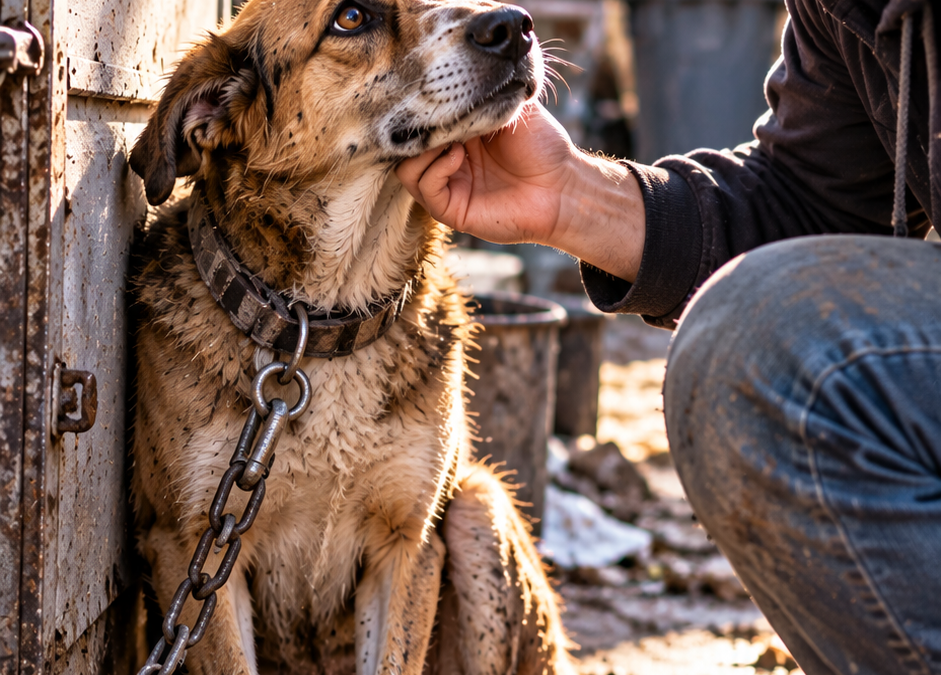
𝗣𝗔𝗥𝗧 𝟮
Meep.
“Yes, you are.”
I scratched his chest.
He sighed.
For a dog whose world had recently consisted of a chain and the space behind a garage, the inside of a car must have been an unfamiliar place.
Yet he seemed remarkably content simply because he wasn’t alone.
That realization hurt.
I thought of all the ordinary things people share with their dogs without giving them much consideration.
A car ride.
A hand resting on a furry head.
A quiet afternoon spent together.
The opportunity to stretch out comfortably beside someone who loves them.
For Beaker, even these simple experiences seemed new and extraordinary.
At one point, he placed his front paws against my leg.
“What’s going on, buddy?”
He looked directly into my face.
Then he lowered his head into my lap.
I became completely still.
His eyes began closing.
“Well, would you look at that?”
He settled more comfortably, releasing a long, exhausted sigh.
Within minutes, he was asleep.
I looked down at the little dog resting against me.
His breathing became slow and steady.
Occasionally, one ear twitched.
His body relaxed so completely that I could feel its weight settling into my lap.
I didn’t move.
My leg gradually became uncomfortable, and I knew I should adjust my position.
But every time I considered moving, I looked down at Beaker and changed my mind.
He had finally found a place where he felt safe enough to sleep.
I wasn’t going to disturb him unless I absolutely had to.
I gently rested my hand against his back.
“Sleep, sweetheart.”
For more than five hours, we shared that strange little sanctuary inside the car.
Sometimes Beaker woke and investigated his surroundings.
Sometimes he demanded more attention.
Occasionally, he entertained me with another ridiculous squeak.
And when he grew tired again, he returned to my lap.
I found myself becoming increasingly attached to him.
It wasn’t simply because he was sweet.
There was something deeply moving about watching an animal choose to trust you after witnessing the circumstances in which he had been living.
I kept thinking about the moment I first saw him.
He had been almost invisible behind the garage, too uncertain to approach.
Now he was sleeping with his head in my lap, apparently convinced that I would protect him.
I wished I could explain everything to him.
I wished I could tell him that the chain would soon be gone.
That he wouldn’t have to return to the garage.
That the people caring for him wanted nothing except to help him recover.
But dogs don’t understand promises spoken in human language.
They understand what we do.
So I stayed beside him.
When the veterinary team was ready, it was time to take Beaker inside.
He seemed reluctant to leave the comfortable arrangement he had established.
“Come on, buddy.”
He looked at me.
I gently guided him forward.
“One more thing, and then you can rest.”
The staff prepared him for surgery.
I remained with him as long as I was permitted.
Just before we separated, he leaned toward me one more time.
I stroked his head.
“Be brave, Beaker.”
His tail moved.
I smiled.
“That’s my boy.”
Then the veterinary staff took him for his procedure.
The moment he disappeared from sight, the room felt strangely empty.
I had known him for only part of a day.
Yet I was already missing the sound of his little meeps and the familiar weight of his head against my leg.
I tried to distract myself.
I checked my phone.
I looked through the photographs I had taken during the rescue.
In one, he was peeking cautiously from behind the garage.
In another, he was rolling onto his back and demanding affection.
I stared at the two images.
They hardly seemed to show the same dog.
But both photographs belonged to Beaker.
The frightened animal and the affectionate little clown were not separate creatures.
They were two sides of a dog whose personality had been constrained by his circumstances.
And somewhere inside the veterinary clinic, the chain that had kept him trapped was finally being removed.
When I received confirmation that the surgery had been successful, relief washed over me.
For the first time that day, I felt able to breathe normally.
The veterinary team had removed the chain and provided the care his neck required.
He would need time to heal, and his recovery would have to be managed carefully.
But the immediate danger had been addressed.
I looked toward the treatment area.
“Good job, buddy.”
Of course, he couldn’t hear me.
I said it anyway.
Once he was stable and ready for continued recovery, plans were made for Beaker to enter foster care.
It was exactly what he needed.
A safe home.
Reliable meals.
A comfortable place to rest.
People who would give him affection without expecting anything in return.
And most importantly, an environment where the remaining physical and emotional consequences of his confinement could gradually heal.
When I visited him after he had settled into his foster home, I wondered whether he would recognize me.
I knew dogs sometimes responded strongly to familiar people, but I didn’t want to assume anything.
Perhaps he would be distracted by his new surroundings.
Perhaps he would feel uncertain.
Perhaps his experience at the clinic would have changed the way he reacted to strangers.
I approached quietly.
“Hey, Beaker.”
His head lifted.
For a moment, he stared at me.
Then his tail started moving.
I smiled.
“Hello, sweetheart.”
He hurried toward me with an enthusiasm that made me laugh.
And there it was.
Meep.
I knelt before he reached me.
He pressed himself against my chest.
“There’s my boy!”
His whole body seemed to wiggle with excitement.
He tried to climb into my lap.
I gently held him close, mindful of his healing neck.
“Oh, I missed you too.”
The foster family laughed as Beaker continued greeting me with his strange little voice.
They told me that he was adapting beautifully to life indoors.
At first, everything had been unfamiliar.
He needed time to explore his new surroundings and learn the household routine.
But it hadn’t taken long for his affectionate personality to emerge.
He loved being around people.
He enjoyed attention.
And he remained extremely enthusiastic about belly rubs.
“That sounds like Beaker,” I said.
One of his foster caregivers smiled.
“He really does want to be close to someone all the time.”
I looked down at the dog now leaning against my legs.
“I can believe it.”
As his recovery progressed, he began discovering the ordinary pleasures of living in a home.
He had a soft place to sleep.
Regular meals arrived without him having to wonder when he might eat again.
He could walk around without being tethered behind a building.
And when he wanted company, there were people nearby who genuinely enjoyed being with him.
Watching him experience those things was more rewarding than I had imagined.
There were no dramatic declarations.
No extraordinary displays of gratitude.
Beaker simply began living the way a happy dog should.
He explored.
He played.
He rested.
He sought affection whenever the opportunity presented itself.
And whenever he became especially excited, he filled the room with his ridiculous little meeps.
His foster family quickly learned that it was almost impossible to remain serious around him.
If someone sat on the floor, Beaker considered it an invitation.
If someone stretched out a hand, he eagerly presented his head for attention.
If a visitor appeared particularly friendly, he might roll onto his back and offer his stomach before anyone had even introduced themselves.
I sometimes wondered whether he was trying to make up for lost time.
Perhaps that was simply the personality he had always possessed, waiting for a safe environment in which to emerge.
Either way, it was beautiful to watch.
One afternoon, I sat beside him while he rested on his comfortable bedding.
I could see that the area around his neck was healing.
The chain was gone.
The sight filled me with a deep, almost overwhelming sense of relief.
I remembered standing behind the garage and discovering that we couldn’t safely remove the remaining chain ourselves.
I remembered the anxious journey to the veterinary clinic and those five long hours in the car.
Now Beaker was stretched comfortably beside me, completely unconcerned by the painful object that had once restricted his every movement.
I gently stroked his back.
“You’ve come a long way, buddy.”
He opened one eye.
Meep.
I laughed.
“Yes, you have.”
He rolled onto his side, inviting another belly rub.
Of course he did.
In Beaker’s world, a moment of emotional reflection was apparently an excellent opportunity to request more affection.
I obliged.
As the weeks passed, his confidence continued growing.
The timid dog I had first met was becoming an outgoing, playful companion.
He remained affectionate and eager to connect with people, but he was also discovering how enjoyable it could be to explore his surroundings without restriction.
He began showing a particular enthusiasm for play.
That detail eventually became important when we started considering what kind of permanent home would suit him best.
Beaker was thriving in foster care, but fostering was only one stage of his journey.
The goal was to find a family who could provide him with lasting security.
Someone who understood what he had survived.
Someone willing to continue supporting his recovery.
Someone who would appreciate his affectionate personality and unusual little voice.
Ideally, we hoped he might find a home with another friendly, energetic dog.
A compatible canine companion could offer Beaker friendship and additional opportunities to play as he continued discovering the world beyond his former confinement.
But what mattered most was finding people who genuinely understood the responsibility of welcoming him into their lives.
He didn’t need another temporary place where he might eventually be forgotten.
He needed a home where he would belong.
As I watched him moving around his foster home, I realized how dramatically his life had changed in such a short time.
When I first found him, he had been hiding behind a garage, attached to a chain that had become a serious danger to his health.
He had been frightened and uncertain.
And yet the moment he realized that I wasn’t going to hurt him, he had approached me with remarkable tenderness.
He had leaned against my legs.
He had rolled onto his back.
He had made that funny little sound that eventually gave him his name.
There had been so much affection inside him, despite everything he had experienced.
Now, instead of being trapped behind a building, he could spend his days surrounded by people who valued him.
He no longer needed to make himself small to avoid attention.
He could ask for affection as often as he wanted.
And judging by the number of belly rubs he demanded, he intended to take full advantage of that privilege.
Sometimes, I still think about the five hours we spent together in the car.
Of all the moments from Beaker’s rescue, that memory remains particularly precious to me.
I remember the uncertainty.
The concern about his surgery.
The exhaustion settling into my body as the hours passed.
But most of all, I remember the weight of his head in my lap.
He had fallen asleep so peacefully.
Despite the chain around his neck and the frightening changes happening around him, he had decided that he could trust the person sitting beside him.
I didn’t know what his life had been like before we found him.
I couldn’t erase whatever had happened.
And I couldn’t explain to him that the people responsible for his care would never again allow him to be forgotten behind a garage.
But I could make sure that every experience from that moment forward helped him understand what safety felt like.
Today, Beaker continues thriving in his foster home.
He is happy, affectionate, and increasingly confident.
He has people who care for him, a comfortable place to sleep, and the opportunity to enjoy the ordinary pleasures that were once beyond his reach.
His permanent family is still somewhere in his future.
I hope that when the right people finally meet him, they see everything I saw behind that garage.
Not simply a dog who survived neglect.
Not merely an animal rescued from a chain.
But a loving, playful companion with an extraordinary capacity for trust.
A dog who responds to kindness with his entire body.
A dog who can turn a difficult afternoon into something beautiful simply by making one ridiculous little sound.
I still remember the first time he looked at me from the shadows.
I remember the uncertainty in his eyes and the way his tail began moving when he realized I was approaching gently.
And I remember what happened when he finally stepped forward.
He didn’t ask for anything extraordinary.
He just wanted someone to touch him kindly.
Now, as he rests in his foster home and waits for the family who will one day welcome him permanently, Beaker has something he didn’t have when I first discovered him.
He has the freedom to be himself.
And somewhere in that comfortable home, whenever he becomes excited enough, a little dog named Beaker still makes the strange, joyful sound that reminds me exactly why I fell in love with him.
Meep.
The Forgotten Dog Beside the Road Kept Watching People Who Never Stopped
He lay beside the road, watching strangers pass while his body grew weaker with every breath. He didn’t bark, chase anyone, or make the slightest effort to attract attention. When I knelt beside him, I realized that the silence surrounding him was the most frightening thing of all.
I had seen neglected animals before, but there was something about the dog lying beside that road that I have never been able to forget.
People were passing within a few feet of him.
Cars moved through the street, and pedestrians continued along the sidewalk, occupied with their phones, conversations, shopping bags, and destinations.
Nobody seemed to notice the fragile body lying just beyond the flow of everyday life.
Or perhaps some people noticed and didn’t know what to do.
I can’t say.
What I remember is that the dog remained almost perfectly still.
He wasn’t sleeping comfortably.
Even from a distance, I could see that something was terribly wrong.
His body was painfully thin. His coat looked dull and neglected, and his legs were positioned awkwardly beneath him, as though he had simply stopped moving wherever his strength had finally deserted him.
I watched another pedestrian pass.
The dog lifted his eyes.
For one brief moment, he seemed to follow the person’s movement.
Then his head lowered again.
I stopped walking.
“Hey, buddy.”
He didn’t react.
I approached cautiously, not knowing whether he was injured, frightened, or simply too weak to acknowledge me.
As I drew closer, I noticed how labored his breathing was.
His chest rose with visible effort.
Every breath seemed to require concentration.
“Oh, sweetheart.”
I crouched a short distance away.
His eyes moved toward me.
That was all.
No wagging tail.
No curious sniff.
No attempt to stand.
He simply looked at me with an exhausted expression that made my stomach tighten.
“How long have you been out here?”
I knew he couldn’t answer.
But there was something unbearable about remaining silent while he lay there struggling.
I extended my hand slowly, allowing him to see what I was doing.
He watched me.
When my fingers moved closer, he didn’t retreat.
I gently touched his shoulder.
His body felt terribly frail.
I looked toward the people assisting me.
“We need to get him help. Now.”
Nobody disagreed.
As we prepared to move him, I kept speaking softly.
“You’re okay, buddy. We’ve got you.”
He made no attempt to resist.
That frightened me more than aggression would have.
A frightened dog still has energy to defend himself.
This little animal seemed to have spent every ounce of strength simply surviving.
We carefully lifted him and carried him toward our vehicle, supporting his body so we wouldn’t cause additional discomfort.
He was astonishingly light.
I had expected him to struggle when his paws left the ground.
Instead, he allowed us to carry him.
His head rested weakly against my arm.
I glanced down at him.
“You’re not staying here.”
His eyes remained open.
“Not anymore.”
I don’t know whether he understood the reassurance in my voice.
I only hoped that, somewhere beneath his exhaustion and fear, he could recognize that the people holding him were trying to help.
We settled him as comfortably as possible and began the journey to the veterinary hospital.
I stayed beside him.
Every few moments, I checked his breathing.
I tried not to stare, but I couldn’t help it.
His chest was moving.
Then it seemed to pause.
Then it moved again.
The journey felt much longer than it actually was.
I found myself looking through the window at the passing streets and thinking about how easily we could have missed him.
There had been nothing dramatic about his appearance from a distance.
No desperate barking.
No frantic attempts to approach strangers.
He had simply been lying beside the road, so weak that he could barely lift his head.
If we had been distracted, we might have passed him like everyone else.
I pushed the thought away.
He was in our vehicle now.
We still had a chance.
When we arrived at the veterinary hospital, the staff immediately recognized the seriousness of his condition.
We explained where he had been found and how little he had moved.
The team carefully transferred him into their care.
I remained nearby as they began assessing his condition.
He was severely weakened, dehydrated, and malnourished.
The veterinary team focused on stabilizing him, providing appropriate fluid support, carefully managed nourishment, and a warm, quiet environment where his exhausted body could begin recovering.
I watched them work with a mixture of relief and fear.
Relief because he was finally receiving professional care.
Fear because I could see how close he had come to losing the strength to continue.
One of the veterinary staff members gently adjusted the bedding beneath him.
“There you go, sweetheart.”
The dog barely moved.
I stood beside his resting place, feeling strangely helpless.
Out on the street, helping him had seemed straightforward.
Find the dog.
Lift him carefully.
Get him to a veterinarian.
But now that he was surrounded by medical professionals, I realized the most difficult part might still be ahead.
Rescue had brought him through the hospital doors.
Recovery would depend on whether his fragile body could respond to treatment.
I crouched near him.
“Come on, buddy.”
His eyes shifted slightly.
“You’ve made it this far.”
I wanted him to stand.
I wanted him to wag his tail or lift his head and show us that he understood he was safe.
But he was far too exhausted.
All he could do was breathe.
And at that moment, breathing was enough.
The first few days were difficult.
He required close monitoring and continued supportive care.
His body had been deprived of adequate nourishment and hydration, and restoring his strength would take time.
I learned to measure progress differently.
Before meeting him, I might have considered an animal’s recovery successful when it began running around, playing, and behaving normally.
With this dog, success initially meant something much smaller.
An easier breath.
A little more movement.
A stronger response when someone approached.
A few moments of comfortable rest.
I became deeply invested in every update.
Whenever I checked on him, I found myself asking the same question.
“How’s our boy doing?”
Sometimes the news was encouraging.
Sometimes it was more cautious.
His condition remained fragile, and the veterinary team couldn’t promise how quickly he would recover.
I understood their concern.
But understanding didn’t make the waiting easier.
One afternoon, I stood beside him while he rested.
He looked so small against the bedding.
I gently spoke his familiar greeting.
“Hey, buddy.”
His eyes opened.
Then something moved near his front paw.
I leaned closer.
At first, I thought I had imagined it.
But a moment later, his paw twitched again.
“Well, hello there.”
I smiled.
It wasn’t much.
It certainly wasn’t enough to declare him recovered.
But after watching him lie almost motionless beside the road, that tiny movement felt extraordinary.
I told the staff what I had seen.
They smiled and continued monitoring him.
I returned my attention to the dog.
“That’s it, sweetheart. One little step at a time.”
Over the following days, he began responding more consistently.
He lifted his head when someone approached.
He showed growing interest in his surroundings.
And eventually, his tail began moving.
The first time I saw it happen, I nearly missed it.
A caretaker was speaking to him while gently adjusting his bedding.
His tail gave a faint movement.
Then another.
I stared.
“Did you see that?”
The caretaker smiled.
“I did.”
I laughed.
“Look at you!”
The dog looked toward my voice.
His tail moved again.
I don’t know whether anyone else in that room understood how much the moment meant to me.
But I remembered carrying him away from the road while wondering whether he would survive the journey.
Now he was beginning to respond to the people caring for him.
Something inside him was returning.
As the days turned into weeks, the changes became increasingly visible.
His breathing grew easier.
He became more interested in his surroundings.
His appetite improved under the carefully managed feeding plan.
Gradually, his body began regaining strength.
The first time he stood without appearing completely overwhelmed by the effort, I watched in silence.
He was still unsteady.
His legs looked thin and unfamiliar beneath him, as though he had to rediscover how to support his own weight.
But he stood.
Then he took a cautious step.
I felt tears gathering in my eyes.
“That’s it, buddy.”
Another step.
“You’re doing great.”
He paused and looked toward me.
His tail moved.
I laughed.
“Oh, you have no idea how proud I am of you.”
His recovery continued.
The dullness in his coat gradually faded as he received consistent nourishment and care.
His body slowly filled out.
His movements became steadier.
And the expression in his eyes changed.
I remembered the exhausted animal who had watched pedestrians pass without enough strength to move.
Now those same eyes followed toys, familiar people, and interesting sounds.
He was becoming curious.
That was when I realized that the dog we had rescued was beginning to emerge from beneath the exhaustion that had defined our first meeting.
He wasn’t simply a sick animal lying in a hospital bed anymore.
He had preferences.
He liked certain kinds of attention.
He responded enthusiastically to familiar voices.
And he seemed increasingly interested in the world beyond his resting area.
One morning, I approached him carrying a small toy.
“Look what I’ve got.”
He lifted his head.
I gently moved the toy.
His eyes followed it.
Then he stretched his nose toward it.
I smiled.
“That’s right. It’s yours.”
He sniffed it carefully.
For several seconds, he seemed uncertain what he was supposed to do.
Then he touched it with one paw.
I laughed.
“Well, there you go.”
He looked at me, apparently encouraged by my enthusiasm.
His tail began moving.
It was such an ordinary moment.
A dog investigating a toy.
But I couldn’t stop smiling.
There had been a time when merely lifting his head seemed beyond his strength.
Now he was curious enough to investigate something new.
As he continued recovering, his personality became more apparent.
He was gentle and affectionate.
He seemed to enjoy being near the people who cared for him, and he increasingly sought out attention instead of remaining withdrawn.
Sometimes, when I sat beside him, he rested his head against my hand.
Other times, he simply watched me with those expressive eyes.
I came to recognize a particular look he gave me when he wanted more affection.
“Really?” I would say.
His tail moved.
“Again?”
He leaned closer.
I scratched behind his ears.
“All right. You win.”
The more he improved, the more difficult it became to remember the dog who had lain beside the road.
Of course, I hadn’t forgotten that day.
I never would.
But the animal standing before me was beginning to look and behave so differently that the memory sometimes felt impossible to reconcile with the present.
He could walk.
He could play.
He could move around without appearing exhausted by every breath.
And perhaps most importantly, he seemed comfortable being close to people.
The trust he was developing meant almost as much to me as his physical recovery.
I didn’t know what his previous experiences with humans had been.
Perhaps he had once belonged to someone who loved him.
Perhaps he had lived on the streets for so long that regular meals and gentle affection had become unfamiliar.
His history remained a mystery.
But I could see how he responded to consistent care.
He no longer watched every movement with the same exhausted uncertainty.
He approached familiar people willingly.
He accepted affection.
And when someone entered the room, his tail often began wagging before they even reached him.
Eventually, the veterinary team determined that he had recovered enough to leave the hospital and continue his new life in a safe, loving environment.
The news filled me with relief.
I had been waiting for that moment since the day we found him.
But it also brought a strange sense of emotion.
The hospital had been the place where his life began changing.
It was where he had received the care he desperately needed and where we had watched him gradually regain his strength.
Now he was ready for something more.
He needed a home.
A place where he could enjoy the life he had nearly lost.
When the arrangements were made, I watched him prepare to leave the hospital.
He was standing on his own.
His coat looked healthier.
His eyes were bright and alert.
And his tail moved whenever someone approached him.
I thought about the moment we had carried him through those doors.
He had been too weak to struggle.
Too exhausted to seek attention.
Now he was eagerly investigating everything around him.
“Look at you,” I whispered.
He turned toward me.
I knelt and gently scratched his head.
“You’re a completely different dog.”
He leaned against my hand.
I smiled.
“Well, maybe not completely.”
Somewhere beneath all the weakness and exhaustion, that affectionate personality had been waiting for the chance to emerge.
Now it finally could.
The transition into his new environment was another important stage of his recovery.
He had a comfortable place to sleep, reliable meals, and people who understood that his difficult past required continued patience.
At first, he explored cautiously.
New spaces could still be unfamiliar.
New sounds sometimes attracted his attention.
But with consistency and affection, his confidence continued growing.
He discovered the pleasure of resting on soft bedding without having to remain alert to every movement around him.
He learned that meals arrived regularly.
And he began enjoying the simple companionship of people who were genuinely happy to see him.
I loved hearing about those everyday moments.
The way he settled comfortably after a meal.
The way his tail began moving when someone called him.
The growing enthusiasm with which he greeted people.
And eventually, the joy he showed when he was able to run.
The first time I saw him moving freely across the grass, I was almost speechless.
He was no longer the fragile animal we had lifted from the roadside.
His legs carried him confidently.
His tail moved with excitement.
He paused, looked around, and then continued exploring.
I watched him running through the open space with the enthusiasm of a dog discovering how wonderful life could be.
I found myself laughing.
“Look at him go!”
There was something extraordinary about seeing him move without pain or overwhelming exhaustion.
Every step seemed to distance him from the terrible circumstances in which we had found him.
He investigated the grass.
He explored his surroundings.
He returned eagerly when someone offered attention.
And when he grew tired, he could settle into a comfortable resting place rather than collapsing on the side of a road.
Sometimes, I still think about the strangers who passed him that day.
I don’t know whether they noticed him.
I don’t know what was happening in their lives or whether they understood how badly he needed help.
But I remember the way he lifted his eyes as people moved past.
He had been so weak that he couldn’t even ask for attention in the way most dogs would.
He had simply remained there, waiting.
Now, whenever someone approaches him, his response is entirely different.
His tail begins moving.
His ears lift.
He steps forward with growing confidence, eager to discover whether the visitor might have time for a little affection.
He has learned that people can be a source of comfort.
And he has people in his life who see him as far more than another forgotten stray.
He belongs.
That is the part of his story that means the most to me.
Not merely that he survived.
Not even that he recovered enough to run and play.
But that the dog who had once been so easily overlooked is now surrounded by people who genuinely care whether he is happy.
His presence matters.
His comfort matters.
His future matters.
I remember standing beside the road and wondering whether we had found him too late.
I remember watching his chest rise and fall with painful effort during the journey to the hospital.
I remember those first uncertain days when even the smallest movement offered a little encouragement.
And I remember the first time his tail moved.
Now, when I see him running across the grass or resting peacefully in the company of people who love him, I understand just how far he has come.
His difficult past will always be part of his story.
But it is no longer the place where his story ends.
Today, he has safety, affection, companionship, and the freedom to enjoy the ordinary pleasures of being a dog.
He can run when he wants to run.
He can play when he wants to play.
And when he grows tired, there is a comfortable place waiting for him.
The last time I watched him settle down after playing, he looked toward me with those bright, familiar eyes.
His tail moved gently against the ground.
I smiled.
“You’re home now, buddy.”
He lowered his head and closed his eyes.
And for the first time, I found myself thinking about the road where we had discovered him without feeling that terrible helplessness in my chest.
Because the dog who had once lain there, too exhausted to move and almost invisible to the world, was now sleeping peacefully in a place where he would never have to wonder whether anyone cared about him again.
𝗧𝗛𝗘 𝗘𝗡𝗗
The Chained Dog Behind the Garage Made a Sound I Could Never Forget
He was hiding behind a garage, watching me as though one wrong movement would make me hurt him. The chain around his neck had already taken away his freedom, but I could see that fear had taken something even more precious. When I finally reached out my hand, the little sound he made nearly broke my heart.
I still remember the first time I saw Beaker.
He was crouched behind a garage, partially concealed by the building, trying to make himself as small as possible. At first, I could barely distinguish his body from the shadows surrounding him. Only when he cautiously lifted his head did I realize that a dog was watching me.
I stopped walking.
“Hey there, sweetheart.”
His ears moved toward my voice.
He didn’t bark. He didn’t growl or rush forward the way some frightened dogs do when a stranger enters their territory. Instead, he remained almost perfectly still, staring at me with an expression that made me wonder how many times someone had approached him without offering kindness.
I crouched several feet away.
“It’s okay. I’m not here to hurt you.”
His eyes followed every movement I made.
I could see that he wanted to come closer. Something in the way he shifted his weight suggested curiosity, perhaps even a little excitement. But each time he seemed ready to move forward, he hesitated.
Then I noticed the chain.
It was attached to him, restricting how far he could move from the garage. Even from where I stood, I could see how uncomfortable the situation was. He had apparently been left there, alone and confined, with no understanding of when or whether anyone would return.
My heart sank.
“Oh, baby. What happened to you?”
Of course, he couldn’t tell me.
I looked around the property, trying to understand the circumstances, but nothing I saw explained why such a gentle-looking animal had been left in this condition.
I slowly extended my hand.
Beaker lowered his head.
For a moment, I thought he might retreat farther into the shadows.
Instead, the very tip of his tail moved.
I held my breath.
“That’s it. You can come over.”
His tail moved again.
This time, the movement was unmistakable.
I smiled.
“There you go.”
He took a hesitant step forward, stopped, and glanced at my hand. I remained crouched, resisting the urge to close the distance too quickly.
There was something painfully familiar about the way he approached. He seemed desperate for affection yet afraid of what might happen if he allowed himself to want it.
I didn’t know how long he had been living behind that garage or what his experiences with people had been. But his behavior told me that trust was something he approached carefully.
“Come on, sweetheart. I’ve got you.”
He moved closer.
His nose reached my fingertips.
I let him sniff my hand, giving him time to decide whether he wanted more contact.
Then, almost without warning, he leaned against me.
Not just a cautious little touch.
He pressed his body against my legs and pushed his head beneath my hand, as if he had been waiting for someone to offer him affection and suddenly couldn’t get enough of it.
“Oh, you sweet boy.”
I began gently scratching behind his ears.
His tail started wagging faster.
Within seconds, the frightened dog who had been hiding behind the garage was leaning against me with his entire body.
I laughed.
“Well, hello! Where have you been hiding all that personality?”
He pushed his head against my hand again.
Then he made the strangest noise.
It was a tiny, high-pitched sound somewhere between a squeak and a muffled little meow.
I stopped petting him.
“What was that?”
He looked at me.
His tail wagged.
I scratched his chest, and he made the sound again.
Meep.
I burst out laughing.
“Oh, my goodness. You sound like a Muppet!”
He pressed even closer, apparently delighted that whatever he was doing had earned him more attention.
Meep.
“Again?”
Another little squeak escaped him.
I looked at the people helping with the rescue.
“Listen to him!”
We laughed, and for a few extraordinary moments, the sadness of his circumstances gave way to the simple joy of meeting a dog with an unmistakably unusual personality.
That was how he became Beaker.
The name seemed to suit him immediately.
Like the beloved little Muppet, he had a way of expressing himself through those ridiculous, endearing noises. Even in the middle of an uncertain rescue, he had managed to make everyone smile.
But as I continued petting him, I noticed something that brought my attention back to why we were there.
Every time Beaker tried to move around me, the chain restricted him.
He seemed accustomed to it.
That bothered me more than I could explain.
A dog should be able to turn toward someone offering affection without being pulled backward by a chain.
He should be able to walk a few steps without feeling pressure against his neck.
And he certainly shouldn’t have to live hidden behind a garage, waiting for someone to remember that he exists.
I looked down at him.
“Let’s see if we can get you out of here.”
We began carefully freeing him from the chain that held him in place.
Beaker watched us with great interest, occasionally interrupting our work by leaning against someone’s leg or pushing his nose beneath a waiting hand.
It was almost as though he couldn’t believe so many people had suddenly decided to pay attention to him.
“You’re going to have to give us a second,” I told him as he attempted to climb into my lap.
He answered with another enthusiastic little meep.
I laughed again.
“All right. I understand. Belly rubs are more important than everything else.”
Eventually, we released him from the tether restricting his movement.
I expected him to be uncertain.
After being confined for who knew how long, perhaps he would run toward the nearest open space or retreat somewhere he could feel protected.
Instead, Beaker did something completely unexpected.
He dropped onto the ground.
For one terrible second, I worried that something was wrong.
Then he rolled onto his back.
His paws curled toward his chest.
His tail swept across the ground.
And he looked at me as though I was supposed to understand exactly what he wanted.
I stared at him.
“Are you serious?”
He wiggled.
I shook my head, smiling through the emotion rising in my throat.
“You just got free, and the first thing you want is a belly rub?”
I knelt beside him and gently rubbed his stomach.
His entire body relaxed.
His mouth opened in what looked remarkably like a smile, and another delighted little squeak escaped his throat.
For several minutes, he seemed to forget everything except the pleasure of being touched gently.
He rolled slightly from side to side, following my hands whenever I paused.
I couldn’t stop thinking about the contrast between the frightened dog I had first seen and the affectionate creature lying at my feet.
He had been hiding when I arrived.
Now he was exposing his stomach to me, apparently convinced that my hands existed solely to make him happy.
I wished that moment could have lasted forever.
But as I examined him more closely, I realized his rescue was not nearly finished.
Although we had freed him from the tether, the chain around his neck was still a serious problem.
It was caught tightly against his skin.
When I tried to assess it, I could see that removing it ourselves might injure him.
My stomach tightened.
“Oh, Beaker.”
I gently moved his fur aside.
The chain was far too tight.
Suddenly, his eagerness for affection seemed even more heartbreaking. He had been so delighted to receive attention that he had barely drawn attention to the painful restriction around his neck.
I looked toward the other rescuers.
“We need a veterinarian.”
Nobody disagreed.
I gently scratched Beaker’s head.
“Well, buddy, it looks like we’re taking a little trip.”
He gazed up at me.
Meep.
I tried to smile.
“Yes. I know. You have a lot to say about everything.”
But beneath the humor, I was frightened.
I didn’t know how badly the chain had damaged his neck or whether he had been living with the pressure for days, weeks, or longer.
I only knew that he needed professional help.
We carefully prepared him for transport.
Beaker seemed delighted by the attention, although he remained uncertain about the unfamiliar surroundings.
I stayed close, speaking to him whenever he looked anxious.
“You’re doing great.”
He sniffed my hand.
“That’s right. I’m still here.”
When we reached the veterinary clinic, I explained his situation to the staff.
The veterinarian examined the chain and quickly confirmed what I had feared: it could not be safely removed through ordinary handling.
Beaker would need a surgical procedure.
I looked down at him.
He was attempting to investigate someone’s shoes.
I almost laughed.
He had absolutely no idea how much trouble he was in.
“Will he be okay?” I asked.
The veterinarian explained the procedure and the need to assess the tissue around his neck carefully.
They would do everything necessary to remove the chain and address the damage it had caused.
I nodded, trying to absorb the information.
I had arrived behind that garage expecting to help a frightened, abandoned dog.
Now I was standing in a veterinary clinic, listening to someone explain that a chain had become so tightly fixed around his neck that surgery was necessary.
The cruelty of it was difficult to comprehend.
And yet Beaker continued seeking affection from everyone around him.
A veterinary technician reached toward him.
His tail started wagging.
Meep.
She smiled.
“What an unusual little voice you have!”
“That’s Beaker,” I said.
The name made her laugh.
“Of course it is.”
As we waited for the surgical procedure, I remained with him.
Our wait stretched longer than I had expected.
Eventually, we spent more than five hours together in the car while arrangements were made for his treatment.
I had anticipated an anxious, difficult experience.
Beaker had other ideas.
At first, he moved around cautiously, inspecting the unfamiliar space and occasionally looking toward the windows.
Every time he became uncertain, I offered a calm word or gently touched his shoulder.
“You’re okay, buddy.”
He would glance toward me.
Then his tail would move.
Sometimes he made his peculiar little sound.
Other times, he simply leaned against me.
As the hours passed, I began to realize that he was watching me almost constantly.
When I moved my hand, his eyes followed it.
When I shifted in my seat, he lifted his head.
If I stopped touching him for too long, he would reach toward me with his nose, as though reminding me that I had an important responsibility.
“You’re a demanding little fellow, aren’t you?”
Meep.
“Yes, you are.”
I scratched his chest.
He sighed.
For a dog whose world had recently consisted of a chain and the space behind a garage, the inside of a car must have been an unfamiliar place.
Yet he seemed remarkably content simply because he wasn’t alone.
That realization hurt.
I thought of all the ordinary things people share with their dogs without giving them much consideration.
A car ride.
A hand resting on a furry head.
A quiet afternoon spent together.
The opportunity to stretch out comfortably beside someone who loves them.
For Beaker, even these simple experiences seemed new and extraordinary.
At one point, he placed his front paws against my leg.
“What’s going on, buddy?”
He looked directly into my face.
Then he lowered his head into my lap.
I became completely still.
His eyes began closing.
“Well, would you look at that?”
He settled more comfortably, releasing a long, exhausted sigh.
Within minutes, he was asleep.
I looked down at the little dog resting against me.
His breathing became slow and steady.
Occasionally, one ear twitched.
His body relaxed so completely that I could feel its weight settling into my lap.
I didn’t move.
My leg gradually became uncomfortable, and I knew I should adjust my position.
But every time I considered moving, I looked down at Beaker and changed my mind.
He had finally found a place where he felt safe enough to sleep.
I wasn’t going to disturb him unless I absolutely had to.
I gently rested my hand against his back.
“Sleep, sweetheart.”
For more than five hours, we shared that strange little sanctuary inside the car.
Sometimes Beaker woke and investigated his surroundings.
Sometimes he demanded more attention.
Occasionally, he entertained me with another ridiculous squeak.
And when he grew tired again, he returned to my lap.
I found myself becoming increasingly attached to him.
It wasn’t simply because he was sweet.
There was something deeply moving about watching an animal choose to trust you after witnessing the circumstances in which he had been living.
I kept thinking about the moment I first saw him.
He had been almost invisible behind the garage, too uncertain to approach.
Now he was sleeping with his head in my lap, apparently convinced that I would protect him.
I wished I could explain everything to him.
I wished I could tell him that the chain would soon be gone.
That he wouldn’t have to return to the garage.
That the people caring for him wanted nothing except to help him recover.
But dogs don’t understand promises spoken in human language.
They understand what we do.
So I stayed beside him.
When the veterinary team was ready, it was time to take Beaker inside.
He seemed reluctant to leave the comfortable arrangement he had established.
“Come on, buddy.”
He looked at me.
I gently guided him forward.
“One more thing, and then you can rest.”
The staff prepared him for surgery.
I remained with him as long as I was permitted.
Just before we separated, he leaned toward me one more time.
I stroked his head.
“Be brave, Beaker.”
His tail moved.
I smiled.
“That’s my boy.”
Then the veterinary staff took him for his procedure.
The moment he disappeared from sight, the room felt strangely empty.
I had known him for only part of a day.
Yet I was already missing the sound of his little meeps and the familiar weight of his head against my leg.
I tried to distract myself.
I checked my phone.
I looked through the photographs I had taken during the rescue.
In one, he was peeking cautiously from behind the garage.
In another, he was rolling onto his back and demanding affection.
I stared at the two images.
They hardly seemed to show the same dog.
But both photographs belonged to Beaker.
The frightened animal and the affectionate little clown were not separate creatures.
They were two sides of a dog whose personality had been constrained by his circumstances.
And somewhere inside the veterinary clinic, the chain that had kept him trapped was finally being removed.
When I received confirmation that the surgery had been successful, relief washed over me.
For the first time that day, I felt able to breathe normally.
The veterinary team had removed the chain and provided the care his neck required.
He would need time to heal, and his recovery would have to be managed carefully.
But the immediate danger had been addressed.
I looked toward the treatment area.
“Good job, buddy.”
Of course, he couldn’t hear me.
I said it anyway.
Once he was stable and ready for continued recovery, plans were made for Beaker to enter foster care.
It was exactly what he needed.
A safe home.
Reliable meals.
A comfortable place to rest.
People who would give him affection without expecting anything in return.
And most importantly, an environment where the remaining physical and emotional consequences of his confinement could gradually heal.
When I visited him after he had settled into his foster home, I wondered whether he would recognize me.
I knew dogs sometimes responded strongly to familiar people, but I didn’t want to assume anything.
Perhaps he would be distracted by his new surroundings.
Perhaps he would feel uncertain.
Perhaps his experience at the clinic would have changed the way he reacted to strangers.
I approached quietly.
“Hey, Beaker.”
His head lifted.
For a moment, he stared at me.
Then his tail started moving.
I smiled.
“Hello, sweetheart.”
He hurried toward me with an enthusiasm that made me laugh.
And there it was.
Meep.
I knelt before he reached me.
He pressed himself against my chest.
“There’s my boy!”
His whole body seemed to wiggle with excitement.
He tried to climb into my lap.
I gently held him close, mindful of his healing neck.
“Oh, I missed you too.”
The foster family laughed as Beaker continued greeting me with his strange little voice.
They told me that he was adapting beautifully to life indoors.
At first, everything had been unfamiliar.
He needed time to explore his new surroundings and learn the household routine.
But it hadn’t taken long for his affectionate personality to emerge.
He loved being around people.
He enjoyed attention.
And he remained extremely enthusiastic about belly rubs.
“That sounds like Beaker,” I said.
One of his foster caregivers smiled.
“He really does want to be close to someone all the time.”
I looked down at the dog now leaning against my legs.
“I can believe it.”
As his recovery progressed, he began discovering the ordinary pleasures of living in a home.
He had a soft place to sleep.
Regular meals arrived without him having to wonder when he might eat again.
He could walk around without being tethered behind a building.
And when he wanted company, there were people nearby who genuinely enjoyed being with him.
Watching him experience those things was more rewarding than I had imagined.
There were no dramatic declarations.
No extraordinary displays of gratitude.
Beaker simply began living the way a happy dog should.
He explored.
He played.
He rested.
He sought affection whenever the opportunity presented itself.
And whenever he became especially excited, he filled the room with his ridiculous little meeps.
His foster family quickly learned that it was almost impossible to remain serious around him.
If someone sat on the floor, Beaker considered it an invitation.
If someone stretched out a hand, he eagerly presented his head for attention.
If a visitor appeared particularly friendly, he might roll onto his back and offer his stomach before anyone had even introduced themselves.
I sometimes wondered whether he was trying to make up for lost time.
Perhaps that was simply the personality he had always possessed, waiting for a safe environment in which to emerge.
Either way, it was beautiful to watch.
One afternoon, I sat beside him while he rested on his comfortable bedding.
I could see that the area around his neck was healing.
The chain was gone.
The sight filled me with a deep, almost overwhelming sense of relief.
I remembered standing behind the garage and discovering that we couldn’t safely remove the remaining chain ourselves.
I remembered the anxious journey to the veterinary clinic and those five long hours in the car.
Now Beaker was stretched comfortably beside me, completely unconcerned by the painful object that had once restricted his every movement.
I gently stroked his back.
“You’ve come a long way, buddy.”
He opened one eye.
Meep.
I laughed.
“Yes, you have.”
He rolled onto his side, inviting another belly rub.
Of course he did.
In Beaker’s world, a moment of emotional reflection was apparently an excellent opportunity to request more affection.
I obliged.
As the weeks passed, his confidence continued growing.
The timid dog I had first met was becoming an outgoing, playful companion.
He remained affectionate and eager to connect with people, but he was also discovering how enjoyable it could be to explore his surroundings without restriction.
He began showing a particular enthusiasm for play.
That detail eventually became important when we started considering what kind of permanent home would suit him best.
Beaker was thriving in foster care, but fostering was only one stage of his journey.
The goal was to find a family who could provide him with lasting security.
Someone who understood what he had survived.
Someone willing to continue supporting his recovery.
Someone who would appreciate his affectionate personality and unusual little voice.
Ideally, we hoped he might find a home with another friendly, energetic dog.
A compatible canine companion could offer Beaker friendship and additional opportunities to play as he continued discovering the world beyond his former confinement.
But what mattered most was finding people who genuinely understood the responsibility of welcoming him into their lives.
He didn’t need another temporary place where he might eventually be forgotten.
He needed a home where he would belong.
As I watched him moving around his foster home, I realized how dramatically his life had changed in such a short time.
When I first found him, he had been hiding behind a garage, attached to a chain that had become a serious danger to his health.
He had been frightened and uncertain.
And yet the moment he realized that I wasn’t going to hurt him, he had approached me with remarkable tenderness.
He had leaned against my legs.
He had rolled onto his back.
He had made that funny little sound that eventually gave him his name.
There had been so much affection inside him, despite everything he had experienced.
Now, instead of being trapped behind a building, he could spend his days surrounded by people who valued him.
He no longer needed to make himself small to avoid attention.
He could ask for affection as often as he wanted.
And judging by the number of belly rubs he demanded, he intended to take full advantage of that privilege.
Sometimes, I still think about the five hours we spent together in the car.
Of all the moments from Beaker’s rescue, that memory remains particularly precious to me.
I remember the uncertainty.
The concern about his surgery.
The exhaustion settling into my body as the hours passed.
But most of all, I remember the weight of his head in my lap.
He had fallen asleep so peacefully.
Despite the chain around his neck and the frightening changes happening around him, he had decided that he could trust the person sitting beside him.
I didn’t know what his life had been like before we found him.
I couldn’t erase whatever had happened.
And I couldn’t explain to him that the people responsible for his care would never again allow him to be forgotten behind a garage.
But I could make sure that every experience from that moment forward helped him understand what safety felt like.
Today, Beaker continues thriving in his foster home.
He is happy, affectionate, and increasingly confident.
He has people who care for him, a comfortable place to sleep, and the opportunity to enjoy the ordinary pleasures that were once beyond his reach.
His permanent family is still somewhere in his future.
I hope that when the right people finally meet him, they see everything I saw behind that garage.
Not simply a dog who survived neglect.
Not merely an animal rescued from a chain.
But a loving, playful companion with an extraordinary capacity for trust.
A dog who responds to kindness with his entire body.
A dog who can turn a difficult afternoon into something beautiful simply by making one ridiculous little sound.
I still remember the first time he looked at me from the shadows.
I remember the uncertainty in his eyes and the way his tail began moving when he realized I was approaching gently.
And I remember what happened when he finally stepped forward.
He didn’t ask for anything extraordinary.
He just wanted someone to touch him kindly.
Now, as he rests in his foster home and waits for the family who will one day welcome him permanently, Beaker has something he didn’t have when I first discovered him.
He has the freedom to be himself.
And somewhere in that comfortable home, whenever he becomes excited enough, a little dog named Beaker still makes the strange, joyful sound that reminds me exactly why I fell in love with him.
Meep.
The Forgotten Dog Beside the Road Kept Watching People Who Never Stopped
He lay beside the road, watching strangers pass while his body grew weaker with every breath. He didn’t bark, chase anyone, or make the slightest effort to attract attention. When I knelt beside him, I realized that the silence surrounding him was the most frightening thing of all.
I had seen neglected animals before, but there was something about the dog lying beside that road that I have never been able to forget.
People were passing within a few feet of him.
Cars moved through the street, and pedestrians continued along the sidewalk, occupied with their phones, conversations, shopping bags, and destinations.
Nobody seemed to notice the fragile body lying just beyond the flow of everyday life.
Or perhaps some people noticed and didn’t know what to do.
I can’t say.
What I remember is that the dog remained almost perfectly still.
He wasn’t sleeping comfortably.
Even from a distance, I could see that something was terribly wrong.
His body was painfully thin. His coat looked dull and neglected, and his legs were positioned awkwardly beneath him, as though he had simply stopped moving wherever his strength had finally deserted him.
I watched another pedestrian pass.
The dog lifted his eyes.
For one brief moment, he seemed to follow the person’s movement.
Then his head lowered again.
I stopped walking.
“Hey, buddy.”
He didn’t react.
I approached cautiously, not knowing whether he was injured, frightened, or simply too weak to acknowledge me.
As I drew closer, I noticed how labored his breathing was.
His chest rose with visible effort.
Every breath seemed to require concentration.
“Oh, sweetheart.”
I crouched a short distance away.
His eyes moved toward me.
That was all.
No wagging tail.
No curious sniff.
No attempt to stand.
He simply looked at me with an exhausted expression that made my stomach tighten.
“How long have you been out here?”
I knew he couldn’t answer.
But there was something unbearable about remaining silent while he lay there struggling.
I extended my hand slowly, allowing him to see what I was doing.
He watched me.
When my fingers moved closer, he didn’t retreat.
I gently touched his shoulder.
His body felt terribly frail.
I looked toward the people assisting me.
“We need to get him help. Now.”
Nobody disagreed.
As we prepared to move him, I kept speaking softly.
“You’re okay, buddy. We’ve got you.”
He made no attempt to resist.
That frightened me more than aggression would have.
A frightened dog still has energy to defend himself.
This little animal seemed to have spent every ounce of strength simply surviving.
We carefully lifted him and carried him toward our vehicle, supporting his body so we wouldn’t cause additional discomfort.
He was astonishingly light.
I had expected him to struggle when his paws left the ground.
Instead, he allowed us to carry him.
His head rested weakly against my arm.
I glanced down at him.
“You’re not staying here.”
His eyes remained open.
“Not anymore.”
I don’t know whether he understood the reassurance in my voice.
I only hoped that, somewhere beneath his exhaustion and fear, he could recognize that the people holding him were trying to help.
We settled him as comfortably as possible and began the journey to the veterinary hospital.
I stayed beside him.
Every few moments, I checked his breathing.
I tried not to stare, but I couldn’t help it.
His chest was moving.
Then it seemed to pause.
Then it moved again.
The journey felt much longer than it actually was.
I found myself looking through the window at the passing streets and thinking about how easily we could have missed him.
There had been nothing dramatic about his appearance from a distance.
No desperate barking.
No frantic attempts to approach strangers.
He had simply been lying beside the road, so weak that he could barely lift his head.
If we had been distracted, we might have passed him like everyone else.
I pushed the thought away.
He was in our vehicle now.
We still had a chance.
When we arrived at the veterinary hospital, the staff immediately recognized the seriousness of his condition.
We explained where he had been found and how little he had moved.
The team carefully transferred him into their care.
I remained nearby as they began assessing his condition.
He was severely weakened, dehydrated, and malnourished.
The veterinary team focused on stabilizing him, providing appropriate fluid support, carefully managed nourishment, and a warm, quiet environment where his exhausted body could begin recovering.
I watched them work with a mixture of relief and fear.
Relief because he was finally receiving professional care.
Fear because I could see how close he had come to losing the strength to continue.
One of the veterinary staff members gently adjusted the bedding beneath him.
“There you go, sweetheart.”
The dog barely moved.
I stood beside his resting place, feeling strangely helpless.
Out on the street, helping him had seemed straightforward.
Find the dog.
Lift him carefully.
Get him to a veterinarian.
But now that he was surrounded by medical professionals, I realized the most difficult part might still be ahead.
Rescue had brought him through the hospital doors.
Recovery would depend on whether his fragile body could respond to treatment.
I crouched near him.
“Come on, buddy.”
His eyes shifted slightly.
“You’ve made it this far.”
I wanted him to stand.
I wanted him to wag his tail or lift his head and show us that he understood he was safe.
But he was far too exhausted.
All he could do was breathe.
And at that moment, breathing was enough.
The first few days were difficult.
He required close monitoring and continued supportive care.
His body had been deprived of adequate nourishment and hydration, and restoring his strength would take time.
I learned to measure progress differently.
Before meeting him, I might have considered an animal’s recovery successful when it began running around, playing, and behaving normally.
With this dog, success initially meant something much smaller.
An easier breath.
A little more movement.
A stronger response when someone approached.
A few moments of comfortable rest.
I became deeply invested in every update.
Whenever I checked on him, I found myself asking the same question.
“How’s our boy doing?”
Sometimes the news was encouraging.
Sometimes it was more cautious.
His condition remained fragile, and the veterinary team couldn’t promise how quickly he would recover.
I understood their concern.
But understanding didn’t make the waiting easier.
One afternoon, I stood beside him while he rested.
He looked so small against the bedding.
I gently spoke his familiar greeting.
“Hey, buddy.”
His eyes opened.
Then something moved near his front paw.
I leaned closer.
At first, I thought I had imagined it.
But a moment later, his paw twitched again.
“Well, hello there.”
I smiled.
It wasn’t much.
It certainly wasn’t enough to declare him recovered.
But after watching him lie almost motionless beside the road, that tiny movement felt extraordinary.
I told the staff what I had seen.
They smiled and continued monitoring him.
I returned my attention to the dog.
“That’s it, sweetheart. One little step at a time.”
Over the following days, he began responding more consistently.
He lifted his head when someone approached.
He showed growing interest in his surroundings.
And eventually, his tail began moving.
The first time I saw it happen, I nearly missed it.
A caretaker was speaking to him while gently adjusting his bedding.
His tail gave a faint movement.
Then another.
I stared.
“Did you see that?”
The caretaker smiled.
“I did.”
I laughed.
“Look at you!”
The dog looked toward my voice.
His tail moved again.
I don’t know whether anyone else in that room understood how much the moment meant to me.
But I remembered carrying him away from the road while wondering whether he would survive the journey.
Now he was beginning to respond to the people caring for him.
Something inside him was returning.
As the days turned into weeks, the changes became increasingly visible.
His breathing grew easier.
He became more interested in his surroundings.
His appetite improved under the carefully managed feeding plan.
Gradually, his body began regaining strength.
The first time he stood without appearing completely overwhelmed by the effort, I watched in silence.
He was still unsteady.
His legs looked thin and unfamiliar beneath him, as though he had to rediscover how to support his own weight.
But he stood.
Then he took a cautious step.
I felt tears gathering in my eyes.
“That’s it, buddy.”
Another step.
“You’re doing great.”
He paused and looked toward me.
His tail moved.
I laughed.
“Oh, you have no idea how proud I am of you.”
His recovery continued.
The dullness in his coat gradually faded as he received consistent nourishment and care.
His body slowly filled out.
His movements became steadier.
And the expression in his eyes changed.
I remembered the exhausted animal who had watched pedestrians pass without enough strength to move.
Now those same eyes followed toys, familiar people, and interesting sounds.
He was becoming curious.
That was when I realized that the dog we had rescued was beginning to emerge from beneath the exhaustion that had defined our first meeting.
He wasn’t simply a sick animal lying in a hospital bed anymore.
He had preferences.
He liked certain kinds of attention.
He responded enthusiastically to familiar voices.
And he seemed increasingly interested in the world beyond his resting area.
One morning, I approached him carrying a small toy.
“Look what I’ve got.”
He lifted his head.
I gently moved the toy.
His eyes followed it.
Then he stretched his nose toward it.
I smiled.
“That’s right. It’s yours.”
He sniffed it carefully.
For several seconds, he seemed uncertain what he was supposed to do.
Then he touched it with one paw.
I laughed.
“Well, there you go.”
He looked at me, apparently encouraged by my enthusiasm.
His tail began moving.
It was such an ordinary moment.
A dog investigating a toy.
But I couldn’t stop smiling.
There had been a time when merely lifting his head seemed beyond his strength.
Now he was curious enough to investigate something new.
As he continued recovering, his personality became more apparent.
He was gentle and affectionate.
He seemed to enjoy being near the people who cared for him, and he increasingly sought out attention instead of remaining withdrawn.
Sometimes, when I sat beside him, he rested his head against my hand.
Other times, he simply watched me with those expressive eyes.
I came to recognize a particular look he gave me when he wanted more affection.
“Really?” I would say.
His tail moved.
“Again?”
He leaned closer.
I scratched behind his ears.
“All right. You win.”
The more he improved, the more difficult it became to remember the dog who had lain beside the road.
Of course, I hadn’t forgotten that day.
I never would.
But the animal standing before me was beginning to look and behave so differently that the memory sometimes felt impossible to reconcile with the present.
He could walk.
He could play.
He could move around without appearing exhausted by every breath.
And perhaps most importantly, he seemed comfortable being close to people.
The trust he was developing meant almost as much to me as his physical recovery.
I didn’t know what his previous experiences with humans had been.
Perhaps he had once belonged to someone who loved him.
Perhaps he had lived on the streets for so long that regular meals and gentle affection had become unfamiliar.
His history remained a mystery.
But I could see how he responded to consistent care.
He no longer watched every movement with the same exhausted uncertainty.
He approached familiar people willingly.
He accepted affection.
And when someone entered the room, his tail often began wagging before they even reached him.
Eventually, the veterinary team determined that he had recovered enough to leave the hospital and continue his new life in a safe, loving environment.
The news filled me with relief.
I had been waiting for that moment since the day we found him.
But it also brought a strange sense of emotion.
The hospital had been the place where his life began changing.
It was where he had received the care he desperately needed and where we had watched him gradually regain his strength.
Now he was ready for something more.
He needed a home.
A place where he could enjoy the life he had nearly lost.
When the arrangements were made, I watched him prepare to leave the hospital.
He was standing on his own.
His coat looked healthier.
His eyes were bright and alert.
And his tail moved whenever someone approached him.
I thought about the moment we had carried him through those doors.
He had been too weak to struggle.
Too exhausted to seek attention.
Now he was eagerly investigating everything around him.
“Look at you,” I whispered.
He turned toward me.
I knelt and gently scratched his head.
“You’re a completely different dog.”
He leaned against my hand.
I smiled.
“Well, maybe not completely.”
Somewhere beneath all the weakness and exhaustion, that affectionate personality had been waiting for the chance to emerge.
Now it finally could.
The transition into his new environment was another important stage of his recovery.
He had a comfortable place to sleep, reliable meals, and people who understood that his difficult past required continued patience.
At first, he explored cautiously.
New spaces could still be unfamiliar.
New sounds sometimes attracted his attention.
But with consistency and affection, his confidence continued growing.
He discovered the pleasure of resting on soft bedding without having to remain alert to every movement around him.
He learned that meals arrived regularly.
And he began enjoying the simple companionship of people who were genuinely happy to see him.
I loved hearing about those everyday moments.
The way he settled comfortably after a meal.
The way his tail began moving when someone called him.
The growing enthusiasm with which he greeted people.
And eventually, the joy he showed when he was able to run.
The first time I saw him moving freely across the grass, I was almost speechless.
He was no longer the fragile animal we had lifted from the roadside.
His legs carried him confidently.
His tail moved with excitement.
He paused, looked around, and then continued exploring.
I watched him running through the open space with the enthusiasm of a dog discovering how wonderful life could be.
I found myself laughing.
“Look at him go!”
There was something extraordinary about seeing him move without pain or overwhelming exhaustion.
Every step seemed to distance him from the terrible circumstances in which we had found him.
He investigated the grass.
He explored his surroundings.
He returned eagerly when someone offered attention.
And when he grew tired, he could settle into a comfortable resting place rather than collapsing on the side of a road.
Sometimes, I still think about the strangers who passed him that day.
I don’t know whether they noticed him.
I don’t know what was happening in their lives or whether they understood how badly he needed help.
But I remember the way he lifted his eyes as people moved past.
He had been so weak that he couldn’t even ask for attention in the way most dogs would.
He had simply remained there, waiting.
Now, whenever someone approaches him, his response is entirely different.
His tail begins moving.
His ears lift.
He steps forward with growing confidence, eager to discover whether the visitor might have time for a little affection.
He has learned that people can be a source of comfort.
And he has people in his life who see him as far more than another forgotten stray.
He belongs.
That is the part of his story that means the most to me.
Not merely that he survived.
Not even that he recovered enough to run and play.
But that the dog who had once been so easily overlooked is now surrounded by people who genuinely care whether he is happy.
His presence matters.
His comfort matters.
His future matters.
I remember standing beside the road and wondering whether we had found him too late.
I remember watching his chest rise and fall with painful effort during the journey to the hospital.
I remember those first uncertain days when even the smallest movement offered a little encouragement.
And I remember the first time his tail moved.
Now, when I see him running across the grass or resting peacefully in the company of people who love him, I understand just how far he has come.
His difficult past will always be part of his story.
But it is no longer the place where his story ends.
Today, he has safety, affection, companionship, and the freedom to enjoy the ordinary pleasures of being a dog.
He can run when he wants to run.
He can play when he wants to play.
And when he grows tired, there is a comfortable place waiting for him.
The last time I watched him settle down after playing, he looked toward me with those bright, familiar eyes.
His tail moved gently against the ground.
I smiled.
“You’re home now, buddy.”
He lowered his head and closed his eyes.
And for the first time, I found myself thinking about the road where we had discovered him without feeling that terrible helplessness in my chest.
Because the dog who had once lain there, too exhausted to move and almost invisible to the world, was now sleeping peacefully in a place where he would never have to wonder whether anyone cared about him again.








