𝗙𝗨𝗟𝗟 𝗦𝗧𝗢𝗥𝗬 The Case Against Me Had My Son’s Name on It
𝗙𝗨𝗟𝗟 𝗦𝗧𝗢𝗥𝗬
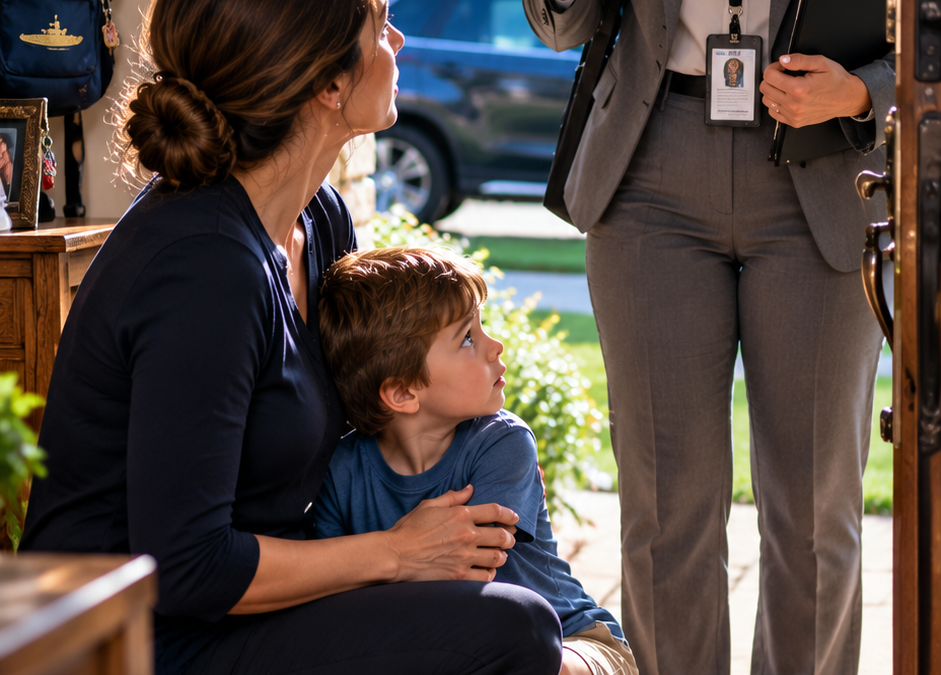
Her pen stopped.
Only for a second.
“Your position doesn’t exempt you from investigation.”
“I know,” I said. “And I expect you to follow every procedure.”
I meant it.
But I also knew something my sister apparently did not.
Evidence leaves trails.
Photographs contain dates.
Statements can be compared.
Timelines can collapse.
Lies eventually develop cracks.
Dana looked down at the folder in her hands.
“The reporting party claims to have photographic evidence.”
My stomach tightened.
“Photographs of what?”
“Injuries on your son.”
Across the room, Eli was making two plastic dinosaurs fight, completely unaware that someone had apparently been documenting every scraped knee, every playground bruise, every ordinary childhood bump.
That was when fear turned into something colder.
Someone had not reported me in a moment of anger.
Someone had been collecting evidence.
And only one person had been close enough to photograph my son without making me suspicious.
But I was about to discover that the pictures were only part of it.
Someone had also accessed private files they were never supposed to see.
And members of my own family were preparing to stand in court and help take my son away from me.
Dana spent another forty minutes in my house.
When she finally closed her folder, I asked the question I had been holding back.
“Are you removing him today?”
Eli was in the kitchen filling a plastic cup with water.
Dana lowered her voice.
“Based on what I’ve observed here, I don’t see an immediate safety concern requiring emergency removal.”
The words landed so heavily that I had to place one hand against the back of a chair.
Not relief exactly.
Not yet.
But room to breathe.
“The investigation is still open,” she continued. “I’ll need to verify childcare arrangements, medical records, school information, and several claims in the report.”
“Understood.”
“There may also be a family court petition.”
That surprised me.
“Already?”
Dana hesitated.
That hesitation told me more than her answer did.
“There has been an inquiry regarding temporary guardianship.”
I stared at her.
“By whom?”
“I’m not able to discuss details outside the proper process.”
“Monica.”
Dana did not confirm it.
She did not need to.
My sister had not merely called CPS.
She had prepared for what came afterward.
That realization followed me through the rest of the evening.
I took Eli to the park because I had promised.
For three minutes, I considered canceling. I considered locking every door, calling an attorney, emailing my commanding officer, and building a defensive file so detailed no one could breathe near it without leaving a sworn statement.
But five-year-olds understand promises better than investigations.
So at 6:15, Eli chased his red soccer ball across a patch of grass while I sat on a bench beneath an oak tree and watched him laugh whenever the ball rolled farther than he expected.
My phone buzzed seven times.
Three relatives.
My mother.
An unknown number.
My neighbor Janet.
And Monica.
I ignored everyone except Janet.
Her message said:
Saw the county vehicle earlier. Everything okay? I’m here if you need me.
I typed back:
We’re okay. I may need to ask you some questions later.
Her response came immediately.
Anytime.
Monica’s message was shorter.
Please call me. This has gone too far.
I read it three times.
The wording bothered me.
Not What happened?
Not Are you okay?
Not even I heard CPS came.
This has gone too far.
It was the kind of sentence people wrote when they knew exactly how far something had already gone.
I locked my phone.
Eli kicked the ball toward me.
“Your turn, Mommy.”
I stood.
For the next twenty minutes, I let the investigation disappear.
Not because I could forget it.
Because he deserved an evening in which adults did not make his world smaller.
That night, after Eli was asleep, I opened my laptop at the kitchen table.
Old instincts came back quickly.
Not Navy instincts exactly.
Lawyer instincts.
When an allegation arrives, you do not start by disproving everything at once. You separate the claims. Identify what can be documented. Preserve records. Reconstruct timelines. Avoid assumptions.
Especially the assumptions that feel emotionally satisfying.
I created four folders.
Childcare.
Medical.
Work Schedule.
Family Communications.
Then I started building a timeline.
For every weekday over the previous six months, I noted where Eli had been after school, who had picked him up, and where I had been working.
It was tedious.
It was also calming.
Facts had edges.
Feelings did not.
By midnight, I had confirmed something important.
There were no unexplained gaps.
Not one.
The report, according to Dana, claimed I had left Eli unsupervised repeatedly while working late.
But my command calendar showed I had not worked past six except four times since January.
On two of those evenings, Eli had been with his licensed after-school provider.
On another, Janet had watched him.
On the fourth, my mother had.
My mother.
I stopped typing.
That evening had been in March.
I remembered it because Monica had come over too.
Mom had picked Eli up from school because I was presenting a training session at the base. When I got home at seven, Monica was sitting on my couch, building a block tower with him.
She had taken pictures.
Several.
I remembered teasing her because she had photographed him wearing one green sock and one blue one.
I opened my phone and searched backward.
There.
March 12.
Three photographs Monica had texted me.
Eli holding his block tower.
Eli laughing with my mother.
And one of him sitting cross-legged on the floor with a faint bruise near his shin.
A normal kindergarten bruise.
I stared at the image.
The next morning, I requested a copy of Eli’s pediatric records.
Then I called someone I had hoped I would never need.
Commander James Wallace had been my supervising attorney years earlier, before he retired and opened a small civilian practice in Chesapeake.
He answered on the third ring.
“Rachel?”
“Good morning, sir.”
“You haven’t called me sir since I retired, which means something is wrong.”
I almost laughed.
Almost.
“I need a family law attorney.”
Silence.
Then his voice changed.
“Not you.”
“My son.”
“Tell me.”
I gave him the facts without interpretation.
He listened without interrupting.
When I finished, he said, “First, you are not representing yourself.”
“I know.”
“Good. Because every lawyer believes that until someone makes an accusation involving their child.”
“I said I know.”
“You also sound angry.”
“I’m furious.”
“Then you especially need counsel.”
He recommended a family law attorney named Priya Shah, whom he described as “the only person I know who can tell a judge they’re wrong without making them want to prove they’re right.”
By 10:30, I was sitting across from Priya in an office overlooking a parking garage.
She was small, composed, and probably in her late thirties. Her desk held almost nothing except a legal pad, two pens, and a framed photograph of three children standing on a beach.
She listened to my story.
When I mentioned Monica, she raised one finger.
“Careful.”
“With what?”
“With deciding the ending before we know the middle.”
“My sister threatened my parenting two days before CPS appeared.”
“Yes.”
“She has photographs.”
“Possibly.”
“She asked about guardianship.”
“Possibly.”
I leaned back.
“You think I’m wrong?”
“I think you might be right.”
“That sounds like the same thing.”
“It isn’t.”
She folded her hands.
“If Monica is behind every allegation, the evidence will tell us. If she isn’t, your certainty could cause you to overlook whoever is.”
That annoyed me because it was exactly what I would have told a client.
Priya must have seen it on my face.
“You hate that I’m making sense.”
“Deeply.”
“Good. We’ll work well together.”
She reviewed the timeline I had prepared.
“This is excellent.”
“I prosecute cases for a living.”
“I know. That means my second problem will be stopping you from turning Thanksgiving into cross-examination.”
“I’m not attending Thanksgiving.”
“It’s July.”
“I’m planning ahead.”
That finally made her smile.
Then she became serious again.
“Rachel, CPS cases are not criminal trials. The purpose isn’t to punish the reporter. The purpose is to determine whether Eli is safe. We stay focused on that.”
“I am focused on that.”
“You’re also focused on Monica.”
I looked toward the window.
She was right.
And I hated that too.
Two days later, Dana called.
She had verified Eli’s after-school program.
No attendance concerns.
She had spoken with Janet.
No supervision concerns.
She had requested medical information.
Nothing unusual so far.
“But,” she said, “I need to ask about a photograph dated May eighteenth.”
I sat straighter.
“What photograph?”
“It shows bruising near Eli’s upper arm.”
May eighteenth.
I searched my memory.
A Sunday.
Then I remembered.
“The trampoline park.”
“What?”
“He went to a birthday party at an indoor trampoline place the day before. He came home with a bruise on his arm because he bumped one of the padded rails.”
“Was anyone with you?”
“About fifteen parents.”
Dana was quiet.
“Can you provide names?”
“Yes.”
“Please do.”
After we hung up, I went through my photographs.
May seventeenth.
Birthday cake.
Foam pits.
Children wearing orange wristbands.
There was Eli beside his friend Noah, both grinning.
And there, just visible beneath the sleeve of his T-shirt, was the beginning of the bruise.
May eighteenth, the day of the photograph Dana possessed, had been a family dinner at my mother’s house.
Monica had been there.
So had my younger brother Daniel.
His wife, Leah.
My cousin Christine.
And my mother.
Suddenly Priya’s warning felt less theoretical.
Monica was not the only person who had access.
The first family call came Thursday night.
My mother.
I nearly let it go to voicemail.
Then I answered.
“Hello.”
“Rachel.”
Mom sounded exhausted.
“Hi, Mom.”
“I didn’t know they were actually going to your house.”
My fingers tightened around the phone.
“They?”
A pause.
“Monica said she had spoken to someone because she was worried.”
Of course.
“What exactly did Monica tell you?”
“That you were overwhelmed. Working too much. That Eli was having accidents.”
“What accidents?”
“She said bruises.”
“He’s five.”
“I know.”
“Do you?”
“Rachel.”
“No. I’m asking.”
She took a breath.
“I know children get bruises.”
“Then why didn’t you call me?”
“I should have.”
The answer came so quickly it took some of the anger out of me.
Mom continued.
“Monica said you would deny everything because you’re trained to argue.”
“That sounds like Monica.”
“She also said she had seen things.”
“What things?”
“She was vague.”
“Yet everyone believed her?”
“Not everyone.”
There was something strange in the way she said it.
“Who didn’t?”
“Daniel.”
I closed my eyes.
My brother and I were not estranged, but we were not close either. Eight years younger than Monica and four years younger than me, Daniel had spent most of our childhood trying not to stand between us.
“What did he say?”
“That Monica was making assumptions.”
“Did he know she was calling CPS?”
“I don’t think so.”
“Did you?”
Another pause.
“Yes.”
That hurt more than I expected.
“You knew.”
“She said she was asking for guidance.”
“And you didn’t tell me.”
“I was afraid you’d cut her off completely.”
“So instead you let her report me.”
“I didn’t understand how serious it would become.”
I stood and walked to the kitchen window.
Outside, Janet was watering her hydrangeas.
The ordinary world continued.
“Mom, she’s trying to become Eli’s guardian.”
“I know that now.”
“You know that now.”
“I’m sorry.”
I wanted to say something sharp.
Something accurate enough to wound.
Instead, I heard Priya’s voice.
Don’t decide the ending before we know the middle.
“What exactly did you give Monica?”
“Give her?”
“Pictures. Records. Information.”
“Nothing.”
“You’re sure?”
“Yes.”
I believed her.
Not because I wanted to.
Because my mother was a terrible liar. She filled silence when nervous, overexplained details, and changed subjects too quickly.
Now she sounded ashamed, but not deceptive.
“Did anyone else give her anything?”
“I don’t know.”
Then Mom said, very quietly, “Rachel, there’s something you should ask Daniel.”
“What?”
“About your father’s old laptop.”
I frowned.
Dad had died three years earlier.
“What does Dad’s laptop have to do with this?”
“I don’t know. Maybe nothing.”
“Mom.”
“After he died, Daniel took it because there were family photographs on it. Your father used to back up everyone’s files. Remember?”
I did.
My father had been the family archivist. Tax returns, graduation pictures, scanned school certificates, Christmas videos—he saved everything.
“What am I supposed to ask Daniel?”
“Ask him whether Monica ever borrowed it.”
I called my brother at 9:18 that night.
He answered with, “I’ve been wondering when you’d call.”
“So you know.”
“I know CPS came.”
“Mom told you?”
“No. Monica did.”
That stopped me.
“When?”
“Yesterday.”
“What did she say?”
“That things had gotten out of hand.”
There was that phrase again.
“Daniel, did Monica borrow Dad’s laptop?”
Silence.
Not long.
Two seconds, maybe three.
Long enough.
“Why are you asking?”
“Because Mom told me to.”
He exhaled.
“Yes.”
“When?”
“A few months ago.”
“How many?”
“February, I think.”
“Why?”
“She said she wanted old family photos for a scrapbook for Mom.”
“How long did she have it?”
“A weekend.”
I sat down.
“What was on it?”
“Mostly Dad’s files.”
“Anything of mine?”
“Probably.”
“Probably?”
“Rachel, Dad backed up everything.”
I felt cold despite the summer heat.
Years earlier, when my husband Mark died, my father had helped me manage paperwork because I could barely look at half of it without falling apart.
Insurance.
Military forms.
Childcare plans.
Emergency contacts.
My Navy family care plan.
Medical releases.
Travel records.
Copies of identification.
Documents containing details no casual visitor to my home would ever see.
“Did Dad have copies of my family care plan?”
Daniel did not answer immediately.
“I think so.”
I closed my eyes.
A family care plan was not evidence that someone was an unfit parent. Military members with dependents routinely prepared them precisely because responsible planning mattered.
But stripped of context?
A list of alternate caregivers.
Deployment contingencies.
Emergency arrangements.
Someone could make ordinary planning look like instability.
“Daniel, I need the laptop.”
“Okay.”
“Tonight.”
“It’s at my office.”
“Tomorrow morning, then.”
“Rachel…”
“What?”
“I need to tell you something else.”
I waited.
“When Monica returned it, I noticed Dad’s external drive wasn’t in the case.”
I felt my heartbeat slow.
Not race.
Slow.
“What did she say?”
“That she hadn’t seen it.”
“And you believed her?”
“At the time.”
“What was on the drive?”
“Backups.”
“All of them?”
“Rachel, I don’t know.”
I wanted to stand up, pace, demand answers.
Instead, I wrote down the words external drive missing.
“When did you notice?”
“The Monday after she returned the laptop.”
“Did you ask anyone else?”
“Mom. Leah. Monica. Nobody knew.”
“Why didn’t you tell me?”
“Because I didn’t know your files were relevant to anything.”
He sounded defensive now.
Then softer.
“And because every conversation involving you and Monica turns into a trial where everyone has to pick a side.”
The sentence landed hard because it was not entirely unfair.
I looked at the dark reflection of myself in the window.
“When did that start happening?” I asked.
Daniel gave a tired laugh.
“When we were twelve?”
“I was sixteen when you were twelve.”
“Exactly.”
Despite everything, I smiled.
Only slightly.
The next morning, Daniel brought Dad’s laptop to Priya’s office.
He looked older than I remembered.
Not physically.
Tired around the eyes.
Leah had come with him, though she stayed mostly quiet.
Priya had arranged for a digital forensic consultant to make a copy of the drive before anyone opened files.
“We preserve first,” she said.
I nodded.
Daniel glanced at me.
“You two are terrifyingly similar.”
Priya looked pleased.
I did not.
While the consultant worked, Leah asked if she could speak with me in the hallway.
She was a middle-school librarian, gentle in the way some people are without being fragile.
“I should have called you earlier,” she said.
“Why didn’t you?”
“Because I didn’t know what was true.”
“That seems to be everyone’s answer.”
“I know.”
She looked down.
“Monica called me in April.”
“About Eli?”
“About you.”
“What did she ask?”
“Whether I thought you were happy.”
The question caught me off guard.
“Happy?”
“She said you seemed… rigid since Mark died.”
I swallowed.
Mark had been gone four years.
Some days that felt like a lifetime.
Some days it felt like I had watched him leave for work yesterday.
“What did you say?”
“That I thought you were doing the best you could.”
“And?”
“She asked whether the Navy was keeping you from moving on.”
I looked at Leah carefully.
“That doesn’t sound like a CPS allegation.”
“No.”
“What else?”
“She asked whether I thought Eli needed more family around.”
“Meaning Monica.”
“I think so.”
I folded my arms.
“Why?”
Leah’s expression changed.
There it was.
Something she did not know how to say.
“Monica has been having a difficult year.”
“So have millions of people.”
“I know.”
“What kind of difficult?”
“She and Peter have been trying to have another child.”
I stared at her.
Monica had a seventeen-year-old stepdaughter, Sophie, from Peter’s first marriage. I knew they had talked about having a baby years ago, but Monica stopped mentioning it.
Leah continued carefully.
“They went through several treatments.”
I felt some of my anger lose its shape.
Not disappear.
Change.
“She didn’t tell me.”
“She didn’t tell many people.”
“That explains why she’s hurting. It doesn’t explain this.”
“No.”
Leah met my eyes.
“But I think she started telling herself that Eli needed her because she needed to feel needed.”
The hallway suddenly seemed too quiet.
“That’s not concern.”
“I didn’t say it was.”
We stood there for a moment.
Then Leah said something I would remember later.
“People don’t always lie because they know they’re lying, Rachel. Sometimes they repeat a fear until it feels like a fact.”
The laptop yielded less than I expected.
And more.
The forensic consultant found that several folders had been accessed during the weekend Monica possessed it.
Old tax files.
Family photographs.
My father’s scanned documents.
And one folder containing backup copies of my Navy family care documents from three years earlier.
That was concerning.
But not proof.
Nothing showed that Monica had copied them.
The missing external drive remained missing.
Priya leaned back in her chair.
“We need discovery.”
The temporary guardianship hearing was scheduled for the following Tuesday.
I read the petition Sunday night.
Then I read it again.
Monica was requesting temporary placement only if the court found that my work obligations created “unpredictable and unsafe periods of supervision.”
She did not accuse me of intentionally harming Eli.
That almost made it worse.
The filing was written to sound reasonable.
Concerned.
Reluctant.
She claimed she was acting only because “other family members had expressed similar observations.”
Attached were statements.
My mother had not submitted one.
Daniel had not.
Leah had not.
But my aunt Carol had.
So had my cousin Christine.
And one person I did not expect.
Janet.
My neighbor.
I stared at her name.
Then called Priya.
“Janet submitted a statement.”
“I saw.”
“She watches Eli.”
“I know.”
“She told CPS she had no concerns.”
“She did.”
“Then what is this?”
“Read the language carefully.”
I did.
Janet’s statement said:
On some afternoons, I have cared for Eli Bennett when Commander Bennett’s professional duties prevented her from arriving at her expected time. Commander Bennett has always contacted me in advance or as soon as practicable.
“That supports me.”
“Yes.”
“Then why is it attached?”
“Because the petition uses it to show your work schedule is unpredictable.”
I felt a headache beginning behind my eyes.
“They took a supportive statement and changed the implication.”
“Exactly.”
“Is that legal?”
“Selective? Yes. Persuasive? We’ll see.”
I wanted to call Monica.
Priya told me not to.
So naturally, Monica called me.
I watched her name glow on my screen for several seconds before answering.
“What?”
“Rachel.”
“Why are you petitioning for guardianship?”
A long silence.
“I didn’t want it to get this far.”
“Stop saying that.”
“What?”
“That it went too far as though it walked there by itself.”
“I was worried.”
“You filed papers asking a judge to consider taking my son out of my home.”
“Temporarily.”
“He is not luggage, Monica.”
“I know that.”
“Do you?”
Her voice cracked slightly.
It was subtle.
I almost missed it.
“I thought you needed help.”
“Then why didn’t you offer help?”
“I did.”
“When?”
“All the time.”
“You criticized my job.”
“You work constantly.”
“I work normal hours.”
“You answer emails at dinner.”
“So do you.”
“That’s different.”
“How?”
She did not answer.
I stood near the kitchen counter, staring at Eli’s drawing taped to the refrigerator.
Three stick figures.
Me.
Him.
A figure with wings labeled DAD.
He still drew Mark into family pictures sometimes.
I never corrected him.
“Where did you get my records?” I asked.
“What records?”
“My family care plan.”
Another silence.
This one was different.
Not surprise.
Calculation.
“Dad had copies.”
“So you saw them.”
“I saw old documents.”
“Did you copy them?”
“No.”
“Did you take Dad’s external drive?”
“No.”
“Did you give any of those files to someone else?”
“No.”
She answered too quickly.
My instincts sharpened.
“Who helped you prepare the petition?”
“A lawyer.”
“Who gave your lawyer documents from my private files?”
“I don’t know what you’re talking about.”
“Monica.”
“I’m telling you the truth.”
“You’ve spent months telling people I’m unstable.”
“I never said unstable.”
“What did you say?”
“That you don’t let people help you.”
“That’s not neglect.”
“I know.”
“Do you?”
Her breathing came unevenly over the line.
Then she said, “You disappeared after Mark died.”
The sentence hit me in a place I had spent four years avoiding.
“I was grieving.”
“You were functioning.”
“I had a child.”
“You were functioning,” she repeated. “You made lists. You handled paperwork. You went back to work. You smiled at Mom. You told everyone you were fine.”
“What did you want me to do?”
“I wanted you to need us.”
There it was.
Not hatred.
Something more complicated.
I sat down.
“You wanted me to fall apart?”
“No.”
“That’s what it sounds like.”
“I wanted to be your sister.”
“You were my sister.”
“No. I was someone you scheduled.”
The words stung because they contained enough truth to be dangerous.
After Mark died, I had controlled everything I could.
Bedtime.
Meals.
Childcare.
Work.
Grief had no schedule, so I scheduled everything around it.
Monica had tried to stay over.
I told her no.
She offered to take Eli for weekends.
I rarely accepted.
She asked me to talk.
I said I was tired.
Somewhere along the way, my refusal to be rescued had become, in her mind, evidence that something was wrong.
But that still did not excuse what she had done.
“You should have talked to me.”
“I tried.”
“No. You judged me.”
“I was scared.”
“Of what?”
“That one day you would finally break and Eli would be the one standing there when it happened.”
My eyes burned.
I did not cry.
“Did you report me?”
She whispered, “Yes.”
The truth did not feel satisfying.
“Did you include the allegations about leaving him alone?”
“I said I worried he might sometimes be alone.”
“Had you ever seen him alone?”
“No.”
“Then why say it?”
“Because Aunt Carol said—”
I closed my eyes.
“Aunt Carol.”
“She said she’d driven past your house once and seen Eli through the window when your car wasn’t there.”
My mind moved quickly.
“When?”
“I don’t know.”
“Month?”
“Spring.”
There were dozens of explanations.
Janet sometimes watched him at my house.
My mother did too.
But instead of asking, Monica had treated inference as evidence.
“And the bruises?”
“I sent pictures.”
“Normal childhood bruises.”
“I didn’t know.”
“You could have asked.”
“You always have an answer.”
“Because there usually is one.”
Silence.
Then I asked the question that mattered.
“Did you take Dad’s external drive?”
“No.”
This time she sounded offended.
Almost hurt.
“I did not take it.”
“Then who did?”
“I don’t know.”
We ended the call without saying goodbye.
The hearing took place Tuesday morning in a small family courtroom in Norfolk.
I wore a gray suit instead of my uniform.
That decision was deliberate.
I was not there as Commander Bennett.
I was there as Eli’s mother.
Monica sat across the aisle beside her attorney.
She looked tired.
Not triumphant.
For reasons I could not explain, that unsettled me more.
My mother sat behind me.
Daniel and Leah sat beside her.
Aunt Carol sat behind Monica.
Judge Elaine Merritt had the practical expression of someone who had spent twenty years listening to families describe each other badly.
Priya presented our evidence calmly.
School attendance.
Childcare records.
Medical records.
My command schedule.
Dana’s preliminary home assessment.
There was no finding of immediate danger.
No pattern of unexplained injury.
No verified instance of Eli being left alone.
Monica’s attorney emphasized concern rather than accusation. He argued that the family had observed increasing isolation and that my military responsibilities could create sudden childcare problems.
Then Judge Merritt asked Monica a simple question.
“Ms. Bennett-Hale, have you personally observed your nephew unattended?”
Monica looked at me.
“No, Your Honor.”
“Have you personally observed your sister fail to provide food, shelter, medical care, or appropriate childcare?”
“No.”
“Have you observed physical mistreatment?”
“No.”
Her attorney shifted slightly.
The judge continued.
“Then your concerns are primarily anticipatory?”
Monica swallowed.
“Yes.”
“Based on what?”
“My sister does not ask for help.”
Judge Merritt leaned back.
“That is not, by itself, a basis for guardianship.”
Something moved through the room.
Not victory.
Release.
Temporary guardianship was denied.
The CPS investigation remained open pending final review, but Dana told Priya afterward that she expected to complete it soon unless new evidence emerged.
Outside the courthouse, Mom tried to hug me.
I stepped back.
Not dramatically.
Just enough.
“I can’t yet.”
Her face crumpled.
“I understand.”
Monica walked past us.
For one second, I thought she would stop.
She did not.
Aunt Carol followed her.
Then Daniel came down the steps with his phone in his hand.
“Rachel.”
Something in his face stopped me.
“What?”
“I got a call from my office.”
“So?”
“Dad’s external drive.”
My pulse quickened.
“They found it?”
He nodded.
“Where?”
“In a box of files I took from Mom’s garage after Dad died. One of my assistants was looking for archived tax records.”
I stared at him.
“So Monica never had it.”
“Apparently not.”
I looked toward the parking lot where my sister had just disappeared between two rows of cars.
For nearly a week, that missing drive had sat in my mind like proof.
Proof that she had gone farther than she admitted.
Proof that she had stolen private information.
Proof that every suspicion I had about her was correct.
Except it wasn’t.
“Bring it to Priya,” I said.
Daniel hesitated.
“There’s more.”
Of course there was.
“What?”
“My assistant plugged it in before calling me.”
“You told them not to—”
“I know. She thought it was a normal office backup.”
I waited.
Daniel looked down at his phone.
“There’s a folder on it named after you.”
“That’s not surprising.”
“No.”
He looked at me again.
“The surprising part is when the folder was last modified.”
I felt the air shift.
“When?”
“Three weeks ago.”
I stared at him.
“That’s impossible.”
“I know.”
“Dad has been dead three years.”
“I know.”
“The drive was in your office storage.”
“Yes.”
“Who has access?”
Daniel did not answer.
He did not need to.
He ran a small accounting firm.
Employees had access.
His wife occasionally came by.
Family members sometimes stopped in.
But one person had worked there part-time during tax season.
One person I had forgotten completely because she was family, because she was quiet, and because everyone had been looking at Monica.
Daniel’s seventeen-year-old step-niece by marriage.
Sophie.
Monica’s stepdaughter.
I looked at him.
“No.”
“I’m not saying she did anything.”
“She’s a kid.”
“She’s seventeen.”
“She loves Eli.”
“I know.”
“Why would she access my files?”
“I don’t know.”
Then Daniel said the thing that sent a chill of uncertainty through me—not fear, but the realization that we had been asking the wrong question from the beginning.
“The modified folder isn’t called Rachel anymore.”
“What is it called?”
He turned the phone so I could see the photograph his assistant had sent.
The folder name was simple.
SOPHIE.
I stared at the screen until the letters blurred.
Sophie.
Monica’s stepdaughter.
The girl who had once sat cross-legged in my living room teaching Eli how to make paper frogs. The teenager who bought him dinosaur stickers with her babysitting money. The quiet one who stood at family gatherings with earbuds in, watching adults injure each other politely.
“Sophie renamed it?” I asked.
“That’s what it looks like.”
“Where is she?”
“At school, I think.”
“Does Monica know?”
“I don’t know.”
Priya, who had been speaking with Dana near the courthouse steps, saw my face and crossed over immediately.
“What happened?”
Daniel explained.
Priya’s expression changed, but only slightly.
“Do not call Sophie yourself.”
“She’s seventeen.”
“She may be a witness. She may also be frightened. We handle this carefully.”
I hated how often she was right.
The external drive went directly to the forensic consultant. By that evening, we had a preliminary report.
Someone had accessed the drive from Daniel’s office computer three weeks earlier.
The user login belonged to Sophie Hale.
The folder once labeled RACHEL had been copied, partially reorganized, and renamed SOPHIE. Inside were subfolders.
ELI.
NAVY PLAN.
PHOTOS.
NOTES.
The files were not deleted.
Not hidden.
Not encrypted.
Whoever had done it had not behaved like a criminal mastermind.
They had behaved like someone trying to understand a mess with the tools available.
Inside the NOTES folder was a document titled:
WHAT MONICA ASKED FOR.
I read it in Priya’s office with both hands flat on the table.
There were bullet points.
Aunt Monica says Rachel’s work makes Eli unsafe.
Find schedule proof.
Find emergency plan.
Find who gets Eli if Rachel deploys.
Find photos showing bruises.
Find anything that shows Rachel cannot handle him alone.
Below that, another note.
But Eli seems happy.
Then another.
Family care plan is not bad? It says normal Navy requirement.
Then another.
Aunt Monica cried again. Says Rachel will hate her but Eli will thank her later.
Then the final line.
I don’t know what to do.
For a long time, nobody spoke.
I felt anger.
At Monica.
At Aunt Carol.
At everyone who had turned a grieving widow and her child into a problem to solve.
But beneath that was something worse.
Sophie had known enough to doubt.
Not enough to stop.
Priya closed the folder.
“This helps explain where some of the petition language came from.”
“She gave Monica the files?”
“Possibly.”
“Possibly?”
“We need to ask her.”
The next morning, Monica called me before I had finished making Eli’s breakfast.
I almost did not answer.
Then I did, because the shape of the case had changed again and avoiding her would not protect anyone.
“Rachel,” she said.
Her voice sounded wrong.
“What happened?”
“Is Sophie with you?”
“No.”
“She left before breakfast. Peter thought she went to school, but the school called. She never arrived.”
I closed my eyes.
“Monica.”
“I know.”
“Did you ask her for files from Dad’s drive?”
Silence.
That was answer enough.
“Did you?”
“I asked her to look for family photos at Daniel’s office.”
“That’s not what I asked.”
“I didn’t tell her to do anything illegal.”
“She’s seventeen. You made her your investigator.”
“I didn’t mean—”
“Stop.”
Eli walked into the kitchen holding two cereal bowls stacked inside each other.
“Mommy, can I have the astronaut spoon?”
I forced my voice steady.
“In the drawer, sweetheart.”
Monica heard him.
Her breathing broke.
“Rachel, I swear I thought I was helping.”
“No,” I said quietly. “You thought you were right.”
She started crying.
I hung up.
Sophie was found two hours later at a public library near Daniel’s office.
Not by police.
By Leah.
Of all people.
Leah had guessed where a frightened bookish teenager might hide with free Wi-Fi and vending-machine pretzels.
Sophie agreed to speak with Priya, her father Peter, and a guardian ad litem assigned after the court learned a minor had been pulled into the evidence trail. Monica was not in the room. Neither was I.
That was best.
I knew it.
I hated it.
Later, Priya summarized what Sophie said.
Monica had been talking about Eli for months.
At first, it sounded like concern.
Rachel works too much.
Rachel won’t accept help.
Rachel is too controlled.
Eli needs more family.
Then Monica began asking Sophie to help organize “family materials.” Photos from old gatherings. Copies of childcare documents. Anything from Dad’s backup drive that might show my schedule was unpredictable.
Sophie did not understand family care plans. Monica told her they were proof that I expected other people to raise Eli.
Sophie believed her at first.
Then she started reading.
That was when doubt began.
She saw that the plan named emergency caregivers in order.
My mother.
Daniel and Leah.
Janet.
Monica appeared only as a temporary contact for short-term situations because she had once asked me to include her.
Sophie saw attendance records.
Medical forms.
Scanned birthday cards from Eli to Mark after he died.
She saw a household that looked less like neglect and more like a mother trying very hard not to drop anything.
So she renamed the folder after herself, intending to make a copy and ask someone what it meant.
But then Monica found the notes.
They argued.
Sophie told her she was twisting things.
Monica said Sophie did not understand motherhood.
Sophie said, “Neither do you.”
That was when the argument became something neither of them could take back.
Monica filed the petition anyway.
Sophie panicked.
She did not tell Daniel.
She did not tell Peter.
She did not tell me.
Because teenagers often understand right and wrong before they understand what to do when adults make both feel dangerous.
Two days later, CPS closed the investigation as unfounded.
Dana called me herself.
“There are no substantiated findings of neglect or abuse,” she said.
I sat on the edge of my bed, one hand pressed against my forehead.
“Thank you.”
“I know this process has been difficult.”
Difficult.
Such a small word.
“Yes.”
She paused.
“For what it’s worth, Commander Bennett, Eli is clearly loved and cared for.”
My throat closed.
“Thank you.”
After the call, I walked into Eli’s room.
He was building a tower with magnetic tiles. It leaned badly to one side.
“Mommy, look. It’s a rocket castle.”
“I see that.”
“Is the lady done asking questions?”
I sat beside him on the floor.
“Yes.”
“Did we tell the truth good?”
I pulled him gently into my lap.
“We told the truth very well.”
“Can we go to the park now?”
I laughed into his hair.
“Yes,” I said. “We can go to the park.”
The family fallout took longer.
Of course it did.
Court orders can deny petitions.
Agencies can close investigations.
But families do not end because a judge bangs a gavel or a caseworker checks a box.
Monica came to my house one week later.
I did not let her inside.
We stood on the porch in the same heavy Virginia heat, the cicadas screaming in the trees and Eli’s red soccer ball visible behind me in the entryway.
She looked thinner.
Or maybe simply less certain.
“I’m sorry,” she said.
I had imagined those words for days.
Sometimes I imagined slamming the door.
Sometimes I imagined giving a speech so precise and devastating that she would feel every hour of fear she had caused me.
But when she stood in front of me, crying without asking to be comforted, I did not feel triumphant.
I felt tired.
“You tried to take my son,” I said.
Her face crumpled.
“I thought I was protecting him.”
“No. You were trying to quiet your own fear by controlling my life.”
She looked down.
“I know that now.”
“Do you?”
She nodded, but I was not sure she did.
Not fully.
Maybe she would someday.
Maybe she would not.
“You used Sophie.”
That hurt her more than anything else.
“I know.”
“She is a child.”
“She’s seventeen.”
“She is a child,” I repeated.
Monica covered her mouth.
I let the silence sit there.
For once, I did not rescue her from it.
“I wanted a baby,” she whispered.
“I know.”
“No. You don’t. I wanted one so badly I started seeing empty space everywhere. In our house. In my marriage. In myself.”
My anger did not disappear.
But it changed shape again.
Grief recognized grief even when it hated what grief had done.
“I’m sorry for that,” I said. “I am. But Eli is not empty space.”
“I know.”
“You don’t get to fill your life with my child.”
“I know.”
“You don’t get to call fear love just because it hurts.”
She cried harder.
I stepped back from the door.
Not inviting her in.
Creating distance.
“I need you to listen carefully.”
She wiped her face.
“For now, you will not see Eli.”
Her shoulders shook once.
“You will not contact his school. You will not contact his childcare provider. You will not contact CPS about me unless there is an actual emergency you have personally witnessed.”
She nodded.
“You will write Sophie a letter. Not an explanation. An apology. You will tell her you put her in an adult situation because you wanted support for something you knew was not clean.”
“I will.”
“You will also tell Mom, Aunt Carol, Christine, and everyone else exactly what the court found. Not your version. The finding.”
“Yes.”
“And Monica?”
She looked at me.
“If you ever try to build a case around my son again, I will not handle you like family.”
For the first time, she seemed to understand that my calm had never been weakness.
It was discipline.
She left without asking to see Eli.
That was the first right thing she had done in weeks.
Sophie came two days later with Peter.
She stood on my porch wearing ripped jeans and a gray hoodie despite the summer heat. Her face was pale, her eyes red.
“I’m sorry,” she said before I could speak.
Peter stood behind her, devastated in the helpless way of parents whose child has been harmed partly by another adult they loved.
I looked at Sophie.
“Do you understand what happened?”
She nodded.
“I gave Aunt Monica things she used against you.”
“You accessed private documents.”
“Yes.”
“You did not come to me.”
Her eyes filled.
“I thought you’d hate me.”
“I’m angry,” I said. “That’s not the same thing.”
She wiped her face with her sleeve.
“I knew Eli wasn’t neglected. I knew it. I should have said something.”
“Yes.”
The word was sharp.
But it was true.
She flinched.
Peter started to speak.
I raised one hand.
He stopped.
Sophie looked at the floor.
“I thought if I could figure out the documents, I could prove Aunt Monica was wrong without betraying her.”
“That was too much for you to carry.”
“I know.”
“An adult should have told you that.”
She cried then.
Not loudly.
Just enough that the teenager vanished and the child underneath showed through.
I softened.
Not all the way.
But enough.
“You are not responsible for Monica’s choices,” I said. “But you are responsible for yours.”
She nodded quickly.
“I know.”
“You can apologize to Eli when he’s older, if I decide he needs to know.”
“Okay.”
“For now, he knows there was a family argument and adults handled it badly.”
Her mouth trembled.
“That’s true.”
“Yes,” I said. “It is.”
Before she left, she handed me a small envelope.
Inside was a drawing Eli had made months earlier at her house. A stick figure, a dinosaur, and a crooked heart.
“I kept it on my mirror,” she said. “I didn’t want Aunt Monica to use it in anything.”
That almost broke me.
I took it.
“Thank you.”
That was the beginning of repair.
Not forgiveness.
Not trust.
Beginning.
My mother spent the next month apologizing in ways that were sometimes helpful and sometimes exhausting.
She admitted she had known Monica was “asking questions.” She admitted she had allowed her own worry about me after Mark’s death to become suspicion. She admitted she had been relieved when someone else acted because it meant she did not have to confront me.
That last one mattered.
It hurt.
But it mattered.
Daniel delivered Dad’s external drive personally after the forensic review ended.
He stood in my kitchen while Eli colored at the table.
“I should have tracked it better,” he said.
“Yes.”
“I should have told you when it went missing.”
“Yes.”
He looked at me.
“You’re very direct.”
“I’ve had a month.”
He gave a small smile.
Then he looked at Eli.
“Hey, buddy.”
Eli held up a blue crayon.
“I’m drawing Jupiter, but Mommy says it needs a storm.”
Daniel looked at me.
“We still have a space phase?”
“We still have a space phase,” I said.
His expression softened.
“I missed a lot.”
“You’re here now.”
That was all I could offer.
It was enough for that day.
Aunt Carol did not apologize.
She sent a message through my mother saying she had “acted out of concern” and hoped I would “one day appreciate how much family cared.”
I blocked her number.
Concern without humility was just control wearing nicer shoes.
Three months later, Eli started first grade.
On the first morning, he insisted on wearing a shirt with planets on it and carrying the same red soccer ball in his backpack even though I explained backpacks were not sports equipment.
He said, “It’s for emotional support.”
I said, “You are six, not a retired admiral.”
He said, “Can retired admirals bring soccer balls?”
I said, “Probably if they outrank everyone.”
He seemed satisfied.
At drop-off, he hugged me hard.
Then ran toward the classroom.
I stood there longer than necessary, watching him disappear among children with lunchboxes and too-big backpacks.
The school counselor, who knew just enough about the investigation to be gentle, came beside me.
“He looks happy.”
“He is.”
“And you?”
I watched Eli turn back once and wave.
“I’m getting there.”
That was true.
The investigation had changed me.
Not because Monica had been right.
She had not been.
But because the fear of losing Eli had forced me to face the way I had treated grief like a logistics problem.
After Mark died, I made the house run.
I never missed a pediatric appointment.
Never forgot a school form.
Never let the refrigerator go empty.
Never let Eli wonder who would pick him up.
I built safety out of calendars and backup plans and emergency contacts because my husband had died on an ordinary morning after kissing our son goodbye.
The world had taught me that love could leave without warning.
So I tried to make sure nothing else could.
Monica saw control and called it danger.
She was wrong.
But she had not imagined the control.
That was the part I had to sit with.
I started therapy in September.
I hated it for the first three sessions.
By the fourth, I hated it less.
By the fifth, I admitted out loud that I was tired.
Not failing.
Not unstable.
Tired.
There is a difference.
One Sunday afternoon in October, Eli and I went to the park with his red soccer ball.
The same park.
The same oak tree.
The air was cooler now, and dry leaves gathered near the sidewalk.
He kicked the ball too hard, and it rolled toward the bench where I had sat months earlier while my phone filled with messages I could not answer.
He chased it, laughing.
I watched him.
For a moment, I remembered Dana at my door.
Eli asking if we were still going to the park.
My hands smoothing my slacks.
The cold realization that someone had been building a case against me from normal childhood bruises and stolen context.
Then Eli turned and shouted, “Mommy, your turn!”
I stood.
And this time, nothing followed me from the bench.
No phone buzzing.
No timeline forming in my head.
No courtroom, no petition, no folder named Sophie, no photographs weaponized into suspicion.
Just my son.
The grass.
The ball.
The ordinary world, returned.
I kicked it badly.
Eli laughed so hard he fell down.
“Mommy, you’re terrible!”
“I’m a lawyer, not a soccer player.”
“That’s not an excuse.”
“It absolutely is.”
He ran toward the ball again.
I watched him, and for the first time in months, the fear in my chest did not tell me to prepare for impact.
It simply passed through.
Like weather.
Later that night, after Eli fell asleep, I sat at the kitchen table and opened the last folder on my laptop.
Family Communications.
I moved every document connected to the investigation into an archive.
Not deleted.
Never deleted.
I was still me.
But archived.
Then I opened a blank document and typed one sentence.
Eli is safe.
I looked at it for a long time.
Then I added another.
So am I.
The case against me had been built from fear, grief, jealousy, and pieces of truth broken off from their context.
It had almost worked because lies do not always arrive looking like lies.
Sometimes they arrive as concern.
As family.
As photographs.
As people saying they only want to help.
But I had learned long before CPS came to my door that truth survives best when someone is willing to preserve it carefully.
So I preserved everything.
The schedules.
The records.
The messages.
The ordinary explanations for ordinary bruises.
The proof that planning was not neglect.
The proof that needing help and being unfit were not the same thing.
And when the people who thought my discipline made me cold finally saw what discipline could protect, the case they built began to fall apart.
Not all at once.
Piece by piece.
A statement.
A timestamp.
A folder name.
A teenager’s note.
A judge’s question.
A caseworker’s final finding.
My sister had tried to make the world see me as a danger to my child.
Instead, she revealed something else.
That I was not alone because I was incapable of love.
I was guarded because I had already lost enough.
And guarding my son was not a crime.
It was motherhood.
One week later, Eli brought home a drawing from school.
Three stick figures again.
Me.
Him.
Mark with wings.
But this time, there was a fourth thing above us.
A row of crooked yellow stars.
“What’s that?” I asked.
“Space,” he said, as if I should have known.
“Of course.”
He taped it to the refrigerator himself.
Right beneath the submarine magnet holding his calendar.
Then he stepped back, studied it seriously, and said, “Now it looks right.”
I looked at our little family on the paper.
Incomplete.
Changed.
Still standing.
“Yes,” I said softly. “It does.”








