𝗙𝗨𝗟𝗟 𝗦𝗧𝗢𝗥𝗬 The Captain’s Final Words Awakened the Woman the Air Force Tried to Erase
𝗣𝗔𝗥𝗧 𝟮
I looked at him.
The truth would have been cruel.
So would a lie.
“I can try.”
Linda reached the cockpit door first, keyed in the emergency access, and shouted through the interphone. The door unlocked.
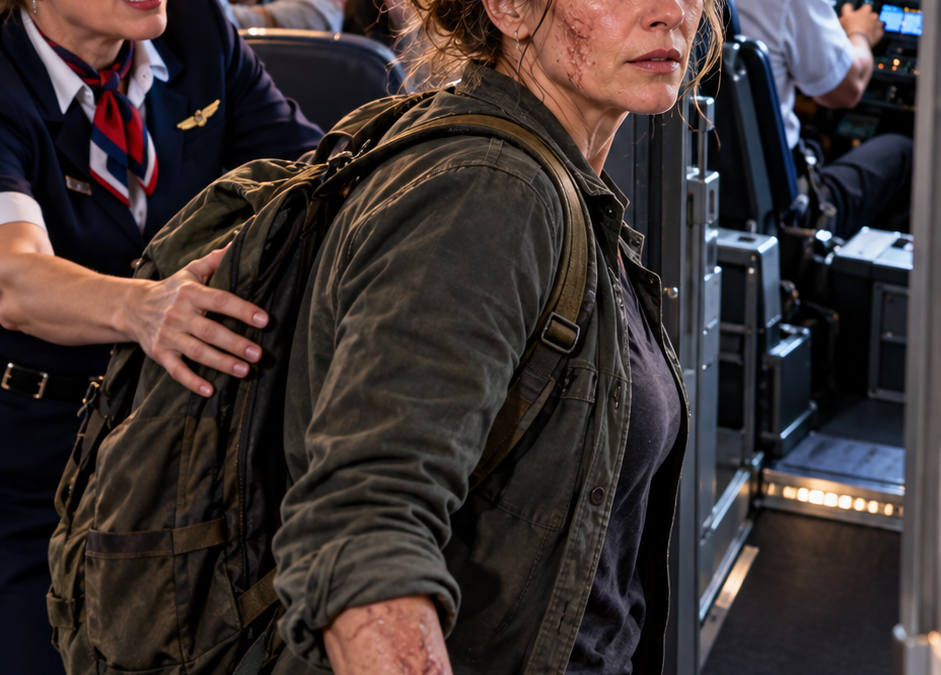
I wrapped my scarred hand around the handle and pulled it open.
The cockpit door resisted the pressure of the bank, and for half a second neither pilot looked at me.
Captain Thomas Reed had both hands locked around the yoke, his shoulders rigid with effort even though the controls were giving him almost nothing back. First Officer Jennifer Parker was bent over the center console, moving through switches and checklists with the disciplined speed of someone who had not yet allowed herself to accept what the instruments were telling her.
Warning lights glowed across the panel.
Outside the windshield, the horizon was tilted so badly that sky filled one side and earth filled the other.
I had not stood inside a cockpit in thirty-two years.
Yet my body remembered before my mind did.
The smell of warm electronics.
The clipped rhythm of radio calls.
The vibration through the floor.
The peculiar silence between trained people when every ordinary solution has already failed.
Captain Reed glanced over his shoulder.
“Who are you?”
“Sarah Mitchell.”
“That doesn’t answer my question.”
“I flew test aircraft at Edwards. Total hydraulic-loss evaluations. Differential-thrust control.”
Jennifer looked up sharply.
“Military?”
“Air Force.”
“What aircraft?”
“More than one.”
Reed’s expression hardened.
“This is a 737.”
“I know.”
“We’ve lost primary flight controls.”
“I heard.”
“We have no useful response from the yoke.”
“I can see that.”
“And you think you can help?”
I looked at the attitude indicator.
Forty-one degrees of right bank.
Slow nose-down trend.
Engine power nearly symmetrical.
The airplane was still flying.
That mattered.
“As long as the engines answer,” I said, “you still have something.”
Jennifer stared at me for one second.
Then training overcame disbelief.
“Differential thrust.”
“Yes.”
“We would need to arrest the bank without overcorrecting.”
“Yes.”
Reed shook his head.
“You can’t fly a passenger jet with throttles.”
“Not normally.”
“This isn’t a simulator.”
“No.”
His eyes met mine.
There was fear in them, but not panic. Fear was normal. Anyone who said otherwise had never carried nearly two hundred souls while an aircraft slowly stopped obeying.
“What exactly are you proposing?” he asked.
“Stop trying to make the airplane behave like it still has normal controls. Treat the engines as crude control surfaces. Reduce power on the left, increase it on the right to counter the right bank. Small changes. Wait for the response. Do not chase it.”
Jennifer was already looking at the engine instruments.
“Captain?”
Reed hesitated.
The bank crept another degree.
“Do it,” he said.
Jennifer’s hands moved carefully.
Not dramatically.
A slight reduction on one side.
A measured increase on the other.
Nothing happened.
Then the aircraft shuddered.
The bank stopped increasing.
Linda was still gripping the cockpit doorway behind me.
“Is that good?” she whispered.
“It’s something,” I said.
Reed watched the attitude indicator.
Forty-two degrees.
Then forty-one.
Forty.
Thirty-nine.
Jennifer released a breath.
“My God.”
“Don’t celebrate,” I said. “We haven’t flown it yet. We’ve only persuaded it to listen.”
Reed gave me a quick look.
For the first time, it contained something other than disbelief.
“Sit down.”
There was an observer seat folded behind the pilots. I strapped myself in while Linda returned to the cabin.
The radio crackled.
“Southwest 2891, Portland Center. We have you. Say intentions.”
Reed stared through the windshield.
“I wish I had some.”
I leaned forward.
“What airports are available?”
Jennifer answered.
“Portland behind us. Eugene southwest. Redmond east.”
“Terrain?”
“Better west if we can get there. Portland has longer runways and emergency support.”
Reed shook his head.
“We can’t turn that far.”
“Maybe not yet.”
“Maybe?”
“That’s the vocabulary we have now.”
He almost laughed.
It was not amusement. It was pressure escaping through the only crack available.
Jennifer spoke to air traffic control.
“Portland Center, Southwest 2891. Stand by. We are attempting limited directional control using differential thrust.”
There was a pause.
Then the controller answered with a voice so deliberately calm that I knew everyone in the room around him must have been standing.
“Southwest 2891, understood. All airspace around you is clear. You have priority anywhere you need.”
Anywhere you need.
Pilots rarely hear words like that.
They usually mean the sky has become very small.
I studied the instruments.
“Captain, what happened immediately before System A dropped?”
Jennifer answered.
“Pressure decay. No unusual vibration. Reservoir quantity looked normal for maybe twenty seconds, then fell.”
“And B?”
“About ninety seconds later.”
“C?”
“Another minute.”
I frowned.
Reed noticed.
“What?”
“Three separate systems don’t usually disappear one after another for no reason.”
“We know.”
“No,” I said. “I mean the sequence matters.”
Jennifer glanced at me.
“You think there was a common cause?”
“There almost has to be.”
“Maintenance?” Reed asked.
The word stayed in the cockpit.
Maintenance.
Two weeks since inspection.
A five-year-old aircraft.
Three systems failing in sequence.
I looked at the overhead panel.
“Any indication of fire?”
“No.”
“Electrical anomalies?”
“Nothing major.”
“Engine-driven pumps?”
“Showing failure.”
“What about fluid?”
Jennifer looked back through recorded messages and indications.
“Quantity dropped after pressure.”
That was strange.
Pressure loss followed by quantity loss could mean leakage under load. But all three systems? Sequentially? Independently?
My mind reached backward thirty-two years toward another cockpit, another sequence of gauges, another group of engineers insisting independent systems could not cascade because they had been designed not to.
The Wraith program had taught me a lesson I had spent half my life trying to forget.
Independent systems are only independent until someone connects them through something nobody believes can fail.
“Sarah?”
Jennifer was watching me.
“Nothing,” I said. “Just thinking.”
Captain Reed nodded at the throttles.
“Let’s see if we can level.”
It took nine minutes.
Nine long minutes to accomplish what a functioning airplane could have done in seconds.
Jennifer and Reed worked together with remarkable discipline. One called out bank angle and vertical speed. The other made small throttle adjustments. I warned them whenever they began correcting faster than the aircraft could respond.
Thirty degrees.
Twenty-five.
Twenty.
At twelve degrees, the airplane tried to roll left.
“Neutralize the thrust difference,” I said.
Jennifer eased the engines closer together.
The roll slowed.
Five degrees right.
Three.
One.
Level.
No one spoke.
The cabin behind us remained unnaturally quiet.
The passengers had been told they were going to die.
Now they were waiting to discover whether the announcement had merely been early.
Reed keyed the radio.
“Portland Center, Southwest 2891. We have achieved approximate wings-level flight.”
The controller came back immediately.
“Southwest 2891, copy. Very good.”
Two words.
Very good.
I saw Reed’s jaw tighten.
He had told 187 people goodbye twelve minutes earlier.
Now hope had returned, which was almost harder.
Despair asks only that you endure.
Hope asks you not to waste it.
“What’s our heading?” I asked.
Jennifer checked.
“Three-five-eight.”
“Portland is west of us?”
“About sixty miles west-northwest.”
“Can we make a shallow turn?”
Reed looked at me.
“You really believe we can land this?”
I did not answer immediately.
Landing was different.
Cruise flight gave us altitude, time, and room. A runway offered none of those. A runway was narrow, unforgiving, and final. It did not care about courage. It did not care about regret. It only accepted physics.
“We can try to get somewhere that gives us options,” I said.
“That wasn’t my question.”
“No.”
He waited.
I looked at the windshield, then at the photographs clipped beside his flight bag. A woman with silver-streaked hair beside him on a beach. Two grown sons. A dog wearing a ridiculous red bandanna.
People imagine courage as certainty.
It almost never is.
“I believe this airplane is still flying,” I said. “And while it’s flying, our job is to keep making the next decision.”
Reed studied me.
Then nodded.
“All right. Next decision.”
We began the turn.
It was barely a turn at all.
A few degrees of bank created by uneven thrust.
Wait.
Correct.
Wait.
Correct.
The process required patience so unnatural under the circumstances that it became its own kind of discipline.
Seven minutes later, we had changed heading by twelve degrees.
Jennifer gave a short, incredulous laugh.
“At this rate, we’ll reach Portland next Tuesday.”
“Tuesday works,” I said.
She smiled despite herself.
Captain Reed did too.
That small moment changed something in the cockpit.
I was no longer the stranger who had walked in from row fourteen.
I was part of the crew.
Not captain.
Not savior.
Crew.
And that distinction mattered more than I expected.
For thirty-two years, newspapers, investigators, lawyers, and Air Force officials had reduced the Wraith accident to one person.
Sarah Mitchell.
One pilot.
One failure.
One convenient story.
But no aircraft is ever the work of one person.
Neither is its survival.
“Let’s talk descent,” Reed said.
The word tightened the air again.
We were still at more than thirty thousand feet.
“We can use power to manage pitch indirectly,” I said. “Increase both engines and the nose should tend to rise. Reduce and it should descend. But configuration changes will be dangerous.”
“Flaps may not respond anyway,” Jennifer said.
“Landing gear?”
“Alternate extension might give us gear,” she said. “But once it’s down, drag goes up and we may not be able to compensate.”
“So we keep it clean as long as possible.”
Reed nodded.
“And landing speed?”
“High.”
“How high?”
I looked at him.
“High enough that everyone on the ground needs to understand this will not look normal.”
He radioed Portland.
The controller told us Runway 10L could be made available. More than eleven thousand feet of pavement. Emergency equipment standing by.
Eleven thousand feet.
It sounded enormous until I imagined a 737 arriving too fast with almost no control authority.
We had room.
But room and control were not the same thing.
Behind us, Linda entered again.
“Captain?”
Reed looked back.
“How are they?”
“Quiet.”
That single word hurt more than screaming would have.
Linda swallowed.
“Some people are writing messages. Some are calling family through the onboard Wi-Fi. A few want to know whether your announcement still stands.”
Reed closed his eyes briefly.
“I shouldn’t have said it like that.”
“You thought it was true,” Jennifer said.
“I’m the captain. I don’t get to hide behind that.”
Linda looked at him gently.
“Then tell them what’s true now.”
Reed turned to me.
“What is true now?”
I thought about it.
“That the aircraft is not under normal control. That we have limited steering with engine thrust. That the crew is working the problem. And that everyone needs to stay seated and follow instructions.”
Linda nodded.
“People can live with the truth if you give them something to do.”
I looked at her.
That sounded like experience.
She noticed.
“Twenty-six years flying,” she said. “Different kind of cockpit.”
Reed reached for the intercom.
His second announcement sounded nothing like the first.
“Ladies and gentlemen, this is Captain Reed. I need to correct what I told you earlier.”
He paused.
“I believed we had lost every means of controlling the aircraft. We have now discovered a limited method of steering using engine power. We are working toward Portland.”
I watched his hand around the microphone.
“We are not safe yet. I won’t tell you something I don’t know. But we are still flying, and we are still working. Please remain seated, keep your seat belts fastened, and listen carefully to the flight attendants.”
Another pause.
“And I am sorry for frightening you with words that may have taken away hope too soon.”
He returned the microphone.
For several seconds, there was no sound.
Then, faintly through the cockpit door, someone began clapping.
It lasted only a few seconds before Linda told everyone to remain calm.
But Reed looked down.
“Thank you,” he whispered.
I did not know whether he meant the passengers, Linda, me, or the airplane.
Maybe all of us.
We continued west.
As the first crisis settled into a slower one, Jennifer asked the question I had known was coming.
“You said Edwards.”
“Yes.”
“What years?”
“Seventy-seven through ninety-two.”
Her eyebrows lifted.
“Mitchell.”
I looked at her.
She repeated it carefully.
“Sarah Mitchell.”
Reed turned.
“You know her?”
Jennifer’s face had changed.
Not recognition exactly.
Memory.
“My father was Navy aviation,” she said. “He kept old flight journals. Test programs. Accident reports. I grew up reading anything with wings in it.”
My chest tightened.
“Then you probably read the official version.”
“I read a version.”
The distinction was deliberate.
Reed looked between us.
“What happened?”
“Not now,” I said.
Jennifer accepted that immediately.
“Not now.”
We reached twenty-six thousand feet before the first unexpected break came.
Jennifer discovered that tiny power adjustments produced more reliable pitch response than they had at cruise altitude. Not much more. But enough.
We developed a rhythm.
Call heading.
Call bank.
Adjust.
Wait.
Call vertical speed.
Adjust.
Wait.
The airplane moved like a ship with a damaged rudder.
Slowly.
Reluctantly.
But it moved.
At eighteen thousand feet, Portland approach took over.
Clouds lay ahead.
Reed stared at them.
“I’d rather keep visual.”
“So would I,” Jennifer said.
Weather reports suggested scattered layers rather than a solid ceiling.
We might get lucky.
Luck was not a plan.
But pilots rarely refuse it.
At fifteen thousand feet, Linda returned with three paper cups of water.
I had not realized how dry my mouth was.
She handed one to me.
A thin gold bracelet circled her wrist. On it were tiny engraved letters.
MOM.
She noticed me noticing.
“My daughter gave it to me,” she said.
“How old is she?”
“Thirty-one.”
I nodded.
“Mine is thirty-four.”
“Seattle?”
I looked at her.
“You heard?”
“When you asked me to open the cockpit, you said you had somewhere you needed to get.”
“I didn’t say Seattle.”
“You looked like someone who had spent a long time getting there.”
I gave a quiet laugh.
“You’re observant.”
“Flight attendants are professional observers.”
She started back toward the cabin, then stopped.
“What’s her name?”
“Emily.”
“Does she know you’re on this flight?”
“Yes.”
“Then let’s get you there.”
After she left, Jennifer said softly, “Wedding?”
I looked at her.
“The invitation was sticking out of your bag when you came in.”
I had forgotten I was carrying my canvas shoulder bag.
“Yes.”
“Your daughter?”
“Yes.”
Reed smiled faintly.
“That seems like important information.”
“She hasn’t spoken to me in fifteen years.”
Neither pilot said anything.
“We’ve exchanged a few emails this month,” I continued. “Not many. She found documents from the investigation. She wanted to talk in person.”
“And you waited until the wedding?” Jennifer asked.
“She sent the invitation.”
“That’s not what I asked.”
I looked at her.
She had the kind of eyes that made evasion feel childish.
“I was afraid,” I admitted.
“Of flying?”
“No.”
I watched the instruments.
“Of arriving.”
That answer seemed to make sense to both of them.
At twelve thousand feet, the mountains disappeared behind us. The land ahead flattened toward the Willamette Valley.
Portland Approach gave us vectors, though vectors was an optimistic word for the wide arcs we were capable of making.
Emergency crews had closed surrounding traffic.
Airline dispatch joined the conversation.
Boeing engineers joined.
Southwest operations joined.
Soon there were too many voices trying to help.
Reed finally said, “One person at a time.”
I understood.
Committees can be useful on the ground.
Aircraft do not have conference rooms.
A Boeing engineer suggested electrical isolation checks that might restore one hydraulic pump if the failure involved control logic rather than physical fluid loss.
Jennifer ran them.
Nothing.
Another engineer asked about reservoir temperature.
Another wanted pump case-drain indications we could not access in flight.
Then someone said something that made me straighten.
“Ask whether maintenance performed the service bulletin inspection on the auxiliary transfer manifold.”
Jennifer looked at me.
“Transfer manifold?”
The technical representative replied, “Certain aircraft in the fleet have a hydraulic-service manifold modification. It should not connect active flight-control circuits, but a failure there can create cross-system fluid loss under specific conditions.”
I felt cold.
Not because I understood the exact equipment.
Because I understood the sentence.
Should not connect.
Specific conditions.
Three supposedly independent systems.
Thirty-two years disappeared.
I was back at Edwards.
A young systems engineer named Daniel Cho stood in a windowless briefing room, tapping a diagram with his pencil.
“The Wraith’s three hydraulic circuits are independent, Sarah.”
“Then why does a pressure pulse in Circuit One appear in Circuit Three?”
“Sensor noise.”
“You don’t know that.”
“We’ve modeled it.”
“Model it again.”
I heard Jennifer call my name.
“Sarah?”
I had gripped the edges of my seat.
“I’m fine.”
“You sure?”
“Yes.”
Reed was watching me.
“Does this remind you of something?”
“Later.”
He nodded, but his expression said the word later was becoming crowded.
At eight thousand feet, Portland became visible.
A strip of gray city beneath broken clouds.
Beyond it, the Columbia River shone like metal.
And somewhere north, much farther than I could see, Seattle waited.
Emily waited.
Or perhaps she did not.
Maybe she was standing in a hotel room staring at her phone. Maybe she had already heard about Flight 2891. Maybe her wedding dress was hanging near a window, untouched, while the past reached for her again through a breaking-news alert.
I had never seen her dress.
I had not helped choose it.
I had not met the man she was marrying except through two photographs attached to an email.
His name was Michael.
He taught high school history.
Emily had written only one sentence about him that mattered.
He is patient with the parts of me that take time.
I had read that sentence maybe fifty times.
Once, when Emily was eight, she climbed into my lap after the Wraith hearings and asked why people on television said I was lying.
I told her grown-ups sometimes misunderstood things.
At eight, she believed me.
At nineteen, she no longer did.
At twenty-three, she left.
Now she was waiting to see whether I would arrive.
“Seven thousand,” Jennifer said.
I returned to the cockpit.
“Start setting up early,” I said. “No last-minute corrections.”
Reed agreed.
Portland offered us Runway 10L.
Wind from the east at six knots.
Good.
Almost straight down the runway.
Another gift.
We planned a long final approach, nearly twenty miles, giving us time to stabilize.
The difficult question was landing gear.
Without normal hydraulics, we could use gravity extension.
But once the gear came down, it would create drag we could not reverse.
“How confident are we that all three will lock?” Reed asked.
Jennifer reviewed the alternate-extension procedure.
“Mechanically, reasonably confident.”
“Reasonably.”
“That word again,” I said.
Reed looked at me.
“We could belly-land.”
“At this speed and with this control limitation, I’d rather not introduce another uncertainty.”
“Agreed.”
He took a breath.
“Do it at five thousand.”
We continued downward.
The city grew larger.
So did the runway.
From high altitude, a runway looks like a line.
From five thousand feet, it becomes a promise.
Jennifer initiated alternate gear extension.
We waited.
One green light.
Then another.
The third took longer.
No one moved.
Then it illuminated.
Three green.
Reed whispered, “Thank you.”
The airplane slowed more than I wanted.
“Nudge power.”
Jennifer increased both engines.
The nose responded late, then rose.
“Hold that.”
Airspeed stabilized.
We were still too fast for a normal landing.
But normal had stopped being relevant.
At four thousand feet, the airplane began drifting south of the extended centerline.
Jennifer corrected with thrust.
Too much.
“Easy.”
She backed off.
The response came slowly.
Reed called the trend.
“Coming back. Coming back.”
Three thousand.
Portland Tower cleared every surrounding frequency.
“Southwest 2891, Runway 10L, cleared to land. Wind zero-nine-zero at six. Emergency vehicles are standing by.”
Reed answered.
“Cleared to land, 10L.”
Then, after a moment, “And thank you.”
The controller replied, “Bring it home.”
I closed my eyes for half a second.
Bring it home.
Those words.
Thirty-two years earlier, during my final Wraith test flight, Daniel Cho had leaned into my cockpit before the canopy closed.
“You see anything you don’t like, Phoenix, bring it home.”
I had tried.
For decades, I believed I failed.
Now, descending through twenty-five hundred feet, I wondered whether I had misunderstood what bringing something home meant.
Maybe it did not always mean saving the machine.
Maybe sometimes it meant carrying the truth long enough for someone else to finally receive it.
The runway filled the windshield.
We were high.
“Reduce two percent,” I said.
Jennifer moved the throttles.
The nose lowered.
“Vertical speed eight hundred,” Reed said.
“Too much. Add one.”
Power came back.
Seven hundred.
Six hundred.
“Good.”
At two thousand feet, a gust pushed us right.
Reed called it immediately.
Jennifer created a small thrust split.
The airplane answered.
“Centering.”
“Hold.”
“Bank three degrees left.”
“Neutralize.”
The wings came nearly level.
I could see the emergency vehicles beside the runway now.
Tiny red trucks.
Waiting.
At fifteen hundred feet, Linda called from the cabin phone.
“Cabin secure.”
Reed answered, “Thank you, Linda.”
There was no speech.
Nothing inspirational.
Professionals had work to do.
One thousand feet.
We were fast.
Too fast by ordinary standards.
But lined up.
“Don’t chase the speed,” I said. “Protect the alignment.”
Reed nodded.
“Five hundred.”
The runway seemed to rise toward us.
Every instinct in me wanted a control stick.
A yoke.
Pedals.
Anything.
But I had nothing.
This was their airplane.
Their hands.
Their landing.
I could only see patterns.
“Small reduction.”
Jennifer reduced power.
The nose dropped.
“Add half back.”
She did.
“Three hundred,” Reed called.
The aircraft drifted left.
“Tiny correction,” I said.
Jennifer adjusted.
Nothing.
“Wait.”
The runway edge moved closer.
“Wait.”
Then the airplane turned.
“Neutral.”
She matched thrust.
Two hundred feet.
The wheels were lower now.
I could see individual runway markings.
“Captain,” Jennifer said, “we’re going to touch fast.”
“I know.”
“Do not try to force the nose,” I said. “Use power only to soften the rate. Once mains touch, get both engines idle together.”
Reed’s hands still rested on the useless yoke.
Old habit.
Faith in familiar things.
One hundred feet.
“Power slightly.”
Jennifer added.
The descent softened.
Fifty.
Forty.
Thirty.
The 737 floated.
Not gracefully.
Not the way pilots want an airplane to land.
But straight.
Twenty.
“Ease.”
Jennifer reduced.
The main landing gear struck the runway with a hard, heavy thump.
The aircraft bounced once.
A chorus of gasps came from the cabin.
“Hold power steady,” I said.
The wheels touched again.
This time, they stayed.
“Idle.”
Both throttles came back.
The nose began to lower.
Reed could not steer normally.
The aircraft drifted slightly right.
“Reverse?” Jennifer asked.
“Symmetric only. Keep it gentle.”
Reed deployed what braking systems remained available.
The runway rushed beneath us.
Ten thousand feet.
Eight thousand.
Six thousand.
The airplane continued drifting.
Emergency crews waited far off the pavement.
Four thousand.
Our speed fell.
The right-side white line crept nearer.
Jennifer looked at me.
“Differential reverse?”
“Not unless you need it.”
Three thousand.
Two.
The aircraft finally slowed to taxi speed.
Then walking speed.
Then stillness.
For a moment, no one seemed to understand it.
The engines remained running.
Warnings still glowed.
The cabin was silent.
But the ground beneath us was no longer moving.
Captain Reed placed both hands flat on his thighs.
Jennifer stared straight ahead.
I listened to the ticking of hot metal.
Thirty-two years.
That was how long it had been since I had landed an aircraft.
I had forgotten the peculiar sound after survival.
It was not cheering.
It was breathing.
Then the cabin erupted.
Applause.
Crying.
Laughter.
A hundred voices released at once.
Jennifer covered her face with both hands.
Reed bowed his head.
I looked through the windshield at the fire trucks approaching.
My own hands were shaking.
Reed noticed.
“You all right?”
“No.”
He nodded.
“Me neither.”
Then he reached across the center console.
I took his hand.
“Thank you,” he said.
“You landed it.”
“We landed it.”
I looked at Jennifer.
She nodded.
“We.”
The word went somewhere deep.
The aircraft was eventually towed clear after emergency crews confirmed there was no immediate fire risk. Passengers exited slowly using stairs, many stopping to hug Linda and the other flight attendants.
Nobody knew who I was yet.
That suited me.
I collected my canvas bag and waited until the cockpit crew was ready to leave.
When I stepped into the aisle, the cabin looked ordinary again.
Discarded water bottles.
A sweater on the floor.
A paperback beneath a seat.
The remains of 187 interrupted lives.
At row fourteen, my seat belt still hung open.
14C.
I reached beneath the seat in front of me for the envelope containing Emily’s wedding invitation.
It was bent at one corner.
I smoothed it with my thumb.
Linda stood nearby.
“You going to call her?”
“I suppose I have to.”
“You flew an uncontrollable airplane.”
“That was easier.”
Linda smiled.
“I believe you.”
Outside the aircraft, airport officials separated us for statements and medical checks.
My phone had thirty-seven missed calls.
Most were from numbers I did not recognize.
Three were from Emily.
I stared at her name.
Then pressed call.
She answered before the first ring finished.
“Mom?”
I had imagined our first conversation for fifteen years.
In some versions, I apologized perfectly.
In others, she did.
Sometimes we both cried.
Sometimes neither of us did.
Reality gave me one word.
“Hi.”
She made a sound between laughter and a sob.
“Are you okay?”
“Yes.”
“I saw the flight number. They said hydraulic failure. Then somebody online said a passenger went into the cockpit and—”
“I’m okay.”
Silence.
Then:
“Was it you?”
“Yes.”
Another silence.
Longer this time.
“Of course it was,” she whispered.
I closed my eyes.
“Emily—”
“I thought you were going to die.”
“I know.”
“And the last thing I sent you was a seating chart.”
I laughed despite myself.
“It was a very detailed seating chart.”
“Mom.”
“I’m sorry.”
“No, I’m sorry.”
We both stopped.
There it was.
Fifteen years compressed into two people trying to apologize at the same time.
“I don’t want to do this on the phone,” she said.
“Neither do I.”
“Can you still come?”
“To the wedding?”
“Yes, to the wedding.”
“I may be a little late.”
She laughed again.
“You think?”
“I’ll find a way.”
“No.”
Her voice became firm.
“Don’t find a way. Just get here safely.”
Something in me loosened.
Safely.
Not heroically.
Not dramatically.
Safely.
“All right,” I said.
Before we hung up, Emily added, “Mom?”
“Yes?”
“There’s someone here who wants to talk to you.”
“Michael?”
“No.”
A man came onto the line.
His voice was older.
Quiet.
Familiar.
“Sarah.”
The airport room vanished.
I knew that voice.
Not from yesterday.
Not from any recent year.
From fluorescent briefing rooms, desert hangars, classified test ranges, and the last moment before the canopy closed on the worst day of my life.
“Daniel?”
“Yes.”
Daniel Cho.
The Wraith systems engineer.
The man who had told me to bring it home.
My knees weakened, and I sat down.
“What are you doing at my daughter’s wedding?”
There was a pause.
“Trying to finish something I should have finished thirty-two years ago.”
I could hear people moving softly around him.
Then he said, “Emily found me six months ago.”
My hand tightened around the phone.
“She found the reports?”
“Not all of them.”
“What does that mean?”
“There was another report, Sarah.”
I stopped breathing.
“One you never saw.”
The airport noise continued around me, but it seemed very far away.
“What report?”
“The final hydraulic analysis from the Wraith investigation.”
I closed my eyes.
“I requested that report for years.”
“I know.”
“They said it didn’t exist.”
“I know.”
“What did it say?”
Daniel did not answer immediately.
When he finally spoke, his voice had changed.
“The engineers were right about the cascade.”
My throat tightened.
“And?”
“And the board knew before they signed the findings against you.”
I stared through the window at the disabled 737 sitting beneath flashing airport lights.
Thirty-two years of silence stood between Daniel and me.
But that was not the part that frightened me.
It was the next thing he said.
“Sarah, I have the original.”
For a moment, I could not speak.
There are silences created by shock, and there are silences created by recognition. This was both.
I had spent half my life knowing the truth and having no way to prove it.
People think vindication arrives like sunlight.
They are wrong.
Sometimes it arrives like a blade.
Because if Daniel had the original report, then the truth had existed all along.
Not as memory.
Not as instinct.
Not as the desperate testimony of a disgraced pilot.
Paper.
Signatures.
Analysis.
Names.
“Why now?” I whispered.
Daniel’s breath shook.
“Because I was a coward.”
The sentence was so simple that I hated him for it.
I hated him because I had needed it thirty-two years earlier.
I hated him because part of me was relieved he had finally said it.
“I was a junior systems engineer,” he continued. “They buried the report after the crash. I kept a copy because I thought someday someone would ask the right question. Then the findings came down. They blamed you. I told myself I would speak once I had protection. Once I had counsel. Once the contract was safe. Once my career was secure.”
His voice broke slightly.
“Then years passed.”
I pressed my scarred hand against my forehead.
“Do you have any idea what they took from me?”
“Yes.”
“No,” I said, my voice sharpening before I could stop it. “You don’t.”
Daniel was silent.
“They took my career. They took my pension. They took my name. They let my daughter grow up believing her mother killed people because she was arrogant.”
“I know.”
“Do you?”
“Yes,” he said quietly. “Because Emily made me read her letters to you.”
That stopped me.
“What?”
“She had copies. Letters she wrote and never sent. Angry ones. Grief ones. Questions. She asked me to read them before she decided whether to contact you.”
The room blurred.
“She did that?”
“Yes.”
“And you told her?”
“I told her what I should have told the world in 1992.”
I swallowed hard.
“The report.”
“It identifies a hydraulic coupling vulnerability in the Wraith’s isolation architecture. Under high-pressure oscillation, the supposed independent circuits could cross-load through the test manifold. It matches the sequence you reported. It matches the telemetry. It says the loss of control began before your last maneuver.”
My heart pounded so hard I could hear it.
“Say that again.”
“The aircraft was already unrecoverable before your last maneuver, Sarah.”
For thirty-two years, one phrase had followed me everywhere.
Pilot-induced loss of control.
They used it in briefings. In hearings. In articles. In whispers. They used it to take a systems failure and make it human enough to blame.
Pilot-induced.
As if I had killed two people with ego and bad judgment.
As if I had not fought that machine until the final second.
“The viewing area,” I said.
Daniel’s voice dropped.
“The aircraft trajectory after ejection was affected by engine rollback asymmetry and delayed termination-command response. The report says the viewing-area impact was a range-safety failure, not a pilot-action outcome.”
I gripped the phone so tightly my hand hurt.
Not my fault.
The words should have freed me.
Instead, they made me tremble.
Because innocence does not return lost years.
Truth does not raise the dead.
Vindication does not sit beside your daughter through childhood nightmares and say, Your mother is not what they called her.
“Sarah?”
I wiped my face with the heel of my hand.
“I’m here.”
“Emily wants you here,” Daniel said.
I laughed once, broken and sharp.
“I just helped land a 737 with no hydraulics. I’m not sure anyone is letting me leave Portland tonight.”
“Then I’ll bring her to you.”
“No.”
The word surprised me.
Daniel went quiet.
I looked through the glass at the disabled aircraft.
At the emergency crews.
At the reporters already gathering behind barriers.
At the plane that had almost become another sealed report, another simplified story, another machine reduced to one cause because people need disasters to make sense.
“No,” I said again, softer. “I’m coming to Seattle.”
“Sarah, you don’t have to—”
“Yes,” I said. “I do.”
For fifteen years, Emily had waited for me to arrive differently. Not as a story. Not as a defense. Not as a woman still standing in the wreckage of a past no one else wanted to revisit.
I had been afraid of arriving.
Now I understood that arriving was the only thing left that mattered.
It took six hours before officials finished with me.
Six hours of statements, medical checks, questions from airline investigators, questions from federal investigators, questions from people who wanted me to repeat technical details while my hands still shook from remembering what survival sounded like.
Captain Reed refused to let anyone describe me as the person who saved the plane alone.
“She was part of the crew,” he said every time.
Jennifer Parker said the same.
Linda Carter said it louder.
By nightfall, the first news headlines had found my name.
SARAH MITCHELL, DISGRACED AIR FORCE TEST PILOT, AIDS EMERGENCY LANDING.
Then the headlines began changing.
FORMER AIR FORCE TEST PILOT.
WRAITH PILOT.
PHOENIX.
I saw that one on a television mounted in the airport medical office.
For a moment, I could not breathe.
Phoenix.
A name I thought had been buried under classified files, congressional ambition, and the cruel efficiency of public blame.
Jennifer found me staring at the screen.
“Does it bother you?” she asked.
“Yes.”
“Do you want them to stop?”
I thought about it.
“No.”
She nodded.
“Good.”
At 10:48 p.m., a private aircraft arranged by the airline and federal officials took Captain Reed, Jennifer, Linda, two investigators, and me to Seattle. It was not the way I had planned to arrive. I wore the same black T-shirt. My hands smelled faintly of antiseptic from the medical office. My canvas bag sat on my lap.
Inside it, the navy dress was still folded.
Emily met me at a private terminal just after midnight.
For a second, I did not recognize her.
Not because she had changed beyond recognition.
Because she was exactly the age I had never allowed myself to imagine.
Thirty-four.
A woman.
My daughter.
Her hair was pulled back loosely. She wore jeans, a cream sweater, and no makeup. Her face was blotchy from crying. Behind her stood a tall man I assumed was Michael, his hand resting protectively but not possessively at her back.
And beside him stood Daniel Cho.
Older. Gray-haired. Smaller than memory had made him. Holding a worn leather document case in both hands.
But I barely saw him.
Emily took one step toward me.
Then stopped.
Fifteen years stood between us.
I crossed them first.
She made a sound that broke whatever remained of me and threw her arms around my neck.
I held my daughter in the empty terminal and felt the years collapse in the only way they could.
Not erased.
Not repaired.
But no longer untouched.
“I’m sorry,” I whispered.
She cried harder.
“I’m sorry too.”
“I should have fought harder for you.”
“You did fight.”
“Not with you.”
Her fingers tightened in my shirt.
“I didn’t know how to believe you.”
“I know.”
“No,” she sobbed. “I should have.”
I pulled back enough to look at her.
“You were a child handed a story by adults who sounded certain.”
She shook her head.
“I was twenty-three when I left.”
“And I was your mother. I should not have told you to go.”
The words landed between us.
The old wound.
Named at last.
Emily closed her eyes.
“That hurt me more than the reports.”
“I know.”
“I waited for you to call.”
“I picked up the phone a hundred times.”
“But you never did.”
“No.”
“Why?”
Because shame is a locked room.
Because grief is heavy.
Because I thought if I could not prove the truth, I had no right to ask for love.
Because sometimes the people trained to survive catastrophe are still cowards in kitchens, parking lots, and daughters’ lives.
“I thought you were better off without me,” I said.
Emily looked at me with tears in her eyes.
“I wasn’t.”
That sentence hurt worse than any public accusation.
Because I believed her.
Michael stepped forward carefully after a minute.
“Lieutenant Colonel Mitchell?”
I almost laughed.
“Sarah is fine.”
He smiled nervously.
“I’m Michael.”
“I know.”
He looked at Emily, then back at me.
“She wanted you here.”
I glanced at my daughter.
“I wanted to be here.”
Daniel Cho approached slowly.
The document case looked heavier than it should have.
“Sarah.”
I turned to him.
For thirty-two years, I had imagined what I might say if I ever faced one of the people who knew enough to help me and chose silence instead.
In my imagination, I was eloquent.
Devastating.
In reality, I was exhausted.
“You waited a long time,” I said.
His face crumpled.
“Yes.”
“Too long.”
“Yes.”
“You understand that if Emily hadn’t found you, you might have died with that report still hidden.”
He looked down.
“Yes.”
“Then why should I trust you now?”
He opened the document case and removed a sealed archival folder.
“Because I am done asking you to trust words.”
He held it out.
I did not take it immediately.
Emily stood beside me.
Not behind me.
Beside me.
That made all the difference.
I took the folder.
Inside was the report.
Original stamps.
Signatures.
Hydraulic cascade analysis.
Telemetry plots.
Board annotations.
And there, on the fourth page, a sentence that split my life in two.
The loss sequence was consistent with system-level coupling failure and not with pilot-commanded input.
Not with pilot-commanded input.
I read it three times.
My hands began to shake.
Emily read over my shoulder.
Then she covered her mouth.
“Mom.”
I could not answer.
The next morning, I did not wear the navy dress to Emily’s wedding.
She brought me a different one.
Simple dark blue.
New.
Still in the garment bag.
“I bought it after I sent the invitation,” she admitted. “I didn’t know if you would come. But I wanted something here in case you did.”
I touched the sleeve.
“You bought me a dress?”
She shrugged, trying to look casual while failing completely.
“I didn’t know your size, so I guessed.”
It fit.
Not perfectly.
But close enough to make both of us cry again.
The wedding was small, held in a garden behind a historic house overlooking the water. The sky was pale and clear, washed clean by morning rain.
I sat in the front row.
Emily insisted.
Daniel Cho sat two rows behind me with the document case at his feet.
Captain Reed, Jennifer Parker, and Linda Carter did not attend the ceremony, but they sent a message through Michael that made Emily laugh through tears.
Tell your mother the crew expects her to remain seated during this flight.
When Emily walked down the aisle, I forgot the Wraith.
I forgot Flight 2891.
I forgot headlines, reports, and thirty-two years of carrying a truth no one wanted.
For those few minutes, I was only a mother watching her daughter marry a patient man.
After the vows, after the kiss, after the applause, Emily came straight to me before greeting anyone else.
She wrapped her arms around me and whispered, “You made it.”
I held her carefully.
“Yes.”
“You brought it home.”
I closed my eyes.
This time, I believed it.
Three weeks later, the Wraith report became public.
Not because I leaked it.
Because Emily, Michael, Daniel Cho, and I handed it to the right people together, with attorneys present and copies already secured.
The old machinery resisted at first.
It always does.
Former officials issued careful statements. Contractors denied wrongdoing. Retired board members claimed memory lapses. Commentators who had built careers on the old story suddenly discovered nuance.
But the report was real.
The telemetry was real.
The annotations were real.
And Flight 2891 had made it impossible for the world to pretend Sarah Mitchell had been a reckless relic clinging to a dead reputation.
A congressional inquiry reopened the Wraith findings.
The Air Force issued a formal correction six months later.
They restored my rank in the record.
They restored my pension.
They returned my medals in a ceremony I almost refused to attend.
I went only because Emily asked.
Captain Reed came.
Jennifer Parker came.
Linda Carter came wearing her gold MOM bracelet.
Daniel Cho came too, though he sat in the back and did not approach me until afterward.
When he did, he said, “It should have happened sooner.”
“Yes,” I said.
“I know sorry isn’t enough.”
“It isn’t.”
He nodded.
“But it is still necessary,” I added.
His eyes filled.
“I’m sorry, Sarah.”
I looked at the man who had failed me and then finally told the truth.
Forgiveness did not arrive that day.
But something else did.
An ending.
Not clean.
Not complete.
But real.
I nodded once.
“I hear you.”
After the ceremony, Emily walked beside me through the parking lot.
Reporters called my name.
Phoenix.
Colonel Mitchell.
Sarah.
For once, none of the names felt like accusations.
Emily slid her arm through mine.
“Do you ever want to fly again?” she asked.
I looked up.
A passenger jet crossed high overhead, leaving a thin white line against the blue.
For thirty-two years, the sound of engines had made my chest tighten.
Now I listened until the aircraft disappeared into sunlight.
“I don’t know,” I said honestly.
Emily smiled.
“That’s allowed.”
“Yes,” I said. “It is.”
A year later, I stood in a training facility outside Seattle, speaking to a room full of pilots, engineers, accident investigators, and maintenance specialists. Behind me on the screen were two photographs.
One of the Wraith.
One of Southwest Flight 2891.
I did not speak about heroism.
Heroism is what people call survival when they do not have to live with the aftermath.
I spoke about systems.
About assumptions.
About how independent failures become connected when arrogance ignores small warnings.
About how truth delayed is not truth preserved.
It is harm extended.
Then I spoke about crews.
The people in cockpits.
The people in cabins.
The people in control rooms.
The people on the ground who say, Bring it home, and mean more than the aircraft.
At the end, someone asked what went through my mind when Captain Reed told the passengers we were going to crash.
I looked at Emily, sitting in the front row beside Michael, one hand resting on her rounded stomach. My first grandchild was due in six weeks.
Then I thought about seat 14C.
The open seat belt.
The tilted aisle.
The scarred hands I had hidden for too long.
“I remembered who I was,” I said.
The room went quiet.
I looked at the two aircraft on the screen.
“One of them destroyed my life because the truth was buried. The other gave part of it back because people finally listened to one another.”
I paused.
“And because an airplane that is still flying is not finished.”
Afterward, Emily found me near the window.
“You okay?”
I smiled.
“No.”
She laughed softly.
“Still honest.”
“Trying to be.”
She leaned her head against my shoulder.
For a long moment, neither of us spoke.
Outside, another aircraft lifted into the sky.
This time, I did not look away.
For thirty-two years, I thought Phoenix was a name I had lost.
I was wrong.
Phoenix was never about fire.
It was never about wreckage.
It was never about proving I could not be destroyed.
It was about returning from the place where everyone had already written the ending.
And on a Friday afternoon over Oregon, when 187 people waited for impact and a captain’s final words echoed through the cabin, I finally understood something I wish I had known long before.
A life can lose control.
A name can be buried.
A family can break.
A truth can disappear for decades.
But as long as something inside you is still flying, the story is not over.
You keep making the next decision.
You bring home what you can.
And when the world finally opens the door, you stand up.








