𝗙𝗨𝗟𝗟 𝗦𝗧𝗢𝗥𝗬 The Captain Grabbed My Arm Before He Saw the Insignia I Was Ordered to Hide
𝗙𝗨𝗟𝗟 𝗦𝗧𝗢𝗥𝗬
The answer was simple.
As far as the evidence goes.
The insignia beneath my collar belonged to a joint investigative command assigned to review misconduct, procurement fraud, falsified readiness reports, and abuse of authority across several installations.
My presence that morning had not been ceremonial.
It had been official.
And Captain Ryan Crawford’s name was already in my file.
I had spent three weeks reviewing complaints from junior Marines who claimed Crawford altered readiness reports, retaliated against anyone who challenged him, and used his rank to intimidate subordinates into silence. Until that moment, everything had been allegations.
Then Crawford grabbed me in front of nearly four hundred witnesses during a Memorial Day ceremony.
Colonel Hale’s expression remained controlled.
“Major,” he said, “do you wish to make a formal report?”
“I already am.”
Crawford went pale.
“This is ridiculous.”
I looked at him.
“No. It was ridiculous when you thought putting your hands on me would be easier than asking one professional question.”
His mouth opened.
No words came out.
That was when Staff Sergeant Miguel Reyes stepped out from formation.
“Sir.”
Crawford snapped toward him.
“Get back in line.”
Reyes did not move.
He was in his early thirties, broad through the shoulders, with the careful stillness of a man who had spent years choosing his words because the wrong ones could cost him. I recognized his name immediately.
Reyes was complaint number four.
He had submitted a statement through an anonymous channel after Crawford threatened to destroy his career over a missing inspection report.
Colonel Hale turned.
“Staff Sergeant?”
Reyes kept his eyes forward.
“I have something to report.”
Crawford’s face darkened.
“Not now.”
Hale’s voice hardened.
“Captain, you are done giving instructions.”
The words landed like a door closing.
Reyes swallowed.
“Sir, Captain Crawford ordered me to certify equipment as mission-ready when it had not passed inspection.”
A murmur moved through the formation.
Crawford shook his head.
“That’s false.”
Reyes continued.
“When I refused, he moved me to punishment duty for twelve consecutive nights and told me my next evaluation would reflect a lack of team commitment.”
One Marine became three.
Then five.
Then eleven.
Each stepped forward.
Each had a story.
Threats.
Altered evaluations.
Missing maintenance records.
Punishment assignments.
A corporal said Crawford ordered him to sign off on communications equipment that had never arrived.
A lance corporal said missing gear had been listed as received under his name while he was on leave.
A sergeant said maintenance deficiencies were rewritten before inspection teams arrived.
Another Marine said Crawford warned them that anyone who embarrassed the company would “be buried so deep nobody would find their career.”
With each statement, Crawford’s posture changed.
At first, he looked angry.
Then insulted.
Then nervous.
Finally, he looked at me.
Not with confusion anymore.
With recognition.
He understood then that I had not wandered into his life by accident.
I opened the folder tucked beneath my arm.
Inside were procurement records, inspection reports, inventory logs, and internal complaints cross-referenced across three installations. I had not come to the ceremony looking for drama. I had come because Crawford’s unit was scheduled to stand publicly in front of the same senior command that had allowed those complaints to sit unresolved for months.
I had wanted to observe.
He had chosen to perform.
“Captain Crawford,” I said, “these records show millions of dollars in communications, vehicle maintenance, and field-support equipment marked as received by your company.”
He stared at the pages.
His breathing changed.
“You set me up.”
“No.”
I looked around at the Marines he had tried to frighten into silence.
“You did that yourself.”
Two military investigators approached from the rear of the ceremony.
They wore ordinary service uniforms, but I knew both of them. Warrant Officer Chen and Special Agent Alvarez had been waiting near the edge of the gathering since the opening prayer.
Crawford saw them and finally understood that this moment had moved beyond embarrassment.
This was procedure now.
Documentation.
Witnesses.
Chain of command.
A record.
But just before Chen reached him, Crawford laughed.
Not nervously.
Knowingly.
“You think I’m the problem?”
I stopped.
He leaned closer, his voice low enough that only Hale, Crawford, Reyes, and I could hear.
“You should ask Colonel Hale who signed the orders above me.”
Colonel Hale’s face went completely still.
And for the first time that morning, I realized Crawford had not been protecting only himself.
He had been protecting someone with stars in his future.
The rest of the ceremony continued because the names on the memorial wall deserved better than our disruption.
That was Colonel Hale’s order.
The chaplain finished reading.
The wreath was laid.
The bugler played taps while Crawford stood between two investigators with his jaw locked and his wrists not yet restrained, but his world already narrowing around him.
I stood at attention.
So did Colonel Hale.
So did Crawford.
For those final notes, even the guilty remained silent.
That mattered to me.
Not because I respected Crawford.
Because Memorial Day was not about him.
When the ceremony ended, families were guided away from the memorial lawn. Marines were dismissed by unit, but most did not leave immediately. They lingered in clusters, glancing toward Crawford, toward me, toward Colonel Hale, trying to understand how a ceremony had turned into the opening scene of something much larger.
Hale walked beside me toward the command building.
His voice was quiet.
“Major Dalton, I assume you have more than what you showed Crawford.”
“I do.”
“Does it involve me?”
I did not answer immediately.
He looked straight ahead.
“That is an answer.”
“No, sir. It is caution.”
His mouth tightened.
“I signed several readiness summaries submitted by Crawford’s company. If those summaries were falsified beneath me, I want that documented clearly.”
“And if they were not falsified beneath you?”
He stopped walking.
For the first time, he turned fully toward me.
“Major, you need to be careful.”
That was a disappointing sentence.
Not because it frightened me.
Because men who had nothing to hide rarely led with warnings.
“I am careful,” I said. “That is why I am here.”
Hale studied me.
He was fifty-one, maybe fifty-two, tall, disciplined, admired by half the base and feared by the other half. His promotion packet was already rumored to be moving. People spoke about him the way ambitious organizations speak about men who appear polished enough to represent them and ruthless enough to survive them.
A future general.
That was the phrase I had heard twice before arriving.
A future general.
Crawford’s final remark had landed exactly where he intended.
You should ask Colonel Hale who signed the orders above me.
Hale resumed walking.
“This discussion should continue in a controlled setting.”
“It will.”
“Good.”
“But not privately.”
His jaw tightened.
“Major.”
“Sir, with respect, privacy is how this survived.”
He looked at me sharply.
Then he said nothing.
Inside the command building, we entered a conference room that had been cleared in advance. Hale noticed that immediately. His eyes moved over the table, the folders, the recording equipment, the two legal officers seated near the far wall, and the empty chair left for him.
He looked back at me.
“You anticipated this.”
“I anticipated resistance.”
“From Crawford?”
“From anyone who had reason to prefer silence.”
There it was again.
That stillness.
Hale pulled out a chair and sat.
“Then begin.”
I did.
For the next two hours, I laid out the structure of the inquiry.
The first complaints involved leadership climate: intimidation, retaliation, evaluation threats, and punishment assignments.
Then came readiness discrepancies.
Vehicles listed operational despite missing parts.
Communication kits marked delivered but never issued.
Field medical supplies signed off by personnel who were not present.
Maintenance logs altered after inspections.
Individually, each discrepancy could be explained away.
A clerical error.
A delayed shipment.
A misunderstanding.
A subordinate’s mistake.
But together, they formed a pattern.
And patterns were harder to intimidate.
Hale listened without interruption.
That was one thing I gave him.
He did not bluster.
He did not insult the witnesses.
He did not accuse me of misunderstanding how command worked.
When I placed Crawford’s signed certifications beside Hale’s approval memos, his expression remained controlled.
Then I opened the second folder.
The one Crawford had not seen.
Hale’s eyes shifted.
He recognized the blue tab.
“That file is restricted.”
“Yes, sir.”
“Who authorized you to access it?”
I placed the authorization memo on the table.
He read it.
His face changed again.
This time, not with fear.
With anger.
“You went above installation command.”
“I was ordered to.”
“By whom?”
I did not answer.
He looked down at the authorization again and understood.
High enough.
That was the answer.
High enough that his next sentence mattered very much.
The blue-tabbed folder contained procurement routing data. Not just what equipment had been ordered, but who approved substitutions, who signed urgency waivers, who authorized alternate vendors, and which officers received readiness summaries after the fact.
Crawford’s signature appeared often.
But Hale’s appeared where it mattered.
Not on every false report.
Not on every missing crate.
He was too experienced for that.
But on expedited acquisition approvals.
On exception memos.
On waivers allowing equipment shortages to be described as “temporary logistical variance” instead of readiness failure.
On one memo that redirected audit inquiries away from Crawford’s company and into a general supply-chain backlog.
I slid that memo across the table.
Hale did not touch it.
“Did you sign this?” I asked.
He looked at it.
“Yes.”
“Did you know the backlog explanation was false?”
“No.”
“Who drafted the memo?”
“My staff.”
“Which staff member?”
He looked up.
“Major, you already know the answer.”
“I need you to say it.”
His eyes hardened.
“Captain Crawford prepared the initial language.”
“And you signed it.”
“Yes.”
“Why?”
“Because at the time, I believed the explanation was supported.”
“By what?”
“Briefings.”
“From Crawford?”
“Among others.”
“Who else?”
For the first time, Hale hesitated.
It was a small hesitation.
Less than two seconds.
But in an investigation, hesitation has weight.
“Colonel,” I said, “who else?”
He leaned back.
“Brigadier General Whitcomb’s logistics office.”
There it was.
Stars in the future.
Only now, it was worse.
Not Hale.
Someone already wearing one.
The room changed.
One of the legal officers looked up from his notes.
Special Agent Alvarez, who had been silent near the wall, shifted slightly.
I kept my face still.
“Did Brigadier General Whitcomb directly instruct you to accept Crawford’s reporting?”
“No.”
“Indirectly?”
Hale’s jaw tightened.
“He emphasized that unnecessary readiness downgrades would damage deployment timelines.”
“That is not the same thing.”
“No.”
“Did he know equipment listed as received was missing?”
“I don’t know.”
“Did you?”
“No.”
I let silence sit for a moment.
Hale finally picked up the memo.
“You think I enabled this.”
“I think your signature made it difficult for people below you to challenge it.”
“That is not the same as corruption.”
“No, sir. It is not.”
He looked at me.
I continued.
“But abuse of authority does not survive on corruption alone. Sometimes it survives on ambition, convenience, and senior officers deciding that uncomfortable reports are less useful than clean ones.”
For the first time, Hale looked away.
That was the first honest thing he had done since entering the room.
Crawford was formally removed from duty before sunset.
The announcement was brief and bloodless.
Captain Ryan Crawford had been temporarily relieved pending investigation into leadership climate, readiness reporting, and procurement irregularities.
Temporarily.
Pending investigation.
Irregularities.
Military language often sounds like it was designed to drain blood from a wound before anyone sees it.
But inside the unit, people understood.
Crawford was finished.
What remained uncertain was how many people he intended to drag with him.
That evening, Staff Sergeant Reyes gave his full statement.
He sat across from me in the same conference room where Hale had been questioned earlier. His hands rested on the table, fingers interlaced so tightly his knuckles had gone pale.
“You don’t have to protect anyone now,” I told him.
He gave a tired laugh.
“Ma’am, I’ve been hearing that for years.”
“I know.”
He looked at me then.
Really looked.
“You do?”
“Yes.”
I had spent enough time reviewing retaliation complaints to understand the anatomy of silence.
At first, people stay quiet because they are afraid.
Then they stay quiet because nothing happened the last time they spoke.
Eventually, silence becomes part of the workplace culture, not because everyone agrees, but because everyone has learned the cost of being first.
Reyes took a breath.
“Captain Crawford told us the missing equipment was above our pay grade.”
“Who is us?”
“Maintenance section. Supply. Platoon sergeants.”
“Did he say where it went?”
“No. But he said if anyone asked, the equipment was delayed in transit.”
“Was it?”
“No, ma’am.”
“How do you know?”
“Because I saw two of the crates.”
I leaned forward.
“Where?”
He looked toward the door.
Alvarez stepped closer.
“Staff Sergeant,” she said, “where did you see the crates?”
Reyes swallowed.
“Warehouse Twelve. Off-base contractor storage.”
That was new.
“Who controlled access?”
“Civilian vendor. Harrow Defense Logistics.”
I wrote the name down.
“Harrow had a contract through the installation?”
“Yes, ma’am.”
“Who approved it?”
Reyes did not need to answer.
By midnight, Harrow Defense Logistics became the center of the investigation.
By morning, three procurement officers had been called in.
By noon, Brigadier General Whitcomb’s office had been notified that investigators would require relevant communications, contract routing data, and personnel available for interview.
By 1400, Whitcomb’s aide informed us the general was unavailable.
By 1410, my command informed his aide that unavailable was not an option.
He arrived at 1600.
Brigadier General Aaron Whitcomb was exactly the kind of officer people described as impressive before they described anything he had done.
Tall. Silver-haired. Athletic. Voice smooth enough to calm a room and polished enough to survive a hearing.
He entered the conference room with a legal advisor and a look of restrained irritation.
“Major Dalton,” he said. “I understand there was an incident yesterday.”
“There were several, sir.”
“So I’ve heard.”
He sat before being invited.
That told me something.
He expected rooms to arrange themselves around him.
I opened the file.
“We are reviewing procurement irregularities tied to Captain Crawford’s company, expedited readiness waivers signed through Colonel Hale’s office, and vendor relationships involving Harrow Defense Logistics.”
Whitcomb’s expression did not change.
“Harrow is one of several approved vendors.”
“Yes, sir.”
“Supply-chain disruptions required flexibility.”
“Yes, sir.”
“Then I hope this inquiry is being conducted with an understanding of operational realities.”
I looked at him.
“Operational reality is why we’re conducting it.”
His eyes sharpened.
I slid a document across the table.
“Harrow Defense Logistics billed for communications kits, vehicle diagnostic modules, and field-support equipment that never reached the unit.”
Whitcomb glanced at the page.
“That would be a contract compliance issue.”
I slid the next page.
“The missing equipment was still marked as received.”
“That would be a unit reporting issue.”
Another page.
“The readiness waiver described shortages as temporary transit delays.”
“That language came from Colonel Hale’s office.”
Another page.
“Harrow’s regional director exchanged thirty-six messages with Captain Crawford in the two weeks before the inspection.”
“Again, that appears to involve Crawford.”
I placed the final document in front of him.
Whitcomb looked down.
For the first time, his calm shifted.
It was subtle.
A tightening at the corner of his mouth.
The document was a calendar invitation recovered from Crawford’s deleted mail.
Private logistics sync.
Attendees: Captain Ryan Crawford, Harrow Defense regional director, Colonel Marcus Hale, Brigadier General Aaron Whitcomb.
Date: six weeks earlier.
Location: Whitcomb’s office.
“Do you recall this meeting, sir?” I asked.
Whitcomb looked at his legal advisor.
Then back at me.
“I attend many meetings.”
“That was not my question.”
His eyes hardened.
“Yes. I recall a logistics discussion.”
“What was discussed?”
“Supply issues.”
“Missing equipment?”
“Potential delays.”
“Falsified receipt records?”
“No.”
“Readiness waivers?”
He paused.
“No.”
“Captain Crawford says otherwise.”
Whitcomb’s nostrils flared slightly.
There it was.
Not fear.
Annoyance that a subordinate had failed to stay contained.
“What exactly has Captain Crawford alleged?” he asked.
“That you knew equipment was missing and directed Colonel Hale to keep readiness reports clean until after the Memorial Day review.”
“That is absurd.”
“Colonel Hale confirms pressure from your office to avoid readiness downgrades.”
“Pressure is not fraud.”
“No, sir.”
“Hale is trying to protect himself.”
“Possibly.”
“Crawford is trying to protect himself.”
“Certainly.”
“Then you have two compromised officers pointing upward to save their careers.”
I nodded.
“That is one interpretation.”
Whitcomb leaned back.
“And the other?”
“That they finally stopped pointing downward.”
The room went still.
Whitcomb’s legal advisor shifted in his seat.
The general looked at me for a long moment.
“Major, do you understand how many careers can be damaged by careless allegations?”
“Yes, sir.”
“Do you understand the operational impact of undermining confidence in senior command?”
“Yes, sir.”
“Then proceed carefully.”
I closed the folder.
“With respect, sir, that is exactly what people keep telling me right before the evidence gets worse.”
Whitcomb stood.
“This interview is over.”
“No, sir,” Alvarez said from the wall. “It is paused.”
Whitcomb looked at her as if noticing her for the first time.
She held his gaze.
“You will remain available.”
He turned back to me.
For one moment, the polished mask slipped.
“You have no idea what you’re stepping into.”
I stood.
“I do, sir.”
And I did.
Not because I knew every answer.
Because I had seen this shape before.
Abuse rarely begins with one dramatic act.
It begins with a report softened for convenience.
A shortage described as temporary.
A subordinate told to stop being difficult.
A signature placed on a memo because asking one more question would delay a briefing.
Then another.
Then another.
Until the lie becomes architecture.
Crawford was not the architect.
He was the loudest room in the building.
Three days later, Harrow Defense Logistics suspended two employees.
Five days later, Colonel Hale submitted a sworn statement acknowledging that he had approved readiness language he had not independently verified and that pressure from Whitcomb’s office shaped how deficiencies were reported.
It was not a confession to fraud.
It was something more complicated.
A senior officer admitting that ambition had made him less curious than duty required.
That statement hurt him.
It did not destroy him immediately.
But it ended the myth of inevitability around his promotion.
Crawford tried to bargain.
He offered emails.
Text messages.
Meeting notes.
He claimed he had only followed the climate set above him. He claimed everyone knew. He claimed the missing gear was part of a temporary arrangement to satisfy readiness metrics while waiting on replacement stock.
But the Marines he had threatened told a different story.
So did the records.
So did the warehouse inventory from Harrow’s off-base storage facility, where investigators found equipment that had been billed, marked as delivered, and never issued.
The first time I saw the crates, I stood in the warehouse aisle with Alvarez beside me.
Stencil markings still visible.
Serial numbers intact.
Gear that junior Marines had been told was delayed, lost, or never ordered sat neatly stacked behind a contractor’s locked gate.
Alvarez folded her arms.
“Millions of dollars sitting in the dark.”
I thought about the lance corporal who had been ordered to sign an inspection sheet for equipment that never arrived.
I thought about Reyes working twelve punishment nights because he refused to lie.
I thought about Crawford’s hand around my arm.
“No,” I said.
Alvarez looked at me.
“Not just dollars.”
I touched one of the crates.
“Trust.”
The investigation lasted months.
That is the part nobody likes in stories.
People want the fall to happen as quickly as the reveal.
But institutions do not move like lightning. They move like machinery—slow, heavy, resistant, but capable of crushing when finally aligned.
Crawford faced administrative and criminal proceedings under military law for assault, false official statements, retaliation, and procurement-related misconduct. He tried to frame himself as a scapegoat. He said he had learned from the culture around him.
There was truth buried in that excuse.
Not enough to save him.
Colonel Hale received formal reprimand and removal from the promotion track pending further review. His career did not end in one dramatic moment, but the future everyone had promised him no longer belonged to him.
Brigadier General Whitcomb’s case moved higher.
Much higher.
His staff fought.
His attorneys objected.
His allies described the inquiry as overreach, confusion, administrative disagreement, anything except what it was.
But the paper trail held.
The messages held.
The meeting records held.
The Harrow contract held.
And one by one, the Marines Crawford thought he had silenced testified.
Staff Sergeant Reyes testified first.
He wore his service uniform, sat straight-backed, and spoke clearly even when Crawford’s counsel tried to make him sound disgruntled.
“Why didn’t you report this earlier?” they asked.
Reyes looked at Crawford, then at the panel.
“I did.”
That answer changed the room.
“I reported it through my chain. I reported it anonymously. I reported it to anyone I thought might listen. The problem wasn’t that Marines didn’t speak. The problem was that the wrong people were comfortable not hearing us.”
I wrote that sentence down.
Not for the file.
For myself.
Months after Memorial Day, I returned to the same memorial wall.
Not for a ceremony.
Not for an investigation.
Just because I needed to stand there without Crawford’s hand on my arm, without witnesses, without folders under my arm and microphones catching every word.
The black granite reflected the sky.
Names stretched across it in disciplined rows.
I stood there with my patrol cap in one hand.
The insignia beneath my collar was visible now.
I had stopped hiding it.
Not because my work had become public.
Most of it never would.
But because I had learned something from that day.
There is a difference between discretion and making yourself smaller so arrogant men can feel larger.
Colonel Hale found me there near sunset.
He was out of uniform.
That surprised me.
For a moment, we stood in silence.
Then he said, “Major.”
“Colonel.”
He looked at the wall.
“I signed too many things because I trusted the machine beneath me.”
I said nothing.
“That is the version I gave myself at first,” he continued. “It sounds better than saying I saw enough smoke and chose not to ask where the fire was.”
The wind moved across the lawn.
“Why are you telling me?” I asked.
“Because you were right.”
“About what?”
“Privacy is how it survived.”
I looked at him then.
He seemed older.
Not ruined.
Not forgiven.
Just altered.
“Reyes and the others deserved better from you,” I said.
“Yes.”
“So did the Marines whose names were used on false reports.”
“Yes.”
“So did the ones on that wall.”
His face tightened.
He looked back at the names.
“Yes.”
There was nothing else I needed from him.
Not an apology to me.
Crawford had grabbed my arm, but Hale’s failure had reached far more people.
“Good evening, Colonel.”
He nodded once.
“Good evening, Major.”
As I walked away, my phone buzzed.
A message from Staff Sergeant Reyes.
Ma’am, just wanted you to know the new inspection team arrived today. They actually opened the crates this time.
I smiled.
Then another message came through.
Also, nobody has called me “not a team player” all week. Feels suspicious.
For the first time in months, I laughed.
The sound felt strange.
Clean.
Captain Ryan Crawford had expected me to panic when he grabbed my arm in front of four hundred Marines.
He expected me to stammer, defend myself, and shrink beneath public embarrassment.
Instead, he exposed himself.
He exposed the culture that protected him.
He exposed the signatures above him, the waivers around him, and the fear beneath him.
He thought the insignia hidden under my collar was the danger.
It wasn’t.
The danger was the record.
The Marines who finally stepped forward.
The reports people thought had disappeared.
The equipment that still had serial numbers.
The truth that had waited quietly beneath intimidation, paperwork, and polished command language.
That Memorial Day began with names on a wall.
Names of people who had given everything.
It ended with living Marines remembering that honor is not a speech, not a uniform, and not a clean readiness report signed by someone chasing promotion.
Honor is what remains when nobody powerful wants the truth spoken aloud.
Crawford learned that too late.
Hale learned it painfully.
Whitcomb learned it publicly.
And I learned something as well.
I had spent most of my career believing control meant staying unreadable.
Still face.
Low voice.
No wasted motion.
But sometimes composure is not silence.
Sometimes composure is standing perfectly still while a man destroys himself against the truth he thought he could intimidate.
Captain Crawford grabbed my arm because he thought I was pretending to be someone important.
He was wrong.
I was never there to look important.
I was there to make sure the Marines he had silenced finally became impossible to ignore.
𝗧𝗛𝗘 𝗘𝗡𝗗
The Captain Grabbed My Arm Before He Saw the Insignia I Was Ordered to Hide
“Release my arm, Captain.”
I kept my voice low.
Controlled.
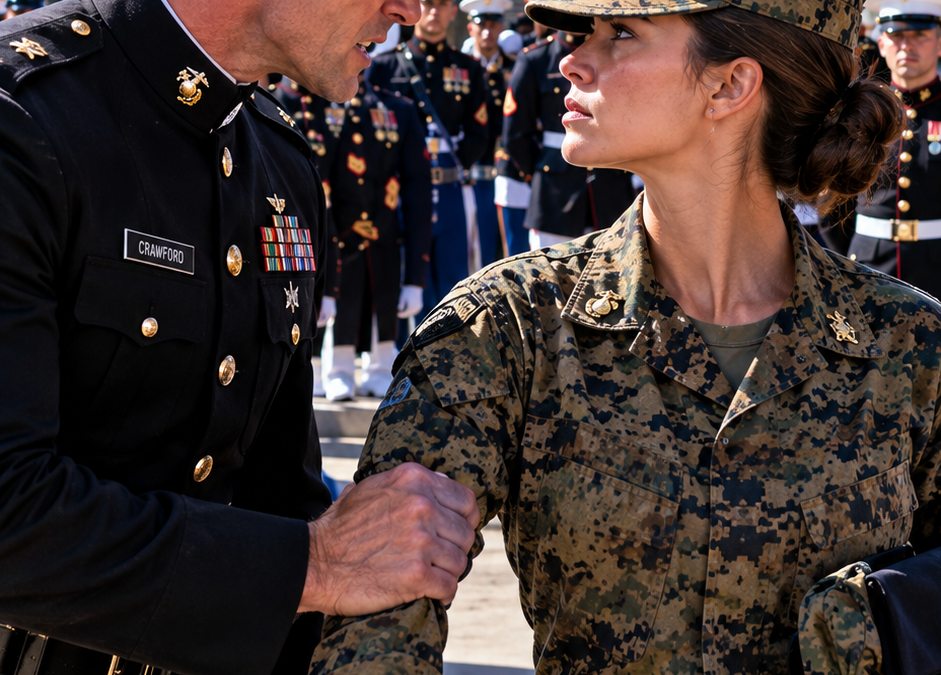
Captain Ryan Crawford’s fingers were wrapped around my bicep hard enough to leave marks, but I didn’t pull away. I didn’t twist free. I didn’t raise my voice. I simply looked down at his hand, then back into his eyes, and gave him one more chance to stop making the worst mistake of his career.
He smirked.
“Our conversation isn’t finished.”
Then he yanked me half a step closer.
Around us, nearly four hundred Marines stood in formation beneath the hard Virginia sun while a chaplain at the podium read the names of fallen service members beside the black granite memorial wall. Flags moved gently in the breeze. Families sat in folding chairs. Gold Star parents stood in the front row with white roses in their hands.
It was Memorial Day.
A day when even loud men were supposed to understand silence.
But Captain Crawford had never been good at understanding things that did not revolve around him.
The ceremony continued, but attention was beginning to shift toward us.
I felt it before I saw it.
A ripple in the formation.
A shift of eyes.
A folding chair scraping behind me.
Crawford felt it too.
Unfortunately, attention only made him bolder.
“You walk onto this installation wearing utility fatigues and expect nobody to question you?” he said.
I said nothing.
His voice grew louder.
“Where’s your insignia?”
“In my patrol cap.”
His eyes flicked toward the folded cap tucked beneath my other arm.
“How convenient.”
“It’s in accordance with regulations.”
He gave a short laugh.
“You honestly expect everyone here to believe you’re an active-duty officer?”
I met his eyes.
“I don’t require your personal approval.”
That hit him.
Color crept up his neck.
Behind him, the chaplain continued reading names, his voice steady over the microphone, but almost no one near us was listening anymore.
Crawford stepped closer.
His breath smelled like coffee and mint.
Beneath that was something stale and aggressive.
I had known men like him before.
Men who mistook composure for weakness.
Men who believed rank was not responsibility but permission.
Men who learned early that if they humiliated people publicly enough, most would choose silence over the exhaustion of fighting back.
“Let me guess,” he said. “Some civilian bought surplus gear and decided today would be a good day to play Marine?”
A few Marines nearby visibly stiffened.
I still did not react.
That seemed to frustrate him more.
“Name and unit.”
I gave him my name.
“Major Jessica Dalton.”
He laughed immediately.
“Major?”
His voice carried across the lawn.
Now dozens of heads turned.
“You expect me to believe that?”
I slowly raised the patrol cap.
Crawford’s smile widened.
He thought I was finally going to prove his point.
Instead, I reached beneath the edge of my collar.
There was a small insignia there.
One I had deliberately kept covered because the assignment attached to it was not meant for public discussion.
Crawford saw it first.
His face changed.
The smirk vanished.
His fingers loosened around my arm.
Then one of the senior Marines standing nearby saw it too.
He went rigid.
Another officer turned.
Then another.
Within seconds, the silence around us became absolute.
Crawford stared at the insignia like it had suddenly become radioactive.
“What the hell is that?” he whispered.
I gently removed his hand from my arm.
Then I leaned closer.
“That, Captain, is the reason you should have listened the first time I told you to let go.”
A voice behind him cut through the silence.
“Captain Crawford.”
Colonel Marcus Hale stepped beside us.
His expression was hard enough to quiet even the people who had not yet understood what had happened. He looked first at Crawford’s hand, then at the insignia beneath my collar.
Something flickered across his face.
Recognition.
Then calculation.
“Step away from Major Dalton,” he said.
Crawford obeyed instantly.
For the first time since he had grabbed me, he looked uncertain.
The chaplain continued reading names at the memorial wall, but the space around us had changed completely. Four hundred Marines did not move. Families sat motionless in their chairs. A child somewhere near the back asked a question and was quickly hushed.
Colonel Hale lowered his voice.
“Major, are you injured?”
“No, sir.”
That was not entirely true.
My arm hurt.
But pain was not the point.
Crawford’s handprint would fade.
What he had just done in front of witnesses would not.
Hale’s eyes returned to Crawford.
“What exactly did you think you were doing, Captain?”
Crawford straightened.
“Sir, I was verifying her identity.”
“With your hand around her arm?”
Crawford’s jaw tightened.
“She refused to properly identify herself.”
“I gave him my name and rank,” I said.
Hale looked at me.
I could see the question behind his eyes.
How far do you intend to take this?
The answer was simple.
As far as the evidence goes.
The insignia beneath my collar belonged to a joint investigative command assigned to review misconduct, procurement fraud, falsified readiness reports, and abuse of authority across several installations.
My presence that morning had not been ceremonial.
It had been official.
And Captain Ryan Crawford’s name was already in my file.
I had spent three weeks reviewing complaints from junior Marines who claimed Crawford altered readiness reports, retaliated against anyone who challenged him, and used his rank to intimidate subordinates into silence. Until that moment, everything had been allegations.
Then Crawford grabbed me in front of nearly four hundred witnesses during a Memorial Day ceremony.
Colonel Hale’s expression remained controlled.
“Major,” he said, “do you wish to make a formal report?”
“I already am.”
Crawford went pale.
“This is ridiculous.”
I looked at him.
“No. It was ridiculous when you thought putting your hands on me would be easier than asking one professional question.”
His mouth opened.
No words came out.
That was when Staff Sergeant Miguel Reyes stepped out from formation.
“Sir.”
Crawford snapped toward him.
“Get back in line.”
Reyes did not move.
He was in his early thirties, broad through the shoulders, with the careful stillness of a man who had spent years choosing his words because the wrong ones could cost him. I recognized his name immediately.
Reyes was complaint number four.
He had submitted a statement through an anonymous channel after Crawford threatened to destroy his career over a missing inspection report.
Colonel Hale turned.
“Staff Sergeant?”
Reyes kept his eyes forward.
“I have something to report.”
Crawford’s face darkened.
“Not now.”
Hale’s voice hardened.
“Captain, you are done giving instructions.”
The words landed like a door closing.
Reyes swallowed.
“Sir, Captain Crawford ordered me to certify equipment as mission-ready when it had not passed inspection.”
A murmur moved through the formation.
Crawford shook his head.
“That’s false.”
Reyes continued.
“When I refused, he moved me to punishment duty for twelve consecutive nights and told me my next evaluation would reflect a lack of team commitment.”
One Marine became three.
Then five.
Then eleven.
Each stepped forward.
Each had a story.
Threats.
Altered evaluations.
Missing maintenance records.
Punishment assignments.
A corporal said Crawford ordered him to sign off on communications equipment that had never arrived.
A lance corporal said missing gear had been listed as received under his name while he was on leave.
A sergeant said maintenance deficiencies were rewritten before inspection teams arrived.
Another Marine said Crawford warned them that anyone who embarrassed the company would “be buried so deep nobody would find their career.”
With each statement, Crawford’s posture changed.
At first, he looked angry.
Then insulted.
Then nervous.
Finally, he looked at me.
Not with confusion anymore.
With recognition.
He understood then that I had not wandered into his life by accident.
I opened the folder tucked beneath my arm.
Inside were procurement records, inspection reports, inventory logs, and internal complaints cross-referenced across three installations. I had not come to the ceremony looking for drama. I had come because Crawford’s unit was scheduled to stand publicly in front of the same senior command that had allowed those complaints to sit unresolved for months.
I had wanted to observe.
He had chosen to perform.
“Captain Crawford,” I said, “these records show millions of dollars in communications, vehicle maintenance, and field-support equipment marked as received by your company.”
He stared at the pages.
His breathing changed.
“You set me up.”
“No.”
I looked around at the Marines he had tried to frighten into silence.
“You did that yourself.”
Two military investigators approached from the rear of the ceremony.
They wore ordinary service uniforms, but I knew both of them. Warrant Officer Chen and Special Agent Alvarez had been waiting near the edge of the gathering since the opening prayer.
Crawford saw them and finally understood that this moment had moved beyond embarrassment.
This was procedure now.
Documentation.
Witnesses.
Chain of command.
A record.
But just before Chen reached him, Crawford laughed.
Not nervously.
Knowingly.
“You think I’m the problem?”
I stopped.
He leaned closer, his voice low enough that only Hale, Crawford, Reyes, and I could hear.
“You should ask Colonel Hale who signed the orders above me.”
Colonel Hale’s face went completely still.
And for the first time that morning, I realized Crawford had not been protecting only himself.
He had been protecting someone with stars in his future.
The rest of the ceremony continued because the names on the memorial wall deserved better than our disruption.
That was Colonel Hale’s order.
The chaplain finished reading.
The wreath was laid.
The bugler played taps while Crawford stood between two investigators with his jaw locked and his wrists not yet restrained, but his world already narrowing around him.
I stood at attention.
So did Colonel Hale.
So did Crawford.
For those final notes, even the guilty remained silent.
That mattered to me.
Not because I respected Crawford.
Because Memorial Day was not about him.
When the ceremony ended, families were guided away from the memorial lawn. Marines were dismissed by unit, but most did not leave immediately. They lingered in clusters, glancing toward Crawford, toward me, toward Colonel Hale, trying to understand how a ceremony had turned into the opening scene of something much larger.
Hale walked beside me toward the command building.
His voice was quiet.
“Major Dalton, I assume you have more than what you showed Crawford.”
“I do.”
“Does it involve me?”
I did not answer immediately.
He looked straight ahead.
“That is an answer.”
“No, sir. It is caution.”
His mouth tightened.
“I signed several readiness summaries submitted by Crawford’s company. If those summaries were falsified beneath me, I want that documented clearly.”
“And if they were not falsified beneath you?”
He stopped walking.
For the first time, he turned fully toward me.
“Major, you need to be careful.”
That was a disappointing sentence.
Not because it frightened me.
Because men who had nothing to hide rarely led with warnings.
“I am careful,” I said. “That is why I am here.”
Hale studied me.
He was fifty-one, maybe fifty-two, tall, disciplined, admired by half the base and feared by the other half. His promotion packet was already rumored to be moving. People spoke about him the way ambitious organizations speak about men who appear polished enough to represent them and ruthless enough to survive them.
A future general.
That was the phrase I had heard twice before arriving.
A future general.
Crawford’s final remark had landed exactly where he intended.
You should ask Colonel Hale who signed the orders above me.
Hale resumed walking.
“This discussion should continue in a controlled setting.”
“It will.”
“Good.”
“But not privately.”
His jaw tightened.
“Major.”
“Sir, with respect, privacy is how this survived.”
He looked at me sharply.
Then he said nothing.
Inside the command building, we entered a conference room that had been cleared in advance. Hale noticed that immediately. His eyes moved over the table, the folders, the recording equipment, the two legal officers seated near the far wall, and the empty chair left for him.
He looked back at me.
“You anticipated this.”
“I anticipated resistance.”
“From Crawford?”
“From anyone who had reason to prefer silence.”
There it was again.
That stillness.
Hale pulled out a chair and sat.
“Then begin.”
I did.
For the next two hours, I laid out the structure of the inquiry.
The first complaints involved leadership climate: intimidation, retaliation, evaluation threats, and punishment assignments.
Then came readiness discrepancies.
Vehicles listed operational despite missing parts.
Communication kits marked delivered but never issued.
Field medical supplies signed off by personnel who were not present.
Maintenance logs altered after inspections.
Individually, each discrepancy could be explained away.
A clerical error.
A delayed shipment.
A misunderstanding.
A subordinate’s mistake.
But together, they formed a pattern.
And patterns were harder to intimidate.
Hale listened without interruption.
That was one thing I gave him.
He did not bluster.
He did not insult the witnesses.
He did not accuse me of misunderstanding how command worked.
When I placed Crawford’s signed certifications beside Hale’s approval memos, his expression remained controlled.
Then I opened the second folder.
The one Crawford had not seen.
Hale’s eyes shifted.
He recognized the blue tab.
“That file is restricted.”
“Yes, sir.”
“Who authorized you to access it?”
I placed the authorization memo on the table.
He read it.
His face changed again.
This time, not with fear.
With anger.
“You went above installation command.”
“I was ordered to.”
“By whom?”
I did not answer.
He looked down at the authorization again and understood.
High enough.
That was the answer.
High enough that his next sentence mattered very much.
The blue-tabbed folder contained procurement routing data. Not just what equipment had been ordered, but who approved substitutions, who signed urgency waivers, who authorized alternate vendors, and which officers received readiness summaries after the fact.
Crawford’s signature appeared often.
But Hale’s appeared where it mattered.
Not on every false report.
Not on every missing crate.
He was too experienced for that.
But on expedited acquisition approvals.
On exception memos.
On waivers allowing equipment shortages to be described as “temporary logistical variance” instead of readiness failure.
On one memo that redirected audit inquiries away from Crawford’s company and into a general supply-chain backlog.
I slid that memo across the table.
Hale did not touch it.
“Did you sign this?” I asked.
He looked at it.
“Yes.”
“Did you know the backlog explanation was false?”
“No.”
“Who drafted the memo?”
“My staff.”
“Which staff member?”
He looked up.
“Major, you already know the answer.”
“I need you to say it.”
His eyes hardened.
“Captain Crawford prepared the initial language.”
“And you signed it.”
“Yes.”
“Why?”
“Because at the time, I believed the explanation was supported.”
“By what?”
“Briefings.”
“From Crawford?”
“Among others.”
“Who else?”
For the first time, Hale hesitated.
It was a small hesitation.
Less than two seconds.
But in an investigation, hesitation has weight.
“Colonel,” I said, “who else?”
He leaned back.
“Brigadier General Whitcomb’s logistics office.”
There it was.
Stars in the future.
Only now, it was worse.
Not Hale.
Someone already wearing one.
The room changed.
One of the legal officers looked up from his notes.
Special Agent Alvarez, who had been silent near the wall, shifted slightly.
I kept my face still.
“Did Brigadier General Whitcomb directly instruct you to accept Crawford’s reporting?”
“No.”
“Indirectly?”
Hale’s jaw tightened.
“He emphasized that unnecessary readiness downgrades would damage deployment timelines.”
“That is not the same thing.”
“No.”
“Did he know equipment listed as received was missing?”
“I don’t know.”
“Did you?”
“No.”
I let silence sit for a moment.
Hale finally picked up the memo.
“You think I enabled this.”
“I think your signature made it difficult for people below you to challenge it.”
“That is not the same as corruption.”
“No, sir. It is not.”
He looked at me.
I continued.
“But abuse of authority does not survive on corruption alone. Sometimes it survives on ambition, convenience, and senior officers deciding that uncomfortable reports are less useful than clean ones.”
For the first time, Hale looked away.
That was the first honest thing he had done since entering the room.
Crawford was formally removed from duty before sunset.
The announcement was brief and bloodless.
Captain Ryan Crawford had been temporarily relieved pending investigation into leadership climate, readiness reporting, and procurement irregularities.
Temporarily.
Pending investigation.
Irregularities.
Military language often sounds like it was designed to drain blood from a wound before anyone sees it.
But inside the unit, people understood.
Crawford was finished.
What remained uncertain was how many people he intended to drag with him.
That evening, Staff Sergeant Reyes gave his full statement.
He sat across from me in the same conference room where Hale had been questioned earlier. His hands rested on the table, fingers interlaced so tightly his knuckles had gone pale.
“You don’t have to protect anyone now,” I told him.
He gave a tired laugh.
“Ma’am, I’ve been hearing that for years.”
“I know.”
He looked at me then.
Really looked.
“You do?”
“Yes.”
I had spent enough time reviewing retaliation complaints to understand the anatomy of silence.
At first, people stay quiet because they are afraid.
Then they stay quiet because nothing happened the last time they spoke.
Eventually, silence becomes part of the workplace culture, not because everyone agrees, but because everyone has learned the cost of being first.
Reyes took a breath.
“Captain Crawford told us the missing equipment was above our pay grade.”
“Who is us?”
“Maintenance section. Supply. Platoon sergeants.”
“Did he say where it went?”
“No. But he said if anyone asked, the equipment was delayed in transit.”
“Was it?”
“No, ma’am.”
“How do you know?”
“Because I saw two of the crates.”
I leaned forward.
“Where?”
He looked toward the door.
Alvarez stepped closer.
“Staff Sergeant,” she said, “where did you see the crates?”
Reyes swallowed.
“Warehouse Twelve. Off-base contractor storage.”
That was new.
“Who controlled access?”
“Civilian vendor. Harrow Defense Logistics.”
I wrote the name down.
“Harrow had a contract through the installation?”
“Yes, ma’am.”
“Who approved it?”
Reyes did not need to answer.
By midnight, Harrow Defense Logistics became the center of the investigation.
By morning, three procurement officers had been called in.
By noon, Brigadier General Whitcomb’s office had been notified that investigators would require relevant communications, contract routing data, and personnel available for interview.
By 1400, Whitcomb’s aide informed us the general was unavailable.
By 1410, my command informed his aide that unavailable was not an option.
He arrived at 1600.
Brigadier General Aaron Whitcomb was exactly the kind of officer people described as impressive before they described anything he had done.
Tall. Silver-haired. Athletic. Voice smooth enough to calm a room and polished enough to survive a hearing.
He entered the conference room with a legal advisor and a look of restrained irritation.
“Major Dalton,” he said. “I understand there was an incident yesterday.”
“There were several, sir.”
“So I’ve heard.”
He sat before being invited.
That told me something.
He expected rooms to arrange themselves around him.
I opened the file.
“We are reviewing procurement irregularities tied to Captain Crawford’s company, expedited readiness waivers signed through Colonel Hale’s office, and vendor relationships involving Harrow Defense Logistics.”
Whitcomb’s expression did not change.
“Harrow is one of several approved vendors.”
“Yes, sir.”
“Supply-chain disruptions required flexibility.”
“Yes, sir.”
“Then I hope this inquiry is being conducted with an understanding of operational realities.”
I looked at him.
“Operational reality is why we’re conducting it.”
His eyes sharpened.
I slid a document across the table.
“Harrow Defense Logistics billed for communications kits, vehicle diagnostic modules, and field-support equipment that never reached the unit.”
Whitcomb glanced at the page.
“That would be a contract compliance issue.”
I slid the next page.
“The missing equipment was still marked as received.”
“That would be a unit reporting issue.”
Another page.
“The readiness waiver described shortages as temporary transit delays.”
“That language came from Colonel Hale’s office.”
Another page.
“Harrow’s regional director exchanged thirty-six messages with Captain Crawford in the two weeks before the inspection.”
“Again, that appears to involve Crawford.”
I placed the final document in front of him.
Whitcomb looked down.
For the first time, his calm shifted.
It was subtle.
A tightening at the corner of his mouth.
The document was a calendar invitation recovered from Crawford’s deleted mail.
Private logistics sync.
Attendees: Captain Ryan Crawford, Harrow Defense regional director, Colonel Marcus Hale, Brigadier General Aaron Whitcomb.
Date: six weeks earlier.
Location: Whitcomb’s office.
“Do you recall this meeting, sir?” I asked.
Whitcomb looked at his legal advisor.
Then back at me.
“I attend many meetings.”
“That was not my question.”
His eyes hardened.
“Yes. I recall a logistics discussion.”
“What was discussed?”
“Supply issues.”
“Missing equipment?”
“Potential delays.”
“Falsified receipt records?”
“No.”
“Readiness waivers?”
He paused.
“No.”
“Captain Crawford says otherwise.”
Whitcomb’s nostrils flared slightly.
There it was.
Not fear.
Annoyance that a subordinate had failed to stay contained.
“What exactly has Captain Crawford alleged?” he asked.
“That you knew equipment was missing and directed Colonel Hale to keep readiness reports clean until after the Memorial Day review.”
“That is absurd.”
“Colonel Hale confirms pressure from your office to avoid readiness downgrades.”
“Pressure is not fraud.”
“No, sir.”
“Hale is trying to protect himself.”
“Possibly.”
“Crawford is trying to protect himself.”
“Certainly.”
“Then you have two compromised officers pointing upward to save their careers.”
I nodded.
“That is one interpretation.”
Whitcomb leaned back.
“And the other?”
“That they finally stopped pointing downward.”
The room went still.
Whitcomb’s legal advisor shifted in his seat.
The general looked at me for a long moment.
“Major, do you understand how many careers can be damaged by careless allegations?”
“Yes, sir.”
“Do you understand the operational impact of undermining confidence in senior command?”
“Yes, sir.”
“Then proceed carefully.”
I closed the folder.
“With respect, sir, that is exactly what people keep telling me right before the evidence gets worse.”
Whitcomb stood.
“This interview is over.”
“No, sir,” Alvarez said from the wall. “It is paused.”
Whitcomb looked at her as if noticing her for the first time.
She held his gaze.
“You will remain available.”
He turned back to me.
For one moment, the polished mask slipped.
“You have no idea what you’re stepping into.”
I stood.
“I do, sir.”
And I did.
Not because I knew every answer.
Because I had seen this shape before.
Abuse rarely begins with one dramatic act.
It begins with a report softened for convenience.
A shortage described as temporary.
A subordinate told to stop being difficult.
A signature placed on a memo because asking one more question would delay a briefing.
Then another.
Then another.
Until the lie becomes architecture.
Crawford was not the architect.
He was the loudest room in the building.
Three days later, Harrow Defense Logistics suspended two employees.
Five days later, Colonel Hale submitted a sworn statement acknowledging that he had approved readiness language he had not independently verified and that pressure from Whitcomb’s office shaped how deficiencies were reported.
It was not a confession to fraud.
It was something more complicated.
A senior officer admitting that ambition had made him less curious than duty required.
That statement hurt him.
It did not destroy him immediately.
But it ended the myth of inevitability around his promotion.
Crawford tried to bargain.
He offered emails.
Text messages.
Meeting notes.
He claimed he had only followed the climate set above him. He claimed everyone knew. He claimed the missing gear was part of a temporary arrangement to satisfy readiness metrics while waiting on replacement stock.
But the Marines he had threatened told a different story.
So did the records.
So did the warehouse inventory from Harrow’s off-base storage facility, where investigators found equipment that had been billed, marked as delivered, and never issued.
The first time I saw the crates, I stood in the warehouse aisle with Alvarez beside me.
Stencil markings still visible.
Serial numbers intact.
Gear that junior Marines had been told was delayed, lost, or never ordered sat neatly stacked behind a contractor’s locked gate.
Alvarez folded her arms.
“Millions of dollars sitting in the dark.”
I thought about the lance corporal who had been ordered to sign an inspection sheet for equipment that never arrived.
I thought about Reyes working twelve punishment nights because he refused to lie.
I thought about Crawford’s hand around my arm.
“No,” I said.
Alvarez looked at me.
“Not just dollars.”
I touched one of the crates.
“Trust.”
The investigation lasted months.
That is the part nobody likes in stories.
People want the fall to happen as quickly as the reveal.
But institutions do not move like lightning. They move like machinery—slow, heavy, resistant, but capable of crushing when finally aligned.
Crawford faced administrative and criminal proceedings under military law for assault, false official statements, retaliation, and procurement-related misconduct. He tried to frame himself as a scapegoat. He said he had learned from the culture around him.
There was truth buried in that excuse.
Not enough to save him.
Colonel Hale received formal reprimand and removal from the promotion track pending further review. His career did not end in one dramatic moment, but the future everyone had promised him no longer belonged to him.
Brigadier General Whitcomb’s case moved higher.
Much higher.
His staff fought.
His attorneys objected.
His allies described the inquiry as overreach, confusion, administrative disagreement, anything except what it was.
But the paper trail held.
The messages held.
The meeting records held.
The Harrow contract held.
And one by one, the Marines Crawford thought he had silenced testified.
Staff Sergeant Reyes testified first.
He wore his service uniform, sat straight-backed, and spoke clearly even when Crawford’s counsel tried to make him sound disgruntled.
“Why didn’t you report this earlier?” they asked.
Reyes looked at Crawford, then at the panel.
“I did.”
That answer changed the room.
“I reported it through my chain. I reported it anonymously. I reported it to anyone I thought might listen. The problem wasn’t that Marines didn’t speak. The problem was that the wrong people were comfortable not hearing us.”
I wrote that sentence down.
Not for the file.
For myself.
Months after Memorial Day, I returned to the same memorial wall.
Not for a ceremony.
Not for an investigation.
Just because I needed to stand there without Crawford’s hand on my arm, without witnesses, without folders under my arm and microphones catching every word.
The black granite reflected the sky.
Names stretched across it in disciplined rows.
I stood there with my patrol cap in one hand.
The insignia beneath my collar was visible now.
I had stopped hiding it.
Not because my work had become public.
Most of it never would.
But because I had learned something from that day.
There is a difference between discretion and making yourself smaller so arrogant men can feel larger.
Colonel Hale found me there near sunset.
He was out of uniform.
That surprised me.
For a moment, we stood in silence.
Then he said, “Major.”
“Colonel.”
He looked at the wall.
“I signed too many things because I trusted the machine beneath me.”
I said nothing.
“That is the version I gave myself at first,” he continued. “It sounds better than saying I saw enough smoke and chose not to ask where the fire was.”
The wind moved across the lawn.
“Why are you telling me?” I asked.
“Because you were right.”
“About what?”
“Privacy is how it survived.”
I looked at him then.
He seemed older.
Not ruined.
Not forgiven.
Just altered.
“Reyes and the others deserved better from you,” I said.
“Yes.”
“So did the Marines whose names were used on false reports.”
“Yes.”
“So did the ones on that wall.”
His face tightened.
He looked back at the names.
“Yes.”
There was nothing else I needed from him.
Not an apology to me.
Crawford had grabbed my arm, but Hale’s failure had reached far more people.
“Good evening, Colonel.”
He nodded once.
“Good evening, Major.”
As I walked away, my phone buzzed.
A message from Staff Sergeant Reyes.
Ma’am, just wanted you to know the new inspection team arrived today. They actually opened the crates this time.
I smiled.
Then another message came through.
Also, nobody has called me “not a team player” all week. Feels suspicious.
For the first time in months, I laughed.
The sound felt strange.
Clean.
Captain Ryan Crawford had expected me to panic when he grabbed my arm in front of four hundred Marines.
He expected me to stammer, defend myself, and shrink beneath public embarrassment.
Instead, he exposed himself.
He exposed the culture that protected him.
He exposed the signatures above him, the waivers around him, and the fear beneath him.
He thought the insignia hidden under my collar was the danger.
It wasn’t.
The danger was the record.
The Marines who finally stepped forward.
The reports people thought had disappeared.
The equipment that still had serial numbers.
The truth that had waited quietly beneath intimidation, paperwork, and polished command language.
That Memorial Day began with names on a wall.
Names of people who had given everything.
It ended with living Marines remembering that honor is not a speech, not a uniform, and not a clean readiness report signed by someone chasing promotion.
Honor is what remains when nobody powerful wants the truth spoken aloud.
Crawford learned that too late.
Hale learned it painfully.
Whitcomb learned it publicly.
And I learned something as well.
I had spent most of my career believing control meant staying unreadable.
Still face.
Low voice.
No wasted motion.
But sometimes composure is not silence.
Sometimes composure is standing perfectly still while a man destroys himself against the truth he thought he could intimidate.
Captain Crawford grabbed my arm because he thought I was pretending to be someone important.
He was wrong.
I was never there to look important.
I was there to make sure the Marines he had silenced finally became impossible to ignore.








