𝗙𝗨𝗟𝗟 𝗦𝗧𝗢𝗥𝗬 The Cable Above My Ridge Was the First Sign Someone Had Decided My Land No Longer Needed My Permission
𝗙𝗨𝗟𝗟 𝗦𝗧𝗢𝗥𝗬
He hesitated.
“You’ll need to talk to the supervisor.”
“I’m asking you.”
He glanced toward the foundations. “Cable system.”
“What kind of cable system?”
“Gondola line.”
The word sounded absurd against the ridge air.
“A gondola,” I repeated.
“Yes, sir.”
“Across my property.”
His expression changed then. Not much, but enough.
“I don’t know about property,” he said carefully. “We were given access.”
“By whom?”
He looked toward the development side of the mountain. “The HOA.”
I stared at him.
“The HOA gave you access to my ridge?”
“That’s what we were told.”
“You have written permission from me?”
“I don’t handle that side.”
“Do you have written permission from anyone who owns this land?”
He swallowed. “Sir, I just work the installation.”
Behind him, another worker stopped moving and listened.
I looked at the fresh concrete again. The foundations were not small. They were not temporary. Someone had planned this, funded it, permitted portions of it, mobilized crews, poured concrete, and strung cable over land my family had owned for generations.
And nobody had called me.
Nobody had mailed a notice.
Nobody had asked for an easement.
Nobody had knocked on my door.
I took out my phone and called the HOA office.
The receptionist recognized my name and immediately became too polite.
“Good morning, Mr. Mercer,” she said. “How can I help you?”
“You can tell Evelyn Reynolds I’m standing on my ridge looking at a gondola cable.”
Silence.
Then papers rustled.
“Ms. Reynolds is in a meeting.”
“No, she isn’t.”
“I’m sorry?”
“She’s either available now, or I’m calling the county sheriff, the land records office, and the state transportation division in that order. Tell her she has five minutes.”
The receptionist’s voice dropped. “Please hold.”
I stood there with the phone to my ear, watching men pretend not to watch me.
After nearly four minutes, Evelyn Reynolds came on the line.
“Mr. Mercer,” she said, smooth as glass. “I understand there’s a concern.”
“A concern?”
“Yes. I was told you had questions about the transportation improvement project.”
“I have one question to start with. Who authorized construction on my property?”
She paused, but only briefly.
“The gondola route has been part of the community’s long-term transportation plan for years.”
“That didn’t answer my question.”
“It was included in the approved development materials.”
“Approved by whom?”
“The association, the planning committee, and the original development board.”
“Did I sign anything?”
“Mr. Mercer, I think it would be better if we discussed this in person.”
“I’m on the ridge.”
“I can be there shortly.”
“Bring every document you think gives you the right to cross my land.”
Her voice cooled. “I’ll bring the relevant file.”
“Bring all of it.”
I ended the call.
The worker nearest me shifted his weight.
“Should we stop?” he asked.
I looked at the hanging cable, the foundations, the equipment, the torn earth.
“That would have been a better question before you poured concrete.”
He looked embarrassed, and I reminded myself he probably had no idea whose land he was on. Workers go where contracts send them. The problem was not the man in the vest. The problem was whoever had decided paperwork was optional because my ridge was inconveniently located.
I stepped back to my truck and pulled out the folder I kept behind the seat.
My father had taught me to keep copies of critical land documents in three places: the house, the barn office, and the truck. Deed, parcel maps, tax records, fence agreements, grazing lease boundaries, timber access history. When I was younger, I thought he was paranoid. As I got older, I realized he had simply lived long enough to understand how often people mistake quiet ownership for weak ownership.
I opened the folder on my hood and found the parcel map for the ridge.
My property line ran exactly where I knew it ran.
The gondola line crossed it cleanly.
Twenty minutes later, a white SUV climbed the access road.
It was too clean for ranch work, too polished for the ridge. It stopped near the site, and Evelyn Reynolds stepped out wearing a camel-colored coat, leather gloves, and the expression of a woman arriving to correct a misunderstanding she had already decided was someone else’s fault.
She carried a thick brown folder under one arm.
I had seen Evelyn before at county meetings and community hearings. She had the practiced confidence of someone who liked microphones, agendas, and rooms where people addressed her as “Madam President.” She was not loud. Loud people reveal too much. Evelyn preferred control. She spoke softly, slowly, and with the kind of patience that implied you were embarrassing yourself by disagreeing.
She walked toward me with a polite smile.
“Mr. Mercer,” she said. “I’m glad we can address this before it becomes unnecessarily contentious.”
I looked at the cable above us.
“You started construction across my ridge without permission. We passed contentious about two foundations ago.”
Her smile tightened.
“I understand this may feel sudden.”
“It doesn’t feel sudden. It feels illegal.”
One of the workers lowered his head and found urgent interest in a toolbox.
Evelyn opened her folder.
“The gondola corridor was contemplated from the beginning of the mountain community project,” she said. “It was designed to reduce vehicle traffic, provide safe winter transportation, and connect upper residences with the valley amenities.”
“I didn’t ask why the HOA wanted it. I asked why it’s on my land.”
“The route follows the planned transportation alignment shown here.”
She removed a large folded map and spread it across the hood of her SUV.
I did not move toward it immediately. Something about the gesture irritated me. She had brought a map as if a printed line could outweigh a deed.
Finally, I stepped closer.
The map was old, worn along the creases, and marked with colored routes. Roads, utility corridors, drainage easements, future trails, and a dotted line labeled “Proposed Aerial Transit Corridor.”
There it was.
A dotted line crossing near my ridge.
Evelyn tapped it with one gloved finger.
“As you can see, this has always been part of the development plan.”
I looked at the map, then at her.
“Where is the recorded aerial easement?”
Her finger stopped moving.
“The corridor is shown on the approved plan.”
“That is not what I asked.”
“The plan establishes the intended route.”
“Evelyn, a drawing does not give you airspace rights.”
She inhaled slowly.
“The association has rights to improve transportation throughout the community.”
“My ridge is not the community.”
“The development surrounds portions of this area.”
“Surrounding land is not the same as owning it.”
She closed the folder halfway, then opened it again, as if the right answer might appear if she handled the papers confidently enough.
“You understand that this system benefits the entire valley,” she said.
“No. I understand that you’re building something over private property without showing me the document that lets you do it.”
“The homeowners have approved funding. Contractors have been retained. State-level discussions have occurred.”
“That still doesn’t create an easement.”
Her eyes sharpened.
“Are you opposed to transportation improvements?”
I almost laughed.
That was the first move people like Evelyn always made when facts turned against them. They tried to turn a property dispute into a character flaw. If I objected to trespass, I was anti-progress. If I asked for documents, I was difficult. If I defended my boundaries, I was standing in the way of the community.
“I’m opposed to people using my land without permission,” I said.
“This is not about taking your land.”
“Then show me the aerial easement.”
She looked toward the workers.
“Perhaps we should discuss this privately.”
“We can discuss it right here.”
“Mr. Mercer—”
“Show me the signed, recorded document granting the HOA or the gondola project the right to cross the airspace over my parcel.”
For the first time since she arrived, Evelyn stopped smiling completely.
Wind moved through the grass around us.
A machine engine idled somewhere behind the crew.
She looked down at the map again.
“The original development materials reference this corridor.”
“That is not an easement.”
“It demonstrates notice.”
“To whom?”
“To affected parties.”
“I never received notice.”
“The documents were public.”
“My deed is public too. That didn’t stop you from ignoring it.”
Her cheeks colored faintly.
“You’re oversimplifying a complex planning issue.”
“No. You’re complicating a simple ownership issue.”
She straightened.
“The HOA proceeded based on the development record.”
“Then the development record better include a signed aerial easement.”
She said nothing.
I folded my arms and waited.
Evelyn finally gathered the map back into the folder with careful, controlled movements.
“I’ll have counsel review the file.”
“You do that. In the meantime, construction stops.”
“I don’t have authority to suspend contractor operations unilaterally.”
“Then get someone who does.”
“The contractor has a schedule.”
“I have a deed.”
She looked at me then with open annoyance.
“This kind of obstruction could expose you to liability.”
That sentence changed the temperature between us.
Until then, I had been angry but measured. I had assumed, generously, that perhaps someone had made a clerical mistake or relied on an incomplete map. But the moment she threatened liability while standing under a cable strung over my land without permission, I understood this was not confusion.
This was pressure.
I stepped closer, keeping my voice low.
“Be very careful, Evelyn.”
Her eyes flicked toward mine.
“You came onto private property with a construction crew, started a permanent aerial transportation project, and now you’re suggesting I may be liable for objecting?”
“I’m saying delays have consequences.”
“So does trespass.”
Neither of us spoke for several seconds.
Then she closed her folder.
“I’ll be in touch.”
“I’ll contact the county first.”
She turned toward her SUV. “That is your right.”
“Yes,” I said. “It is.”
She drove away slowly, raising a thin trail of dust behind her.
The crews did not leave immediately. They stood around in small groups, making phone calls and studying their own paperwork. I took photographs of everything: foundations, stakes, cable alignment, equipment tracks, vehicle plates, contractor markings, and the position of the cable against visible boundary features.
No one tried to stop me.
By noon, the crews had paused active work, though not officially packed up. That bothered me. Paused work could start again the moment I left. I stayed until they loaded several tools and drove down toward the development side.
Only then did I leave the ridge.
At the house, I spread my property records across the kitchen table.
The table had been in my family longer than I had. My parents had signed school forms on it, argued over bills on it, sorted seed invoices on it, and once, after a wildfire came within two miles of the ranch, my father laid every insurance document he owned across its scarred surface and told me, “Paper is boring until paper is the only thing standing between you and someone else’s version of the truth.”
I heard his voice that afternoon as I sorted the documents.
The deed was clear. The parcel description was clear. The ridge boundaries were clear.
I found old survey records, tax maps, and correspondence from when the development first went in. There had been negotiations years earlier about a road maintenance agreement near the lower valley, but nothing about aerial access across the ridge. Nothing about a gondola. Nothing about towers.
I called the county land records office.
A woman named Marcy answered. I had spoken with her before when recording a fence line adjustment with a neighbor. She was efficient, direct, and allergic to drama.
“County Recorder’s Office.”
“Marcy, this is Caleb Mercer.”
“Morning, Caleb. What did someone do now?”
Despite everything, I almost smiled.
“I need to verify whether any aerial easement, gondola easement, transit corridor, or air rights agreement has ever been recorded against my ridge parcel.”
There was a pause.
“That is oddly specific.”
“There’s a cable hanging over it.”
Another pause.
“A cable.”
“A gondola cable.”
She exhaled. “Give me the parcel number.”
I read it to her.
“I’ll search the grantor-grantee index, parcel instruments, subdivision references, transportation agreements, utility filings, and anything tied to the development plat.”
“How long?”
“I’ll do a preliminary search now. Full certification takes longer.”
“I need to know whether there’s anything obvious.”
“You’ll know shortly.”
I waited with the phone on speaker while she searched. I could hear typing, then the faint click of files opening and closing.
After several minutes, she came back.
“I’m not seeing an aerial easement recorded under your parcel.”
“You’re sure?”
“I’m sure enough to say I don’t see one in the indexed records. I see your deed, prior family transfers, a timber access agreement from years back, the old road maintenance document, and a utility easement along the lower boundary. Nothing granting aerial transit rights across the ridge.”
“What about the HOA development plan?”
“I see recorded plats for the development, but a proposed corridor on a plat is not the same thing as an executed easement against your property.”
I closed my eyes.
There it was.
The sentence Evelyn had refused to say.
“Can you email me the preliminary search summary?”
“I can email a non-certified summary. For certified copies, submit the request.”
“Send the summary. I’ll file for certified copies today.”
“You may also want a current boundary confirmation if construction is already happening.”
“I’m calling Daniel.”
“Good.”
Daniel Hart was the county surveyor people called when they wanted arguments to stop being arguments. He had worked in mountain land longer than most developers had been alive. He knew old fence lines, bad maps, forgotten road claims, and every trick people used to stretch a dotted line into a right they did not possess.
I called his office next.
His assistant said he was in the field but would return messages by late afternoon. I left a detailed message, then sent photos.
He called back eighteen minutes later.
“Caleb,” he said, without hello, “tell me those pictures are from someone else’s property.”
“They’re from my ridge.”
“Who installed that cable?”
“Contractor working through the HOA.”
“They have an easement?”
“Recorder doesn’t see one.”
He went quiet.
“Don’t let them pour anything else.”
“They already poured foundations.”
“I’ll come tomorrow morning.”
“Can you come sooner?”
“I’m two counties over.”
“Daniel.”
He heard something in my voice then. Maybe anger. Maybe fear. Maybe both.
He sighed.
“I’ll leave at six. I’ll be there early.”
That night, I barely slept.
Every time I closed my eyes, I saw the cable against the sky.
It is difficult to explain to someone who has never owned land that property is not just dirt. It is memory made physical. It is labor you can stand on. It is the place where your dead still have weight because they built fences, planted trees, dug ditches, repaired roofs, buried dogs, lost money, survived storms, and left behind marks that strangers cannot see.
The ridge was not useful in the way pasture was useful. It did not grow much. It did not shelter equipment. It did not produce hay. But it mattered.
My grandfather had proposed to my grandmother there. My father had scattered my mother’s ashes under the old pine near the overlook. I had stood there after my divorce and watched a storm crawl over the valley, wondering how a place could remain so steady while a life came apart beneath it.
And now a cable hung over it because someone in a meeting had drawn a dotted line.
By dawn, I was already dressed.
I drove up before Daniel arrived, half expecting to find the crews back at work.
They were there.
Two trucks had entered from the development side. Workers were unloading equipment near the second tower location, and a concrete truck was parked below the ridge, engine running.
I stopped hard, gravel snapping under my tires.
One of the supervisors turned as I got out.
“No additional work happens today,” I called.
He walked toward me with a clipboard.
“Sir, you’ll need to speak with project management.”
“I did. They don’t have the easement.”
“We have authorization.”
“From whom?”
“The HOA and project office.”
“The HOA does not own my land.”
He looked tired, like he had been warned about me.
“Our understanding is that this is within the approved gondola corridor.”
“Your understanding is wrong.”
“We’re not here to argue property law.”
“You are standing in the middle of it.”
His jaw tightened.
“We have crews scheduled.”
“And I have a county surveyor on his way.”
That made him pause.
Behind him, men slowed.
“County surveyor?”
“Yes.”
He looked toward the concrete truck, then back at me.
“I’ll make a call.”
“Good.”
He walked away.
I stayed beside my truck, watching every movement. No one touched the foundation forms. No one unloaded more concrete. I took more photos, making sure time stamps captured everything.
Twenty minutes later, Evelyn Reynolds arrived again.
This time, she was not smiling when she stepped out.
She wore dark slacks, a cream sweater, and a wool coat too elegant for the muddy tire tracks near the work zone. The brown folder was back, thicker now, clipped shut with a metal clasp.
“Mr. Mercer,” she said.
“Evelyn.”
“I had hoped we could avoid escalating this.”
“So had I. Then your crews came back.”
“They are operating under existing approvals.”
“Not under an easement.”
Her eyes narrowed.
“The distinction is being reviewed.”
“Construction doesn’t continue while you review whether you have permission to build.”
“You don’t have unilateral authority to shut down a public-benefit project.”
“It’s not public when it crosses private property without rights.”
She stepped closer, lowering her voice.
“You need to understand something. This project has been in planning for years. Homeowners have paid assessments. Contracts have been signed. Investors, county planners, and transportation consultants have all relied on this route. You cannot simply appear at the last moment and derail it.”
I stared at her.
“Appear?”
She blinked.
“I mean—”
“My family has owned this ridge since before your development existed. The cable appeared. I did not.”
For a second, she looked away.
Then she recovered.
“No one is questioning your family history.”
“You are questioning whether it matters.”
“That is not what I said.”
“It is what you’re doing.”
The sound of another vehicle climbing the road ended the exchange.
Daniel Hart’s county truck came over the rise and stopped near the survey stakes. He stepped out wearing a faded field jacket, work boots, and a cap that looked older than some of the houses across the valley. He moved slowly, not because he was weak, but because he had learned that hurrying made people think confusion was acceptable.
He nodded at me.
“Caleb.”
“Daniel.”
He looked at Evelyn, the workers, the foundations, the cable, and the equipment.
Then he looked up.
“Well,” he said, “that’s not subtle.”
Evelyn approached him with official politeness.
“Mr. Hart, I’m Evelyn Reynolds, president of the Mountain Crest Homeowners Association. We appreciate the county’s willingness to clarify this matter.”
Daniel shook her hand.
“I’m here to verify boundary conditions and review what’s being constructed relative to recorded parcels.”
“We have development documents available.”
“I’ll look at everything.”
He opened the back of his truck and began unloading equipment.
There is something deeply calming about watching a competent person work when everyone else has been arguing. Daniel did not care about tone, pressure, polished folders, or community vision statements. He cared about monuments, bearings, recorded descriptions, survey history, and where the ground said the line actually was.
He set up his instrument, checked reference points, and began moving through the ridge with deliberate precision.
Evelyn stood several yards away, arms folded.
The contractor supervisor hovered near his truck.
I stayed close enough to answer questions but far enough not to interfere.
Daniel found the old boundary markers exactly where I expected them. One iron pin near the rock shelf. Another partially obscured by brush. A third near the old fence line. He checked them against the parcel records, then against the construction staking.
After nearly an hour, he stood beneath the gondola cable and looked down at his tablet.
Then he looked up at the cable again.
No one spoke.
That silence had weight.
Finally, Daniel turned toward Evelyn.
“This line is crossing Mercer’s private parcel.”
Evelyn opened her folder immediately.
“The transportation corridor is shown in the development plan.”
Daniel held up one hand.
“I’m not talking about planning intent. I’m talking about the physical alignment relative to recorded property boundaries.”
He tapped the map on his tablet.
“The cable is not simply crossing a road, trail corridor, or common area. It passes through the airspace above this parcel.”
Evelyn’s lips pressed together.
“We understand there may be overlap near the ridge, but—”
Daniel interrupted gently.
“Where’s the aerial easement?”
The question landed hard.
It was not angry. It was not dramatic. That made it worse for Evelyn.
She looked down at her folder.
“As I explained to Mr. Mercer, the gondola route appears in the original development materials.”
“I heard that,” Daniel said. “Where is the recorded easement granting the project the right to occupy or pass through the airspace above his land?”
“The documents reference a future transportation corridor.”
“Reference is not grant.”
“The community relied on this alignment.”
“Reliance is not recordation.”
Her face hardened.
Daniel turned to the contractor supervisor.
“Do you have project documentation showing right of access across this parcel?”
The supervisor looked uncomfortable.
“I have plans, permits, and access authorization from the HOA.”
“Do those include a signed easement from the landowner?”
“I’d have to check with the project office.”
Daniel nodded.
“Do that.”
The supervisor stepped away with his phone.
Evelyn said, “Mr. Hart, surely the county approved aspects of this project before construction began.”
Daniel looked at her calmly.
“County review of planning documents does not create private property rights. If a route requires crossing private land or airspace, the project needs documentation establishing that right.”
“The corridor has been on maps for years.”
“Then the easement should be easy to produce.”
She had no answer.
For the first time since the dispute began, I saw something in Evelyn’s expression that looked almost like uncertainty.
Not regret.
Not yet.
But uncertainty.
Daniel unfolded a paper map across the hood of his truck and weighted the corners with field tools. He marked the recorded parcel boundaries, then overlaid the planned gondola route. The line crossed my ridge plainly enough that even a child could see the conflict.
“This is the issue,” he said, pointing with a pencil. “The planned route may have existed conceptually. But the recorded parcel boundary is here. The cable alignment is here. If you don’t have an easement, license, condemnation order, or other recorded property right, then the project has a documentation problem.”
Evelyn’s voice became sharper.
“Are you issuing a stop-work order?”
“That may fall to the relevant project authority or state transportation office, depending on permit conditions. I’m documenting the boundary conflict.”
“But your position is that construction cannot continue?”
“My position is that the project needs to show legal authority to cross this parcel.”
“That is a legal conclusion.”
“It’s a surveying conclusion that triggers a legal question.”
I looked at Evelyn.
“She asked whether you were shutting it down because she doesn’t want to be the one to tell the crews to stop.”
Evelyn turned on me.
“That is unnecessary.”
“No,” I said. “What’s unnecessary is pouring concrete first and looking for permission afterward.”
Her eyes flashed.
“You are assuming bad faith.”
“I’m observing behavior.”
Before she could answer, another vehicle came up the ridge.
This one was dark blue, with state plates.
It parked beside Daniel’s truck, and a man in a gray jacket stepped out carrying a slim case and a tablet. He looked younger than Daniel but older than the contractor supervisor, with the weary composure of someone who had spent years walking into disputes nobody wanted to own.
Daniel nodded to him.
“Ray.”
“Daniel.”
Evelyn straightened immediately.
“Mr. Calder,” she said, forcing warmth back into her voice. “Thank you for coming.”
Ray Calder shook her hand, then mine.
“State Transportation Project Compliance,” he said. “I understand there’s a question regarding the gondola alignment and private property rights.”
“That is one way to put it,” I said.
He looked up at the cable.
“I can see the alignment.”
Evelyn opened her folder again.
“We have the community declaration, the development plat, the long-term transportation plan, and references to the future gondola corridor. This project has not appeared out of nowhere.”
Ray nodded. “Let’s review the documents.”
She led him to her SUV and spread the papers across the rear cargo area like evidence in a trial.
I watched her hands.
They were steady, but her movements were faster now.
She showed him the old development map. The community declaration. The plat. Pages referencing future transportation improvements. Assessment approvals. Planning notes. A corridor study.
Ray listened without interrupting.
Then he asked, “Where is the instrument granting aerial crossing rights over the Mercer parcel?”
Evelyn paused.
“The corridor is referenced in these materials.”
“I see that.”
“And the community development plan contemplated this connection from the beginning.”
“I see that too.”
“The association proceeded based on that record.”
Ray looked at her.
“I still need the property-right document.”
Evelyn glanced toward me, then back at him.
“We’re reviewing whether a separate document exists.”
I stepped forward and placed my deed and parcel description beside her HOA papers.
“This is my recorded deed,” I said. “The county recorder found no aerial easement indexed against my parcel. Daniel’s survey confirms the cable crosses my boundary.”
Ray picked up the deed and reviewed it carefully. Then he looked at Daniel’s map.
For several minutes, no one spoke except to answer small factual questions.
Ray asked about tower locations, cable height, construction access points, staging areas, recorded rights-of-way, and whether any notice had been sent directly to me as the affected landowner.
Evelyn said notices had been posted in community materials.
I said I was not a member of the HOA.
Ray made a note.
Evelyn said the project had been discussed publicly.
I said public discussion did not transfer property rights.
Ray made another note.
The contractor supervisor returned and quietly told Ray he did not have a signed easement in his field packet.
Ray asked whether the project office could produce one electronically.
The supervisor made another call.
While he waited, the ridge held its breath.
A few workers stood near the equipment pretending not to listen. The concrete truck was gone now, sent away or delayed. The cable still hung above us like the physical shape of someone’s assumption.
Finally, the supervisor lowered his phone.
“They’re checking central records,” he said.
Ray’s expression did not change.
“How long?”
“I don’t know.”
Ray turned to Evelyn.
“Until documentation is produced, no additional tower work should proceed on the affected segment.”
Evelyn stiffened.
“Is that a formal directive?”
“It is a compliance instruction pending documentation review.”
“This delay has cost implications.”
“I understand.”
“Crews are scheduled. Equipment has been mobilized.”
“I understand that as well.”
“The project has public-safety and winter-access benefits.”
Ray’s voice remained even.
“None of that answers the property-right question.”
The words struck harder because they were so plain.
Evelyn looked at the cable, then at the ridge beneath it, then finally at me.
For the first time, she addressed me without the performance.
“Would you consider signing an agreement for the route?”
The question surprised me less than the way she asked it.
No threat.
No speech about community benefit.
No liability warning.
Just the question that should have been asked before the first crew ever climbed my road.
I looked across the valley.
From up there, the HOA development looked almost peaceful. Rooflines tucked among trees. Roads curving neatly through the slope. Houses built for views they had not earned but had paid dearly to possess. I imagined families there wanting a gondola because winter roads were dangerous, because driving down the mountain took time, because convenience always looks reasonable from the side that benefits.
I was not against transportation.
I was not against safety.
I was not even against progress, though people like Evelyn loved using that word as if it ended every argument.
What I was against was being erased.
I turned back to her.
“I would have considered a discussion before construction started.”
Her face tightened, but she said nothing.
“I would have considered reviewing an alignment,” I continued. “I would have considered compensation, conditions, height restrictions, access limitations, environmental protections, liability terms, emergency protocols, and whether the route could be shifted. I would have considered all of that because adults discuss property rights before they build over someone’s land.”
Evelyn lowered her eyes for half a second.
“Can we have that discussion now?”
“Not while there’s active construction on my ridge.”
Ray looked between us.
“That is reasonable. The project office will need to provide documentation or pursue a proper agreement before work continues on this segment.”
The contractor supervisor nodded reluctantly.
“I’ll notify the crews.”
Daniel folded his map.
“I’ll finalize the boundary memo and send it to the county file.”
Evelyn closed her folder.
The sound was small, but it felt final.
For the rest of the afternoon, the ridge changed from a construction site into a place of waiting.
Workers secured equipment. Nothing new was poured. No new tower work began. The men who had arrived in the morning expecting a normal day left with cautious glances and quiet conversations. The contractor supervisor gave me a business card and said his company would not resume work on the disputed section until the project office provided clearance.
I appreciated the sentence but did not mistake it for trust.
Ray Calder wrote his preliminary instruction into an email before leaving the site. He read the key line aloud because I asked him to.
“Pending verification of recorded aerial property rights or execution of an appropriate agreement with the affected landowner, no further construction activity shall proceed on the Mercer ridge segment.”
For the first time in two days, my lungs fully opened.
Evelyn heard it too.
Her jaw moved slightly, as if she wanted to object again but could not find a sentence that would survive the documents around her.
When Ray left, Daniel stayed behind for a few minutes.
The wind had strengthened. It moved through the pines and made the cable hum faintly overhead.
Daniel looked up at it.
“Ugly thing,” he said.
I almost laughed, but it came out tired.
“Yeah.”
“You handled yourself well.”
“I wanted to do a lot worse.”
“I know.”
I looked at the disturbed ground, the concrete foundations, the tire tracks pressed into soil that had not seen heavy equipment in decades.
“My father would have hated this.”
Daniel was quiet for a moment.
“Your father hated most things that arrived without asking.”
That time, I did laugh.
It hurt a little.
“He always said maps are dangerous in the hands of people who don’t respect fences.”
“He was right.”
Daniel packed the last of his equipment into the truck, then turned back to me.
“Get certified records. Get counsel if they push. Don’t rely on verbal assurances.”
“I won’t.”
“And Caleb?”
“Yeah?”
“Don’t let them make you feel unreasonable for requiring the thing they should have had from the start.”
After he drove away, only Evelyn and I remained.
Her SUV was parked near the access road. Mine was beside the old fence post. Between us sat the interrupted machinery, the fresh concrete, and years of assumptions finally dragged into daylight.
She walked toward me slowly.
“I should have contacted you earlier,” she said.
It was not an apology, exactly.
But it was the closest she had come.
“Yes,” I said.
“The board believed the corridor rights had been addressed during the original development process.”
“You’re the board president. Belief is not documentation.”
“I understand that now.”
I studied her face.
There was still pride there. Still calculation. But also fatigue. Maybe even fear. Not fear of me, but fear of explaining to homeowners why a project they had already paid for was now tangled in a property dispute that could have been avoided by one honest conversation.
“Do you?” I asked.
She looked toward the cable.
“I understand that we have a problem.”
“That’s not the same thing.”
She turned back.
“What do you want, Mr. Mercer?”
The honest answer was complicated.
I wanted the cable gone.
I wanted the ridge restored.
I wanted the people who treated my family’s land like blank space to stand where my father stood after my mother died and understand why a dotted line on a map could feel like a hand reaching into a grave.
But I also knew the world was not built from wanting.
The concrete existed. The cable existed. The project existed. So did my deed.
“I want the construction stopped until the rights are handled correctly,” I said. “I want all documents. I want the recorded history. I want the engineering plan. I want the environmental review. I want proposed maintenance access. I want liability terms. I want compensation addressed. I want restoration for damage already done. And I want everyone involved to remember that my land is not a gap in your paperwork.”
She listened without interrupting.
Then she nodded once.
“I’ll speak with counsel.”
“Good.”
“We may be able to propose terms.”
“You may.”
Her mouth tightened slightly at the way I said it.
Then she walked back to her SUV.
Before getting in, she paused.
“For what it’s worth, I did not intend this to feel like a violation.”
I looked at the cable above us.
“That’s the thing about violations,” I said. “They don’t require your intention. Just your action.”
She had no answer.
Her SUV rolled down the ridge and disappeared into the trees.
I stayed long after everyone left.
The sun dropped toward the mountains, turning the valley copper and shadow. The construction site looked different in evening light. Less powerful. More exposed. The machines were just machines now. The stakes were just sticks. The cable, still dark against the sky, no longer looked inevitable.
It looked challenged.
I walked to the old pine near the overlook.
The ground beneath it was undisturbed. For that, I was grateful in a way that nearly broke me. I stood there with one hand on the rough bark and listened to the ridge settling back into itself.
I thought about my father.
I thought about all the times I had rolled my eyes as a younger man when he corrected a boundary description, saved a receipt, or drove into town to record some document nobody else thought mattered. I had mistaken his vigilance for stubbornness because I had not yet lived through the kind of day when a stranger’s confidence arrives on your land before their proof does.
The next morning, the certified search request went in.
By afternoon, my attorney had copies of the deed, the survey memo, Ray Calder’s compliance instruction, and every photograph I had taken. The HOA’s counsel sent a carefully worded email acknowledging that construction on the ridge segment would remain paused pending review of “applicable property rights.”
I read that phrase several times.
Applicable property rights.
Such clean words for such a dirty feeling.
Over the next week, the crews stayed away.
The equipment was removed in stages. The tower foundations remained, capped and marked, waiting on whatever came next. The cable was secured but unused. No gondola cars moved across my ridge. No one entered through my gate.
Neighbors called.
Some were curious. Some were sympathetic. A few from the HOA community tried to explain how important the gondola would be for winter access, as if I had caused the missing easement by noticing it.
One man told me, “You know, this project helps a lot of families.”
I said, “Then the people managing it should have protected it by doing the paperwork correctly.”
He did not have much to say after that.
Evelyn requested a formal meeting two weeks later.
This time, it happened in my attorney’s office, not on the ridge. She came with HOA counsel, two board members, and a transportation consultant. I came with my attorney, Daniel’s survey memo, and the quiet confidence of a man who had stopped arguing from emotion because the record had finally caught up with the truth.
The meeting was not friendly.
But it was different.
No one claimed the development map was enough. No one suggested I was obstructing progress. No one threatened liability. They discussed alternatives, mitigation, compensation, and whether the alignment could be shifted away from the most sensitive part of the ridge.
Nothing was signed that day.
I did not expect it to be.
But before we left, Evelyn looked across the table and said, “The association acknowledges that no recorded aerial easement has been located for the Mercer ridge segment at this time.”
My attorney wrote the sentence down.
So did hers.
That was enough for one day.
Months may pass before the final answer is decided. They may reroute the gondola. They may negotiate. They may abandon that segment entirely. That part remains unfinished, not because the truth is unclear, but because correcting an assumption takes longer than making one.
But the ending that mattered to me came earlier.
It came on the ridge, beneath that cable, when the state representative told the crews no more work would move forward until the property rights were real and documented.
It came when Evelyn Reynolds lowered her brown folder and finally asked a question instead of making a claim.
It came when the machines went quiet.
Now, some evenings, I drive back up to the ridge.
The scars are still there. Concrete does not vanish because someone admits they should have asked first. Tire tracks remain in places where the grass has not yet grown back. The cable still cuts across the sky for now, a dark reminder of how easily people with plans can forget people with deeds.
But the ridge is quiet again.
Not untouched.
Not innocent.
Quiet.
And when I stand beneath the old pine and look across the valley, I no longer see only the violation.
I see the line that held.
I see my grandfather’s fence posts, my father’s records, my mother’s resting place, and the land itself refusing to become someone else’s shortcut simply because they had drawn a convenient path through it.
That is what Evelyn never understood when she arrived with her folder and her confident explanations.
Land does not defend itself with anger.
It defends itself with memory, boundaries, and proof.
And on the morning they tried to hang a gondola over my ridge without asking, all three were waiting for them.
𝗧𝗛𝗘 𝗘𝗡𝗗
The Cable Above My Ridge Was the First Sign Someone Had Decided My Land No Longer Needed My Permission
The first thing I noticed was not the cable.
It was the silence on the ridge, broken by machinery where only wind had ever belonged.
By the time I understood what was hanging above my land, the people who put it there were already acting as if my permission had never mattered.
My ridge had always been the quietest part of the property.
The rest of the ranch had its own language. The lower pasture spoke in the low grumble of cattle moving through grass before sunrise. The barn had its familiar creaks, the water pump had its cough, and the gravel road gave away every truck long before it reached the house. Even the valley carried sound strangely, sending up the distant bark of a neighbor’s dog or the hard echo of a gate slamming half a mile away.
But the ridge was different.
Up there, sound thinned out. Wind moved through pine needles. Hawks circled without effort. The whole valley opened beneath your boots, green and gold depending on the season, with forested mountains shouldering the horizon like old men who had seen everything and had no need to explain themselves.
My father used to say a man could find out what he believed by standing alone on high ground.
As a boy, I never knew what he meant. I only knew he went up there whenever he was angry, grieving, or trying not to say something he would regret. After my mother died, he stood on that ridge every evening for three straight weeks. He never took a chair, never carried a drink, never brought a radio. He just stood there in his work coat, facing the valley, until the light disappeared.
When I inherited the ranch, I kept that habit without meaning to.
Whenever the world got too loud, I drove the old ranch truck up the switchback road and parked beside a weathered fence post my grandfather had set by hand. From there, I could see nearly everything that mattered to me: the red roof of the barn, the river flashing through cottonwoods, the old timber line, the grazing pasture, and the narrow county road that curved past the base of my land before disappearing toward the newer community development on the far side of the valley.
That development had come slowly at first.
A few large homes. A paved access road. A small community center. Then gates. Then signs. Then newsletters printed on glossy paper using words like “vision,” “connectivity,” and “shared mountain lifestyle.”
I did not begrudge people wanting a view. I understood it. I had spent my whole life protecting mine.
But I had also learned something important about developments that arrived near old land: they loved the landscape right up until the landscape refused to obey them.
That morning began like any other clear mountain morning in early fall.
I was in the barn before sunrise, checking a section of tack that needed repair and trying to decide whether the north fence could survive one more winter without replacement. The air had that dry, sharp smell it gets when frost is thinking about coming but has not yet committed. By seven, sunlight had started spilling over the eastern ridge, hitting the windows of the newer houses across the valley and making them flash like pieces of broken glass.
I poured coffee into a travel mug, stepped outside, and paused.
Something was wrong.
At first, I could not place it.
The cattle were calm. The sky was clean. Nothing looked disturbed around the barn or the lower road. Still, I felt that small, immediate tightening in my chest that every landowner knows. The feeling that your property has changed before your eyes have found the change.
Then I looked up toward my ridge.
Above the tree line, stretched across open sky where nothing had ever crossed except birds and weather, was a cable.
For several seconds, I did not move.
It was so out of place that my mind rejected it. A dark line cut across the morning light, running from somewhere beyond the western slope toward the direction of the HOA development. It hung high, rigid, deliberate, and impossible to mistake for anything natural.
I lowered my coffee without taking a drink.
“No,” I said quietly.
The word disappeared into the yard.
I walked to the edge of the gravel drive and stared harder, thinking maybe it was some temporary utility line, some emergency equipment, some survey marker strung between two points for a reason that would make sense once I got closer.
But the longer I looked, the clearer it became.
The cable crossed my ridge.
Not near it.
Not beside it.
Across it.
I set the mug on the hood of my truck, climbed inside, and drove toward the upper road.
The route to the ridge was never meant for people who did not know it. It was steep in places, narrow in others, and cut through timber thick enough to swallow sound. My family had maintained it for ranch access, firebreak checks, fencing work, and the occasional trip up to clear fallen trees after storms. The road was private, marked clearly at the lower gate with signs that had been there for years.
I unlocked the gate, drove through, and locked it behind me out of habit.
Halfway up, I started hearing engines.
Not the low, familiar sound of a ranch truck or chainsaw, but the metallic, grinding rhythm of heavy construction equipment. The kind of noise that carries arrogance with it. Diesel engines. Hydraulic arms. Men shouting instructions over backup alarms.
My hands tightened around the steering wheel.
When I rounded the last bend, I saw them.
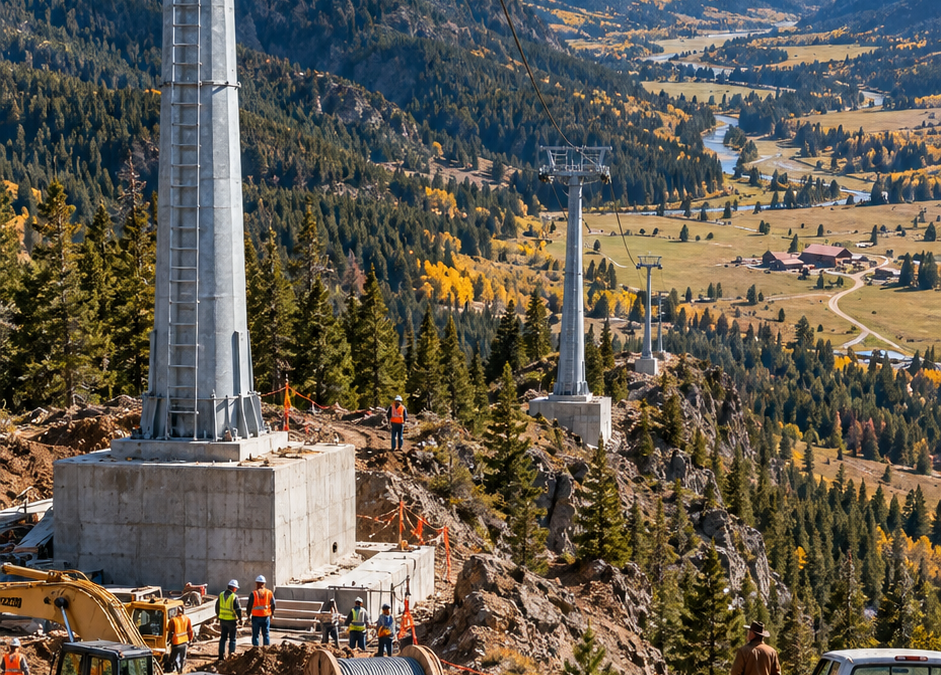
Fresh concrete tower foundations sat in the ground where grass and rock had been two days earlier. Survey stakes with bright orange ribbon marked a line across the ridge. A spool of cable rested near a tracked machine. Several workers in safety vests moved around the site as if they had every right to be there.
For a moment, I did not speak.
I shut off the truck and stepped out slowly.
The wind hit me first. Then the smell of wet concrete.
One of the workers glanced at me, then looked away like I was only a curious neighbor. That irritated me more than if he had challenged me. There is a special kind of insult in being treated like a visitor on your own land.
I walked toward him.
“Who’s in charge here?” I asked.
He turned back, took in my boots, my work jacket, my truck, and finally seemed to understand that I was not part of the crew.
“Site supervisor’s down near the lower staging area,” he said.
“What is this?”
He hesitated.
“You’ll need to talk to the supervisor.”
“I’m asking you.”
He glanced toward the foundations. “Cable system.”
“What kind of cable system?”
“Gondola line.”
The word sounded absurd against the ridge air.
“A gondola,” I repeated.
“Yes, sir.”
“Across my property.”
His expression changed then. Not much, but enough.
“I don’t know about property,” he said carefully. “We were given access.”
“By whom?”
He looked toward the development side of the mountain. “The HOA.”
I stared at him.
“The HOA gave you access to my ridge?”
“That’s what we were told.”
“You have written permission from me?”
“I don’t handle that side.”
“Do you have written permission from anyone who owns this land?”
He swallowed. “Sir, I just work the installation.”
Behind him, another worker stopped moving and listened.
I looked at the fresh concrete again. The foundations were not small. They were not temporary. Someone had planned this, funded it, permitted portions of it, mobilized crews, poured concrete, and strung cable over land my family had owned for generations.
And nobody had called me.
Nobody had mailed a notice.
Nobody had asked for an easement.
Nobody had knocked on my door.
I took out my phone and called the HOA office.
The receptionist recognized my name and immediately became too polite.
“Good morning, Mr. Mercer,” she said. “How can I help you?”
“You can tell Evelyn Reynolds I’m standing on my ridge looking at a gondola cable.”
Silence.
Then papers rustled.
“Ms. Reynolds is in a meeting.”
“No, she isn’t.”
“I’m sorry?”
“She’s either available now, or I’m calling the county sheriff, the land records office, and the state transportation division in that order. Tell her she has five minutes.”
The receptionist’s voice dropped. “Please hold.”
I stood there with the phone to my ear, watching men pretend not to watch me.
After nearly four minutes, Evelyn Reynolds came on the line.
“Mr. Mercer,” she said, smooth as glass. “I understand there’s a concern.”
“A concern?”
“Yes. I was told you had questions about the transportation improvement project.”
“I have one question to start with. Who authorized construction on my property?”
She paused, but only briefly.
“The gondola route has been part of the community’s long-term transportation plan for years.”
“That didn’t answer my question.”
“It was included in the approved development materials.”
“Approved by whom?”
“The association, the planning committee, and the original development board.”
“Did I sign anything?”
“Mr. Mercer, I think it would be better if we discussed this in person.”
“I’m on the ridge.”
“I can be there shortly.”
“Bring every document you think gives you the right to cross my land.”
Her voice cooled. “I’ll bring the relevant file.”
“Bring all of it.”
I ended the call.
The worker nearest me shifted his weight.
“Should we stop?” he asked.
I looked at the hanging cable, the foundations, the equipment, the torn earth.
“That would have been a better question before you poured concrete.”
He looked embarrassed, and I reminded myself he probably had no idea whose land he was on. Workers go where contracts send them. The problem was not the man in the vest. The problem was whoever had decided paperwork was optional because my ridge was inconveniently located.
I stepped back to my truck and pulled out the folder I kept behind the seat.
My father had taught me to keep copies of critical land documents in three places: the house, the barn office, and the truck. Deed, parcel maps, tax records, fence agreements, grazing lease boundaries, timber access history. When I was younger, I thought he was paranoid. As I got older, I realized he had simply lived long enough to understand how often people mistake quiet ownership for weak ownership.
I opened the folder on my hood and found the parcel map for the ridge.
My property line ran exactly where I knew it ran.
The gondola line crossed it cleanly.
Twenty minutes later, a white SUV climbed the access road.
It was too clean for ranch work, too polished for the ridge. It stopped near the site, and Evelyn Reynolds stepped out wearing a camel-colored coat, leather gloves, and the expression of a woman arriving to correct a misunderstanding she had already decided was someone else’s fault.
She carried a thick brown folder under one arm.
I had seen Evelyn before at county meetings and community hearings. She had the practiced confidence of someone who liked microphones, agendas, and rooms where people addressed her as “Madam President.” She was not loud. Loud people reveal too much. Evelyn preferred control. She spoke softly, slowly, and with the kind of patience that implied you were embarrassing yourself by disagreeing.
She walked toward me with a polite smile.
“Mr. Mercer,” she said. “I’m glad we can address this before it becomes unnecessarily contentious.”
I looked at the cable above us.
“You started construction across my ridge without permission. We passed contentious about two foundations ago.”
Her smile tightened.
“I understand this may feel sudden.”
“It doesn’t feel sudden. It feels illegal.”
One of the workers lowered his head and found urgent interest in a toolbox.
Evelyn opened her folder.
“The gondola corridor was contemplated from the beginning of the mountain community project,” she said. “It was designed to reduce vehicle traffic, provide safe winter transportation, and connect upper residences with the valley amenities.”
“I didn’t ask why the HOA wanted it. I asked why it’s on my land.”
“The route follows the planned transportation alignment shown here.”
She removed a large folded map and spread it across the hood of her SUV.
I did not move toward it immediately. Something about the gesture irritated me. She had brought a map as if a printed line could outweigh a deed.
Finally, I stepped closer.
The map was old, worn along the creases, and marked with colored routes. Roads, utility corridors, drainage easements, future trails, and a dotted line labeled “Proposed Aerial Transit Corridor.”
There it was.
A dotted line crossing near my ridge.
Evelyn tapped it with one gloved finger.
“As you can see, this has always been part of the development plan.”
I looked at the map, then at her.
“Where is the recorded aerial easement?”
Her finger stopped moving.
“The corridor is shown on the approved plan.”
“That is not what I asked.”
“The plan establishes the intended route.”
“Evelyn, a drawing does not give you airspace rights.”
She inhaled slowly.
“The association has rights to improve transportation throughout the community.”
“My ridge is not the community.”
“The development surrounds portions of this area.”
“Surrounding land is not the same as owning it.”
She closed the folder halfway, then opened it again, as if the right answer might appear if she handled the papers confidently enough.
“You understand that this system benefits the entire valley,” she said.
“No. I understand that you’re building something over private property without showing me the document that lets you do it.”
“The homeowners have approved funding. Contractors have been retained. State-level discussions have occurred.”
“That still doesn’t create an easement.”
Her eyes sharpened.
“Are you opposed to transportation improvements?”
I almost laughed.
That was the first move people like Evelyn always made when facts turned against them. They tried to turn a property dispute into a character flaw. If I objected to trespass, I was anti-progress. If I asked for documents, I was difficult. If I defended my boundaries, I was standing in the way of the community.
“I’m opposed to people using my land without permission,” I said.
“This is not about taking your land.”
“Then show me the aerial easement.”
She looked toward the workers.
“Perhaps we should discuss this privately.”
“We can discuss it right here.”
“Mr. Mercer—”
“Show me the signed, recorded document granting the HOA or the gondola project the right to cross the airspace over my parcel.”
For the first time since she arrived, Evelyn stopped smiling completely.
Wind moved through the grass around us.
A machine engine idled somewhere behind the crew.
She looked down at the map again.
“The original development materials reference this corridor.”
“That is not an easement.”
“It demonstrates notice.”
“To whom?”
“To affected parties.”
“I never received notice.”
“The documents were public.”
“My deed is public too. That didn’t stop you from ignoring it.”
Her cheeks colored faintly.
“You’re oversimplifying a complex planning issue.”
“No. You’re complicating a simple ownership issue.”
She straightened.
“The HOA proceeded based on the development record.”
“Then the development record better include a signed aerial easement.”
She said nothing.
I folded my arms and waited.
Evelyn finally gathered the map back into the folder with careful, controlled movements.
“I’ll have counsel review the file.”
“You do that. In the meantime, construction stops.”
“I don’t have authority to suspend contractor operations unilaterally.”
“Then get someone who does.”
“The contractor has a schedule.”
“I have a deed.”
She looked at me then with open annoyance.
“This kind of obstruction could expose you to liability.”
That sentence changed the temperature between us.
Until then, I had been angry but measured. I had assumed, generously, that perhaps someone had made a clerical mistake or relied on an incomplete map. But the moment she threatened liability while standing under a cable strung over my land without permission, I understood this was not confusion.
This was pressure.
I stepped closer, keeping my voice low.
“Be very careful, Evelyn.”
Her eyes flicked toward mine.
“You came onto private property with a construction crew, started a permanent aerial transportation project, and now you’re suggesting I may be liable for objecting?”
“I’m saying delays have consequences.”
“So does trespass.”
Neither of us spoke for several seconds.
Then she closed her folder.
“I’ll be in touch.”
“I’ll contact the county first.”
She turned toward her SUV. “That is your right.”
“Yes,” I said. “It is.”
She drove away slowly, raising a thin trail of dust behind her.
The crews did not leave immediately. They stood around in small groups, making phone calls and studying their own paperwork. I took photographs of everything: foundations, stakes, cable alignment, equipment tracks, vehicle plates, contractor markings, and the position of the cable against visible boundary features.
No one tried to stop me.
By noon, the crews had paused active work, though not officially packed up. That bothered me. Paused work could start again the moment I left. I stayed until they loaded several tools and drove down toward the development side.
Only then did I leave the ridge.
At the house, I spread my property records across the kitchen table.
The table had been in my family longer than I had. My parents had signed school forms on it, argued over bills on it, sorted seed invoices on it, and once, after a wildfire came within two miles of the ranch, my father laid every insurance document he owned across its scarred surface and told me, “Paper is boring until paper is the only thing standing between you and someone else’s version of the truth.”
I heard his voice that afternoon as I sorted the documents.
The deed was clear. The parcel description was clear. The ridge boundaries were clear.
I found old survey records, tax maps, and correspondence from when the development first went in. There had been negotiations years earlier about a road maintenance agreement near the lower valley, but nothing about aerial access across the ridge. Nothing about a gondola. Nothing about towers.
I called the county land records office.
A woman named Marcy answered. I had spoken with her before when recording a fence line adjustment with a neighbor. She was efficient, direct, and allergic to drama.
“County Recorder’s Office.”
“Marcy, this is Caleb Mercer.”
“Morning, Caleb. What did someone do now?”
Despite everything, I almost smiled.
“I need to verify whether any aerial easement, gondola easement, transit corridor, or air rights agreement has ever been recorded against my ridge parcel.”
There was a pause.
“That is oddly specific.”
“There’s a cable hanging over it.”
Another pause.
“A cable.”
“A gondola cable.”
She exhaled. “Give me the parcel number.”
I read it to her.
“I’ll search the grantor-grantee index, parcel instruments, subdivision references, transportation agreements, utility filings, and anything tied to the development plat.”
“How long?”
“I’ll do a preliminary search now. Full certification takes longer.”
“I need to know whether there’s anything obvious.”
“You’ll know shortly.”
I waited with the phone on speaker while she searched. I could hear typing, then the faint click of files opening and closing.
After several minutes, she came back.
“I’m not seeing an aerial easement recorded under your parcel.”
“You’re sure?”
“I’m sure enough to say I don’t see one in the indexed records. I see your deed, prior family transfers, a timber access agreement from years back, the old road maintenance document, and a utility easement along the lower boundary. Nothing granting aerial transit rights across the ridge.”
“What about the HOA development plan?”
“I see recorded plats for the development, but a proposed corridor on a plat is not the same thing as an executed easement against your property.”
I closed my eyes.
There it was.
The sentence Evelyn had refused to say.
“Can you email me the preliminary search summary?”
“I can email a non-certified summary. For certified copies, submit the request.”
“Send the summary. I’ll file for certified copies today.”
“You may also want a current boundary confirmation if construction is already happening.”
“I’m calling Daniel.”
“Good.”
Daniel Hart was the county surveyor people called when they wanted arguments to stop being arguments. He had worked in mountain land longer than most developers had been alive. He knew old fence lines, bad maps, forgotten road claims, and every trick people used to stretch a dotted line into a right they did not possess.
I called his office next.
His assistant said he was in the field but would return messages by late afternoon. I left a detailed message, then sent photos.
He called back eighteen minutes later.
“Caleb,” he said, without hello, “tell me those pictures are from someone else’s property.”
“They’re from my ridge.”
“Who installed that cable?”
“Contractor working through the HOA.”
“They have an easement?”
“Recorder doesn’t see one.”
He went quiet.
“Don’t let them pour anything else.”
“They already poured foundations.”
“I’ll come tomorrow morning.”
“Can you come sooner?”
“I’m two counties over.”
“Daniel.”
He heard something in my voice then. Maybe anger. Maybe fear. Maybe both.
He sighed.
“I’ll leave at six. I’ll be there early.”
That night, I barely slept.
Every time I closed my eyes, I saw the cable against the sky.
It is difficult to explain to someone who has never owned land that property is not just dirt. It is memory made physical. It is labor you can stand on. It is the place where your dead still have weight because they built fences, planted trees, dug ditches, repaired roofs, buried dogs, lost money, survived storms, and left behind marks that strangers cannot see.
The ridge was not useful in the way pasture was useful. It did not grow much. It did not shelter equipment. It did not produce hay. But it mattered.
My grandfather had proposed to my grandmother there. My father had scattered my mother’s ashes under the old pine near the overlook. I had stood there after my divorce and watched a storm crawl over the valley, wondering how a place could remain so steady while a life came apart beneath it.
And now a cable hung over it because someone in a meeting had drawn a dotted line.
By dawn, I was already dressed.
I drove up before Daniel arrived, half expecting to find the crews back at work.
They were there.
Two trucks had entered from the development side. Workers were unloading equipment near the second tower location, and a concrete truck was parked below the ridge, engine running.
I stopped hard, gravel snapping under my tires.
One of the supervisors turned as I got out.
“No additional work happens today,” I called.
He walked toward me with a clipboard.
“Sir, you’ll need to speak with project management.”
“I did. They don’t have the easement.”
“We have authorization.”
“From whom?”
“The HOA and project office.”
“The HOA does not own my land.”
He looked tired, like he had been warned about me.
“Our understanding is that this is within the approved gondola corridor.”
“Your understanding is wrong.”
“We’re not here to argue property law.”
“You are standing in the middle of it.”
His jaw tightened.
“We have crews scheduled.”
“And I have a county surveyor on his way.”
That made him pause.
Behind him, men slowed.
“County surveyor?”
“Yes.”
He looked toward the concrete truck, then back at me.
“I’ll make a call.”
“Good.”
He walked away.
I stayed beside my truck, watching every movement. No one touched the foundation forms. No one unloaded more concrete. I took more photos, making sure time stamps captured everything.
Twenty minutes later, Evelyn Reynolds arrived again.
This time, she was not smiling when she stepped out.
She wore dark slacks, a cream sweater, and a wool coat too elegant for the muddy tire tracks near the work zone. The brown folder was back, thicker now, clipped shut with a metal clasp.
“Mr. Mercer,” she said.
“Evelyn.”
“I had hoped we could avoid escalating this.”
“So had I. Then your crews came back.”
“They are operating under existing approvals.”
“Not under an easement.”
Her eyes narrowed.
“The distinction is being reviewed.”
“Construction doesn’t continue while you review whether you have permission to build.”
“You don’t have unilateral authority to shut down a public-benefit project.”
“It’s not public when it crosses private property without rights.”
She stepped closer, lowering her voice.
“You need to understand something. This project has been in planning for years. Homeowners have paid assessments. Contracts have been signed. Investors, county planners, and transportation consultants have all relied on this route. You cannot simply appear at the last moment and derail it.”
I stared at her.
“Appear?”
She blinked.
“I mean—”
“My family has owned this ridge since before your development existed. The cable appeared. I did not.”
For a second, she looked away.
Then she recovered.
“No one is questioning your family history.”
“You are questioning whether it matters.”
“That is not what I said.”
“It is what you’re doing.”
The sound of another vehicle climbing the road ended the exchange.
Daniel Hart’s county truck came over the rise and stopped near the survey stakes. He stepped out wearing a faded field jacket, work boots, and a cap that looked older than some of the houses across the valley. He moved slowly, not because he was weak, but because he had learned that hurrying made people think confusion was acceptable.
He nodded at me.
“Caleb.”
“Daniel.”
He looked at Evelyn, the workers, the foundations, the cable, and the equipment.
Then he looked up.
“Well,” he said, “that’s not subtle.”
Evelyn approached him with official politeness.
“Mr. Hart, I’m Evelyn Reynolds, president of the Mountain Crest Homeowners Association. We appreciate the county’s willingness to clarify this matter.”
Daniel shook her hand.
“I’m here to verify boundary conditions and review what’s being constructed relative to recorded parcels.”
“We have development documents available.”
“I’ll look at everything.”
He opened the back of his truck and began unloading equipment.
There is something deeply calming about watching a competent person work when everyone else has been arguing. Daniel did not care about tone, pressure, polished folders, or community vision statements. He cared about monuments, bearings, recorded descriptions, survey history, and where the ground said the line actually was.
He set up his instrument, checked reference points, and began moving through the ridge with deliberate precision.
Evelyn stood several yards away, arms folded.
The contractor supervisor hovered near his truck.
I stayed close enough to answer questions but far enough not to interfere.
Daniel found the old boundary markers exactly where I expected them. One iron pin near the rock shelf. Another partially obscured by brush. A third near the old fence line. He checked them against the parcel records, then against the construction staking.
After nearly an hour, he stood beneath the gondola cable and looked down at his tablet.
Then he looked up at the cable again.
No one spoke.
That silence had weight.
Finally, Daniel turned toward Evelyn.
“This line is crossing Mercer’s private parcel.”
Evelyn opened her folder immediately.
“The transportation corridor is shown in the development plan.”
Daniel held up one hand.
“I’m not talking about planning intent. I’m talking about the physical alignment relative to recorded property boundaries.”
He tapped the map on his tablet.
“The cable is not simply crossing a road, trail corridor, or common area. It passes through the airspace above this parcel.”
Evelyn’s lips pressed together.
“We understand there may be overlap near the ridge, but—”
Daniel interrupted gently.
“Where’s the aerial easement?”
The question landed hard.
It was not angry. It was not dramatic. That made it worse for Evelyn.
She looked down at her folder.
“As I explained to Mr. Mercer, the gondola route appears in the original development materials.”
“I heard that,” Daniel said. “Where is the recorded easement granting the project the right to occupy or pass through the airspace above his land?”
“The documents reference a future transportation corridor.”
“Reference is not grant.”
“The community relied on this alignment.”
“Reliance is not recordation.”
Her face hardened.
Daniel turned to the contractor supervisor.
“Do you have project documentation showing right of access across this parcel?”
The supervisor looked uncomfortable.
“I have plans, permits, and access authorization from the HOA.”
“Do those include a signed easement from the landowner?”
“I’d have to check with the project office.”
Daniel nodded.
“Do that.”
The supervisor stepped away with his phone.
Evelyn said, “Mr. Hart, surely the county approved aspects of this project before construction began.”
Daniel looked at her calmly.
“County review of planning documents does not create private property rights. If a route requires crossing private land or airspace, the project needs documentation establishing that right.”
“The corridor has been on maps for years.”
“Then the easement should be easy to produce.”
She had no answer.
For the first time since the dispute began, I saw something in Evelyn’s expression that looked almost like uncertainty.
Not regret.
Not yet.
But uncertainty.
Daniel unfolded a paper map across the hood of his truck and weighted the corners with field tools. He marked the recorded parcel boundaries, then overlaid the planned gondola route. The line crossed my ridge plainly enough that even a child could see the conflict.
“This is the issue,” he said, pointing with a pencil. “The planned route may have existed conceptually. But the recorded parcel boundary is here. The cable alignment is here. If you don’t have an easement, license, condemnation order, or other recorded property right, then the project has a documentation problem.”
Evelyn’s voice became sharper.
“Are you issuing a stop-work order?”
“That may fall to the relevant project authority or state transportation office, depending on permit conditions. I’m documenting the boundary conflict.”
“But your position is that construction cannot continue?”
“My position is that the project needs to show legal authority to cross this parcel.”
“That is a legal conclusion.”
“It’s a surveying conclusion that triggers a legal question.”
I looked at Evelyn.
“She asked whether you were shutting it down because she doesn’t want to be the one to tell the crews to stop.”
Evelyn turned on me.
“That is unnecessary.”
“No,” I said. “What’s unnecessary is pouring concrete first and looking for permission afterward.”
Her eyes flashed.
“You are assuming bad faith.”
“I’m observing behavior.”
Before she could answer, another vehicle came up the ridge.
This one was dark blue, with state plates.
It parked beside Daniel’s truck, and a man in a gray jacket stepped out carrying a slim case and a tablet. He looked younger than Daniel but older than the contractor supervisor, with the weary composure of someone who had spent years walking into disputes nobody wanted to own.
Daniel nodded to him.
“Ray.”
“Daniel.”
Evelyn straightened immediately.
“Mr. Calder,” she said, forcing warmth back into her voice. “Thank you for coming.”
Ray Calder shook her hand, then mine.
“State Transportation Project Compliance,” he said. “I understand there’s a question regarding the gondola alignment and private property rights.”
“That is one way to put it,” I said.
He looked up at the cable.
“I can see the alignment.”
Evelyn opened her folder again.
“We have the community declaration, the development plat, the long-term transportation plan, and references to the future gondola corridor. This project has not appeared out of nowhere.”
Ray nodded. “Let’s review the documents.”
She led him to her SUV and spread the papers across the rear cargo area like evidence in a trial.
I watched her hands.
They were steady, but her movements were faster now.
She showed him the old development map. The community declaration. The plat. Pages referencing future transportation improvements. Assessment approvals. Planning notes. A corridor study.
Ray listened without interrupting.
Then he asked, “Where is the instrument granting aerial crossing rights over the Mercer parcel?”
Evelyn paused.
“The corridor is referenced in these materials.”
“I see that.”
“And the community development plan contemplated this connection from the beginning.”
“I see that too.”
“The association proceeded based on that record.”
Ray looked at her.
“I still need the property-right document.”
Evelyn glanced toward me, then back at him.
“We’re reviewing whether a separate document exists.”
I stepped forward and placed my deed and parcel description beside her HOA papers.
“This is my recorded deed,” I said. “The county recorder found no aerial easement indexed against my parcel. Daniel’s survey confirms the cable crosses my boundary.”
Ray picked up the deed and reviewed it carefully. Then he looked at Daniel’s map.
For several minutes, no one spoke except to answer small factual questions.
Ray asked about tower locations, cable height, construction access points, staging areas, recorded rights-of-way, and whether any notice had been sent directly to me as the affected landowner.
Evelyn said notices had been posted in community materials.
I said I was not a member of the HOA.
Ray made a note.
Evelyn said the project had been discussed publicly.
I said public discussion did not transfer property rights.
Ray made another note.
The contractor supervisor returned and quietly told Ray he did not have a signed easement in his field packet.
Ray asked whether the project office could produce one electronically.
The supervisor made another call.
While he waited, the ridge held its breath.
A few workers stood near the equipment pretending not to listen. The concrete truck was gone now, sent away or delayed. The cable still hung above us like the physical shape of someone’s assumption.
Finally, the supervisor lowered his phone.
“They’re checking central records,” he said.
Ray’s expression did not change.
“How long?”
“I don’t know.”
Ray turned to Evelyn.
“Until documentation is produced, no additional tower work should proceed on the affected segment.”
Evelyn stiffened.
“Is that a formal directive?”
“It is a compliance instruction pending documentation review.”
“This delay has cost implications.”
“I understand.”
“Crews are scheduled. Equipment has been mobilized.”
“I understand that as well.”
“The project has public-safety and winter-access benefits.”
Ray’s voice remained even.
“None of that answers the property-right question.”
The words struck harder because they were so plain.
Evelyn looked at the cable, then at the ridge beneath it, then finally at me.
For the first time, she addressed me without the performance.
“Would you consider signing an agreement for the route?”
The question surprised me less than the way she asked it.
No threat.
No speech about community benefit.
No liability warning.
Just the question that should have been asked before the first crew ever climbed my road.
I looked across the valley.
From up there, the HOA development looked almost peaceful. Rooflines tucked among trees. Roads curving neatly through the slope. Houses built for views they had not earned but had paid dearly to possess. I imagined families there wanting a gondola because winter roads were dangerous, because driving down the mountain took time, because convenience always looks reasonable from the side that benefits.
I was not against transportation.
I was not against safety.
I was not even against progress, though people like Evelyn loved using that word as if it ended every argument.
What I was against was being erased.
I turned back to her.
“I would have considered a discussion before construction started.”
Her face tightened, but she said nothing.
“I would have considered reviewing an alignment,” I continued. “I would have considered compensation, conditions, height restrictions, access limitations, environmental protections, liability terms, emergency protocols, and whether the route could be shifted. I would have considered all of that because adults discuss property rights before they build over someone’s land.”
Evelyn lowered her eyes for half a second.
“Can we have that discussion now?”
“Not while there’s active construction on my ridge.”
Ray looked between us.
“That is reasonable. The project office will need to provide documentation or pursue a proper agreement before work continues on this segment.”
The contractor supervisor nodded reluctantly.
“I’ll notify the crews.”
Daniel folded his map.
“I’ll finalize the boundary memo and send it to the county file.”
Evelyn closed her folder.
The sound was small, but it felt final.
For the rest of the afternoon, the ridge changed from a construction site into a place of waiting.
Workers secured equipment. Nothing new was poured. No new tower work began. The men who had arrived in the morning expecting a normal day left with cautious glances and quiet conversations. The contractor supervisor gave me a business card and said his company would not resume work on the disputed section until the project office provided clearance.
I appreciated the sentence but did not mistake it for trust.
Ray Calder wrote his preliminary instruction into an email before leaving the site. He read the key line aloud because I asked him to.
“Pending verification of recorded aerial property rights or execution of an appropriate agreement with the affected landowner, no further construction activity shall proceed on the Mercer ridge segment.”
For the first time in two days, my lungs fully opened.
Evelyn heard it too.
Her jaw moved slightly, as if she wanted to object again but could not find a sentence that would survive the documents around her.
When Ray left, Daniel stayed behind for a few minutes.
The wind had strengthened. It moved through the pines and made the cable hum faintly overhead.
Daniel looked up at it.
“Ugly thing,” he said.
I almost laughed, but it came out tired.
“Yeah.”
“You handled yourself well.”
“I wanted to do a lot worse.”
“I know.”
I looked at the disturbed ground, the concrete foundations, the tire tracks pressed into soil that had not seen heavy equipment in decades.
“My father would have hated this.”
Daniel was quiet for a moment.
“Your father hated most things that arrived without asking.”
That time, I did laugh.
It hurt a little.
“He always said maps are dangerous in the hands of people who don’t respect fences.”
“He was right.”
Daniel packed the last of his equipment into the truck, then turned back to me.
“Get certified records. Get counsel if they push. Don’t rely on verbal assurances.”
“I won’t.”
“And Caleb?”
“Yeah?”
“Don’t let them make you feel unreasonable for requiring the thing they should have had from the start.”
After he drove away, only Evelyn and I remained.
Her SUV was parked near the access road. Mine was beside the old fence post. Between us sat the interrupted machinery, the fresh concrete, and years of assumptions finally dragged into daylight.
She walked toward me slowly.
“I should have contacted you earlier,” she said.
It was not an apology, exactly.
But it was the closest she had come.
“Yes,” I said.
“The board believed the corridor rights had been addressed during the original development process.”
“You’re the board president. Belief is not documentation.”
“I understand that now.”
I studied her face.
There was still pride there. Still calculation. But also fatigue. Maybe even fear. Not fear of me, but fear of explaining to homeowners why a project they had already paid for was now tangled in a property dispute that could have been avoided by one honest conversation.
“Do you?” I asked.
She looked toward the cable.
“I understand that we have a problem.”
“That’s not the same thing.”
She turned back.
“What do you want, Mr. Mercer?”
The honest answer was complicated.
I wanted the cable gone.
I wanted the ridge restored.
I wanted the people who treated my family’s land like blank space to stand where my father stood after my mother died and understand why a dotted line on a map could feel like a hand reaching into a grave.
But I also knew the world was not built from wanting.
The concrete existed. The cable existed. The project existed. So did my deed.
“I want the construction stopped until the rights are handled correctly,” I said. “I want all documents. I want the recorded history. I want the engineering plan. I want the environmental review. I want proposed maintenance access. I want liability terms. I want compensation addressed. I want restoration for damage already done. And I want everyone involved to remember that my land is not a gap in your paperwork.”
She listened without interrupting.
Then she nodded once.
“I’ll speak with counsel.”
“Good.”
“We may be able to propose terms.”
“You may.”
Her mouth tightened slightly at the way I said it.
Then she walked back to her SUV.
Before getting in, she paused.
“For what it’s worth, I did not intend this to feel like a violation.”
I looked at the cable above us.
“That’s the thing about violations,” I said. “They don’t require your intention. Just your action.”
She had no answer.
Her SUV rolled down the ridge and disappeared into the trees.
I stayed long after everyone left.
The sun dropped toward the mountains, turning the valley copper and shadow. The construction site looked different in evening light. Less powerful. More exposed. The machines were just machines now. The stakes were just sticks. The cable, still dark against the sky, no longer looked inevitable.
It looked challenged.
I walked to the old pine near the overlook.
The ground beneath it was undisturbed. For that, I was grateful in a way that nearly broke me. I stood there with one hand on the rough bark and listened to the ridge settling back into itself.
I thought about my father.
I thought about all the times I had rolled my eyes as a younger man when he corrected a boundary description, saved a receipt, or drove into town to record some document nobody else thought mattered. I had mistaken his vigilance for stubbornness because I had not yet lived through the kind of day when a stranger’s confidence arrives on your land before their proof does.
The next morning, the certified search request went in.
By afternoon, my attorney had copies of the deed, the survey memo, Ray Calder’s compliance instruction, and every photograph I had taken. The HOA’s counsel sent a carefully worded email acknowledging that construction on the ridge segment would remain paused pending review of “applicable property rights.”
I read that phrase several times.
Applicable property rights.
Such clean words for such a dirty feeling.
Over the next week, the crews stayed away.
The equipment was removed in stages. The tower foundations remained, capped and marked, waiting on whatever came next. The cable was secured but unused. No gondola cars moved across my ridge. No one entered through my gate.
Neighbors called.
Some were curious. Some were sympathetic. A few from the HOA community tried to explain how important the gondola would be for winter access, as if I had caused the missing easement by noticing it.
One man told me, “You know, this project helps a lot of families.”
I said, “Then the people managing it should have protected it by doing the paperwork correctly.”
He did not have much to say after that.
Evelyn requested a formal meeting two weeks later.
This time, it happened in my attorney’s office, not on the ridge. She came with HOA counsel, two board members, and a transportation consultant. I came with my attorney, Daniel’s survey memo, and the quiet confidence of a man who had stopped arguing from emotion because the record had finally caught up with the truth.
The meeting was not friendly.
But it was different.
No one claimed the development map was enough. No one suggested I was obstructing progress. No one threatened liability. They discussed alternatives, mitigation, compensation, and whether the alignment could be shifted away from the most sensitive part of the ridge.
Nothing was signed that day.
I did not expect it to be.
But before we left, Evelyn looked across the table and said, “The association acknowledges that no recorded aerial easement has been located for the Mercer ridge segment at this time.”
My attorney wrote the sentence down.
So did hers.
That was enough for one day.
Months may pass before the final answer is decided. They may reroute the gondola. They may negotiate. They may abandon that segment entirely. That part remains unfinished, not because the truth is unclear, but because correcting an assumption takes longer than making one.
But the ending that mattered to me came earlier.
It came on the ridge, beneath that cable, when the state representative told the crews no more work would move forward until the property rights were real and documented.
It came when Evelyn Reynolds lowered her brown folder and finally asked a question instead of making a claim.
It came when the machines went quiet.
Now, some evenings, I drive back up to the ridge.
The scars are still there. Concrete does not vanish because someone admits they should have asked first. Tire tracks remain in places where the grass has not yet grown back. The cable still cuts across the sky for now, a dark reminder of how easily people with plans can forget people with deeds.
But the ridge is quiet again.
Not untouched.
Not innocent.
Quiet.
And when I stand beneath the old pine and look across the valley, I no longer see only the violation.
I see the line that held.
I see my grandfather’s fence posts, my father’s records, my mother’s resting place, and the land itself refusing to become someone else’s shortcut simply because they had drawn a convenient path through it.
That is what Evelyn never understood when she arrived with her folder and her confident explanations.
Land does not defend itself with anger.
It defends itself with memory, boundaries, and proof.
And on the morning they tried to hang a gondola over my ridge without asking, all three were waiting for them.








