𝗙𝗨𝗟𝗟 𝗦𝗧𝗢𝗥𝗬 The Bridge Looked Forgotten Until the HOA Claimed It Had Always Belonged to Them
𝗙𝗨𝗟𝗟 𝗦𝗧𝗢𝗥𝗬
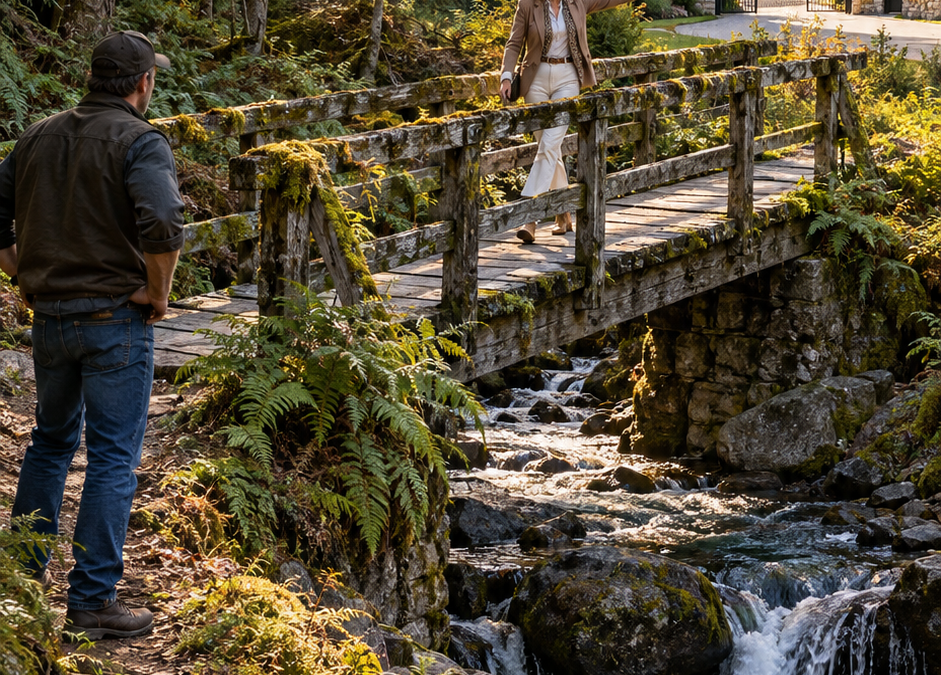
He glanced at my notebook. “You the new owner?”
“I am.”
“Nice place.” He smiled. “Name’s Tom Keller. I live over in Laurel Ridge.”
I introduced myself.
His dog sniffed the rail, uninterested in property law.
Tom looked around the creek like he was seeing it through my eyes for the first time. “People were wondering who bought it.”
“I’m still learning what I bought.”
He nodded toward the bridge. “This old thing’s been here forever.”
“How long have residents been using it?”
“As long as I’ve lived here. Twelve years at least. Probably longer. It connects to our walking loop.”
“Does the HOA own the land under it?”
Tom blinked, surprised by the question.
“I don’t know,” he said. “Everyone always assumed they did.”
Assumed.
That word has caused more damage in property disputes than almost any other.
“Who maintains the bridge?” I asked.
“The HOA sends someone out once in a while. They fixed the railing last spring. Replaced a few boards maybe two years ago.”
“Do you know if there’s an easement?”
He looked uncomfortable now. Not defensive, just aware that the conversation had moved into territory he did not understand.
“I wouldn’t know,” he said. “We were told it was community access.”
“Told by who?”
“The board, I guess.”
He gave a small shrug, then gently tugged the dog’s leash. “I hope there’s no problem. A lot of people use this crossing.”
“That may be the problem,” I said.
Tom did not argue. That made me like him.
He just nodded, said he hoped everything worked out, and continued into the trees on my side of the creek like it was still normal.
I watched him go.
Then I wrote one sentence in my notebook.
Find original deed.
A few days later, Rebecca arrived.
I was clearing fallen branches near the upper trail when I saw her crossing the bridge with two walking poles and the energy of someone who believed the whole mountain should step aside for her.
She was in her late forties, dressed in expensive outdoor clothing that looked too clean for actual woods. Her hair was pulled back tightly, her sunglasses were perched on top of her head, and she carried a folder under one arm.
She did not introduce herself at first.
She looked at the brush pile, then at me, then toward the bridge.
“You’re the new owner,” she said.
“That’s right.”
“I’m Rebecca Sloan, president of the Laurel Ridge HOA.”
There it was.
I wiped my hands on my jeans. “Nice to meet you.”
She did not return the courtesy.
“We need to discuss the bridge.”
“I figured someone would.”
Her eyes sharpened. “Good. Then you understand it is an established community access point.”
“I understand people have been using it.”
“That bridge is ours.”
She said it flatly.
Not as a question.
Not as a belief.
As if repeating it with enough confidence could make the deed rewrite itself.
I looked past her at the structure, moss on the railing, creek flashing below.
“Show me the document proving that,” I said.
Rebecca smiled in a way that made clear she had not expected resistance so soon.
“The HOA has maintained access through this bridge for years.”
“Maintenance is not ownership.”
“It establishes use.”
“It may establish that someone paid for repairs. It does not prove your association owns the bridge or the land underneath it.”
Her face changed.
People like Rebecca are rarely angered by insults as quickly as they are angered by precision.
“The residents rely on this crossing,” she said.
“That still doesn’t answer the ownership question.”
“The previous owner never objected.”
“I’m not the previous owner.”
She took one step closer. “Let me be clear. Laurel Ridge considers this bridge part of its trail system. Any interference with that access will create a serious issue.”
I held her gaze. “Let me be clear. I just bought this property. I’m reviewing the boundaries and records. Until I know exactly what rights exist, nobody should assume they can cross my land.”
“You can’t just cut off access people have used for years.”
“I haven’t cut off anything. I asked for proof.”
Rebecca opened her folder and pulled out several pages. They looked like HOA meeting notes, maintenance invoices, and a printed trail map. She held the map out, tapping a dotted line that crossed the creek.
“This is the Laurel Ridge trail system.”
I studied it.
The map was polished. Color-coded. Labeled. Very official-looking.
But official-looking documents are sometimes only artwork with confidence.
“Who prepared this map?” I asked.
“Our landscape committee originally, then it was updated by the board.”
“Is it recorded with the county?”
“That isn’t necessary for a community trail map.”
“Then it doesn’t establish property rights.”
Rebecca’s lips pressed together.
She slid the pages back into her folder.
“I’m going to advise the board that we may have a problem.”
“You do that.”
She started back toward the bridge, then turned.
“I hope you understand something,” she said. “People move here for access to nature. That bridge matters to this community.”
I looked around at my trees, my creek, my side of the mountain.
“It matters to me too.”
She crossed without another word.
That conversation changed the way I saw the property.
Before Rebecca, the bridge had been a curiosity.
After Rebecca, it became a question with weight.
That evening, I spread every closing document across my kitchen table. The house I was renting while planning the build still smelled faintly of cardboard boxes and sawdust from a shelf I had installed the day before. Rain tapped against the window. The mountain went black beyond the glass.
I pulled out the title packet.
Warranty deed.
Survey.
Tax map.
Disclosure forms.
Old title exceptions.
The bridge appeared only on the simple property map, a thin black mark over the creek, unlabeled except for the word footbridge.
That was not enough.
I needed older records.
The next morning, I drove to the county records office.
The clerk helped me pull the chain of title, and that is where the land began telling its real story.
The original deed was much older than the closing packet. It had been copied and recopied over decades, but the legal description remained intact: calls to stone markers, old trees, creek bends, ridge lines, and long-vanished property owners whose names sounded like they belonged to another century.
I sat at a public terminal and followed the boundary language line by line.
It was slow work.
Metes and bounds descriptions can feel like reading a map through a keyhole. From a white oak to a stone pile. From the stone pile south sixty-two degrees east to the creek bend. Along the creek to the narrow crossing. From the crossing to the old chestnut stump.
Most people skim that kind of language.
I did not.
Because near the bottom of the second page, I saw the phrase that made me stop.
Thence across the narrow crossing at Mill Creek, including the timber footbridge and approach thereto…
I read it once.
Then again.
Then a third time, slower.
Including the timber footbridge and approach.
My pulse changed.
The deed did not treat the bridge as separate from the parcel. It described it as part of the boundary area and included the approach. The old landmark names were different now, but the geography matched what I had seen. Narrow crossing. Creek bend. Slope to the north. Trail toward what had once been a timber road.
The wording suggested the structure stood entirely within the property I had just bought.
But suggested was not enough.
I needed someone qualified.
The next morning, I called a property attorney named Daniel Mercer. A contractor friend had recommended him after a boundary dispute involving a private road. Daniel’s office was in an old brick building downtown, the kind with worn stairs and law books still displayed in the conference room even though everyone used computers now.
I brought everything.
The closing documents.
The simple map.
The old deed.
The survey.
Photos of the bridge.
Photos of the trail.
Rebecca’s trail map, which I had photographed before handing it back.
Daniel read quietly for almost fifteen minutes.
That impressed me.
Bad attorneys talk too soon. Good ones read first.
When he reached the historical description, he leaned closer.
“Interesting,” he said.
“That sounds expensive.”
He smiled faintly. “It often is.”
He read the crossing language again, then compared it with the survey.
“Who has been maintaining the bridge?” he asked.
“The HOA, apparently. They repair railings and boards occasionally.”
“Do they claim ownership?”
“Yes.”
“Based on what?”
“Maintenance records and use.”
He sat back. “Maintenance history can matter, but it does not automatically create ownership. Paying to repair something on another person’s land may show use, permission, mistake, or assumption. It does not, by itself, transfer title.”
“That’s what I thought.”
“Have they produced a recorded easement?”
“No.”
“License agreement?”
“No.”
“Deed?”
“No.”
“Any recorded trail right?”
“Not that I’ve seen.”
He tapped the old deed. “Then the bridge description is significant.”
“What do I do?”
“We verify the physical location. We compare the deed, survey, markers, and current bridge position. Then we ask the HOA to produce whatever recorded right they think they have.”
“And if they don’t have one?”
“Then they have a problem.”
He paused, then added, “And so do you, because people hate losing access they thought was theirs.”
We visited the property together that afternoon.
Daniel arrived in a gray pickup, wearing boots instead of office shoes, which immediately raised my opinion of him. He brought a survey copy, a metal probe, and a notebook. We walked the creek line slowly. He was not a surveyor, and he made that clear, but he knew enough to compare records with physical evidence.
The creek was running high from the rain.
Water rushed under the bridge, striking rocks hard enough to send spray against the lower beams. Leaves stuck to the damp planks. The forest smelled like wet bark and soil.
Daniel studied the approach.
“This has been used heavily,” he said.
“Residents?”
“Likely.”
He pointed to the packed trail. “That kind of wear doesn’t happen from one owner walking it twice a month.”
We searched near the old landmark calls. The white oak mentioned in the deed was long gone, but the creek bend remained. So did a stone cluster partly buried in leaves near the slope. Then, near the bridge approach on my side, Daniel stopped and crouched.
“Here.”
I knelt beside him.
At first, I saw only leaves and mud.
Then he brushed debris aside and revealed an old iron marker, half sunk into the ground, rusted but still solid.
It sat only a few feet from the bridge approach.
Daniel checked it against the survey.
Then against the deed calls.
Then he stood and looked across the creek.
“This is very close,” he said.
“To what?”
“To exactly where the historical survey says it should be.”
The bridge creaked behind us.
I turned.
Rebecca was crossing from the HOA side with two board members behind her.
She must have seen us from the trail or been called by someone watching from a nearby house. Either way, she moved quickly, face tight, folder in hand again.
“What are you doing?” she demanded.
Daniel answered before I could.
“Reviewing property records.”
“And you are?”
“Daniel Mercer, counsel for the property owner.”
Rebecca’s expression changed immediately.
Not fear.
Calculation.
She looked at me. “You hired an attorney?”
“You brought an HOA claim onto my land.”
“This is not your land alone.”
Daniel said, “That is precisely the question.”
One of the board members, a tall man with silver hair and a vest embroidered with the Laurel Ridge logo, stepped forward.
“This bridge has always served our community,” he said.
Daniel looked at him. “What is your name?”
“Charles Brant. HOA vice president.”
“Mr. Brant, does the HOA have a recorded deed, easement, or license granting access across this parcel?”
Charles looked at Rebecca.
Rebecca opened her folder.
“We have maintenance records.”
Daniel waited.
Rebecca pulled out invoices. Railing repair. Plank replacement. Trail clearing. Liability inspection. The amounts were not huge, but they went back years.
“We have paid to maintain that bridge,” she said.
Daniel took the copies, reviewed them briefly, then handed them back.
“These show expenditures. They do not show ownership.”
Charles bristled. “Why would we maintain a bridge we don’t own?”
I answered that one.
“Because nobody checked.”
Rebecca glared at me.
Daniel unfolded the historical survey and laid it on a flat rock near the creek. He anchored one corner with his notebook.
“This deed description includes the timber footbridge and approach at the narrow crossing,” he said. “The current physical markers appear consistent with the bridge being inside my client’s parcel.”
Rebecca leaned over the map.
Her face hardened.
“That is an old document.”
“Yes,” Daniel said. “Recorded documents often are.”
“The HOA has relied on this bridge for years.”
“Reliance does not answer the title question.”
Charles said, “You can’t expect an entire community to stop using a trail because of some old wording.”
Daniel looked at him calmly. “Old wording is how land ownership is usually defined.”
Rebecca straightened. “We are calling an emergency meeting.”
“Good,” I said. “Bring the deed.”
She gave me a look that told me she still believed public pressure could do what paperwork could not.
That evening, my phone began lighting up.
At first, the messages came from numbers I did not recognize. Then emails arrived through a neighborhood contact list I had never joined. Someone had clearly circulated my name.
Please don’t close the bridge. My kids use it every weekend.
This trail has been part of Laurel Ridge for years.
Why would you buy land beside a community and then attack us?
One message simply said:
You are taking away something that belongs to everyone.
I did not reply.
Daniel had warned me not to debate residents individually.
“Let Rebecca turn this into a mob if she wants,” he said over the phone. “You stay factual.”
The emergency meeting was scheduled for the next night at the Laurel Ridge clubhouse.
I did not have to attend.
Daniel said we could send a letter.
But I wanted to see the room.
Not because I wanted a fight.
Because I needed to understand what story Rebecca had told them.
The clubhouse sat high above the creek, all stone veneer, tall windows, exposed beams, and warm lighting. It looked like a mountain lodge built by people who had never chopped wood but loved the idea of fireplaces. When I arrived with Daniel, the parking lot was almost full.
Inside, residents packed the meeting room.
Some stood along the back wall. Others sat with arms crossed, already angry. A few turned to stare as I entered. I heard whispers ripple across the rows.
“That’s him.”
“The new owner.”
“He wants to shut it down.”
Rebecca sat at the front table with Charles and three other board members. She looked composed, prepared, and righteous.
That worried me more than if she had looked angry.
Righteous people can justify almost anything.
She opened the meeting with a statement.
“As many of you know, Laurel Ridge is facing an unexpected challenge regarding our historic creek bridge access,” she said. “For many years, residents have enjoyed and maintained that crossing as part of our community trail system. Recently, the new owner of the adjacent parcel has questioned that access and suggested the bridge may not belong to the community.”
Murmurs spread.
Rebecca continued.
“I want to be clear. Your board is committed to protecting community access, preserving our trail system, and defending the amenities that make Laurel Ridge special.”
People applauded.
Not everyone.
But enough.
Daniel leaned toward me. “She skipped the deed.”
“I noticed.”
Rebecca summarized maintenance history. She showed photos of volunteer cleanup days. She displayed the trail map with the dotted line crossing the creek. She mentioned money spent on repairs. She talked about community tradition, safety, recreation, and property values.
She did not mention recorded ownership once.
By the time she finished, half the room looked ready to blame me for stealing their childhood memories, even though I had owned the land for less than two weeks.
Then Rebecca said, “The new owner has asked to speak.”
That was not exactly true.
I had not asked.
But I stood anyway.
My hands felt cold, but my voice came out steady.
“My name is Nathan Whitaker,” I said. “I bought the property across the creek because it is outside the HOA. I did not buy it to create conflict. I did not buy it to punish residents. And I did not come here tonight to argue about whether people enjoy using the bridge.”
I looked around the room.
“That is not the issue.”
Someone muttered, “Then what is?”
“The issue is whether the HOA has a legal right to claim ownership or access across my land.”
Rebecca started to interrupt, but Daniel shifted beside me, and she stopped.
I continued.
“When I found the bridge, I checked my property records. The old deed describes the creek crossing and includes the timber footbridge and its approach. We also found an old boundary marker near the bridge that appears consistent with that description.”
I held up the survey copy.
“The boundary does not stop at the water in the way the HOA trail map suggests. It crosses the creek area and includes the bridge location.”
A man in the second row stood. “But we’ve used that trail for years.”
“I understand.”
“My kids learned to fish down there.”
“I understand that too.”
“Then why are you trying to take it?”
The room stirred again.
I took a breath.
“I am not trying to take anything. I am trying to establish what I already bought.”
That quieted some people.
Not Rebecca.
She leaned into her microphone. “The HOA has maintained that bridge for years.”
Daniel stood then.
“May I respond?”
Rebecca looked like she wanted to refuse, but with the room watching, she nodded.
Daniel introduced himself, then spoke plainly.
“Maintenance records are not the same as ownership records. If the HOA has a recorded deed, easement, license, dedication, or other instrument granting bridge access across Mr. Whitaker’s parcel, this would be the time to identify it.”
Rebecca’s jaw tightened.
Daniel continued.
“My client has asked for documentation. To date, he has received maintenance invoices, meeting notes, and an internal trail map. None of those documents transfer ownership of land. None create a recorded easement.”
Charles leaned toward his microphone. “Counsel, are you saying our residents have no rights at all?”
“I am saying your board has not yet produced the documents required to prove the rights it claims.”
A woman near the front raised her hand. “What happens if there is no easement?”
Rebecca said quickly, “We are not accepting that conclusion.”
Daniel said, “Then the HOA should produce its recorded support.”
The room shifted again.
Not fully in my favor.
But away from certainty.
That was enough.
Facts do not always win quickly. Sometimes they just slow down a lie.
After the meeting, several residents approached me.
Some were angry.
One man told me I was destroying the neighborhood. A woman accused me of trying to extort the HOA. Another insisted that because the bridge had been used before I bought the property, I had accepted that use automatically.
Daniel handled most of them with calm repetition.
“We are reviewing recorded rights.”
“Please direct legal questions to the board.”
“Maintenance does not establish title.”
“Use and ownership are different questions.”
Then Tom Keller, the neighbor with the golden retriever, came up quietly.
“I’m sorry,” he said.
“You didn’t do anything.”
“I told people everyone assumed the HOA owned it. I should have said we didn’t know.”
“That’s more honest than most.”
He glanced toward Rebecca, who was surrounded by residents near the front table.
“People are worried,” he said.
“I know.”
“My wife walks that bridge almost every morning. It’s the only easy loop without going along the road.”
“I’m not trying to hurt anybody.”
“I believe you.”
That mattered.
More than I expected.
The next week became a storm of paperwork.
Daniel sent a formal demand to the HOA requesting any and all documents supporting ownership, access, maintenance authority, trail rights, bridge control, or easement claims. He also advised them that until rights were clarified, expanded use, repairs, modifications, or assertions of ownership should stop.
Rebecca responded through the HOA attorney, Philip Grant.
Grant’s first letter sounded confident but thin.
He claimed the HOA had “longstanding use and maintenance history” and that residents had relied on the bridge as part of the community trail system. He also suggested that any attempt to restrict access could create claims based on historical use.
Daniel read the letter in front of me and made a sound somewhere between a laugh and a cough.
“He has no deed,” he said.
“How do you know?”
“If he had one, it would be in paragraph one.”
Daniel replied with the old deed language, survey references, photos of the marker, and a request for recorded documentation—not general reliance, not community expectations, not emotional history, but documents.
Two days later, Grant asked for more time.
That told us plenty.
While the lawyers exchanged letters, I visited the bridge every morning.
Not to guard it.
To understand it.
I began noticing things I had missed before.
Initials carved into the underside of the rail. Old bolt heads with square edges. A repair plank newer than the rest. A place where the trail had been widened by years of boots avoiding a muddy spot. A faded ribbon tied to a tree near the HOA side. A small smooth stone placed on one bridge post, probably by a child.
The bridge did not feel malicious.
It felt loved.
That complicated my anger.
Because Rebecca was wrong. The HOA had no right to claim what it could not prove. But the residents were not all villains. Many had simply believed what they were told. They had walked dogs there, taught children to skip stones there, taken quiet mornings there. Their attachment was real.
But attachment is not ownership.
And that distinction mattered.
A week later, Daniel and I met a licensed surveyor named Claire Emerson at the property.
She spent six hours there.
She found old markers, checked modern coordinates, compared deed calls, ran measurements across the creek, and flagged the relevant boundary. By the time she finished, small orange flags showed what had been invisible to most people for years.
The bridge was inside my property line.
Not partly.
Not close.
Inside.
The approach from the HOA side touched a trail easement within their subdivision, but the bridge structure itself and the immediate crossing sat on my land.
Claire gave no dramatic speech.
Surveyors do not need to.
She just said, “I’ll prepare the certified survey.”
Rebecca arrived near the end.
This time, she came with Philip Grant.
He was a compact man with silver glasses, a leather portfolio, and the cautious expression of an attorney who had begun to suspect his client had oversold the facts.
Claire explained her preliminary findings.
Grant asked measured questions.
Rebecca interrupted twice.
“So you’re saying years of maintenance mean nothing?”
Claire looked at her. “I’m saying the boundary is where the boundary is.”
Rebecca turned to Grant. “Can she just say that?”
Grant’s face tightened. “She is the surveyor.”
That was the first moment I saw Rebecca’s confidence truly crack.
Not collapse.
Crack.
She had built her entire argument on community expectation. She thought if enough people had used the bridge long enough, the land would somehow become theirs by social pressure. But survey flags do not respond to applause. Deeds do not bend because residents feel inconvenienced.
A certified survey arrived ten days later.
Daniel sent it to the HOA.
The response took four days.
When it came, the tone had changed.
The HOA no longer stated that it owned the bridge. It stated that it “continued to evaluate potential access claims” and wished to discuss “a practical resolution preserving neighborhood continuity.”
Translation: they had lost the ownership argument.
But Rebecca was not ready to say that publicly.
So I said it for her.
At the next HOA meeting, Daniel and I attended again.
The room was even fuller than before. This time, the mood was different. Still tense, but less certain. Residents had seen survey flags. Rumors had spread. Someone had obtained a copy of the certified survey from county filings. People were beginning to understand that Rebecca’s first version had left out the only facts that mattered.
Rebecca opened stiffly.
“The board has received additional survey information,” she said. “While we continue reviewing all legal options, we remain committed to maintaining access if possible.”
A resident called out, “Do we own the bridge or not?”
Rebecca paused.
Philip Grant leaned toward his microphone.
“The certified survey indicates the bridge structure lies within Mr. Whitaker’s parcel.”
The room erupted.
Not with one sound.
With many.
Anger. Surprise. Embarrassment. Questions.
Rebecca tried to speak over them. “That does not mean the community has no rights.”
A man near the back shouted, “You told us it was ours.”
Rebecca said, “Based on years of maintenance—”
“That’s not what you said.”
Another resident stood. “Did the board ever have a deed?”
Rebecca did not answer.
Grant did.
“We have not located a recorded deed granting ownership of the bridge to the HOA.”
That sentence did what my explanation could not.
It moved the room.
People turned toward Rebecca. Not all at once, but in waves. Confusion became suspicion. Suspicion became anger. Not at me this time. At the person who had told them certainty existed where records did not.
Then Tom Keller stood.
“I’ve used that bridge for twelve years,” he said. “I thought the HOA owned it because that’s what we were told. If that wasn’t verified, residents deserve to know why.”
A woman beside him nodded. “And why did we spend dues maintaining something we didn’t own?”
Rebecca’s face flushed. “The board acted in good faith.”
That phrase again.
Good faith.
People use it when the results are bad but they want credit for intentions.
Daniel stood only when invited. He did not gloat. He did not accuse residents. He laid out three facts.
The bridge was inside my property.
The HOA had not produced recorded ownership or easement documents.
Any future access would require a lawful agreement.
Then he added one more thing.
“My client is willing to discuss a controlled access arrangement, but he is not willing to pretend the bridge belongs to the HOA.”
The room went quiet.
That was the first time many of them looked at me not as a thief, but as a person with something they wanted and a right to decide what happened next.
Negotiations began after that.
They were not easy.
Rebecca initially demanded continued unrestricted access while talks proceeded. Daniel refused. The HOA attorney suggested a temporary license. Daniel agreed in principle, but only with liability terms, maintenance obligations, user limits, signage correction, and acknowledgment of ownership.
Rebecca hated the acknowledgment clause.
She said it would “confuse residents.”
Daniel replied, “They are already confused because the board misinformed them.”
I said nothing, but I admired the precision.
Meanwhile, we had the bridge inspected.
That inspection changed everything again.
The bridge looked sturdy from above, but the underside told a different story. Two support beams had rot near the creek spray line. Some fasteners were corroded. Several planks were sound, but others had been replaced without addressing the structure below. The railing repair the HOA had paid for was cosmetic compared to what the bridge actually needed.
The inspector’s report was blunt.
The bridge should not remain open for regular community use without repair.
For safety reasons, I closed it the same afternoon.
Not with drama.
Not with chains and threats.
I put up temporary barriers and a sign stating that the bridge was closed pending structural repair and legal access review.
Within two hours, Rebecca accused me of retaliation.
Daniel sent the inspection report to the HOA attorney.
That ended that argument.
Residents were upset, but the tone shifted again. The question was no longer only who owned the bridge. It was who had been sending families across a structure they did not own and had not properly inspected.
At the next meeting, Rebecca faced the hardest questions yet.
“Who approved the repairs?”
“Were the beams inspected?”
“Did our insurance cover use on private property?”
“Why didn’t the board verify ownership?”
“Why did you tell us he was taking our bridge if the survey wasn’t complete?”
Her answers became shorter.
Less confident.
More dependent on the attorney.
By the end of that meeting, Charles resigned as vice president. Two weeks later, Rebecca stepped down as board president, though she remained on the board for a short time before disappearing from meetings altogether.
The new board president was Tom Keller.
He called me personally.
“I don’t want to fight,” he said.
“Neither do I.”
“I want residents to have access if we can do it right.”
“So do I.”
That was true.
By then, I had walked the bridge enough, studied it enough, and listened enough to understand its value. I did not want to become the kind of landowner who enjoyed denying people something beautiful simply because I could. But I also refused to let my land be absorbed by assumption.
So we built an agreement.
Not quickly.
Not casually.
Correctly.
The HOA acknowledged in writing that the bridge and immediate approaches were on my property. They acknowledged they had no ownership interest in the structure. They agreed to correct all community maps and materials. They agreed that access would exist only under a revocable license, not an easement, unless I later chose otherwise. They agreed to carry insurance naming me as an additional insured for bridge-related use. They agreed to pay for repairs approved by my engineer and completed by a licensed contractor. They agreed to install signs stating that access was permitted by private agreement.
No more pretending.
No more “ours.”
No more quiet conversion of my land into their amenity.
In exchange, I allowed limited pedestrian use during daylight hours once the bridge was repaired.
No bicycles. No motorized vehicles. No events. No expansion of the trail. No entry beyond the marked path. No maintenance work without written notice. No board member claiming authority over my side of the creek.
It was stricter than some residents wanted.
It was more generous than Rebecca deserved.
That balance felt right.
The repairs took almost a month.
The contractor replaced the rotted beams, reinforced the supports, reset several planks, and rebuilt the railings in a way that respected the old structure without pretending rotten wood was historic charm. I watched the work closely. Not because I distrusted the contractor, but because the bridge had become something more than a crossing.
It had become a line.
A visible reminder that generosity means nothing if it is forced.
When the bridge reopened, the new sign stood at the HOA side of the trail.
It was simple.
Private Bridge Access Permitted by Agreement. Please Remain on Marked Path.
The first morning, Tom crossed with his golden retriever.
He stopped halfway and looked down at the creek.
Then he looked back at me, standing near the far approach.
“Looks good,” he said.
“It does.”
“Thank you,” he added.
I nodded.
“Just keep people on the trail.”
“I will.”
And he did.
For the most part, residents respected the agreement. Some grumbled. Some missed the old illusion that the bridge belonged to them without question. But most adapted quickly. People often make peace with boundaries once the boundary is clear and consistently enforced.
Rebecca never apologized.
I did not expect her to.
People like Rebecca rarely apologize for assumptions. At most, they resent being corrected.
I saw her once that fall, standing on the HOA side of the creek with a woman I did not recognize. She looked at the sign, then across the bridge toward me. For a moment, I thought she might say something.
She didn’t.
She turned and walked away.
By winter, the conflict had faded into the ordinary life of the mountain.
Snow collected on the bridge rails. The creek ran dark under ice shelves along the banks. My land grew quiet in the deep way only forest land can, every sound softened by cold. I started clearing a site for the small cabin I had wanted from the beginning. Nothing grand. Just a place with a woodstove, a long porch, and windows facing the creek.
Sometimes, while working, I heard footsteps on the bridge.
A resident walking a dog.
A couple moving slowly under the trees.
A child asking why the water was so loud.
The sound no longer angered me.
Because now it happened by permission.
That made all the difference.
One afternoon, Daniel came out to drop off the final recorded documents. We stood near the bridge while the creek rushed below.
“You know,” he said, “a lot of people would have closed it permanently.”
“I thought about it.”
“What changed your mind?”
I watched water curl around a stone and break white on the downstream side.
“The bridge was never the enemy.”
Daniel smiled faintly. “No. Bad assumptions were.”
That was exactly it.
The bridge had done nothing wrong. It had simply stood there longer than anyone remembered, carrying people over water while paperwork slept in drawers and board members told stories they had never verified.
The real problem was not the crossing.
It was the claim.
Rebecca had looked at something useful, something beautiful, something old, and decided that use made it hers. She had mistaken maintenance for ownership, habit for law, confidence for proof.
I had bought the land for privacy and freedom from neighborhood politics.
Instead, I inherited a lesson in how quickly other people will rename your property if you leave the truth unspoken.
So I spoke it.
With deeds.
With surveys.
With markers pulled from beneath wet leaves.
With an attorney who understood that the smallest clause in an old document can carry more weight than a room full of angry residents.
In the end, the HOA kept access, but not control.
The residents kept their walking loop, but not the lie that it belonged to them.
And I kept my land.
Not by shouting.
Not by threatening.
Not by pretending history did not matter.
I kept it by proving where the line had always been.
The creek still runs under that bridge every day. It does not care about board meetings or trail maps or who once claimed what. Water has its own kind of honesty. It follows the land as it is, not as people describe it.
Sometimes I stand on the bank at dusk and watch the last light catch the railing. The bridge looks peaceful now. Almost innocent.
But I know better.
That old footbridge was never just a bridge.
It was a test.
And for a while, Rebecca thought I was the one being tested.
She was wrong.
The bridge had been testing everyone who crossed it for years.
It tested whether people understood permission.
Whether they respected boundaries.
Whether they knew the difference between a path and a right.
Rebecca failed because she thought history belonged to whoever spoke loudest.
I passed because I did what she never bothered to do.
I read the deed.
𝗧𝗛𝗘 𝗘𝗡𝗗
The Bridge Looked Forgotten Until the HOA Claimed It Had Always Belonged to Them
I bought the land because I wanted silence, not a fight.
The old bridge over the creek looked harmless the first time I saw it.
Then the HOA president crossed it and told me it had never really been mine.
When I signed the papers, I thought I was buying the kind of privacy people spend half their lives trying to find.
The property sat in a narrow mountain valley, tucked behind a wall of pines and old hardwoods, with a creek cutting through the lowest part like a silver seam. It was not flat, not polished, not designed for easy living. The land climbed in shelves toward the ridge, dropped sharply in places, and disappeared into stands of timber thick enough to swallow sound.
That was exactly why I wanted it.
I had spent too many years living close to people who believed proximity gave them authority. People who looked at a fence and saw a suggestion. People who heard the word private and immediately began searching for exceptions. I wanted distance from all of that. No HOA. No board meetings. No community emails about mailbox paint, trash bin placement, or whether porch lights were too bright after ten.
Just trees.
Water.
Stone.
Quiet.
The first week after closing, I walked the property every day.
I had no real plan at first. I simply wanted to know what I had bought. The seller had given me a survey packet, a simple property map, and a stack of disclosures that made the land sound ordinary: forested acreage, mountain creek, old trails, no active structures except a small storage shed near the upper clearing.
But land is never only what paperwork says it is.
Land has habits.
It has scars.
It has old uses that linger long after people forget why they existed.
So I walked.
I followed deer trails through ferns and wet leaves. I found an old fire ring near a cluster of boulders. I found two rusted fence staples buried in the bark of a pine tree that must have been young when someone hammered them in. I found the remains of a logging path, now mostly grown over, bending toward the north slope.
And then I found the bridge.
It crossed the creek at the narrowest point, hidden beneath a canopy of hemlocks and mountain laurel. At first, I almost missed it. The wood had weathered gray. Moss grew along the rails. Ferns crowded the approach. The creek moved under it quickly, cold and clear, breaking white over flat stones before disappearing around a bend.
The bridge was not large.
Just a footbridge, wide enough for two people to pass carefully, built from heavy timbers and planks that had been replaced in patches over the years. But it had been built with intention. Whoever placed it there had understood the creek. They had chosen the only practical crossing for several hundred yards in either direction. Upstream, the banks rose steep and rocky. Downstream, the water widened into a shallow, marshy run where the soil stayed soft most of the year.
This spot was the throat of the valley.
I stood there a long time, listening to the creek under the boards.
The bridge looked older than anything else I had seen on the property. Older than the shed. Older than the gravel pull-off near the road. The posts were set deep, and though parts had clearly been repaired, the structure itself had the stubborn look of something that had survived weather, neglect, and people.
Then I noticed the trail.
On my side, it disappeared into the trees toward the upper clearing.
On the other side, it climbed the bank and continued toward the expensive mountain subdivision beyond the creek.
That was when the bridge stopped looking quaint.
Across the water sat Laurel Ridge, a private community of large homes with stone chimneys, paved roads, manicured shoulders, and views people paid too much money to photograph from kitchen windows. I had seen the entrance sign from the county road but had not paid much attention to it. The subdivision was outside my purchase. My land was outside theirs. That had been part of the appeal.
But the bridge connected us.
Not symbolically.
Physically.
A private piece of my forest had a direct footpath into an HOA neighborhood.
I walked across carefully. The bridge gave slightly under my weight but held firm. On the far side, the trail became clearer. Not wild. Used. The dirt was packed. Small stones lined one side in places. A couple of fresh boot prints showed in the damp soil.
People were using it.
I stood there, looking toward the subdivision through the trees, and felt the first pinch of unease.
I had owned the land for less than a week.
Already, it seemed people had been crossing it for years.
The next morning, I returned with coffee and a notebook. I marked the bridge on my property map, then followed the trail from both directions. On my side, it ran about two hundred yards through the trees before fading near an old logging path. On the HOA side, it connected to what looked like a landscaped walking trail behind the homes.
There was no fence.
No sign.
No locked gate.
No indication where their community ended and my property began.
Around nine, while I was kneeling near the bridge approach trying to find an old marker, I heard footsteps on the boards.
I looked up.
A man in hiking clothes stood halfway across the bridge with a golden retriever on a leash. He was maybe sixty, friendly-faced, with gray hair and the relaxed confidence of someone taking his normal morning walk.
“Oh,” he said. “Didn’t mean to startle you.”
“You didn’t.”
He glanced at my notebook. “You the new owner?”
“I am.”
“Nice place.” He smiled. “Name’s Tom Keller. I live over in Laurel Ridge.”
I introduced myself.
His dog sniffed the rail, uninterested in property law.
Tom looked around the creek like he was seeing it through my eyes for the first time. “People were wondering who bought it.”
“I’m still learning what I bought.”
He nodded toward the bridge. “This old thing’s been here forever.”
“How long have residents been using it?”
“As long as I’ve lived here. Twelve years at least. Probably longer. It connects to our walking loop.”
“Does the HOA own the land under it?”
Tom blinked, surprised by the question.
“I don’t know,” he said. “Everyone always assumed they did.”
Assumed.
That word has caused more damage in property disputes than almost any other.
“Who maintains the bridge?” I asked.
“The HOA sends someone out once in a while. They fixed the railing last spring. Replaced a few boards maybe two years ago.”
“Do you know if there’s an easement?”
He looked uncomfortable now. Not defensive, just aware that the conversation had moved into territory he did not understand.
“I wouldn’t know,” he said. “We were told it was community access.”
“Told by who?”
“The board, I guess.”
He gave a small shrug, then gently tugged the dog’s leash. “I hope there’s no problem. A lot of people use this crossing.”
“That may be the problem,” I said.
Tom did not argue. That made me like him.
He just nodded, said he hoped everything worked out, and continued into the trees on my side of the creek like it was still normal.
I watched him go.
Then I wrote one sentence in my notebook.
Find original deed.
A few days later, Rebecca arrived.
I was clearing fallen branches near the upper trail when I saw her crossing the bridge with two walking poles and the energy of someone who believed the whole mountain should step aside for her.
She was in her late forties, dressed in expensive outdoor clothing that looked too clean for actual woods. Her hair was pulled back tightly, her sunglasses were perched on top of her head, and she carried a folder under one arm.
She did not introduce herself at first.
She looked at the brush pile, then at me, then toward the bridge.
“You’re the new owner,” she said.
“That’s right.”
“I’m Rebecca Sloan, president of the Laurel Ridge HOA.”
There it was.
I wiped my hands on my jeans. “Nice to meet you.”
She did not return the courtesy.
“We need to discuss the bridge.”
“I figured someone would.”
Her eyes sharpened. “Good. Then you understand it is an established community access point.”
“I understand people have been using it.”
“That bridge is ours.”
She said it flatly.
Not as a question.
Not as a belief.
As if repeating it with enough confidence could make the deed rewrite itself.
I looked past her at the structure, moss on the railing, creek flashing below.
“Show me the document proving that,” I said.
Rebecca smiled in a way that made clear she had not expected resistance so soon.
“The HOA has maintained access through this bridge for years.”
“Maintenance is not ownership.”
“It establishes use.”
“It may establish that someone paid for repairs. It does not prove your association owns the bridge or the land underneath it.”
Her face changed.
People like Rebecca are rarely angered by insults as quickly as they are angered by precision.
“The residents rely on this crossing,” she said.
“That still doesn’t answer the ownership question.”
“The previous owner never objected.”
“I’m not the previous owner.”
She took one step closer. “Let me be clear. Laurel Ridge considers this bridge part of its trail system. Any interference with that access will create a serious issue.”
I held her gaze. “Let me be clear. I just bought this property. I’m reviewing the boundaries and records. Until I know exactly what rights exist, nobody should assume they can cross my land.”
“You can’t just cut off access people have used for years.”
“I haven’t cut off anything. I asked for proof.”
Rebecca opened her folder and pulled out several pages. They looked like HOA meeting notes, maintenance invoices, and a printed trail map. She held the map out, tapping a dotted line that crossed the creek.
“This is the Laurel Ridge trail system.”
I studied it.
The map was polished. Color-coded. Labeled. Very official-looking.
But official-looking documents are sometimes only artwork with confidence.
“Who prepared this map?” I asked.
“Our landscape committee originally, then it was updated by the board.”
“Is it recorded with the county?”
“That isn’t necessary for a community trail map.”
“Then it doesn’t establish property rights.”
Rebecca’s lips pressed together.
She slid the pages back into her folder.
“I’m going to advise the board that we may have a problem.”
“You do that.”
She started back toward the bridge, then turned.
“I hope you understand something,” she said. “People move here for access to nature. That bridge matters to this community.”
I looked around at my trees, my creek, my side of the mountain.
“It matters to me too.”
She crossed without another word.
That conversation changed the way I saw the property.
Before Rebecca, the bridge had been a curiosity.
After Rebecca, it became a question with weight.
That evening, I spread every closing document across my kitchen table. The house I was renting while planning the build still smelled faintly of cardboard boxes and sawdust from a shelf I had installed the day before. Rain tapped against the window. The mountain went black beyond the glass.
I pulled out the title packet.
Warranty deed.
Survey.
Tax map.
Disclosure forms.
Old title exceptions.
The bridge appeared only on the simple property map, a thin black mark over the creek, unlabeled except for the word footbridge.
That was not enough.
I needed older records.
The next morning, I drove to the county records office.
The clerk helped me pull the chain of title, and that is where the land began telling its real story.
The original deed was much older than the closing packet. It had been copied and recopied over decades, but the legal description remained intact: calls to stone markers, old trees, creek bends, ridge lines, and long-vanished property owners whose names sounded like they belonged to another century.
I sat at a public terminal and followed the boundary language line by line.
It was slow work.
Metes and bounds descriptions can feel like reading a map through a keyhole. From a white oak to a stone pile. From the stone pile south sixty-two degrees east to the creek bend. Along the creek to the narrow crossing. From the crossing to the old chestnut stump.
Most people skim that kind of language.
I did not.
Because near the bottom of the second page, I saw the phrase that made me stop.
Thence across the narrow crossing at Mill Creek, including the timber footbridge and approach thereto…
I read it once.
Then again.
Then a third time, slower.
Including the timber footbridge and approach.
My pulse changed.
The deed did not treat the bridge as separate from the parcel. It described it as part of the boundary area and included the approach. The old landmark names were different now, but the geography matched what I had seen. Narrow crossing. Creek bend. Slope to the north. Trail toward what had once been a timber road.
The wording suggested the structure stood entirely within the property I had just bought.
But suggested was not enough.
I needed someone qualified.
The next morning, I called a property attorney named Daniel Mercer. A contractor friend had recommended him after a boundary dispute involving a private road. Daniel’s office was in an old brick building downtown, the kind with worn stairs and law books still displayed in the conference room even though everyone used computers now.
I brought everything.
The closing documents.
The simple map.
The old deed.
The survey.
Photos of the bridge.
Photos of the trail.
Rebecca’s trail map, which I had photographed before handing it back.
Daniel read quietly for almost fifteen minutes.
That impressed me.
Bad attorneys talk too soon. Good ones read first.
When he reached the historical description, he leaned closer.
“Interesting,” he said.
“That sounds expensive.”
He smiled faintly. “It often is.”
He read the crossing language again, then compared it with the survey.
“Who has been maintaining the bridge?” he asked.
“The HOA, apparently. They repair railings and boards occasionally.”
“Do they claim ownership?”
“Yes.”
“Based on what?”
“Maintenance records and use.”
He sat back. “Maintenance history can matter, but it does not automatically create ownership. Paying to repair something on another person’s land may show use, permission, mistake, or assumption. It does not, by itself, transfer title.”
“That’s what I thought.”
“Have they produced a recorded easement?”
“No.”
“License agreement?”
“No.”
“Deed?”
“No.”
“Any recorded trail right?”
“Not that I’ve seen.”
He tapped the old deed. “Then the bridge description is significant.”
“What do I do?”
“We verify the physical location. We compare the deed, survey, markers, and current bridge position. Then we ask the HOA to produce whatever recorded right they think they have.”
“And if they don’t have one?”
“Then they have a problem.”
He paused, then added, “And so do you, because people hate losing access they thought was theirs.”
We visited the property together that afternoon.
Daniel arrived in a gray pickup, wearing boots instead of office shoes, which immediately raised my opinion of him. He brought a survey copy, a metal probe, and a notebook. We walked the creek line slowly. He was not a surveyor, and he made that clear, but he knew enough to compare records with physical evidence.
The creek was running high from the rain.
Water rushed under the bridge, striking rocks hard enough to send spray against the lower beams. Leaves stuck to the damp planks. The forest smelled like wet bark and soil.
Daniel studied the approach.
“This has been used heavily,” he said.
“Residents?”
“Likely.”
He pointed to the packed trail. “That kind of wear doesn’t happen from one owner walking it twice a month.”
We searched near the old landmark calls. The white oak mentioned in the deed was long gone, but the creek bend remained. So did a stone cluster partly buried in leaves near the slope. Then, near the bridge approach on my side, Daniel stopped and crouched.
“Here.”
I knelt beside him.
At first, I saw only leaves and mud.
Then he brushed debris aside and revealed an old iron marker, half sunk into the ground, rusted but still solid.
It sat only a few feet from the bridge approach.
Daniel checked it against the survey.
Then against the deed calls.
Then he stood and looked across the creek.
“This is very close,” he said.
“To what?”
“To exactly where the historical survey says it should be.”
The bridge creaked behind us.
I turned.
Rebecca was crossing from the HOA side with two board members behind her.
She must have seen us from the trail or been called by someone watching from a nearby house. Either way, she moved quickly, face tight, folder in hand again.
“What are you doing?” she demanded.
Daniel answered before I could.
“Reviewing property records.”
“And you are?”
“Daniel Mercer, counsel for the property owner.”
Rebecca’s expression changed immediately.
Not fear.
Calculation.
She looked at me. “You hired an attorney?”
“You brought an HOA claim onto my land.”
“This is not your land alone.”
Daniel said, “That is precisely the question.”
One of the board members, a tall man with silver hair and a vest embroidered with the Laurel Ridge logo, stepped forward.
“This bridge has always served our community,” he said.
Daniel looked at him. “What is your name?”
“Charles Brant. HOA vice president.”
“Mr. Brant, does the HOA have a recorded deed, easement, or license granting access across this parcel?”
Charles looked at Rebecca.
Rebecca opened her folder.
“We have maintenance records.”
Daniel waited.
Rebecca pulled out invoices. Railing repair. Plank replacement. Trail clearing. Liability inspection. The amounts were not huge, but they went back years.
“We have paid to maintain that bridge,” she said.
Daniel took the copies, reviewed them briefly, then handed them back.
“These show expenditures. They do not show ownership.”
Charles bristled. “Why would we maintain a bridge we don’t own?”
I answered that one.
“Because nobody checked.”
Rebecca glared at me.
Daniel unfolded the historical survey and laid it on a flat rock near the creek. He anchored one corner with his notebook.
“This deed description includes the timber footbridge and approach at the narrow crossing,” he said. “The current physical markers appear consistent with the bridge being inside my client’s parcel.”
Rebecca leaned over the map.
Her face hardened.
“That is an old document.”
“Yes,” Daniel said. “Recorded documents often are.”
“The HOA has relied on this bridge for years.”
“Reliance does not answer the title question.”
Charles said, “You can’t expect an entire community to stop using a trail because of some old wording.”
Daniel looked at him calmly. “Old wording is how land ownership is usually defined.”
Rebecca straightened. “We are calling an emergency meeting.”
“Good,” I said. “Bring the deed.”
She gave me a look that told me she still believed public pressure could do what paperwork could not.
That evening, my phone began lighting up.
At first, the messages came from numbers I did not recognize. Then emails arrived through a neighborhood contact list I had never joined. Someone had clearly circulated my name.
Please don’t close the bridge. My kids use it every weekend.
This trail has been part of Laurel Ridge for years.
Why would you buy land beside a community and then attack us?
One message simply said:
You are taking away something that belongs to everyone.
I did not reply.
Daniel had warned me not to debate residents individually.
“Let Rebecca turn this into a mob if she wants,” he said over the phone. “You stay factual.”
The emergency meeting was scheduled for the next night at the Laurel Ridge clubhouse.
I did not have to attend.
Daniel said we could send a letter.
But I wanted to see the room.
Not because I wanted a fight.
Because I needed to understand what story Rebecca had told them.
The clubhouse sat high above the creek, all stone veneer, tall windows, exposed beams, and warm lighting. It looked like a mountain lodge built by people who had never chopped wood but loved the idea of fireplaces. When I arrived with Daniel, the parking lot was almost full.
Inside, residents packed the meeting room.
Some stood along the back wall. Others sat with arms crossed, already angry. A few turned to stare as I entered. I heard whispers ripple across the rows.
“That’s him.”
“The new owner.”
“He wants to shut it down.”
Rebecca sat at the front table with Charles and three other board members. She looked composed, prepared, and righteous.
That worried me more than if she had looked angry.
Righteous people can justify almost anything.
She opened the meeting with a statement.
“As many of you know, Laurel Ridge is facing an unexpected challenge regarding our historic creek bridge access,” she said. “For many years, residents have enjoyed and maintained that crossing as part of our community trail system. Recently, the new owner of the adjacent parcel has questioned that access and suggested the bridge may not belong to the community.”
Murmurs spread.
Rebecca continued.
“I want to be clear. Your board is committed to protecting community access, preserving our trail system, and defending the amenities that make Laurel Ridge special.”
People applauded.
Not everyone.
But enough.
Daniel leaned toward me. “She skipped the deed.”
“I noticed.”
Rebecca summarized maintenance history. She showed photos of volunteer cleanup days. She displayed the trail map with the dotted line crossing the creek. She mentioned money spent on repairs. She talked about community tradition, safety, recreation, and property values.
She did not mention recorded ownership once.
By the time she finished, half the room looked ready to blame me for stealing their childhood memories, even though I had owned the land for less than two weeks.
Then Rebecca said, “The new owner has asked to speak.”
That was not exactly true.
I had not asked.
But I stood anyway.
My hands felt cold, but my voice came out steady.
“My name is Nathan Whitaker,” I said. “I bought the property across the creek because it is outside the HOA. I did not buy it to create conflict. I did not buy it to punish residents. And I did not come here tonight to argue about whether people enjoy using the bridge.”
I looked around the room.
“That is not the issue.”
Someone muttered, “Then what is?”
“The issue is whether the HOA has a legal right to claim ownership or access across my land.”
Rebecca started to interrupt, but Daniel shifted beside me, and she stopped.
I continued.
“When I found the bridge, I checked my property records. The old deed describes the creek crossing and includes the timber footbridge and its approach. We also found an old boundary marker near the bridge that appears consistent with that description.”
I held up the survey copy.
“The boundary does not stop at the water in the way the HOA trail map suggests. It crosses the creek area and includes the bridge location.”
A man in the second row stood. “But we’ve used that trail for years.”
“I understand.”
“My kids learned to fish down there.”
“I understand that too.”
“Then why are you trying to take it?”
The room stirred again.
I took a breath.
“I am not trying to take anything. I am trying to establish what I already bought.”
That quieted some people.
Not Rebecca.
She leaned into her microphone. “The HOA has maintained that bridge for years.”
Daniel stood then.
“May I respond?”
Rebecca looked like she wanted to refuse, but with the room watching, she nodded.
Daniel introduced himself, then spoke plainly.
“Maintenance records are not the same as ownership records. If the HOA has a recorded deed, easement, license, dedication, or other instrument granting bridge access across Mr. Whitaker’s parcel, this would be the time to identify it.”
Rebecca’s jaw tightened.
Daniel continued.
“My client has asked for documentation. To date, he has received maintenance invoices, meeting notes, and an internal trail map. None of those documents transfer ownership of land. None create a recorded easement.”
Charles leaned toward his microphone. “Counsel, are you saying our residents have no rights at all?”
“I am saying your board has not yet produced the documents required to prove the rights it claims.”
A woman near the front raised her hand. “What happens if there is no easement?”
Rebecca said quickly, “We are not accepting that conclusion.”
Daniel said, “Then the HOA should produce its recorded support.”
The room shifted again.
Not fully in my favor.
But away from certainty.
That was enough.
Facts do not always win quickly. Sometimes they just slow down a lie.
After the meeting, several residents approached me.
Some were angry.
One man told me I was destroying the neighborhood. A woman accused me of trying to extort the HOA. Another insisted that because the bridge had been used before I bought the property, I had accepted that use automatically.
Daniel handled most of them with calm repetition.
“We are reviewing recorded rights.”
“Please direct legal questions to the board.”
“Maintenance does not establish title.”
“Use and ownership are different questions.”
Then Tom Keller, the neighbor with the golden retriever, came up quietly.
“I’m sorry,” he said.
“You didn’t do anything.”
“I told people everyone assumed the HOA owned it. I should have said we didn’t know.”
“That’s more honest than most.”
He glanced toward Rebecca, who was surrounded by residents near the front table.
“People are worried,” he said.
“I know.”
“My wife walks that bridge almost every morning. It’s the only easy loop without going along the road.”
“I’m not trying to hurt anybody.”
“I believe you.”
That mattered.
More than I expected.
The next week became a storm of paperwork.
Daniel sent a formal demand to the HOA requesting any and all documents supporting ownership, access, maintenance authority, trail rights, bridge control, or easement claims. He also advised them that until rights were clarified, expanded use, repairs, modifications, or assertions of ownership should stop.
Rebecca responded through the HOA attorney, Philip Grant.
Grant’s first letter sounded confident but thin.
He claimed the HOA had “longstanding use and maintenance history” and that residents had relied on the bridge as part of the community trail system. He also suggested that any attempt to restrict access could create claims based on historical use.
Daniel read the letter in front of me and made a sound somewhere between a laugh and a cough.
“He has no deed,” he said.
“How do you know?”
“If he had one, it would be in paragraph one.”
Daniel replied with the old deed language, survey references, photos of the marker, and a request for recorded documentation—not general reliance, not community expectations, not emotional history, but documents.
Two days later, Grant asked for more time.
That told us plenty.
While the lawyers exchanged letters, I visited the bridge every morning.
Not to guard it.
To understand it.
I began noticing things I had missed before.
Initials carved into the underside of the rail. Old bolt heads with square edges. A repair plank newer than the rest. A place where the trail had been widened by years of boots avoiding a muddy spot. A faded ribbon tied to a tree near the HOA side. A small smooth stone placed on one bridge post, probably by a child.
The bridge did not feel malicious.
It felt loved.
That complicated my anger.
Because Rebecca was wrong. The HOA had no right to claim what it could not prove. But the residents were not all villains. Many had simply believed what they were told. They had walked dogs there, taught children to skip stones there, taken quiet mornings there. Their attachment was real.
But attachment is not ownership.
And that distinction mattered.
A week later, Daniel and I met a licensed surveyor named Claire Emerson at the property.
She spent six hours there.
She found old markers, checked modern coordinates, compared deed calls, ran measurements across the creek, and flagged the relevant boundary. By the time she finished, small orange flags showed what had been invisible to most people for years.
The bridge was inside my property line.
Not partly.
Not close.
Inside.
The approach from the HOA side touched a trail easement within their subdivision, but the bridge structure itself and the immediate crossing sat on my land.
Claire gave no dramatic speech.
Surveyors do not need to.
She just said, “I’ll prepare the certified survey.”
Rebecca arrived near the end.
This time, she came with Philip Grant.
He was a compact man with silver glasses, a leather portfolio, and the cautious expression of an attorney who had begun to suspect his client had oversold the facts.
Claire explained her preliminary findings.
Grant asked measured questions.
Rebecca interrupted twice.
“So you’re saying years of maintenance mean nothing?”
Claire looked at her. “I’m saying the boundary is where the boundary is.”
Rebecca turned to Grant. “Can she just say that?”
Grant’s face tightened. “She is the surveyor.”
That was the first moment I saw Rebecca’s confidence truly crack.
Not collapse.
Crack.
She had built her entire argument on community expectation. She thought if enough people had used the bridge long enough, the land would somehow become theirs by social pressure. But survey flags do not respond to applause. Deeds do not bend because residents feel inconvenienced.
A certified survey arrived ten days later.
Daniel sent it to the HOA.
The response took four days.
When it came, the tone had changed.
The HOA no longer stated that it owned the bridge. It stated that it “continued to evaluate potential access claims” and wished to discuss “a practical resolution preserving neighborhood continuity.”
Translation: they had lost the ownership argument.
But Rebecca was not ready to say that publicly.
So I said it for her.
At the next HOA meeting, Daniel and I attended again.
The room was even fuller than before. This time, the mood was different. Still tense, but less certain. Residents had seen survey flags. Rumors had spread. Someone had obtained a copy of the certified survey from county filings. People were beginning to understand that Rebecca’s first version had left out the only facts that mattered.
Rebecca opened stiffly.
“The board has received additional survey information,” she said. “While we continue reviewing all legal options, we remain committed to maintaining access if possible.”
A resident called out, “Do we own the bridge or not?”
Rebecca paused.
Philip Grant leaned toward his microphone.
“The certified survey indicates the bridge structure lies within Mr. Whitaker’s parcel.”
The room erupted.
Not with one sound.
With many.
Anger. Surprise. Embarrassment. Questions.
Rebecca tried to speak over them. “That does not mean the community has no rights.”
A man near the back shouted, “You told us it was ours.”
Rebecca said, “Based on years of maintenance—”
“That’s not what you said.”
Another resident stood. “Did the board ever have a deed?”
Rebecca did not answer.
Grant did.
“We have not located a recorded deed granting ownership of the bridge to the HOA.”
That sentence did what my explanation could not.
It moved the room.
People turned toward Rebecca. Not all at once, but in waves. Confusion became suspicion. Suspicion became anger. Not at me this time. At the person who had told them certainty existed where records did not.
Then Tom Keller stood.
“I’ve used that bridge for twelve years,” he said. “I thought the HOA owned it because that’s what we were told. If that wasn’t verified, residents deserve to know why.”
A woman beside him nodded. “And why did we spend dues maintaining something we didn’t own?”
Rebecca’s face flushed. “The board acted in good faith.”
That phrase again.
Good faith.
People use it when the results are bad but they want credit for intentions.
Daniel stood only when invited. He did not gloat. He did not accuse residents. He laid out three facts.
The bridge was inside my property.
The HOA had not produced recorded ownership or easement documents.
Any future access would require a lawful agreement.
Then he added one more thing.
“My client is willing to discuss a controlled access arrangement, but he is not willing to pretend the bridge belongs to the HOA.”
The room went quiet.
That was the first time many of them looked at me not as a thief, but as a person with something they wanted and a right to decide what happened next.
Negotiations began after that.
They were not easy.
Rebecca initially demanded continued unrestricted access while talks proceeded. Daniel refused. The HOA attorney suggested a temporary license. Daniel agreed in principle, but only with liability terms, maintenance obligations, user limits, signage correction, and acknowledgment of ownership.
Rebecca hated the acknowledgment clause.
She said it would “confuse residents.”
Daniel replied, “They are already confused because the board misinformed them.”
I said nothing, but I admired the precision.
Meanwhile, we had the bridge inspected.
That inspection changed everything again.
The bridge looked sturdy from above, but the underside told a different story. Two support beams had rot near the creek spray line. Some fasteners were corroded. Several planks were sound, but others had been replaced without addressing the structure below. The railing repair the HOA had paid for was cosmetic compared to what the bridge actually needed.
The inspector’s report was blunt.
The bridge should not remain open for regular community use without repair.
For safety reasons, I closed it the same afternoon.
Not with drama.
Not with chains and threats.
I put up temporary barriers and a sign stating that the bridge was closed pending structural repair and legal access review.
Within two hours, Rebecca accused me of retaliation.
Daniel sent the inspection report to the HOA attorney.
That ended that argument.
Residents were upset, but the tone shifted again. The question was no longer only who owned the bridge. It was who had been sending families across a structure they did not own and had not properly inspected.
At the next meeting, Rebecca faced the hardest questions yet.
“Who approved the repairs?”
“Were the beams inspected?”
“Did our insurance cover use on private property?”
“Why didn’t the board verify ownership?”
“Why did you tell us he was taking our bridge if the survey wasn’t complete?”
Her answers became shorter.
Less confident.
More dependent on the attorney.
By the end of that meeting, Charles resigned as vice president. Two weeks later, Rebecca stepped down as board president, though she remained on the board for a short time before disappearing from meetings altogether.
The new board president was Tom Keller.
He called me personally.
“I don’t want to fight,” he said.
“Neither do I.”
“I want residents to have access if we can do it right.”
“So do I.”
That was true.
By then, I had walked the bridge enough, studied it enough, and listened enough to understand its value. I did not want to become the kind of landowner who enjoyed denying people something beautiful simply because I could. But I also refused to let my land be absorbed by assumption.
So we built an agreement.
Not quickly.
Not casually.
Correctly.
The HOA acknowledged in writing that the bridge and immediate approaches were on my property. They acknowledged they had no ownership interest in the structure. They agreed to correct all community maps and materials. They agreed that access would exist only under a revocable license, not an easement, unless I later chose otherwise. They agreed to carry insurance naming me as an additional insured for bridge-related use. They agreed to pay for repairs approved by my engineer and completed by a licensed contractor. They agreed to install signs stating that access was permitted by private agreement.
No more pretending.
No more “ours.”
No more quiet conversion of my land into their amenity.
In exchange, I allowed limited pedestrian use during daylight hours once the bridge was repaired.
No bicycles. No motorized vehicles. No events. No expansion of the trail. No entry beyond the marked path. No maintenance work without written notice. No board member claiming authority over my side of the creek.
It was stricter than some residents wanted.
It was more generous than Rebecca deserved.
That balance felt right.
The repairs took almost a month.
The contractor replaced the rotted beams, reinforced the supports, reset several planks, and rebuilt the railings in a way that respected the old structure without pretending rotten wood was historic charm. I watched the work closely. Not because I distrusted the contractor, but because the bridge had become something more than a crossing.
It had become a line.
A visible reminder that generosity means nothing if it is forced.
When the bridge reopened, the new sign stood at the HOA side of the trail.
It was simple.
Private Bridge Access Permitted by Agreement. Please Remain on Marked Path.
The first morning, Tom crossed with his golden retriever.
He stopped halfway and looked down at the creek.
Then he looked back at me, standing near the far approach.
“Looks good,” he said.
“It does.”
“Thank you,” he added.
I nodded.
“Just keep people on the trail.”
“I will.”
And he did.
For the most part, residents respected the agreement. Some grumbled. Some missed the old illusion that the bridge belonged to them without question. But most adapted quickly. People often make peace with boundaries once the boundary is clear and consistently enforced.
Rebecca never apologized.
I did not expect her to.
People like Rebecca rarely apologize for assumptions. At most, they resent being corrected.
I saw her once that fall, standing on the HOA side of the creek with a woman I did not recognize. She looked at the sign, then across the bridge toward me. For a moment, I thought she might say something.
She didn’t.
She turned and walked away.
By winter, the conflict had faded into the ordinary life of the mountain.
Snow collected on the bridge rails. The creek ran dark under ice shelves along the banks. My land grew quiet in the deep way only forest land can, every sound softened by cold. I started clearing a site for the small cabin I had wanted from the beginning. Nothing grand. Just a place with a woodstove, a long porch, and windows facing the creek.
Sometimes, while working, I heard footsteps on the bridge.
A resident walking a dog.
A couple moving slowly under the trees.
A child asking why the water was so loud.
The sound no longer angered me.
Because now it happened by permission.
That made all the difference.
One afternoon, Daniel came out to drop off the final recorded documents. We stood near the bridge while the creek rushed below.
“You know,” he said, “a lot of people would have closed it permanently.”
“I thought about it.”
“What changed your mind?”
I watched water curl around a stone and break white on the downstream side.
“The bridge was never the enemy.”
Daniel smiled faintly. “No. Bad assumptions were.”
That was exactly it.
The bridge had done nothing wrong. It had simply stood there longer than anyone remembered, carrying people over water while paperwork slept in drawers and board members told stories they had never verified.
The real problem was not the crossing.
It was the claim.
Rebecca had looked at something useful, something beautiful, something old, and decided that use made it hers. She had mistaken maintenance for ownership, habit for law, confidence for proof.
I had bought the land for privacy and freedom from neighborhood politics.
Instead, I inherited a lesson in how quickly other people will rename your property if you leave the truth unspoken.
So I spoke it.
With deeds.
With surveys.
With markers pulled from beneath wet leaves.
With an attorney who understood that the smallest clause in an old document can carry more weight than a room full of angry residents.
In the end, the HOA kept access, but not control.
The residents kept their walking loop, but not the lie that it belonged to them.
And I kept my land.
Not by shouting.
Not by threatening.
Not by pretending history did not matter.
I kept it by proving where the line had always been.
The creek still runs under that bridge every day. It does not care about board meetings or trail maps or who once claimed what. Water has its own kind of honesty. It follows the land as it is, not as people describe it.
Sometimes I stand on the bank at dusk and watch the last light catch the railing. The bridge looks peaceful now. Almost innocent.
But I know better.
That old footbridge was never just a bridge.
It was a test.
And for a while, Rebecca thought I was the one being tested.
She was wrong.
The bridge had been testing everyone who crossed it for years.
It tested whether people understood permission.
Whether they respected boundaries.
Whether they knew the difference between a path and a right.
Rebecca failed because she thought history belonged to whoever spoke loudest.
I passed because I did what she never bothered to do.
I read the deed.








