𝗙𝗨𝗟𝗟 𝗦𝗧𝗢𝗥𝗬 The Bridge Across My Creek Was Already Built Before Anyone Asked Who Owned the Ground Beneath It
𝗙𝗨𝗟𝗟 𝗦𝗧𝗢𝗥𝗬
The man with the clipboard shifted his weight.
Rebecca heard the movement and gave him a sharp glance before turning back to me.
“This project benefits the entire community,” she said. “Residents were having difficulty reaching the west-side trail area.”
“There is no west-side trail area. There is my ranch.”
“The land has been used informally for years.”
“By people trespassing.”
“That is a hostile way to describe neighbors enjoying open space.”
“That is the legal way to describe people entering private property without permission.”
Her face hardened.
“We acted in good faith.”
“No,” I said. “You acted without asking.”
For the first time, her confidence flickered.
Only for a second.
Then she pointed at the bridge. “This is already built. We are not undoing a community improvement because you suddenly object.”
“Construction stops right now.”
“It’s finished.”
“Then use stops right now.”
Rebecca crossed her arms. “You don’t get to make that decision alone.”
“I own the land.”
“We’ll see what the county says.”
That was the smartest thing she said all morning.
Because I intended to ask the county the same question.
After Rebecca left, I walked the area again. The more I looked, the worse it got. The bridge landing on my side extended farther into the ranch than I had first realized. The graded approach curved toward an open stretch of pasture that would make a convenient walking loop if someone ignored the fact that cattle sometimes grazed there and gates existed for a reason. The builders had cut brush, disturbed the bank, and moved soil near the creek.
By noon, I was back in my office with the ranch survey spread across my desk.
The documents were clear.
The creek ran through my property. The banks on both sides near that crossing were mine. The eastern fence marked the edge of Cedar Hills Estates, and the bridge landing crossed beyond that line onto my parcel.
There was no easement.
No access agreement.
No maintenance license.
No right-of-way.
Nothing.
I printed the survey, gathered the photos, and drove to the county permit office.
The woman at the front counter sent me to construction permits. Construction permits sent me to environmental review. Environmental review called in a permit inspector named David Harris.
David was in his fifties, with a gray mustache, heavy work boots, and the tired eyes of someone who had seen enough bad projects to recognize trouble before opening the file.
He listened carefully as I explained the situation.
Then I handed him the photographs.
His expression changed when he saw the bridge.
“This was built recently?”
“Very recently.”
“Across a creek?”
“Yes.”
“On your property?”
“That is what my survey shows.”
“Do you have a permit number?”
“No. I was hoping you did.”
That did not amuse him.
He typed in the project location, searched by nearby subdivision name, then searched by HOA applicant.
Something came up.
He opened the file and began reading.
At first, his face gave away nothing. Then his eyes narrowed.
“This application describes a pedestrian bridge replacement adjacent to HOA open space,” he said.
“Replacement?”
“That is what the permit description says.”
“There was no bridge there before.”
He looked at the photos again. “You’re sure?”
“I have owned that ranch for years. My father owned it before me. There was no bridge.”
David printed the project summary and compared it with my survey.
Then he pulled up the submitted bridge plan.
The plan showed a creek crossing, but the location diagram was vague. It referenced HOA-managed trail access and showed the structure landing within what appeared to be community space. But the plan did not match what I had photographed. The actual bridge was larger. The approaches were different. The landing was farther inside my property.
David leaned back slowly.
“I need to inspect this in person.”
“Today?”
He looked at the photo of the support posts sunk beside the creek.
“Yes,” he said. “Today.”
By midafternoon, David Harris was standing beside me at the bridge.
Rebecca arrived ten minutes later.
This time, she brought the same board member, a contractor in a company shirt, and a man I assumed was the HOA attorney because he wore polished shoes that did not belong anywhere near a muddy creek.
David did not waste time.
He walked the bridge with a tape measure, checked the width, measured the landing, photographed the posts, studied the creek bank, and compared the actual construction to the submitted plans.
The contractor tried to explain.
“We built according to the HOA’s direction.”
David looked at him. “I’m asking about the approved plan.”
“It’s generally consistent.”
David glanced at the support structure. “Generally is doing a lot of work in that sentence.”
Rebecca stepped forward. “Inspector Harris, the HOA acted in good faith. We applied for the permit. We used a licensed contractor. We were trying to provide safe access for residents.”
David did not look impressed.
“Good intentions do not replace required approvals or property permission.”
Rebecca’s jaw tightened. “The bridge is already here. Can’t it simply remain while we clear up the misunderstanding?”
David looked at my survey, then toward the boundary marker I had shown him near the creek.
“That depends on the review.”
I said, “The construction affects my property.”
David nodded. “I can see that.”
The HOA attorney finally spoke. “There may be historical use rights involved.”
David turned toward him. “That is for attorneys to argue. My concern is whether the structure was permitted as built and whether it was constructed within the authority represented in the application.”
“And?” Rebecca asked.
David closed his folder.
“And work stops until the county reviews the violations.”
He walked to the bridge approach, pulled a formal inspection notice from his vehicle, and posted it where no one could miss it.
STOP WORK / HOLD FOR REVIEW
The bright notice snapped in the breeze.
Rebecca stared at it as if the paper itself had insulted her.
“This is unnecessary,” she said.
David looked at her evenly. “No further construction, no modification, no use as a public or community crossing until the permit office issues a determination.”
“The residents need this bridge.”
“The residents can wait.”
For the first time since I found the bridge, the HOA had been stopped by someone other than me.
The bridge stood there, finished but unusable, cutting across the creek like a bad idea frozen in place.
Over the next week, I cooperated with the county.
I sent David everything he requested: the ranch deed, the boundary survey, photographs of the preexisting creek area from prior years, fence repair records, and maps showing the property line. He asked whether anyone from the HOA had requested access before construction. I told him no. He asked whether I had signed any permission form. No. Any license agreement? No. Any temporary construction access? No.
Meanwhile, Rebecca went to work on the HOA board.
I heard about the meeting from one of the few Cedar Hills residents I knew personally, a retired teacher named Alan who sometimes bought hay from me for his daughter’s horses. He called me the next morning.
“You should know Rebecca is trying to frame this as you blocking a safety improvement.”
“I expected that.”
“She said the bridge was for emergency access and resident safety.”
“Emergency access to what?”
“That question came up.”
“And?”
“She didn’t answer well.”
I smiled for the first time in days.
At the HOA meeting, Rebecca argued that the bridge was essential. She said it improved connectivity, reduced trail hazards, and gave residents a safer path across the creek. She described it as a community benefit that had been delayed by “one ranch owner’s hostility.”
But the board had started asking questions.
Why had no one seen written permission from me?
Why did the permit describe a replacement if no bridge had existed?
Why did the actual bridge not match the submitted plan?
Why had construction equipment entered private ranch land?
Why had the project continued after I objected?
Those questions made Rebecca defensive.
According to Alan, she kept returning to the same line.
“We approved it.”
Finally, one board member asked, “But did we have the right to approve it?”
That was the question that mattered.
Rebecca apparently ended the discussion quickly after that.
The county review took longer than I wanted, but not longer than I expected. Government does not move at the speed of outrage. It moves through files, inspections, comparisons, notices, and signatures.
David returned twice.
The first time, he brought another inspector to examine the creek disturbance. They looked at soil displacement, bank stabilization, waterway impact, and whether any environmental permits should have been required because the bridge touched a creek corridor.
The second time, he brought a county mapping technician and rechecked the bridge against the approved plans.
The problems multiplied.
The bridge was larger than the submitted description.
The location did not match the application materials.
The landing affected private property not identified in the permit file.
The project had been described as a replacement, but no credible record showed a prior bridge.
The construction work had disturbed the creek bank beyond what the permit indicated.
And most importantly, the HOA had not produced my written permission or any recorded easement giving them the right to build there.
Rebecca still fought.
She sent letters.
She claimed the HOA had relied on contractor advice.
Then she claimed the contractor had relied on board direction.
Then she suggested the ranch boundary was “unclear,” even after David had stood beside the marker with my survey in his hand.
At one point, she showed up at my gate.
I did not open it.
I spoke to her through the bars while my dog stood beside me, growling low in his throat.
“This has gone too far,” she said.
“I agree.”
“You’re making enemies.”
“You built a bridge on my land.”
“We were trying to improve the area.”
“My property is not your area.”
“You could work with us.”
“You could have asked.”
Her face tightened at that.
That was the part she hated most. Not the permit problem. Not the county notice. Not the board questions.
She hated being reminded that none of this would have happened if she had simply asked the owner.
But asking would have meant acknowledging I had the right to say no.
And people like Rebecca often prefer consequences to permission.
Three weeks after the first inspection, David called.
“The county has completed its review,” he said.
I was in the barn repairing a gate latch, and I stopped with the wrench still in my hand.
“What did they decide?”
“The bridge was not approved as constructed. The permit application contained inaccurate or incomplete location information, and the structure affects private property without documented authorization. The creek impacts also exceed what was reviewed.”
I waited.
David continued.
“The county is ordering removal.”
For a moment, I said nothing.
Not because I was surprised.
Because relief sometimes arrives so cleanly that it leaves no words behind.
“When?” I asked.
“The order will be issued today. The responsible party will have a deadline for removal and site restoration. We will monitor compliance.”
“Thank you.”
“Don’t thank me yet,” he said. “Removal needs to be done properly. No one gets to damage your creek twice.”
That was why I liked him.
He understood the real issue.
The bridge was not just an object to tear out. It had been driven into a living creek bank. Removing it carelessly could do more harm than leaving it in place. The county required a removal plan, erosion controls, site stabilization, and inspection afterward.
Rebecca received the notice that afternoon.
By evening, Cedar Hills knew.
Alan called again.
“She’s furious.”
“I figured.”
“She told everyone the county made a political decision.”
“That bridge is not a political party.”
“She also said you pressured them.”
“I gave them my deed.”
“That was apparently pressure.”
I almost laughed.
A week later, the removal crew arrived.
It was almost poetic. The same type of trucks, the same kind of equipment, the same smell of diesel and wet soil—but this time, they were there under county order, not HOA arrogance.
David Harris stood near the creek with a clipboard.
I stood farther back, arms crossed, watching.
Rebecca stood on the subdivision side with two board members and the HOA attorney. She wore sunglasses even though the sky was cloudy. She did not look at me.
The crew started with the railings.
Then the deck boards.
Then the cross supports.
Each piece came off carefully and was stacked on a flatbed. The bridge that had appeared so suddenly began disappearing board by board, bolt by bolt, beam by beam. Without the deck, the structure looked less powerful. Without the railings, less official. Without the supports, it became what it had always been.
Wood in the wrong place.
When the first landing section lifted away from my side of the creek, I saw the damaged ground beneath it. The soil had been compacted. Roots had been cut. Gravel had been pushed into places it never should have been.
Anger came back then.
Quiet, but deep.
Not because of the bridge itself.
Because of the assumption behind it.
Rebecca had looked at my ranch and seen empty space. She had looked at my creek and seen convenience. She had looked at my boundary and seen an obstacle to work around, not a legal line to respect.
That kind of thinking does damage long before construction begins.
By late afternoon, the bridge was gone.
Not fully erased yet. The bank still needed restoration. Straw wattles were placed near disturbed soil. Seed mix was spread. Erosion fabric was secured. The crew removed excess gravel from my side and regraded the approach to match the natural slope as closely as possible.
David inspected everything before leaving.
“This will need follow-up after the next rain,” he said.
“I’ll be watching.”
“I know.”
He looked toward the subdivision side, where Rebecca was speaking sharply to her attorney.
Then he looked back at me.
“Property lines matter,” he said. “People remember that after they get expensive.”
Within days, the creek began looking like itself again.
Not perfectly.
Land takes time to heal.
But the shape returned. Water moved cleanly around the bank. The open scar where the bridge had been began settling under straw and seed. The tire tracks faded after a week of dry wind. The equipment left. The voices stopped.
One evening, I walked down alone.
The creek was running low and clear. A kingfisher flashed blue over the water. Cottonwood leaves moved overhead with that dry whisper they make in late season. I stood where the bridge had landed and tried to picture it again.
For a moment, I could.
The railing.
The deck.
Rebecca standing there with her folder, telling me the HOA had approved what they had never owned.
Then the image faded.
The creek became the creek again.
That was all I had wanted from the beginning.
Not revenge.
Not drama.
Not a fight with a neighborhood full of people I barely knew.
I wanted the land respected.
Later, the HOA board sent me a formal letter. It did not apologize exactly. Organizations are skilled at arranging regret without placing it too close to responsibility. But it acknowledged that the bridge had been constructed without proper authorization affecting my property and that Cedar Hills Estates would not attempt future access improvements across my ranch without written permission and proper permits.
I kept that letter in my records.
The board also revised its approval procedures. Any project near property boundaries now required legal review, survey verification, written access documentation, and permit confirmation before work could begin. That should have been common sense, but common sense often arrives after invoices.
Rebecca resigned as HOA president before winter.
The official announcement said she wanted to “focus on personal matters.” Alan told me the board had been divided after the bridge removal and several members blamed her for pushing the project too fast.
Maybe that was true.
Maybe it was not.
Either way, the bridge was gone.
That was enough for me.
The next spring, grass grew over the disturbed approach. Willow shoots appeared near the bank. The creek rose with snowmelt and ran fast for two weeks, polishing the stones as if washing away the last memory of the mistake. By summer, someone standing there for the first time would not have known a bridge had ever existed.
But I knew.
I remembered the fresh wood.
The tire tracks.
The arrogance.
The way Rebecca said the HOA had approved it, as if that settled anything.
It settled nothing.
Because private property does not become public convenience by committee vote.
A creek does not stop belonging to the landowner because residents want a shortcut.
And a permit application does not become truthful because someone submits it with confidence.
The HOA thought building first would force acceptance later.
They were wrong.
The county looked at the plans, the property line, the creek, the missing permission, and the structure itself. Then it said what Rebecca should have understood from the beginning.
The bridge had to go.
Now, when I walk that creek line, I still stop at the crossing. Not because anything remains there, but because absence can be meaningful too. No railings. No deck. No gravel approach. No unauthorized traffic cutting into my pasture.
Just water.
Trees.
Mud.
Stone.
The ranch as it was before someone decided my land was easier to use than my permission was to ask.
And every time I hear the creek moving through that narrow bend, I remember the lesson Rebecca learned too late.
A bridge can be built in a week.
But a boundary, once proven, can outlast every board that tries to ignore it.
𝗧𝗛𝗘 𝗘𝗡𝗗
The Bridge Across My Creek Was Already Built Before Anyone Asked Who Owned the Ground Beneath It
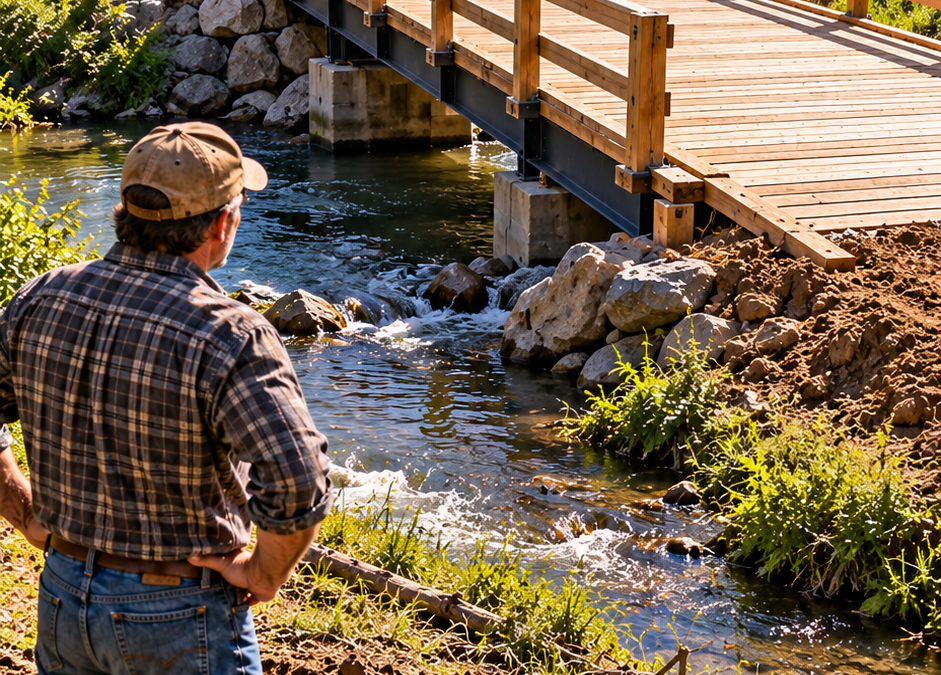
The first thing I saw was the fresh wood cutting across my creek like a claim someone had nailed into my land.
By the time I found the tire tracks, I knew this was not a mistake.
And when Rebecca Collins told me the HOA had already approved it, I understood she had confused a board vote with ownership.
My name is Jack Miller, and that creek had been part of my ranch longer than anyone in Rebecca’s neighborhood had been alive.
It was not a large creek. Nobody would have put it on a postcard or driven an hour just to see it. It wound through the lower pasture in a narrow silver line, slipping under cottonwoods, bending around sandstone shelves, and widening only after heavy rain. In spring, it ran cold and fast from the hills. In summer, it thinned into clear pools where dragonflies hovered and cattle drank in the shade. In winter, ice formed along the edges and cracked under the morning sun.
To most people, it probably looked ordinary.
To me, it was one of the quietest places on the ranch.
My father used to walk that creek line when he needed to think. My grandfather had fenced the south bank by hand after a flood took the old wire out in 1978. I had learned where the soft crossings were, where the ground held, where the mud swallowed boots, and where the deer came down just before dusk. The creek was not an amenity. It was not a trail feature. It was not something drawn into a neighborhood brochure.
It was private land.
My private land.
That was why I stopped cold the morning I saw the bridge.
I had driven out early to check the lower pasture after a week of rain. The sky was still pale, the air damp, and the truck tires hissed through wet grass as I followed the ranch trail toward the creek. I expected to find a washed-out culvert or maybe a section of fence down.
Instead, I found a bridge.
A large wooden bridge.
Fresh lumber, new railings, heavy support posts, and a wide deck built directly across my creek.
For a few seconds, I simply sat in the truck with both hands on the wheel, trying to make sense of something that should not have existed.
The bridge connected a gravel road on the far side to an open section inside my ranch. It was not a little footbridge someone had thrown together with spare boards. This had been planned. Measured. Built with equipment. The approaches had been graded. Gravel had been spread. Tire marks cut deep into the damp soil near the bank. Fresh sawdust still clung to the edges of the posts.
Someone had brought machinery onto my land.
Someone had crossed my boundary.
Someone had built a structure over my creek without saying one word to me.
I got out slowly.
The smell of cut pine and wet dirt hung in the air. Mud stuck to my boots as I walked closer. The creek moved beneath the new deck, flowing around support posts that had been sunk near the bank. On the far side, orange construction flags still fluttered from small stakes. A piece of yellow caution tape had snagged on a blackberry cane.
I stepped onto the bridge.
It was solid.
That almost made me angrier.
Whoever built it had not made a sloppy mistake in the dark. They had done good work in the wrong place.
I walked to the far end and looked back across the creek toward my pasture. From that angle, the bridge made its purpose obvious. It gave the nearby subdivision a direct connection into a section of my ranch that had always been difficult to reach. The opposite side led toward a small road used by the homeowners in Cedar Hills Estates, the HOA that bordered my eastern fence line.
I knew then who was behind it.
I took out my phone and started documenting everything.
Wide shots of the bridge.
Close shots of the posts.
Tire tracks.
Gravel.
Fresh cuts.
The creek bank.
The approach inside my ranch.
The boundary fence where a section had been pulled back and poorly wired shut.
I did not yell. I did not tear anything down. I did not block the road with my truck.
I had learned a long time ago that the first person to lose control often loses the record.
So I recorded.
I was photographing the cut fence when I heard a voice behind me.
“Jack.”
I turned.
Rebecca Collins was walking toward the bridge from the subdivision side, wearing a bright jacket, polished boots, and the calm expression of someone who had expected to find me there and had already prepared her speech.
Rebecca was the HOA president of Cedar Hills Estates. She had a reputation for treating every surrounding parcel like unfinished HOA business. If a pasture bordered the subdivision, she called it “visual impact.” If a ranch road ran near the neighborhood, she called it “shared access potential.” If a creek ran along the edge of her community, apparently she called a contractor.
Two men came behind her. One carried a clipboard. The other had the uncomfortable look of a board member who had agreed to attend without fully understanding the facts.
Rebecca stopped at the bridge and looked around as if inspecting a completed improvement.
“Looks good, doesn’t it?” she said.
I stared at her.
“Did you build this?”
“The HOA approved the project last month.”
“That is not what I asked.”
Her smile tightened. “The bridge was necessary. Our residents needed easier access to the other side of the creek.”
“The other side of the creek is my ranch.”
“It’s not like we’re interfering with your house.”
I let that sentence hang between us.
People like Rebecca always revealed themselves if you let them speak long enough. To her, private property only became real when there was a house, a gate, or a person standing in the way. Pasture was empty. Creek banks were unused. Ranchland was just open space waiting for someone more organized to claim a purpose for it.
I pointed toward the support posts. “You built this on my land.”
“We built it across the creek.”
“My creek.”
“Jack, let’s not be dramatic.”
I laughed once, but there was no humor in it. “Show me the document.”
Her eyebrows lifted. “What document?”
“The document giving the HOA permission to build a bridge across my creek and land a structure inside my property line.”
Rebecca looked annoyed, not worried. “The board approved it.”
“An HOA vote does not give you someone else’s land.”
The man with the clipboard shifted his weight.
Rebecca heard the movement and gave him a sharp glance before turning back to me.
“This project benefits the entire community,” she said. “Residents were having difficulty reaching the west-side trail area.”
“There is no west-side trail area. There is my ranch.”
“The land has been used informally for years.”
“By people trespassing.”
“That is a hostile way to describe neighbors enjoying open space.”
“That is the legal way to describe people entering private property without permission.”
Her face hardened.
“We acted in good faith.”
“No,” I said. “You acted without asking.”
For the first time, her confidence flickered.
Only for a second.
Then she pointed at the bridge. “This is already built. We are not undoing a community improvement because you suddenly object.”
“Construction stops right now.”
“It’s finished.”
“Then use stops right now.”
Rebecca crossed her arms. “You don’t get to make that decision alone.”
“I own the land.”
“We’ll see what the county says.”
That was the smartest thing she said all morning.
Because I intended to ask the county the same question.
After Rebecca left, I walked the area again. The more I looked, the worse it got. The bridge landing on my side extended farther into the ranch than I had first realized. The graded approach curved toward an open stretch of pasture that would make a convenient walking loop if someone ignored the fact that cattle sometimes grazed there and gates existed for a reason. The builders had cut brush, disturbed the bank, and moved soil near the creek.
By noon, I was back in my office with the ranch survey spread across my desk.
The documents were clear.
The creek ran through my property. The banks on both sides near that crossing were mine. The eastern fence marked the edge of Cedar Hills Estates, and the bridge landing crossed beyond that line onto my parcel.
There was no easement.
No access agreement.
No maintenance license.
No right-of-way.
Nothing.
I printed the survey, gathered the photos, and drove to the county permit office.
The woman at the front counter sent me to construction permits. Construction permits sent me to environmental review. Environmental review called in a permit inspector named David Harris.
David was in his fifties, with a gray mustache, heavy work boots, and the tired eyes of someone who had seen enough bad projects to recognize trouble before opening the file.
He listened carefully as I explained the situation.
Then I handed him the photographs.
His expression changed when he saw the bridge.
“This was built recently?”
“Very recently.”
“Across a creek?”
“Yes.”
“On your property?”
“That is what my survey shows.”
“Do you have a permit number?”
“No. I was hoping you did.”
That did not amuse him.
He typed in the project location, searched by nearby subdivision name, then searched by HOA applicant.
Something came up.
He opened the file and began reading.
At first, his face gave away nothing. Then his eyes narrowed.
“This application describes a pedestrian bridge replacement adjacent to HOA open space,” he said.
“Replacement?”
“That is what the permit description says.”
“There was no bridge there before.”
He looked at the photos again. “You’re sure?”
“I have owned that ranch for years. My father owned it before me. There was no bridge.”
David printed the project summary and compared it with my survey.
Then he pulled up the submitted bridge plan.
The plan showed a creek crossing, but the location diagram was vague. It referenced HOA-managed trail access and showed the structure landing within what appeared to be community space. But the plan did not match what I had photographed. The actual bridge was larger. The approaches were different. The landing was farther inside my property.
David leaned back slowly.
“I need to inspect this in person.”
“Today?”
He looked at the photo of the support posts sunk beside the creek.
“Yes,” he said. “Today.”
By midafternoon, David Harris was standing beside me at the bridge.
Rebecca arrived ten minutes later.
This time, she brought the same board member, a contractor in a company shirt, and a man I assumed was the HOA attorney because he wore polished shoes that did not belong anywhere near a muddy creek.
David did not waste time.
He walked the bridge with a tape measure, checked the width, measured the landing, photographed the posts, studied the creek bank, and compared the actual construction to the submitted plans.
The contractor tried to explain.
“We built according to the HOA’s direction.”
David looked at him. “I’m asking about the approved plan.”
“It’s generally consistent.”
David glanced at the support structure. “Generally is doing a lot of work in that sentence.”
Rebecca stepped forward. “Inspector Harris, the HOA acted in good faith. We applied for the permit. We used a licensed contractor. We were trying to provide safe access for residents.”
David did not look impressed.
“Good intentions do not replace required approvals or property permission.”
Rebecca’s jaw tightened. “The bridge is already here. Can’t it simply remain while we clear up the misunderstanding?”
David looked at my survey, then toward the boundary marker I had shown him near the creek.
“That depends on the review.”
I said, “The construction affects my property.”
David nodded. “I can see that.”
The HOA attorney finally spoke. “There may be historical use rights involved.”
David turned toward him. “That is for attorneys to argue. My concern is whether the structure was permitted as built and whether it was constructed within the authority represented in the application.”
“And?” Rebecca asked.
David closed his folder.
“And work stops until the county reviews the violations.”
He walked to the bridge approach, pulled a formal inspection notice from his vehicle, and posted it where no one could miss it.
STOP WORK / HOLD FOR REVIEW
The bright notice snapped in the breeze.
Rebecca stared at it as if the paper itself had insulted her.
“This is unnecessary,” she said.
David looked at her evenly. “No further construction, no modification, no use as a public or community crossing until the permit office issues a determination.”
“The residents need this bridge.”
“The residents can wait.”
For the first time since I found the bridge, the HOA had been stopped by someone other than me.
The bridge stood there, finished but unusable, cutting across the creek like a bad idea frozen in place.
Over the next week, I cooperated with the county.
I sent David everything he requested: the ranch deed, the boundary survey, photographs of the preexisting creek area from prior years, fence repair records, and maps showing the property line. He asked whether anyone from the HOA had requested access before construction. I told him no. He asked whether I had signed any permission form. No. Any license agreement? No. Any temporary construction access? No.
Meanwhile, Rebecca went to work on the HOA board.
I heard about the meeting from one of the few Cedar Hills residents I knew personally, a retired teacher named Alan who sometimes bought hay from me for his daughter’s horses. He called me the next morning.
“You should know Rebecca is trying to frame this as you blocking a safety improvement.”
“I expected that.”
“She said the bridge was for emergency access and resident safety.”
“Emergency access to what?”
“That question came up.”
“And?”
“She didn’t answer well.”
I smiled for the first time in days.
At the HOA meeting, Rebecca argued that the bridge was essential. She said it improved connectivity, reduced trail hazards, and gave residents a safer path across the creek. She described it as a community benefit that had been delayed by “one ranch owner’s hostility.”
But the board had started asking questions.
Why had no one seen written permission from me?
Why did the permit describe a replacement if no bridge had existed?
Why did the actual bridge not match the submitted plan?
Why had construction equipment entered private ranch land?
Why had the project continued after I objected?
Those questions made Rebecca defensive.
According to Alan, she kept returning to the same line.
“We approved it.”
Finally, one board member asked, “But did we have the right to approve it?”
That was the question that mattered.
Rebecca apparently ended the discussion quickly after that.
The county review took longer than I wanted, but not longer than I expected. Government does not move at the speed of outrage. It moves through files, inspections, comparisons, notices, and signatures.
David returned twice.
The first time, he brought another inspector to examine the creek disturbance. They looked at soil displacement, bank stabilization, waterway impact, and whether any environmental permits should have been required because the bridge touched a creek corridor.
The second time, he brought a county mapping technician and rechecked the bridge against the approved plans.
The problems multiplied.
The bridge was larger than the submitted description.
The location did not match the application materials.
The landing affected private property not identified in the permit file.
The project had been described as a replacement, but no credible record showed a prior bridge.
The construction work had disturbed the creek bank beyond what the permit indicated.
And most importantly, the HOA had not produced my written permission or any recorded easement giving them the right to build there.
Rebecca still fought.
She sent letters.
She claimed the HOA had relied on contractor advice.
Then she claimed the contractor had relied on board direction.
Then she suggested the ranch boundary was “unclear,” even after David had stood beside the marker with my survey in his hand.
At one point, she showed up at my gate.
I did not open it.
I spoke to her through the bars while my dog stood beside me, growling low in his throat.
“This has gone too far,” she said.
“I agree.”
“You’re making enemies.”
“You built a bridge on my land.”
“We were trying to improve the area.”
“My property is not your area.”
“You could work with us.”
“You could have asked.”
Her face tightened at that.
That was the part she hated most. Not the permit problem. Not the county notice. Not the board questions.
She hated being reminded that none of this would have happened if she had simply asked the owner.
But asking would have meant acknowledging I had the right to say no.
And people like Rebecca often prefer consequences to permission.
Three weeks after the first inspection, David called.
“The county has completed its review,” he said.
I was in the barn repairing a gate latch, and I stopped with the wrench still in my hand.
“What did they decide?”
“The bridge was not approved as constructed. The permit application contained inaccurate or incomplete location information, and the structure affects private property without documented authorization. The creek impacts also exceed what was reviewed.”
I waited.
David continued.
“The county is ordering removal.”
For a moment, I said nothing.
Not because I was surprised.
Because relief sometimes arrives so cleanly that it leaves no words behind.
“When?” I asked.
“The order will be issued today. The responsible party will have a deadline for removal and site restoration. We will monitor compliance.”
“Thank you.”
“Don’t thank me yet,” he said. “Removal needs to be done properly. No one gets to damage your creek twice.”
That was why I liked him.
He understood the real issue.
The bridge was not just an object to tear out. It had been driven into a living creek bank. Removing it carelessly could do more harm than leaving it in place. The county required a removal plan, erosion controls, site stabilization, and inspection afterward.
Rebecca received the notice that afternoon.
By evening, Cedar Hills knew.
Alan called again.
“She’s furious.”
“I figured.”
“She told everyone the county made a political decision.”
“That bridge is not a political party.”
“She also said you pressured them.”
“I gave them my deed.”
“That was apparently pressure.”
I almost laughed.
A week later, the removal crew arrived.
It was almost poetic. The same type of trucks, the same kind of equipment, the same smell of diesel and wet soil—but this time, they were there under county order, not HOA arrogance.
David Harris stood near the creek with a clipboard.
I stood farther back, arms crossed, watching.
Rebecca stood on the subdivision side with two board members and the HOA attorney. She wore sunglasses even though the sky was cloudy. She did not look at me.
The crew started with the railings.
Then the deck boards.
Then the cross supports.
Each piece came off carefully and was stacked on a flatbed. The bridge that had appeared so suddenly began disappearing board by board, bolt by bolt, beam by beam. Without the deck, the structure looked less powerful. Without the railings, less official. Without the supports, it became what it had always been.
Wood in the wrong place.
When the first landing section lifted away from my side of the creek, I saw the damaged ground beneath it. The soil had been compacted. Roots had been cut. Gravel had been pushed into places it never should have been.
Anger came back then.
Quiet, but deep.
Not because of the bridge itself.
Because of the assumption behind it.
Rebecca had looked at my ranch and seen empty space. She had looked at my creek and seen convenience. She had looked at my boundary and seen an obstacle to work around, not a legal line to respect.
That kind of thinking does damage long before construction begins.
By late afternoon, the bridge was gone.
Not fully erased yet. The bank still needed restoration. Straw wattles were placed near disturbed soil. Seed mix was spread. Erosion fabric was secured. The crew removed excess gravel from my side and regraded the approach to match the natural slope as closely as possible.
David inspected everything before leaving.
“This will need follow-up after the next rain,” he said.
“I’ll be watching.”
“I know.”
He looked toward the subdivision side, where Rebecca was speaking sharply to her attorney.
Then he looked back at me.
“Property lines matter,” he said. “People remember that after they get expensive.”
Within days, the creek began looking like itself again.
Not perfectly.
Land takes time to heal.
But the shape returned. Water moved cleanly around the bank. The open scar where the bridge had been began settling under straw and seed. The tire tracks faded after a week of dry wind. The equipment left. The voices stopped.
One evening, I walked down alone.
The creek was running low and clear. A kingfisher flashed blue over the water. Cottonwood leaves moved overhead with that dry whisper they make in late season. I stood where the bridge had landed and tried to picture it again.
For a moment, I could.
The railing.
The deck.
Rebecca standing there with her folder, telling me the HOA had approved what they had never owned.
Then the image faded.
The creek became the creek again.
That was all I had wanted from the beginning.
Not revenge.
Not drama.
Not a fight with a neighborhood full of people I barely knew.
I wanted the land respected.
Later, the HOA board sent me a formal letter. It did not apologize exactly. Organizations are skilled at arranging regret without placing it too close to responsibility. But it acknowledged that the bridge had been constructed without proper authorization affecting my property and that Cedar Hills Estates would not attempt future access improvements across my ranch without written permission and proper permits.
I kept that letter in my records.
The board also revised its approval procedures. Any project near property boundaries now required legal review, survey verification, written access documentation, and permit confirmation before work could begin. That should have been common sense, but common sense often arrives after invoices.
Rebecca resigned as HOA president before winter.
The official announcement said she wanted to “focus on personal matters.” Alan told me the board had been divided after the bridge removal and several members blamed her for pushing the project too fast.
Maybe that was true.
Maybe it was not.
Either way, the bridge was gone.
That was enough for me.
The next spring, grass grew over the disturbed approach. Willow shoots appeared near the bank. The creek rose with snowmelt and ran fast for two weeks, polishing the stones as if washing away the last memory of the mistake. By summer, someone standing there for the first time would not have known a bridge had ever existed.
But I knew.
I remembered the fresh wood.
The tire tracks.
The arrogance.
The way Rebecca said the HOA had approved it, as if that settled anything.
It settled nothing.
Because private property does not become public convenience by committee vote.
A creek does not stop belonging to the landowner because residents want a shortcut.
And a permit application does not become truthful because someone submits it with confidence.
The HOA thought building first would force acceptance later.
They were wrong.
The county looked at the plans, the property line, the creek, the missing permission, and the structure itself. Then it said what Rebecca should have understood from the beginning.
The bridge had to go.
Now, when I walk that creek line, I still stop at the crossing. Not because anything remains there, but because absence can be meaningful too. No railings. No deck. No gravel approach. No unauthorized traffic cutting into my pasture.
Just water.
Trees.
Mud.
Stone.
The ranch as it was before someone decided my land was easier to use than my permission was to ask.
And every time I hear the creek moving through that narrow bend, I remember the lesson Rebecca learned too late.
A bridge can be built in a week.
But a boundary, once proven, can outlast every board that tries to ignore it.








