The Blind K9 Everyone Had Given Up On Was Still Listening for Something We Couldn’t See
𝗣𝗔𝗥𝗧 𝟮
The veterinarian didn’t stop me.
So I stayed there.
The rain whispered against the windows.
Rook’s breathing filled the quiet space between us.
At first, he remained pressed near the wall.
Then his nose lifted.
His ears moved toward the water bowl.
Then toward me.
I didn’t call his name.
Didn’t tap the floor.
Didn’t say good boy.
Didn’t make myself useful.
That was harder than it sounds.
Nurses are trained to intervene.
To anticipate.
To prevent discomfort before it becomes distress.
We solve problems.
We move people.
We position limbs.
We guide.
We reassure.
We do things.
Sitting still while a frightened animal struggled with uncertainty felt almost negligent.
But Rook’s breathing began to slow.
His shoulder came away from the wall.
Just an inch.
Then another.
The veterinarian glanced at the clock.
“Emily, one supervised session tomorrow. Then we make the placement recommendation.”
Cole opened his mouth.
Before he could answer, Rook shifted.
Not toward me.
Not fully.
He simply turned his body away from the corner.
But Cole saw it.
His objection disappeared.
I kept my hands resting on my lap.
For days, everyone had been measuring whether Rook would still obey.
Tomorrow, I wanted to measure something else.
Whether he would choose.
The following afternoon, I entered the rehabilitation room carrying nothing except my chart.
No treats.
No training lead.
No favorite toy.
Nothing I could use to persuade Rook.
Behind the observation glass, the veterinarian already had the evaluation form open.
Cole stood near the door with his arms folded.
Rook waited beside the back wall.
His eyes were still cloudy.
His posture still guarded.
But when my shoes crossed the rubber flooring, his ears followed every step.
I stopped several feet away.
Cole looked at me.
“You’re not going to call him?”
“No.”
“Then what exactly are we evaluating?”
“Whether he makes a choice when nobody makes one for him.”
Cole’s jaw tightened.
“He was trained to respond to commands.”
“And we already know what happens when we give him one right now.”
He didn’t like that.
I could see it.
But he didn’t argue.
I sat on a short bench and turned slightly away from Rook.
Then I waited.
The ventilation system hummed overhead.
Somewhere down the corridor, a kennel latch clicked.
Another dog barked once.
Rook’s ears turned toward the sound, held there, then returned toward me.
Five minutes passed.
Cole shifted his weight.
“Emily.”
I kept watching Rook.
One front paw had moved forward barely an inch.
“We don’t have all afternoon.”
“I know.”
“If this doesn’t work, they sign the recommendation.”
I looked at him.
Every second felt to Cole like another piece of Rook disappearing.
I understood that.
But if I filled the silence because Cole couldn’t bear it, we would learn nothing.
“Then let it be his twenty minutes.”
Cole looked through the glass.
The veterinarian didn’t intervene.
The clock continued moving.
Rook lowered his head.
I fought every instinct to encourage him.
No praise.
No reaching hand.
No whispered reassurance.
Ten minutes.
Cole stepped forward.
“Enough.”
Rook’s ears flattened instantly.
Cole froze.
His hand moved toward the rehabilitation lead.
I stood.
But I didn’t step between him and Rook.
“I can get him moving,” Cole said.
“You can.”
His hand paused.
“But then we won’t know whether he chose it.”
Cole stared at me.
“And if he chooses nothing?”
“Then we document that honestly.”
“You’d risk his last session on waiting?”
“I’d rather document an honest refusal than call a forced response progress.”
The words came out harder than I intended.
Cole looked at me for several seconds.
Then his arm dropped.
Through the speaker, the veterinarian said, “Fifteen minutes.”
I sat again.
This time, I shifted sideways, opening the space between Rook and me.
Rook lifted his nose.
One step.
Cole stopped breathing for a beat.
Rook paused.
I lowered my eyes.
Second step.
His nails whispered across the rubber floor.
Third.
Another pause.
No command had brought him there.
No leash had pulled him.
No food waited in my palm.
He took another cautious step.
Then another.
When he reached my boots, he lowered himself beside them.
I wanted to touch him so badly my fingers actually hurt from staying still.
Cole stared.
“Rook.”
The name came from him like a prayer.
One of Rook’s ears turned toward Cole.
But he stayed beside me.
The observation-room door opened.
The veterinarian entered carrying the unsigned placement form.
He looked at Rook.
Then at the empty stretch of floor the dog had crossed.
“Don’t end the session.”
I lifted my eyes.
“What do you want to test?”
“Whether he came to you because you’re becoming his safe point,” he said, “or whether he just showed us he can still navigate when the decision is his.”
Cole looked at me.
Yesterday, he had called Rook finished.
Today, Rook had crossed a room for no reason anyone else had given him.
The placement form remained unsigned.
The next morning, we changed the environment deliberately.
A low padded platform sat near one wall.
Three foam markers crossed the floor.
Rook’s water bowl remained on its familiar mark.
Cole stood with him near the entrance, holding the short lead.
But he had not clipped it to Rook’s collar.
I noticed.
I didn’t praise him for it.
Change matters more when people choose it themselves.
“You’re part of the assessment today,” the veterinarian told me. “Watch his movement. If we’re interfering with what he’s showing us, say so.”
I nodded.
Cole looked at me.
“Where do you want me?”
“Across the room. Somewhere he can hear you.”
Cole began walking.
“Don’t call him yet.”
He stopped.
Then continued without complaint.
I stood several feet from Rook.
“Rook.”
I said his name once.
Then I moved three steps left.
His ears followed my shoes.
I moved again.
He tracked the sound and followed.
At the first foam marker, one paw brushed the edge.
He stopped.
Cole leaned forward.
I lifted two fingers.
Wait.
He stayed where he was.
Rook lowered his nose.
Tested the floor.
Shifted his weight.
Then stepped around the marker.
At the second, he corrected earlier.
Near the padded platform, he altered his angle before reaching it.
Sound.
Memory.
Texture.
Decision.
That was what I was watching.
Not blindness.
Adaptation.
An orderly entered carrying folded mats.
He pushed a small rolling cart against the wall and hurried back into the corridor.
One wheel remained several inches inside Rook’s route.
Cole saw it first.
“Hold on.”
He started toward the cart.
“Leave it.”
He stopped.
“That wasn’t part of the setup.”
“Exactly.”
The veterinarian looked at me.
“You think he knows it’s there?”
Rook’s ears had already turned toward the fading squeak of the wheels.
“I think he knows something changed.”
Rook moved forward.
Several feet from the cart, he slowed.
His nose worked the air.
Cole’s fingers tightened around the loose lead.
But he stayed still.
Rook approached until his whiskers brushed the metal frame.
He froze.
Backed half a step.
Then searched.
A few seconds later, he found the open space beside the cart and moved around it.
Cole’s grip loosened.
Rook continued until only a few feet separated them.
Cole didn’t call him.
He simply opened his hand.
Rook crossed the remaining distance and pressed his nose into Cole’s palm.
The veterinarian lowered his pen.
“Suspend the placement recommendation.”
Cole looked up.
“For how long?”
“Until we understand what we’re actually looking at.”
He closed the evaluation folder.
“He isn’t moving like a dog who has no idea where he is.”
Then he turned toward me.
“I want your observations included in his rehabilitation assessments. Environmental responses. Behavior changes. Adaptation.”
“Understood.”
Cole looked down at the lead in his hand.
“So what do we change?”
I met his eyes.
“Stop solving every problem before he reaches it.”
He looked toward the cart.
“And when he needs help?”
“Give him information first. Then time.”
“Commands?”
“When they’re useful.”
I glanced toward the lead.
“Not because waiting makes us uncomfortable.”
Cole studied the clip.
Then he crossed the room and hung the lead on its hook.
The small metal click made Rook’s ear turn.
Cole noticed.
That mattered.
“Tomorrow,” he said, “you show me how you’re reading him.”
I nodded toward Rook.
“You learn how to read him.”
Cole was quiet.
Then he nodded.
The following session, he entered with the lead in his hand instead of clipped to Rook’s collar.
Two textured mats and a shallow padded step crossed the room.
This time, Cole was the one doing the work.
“Tell me what you watch first,” he said.
“His ears before his feet.”
Cole looked at Rook.
“If he stops?”
“Don’t decide for him what the stop means.”
Cole faced him.
“Rook.”
The dog’s head turned toward his voice.
Cole tapped his boot once against the floor and moved several feet away.
Then he waited.
Rook followed until his paws reached the first textured mat.
He stopped.
Cole’s fingers tightened around the loose lead.
“Give him a second.”
“A second for what?”
“To tell you whether he needs help.”
Cole relaxed his hand.
Rook tested the unfamiliar surface with one paw.
Then moved forward.
At the shallow step, he paused again.
This time, Cole caught his own impulse before I said anything.
Rook found the edge.
Lifted one paw.
Then stepped across.
When he reached Cole, the sergeant crouched but didn’t reach for him.
Rook closed the last few inches himself and pressed his shoulder against Cole’s knee.
Only then did Cole touch his neck.
“Good,” I said.
Cole glanced up.
“Me or him?”
“Both.”
For the first time since I’d met him, a faint smile crossed Cole’s face.
He stood and moved to the opposite side of the room.
One tap of his boot.
Rook followed.
He drifted toward the padded wall, brushed it with his whiskers, corrected, and continued.
Cole’s hand moved toward the lead.
Then stopped on its own.
I stepped toward the observation-room door.
“Where are you going?” Cole asked.
“Out of his map.”
Cole looked at Rook.
“He’s tracking your footsteps too.”
“Exactly.”
I went behind the glass and closed the door.
Cole continued alone.
At the textured mat, Rook hesitated.
Cole waited.
At the shallow step, he gave one sound marker and nothing more.
Rook found the edge and crossed.
When he reached Cole, the sergeant lowered one hand.
Rook touched it with his nose.
Relief softened Cole’s face.
Then metal crashed in the corridor.
A technician had dropped a stainless steel tray.
The sound exploded through the room.
Rook dropped instantly.
His paws skidded backward.
Then he disappeared beneath the padded bench.
Cole turned.
“Rook.”
Nothing.
He stepped closer.
“Rook, come.”
The dog pushed deeper beneath the bench.
Cole reached for the lead.
I was already through the observation door.
“He needs to come out,” Cole said.
His voice remained controlled.
But the clip was open in his fingers.
“I know.”
“Then help me.”
I stopped several feet from the bench.
Rook’s breathing came fast in the shadow beneath it.
“Don’t pull him out.”
Cole looked at me.
“We can’t leave him under there every time something scares him.”
“No.”
I held his gaze.
“But if you drag him out, he learns that being afraid means losing his choice.”
Cole looked beneath the bench.
Minutes earlier, patience had been easy because Rook had been moving forward.
Now waiting meant watching him retreat.
That was harder.
Slowly, Cole lowered the lead.
“What do I do?”
“Give him what you gave him before the noise.”
“Time?”
“A choice.”
Cole lowered himself onto the floor, outside Rook’s reach.
He placed the unused lead beside his boot.
And didn’t call him again.
Minutes passed.
The corridor became quiet.
Still, Rook stayed beneath the bench.
I sat against the opposite wall.
Eventually Cole spoke.
“He pulled me out once.”
I looked at him.
His eyes stayed on the darkness beneath the bench.
“I couldn’t get my footing.”
His thumb rubbed against the metal clip.
“He kept pulling until I moved.”
I didn’t interrupt.
“Wouldn’t leave me.”
The dog hiding beneath the bench was the same dog who had once refused to leave Cole behind.
“So when you see him under there…”
Cole’s jaw tightened.
“I see him disappearing.”
Something inside me softened.
Not because Cole had been wrong to push.
Because I finally understood what he thought he was losing.
Rook shifted.
His tags touched softly.
Cole leaned forward automatically.
I lifted one hand.
He stopped.
“What if he stays there?”
“Then he stays until he decides he can come out.”
“And that helps him?”
“I don’t know if it helps him today.”
I looked beneath the bench.
“Pulling him out would help us feel better today.”
Cole stared at the lead.
Then he picked it up.
Not to use it.
He placed it farther away.
“I keep thinking if I can get him responding again, I can get him back.”
“Back to what?”
Cole said nothing.
His gaze moved toward the black working harness hanging beside the door.
Worn nylon.
Brass buckle.
The handle polished smooth by years of use.
“He’s a working dog.”
“He was trained for a purpose.”
“He liked working.”
“I’m sure he did.”
Cole looked at me.
“Did?”
I didn’t soften it.
“He may never work again.”
His expression tightened.
“You don’t know that.”
“No.”
I shook my head.
“I don’t know that he won’t either.”
I nodded toward the harness.
“But if every good day only matters because it gets him closer to wearing that again, we’re deciding what recovery has to look like before he gets there.”
Cole stared at the harness.
“He liked it.”
“Maybe he still would.”
I looked toward Rook.
“But wanting that for him and needing it from him aren’t the same thing.”
Rook’s head appeared from beneath the bench.
Neither of us moved.
His nose tested the air.
Cole’s hand twitched.
Then settled against his knee.
Rook crawled forward until his shoulders cleared the bench.
Stopped.
Listened.
Then stood.
He crossed toward the water bowl.
Drank.
And remained in the open instead of returning beneath the bench.
Cole didn’t praise him.
Didn’t command him closer.
He simply watched.
The next morning, I found Cole already in the rehabilitation room.
The working harness still hung beside the door.
But the training lead had been moved onto a shelf.
Rook stood near the padded platform, listening.
Cole looked at me.
“I’ve been thinking about what happens after rehab.”
I set my clipboard down.
“What about it?”
“I kept asking whether we could get him back to work.”
His eyes moved toward the harness.
“Maybe that’s not the first question anymore.”
I waited.
“Maybe I should be asking what kind of life he can build like this.”
I gave a small nod.
Cole studied Rook.
“Do you think he could ever work operationally again?”
There was no defensiveness now.
No demand.
Just a question.
I didn’t answer until the veterinarian entered.
When he did, I lifted Rook’s working harness from the wall and placed it on the table.
The nylon had been worn smooth where Cole’s hand had gripped it hundreds of times.
“Operational return requires another evaluation track,” the veterinarian said. “Mobility. Environmental tolerance. Reliability. Response under pressure. We’re not there.”
Cole looked toward me.
“But could we get there?”
“I can tell you what I’m seeing now.”
I placed my hand lightly on the harness.
“I can help build rehabilitation around what he can do now.”
Then I met Cole’s eyes.
“But I’m not going to decide what he owes you afterward.”
His expression tightened.
“That’s not what I asked.”
“I think it is.”
The room went quiet.
“Every good session keeps becoming evidence that maybe he can work again.”
I looked toward Rook.
“But first, he has to learn how to live blind.”
Cole looked down.
“Whatever comes after that shouldn’t be the price of getting there.”
“So you’re saying retire him?”
“No.”
I shook my head.
“I’m saying stop making retirement or return to duty the test he has to pass right now.”
Across the room, Rook reached the edge of a textured mat.
Paused.
Cole noticed.
And stayed where he was.
The veterinarian closed the operational assessment packet.
“Then we shift rehabilitation toward independent adaptation. Operational evaluation stays suspended unless there’s a reason to revisit it.”
Cole looked at him.
“No performance testing?”
“Not now.”
Cole picked up the harness.
For a moment, he simply held it.
Then he crouched several feet from Rook.
“I kept thinking taking this off meant giving up on you.”
Rook turned toward his voice.
Cole ran his hand once across the worn handle.
Then he stood and placed the harness inside the equipment cabinet.
The glass door closed with a soft click.
Rook remained in his collar.
Nothing else.
Cole looked at me.
“What do you need from me?”
“Consistency.”
“Meaning?”
“Keep sound markers predictable. Use commands when they give him information. If he freezes, don’t make physical guidance your first response.”
Cole nodded.
“And you?”
“I’ll document what changes. I’ll tell you what I see. And if I think we’re taking choice away from him, I’ll say so.”
I paused.
“But I’m not becoming the person he can only function beside.”
Cole glanced at me.
“You’re stepping away.”
“When he doesn’t need me.”
I moved toward the observation line.
“If this works, that’s supposed to happen.”
Cole looked at Rook.
“All right.”
I tapped one knuckle softly against the padded rail.
Rook’s ears turned.
Then I stepped back.
Cole positioned himself across the open floor.
No lead.
No harness.
Rook tested the edge of the mat with one paw.
Then stepped onto it.
When he stopped again, Cole waited.
After several seconds, he tapped his boot once.
Rook turned toward him.
Cole lowered himself onto one knee.
His hands stayed against his own leg.
“Your move.”
Rook stood between us.
I gave him nothing else.
After a moment, he walked toward Cole.
I stayed where I was.
That was the point.
Later that afternoon, I pushed my nursing supply cart toward the rehabilitation wing.
The corridor smelled of antiseptic.
Wheels rattled softly beneath my hands.
Ahead, Cole knelt beside Rook near the open doorway.
Rook wore only his collar.
I slowed when I heard Cole talking.
“I think I finally get it.”
Rook turned one ear toward him.
Cole’s hand rested on his own thigh.
“That blind K9 is finished.”
I stopped.
For a second, I thought he’d gone backward.
Then Cole continued.
“The one I kept trying to bring back.”
His voice dropped.
“You don’t owe me that dog anymore.”
A metallic rattle sounded behind me.
I turned.
Farther up the sloped service corridor, a maintenance worker was repositioning a loaded cart.
One wheel rolled free before the brake caught.
The worker grabbed the handle.
Missed.
“Ma’am, watch out!”
The cart began gathering speed.
I pulled at my nursing cart to clear the passage.
One front caster caught against a floor seam.
My cart jammed sideways.
“Emily!”
Cole’s voice hit me a split second before the noise became terrifyingly loud.
Metal wheels.
Loaded weight.
A fast-moving object coming directly downhill.
I twisted the cart.
It wouldn’t move.
And Rook moved first.
His ears snapped toward the accelerating rattle.
His head turned.
His paws shifted.
No command came.
No one said his name.
He launched.
I saw white fur.
Then his shoulder slammed into my hip.
The impact drove me sideways into a recessed doorway.
I fell hard against the wall.
Rook turned with me and planted himself across my legs, body braced toward the corridor.
Cole lunged past us.
He caught the maintenance cart by the side rail.
Its momentum dragged him several steps.
One wheel struck the wall.
Metal shuddered.
Then stopped.
For one second, the entire corridor seemed to hold its breath.
My clipboard lay open on the tile.
My heart hammered so violently I could hear it.
Rook remained between me and the cart.
Blind eyes open.
Body pointed toward the danger that had gone silent.
My hand found his shoulder.
He was trembling.
Not much.
But I felt it.
I hadn’t called his name.
Cole hadn’t commanded him.
He had heard the wheels.
Measured the movement.
Located me.
And chosen.
“Rook,” Cole said quietly.
One ear turned toward him.
Rook stayed where he was.
Cole stared.
I knew exactly what he was seeing.
The dog he had called finished had heard danger, understood enough of it, and acted before either of us.
“I’m okay,” I whispered.
Only then did Rook shift.
Cole crouched a few feet away.
He didn’t grab the collar.
Didn’t pull Rook to him.
“Is he hurt?”
I sat up and ran careful hands along Rook’s shoulders.
Chest.
Legs.
Paws.
“Nothing obvious. He needs to be checked.”
“Then that’s where we go.”
No one said what Rook had proved.
No one asked for another test.
And that mattered more than I expected.
Rook stood.
Listened.
Then turned toward Cole’s breathing.
He crossed the few feet between them on his own.
Cole waited until Rook reached him before touching his neck.
I pushed myself upright against the wall.
The maintenance worker stood beside the stopped cart, pale and shaken.
Cole handed me my clipboard.
For a moment, neither of us spoke.
Rook stood between us in the center of the corridor.
His eyes were still cloudy.
His harness was still behind glass.
Nothing about his condition had changed.
Cole tapped his boot once.
Rook’s ears turned toward him.
Cole did not call him closer.
He waited.
Rook listened.
Then chose his direction.
This time, Cole followed.
The veterinarian examined him immediately.
No obvious injury.
No swelling.
No pain response.
“Keep him quiet for the rest of the day.”
Cole nodded.
“Then he rests.”
Nothing about training.
Nothing about operational potential.
Nothing about what Rook had just proved.
That was when I knew something inside Cole had finally shifted.
The veterinarian helped Rook down.
Cole crouched several feet away.
Rook oriented toward his breathing and crossed the room without being called.
When he reached him, Cole rested one hand against his chest.
“Okay. We’re done today.”
I opened Rook’s chart.
Behind the rehabilitation notes, the operational evaluation packet was still clipped in place.
I removed it.
“Do you want this left open?”
Cole looked at the packet.
Then at Rook.
“No.”
The veterinarian paused.
“You want to proceed with retirement?”
Cole ran his fingers once through the fur behind Rook’s ear.
“Yes.”
His voice was steady.
“Not because he’s useless.”
The room went quiet.
“Because I’m done asking him to prove he isn’t.”
I looked down before either man could see how deeply the words hit me.
The veterinarian pulled the retirement paperwork from the file.
No ceremony followed.
No medal.
No speech.
Just paper moving from one stack into another.
But I understood what had happened.
Cole wasn’t giving up on Rook.
He was finally letting go of the version of him that no longer existed.
That afternoon, Cole found me beside the rehabilitation room with a notebook.
“Walk me through it again.”
“You already know the routine.”
“I want it written down.”
So I gave him what mattered.
Predictable sound markers.
Familiar object placement.
Consistent routes before new ones.
Time to process before physical guidance.
Sound before touch whenever possible.
Help only when Rook showed he needed it.
Cole wrote every line.
“You don’t need me for every session,” I said.
His pen stopped.
“I know.”
He looked at the notes.
“I still want your observations while you’re assigned here.”
“You’ll have them.”
“But I handle the rest.”
I smiled faintly.
“You handle the rest.”
Cole folded the paper and slipped it into the pocket where he used to keep Rook’s short lead.
The following session, I stayed behind the observation glass.
Cole arranged the room himself.
Two textured mats.
One sound marker.
A clear route between them.
He noticed a stool near the path and moved it aside before Rook entered.
Rook stopped at the doorway.
Listening.
Cole tapped the floor once.
Rook turned toward him.
Started forward.
At the first mat, he paused.
Cole waited.
Rook tested the edge.
Continued.
At the second, the pause lasted longer.
Cole shifted his weight.
Caught himself.
Stayed still.
Rook found the edge and crossed until he reached him.
Cole hadn’t looked toward me once.
Only then did he glance at the observation window.
“Anything I missed?”
I considered him.
“You gave him room before you gave him help.”
Cole nodded.
Then wrote the sentence down.
Later, I returned supplies to the cabinet.
Behind the glass, Rook’s black working harness rested folded neatly on a shelf.
Cole hadn’t thrown it away.
He hadn’t needed to.
The harness was part of their history.
It deserved to be kept.
But it no longer hung on the wall like a question Rook had to answer every morning.
Cole entered carrying the stainless steel water bowl.
“Same place for now.”
He set it on the familiar mark.
The steel base scraped softly.
Rook’s ears lifted.
He crossed toward the sound and drank.
Cole stepped away.
Leaving the floor open around him.
I closed the supply cabinet and took hold of my nursing cart.
No one asked me to stay.
Behind me, Rook finished drinking.
His tags made one soft sound.
Cole said nothing.
He waited.
I pushed the cart into the corridor without looking back.
Whatever direction Rook chose next no longer depended on me being in the room.
Three weeks later, I crossed the rehabilitation courtyard with a stack of charts under one arm when I heard a single tap behind me.
I stopped.
Morning sunlight warmed the concrete.
Fresh-cut grass drifted through the open doors.
Another tap.
Then silence.
I turned.
Rook stood near the courtyard entrance beside Cole.
Only his collar.
No harness.
A maintenance cart sat parked along the walkway ahead.
Three weeks earlier, the sound of rolling metal had sent everyone moving.
Today, it was simply part of the environment.
Cole tapped his boot once more.
Then waited.
Rook started forward.
His paws moved from smooth concrete onto the rough walkway.
He slowed at the texture change.
Lifted his nose.
Listened.
Cole stayed behind him.
“Take your time.”
Near the parked cart, Rook stopped.
Cole’s right hand moved slightly.
Then settled against his thigh.
Rook listened to the faint ticking of cooling metal.
Shifted left.
Found his own path around it.
Cole smiled.
But said nothing.
Rook crossed the remaining distance and touched his nose to Cole’s open palm.
Only then did Cole scratch beneath his collar.
I started toward the rehabilitation wing.
“Nurse Carter?”
I looked back.
Cole nodded toward the charts under my arm.
“Still doing his weekly notes until Friday?”
“That’s the plan.”
“After that?”
“Routine follow-up goes back to the rehabilitation team.”
Cole looked down at Rook.
“Good.”
I raised an eyebrow.
“Good?”
“Means we’re not keeping you here because I’m afraid to do this without you.”
A faint smile touched my face.
“That would be a terrible rehabilitation plan.”
Cole almost laughed.
Rook turned toward the sound.
I walked closer but stopped several feet away.
Rook oriented toward me.
For a moment, nobody moved.
Then he crossed the distance himself.
His nose touched my fingers.
I rested one hand lightly against the side of his face.
“Hey, Rook.”
His tail moved once.
Then he turned away.
Not because he didn’t remember me.
Because he didn’t need me.
And I had never been more relieved to be unnecessary.
He crossed back toward Cole and stopped beside his left leg without being called.
Cole looked at me.
“We’re taking the east path. Same sound markers. No harness.”
“Watch the drainage grate near the second turn. The texture changes before it.”
“Got it.”
Cole tapped his boot once and started toward the gate.
Rook followed for several steps.
Then drifted toward the grass.
His nose worked at some scent invisible to us.
Cole stopped.
He didn’t call him back.
Didn’t whistle.
Didn’t pull.
He waited.
A few seconds later, Rook lifted his head.
Found Cole again.
Returned to the path on his own.
I watched them for one last moment.
Months earlier, perhaps even weeks earlier, I would have seen a blind dog moving uncertainly beside a handler.
Now I saw something else.
A dog who had lost his sight but not his judgment.
A soldier who had nearly confused love with control.
And a relationship learning how to survive after neither of them could return to what they had been.
I turned toward the rehabilitation wing.
Inside, carts rolled softly across rubber flooring.
A cabinet opened.
Someone called for fresh supplies.
I set the charts on the treatment counter and wrapped my fingers around the handle of my nursing cart.
Through the open courtyard door came one familiar sound.
A tap.
A pause.
Then Rook’s paws moving again.
At his own pace.
I pushed my cart toward my next patient.
I didn’t look back.
I didn’t need to.
Cole had once looked at a blind dog standing helplessly in a corner and believed the only compassionate thing left was to accept that he was finished.
I had almost believed it too.
But Rook had never needed us to restore the dog he used to be.
He needed us to stop crowding the darkness long enough for him to discover who he could become inside it.
And once we did, he kept finding his way forward.
One choice at a time.
Have you finished reading the story and want to read it again?
The Blind K9 Everyone Had Given Up On Was Still Listening for Something We Couldn’t See
They thought blindness had taken everything that made Rook who he was.
I wasn’t sure they were wrong.
But the first time he chose to move without anyone commanding him, I realized we had been asking the wrong question.
Rain tapped steadily against the narrow windows of the rehabilitation room at Fort Calder, soft enough that most people would have stopped hearing it after a few minutes.
Rook didn’t.
His ears shifted with every change in the rhythm.
That was the first thing I noticed about him.
Not his eyes.
Not the cloudy film covering them.
Not the way he stood facing the padded corner as if he had forgotten the rest of the room existed.
His ears.
They were still working.
Still searching.
Still trying to build a world from sounds the rest of us ignored.
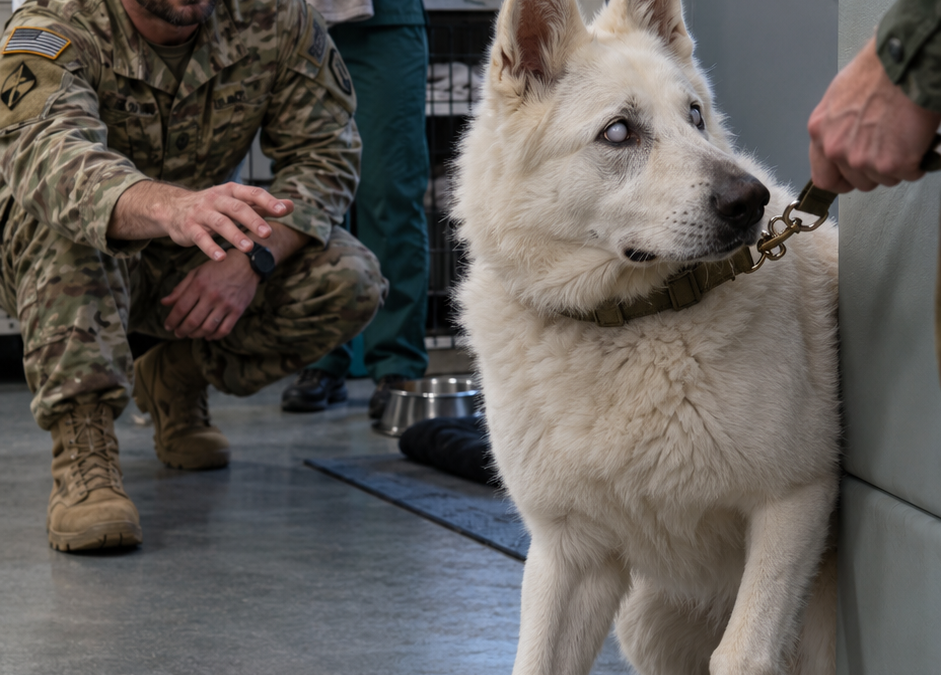
I stood beside the supply cabinet with a folded towel in my hands while Staff Sergeant Cole Mercer crouched several feet behind the white German Shepherd.
“Rook.”
The dog’s ears turned.
Cole waited.
“Here.”
Rook had heard him.
There was no question about that.
But his body didn’t follow.
He stayed near the wall, rigid and silent, his cloudy eyes open toward nothing.
Cole’s jaw tightened.
“Rook, come.”
Nothing.
The veterinarian beside me lowered his eyes toward the evaluation sheet.
I could almost feel the conclusion forming in the room before anyone said it aloud.
Rook was eating poorly.
He withdrew when guided.
Commands he had once obeyed instantly now left him frozen or backing away.
His vision was gone.
And with it, everyone seemed to believe, the certainty that had once made him reliable.
Cole crouched lower and extended one hand.
Rook’s nose moved.
He caught Cole’s scent.
For half a second, his head turned toward the man who had worked beside him for years.
Then he stepped backward until his shoulder touched the wall.
Something in Cole’s face changed.
It wasn’t anger.
It was worse.
Grief.
The kind that had already started disguising itself as acceptance.
Cole slowly closed his hand.
“That blind K9 is finished.”
No one answered.
The rain kept tapping against the glass.
I looked at Rook’s feet.
Cole reached for the short rehabilitation lead hanging beside the door.
The metal clip touched Rook’s collar ring with a small click.
Rook immediately recoiled.
His breathing changed.
Shorter.
Faster.
His hind legs shifted toward the corner.
“Sergeant Mercer.”
Cole looked at me.
I nodded toward the stainless steel water bowl near the opposite wall.
“Could you put the bowl back where it usually sits?”
His expression hardened slightly.
“He has to learn that the room changes.”
“Maybe.”
“Maybe?”
I looked back at Rook.
Earlier that afternoon, he’d approached the padded platform near the wall and turned away from its corner before touching it.
He had known where that wall was.
He had known the platform was there.
But when an orderly had moved his water bowl six feet from its normal position, Rook had searched the old spot twice.
That didn’t look like a dog who had completely lost his map.
It looked like a dog whose map kept being rewritten before he had time to trust it.
Cole followed my eyes.
“He’s blind.”
“I know.”
“Then what are you seeing?”
Rook’s head shifted between our voices.
I wished I had an answer strong enough to justify the instinct growing inside me.
But I didn’t.
“Something I’m not sure about yet.”
Cole looked toward the clock.
At the end of the next evaluation, the team would make a placement recommendation.
If Rook showed no meaningful progress, he would be removed from rehabilitation and transferred into permanent retirement placement.
The language sounded gentle.
Administrative.
Necessary.
But I had worked in military rehabilitation long enough to understand what those forms meant emotionally.
For Cole, that paperwork wasn’t simply about where Rook would live.
It was the official declaration that the partner he had trusted in places most people would never see was gone.
“We’ve tried voice guidance,” Cole said. “Food. Physical prompting. Lead work.”
“And when he refuses?”
“We try again.”
“Harder?”
Cole looked at me.
I wasn’t accusing him.
His impatience wasn’t cruelty.
It was fear.
Fear that if he stopped pushing Rook toward the dog he used to be, that dog would disappear forever.
I crossed the room, lifted the water bowl, and returned it to the faint circular mark worn into the rubber flooring.
The steel base scraped softly.
Rook’s ears rose.
I stepped away.
Then I crossed to the opposite wall and sat down on the floor.
No food.
No leash.
No hand extended toward him.
Cole frowned.
“What are you doing?”
“Nothing.”
“That’s the plan?”
“For one minute.”
His eyebrows lifted.
“One minute of what?”
“Nobody asking him for anything.”
Cole looked toward the veterinarian.
The veterinarian didn’t stop me.
So I stayed there.
The rain whispered against the windows.
Rook’s breathing filled the quiet space between us.
At first, he remained pressed near the wall.
Then his nose lifted.
His ears moved toward the water bowl.
Then toward me.
I didn’t call his name.
Didn’t tap the floor.
Didn’t say good boy.
Didn’t make myself useful.
That was harder than it sounds.
Nurses are trained to intervene.
To anticipate.
To prevent discomfort before it becomes distress.
We solve problems.
We move people.
We position limbs.
We guide.
We reassure.
We do things.
Sitting still while a frightened animal struggled with uncertainty felt almost negligent.
But Rook’s breathing began to slow.
His shoulder came away from the wall.
Just an inch.
Then another.
The veterinarian glanced at the clock.
“Emily, one supervised session tomorrow. Then we make the placement recommendation.”
Cole opened his mouth.
Before he could answer, Rook shifted.
Not toward me.
Not fully.
He simply turned his body away from the corner.
But Cole saw it.
His objection disappeared.
I kept my hands resting on my lap.
For days, everyone had been measuring whether Rook would still obey.
Tomorrow, I wanted to measure something else.
Whether he would choose.
The following afternoon, I entered the rehabilitation room carrying nothing except my chart.
No treats.
No training lead.
No favorite toy.
Nothing I could use to persuade Rook.
Behind the observation glass, the veterinarian already had the evaluation form open.
Cole stood near the door with his arms folded.
Rook waited beside the back wall.
His eyes were still cloudy.
His posture still guarded.
But when my shoes crossed the rubber flooring, his ears followed every step.
I stopped several feet away.
Cole looked at me.
“You’re not going to call him?”
“No.”
“Then what exactly are we evaluating?”
“Whether he makes a choice when nobody makes one for him.”
Cole’s jaw tightened.
“He was trained to respond to commands.”
“And we already know what happens when we give him one right now.”
He didn’t like that.
I could see it.
But he didn’t argue.
I sat on a short bench and turned slightly away from Rook.
Then I waited.
The ventilation system hummed overhead.
Somewhere down the corridor, a kennel latch clicked.
Another dog barked once.
Rook’s ears turned toward the sound, held there, then returned toward me.
Five minutes passed.
Cole shifted his weight.
“Emily.”
I kept watching Rook.
One front paw had moved forward barely an inch.
“We don’t have all afternoon.”
“I know.”
“If this doesn’t work, they sign the recommendation.”
I looked at him.
Every second felt to Cole like another piece of Rook disappearing.
I understood that.
But if I filled the silence because Cole couldn’t bear it, we would learn nothing.
“Then let it be his twenty minutes.”
Cole looked through the glass.
The veterinarian didn’t intervene.
The clock continued moving.
Rook lowered his head.
I fought every instinct to encourage him.
No praise.
No reaching hand.
No whispered reassurance.
Ten minutes.
Cole stepped forward.
“Enough.”
Rook’s ears flattened instantly.
Cole froze.
His hand moved toward the rehabilitation lead.
I stood.
But I didn’t step between him and Rook.
“I can get him moving,” Cole said.
“You can.”
His hand paused.
“But then we won’t know whether he chose it.”
Cole stared at me.
“And if he chooses nothing?”
“Then we document that honestly.”
“You’d risk his last session on waiting?”
“I’d rather document an honest refusal than call a forced response progress.”
The words came out harder than I intended.
Cole looked at me for several seconds.
Then his arm dropped.
Through the speaker, the veterinarian said, “Fifteen minutes.”
I sat again.
This time, I shifted sideways, opening the space between Rook and me.
Rook lifted his nose.
One step.
Cole stopped breathing for a beat.
Rook paused.
I lowered my eyes.
Second step.
His nails whispered across the rubber floor.
Third.
Another pause.
No command had brought him there.
No leash had pulled him.
No food waited in my palm.
He took another cautious step.
Then another.
When he reached my boots, he lowered himself beside them.
I wanted to touch him so badly my fingers actually hurt from staying still.
Cole stared.
“Rook.”
The name came from him like a prayer.
One of Rook’s ears turned toward Cole.
But he stayed beside me.
The observation-room door opened.
The veterinarian entered carrying the unsigned placement form.
He looked at Rook.
Then at the empty stretch of floor the dog had crossed.
“Don’t end the session.”
I lifted my eyes.
“What do you want to test?”
“Whether he came to you because you’re becoming his safe point,” he said, “or whether he just showed us he can still navigate when the decision is his.”
Cole looked at me.
Yesterday, he had called Rook finished.
Today, Rook had crossed a room for no reason anyone else had given him.
The placement form remained unsigned.
The next morning, we changed the environment deliberately.
A low padded platform sat near one wall.
Three foam markers crossed the floor.
Rook’s water bowl remained on its familiar mark.
Cole stood with him near the entrance, holding the short lead.
But he had not clipped it to Rook’s collar.
I noticed.
I didn’t praise him for it.
Change matters more when people choose it themselves.
“You’re part of the assessment today,” the veterinarian told me. “Watch his movement. If we’re interfering with what he’s showing us, say so.”
I nodded.
Cole looked at me.
“Where do you want me?”
“Across the room. Somewhere he can hear you.”
Cole began walking.
“Don’t call him yet.”
He stopped.
Then continued without complaint.
I stood several feet from Rook.
“Rook.”
I said his name once.
Then I moved three steps left.
His ears followed my shoes.
I moved again.
He tracked the sound and followed.
At the first foam marker, one paw brushed the edge.
He stopped.
Cole leaned forward.
I lifted two fingers.
Wait.
He stayed where he was.
Rook lowered his nose.
Tested the floor.
Shifted his weight.
Then stepped around the marker.
At the second, he corrected earlier.
Near the padded platform, he altered his angle before reaching it.
Sound.
Memory.
Texture.
Decision.
That was what I was watching.
Not blindness.
Adaptation.
An orderly entered carrying folded mats.
He pushed a small rolling cart against the wall and hurried back into the corridor.
One wheel remained several inches inside Rook’s route.
Cole saw it first.
“Hold on.”
He started toward the cart.
“Leave it.”
He stopped.
“That wasn’t part of the setup.”
“Exactly.”
The veterinarian looked at me.
“You think he knows it’s there?”
Rook’s ears had already turned toward the fading squeak of the wheels.
“I think he knows something changed.”
Rook moved forward.
Several feet from the cart, he slowed.
His nose worked the air.
Cole’s fingers tightened around the loose lead.
But he stayed still.
Rook approached until his whiskers brushed the metal frame.
He froze.
Backed half a step.
Then searched.
A few seconds later, he found the open space beside the cart and moved around it.
Cole’s grip loosened.
Rook continued until only a few feet separated them.
Cole didn’t call him.
He simply opened his hand.
Rook crossed the remaining distance and pressed his nose into Cole’s palm.
The veterinarian lowered his pen.
“Suspend the placement recommendation.”
Cole looked up.
“For how long?”
“Until we understand what we’re actually looking at.”
He closed the evaluation folder.
“He isn’t moving like a dog who has no idea where he is.”
Then he turned toward me.
“I want your observations included in his rehabilitation assessments. Environmental responses. Behavior changes. Adaptation.”
“Understood.”
Cole looked down at the lead in his hand.
“So what do we change?”
I met his eyes.
“Stop solving every problem before he reaches it.”
He looked toward the cart.
“And when he needs help?”
“Give him information first. Then time.”
“Commands?”
“When they’re useful.”
I glanced toward the lead.
“Not because waiting makes us uncomfortable.”
Cole studied the clip.
Then he crossed the room and hung the lead on its hook.
The small metal click made Rook’s ear turn.
Cole noticed.
That mattered.
“Tomorrow,” he said, “you show me how you’re reading him.”
I nodded toward Rook.
“You learn how to read him.”
Cole was quiet.
Then he nodded.
The following session, he entered with the lead in his hand instead of clipped to Rook’s collar.
Two textured mats and a shallow padded step crossed the room.
This time, Cole was the one doing the work.
“Tell me what you watch first,” he said.
“His ears before his feet.”
Cole looked at Rook.
“If he stops?”
“Don’t decide for him what the stop means.”
Cole faced him.
“Rook.”
The dog’s head turned toward his voice.
Cole tapped his boot once against the floor and moved several feet away.
Then he waited.
Rook followed until his paws reached the first textured mat.
He stopped.
Cole’s fingers tightened around the loose lead.
“Give him a second.”
“A second for what?”
“To tell you whether he needs help.”
Cole relaxed his hand.
Rook tested the unfamiliar surface with one paw.
Then moved forward.
At the shallow step, he paused again.
This time, Cole caught his own impulse before I said anything.
Rook found the edge.
Lifted one paw.
Then stepped across.
When he reached Cole, the sergeant crouched but didn’t reach for him.
Rook closed the last few inches himself and pressed his shoulder against Cole’s knee.
Only then did Cole touch his neck.
“Good,” I said.
Cole glanced up.
“Me or him?”
“Both.”
For the first time since I’d met him, a faint smile crossed Cole’s face.
He stood and moved to the opposite side of the room.
One tap of his boot.
Rook followed.
He drifted toward the padded wall, brushed it with his whiskers, corrected, and continued.
Cole’s hand moved toward the lead.
Then stopped on its own.
I stepped toward the observation-room door.
“Where are you going?” Cole asked.
“Out of his map.”
Cole looked at Rook.
“He’s tracking your footsteps too.”
“Exactly.”
I went behind the glass and closed the door.
Cole continued alone.
At the textured mat, Rook hesitated.
Cole waited.
At the shallow step, he gave one sound marker and nothing more.
Rook found the edge and crossed.
When he reached Cole, the sergeant lowered one hand.
Rook touched it with his nose.
Relief softened Cole’s face.
Then metal crashed in the corridor.
A technician had dropped a stainless steel tray.
The sound exploded through the room.
Rook dropped instantly.
His paws skidded backward.
Then he disappeared beneath the padded bench.
Cole turned.
“Rook.”
Nothing.
He stepped closer.
“Rook, come.”
The dog pushed deeper beneath the bench.
Cole reached for the lead.
I was already through the observation door.
“He needs to come out,” Cole said.
His voice remained controlled.
But the clip was open in his fingers.
“I know.”
“Then help me.”
I stopped several feet from the bench.
Rook’s breathing came fast in the shadow beneath it.
“Don’t pull him out.”
Cole looked at me.
“We can’t leave him under there every time something scares him.”
“No.”
I held his gaze.
“But if you drag him out, he learns that being afraid means losing his choice.”
Cole looked beneath the bench.
Minutes earlier, patience had been easy because Rook had been moving forward.
Now waiting meant watching him retreat.
That was harder.
Slowly, Cole lowered the lead.
“What do I do?”
“Give him what you gave him before the noise.”
“Time?”
“A choice.”
Cole lowered himself onto the floor, outside Rook’s reach.
He placed the unused lead beside his boot.
And didn’t call him again.
Minutes passed.
The corridor became quiet.
Still, Rook stayed beneath the bench.
I sat against the opposite wall.
Eventually Cole spoke.
“He pulled me out once.”
I looked at him.
His eyes stayed on the darkness beneath the bench.
“I couldn’t get my footing.”
His thumb rubbed against the metal clip.
“He kept pulling until I moved.”
I didn’t interrupt.
“Wouldn’t leave me.”
The dog hiding beneath the bench was the same dog who had once refused to leave Cole behind.
“So when you see him under there…”
Cole’s jaw tightened.
“I see him disappearing.”
Something inside me softened.
Not because Cole had been wrong to push.
Because I finally understood what he thought he was losing.
Rook shifted.
His tags touched softly.
Cole leaned forward automatically.
I lifted one hand.
He stopped.
“What if he stays there?”
“Then he stays until he decides he can come out.”
“And that helps him?”
“I don’t know if it helps him today.”
I looked beneath the bench.
“Pulling him out would help us feel better today.”
Cole stared at the lead.
Then he picked it up.
Not to use it.
He placed it farther away.
“I keep thinking if I can get him responding again, I can get him back.”
“Back to what?”
Cole said nothing.
His gaze moved toward the black working harness hanging beside the door.
Worn nylon.
Brass buckle.
The handle polished smooth by years of use.
“He’s a working dog.”
“He was trained for a purpose.”
“He liked working.”
“I’m sure he did.”
Cole looked at me.
“Did?”
I didn’t soften it.
“He may never work again.”
His expression tightened.
“You don’t know that.”
“No.”
I shook my head.
“I don’t know that he won’t either.”
I nodded toward the harness.
“But if every good day only matters because it gets him closer to wearing that again, we’re deciding what recovery has to look like before he gets there.”
Cole stared at the harness.
“He liked it.”
“Maybe he still would.”
I looked toward Rook.
“But wanting that for him and needing it from him aren’t the same thing.”
Rook’s head appeared from beneath the bench.
Neither of us moved.
His nose tested the air.
Cole’s hand twitched.
Then settled against his knee.
Rook crawled forward until his shoulders cleared the bench.
Stopped.
Listened.
Then stood.
He crossed toward the water bowl.
Drank.
And remained in the open instead of returning beneath the bench.
Cole didn’t praise him.
Didn’t command him closer.
He simply watched.
The next morning, I found Cole already in the rehabilitation room.
The working harness still hung beside the door.
But the training lead had been moved onto a shelf.
Rook stood near the padded platform, listening.
Cole looked at me.
“I’ve been thinking about what happens after rehab.”
I set my clipboard down.
“What about it?”
“I kept asking whether we could get him back to work.”
His eyes moved toward the harness.
“Maybe that’s not the first question anymore.”
I waited.
“Maybe I should be asking what kind of life he can build like this.”
I gave a small nod.
Cole studied Rook.
“Do you think he could ever work operationally again?”
There was no defensiveness now.
No demand.
Just a question.
I didn’t answer until the veterinarian entered.
When he did, I lifted Rook’s working harness from the wall and placed it on the table.
The nylon had been worn smooth where Cole’s hand had gripped it hundreds of times.
“Operational return requires another evaluation track,” the veterinarian said. “Mobility. Environmental tolerance. Reliability. Response under pressure. We’re not there.”
Cole looked toward me.
“But could we get there?”
“I can tell you what I’m seeing now.”
I placed my hand lightly on the harness.
“I can help build rehabilitation around what he can do now.”
Then I met Cole’s eyes.
“But I’m not going to decide what he owes you afterward.”
His expression tightened.
“That’s not what I asked.”
“I think it is.”
The room went quiet.
“Every good session keeps becoming evidence that maybe he can work again.”
I looked toward Rook.
“But first, he has to learn how to live blind.”
Cole looked down.
“Whatever comes after that shouldn’t be the price of getting there.”
“So you’re saying retire him?”
“No.”
I shook my head.
“I’m saying stop making retirement or return to duty the test he has to pass right now.”
Across the room, Rook reached the edge of a textured mat.
Paused.
Cole noticed.
And stayed where he was.
The veterinarian closed the operational assessment packet.
“Then we shift rehabilitation toward independent adaptation. Operational evaluation stays suspended unless there’s a reason to revisit it.”
Cole looked at him.
“No performance testing?”
“Not now.”
Cole picked up the harness.
For a moment, he simply held it.
Then he crouched several feet from Rook.
“I kept thinking taking this off meant giving up on you.”
Rook turned toward his voice.
Cole ran his hand once across the worn handle.
Then he stood and placed the harness inside the equipment cabinet.
The glass door closed with a soft click.
Rook remained in his collar.
Nothing else.
Cole looked at me.
“What do you need from me?”
“Consistency.”
“Meaning?”
“Keep sound markers predictable. Use commands when they give him information. If he freezes, don’t make physical guidance your first response.”
Cole nodded.
“And you?”
“I’ll document what changes. I’ll tell you what I see. And if I think we’re taking choice away from him, I’ll say so.”
I paused.
“But I’m not becoming the person he can only function beside.”
Cole glanced at me.
“You’re stepping away.”
“When he doesn’t need me.”
I moved toward the observation line.
“If this works, that’s supposed to happen.”
Cole looked at Rook.
“All right.”
I tapped one knuckle softly against the padded rail.
Rook’s ears turned.
Then I stepped back.
Cole positioned himself across the open floor.
No lead.
No harness.
Rook tested the edge of the mat with one paw.
Then stepped onto it.
When he stopped again, Cole waited.
After several seconds, he tapped his boot once.
Rook turned toward him.
Cole lowered himself onto one knee.
His hands stayed against his own leg.
“Your move.”
Rook stood between us.
I gave him nothing else.
After a moment, he walked toward Cole.
I stayed where I was.
That was the point.
Later that afternoon, I pushed my nursing supply cart toward the rehabilitation wing.
The corridor smelled of antiseptic.
Wheels rattled softly beneath my hands.
Ahead, Cole knelt beside Rook near the open doorway.
Rook wore only his collar.
I slowed when I heard Cole talking.
“I think I finally get it.”
Rook turned one ear toward him.
Cole’s hand rested on his own thigh.
“That blind K9 is finished.”
I stopped.
For a second, I thought he’d gone backward.
Then Cole continued.
“The one I kept trying to bring back.”
His voice dropped.
“You don’t owe me that dog anymore.”
A metallic rattle sounded behind me.
I turned.
Farther up the sloped service corridor, a maintenance worker was repositioning a loaded cart.
One wheel rolled free before the brake caught.
The worker grabbed the handle.
Missed.
“Ma’am, watch out!”
The cart began gathering speed.
I pulled at my nursing cart to clear the passage.
One front caster caught against a floor seam.
My cart jammed sideways.
“Emily!”
Cole’s voice hit me a split second before the noise became terrifyingly loud.
Metal wheels.
Loaded weight.
A fast-moving object coming directly downhill.
I twisted the cart.
It wouldn’t move.
And Rook moved first.
His ears snapped toward the accelerating rattle.
His head turned.
His paws shifted.
No command came.
No one said his name.
He launched.
I saw white fur.
Then his shoulder slammed into my hip.
The impact drove me sideways into a recessed doorway.
I fell hard against the wall.
Rook turned with me and planted himself across my legs, body braced toward the corridor.
Cole lunged past us.
He caught the maintenance cart by the side rail.
Its momentum dragged him several steps.
One wheel struck the wall.
Metal shuddered.
Then stopped.
For one second, the entire corridor seemed to hold its breath.
My clipboard lay open on the tile.
My heart hammered so violently I could hear it.
Rook remained between me and the cart.
Blind eyes open.
Body pointed toward the danger that had gone silent.
My hand found his shoulder.
He was trembling.
Not much.
But I felt it.
I hadn’t called his name.
Cole hadn’t commanded him.
He had heard the wheels.
Measured the movement.
Located me.
And chosen.
“Rook,” Cole said quietly.
One ear turned toward him.
Rook stayed where he was.
Cole stared.
I knew exactly what he was seeing.
The dog he had called finished had heard danger, understood enough of it, and acted before either of us.
“I’m okay,” I whispered.
Only then did Rook shift.
Cole crouched a few feet away.
He didn’t grab the collar.
Didn’t pull Rook to him.
“Is he hurt?”
I sat up and ran careful hands along Rook’s shoulders.
Chest.
Legs.
Paws.
“Nothing obvious. He needs to be checked.”
“Then that’s where we go.”
No one said what Rook had proved.
No one asked for another test.
And that mattered more than I expected.
Rook stood.
Listened.
Then turned toward Cole’s breathing.
He crossed the few feet between them on his own.
Cole waited until Rook reached him before touching his neck.
I pushed myself upright against the wall.
The maintenance worker stood beside the stopped cart, pale and shaken.
Cole handed me my clipboard.
For a moment, neither of us spoke.
Rook stood between us in the center of the corridor.
His eyes were still cloudy.
His harness was still behind glass.
Nothing about his condition had changed.
Cole tapped his boot once.
Rook’s ears turned toward him.
Cole did not call him closer.
He waited.
Rook listened.
Then chose his direction.
This time, Cole followed.
The veterinarian examined him immediately.
No obvious injury.
No swelling.
No pain response.
“Keep him quiet for the rest of the day.”
Cole nodded.
“Then he rests.”
Nothing about training.
Nothing about operational potential.
Nothing about what Rook had just proved.
That was when I knew something inside Cole had finally shifted.
The veterinarian helped Rook down.
Cole crouched several feet away.
Rook oriented toward his breathing and crossed the room without being called.
When he reached him, Cole rested one hand against his chest.
“Okay. We’re done today.”
I opened Rook’s chart.
Behind the rehabilitation notes, the operational evaluation packet was still clipped in place.
I removed it.
“Do you want this left open?”
Cole looked at the packet.
Then at Rook.
“No.”
The veterinarian paused.
“You want to proceed with retirement?”
Cole ran his fingers once through the fur behind Rook’s ear.
“Yes.”
His voice was steady.
“Not because he’s useless.”
The room went quiet.
“Because I’m done asking him to prove he isn’t.”
I looked down before either man could see how deeply the words hit me.
The veterinarian pulled the retirement paperwork from the file.
No ceremony followed.
No medal.
No speech.
Just paper moving from one stack into another.
But I understood what had happened.
Cole wasn’t giving up on Rook.
He was finally letting go of the version of him that no longer existed.
That afternoon, Cole found me beside the rehabilitation room with a notebook.
“Walk me through it again.”
“You already know the routine.”
“I want it written down.”
So I gave him what mattered.
Predictable sound markers.
Familiar object placement.
Consistent routes before new ones.
Time to process before physical guidance.
Sound before touch whenever possible.
Help only when Rook showed he needed it.
Cole wrote every line.
“You don’t need me for every session,” I said.
His pen stopped.
“I know.”
He looked at the notes.
“I still want your observations while you’re assigned here.”
“You’ll have them.”
“But I handle the rest.”
I smiled faintly.
“You handle the rest.”
Cole folded the paper and slipped it into the pocket where he used to keep Rook’s short lead.
The following session, I stayed behind the observation glass.
Cole arranged the room himself.
Two textured mats.
One sound marker.
A clear route between them.
He noticed a stool near the path and moved it aside before Rook entered.
Rook stopped at the doorway.
Listening.
Cole tapped the floor once.
Rook turned toward him.
Started forward.
At the first mat, he paused.
Cole waited.
Rook tested the edge.
Continued.
At the second, the pause lasted longer.
Cole shifted his weight.
Caught himself.
Stayed still.
Rook found the edge and crossed until he reached him.
Cole hadn’t looked toward me once.
Only then did he glance at the observation window.
“Anything I missed?”
I considered him.
“You gave him room before you gave him help.”
Cole nodded.
Then wrote the sentence down.
Later, I returned supplies to the cabinet.
Behind the glass, Rook’s black working harness rested folded neatly on a shelf.
Cole hadn’t thrown it away.
He hadn’t needed to.
The harness was part of their history.
It deserved to be kept.
But it no longer hung on the wall like a question Rook had to answer every morning.
Cole entered carrying the stainless steel water bowl.
“Same place for now.”
He set it on the familiar mark.
The steel base scraped softly.
Rook’s ears lifted.
He crossed toward the sound and drank.
Cole stepped away.
Leaving the floor open around him.
I closed the supply cabinet and took hold of my nursing cart.
No one asked me to stay.
Behind me, Rook finished drinking.
His tags made one soft sound.
Cole said nothing.
He waited.
I pushed the cart into the corridor without looking back.
Whatever direction Rook chose next no longer depended on me being in the room.
Three weeks later, I crossed the rehabilitation courtyard with a stack of charts under one arm when I heard a single tap behind me.
I stopped.
Morning sunlight warmed the concrete.
Fresh-cut grass drifted through the open doors.
Another tap.
Then silence.
I turned.
Rook stood near the courtyard entrance beside Cole.
Only his collar.
No harness.
A maintenance cart sat parked along the walkway ahead.
Three weeks earlier, the sound of rolling metal had sent everyone moving.
Today, it was simply part of the environment.
Cole tapped his boot once more.
Then waited.
Rook started forward.
His paws moved from smooth concrete onto the rough walkway.
He slowed at the texture change.
Lifted his nose.
Listened.
Cole stayed behind him.
“Take your time.”
Near the parked cart, Rook stopped.
Cole’s right hand moved slightly.
Then settled against his thigh.
Rook listened to the faint ticking of cooling metal.
Shifted left.
Found his own path around it.
Cole smiled.
But said nothing.
Rook crossed the remaining distance and touched his nose to Cole’s open palm.
Only then did Cole scratch beneath his collar.
I started toward the rehabilitation wing.
“Nurse Carter?”
I looked back.
Cole nodded toward the charts under my arm.
“Still doing his weekly notes until Friday?”
“That’s the plan.”
“After that?”
“Routine follow-up goes back to the rehabilitation team.”
Cole looked down at Rook.
“Good.”
I raised an eyebrow.
“Good?”
“Means we’re not keeping you here because I’m afraid to do this without you.”
A faint smile touched my face.
“That would be a terrible rehabilitation plan.”
Cole almost laughed.
Rook turned toward the sound.
I walked closer but stopped several feet away.
Rook oriented toward me.
For a moment, nobody moved.
Then he crossed the distance himself.
His nose touched my fingers.
I rested one hand lightly against the side of his face.
“Hey, Rook.”
His tail moved once.
Then he turned away.
Not because he didn’t remember me.
Because he didn’t need me.
And I had never been more relieved to be unnecessary.
He crossed back toward Cole and stopped beside his left leg without being called.
Cole looked at me.
“We’re taking the east path. Same sound markers. No harness.”
“Watch the drainage grate near the second turn. The texture changes before it.”
“Got it.”
Cole tapped his boot once and started toward the gate.
Rook followed for several steps.
Then drifted toward the grass.
His nose worked at some scent invisible to us.
Cole stopped.
He didn’t call him back.
Didn’t whistle.
Didn’t pull.
He waited.
A few seconds later, Rook lifted his head.
Found Cole again.
Returned to the path on his own.
I watched them for one last moment.
Months earlier, perhaps even weeks earlier, I would have seen a blind dog moving uncertainly beside a handler.
Now I saw something else.
A dog who had lost his sight but not his judgment.
A soldier who had nearly confused love with control.
And a relationship learning how to survive after neither of them could return to what they had been.
I turned toward the rehabilitation wing.
Inside, carts rolled softly across rubber flooring.
A cabinet opened.
Someone called for fresh supplies.
I set the charts on the treatment counter and wrapped my fingers around the handle of my nursing cart.
Through the open courtyard door came one familiar sound.
A tap.
A pause.
Then Rook’s paws moving again.
At his own pace.
I pushed my cart toward my next patient.
I didn’t look back.
I didn’t need to.
Cole had once looked at a blind dog standing helplessly in a corner and believed the only compassionate thing left was to accept that he was finished.
I had almost believed it too.
But Rook had never needed us to restore the dog he used to be.
He needed us to stop crowding the darkness long enough for him to discover who he could become inside it.
And once we did, he kept finding his way forward.
One choice at a time.








