𝗙𝗨𝗟𝗟 𝗦𝗧𝗢𝗥𝗬 The Black Belt Who Called Me “Mop Girl” Wouldn’t Stop Until I Stepped Onto His Mat
𝗙𝗨𝗟𝗟 𝗦𝗧𝗢𝗥𝗬
I turned toward him.
“Pretty sure that’s the point.”
He folded his arms.
“You want to hit something, or do you want to learn how to fight?”
I told him there wasn’t a difference.
He smiled.
“Come back tomorrow, and I’ll show you how wrong you are.”
I did.
Then I came back the next day.
And the next.
Within six months, Raymond had become more important to me than any other adult in my life.
He never promised that fighting would solve my problems. He never told me I was special or insisted that I was destined to become a champion.
Instead, he taught me discipline.
He taught me to keep my balance when someone tried to intimidate me, to control my breathing when my heart was racing, and to recognize the difference between a person who was dangerous and a person who merely wanted to appear dangerous.
His favorite lesson was the simplest.
“Don’t fight angry, baby girl. Fight quiet. Let them come to you, let them make mistakes, and make them pay.”
My first underground fight took place in the basement of an abandoned commercial building.
There were no television cameras, athletic commissions, or professional promoters. Just two fighters inside a chalk circle, a crowd that had paid cash to get in, and enough noise to make the concrete walls vibrate.
I was terrified.
Raymond could see it.
He put his hands on my shoulders before I stepped into the circle.
“What do you do when someone bigger than you comes forward?”
“Wait.”
“And then?”
“Watch.”
“And after that?”
I looked at him.
“Make them pay for every mistake.”
He grinned.
“That’s my girl.”
I won in ninety seconds.
My opponent charged toward me almost immediately, throwing punches with enough force to frighten half the people watching.
I waited until she overextended herself.
Then I stepped into range and landed a straight right hand.
She went down.
The crowd didn’t cheer at first.
It went completely silent.
Someone standing near the entrance whispered that I had appeared from nowhere.
That was how I became the Ghost.
Over the next twelve years, I fought women who outweighed me by thirty pounds, former amateur boxing champions, experienced wrestlers, and competitors with backgrounds in judo and other martial arts.
Some were stronger than me.
Some were faster.
A few were talented enough to make me question whether I would leave the ring on my own feet.
But Raymond had taught me something that never appeared on a fight record.
He taught me to be patient when other people were desperate to prove themselves.
By the time I reached my thirty-fourth fight, I had never lost.
That last bout was against a former Golden Gloves champion from Chicago. She had a powerful jab, relentless pressure, and the reputation of a woman who could break an opponent’s confidence before the opening bell.
The fight ended in the second round.
I won by technical knockout.
Raymond embraced me afterward, laughing so hard that his glasses nearly fell off.
“Thirty-four and zero!” he shouted. “You’re going to give this old man a heart attack!”
An hour later, he collapsed in the parking lot.
I was standing beside him when it happened.
At first, I thought he had tripped. Then I saw the expression on his face and knew something was terribly wrong.
I dropped to my knees and tried to help him.
Someone called an ambulance.
Someone else ran for a medical kit.
I remember holding his hand against the cold asphalt and begging him to stay with me.
“Coach, please. Stay with me.”
He couldn’t answer.
I kept talking anyway.
I told him we would go home, that I would make him breakfast, that we still had years of work to do.
He never opened his eyes again.
The ambulance arrived too late.
For twelve years, Raymond had taught me how to remain calm when someone was trying to hurt me.
He had never taught me what to do when the person I loved most was dying and there was nothing I could do to stop it.
Three weeks after his funeral, I left Detroit.
I never fought again.
At least, that was what I told myself.
By the time I started working at Summit Edge Academy, I had become skilled at keeping my past separate from my present.
I walked past the training mats with my bucket, washed blood from discarded hand wraps, and listened to young fighters argue about techniques I had mastered years earlier.
Occasionally, I watched them train.
Sometimes, after everyone had gone home, I stood in front of the heavy bag and moved my hands through an old combination.
A jab.
A slip.
A cross.
A pivot.
Then I stopped, picked up the mop, and went back to work.
Thirty seconds was usually all I allowed myself.
Anything longer felt too much like admitting that the part of me Raymond had created was still alive.
Tyler Grant arrived at the academy every morning as though the entire building had been constructed for his personal convenience.
He was twenty-eight, six feet two inches tall, and weighed approximately two hundred and ten pounds.
He drove a white BMW, sometimes parking it across two spaces, and carried a designer gym bag that cost more than I earned in a week.
He was a fourth-degree Taekwondo black belt, a three-time Southeast regional champion, and the academy’s most recognizable instructor.
His sanctioned competition record stood at fourteen wins without a loss.
His highlight videos had accumulated more than a hundred thousand views, and his social media accounts had attracted twice as many followers.
He knew exactly how talented he was.
Unfortunately, he seemed equally determined to make everyone else aware of it.
Tyler taught advanced striking classes twice a week and supervised the competition team on weekends. He was the face of Summit Edge, appearing on promotional materials, local television segments, and nearly every social media video the academy published.
Parents admired him.
Students imitated him.
Younger fighters looked at him as though he possessed every secret they needed to become successful.
And Tyler loved every second of it.
He demonstrated techniques with exaggerated precision, frequently turning toward the mirrors after a spinning kick or glancing at whoever happened to be filming.
His students laughed at his jokes, purchased the supplements he promoted, and treated his opinions like established facts.
I wasn’t impressed.
Not because Tyler lacked skill.
He was genuinely talented.
His timing was good, his flexibility was exceptional, and his kicking combinations were beautiful when performed against cooperative training partners.
But I had spent twelve years fighting people who were dangerous even when nobody was watching.
Tyler seemed most comfortable when everybody was.
He also had an unpleasant habit of reminding the people he considered beneath him exactly where they stood.
Especially me.
“Hey, mop girl. There’s water near the changing rooms.”
“Clean the bathroom again. It smells.”
“Move your bucket. You’re blocking the equipment.”
He never called me Ursula.
I wasn’t sure he even knew that was my name.
For three years, I responded to his orders with a nod, completed my work, and continued with my day.
He mistook my silence for submission.
I mistook my ability to endure his behavior for proof that I had moved beyond my old life.
Neither of us understood how much that misunderstanding would eventually cost him.
Everything began changing when Gregory Palmer, the academy’s owner, arranged a visit from Nathan Cross.
Nathan was a talent scout associated with one of the largest MMA management firms on the East Coast. He had discovered several fighters who eventually reached major professional organizations, including two UFC champions.
He was known for visiting small gyms and regional competitions that bigger promoters usually ignored.
Unlike Tyler’s social media followers, Nathan wasn’t especially interested in flashy techniques or carefully edited highlight reels.
He wanted to see what fighters did when their opponents stopped cooperating.
When Gregory announced that Nathan would spend several days evaluating the academy, Tyler treated the visit as the biggest opportunity of his career.
He trained harder than I’d seen him train in months.
He bought new equipment, changed his diet, and spent hours rehearsing combinations in front of the mirrors.
His confidence became louder.
His patience became shorter.
At first, I assumed he was simply excited.
Later, I understood that beneath all his boasting was something he had worked very hard to conceal.
Fear.
Tyler’s fourteen undefeated sanctioned fights looked impressive on paper, but his competition had been carefully selected. Most of his opponents were regional fighters with losing records, aging competitors, or athletes whose styles matched his strengths.
He had never been forced to solve a serious problem against someone who was genuinely better than him.
And Nathan Cross was coming to watch him.
The Monday before Nathan arrived, I was carrying a bucket of dirty water down the hallway when Tyler passed me.
There was plenty of room.
He could easily have walked around me.
Instead, he bumped my shoulder hard enough to send water over the edge of the bucket and down the front of my uniform.
I stopped.
He kept walking.
“Watch where you’re going, mop girl.”
I looked down at my wet clothes.
For a moment, my grip tightened so hard around the bucket handle that my knuckles turned white.
I could feel anger rising through my chest, sudden and familiar.
It was the kind of anger Raymond had spent years teaching me to control.
I took one slow breath.
Then another.
I watched Tyler disappear around the corner.
And I cleaned up the water.
Wednesday morning, Nathan Cross arrived at Summit Edge wearing a plain navy polo shirt and khaki pants.
He carried a leather notebook and a pen.
No entourage.
No camera crew.
No announcement.
He shook Gregory’s hand, declined the coffee offered by the receptionist, Mrs. Dolores Wilson, and took a chair near the main training floor.
He sat there watching.
Tyler noticed him almost immediately.
He straightened his posture, squared his shoulders, and began throwing elaborate warm-up combinations that were entirely unnecessary for the class he was about to teach.
Nathan wrote something in his notebook.
Tyler smiled.
The advanced striking class began.
Eight students gathered on the mat while Tyler demonstrated spinning back kicks, jumping switch kicks, and an elaborate combination he called the Tyler Special.
Every strike was crisp.
Every movement was precise.
And every combination ended with Tyler glancing toward Nathan to see whether he’d been impressed.
Nathan kept writing.
By the second class, Tyler was becoming visibly frustrated.
He couldn’t interpret the scout’s expression.
No smile.
No approving nod.
Not even a raised eyebrow.
So Tyler pushed harder.
He called a twenty-year-old blue belt named Colton into the center of the mat for a live drill.
Colton was talented but inexperienced, and he looked nervous standing opposite the academy’s most celebrated instructor.
“Come on,” Tyler told him. “Give me something real.”
Colton threw a hesitant jab.
Tyler slipped it, drove a hard hook into his body, and swept his legs out from under him.
Colton landed heavily on the mat.
He curled onto one side, struggling to breathe.
Tyler stood over him, smiling at the audience.
“That’s what happens when you hesitate.”
He turned toward Nathan.
The scout didn’t look up.
From where I was wiping down the cage wall, I saw Tyler’s expression change.
The applause he had expected never came.
And for someone who measured his worth through other people’s admiration, the silence seemed unbearable.
During the break, Tyler walked toward me.
I was kneeling beside the cage, scrubbing the lower metal frame where sweat and dirt had accumulated.
His shadow fell across my hands.
“You missed a spot.”
I looked down.
The floor was spotless.
“Where?”
He pointed toward an empty section of mat.
“Right there.”
I stared at it.
There was nothing there.
He leaned closer.
“Do you see it?”
Students began turning toward us.
I dipped my cloth into the bucket and wiped the area he’d indicated.
“Better,” Tyler announced.
He walked away without looking back.
I continued cleaning, but I could feel someone’s eyes on me.
When I glanced toward the chairs, Nathan Cross was watching.
He looked from me to Tyler, then wrote something lengthy in his notebook.
That evening, after the final class ended and everyone had gone home, I found myself standing in front of the heavy bag.
Only one strip of fluorescent lighting remained on.
The gym was quiet.
I should have finished cleaning and gone home.
Instead, I removed my work gloves.
I stood in front of the bag for a long moment, remembering Tyler’s voice and the expression on Colton’s face when he hit the mat.
Then I threw a jab.
The bag barely moved.
But the sound of my fist striking it pulled something awake inside me.
I threw a cross.
Then a hook.
Then a combination I hadn’t practiced properly in three years.
My feet began moving automatically.
I pivoted, changed angles, slipped an imaginary punch, and drove another combination into the leather.
The bag swung violently.
Its chains rattled against the ceiling mount.
I moved faster.
For thirty seconds, I wasn’t thinking about bleach, rent, bus schedules, or Tyler Grant.
I was back in Raymond’s basement.
I could almost hear him behind me.
“Hands up, baby girl. Chin down. There you go.”
Then I stopped.
My breathing was heavy.
My hands were trembling.
Not from exhaustion.
From memory.
I pressed my forehead against the heavy bag and closed my eyes.
I wanted Raymond to be there so badly that the longing felt physical.
“Coach,” I whispered.
There was no answer.
Only the quiet creaking of the chain as the bag slowly stopped swinging.
I retrieved my gloves, picked up the mop, and finished cleaning.
At nine thirty, I sat alone at the bus stop beneath the dim streetlights, staring at the wet road.
I didn’t know that one of the gym’s security cameras had recorded everything.
And I certainly didn’t know that Nathan Cross would review the footage the following morning.
He would later tell me that he watched those forty seconds six times.
By the third viewing, he had stopped studying the punches and started studying my footwork.
By the sixth, he was searching through archived articles about underground fighting in Detroit.
Friday evening arrived with more noise and excitement than Summit Edge had experienced in months.
Gregory had organized an open exhibition for students, parents, and members of Atlanta’s martial arts community.
Folding chairs lined the walls. Refreshments occupied a table near the entrance. A large banner hung above the cage, announcing the academy’s commitment to building champions.
Nathan sat in the second row, notebook open.
Tyler was practically vibrating with anticipation.
He opened the exhibition with an elaborate solo demonstration.
A spinning heel kick.
A tornado kick.
A flying knee that struck his training partner’s pads with an explosive crack.
The audience erupted.
Students cheered.
Parents applauded.
Tyler spread his arms, smiling beneath the bright lights.
Then he looked directly at Nathan.
The scout wrote something down.
His expression didn’t change.
Tyler’s smile tightened.
During the sparring demonstration, he called two intermediate students onto the mat, one after the other.
The first lasted less than a minute before a hard body kick knocked the air from his lungs.
The second attempted a clinch and was swept onto his back.
Tyler stood in the center of the training area, barely breathing hard, accepting the applause.
But Nathan continued writing.
I was near the water cooler when Tyler’s expression changed.
He needed something bigger.
Something the audience would remember.
Something that would finally force Nathan Cross to look at him.
Then his eyes found me.
“Hey!”
I kept filling the water jug.
“Hey, mop girl!”
I looked up.
Tyler was standing beneath the exhibition lights with his arms spread wide.
“You’ve been watching us train for three years. You must’ve learned something by now.”
Several students laughed.
I said nothing.
He pointed toward the mat.
“Come on. Let’s see what you’ve got.”
I shook my head.
“I’m working.”
“Oh, don’t be shy.”
He leaned against the cage, grinning at the crowd.
“I’ll give you a free lesson. People pay two hundred dollars a month for what I’m about to teach you.”
More laughter.
I set down the water jug.
“Tyler, I’m not interested.”
His smile widened.
“What’s wrong? Scared?”
Mrs. Wilson spoke sharply from behind the reception desk.
“Tyler, leave her alone.”
He ignored her.
“I’m just trying to have a little fun.”
Then he looked directly at me.
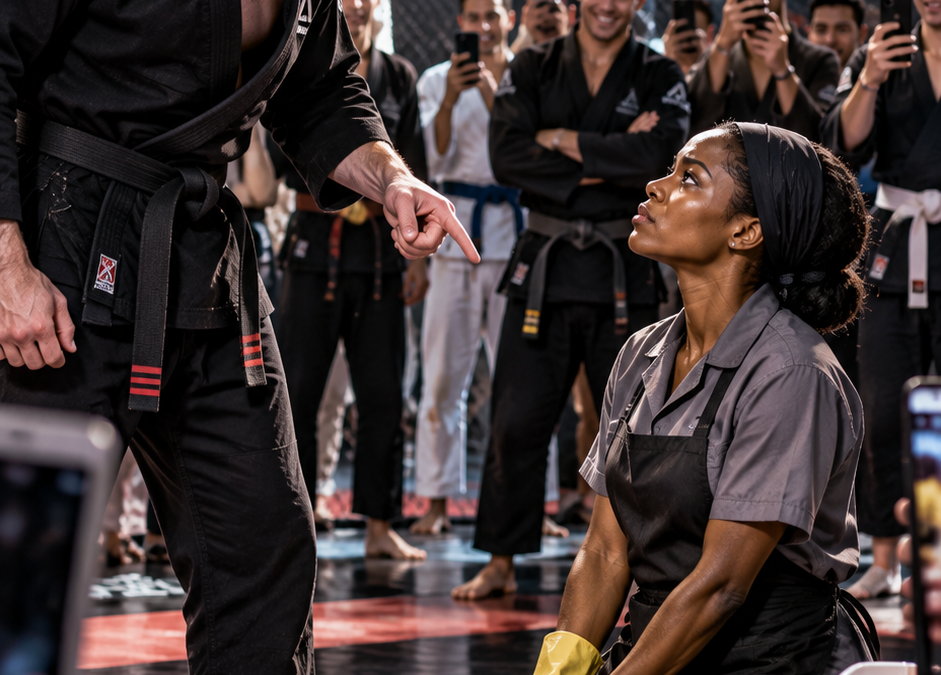
“Get on my mat, mop girl.”
I stared at him.
“Excuse me?”
“You heard me. Maybe if you learned to fight, you wouldn’t spend your whole life on your knees scrubbing floors.”
A few people laughed.
Others looked uncomfortable.
I felt my face grow hot.
But Tyler wasn’t finished.
“Or is mopping the only thing your kind knows how to do?”
The laughter stopped.
Even his students seemed uncertain about what they had just heard.
Nathan lowered his pen.
I looked around the room.
Dozens of people were watching.
Some had their phones out.
Others avoided meeting my eyes.
I had spent three years working in that building, cleaning up after people who barely acknowledged that I existed.
Now the academy’s most celebrated instructor was publicly humiliating me, and almost nobody was willing to tell him to stop.
I thought about Raymond.
About the way he treated the church custodian with exactly the same respect he showed visiting trainers.
About the time he had made a promising young fighter apologize to an elderly volunteer for leaving dirty equipment scattered across the floor.
And about the words he repeated whenever someone confused athletic ability with personal worth.
“Your hands don’t make you a good fighter if you don’t know when to put them down.”
I looked back at Tyler.
“One round?”
He laughed.
“One round. Just for fun.”
I pulled off my rubber gloves.
“Okay.”
For the first time that evening, Tyler appeared briefly surprised.
Then he smiled again.
“That’s what I’m talking about!”
I walked toward the training floor.
Mrs. Wilson reached for my arm.
“Ursula, honey, you don’t have to do this.”
I looked at her.
“I know.”
She studied my face for a moment.
Whatever she saw made her release my arm.
I removed my sneakers at the edge of the mat.
The room was buzzing.
People were whispering, laughing nervously, and raising their phones.
I could hear somebody predicting that Tyler would finish the demonstration in thirty seconds.
Another student said I was going to get hurt.
I stepped onto the canvas barefoot.
Then I settled into my stance.
My breathing slowed.
My weight shifted naturally onto the balls of my feet.
My chin tucked.
My hands remained loose.
It was such a small movement that almost nobody noticed.
Almost.
Nathan leaned forward so suddenly that his notebook slid from his lap.
Gregory turned toward him.
“Sorry about this. She’s just the cleaning lady. It’ll be over quickly.”
Nathan didn’t answer.
His eyes were fixed on my feet.
Across the mat, Tyler bounced on his toes, threw a quick combination into the air, and winked at the students nearest the cage.
“Ready, mop girl?”
I looked at him.
“Whenever you are.”
He grinned.
“Don’t worry. I’ll let you swing first.”
I didn’t move.
“Come on. Throw something.”
I remained still.
A student near the front shouted that he was giving me thirty seconds.
Tyler laughed.
I could hear every word.
But as I stood there, something extraordinary happened.
The noise began to fade.
The folding chairs, the phones, the bright lights, and the crowded gym seemed to move farther away.
I was back in the church basement in Detroit.
Raymond stood opposite me in his gray T-shirt, reading glasses pushed onto his forehead.
I could hear his voice as clearly as though he were standing beside me.
“What’s the first thing you do when someone bigger than you comes forward?”
“Wait.”
“What’s the second?”
“Watch.”
“And the third?”
I almost smiled.
“Make them pay for every mistake.”
Then the memory disappeared.
I was standing on the mat at Summit Edge again.
Tyler’s voice cut through the room.
“Hey! You still with us?”
I lifted my eyes.
He raised his guard.
And attacked.
His first strike was a high roundhouse kick aimed toward my head.
It was fast.
I could see why his students admired him.
His balance was excellent, and his leg moved with the precision of someone who had repeated the same technique thousands of times.
But he had given away the kick before he threw it.
His shoulder shifted.
His hips loaded.
His eyes flicked toward the target.
I moved my head a few inches.
His foot passed beside my ear.
I didn’t step backward.
I didn’t raise my hands.
I simply watched him recover his balance.
A ripple of surprise moved through the crowd.
Tyler smiled as though I had gotten lucky.
He threw the same kick from the opposite side.
I ducked.
His leg passed harmlessly over my head.
When I straightened, I was standing exactly where I had been before.
Tyler stopped smiling.
I could see him recalculating.
He came forward with a jab, a cross, and a spinning back kick.
The jab passed beside my shoulder.
I redirected the cross with my forearm and stepped outside the spinning kick.
Tyler’s momentum carried him past me.
He stumbled, recovered, and turned.
I was still standing in front of him.
Still breathing calmly.
Still waiting.
Someone near the cage whispered, “Hold on.”
Another voice answered, “How did she do that?”
Tyler’s expression hardened.
He charged.
This time, there was less technique and more frustration.
He threw a rapid series of punches, trying to overwhelm me with speed.
I slipped the first jab.
Then the second.
I rolled beneath a hook and leaned away from an uppercut.
When he threw an overhand right, I caught his fist in my open palm.
For one second, neither of us moved.
He stared at our hands.
I looked directly into his eyes.
Then I released his fist and gently pushed it back toward him.
He staggered backward.
Not because I had struck him.
Because he finally understood that I had allowed every one of those punches to miss.
The gym fell silent.
He had thrown perhaps twenty strikes.
Not one had landed cleanly.
And I hadn’t thrown a single punch.
I watched his breathing.
It had already become heavier.
He was working much harder than I was, and he was beginning to make mistakes he would never have made during a controlled demonstration.
He dropped his right hand after his jab.
He shifted his hips too early before his kicks.
And whenever he prepared to throw an overhand punch, his eyes moved toward the side he intended to attack.
I recognized his patterns.
He knew almost nothing about mine.
For the first time since I had known him, Tyler Grant looked uncertain.
Across the room, Nathan Cross rose from his chair.
He was holding his phone.
I later learned that he had found an archived photograph of me standing inside a chalk circle in Detroit.
The headline identified me as the Ghost of Grashet.
Thirty-four fights.
Thirty-four victories.
Not one defeat.
Nathan looked from the photograph to me and back again.
“Oh my God,” he whispered.
But I wasn’t watching him.
I was watching Tyler.
He had stopped performing for the crowd.
His guard rose higher.
His stance tightened.
He no longer looked toward the mirrors.
For the first time that evening, he was beginning to behave like a man who understood he was in a real fight.
I slowly raised my hands.
Tyler saw the movement.
Something changed in his expression.
Until then, I had allowed him to attack without striking back.
Now he had to wonder what would happen when I stopped waiting.
I took one small step forward.
He immediately threw a jab to keep me at a distance.
I redirected it and touched his chin with a jab of my own.
It wasn’t a powerful strike.
It was a reminder that I could reach him whenever I chose.
His head moved backward in surprise.
He threw a wild hook.
I ducked beneath it, stepped toward his exposed side, and drove a short punch into his body.
The impact made him fold slightly.
His knees bent.
His guard dropped.
I could have followed with another strike.
I didn’t.
I stepped backward and waited for him to recover.
The room was completely silent now.
Nobody was laughing.
Nobody was making predictions.
Tyler straightened slowly, breathing through his mouth.
I could see his pride fighting against the reality of what was happening.
He looked toward Nathan.
The scout was standing beside his chair, watching every movement.
Then Tyler came at me with everything he had left.
He threw a three-punch combination followed by a switch kick toward my ribs.
The punches were fast.
His technique was still excellent.
But his movements had become increasingly predictable.
I slipped the jab, rolled beneath the cross, and moved just outside the hook.
When the kick came, I checked it.
The impact cracked through the gym.
Tyler winced.
His balance shifted for a fraction of a second.
That was all I needed.
I stepped inside his preferred range.
A short hook struck his body.
An uppercut split his guard.
Then a final hook connected with his jaw.
His mouthguard flew out.
It bounced twice on the canvas and stopped near the feet of a stunned student in the front row.
Tyler stumbled backward.
His hands dropped.
His eyes looked unfocused.
I could see that he had reached the point where continuing would be dangerous.
But he was still trying to come forward.
I used a controlled push kick to create distance.
He staggered into the cage wall.
The chain-link fencing rattled behind him.
His arms spread against it as he struggled to regain his balance.
I stopped three feet away.
My hands were still raised.
Tyler looked at me.
For the first time that night, there was no laughter, no arrogance, and no carefully practiced confidence.
Only a frightened man struggling to understand what had happened.
I drew back my right hand.
For a moment, I could feel twelve years of training gathering in my shoulders.
I knew exactly how much damage another strike could cause.
I also knew that Tyler was no longer in a position to defend himself properly.
I held the punch.
One second.
Two.
Three.
Then I lowered my hand.
I stepped backward and turned away.
I had spent twelve years learning how to finish fights.
Raymond had spent those same years teaching me when not to.
That night, I finally understood which lesson mattered more.
Behind me, Tyler slid down the cage wall.
His knees gave way, and he sat heavily on the canvas.
His bottom lip was bleeding.
His chest rose and fell rapidly.
He stared at the floor.
For several seconds, the entire gym remained silent.
Then the noise erupted.
People stood from their chairs, shouted to each other, and replayed recordings on their phones.
Some were cheering.
Others looked shocked.
A few appeared embarrassed by how eagerly they had laughed when Tyler first called me onto the mat.
I barely noticed.
My hands had begun trembling.
Not because I was afraid of Tyler.
Because I had just done something I had promised myself I would never do again.
I had fought.
And for the first time since Raymond’s death, I had felt the part of myself I thought I had buried come alive.
I started toward the edge of the mat.
Then a man’s voice stopped me.
“Ursula Brooks.”
I turned.
Nathan Cross was standing several feet away.
He held up his phone.
On the screen was an old photograph of a younger version of me standing inside a chalk circle.
I recognized the picture immediately.
Detroit.
My twenty-ninth fight.
Raymond had taken me out for breakfast afterward because he said I needed to celebrate a win without collecting another bruise.
Nathan looked at me.
“You’re the Ghost of Grashet.”
The gym fell silent again.
I looked at the photograph.
For a moment, the memories were so powerful that I could barely speak.
“I was.”
Nathan shook his head slowly.
“Thirty-four wins. Zero losses. Twenty-two knockouts.”
People began reaching for their phones.
Students searched my name.
Articles appeared.
Old fight recordings surfaced.
I watched several people stare at their screens, then look at me as though they were seeing a stranger.
One student whispered, “She’s actually real.”
Another said, “She’s been cleaning our gym for three years.”
Mrs. Wilson had both hands over her mouth.
Her eyes were filled with tears.
I stood barefoot on the canvas, feeling more exposed than I ever had during a fight.
Nathan looked at me.
“Everyone thought you’d disappeared.”
“I did.”
“Why?”
My throat tightened.
I looked toward the gym entrance, suddenly wishing Raymond would walk through it carrying his battered training bag.
“My coach died.”
Nathan’s expression softened.
“Raymond Ellis?”
I nodded.
“He was my family.”
For several seconds, Nathan said nothing.
Then he lowered his phone.
“I’m sorry.”
It was the first time that evening someone had spoken to me without trying to impress an audience.
And somehow, that almost made me cry.
The crowd gradually began to thin.
People continued watching the recordings, whispering about the fight and reading everything they could find about my old career.
Tyler remained near the cage wall.
Nobody seemed certain whether to approach him.
A few of his students watched him from a distance, their admiration replaced by uncomfortable confusion.
I didn’t feel triumphant.
I had never wanted to humiliate him.
I had wanted him to stop humiliating me.
There was a difference, although I wasn’t certain anyone watching understood it.
Mrs. Wilson reached me before I could put my shoes back on.
She wrapped her arms around me so tightly that I almost lost my balance.
“Oh, honey.”
I hugged her.
She pulled back just far enough to look at my face.
“Why didn’t you ever tell me?”
I swallowed.
“Because I wasn’t trying to be that person anymore.”
She brushed a tear from her cheek.
“You didn’t have to be that person for us to treat you better.”
I looked toward the floor I had spent three years cleaning.
She was right.
And I wondered how many people had watched Tyler mistreat me because they assumed I had no way to defend myself.
I wondered whether they would have intervened if I hadn’t turned out to be somebody they now considered important.
That question stayed with me long after the crowd disappeared.
Nathan waited near the edge of the training floor.
When Mrs. Wilson finally released me, he approached.
“Can we talk?”
I nodded.
Gregory offered us his office, but Nathan shook his head.
“Here is fine.”
He sat on the edge of the mat beside me.
For a moment, neither of us spoke.
Then he said, “I’ve watched hundreds of fighters over the years. Some were naturally gifted. Some worked harder than anyone I’ve ever met. A few had both.”
I stared at my hands.
“I’m not looking for a fight contract.”
“I know.”
“Then what do you want?”
He took a moment before answering.
“I run a development program for young fighters. Mostly women from backgrounds where nobody gives them much of an opportunity.”
I looked at him.
“We work with athletes who have talent but no connections. Some come from neighborhoods without proper training facilities. Others have been told their entire lives that they don’t belong in combat sports.”
He paused.
“They need coaches who understand what it means to start with nothing.”
I felt something tighten in my chest.
Nathan continued.
“They need someone who’s fought from the bottom, someone who understands discipline and fear and what happens when the whole room expects you to lose.”
He looked directly at me.
“They need you.”
I lowered my eyes.
For three years, I had avoided every opportunity to return to fighting.
The idea of stepping back into a gym as a coach felt almost as frightening as the idea of entering a ring.
Because coaching meant teaching someone else everything Raymond had taught me.
It meant returning to memories I had spent years trying to escape.
I looked at the old scars across my knuckles.
I remembered Raymond sitting beside me after a difficult training session, carefully unwrapping my swollen hands.
He had asked me what I wanted to do when my fighting career ended.
I told him I hadn’t thought about it.
He smiled.
“Then start thinking, baby girl.”
“Why?”
“Because somebody’s going to need what you’ve learned. Promise me you’ll pass it on.”
I had promised.
Then he died.
And instead of keeping that promise, I had run away from the only world where I had ever truly felt at home.
I sat beside Nathan for a long time.
Finally, I looked at him.
“When do I start?”
He smiled.
“Whenever you’re ready.”
That night, I rode the bus home with my work uniform folded inside my bag.
I sat in my usual seat near the back.
Outside, Atlanta moved past the windows in long ribbons of light.
My phone had been ringing almost continuously since I left the gym.
Old contacts from Detroit.
People I hadn’t spoken to in years.
Unknown numbers.
Messages from former fighters who had seen the video.
I turned the phone off.
I wasn’t ready to explain myself to anyone.
When I reached my apartment, I placed my bag beside the door and sat on the edge of my bed.
Raymond’s photograph stood on the nightstand.
For three years, I had looked at it and felt the terrible emptiness of knowing I would never hear his voice again.
That night, something was different.
I picked up the newspaper clipping that had been lying facedown.
I turned it over.
The Ghost of Grashet: Detroit’s Undefeated Underground Queen.
I studied the photograph of my younger self.
She looked fierce, confident, and completely unaware that the happiest years of her life would end so suddenly.
I touched the edge of the clipping.
Then I looked at Raymond’s photograph.
“I didn’t forget, Coach.”
My voice trembled.
“I just didn’t know how to come back.”
For the first time since his funeral, I allowed myself to cry without trying to stop.
The following morning, I arrived at Summit Edge at six o’clock.
But I didn’t enter through the side door.
I walked through the front entrance.
Gregory Palmer was waiting in the lobby.
He looked exhausted.
I suspected he hadn’t slept much after discovering that millions of people were watching a video of his most celebrated instructor humiliating his cleaning employee.
He stood beside the reception desk holding a cardboard box.
“Ursula.”
It was one of the few times I could remember him saying my name.
“Morning, Gregory.”
He handed me the box.
Inside was a black coaching tracksuit with the Summit Edge logo embroidered on the chest.
I looked at him.
“What’s this?”
“I spoke with Nathan. If you’re willing, we’d like you to take responsibility for a new training program here.”
I stared at the tracksuit.
For three years, I had cleaned the same floors where other people taught.
Now the owner of the academy was asking me to become one of its coaches.
Gregory shifted uncomfortably.
“I also owe you an apology.”
I looked up.
“I knew Tyler could be difficult. I told myself his behavior was harmless because he brought in students and attracted attention to the academy.”
He glanced toward the empty training floor.
“Yesterday made it impossible to keep pretending that.”
I held the box against my chest.
“You should’ve stopped him before you knew I could fight.”
Gregory nodded.
“You’re right.”
Then he pointed toward the far wall.
A maintenance crew was working near the heavy bags.
They were installing a plaque above the entrance to a smaller training room.
I walked closer.
The letters came into focus.
THE RAYMOND ELLIS TRAINING ROOM.
I stopped.
For a moment, I couldn’t breathe.
I had seen Raymond’s name on a gravestone.
I had seen it on old newspaper clippings and faded photographs.
But I had never imagined seeing it on the wall of a gym where young fighters would train under his principles.
I read the plaque three times.
My lips moved, but no words came out.
Then I began crying.
Not quietly.
Not gracefully.
I stood there holding a coaching tracksuit I had never asked for, staring at the name of a man I thought the world had forgotten.
Mrs. Wilson appeared beside me carrying two cups of coffee.
She placed one on a nearby bench and gently put her arm around my shoulders.
Neither of us spoke.
She simply stood beside me until I could breathe again.
That afternoon, Tyler Grant returned to Summit Edge.
He didn’t arrive in his white BMW.
I learned later that he’d taken the bus.
He carried a plain backpack and a bottle of water, and he looked as though he’d aged ten years overnight.
The video of our fight had reached fourteen million views in approximately six hours.
By the next morning, he had deleted his social media accounts.
For someone who had built so much of his identity around public admiration, the sudden loss of control must have been devastating.
But I wasn’t interested in speculating about how embarrassed he felt.
I was adjusting the height of a heavy bag when he entered the training room.
“Ursula.”
I turned.
It was the first time he’d ever addressed me by my name.
He stood near the doorway, looking uncomfortable.
“I wanted to say I’m sorry.”
I waited.
He looked down.
“For the things I said. The way I treated you. All of it.”
I studied him for a moment.
There was no audience.
No camera crew.
No students waiting to laugh at his jokes.
Just a young man who had finally discovered what it felt like to stand in front of someone whose respect he hadn’t earned.
“Do you understand why what you did was wrong?” I asked.
He nodded.
“I thought I did yesterday. But I watched the video again last night, and I saw everyone laughing.”
He swallowed.
“I saw how you looked when I told you to get on the mat.”
I said nothing.
“And I realized I would’ve done the same thing even if you couldn’t fight.”
That was the first honest thing I had ever heard him say.
I looked toward the heavy bag.
“Everybody has something to learn, Tyler.”
He nodded.
“Even me.”
“Especially you.”
For the first time, he managed a small, embarrassed smile.
I pointed toward the mat.
“If you’re serious about coming back, you’ll start with the basics.”
He looked at me.
“As a student?”
“That’s usually how learning works.”
Tyler lowered his bag.
Then he stepped onto the mat.
Not as the celebrated instructor who expected everyone to admire him.
As a student who had finally discovered that talent and character were two very different things.
Six months later, Summit Edge Academy looked almost exactly the same from the outside.
The white BMWs still filled the parking lot. The trophy cases still stood near the entrance. The fluorescent lights still buzzed above the training floor.
But the atmosphere inside had changed.
Students no longer laughed when employees were insulted.
Coaches were expected to demonstrate discipline and respect, not simply technical ability.
Gregory had introduced clear policies for protecting employees and reporting inappropriate conduct.
And in the training room named after Raymond Ellis, I taught twelve young women who had been told in one way or another that they didn’t belong.
Some came from neighborhoods where affordable training facilities were almost impossible to find.
Others had struggled to convince their families that combat sports were a legitimate pursuit.
Several had arrived with little more than determination and a willingness to work.
I recognized something of my younger self in every one of them.
I taught them the same way Raymond had taught me.
Patiently.
Precisely.
Without unnecessary theatrics.
When someone became frustrated, I reminded her that anger could destroy the judgment she needed most.
When someone became overconfident, I paired her with an opponent who could expose the weakness she hadn’t yet recognized.
And when someone wanted to quit because the work was harder than she’d imagined, I told her about the old church basement where I had once learned to believe in myself.
Three of my students were being evaluated by Nathan’s development program.
Two had already won their first amateur bouts.
One, a seventeen-year-old from East Atlanta named Grace, had stopped her opponent in forty-five seconds.
When a local interviewer asked who trained her, Grace smiled.
“The Ghost.”
I watched that interview twice.
Not because I missed hearing the nickname.
Because I could almost imagine Raymond sitting beside me, laughing at the idea that his little gym in Detroit had somehow found its way into the life of a teenage girl in Atlanta.
Tyler trained at Summit Edge three days a week.
He arrived through the front entrance, greeted the staff by name, and bowed when he entered my training room.
He still had exceptional athletic ability.
His kicks remained beautiful.
His combinations were fast.
But he had stopped treating every sparring session like an opportunity to humiliate somebody.
He worked with younger students, practiced his fundamentals, and accepted correction without arguing.
Sometimes, when he became frustrated, I reminded him of the same principle Raymond had repeated to me for twelve years.
“Don’t fight angry. Fight quiet.”
Tyler never talked publicly about the night we fought.
He didn’t need to.
Fourteen million people had already seen it.
What mattered more to me was the person he chose to become afterward.
One Tuesday evening, after the last class had ended and the students had gone home, I stood alone inside the Raymond Ellis Training Room.
The lights were low.
The building was quiet.
For a moment, it felt exactly like those early mornings when I used to arrive carrying a bucket and a mop.
But this time, I wasn’t cleaning.
I was holding a pair of hand wraps.
I sat on the edge of the mat and began wrapping my hands the way Raymond had taught me twenty years earlier.
Thumb loop.
Across the knuckles.
Between the fingers.
Around the wrist.
Every movement brought back a memory.
Raymond correcting my stance.
Raymond laughing after a hard training session.
Raymond telling me that the real purpose of learning to fight wasn’t proving I could hurt someone.
It was learning that I didn’t have to.
I stood and approached the heavy bag.
The old newspaper clipping was framed beside his plaque.
For three years, I had hidden it facedown because I couldn’t bear to remember the life I’d lost.
Now it hung where young fighters could see it.
Not as a monument to thirty-four victories.
But as a reminder that the person teaching them had once been a frightened young woman who needed someone to believe in her.
I settled into my stance.
My hands rose.
My chin tucked.
I threw a jab.
Then a cross.
Then the same combination Raymond had taught me in his church basement.
The bag swung gently.
I stopped and rested my forehead against the leather.
For a long moment, I stood there listening to the quiet hum of the ventilation system.
“Promise kept, Coach.”
Then I stepped back.
I looked at the plaque above the door and smiled.
Three years earlier, I had walked away from fighting because I couldn’t imagine continuing without Raymond.
I had believed that leaving Detroit meant leaving behind everything that reminded me of him.
But grief had confused the place where I lost him with the life he had given me.
I didn’t have to return to the underground circuit.
I didn’t have to defend my undefeated record, accept another fight, or prove that the Ghost of Grashet was still dangerous.
I could honor Raymond by doing what he had always asked.
I could pass it on.
The young women who trained in that room would never meet him. They would never hear his laughter echoing through the old church basement or feel his enormous hands carefully tightening the wraps around their knuckles.
But every time I corrected a frightened student, taught someone to remain calm under pressure, or reminded an arrogant fighter that talent did not excuse cruelty, a little more of Raymond’s wisdom survived.
That was the legacy I had almost thrown away.
Tyler Grant had challenged me because he believed a woman scrubbing floors couldn’t possibly have anything worth teaching him.
He had mistaken my job for my identity and my silence for weakness.
What he discovered on that mat changed both our lives, but it wasn’t the punches that mattered most.
It was the moment I realized I could lower my hand instead of throwing the final strike.
For years, I had thought being the Ghost meant making sure nobody saw me.
Now I understood that I had spent three years hiding from myself.
I turned off the training room lights, locked the door, and walked toward the front entrance.
Outside, the evening air was cool, and Atlanta’s streets glittered beneath the streetlights.
I still took the bus home.
I still lived in the same little apartment.
And Raymond’s photograph still stood on my nightstand.
But I no longer kept the newspaper clipping facedown.
I had finally stopped running from the person he had helped me become.
And for the first time in three years, I wasn’t afraid to let her live again.








