𝗙𝗨𝗟𝗟 𝗦𝗧𝗢𝗥𝗬 The Armed Man Holding Me Hostage Couldn’t Understand Why I Wasn’t Afraid
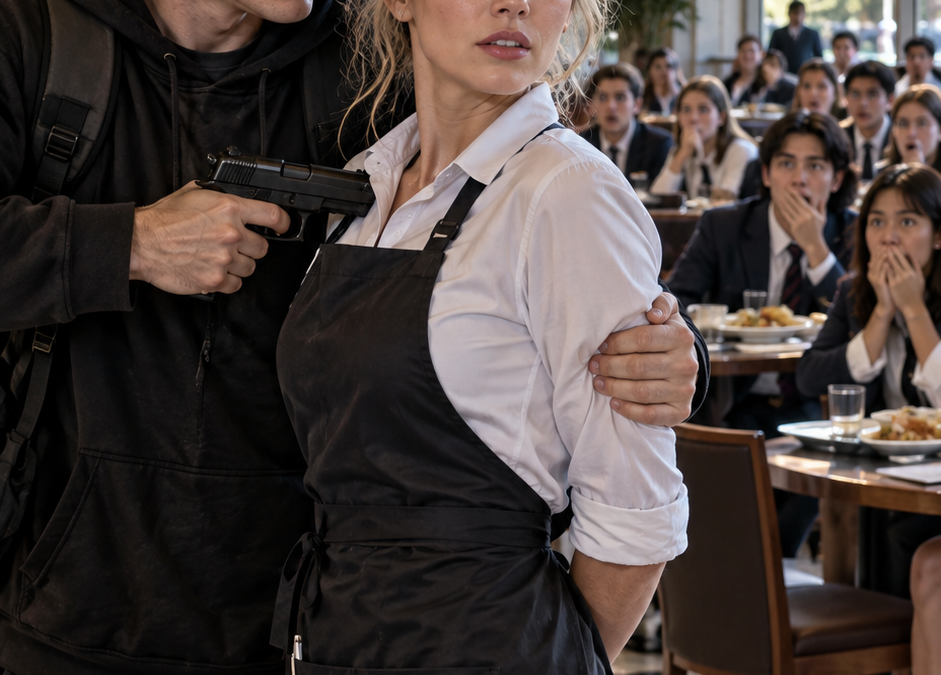
𝗣𝗔𝗥𝗧 𝟮
Because he was calling my name.
That was my answer every time.
There are decisions you make by calculation.
There are others your body makes before calculation has a chance.
I reached him.
Then the second blast came.
I remember being lifted.
Not far.
Maybe three feet.
Maybe six.
Memory behaves strangely around explosions.
I remember hitting the ground.
I remember no pain at first.
I remember trying to stand and discovering my left leg had opinions separate from mine.
Then pain arrived everywhere at once.
My teammate was still alive.
So I worked.
That was what I knew.
Pressure.
Airway.
Tourniquet.
Breathing.
Reassess.
Ignore my own blood.
Someone tried to pull me away.
I told him to stop.
Someone told me I’d been hit.
I told him I was busy.
Eleven minutes.
That was how long I stayed with my teammate before another medic reached us.
Eleven minutes that later appeared in an official report.
Eleven minutes that eventually became part of a commendation I never wanted to read.
Eleven minutes that cost me the only career I had ever imagined keeping.
My injuries were not dramatic enough to kill me.
That almost made them harder to explain.
Six months of surgeries.
Physical therapy.
Nerve testing.
Strength testing.
Range of motion.
More surgeries.
More testing.
Then the medical board.
The officer across from me was kind.
I hated him for being kind.
Cruelty gives you something to fight.
Kindness leaves you with reality.
“You are not being cleared for deployment.”
I looked at the paper.
He waited.
There were appeal procedures.
He explained them.
I listened.
Then I signed.
No appeal.
No anger in the room.
No speech.
I simply understood something had ended.
For nine years, I had been useful in a very specific way.
Then, in one office with fluorescent lighting and a flag in the corner, the Navy informed me that the way I had learned to be useful was no longer available.
I moved to California.
I tried private medical work.
Lasted three months.
I tried emergency dispatch.
Lasted six weeks.
Every call put me somewhere I could hear the emergency and could not touch it.
That was worse.
Eventually I found Harrington.
Structured mornings.
Clear hierarchy.
Schedules that stayed schedules.
Nobody bleeding.
Nobody screaming.
Nobody expecting my hands to save them.
I could arrive at 6:15, prepare the service line, work through lunch, and go home knowing the greatest emergency of the day might involve gluten-free bread.
That became enough.
Or I taught myself to call it enough.
On the Tuesday Ryan Callaway entered the canteen, my morning had started with Madison Hale telling me I was incompetent.
Madison was nineteen.
Blonde.
Expensive coat draped over the back of her chair despite a campus rule asking students not to block the aisles.
She came from a family whose name appeared on one of Harrington’s newer science buildings.
I knew that because everyone knew it.
Madison arrived at 8:50 with two friends and ordered the same breakfast she usually did.
Egg whites.
Avocado.
Fruit.
A specific dressing.
No nuts.
She had a documented severe allergy, and the kitchen had protocols.
I knew them.
The kitchen knew them.
That morning her plate came out wrong.
Not dangerously wrong.
Just cold.
Madison touched one forkful, waved me over, and held up the plate as though presenting evidence at trial.
“This is cold.”
“I’m sorry. I’ll replace it.”
“It’s not complicated.”
“No.”
“My parents pay an insane amount for me to be here.”
I nodded.
“I’ll replace it.”
One of her friends looked embarrassed.
The other looked amused.
Madison continued.
“Maybe if the staff here could handle basic things without being reminded, mornings would be easier for everybody.”
Three nearby tables heard her.
Nobody said anything.
I picked up the plate.
“You’re right. I’ll bring you another.”
That seemed to disappoint her.
People sometimes become more frustrated when you refuse the argument they prepared.
I returned to the kitchen.
Asked for a replacement.
Reminded the line cook about Madison’s allergy.
He nodded.
I took the new plate out.
Madison barely looked at me when I placed it down.
“Thank you.”
“You’re welcome.”
As I walked away, she said something to her friends.
They laughed.
I didn’t hear the exact words.
I didn’t need to.
At one point in my life, a man had screamed at me while I held an artery closed inside his leg.
He apologized six months later.
I told him there was nothing to apologize for.
Pain turns people into versions of themselves they would not choose.
Privilege can do something similar, only more quietly.
By 10:45, breakfast had thinned into early lunch.
Students entered between classes.
I refilled dispensers.
Restocked napkins.
Cleaned three tables.
At 11:13, I was carrying a tray toward the service station.
At 11:14, the south doors opened.
Ryan Callaway stepped inside.
Before I saw the weapon, I saw his face.
That is important.
People think danger announces itself through objects.
Sometimes it announces itself through attention.
Ryan looked like a man who had stopped seeing the room as a collection of human beings and started seeing it as the final obstacle between himself and something he believed he needed.
His clothes were ordinary.
Dark jacket.
Gray shirt.
Jeans.
Twenty-three, maybe twenty-four.
He looked exhausted.
Not intoxicated.
Not detached.
Desperate.
Then I saw the weapon.
He had it down at his side.
A student near the entrance screamed.
Everything accelerated.
Ryan grabbed the nearest person.
Me.
His left arm locked around mine.
The weapon pressed against my side.
“Everybody down!”
His voice cracked on the last word.
That told me almost as much as the weapon.
Forty students froze.
Ryan shouted again.
“Get down!”
This time they moved.
Chairs scraped.
Plates hit the floor.
One glass shattered.
A young man near the windows grabbed his girlfriend and pulled her underneath a table.
Two students crouched behind a column.
Another remained standing until someone dragged him down by the sleeve.
I let Ryan move me toward the center.
No resistance.
Resistance would force him to make a decision.
At that moment I wanted him making as few decisions as possible.
“Don’t move,” he said.
“I’m not moving.”
“Aren’t you scared?”
That was when I told him.
“I’ve been here before.”
He looked at me.
Confusion interrupted panic for half a second.
Useful.
“You think this is funny?”
“No.”
“You don’t know me.”
“No.”
“Then shut up.”
“Okay.”
I meant it.
Talking because you are afraid of silence is one of the fastest ways to lose control of a frightened person.
I watched instead.
His hands shook.
His breathing remained relatively steady.
The weapon stayed low.
Finger position inconsistent but not actively tightening.
His eyes kept moving toward his jacket pocket.
Not the exits.
Not the students.
Pocket.
There was something in it he cared about.
His purpose.
People outside the room might eventually classify us into two categories.
Hostage taker.
Hostages.
Inside the room, categories were less useful.
I needed to know what Ryan wanted.
Not what he was doing.
Those were different things.
Three students near the windows were approaching panic.
One girl had begun breathing too quickly.
I caught her eye.
Raised my hand slightly.
Palm down.
Slow.
She stared at me.
I breathed deliberately.
In.
Out.
Again.
She followed.
Ryan never noticed.
I shifted my body half a step.
That gave two students a clearer path behind one of the heavy oak tables.
I looked toward it.
Then at them.
Tiny movement.
They understood.
Crawled.
Ryan saw movement.
“Stay down!”
Nobody moved after that.
I said quietly, “They’re scared.”
“I know.”
“They’ll listen if you stop shouting.”
He looked at me.
I kept my face neutral.
“I’m not telling you what to do. I’m telling you they’re already listening.”
His jaw tightened.
But he did not shout again.
First siren at 11:20.
Then another.
Then several.
Ryan’s eyes moved toward the windows.
I counted the seconds.
One.
Two.
Three.
He looked back.
In three seconds I learned more.
Police response quick.
Campus lockdown likely active.
Ryan expected police but reacted emotionally when they arrived.
That meant he had imagined this morning, but not properly planned it.
A plan survives expected events.
A fantasy becomes unstable when reality arrives.
“Phones on the ground,” he said.
Students obeyed.
One phone continued vibrating near a chair.
Ryan ignored it.
Good.
The weapon was leverage.
Not fascination.
I still did not know whether anyone would die.
But I knew the probability had moved in our favor.
At 11:26, a phone on the service counter rang.
Ryan stared at it.
Ring.
Ring.
He ordered me to pick it up.
I did.
“Speaker.”
I activated it.
A negotiator introduced himself.
Calm male voice.
Professional.
He asked whether anyone was hurt.
Ryan took the phone.
“No.”
The negotiator asked his name.
“You know my name.”
“I want to hear it from you.”
Ryan’s expression changed.
Tiny.
Annoyance.
“You know who I am.”
“I’d like you to tell me.”
I listened.
The negotiator was trained.
Competent.
Doing exactly what procedure demanded.
But Ryan did not want to establish identity.
He wanted identity acknowledged.
There is a difference.
For eight minutes—though the source version of the story might remember four—Ryan argued with a man whose job required him to slow time.
The negotiator asked what Ryan wanted.
Ryan said, “I want them to answer.”
“Who?”
“They know.”
“Help me understand.”
“They already understand.”
That repeated pattern mattered.
Ryan believed the people outside possessed information they were pretending not to possess.
The negotiator kept trying to move him toward specific demands.
Ryan kept moving backward toward grievance.
Eventually he ended the call.
Not violently.
Just pressed the button.
Stared at the phone.
Then set it down.
I waited.
One minute.
Two.
Silence began doing work for me.
Ryan looked around the canteen.
Forty students.
Plates abandoned.
A woman crying quietly.
His weapon.
Me.
Reality had arrived.
I glanced at his jacket.
“The paper.”
His eyes snapped toward me.
“What?”
“In your pocket.”
His face hardened.
“What about it?”
“You keep checking it.”
“Mind your business.”
“I’m currently part of your business.”
Bad line.
Too sharp.
I saw him tense.
So I softened immediately.
“Sorry.”
He stared.
“I mean it.”
That surprised him.
“I don’t know what’s on the paper. But I’m guessing it’s why you’re here.”
He said nothing.
“Names?”
His eyes changed.
I had it.
“People you came to see.”
“Shut up.”
“Okay.”
I did.
Thirty seconds.
He pulled the folded paper out himself.
That was the moment I knew Ryan wanted someone to understand.
Really understand.
Not excuse him.
Not approve.
Understand.
He unfolded it.
Five names.
Administrators.
Dean.
Academic integrity officer.
Board representative.
One student.
I recognized one surname.
Wealthy family.
Campus donor.
Ryan caught me looking.
“You know him?”
“Know the name.”
“Of course you do.”
There was enough bitterness in those four words to explain half the morning.
“What happened?”
He laughed.
Not because anything was funny.
“You work here.”
“Yes.”
“And you don’t know?”
“No.”
“Exactly.”
I waited.
Then he started talking.
Full scholarship.
First person in his family to attend college.
Engineering.
Third year.
Top grades.
A group project.
Plagiarism accusation.
Evidence submitted under his credentials.
Another student involved.
The son of a donor.
Ryan claimed the investigation had been rushed.
He claimed technical metadata supported his version.
He claimed emails proved files had been altered after he submitted his work.
He appealed.
Denied.
Appealed again.
Denied.
He asked for an independent review.
Denied.
Requested a hearing.
Received one after months.
Same outcome.
Expelled.
Scholarship terminated.
Housing lost.
Job offer withdrawn.
His parents refinanced something to help him pay an attorney who eventually told him fighting the college would cost more than finishing somewhere else.
“So why not finish somewhere else?” I asked.
Ryan looked at me with pure fury.
Because that question sounded simple only to someone who hadn’t lost what he lost.
I regretted it immediately.
“Forget I asked.”
“No.”
His voice shook.
“You want to know?”
“Yes.”
“I did everything right.”
That was the center.
Not the degree.
Not even the accusation.
“I did everything they told people like me to do.”
He pointed toward the marble floor.
“Study. Work. Get the scholarship. Don’t cause trouble. Be grateful.”
His eyes filled.
“My mother cleaned hotel rooms so I could spend high school studying instead of working nights.”
No one moved.
“My father drove trucks sixteen hours a day.”
His grip on the weapon tightened.
“And one kid’s father makes a phone call and suddenly I’m the dishonest one.”
His voice broke.
“I sent them proof.”
I said nothing.
“They didn’t care.”
“I believe that you believe that.”
Wrong.
His face hardened.
“You believe I believe it.”
I corrected myself.
“You’re right.”
He stared.
“I shouldn’t have said it that way.”
Silence.
“I believe you presented evidence.”
His expression shifted.
“I don’t know what happened because I wasn’t there. But I believe nobody listening to you for eight months can make a person feel like they don’t exist.”
That reached him.
His weapon lowered perhaps an inch.
Outside, sirens.
Inside, breathing.
Then I heard something wrong.
Not Ryan.
Across the room.
A breath with a faint high note.
Wheeze.
I turned my eyes without moving my head.
Madison.
Against the west wall.
Knees to chest.
Face pale.
At first, I assumed panic.
Then I saw her neck.
Red.
Small raised patches.
Her eyes looked swollen.
She rubbed at her throat.
No.
I knew her allergy.
Her replacement breakfast.
The kitchen.
Possible cross-contamination.
Her breathing shortened again.
I counted.
Too fast.
Not panic-fast.
Obstruction-fast.
I looked back at Ryan.
“There’s a medical emergency.”
He laughed once.
“Nice try.”
“Look at the blonde girl against the wall.”
He didn’t.
“Ryan.”
“No.”
“If I wanted to rush you, I would’ve done it before police surrounded the building.”
His eyes met mine.
“That student is going into anaphylaxis.”
“What?”
“Severe allergic reaction.”
Madison’s hand went to her throat.
The student beside her noticed.
“Something’s wrong!”
Ryan spun.
The weapon rose slightly.
Everyone tensed.
I lowered my voice.
“Keep it down.”
He looked at me.
“Keep the weapon down, not because I’m ordering you to. Because if everybody panics, she gets worse.”
He looked at Madison.
Her breathing had become audible.
“How long?”
“Before what?”
“Before she’s…”
He couldn’t finish.
“Could be minutes.”
His face drained.
“I didn’t—”
“I know.”
That mattered.
I said it again.
“I know you didn’t come here for that.”
Ryan stared at her.
“What do you need?”
“Let me go to her.”
His gaze snapped back.
“If I let you—”
“I come back.”
He laughed nervously.
“You expect me to believe that?”
“Yes.”
“Why?”
“Because I said I would.”
That answer came from an older version of me.
A version I had been pretending no longer existed.
Ryan searched my face.
Then stepped away.
“Go.”
I moved.
Not ran.
Running turns concern into panic.
I walked quickly across the marble.
Knelt beside Madison.
Her eyes found mine.
All the arrogance from breakfast was gone.
Not punished.
Gone.
Fear strips life down to essentials.
“Olivia.”
First time she had ever used my name.
“I’m here.”
“I can’t…”
“I know.”
I lifted her chin.
Checked airway.
Looked at skin.
Hives spreading.
Lip swelling.
Respiratory compromise.
“Do you have an injector?”
She shook her head.
“Bag?”
A friend pointed across the room.
Ryan shouted, “Nobody moves!”
I looked over my shoulder.
“I need the bag.”
His eyes moved from me to Madison.
Then he nodded.
A student crawled toward it.
I searched Madison’s backpack.
No injector.
“Where?”
“Dorm.”
Of course.
I turned toward the service line.
“First aid cabinet.”
A student nearest the kitchen looked at me.
“Bring it.”
He froze.
I used the voice.
The one I had not used in two years.
“Now.”
He moved.
Fast.
The cabinet reached me.
I opened it.
I already knew most of what was inside because I’d inspected it weeks earlier after noticing the seal broken.
Antihistamines.
Basic supplies.
Emergency epinephrine auto-injector under campus protocol.
Expiration date acceptable.
I pulled it out.
Madison saw it.
“No.”
“Madison, look at me.”
Her eyes locked on mine.
“You are having a severe allergic reaction.”
Tears rolled down her face.
“I’m scared.”
“I know.”
“I can’t breathe.”
“You are breathing.”
Barely.
Important distinction.
“And we’re going to keep you breathing.”
I administered the epinephrine.
Someone behind me gasped.
I ignored it.
Time.
Observe.
Position.
Airway.
Prepare for second intervention if necessary.
Outside, emergency medical services were waiting.
Inside, we still had Ryan.
I could not simply open the doors.
So I worked with what existed.
“Slow breaths.”
Madison shook.
“I can’t.”
“Yes, you can.”
“No.”
“Listen to me.”
She did.
“In.”
I demonstrated.
“Out.”
Again.
“Good.”
Her friends stared.
One whispered, “How do you know this?”
I didn’t answer.
Madison’s breathing remained difficult for several minutes.
Then gradually, slowly, the pitch softened.
Air moved more freely.
Her eyes remained swollen.
Still dangerous.
But improving.
I checked the time.
Eleven minutes from when I first recognized the reaction until I felt confident enough to move away.
Eleven minutes.
Again.
Life has strange patterns.
Madison caught my sleeve.
I looked down.
Her fingers barely held the fabric.
This morning she had called me incompetent because her breakfast was cold.
Now she looked at me with naked fear and gratitude.
“Don’t go.”
That one hurt.
I had heard versions of those words before.
“I need to finish something.”
Her grip tightened.
“You’re okay right now.”
“What if—”
“I’ll still be in the room.”
Her eyes searched mine.
I touched her hand.
“I won’t leave you alone.”
She released my sleeve.
I stood.
The entire canteen looked at me differently.
I hated that.
Not because I disliked respect.
Because respect arriving only after demonstration is a complicated gift.
Forty people had watched me move from waitress to something they considered more important.
I had been the same person before Madison stopped breathing properly.
Same hands.
Same history.
Same scars.
Only their information had changed.
Ryan was staring too.
“What are you?”
The question almost made me laugh.
“A waitress.”
“Bullshit.”
A few students actually looked startled.
I walked toward him.
“You asked.”
“No waitress does that.”
“Some do.”
“You know what I mean.”
I stopped several feet away.
He no longer held the weapon against anyone.
It hung near his thigh.
Good.
“I used to be a combat medic.”
His eyes narrowed.
“Army?”
“Navy.”
“How long?”
“Nine years.”
He looked toward Madison.
Then back.
“What happened?”
“My career ended.”
“How?”
“Same way most things end.”
He waited.
“Something happened I couldn’t undo.”
For the first time since entering the room, Ryan looked at me not as hostage or obstacle.
As evidence.
Evidence that a life could break and continue.
I saw the opening.
I did not rush it.
“When I told you I’d been here before, I wasn’t talking about a college canteen.”
“No kidding.”
“I’ve had weapons closer.”
His eyes dropped.
“I’ve been in rooms where people died.”
Silence.
“I’ve also been the person on the floor.”
Ryan looked at my left side.
Maybe he had noticed the way I moved.
Maybe not.
“I got hurt on my last mission.”
“Bad?”
“Bad enough.”
“Someone die?”
I thought about my teammate.
“He lived.”
Ryan nodded once.
“And you?”
“I survived.”
“That’s not what I asked.”
That surprised me.
Maybe Ryan understood more than I gave him credit for.
I looked around Harrington.
“No.”
His eyes narrowed.
“No what?”
“I survived. I didn’t know how to live after.”
Ryan’s expression changed.
I continued.
“The Navy told me I couldn’t deploy again.”
“You fought them?”
“No.”
“Why not?”
“I had nothing left.”
He seemed disappointed.
Maybe he needed me to say I had fought an institution and won.
I couldn’t give him that.
“Sometimes systems are wrong,” I said.
His jaw tightened.
“Exactly.”
“Sometimes they’re also right about parts we don’t want to hear.”
His expression hardened again.
Careful.
“I’m not saying Harrington was right about you.”
“Sounds like it.”
“No.”
I pointed subtly toward the weapon.
“I’m saying an institution failing you doesn’t make every response to that failure equally right.”
His eyes dropped.
“This is the first time they’ve listened.”
“Have they?”
He looked at me.
“Right now they’re listening to the gun.”
Silence.
“Not your evidence.”
His face changed.
I knew I had hit the truth.
“The moment you walked in with that, you gave everyone who ignored you an easier story.”
He swallowed.
“What story?”
“That you’re dangerous.”
His grip loosened.
“They won’t have to talk about the appeal.”
His eyes moved to the students.
“They won’t have to talk about plagiarism.”
Then to the windows.
“They won’t have to talk about money.”
He looked at me.
“They’ll talk about today.”
His eyes filled.
I kept going because stopping would be cruel.
“If someone dies, today becomes the only story anyone ever tells about you.”
His face tightened.
“I didn’t come here to kill anyone.”
“I know.”
“You don’t know me.”
“I know enough.”
“No, you don’t.”
“You let me save Madison.”
That stopped him.
I pointed gently toward her.
“You could’ve refused.”
He looked.
Madison sat against the wall, breathing easier.
“You didn’t.”
His weapon lowered another inch.
“That matters.”
Outside, police lights flashed across the marble.
Ryan whispered, “Not to them.”
“Maybe not.”
He looked at me sharply.
I refused to lie.
“I don’t know what happens after you walk out.”
His eyes turned hard.
“Prison.”
“Maybe.”
“Definitely.”
“There will be consequences.”
That was important.
I would not manipulate him with promises I couldn’t keep.
“You took people hostage.”
His face collapsed slightly.
“You brought a weapon into a crowded room.”
“I know.”
“That doesn’t disappear because your reason started somewhere real.”
His breathing quickened.
I slowed mine.
“But you still control what happens next.”
He stared.
“For how long?”
“One decision.”
“What decision?”
“Whether anyone gets hurt.”
He looked down at the gun.
His voice became small.
“I already hurt them.”
“Yes.”
Another lie I refused to tell.
“They’re terrified.”
Someone nearby began crying again.
Ryan flinched.
“But they’re alive.”
I let the sentence sit.
“So are you.”
His thumb shifted along the grip.
The weapon remained pointed downward.
I told him about the medical board.
Not everything.
Just enough.
“I sat in an office while people explained the only work I’d ever wanted was over.”
Ryan listened.
“I thought being useful and being deployable were the same thing.”
He looked toward Madison.
I followed his gaze.
“I was wrong.”
Silence.
“I spent two years proving I was fine by making my life as small as possible.”
Ryan looked around the canteen.
“This is small?”
“For me, it was hiding.”
He almost smiled.
“Rich kids yelling about breakfast?”
“Extremely dangerous environment.”
A weak laugh escaped him.
First laugh.
Critical.
His shoulders dropped a fraction.
I continued.
“I thought if no one needed anything serious from me, I could never fail at the thing I used to be.”
Ryan looked at the paper sticking from his pocket.
“You lost everything too.”
“No.”
He frowned.
“It felt like everything.”
“That’s different?”
“Yes.”
“How?”
“I eventually discovered that losing the future I planned didn’t mean I had no future left.”
His eyes filled again.
“You don’t understand.”
“I understand more than you think.”
“My record is destroyed.”
“Maybe.”
“My scholarship is gone.”
“Right now.”
“My parents—”
“Still have a son.”
His face broke.
Barely.
I saw it.
I softened my voice.
“If this morning ends with you coming out alive and everyone in this room alive, there are still things that can happen afterward.”
“Like prison.”
“Maybe prison.”
He looked angry.
I held his gaze.
“And appeals. Lawyers. Reviews. Evidence. Consequences. Years you didn’t plan.”
He shook his head.
“That isn’t a life.”
“It might not be the life you wanted.”
His eyes met mine.
“Those aren’t the same thing.”
Silence.
Long.
Nobody in the room moved.
I could hear Madison breathing behind me.
Steady enough.
Police outside.
Ryan’s own breaths.
In.
Out.
He took the folded list from his pocket.
Opened it.
Five names.
He stared.
Then looked at the weapon.
“You really think they’ll review it?”
“I don’t know.”
Wrong answer for persuasion.
Right answer for trust.
“I won’t promise you something I can’t control.”
His eyes lifted.
“But if you hurt somebody, I can promise the original case becomes secondary.”
He knew.
That was the terrible part.
He knew.
Ryan had been walking toward that realization from the moment the sirens arrived.
I was only standing beside him when he reached it.
His eyes went to Madison.
“She okay?”
“For now.”
“She needs a hospital?”
“Yes.”
He closed his eyes.
When he opened them again, he looked twenty-three.
Not armed man.
Not hostage taker.
Twenty-three.
Exhausted.
Terrified.
Lost.
“What do I do?”
The question was almost inaudible.
I answered simply.
“Put it down.”
He stared at the table between us.
“Then what?”
“I secure it.”
“You?”
“Yes.”
“Police come in?”
“Eventually.”
“They’ll shoot me.”
“Not if we communicate clearly and you follow instructions.”
“You can’t guarantee that.”
“No.”
His jaw tightened.
“But I can help make it less likely.”
He looked at me.
“How?”
“You put the weapon down. Step away. Hands visible. I call the negotiator and tell him exactly what happened.”
Ryan looked toward the door.
“I’m scared.”
There it was.
The sentence he’d spent all morning hiding behind anger.
“I know.”
“What if—”
“I know.”
His eyes moved back to mine.
“Aren’t you?”
“Yes.”
That surprised him.
“You don’t look scared.”
“I’ve had practice functioning while scared.”
His mouth twitched.
“Different thing.”
“Completely.”
His hand began moving.
Slowly.
I did not move toward him.
Did not reach.
Did not speak.
The weapon touched the tabletop.
He kept his hand on it for another second.
Then two.
Then let go.
One step backward.
Another.
Hands raised.
A collective sound moved through the canteen.
Not cheering.
Exhale.
Forty people realizing they had been holding more breath than lungs should carry.
I stepped forward.
Secured the weapon.
Cleared it safely.
Moved it out of reach.
Locked it in the secure kitchen cabinet.
Then I picked up the phone.
The negotiator answered immediately.
“This is Olivia Hart.”
“Olivia, are you safe?”
“Yes.”
“Where’s Ryan?”
“Standing in the center of the room, unarmed, hands visible.”
Pause.
“Confirm the weapon is secured.”
“Confirmed.”
“Any injuries?”
“One student had an anaphylactic reaction. Epinephrine administered. Currently stable but requires EMS immediately.”
Another pause.
His voice changed.
More focused.
“Understood.”
I gave him the rest.
Ryan followed every instruction.
Ninety seconds later, officers entered.
Weapons ready.
Commands loud.
Ryan froze at the first shout.
I said, “Do exactly what they say.”
He did.
Knees.
Hands.
Prone.
Cuffs.
No resistance.
No violence.
As officers moved him toward the door, Ryan looked back.
Our eyes met.
He looked ashamed.
Afraid.
Maybe relieved.
I nodded once.
Not approval.
Not forgiveness.
Acknowledgment.
Keep going.
He understood something in it.
Nodded back.
Then he disappeared through the doors.
Paramedics came for Madison.
Students began crying, calling parents, embracing strangers, answering officers.
The room filled with noise.
I stood beside a table with one overturned chair and suddenly could not feel my fingers.
That was normal.
Adrenaline leaves slowly.
A paramedic asked if I wanted to sit.
“No.”
“You sure?”
“No.”
He smiled faintly.
“Sit anyway.”
I did.
Madison was on a stretcher near the doors.
She saw me.
Raised one hand weakly.
I lifted mine.
That was enough.
Then the police commander approached.
Colonel Harris.
Late fifties.
Gray hair.
The posture of someone who had spent decades entering rooms after other people had made terrible decisions.
“Olivia Hart?”
“Yes.”
He looked at me strangely.
Not because of the hostage incident.
Something else.
“Can I confirm your full legal name?”
I gave it.
He nodded.
“Date of birth?”
I gave that too.
His expression became even stranger.
“What?”
“Nothing.”
“That isn’t a nothing face.”
For the first time that day, he almost smiled.
“We ran background on all staff.”
“Standard.”
“Yes.”
“And?”
“Your file generated an alert.”
My stomach tightened.
I hadn’t seen one of those in years.
“What kind?”
“The kind that makes people above my pay grade call me.”
I rubbed my forehead.
“That’s unnecessary.”
“Apparently they disagree.”
“Who?”
He looked toward the entrance.
“You’ll find out.”
Twenty-two minutes later, two black SUVs arrived.
By then, most students had been moved to another building for interviews and support.
The canteen looked wounded.
Food drying on plates.
Broken glass.
Chairs displaced.
One abandoned backpack near the wall.
My manager kept trying to ask if I was all right.
I kept telling him I didn’t know.
Then the south doors opened.
Admiral Patricia Walsh walked in.
Four stars.
Full uniform.
Forty years of service arranged into ribbons and insignia across her chest.
I had met her twice.
Once before my injury.
Once during the medical board process.
She remembered me.
I wished she didn’t.
Everyone remaining in the room noticed her.
Of course they did.
People who had ignored me for eight months suddenly looked between the admiral and the waitress.
Walsh crossed the marble.
Stopped in front of me.
I stood.
“Ma’am.”
“Hart.”
I hated how quickly my spine remembered.
She studied my apron.
“You kept the name tag.”
I looked down.
OLIVIA.
“College policy.”
A flicker of amusement.
Then gone.
“I heard what happened.”
“Ryan surrendered.”
“I heard.”
“Madison is stable.”
“I heard that too.”
“Then why are you here?”
Harris looked like he wanted to disappear.
Admiral Walsh did not.
“Because some debts become embarrassing when left unpaid long enough.”
My stomach tightened.
“Ma’am.”
She turned toward Harris.
Then toward the students and staff still present.
“I’ll keep this brief.”
That is never a comforting sentence from an admiral.
Walsh spoke without drama.
She said I had served nine years as a Navy combat medic supporting special operations.
She did not name locations.
Did not describe classified objectives.
She told them about my final mission in human terms.
A teammate caught inside a blast radius.
A second explosive event.
My injuries.
Eleven minutes of treatment while wounded.
I stared at the marble.
I had spent two years carefully making those eleven minutes irrelevant to my daily identity.
Now an admiral was placing them in the middle of the room.
Walsh said, “Petty Officer Hart remained with her teammate until relief arrived despite injuries that later ended her deployable career.”
Someone behind me whispered.
I hated that too.
Not the respect.
The transformation.
The idea that I had become more worthy because the room finally knew something impressive about me.
Walsh continued.
“What happened today was different in circumstance and identical in character.”
I looked up.
She met my eyes.
“Under pressure, she observed before acting. She preserved life. She prevented panic. And she convinced an armed young man to choose surrender without promising him anything she could not guarantee.”
The room stayed silent.
Then Walsh reached into a folder carried by an aide.
She removed a document and a small presentation case.
I knew immediately.
“No.”
One corner of her mouth moved.
“Yes.”
“Ma’am, absolutely not.”
“You lost the ability to refuse this nine years ago.”
A few people looked confused.
So was I.
Walsh placed the case on a nearby table.
“The commendation associated with your final deployment was drafted and approved but never formally presented after administrative errors connected to your medical separation.”
“Administrative errors.”
“I chose diplomatic language because students are present.”
Colonel Harris coughed into his fist.
I stared at the case.
Nine years.
Walsh’s voice softened.
“The Navy has owed you this for a long time.”
“I don’t need a medal.”
“I know.”
“Then why?”
“Because not needing acknowledgment and not deserving it are different things.”
That landed harder than I expected.
Walsh looked around the canteen.
Then back to me.
“What happened here today doesn’t make you who you are.”
I appreciated that.
“It simply made it impossible for this room to continue pretending it knew you based on the uniform you happen to be wearing.”
My throat tightened.
Across the canteen, Madison was gone with paramedics, but I could still see the place where she had been sitting.
Four hours earlier, she had called me incompetent.
I didn’t feel vindicated.
I felt sad.
Because none of us should need to save a life before people remember we’re human.
The days after the hostage incident were ugly.
News vans.
Campus statements.
Counseling sessions.
Police interviews.
Administrative reviews.
People I had served breakfast to for months suddenly wanted to shake my hand.
Some apologized for never learning my name.
Others became too respectful, which was almost as uncomfortable as being ignored.
Madison came back two weeks later.
She waited until my section was quiet.
Then approached the counter.
No friends.
No expensive coat.
Just Madison.
“Hi.”
“Hi.”
She looked at her hands.
“I owe you an apology.”
“You don’t owe me because I treated you.”
“Not for that.”
I knew.
She swallowed.
“The breakfast.”
“You were upset.”
“I was awful.”
“You were nineteen.”
“I’m still nineteen.”
“That was my subtle attempt to help you.”
She almost smiled.
Then her eyes filled.
“I didn’t know your name.”
“You do now.”
“I should have known before.”
That was better than any dramatic apology.
“Yes,” I said.
She nodded.
“I’m sorry.”
“I accept.”
She exhaled.
“Also, thank you.”
“You’re welcome.”
Then she surprised me.
“Was it the replacement plate?”
“Probably cross-contamination.”
Her face went pale.
“The kitchen reviewed everything. They changed the allergy protocol.”
“Good.”
Madison nodded.
Then looked at my left arm.
“Does it still hurt?”
I considered pretending not to understand.
Didn’t.
“Yes.”
“Every day?”
“Most.”
She looked troubled.
“You still came to me.”
“That wasn’t a decision.”
“What do you mean?”
“I saw someone who couldn’t breathe.”
I shrugged.
“My body remembered what to do.”
She stood quietly.
“That’s kind of incredible.”
“No.”
She looked surprised.
“It’s training.”
“And you.”
I did not argue.
Maybe because part of me was beginning to believe her.
Ryan’s case moved separately.
He was charged.
As he should have been.
What happened to him before that Tuesday did not erase what he did inside the canteen.
That distinction mattered to me.
Compassion that requires pretending harm did not occur is not compassion.
It’s avoidance.
But the incident also triggered scrutiny Harrington had spent months resisting.
Lawyers reviewed Ryan’s original academic case.
An outside panel examined the plagiarism investigation.
The college eventually acknowledged serious procedural flaws.
Evidence had not been properly considered.
Conflicts of interest had not been adequately disclosed.
The original expulsion was overturned.
His academic record was corrected.
His scholarship eligibility was formally restored, though his legal situation meant his actual return to campus would depend on far more than an administrative letter.
Both truths existed.
Harrington had failed him.
Ryan had then failed forty innocent people.
One did not cancel the other.
Several months after the review, I received a message through Ryan’s attorney.
Two words.
Thank you.
I stared at them.
My first instinct was not to answer.
Then I remembered his face after he put the weapon down.
Twenty-three.
Scared.
Still responsible.
Still alive.
I wrote back.
Keep going.
That was all.
Six months after the hostage incident, I left the canteen.
Not Harrington.
The college created a position after reviewing how badly several systems had failed people long before that Tuesday.
Veteran Transition and Crisis Support Coordinator.
Terrible title.
Useful job.
I helped veterans entering college translate military experience into civilian language.
I helped students returning after medical leave.
I sat with scholarship students who felt one grade away from losing their family’s future.
I referred people to professionals when their problems were larger than my role.
Most importantly, I listened before deciding what category they belonged in.
The salary was better.
My office had a window.
I hated the desk.
I still ate lunch in the canteen.
Same corner table.
Back toward the wall.
Main entrance in view.
Some habits are not symptoms.
Some are simply scars you learn to use.
Madison occasionally sat with me.
The first time, I raised an eyebrow.
She said, “What?”
“You have approximately three hundred friends.”
“Most of them talk too much.”
“That has never bothered you before.”
“I’m evolving.”
“Dangerous.”
She laughed.
Her allergy injector lived in her bag now.
I checked.
Of course I checked.
Admiral Walsh’s commendation stayed in a drawer for months.
Eventually I framed it.
Not because I needed people to see it.
I hung it in my office behind the door where most visitors wouldn’t notice unless they turned around.
Under it, I placed my old Harrington name tag.
OLIVIA.
Same name.
Two uniforms.
One person.
That mattered to me more than the medal.
For years, I had separated my life into versions.
Olivia the medic.
Olivia the injured veteran.
Olivia the waitress.
Olivia the woman nobody noticed.
I thought survival required choosing one and burying the others.
That Tuesday taught me something different.
Nothing useful in us disappears merely because the uniform changes.
Training stays.
Compassion stays.
Instinct stays.
Fear stays too.
People later asked why I wasn’t afraid when Ryan held me.
I always corrected them.
I was afraid.
The gun was real.
The risk was real.
I knew exactly how quickly frightened hands could make irreversible mistakes.
Fear was there the entire time.
It simply wasn’t in charge.
There is a difference.
The people who look calm in dangerous rooms are not necessarily fearless.
Sometimes they have simply learned that fear can sit beside you without getting to make decisions.
Ryan never grabbed the wrong person.
People liked saying that afterward.
He grabbed the wrong waitress.
He didn’t know she had been a combat medic.
He picked the one person in the room who knew what to do.
I never liked that version.
It made the story about punishment.
As though fate had tricked him by placing a dangerous woman in an apron within reach.
That wasn’t what happened.
Ryan grabbed a person who understood something about broken futures.
A person who knew what it felt like to lose the life you believed you had earned.
A person who also knew that pain does not give you permission to hand pain to strangers.
Maybe that mattered more than my military training.
Maybe both mattered.
I still think about the moment he asked if I was scared.
Sometimes I imagine giving him a different answer.
Yes.
Of course.
Terrified.
But I understand why I said what I did.
I’ve been here before.
Not literally.
No two dangerous rooms are identical.
What I meant was that I knew the feeling of standing in a moment where everything afterward depended on what happened in the next few seconds.
I knew how quickly panic turned choices into consequences.
I knew what it meant to have your life divided into before and after.
Ryan was standing on that line.
So was Madison.
So were forty students.
So was I.
The remarkable part was not that I had been there before.
It was that this time, everybody walked away alive.
A year after the incident, I entered the canteen at 11:14 on a Tuesday.
I did that deliberately.
I had avoided that exact time without admitting it.
The room looked ordinary.
Students eating.
Someone complaining about coffee.
A backpack blocking an aisle.
Rain beginning outside.
The marble still reflected the windows.
For several seconds, my body remembered everything.
Weapon against my ribs.
Madison’s wheezing.
Ryan’s shaking hand.
Police lights.
Then a student at a nearby table waved.
“Olivia.”
I looked over.
A first-year veteran I had helped with housing paperwork.
“You eating?”
“In theory.”
“Sit.”
I did.
No one stared.
No one whispered about the hostage incident.
No one needed me to perform heroism.
A student across the room asked a staff member for extra napkins.
Someone laughed too loudly.
A plate dropped in the kitchen.
My shoulders jumped.
Then settled.
Ordinary.
I had once thought ordinary meant invisible.
Then I thought it meant safe.
Now I understood it differently.
Ordinary was not the absence of courage.
Ordinary was what courage was supposed to protect.
Breakfast.
College.
Complaints.
Second chances.
Young people making stupid mistakes they could survive.
A woman with an old injury sitting at a table instead of checking every door.
That was what the work had always been for.
Not medals.
Not uniforms.
Not stories people told afterward.
This.
I looked through the windows toward the campus.
For nine years, I had believed being useful meant running toward the worst moment in somebody’s life.
For two years after that, I believed usefulness had been taken from me.
Then one frightened young man walked into a canteen with a weapon and forced me to discover something I should have understood much earlier.
The uniform had changed.
The mission hadn’t.
Keep people alive.
See the person before the problem.
Tell the truth even when the truth is uncomfortable.
And when somebody believes their worst moment has already decided the rest of their life, remind them that one terrible chapter can still be followed by another page.
I finished lunch.
Picked up my tray.
Carried it toward the return station.
A new staff member reached for it.
“I’ve got it,” he said.
I smiled.
“So do I.”
And for the first time in a long time, I knew exactly what I meant.
Have you finished reading the story and want to read it again?
The Armed Man Holding Me Hostage Couldn’t Understand Why I Wasn’t Afraid
The gun pressed against my side, but his hand was shaking harder than mine.
Forty students were waiting for me to panic.
Instead, I looked at the young man holding me and realized fear was not the most dangerous thing in the room.
My name is Olivia Hart, and at 11:14 on a Tuesday morning, Ryan Callaway grabbed me by the arm in the middle of Harrington Elite College’s main canteen and pressed a weapon against my ribs.
“Don’t move.”
“I’m not moving.”
His eyes searched my face.
He was breathing too quickly, though not yet uncontrollably. Sweat had gathered along his hairline despite the cool room. The weapon sat low against my side instead of pointing toward the students spread across the marble-floored dining hall.
His grip was firm.
His intention wasn’t.
That mattered.
“Aren’t you scared?” he asked.
I looked at his hand.
Then his eyes.
Then the weapon.
“I’ve been here before.”
He stared at me.
Across the canteen, someone gasped.
Nobody in that room understood what I meant.
Ryan least of all.
Eight months earlier, I had begun working the morning shift at Harrington because I thought serving breakfast to wealthy college students would be the closest thing I could find to a life without emergencies.
I had been wrong about that.
Harrington was the kind of university that looked expensive even when no one was speaking.
White stone buildings.
Perfect lawns.
Massive windows.
Names carved into walls belonging to families who had donated more money than I would earn in several lifetimes.
The main canteen looked more like a luxury hotel dining room than a student cafeteria.
Polished marble floors reflected the hanging lights.
Floor-to-ceiling glass overlooked the center quadrangle.
The chairs were upholstered.
The tables were solid oak.
There were fresh flowers near the entrance every Monday morning.
Students complained when the coffee was too hot.
Or too cold.
Or made five minutes earlier than they preferred.
I did not resent them for that.
Not really.
People measure inconvenience against the hardest thing they know.
If the worst thing that has happened to you before breakfast is receiving the wrong kind of milk, then the wrong kind of milk can feel enormous.
I knew better than most people that perspective cannot be handed to someone simply because you possess more of it.
So I served food.
Refilled water.
Remembered allergies.
Kept quiet.
Most students knew my face.
Very few knew my name.
I preferred that.
For nine years before Harrington, people had known exactly who I was.
I had been a Navy combat medic embedded with special operations teams, including SEAL units, in places I still cannot name.
I had worked in buildings with no electricity and aircraft with no room to stand.
I had treated men whose injuries did not leave me enough time to be frightened until much later.
My hands knew how to stop bleeding before my thoughts caught up.
My eyes knew how to measure a room.
Door.
Window.
Cover.
Threat.
Casualties.
Exit.
I never consciously turned those habits on.
Eventually, they simply became the way I existed.
Even at Harrington.
Especially at Harrington.
Every morning when I entered the canteen, I knew where the exits were.
There were four.
Main doors to the south.
Kitchen access behind the service line.
Staff corridor near the restrooms.
Emergency exit beside the west windows.
I knew which tables were heavy enough to provide meaningful cover.
Three along the interior wall.
Two beside the columns.
I knew the blind spots created by decorative partitions.
I knew which fire extinguisher had been moved four feet from its marked location because somebody thought the red cylinder ruined the photographs during donor events.
Nobody asked me to know these things.
Nobody noticed that I did.
That was fine.
I had spent two years becoming invisible on purpose.
The mission that ended my military career happened in a country I am still legally prohibited from identifying.
We had intelligence on a device.
The intelligence was wrong.
Not wildly wrong.
Just wrong enough.
Sometimes a few yards or a few seconds are the difference between an operation going according to plan and a room full of people learning what permanent means.
The explosion caught one of my teammates in the open.
I moved toward him.
Someone shouted for me to stay down.
I ignored them.
That part became a source of argument later.
People reviewing the mission asked whether I had understood the secondary threat.
Yes.
Had I understood I might be entering the blast radius?
Yes.
Had I understood the casualty might already be beyond recovery?
Yes.
Then why did I move?
Because he was calling my name.
That was my answer every time.
There are decisions you make by calculation.
There are others your body makes before calculation has a chance.
I reached him.
Then the second blast came.
I remember being lifted.
Not far.
Maybe three feet.
Maybe six.
Memory behaves strangely around explosions.
I remember hitting the ground.
I remember no pain at first.
I remember trying to stand and discovering my left leg had opinions separate from mine.
Then pain arrived everywhere at once.
My teammate was still alive.
So I worked.
That was what I knew.
Pressure.
Airway.
Tourniquet.
Breathing.
Reassess.
Ignore my own blood.
Someone tried to pull me away.
I told him to stop.
Someone told me I’d been hit.
I told him I was busy.
Eleven minutes.
That was how long I stayed with my teammate before another medic reached us.
Eleven minutes that later appeared in an official report.
Eleven minutes that eventually became part of a commendation I never wanted to read.
Eleven minutes that cost me the only career I had ever imagined keeping.
My injuries were not dramatic enough to kill me.
That almost made them harder to explain.
Six months of surgeries.
Physical therapy.
Nerve testing.
Strength testing.
Range of motion.
More surgeries.
More testing.
Then the medical board.
The officer across from me was kind.
I hated him for being kind.
Cruelty gives you something to fight.
Kindness leaves you with reality.
“You are not being cleared for deployment.”
I looked at the paper.
He waited.
There were appeal procedures.
He explained them.
I listened.
Then I signed.
No appeal.
No anger in the room.
No speech.
I simply understood something had ended.
For nine years, I had been useful in a very specific way.
Then, in one office with fluorescent lighting and a flag in the corner, the Navy informed me that the way I had learned to be useful was no longer available.
I moved to California.
I tried private medical work.
Lasted three months.
I tried emergency dispatch.
Lasted six weeks.
Every call put me somewhere I could hear the emergency and could not touch it.
That was worse.
Eventually I found Harrington.
Structured mornings.
Clear hierarchy.
Schedules that stayed schedules.
Nobody bleeding.
Nobody screaming.
Nobody expecting my hands to save them.
I could arrive at 6:15, prepare the service line, work through lunch, and go home knowing the greatest emergency of the day might involve gluten-free bread.
That became enough.
Or I taught myself to call it enough.
On the Tuesday Ryan Callaway entered the canteen, my morning had started with Madison Hale telling me I was incompetent.
Madison was nineteen.
Blonde.
Expensive coat draped over the back of her chair despite a campus rule asking students not to block the aisles.
She came from a family whose name appeared on one of Harrington’s newer science buildings.
I knew that because everyone knew it.
Madison arrived at 8:50 with two friends and ordered the same breakfast she usually did.
Egg whites.
Avocado.
Fruit.
A specific dressing.
No nuts.
She had a documented severe allergy, and the kitchen had protocols.
I knew them.
The kitchen knew them.
That morning her plate came out wrong.
Not dangerously wrong.
Just cold.
Madison touched one forkful, waved me over, and held up the plate as though presenting evidence at trial.
“This is cold.”
“I’m sorry. I’ll replace it.”
“It’s not complicated.”
“No.”
“My parents pay an insane amount for me to be here.”
I nodded.
“I’ll replace it.”
One of her friends looked embarrassed.
The other looked amused.
Madison continued.
“Maybe if the staff here could handle basic things without being reminded, mornings would be easier for everybody.”
Three nearby tables heard her.
Nobody said anything.
I picked up the plate.
“You’re right. I’ll bring you another.”
That seemed to disappoint her.
People sometimes become more frustrated when you refuse the argument they prepared.
I returned to the kitchen.
Asked for a replacement.
Reminded the line cook about Madison’s allergy.
He nodded.
I took the new plate out.
Madison barely looked at me when I placed it down.
“Thank you.”
“You’re welcome.”
As I walked away, she said something to her friends.
They laughed.
I didn’t hear the exact words.
I didn’t need to.
At one point in my life, a man had screamed at me while I held an artery closed inside his leg.
He apologized six months later.
I told him there was nothing to apologize for.
Pain turns people into versions of themselves they would not choose.
Privilege can do something similar, only more quietly.
By 10:45, breakfast had thinned into early lunch.
Students entered between classes.
I refilled dispensers.
Restocked napkins.
Cleaned three tables.
At 11:13, I was carrying a tray toward the service station.
At 11:14, the south doors opened.
Ryan Callaway stepped inside.
Before I saw the weapon, I saw his face.
That is important.
People think danger announces itself through objects.
Sometimes it announces itself through attention.
Ryan looked like a man who had stopped seeing the room as a collection of human beings and started seeing it as the final obstacle between himself and something he believed he needed.
His clothes were ordinary.
Dark jacket.
Gray shirt.
Jeans.
Twenty-three, maybe twenty-four.
He looked exhausted.
Not intoxicated.
Not detached.
Desperate.
Then I saw the weapon.
He had it down at his side.
A student near the entrance screamed.
Everything accelerated.
Ryan grabbed the nearest person.
Me.
His left arm locked around mine.
The weapon pressed against my side.
“Everybody down!”
His voice cracked on the last word.
That told me almost as much as the weapon.
Forty students froze.
Ryan shouted again.
“Get down!”
This time they moved.
Chairs scraped.
Plates hit the floor.
One glass shattered.
A young man near the windows grabbed his girlfriend and pulled her underneath a table.
Two students crouched behind a column.
Another remained standing until someone dragged him down by the sleeve.
I let Ryan move me toward the center.
No resistance.
Resistance would force him to make a decision.
At that moment I wanted him making as few decisions as possible.
“Don’t move,” he said.
“I’m not moving.”
“Aren’t you scared?”
That was when I told him.
“I’ve been here before.”
He looked at me.
Confusion interrupted panic for half a second.
Useful.
“You think this is funny?”
“No.”
“You don’t know me.”
“No.”
“Then shut up.”
“Okay.”
I meant it.
Talking because you are afraid of silence is one of the fastest ways to lose control of a frightened person.
I watched instead.
His hands shook.
His breathing remained relatively steady.
The weapon stayed low.
Finger position inconsistent but not actively tightening.
His eyes kept moving toward his jacket pocket.
Not the exits.
Not the students.
Pocket.
There was something in it he cared about.
His purpose.
People outside the room might eventually classify us into two categories.
Hostage taker.
Hostages.
Inside the room, categories were less useful.
I needed to know what Ryan wanted.
Not what he was doing.
Those were different things.
Three students near the windows were approaching panic.
One girl had begun breathing too quickly.
I caught her eye.
Raised my hand slightly.
Palm down.
Slow.
She stared at me.
I breathed deliberately.
In.
Out.
Again.
She followed.
Ryan never noticed.
I shifted my body half a step.
That gave two students a clearer path behind one of the heavy oak tables.
I looked toward it.
Then at them.
Tiny movement.
They understood.
Crawled.
Ryan saw movement.
“Stay down!”
Nobody moved after that.
I said quietly, “They’re scared.”
“I know.”
“They’ll listen if you stop shouting.”
He looked at me.
I kept my face neutral.
“I’m not telling you what to do. I’m telling you they’re already listening.”
His jaw tightened.
But he did not shout again.
First siren at 11:20.
Then another.
Then several.
Ryan’s eyes moved toward the windows.
I counted the seconds.
One.
Two.
Three.
He looked back.
In three seconds I learned more.
Police response quick.
Campus lockdown likely active.
Ryan expected police but reacted emotionally when they arrived.
That meant he had imagined this morning, but not properly planned it.
A plan survives expected events.
A fantasy becomes unstable when reality arrives.
“Phones on the ground,” he said.
Students obeyed.
One phone continued vibrating near a chair.
Ryan ignored it.
Good.
The weapon was leverage.
Not fascination.
I still did not know whether anyone would die.
But I knew the probability had moved in our favor.
At 11:26, a phone on the service counter rang.
Ryan stared at it.
Ring.
Ring.
He ordered me to pick it up.
I did.
“Speaker.”
I activated it.
A negotiator introduced himself.
Calm male voice.
Professional.
He asked whether anyone was hurt.
Ryan took the phone.
“No.”
The negotiator asked his name.
“You know my name.”
“I want to hear it from you.”
Ryan’s expression changed.
Tiny.
Annoyance.
“You know who I am.”
“I’d like you to tell me.”
I listened.
The negotiator was trained.
Competent.
Doing exactly what procedure demanded.
But Ryan did not want to establish identity.
He wanted identity acknowledged.
There is a difference.
For eight minutes—though the source version of the story might remember four—Ryan argued with a man whose job required him to slow time.
The negotiator asked what Ryan wanted.
Ryan said, “I want them to answer.”
“Who?”
“They know.”
“Help me understand.”
“They already understand.”
That repeated pattern mattered.
Ryan believed the people outside possessed information they were pretending not to possess.
The negotiator kept trying to move him toward specific demands.
Ryan kept moving backward toward grievance.
Eventually he ended the call.
Not violently.
Just pressed the button.
Stared at the phone.
Then set it down.
I waited.
One minute.
Two.
Silence began doing work for me.
Ryan looked around the canteen.
Forty students.
Plates abandoned.
A woman crying quietly.
His weapon.
Me.
Reality had arrived.
I glanced at his jacket.
“The paper.”
His eyes snapped toward me.
“What?”
“In your pocket.”
His face hardened.
“What about it?”
“You keep checking it.”
“Mind your business.”
“I’m currently part of your business.”
Bad line.
Too sharp.
I saw him tense.
So I softened immediately.
“Sorry.”
He stared.
“I mean it.”
That surprised him.
“I don’t know what’s on the paper. But I’m guessing it’s why you’re here.”
He said nothing.
“Names?”
His eyes changed.
I had it.
“People you came to see.”
“Shut up.”
“Okay.”
I did.
Thirty seconds.
He pulled the folded paper out himself.
That was the moment I knew Ryan wanted someone to understand.
Really understand.
Not excuse him.
Not approve.
Understand.
He unfolded it.
Five names.
Administrators.
Dean.
Academic integrity officer.
Board representative.
One student.
I recognized one surname.
Wealthy family.
Campus donor.
Ryan caught me looking.
“You know him?”
“Know the name.”
“Of course you do.”
There was enough bitterness in those four words to explain half the morning.
“What happened?”
He laughed.
Not because anything was funny.
“You work here.”
“Yes.”
“And you don’t know?”
“No.”
“Exactly.”
I waited.
Then he started talking.
Full scholarship.
First person in his family to attend college.
Engineering.
Third year.
Top grades.
A group project.
Plagiarism accusation.
Evidence submitted under his credentials.
Another student involved.
The son of a donor.
Ryan claimed the investigation had been rushed.
He claimed technical metadata supported his version.
He claimed emails proved files had been altered after he submitted his work.
He appealed.
Denied.
Appealed again.
Denied.
He asked for an independent review.
Denied.
Requested a hearing.
Received one after months.
Same outcome.
Expelled.
Scholarship terminated.
Housing lost.
Job offer withdrawn.
His parents refinanced something to help him pay an attorney who eventually told him fighting the college would cost more than finishing somewhere else.
“So why not finish somewhere else?” I asked.
Ryan looked at me with pure fury.
Because that question sounded simple only to someone who hadn’t lost what he lost.
I regretted it immediately.
“Forget I asked.”
“No.”
His voice shook.
“You want to know?”
“Yes.”
“I did everything right.”
That was the center.
Not the degree.
Not even the accusation.
“I did everything they told people like me to do.”
He pointed toward the marble floor.
“Study. Work. Get the scholarship. Don’t cause trouble. Be grateful.”
His eyes filled.
“My mother cleaned hotel rooms so I could spend high school studying instead of working nights.”
No one moved.
“My father drove trucks sixteen hours a day.”
His grip on the weapon tightened.
“And one kid’s father makes a phone call and suddenly I’m the dishonest one.”
His voice broke.
“I sent them proof.”
I said nothing.
“They didn’t care.”
“I believe that you believe that.”
Wrong.
His face hardened.
“You believe I believe it.”
I corrected myself.
“You’re right.”
He stared.
“I shouldn’t have said it that way.”
Silence.
“I believe you presented evidence.”
His expression shifted.
“I don’t know what happened because I wasn’t there. But I believe nobody listening to you for eight months can make a person feel like they don’t exist.”
That reached him.
His weapon lowered perhaps an inch.
Outside, sirens.
Inside, breathing.
Then I heard something wrong.
Not Ryan.
Across the room.
A breath with a faint high note.
Wheeze.
I turned my eyes without moving my head.
Madison.
Against the west wall.
Knees to chest.
Face pale.
At first, I assumed panic.
Then I saw her neck.
Red.
Small raised patches.
Her eyes looked swollen.
She rubbed at her throat.
No.
I knew her allergy.
Her replacement breakfast.
The kitchen.
Possible cross-contamination.
Her breathing shortened again.
I counted.
Too fast.
Not panic-fast.
Obstruction-fast.
I looked back at Ryan.
“There’s a medical emergency.”
He laughed once.
“Nice try.”
“Look at the blonde girl against the wall.”
He didn’t.
“Ryan.”
“No.”
“If I wanted to rush you, I would’ve done it before police surrounded the building.”
His eyes met mine.
“That student is going into anaphylaxis.”
“What?”
“Severe allergic reaction.”
Madison’s hand went to her throat.
The student beside her noticed.
“Something’s wrong!”
Ryan spun.
The weapon rose slightly.
Everyone tensed.
I lowered my voice.
“Keep it down.”
He looked at me.
“Keep the weapon down, not because I’m ordering you to. Because if everybody panics, she gets worse.”
He looked at Madison.
Her breathing had become audible.
“How long?”
“Before what?”
“Before she’s…”
He couldn’t finish.
“Could be minutes.”
His face drained.
“I didn’t—”
“I know.”
That mattered.
I said it again.
“I know you didn’t come here for that.”
Ryan stared at her.
“What do you need?”
“Let me go to her.”
His gaze snapped back.
“If I let you—”
“I come back.”
He laughed nervously.
“You expect me to believe that?”
“Yes.”
“Why?”
“Because I said I would.”
That answer came from an older version of me.
A version I had been pretending no longer existed.
Ryan searched my face.
Then stepped away.
“Go.”
I moved.
Not ran.
Running turns concern into panic.
I walked quickly across the marble.
Knelt beside Madison.
Her eyes found mine.
All the arrogance from breakfast was gone.
Not punished.
Gone.
Fear strips life down to essentials.
“Olivia.”
First time she had ever used my name.
“I’m here.”
“I can’t…”
“I know.”
I lifted her chin.
Checked airway.
Looked at skin.
Hives spreading.
Lip swelling.
Respiratory compromise.
“Do you have an injector?”
She shook her head.
“Bag?”
A friend pointed across the room.
Ryan shouted, “Nobody moves!”
I looked over my shoulder.
“I need the bag.”
His eyes moved from me to Madison.
Then he nodded.
A student crawled toward it.
I searched Madison’s backpack.
No injector.
“Where?”
“Dorm.”
Of course.
I turned toward the service line.
“First aid cabinet.”
A student nearest the kitchen looked at me.
“Bring it.”
He froze.
I used the voice.
The one I had not used in two years.
“Now.”
He moved.
Fast.
The cabinet reached me.
I opened it.
I already knew most of what was inside because I’d inspected it weeks earlier after noticing the seal broken.
Antihistamines.
Basic supplies.
Emergency epinephrine auto-injector under campus protocol.
Expiration date acceptable.
I pulled it out.
Madison saw it.
“No.”
“Madison, look at me.”
Her eyes locked on mine.
“You are having a severe allergic reaction.”
Tears rolled down her face.
“I’m scared.”
“I know.”
“I can’t breathe.”
“You are breathing.”
Barely.
Important distinction.
“And we’re going to keep you breathing.”
I administered the epinephrine.
Someone behind me gasped.
I ignored it.
Time.
Observe.
Position.
Airway.
Prepare for second intervention if necessary.
Outside, emergency medical services were waiting.
Inside, we still had Ryan.
I could not simply open the doors.
So I worked with what existed.
“Slow breaths.”
Madison shook.
“I can’t.”
“Yes, you can.”
“No.”
“Listen to me.”
She did.
“In.”
I demonstrated.
“Out.”
Again.
“Good.”
Her friends stared.
One whispered, “How do you know this?”
I didn’t answer.
Madison’s breathing remained difficult for several minutes.
Then gradually, slowly, the pitch softened.
Air moved more freely.
Her eyes remained swollen.
Still dangerous.
But improving.
I checked the time.
Eleven minutes from when I first recognized the reaction until I felt confident enough to move away.
Eleven minutes.
Again.
Life has strange patterns.
Madison caught my sleeve.
I looked down.
Her fingers barely held the fabric.
This morning she had called me incompetent because her breakfast was cold.
Now she looked at me with naked fear and gratitude.
“Don’t go.”
That one hurt.
I had heard versions of those words before.
“I need to finish something.”
Her grip tightened.
“You’re okay right now.”
“What if—”
“I’ll still be in the room.”
Her eyes searched mine.
I touched her hand.
“I won’t leave you alone.”
She released my sleeve.
I stood.
The entire canteen looked at me differently.
I hated that.
Not because I disliked respect.
Because respect arriving only after demonstration is a complicated gift.
Forty people had watched me move from waitress to something they considered more important.
I had been the same person before Madison stopped breathing properly.
Same hands.
Same history.
Same scars.
Only their information had changed.
Ryan was staring too.
“What are you?”
The question almost made me laugh.
“A waitress.”
“Bullshit.”
A few students actually looked startled.
I walked toward him.
“You asked.”
“No waitress does that.”
“Some do.”
“You know what I mean.”
I stopped several feet away.
He no longer held the weapon against anyone.
It hung near his thigh.
Good.
“I used to be a combat medic.”
His eyes narrowed.
“Army?”
“Navy.”
“How long?”
“Nine years.”
He looked toward Madison.
Then back.
“What happened?”
“My career ended.”
“How?”
“Same way most things end.”
He waited.
“Something happened I couldn’t undo.”
For the first time since entering the room, Ryan looked at me not as hostage or obstacle.
As evidence.
Evidence that a life could break and continue.
I saw the opening.
I did not rush it.
“When I told you I’d been here before, I wasn’t talking about a college canteen.”
“No kidding.”
“I’ve had weapons closer.”
His eyes dropped.
“I’ve been in rooms where people died.”
Silence.
“I’ve also been the person on the floor.”
Ryan looked at my left side.
Maybe he had noticed the way I moved.
Maybe not.
“I got hurt on my last mission.”
“Bad?”
“Bad enough.”
“Someone die?”
I thought about my teammate.
“He lived.”
Ryan nodded once.
“And you?”
“I survived.”
“That’s not what I asked.”
That surprised me.
Maybe Ryan understood more than I gave him credit for.
I looked around Harrington.
“No.”
His eyes narrowed.
“No what?”
“I survived. I didn’t know how to live after.”
Ryan’s expression changed.
I continued.
“The Navy told me I couldn’t deploy again.”
“You fought them?”
“No.”
“Why not?”
“I had nothing left.”
He seemed disappointed.
Maybe he needed me to say I had fought an institution and won.
I couldn’t give him that.
“Sometimes systems are wrong,” I said.
His jaw tightened.
“Exactly.”
“Sometimes they’re also right about parts we don’t want to hear.”
His expression hardened again.
Careful.
“I’m not saying Harrington was right about you.”
“Sounds like it.”
“No.”
I pointed subtly toward the weapon.
“I’m saying an institution failing you doesn’t make every response to that failure equally right.”
His eyes dropped.
“This is the first time they’ve listened.”
“Have they?”
He looked at me.
“Right now they’re listening to the gun.”
Silence.
“Not your evidence.”
His face changed.
I knew I had hit the truth.
“The moment you walked in with that, you gave everyone who ignored you an easier story.”
He swallowed.
“What story?”
“That you’re dangerous.”
His grip loosened.
“They won’t have to talk about the appeal.”
His eyes moved to the students.
“They won’t have to talk about plagiarism.”
Then to the windows.
“They won’t have to talk about money.”
He looked at me.
“They’ll talk about today.”
His eyes filled.
I kept going because stopping would be cruel.
“If someone dies, today becomes the only story anyone ever tells about you.”
His face tightened.
“I didn’t come here to kill anyone.”
“I know.”
“You don’t know me.”
“I know enough.”
“No, you don’t.”
“You let me save Madison.”
That stopped him.
I pointed gently toward her.
“You could’ve refused.”
He looked.
Madison sat against the wall, breathing easier.
“You didn’t.”
His weapon lowered another inch.
“That matters.”
Outside, police lights flashed across the marble.
Ryan whispered, “Not to them.”
“Maybe not.”
He looked at me sharply.
I refused to lie.
“I don’t know what happens after you walk out.”
His eyes turned hard.
“Prison.”
“Maybe.”
“Definitely.”
“There will be consequences.”
That was important.
I would not manipulate him with promises I couldn’t keep.
“You took people hostage.”
His face collapsed slightly.
“You brought a weapon into a crowded room.”
“I know.”
“That doesn’t disappear because your reason started somewhere real.”
His breathing quickened.
I slowed mine.
“But you still control what happens next.”
He stared.
“For how long?”
“One decision.”
“What decision?”
“Whether anyone gets hurt.”
He looked down at the gun.
His voice became small.
“I already hurt them.”
“Yes.”
Another lie I refused to tell.
“They’re terrified.”
Someone nearby began crying again.
Ryan flinched.
“But they’re alive.”
I let the sentence sit.
“So are you.”
His thumb shifted along the grip.
The weapon remained pointed downward.
I told him about the medical board.
Not everything.
Just enough.
“I sat in an office while people explained the only work I’d ever wanted was over.”
Ryan listened.
“I thought being useful and being deployable were the same thing.”
He looked toward Madison.
I followed his gaze.
“I was wrong.”
Silence.
“I spent two years proving I was fine by making my life as small as possible.”
Ryan looked around the canteen.
“This is small?”
“For me, it was hiding.”
He almost smiled.
“Rich kids yelling about breakfast?”
“Extremely dangerous environment.”
A weak laugh escaped him.
First laugh.
Critical.
His shoulders dropped a fraction.
I continued.
“I thought if no one needed anything serious from me, I could never fail at the thing I used to be.”
Ryan looked at the paper sticking from his pocket.
“You lost everything too.”
“No.”
He frowned.
“It felt like everything.”
“That’s different?”
“Yes.”
“How?”
“I eventually discovered that losing the future I planned didn’t mean I had no future left.”
His eyes filled again.
“You don’t understand.”
“I understand more than you think.”
“My record is destroyed.”
“Maybe.”
“My scholarship is gone.”
“Right now.”
“My parents—”
“Still have a son.”
His face broke.
Barely.
I saw it.
I softened my voice.
“If this morning ends with you coming out alive and everyone in this room alive, there are still things that can happen afterward.”
“Like prison.”
“Maybe prison.”
He looked angry.
I held his gaze.
“And appeals. Lawyers. Reviews. Evidence. Consequences. Years you didn’t plan.”
He shook his head.
“That isn’t a life.”
“It might not be the life you wanted.”
His eyes met mine.
“Those aren’t the same thing.”
Silence.
Long.
Nobody in the room moved.
I could hear Madison breathing behind me.
Steady enough.
Police outside.
Ryan’s own breaths.
In.
Out.
He took the folded list from his pocket.
Opened it.
Five names.
He stared.
Then looked at the weapon.
“You really think they’ll review it?”
“I don’t know.”
Wrong answer for persuasion.
Right answer for trust.
“I won’t promise you something I can’t control.”
His eyes lifted.
“But if you hurt somebody, I can promise the original case becomes secondary.”
He knew.
That was the terrible part.
He knew.
Ryan had been walking toward that realization from the moment the sirens arrived.
I was only standing beside him when he reached it.
His eyes went to Madison.
“She okay?”
“For now.”
“She needs a hospital?”
“Yes.”
He closed his eyes.
When he opened them again, he looked twenty-three.
Not armed man.
Not hostage taker.
Twenty-three.
Exhausted.
Terrified.
Lost.
“What do I do?”
The question was almost inaudible.
I answered simply.
“Put it down.”
He stared at the table between us.
“Then what?”
“I secure it.”
“You?”
“Yes.”
“Police come in?”
“Eventually.”
“They’ll shoot me.”
“Not if we communicate clearly and you follow instructions.”
“You can’t guarantee that.”
“No.”
His jaw tightened.
“But I can help make it less likely.”
He looked at me.
“How?”
“You put the weapon down. Step away. Hands visible. I call the negotiator and tell him exactly what happened.”
Ryan looked toward the door.
“I’m scared.”
There it was.
The sentence he’d spent all morning hiding behind anger.
“I know.”
“What if—”
“I know.”
His eyes moved back to mine.
“Aren’t you?”
“Yes.”
That surprised him.
“You don’t look scared.”
“I’ve had practice functioning while scared.”
His mouth twitched.
“Different thing.”
“Completely.”
His hand began moving.
Slowly.
I did not move toward him.
Did not reach.
Did not speak.
The weapon touched the tabletop.
He kept his hand on it for another second.
Then two.
Then let go.
One step backward.
Another.
Hands raised.
A collective sound moved through the canteen.
Not cheering.
Exhale.
Forty people realizing they had been holding more breath than lungs should carry.
I stepped forward.
Secured the weapon.
Cleared it safely.
Moved it out of reach.
Locked it in the secure kitchen cabinet.
Then I picked up the phone.
The negotiator answered immediately.
“This is Olivia Hart.”
“Olivia, are you safe?”
“Yes.”
“Where’s Ryan?”
“Standing in the center of the room, unarmed, hands visible.”
Pause.
“Confirm the weapon is secured.”
“Confirmed.”
“Any injuries?”
“One student had an anaphylactic reaction. Epinephrine administered. Currently stable but requires EMS immediately.”
Another pause.
His voice changed.
More focused.
“Understood.”
I gave him the rest.
Ryan followed every instruction.
Ninety seconds later, officers entered.
Weapons ready.
Commands loud.
Ryan froze at the first shout.
I said, “Do exactly what they say.”
He did.
Knees.
Hands.
Prone.
Cuffs.
No resistance.
No violence.
As officers moved him toward the door, Ryan looked back.
Our eyes met.
He looked ashamed.
Afraid.
Maybe relieved.
I nodded once.
Not approval.
Not forgiveness.
Acknowledgment.
Keep going.
He understood something in it.
Nodded back.
Then he disappeared through the doors.
Paramedics came for Madison.
Students began crying, calling parents, embracing strangers, answering officers.
The room filled with noise.
I stood beside a table with one overturned chair and suddenly could not feel my fingers.
That was normal.
Adrenaline leaves slowly.
A paramedic asked if I wanted to sit.
“No.”
“You sure?”
“No.”
He smiled faintly.
“Sit anyway.”
I did.
Madison was on a stretcher near the doors.
She saw me.
Raised one hand weakly.
I lifted mine.
That was enough.
Then the police commander approached.
Colonel Harris.
Late fifties.
Gray hair.
The posture of someone who had spent decades entering rooms after other people had made terrible decisions.
“Olivia Hart?”
“Yes.”
He looked at me strangely.
Not because of the hostage incident.
Something else.
“Can I confirm your full legal name?”
I gave it.
He nodded.
“Date of birth?”
I gave that too.
His expression became even stranger.
“What?”
“Nothing.”
“That isn’t a nothing face.”
For the first time that day, he almost smiled.
“We ran background on all staff.”
“Standard.”
“Yes.”
“And?”
“Your file generated an alert.”
My stomach tightened.
I hadn’t seen one of those in years.
“What kind?”
“The kind that makes people above my pay grade call me.”
I rubbed my forehead.
“That’s unnecessary.”
“Apparently they disagree.”
“Who?”
He looked toward the entrance.
“You’ll find out.”
Twenty-two minutes later, two black SUVs arrived.
By then, most students had been moved to another building for interviews and support.
The canteen looked wounded.
Food drying on plates.
Broken glass.
Chairs displaced.
One abandoned backpack near the wall.
My manager kept trying to ask if I was all right.
I kept telling him I didn’t know.
Then the south doors opened.
Admiral Patricia Walsh walked in.
Four stars.
Full uniform.
Forty years of service arranged into ribbons and insignia across her chest.
I had met her twice.
Once before my injury.
Once during the medical board process.
She remembered me.
I wished she didn’t.
Everyone remaining in the room noticed her.
Of course they did.
People who had ignored me for eight months suddenly looked between the admiral and the waitress.
Walsh crossed the marble.
Stopped in front of me.
I stood.
“Ma’am.”
“Hart.”
I hated how quickly my spine remembered.
She studied my apron.
“You kept the name tag.”
I looked down.
OLIVIA.
“College policy.”
A flicker of amusement.
Then gone.
“I heard what happened.”
“Ryan surrendered.”
“I heard.”
“Madison is stable.”
“I heard that too.”
“Then why are you here?”
Harris looked like he wanted to disappear.
Admiral Walsh did not.
“Because some debts become embarrassing when left unpaid long enough.”
My stomach tightened.
“Ma’am.”
She turned toward Harris.
Then toward the students and staff still present.
“I’ll keep this brief.”
That is never a comforting sentence from an admiral.
Walsh spoke without drama.
She said I had served nine years as a Navy combat medic supporting special operations.
She did not name locations.
Did not describe classified objectives.
She told them about my final mission in human terms.
A teammate caught inside a blast radius.
A second explosive event.
My injuries.
Eleven minutes of treatment while wounded.
I stared at the marble.
I had spent two years carefully making those eleven minutes irrelevant to my daily identity.
Now an admiral was placing them in the middle of the room.
Walsh said, “Petty Officer Hart remained with her teammate until relief arrived despite injuries that later ended her deployable career.”
Someone behind me whispered.
I hated that too.
Not the respect.
The transformation.
The idea that I had become more worthy because the room finally knew something impressive about me.
Walsh continued.
“What happened today was different in circumstance and identical in character.”
I looked up.
She met my eyes.
“Under pressure, she observed before acting. She preserved life. She prevented panic. And she convinced an armed young man to choose surrender without promising him anything she could not guarantee.”
The room stayed silent.
Then Walsh reached into a folder carried by an aide.
She removed a document and a small presentation case.
I knew immediately.
“No.”
One corner of her mouth moved.
“Yes.”
“Ma’am, absolutely not.”
“You lost the ability to refuse this nine years ago.”
A few people looked confused.
So was I.
Walsh placed the case on a nearby table.
“The commendation associated with your final deployment was drafted and approved but never formally presented after administrative errors connected to your medical separation.”
“Administrative errors.”
“I chose diplomatic language because students are present.”
Colonel Harris coughed into his fist.
I stared at the case.
Nine years.
Walsh’s voice softened.
“The Navy has owed you this for a long time.”
“I don’t need a medal.”
“I know.”
“Then why?”
“Because not needing acknowledgment and not deserving it are different things.”
That landed harder than I expected.
Walsh looked around the canteen.
Then back to me.
“What happened here today doesn’t make you who you are.”
I appreciated that.
“It simply made it impossible for this room to continue pretending it knew you based on the uniform you happen to be wearing.”
My throat tightened.
Across the canteen, Madison was gone with paramedics, but I could still see the place where she had been sitting.
Four hours earlier, she had called me incompetent.
I didn’t feel vindicated.
I felt sad.
Because none of us should need to save a life before people remember we’re human.
The days after the hostage incident were ugly.
News vans.
Campus statements.
Counseling sessions.
Police interviews.
Administrative reviews.
People I had served breakfast to for months suddenly wanted to shake my hand.
Some apologized for never learning my name.
Others became too respectful, which was almost as uncomfortable as being ignored.
Madison came back two weeks later.
She waited until my section was quiet.
Then approached the counter.
No friends.
No expensive coat.
Just Madison.
“Hi.”
“Hi.”
She looked at her hands.
“I owe you an apology.”
“You don’t owe me because I treated you.”
“Not for that.”
I knew.
She swallowed.
“The breakfast.”
“You were upset.”
“I was awful.”
“You were nineteen.”
“I’m still nineteen.”
“That was my subtle attempt to help you.”
She almost smiled.
Then her eyes filled.
“I didn’t know your name.”
“You do now.”
“I should have known before.”
That was better than any dramatic apology.
“Yes,” I said.
She nodded.
“I’m sorry.”
“I accept.”
She exhaled.
“Also, thank you.”
“You’re welcome.”
Then she surprised me.
“Was it the replacement plate?”
“Probably cross-contamination.”
Her face went pale.
“The kitchen reviewed everything. They changed the allergy protocol.”
“Good.”
Madison nodded.
Then looked at my left arm.
“Does it still hurt?”
I considered pretending not to understand.
Didn’t.
“Yes.”
“Every day?”
“Most.”
She looked troubled.
“You still came to me.”
“That wasn’t a decision.”
“What do you mean?”
“I saw someone who couldn’t breathe.”
I shrugged.
“My body remembered what to do.”
She stood quietly.
“That’s kind of incredible.”
“No.”
She looked surprised.
“It’s training.”
“And you.”
I did not argue.
Maybe because part of me was beginning to believe her.
Ryan’s case moved separately.
He was charged.
As he should have been.
What happened to him before that Tuesday did not erase what he did inside the canteen.
That distinction mattered to me.
Compassion that requires pretending harm did not occur is not compassion.
It’s avoidance.
But the incident also triggered scrutiny Harrington had spent months resisting.
Lawyers reviewed Ryan’s original academic case.
An outside panel examined the plagiarism investigation.
The college eventually acknowledged serious procedural flaws.
Evidence had not been properly considered.
Conflicts of interest had not been adequately disclosed.
The original expulsion was overturned.
His academic record was corrected.
His scholarship eligibility was formally restored, though his legal situation meant his actual return to campus would depend on far more than an administrative letter.
Both truths existed.
Harrington had failed him.
Ryan had then failed forty innocent people.
One did not cancel the other.
Several months after the review, I received a message through Ryan’s attorney.
Two words.
Thank you.
I stared at them.
My first instinct was not to answer.
Then I remembered his face after he put the weapon down.
Twenty-three.
Scared.
Still responsible.
Still alive.
I wrote back.
Keep going.
That was all.
Six months after the hostage incident, I left the canteen.
Not Harrington.
The college created a position after reviewing how badly several systems had failed people long before that Tuesday.
Veteran Transition and Crisis Support Coordinator.
Terrible title.
Useful job.
I helped veterans entering college translate military experience into civilian language.
I helped students returning after medical leave.
I sat with scholarship students who felt one grade away from losing their family’s future.
I referred people to professionals when their problems were larger than my role.
Most importantly, I listened before deciding what category they belonged in.
The salary was better.
My office had a window.
I hated the desk.
I still ate lunch in the canteen.
Same corner table.
Back toward the wall.
Main entrance in view.
Some habits are not symptoms.
Some are simply scars you learn to use.
Madison occasionally sat with me.
The first time, I raised an eyebrow.
She said, “What?”
“You have approximately three hundred friends.”
“Most of them talk too much.”
“That has never bothered you before.”
“I’m evolving.”
“Dangerous.”
She laughed.
Her allergy injector lived in her bag now.
I checked.
Of course I checked.
Admiral Walsh’s commendation stayed in a drawer for months.
Eventually I framed it.
Not because I needed people to see it.
I hung it in my office behind the door where most visitors wouldn’t notice unless they turned around.
Under it, I placed my old Harrington name tag.
OLIVIA.
Same name.
Two uniforms.
One person.
That mattered to me more than the medal.
For years, I had separated my life into versions.
Olivia the medic.
Olivia the injured veteran.
Olivia the waitress.
Olivia the woman nobody noticed.
I thought survival required choosing one and burying the others.
That Tuesday taught me something different.
Nothing useful in us disappears merely because the uniform changes.
Training stays.
Compassion stays.
Instinct stays.
Fear stays too.
People later asked why I wasn’t afraid when Ryan held me.
I always corrected them.
I was afraid.
The gun was real.
The risk was real.
I knew exactly how quickly frightened hands could make irreversible mistakes.
Fear was there the entire time.
It simply wasn’t in charge.
There is a difference.
The people who look calm in dangerous rooms are not necessarily fearless.
Sometimes they have simply learned that fear can sit beside you without getting to make decisions.
Ryan never grabbed the wrong person.
People liked saying that afterward.
He grabbed the wrong waitress.
He didn’t know she had been a combat medic.
He picked the one person in the room who knew what to do.
I never liked that version.
It made the story about punishment.
As though fate had tricked him by placing a dangerous woman in an apron within reach.
That wasn’t what happened.
Ryan grabbed a person who understood something about broken futures.
A person who knew what it felt like to lose the life you believed you had earned.
A person who also knew that pain does not give you permission to hand pain to strangers.
Maybe that mattered more than my military training.
Maybe both mattered.
I still think about the moment he asked if I was scared.
Sometimes I imagine giving him a different answer.
Yes.
Of course.
Terrified.
But I understand why I said what I did.
I’ve been here before.
Not literally.
No two dangerous rooms are identical.
What I meant was that I knew the feeling of standing in a moment where everything afterward depended on what happened in the next few seconds.
I knew how quickly panic turned choices into consequences.
I knew what it meant to have your life divided into before and after.
Ryan was standing on that line.
So was Madison.
So were forty students.
So was I.
The remarkable part was not that I had been there before.
It was that this time, everybody walked away alive.
A year after the incident, I entered the canteen at 11:14 on a Tuesday.
I did that deliberately.
I had avoided that exact time without admitting it.
The room looked ordinary.
Students eating.
Someone complaining about coffee.
A backpack blocking an aisle.
Rain beginning outside.
The marble still reflected the windows.
For several seconds, my body remembered everything.
Weapon against my ribs.
Madison’s wheezing.
Ryan’s shaking hand.
Police lights.
Then a student at a nearby table waved.
“Olivia.”
I looked over.
A first-year veteran I had helped with housing paperwork.
“You eating?”
“In theory.”
“Sit.”
I did.
No one stared.
No one whispered about the hostage incident.
No one needed me to perform heroism.
A student across the room asked a staff member for extra napkins.
Someone laughed too loudly.
A plate dropped in the kitchen.
My shoulders jumped.
Then settled.
Ordinary.
I had once thought ordinary meant invisible.
Then I thought it meant safe.
Now I understood it differently.
Ordinary was not the absence of courage.
Ordinary was what courage was supposed to protect.
Breakfast.
College.
Complaints.
Second chances.
Young people making stupid mistakes they could survive.
A woman with an old injury sitting at a table instead of checking every door.
That was what the work had always been for.
Not medals.
Not uniforms.
Not stories people told afterward.
This.
I looked through the windows toward the campus.
For nine years, I had believed being useful meant running toward the worst moment in somebody’s life.
For two years after that, I believed usefulness had been taken from me.
Then one frightened young man walked into a canteen with a weapon and forced me to discover something I should have understood much earlier.
The uniform had changed.
The mission hadn’t.
Keep people alive.
See the person before the problem.
Tell the truth even when the truth is uncomfortable.
And when somebody believes their worst moment has already decided the rest of their life, remind them that one terrible chapter can still be followed by another page.
I finished lunch.
Picked up my tray.
Carried it toward the return station.
A new staff member reached for it.
“I’ve got it,” he said.
I smiled.
“So do I.”
And for the first time in a long time, I knew exactly what I meant.








