𝗙𝗨𝗟𝗟 𝗦𝗧𝗢𝗥𝗬 The Applause Died Before the Medal Touched My Uniform
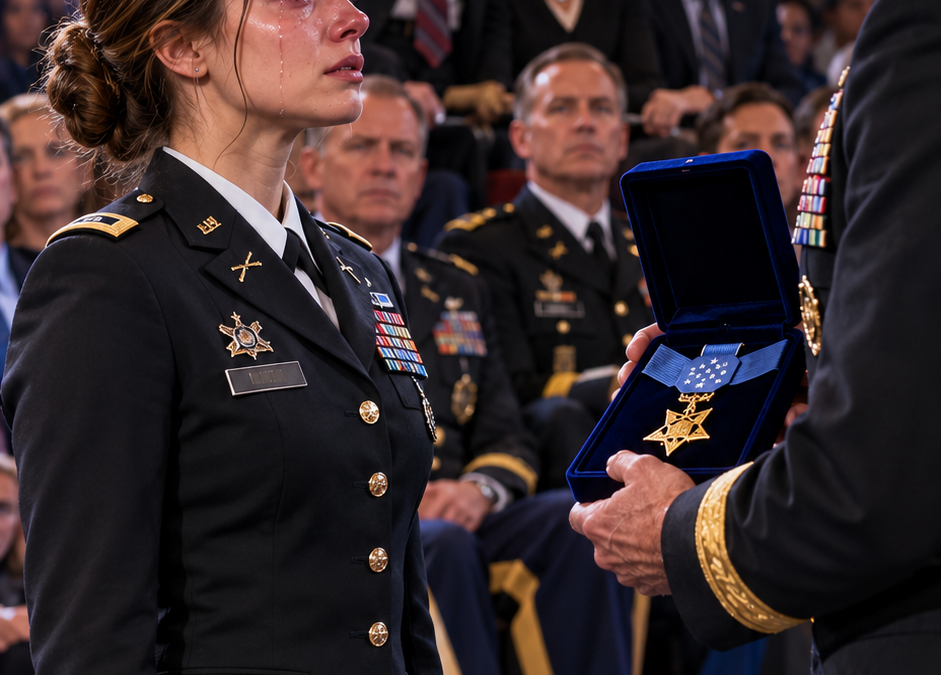
𝗙𝗨𝗟𝗟 𝗦𝗧𝗢𝗥𝗬
I had known the route was compromised. Everyone who survived that road knew it. Ambushes did not form themselves out of coincidence. But after months of interviews, reviews, and classified summaries, we had been told the source remained unknown.
Unknown did not mean forgotten.
Unknown did not mean closed.
Ryan suddenly sat upright.
Mom whispered, “Oh God.”
General Warren’s eyes moved toward my father.
“The information did not come from inside Captain Morgan’s unit.”
My father’s mouth opened.
No sound came out.
The general’s next words shattered the ceremony, the medal, and every story my family had ever told itself.
“It came from her family.”
For several seconds, I could hear nothing except the low electrical hum from the auditorium lights.
It came from her family.
My father’s face lost all color.
Ryan leaned forward so abruptly that his program slid from his knee and landed on the floor.
Mom did not bend to pick it up.
No one in the auditorium moved. No one seemed certain whether they had just witnessed a military honor, a public accusation, or the beginning of something that should never have happened in front of witnesses.
General Warren closed the file.
“This ceremony will pause for ten minutes,” he said.
His voice was calm again, but it was no longer ceremonial.
“Captain Morgan, your family will accompany us to the conference room behind the stage.”
My first instinct was to object.
My second was to demand an explanation.
Instead, training took over.
“Yes, sir.”
The general looked toward the audience.
“Ladies and gentlemen, Captain Morgan’s citation and recognition remain unchanged. This concerns a separate, unresolved security investigation. I ask for your patience and discretion.”
Then he turned and walked toward the side door.
I followed.
Behind me, chairs shifted.
People whispered.
I kept my eyes forward.
There are moments when dignity is not a feeling. It is simply a direction you decide to walk.
The conference room behind the stage was small compared with the auditorium. A long oak table filled most of it. A carafe of coffee sat untouched near the wall beside a stack of paper cups.
There were no flags.
No cameras.
No applause.
No velvet case in the center of a stage.
For some reason, that made everything harder.
Dad entered last.
Mom sat near one end of the table. Ryan took the chair beside her.
Dad chose the farthest seat from me.
General Warren remained standing.
A woman in a dark blue suit was already inside the room. I recognized her, though it took me a moment to place where I had seen her before.
“Lieutenant Colonel Naomi Velez,” she said. “Army Counterintelligence.”
We had spoken once after the ambush.
Only once.
Forty-eight hours after I left the hospital, still bruised, stitched, and medicated enough that bright lights hurt my eyes, she asked me questions about route changes, radio procedures, personnel access, departure times, and contractor involvement. I answered until every sentence sounded identical.
At the time, I assumed she was conducting a standard review.
Now she watched my face and seemed to understand exactly what I was thinking.
“You were not informed of the full scope of the investigation,” she said.
“Why?”
“The decision was made above my level.”
“Why?”
This time General Warren answered.
“Because investigators did not know whether telling you would compromise an active inquiry.”
I looked from him to Velez.
“And now?”
“Now,” Velez said, “we have enough information to tell you the part that directly concerns your family.”
I turned toward Dad.
He stared at the tabletop.
That frightened me more than if he had argued.
My father always argued.
When I joined ROTC, he argued that I was throwing myself into a system that would use me and forget me.
When I commissioned, he argued that military loyalty was just another word for obedience.
When I came home from my first deployment, he argued that I was too quiet, then told me not to make everyone uncomfortable by acting haunted.
Even when we agreed, Dad found a way to debate the agreement.
Silence did not belong to him.
“Dad.”
He lifted his eyes.
“What do you know?”
Mom whispered, “Taylor.”
I looked at her.
She seemed smaller somehow.
Not weak.
Just tired.
“What do you know?” I asked again.
Dad leaned back in his chair.
“Not what they think.”
Velez opened a second folder.
“What do you believe we think, Mr. Morgan?”
His eyes sharpened.
“That I betrayed my daughter.”
“No one in this room has said that.”
“You didn’t have to.”
Ryan rubbed both hands over his face.
“Dad, stop.”
Dad turned toward him.
“You stay out of this.”
“No.”
The word surprised all of us.
Ryan rarely contradicted Dad directly. Growing up, I had been the one who pushed. Ryan learned to bend. For years, I mistook his avoidance of conflict for laziness.
Now he looked directly at our father.
“You don’t get to tell me to stay out of it anymore.”
Dad’s jaw tightened.
General Warren pulled out a chair.
“Everyone is going to have an opportunity to speak,” he said.
Then he sat.
“Colonel Velez.”
Velez turned several pages toward me.
The first contained a diagram of companies and subcontractors.
I recognized one name immediately.
MORGAN TRANSIT CONSULTING.
Dad’s company.
He had started it when I was in high school. It was not large, but it was stable, and he treated it like proof that discipline and suspicion could build something useful. He specialized in logistics planning for commercial freight carriers and occasionally consulted for defense subcontractors moving nonclassified equipment.
Growing up, that business was the background noise of our house.
Phone calls during dinner.
Invoices on the kitchen counter.
Maps taped to the wall of Dad’s office.
Colored pins showing distribution centers across three states.
I had never found his work especially interesting.
Now his company’s name sat in the center of a counterintelligence diagram.
Velez pointed to it.
“Six months before the Fort Irwin operation, Morgan Transit Consulting entered a subcontract with Continental Field Systems.”
Dad said, “A legitimate defense contractor.”
“Yes.”
“I passed every background review they required.”
“Yes.”
He looked almost relieved to receive agreement.
Velez continued.
“Continental Field Systems provided equipment and transportation modeling for several training rotations. Your company was hired to analyze convoy delays involving civilian roads around the installation.”
“That wasn’t classified,” Dad said.
“Most of it wasn’t.”
Most.
That word changed the air.
Velez placed another sheet in front of me.
It showed an email.
The message itself looked ordinary. Weather delays. Vehicle clearances. Alternate routes.
But one attachment had been highlighted.
MOVEMENT WINDOW REVISION — INTERNAL DISTRIBUTION.
I read the date.
Three days before the ambush.
My stomach tightened.
“That should not have been sent to him,” I said.
“It wasn’t,” Velez replied.
I looked up.
“Then how did his company get it?”
“Through a shared contractor portal. Someone at Continental accidentally uploaded a folder with permissions broader than intended.”
Dad leaned forward immediately.
“There. That’s what I’ve been saying for years. Their mistake.”
Velez did not react.
“The file remained visible for eleven minutes.”
“How many people accessed it?” I asked.
“Three accounts.”
“And his was one?”
“Yes.”
Dad looked at me.
“Taylor, listen to me. Contractors download batches of material. Half the time you don’t even know what is inside the packet until you open it.”
“Did you open it?”
He hesitated.
Ryan looked away.
My father said, “Yes.”
I felt something inside me shift.
Not break.
Not yet.
Just move from where it had been.
“What did you do with it?”
Dad pressed his lips together.
Velez answered for him.
“He copied data from it into a commercial traffic-analysis project.”
Mom closed her eyes.
Dad’s face tightened.
“You make that sound criminal.”
“I am describing what happened.”
“It was route data. Generic route data.”
“It contained a departure window.”
“Not names.”
“It contained vehicle sequencing.”
“Not her name.”
“It contained a coded designation associated with her unit.”
Dad pushed back from the table.
“I didn’t know.”
I stared at him.
“What didn’t you know?”
“That it was yours.”
The answer came quickly.
Too quickly.
I had spent my entire adult life reading people under pressure. I knew what rehearsed certainty sounded like.
“Did you know before the ambush?”
“No.”
“Did you know after?”
His eyes moved toward Ryan.
That was the first real answer I received.
Ryan whispered, “Dad.”
I looked at my brother.
“When?”
Ryan’s eyes were wet, though he was not crying.
“Two days after.”
Mom reached for his hand.
He allowed her to take it.
I stared at him.
“You knew two days after?”
“I knew there might be a connection.”
“Why didn’t you tell me?”
“Because I didn’t know what it meant.”
“You could have told investigators.”
“I wanted to.”
Dad said, “Ryan.”
“Enough.”
Ryan’s voice cracked. He looked ashamed of the sound, swallowed, then continued more quietly.
“I found the file because I was doing cleanup on the company server. Dad asked me to archive anything connected with Continental until their lawyers finished reviewing it.”
I remembered that period.
Dad had called me once while I was still recovering.
It had been an awkward three-minute conversation.
He asked whether I needed anything.
I said no.
He said Mom had been worried.
I asked whether he was worried.
There had been a long pause.
Then he told me I had always been capable of handling myself.
At the time, I took it as praise.
Now I wondered whether it had been guilt.
Ryan continued.
“I saw the route file. I recognized the date.”
My hands had gone cold.
“What did you do?”
“I asked Dad.”
Dad stared toward the wall.
“And?”
“He said it was probably coincidence.”
Dad looked back at me.
“That was exactly what I thought.”
Ryan shook his head.
“You said more than that.”
“Ryan.”
“You said we shouldn’t create a story where there wasn’t one.”
“That is not unreasonable.”
“You told me deleting duplicate project folders was standard cleanup.”
Velez said, “They were deleted forty-three minutes later.”
Mom’s grip tightened around Ryan’s hand.
I looked at Dad.
“Did you delete them?”
“No.”
Ryan whispered, “I did.”
That hurt differently.
Ryan had been twenty-four then.
Old enough to understand responsibility.
Young enough, maybe, to believe a father who had spent his entire life defining what counted as a real problem.
I wanted anger.
Anger would have been easier.
Instead, what I felt was grief.
Not just for the ambush.
For something older.
For Sunday dinners.
For Dad teaching us how to change a tire.
For Ryan following me through the backyard when we were little.
For Mom keeping every school photograph in labeled boxes.
A family can contain years of ordinary love and still fail catastrophically at truth.
Both things can be real.
“Why?” I asked Ryan.
He looked at me.
“Because Dad said the investigation would destroy the company.”
I waited.
“He had twelve employees then. Some of them had worked for him for years. He said Continental would cancel every contract. He said investigators would treat us like suspects even if the upload was accidental.”
Dad interrupted.
“They did.”
Velez said, “Because evidence was deleted.”
Dad gave a bitter laugh.
“There it is.”
I turned on him.
“No. Don’t do that.”
He stopped.
I had not raised my voice.
I did not need to.
“You don’t get to turn consequences into proof that you were right.”
For perhaps the first time in my life, my father had no immediate response.
General Warren folded his hands.
“Mr. Morgan, was any of the information sold or transferred outside your company?”
Dad answered at once.
“No.”
Velez slid another page across the table.
“Your accounting records show a payment of eighteen thousand dollars from Hale Data Strategies nine days before the ambush.”
Dad’s face hardened.
“That was for a transportation model.”
“What kind?”
“Commercial route-risk projections.”
“Using what source material?”
“Public traffic information. Our own modeling. Contractor datasets.”
“Including the Continental file?”
Dad said nothing.
Velez waited.
He finally looked at me.
“I did not send them the document.”
“That was not the question,” I said.
His expression changed.
There was no smugness now.
No boredom.
Only a man realizing language could no longer build a wall around him.
“I used some of the numbers.”
The room seemed to narrow.
“What numbers?”
“Timing assumptions. Road congestion. Vehicle intervals.”
“Departure window?”
He swallowed.
“I don’t remember.”
Ryan whispered, “You do.”
Dad turned toward him.
“How would you know?”
“Because you told me.”
The silence that followed was different from the auditorium.
There, people had been shocked.
Here, everyone was listening.
Ryan took a slow breath.
“You said the client wanted unusually specific convoy timing. You joked that government planners had finally produced something useful.”
Dad shook his head.
“That conversation was years ago.”
“I remember because it was the week Taylor got hurt.”
Mom closed her eyes again.
I wondered how many times this conversation had happened without me.
Maybe none.
Maybe hundreds.
Families become skilled at building rooms inside themselves that only certain people are allowed to enter.
I had been overseas while mine constructed an entire wing.
“What was Hale Data Strategies?” I asked.
Velez replied.
“On paper, a private risk-analysis firm.”
“And in reality?”
“A small company purchasing datasets from multiple logistics consultants.”
“For whom?”
“That took longer to determine.”
General Warren spoke.
“The investigators eventually established that Hale sold aggregated transportation intelligence to a foreign-owned corporate intermediary.”
My pulse increased.
“Connected to the people who attacked us?”
“Indirectly.”
The general chose his words carefully.
“Hale did not appear to know the final buyer’s purpose. Your father did not appear to know Hale’s downstream client.”
I looked at Dad.
“Appear?”
“That distinction matters,” Velez said. “We found no evidence your father intended to harm you, your unit, or anyone else.”
Dad released a breath.
For one brief moment, relief crossed his face.
Then Velez continued.
“But intent was never the unresolved question.”
He looked at her.
“What was?”
“Why you hid the connection after you recognized it.”
Dad’s relief vanished.
Mom spoke for the first time in several minutes.
“Richard.”
I had heard my mother say my father’s name thousands of times.
I had never heard it sound like that.
Not angry.
Disappointed.
That was worse.
Dad rubbed one hand across his forehead.
“You all want a clean explanation.”
“No,” I said. “I want the true one.”
He looked at me.
“I was afraid.”
It was so simple that I almost missed it.
Dad had spent my childhood treating fear as something other people indulged.
Fear of failure.
Fear of embarrassment.
Fear of not being tough enough.
He had solutions for all of it.
Work harder.
Stop complaining.
Think ahead.
Be useful.
Now he sat at an oak conference table in a building full of soldiers and admitted fear had made one of the largest decisions of his life.
“I had built that company for nineteen years,” he said. “We had just taken a second mortgage to expand. Your mother had put retirement money into it. Ryan was working there. People depended on me.”
Mom looked startled.
“Do not put that on me.”
Dad turned.
“I didn’t mean—”
“You made me part of your justification without telling me the truth.”
“I was protecting us.”
“You didn’t ask whether I wanted that protection.”
He looked down.
Mom’s voice remained controlled.
“If you had told me a file from your company might have been connected to what happened to Taylor, I would have told you to call investigators before you finished the sentence.”
“I know.”
“Did you know then?”
He did not answer.
That answer was clear enough.
I walked toward the window.
Outside, late afternoon sunlight reflected off parked cars. Ordinary people moved along the sidewalk. Somewhere, someone was deciding what to have for dinner.
I found that almost offensive.
“How long has the Army known?” I asked.
Velez answered.
“We identified Morgan Transit’s access within the first week. The deletion complicated the timeline. Hale Data dissolved six months later. Its servers had been transferred between multiple jurisdictions.”
“And you never told me?”
“We had circumstantial evidence involving your family and no proof of intent. Command believed disclosure would create unnecessary harm while the inquiry remained active.”
I turned.
“That was not their decision to make.”
General Warren nodded slowly.
“I agree.”
The admission surprised me.
“I did not command the investigation at the time,” he said. “I inherited portions of the case two years later. If I had been in the position then that I am now, I would have argued you should have been informed earlier.”
“Argued?”
“Yes.”
“Not guaranteed?”
“No, Captain.”
At least he did not pretend.
My eyes moved to the velvet medal case sitting on a side table.
An aide must have brought it with us.
It seemed absurdly small.
“So what happens now?”
Velez answered.
“The government completed its criminal review last year. No evidence supported charges related to intentional assistance in the attack.”
Dad sat straighter.
“But?”
“The deletion and contracting issues were handled separately. Morgan Transit lost eligibility for defense-related work.”
I stared at Dad.
“You told me you decided to leave government contracting.”
He looked away.
Three years earlier, during Thanksgiving dinner, he had announced that government work was too bureaucratic. He said he preferred private clients.
I had believed him.
Another memory rearranged itself.
“How much of our family history have you rewritten?” I asked quietly.
Dad flinched.
“I never lied about loving you.”
“That was not what I asked.”
He pressed his palms against the table.
“I didn’t know how to tell you.”
“You could have started with the truth.”
“You think everything is that simple.”
“No.”
The word came out sharper than I intended.
I steadied myself.
“I think some things are complicated. I think truth can be complicated. I think fear can be complicated. I think guilt can be complicated.”
I pointed toward the file.
“But hiding evidence is not complicated.”
Ryan stared at his hands.
“I’m sorry.”
I looked at him.
He said it again.
“I’m sorry, Taylor.”
Part of me wanted to tell him it was all right.
Older sisters learn reflexes too.
Fix the problem.
Make the younger sibling feel better.
Carry what is too heavy.
I resisted.
“I believe you are sorry.”
His face tightened.
“But I can’t tell you it’s okay yet.”
He nodded.
“I know.”
That was the first honest exchange between us all afternoon.
General Warren stood.
“There is one more matter.”
I almost laughed.
Of course there was.
He picked up the file.
“The reason I reacted when your father used the phrase ‘just a tool’ was not only because of his interruption.”
Dad went still.
Velez pulled out a printed email.
“We recovered correspondence from Hale Data Strategies shortly before the company closed.”
She placed it in front of me.
The sender’s name had been redacted.
The recipient was a Hale executive.
The message contained only four lines.
Most of it concerned dataset formatting.
Then I saw the final sentence.
The Morgan girl is just a tool for the exercise planners. Her unit will confirm whether the timing model is accurate.
I read it twice.
My mouth went dry.
“Who wrote this?”
Velez looked at my father.
Dad stared at the page.
“I never saw that.”
Ryan stood halfway out of his chair.
“Wait.”
His face had changed.
“What?” I asked.
He pointed to the email.
“That phrase.”
Dad said, “Ryan, sit down.”
“No.”
Ryan looked at me.
“Taylor, Dad says things like that, but he doesn’t write like that.”
Dad frowned.
“What are you talking about?”
Ryan ignored him.
“He never says timing model. He says schedule model. Always. Even when clients call it something else.”
Velez watched him carefully.
“And the Morgan girl?”
Ryan shook his head.
“Dad would never call Taylor that in writing to a client. He’d say my daughter or Captain Morgan if he was showing off.”
Under other circumstances, the comment might have made me smile.
No one did.
I looked at Velez.
“Did you determine the sender?”
“No.”
“Why not?”
“The account used a Morgan Transit domain address that no longer existed by the time we recovered the message.”
Dad suddenly leaned forward.
“Which address?”
Velez read it aloud.
“Operations at Morgan Transit Consulting.”
Dad shook his head immediately.
“That wasn’t mine.”
Ryan looked at him.
“It was the shared operations inbox.”
“No.”
“Yes, it was.”
“Not then.”
Ryan stopped.
Dad looked directly at Velez.
“We shut that address down four months before the Continental contract.”
Velez’s expression changed subtly.
“You’re certain?”
“I paid the invoice to migrate our email system. I complained about the cost for weeks.”
Mom nodded.
“He did.”
Dad turned toward Ryan.
“After the migration, what happened to the old domain?”
Ryan’s face slowly lost color.
“I don’t know.”
Dad stood.
“The domain registration.”
Ryan closed his eyes.
“Oh.”
“What?” I asked.
He looked at me.
“I was supposed to renew it.”
“And?”
“I didn’t.”
The room went quiet again.
Velez was already writing something.
Ryan spoke quickly.
“I thought it didn’t matter because we had moved everything to the new company domain.”
“When did the old domain expire?” she asked.
“I would have to check.”
Dad said, “About five months before the ambush.”
General Warren looked toward Velez.
He understood immediately.
Someone could have purchased the abandoned domain.
Someone could have recreated the old operations email address.
Someone could have written messages that appeared to come from Morgan Transit.
I looked at my father.
For the first time that afternoon, his confusion looked completely genuine.
“You thought I wrote that,” he said to Velez.
“We considered it likely.”
“And because I didn’t tell you about the dataset sale, you assumed—”
“We followed the evidence we had,” she said.
Dad sat slowly.
The certainty in the room had disappeared.
Not his responsibility.
That remained.
He had accessed information he should not have used.
He had sold modeling derived from it.
He had concealed the connection.
Ryan had deleted files.
Those facts did not vanish because another possibility had appeared.
But a different question now stood beside them.
Who had impersonated Morgan Transit?
And why?
General Warren looked at Velez.
“How quickly can you verify the domain registration history?”
“I can make the request now.”
Ryan reached for his phone.
“I might still have records.”
Dad gave him a skeptical look.
“You keep records from seven years ago?”
Ryan shrugged faintly.
“You’re the one who taught me never to throw away a receipt.”
For the first time, something almost human passed between them.
Not forgiveness.
Not humor exactly.
Recognition.
Mom stood.
“I have something too.”
All of us looked at her.
She opened her handbag and removed a folded envelope.
“I wasn’t going to bring this up today.”
She handed it to me.
My name was written on the front.
Taylor.
Not Captain Morgan.
Not Tay.
Taylor.
The handwriting was unfamiliar.
I looked at Mom.
“What is this?”
“It came to the house four months after the ambush.”
Dad frowned.
“I’ve never seen that.”
“I know.”
Mom’s voice was quiet.
“I kept it because I didn’t know what it meant.”
I unfolded the paper.
There was no signature.
Only three sentences.
Your daughter was not the intended target.
The route was purchased to test whether the information was real.
Someone at Morgan Transit made the sale possible, but not the person everyone will blame.
I read the final sentence again.
Then I looked up.
Mom was watching me.
Velez extended her hand.
“Mrs. Morgan, may I see that?”
Mom nodded.
I passed it across the table.
My father seemed unable to speak.
Ryan stared at the envelope.
General Warren asked the question I could not.
“Why didn’t you give this to investigators?”
Mom’s eyes filled.
“Because by then I knew Richard had hidden something.”
Dad whispered, “Diane.”
She looked at him.
“And I was afraid the letter meant Ryan had done something worse.”
My brother went completely still.
Mom continued.
“I had one husband hiding information and one son helping him delete files. I thought if I handed over that letter, I might lose all of you.”
She looked at me.
“I told myself I was protecting the family.”
The words hung there.
The same words Dad had used.
I stared at my mother.
Then my father.
Then my brother.
For years, I had thought I was the only Morgan who understood what pressure could do to a person.
I was wrong.
Pressure had come for all of us.
None of them had handled it well.
Maybe neither had I, in ways I had not yet understood.
Velez examined the envelope carefully.
“There may still be trace evidence in the postal records.”
“After all this time?” I asked.
“Possibly.”
General Warren glanced toward the door leading back to the auditorium.
The ceremony was waiting.
Hundreds of people were waiting.
My medal was waiting.
I realized suddenly that I did not care.
“Sir,” I said, “I don’t want to go back out there yet.”
He studied me.
Then nodded.
“You don’t have to.”
Dad looked at the medal case.
“What about the ceremony?”
General Warren’s response was immediate.
“The medal belongs to Captain Morgan whether this ceremony happens today or another day.”
Something in my chest loosened.
All afternoon I had felt as if the medal, the investigation, and my family had tangled into one impossible judgment.
They were not the same thing.
What I had done on that road remained mine.
What my father had done afterward remained his.
What Ryan had done remained his.
What Mom had concealed remained hers.
Truth did not require mixing every guilt into one container.
I took a chair across from my family.
For once, I was not standing at attention.
“Mom,” I said, “start at the beginning.”
She nodded.
Dad looked at me carefully.
“Taylor.”
I met his eyes.
“I’m listening.”
He seemed almost relieved.
Then I added, “Listening is not the same as forgiving.”
His expression fell.
“I understand.”
I hoped he did.
Velez’s phone vibrated.
She looked down.
Her brows drew together.
“That was fast.”
“What?” General Warren asked.
She turned the screen toward him.
The old Morgan Transit domain had indeed expired.
It had been purchased eighteen days later.
Not by Hale Data Strategies.
Not by any company in the Army investigation.
The registrant had used a privacy service, but the recovery request had uncovered a billing contact attached to an accounting firm.
General Warren read the name twice.
Then he looked at my father.
“Do you know a man named Daniel Mercer?”
Dad did not answer.
Mom did.
“Oh my God.”
Ryan looked between them.
“Who is Daniel Mercer?”
My father’s shoulders lowered.
Not in fear.
In recognition.
“He was my business partner.”
I stared at him.
“You never had a business partner.”
Dad looked at me.
And in a voice stripped of every defense he had carried into that room, he said, “Yes, Taylor. I did.”
The words were so quiet that for a moment I thought I had misunderstood them.
My father had built his life on certainty. He had presented every decision as proof of discipline, every success as evidence that he had never needed anyone. Morgan Transit Consulting, according to every family story I had ever heard, was his company. His idea. His risk. His achievement.
Now, sitting in a military conference room with the Medal of Honor ceremony paused outside the door, he was telling me there had been another man at the beginning.
Daniel Mercer.
The name meant nothing to me at first.
Then Mom looked down at her hands, and memory opened.
I saw a younger version of myself at the kitchen table, maybe eleven years old, doing math homework while Dad argued behind his office door. I remembered a man’s voice on speakerphone. Calm. Smooth. Infuriating. Dad had said, “You don’t get to walk away with half of what I built.”
At the time, I thought it was a client.
Maybe all children misunderstand their parents until the truth becomes old enough to hurt them.
“Tell me,” I said.
Dad rubbed one hand over his face.
“Daniel and I started the company together. I handled logistics and operations. He handled finance, sales, client relationships. He was charming in ways I was not.”
That sounded like my father’s version of a compliment.
“We grew fast the first few years,” Dad continued. “Too fast. Daniel wanted defense work before we were ready. I wanted commercial freight first. We fought constantly.”
Mom said quietly, “It got ugly.”
Dad nodded.
“He started moving money. Not enough to bankrupt us, but enough for me to notice. I confronted him. He said I was paranoid.”
Ryan leaned forward.
“What happened?”
“I bought him out.”
“You said you never had a partner.”
“I didn’t want the story following us,” Dad said. “I didn’t want clients wondering whether the company was unstable. So I buried it.”
The room seemed to tighten around those words.
I almost laughed.
Of course he had buried it.
That was what we did in the Morgan family.
We did not heal things.
We buried them and called the ground stable.
Velez looked at Dad.
“Did Mercer have access to the old domain?”
“At one point, yes.”
“Did he know your naming conventions?”
“Yes.”
“Would he know how to impersonate the operations inbox?”
Dad’s jaw tightened.
“Yes.”
General Warren’s eyes sharpened.
“Would he have had a motive to harm you?”
Dad swallowed.
“Yes.”
“Would he have had a motive to harm Captain Morgan?”
Dad looked at me.
“No.”
The answer came fast.
Maybe too fast.
I said, “Don’t protect me with assumptions. Not today.”
He closed his mouth.
Then he nodded once.
“I don’t know.”
That was the first time all day my father chose uncertainty over control.
Velez stood.
“I need to make calls.”
General Warren stood with her.
“We are going to move this conversation to a secured office.”
He looked at me.
“Captain Morgan, I can have someone escort you to a separate room.”
“No,” I said.
Dad looked up.
I did not look at him.
“I want to hear it.”
Velez studied me for a moment, then nodded.
“Understood.”
The next six hours unfolded like a second ambush.
No gunfire.
No smoke.
No burning vehicles.
Just records, passwords, old invoices, archived emails, domain transfers, bank statements, names that had sat unnoticed in files for years because everyone had been staring at the most obvious mistake.
My father’s mistake.
Ryan’s deletion.
Mom’s silence.
They mattered.
But they had also created cover.
Daniel Mercer had purchased the expired Morgan Transit domain through a broker eighteen days after it lapsed. Using that domain, he recreated the operations email address and began corresponding with Hale Data Strategies as if he were still connected to my father’s company.
He did not need direct access to Morgan Transit’s active servers.
Dad had already sold Hale enough modeling data to make the relationship plausible.
Mercer only had to step into the shadow my father created.
The old email gave him credibility.
The contractor dataset gave him value.
My father’s arrogance gave him opportunity.
And my family’s fear gave him time.
By midnight, Velez had preliminary confirmation from federal partners. Daniel Mercer had surfaced before in investigations involving gray-market procurement data. Never conclusively. Never cleanly. Always one shell company away from being named directly.
The recovered email about “the Morgan girl” had not been written by my father.
It had been sent from the resurrected operations account weeks after Dad claimed he stopped communicating with Hale.
The phrase my father repeated in the auditorium — “just a tool” — had not been invented by him.
That almost made it worse.
At some point after the ambush, during one of the private conversations my family never had with me, Dad must have seen that phrase in a document or heard it during legal review. He absorbed it, resented it, repeated it, maybe because part of him believed it and part of him hated that someone else had said it first.
He had used the words to diminish me.
But the words had also exposed the lie he had been orbiting for years.
Near one in the morning, General Warren finally ordered food into the secured office. Sandwiches appeared on a tray. No one ate much.
Mom sat wrapped in silence.
Ryan kept answering questions, pulling up old backups, digging through records with the desperation of a man trying to become useful before guilt swallowed him whole.
Dad looked older by the hour.
Not fragile.
I would not give him that.
But stripped.
Every time Velez asked another question, he answered.
No performance.
No debate.
No attempt to win the room.
At 1:38 a.m., Velez returned from the hallway with a fresh printout.
“We found the Mercer connection to Hale.”
General Warren stepped toward her.
“What kind?”
“A consulting payment routed through three intermediaries. Dates match the final transfer of movement-related data.”
She looked at me.
“It does not prove he knew the final purpose of the information. Not yet. But it proves he inserted himself into the chain.”
I nodded.
My body felt strangely distant from me.
After years of wondering how the enemy had known our route, the truth was not a single villain stepping out of darkness.
It was a chain.
A careless upload.
A contractor who accessed what he should have reported.
My father using data he should have deleted.
A sale to a company that asked too few questions.
A former partner impersonating Morgan Transit.
A foreign intermediary.
A road in the desert.
A burning vehicle.
Three men dead.
Seven alive.
Me standing in dress uniform with a medal waiting outside the door.
People want betrayal to be clean. They want one hand holding the knife.
Sometimes betrayal is a series of smaller hands pushing the door open.
At 2:10 a.m., Dad asked to speak to me alone.
I almost said no.
Then I looked at him.
For the first time in my life, Richard Morgan looked like a man who understood that permission was not owed to him.
“Five minutes,” I said.
General Warren allowed us into a smaller adjoining office with a glass panel in the door. Privacy, but not secrecy.
That mattered.
Dad stood by the table.
I remained near the door.
For several seconds, he said nothing.
Then he looked at me and whispered, “I don’t know how to be your father after this.”
I did not expect the sentence.
I expected excuses. A confession. Maybe a plea.
Not that.
I folded my arms because I needed something to do with my hands.
“You could start by telling the truth without waiting to be trapped by it.”
He nodded.
“I hated the Army for taking you away.”
“You mean I left.”
He flinched.
“Yes.”
That correction mattered.
He forced himself to continue.
“I told myself you joined because you wanted to prove me wrong. I told myself every promotion was another way of saying you didn’t need us. When you were hurt, everyone called you a hero, and I…” He stopped, ashamed. “I felt like I had no place in your life except as the man you escaped.”
I stared at him.
“That still does not explain what you said today.”
“No,” he said quickly. “It doesn’t excuse it.”
“I didn’t ask whether it excused it.”
He looked down.
“I was jealous.”
The word seemed to cost him something.
“Of what?”
“Of the Army. Of the way people looked at you today. Of the fact that strangers seemed to understand your worth better than I had ever allowed myself to.”
My throat tightened, and I hated it.
I wanted clean anger.
I wanted him to remain simple.
He was making that impossible.
“You thought calling me a tool would make the room see me the way you did.”
His face twisted.
“Yes.”
There it was.
Ugly.
Honest.
Too late, but honest.
“And instead it made them see you.”
He closed his eyes.
“Yes.”
I looked through the glass panel toward the hallway. Ryan sat hunched over a laptop. Mom stared into a paper cup. General Warren spoke quietly with Velez.
“My soldiers died,” I said.
Dad opened his eyes.
“I know.”
“No. You know the sentence. You don’t know the weight.”
He did not interrupt.
“Mateo Ruiz had two daughters. Aaron Phelps was twenty-three and had just bought an engagement ring. Cole Danvers made terrible coffee and sang old country songs off-key every morning. They were not variables in a schedule model.”
Dad’s eyes filled.
“They were not numbers your client wanted unusually specific timing on.”
“I’m sorry.”
“I know.”
The words came out before I decided to say them.
His face changed.
I held up a hand.
“Do not mistake that for forgiveness.”
“I won’t.”
“I believe you are sorry. I believe you did not intend to get anyone killed. I believe Mercer used what you exposed.”
He swallowed.
“But?”
“But men died in the space between what you knew and what you admitted.”
He looked as if the sentence had entered him and found bone.
“You will tell investigators everything,” I said.
“Yes.”
“You will not protect the company.”
“There is no company worth protecting now.”
“You will not protect Ryan.”
His eyes moved toward the hallway.
“He deleted the files because of me.”
“He deleted them.”
Dad nodded slowly.
“Yes.”
“You will not protect Mom.”
He closed his eyes.
“Yes.”
“And you will not ask me to make this easier for you.”
When he looked at me again, he seemed smaller and more human than he had ever allowed himself to appear.
“I won’t.”
I opened the door.
Our five minutes were over.
The next morning, the ceremony was formally postponed.
The public statement was brief. A security matter had required immediate attention. Captain Morgan’s recognition remained unchanged. A rescheduled ceremony would take place at a later date.
Reporters wanted more.
They did not get it.
For forty-six days, my life became two parallel investigations.
One was official.
Velez and federal investigators reopened leads connected to Daniel Mercer, Hale Data Strategies, and the foreign intermediary. Mercer was found in Arizona under the name Daniel Merrick, consulting for another logistics firm. He had aged badly in the photographs they showed me, but his eyes had the same polished confidence I remembered from that childhood voice behind Dad’s office door.
When investigators brought him in, he denied everything.
Then they showed him the domain registration.
The Hale correspondence.
The payment trail.
The old envelope.
The email using my name like a disposable object.
He did not confess immediately.
Men like Mercer rarely do.
They negotiate with silence first.
But evidence has its own patience.
Eventually, his story changed. He claimed he had only wanted to damage Richard Morgan’s company. He claimed he had no idea the route data would reach hostile hands. He claimed everyone in the industry bought and sold gray information. He claimed my unit was never supposed to be in real danger.
I read the summary three times.
Never supposed to be in real danger.
As if danger required his permission.
As if bullets cared about intent.
As if the dead could be comforted by the fact that the man who helped expose them had meant only to hurt someone else.
The second investigation was private.
That one had no case number.
It lived in phone calls I did not answer, apologies I was not ready to receive, and memories that kept rearranging themselves without my consent.
Mom admitted she had found the anonymous letter and hidden it because she was terrified of losing the family.
Ryan admitted he had known more than he told himself. He had deleted files because Dad told him to, but also because part of him wanted the problem to disappear.
Dad admitted he had let pride and fear guide decisions that should have belonged to truth.
None of their admissions fixed anything.
But they changed the air.
For the first time in my life, the Morgan family stopped treating silence as loyalty.
Two months later, General Warren called me into his office.
The rescheduled ceremony would be smaller, he said. My choice. No press unless I wanted them. Families of the men lost in the ambush had been notified that the investigation had developed significantly, though details remained restricted.
Then he paused.
“Captain Morgan, your family has requested permission to attend.”
I looked at the window behind his desk.
Outside, soldiers crossed the courtyard in pairs.
“Did they ask you to ask me?”
“No.”
“Good.”
He waited.
I thought about saying no.
Part of me wanted to.
Part of me wanted them to sit somewhere far away, outside the room, outside the moment, outside the honor they had almost contaminated with their fear.
But another part of me remembered Ruiz’s wife at the memorial, standing straight while her daughters clung to her skirt.
I remembered Phelps’s mother pressing his folded flag to her chest.
I remembered Cole Danvers’s wife telling me, “He would have wanted you to live loud enough for all of them.”
Living loudly, I had learned, did not always mean victory.
Sometimes it meant refusing to hide from the people who had failed you.
“They can attend,” I said. “But they do not sit in the front.”
General Warren nodded.
“Understood.”
The second ceremony took place on a Thursday morning.
No reporters.
No crowded auditorium.
No forced spectacle.
Just a smaller hall, polished floors, rows of soldiers, the families of Ruiz, Phelps, and Danvers, a few officers, and my family seated near the back.
This time, when I entered, I did not look for my father first.
I looked for the families.
Mrs. Ruiz held a photo of Mateo tucked inside her program.
Phelps’s parents sat shoulder to shoulder.
Danvers’s wife wore his wedding ring on a chain beside her own.
I walked to them before the ceremony began.
“I’m glad you came,” I said.
Mrs. Ruiz took my hands.
“He would be angry if we didn’t.”
I almost smiled.
“Yeah. He would.”
Phelps’s mother touched my sleeve.
“You don’t have to carry all three of them by yourself.”
I could not answer.
Danvers’s wife looked toward the stage.
“Let them say what he did. Let them say what you did. That matters.”
So I did.
I stood under the lights again.
The citation was read again.
This time, when the words described the ambush, I let them come.
I did not pretend they were enough.
I did not pretend they were wrong.
When General Warren stepped forward with the medal, his voice was low enough that only I could hear.
“This honor was never dependent on what anyone tried to hide.”
I swallowed.
“Yes, sir.”
He placed the ribbon around my neck.
The medal settled against my chest.
It was heavier than I expected.
Not because of the metal.
Because of the names beneath it.
The room applauded.
I did not look at my family until it was over.
When I finally turned, Mom was crying openly. Ryan stood with his hands clasped in front of him, no half-smile, no performance. Dad stood beside them.
He did not clap loudly.
He did not try to catch my eye.
He simply stood.
For once, he did not make the moment about whether he approved of it.
After the ceremony, he approached me near the side wall.
Slowly.
Carefully.
Like a man approaching a border he no longer had the right to cross without permission.
“Captain Morgan,” he said.
Not Taylor.
Not sweetheart.
Not kid.
Captain Morgan.
The respect in it nearly undid me.
“I wanted to say…” He stopped.
I waited.
He took a breath.
“I am proud of you.”
The sentence was plain.
No lesson attached.
No criticism hidden beneath it.
No warning against becoming arrogant.
Just five words that should not have taken thirty years.
I looked at him.
“Thank you.”
His eyes shone.
“I know that does not fix anything.”
“No,” I said. “It doesn’t.”
He nodded.
“But it is the first time you have said it without trying to take something back.”
His mouth trembled.
“I’m learning.”
“I know.”
Mom came next.
She did not ask to hug me.
That mattered.
“I should have given them the letter,” she said.
“Yes.”
“I thought silence would keep us together.”
I looked toward the families across the room.
“Silence kept everyone alone.”
She nodded, tears slipping down her face.
Ryan stood a few feet away, waiting his turn as if we were all learning new rules for how to be a family.
When I looked at him, he stepped forward.
“I’m cooperating with everything,” he said.
“I know.”
“I resigned from the company.”
“I heard.”
He swallowed.
“I don’t expect you to forgive me.”
“Good,” I said.
He flinched, then nodded.
I let the silence hold for a moment.
Then I added, “But I don’t want to hate you forever either.”
His eyes filled.
“That’s more than I deserve.”
“Probably.”
For the first time in years, he almost smiled.
The legal process did not end quickly.
It rarely does.
Daniel Mercer was charged for crimes tied to fraud, unlawful acquisition and sale of sensitive government-related data, identity misuse, and obstruction. The exact charges shifted as prosecutors built the case, but the core was simple enough for me.
He had found an old doorway into my father’s company and used it.
He had sold credibility that was not his.
He had helped turn training data into targeting information.
My father was not charged with intentionally aiding the attack. That mattered legally.
It did not absolve him morally.
Morgan Transit collapsed before the year ended. Dad liquidated what remained and used a portion to establish a fund for the families affected by the ambush. He did not announce it publicly. He did not put his name on it.
When he told me, he said, “It isn’t enough.”
I said, “No. It isn’t.”
He nodded.
“But do it anyway.”
“I am.”
Ryan accepted a penalty for the deleted records. It changed his career. Maybe it should have. He did not complain to me about it, which was the smartest thing he could have done.
Mom began writing letters.
Not dramatic ones.
Not letters asking me to understand.
Letters that told the truth in pieces. What she remembered. What she feared. What she regretted. She did not ask me to answer them.
Sometimes I did.
Often I did not.
As for me, I kept serving.
People assumed the medal changed how I saw myself.
It did not.
The medal changed how other people looked at me.
The truth changed how I looked at everything else.
For years, I believed courage meant running toward fire when other people ran away.
I still believe that.
But I learned there is another kind of courage, quieter and much less celebrated.
The courage to tell the truth when the lie would protect your reputation.
The courage to admit fear before fear makes decisions for you.
The courage to stop calling silence loyalty.
The courage to look at the people you love and say, “You hurt me,” without softening the words to spare them.
A year after the postponed ceremony, I visited the memorial at Fort Irwin.
Three names were etched into stone.
Mateo Ruiz.
Aaron Phelps.
Cole Danvers.
I stood there alone at sunrise, the desert cold around me, the medal locked away at home because I had not come to show it to anyone.
I had come to speak.
“I know more now,” I said quietly.
The wind moved over the sand.
“I still don’t know if that makes it better.”
It did not, of course.
Truth does not raise the dead.
It does not erase the sound of a man calling for his wife.
It does not take smoke out of memory.
But truth gives grief a place to stand.
For years, I had been grieving inside a story with missing pages.
Now the pages were ugly.
But they were there.
When I turned to leave, my phone vibrated.
A message from Dad.
I almost ignored it.
Then I opened it.
Taylor, I am meeting with investigators again today. I wanted you to hear that from me, not from anyone else. I will answer everything they ask. No more omissions.
I stared at the screen.
Then I typed back.
Good.
I waited a moment.
Then I added:
That is how you start.
His reply came three minutes later.
I know.
I put the phone away and looked once more at the names.
For a long time, I had believed the worst moment of my life was the ambush.
Then I believed it was standing beneath ceremony lights while my father’s voice exposed the rot beneath my family.
Now I understood something harder.
The worst moment was not one moment.
It was every silence that allowed harm to keep moving.
Every person who saw a warning and called it complicated.
Every choice to protect comfort instead of truth.
The medal on my chest had honored what I did in the fire.
But the truth after the fire demanded something else from me.
Not heroism.
Honesty.
I walked back toward my vehicle as the sun rose over the desert road.
There was no applause.
No citation.
No general waiting with a velvet case.
Only morning light spreading across the place where everything had changed.
And for the first time in years, I felt the weight I carried settle into something I could bear.
Not because it was lighter.
Because it was finally real.








