𝗙𝗨𝗟𝗟 𝗦𝗧𝗢𝗥𝗬 The Airport Officer Tore My Badge Off Before I Could Explain the Red Light
𝗙𝗨𝗟𝗟 𝗦𝗧𝗢𝗥𝗬
The screen flashed red.
I paused.
It wasn’t an extraordinary event.
Electronic readers occasionally failed to register a card on the first attempt. A person could hold the credential at the wrong angle, move it away too quickly, or encounter a temporary communication problem.
The normal response was straightforward.
Try again.
If the second attempt failed, verify the credential through the appropriate airport or airline system.
I adjusted the card and prepared to rescan it.
That was when Travis stepped away from the nearby security podium.
“Stop right there.”
I looked up.
“Is there a problem?”
“Keep your hands off the scanner.”
“The first attempt didn’t read.”
“I saw that.”
“Then I’ll try again.”
He moved between me and the reader.
“No.”
I studied his expression.
He was a large man, thick through the shoulders, with pale eyes and short brown hair.
His uniform was neat, his equipment properly secured, and his posture suggested someone who was accustomed to having people comply immediately.
I had no reason to assume he was acting improperly simply because he wanted to examine a failed credential scan.
I did, however, expect him to explain what he needed.
“My identification is current,” I said. “Would you like to verify it?”
“Where are you going?”
“Gate D42.”
“What are you doing there?”
I looked at him.
“I’m the captain assigned to the international departure.”
He glanced at my uniform.
“That’s what you say.”
I felt something uncomfortable settle in my stomach.
“My photograph, employee number, and position are on the badge. You can also contact airline operations.”
He ignored the suggestion.
“Why are you using this entrance?”
“Because it’s the employee access point for my assigned departure area.”
“Who told you to use it?”
“It’s part of our normal crew access route.”
He took another step toward me.
“You’re getting awfully comfortable telling me how things work.”
I glanced toward the clock above the corridor.
Our departure sequence was moving forward.
I knew exactly how many things depended on the captain reaching the aircraft.
Crew coordination.
Final flight preparation.
Passenger boarding.
Gate operations.
Baggage loading.
International departure scheduling.
A missing pilot could create problems far beyond one delayed aircraft.
I brought my attention back to Travis.
“Officer, I’m not challenging the checkpoint. I’m asking you to verify my credentials so we can resolve this.”
He rested one hand near the handcuff case on his belt.
“Maybe you should stop talking.”
A second officer approached.
He was younger, with short black hair, an athletic build, and an alert expression.
His nameplate read Ruiz.
His body camera was already recording.
“What’s going on?” he asked.
Travis didn’t look away from me.
“Failed credential. Subject’s being uncooperative.”
I felt my jaw tighten.
“I haven’t refused anything.”
Ruiz looked at the scanner, then at my badge.
“Has the credential been checked through the system?”
“I’m handling it,” Travis said.
The younger officer didn’t argue.
But I noticed his eyes move from my identification to my empty hands and then back toward his partner.
He seemed to understand that something about the encounter wasn’t adding up.
Several feet away, a ground service employee in a reflective vest had stopped walking.
He looked toward me.
Then toward the checkpoint.
I recognized him.
Luis Mendoza.
Luis had worked in Miami ground operations for fourteen years, and I had seen him through more aircraft turnarounds than I could count.
He knew the crews, gates, and flight assignments because his job depended on keeping track of the people and equipment needed for a departure.
Our eyes met briefly.
I saw recognition on his face.
Then concern.
He began approaching, but Travis noticed the movement and extended his arm toward the lane divider.
“Stay back. Active security matter.”
Luis stopped.
I could see him weighing whether stepping closer would help me or make the confrontation worse.
He chose not to approach.
Instead, he looked toward the departure corridor.
I didn’t realize he was already thinking about how quickly someone from airline operations could reach us.
Travis stepped closer again.
“Let me see that badge.”
I reached toward the identification hanging against my shirt.
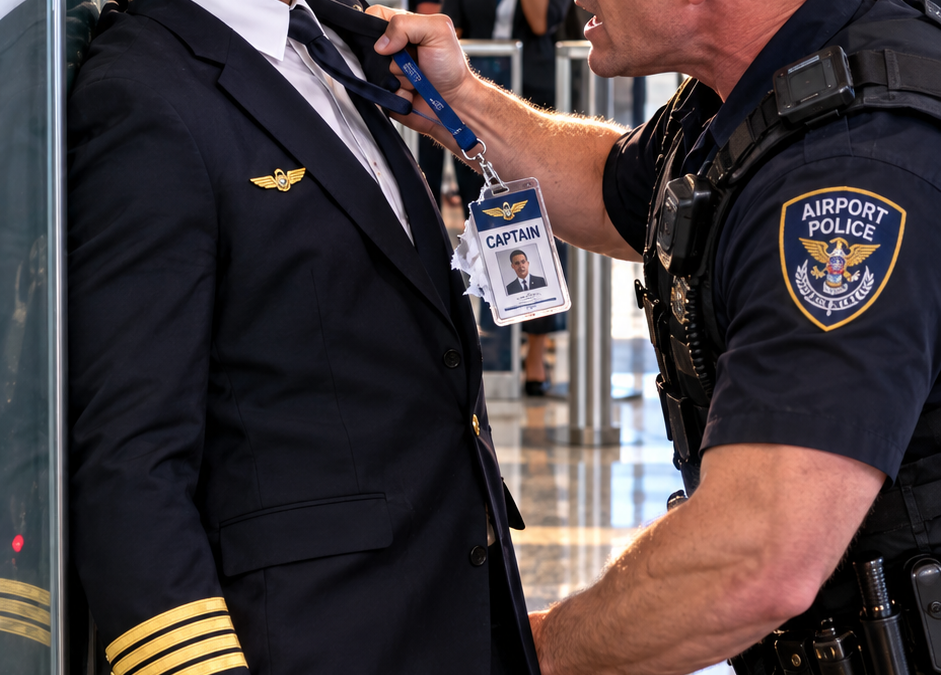
Before my fingers touched it, he grabbed the lanyard.
“Hands down.”
I stopped immediately.
“Officer, you asked to see my badge.”
“Don’t move.”
Then he pulled.
Hard.
The blue fabric connector snapped.
My upper body jerked forward, and the badge came away in his hand.
For a second, I stared at the broken lanyard hanging from my collar.
It was such an unnecessary movement that my mind struggled to process it.
He could have asked me to hand him the credential.
He could have examined it while it remained attached to my uniform.
He could have allowed me to rescan it.
Instead, he had physically torn it from my chest.
“Why did you do that?” I asked.
He stepped closer.
“Back up.”
I hadn’t moved.
“Officer, I’m standing still.”
“Don’t reach for me.”
I instinctively lifted one hand toward the badge he was holding.
Not to grab it.
Not to touch him.
Simply because he had taken something from my uniform without warning.
Before I could lower my hand, he seized my upper arm.
Then he turned me sharply toward the glass wall.
My palm struck the partition.
He drove his forearm across my shoulder and pinned me against it.
For a moment, I could see my own reflection.
White captain’s shirt.
Four gold stripes.
Broken lanyard.
An airport police officer pressing me against the wall while people stopped to watch.
“What are you doing?”
“Stop resisting.”
“I’m not resisting.”
“Keep your hands where I can see them.”
“My hand is against the glass.”
He pressed harder.
Pain spread across my shoulder.
Behind me, my rolling suitcase tipped over after his boot caught one of its wheels.
The outside pocket opened.
Flight documents spilled across the polished floor.
A checklist slid toward Ruiz’s shoes.
Another page disappeared beneath a metal bench.
I heard the suitcase strike the ground.
Then I heard someone gasp.
For the first time, I understood that I wasn’t simply experiencing an unpleasant credential check.
I was being physically restrained without anyone having established that my identification was invalid or that I had attempted to enter a restricted area unlawfully.
And I was surrounded by strangers whose first view of the situation was a Black pilot pressed against glass by a uniformed officer.
Some of them would assume I must have done something wrong.
Others would wonder why the officer was treating me that way.
But none of them could know what had happened before they turned around.
Unless somebody had recorded it.
Ruiz moved closer.
“Travis, his hands were visible.”
“I’m controlling the situation.”
“He didn’t try to cross the checkpoint.”
“Stay out of my way.”
I kept my voice level.
“My identification is in your hand. Please verify it.”
Travis shifted his grip.
“Keep talking, Captain, and I’ll put you in handcuffs.”
I looked toward the nearby security camera.
Then toward Ruiz’s body camera.
I had spent decades teaching myself to separate emotion from decision-making.
Aviation demands that discipline.
When an aircraft develops a problem, the crew can’t solve it by becoming offended that the problem exists.
You identify what you know.
You identify what you don’t know.
You examine the available options.
And you avoid making the situation worse simply because you feel pressure to act.
Standing against that glass, I tried to apply the same discipline.
I knew my credential was valid.
I knew Travis hadn’t allowed a second scan.
I knew I had not attempted to bypass the checkpoint.
I knew other cameras were recording.
And I knew reacting physically could turn an already dangerous situation into something far worse.
So I remained still.
But I would be lying if I said I wasn’t afraid.
I could feel Travis’s hand near my shoulder.
I could see his duty belt in the reflection of the glass.
I knew how easily a sudden movement could be interpreted as resistance once an officer had already decided that a person was threatening.
And I knew that every minute passing on the departure clock was another minute my aircraft remained without its captain.
“Officer Cole,” I said carefully, “the Boeing outside that window cannot depart without me.”
He glanced toward the terminal windows.
The aircraft was visible in the distance, connected to the jet bridge at gate D42.
More than two hundred passengers were boarding or already seated.
“Are you trying to threaten me with your airline?”
“No. I’m explaining why we need to resolve this promptly.”
“Sounds like you’re trying to tell me what to do.”
“I’m asking you to verify the credential you’re holding.”
His grip tightened.
I stopped speaking.
There was no way to reason with a person who had decided every explanation was another form of defiance.
Several yards away, a woman began recording openly.
She was about sixty, with silver-blonde hair, rectangular glasses, and the careful posture of someone who was trying to capture the entire scene without stepping into it.
I later learned her name was Elaine Porter.
She was a retired school administrator traveling through Miami on her way to Atlanta.
She had spent thirty years dealing with frightened students, angry parents, and difficult situations in which adults sometimes became more emotional than the children they were supposed to help.
She told investigators that what first caught her attention wasn’t my uniform.
It was how still I remained while Travis repeatedly moved closer.
She raised her phone and began recording.
Other travelers stopped nearby.
A few people held their phones low, uncertain whether they should film.
Others stared at the flight documents scattered around my suitcase.
Luis remained near the lane divider.
He recognized me.
He knew my flight assignment.
And he was watching the entire operation deteriorate because one officer wouldn’t complete a simple verification.
Ruiz tried again.
“Travis, let’s run the credential through access control.”
“I told you I’m handling it.”
“We have the airline system right here.”
Travis turned toward him.
“Do you want to take over?”
Ruiz didn’t answer immediately.
I watched the younger officer’s expression in the glass.
He seemed to understand that his partner was asking a question that had very little to do with security.
Travis wanted agreement.
Ruiz wanted verification.
And the difference between those two goals was becoming painfully obvious.
Ruiz reached toward the radio on his vest.
“Requesting a supervisor at the employee checkpoint.”
Travis turned sharply.
“What are you doing?”
“Getting somebody here to help resolve the credential issue.”
“I didn’t ask for a supervisor.”
“I know.”
The radio call changed the atmosphere.
Travis didn’t release me.
But I felt a brief hesitation in his grip.
For the first time, he seemed to understand that somebody outside the immediate encounter might soon examine what he had done.
I kept my hand against the glass.
I could see the reflection of my captain’s stripes.
They had once represented years of training, evaluations, examinations, and thousands of hours spent proving I could be trusted with complicated decisions.
At that moment, the officer holding me appeared to regard them as nothing more than part of a costume.
That hurt in a way I hadn’t expected.
Not because I believed a captain deserved greater dignity than a baggage handler or cleaner.
But because I had done everything required to establish who I was, and none of it seemed to matter.
The only thing Travis had trusted immediately was his own suspicion.
At gate D42, Ethan Walker was checking the departure clock for the third time.
He had completed every preparation that could properly proceed without me.
The aircraft was being readied for departure.
Boarding was approaching its final stage.
The ramp team was coordinating baggage loading.
And I still hadn’t arrived.
Ethan knew I wasn’t habitually late.
If I expected a delay, I communicated it.
If I encountered a problem, I contacted operations.
An unexplained absence so close to departure was unusual enough to concern him.
He contacted Sarah Collins, the airline’s operations manager.
Sarah was forty-six and had spent twenty-two years solving problems that most travelers never knew existed.
An international flight could be disrupted by a late crew member, a missing document, an unexpected aircraft issue, or one piece of information that hadn’t reached the person who needed it.
Sarah knew how to move quickly without guessing.
She checked my crew record.
I had checked in.
I had completed the briefing.
My assignment hadn’t changed.
There was no sick call, replacement request, or message explaining why I hadn’t reached the gate.
She contacted internal operations.
Then she checked the employee access system.
One unsuccessful scanner event appeared beside my credential.
There was no record of a successful second attempt.
At almost the same moment, a gate coordinator named Megan Foster came around the corridor near the checkpoint.
She had been carrying a handheld device and hurrying back toward D42 when she noticed the gathering crowd.
She slowed.
Then she saw my overturned suitcase.
She recognized the luggage tag attached to its handle.
Her eyes moved toward the glass wall.
And she saw me.
According to Megan, she stood motionless for a fraction of a second because her brain couldn’t reconcile what she was seeing.
The captain she had watched complete the crew briefing was being held against the wall by an airport police officer.
His identification was torn from its lanyard.
His paperwork was on the floor.
And the aircraft he was supposed to command was waiting only a short distance away.
Megan turned and ran.
When she reached D42, she was out of breath.
Sarah looked up.
“What happened?”
“Captain Reed.”
“What about him?”
“He’s at the employee checkpoint. Police have him against the wall.”
Sarah stared.
“What?”
“His suitcase is on the floor. They’re holding him.”
Ethan heard the exchange.
He stood immediately.
Sarah checked the access system again.
The failed scan was still the only recorded event.
“Where exactly?”
Megan pointed toward the corridor.
Sarah grabbed her tablet.
“Rachel, come with me. David, bring the crew roster.”
Rachel Kim was the senior gate agent working our departure.
David Morales was the operations coordinator responsible for helping synchronize the gate and ramp teams.
Both knew me.
Both had access to records that could confirm my assignment immediately.
Ethan coordinated the necessary temporary coverage of the aircraft and joined them.
Then Sarah started running.
I learned afterward that people at the gate noticed her expression before they understood what was happening.
Sarah didn’t usually run.
She moved quickly, certainly, but she preferred controlled efficiency.
Seeing her sprint away from a crowded departure gate was enough to make several airline employees exchange worried looks.
One passenger near the window pointed toward the checkpoint.
Others followed his gaze.
From their position, the glass corridor was visible, although individual faces were difficult to distinguish.
They could see a man in a white pilot’s uniform standing beside two police officers.
They could also see the airline staff moving rapidly toward him.
Speculation began spreading almost immediately.
Was there a security emergency?
Had somebody attempted to impersonate a pilot?
Was the delayed departure connected to whatever was happening down the corridor?
The gate staff didn’t speculate.
They told passengers only that an operational issue was being resolved.
Meanwhile, I was still pinned against the glass.
Travis had finally begun examining my badge with the attention he should have given it from the beginning.
He looked at the photograph.
Then at my face.
Then back at the card.
“My picture matches,” I said.
He gave me a hostile look.
“I can see that.”
“My employee number can be verified through airline operations.”
He didn’t respond.
Ruiz leaned close enough to read the credential.
I saw his eyes move across my name.
Marcus Reed.
Captain.
Active airline employee.
The information was clear.
The four stripes on my shoulders matched the position printed on the card.
My flight bag and suitcase were the ordinary equipment of a working pilot.
My only recorded access problem was a single failed scanner attempt.
Every piece of information pointed toward the same conclusion.
But Travis still hadn’t released me.
I began to wonder whether he was frightened of what would happen when he did.
He had already torn my badge from my chest.
He had forced me against a wall.
He had threatened to handcuff me.
He had done all of it in front of security cameras, another officer, airport employees, and travelers who were now recording openly.
If he released me without finding something wrong, he would have to explain why the confrontation had happened in the first place.
And I was beginning to think he had no explanation he was willing to give.
Then I heard footsteps.
Fast.
Purposeful.
Coming from the direction of D42.
“Captain Reed!”
I recognized Sarah’s voice immediately.
She rounded the corner several steps ahead of the others.
When she saw me against the glass, she stopped so abruptly that Rachel nearly collided with her.
Then Sarah moved toward Travis.
“Release him.”
Travis turned his head.
“Ma’am, stay back. This is an active security matter.”
Sarah held up her airline operations identification.
“I’m Sarah Collins, the operations manager responsible for the international departure at D42.”
She pointed toward me.
“That is Captain Marcus Reed. He’s the commanding captain assigned to our aircraft.”
Travis glanced at her identification.
“His badge failed.”
“Then why haven’t you verified it?”
“He was being uncooperative.”
I felt Sarah’s eyes move toward my hand flattened against the glass.
Then toward the broken lanyard.
Then toward the flight documents scattered across the floor.
Her expression changed.
“Captain Reed completed his required crew briefing earlier this afternoon. He is checked in, assigned, and expected on the flight deck of an aircraft carrying more than two hundred passengers.”
Travis looked toward the windows.
Sarah stepped closer.
“That aircraft is delayed because you’re preventing its captain from reaching the gate.”
Ethan arrived beside her.
“I’m Ethan Walker, his first officer. We completed our crew briefing together. He’s exactly who he says he is.”
Rachel opened the staffing system on her handheld device.
“Here’s the active roster.”
She turned the screen toward Ruiz.
My name appeared in the captain position beside the flight number.
David checked the credential status through the airline operations interface.
“His access is active,” he said. “No suspension, no revocation, no mismatch. One failed reader event.”
Sarah looked directly at Travis.
“One failed scan?”
He didn’t answer.
I felt his grip shift again.
Ruiz moved closer.
“Travis, we need to release him.”
“I haven’t finished—”
“The identity has been verified.”
Sarah’s voice was steady.
“Officer, I need you to step away from our captain.”
For several seconds, nobody moved.
I could see the decision unfolding in Travis’s expression.
He had started the encounter certain that his suspicion was more important than anything I could tell him.
Now the airline operations manager, my first officer, the gate staff, and the access system were all confirming exactly what I had said from the beginning.
His badge was still in his hand.
My badge, the one he had torn from my uniform, was still in the other.
And the cameras were still recording.
Before the confrontation could escalate again, another uniformed officer approached from the opposite side of the checkpoint.
Sergeant Michael Grant.
He was in his fifties, graying, with the controlled manner of someone who had spent years managing difficult situations without confusing loudness with authority.
Ruiz had called him minutes earlier.
Grant took one look at the scene.
My overturned suitcase.
The scattered documents.
The broken lanyard.
The airline manager standing in front of Travis.
The passenger recording from several yards away.
And my hand still pressed against the glass.
His eyes narrowed.
“What’s happening here?”
Ruiz answered before Travis could speak.
“One unsuccessful credential scan. Captain Reed requested verification. His identity and access have now been confirmed through airline operations.”
Grant looked at me.
Then at Travis.
“Why is he being physically restrained?”
Travis began explaining that I had attempted to interfere with a security check.
Grant raised one hand.
“Release him.”
Travis hesitated.
“Sergeant—”
“Release him. We can review the rest after everyone is safe and the evidence is secured.”
The pressure against my shoulder disappeared.
I lowered my arm.
For a moment, I stood perfectly still.
My shoulder ached.
My shirt was wrinkled.
The broken remains of my lanyard hung against my chest.
I could feel strangers watching me, waiting to see whether I would become angry, demand an apology, or confront the officer who had just humiliated me.
I wanted to.
More than I cared to admit.
I wanted to ask Travis whether he would have treated me differently if I hadn’t been Black.
I wanted to ask why the words captain and airline operations hadn’t meant anything until Sarah arrived to confirm them.
I wanted to ask what would have happened if I had been a cleaner, a baggage handler, or a contractor without an entire flight crew searching for me.
But my aircraft was still waiting.
And more than two hundred people had entrusted their journey to the crew I commanded.
I wasn’t going to let the confrontation dictate my next decision.
So I looked down at my suitcase.
Then I crouched and picked it up.
Ethan immediately moved toward the checklist lying near the lane divider.
“I’ve got this.”
Rachel retrieved another document from beneath the metal bench.
David gathered the remaining pages.
I checked the suitcase for damage and carefully returned the paperwork to its proper order.
Sarah watched me.
“Marcus, are you hurt?”
“My shoulder’s sore.”
“Anything else?”
“No.”
She studied me for a moment.
“Don’t give me the captain answer. Give me the accurate one.”
I almost smiled.
“The shoulder is sore. My hands are steady. I’m angry.”
“That’s fair.”
I looked toward the departure clock.
“How much time have we lost?”
“Enough that we’re already delayed.”
“Then we need to decide whether there’s still time to complete everything safely.”
She nodded.
“We will.”
Grant approached.
“Captain Reed, I need to speak with you about the incident.”
“I understand.”
“Before anyone prepares the final report, I’m ordering preservation of the relevant body camera footage, overhead surveillance recordings, access logs, and radio communications.”
I looked at him.
“Thank you.”
He glanced toward Travis.
“Nobody involved leaves until the initial evidence-preservation requirements are completed.”
Travis stood several feet away, still holding my damaged credential.
For the first time, he looked uncertain.
Grant instructed him to return it.
I accepted the card without speaking.
The broken connector had left the lanyard unusable.
Rachel found a clear document sleeve so I could secure the credential without wearing the damaged strap.
Elaine Porter was still recording.
I noticed her watching as I placed the card inside the sleeve.
Our eyes met.
She lowered her phone slightly.
“Are you all right, Captain?”
“I’m going to be.”
She nodded.
“I recorded the whole thing.”
I looked toward Travis.
Then back at her.
“Please keep the original recording.”
“I will.”
I thanked her.
Then Sarah guided me away from the checkpoint.
I walked beside Ethan, carrying my suitcase myself even though he offered to take it.
Every few steps, I felt the soreness in my shoulder.
The adrenaline that had helped me remain focused was beginning to fade.
My hands were still steady.
But I could feel a heaviness gathering beneath my ribs.
I knew the encounter had affected me.
The question was whether it had affected me enough to interfere with my ability to command an international flight.
And that was a question I couldn’t afford to answer carelessly.
Sarah took me into a quiet airline operations room near D42.
The door closed behind us.
For the first time since the scanner flashed red, I wasn’t surrounded by cameras, strangers, and police officers.
I sat down.
Then I looked at my hands.
They were steady.
I flexed my fingers.
My right shoulder felt stiff, but I could move it normally.
Sarah placed a bottle of water on the table.
“Drink.”
I obeyed.
Ethan pulled up a chair.
“Marcus, we can get a replacement captain if you need one.”
I looked at him.
“I know.”
“There’s no shame in making that call.”
“I know that, too.”
He waited.
I appreciated that he didn’t attempt to reassure me prematurely.
A person can look calm while still being too distracted to make the decisions that matter.
I had taught that principle for years.
Now I had to apply it to myself.
Sarah sat across from me.
“Let’s evaluate where we are.”
She didn’t ask whether I was embarrassed.
She didn’t ask whether I wanted to prove anything to Travis.
She focused on the operational questions.
Was I injured?
Was my concentration intact?
Could I review updated information accurately?
Did I feel capable of completing the departure without rushing or allowing the confrontation to influence my judgment?
I answered as honestly as I could.
Then Ethan and I reviewed the updated weather package, fuel figures, routing, aircraft status, and revised departure timing.
I deliberately slowed down.
There was no benefit in recovering ten minutes if the effort created a mistake that could endanger our passengers.
My shoulder was sore, but I retained full movement.
My concentration returned as I worked through the familiar information.
I checked figures.
Asked questions.
Confirmed changes.
And noticed that the tightness in my chest was gradually easing.
For the first time since Travis had pulled my identification from my uniform, I felt as though my choices belonged to me again.
My phone had been returned by then.
It vibrated on the table.
Denise.
I stared at her name for a moment.
I knew she had probably seen something.
The encounter had taken place in a crowded terminal.
Several people had been recording.
And the internet rarely allowed an embarrassing event to remain private for very long.
I stepped into a quieter corner of the operations room and answered.
“Hey, sweetheart.”
“Marcus.”
I heard the strain in her voice immediately.
“Are you hurt?”
“I’m safe.”
“That’s not what I asked.”
I closed my eyes.
“My shoulder’s sore. Nothing serious.”
“I saw the video.”
Of course she had.
“How much?”
“Enough.”
She took a breath.
“Why didn’t you call me?”
“It happened so quickly. I wanted to get through the immediate situation before I worried you.”
“Marcus, I watched an officer pin you against a wall.”
I leaned against the counter.
“I know.”
“Your hand was up by your shoulder. He looked like he was going to handcuff you.”
“He threatened to.”
She was quiet.
Then she asked the question I had been avoiding myself.
“What would’ve happened if nobody from the airline had come?”
I looked through the frosted glass toward the corridor.
I didn’t have an answer I could give her.
“I don’t know.”
That was the truth.
Denise had spent her career working with injured children.
She understood what it meant to watch somebody you loved experience pain while you had no way to intervene.
But she had never expected to learn that helplessness from a video of her husband in his own workplace.
“I wish you had called me before I saw it.”
“So do I.”
She took another breath.
“Are you still flying?”
“We’re evaluating that now. I’m not going back into the cockpit unless I’m satisfied I’m fit to command.”
“Good.”
I smiled faintly.
“You sound like my operations manager.”
“Then maybe you should listen to both of us.”
I laughed for the first time since the encounter.
It felt strange.
But it also felt good.
“I love you.”
“I love you, too. Call me before you disappear into another airplane.”
“I will.”
When I ended the call, Sarah was waiting.
“Everything okay?”
“Denise saw the video.”
Her expression softened.
“I’m sorry.”
I shook my head.
“You don’t need to apologize.”
“I know. But I still am.”
I returned to the table.
Ethan and I completed another review of the departure information.
Sarah offered me the option of being replaced without any suggestion that doing so would damage my career.
I considered it seriously.
I asked myself the same questions I would have asked another captain after a stressful event.
Was I distracted?
Was I fatigued beyond an acceptable limit?
Could I accurately process the information necessary to command the aircraft?
Was I making the decision because I genuinely believed I was fit, or because I wanted to prove that Travis hadn’t affected me?
That last question mattered most.
Pride has no place in a safety decision.
I had just spent the better part of an hour watching what happened when someone allowed pride to become more important than verification.
I wasn’t going to repeat the mistake in another form.
After additional rest and review, I determined that I was ready.
Sarah accepted the assessment.
Ethan agreed that we had enough time to complete the remaining procedures without compromising safety.
We coordinated the revised departure plan.
Then I stood and collected my flight bag.
“All right,” I said. “Let’s get our passengers where they need to go.”
Across the terminal, Sergeant Grant had begun reviewing the evidence.
The access-control system showed that my badge was active.
My photograph matched.
My employee number matched.
There was no suspension, stolen-card alert, or indication that my credentials had been revoked.
The scanner had recorded one unsuccessful attempt.
Only one.
There had been no second scan because Travis physically blocked the reader before I could try again.
The system’s ordinary verification procedure allowed a repeat attempt and additional confirmation through airport access control or airline operations.
Exactly what I had requested.
Grant examined the overhead surveillance footage.
One camera showed me approaching the checkpoint normally.
I presented my credential.
The reader flashed red.
I paused and prepared to try again.
Then Travis moved in front of me.
He prevented the second scan.
Another camera captured him grabbing the badge and pulling hard enough to break the lanyard.
My hand lifted instinctively toward the credential.
Then Travis seized my arm and turned me toward the glass.
There was no attempted escape.
No clenched fist.
No effort to push past the checkpoint.
No movement toward the officer’s weapon.
Nothing resembling the resistance Travis had suggested.
Ruiz’s body camera provided an even clearer view.
It showed my hands remaining visible.
It recorded me requesting verification.
It captured Ruiz suggesting the same solution.
And it showed Travis increasing his physical control despite the absence of any visible threat.
Grant reviewed the recordings carefully.
He instructed both officers to prepare independent reports without consulting each other’s written accounts.
The electronic evidence was preserved separately so later explanations could be compared against the original timeline.
Travis was removed from direct checkpoint duties while the incident underwent formal review.
Ruiz remained on duty but was separated from his partner for reporting purposes.
Nobody declared the investigation complete that afternoon.
Nobody needed to.
The first obligation was to preserve the facts.
I appreciated that more than I could explain.
I had spent twenty years in aviation, where major incidents were examined through records, procedures, and evidence rather than relying solely on the confidence of the person making the first statement.
The same principle should apply when someone exercises police authority.
Especially when that authority includes the ability to restrain another human being.
By the time Ethan and I returned toward D42, the atmosphere in the corridor had changed.
The scanner was still there.
The glass wall was still there.
The surveillance cameras remained fixed above the checkpoint.
But Travis was gone.
Another officer handled my credential.
The verification was completed without confrontation.
I secured the card inside its temporary sleeve and continued toward the gate.
A few passengers recognized me before Sarah or Rachel had a chance to say anything.
Some lowered their phones.
Others watched quietly.
I saw curiosity on several faces.
Concern on others.
And something resembling embarrassment from people who had apparently witnessed part of the detention and weren’t sure how to react now that I was walking toward the aircraft.
I didn’t want applause.
I didn’t want anyone confronting the officers on my behalf.
I wanted the incident documented properly.
And I wanted to do my job.
Sarah had already instructed the gate team not to turn my return into a public spectacle.
She knew that the immediate priority remained preparing more than two hundred people for a safe international departure.
I appreciated her judgment.
As Ethan and I approached the jet bridge, he glanced at me.
“You good?”
I looked at him.
“Good enough to do this properly.”
He nodded.
“Then let’s start from where we need to start.”
That was exactly what I wanted to hear.
Inside the cockpit, I placed my flight bag beside the captain’s seat.
The flight deck was familiar in a way that felt almost comforting.
The displays.
The controls.
The checklists.
The structured flow of information between two pilots who understood their responsibilities.
Less than an hour earlier, another man had been dictating where I could stand, whether I could move my hands, and whether the identification I carried was believable.
Now I was back in an environment where important decisions were supposed to be justified by procedures, verified information, and disciplined teamwork.
Ethan and I deliberately revisited the relevant checks.
We reviewed the updated fuel figures.
Weather changes.
Routing.
Aircraft status.
Departure clearance.
Revised timing.
Operational notices.
The delay had created pressure throughout the system.
I could hear it in the radio traffic and see it in the messages from ground operations.
But I refused to treat the lost time as something we needed to recover at any cost.
The passengers deserved an aircraft operated by a crew that had completed every required procedure.
They didn’t deserve two pilots trying to make up for somebody else’s bad judgment.
Eventually, the final preparations were complete.
The doors closed.
The aircraft pushed back later than scheduled.
From the left seat, I watched the terminal lights move slowly across the cockpit windows.
I could see other aircraft waiting for their departures.
Ground vehicles moving between gates.
The enormous network of people and machines that kept a major international airport operating.
For passengers, the delay would become another travel inconvenience.
They might miss a connection.
Reach their hotel later than expected.
Arrive tired and frustrated.
Some would remember seeing part of the confrontation.
Others would learn about it afterward.
But the most important part of the afternoon was something they would probably never know.
We had not allowed the pressure created by the detention to compromise the operation of their flight.
When we finally climbed away from Miami, I looked through the windshield toward the darkening sky.
I had spent the last hour trying not to think about the glass wall.
Now I was doing what I had trained my entire adult life to do.
Flying.
The aircraft settled into its climb.
Ethan completed his side of the required procedures.
I answered the necessary radio calls and continued the flight.
My shoulder still ached.
The humiliation had not disappeared.
But I was no longer standing beneath a security camera waiting for a stranger to decide whether I belonged in my own workplace.
I was exactly where my verified assignment said I should be.
When we reached our destination, I called Denise.
She answered immediately.
“How was the flight?”
“Safe.”
“And how’s your shoulder?”
“Still sore.”
“That’s the honest answer?”
“That’s the honest answer.”
She was quiet for a moment.
Then she said something I hadn’t expected.
“I keep thinking about how calm you looked in that video.”
I sat on the edge of the hotel bed.
“I didn’t feel calm the entire time.”
“I know.”
“I was angry. I was afraid he was going to handcuff me. And I kept thinking about everybody waiting on the airplane.”
She sighed.
“People are going to watch that video and think you weren’t frightened because you didn’t yell.”
“I know.”
“But I know what your face looks like when you’re holding something in.”
I looked down at my hands.
She was right.
My professional composure had protected me during the encounter.
It had also concealed how deeply it had affected me.
I couldn’t allow strangers to mistake that composure for proof that the experience hadn’t hurt.
“Denise,” I said quietly, “the worst part wasn’t even when he pushed me against the wall.”
“What was it?”
“It was realizing that he had already decided what kind of person I was before he looked at the badge.”
She didn’t answer immediately.
Then she said, “Come home.”
I closed my eyes.
“I will.”
The formal investigation continued after my flight departed.
Sergeant Grant submitted the preserved access logs, surveillance footage, radio communications, and both officers’ body camera recordings for review.
Captain Laura Bennett, who supervised professional standards for the airport police division, led the administrative examination.
She had spent twenty-seven years in law enforcement and had developed a reputation for separating reasonable security decisions from unnecessary escalation.
Her review began with a distinction that mattered to me.
The failed scan had given Travis a legitimate reason to pause the access process and verify my credentials.
I had never disputed that.
Airports have restricted areas for good reasons.
People who attempt to enter those areas using invalid credentials need to be stopped and properly investigated.
The central issue was what Travis chose to do after the scanner displayed a single unsuccessful reading.
He had refused a second attempt.
He had ignored the readily available verification methods.
He had taken my credential by force.
He had broken the lanyard.
He had physically restrained me against a glass partition.
And he had moved toward handcuffs without establishing that my identification was fraudulent or that I presented an immediate threat.
The independent records made the sequence clear.
My credential had been active throughout the encounter.
The photograph matched.
My employment record matched.
My crew assignment matched.
I had not attempted to enter the restricted area without authorization.
I had not physically resisted before Travis restrained me.
And my repeated requests for verification were documented.
The broken lanyard became one of the simplest and most revealing pieces of evidence.
It marked the precise moment when an ordinary credential check had become an unnecessary physical confrontation.
Bennett also examined Travis’s claim that he had interpreted my movements as interference.
The surveillance footage showed that I lifted my hand only after he seized my identification.
I never touched him.
I never attempted to grab his weapon.
I never tried to push past him.
The movement lasted an instant.
Yet it had become the justification for pinning me against the wall.
Bennett’s review concluded that Travis had failed to follow appropriate verification procedures and had escalated the encounter without sufficient justification.
He received formal discipline.
He was removed from employee checkpoint duties while completing remedial training and a performance evaluation.
His future assignment depended on demonstrating that he could distinguish uncertainty from resistance and inconvenience from an actual threat.
I read the findings carefully.
I was relieved that the evidence had been examined.
But I didn’t experience the satisfaction some people expected me to feel.
I hadn’t wanted a man to lose his career because a scanner malfunctioned.
I wanted a system in which a malfunctioning scanner didn’t become an excuse to use force against somebody who was cooperating.
And I wanted the next employee who encountered a red light to have a chance to verify their badge without being treated like a criminal.
Ruiz’s actions were examined separately.
Investigators reviewed when he first recognized that I presented no visible threat.
They considered how long he waited before challenging Travis’s approach.
And they examined his eventual decision to request a supervisor and support my release.
The footage established that he hadn’t caused the initial confrontation.
It also showed that he had identified verification as the appropriate next step before Travis increased the physical restraint.
But the review didn’t present him as a hero simply because he eventually intervened.
He was required to examine whether he could have acted sooner.
That distinction mattered.
One officer’s confidence can become dangerous when everybody around him treats disagreement as disloyalty.
Professional responsibility sometimes requires a person to challenge a colleague before a situation reaches the point where the damage is already done.
I thought about Ruiz often during the weeks that followed.
He had looked uncomfortable almost from the beginning.
He had seen my hands.
He had seen the badge.
He had heard my requests for verification.
But he had also been standing beside a partner who seemed determined to interpret every disagreement as insubordination.
When he finally used his radio to request a supervisor, he changed the direction of the encounter.
I hoped the experience would make him more willing to trust what he could actually observe instead of accepting another officer’s certainty.
The airport and airline also revised their coordination procedures for isolated credential-reader failures.
A single unsuccessful scan would ordinarily lead to another attempt.
If the problem continued, employees could be verified through the airport’s access-control records and the appropriate airline operations system.
Officers still retained authority to respond to fraudulent credentials, attempted unauthorized entry, threatening behavior, or other legitimate security concerns.
But an isolated scanner failure was not supposed to become proof of wrongdoing by itself.
The new training materials included portions of the surveillance footage.
They showed my approach to the checkpoint.
The red indicator.
Travis blocking the reader.
The broken lanyard.
The physical restraint.
And the arrival of the airline operations team carrying information that had been available through ordinary verification procedures all along.
When Sarah told me those recordings would be used for training, I had mixed feelings.
Part of me hated knowing that future airport employees would watch me being shoved against a wall.
Another part understood the value of preserving an example that couldn’t easily be dismissed as a misunderstanding.
I agreed that the footage could be used through the appropriate procedures.
But I made one request.
The training shouldn’t focus only on the fact that I was the captain of an international flight.
I wanted it to address the way every employee deserved to be treated at a security checkpoint.
A baggage handler with an expired card.
A mechanic whose photograph no longer resembled his current appearance.
A cleaner whose badge reader failed.
A flight attendant who approached the wrong access lane.
A contractor carrying unfamiliar paperwork.
Or a pilot standing beneath an enormous airport clock while hundreds of passengers waited for him.
Their jobs were different.
Their responsibilities were different.
But none of them should be treated as dishonest simply because a machine failed to produce a green light.
Several weeks after the incident, I returned to Miami International Airport for another early evening departure.
The terminal looked exactly as it always had.
Travelers hurried toward their gates.
Rolling suitcases rattled across polished floors.
Ground crews moved around aircraft beyond the enormous windows.
Departure announcements competed with the conversations of people trying to find their way through one of the busiest airports in the country.
I wore a fresh white captain’s shirt and a new blue lanyard.
The original one had been returned to me after the investigation.
Its broken connector was still attached to the torn fabric.
I kept it at home.
Not because I wanted a souvenir.
Because I wanted to remember how quickly the encounter had escalated and how little evidence had existed when it did.
As I approached the employee access corridor, I felt my stomach tighten.
I hadn’t expected that reaction.
I had crossed the checkpoint thousands of times before the incident.
But now I could remember exactly where my suitcase had fallen.
I knew which camera had captured the badge being torn from my chest.
And I could still imagine the pressure of Travis’s forearm against my shoulder whenever I looked toward the glass wall.
I slowed slightly.
Then I continued.
A different officer stood at the checkpoint.
He greeted me politely.
“Good afternoon, Captain.”
“Good afternoon.”
I presented my credential.
For a fraction of a second, I found myself holding my breath.
Then the scanner flashed green.
The officer compared the photograph, checked the displayed information, and stepped aside.
“You’re cleared. Have a good flight.”
“Thank you.”
That was all.
No confrontation.
No hand reaching for my identification.
No accusation.
No suitcase overturned beneath police boots.
No crowd gathering with phones.
I collected the handle of my rolling bag and walked through the employee corridor.
Beyond the glass, another aircraft waited at its gate.
Another crew was preparing for departure.
Another group of passengers was trusting us to do our work properly.
As I approached the gate, Ethan called from the flight deck.
“Captain, everything’s ready when you are.”
I smiled.
“I’m on my way.”
I could have told him what had happened at the checkpoint.
I could have described the strange relief of watching a scanner display green after weeks of remembering one red light.
But I didn’t.
Instead, I continued walking toward the aircraft.
The encounter with Travis had changed how I understood the relationship between authority and verification.
It had reminded me that confidence was not the same as accuracy.
That a uniform could represent responsibility without granting permission to abandon restraint.
And that a person’s composure should never be mistaken for evidence that mistreatment has caused no harm.
The incident also taught me something about the people who had stood nearby.
Luis had recognized me and understood that the problem needed to reach airline operations.
Megan had run to the gate rather than assume somebody else would resolve it.
Sarah had come straight to the checkpoint with the information necessary to verify my identity.
Ethan, Rachel, and David had supported her with the crew roster and operational records.
Ruiz had kept his camera recording and requested a supervisor.
Grant had preserved the evidence before allowing anyone’s embarrassment to become the official story.
And Elaine had recorded what she saw without knowing whether her footage would ever matter.
None of those people could undo what happened against the glass.
But their decisions prevented a short encounter from becoming a story controlled entirely by the person who had used force.
When I reached the aircraft, I stepped through the cockpit door and placed my flight bag beside the captain’s seat.
Ethan looked up.
“Ready?”
I glanced at the departure information.
Then I took my seat.
“Let’s get to work.”
As I fastened my seat belt, I thought about the moment Travis had looked at my uniform and told me that wearing it didn’t give me the right to explain how security worked.
In one narrow sense, he had been correct.
My uniform did not entitle me to bypass security.
My four stripes did not excuse me from verification.
And the fact that passengers were waiting for me did not make my time more valuable than the safety of everyone else in the airport.
But I hadn’t asked for any of those privileges.
I had asked him to check my identification.
That was the entire difference.
The scanner had been wrong for an instant.
He had chosen to remain wrong long after the evidence was available.
I settled my hands into their familiar positions and began reviewing the information in front of me.
This time, nobody needed to run down the corridor to establish who I was.
Nobody needed to recognize my suitcase.
Nobody needed to raise a phone or demand that a recording be preserved.
I was simply Captain Marcus Reed, reporting for duty, with an aircraft to prepare and people waiting to get home.
And after everything that had happened, being allowed to do that ordinary job without humiliation felt more important than I could ever have imagined.








