𝗣𝗔𝗥𝗧 𝟮 Six Retired K9s Were Waiting to Disappear by Morning, and One Forgotten Name Was Still Following Them
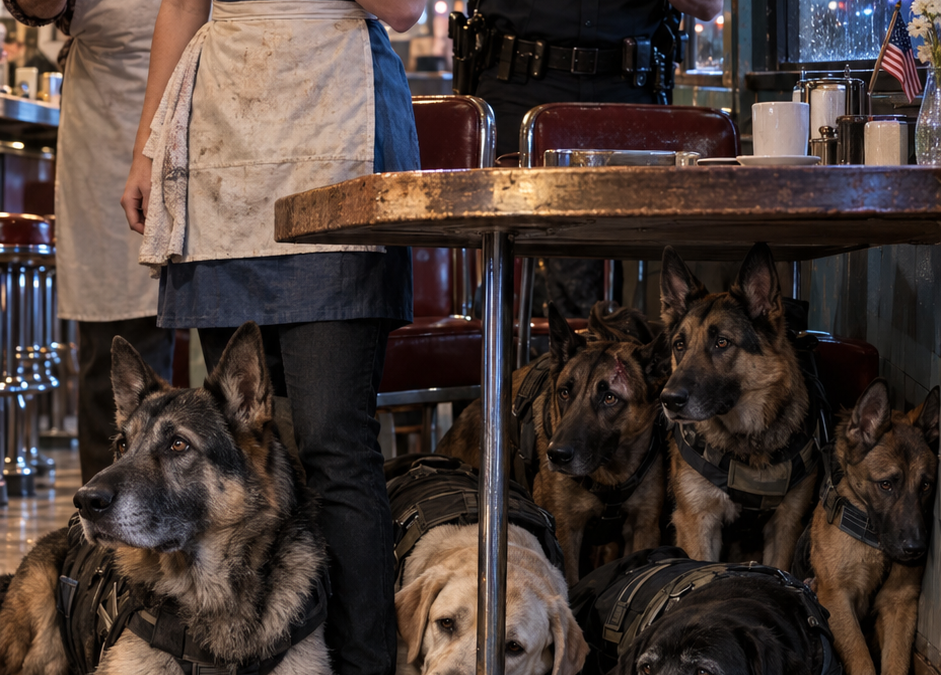
𝗣𝗔𝗥𝗧 𝟮
His tail hit the floor once.
A single thump.
That almost broke me.
I laughed softly.
“Yeah. Me too.”
I had been working at the Blue Lantern since I was eighteen.
Almost six years.
Long enough that I knew which truck drivers wanted coffee before sitting down.
Which nurses from County Memorial wanted silence after midnight.
Which firefighters pretended they weren’t starving until you put extra fries on the plate.
Which state troopers wanted the booth facing the door.
Which old widowers came for pie because going home too early meant sitting in an empty house.
Working nights in a roadside diner teaches you more about people than most college classes probably do.
People get honest when they’re exhausted.
They tell waitresses things they would never tell neighbors.
Divorces.
Deaths.
Failures.
Affairs.
Children who stopped calling.
Parents they couldn’t forgive.
Jobs they were afraid to lose.
I learned early that people often reveal who they are when they think the person listening doesn’t matter.
That night, the six dogs mattered to me partly because everyone around them had started speaking as though they didn’t.
Mr. Harris came up behind me.
“Emily, listen to me.”
I stood.
He lowered his voice.
“You live in an apartment.”
“I know where I live.”
“Your landlord doesn’t allow one German Shepherd, much less whatever this is.”
“Six dogs.”
“I can count.”
“Good.”
“Don’t get smart with me.”
I looked away.
He softened.
That was worse.
“Kid.”
I hated when he called me that because he usually did it only when he was worried.
“You work six days most weeks.”
“I know.”
“You’re already covering double shifts because Jenny’s having the baby.”
“I know.”
“You don’t have a yard.”
“I know.”
“Food alone for six dogs—”
“I know.”
“Veterinary care?”
“I know.”
“Medication?”
“I know.”
“Liability?”
“I know.”
“You keep saying that.”
“Because I know.”
“No, you know the words. That’s different from knowing what six retired K9s are going to cost.”
I looked toward the table.
“So what am I supposed to do?”
His face tightened.
“Be realistic.”
“About what?”
“About what you can actually change.”
Something inside me went still.
People had said versions of that sentence to me my whole life.
Be realistic.
When my father died when I was sixteen, relatives told my mother and me to be realistic about money.
When Mom got sick less than two years later, doctors told us to be realistic about treatment.
After she died, people told me to be realistic about school.
Realistic about rent.
Realistic about grief.
Realistic about the fact that the aunt who had promised I would always have a home suddenly discovered she had “too much going on.”
Realistic about friends who stopped calling because sadness was uncomfortable.
Realistic had usually meant the same thing.
Accept that something painful is happening because fixing it would inconvenience everybody else.
I wasn’t angry at Mr. Harris.
He had helped me more than most people ever had.
He had given me extra shifts when I was eighteen.
Let me eat free after closing.
Driven me home when my car broke down.
Once paid my electric bill without telling me, then spent six months pretending he had miscalculated my wages.
But standing in that diner, looking at those six dogs, I could not accept realism as a reason to do nothing.
“I know I can’t fix everything,” I said.
Mr. Harris sighed.
“Emily—”
“But I can try to fix this.”
“You might destroy yourself trying.”
I looked at Buddy.
“Maybe.”
Deputy Mason approached.
“Emily.”
I turned.
He had the careful tone police officers use when they want you to understand they are about to say something unpleasant without making it sound cruel.
“These aren’t shelter dogs.”
“I know.”
“They’re trained animals.”
“I know.”
“They’ve been conditioned for police work. Some have bite training. Some have behavioral issues. They can’t just be brought into an apartment and treated like pets.”
“I know.”
“You keep saying that.”
“So does he.”
I nodded toward Mr. Harris.
Mason almost smiled.
Almost.
Then he looked back at the dogs.
“Rex worked patrol.”
The German Shepherd’s ears moved.
“Shadow did suspect apprehension and tracking.”
The Malinois watched Mason carefully.
“Buddy worked narcotics detection for years.”
I looked down at him.
“Duke worked explosives.”
The black Labrador lifted his head at the sound of his name.
“Ace was being trained for dual-purpose work. Charlie worked evidence searches.”
Mason folded his arms.
“These dogs have routines. Triggers. Commands. Histories you don’t know.”
“Then tell me.”
“It isn’t that easy.”
“Why?”
“Because some of their records are incomplete.”
That got my attention.
“What does that mean?”
He hesitated.
“The department reorganized fast.”
“So?”
“Handlers changed. Records moved. Some things didn’t transfer cleanly.”
I stared at him.
“You lost paperwork for police dogs?”
“I didn’t lose anything.”
“But somebody did.”
Mason’s jaw tightened.
I could tell I had touched something he didn’t want to discuss.
He checked the wall clock.
“Thirty minutes.”
My stomach dropped.
“What?”
“I have thirty minutes before I need to leave.”
“With them?”
“Yes.”
“To where?”
“County holding.”
“What is county holding?”
“Temporary kennels.”
“For how long?”
“Emily.”
“For how long?”
He looked toward the dogs rather than me.
“That depends.”
“On what?”
“Placement.”
“And if there is no placement?”
Silence.
The thunder outside seemed suddenly closer.
“Mason.”
He rubbed the back of his neck.
“I’m not the person making that decision.”
“That wasn’t my question.”
“It’s the only answer I can give you.”
I knew then.
Maybe not exactly.
But enough.
I looked at Rex.
Still watching the door.
Buddy.
Duke.
Shadow.
Ace.
Charlie.
Dogs that had ridden in police vehicles.
Entered dark buildings.
Followed armed officers.
Searched fields.
Waited through sirens.
Worked through storms.
Trusted human beings completely because their jobs had required it.
And now their futures depended on paperwork and budgets.
I heard myself speak before fear could stop me.
“I’ll take all six.”
Mason turned fully toward me.
“What?”
“All six.”
“No.”
“Yes.”
“No, you don’t understand what you’re agreeing to.”
“I understand they need somewhere to go.”
“You cannot adopt six police K9s in thirty minutes.”
“Then don’t call it adoption. Call it temporary placement.”
“That isn’t how it works.”
“You just said they’re going to temporary holding.”
“That’s county property.”
“So let me be the holding.”
Mr. Harris muttered something that probably wasn’t meant for customers.
Mason shook his head.
“You’re twenty-four.”
“I’ve been twenty-four all year. That isn’t new information.”
“This isn’t funny.”
“I’m not joking.”
I reached into the pocket of my apron.
My fingers closed around the folded bills I had earned that week.
Tips.
Cash I had planned to deposit after my shift.
Rent money.
Gas money.
Grocery money.
I put it on the counter.
The stack looked pathetic.
Mr. Harris stared at it.
“Don’t.”
I ignored him.
“That’s what I have right now.”
Mason looked from the money to me.
“This isn’t about paying an adoption fee.”
“I know.”
“You’d need food.”
“I’ll find it.”
“Crates.”
“I’ll find them.”
“Veterinary clearance.”
“I’ll call somebody.”
“A legal place to keep them.”
My confidence faltered.
Only slightly.
Mr. Harris noticed.
Of course he did.
He knew me too well.
“You don’t have one,” he said.
“Not yet.”
“Emily.”
“I said not yet.”
He closed his eyes.
Mason checked the clock.
“Twenty-three minutes.”
I grabbed the diner phone.
“What are you doing?”
“Finding one.”
The first shelter said no before I finished explaining.
The second listened longer, then told me every kennel was full.
A rescue forty miles away said they could possibly help with one dog after the weekend.
One.
I needed six.
I called a veterinarian whose clinic sometimes ordered takeout from us.
Dr. Patel answered from home.
“Emily?”
“I need help.”
“That sentence from you usually means an injured raccoon.”
“It’s bigger than a raccoon.”
“How much bigger?”
“Six police dogs.”
Silence.
“Please explain that sentence.”
I did.
Quickly.
He didn’t laugh.
That helped.
“Can you examine them?”
“Not tonight.”
“Tomorrow?”
“If you can get them here.”
“How much?”
“Emily.”
“How much?”
“Six complete exams, blood work if necessary, medications, vaccines if they’re behind—”
“I don’t need the total.”
“You absolutely need the total.”
“Can you discount it?”
He sighed.
“Yes.”
Hope sparked.
“How much?”
“I don’t know until I see them. But yes.”
“Thank you.”
“That was not me saying this is a good idea.”
“I didn’t ask whether it was good.”
“I know.”
Next I called my friend Natalie.
She answered half asleep.
“Someone better be bleeding.”
“I need blankets.”
“What?”
“Dog blankets.”
“How many dogs?”
“Six.”
She was silent.
“Emily Carter, why do you need blankets for six dogs at eleven-thirty at night?”
“I’ll explain later.”
“No, explain now.”
“I’m trying to keep six retired police K9s from being taken to county holding.”
Another silence.
“I have four blankets.”
“Bring them.”
“I’m putting on pants.”
I called Tyler, a cook who had left two hours earlier.
He had a cousin who worked at a farm supply store.
They had damaged bags of dog food they couldn’t sell.
“I can get three, maybe four,” Tyler said.
“Tonight?”
“You owe me.”
“I already owe you.”
“Then you owe me more.”
I called everyone.
Former coworkers.
Customers I trusted.
A volunteer from church.
A woman who ran a horse rescue.
Most couldn’t help.
Some wanted to.
One offered two crates.
One offered a fenced equipment shed for forty-eight hours if I could clean it first.
That was the closest thing to a miracle I had found.
I hung up.
Mason checked the clock.
“Fourteen minutes.”
“We have a temporary building.”
“For six trained K9s?”
“Fenced.”
“Secure?”
“Probably.”
“Probably doesn’t work.”
“I can inspect it.”
“You can’t legally assume custody based on maybe.”
I wanted to scream.
Instead I inhaled.
Think.
There had to be another way.
That was when Rex stood.
No warning.
One second he was lying beneath the table.
The next he was on his feet.
His ears went forward.
Shadow stood immediately.
Ace followed.
Then Charlie.
Duke lifted his head.
Buddy struggled upright.
All six looked toward the front windows.
The movement was so synchronized it silenced everyone again.
“What is it?” I whispered.
Rex stared through the rain-covered glass.
His body wasn’t aggressive.
Alert.
Expectant.
Then something came from deep in his throat.
Not a growl.
A quiet whine.
I had never heard him make a sound before.
I followed his gaze.
Across the parking lot, near the highway entrance, sat a black SUV.
Headlights off.
Engine running.
At least I thought it was running.
Rain blurred everything.
I could barely make out the shape of somebody behind the windshield.
“How long has that been there?” Mason asked.
Mr. Harris turned.
“What vehicle?”
“That SUV.”
“I didn’t see it pull in.”
I hadn’t either.
Mason stepped toward the window.
Rex moved with him.
Not toward Mason.
Toward the vehicle.
Shadow’s ears remained forward.
Buddy stared.
“Maybe ten minutes,” I said.
Mason looked at me.
“You noticed it?”
“Not until now.”
The SUV sat there another few seconds.
Then its headlights came on.
It backed out.
Turned toward the highway.
And disappeared into the rain.
“What was that?” I asked.
Mason didn’t answer.
“Deputy?”
“Probably nothing.”
“That sounded convincing.”
“It could have been someone using the parking lot.”
“At midnight with their lights off?”
Mr. Harris said, “People do stranger things.”
Maybe.
But the dogs didn’t think it was nothing.
Buddy remained standing.
His body had changed.
He seemed awake in a way he hadn’t been all night.
I walked toward him.
“Hey.”
His eyes stayed on the empty road.
I crouched beside him.
That was when I noticed something metal beneath the edge of his K9 vest.
At first I thought it was part of a buckle.
Then I saw the chain.
A small rectangular tag had slipped from beneath the vest.
I reached slowly.
“Can I see this?”
Buddy turned toward my hand.
Sniffed once.
Then let me touch it.
I pulled the tag free.
The engraving was worn.
I wiped it with my thumb.
The first line was a name.
DANIEL REED.
Below that were smaller letters.
K9 UNIT.
I read it again.
“Daniel Reed.”
Mason reacted instantly.
Not dramatically.
That was why it frightened me.
His face simply lost color.
He stepped toward us.
“What did you say?”
I held up the tag.
“This says Daniel Reed.”
Mason took it carefully.
“Where did you get this?”
“It was under Buddy’s vest.”
He stared at the metal.
“That’s impossible.”
My skin prickled.
“What is?”
He turned it over.
Nothing on the back.
“Mason.”
He didn’t answer.
“Who is Daniel Reed?”
He looked toward Buddy.
Then Rex.
Then the other dogs.
Finally the door.
I stood.
“Who is he?”
Mason checked the clock again.
Nine minutes.
I hated that clock.
Every time he looked at it, I felt as though the dogs were being measured toward some invisible deadline.
“Deputy.”
He lowered his voice.
“Officer Daniel Reed worked K9.”
“With Buddy?”
Mason looked at the tag again.
“That’s the problem.”
“What problem?”
“Buddy’s records list a different last handler.”
“So he had more than one.”
“Yes.”
“That happens, doesn’t it?”
“It can.”
“Then why are you pale?”
Mason’s jaw tightened.
I stepped closer.
“What aren’t you telling me?”
He looked exhausted suddenly.
Older than he had twenty minutes earlier.
“Because Officer Reed wasn’t supposed to have a K9 anymore.”
The words landed strangely.
“What does that mean?”
“He was removed from active K9 duty.”
“Why?”
Mason hesitated.
“After an incident.”
“What kind?”
“I shouldn’t be discussing personnel matters.”
“Six dogs connected to your department are about to disappear into county holding and one is carrying this man’s name under his vest. I think we’re past normal personnel policy.”
“Emily.”
“What happened to him?”
Mason stared at me.
I saw conflict in his expression.
Fear, maybe.
Or loyalty.
Then the lights flickered.
Once.
Twice.
The old diner went dark for less than a second.
The refrigerator motors stopped.
The fan slowed.
Thunder cracked directly overhead.
Then the lights came back.
At the same moment, the bell above the front door rang.
Every K9 stood.
Not one after another.
All six.
Rex.
Shadow.
Buddy.
Ace.
Duke.
Charlie.
Six animals on their feet at the exact same moment.
I turned.
A man stood inside the entrance.
Rain streamed from his dark police jacket.
He was tall.
Mid-thirties, maybe older.
His face was lean, exhausted, and pale beneath the harsh diner lights.
Water ran from his hair onto his collar.
His uniform looked official.
Not county deputy brown like Mason’s.
Dark municipal blue.
A badge shone over his chest.
But he wasn’t looking at Mason.
He wasn’t looking at Mr. Harris.
He wasn’t looking at me.
He was looking at the dogs.
Rex began trembling.
Not fear.
I knew enough by then to see the difference.
His entire body shook while he stood absolutely still.
Shadow let out a noise somewhere between a whine and a breath.
Charlie stepped away from the wall for the first time all evening.
Buddy moved forward.
The man took one step.
Then another.
His face changed.
Something inside it broke.
“Buddy.”
The old Labrador made a sound I will remember until I die.
A low, trembling whine.
Then he pulled away from the table and crossed the diner.
Not running.
He was too old for that.
But fast enough that his paws slipped once on the tile.
The officer dropped to his knees.
Buddy hit him in the chest.
The man wrapped both arms around the dog.
For several seconds, there was no police officer.
No K9.
No paperwork.
Just a man holding an old dog as though he had been trying to get back to him for years.
Buddy’s tail struck the floor repeatedly.
The officer pressed his face into the Labrador’s neck.
“Hey, partner.”
His voice cracked.
“I’m here.”
I looked at the badge.
The name plate above it read:
D. REED.
My stomach dropped.
Daniel Reed.
The name on Buddy’s tag.
Mason whispered something under his breath.
Reed looked up.
His expression changed the instant he saw the deputy.
“What are they doing here?”
Mason straightened.
“Daniel.”
“What are they doing here?”
“It’s complicated.”
“No.”
Reed stood.
Buddy remained pressed against his leg.
“It isn’t. I asked a question.”
Mason glanced at me.
Reed followed his gaze.
His eyes moved to my apron.
Then the cash sitting on the counter.
Then the blankets.
Then the dogs.
“What happened?”
I swallowed.
“They were supposed to be taken to county holding tonight.”
Reed’s head snapped toward Mason.
“Why?”
“Restructuring.”
Reed laughed once.
There was no humor in it.
“Of course.”
Mason said, “This isn’t my decision.”
“No. It’s never anybody’s decision when something goes wrong.”
“Daniel—”
“What happened to their handlers?”
“Reassigned.”
“All of them?”
“Most.”
“And the dogs?”
“Evaluated.”
Reed looked at Rex.
The German Shepherd still had not moved.
“Evaluated by who?”
Mason didn’t answer.
Reed’s expression hardened.
“Who?”
“The review board.”
“What review board?”
“You know how this works.”
“I know exactly how this works. That’s why I’m asking.”
The air in the diner changed.
I understood then that whatever I had walked into had started long before that night.
I stepped closer.
“Officer Reed?”
He looked at me.
“I’m Emily.”
His eyes dropped to my apron again.
“I work here.”
“I figured.”
“I found something.”
I held out the metal tag.
Buddy’s body went still.
Daniel stared at it.
For a long moment, he didn’t take it.
Then his fingers closed around the edges.
His thumb moved over his own name.
“Where was this?”
“Under Buddy’s vest.”
Daniel looked down at the Labrador.
“You kept it.”
Buddy looked up at him.
I felt suddenly as though I had walked into a room I had no right to be in.
Daniel’s voice became quieter.
“I gave this to him the last day we worked together.”
Mason looked away.
“Why wasn’t he with you?” I asked.
Daniel’s hand tightened around the tag.
“That depends who you ask.”
“I’m asking you.”
Mason said, “Emily, this isn’t—”
Daniel cut him off.
“No.”
He looked at me.
“She deserves an answer if she’s the one trying to stop this.”
Mason stared.
Daniel took a breath.
“Three years ago Buddy and I worked narcotics and tracking. We were attached to a regional task force.”
His hand rested on Buddy’s head.
“We got called to a warehouse outside the county.”
Mason interrupted.
“Daniel.”
“I know what I’m allowed to say.”
He continued.
“There was a search. Information was wrong. Things went bad.”
His jaw tightened.
“Buddy alerted on an area we were told was clear.”
I watched him.
“What was there?”
“A man.”
“Armed?”
Daniel nodded.
“Buddy gave us warning before we walked into it.”
His eyes lowered.
“He saved two officers.”
“And?”
“And during the response, Buddy was injured.”
I looked down at the Labrador.
There was a faint scar near his shoulder that I hadn’t noticed beneath the yellow fur.
“Afterward there were questions about the operation.”
“What kind of questions?”
“Who approved the entry. Who had accurate intelligence. Who ignored Buddy’s alert.”
Mason stared at the floor.
Daniel continued.
“I gave a statement.”
“You told the truth.”
“I told what I saw.”
“And somebody didn’t like it.”
His smile was tired.
“That’s one way to put it.”
He looked at Mason.
“I was removed from K9 duty before the internal review was finished.”
Mason said quietly, “You were placed on administrative reassignment.”
Daniel turned toward him.
“They took my partner.”
Mason said nothing.
“They put him under another handler while I was ordered not to contact the unit.”
His voice remained controlled.
That almost made it worse.
“I fought it for months.”
“What happened?”
“The review closed. Nobody admitted anything significant. I stayed reassigned.”
“And Buddy?”
“Transferred again.”
He looked at the other dogs.
“After that, I started hearing about more handler changes. Dogs moving between units. Records rewritten. People retiring early.”
Mason said, “You’re making it sound worse than it was.”
Daniel stared at him.
“Six police dogs are sitting in a diner at midnight because nobody had a place for them.”
Mason had no answer.
Neither did I.
Daniel looked at me.
“How did you get involved?”
I almost laughed.
“I brought them water.”
His eyebrows rose.
“That’s it?”
“At first.”
Mr. Harris spoke from behind the counter.
“Then she decided to financially destroy herself.”
I gave him a look.
He ignored it.
“She said she’d take all six.”
Daniel stared at me.
“All six?”
“I didn’t know what else to do.”
“You live on a farm?”
“No.”
“House?”
“Apartment.”
He blinked.
Mr. Harris said, “See? Somebody else understands.”
I folded my arms.
“The apartment issue is temporary.”
Daniel looked genuinely confused.
“You volunteered to take six retired K9s without having anywhere to keep them?”
“When you say it like that, it sounds irresponsible.”
“It is irresponsible.”
I felt my cheeks burn.
Then he added, “It’s also probably the first irresponsible thing anybody’s done tonight for the right reason.”
That shut me up.
Buddy leaned against Daniel.
Rex finally moved.
One step.
Daniel saw him.
“Rex.”
The German Shepherd’s ears softened.
Daniel crouched.
“Come here, old man.”
Rex hesitated.
Then crossed the distance.
Daniel touched his chest first rather than his head.
Rex leaned into him.
“You remember me?”
Rex’s eyes closed.
Daniel’s face tightened.
One by one, the others approached.
Shadow stayed farthest away.
Daniel didn’t call him.
He simply let Shadow decide.
Ace sniffed his sleeve.
Duke sat beside Buddy.
Charlie circled behind Daniel and stopped where he could smell his jacket.
This man knew them.
Maybe not as deeply as he knew Buddy.
But enough.
Mason checked the clock.
I snapped.
“Stop looking at that thing.”
He looked at me.
“I have a job.”
“So did they.”
The words came out harder than I intended.
Silence followed.
Mason put his hands on his hips.
“You think I wanted this assignment?”
“I don’t know.”
“I’ve spent eight years with this department.”
His voice rose for the first time.
“I worked around K9 teams. I knew handlers. I knew these dogs.”
“Then help them.”
“You think that isn’t what I’m trying to do?”
“It doesn’t look like it.”
His eyes flashed.
“I brought them here instead of driving directly to holding because I knew Harris would let me keep them somewhere warm while paperwork was being finalized.”
Mr. Harris frowned.
“You told me you needed somewhere for them to wait.”
“That’s what I mean.”
Mason continued.
“I called three departments myself. Two rescues. Two former handlers.”
That surprised me.
“Why didn’t you say that?”
“Because none of them could take all six.”
Daniel stood.
“All six don’t need to stay together.”
Mason looked at him.
Daniel’s expression changed as soon as he said it.
Buddy stared up at him.
Rex stood close behind.
The others remained clustered around the group.
Daniel rubbed his face.
“No.”
“What?” I asked.
He looked at them.
“They might.”
Mason frowned.
“They’ve been kenneled together for weeks.”
Daniel nodded slowly.
“That’s why.”
He pointed toward Charlie.
“He doesn’t settle quickly with new handlers.”
Shadow watched him.
“Shadow mirrors Rex when he’s uncertain.”
He looked at Duke.
“Duke hates unfamiliar kennels.”
Mason said, “They’re dogs, Daniel.”
Daniel’s face hardened.
“Exactly. Which means we’re responsible for understanding what we trained into them.”
He turned to me.
“Police K9s don’t think about retirement like people do. Their entire lives are structure. Handler. Vehicle. Command. Work. Home. Repeat.”
His hand rested on Buddy.
“Take away the handler, then the work, then the kennel, then every familiar dog around them, and we call the resulting stress a behavioral problem.”
Nobody spoke.
I thought about myself at eighteen.
My mother dead.
My father already gone.
House lost.
School ended.
Friends moving forward.
People calling me difficult because I didn’t know how to behave as if losing everything were normal.
Convenient.
The word came back.
These dogs weren’t useless.
They had become inconvenient.
Daniel looked toward Mason.
“Who signed the transfer order?”
Mason’s face changed.
There it was again.
The thing underneath the thing.
“I don’t know.”
Daniel almost smiled.
“You brought six dogs out of county kennels without seeing who signed?”
“I received instructions through Captain Morris.”
“Show me.”
Mason hesitated.
“Show me the paperwork.”
“This isn’t your case.”
“It has my former K9 wearing my identification tag.”
Mason glanced toward me.
I said nothing.
Finally, he reached into the document bag near the table.
He removed a folder.
Daniel opened it.
Read the first page.
Then the second.
His eyes slowed.
“What?”
Mason asked.
Daniel didn’t answer.
“What?”
Daniel looked at him.
“Buddy isn’t listed.”
I felt cold.
“What do you mean?”
He turned the paper toward us.
There were five identification numbers.
Rex.
Shadow.
Ace.
Duke.
Charlie.
No Buddy.
Mason grabbed the folder.
“That can’t be right.”
“You counted six dogs when you picked them up?”
“Yes.”
“Did you verify IDs?”
“I was told the unit was ready for transfer.”
“You transported a dog not listed on your paperwork?”
Mason looked furious now.
Mostly at himself.
“I checked kennel tags.”
“Whose tag was on Buddy’s kennel?”
Mason went still.
Daniel stared at him.
“Mason.”
“I don’t remember.”
“You better.”
“I had six dogs, six kennel cards.”
“Names?”
Mason’s eyes shifted toward Buddy.
“One said Benny.”
I looked at Buddy.
“Benny?”
Daniel’s face became unreadable.
“That’s why.”
“What?” I asked.
He crouched beside Buddy.
“Come here.”
Buddy immediately moved closer.
Daniel ran his hand beneath the dog’s vest, checking straps, collar, tags.
Then he found a second tag.
A plastic county ID.
He turned it over.
The printed name read:
BENNY — K9 417.
Daniel’s mouth tightened.
“This isn’t his ID.”
Mason stepped closer.
“How do you know?”
“Because Buddy’s chip number ends in 62.”
“You remember his microchip number?”
“I memorized everything attached to this dog.”
The way he said it silenced us.
Mason pulled out his phone.
“No signal.”
Mr. Harris pointed toward the back office.
“Landline.”
Mason disappeared behind the counter.
Daniel remained kneeling with Buddy.
I sat on the edge of a chair.
“What does this mean?”
He looked at me.
“I don’t know yet.”
“You have an idea.”
“Yes.”
“Tell me.”
“There was a transfer list.”
“For five dogs.”
“Yes.”
“And Buddy somehow got added.”
“Yes.”
“By accident?”
Daniel looked at the dog.
“Maybe.”
“But you don’t think so.”
“No.”
I heard Mason arguing quietly into the office phone.
Daniel rubbed Buddy’s ears.
“When I appealed my reassignment, I asked to adopt him.”
“What happened?”
“Denied.”
“Why?”
“They said Buddy remained operationally necessary.”
I stared at the aging Labrador.
“How long ago?”
“Two years.”
“And now they’re throwing him into holding.”
Daniel nodded once.
I felt anger rise inside me.
“Can they do that?”
“Depends who officially owns him and what his current status is.”
“He isn’t on the transfer paperwork.”
“That matters.”
Mason returned.
His expression made my heart beat faster.
“What?”
He looked at Daniel.
“The K9 supervisor says Buddy isn’t supposed to be with this group.”
Nobody breathed.
Daniel stood.
“Where is he supposed to be?”
“According to their system, he’s already retired.”
“With who?”
Mason swallowed.
“You.”
The diner became impossibly quiet.
Daniel stared at him.
“What?”
“The system shows retirement transfer approved fourteen months ago.”
Daniel’s face went blank.
“No.”
“It lists you.”
“No.”
“Daniel—”
“I never received him.”
“I’m telling you what the system says.”
“I filed for him two years ago. They denied it.”
“The record changed fourteen months ago.”
“Who changed it?”
Mason shook his head.
“I couldn’t get that over the phone.”
Daniel looked down at Buddy.
Fourteen months.
This dog had officially belonged with him for more than a year.
And neither had known.
“How long has he been in county kennels?” I asked.
Mason looked miserable.
“Most of the last year.”
Daniel closed his eyes.
Buddy leaned against him.
For the first time since he walked in, Daniel looked less angry than devastated.
“You mean he was approved to me.”
Mason nodded.
“And nobody called.”
“I don’t know.”
“He spent fourteen months in a kennel.”
“Daniel—”
“Fourteen months.”
Buddy looked up.
Daniel dropped back to his knees.
His hands moved over the old Labrador’s face.
“I’m sorry.”
Buddy licked his wrist.
Daniel laughed once through tears.
“I’m so sorry.”
That moment changed the entire room.
Until then, the dogs had been a problem to solve.
Now they had a history.
A failure.
Maybe several failures.
I looked at Rex, Shadow, Ace, Duke, Charlie.
“What about the others?”
Daniel understood immediately.
“If Buddy’s record is wrong…”
Mason nodded.
“We check every one.”
The thirty-minute deadline disappeared.
Nobody mentioned it again.
Mason spread paperwork across two diner tables.
Mr. Harris locked the front door and flipped the sign to CLOSED.
Natalie arrived carrying blankets and stopped dead when she saw the police officer kneeling among six dogs.
“I feel like I missed something.”
“You did.”
“Are we committing crimes?”
“Not currently.”
“That isn’t reassuring.”
She put down the blankets.
Tyler arrived twenty minutes later with four huge damaged bags of dog food in his pickup.
Dr. Patel called back and agreed to open the clinic early.
The horse rescue owner offered use of an indoor training barn temporarily once she heard police were involved.
For the first time, help started arriving faster than the problems.
Mason spent nearly an hour on the phone.
The records got stranger.
Rex had an approved retirement request from a former handler who had moved to Indiana.
Nobody had contacted him after he relocated.
Duke’s paperwork listed him as medically unsuitable for service but contained no retirement disposition at all.
Charlie had been marked for behavior rehabilitation six months earlier, but the program he was supposed to enter had shut down before he arrived.
Shadow’s former handler had requested ownership and been told the dog had already been committed to another department.
That transfer apparently never happened.
Ace was the only dog whose paperwork matched the official transfer order.
Five dogs.
Five separate bureaucratic failures.
One diner.
One rainy night.
Daniel stood over the papers.
“This wasn’t one mistake.”
Mason shook his head.
“No.”
“Was it deliberate?”
“I don’t know.”
Neither did I.
And eventually, I realized the answer almost didn’t matter to the dogs.
Whether cruelty or negligence had put them there, they had still ended up beneath a diner table waiting for human beings to decide whether they were worth the trouble.
Daniel looked at me.
“You really planned to take all of them?”
“I was working on it.”
“With three hundred dollars?”
“Three hundred eighty-two.”
Mr. Harris said, “She’s very proud of the eighty-two.”
“I wasn’t counting the cash tips.”
Daniel laughed.
It was the first real laugh I heard from him.
Buddy’s tail moved.
Then Daniel grew serious.
“You can’t keep six dogs alone.”
“I know that now.”
“You knew it before.”
“I suspected.”
He looked around at the room.
Blankets.
Food.
Phone numbers scribbled on napkins.
Dr. Patel’s clinic address.
The temporary barn contact.
“You still tried.”
“Yes.”
“Why?”
It was such a simple question.
I almost gave him a simple answer.
Because they needed help.
Because it was wrong.
Because somebody had to.
Instead, I looked at Buddy.
“My dad died when I was sixteen.”
Daniel waited.
“My mom died two years later.”
I rubbed my palms against my apron.
“For a while, everybody wanted to help. People brought food. People said call anytime. People told me I was family.”
I smiled faintly.
“Then time passed.”
Daniel’s expression softened.
“People went back to their lives.”
“Yeah.”
I nodded toward the dogs.
“I know they’re not people.”
Daniel looked at Buddy.
“Sometimes I’m not sure that distinction helps us much.”
“I just know what it feels like when people decide caring about you has become complicated.”
The words came out quieter than I expected.
“When Deputy Mason said age, injuries, behavior, medical cost… all I heard was reasons people use when something becomes inconvenient.”
Daniel looked at me for a long time.
Then he nodded.
“I understand.”
And I believed him.
Near two in the morning, Mason finally received instructions from a superior.
The dogs would not go to county holding.
All transfers were frozen pending record verification.
Buddy could leave with Daniel immediately once identity was confirmed through his microchip.
The other five would remain temporarily together at the rescue barn under county supervision while former handlers and retirement requests were reviewed.
I should have felt victorious.
Instead, I felt exhausted.
Relieved, yes.
But angry too.
Because nothing we had done that night was extraordinary.
We had looked carefully.
Asked basic questions.
Read the paperwork.
Called people.
And somehow those simple acts had been enough to uncover five years’ worth of carelessness and fourteen months Buddy should have spent somewhere else.
Daniel sat in a booth with Buddy’s head in his lap.
Rex slept beneath the table.
Shadow had finally accepted a blanket.
Charlie was curled beside him.
Duke had taken his medication hidden inside part of a hamburger patty.
Ace watched the kitchen every time Tyler moved.
I carried Daniel coffee.
He looked at it.
“I didn’t order that.”
“Occupational habit.”
He smiled.
“Thanks.”
I sat across from him.
“You were in the SUV.”
He stopped.
“What?”
“Earlier. Black SUV across the lot.”
Daniel looked guilty.
“That was you.”
“Yes.”
“Why didn’t you come in?”
He looked at Buddy.
“I wasn’t sure he was here.”
“How did you know anything was happening?”
“A former K9 officer called me. Said he heard some dogs were being moved tonight.”
“So you followed Mason?”
“For part of the route.”
Mason called from the counter, “I knew somebody was back there.”
Daniel ignored him.
“I saw them through the diner window.”
“Why wait?”
His hand moved slowly over Buddy’s head.
“Because I wasn’t supposed to have contact with him.”
“After three years?”
“The order was never formally withdrawn.”
“So you sat outside.”
“Yes.”
“How long?”
“Long enough to convince myself walking in would make things worse.”
I thought about the thirty-minute deadline.
“What changed?”
He looked at me.
“You did.”
I frowned.
“I didn’t know you were there.”
“I watched you moving blankets.”
He smiled slightly.
“Then you started making phone calls.”
“You could see that?”
“I could see you yelling into the phone.”
“I wasn’t yelling.”
Mr. Harris called out, “She was yelling.”
I gave him a look.
Daniel laughed.
“Then Mason kept checking his watch.”
“He did that a lot.”
“And you put money on the counter.”
My cheeks warmed.
“You saw that too?”
“I saw enough.”
He looked at the dogs.
“Then I watched six police K9s stand when they noticed my vehicle.”
His expression shifted.
“I knew Buddy remembered.”
“Of course he remembered.”
Daniel looked down.
“I wasn’t sure.”
That hurt to hear.
“Three years is a long time.”
“Not for everything.”
“No.”
He stroked Buddy’s head.
“No, apparently it isn’t.”
At sunrise, the rain finally weakened.
Gray light spread over the parking lot.
Tyler brewed fresh coffee.
Natalie had fallen asleep in a booth.
Mr. Harris was pretending he hadn’t also fallen asleep sitting upright in his office chair.
Deputy Mason stood outside speaking with a supervisor who had arrived from the county.
Two more vehicles were coming to help transport the dogs safely to the rescue barn.
Buddy was not going with them.
Dr. Patel had come by with a microchip scanner.
Daniel watched while the veterinarian passed it over Buddy’s shoulders.
The machine beeped.
Dr. Patel read the number.
Daniel finished it from memory.
“…662.”
The veterinarian looked at him.
“That’s correct.”
Daniel closed his eyes.
Mason handed him a temporary custody form.
“Until formal paperwork is reissued.”
Daniel stared at it.
“What if someone changes their mind?”
“They won’t.”
“You don’t know that.”
Mason looked toward the county supervisor.
“I made copies.”
Daniel looked at him.
Mason shrugged.
“Learned something tonight.”
They exchanged the kind of glance men share when there is too much history to repair in one conversation.
Daniel signed.
Buddy stood beside his leg.
No leash needed.
When the pen left the paper, Daniel looked down.
“Well, partner.”
Buddy’s tail started moving.
“You want to go home?”
The old Labrador sneezed.
Daniel laughed.
“I’ll take that as yes.”
I watched them walk toward the door.
Buddy reached it first.
Then stopped.
He turned around.
Looked directly at me.
Daniel stopped too.
Buddy walked back.
I crouched.
This time, I reached for him.
He pushed his head against my chest.
I wrapped my arms around his neck.
“You’re welcome,” I whispered, although I wasn’t sure whether I had actually done enough to deserve the moment.
His tail hit the tile.
When I released him, he returned to Daniel.
The officer held the door open.
Morning light spilled inside.
Buddy walked out beside his partner.
No county kennel.
No transfer truck.
No stranger waiting at the end of a leash.
Home.
I cried after the door closed.
Not dramatically.
I simply turned toward the counter and realized my face was wet.
Mr. Harris slid a napkin toward me.
“You’re off the clock.”
I wiped my eyes.
“Since when?”
“Since about six hours ago.”
“Are you paying overtime?”
“No.”
“Then I’m still crying on company time.”
He shook his head.
“You are a ridiculous person.”
“You like me.”
“Sometimes.”
Outside, Daniel loaded Buddy into the back seat of his vehicle.
Not the black SUV.
A marked police cruiser someone had brought for him.
Buddy put his front paws on the window and looked toward the diner.
Daniel waved once.
Then they drove away.
The other five left later that morning.
Not to disappear.
To wait.
There is a difference.
Rex climbed into the transport van beside Shadow.
Charlie refused until Ace went first.
Duke needed help getting his rear legs onto the platform.
Nobody rushed him.
I watched every door close.
Five dogs.
Still together.
Still accounted for.
Still somebody’s responsibility.
Mason stood beside me.
“You should sleep.”
“I will.”
“Your shift tonight?”
“I’m supposed to work.”
Mr. Harris shouted from inside, “No, she isn’t.”
I smiled.
Mason put his hands into his jacket pockets.
“You know you couldn’t actually have taken them all.”
“I know.”
“Do you?”
“Probably not.”
He laughed softly.
Then grew serious.
“You caused a lot of trouble.”
“Good.”
“I figured you’d say that.”
The investigation into the records lasted months.
I learned most of what happened afterward through Daniel and Mason.
No dramatic conspiracy appeared.
There wasn’t one villain secretly trying to get rid of police dogs.
The truth was less cinematic and, in some ways, more disturbing.
Budget changes had happened too quickly.
Supervisors changed.
A database migration had duplicated and buried records.
Retirement applications had been approved without notifications being sent.
Handlers had moved.
Some files still existed only on paper.
Everyone assumed somebody else was following up.
Buddy’s case became the example nobody in the department could explain away.
A dog legally approved to retire with his former handler had spent fourteen additional months in county kennels because one electronic status had changed and nobody contacted the man whose name sat right beside it.
That mistake led officials to recheck every retired and transferred K9 in the county system.
Rex eventually went to his former handler in Indiana.
The man drove six hours to get him.
I was there when they met at the rescue barn.
Rex heard the truck before we did.
He stood.
His ears went forward.
An older man climbed out and said, “Hey, Sergeant.”
Rex ran.
Not fast.
Not like a young dog.
But fast enough.
Shadow’s former handler turned out to have never stopped asking for him.
When the county finally called, she cried so hard over the phone that Mason had to repeat the address three times.
Duke was medically retired and adopted by a bomb technician who had worked beside his team for years.
He bought an orthopedic bed large enough for a small horse.
Charlie remained the most difficult.
The first two handler options didn’t work.
He panicked in unfamiliar homes.
Stopped eating.
Paced constantly.
So the rescue barn kept him longer.
I visited almost every day.
At first, Charlie wouldn’t let me touch him.
That was fine.
I knew something about letting people decide when closeness was safe.
I brought food.
Sat outside the kennel.
Read books.
Talked about whatever happened at the diner.
One afternoon, after nearly three weeks, I was sitting on the floor complaining to him about a customer who had sent scrambled eggs back three times when Charlie walked over and put his chin on my knee.
I stopped talking.
He stared at me.
“Oh.”
His ears moved.
“That complicates things.”
A week later, Charlie came home with me.
Not to my apartment.
Mr. Harris had apparently spent several weeks making calls behind my back.
A customer owned a little house on three acres outside town.
The previous tenant had moved out.
The rent was less than my apartment because the house needed work.
The fence needed repairs.
Mr. Harris covered the deposit.
I threatened to repay him.
He told me to shut up.
So I moved.
Charlie got a yard.
I got a leaking bathroom faucet and neighbors half a mile away.
Fair trade.
Ace was eventually adopted by a state search-and-rescue trainer who retrained him for missing-person work instead of patrol.
Apparently Ace had been considered inconvenient mostly because his skill set no longer matched one department’s budget.
Given another job, he thrived.
Six dogs entered the Blue Lantern on one rainy night with uncertain futures.
Six eventually walked back out with names attached to their lives again.
But Buddy remained the one I saw most.
Daniel started coming into the diner every Thursday night.
Always the booth near the window.
Always black coffee.
Usually eggs, toast, bacon.
Buddy came whenever rules allowed and lay beneath the table.
The first time they returned together, Buddy walked straight behind the counter toward me.
Mr. Harris pointed.
“No dogs behind the counter.”
Buddy ignored him.
I hugged him.
Mr. Harris pretended to be angry.
Ten minutes later, I caught him feeding Buddy bacon.
Daniel went through a long administrative process after the records investigation.
Eventually his restriction from the K9 unit was formally removed.
He didn’t immediately return.
I asked why once.
He looked at Buddy sleeping beneath the table.
“I spent years believing getting back into K9 was the only way to fix what happened.”
“And now?”
“Now I think getting him home was enough.”
Buddy lived with Daniel for almost four more years.
His hips worsened.
His face turned completely white.
He eventually needed help climbing stairs.
Daniel built a ramp.
When Buddy could no longer jump into the cruiser, Daniel bought one of those ridiculously expensive folding ramps and pretended it had been on sale.
When Buddy’s hearing faded, Daniel started using hand signals again.
Old commands.
Old habits.
Old partnership.
The last time I saw Buddy, he was lying beneath the same table where I had first found him.
Charlie was asleep beside my feet.
Daniel sat across from me.
Buddy’s eyes were closed.
His breathing was slow.
I looked at the old metal tag hanging from his collar.
DANIEL REED.
K9 UNIT.
“You put it back.”
Daniel touched it.
“Never coming off again.”
Buddy opened his eyes at the sound of his voice.
His tail moved once.
Just one soft thump against the floor.
Exactly the same way it had the night I asked if he was hungry.
I smiled.
Daniel noticed.
“What?”
“Nothing.”
“No, what?”
“I was just thinking about the first night.”
He laughed.
“When you tried to adopt six police dogs with waitress tips?”
“I had a plan.”
“You had four blankets and no yard.”
“There were developing details.”
He shook his head.
“You know what Mason still calls you?”
“I’m afraid to ask.”
“The Blue Lantern Incident.”
“That makes me sound dangerous.”
“You were dangerous.”
“To bureaucracy.”
“Exactly.”
We both laughed.
But after Daniel left that evening, I stood behind the counter watching Buddy move slowly beside him across the parking lot.
And I thought about how close everything had come to going differently.
If the rain hadn’t been so bad, maybe Mason wouldn’t have stopped at the diner.
If I had been busy, maybe I wouldn’t have asked why six dogs were beneath that table.
If Buddy’s old tag hadn’t slipped from beneath his vest, maybe Daniel’s name would never have come up.
If Daniel had stayed in the SUV five minutes longer, maybe Mason would have driven away.
People like to imagine important moments announcing themselves.
Sirens.
Speeches.
Courage that looks unmistakably like courage.
That night didn’t feel like that.
It felt messy.
Expensive.
Confusing.
I was scared.
Mason was frustrated.
Mr. Harris thought I was making the worst financial decision of my life.
Daniel almost remained outside because he believed walking through the door might make things harder.
Nobody knew the full story.
We simply knew six dogs were about to be taken somewhere none of them understood.
So we stopped.
We looked closer.
That turned out to be enough.
I still work at the Blue Lantern.
Not six nights a week anymore.
Mr. Harris eventually made me assistant manager, mostly because he says nobody else is stubborn enough to argue with delivery companies.
Charlie still lives with me.
He has gray around his muzzle now.
Some nights he sleeps so deeply I have to watch his chest for a second to reassure myself.
And whenever a police cruiser pulls into the diner parking lot, he still lifts his head.
Old instincts.
Old memories.
Maybe old hope.
People sometimes ask whether I really would have taken all six dogs that night.
The sensible answer is no.
I didn’t have the money.
I didn’t have the space.
I didn’t have the experience.
Taking six highly trained K9s into a tiny apartment would have been completely impossible.
But that isn’t the answer I give.
Because when I said, “I’ll take all of them,” I wasn’t making a budget.
I was refusing to let the conversation end with, “There’s nowhere for them to go.”
There is almost always somewhere.
A former handler.
A rescue barn.
A veterinarian willing to open early.
A friend with blankets.
A cook with damaged bags of food.
A stubborn diner owner quietly making phone calls.
A police officer sitting in a dark SUV because he still loves the dog someone told him he had lost.
Sometimes the place an abandoned creature needs already exists.
The problem is that nobody has connected the pieces yet.
That rainy Ohio night, six old K9s sat under a diner table while human beings described them using words like retirement, transfer, behavior, cost, and disposition.
By sunrise, they had names again.
Histories.
Handlers.
Homes waiting somewhere at the other end of a phone call.
And Buddy had his partner.
Years later, when Daniel told me Buddy had died peacefully at home with his head in Daniel’s lap, I cried harder than I expected.
Charlie sat beside me through the entire phone call.
Daniel’s voice shook.
“He waited until I told him he could go.”
I couldn’t speak for several seconds.
Finally I asked, “Did he have his tag?”
Daniel laughed through the tears.
“Of course.”
After we hung up, I sat on my kitchen floor.
Charlie came over.
He lowered his body beside mine.
I rested my hand on his neck.
Outside, rain had started falling.
Not a storm.
Just a quiet autumn rain.
For a moment, I was twenty-four again.
Standing inside the Blue Lantern.
Six exhausted police dogs beneath the table.
Deputy Mason checking the clock.
Three hundred eighty-two dollars in my bank account.
No yard.
No plan worth mentioning.
Only the unbearable certainty that if everyone else walked away, I couldn’t.
I remembered Rex staring at the front door.
Buddy’s tail hitting the floor once.
The cold metal tag in my hand.
Daniel Reed stepping through the rain thirty minutes after I had promised six dogs something I had no idea how to give them.
And I finally understood why that night had stayed with me.
It wasn’t because I saved six K9s.
I didn’t.
A lot of people helped.
Some of those dogs were saved by handlers who never stopped asking where they were.
Some were saved by paperwork finally being read correctly.
Some by strangers.
Some by second chances.
What mattered was simpler.
For one night, when six loyal animals had become inconvenient to the system they had served, someone looked at them before looking at the cost.
Then someone else did.
And someone else.
Until the whole room changed.
That is how rescue happens more often than people realize.
Not because one person can carry everything.
Because one person refuses to look away long enough for the next person to notice.
I scratched Charlie gently behind the ear.
His eyes closed.
The rain tapped against the windows.
Somewhere in my desk drawer, I still had the first scrap of paper from that night.
Six names written in blue diner pen.
Rex.
Shadow.
Buddy.
Ace.
Duke.
Charlie.
Beside them, in my rushed handwriting, were the words I had written while Mason argued on the phone:
DON’T LET THEM DISAPPEAR.
I never did.








