𝗣𝗔𝗥𝗧 𝟮 SHE TURNED MY WAREHOUSE INTO FREE HOA STORAGE—93 DAYS LATER, I AUCTIONED EVERYTHING SHE LEFT BEHIND
PART2
I watched the footage twice.
Nora stood beside me.
“Want me to call someone?”
“Yes.”
“The police?”
“Eventually.”
“Who first?”
“You.”
She looked confused.
“I need an inventory.”
Her eyebrows lifted.
“All of it?”
“Everything they brought inside.”
That was the point where Nora understood exactly how angry I was.
She had seen me deal with bad suppliers, late contractors, damaged shipments, and one forklift driver who somehow put a pallet through an office wall.
I rarely shouted.
I documented.
Nora once told me that when I got quiet, someone usually ended up receiving a certified letter.
That morning, she grabbed a tablet.
We started at row one.
Patio furniture sets.
Forty.
Portable fencing sections.
Sixty-two.
Traffic barriers.
Twenty-four.
Holiday-decoration boxes.
More than seventy.
Leaf blowers.
Salt spreader.
Riding mower.
Generators.
Utility cart.
Traffic signs.
Office boxes.
Landscaping tools.
We numbered everything.
Photographed everything.
Recorded serial numbers.
Logged condition.
Noted exactly where each item sat.
By the end of the day, we had 327 separate items or grouped lots.
The cameras gave us something even better.
Truck plates.
Delivery times.
Drivers.
Marissa supervising.
The locksmith.
Every arrival.
Every removal attempt.
Everything.
I called Marissa.
She answered quickly.
“Grant.”
“You have seventy-two hours.”
“For what?”
“To remove everything.”
“We already discussed this.”
“No. You announced something. I rejected it.”
She sighed.
“The property has been temporarily dedicated to community operations.”
That sentence was so absurd I almost respected it.
“Dedicated by whom?”
“The association.”
“You cannot dedicate my building.”
“There was a necessity.”
“That’s your legal argument?”
“Yes.”
“Necessity?”
“Our maintenance facility isn’t available.”
“So rent another one.”
“We don’t need to pay unnecessary commercial fees when appropriate space is already available.”
I looked around my warehouse.
“Appropriate to whom?”
“Everyone.”
“No, Marissa. Appropriate to you.”
She went quiet.
I continued.
“Seventy-two hours.”
She hung up.
The next call I made was to Tessa Ward.
Tessa had handled two commercial leases and one boundary dispute for me in the past.
She was the kind of lawyer who didn’t raise her voice because she preferred leaving that work to the documents.
I explained the situation.
She interrupted only once.
“She changed your lock?”
“Yes.”
“Send me that footage.”
I did.
By the next afternoon, she had pulled the deed.
Survey.
County parcel map.
Recorded boundary documents.
Then she called.
“Good news.”
“There’s good news?”
“The HOA has no interest in your warehouse.”
“I knew that.”
“I know. But now I know it professionally.”
I laughed.
“No easement?”
“None.”
“Lease?”
“None.”
“License?”
“No.”
“Shared access?”
“No.”
“Community service zone?”
She paused.
“That is not a thing.”
“Marissa seemed very confident.”
“Confidence is not recorded at the county courthouse.”
That was why I liked Tessa.
I asked the obvious question.
“Can I put everything outside?”
“No.”
“Why?”
“Because if you damage any of it, they suddenly have a real claim.”
“So I’m supposed to babysit their mower?”
“For now.”
She laid out the plan.
Formal notice.
Detailed inventory.
Proof of ownership.
Commercial storage charges based on market rates.
Removal deadline.
Final abandonment warning.
And if Marissa continued ignoring everything, Tessa would use the proper legal process for disposition, including court review where required before anything was sold.
“No shortcuts,” she said.
“Fine.”
“No dramatic forklift revenge.”
“I wasn’t planning—”
“You were thinking about it.”
“Maybe once.”
“Don’t.”
The first certified notice gave Stone Brook Ridge thirty days to remove all property.
Storage charge:
$6,500 per month.
Tessa had pulled comparable commercial-storage rates and documented the number.
Marissa personally signed for the letter.
Two days later, she emailed me.
Stone Brook Ridge rejects your attempt to impose unauthorized storage charges on community assets housed within a community access facility.
I replied:
My warehouse is not a community access facility and never has been.
That was the entire email.
A week passed.
I assumed they would finally begin moving things.
Instead, another truck appeared.
Then another.
Sixteen picnic tables.
Three commercial pressure washers.
A compact tractor.
Thousands of feet of string lights.
More barriers.
I drove down immediately.
A third truck was backing toward the loading dock.
I walked behind it.
Raised my hand.
The driver stopped.
Marissa came around the side.
“What are you doing?”
“Stopping delivery.”
“You cannot interfere with HOA operations.”
“This is my loading dock.”
“Move.”
“No.”
She pulled out her phone.
“You’re obstructing community property.”
“You’re delivering community property onto private commercial property after written notice telling you not to.”
She called police.
I almost thanked her.
Deputy Mason Crowley arrived twenty minutes later.
Marissa met him first.
“Officer, this man is interfering with HOA assets.”
Mason looked at me.
“Mr. Holloway?”
I handed him a copy of my deed.
Then the county parcel map.
Then Tessa’s notice.
He studied them.
Looked toward the warehouse.
Then at Marissa.
“This building belongs to Mr. Holloway.”
Marissa crossed her arms.
“The association considers it part of a community service zone.”
Mason looked back at the parcel map.
“The county doesn’t.”
“Our attorney—”
“I’m not deciding your civil argument.”
He pointed at the warehouse.
“But you cannot treat property you don’t own as if you do.”
“We have equipment inside.”
“Then you should probably remove it.”
Marissa’s face tightened.
“You’re taking his side.”
“No.”
He handed me the deed.
“I’m taking the deed’s side.”
That line stayed with me.
Marissa left.
The new truck left too.
But everything already inside stayed.
Thirty days passed.
Nothing moved.
Tessa sent the second notice.
FINAL NOTICE — PROPERTY SUBJECT TO ABANDONMENT PROCESS
Marissa signed for that too.
That same week, I received an unexpected call.
“Mr. Holloway?”
“Yes?”
“My name is Russell Pike.”
I recognized it.
Stone Brook Ridge treasurer.
“I know who you are.”
“Can I ask you something?”
“Sure.”
“Did you agree to let the association use your warehouse for six months?”
I sat back.
“No.”
Silence.
“Nothing verbally?”
“No.”
“Email?”
“No.”
“Handshake?”
“No.”
“What exactly did Marissa tell you?”
Another pause.
“That you offered the space.”
I laughed once.
Not because it was funny.
Because the lie was so clean.
“Russell, give me an email address.”
He did.
I forwarded the entire exchange.
Initial demand.
Marissa’s response.
Storage notice.
Her rejection.
Photos.
Russell called back ten minutes later.
“Okay.”
His voice sounded different.
“She lied.”
“Yes.”
“She told the board you had vacant space and had agreed to temporary use.”
“I agreed to exactly nothing.”
There was another silence.
Then Russell said:
“Our maintenance building isn’t being renovated.”
“What?”
“It was sold.”
That caught me.
“Sold?”
“Three months ago.”
“Why?”
“Clubhouse funding.”
I waited.
Russell continued.
“Marissa pushed the sale. Said we could use the proceeds to accelerate the clubhouse renovation.”
“And then you had nowhere to store the equipment.”
“Yes.”
“Did the board budget commercial storage?”
“We discussed it.”
“How much?”
“Too much, according to Marissa.”
There it was.
The whole thing.
Stone Brook Ridge had sold its own maintenance building.
Then, rather than rent legitimate warehouse space, Marissa had looked six hundred feet beyond the HOA boundary, seen mine sitting partly empty, and decided rent was for people with less imagination.
“Russell.”
“Yes?”
“You need to tell your board what is happening.”
“I intend to.”
“Quickly.”
I called Tessa.
She wasn’t surprised.
“Of course.”
“Of course?”
“People rarely trespass at this scale without a financial reason.”
“She told the board I volunteered the space.”
“Good.”
“How is that good?”
“Because now we have internal witnesses.”
Tessa assembled the file.
Deed.
Survey.
County map.
All three notices.
Delivery receipts.
Marissa’s signatures.
Inventory.
Camera footage.
Police report.
Comparable commercial rates.
Emails.
Russell’s account.
Everything.
She looked through the binder one afternoon and said:
“There are disputes where you need to persuade someone.”
“And this?”
“This is a dispute where you need to stop the other side from escaping its own paperwork.”
Ten days before the next deadline, Tessa sent the third notice.
Final deadline.
Ten days.
If Stone Brook Ridge failed to retrieve the property and satisfy the lawful storage dispute, we would proceed with formal disposition.
Marissa arrived the next afternoon.
Two board members came with her.
She stormed into the warehouse holding the notice.
“You are not selling HOA property.”
I looked at her.
“Come get it.”
“We have nowhere to put it.”
I shrugged.
She stared at me.
“That is your answer?”
“Yes.”
“You expect us to move all of this?”
“You moved it in.”
“That would cost tens of thousands.”
“Probably.”
“You’re being vindictive.”
“No. Vindictive would have been charging admission.”
One board member looked away, hiding a smile.
Marissa slapped the notice onto a table.
“If a single item goes missing, we will sue you for millions.”
I pointed toward the warehouse floor.
“You have occupied roughly eleven thousand square feet for forty-three days.”
“We have community rights.”
“Show them.”
She glared.
“You’re bluffing.”
“No.”
“You would never actually sell this.”
I looked at her.
“Try me.”
She left.
Nora walked over afterward.
“That was dramatic.”
“I regret it already.”
“No, you don’t.”
“No.”
The next morning, Nora called me from the back corner.
“Grant?”
“What?”
“Come here.”
Behind a wall of stacked boxes sat a utility vehicle.
2022 model.
Rough value:
Nineteen thousand dollars.
I checked our original inventory.
It hadn’t been visible during the first count.
Then we found more.
Four commercial generators.
Two zero-turn mowers.
A pallet of construction materials.
An unassembled outdoor kitchen package.
By the time everything was cataloged, estimated value had climbed well above $140,000.
Russell reviewed the HOA asset register.
Then called.
“We have a problem.”
“What?”
“Some of that equipment isn’t listed.”
“Which?”
“The utility vehicle.”
“What else?”
“One mower. Two generators. Outdoor kitchen.”
“Paid for by HOA?”
“I found payments.”
“But no asset entry?”
“No.”
That moved the dispute into territory I had never intended to visit.
I wanted my warehouse back.
I had no interest in conducting an HOA financial investigation.
Unfortunately, their financial investigation was occupying aisle seven.
Day forty-seven brought a lawsuit.
Marissa filed on behalf of Stone Brook Ridge.
Emergency injunction.
According to the complaint, I was:
Wrongfully detaining HOA property.
Blocking lawful access.
Demanding extortionate storage charges.
Threatening community assets.
And attempting to profit from residents.
Tessa read the complaint in her office.
Halfway through, she smiled.
“What?”
“She admitted ownership.”
“Of the equipment?”
“Every piece.”
“Was that disputed?”
“Not by us.”
“No.”
“But this filing matters.”
She tapped the page.
“Stone Brook Ridge is affirmatively telling the court these goods are theirs and that they know exactly where they are.”
“So?”
“So abandoned-property disputes often turn on notice, ownership, possession, opportunity to retrieve, and deadlines.”
She raised the complaint.
“Marissa just certified a major piece of our timeline.”
At the injunction hearing, Marissa sat behind the HOA attorney with three board members.
Tessa stood beside me.
The judge asked a simple question.
“Was there an agreement permitting Stone Brook Ridge to store property at Mr. Holloway’s warehouse?”
Their attorney looked toward Marissa.
Marissa whispered something.
He answered.
“My client understood that permission had been granted.”
Tessa stood.
“Written agreement?”
None.
“Email?”
None.
“Text?”
None.
“Rent payment?”
None.
“License?”
None.
“Recorded easement?”
None.
“Witness to a conversation in which Mr. Holloway gave permission?”
None.
Then Tessa built the timeline.
Day one:
Unauthorized delivery.
Day two:
Lock changed.
Initial verbal demand.
Seventy-two-hour demand.
Thirty-day certified notice.
Storage charges.
Second notice.
Final deadline.
Police incident.
Continued refusal.
The judge looked at Marissa.
“Why wasn’t the property removed when Mr. Holloway objected?”
Marissa answered herself.
“Because moving it would have created unnecessary expense for the homeowners.”
I looked at Tessa.
She looked at me.
Neither of us needed to say anything.
That sentence demolished Marissa’s own argument.
She had not misunderstood.
She had known the warehouse was mine.
She simply decided moving equipment would cost money and therefore I should absorb the inconvenience instead.
The judge denied the emergency injunction.
He did not instantly authorize an auction on the spot.
Tessa had never expected that.
But the court made clear that Stone Brook Ridge needed to resolve the storage issue properly and quickly.
We continued following the required process.
The updated invoice reached:
$28,740.
Storage.
Handling.
Administration.
Documented associated charges.
Russell told me Marissa tore the invoice in half during a board discussion.
“She said you’re bluffing.”
“She’s consistent.”
Tessa completed the public-notice requirements.
Direct notices to the HOA.
Direct notices to board members.
Required postings.
Formal sale procedures.
Then I hired Dale Mercer.
Licensed auctioneer.
He had been conducting farm, commercial, and equipment auctions for decades.
Dale entered the warehouse carrying a yellow legal pad.
He walked for almost an hour.
He inspected the tractor.
Generators.
Mowers.
Pressure washers.
Furniture.
Utility vehicle.
Outdoor kitchen.
Then he looked at me.
“This isn’t junk.”
“I know.”
“How much do you think it’s worth?”
“Maybe one-forty.”
He shook his head.
“Liquidation?”
“Yes.”
He walked toward the utility vehicle.
“One-eighty to two-forty depending on attendance.”
I stared at him.
“Seriously?”
“You have contractors, landscapers, farmers, property managers, resellers. Promote it correctly and this place will be packed.”
“I don’t want to make money off them.”
He shrugged.
“Then follow the distribution process exactly. You take only what you’re legally entitled to. Everything else gets handled as required.”
That matched Tessa’s advice.
Transparency became obsessive.
Nora photographed every lot.
Dale assigned numbers.
Serials.
Condition notes.
Descriptions.
Nothing disappeared into a side deal.
Nothing was reserved for friends.
Nothing quietly loaded into my truck.
Every dollar would be tracked.
Marissa received the auction notice.
My phone rang fifteen minutes later.
“Cancel it.”
“No.”
“You cannot do this.”
“Remove the property.”
“We are not paying your invented fees.”
“Then discuss that with Tessa.”
“Grant.”
“Yes?”
“You’re making a massive mistake.”
“Saturday.”
“What?”
“I’ll see you Saturday.”
She hung up.
Then came the HOA email campaign.
Residents received a message describing me as a hostile commercial landowner attempting to seize community assets.
Marissa urged them to come “protect HOA property.”
Russell responded by forwarding the certified notices to the entire board.
That created problems for her.
Board members learned I had been demanding removal for almost two months.
One called me personally.
“Why didn’t Marissa tell us?”
“You should ask Marissa.”
“We thought you agreed.”
“I did not.”
“Why didn’t she move everything after the first notice?”
“You should definitely ask Marissa.”
Three days before auction, HOA trucks appeared again.
For one brief moment, I thought the nightmare was ending.
Then I saw what they were doing.
They went straight toward the tractor.
Utility vehicle.
Generators.
Only the expensive things.
I stepped into the dock.
“No.”
Marissa climbed down from the lead truck.
“What now?”
“Either resolve the process and remove everything properly or nothing leaves.”
“That tractor belongs to Stone Brook Ridge.”
“So do the picnic tables.”
“We don’t need those immediately.”
“That’s unfortunate.”
“You are holding our tractor hostage.”
“No. I’m preventing selective removal after months of formal notice while an active legal process is underway.”
She pointed at me.
“You’re stealing it.”
Tessa arrived ten minutes later.
She had been expecting trouble.
She told Marissa the same thing.
Resolve the outstanding claim.
Follow the removal terms.
Take all qualifying property.
Not simply the highest-value items.
Marissa left furious.
The following afternoon, Stone Brook Ridge’s actual outside attorney called Tessa.
Apparently Marissa had not given him the complete story.
He asked:
“Did Ms. Vance receive all three notices?”
Tessa answered:
“She signed for two personally.”
Silence.
“Did she actually change Mr. Holloway’s lock?”
“Yes.”
Longer silence.
“Send me the file.”
Tessa did.
He did not call back that day.
The evening before the auction, trucks were already parking along the road.
Flatbeds.
Equipment trailers.
Pickup trucks.
Dale stood beside me at the loading dock.
“This is going to be ridiculous tomorrow.”
I looked across the warehouse.
Three months of clutter.
Three months of warnings.
Three months of Marissa telling me I would not follow through.
“Good.”
Dale looked at me.
“Enjoying yourself?”
“No.”
He smiled.
“Little bit.”
“Maybe five percent.”
At seven Saturday morning, more than one hundred twenty people were already outside.
By eight-thirty, the crowd had doubled.
Landscapers.
Contractors.
Farmers.
Resellers.
Property managers.
Small businesses.
Curious locals.
Someone selling coffee out of a van had set up near the gate.
It looked less like litigation and more like a county fair designed by attorneys.
A banner hung above the loading dock.
PUBLIC AUCTION
ABANDONED COMMERCIAL PROPERTY
Dale had divided everything into ninety-plus lots.
I walked through the warehouse once.
Ran my hand across a stack of chairs.
Then stopped.
Nora stood beside me.
“You okay?”
“Ask me tonight.”
Deputy Mason Crowley arrived with another officer.
Not to conduct the sale.
Just to keep peace.
I was grateful.
At nine sharp, Dale took the microphone.
“Ladies and gentlemen—”
Car horns erupted outside.
Three HOA vehicles came through the lot.
Marissa stepped out before the lead SUV fully stopped.
“STOP THIS AUCTION!”
Two hundred heads turned.
She marched toward Dale.
“This property has been stolen.”
Dale lowered the microphone.
“Do you have a court order stopping the sale?”
“This equipment belongs to Stone Brook Ridge.”
“That wasn’t my question.”
She turned toward Mason.
“Arrest him.”
Mason looked almost tired already.
“For what?”
“For selling our property.”
“Do you have a valid injunction?”
“We filed—”
“Do you have one?”
No answer.
Tessa stepped forward and handed Mason the case file.
He recognized most of it.
He looked at Marissa.
“Unless you have a valid court order, I’m here to keep the peace.”
She turned toward me.
“This is your last chance.”
I looked at the crowd.
Then back at her.
“You had ninety-three days.”
Dale raised the hammer.
“Lot one.”
The auction began.
Landscaping tools.
$2,300.
“Sold.”
Pressure washer.
$3,100.
“Sold.”
Generator.
$5,400.
“Sold.”
Zero-turn mower.
$8,750.
“Sold.”
Every hammer strike seemed to physically affect Marissa.
She kept calling her attorney.
Walking away.
Coming back.
Whispering to board members.
The auction continued.
Lot forty-four.
Utility vehicle.
Dale opened at twelve thousand.
“Twelve?”
A hand rose.
“Twelve.”
“Thirteen.”
“Fourteen.”
“Fourteen-five.”
“Fifteen.”
“Sixteen.”
“Sixteen-five.”
Then:
“Seventeen thousand two hundred fifty.”
Dale paused.
“Seventeen-two-fifty once.”
Marissa pushed forward.
“That vehicle belongs to Stone Brook Ridge!”
Dale looked at her.
“Then Stone Brook Ridge should have removed it.”
“Seventeen-two-fifty twice.”
Hammer.
“Sold.”
Someone in the crowd shouted:
“How long was this stuff here?”
I ignored it.
Nora didn’t.
“Ninety-three days!”
Laughter rolled across the loading area.
Marissa spun toward her.
“Do you think this is funny?”
Mason stepped forward.
“Ms. Vance.”
She stopped.
“One more disruption and you leave.”
For the first time all morning, Marissa shut up.
Halfway through the sale, we reached a group of storage cabinets.
Tessa had already removed most paper records from auction eligibility.
Sensitive documents were not something we were casually going to sell to the highest bidder.
Nora was doing a final visual check.
Then she stopped.
“Grant.”
I walked over.
“What?”
She pointed behind folding tables.
Another locked cabinet.
We had missed it in the first grouping because it sat behind equipment.
Dale looked at his sheet.
“Not listed.”
Marissa saw it.
Her reaction was immediate.
“That cabinet is not part of the auction.”
Her voice changed enough that everyone near us noticed.
Tessa looked at Dale.
“Pull it.”
Dale nodded.
I looked at Marissa.
“What’s inside?”
“Confidential records.”
Russell had arrived earlier.
He walked over.
“I’ve never seen that cabinet.”
Marissa snapped:
“Stay out of this.”
Russell folded his arms.
“No.”
Tessa arranged for the cabinet to remain sealed pending proper review with HOA representation and legal oversight.
We did not open it in front of the crowd.
That would have been reckless.
The auction continued.
Later, when the cabinet was lawfully reviewed, there were no resident files inside.
No confidential homeowner records.
Instead:
Vendor invoices.
Purchase orders.
Reimbursement forms.
Contracts.
Equipment receipts.
Russell sat across from the documents.
His face went pale.
“What?”
He handed me one invoice.
VANCE PROPERTY SERVICES
“Who are they?”
“Marissa’s brother.”
I read the amount.
Commercial mower.
Purchase price:
$18,900.
Market value closer to eleven.
Generator:
$10,700.
Comparable equipment about six thousand.
Outdoor furniture:
Almost double common retail pricing.
More invoices.
More equipment.
More inflated numbers.
I looked at Russell.
“Board approved these?”
“Not like this.”
“How were they paid?”
“HOA funds.”
“Did residents know the vendor was related to Marissa?”
“I didn’t.”
That was no longer my problem.
Technically.
But the evidence was sitting in my warehouse because Marissa had brought it there herself.
Back outside, the auctioneer’s voice echoed through the loading dock.
“Sold.”
Hammer.
“Sold.”
Hammer.
“Sold.”
Every strike removed another object from the floor.
Board members began reading copies of the vendor records.
One asked Russell:
“How did we miss this?”
He looked embarrassed.
“We trusted her.”
That answer explained more than any audit probably would.
Then came one of the strangest moments of the entire day.
Stone Brook Ridge realized it still needed some of the equipment.
Its own attorney confirmed the obvious.
The auction was legitimate and public.
If the HOA wanted property being sold, it could bid.
Just like everyone else.
Marissa nearly exploded.
“We already own it!”
Russell looked at her.
“Then why didn’t we remove it?”
The compact tractor came up.
Lot seventy-one.
Dale opened at nine thousand.
A landscaping company bid.
Ten.
Eleven.
Thirteen-five.
Russell had been authorized by board members to purchase critical equipment where financially sensible.
He raised his number.
“Fourteen.”
Landscaper:
“Fourteen-five.”
Russell:
“Fifteen.”
Another bid.
“Fifteen-five.”
Then Russell:
“Sixteen-two-fifty.”
Pause.
No further bids.
Hammer.
“Sold.”
The crowd murmured.
Stone Brook Ridge had just paid $16,250 to buy back a tractor it could have removed from my warehouse months earlier for the cost of a truck.
Marissa stared at Russell.
He avoided looking at her.
Later, they bought back a generator too.
$6,100.
Nora leaned toward me.
“They refused to pay storage and now they’re buying their own stuff.”
“I noticed.”
“You’re not going to smile?”
“No.”
“You’re smiling.”
“Internally.”
By late afternoon, ninety-two lots had sold.
Gross proceeds:
$214,680.
Records and other legally excluded items remained separate.
Dale reconciled each transaction.
Documented fees.
Auction expenses.
Qualified storage charges.
Handling.
Legal expenses.
I did not simply take $214,680 and celebrate.
That had never been the point.
Amounts I was entitled to receive were handled accordingly.
The balance went through the proper legal process.
I wanted my warehouse.
That was all.
At 5:40 p.m., the final trailer pulled away.
Silence returned.
Nora stood in the middle of the floor.
For the first time in ninety-three days, I could see almost the entire length of the building.
She put her hands on her hips.
“Well.”
“Well what?”
“Worth it?”
I looked toward the side door.
“Ask me after I change the locks.”
She laughed.
The real disaster for Marissa began afterward.
Russell called an emergency board meeting.
The HOA attorney attended.
So did several furious residents.
He walked them through the cost.
Storage dispute.
Legal fees.
Auction-related losses.
Repurchases.
Transport.
Administrative costs.
Then he compared all of it to the commercial-storage quote the HOA could have accepted in the first place.
Roughly:
$4,800 per month.
Three months would have cost around $14,400.
Fourteen thousand four hundred dollars.
Marissa had turned that problem into something exponentially larger because she believed paying rent was more offensive than taking someone else’s building.
Russell asked her:
“Why did you tell us Grant offered the warehouse?”
Marissa leaned back.
“That was my understanding.”
Russell projected the email chain.
My first demand.
Her response.
My seventy-two-hour demand.
Her “necessity” claim.
The storage notices.
Nothing remotely resembling permission.
“What part of this says he offered the building?”
Marissa looked toward the HOA attorney.
He did not help her.
Then came Vance Property Services.
Invoices went onto the screen.
Residents started calculating.
The mower.
Generators.
Furniture.
Outdoor equipment.
Repeated inflated purchases.
One board member said:
“You never disclosed your brother owned this company.”
Marissa’s face changed.
“This is becoming a smear campaign.”
Russell answered:
“These are invoices.”
“You’re twisting routine purchasing decisions.”
“Why weren’t the assets registered?”
She didn’t answer.
“Why were prices so high?”
No answer.
“Why was the cabinet hidden?”
“It wasn’t hidden.”
“Then why had the board never seen it?”
She raised her voice.
“You are trying to destroy everything I’ve built.”
One resident answered from the back.
“No. We’re trying to figure out what you spent.”
That ended the room.
A motion was called.
Vote.
Marissa was removed as HOA president that evening.
No long speech.
No dramatic resignation.
No ceremonial exit.
Just votes.
Her signing authority disappeared.
Her contract authority disappeared.
Her spending authority disappeared.
An independent audit was ordered.
Nobody declared her guilty of crimes that had not been proven.
But the political reality inside Stone Brook Ridge was finished.
The woman who had once entered my warehouse and announced, “We’ll be using this from now on,” could no longer authorize so much as a landscaping invoice.
She sent me one final demand letter.
Personally.
Emotional damage.
Reputational damage.
Business interference.
I forwarded it to Tessa.
She read it.
Then set it down.
“Well?”
“Frame it if you want.”
“That’s your legal advice?”
“My legal advice is don’t respond.”
“Am I in danger?”
“No.”
No lawsuit followed.
Marissa no longer had the HOA attorney behind her.
Private lawyers apparently had little appetite for explaining to a court why a woman should recover damages after occupying another man’s commercial building for three months without a lease.
Residents who once supported her stopped calling.
Her name disappeared from the newsletter.
Stone Brook Ridge’s new board contacted me.
Different tone entirely.
Professional.
Apologetic.
They sent a formal agreement acknowledging:
The HOA had no legal right to my warehouse.
The warehouse was not HOA property.
No community-service zone included my parcel.
No Stone Brook Ridge vehicle or employee would enter without permission.
The warehouse address would no longer appear in association documents.
Any remaining financial obligations would be resolved under the negotiated settlement framework.
I agreed.
With one condition.
There was an old sign near the access road.
STONE BROOK RIDGE SERVICE AREA
It wasn’t technically on my building, but its placement created the false impression that my property formed part of the subdivision’s operations.
“Remove it.”
The new board agreed immediately.
Marissa objected.
Nobody cared.
Three months later, the warehouse looked completely different.
The entire ordeal had taught me something useful.
I had been wasting space.
A logistics company leased nine thousand square feet.
An agricultural supplier leased another five thousand.
Combined monthly rent exceeded eleven thousand dollars.
The square footage Marissa once described as “basically empty anyway” became one of the steadiest income streams in my portfolio.
Nora found that particularly funny.
One morning she walked into my office carrying rent statements.
“You know Marissa accidentally did you a favor.”
“Don’t say that.”
“She proved the warehouse had value.”
“I knew it had value.”
“You weren’t renting it.”
“I was strategically underutilizing it.”
She laughed.
“That’s a nice way to say empty.”
I pointed toward the door.
“Out.”
I upgraded everything.
Electric gate.
New cameras.
Electronic access control.
Alarm system.
Separate tenant codes.
Motion detection.
And one large sign.
PRIVATE COMMERCIAL PROPERTY
NO HOA ACCESS
Nora thought it was excessive.
I disagreed.
Dale stopped by one afternoon.
He carried a wooden auction paddle.
Number 37.
“Last bidder left it.”
“What am I supposed to do with that?”
“Hang it up.”
“Why?”
“History.”
I eventually did.
It went on the office wall.
Not as a trophy.
Not because I enjoyed selling someone else’s abandoned equipment.
It reminded me of ninety-three days of being told I would never follow through.
Next to it, I framed Marissa’s original:
HOA FACILITY UTILIZATION NOTICE
The fictional document declaring my property part of her imaginary service zone.
And beside that:
The final auction summary.
Gross proceeds:
$214,680.
Nora suggested a plaque underneath.
“What should it say?”
I thought for a moment.
Then:
Property rights are not decided by whoever is holding the largest clipboard.
She laughed.
“Perfect.”
One afternoon, months later, I saw Marissa outside the new gate.
Her old temporary access code no longer worked.
She stood beside her vehicle staring through the fence.
I walked over.
“What do you need?”
She looked past me.
“You ruined Stone Brook Ridge.”
“No.”
“You embarrassed the association in front of the entire town.”
“No.”
“You sold community equipment.”
“You abandoned community equipment.”
Her eyes narrowed.
“You could have let us keep using the warehouse.”
“You could have asked.”
“We needed space.”
“You could have rented it.”
“You charged ridiculous fees.”
“You could have moved everything.”
“Grant—”
“Ninety-three days.”
She stopped.
I continued.
“You had ninety-three days.”
“We were trying to resolve it.”
“No. You were trying to outlast me.”
She looked toward the warehouse.
Forklifts moved behind the loading docks.
Tenant trucks lined the far wall.
The building was more active than it had been in years.
“You sold everything.”
I turned toward the gate.
Then stopped.
Looked back.
“No.”
She frowned.
“I didn’t sell your property.”
“What do you call that auction?”
“I sold property you abandoned after repeated formal notice and a legal process you spent months refusing to take seriously.”
She opened her mouth.
I added:
“You could have prevented the whole thing with one truck convoy.”
No response.
I walked back through the gate.
It closed behind me.
The independent audit wrapped up roughly a month later.
Stone Brook Ridge announced that a number of purchasing decisions made during Marissa’s presidency required further review.
The board overhauled contracting rules.
Major vendor relationships required disclosure.
Related-party transactions required independent approval.
Storage agreements had to be written.
Facility use needed a formal vote.
No property outside the HOA boundary could ever again be designated for association use without written permission from the actual owner.
Russell became interim president.
At his first meeting, according to Nora’s cousin who lived in Stone Brook Ridge, he said:
“The authority of this board ends where our legal authority ends.”
Remarkable concept.
Apparently revolutionary.
Someone suggested the storage policy should unofficially be called the Marissa Rule.
Residents laughed.
Marissa did not attend.
My warehouse stayed exactly where it had always been.
Outside Stone Brook Ridge.
No community-service zone.
No HOA trucks.
No mystery locksmiths.
No picnic tables multiplying overnight.
Occasionally, one of my new tenants would ask about the sign.
NO HOA ACCESS
“Long story?”
They’d ask.
“Not really.”
I’d tell them:
“A woman once decided this warehouse belonged to everybody except the man who owned it.”
Most people laughed.
Then Nora would pull out the auction photos.
Crowd.
Trailers.
Auctioneer.
Equipment rows.
Marissa standing near the loading dock.
“Wait,” they’d say. “That actually happened?”
“Yes.”
“What happened to her?”
“She lost the argument.”
That answer was technically true.
It just left out the expensive parts.
What stayed with me wasn’t the money.
Not the $214,680 auction total.
Not the storage claim.
Not the new rental income.
Not even the tractor Stone Brook Ridge had to buy back at auction.
It was the first morning.
Marissa standing on my concrete floor.
Twelve trucks outside.
My building full of strangers.
And that sentence.
“We’ll be using this warehouse from now on.”
She said it because she believed authority could be created by acting as though resistance was unreasonable.
She didn’t ask because asking would have allowed me to say no.
So she skipped permission entirely.
Then, when I did say no, she behaved as though my refusal were the actual problem.
That was the entire psychology of the dispute.
My warehouse sat underused.
Therefore, she needed it more.
The HOA needed storage.
Therefore, necessity became authority.
Moving the equipment would cost money.
Therefore, I should absorb the inconvenience.
The board had voted.
Therefore, the board’s decision somehow applied to someone who was not in the association.
Every step depended on the same assumption.
Her needs outranked my ownership.
They didn’t.
The deed didn’t care about necessity.
The county map didn’t care about the board vote.
Deputy Mason didn’t care about Marissa’s clipboard.
And eventually, the auctioneer didn’t care either.
The process moved forward because she had been warned.
Again.
And again.
And again.
She was given opportunities that most reasonable people would have taken immediately.
Remove the property.
Pay legitimate storage.
Negotiate.
Rent commercial space.
Ask for additional time in good faith.
Anything.
Instead, she decided I was bluffing.
That was her real mistake.
Not using the warehouse.
She might have recovered from that quickly.
Her mistake was treating every deadline as proof there would be another deadline afterward.
Seventy-two hours?
Ignore it.
Thirty days?
Ignore it.
Final notice?
Ignore it.
Court hearing?
Still ignore it.
Auction notice?
Threaten me.
Auction date?
Show up and yell.
Eventually, there was no next deadline.
There was a hammer.
“Sold.”
That word became strangely satisfying by the end of that Saturday.
Not because I wanted her equipment gone to strangers.
Because every “sold” represented something Marissa could have prevented.
Sold.
A mower she could have moved.
Sold.
A generator she could have moved.
Sold.
Furniture she could have moved.
Sold.
A utility vehicle nobody on her board even knew existed.
Sold.
A tractor her own HOA eventually had to buy back.
The auction did not happen to her.
It happened after her.
After every warning.
After every refusal.
After every lie to her board.
After every opportunity to solve the problem cheaply.
That’s why, when people around Cedar Bluff later described the whole thing as revenge, I corrected them.
Revenge would have been dumping everything in the rain on day one.
Revenge would have been damaging equipment.
Revenge would have been hiding things.
I did none of that.
I inventoried.
Photographed.
Protected.
Notified.
Waited.
Went to court.
Followed process.
Then sold only what could legally be sold.
It was not revenge.
It was administration.
Administration with an auctioneer.
The funniest part came years later.
Stone Brook Ridge still owns landscaping equipment.
Still stores holiday decorations.
Still needs pressure washers.
Still has generators.
But now it rents proper commercial storage.
Written lease.
Monthly payment.
Insurance.
Access schedule.
Imagine that.
Russell called me once.
“You know what our current storage bill is?”
“No.”
“Five thousand one hundred a month.”
“Sounds reasonable.”
“You could have charged us that.”
“I tried.”
He laughed.
“I know.”
I looked at the framed utilization notice.
“Marissa didn’t like paying rent.”
“No.”
“How’d that work out?”
“Expensively.”
That was good enough for me.
Marissa Vance once believed an HOA vote could turn my warehouse into free community storage.
She believed unused space belonged to whoever had the nerve to occupy it.
She believed enough official-looking paper could make a private building public.
She believed I would eventually get tired.
I didn’t.
Ninety-three days after she first walked onto my property with a clipboard, she returned to find more than two hundred strangers standing outside that same warehouse.
Trucks lined the road.
Bidders held numbers.
An auctioneer stood at the loading dock.
And the equipment she had refused to remove was leaving one lot at a time.
By sunset, the warehouse was empty.
Her presidency soon followed.
The final lesson was simple.
If you borrow something, ask.
If the answer is no, leave.
And if someone gives you ninety-three days to remove your property from a warehouse you never had permission to occupy in the first place—
do not wait for the man with the hammer to explain what “final notice” means.
Have you finished reading the story and want to read it again?
SHE TURNED MY WAREHOUSE INTO FREE HOA STORAGE—93 DAYS LATER, I AUCTIONED EVERYTHING SHE LEFT BEHIND
She filled my warehouse without asking.
Then she changed my locks.
Ninety-three days later, she came back and found an auctioneer selling everything she had refused to remove.
My name is Grant Holloway.
For more than ten years, I owned an eighteen-thousand-square-foot warehouse on the edge of Cedar Bluff.
It wasn’t glamorous.
Concrete floor.
Steel rafters.
Four loading docks.
A small office in the front.
The kind of building nobody photographs unless they’re documenting storm damage or trying to sell forklift insurance.
Years earlier, it had been the primary distribution center for my agricultural supply company.
As the business grew, I moved most operations to a larger facility across town.
After that, I used only about one-third of the old warehouse for seasonal equipment, replacement parts, packaging supplies, and machinery I didn’t need every day.
The rest sat mostly empty.
Mostly empty, however, is not the same thing as publicly available.
That distinction would become surprisingly difficult for one woman to understand.
The warehouse sat on commercial land just beyond Stone Brook Ridge, a large residential subdivision with an active homeowners association.
My property was not part of Stone Brook Ridge.
Never had been.
I paid no dues.
Signed no covenants.
Held no membership.
Attended no meetings.
The county plat showed the boundary clearly, with my warehouse sitting roughly six hundred feet outside the subdivision line.
For years, that arrangement caused no problems.
Then Marissa Vance became HOA president.
I knew her name before I ever met her.
People around Cedar Bluff tended to mention Marissa the way they mentioned thunderstorms.
Usually after something unpleasant had already happened.
She liked rules.
More accurately, she liked being the person who announced rules.
Her newsletters were full of phrases like community integrity, shared standards, and collective responsibility.
None of that concerned me.
I was not part of her community.
At least, I wasn’t supposed to be.
One Monday morning, my warehouse manager, Nora Beckett, called me.
She had worked for me for eleven years and almost never sounded rattled.
That morning, she skipped hello.
“Grant, you need to come down here.”
“What happened?”
“You need to see it.”
“Nora.”
“Twelve trucks.”
I sat up.
“What trucks?”
“HOA trucks.”
Twenty minutes later, I pulled into the warehouse lot and found exactly twelve trucks and trailers lined up along my loading docks.
People in Stone Brook Ridge maintenance shirts were carrying furniture inside.
Patio chairs.
Tables.
Landscaping equipment.
Boxes.
Portable fences.
Holiday decorations.
A riding mower.
A salt spreader.
Generators.
Traffic signs.
Leaf blowers.
I parked and walked inside.
My warehouse looked like a suburban yard sale had exploded across eleven thousand square feet.
And standing in the middle of it all was Marissa Vance.
Clipboard.
Sunglasses.
Perfect posture.
She pointed toward an empty section near the west wall.
“Put those tables over there.”
I stopped ten feet away.
“Excuse me.”
She turned.
“Yes?”
“Why are you unloading equipment into my building?”
She looked almost surprised by the question.
“We’ll be using this warehouse from now on.”
No greeting.
No request.
No explanation.
Just an announcement.
I stared at her.
“Who is ‘we’?”
“Stone Brook Ridge.”
“Who authorized you to use my warehouse?”
“The board.”
I nodded slowly.
“Your board authorized you to use my property?”
“Our maintenance building is being renovated.”
“That wasn’t my question.”
She looked around.
“You barely use this space anyway.”
And that was the first moment I understood I wasn’t dealing with confusion.
Marissa knew exactly what she was doing.
She had seen unused square footage and apparently concluded vacancy was a form of consent.
I pointed toward the loading dock.
“Everything goes back outside.”
She gave a short laugh.
“You’re being dramatic.”
“No. I’m being very clear.”
She reached into her folder and handed me a printed page.
At the top:
STONE BROOK COMMUNITY SERVICE ZONE
FACILITY UTILIZATION NOTICE
I read it once.
Then again.
According to Marissa’s homemade declaration, my warehouse sat inside something called a “community service zone.”
There was only one problem.
No such zone existed.
The legal address on her own page was wrong.
I looked at her.
“You made this.”
“The board adopted it.”
“The county didn’t.”
“The association has jurisdiction over shared community service areas.”
“This isn’t one.”
“You can take that up with the board.”
I removed the copy from her clipboard.
“I’ll keep this.”
“That is association property.”
“So is my warehouse now, apparently.”
Her expression tightened.
I pointed toward the doors.
“You have until five this afternoon to remove everything.”
She smiled.
Then laughed.
Actually laughed.
“Grant, nobody is moving twelve trucks’ worth of equipment because you’re having a territorial moment.”
I looked at the rows of furniture spreading across my floor.
“You might want to start early.”
Then she walked out.
Not one truck was reloaded.
Not one box moved.
The following morning, my cameras showed Marissa arriving with a locksmith.
She changed the lock on my side entrance.
That was when I stopped treating the situation as ridiculous.
And started treating it as evidence.
PART2
I watched the footage twice.
Nora stood beside me.
“Want me to call someone?”
“Yes.”
“The police?”
“Eventually.”
“Who first?”
“You.”
She looked confused.
“I need an inventory.”
Her eyebrows lifted.
“All of it?”
“Everything they brought inside.”
That was the point where Nora understood exactly how angry I was.
She had seen me deal with bad suppliers, late contractors, damaged shipments, and one forklift driver who somehow put a pallet through an office wall.
I rarely shouted.
I documented.
Nora once told me that when I got quiet, someone usually ended up receiving a certified letter.
That morning, she grabbed a tablet.
We started at row one.
Patio furniture sets.
Forty.
Portable fencing sections.
Sixty-two.
Traffic barriers.
Twenty-four.
Holiday-decoration boxes.
More than seventy.
Leaf blowers.
Salt spreader.
Riding mower.
Generators.
Utility cart.
Traffic signs.
Office boxes.
Landscaping tools.
We numbered everything.
Photographed everything.
Recorded serial numbers.
Logged condition.
Noted exactly where each item sat.
By the end of the day, we had 327 separate items or grouped lots.
The cameras gave us something even better.
Truck plates.
Delivery times.
Drivers.
Marissa supervising.
The locksmith.
Every arrival.
Every removal attempt.
Everything.
I called Marissa.
She answered quickly.
“Grant.”
“You have seventy-two hours.”
“For what?”
“To remove everything.”
“We already discussed this.”
“No. You announced something. I rejected it.”
She sighed.
“The property has been temporarily dedicated to community operations.”
That sentence was so absurd I almost respected it.
“Dedicated by whom?”
“The association.”
“You cannot dedicate my building.”
“There was a necessity.”
“That’s your legal argument?”
“Yes.”
“Necessity?”
“Our maintenance facility isn’t available.”
“So rent another one.”
“We don’t need to pay unnecessary commercial fees when appropriate space is already available.”
I looked around my warehouse.
“Appropriate to whom?”
“Everyone.”
“No, Marissa. Appropriate to you.”
She went quiet.
I continued.
“Seventy-two hours.”
She hung up.
The next call I made was to Tessa Ward.
Tessa had handled two commercial leases and one boundary dispute for me in the past.
She was the kind of lawyer who didn’t raise her voice because she preferred leaving that work to the documents.
I explained the situation.
She interrupted only once.
“She changed your lock?”
“Yes.”
“Send me that footage.”
I did.
By the next afternoon, she had pulled the deed.
Survey.
County parcel map.
Recorded boundary documents.
Then she called.
“Good news.”
“There’s good news?”
“The HOA has no interest in your warehouse.”
“I knew that.”
“I know. But now I know it professionally.”
I laughed.
“No easement?”
“None.”
“Lease?”
“None.”
“License?”
“No.”
“Shared access?”
“No.”
“Community service zone?”
She paused.
“That is not a thing.”
“Marissa seemed very confident.”
“Confidence is not recorded at the county courthouse.”
That was why I liked Tessa.
I asked the obvious question.
“Can I put everything outside?”
“No.”
“Why?”
“Because if you damage any of it, they suddenly have a real claim.”
“So I’m supposed to babysit their mower?”
“For now.”
She laid out the plan.
Formal notice.
Detailed inventory.
Proof of ownership.
Commercial storage charges based on market rates.
Removal deadline.
Final abandonment warning.
And if Marissa continued ignoring everything, Tessa would use the proper legal process for disposition, including court review where required before anything was sold.
“No shortcuts,” she said.
“Fine.”
“No dramatic forklift revenge.”
“I wasn’t planning—”
“You were thinking about it.”
“Maybe once.”
“Don’t.”
The first certified notice gave Stone Brook Ridge thirty days to remove all property.
Storage charge:
$6,500 per month.
Tessa had pulled comparable commercial-storage rates and documented the number.
Marissa personally signed for the letter.
Two days later, she emailed me.
Stone Brook Ridge rejects your attempt to impose unauthorized storage charges on community assets housed within a community access facility.
I replied:
My warehouse is not a community access facility and never has been.
That was the entire email.
A week passed.
I assumed they would finally begin moving things.
Instead, another truck appeared.
Then another.
Sixteen picnic tables.
Three commercial pressure washers.
A compact tractor.
Thousands of feet of string lights.
More barriers.
I drove down immediately.
A third truck was backing toward the loading dock.
I walked behind it.
Raised my hand.
The driver stopped.
Marissa came around the side.
“What are you doing?”
“Stopping delivery.”
“You cannot interfere with HOA operations.”
“This is my loading dock.”
“Move.”
“No.”
She pulled out her phone.
“You’re obstructing community property.”
“You’re delivering community property onto private commercial property after written notice telling you not to.”
She called police.
I almost thanked her.
Deputy Mason Crowley arrived twenty minutes later.
Marissa met him first.
“Officer, this man is interfering with HOA assets.”
Mason looked at me.
“Mr. Holloway?”
I handed him a copy of my deed.
Then the county parcel map.
Then Tessa’s notice.
He studied them.
Looked toward the warehouse.
Then at Marissa.
“This building belongs to Mr. Holloway.”
Marissa crossed her arms.
“The association considers it part of a community service zone.”
Mason looked back at the parcel map.
“The county doesn’t.”
“Our attorney—”
“I’m not deciding your civil argument.”
He pointed at the warehouse.
“But you cannot treat property you don’t own as if you do.”
“We have equipment inside.”
“Then you should probably remove it.”
Marissa’s face tightened.
“You’re taking his side.”
“No.”
He handed me the deed.
“I’m taking the deed’s side.”
That line stayed with me.
Marissa left.
The new truck left too.
But everything already inside stayed.
Thirty days passed.
Nothing moved.
Tessa sent the second notice.
FINAL NOTICE — PROPERTY SUBJECT TO ABANDONMENT PROCESS
Marissa signed for that too.
That same week, I received an unexpected call.
“Mr. Holloway?”
“Yes?”
“My name is Russell Pike.”
I recognized it.
Stone Brook Ridge treasurer.
“I know who you are.”
“Can I ask you something?”
“Sure.”
“Did you agree to let the association use your warehouse for six months?”
I sat back.
“No.”
Silence.
“Nothing verbally?”
“No.”
“Email?”
“No.”
“Handshake?”
“No.”
“What exactly did Marissa tell you?”
Another pause.
“That you offered the space.”
I laughed once.
Not because it was funny.
Because the lie was so clean.
“Russell, give me an email address.”
He did.
I forwarded the entire exchange.
Initial demand.
Marissa’s response.
Storage notice.
Her rejection.
Photos.
Russell called back ten minutes later.
“Okay.”
His voice sounded different.
“She lied.”
“Yes.”
“She told the board you had vacant space and had agreed to temporary use.”
“I agreed to exactly nothing.”
There was another silence.
Then Russell said:
“Our maintenance building isn’t being renovated.”
“What?”
“It was sold.”
That caught me.
“Sold?”
“Three months ago.”
“Why?”
“Clubhouse funding.”
I waited.
Russell continued.
“Marissa pushed the sale. Said we could use the proceeds to accelerate the clubhouse renovation.”
“And then you had nowhere to store the equipment.”
“Yes.”
“Did the board budget commercial storage?”
“We discussed it.”
“How much?”
“Too much, according to Marissa.”
There it was.
The whole thing.
Stone Brook Ridge had sold its own maintenance building.
Then, rather than rent legitimate warehouse space, Marissa had looked six hundred feet beyond the HOA boundary, seen mine sitting partly empty, and decided rent was for people with less imagination.
“Russell.”
“Yes?”
“You need to tell your board what is happening.”
“I intend to.”
“Quickly.”
I called Tessa.
She wasn’t surprised.
“Of course.”
“Of course?”
“People rarely trespass at this scale without a financial reason.”
“She told the board I volunteered the space.”
“Good.”
“How is that good?”
“Because now we have internal witnesses.”
Tessa assembled the file.
Deed.
Survey.
County map.
All three notices.
Delivery receipts.
Marissa’s signatures.
Inventory.
Camera footage.
Police report.
Comparable commercial rates.
Emails.
Russell’s account.
Everything.
She looked through the binder one afternoon and said:
“There are disputes where you need to persuade someone.”
“And this?”
“This is a dispute where you need to stop the other side from escaping its own paperwork.”
Ten days before the next deadline, Tessa sent the third notice.
Final deadline.
Ten days.
If Stone Brook Ridge failed to retrieve the property and satisfy the lawful storage dispute, we would proceed with formal disposition.
Marissa arrived the next afternoon.
Two board members came with her.
She stormed into the warehouse holding the notice.
“You are not selling HOA property.”
I looked at her.
“Come get it.”
“We have nowhere to put it.”
I shrugged.
She stared at me.
“That is your answer?”
“Yes.”
“You expect us to move all of this?”
“You moved it in.”
“That would cost tens of thousands.”
“Probably.”
“You’re being vindictive.”
“No. Vindictive would have been charging admission.”
One board member looked away, hiding a smile.
Marissa slapped the notice onto a table.
“If a single item goes missing, we will sue you for millions.”
I pointed toward the warehouse floor.
“You have occupied roughly eleven thousand square feet for forty-three days.”
“We have community rights.”
“Show them.”
She glared.
“You’re bluffing.”
“No.”
“You would never actually sell this.”
I looked at her.
“Try me.”
She left.
Nora walked over afterward.
“That was dramatic.”
“I regret it already.”
“No, you don’t.”
“No.”
The next morning, Nora called me from the back corner.
“Grant?”
“What?”
“Come here.”
Behind a wall of stacked boxes sat a utility vehicle.
2022 model.
Rough value:
Nineteen thousand dollars.
I checked our original inventory.
It hadn’t been visible during the first count.
Then we found more.
Four commercial generators.
Two zero-turn mowers.
A pallet of construction materials.
An unassembled outdoor kitchen package.
By the time everything was cataloged, estimated value had climbed well above $140,000.
Russell reviewed the HOA asset register.
Then called.
“We have a problem.”
“What?”
“Some of that equipment isn’t listed.”
“Which?”
“The utility vehicle.”
“What else?”
“One mower. Two generators. Outdoor kitchen.”
“Paid for by HOA?”
“I found payments.”
“But no asset entry?”
“No.”
That moved the dispute into territory I had never intended to visit.
I wanted my warehouse back.
I had no interest in conducting an HOA financial investigation.
Unfortunately, their financial investigation was occupying aisle seven.
Day forty-seven brought a lawsuit.
Marissa filed on behalf of Stone Brook Ridge.
Emergency injunction.
According to the complaint, I was:
Wrongfully detaining HOA property.
Blocking lawful access.
Demanding extortionate storage charges.
Threatening community assets.
And attempting to profit from residents.
Tessa read the complaint in her office.
Halfway through, she smiled.
“What?”
“She admitted ownership.”
“Of the equipment?”
“Every piece.”
“Was that disputed?”
“Not by us.”
“No.”
“But this filing matters.”
She tapped the page.
“Stone Brook Ridge is affirmatively telling the court these goods are theirs and that they know exactly where they are.”
“So?”
“So abandoned-property disputes often turn on notice, ownership, possession, opportunity to retrieve, and deadlines.”
She raised the complaint.
“Marissa just certified a major piece of our timeline.”
At the injunction hearing, Marissa sat behind the HOA attorney with three board members.
Tessa stood beside me.
The judge asked a simple question.
“Was there an agreement permitting Stone Brook Ridge to store property at Mr. Holloway’s warehouse?”
Their attorney looked toward Marissa.
Marissa whispered something.
He answered.
“My client understood that permission had been granted.”
Tessa stood.
“Written agreement?”
None.
“Email?”
None.
“Text?”
None.
“Rent payment?”
None.
“License?”
None.
“Recorded easement?”
None.
“Witness to a conversation in which Mr. Holloway gave permission?”
None.
Then Tessa built the timeline.
Day one:
Unauthorized delivery.
Day two:
Lock changed.
Initial verbal demand.
Seventy-two-hour demand.
Thirty-day certified notice.
Storage charges.
Second notice.
Final deadline.
Police incident.
Continued refusal.
The judge looked at Marissa.
“Why wasn’t the property removed when Mr. Holloway objected?”
Marissa answered herself.
“Because moving it would have created unnecessary expense for the homeowners.”
I looked at Tessa.
She looked at me.
Neither of us needed to say anything.
That sentence demolished Marissa’s own argument.
She had not misunderstood.
She had known the warehouse was mine.
She simply decided moving equipment would cost money and therefore I should absorb the inconvenience instead.
The judge denied the emergency injunction.
He did not instantly authorize an auction on the spot.
Tessa had never expected that.
But the court made clear that Stone Brook Ridge needed to resolve the storage issue properly and quickly.
We continued following the required process.
The updated invoice reached:
$28,740.
Storage.
Handling.
Administration.
Documented associated charges.
Russell told me Marissa tore the invoice in half during a board discussion.
“She said you’re bluffing.”
“She’s consistent.”
Tessa completed the public-notice requirements.
Direct notices to the HOA.
Direct notices to board members.
Required postings.
Formal sale procedures.
Then I hired Dale Mercer.
Licensed auctioneer.
He had been conducting farm, commercial, and equipment auctions for decades.
Dale entered the warehouse carrying a yellow legal pad.
He walked for almost an hour.
He inspected the tractor.
Generators.
Mowers.
Pressure washers.
Furniture.
Utility vehicle.
Outdoor kitchen.
Then he looked at me.
“This isn’t junk.”
“I know.”
“How much do you think it’s worth?”
“Maybe one-forty.”
He shook his head.
“Liquidation?”
“Yes.”
He walked toward the utility vehicle.
“One-eighty to two-forty depending on attendance.”
I stared at him.
“Seriously?”
“You have contractors, landscapers, farmers, property managers, resellers. Promote it correctly and this place will be packed.”
“I don’t want to make money off them.”
He shrugged.
“Then follow the distribution process exactly. You take only what you’re legally entitled to. Everything else gets handled as required.”
That matched Tessa’s advice.
Transparency became obsessive.
Nora photographed every lot.
Dale assigned numbers.
Serials.
Condition notes.
Descriptions.
Nothing disappeared into a side deal.
Nothing was reserved for friends.
Nothing quietly loaded into my truck.
Every dollar would be tracked.
Marissa received the auction notice.
My phone rang fifteen minutes later.
“Cancel it.”
“No.”
“You cannot do this.”
“Remove the property.”
“We are not paying your invented fees.”
“Then discuss that with Tessa.”
“Grant.”
“Yes?”
“You’re making a massive mistake.”
“Saturday.”
“What?”
“I’ll see you Saturday.”
She hung up.
Then came the HOA email campaign.
Residents received a message describing me as a hostile commercial landowner attempting to seize community assets.
Marissa urged them to come “protect HOA property.”
Russell responded by forwarding the certified notices to the entire board.
That created problems for her.
Board members learned I had been demanding removal for almost two months.
One called me personally.
“Why didn’t Marissa tell us?”
“You should ask Marissa.”
“We thought you agreed.”
“I did not.”
“Why didn’t she move everything after the first notice?”
“You should definitely ask Marissa.”
Three days before auction, HOA trucks appeared again.
For one brief moment, I thought the nightmare was ending.
Then I saw what they were doing.
They went straight toward the tractor.
Utility vehicle.
Generators.
Only the expensive things.
I stepped into the dock.
“No.”
Marissa climbed down from the lead truck.
“What now?”
“Either resolve the process and remove everything properly or nothing leaves.”
“That tractor belongs to Stone Brook Ridge.”
“So do the picnic tables.”
“We don’t need those immediately.”
“That’s unfortunate.”
“You are holding our tractor hostage.”
“No. I’m preventing selective removal after months of formal notice while an active legal process is underway.”
She pointed at me.
“You’re stealing it.”
Tessa arrived ten minutes later.
She had been expecting trouble.
She told Marissa the same thing.
Resolve the outstanding claim.
Follow the removal terms.
Take all qualifying property.
Not simply the highest-value items.
Marissa left furious.
The following afternoon, Stone Brook Ridge’s actual outside attorney called Tessa.
Apparently Marissa had not given him the complete story.
He asked:
“Did Ms. Vance receive all three notices?”
Tessa answered:
“She signed for two personally.”
Silence.
“Did she actually change Mr. Holloway’s lock?”
“Yes.”
Longer silence.
“Send me the file.”
Tessa did.
He did not call back that day.
The evening before the auction, trucks were already parking along the road.
Flatbeds.
Equipment trailers.
Pickup trucks.
Dale stood beside me at the loading dock.
“This is going to be ridiculous tomorrow.”
I looked across the warehouse.
Three months of clutter.
Three months of warnings.
Three months of Marissa telling me I would not follow through.
“Good.”
Dale looked at me.
“Enjoying yourself?”
“No.”
He smiled.
“Little bit.”
“Maybe five percent.”
At seven Saturday morning, more than one hundred twenty people were already outside.
By eight-thirty, the crowd had doubled.
Landscapers.
Contractors.
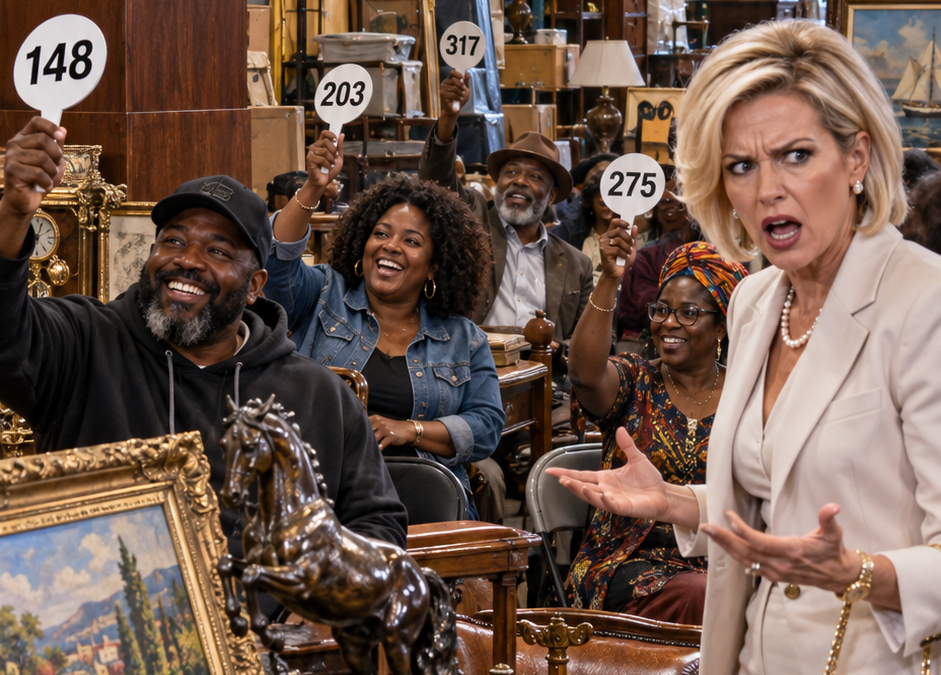
Farmers.
Resellers.
Property managers.
Small businesses.
Curious locals.
Someone selling coffee out of a van had set up near the gate.
It looked less like litigation and more like a county fair designed by attorneys.
A banner hung above the loading dock.
PUBLIC AUCTION
ABANDONED COMMERCIAL PROPERTY
Dale had divided everything into ninety-plus lots.
I walked through the warehouse once.
Ran my hand across a stack of chairs.
Then stopped.
Nora stood beside me.
“You okay?”
“Ask me tonight.”
Deputy Mason Crowley arrived with another officer.
Not to conduct the sale.
Just to keep peace.
I was grateful.
At nine sharp, Dale took the microphone.
“Ladies and gentlemen—”
Car horns erupted outside.
Three HOA vehicles came through the lot.
Marissa stepped out before the lead SUV fully stopped.
“STOP THIS AUCTION!”
Two hundred heads turned.
She marched toward Dale.
“This property has been stolen.”
Dale lowered the microphone.
“Do you have a court order stopping the sale?”
“This equipment belongs to Stone Brook Ridge.”
“That wasn’t my question.”
She turned toward Mason.
“Arrest him.”
Mason looked almost tired already.
“For what?”
“For selling our property.”
“Do you have a valid injunction?”
“We filed—”
“Do you have one?”
No answer.
Tessa stepped forward and handed Mason the case file.
He recognized most of it.
He looked at Marissa.
“Unless you have a valid court order, I’m here to keep the peace.”
She turned toward me.
“This is your last chance.”
I looked at the crowd.
Then back at her.
“You had ninety-three days.”
Dale raised the hammer.
“Lot one.”
The auction began.
Landscaping tools.
$2,300.
“Sold.”
Pressure washer.
$3,100.
“Sold.”
Generator.
$5,400.
“Sold.”
Zero-turn mower.
$8,750.
“Sold.”
Every hammer strike seemed to physically affect Marissa.
She kept calling her attorney.
Walking away.
Coming back.
Whispering to board members.
The auction continued.
Lot forty-four.
Utility vehicle.
Dale opened at twelve thousand.
“Twelve?”
A hand rose.
“Twelve.”
“Thirteen.”
“Fourteen.”
“Fourteen-five.”
“Fifteen.”
“Sixteen.”
“Sixteen-five.”
Then:
“Seventeen thousand two hundred fifty.”
Dale paused.
“Seventeen-two-fifty once.”
Marissa pushed forward.
“That vehicle belongs to Stone Brook Ridge!”
Dale looked at her.
“Then Stone Brook Ridge should have removed it.”
“Seventeen-two-fifty twice.”
Hammer.
“Sold.”
Someone in the crowd shouted:
“How long was this stuff here?”
I ignored it.
Nora didn’t.
“Ninety-three days!”
Laughter rolled across the loading area.
Marissa spun toward her.
“Do you think this is funny?”
Mason stepped forward.
“Ms. Vance.”
She stopped.
“One more disruption and you leave.”
For the first time all morning, Marissa shut up.
Halfway through the sale, we reached a group of storage cabinets.
Tessa had already removed most paper records from auction eligibility.
Sensitive documents were not something we were casually going to sell to the highest bidder.
Nora was doing a final visual check.
Then she stopped.
“Grant.”
I walked over.
“What?”
She pointed behind folding tables.
Another locked cabinet.
We had missed it in the first grouping because it sat behind equipment.
Dale looked at his sheet.
“Not listed.”
Marissa saw it.
Her reaction was immediate.
“That cabinet is not part of the auction.”
Her voice changed enough that everyone near us noticed.
Tessa looked at Dale.
“Pull it.”
Dale nodded.
I looked at Marissa.
“What’s inside?”
“Confidential records.”
Russell had arrived earlier.
He walked over.
“I’ve never seen that cabinet.”
Marissa snapped:
“Stay out of this.”
Russell folded his arms.
“No.”
Tessa arranged for the cabinet to remain sealed pending proper review with HOA representation and legal oversight.
We did not open it in front of the crowd.
That would have been reckless.
The auction continued.
Later, when the cabinet was lawfully reviewed, there were no resident files inside.
No confidential homeowner records.
Instead:
Vendor invoices.
Purchase orders.
Reimbursement forms.
Contracts.
Equipment receipts.
Russell sat across from the documents.
His face went pale.
“What?”
He handed me one invoice.
VANCE PROPERTY SERVICES
“Who are they?”
“Marissa’s brother.”
I read the amount.
Commercial mower.
Purchase price:
$18,900.
Market value closer to eleven.
Generator:
$10,700.
Comparable equipment about six thousand.
Outdoor furniture:
Almost double common retail pricing.
More invoices.
More equipment.
More inflated numbers.
I looked at Russell.
“Board approved these?”
“Not like this.”
“How were they paid?”
“HOA funds.”
“Did residents know the vendor was related to Marissa?”
“I didn’t.”
That was no longer my problem.
Technically.
But the evidence was sitting in my warehouse because Marissa had brought it there herself.
Back outside, the auctioneer’s voice echoed through the loading dock.
“Sold.”
Hammer.
“Sold.”
Hammer.
“Sold.”
Every strike removed another object from the floor.
Board members began reading copies of the vendor records.
One asked Russell:
“How did we miss this?”
He looked embarrassed.
“We trusted her.”
That answer explained more than any audit probably would.
Then came one of the strangest moments of the entire day.
Stone Brook Ridge realized it still needed some of the equipment.
Its own attorney confirmed the obvious.
The auction was legitimate and public.
If the HOA wanted property being sold, it could bid.
Just like everyone else.
Marissa nearly exploded.
“We already own it!”
Russell looked at her.
“Then why didn’t we remove it?”
The compact tractor came up.
Lot seventy-one.
Dale opened at nine thousand.
A landscaping company bid.
Ten.
Eleven.
Thirteen-five.
Russell had been authorized by board members to purchase critical equipment where financially sensible.
He raised his number.
“Fourteen.”
Landscaper:
“Fourteen-five.”
Russell:
“Fifteen.”
Another bid.
“Fifteen-five.”
Then Russell:
“Sixteen-two-fifty.”
Pause.
No further bids.
Hammer.
“Sold.”
The crowd murmured.
Stone Brook Ridge had just paid $16,250 to buy back a tractor it could have removed from my warehouse months earlier for the cost of a truck.
Marissa stared at Russell.
He avoided looking at her.
Later, they bought back a generator too.
$6,100.
Nora leaned toward me.
“They refused to pay storage and now they’re buying their own stuff.”
“I noticed.”
“You’re not going to smile?”
“No.”
“You’re smiling.”
“Internally.”
By late afternoon, ninety-two lots had sold.
Gross proceeds:
$214,680.
Records and other legally excluded items remained separate.
Dale reconciled each transaction.
Documented fees.
Auction expenses.
Qualified storage charges.
Handling.
Legal expenses.
I did not simply take $214,680 and celebrate.
That had never been the point.
Amounts I was entitled to receive were handled accordingly.
The balance went through the proper legal process.
I wanted my warehouse.
That was all.
At 5:40 p.m., the final trailer pulled away.
Silence returned.
Nora stood in the middle of the floor.
For the first time in ninety-three days, I could see almost the entire length of the building.
She put her hands on her hips.
“Well.”
“Well what?”
“Worth it?”
I looked toward the side door.
“Ask me after I change the locks.”
She laughed.
The real disaster for Marissa began afterward.
Russell called an emergency board meeting.
The HOA attorney attended.
So did several furious residents.
He walked them through the cost.
Storage dispute.
Legal fees.
Auction-related losses.
Repurchases.
Transport.
Administrative costs.
Then he compared all of it to the commercial-storage quote the HOA could have accepted in the first place.
Roughly:
$4,800 per month.
Three months would have cost around $14,400.
Fourteen thousand four hundred dollars.
Marissa had turned that problem into something exponentially larger because she believed paying rent was more offensive than taking someone else’s building.
Russell asked her:
“Why did you tell us Grant offered the warehouse?”
Marissa leaned back.
“That was my understanding.”
Russell projected the email chain.
My first demand.
Her response.
My seventy-two-hour demand.
Her “necessity” claim.
The storage notices.
Nothing remotely resembling permission.
“What part of this says he offered the building?”
Marissa looked toward the HOA attorney.
He did not help her.
Then came Vance Property Services.
Invoices went onto the screen.
Residents started calculating.
The mower.
Generators.
Furniture.
Outdoor equipment.
Repeated inflated purchases.
One board member said:
“You never disclosed your brother owned this company.”
Marissa’s face changed.
“This is becoming a smear campaign.”
Russell answered:
“These are invoices.”
“You’re twisting routine purchasing decisions.”
“Why weren’t the assets registered?”
She didn’t answer.
“Why were prices so high?”
No answer.
“Why was the cabinet hidden?”
“It wasn’t hidden.”
“Then why had the board never seen it?”
She raised her voice.
“You are trying to destroy everything I’ve built.”
One resident answered from the back.
“No. We’re trying to figure out what you spent.”
That ended the room.
A motion was called.
Vote.
Marissa was removed as HOA president that evening.
No long speech.
No dramatic resignation.
No ceremonial exit.
Just votes.
Her signing authority disappeared.
Her contract authority disappeared.
Her spending authority disappeared.
An independent audit was ordered.
Nobody declared her guilty of crimes that had not been proven.
But the political reality inside Stone Brook Ridge was finished.
The woman who had once entered my warehouse and announced, “We’ll be using this from now on,” could no longer authorize so much as a landscaping invoice.
She sent me one final demand letter.
Personally.
Emotional damage.
Reputational damage.
Business interference.
I forwarded it to Tessa.
She read it.
Then set it down.
“Well?”
“Frame it if you want.”
“That’s your legal advice?”
“My legal advice is don’t respond.”
“Am I in danger?”
“No.”
No lawsuit followed.
Marissa no longer had the HOA attorney behind her.
Private lawyers apparently had little appetite for explaining to a court why a woman should recover damages after occupying another man’s commercial building for three months without a lease.
Residents who once supported her stopped calling.
Her name disappeared from the newsletter.
Stone Brook Ridge’s new board contacted me.
Different tone entirely.
Professional.
Apologetic.
They sent a formal agreement acknowledging:
The HOA had no legal right to my warehouse.
The warehouse was not HOA property.
No community-service zone included my parcel.
No Stone Brook Ridge vehicle or employee would enter without permission.
The warehouse address would no longer appear in association documents.
Any remaining financial obligations would be resolved under the negotiated settlement framework.
I agreed.
With one condition.
There was an old sign near the access road.
STONE BROOK RIDGE SERVICE AREA
It wasn’t technically on my building, but its placement created the false impression that my property formed part of the subdivision’s operations.
“Remove it.”
The new board agreed immediately.
Marissa objected.
Nobody cared.
Three months later, the warehouse looked completely different.
The entire ordeal had taught me something useful.
I had been wasting space.
A logistics company leased nine thousand square feet.
An agricultural supplier leased another five thousand.
Combined monthly rent exceeded eleven thousand dollars.
The square footage Marissa once described as “basically empty anyway” became one of the steadiest income streams in my portfolio.
Nora found that particularly funny.
One morning she walked into my office carrying rent statements.
“You know Marissa accidentally did you a favor.”
“Don’t say that.”
“She proved the warehouse had value.”
“I knew it had value.”
“You weren’t renting it.”
“I was strategically underutilizing it.”
She laughed.
“That’s a nice way to say empty.”
I pointed toward the door.
“Out.”
I upgraded everything.
Electric gate.
New cameras.
Electronic access control.
Alarm system.
Separate tenant codes.
Motion detection.
And one large sign.
PRIVATE COMMERCIAL PROPERTY
NO HOA ACCESS
Nora thought it was excessive.
I disagreed.
Dale stopped by one afternoon.
He carried a wooden auction paddle.
Number 37.
“Last bidder left it.”
“What am I supposed to do with that?”
“Hang it up.”
“Why?”
“History.”
I eventually did.
It went on the office wall.
Not as a trophy.
Not because I enjoyed selling someone else’s abandoned equipment.
It reminded me of ninety-three days of being told I would never follow through.
Next to it, I framed Marissa’s original:
HOA FACILITY UTILIZATION NOTICE
The fictional document declaring my property part of her imaginary service zone.
And beside that:
The final auction summary.
Gross proceeds:
$214,680.
Nora suggested a plaque underneath.
“What should it say?”
I thought for a moment.
Then:
Property rights are not decided by whoever is holding the largest clipboard.
She laughed.
“Perfect.”
One afternoon, months later, I saw Marissa outside the new gate.
Her old temporary access code no longer worked.
She stood beside her vehicle staring through the fence.
I walked over.
“What do you need?”
She looked past me.
“You ruined Stone Brook Ridge.”
“No.”
“You embarrassed the association in front of the entire town.”
“No.”
“You sold community equipment.”
“You abandoned community equipment.”
Her eyes narrowed.
“You could have let us keep using the warehouse.”
“You could have asked.”
“We needed space.”
“You could have rented it.”
“You charged ridiculous fees.”
“You could have moved everything.”
“Grant—”
“Ninety-three days.”
She stopped.
I continued.
“You had ninety-three days.”
“We were trying to resolve it.”
“No. You were trying to outlast me.”
She looked toward the warehouse.
Forklifts moved behind the loading docks.
Tenant trucks lined the far wall.
The building was more active than it had been in years.
“You sold everything.”
I turned toward the gate.
Then stopped.
Looked back.
“No.”
She frowned.
“I didn’t sell your property.”
“What do you call that auction?”
“I sold property you abandoned after repeated formal notice and a legal process you spent months refusing to take seriously.”
She opened her mouth.
I added:
“You could have prevented the whole thing with one truck convoy.”
No response.
I walked back through the gate.
It closed behind me.
The independent audit wrapped up roughly a month later.
Stone Brook Ridge announced that a number of purchasing decisions made during Marissa’s presidency required further review.
The board overhauled contracting rules.
Major vendor relationships required disclosure.
Related-party transactions required independent approval.
Storage agreements had to be written.
Facility use needed a formal vote.
No property outside the HOA boundary could ever again be designated for association use without written permission from the actual owner.
Russell became interim president.
At his first meeting, according to Nora’s cousin who lived in Stone Brook Ridge, he said:
“The authority of this board ends where our legal authority ends.”
Remarkable concept.
Apparently revolutionary.
Someone suggested the storage policy should unofficially be called the Marissa Rule.
Residents laughed.
Marissa did not attend.
My warehouse stayed exactly where it had always been.
Outside Stone Brook Ridge.
No community-service zone.
No HOA trucks.
No mystery locksmiths.
No picnic tables multiplying overnight.
Occasionally, one of my new tenants would ask about the sign.
NO HOA ACCESS
“Long story?”
They’d ask.
“Not really.”
I’d tell them:
“A woman once decided this warehouse belonged to everybody except the man who owned it.”
Most people laughed.
Then Nora would pull out the auction photos.
Crowd.
Trailers.
Auctioneer.
Equipment rows.
Marissa standing near the loading dock.
“Wait,” they’d say. “That actually happened?”
“Yes.”
“What happened to her?”
“She lost the argument.”
That answer was technically true.
It just left out the expensive parts.
What stayed with me wasn’t the money.
Not the $214,680 auction total.
Not the storage claim.
Not the new rental income.
Not even the tractor Stone Brook Ridge had to buy back at auction.
It was the first morning.
Marissa standing on my concrete floor.
Twelve trucks outside.
My building full of strangers.
And that sentence.
“We’ll be using this warehouse from now on.”
She said it because she believed authority could be created by acting as though resistance was unreasonable.
She didn’t ask because asking would have allowed me to say no.
So she skipped permission entirely.
Then, when I did say no, she behaved as though my refusal were the actual problem.
That was the entire psychology of the dispute.
My warehouse sat underused.
Therefore, she needed it more.
The HOA needed storage.
Therefore, necessity became authority.
Moving the equipment would cost money.
Therefore, I should absorb the inconvenience.
The board had voted.
Therefore, the board’s decision somehow applied to someone who was not in the association.
Every step depended on the same assumption.
Her needs outranked my ownership.
They didn’t.
The deed didn’t care about necessity.
The county map didn’t care about the board vote.
Deputy Mason didn’t care about Marissa’s clipboard.
And eventually, the auctioneer didn’t care either.
The process moved forward because she had been warned.
Again.
And again.
And again.
She was given opportunities that most reasonable people would have taken immediately.
Remove the property.
Pay legitimate storage.
Negotiate.
Rent commercial space.
Ask for additional time in good faith.
Anything.
Instead, she decided I was bluffing.
That was her real mistake.
Not using the warehouse.
She might have recovered from that quickly.
Her mistake was treating every deadline as proof there would be another deadline afterward.
Seventy-two hours?
Ignore it.
Thirty days?
Ignore it.
Final notice?
Ignore it.
Court hearing?
Still ignore it.
Auction notice?
Threaten me.
Auction date?
Show up and yell.
Eventually, there was no next deadline.
There was a hammer.
“Sold.”
That word became strangely satisfying by the end of that Saturday.
Not because I wanted her equipment gone to strangers.
Because every “sold” represented something Marissa could have prevented.
Sold.
A mower she could have moved.
Sold.
A generator she could have moved.
Sold.
Furniture she could have moved.
Sold.
A utility vehicle nobody on her board even knew existed.
Sold.
A tractor her own HOA eventually had to buy back.
The auction did not happen to her.
It happened after her.
After every warning.
After every refusal.
After every lie to her board.
After every opportunity to solve the problem cheaply.
That’s why, when people around Cedar Bluff later described the whole thing as revenge, I corrected them.
Revenge would have been dumping everything in the rain on day one.
Revenge would have been damaging equipment.
Revenge would have been hiding things.
I did none of that.
I inventoried.
Photographed.
Protected.
Notified.
Waited.
Went to court.
Followed process.
Then sold only what could legally be sold.
It was not revenge.
It was administration.
Administration with an auctioneer.
The funniest part came years later.
Stone Brook Ridge still owns landscaping equipment.
Still stores holiday decorations.
Still needs pressure washers.
Still has generators.
But now it rents proper commercial storage.
Written lease.
Monthly payment.
Insurance.
Access schedule.
Imagine that.
Russell called me once.
“You know what our current storage bill is?”
“No.”
“Five thousand one hundred a month.”
“Sounds reasonable.”
“You could have charged us that.”
“I tried.”
He laughed.
“I know.”
I looked at the framed utilization notice.
“Marissa didn’t like paying rent.”
“No.”
“How’d that work out?”
“Expensively.”
That was good enough for me.
Marissa Vance once believed an HOA vote could turn my warehouse into free community storage.
She believed unused space belonged to whoever had the nerve to occupy it.
She believed enough official-looking paper could make a private building public.
She believed I would eventually get tired.
I didn’t.
Ninety-three days after she first walked onto my property with a clipboard, she returned to find more than two hundred strangers standing outside that same warehouse.
Trucks lined the road.
Bidders held numbers.
An auctioneer stood at the loading dock.
And the equipment she had refused to remove was leaving one lot at a time.
By sunset, the warehouse was empty.
Her presidency soon followed.
The final lesson was simple.
If you borrow something, ask.
If the answer is no, leave.
And if someone gives you ninety-three days to remove your property from a warehouse you never had permission to occupy in the first place—
do not wait for the man with the hammer to explain what “final notice” means.








