𝗣𝗔𝗥𝗧 𝟮 She Shielded Her Puppies From the Burning Asphalt—But No One Has Taken Them Home
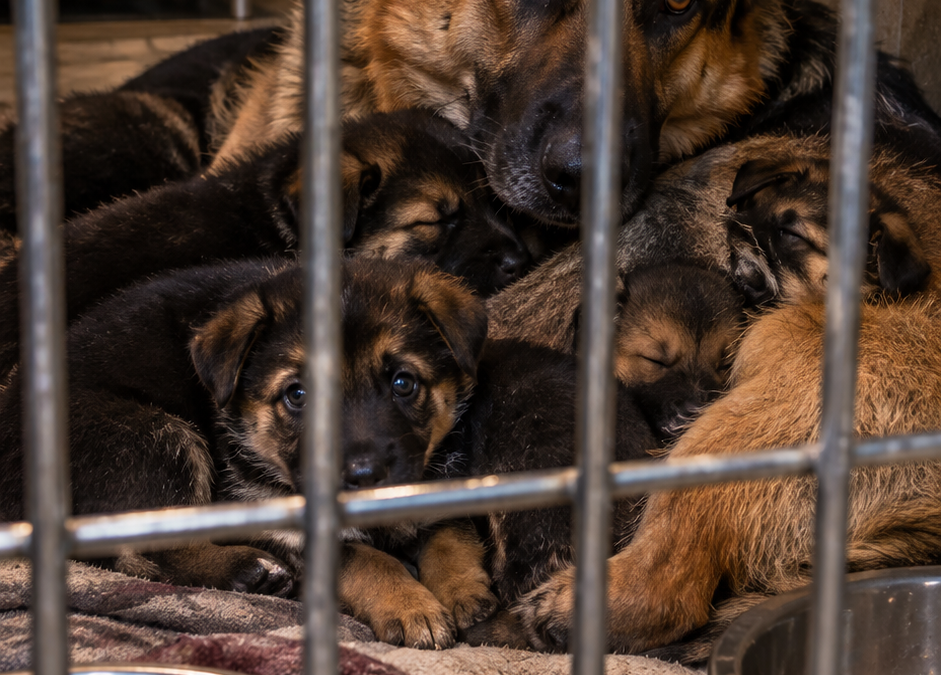
𝗣𝗔𝗥𝗧 𝟮
I stayed crouched.
My legs were already cramping, but moving too quickly would have ruined everything.
People sometimes imagine rescue as one dramatic moment.
You rush in.
You pick up the animal.
You save the day.
Real rescue is often much quieter.
Sometimes it is twenty minutes of doing almost nothing because doing too much is exactly what will make everything worse.
The mother watched my face.
I avoided staring directly into her eyes.
Instead, I turned slightly sideways.
Less threatening.
The little male had pushed himself beneath her again.
The female pressed beside him.
The third puppy remained motionless except for the rapid fluttering of his ribs.
Too fast.
That was bad.
I whispered, “I see him.”
Her ear moved.
“I know.”
Of course she couldn’t understand the words.
But tone matters.
Animals understand tension.
They understand impatience.
They understand when a person approaches like they own the situation.
I owned nothing there.
That mother had kept all three puppies alive long before I appeared.
I was asking permission to help.
I pulled a thin rope from my pocket.
I had used it earlier that morning while repairing a broken gate at the shelter.
I placed one end on the asphalt and dragged it slowly through the dust.
The little male noticed first.
His eyes followed the movement.
The rope scraped.
He lifted one paw.
“Come on.”
The mother watched him.
He took a step.
Then another.
His tiny body swayed.
I stopped moving the rope.
He reached it.
Sniffed.
Pawed.
Then stumbled into my shoe.
I froze.
The mother’s head came up sharply.
“It’s okay.”
The pup leaned against my boot.
His whole body radiated heat.
I wanted to scoop him up.
I didn’t.
That would have been for me, not for him.
So I waited.
The mother stretched her neck and sniffed the air.
Then she did something I hadn’t expected.
She nudged the female puppy.
The girl rolled onto her feet.
She blinked at the male.
Then followed.
Two puppies now sat beside my knees.
The mother remained over the smallest one.
Her expression changed.
Not relaxed.
But uncertain.
She looked from her two puppies to me.
Then back again.
I poured more water into my hand.
The male drank.
The female drank.
Their mother watched.
The shadow under the truck shrank another inch.
I looked toward the smallest pup.
“So what about him?”
Her head lowered.
I thought she might cover him more tightly.
Instead, she shifted.
Barely.
Just enough for his face to become visible.
His eyes were half open.
His mouth moved.
No sound.
My stomach dropped.
I crawled forward one inch.
The mother’s muscles tightened.
I stopped.
Another inch.
She didn’t move.
I extended my hand.
Not toward the puppy.
Toward the pavement.
Palm flat.
She sniffed.
Then looked away.
That was all I needed.
I reached for the smallest pup.
Her head snapped back toward me.
My hand froze.
She stared.
I whispered, “Please.”
I don’t know why.
Maybe I was talking to her.
Maybe I was talking to whatever decides whether small lives get another chance.
The mother’s nose touched the puppy.
She licked his head.
Then she stepped back.
One step.
It was hardly anything.
It was everything.
I slid my hand beneath him.
He weighed almost nothing.
His body was frighteningly hot.
Not warm.
Hot.
His legs hung loosely over my fingers.
“Hey, little guy.”
No response.
His mother stood.
For the first time, I saw how weak her hind legs were.
She nearly collapsed.
The male puppy cried.
She immediately looked toward him.
Even close to falling herself, her attention belonged to them.
I tucked the smallest puppy against my shirt.
Then I poured water onto a cloth and dabbed his paws and belly.
Not ice.
Never ice.
Slow cooling.
Slow hydration.
I kept him shaded with my body.
His mother came closer.
Her nose touched his back.
“He’s here.”
She licked him.
The puppy twitched.
There.
Tiny.
But real.
“Good.”
The mother’s eyes locked on mine.
I wondered how long she had been out there.
Hours?
Days?
Had someone left them?
Had she given birth nearby?
Were these puppies born somewhere safer before being forced onto the street?
I didn’t know.
But the dirt around her neck suggested she had worn a collar recently.
And there was a flattened patch in the fur where one had been.
That told its own story.
The female puppy crawled toward me.
I rubbed a wet finger against her gums.
She licked weakly.
The male followed.
We spent the next several minutes taking turns.
Water.
Shade.
Rest.
The mother continued allowing me closer.
I called the shelter.
“Animal rescue, this is Elena.”
“It’s Daniel.”
“Where are you?”
“Service road near Arrow Highway. I’ve got a shepherd mother and three puppies.”
“Condition?”
“Heat stress. Maybe worse on one pup.”
“Can you transport?”
“I think so.”
“Need backup?”
“Yes.”
“On the way.”
I hung up.
The mother watched the phone disappear into my pocket.
“Help’s coming.”
One of the puppies sneezed.
“Exactly.”
The rusted truck above us creaked.
Metal expanding in the heat.
The mother flinched.
So did I.
For a second, I wondered whether the truck was abandoned or simply parked.
Then I heard an engine approaching.
Shelter van.
Elena pulled onto the shoulder.
Another volunteer, Marcus, sat beside her.
I raised one hand.
“Stay back.”
They did.
Elena knew better than to make a rescue about speed when speed wasn’t necessary.
She carried a crate but stopped thirty feet away.
“Mom okay?”
“Protective.”
“Biting?”
“No.”
“Growling?”
“No.”
Elena studied her.
“That might mean she’s exhausted.”
“I know.”
The mother looked at the strangers.
Her body immediately shifted over her puppies again.
Progress erased in half a second.
“Easy,” I whispered.
Elena sat on the ground.
Marcus did the same.
Nobody moved.
The mother looked at me.
Then at them.
Then back to her babies.
I returned the smallest puppy to her.
She sniffed him desperately.
Licked his face.
He squeaked.
The sound felt enormous.
The mother pressed him beneath her chest.
Elena whispered, “That the weak one?”
“Yeah.”
“We need him examined.”
“I know.”
“How do you want to move them?”
I looked at the crate.
Then the mother.
“Together.”
Marcus nodded.
“I’ll slide it.”
Very slowly, he pushed the crate across the asphalt toward me.
The metal bottom scraped.
The mother’s ears went back.
I placed one hand on the crate.
“Look.”
She watched.
I opened the door.
Nothing.
Then I picked up the rope again.
The male puppy followed it immediately.
Apparently nearly dying of heat had not eliminated curiosity.
He toddled toward the crate.
The mother stared.
I moved the rope inside.
The puppy entered.
“Good.”
The female watched him.
Then followed.
The mother stood.
Her body moved between the crate and the smallest puppy.
I picked him up.
Her eyes sharpened.
“He’s coming too.”
I placed him inside beside his siblings.
The mother looked at me.
Then at the crate.
The puppies cried.
She entered.
No hesitation.
She curled around all three.
I closed the door.
For the first time in nearly an hour, I took a full breath.
Marcus stood.
“Got them?”
“Got them.”
Elena lifted one side.
I took the other.
The mother’s eyes never left me.
As we carried the crate toward the van, she checked each puppy again.
One.
Two.
Three.
I watched her nose touch each tiny body.
Count.
Again.
One.
Two.
Three.
Only when she was sure they were all there did she settle.
We loaded the crate.
I sat beside it.
Elena drove.
Marcus turned the air-conditioning vents toward the rear.
Cool.
Not freezing.
Gradual.
The little male whimpered at every bump.
His sister climbed halfway over him.
The smallest pup stayed beneath his mother’s chin.
She braced her body around them whenever the van turned.
“You can rest,” I told her.
She didn’t.
Her eyes remained open.
The road outside shimmered.
San Gabriel Mountains sat pale against the horizon.
At every stoplight, she counted again.
Nose.
One.
Two.
Three.
Touching each.
Checking.
Protecting.
When we reached the shelter, the sound hit first.
Barking.
Metal kennel doors.
Fans.
People talking.
The mother’s entire body tightened.
“Easy.”
We carried the crate through the side entrance.
She stared through the bars.
New place.
New smells.
New danger.
I hated what shelter environments could feel like to frightened animals.
We called them safe.
And compared with the road, they were.
But dogs don’t understand administrative definitions.
They understand noise.
Bars.
Doors.
Strangers.
The mother was brought into a large kennel with her puppies.
We placed clean blankets in one corner.
Fresh water.
Food.
A cooling mat.
The moment the crate opened, she stepped out.
Then immediately turned around.
The male emerged.
She sniffed him.
The female came next.
Sniff.
The smallest hesitated.
She reached in and gently nudged him.
He crawled out.
One.
Two.
Three.
Everyone accounted for.
Only then did she inspect the room.
Elena stood beside me with an intake clipboard.
“Need names.”
I hated intake names.
Not because names are bad.
Because sometimes they feel like pretending everything is normal.
Found location.
Approximate age.
Sex.
Color.
Condition.
Animal number.
As though the previous hour could be turned into boxes.
Elena waited.
I looked at the mother.
She stood over her puppies while they investigated the blanket.
“Ria.”
Elena wrote it.
“Ria?”
“It fits.”
“Okay.”
I pointed to the male who had followed the rope.
“Rook.”
The female bumped into the water bowl.
“Lark.”
Elena smiled.
“And the little one?”
I looked at him.
He had curled against Ria’s front leg.
For several seconds, I couldn’t think.
Then—
“Micah.”
Elena wrote it down.
Ria.
Rook.
Lark.
Micah.
Four names.
Four lives.
It felt better than four numbers.
A technician brought food.
Ria ignored it.
The puppies approached first.
Rook sniffed.
Lark licked the edge.
Ria watched.
Only after they began eating did she lower her head to the bowl.
Motherhood before hunger.
Again.
I leaned against the kennel door.
“You can eat.”
She glanced at me.
“I promise they’re not going anywhere.”
She ate quickly.
Too quickly.
We divided her meal into smaller portions.
Her ribs looked even worse under the fluorescent lights.
Outside, dust had softened everything.
Here, nothing could hide.
She was painfully thin.
The puppies weren’t much better.
Micah especially.
His coat lacked shine.
His eyes remained dull.
After eating, Ria lay down.
All three puppies immediately gathered against her.
Rook closest to her belly.
Lark across her front legs.
Micah tucked beneath her chin.
I watched Ria lower her head across him.
Her eyes stayed open.
The kennel door closed.
The lock clicked.
For the first time, I wondered whether safety could still feel like abandonment from the other side of the bars.
Micah crashed that night.
It happened fast.
One moment he was sleeping.
The next, Elena found him limp beneath Ria.
His breathing was too rapid.
His gums pale.
She called me.
I was still at the shelter finishing paperwork.
“Daniel.”
Her voice made me stand instantly.
“What?”
“Micah.”
I was already running.
Ria stood over him.
She wasn’t aggressive.
She looked terrified.
That was worse.
Dr. Bennett, our shelter veterinarian, entered.
Ria shifted toward Micah.
I opened the kennel.
“Ria.”
Her eyes found me.
I knelt.
“Let us help.”
She watched my hands.
I lifted Micah.
His body felt feather-light.
Too light.
Ria followed every inch.
Dr. Bennett said, “Exam room.”
We moved.
Ria reached the kennel gate.
Pressed her chest against it.
I looked back.
“I’ll bring him back.”
Again, words she couldn’t understand.
But I needed to say them.
Micah was dehydrated.
His glucose was low.
Heat exposure had hit him hardest.
Fluids.
Glucose.
Temperature support.
Monitoring.
Nothing dramatic.
Everything urgent.
I held one tiny paw between my thumb and finger while Dr. Bennett placed a catheter.
Micah barely reacted.
“Come on.”
The fluids began.
Drop.
Drop.
Drop.
Borrowed time in a clear plastic line.
I watched his chest.
Rise.
Fall.
Too fast.
Dr. Bennett listened with his stethoscope.
“What are you thinking?”
“Heat stress. Dehydration. Possible secondary infection. He’s the weakest, so he has less reserve.”
“He’ll make it?”
Dr. Bennett didn’t answer immediately.
I hated that.
“Tell me.”
“I don’t know.”
There are three words rescuers hear too often.
I don’t know.
We like certainty.
Medicine does not owe us certainty.
We waited.
At midnight, his breathing remained fast.
At one, his temperature stabilized.
At two, he twitched one ear.
I noticed before Dr. Bennett did.
“He moved.”
“I saw.”
Then came the sound.
A squeak.
Thin.
High.
Micah opened his mouth.
Another squeak.
I laughed.
Not because anything was funny.
Because sometimes hope sounds ridiculous when it bursts out of exhaustion.
Dr. Bennett nodded.
“That’s better.”
“Better?”
“Better.”
Not safe.
Not cured.
Better.
I would take it.
We returned him to Ria.
The moment I entered the kennel, she rushed forward.
I lowered Micah onto the blanket.
She smelled him from nose to tail.
Then began licking him so furiously I had to put my hand between them.
“Easy.”
She ignored me.
Rook woke.
Lark woke.
Both crawled over.
Family inspection.
One.
Two.
Three.
Ria lay down.
Micah pressed against her.
She curled around him.
Her body became the shield again.
But now it was shelter walls around her.
Clean blankets beneath her.
Water beside her.
Medical care down the hall.
The danger had changed.
She didn’t know that yet.
I sat outside the kennel until nearly sunrise.
Every time I started to leave, Ria lifted her head.
So I stayed.
Morning light entered through the high windows.
Rook woke first.
He attacked Lark’s ear.
Lark screamed as though murder was occurring.
Then immediately attacked back.
For the first time since they arrived, the sound coming from their kennel wasn’t distress.
It was play.
I stood.
Rook bounced sideways.
His legs betrayed him.
He landed in the water dish.
Splash.
Lark froze.
Then pounced.
I laughed.
Ria lifted her head.
She looked at them like she had no idea what these ridiculous creatures were doing.
Then her tail moved.
Once.
Slowly.
It brushed the floor.
I stopped laughing.
That mattered.
I found a rope toy in the donation room.
Nothing fancy.
Just braided fabric.
I slid it into the kennel.
Lark attacked it immediately.
Rook grabbed the other end.
They pulled.
Neither had enough strength to move the toy more than a few inches.
Still, each appeared convinced victory was imminent.
Micah watched.
I held the rope closer.
He crawled forward.
Slow.
Unsteady.
Ria watched him.
He reached the toy.
Opened his mouth.
Bit.
Weak.
But there.
His head shook once.
A tiny attempt at tugging.
“That’s right.”
Ria lowered herself to her elbows.
Her tail moved again.
The next several days became easier.
Not easy.
Easier.
Micah needed extra meals and close monitoring.
Rook gained weight fastest.
Lark became the troublemaker.
If there was a bowl to climb into, she climbed into it.
If there was bedding to drag across the kennel, she dragged it.
If Rook wanted a toy, Lark needed that exact toy immediately.
Micah stayed quieter.
But every day, he became a little more puppy and a little less patient.
He learned to bark.
The first time it happened, he startled himself.
He looked behind him as though another dog had entered the kennel.
I laughed so hard Elena came running.
“What?”
“Micah barked.”
She stared.
“That’s why you’re laughing?”
“You had to see his face.”
Micah barked again.
Ria licked him.
We began allowing Ria outside into a fenced exercise yard.
At first, she wouldn’t leave the puppies.
We opened the kennel.
She stood at the doorway.
Looked back.
One.
Two.
Three.
Then stepped into the hall.
Two feet.
Stopped.
Returned.
We tried the next day.
Same thing.
On the fourth day, she walked to the yard with me.
The moment grass touched her paws, she froze.
Then lowered her nose.
Sniffed.
For nearly a minute, she simply stood there.
Sunlight touched her back.
Not the brutal sun from the highway.
Morning light.
Soft.
Warm.
She looked almost confused.
I tossed a tennis ball.
It rolled several feet.
Ria jumped.
Then watched it.
I picked it up.
Rolled again.
She followed.
One step.
Two.
Sniff.
The ball moved under her nose.
She pawed it.
It rolled.
She barked.
I smiled.
“You scared it.”
She pawed again.
Soon, she was chasing it.
Not fast.
Not gracefully.
But playing.
That changed something for me.
Until that moment, I had only seen Ria as a mother.
Protector.
Survivor.
Guard.
I had forgotten she was also a dog.
A dog who might enjoy grass.
Toys.
Sun.
Someone scratching behind her ears.
A life that did not require standing between danger and her puppies every second.
I sat in the yard.
Ria approached.
She stood several feet away.
Then closer.
Finally beside me.
I extended my hand.
She sniffed.
I scratched beneath her chin.
She closed her eyes.
Only for a second.
But she closed them.
Trust.
Not surrender.
Not obedience.
Trust.
There is a difference.
By the second week, the puppies were strong enough for adoption photos.
Elena brought a camera.
We placed a clean blanket in the visiting room.
Rook immediately tried to eat it.
Lark attacked the photographer’s shoelace.
Micah sat still and looked directly into the lens like an animal who understood publicity.
Ria positioned herself behind all three.
Head high.
Ears forward.
Beautiful.
The photograph was posted online.
“German Shepherd Mom and Three Puppies Rescued From Extreme Heat.”
People responded.
Hundreds of comments.
Messages.
Expressions of heartbreak.
Promises that they would adopt them “if only” they lived closer.
“If only my landlord allowed dogs.”
“If only we didn’t already have three.”
“If only…”
I understood.
Most people meant well.
But shelters are full of animals surrounded by good intentions.
What they need are actual doors opening.
Actual applications.
Actual homes.
Saturday was adoption day.
Families arrived before we opened.
The hallway filled with voices.
Children.
Couples.
Older people.
People carrying leashes they had bought before choosing a dog.
I stood near Ria’s kennel.
She noticed every visitor.
At first, I felt hopeful.
A family stopped.
Two children.
Parents.
The little girl pointed.
“Puppies!”
Ria stood.
The puppies rushed forward.
Rook barked.
Lark wagged.
Micah remained behind Ria’s front leg.
The father read their information card.
“German Shepherd.”
The mother frowned slightly.
“They get big.”
The family moved on.
Another couple stopped.
The man looked at Ria.
“How old?”
“About three, best estimate.”
“Too old.”
Three.
Too old.
I watched them walk toward a six-month-old husky.
Ria looked after them.
A young woman spent ten minutes talking to Lark.
Then asked if she could adopt only her.
Possible someday.
But the puppies were still young enough to remain with Ria a little longer.
We explained.
She said she would think about it.
She didn’t return.
An older man stopped.
He liked Rook.
Then Ria stood.
The man stepped back.
“She protective?”
“She’s a mother.”
“She looks intense.”
Intense.
There was another word humans use when an animal’s history becomes visible.
I wanted to tell him what that “intense” dog had done.
How she had flattened herself against burning asphalt.
How she refused water until her puppies drank.
How she had pushed them toward a stranger because she understood they needed something she could no longer provide.
I didn’t.
Adoption should not begin with guilt.
So I simply said, “She’s cautious.”
The man moved on.
By afternoon, the hallway grew quiet.
No applications.
I sat outside Ria’s kennel.
“You had a bad sales day.”
She stared.
“Same.”
Rook chewed her tail.
Ria moved it.
He followed.
Lark climbed over Micah.
Micah complained.
Ria sighed.
I wondered whether dogs understood being passed over.
Probably not in the complicated way we do.
But they understand patterns.
Doors opening.
People approaching.
People leaving.
Voices.
Smells.
Hope is our word for it.
Waiting belongs to them.
That evening, the shelter lights dimmed.
Ria circled three times.
Then lay down.
The puppies gathered against her.
One.
Two.
Three.
She licked them.
The kennel door stayed closed.
The following Saturday brought more visitors.
Still nothing.
Then another week.
Micah gained weight.
Rook learned to sit for treats.
Lark learned that pretending to sit sometimes also produced treats.
Ria became friendlier with staff.
She began meeting strangers outside the kennel.
Slowly.
One person at a time.
Inside the kennel, she felt responsible for protecting her puppies.
Outside, she could become herself.
She leaned into gentle scratches.
She carried tennis balls.
She learned to look at me before reacting to unfamiliar sounds.
Progress.
Meanwhile, the puppies grew.
Their legs lengthened.
Ears became enormous.
Baby faces sharpened into early shepherd features.
They were becoming exactly what everyone claimed to want.
Young.
Beautiful.
Smart.
Still they waited.
Then the fire started.
I smelled it before I heard anything.
Smoke.
Faint.
Dry.
Wrong.
I was cleaning bowls when Elena walked into the kennel room carrying a radio.
“Brush fire near the foothills.”
“How far?”
“Far enough right now.”
Right now.
Important words.
By noon, ash began falling.
Gray flecks drifted past the windows.
Dogs started reacting before humans did.
Noses lifted.
Pacing.
Whining.
Ria stood.
Her entire body changed.
Smoke meant danger.
Maybe she knew fire.
Maybe she only knew that every person around her suddenly smelled afraid.
The radio crackled.
“Wind shift.”
Then later:
“Prepare for possible evacuation.”
The shelter moved instantly.
Crates came from storage.
Vehicle assignments.
Dog lists.
Medication bags.
Emergency folders.
Every animal needed a destination.
Chaos arrived disguised as procedure.
Kennel doors clanged.
Dogs barked.
Volunteers shouted numbers.
Ria gathered her puppies.
Rook beneath her belly.
Lark behind one leg.
Micah pressed against the wall.
I approached.
“Hey.”
Ria looked at me.
Ash clung to her back.
“We’re moving.”
She didn’t know that meant safety.
The first evacuation plan separated animals into individual crates.
Usually, that made sense.
Transport safety.
Space.
Control.
But when Elena handed me four labels, I looked at them.
RIA.
ROOK.
LARK.
MICAH.
Four crates.
I looked at Ria.
No.
“Daniel?”
“They go together.”
“Protocol says—”
“Micah’s still fragile.”
“He’s stronger now.”
“Ria will panic if she can’t see them.”
“We have limited space.”
“I need one large crate.”
Elena hesitated.
Another volunteer shouted from the hallway.
“Fire jumped the ridge!”
The radio crackled.
Road closure.
Wind.
Embers.
No time for debate.
Elena pointed toward the storage room.
“Last oversized carrier. Take it.”
I ran.
By the time I returned, smoke had thickened outside.
I pushed the crate toward Ria’s kennel.
She backed away.
“Come on.”
Rook saw the open crate and approached.
Of course.
Rook feared almost nothing except missing meals.
He walked inside.
Lark followed because Rook had something she did not.
Micah stood beside Ria.
I lifted him.
Ria watched.
“You know me.”
She let me carry him into the crate.
Then I looked at her.
“Your turn.”
She stared.
Behind us, another kennel opened.
Dogs barked.
People moved.
Ria lowered her body.
For one second, I thought she would refuse.
Then Micah squeaked.
Ria entered.
She curled around all three puppies.
One.
Two.
Three.
I shut the door.
“Got them!”
Marcus appeared.
We lifted.
The carrier was heavy now.
Much heavier than the day I found them.
Good.
Weight meant health.
Ria’s eyes stayed on me as we rolled through the hallway.
The shelter was half empty.
Rows of open kennel doors looked unsettling.
Outside, the sky had turned orange-gray.
Ash moved through the parking lot.
I coughed.
We loaded the crate into a transport truck.
Ria stood as soon as the carrier tilted.
Her body widened over the puppies.
Same posture.
Different danger.
I climbed in beside them.
Marcus yelled, “Daniel, you’re in truck two!”
“I know.”
“You’re supposed to be helping load!”
“I am!”
He looked at Ria.
“Fine.”
One more crate entered.
Then another.
Door slammed.
Darkness.
Dogs barked from surrounding carriers.
The engine started.
Ria’s eyes remained fixed on me.
I put my fingers against the crate door.
“Still here.”
She pushed her nose toward them.
The truck moved.
For forty minutes, their entire world became engine noise, darkness, smoke, and metal.
But they were together.
That mattered.
We evacuated to a partner facility south of the fire zone.
When we arrived, Ria refused to leave the crate until I opened it and sat beside the door.
Rook rushed out.
Lark followed.
Micah stepped carefully.
Ria emerged last.
Then counted.
One.
Two.
Three.
We gave them water.
Food.
A quiet temporary kennel.
That night, I slept on a folding chair outside their run.
At three in the morning, Ria woke.
She looked at me.
Then lowered her head again.
By morning, officials reported progress on the fire.
By evening, evacuation orders near the shelter were being reassessed.
Two days later, we returned.
The building smelled faintly of smoke.
Ash covered the outdoor yard.
But the shelter stood.
Every dog came home.
Every cat.
Every rabbit.
Every terrified little life we had packed into vehicles.
We had been lucky.
I carried Ria’s crate in last.
When I opened it, Rook bounded out.
Lark tackled him.
Micah paused.
Ria nudged him.
Then he stepped into the kennel.
She followed.
One.
Two.
Three.
Safe.
I shut the door.
And then something happened that broke my heart more than the fire had.
Ria walked to the gate.
She looked down the hallway.
Empty.
No visitors.
No family waiting.
No person saying, “That’s her.”
She had survived the road.
The heat.
Dehydration.
Micah’s collapse.
Shelter stress.
A wildfire evacuation.
And she was still behind bars.
I sat beside the gate.
“You’ve got terrible luck.”
Her ears lifted.
“Except for the survival part.”
She moved closer.
I put my hand through the bars.
She pressed her forehead against my fingers.
There are moments when a shelter can feel like victory and failure at the same time.
We had saved them.
That mattered.
They had food.
Medical care.
Protection.
Names.
They were alive.
That mattered more than anything.
But rescue is not finished when an animal enters a kennel.
A kennel is supposed to be a bridge.
Not a destination.
Days became weeks.
Rook grew tall.
Lark’s ears finally stood.
Mostly.
Micah became stronger than I ever expected.
He remained smaller than his siblings, but he no longer moved like the puppy I carried half-conscious from beneath the truck.
He ran.
He barked.
He stole toys.
He wrestled Rook until Ria separated them with one tired look.
The three puppies were healthy enough to begin spending short periods apart.
That helped.
They needed individual confidence.
Individual training.
Individual bonds.
Ria also needed to learn she could exist without counting them every minute.
The first separation lasted five minutes.
Rook went with Marcus.
Ria paced.
I sat inside her kennel.
“He’s coming back.”
She paced.
Lark chased her tail.
Micah slept.
Five minutes later, Rook returned.
Ria inspected him from head to toe.
Next time, ten minutes.
Then twenty.
Slowly, she learned.
Her babies could leave.
And come back.
That may have been the hardest lesson of all.
One afternoon, I took Ria into the yard alone.
No puppies.
She checked the gate behind us.
Then looked at me.
“What now?”
She waited.
I picked up the tennis ball.
Threw it.
Ria chased.
For fifteen minutes, she was not Mother.
Not Protector.
Not Survivor.
Just Ria.
She ran.
Returned the ball approximately half the time.
The rest she kept because apparently rescue did not include surrendering property rights.
I laughed.
“You realize the deal is you bring it back.”
She lay down and put one paw on it.
“Negotiation rejected.”
When we returned, the puppies mobbed her.
Ria tolerated their celebration.
Then looked at me as though blaming me for creating three emotionally unstable dependents.
“You made them.”
She sighed.
Another adoption weekend came.
A family stopped at Rook.
They liked him.
They filled out an application.
My heart jumped.
Then their landlord denied approval.
Another couple spent an hour with Lark.
They promised to call.
They didn’t.
A retired teacher loved Micah.
Her apartment had a weight restriction.
He would eventually exceed it.
Ria attracted fewer people.
German Shepherd.
Adult.
Protective.
Mother.
People saw responsibility where I saw loyalty.
“She seems serious,” one visitor said.
“She is.”
“Does she play?”
“Every day.”
“Good with people?”
“Once she knows them.”
“How long does that take?”
“Depends on the person.”
He smiled politely.
Then chose another kennel.
I stopped resenting visitors.
Mostly.
They needed the right dog.
The dogs needed the right humans.
Forcing either side was how animals ended up abandoned beneath trucks in the first place.
So we waited.
Ria waited.
The puppies waited.
They became familiar faces.
Volunteers knew them.
Staff loved them.
Rook learned how to open a kennel latch if it wasn’t clipped properly.
Lark learned to steal gloves.
Micah learned that tilting his head dramatically earned treats from almost everyone.
Ria learned that when I entered carrying a leash, she was going outside.
Her tail began wagging before I reached the gate.
That first tail wag still mattered every time.
One morning, months after the rescue, I arrived before sunrise.
The shelter was quiet.
Ria was awake.
She lay with all three puppies—no longer really puppies—around her.
They barely fit.
Rook’s legs extended into the walkway.
Lark was upside down.
Micah had somehow wedged himself beneath Ria’s chin, exactly as he had the first night.
I sat outside.
Ria lifted her head.
Her muzzle had started getting lighter around the edges.
Not age.
Probably stress and coat change.
Still, it reminded me how much time had passed.
“You’re still here.”
She blinked.
I hated those words.
People hear “no-kill shelter” and imagine time becomes irrelevant.
It doesn’t.
Even when euthanasia isn’t hanging over an animal’s head, shelter life costs something.
Noise.
Stress.
Routine without ownership.
Affection divided among dozens of animals.
A kennel is better than burning asphalt.
But better is not the same as home.
I unlocked the gate.
Ria stood.
The pups woke.
Four shepherds looked at me.
“All right.”
Leashes.
Morning walk.
We took them into the yard one at a time.
Rook ran first.
Lark chased him.
Micah chased both.
Ria stood beside me.
She watched them.
Same dark eyes.
Less fear.
More patience.
I thought about the first afternoon beneath that rusted truck.
She had looked ancient then.
Not old.
Burdened.
Like every bad thing that could happen had already introduced itself.
Now she watched her puppies race through cool grass.
No blistering road.
No shrinking shade.
No dry tongues.
No desperate need to use her own body as shelter.
I crouched beside her.
“You did it.”
She looked at me.
“You know that?”
Her ear twitched.
“They’re alive because you refused to quit.”
Rook crashed into Lark.
Lark screamed.
Micah joined.
Ria exhaled heavily.
I laughed.
“Maybe you’re reconsidering.”
She nudged my hand.
I scratched her neck.
The flattened collar mark was almost gone now.
Fur had filled back in.
Her ribs no longer showed.
Her coat shone black and tan in the morning light.
Her body had healed.
Trust took longer.
But that was healing too.
Not becoming the dog she had been before.
Becoming the dog she could still be after.
When it was time to go inside, Ria walked willingly.
That was progress I wished I could celebrate without sadness.
She trusted the shelter.
She knew her kennel.
She knew her bed.
She knew her bowls.
She knew my footsteps.
Shelter had become familiar.
And familiar can quietly turn into permanent if nobody comes.
Back behind the gate, the pups gathered around the water.
Ria stood near me.
I closed the latch.
Click.
Her ears moved.
I hated that sound.
She watched me through the bars.
“I’ll be back.”
I meant it.
I always came back.
But I wanted someone else to arrive someday.
Someone who didn’t leave at closing time.
Someone whose door opened into a living room instead of a kennel.
Someone who would learn that Rook slept with his paws in the air.
That Lark liked to carry two toys at once.
That Micah still preferred sleeping with his face pressed against someone warm.
That Ria checked every room before settling down because protecting a family had become the shape of her life.
Someone who would look at four shepherds and not see four problems.
Four expenses.
Four large dogs.
Four sets of paws.
But four lives that had already fought too hard to be invisible.
Until then, we kept doing what shelters do.
Morning cleaning.
Breakfast.
Medication.
Walks.
Training.
Laundry.
Applications.
Phone calls.
Photos.
Hope.
Waiting.
Another Saturday came.
Families filled the hallway again.
Ria stood as footsteps approached.
Rook barked once.
Lark pressed against the gate.
Micah tilted his head.
A little girl stopped.
She stared at them.
Her father gently touched her shoulder.
“We’re looking for a smaller dog.”
The girl didn’t move immediately.
She looked at Ria.
Ria looked back.
Then the family walked on.
I stayed across the hall.
Ria remained standing for a few seconds.
Then lay down beside her puppies.
No drama.
No cry.
No understanding of why.
Just waiting.
That may be what hurt the most.
Animals do not know that humans have preferences.
Breed restrictions.
Schedules.
Landlords.
Budgets.
Fenced-yard requirements.
They do not know that someone may love their photograph and still never come.
They only know the gate opened for someone else.
Not them.
Evening came.
Visitors left.
Kennel lights dimmed.
I finished my rounds.
Ria’s kennel was last.
It always was.
Rook slept in the corner.
Lark was curled against him.
Micah lay beneath Ria’s chin.
I opened the gate and sat on the floor.
Ria shifted closer.
Her shoulder rested against mine.
The first day I saw her, she wouldn’t let me cross five feet of asphalt.
Now she leaned her full weight against me.
I rubbed her chest.
“You remember that truck?”
She sighed.
“I do.”
The shelter was almost silent.
Somewhere down the hall, an old hound snored.
A fan hummed.
Metal expanded softly as the building cooled.
I looked at Micah.
He had once been so weak I thought he might disappear in my hands.
Now his paws twitched while he dreamed.
I looked at Rook.
The first puppy she had pushed toward my water.
I looked at Lark.
The little girl who had followed him because her mother decided a stranger might be safer than the heat.
Then Ria.
The one who had made that choice.
People said I rescued them.
That isn’t how I remember it.
I found them.
Ria had already done the saving.
She kept three puppies alive under a truck in heat strong enough to soften asphalt.
She gave them water before taking it herself.
She moved them toward me when every instinct must have told her strangers were dangerous.
She trusted when distrust would have been easier.
She covered them during the wildfire evacuation just as she had covered them beside the highway.
Again and again, whenever the world became frightening, Ria made the same decision.
My body first.
My babies behind me.
That is who she was.
The shelter had given them names.
Food.
Medicine.
Safety.
Time.
But it could not give them the one thing they were still missing.
A home.
I stood to leave.
Ria looked up.
“I know.”
I hated leaving her.
But morning would come.
And I would return.
Someone would fill the bowls.
Someone would wash the blankets.
Someone would walk them.
Someone would throw Ria’s tennis ball badly enough that she could steal it.
Someone would laugh when Lark ran off with a glove.
Someone would stop Rook from investigating the kennel latch.
Someone would pretend not to notice that Micah had learned which volunteers carried the best treats.
Their lives were not empty.
They were loved.
Shelter love is real.
But it is borrowed.
Shared.
Given in shifts.
Home is different.
Home means knowing who opens the door every night.
It means a couch with your hair on it.
A water bowl nobody else uses.
A yard whose smells become familiar.
A person whose footsteps belong to you.
Ria deserved that.
So did Rook.
Lark.
Micah.
I latched the kennel.
Click.
Ria stood behind the bars.
For a moment, the image hit me hard.
The mother who once stood beneath a rusted truck shielding her puppies from sunlight was still shielding them.
Only now there was no burning road.
No shrinking shadow.
No trucks shaking the ground.
The danger was gone.
The waiting wasn’t.
Ria turned.
She touched Rook with her nose.
Then Lark.
Then Micah.
One.
Two.
Three.
Always counting.
Always making sure.
All there.
All alive.
She circled once and lay down.
The three young shepherds gathered around her.
Ria rested her head over Micah.
I shut off the hallway light.
The last thing I saw before darkness settled was her silhouette behind the kennel gate.
Strong.
Watchful.
Waiting.
The world had already tested that little family with heat, hunger, illness, fear, smoke, and fire.
Every time, they stayed together.
Every time, Ria stood between her puppies and whatever came next.
Now there was only one battle she could not fight for them.
She could not choose who walked through the shelter door.
She could not make someone stop.
She could not explain what they had survived.
She could not tell anyone that the pup sleeping beneath her chin had once been so weak his breath barely moved his ribs.
She could not explain that Rook was brave because his mother taught him how.
That Lark was playful because she finally learned the world could contain something besides danger.
That Micah was alive because a mother refused to let the heat take him.
Ria could only wait.
So that is what she did.
Behind bars.
Beside her puppies.
Still counting them.
Still guarding them.
Still believing, in the only way a dog can believe, that the next door opening might finally mean something different.
And until that day came, every evening ended the same way.
Rook curled against one side of her.
Lark pressed against the other.
Micah tucked himself beneath her chin.
One.
Two.
Three.
Ria lowered her head.
The kennel went quiet.
And four German Shepherds who had already survived everything slept together behind a locked gate, alive, safe, deeply loved—
but still waiting for home.
Have you finished reading the story and want to read it again?
She Shielded Her Puppies From the Burning Asphalt—But No One Has Taken Them Home
She was burning so her puppies wouldn’t.
One of them was already fading.
And getting them off that road was only the beginning.
My name is Daniel, and I still remember the way the heat looked that afternoon outside Irwindale, California.
It wasn’t just hot.
The whole road seemed to move.
Heat waves rose from the asphalt in shimmering sheets, bending the trucks on the highway into strange shapes. The air smelled like hot rubber, dust, and metal. Every breath felt dry enough to scrape the inside of my throat.
I had been driving back toward the shelter when I noticed something underneath an old rusted truck parked beside a service road.
At first, I thought it was a discarded tarp.
Then the shape lifted its head.
German Shepherd.
Female.
Black and tan beneath a coat dulled almost gray by dust.
She was lying almost completely flat against the asphalt.
Not because she was comfortable.
Because three puppies were underneath her.
I pulled over so fast the tires kicked gravel against the shoulder.
By the time I reached them, I understood what she was doing.
The shade beneath the truck was disappearing.
As the afternoon sun shifted, the shadow had narrowed into a strip barely wide enough to cover the puppies.
So their mother had made herself wider.
Her front legs stretched one direction.
Her hindquarters the other.
Her ribs rose sharply beneath her coat every time she breathed.
She had turned her own body into a roof.
Three tiny German Shepherd puppies were pressed against her belly.
Maybe eight weeks old.
One male was awake but weak, his tongue hanging slightly from his mouth.
A little female lay beside him, blinking slowly.
The smallest pup was almost completely hidden beneath his mother’s chest.
He wasn’t moving much.
That frightened me immediately.
I crouched several yards away.
The asphalt burned straight through my jeans.
The mother lifted her head.
Our eyes met.
I expected a growl.
Teeth.
Maybe a charge.
Instead, she stared at me.
That somehow felt worse.
There was no energy left for threats.
Just calculation.
She had to decide whether I was one more danger she needed to fight.
I placed a water bottle on the pavement.
“Easy, Mama.”
Her ears moved.
“I’m not coming any closer.”
A truck thundered past on the highway.
The puppies flinched.
She lowered her body over them.
That was when I saw how badly she was trembling.
Not fear.
Exhaustion.
Heat.
Probably dehydration.
I slowly opened the water bottle.
Her eyes followed every movement.
I poured some into my palm.
Then held my hand low.
Nothing happened.
I waited.
The sun crept farther beneath the truck.
The little male whimpered.
The mother looked at him.
Then at me.
Then, slowly, she nudged him forward with her nose.
I almost stopped breathing.
The puppy stumbled from beneath her body.
His legs shook.
He reached my hand and licked once.
Then again.
His tongue felt dry and rough.
“Good boy.”
He drank what little water my palm could hold.
The mother watched.
When he finished, she pulled him back toward her.
Then she nudged the female.
One puppy at a time.
Her babies first.
Always.
Only after the second puppy drank did she allow herself to move closer.
Her tongue touched my palm.
One careful lap.
Then another.
She could have swallowed half the bottle.
Instead, she stopped and turned toward the smallest puppy.
He still hadn’t moved.
I looked at her.
She looked at me.
The shrinking shadow had nearly reached him.
And suddenly I understood that whatever trust existed between us was about to be tested.
Because I didn’t have another hour.
I might not even have another ten minutes.
That puppy needed out of the heat.
And his mother had to decide whether she was willing to let me cross the last invisible line between us.
PART2
I stayed crouched.
My legs were already cramping, but moving too quickly would have ruined everything.
People sometimes imagine rescue as one dramatic moment.
You rush in.
You pick up the animal.
You save the day.
Real rescue is often much quieter.
Sometimes it is twenty minutes of doing almost nothing because doing too much is exactly what will make everything worse.
The mother watched my face.
I avoided staring directly into her eyes.
Instead, I turned slightly sideways.
Less threatening.
The little male had pushed himself beneath her again.
The female pressed beside him.
The third puppy remained motionless except for the rapid fluttering of his ribs.
Too fast.
That was bad.
I whispered, “I see him.”
Her ear moved.
“I know.”
Of course she couldn’t understand the words.
But tone matters.
Animals understand tension.
They understand impatience.
They understand when a person approaches like they own the situation.
I owned nothing there.
That mother had kept all three puppies alive long before I appeared.
I was asking permission to help.
I pulled a thin rope from my pocket.
I had used it earlier that morning while repairing a broken gate at the shelter.
I placed one end on the asphalt and dragged it slowly through the dust.
The little male noticed first.
His eyes followed the movement.
The rope scraped.
He lifted one paw.
“Come on.”
The mother watched him.
He took a step.
Then another.
His tiny body swayed.
I stopped moving the rope.
He reached it.
Sniffed.
Pawed.
Then stumbled into my shoe.
I froze.
The mother’s head came up sharply.
“It’s okay.”
The pup leaned against my boot.
His whole body radiated heat.
I wanted to scoop him up.
I didn’t.
That would have been for me, not for him.
So I waited.
The mother stretched her neck and sniffed the air.
Then she did something I hadn’t expected.
She nudged the female puppy.
The girl rolled onto her feet.
She blinked at the male.
Then followed.
Two puppies now sat beside my knees.
The mother remained over the smallest one.
Her expression changed.
Not relaxed.
But uncertain.
She looked from her two puppies to me.
Then back again.
I poured more water into my hand.
The male drank.
The female drank.
Their mother watched.
The shadow under the truck shrank another inch.
I looked toward the smallest pup.
“So what about him?”
Her head lowered.
I thought she might cover him more tightly.
Instead, she shifted.
Barely.
Just enough for his face to become visible.
His eyes were half open.
His mouth moved.
No sound.
My stomach dropped.
I crawled forward one inch.
The mother’s muscles tightened.
I stopped.
Another inch.
She didn’t move.
I extended my hand.
Not toward the puppy.
Toward the pavement.
Palm flat.
She sniffed.
Then looked away.
That was all I needed.
I reached for the smallest pup.
Her head snapped back toward me.
My hand froze.
She stared.
I whispered, “Please.”
I don’t know why.
Maybe I was talking to her.
Maybe I was talking to whatever decides whether small lives get another chance.
The mother’s nose touched the puppy.
She licked his head.
Then she stepped back.
One step.
It was hardly anything.
It was everything.
I slid my hand beneath him.
He weighed almost nothing.
His body was frighteningly hot.
Not warm.
Hot.
His legs hung loosely over my fingers.
“Hey, little guy.”
No response.
His mother stood.
For the first time, I saw how weak her hind legs were.
She nearly collapsed.
The male puppy cried.
She immediately looked toward him.
Even close to falling herself, her attention belonged to them.
I tucked the smallest puppy against my shirt.
Then I poured water onto a cloth and dabbed his paws and belly.
Not ice.
Never ice.
Slow cooling.
Slow hydration.
I kept him shaded with my body.
His mother came closer.
Her nose touched his back.
“He’s here.”
She licked him.
The puppy twitched.
There.
Tiny.
But real.
“Good.”
The mother’s eyes locked on mine.
I wondered how long she had been out there.
Hours?
Days?
Had someone left them?
Had she given birth nearby?
Were these puppies born somewhere safer before being forced onto the street?
I didn’t know.
But the dirt around her neck suggested she had worn a collar recently.
And there was a flattened patch in the fur where one had been.
That told its own story.
The female puppy crawled toward me.
I rubbed a wet finger against her gums.
She licked weakly.
The male followed.
We spent the next several minutes taking turns.
Water.
Shade.
Rest.
The mother continued allowing me closer.
I called the shelter.
“Animal rescue, this is Elena.”
“It’s Daniel.”
“Where are you?”
“Service road near Arrow Highway. I’ve got a shepherd mother and three puppies.”
“Condition?”
“Heat stress. Maybe worse on one pup.”
“Can you transport?”
“I think so.”
“Need backup?”
“Yes.”
“On the way.”
I hung up.
The mother watched the phone disappear into my pocket.
“Help’s coming.”
One of the puppies sneezed.
“Exactly.”
The rusted truck above us creaked.
Metal expanding in the heat.
The mother flinched.
So did I.
For a second, I wondered whether the truck was abandoned or simply parked.
Then I heard an engine approaching.
Shelter van.
Elena pulled onto the shoulder.
Another volunteer, Marcus, sat beside her.
I raised one hand.
“Stay back.”
They did.
Elena knew better than to make a rescue about speed when speed wasn’t necessary.
She carried a crate but stopped thirty feet away.
“Mom okay?”
“Protective.”
“Biting?”
“No.”
“Growling?”
“No.”
Elena studied her.
“That might mean she’s exhausted.”
“I know.”
The mother looked at the strangers.
Her body immediately shifted over her puppies again.
Progress erased in half a second.
“Easy,” I whispered.
Elena sat on the ground.
Marcus did the same.
Nobody moved.
The mother looked at me.
Then at them.
Then back to her babies.
I returned the smallest puppy to her.
She sniffed him desperately.
Licked his face.
He squeaked.
The sound felt enormous.
The mother pressed him beneath her chest.
Elena whispered, “That the weak one?”
“Yeah.”
“We need him examined.”
“I know.”
“How do you want to move them?”
I looked at the crate.
Then the mother.
“Together.”
Marcus nodded.
“I’ll slide it.”
Very slowly, he pushed the crate across the asphalt toward me.
The metal bottom scraped.
The mother’s ears went back.
I placed one hand on the crate.
“Look.”
She watched.
I opened the door.
Nothing.
Then I picked up the rope again.
The male puppy followed it immediately.
Apparently nearly dying of heat had not eliminated curiosity.
He toddled toward the crate.
The mother stared.
I moved the rope inside.
The puppy entered.
“Good.”
The female watched him.
Then followed.
The mother stood.
Her body moved between the crate and the smallest puppy.
I picked him up.
Her eyes sharpened.
“He’s coming too.”
I placed him inside beside his siblings.
The mother looked at me.
Then at the crate.
The puppies cried.
She entered.
No hesitation.
She curled around all three.
I closed the door.
For the first time in nearly an hour, I took a full breath.
Marcus stood.
“Got them?”
“Got them.”
Elena lifted one side.
I took the other.
The mother’s eyes never left me.
As we carried the crate toward the van, she checked each puppy again.
One.
Two.
Three.
I watched her nose touch each tiny body.
Count.
Again.
One.
Two.
Three.
Only when she was sure they were all there did she settle.
We loaded the crate.
I sat beside it.
Elena drove.
Marcus turned the air-conditioning vents toward the rear.
Cool.
Not freezing.
Gradual.
The little male whimpered at every bump.
His sister climbed halfway over him.
The smallest pup stayed beneath his mother’s chin.
She braced her body around them whenever the van turned.
“You can rest,” I told her.
She didn’t.
Her eyes remained open.
The road outside shimmered.
San Gabriel Mountains sat pale against the horizon.
At every stoplight, she counted again.
Nose.
One.
Two.
Three.
Touching each.
Checking.
Protecting.
When we reached the shelter, the sound hit first.
Barking.
Metal kennel doors.
Fans.
People talking.
The mother’s entire body tightened.
“Easy.”
We carried the crate through the side entrance.
She stared through the bars.
New place.
New smells.
New danger.
I hated what shelter environments could feel like to frightened animals.
We called them safe.
And compared with the road, they were.
But dogs don’t understand administrative definitions.
They understand noise.
Bars.
Doors.
Strangers.
The mother was brought into a large kennel with her puppies.
We placed clean blankets in one corner.
Fresh water.
Food.
A cooling mat.
The moment the crate opened, she stepped out.
Then immediately turned around.
The male emerged.
She sniffed him.
The female came next.
Sniff.
The smallest hesitated.
She reached in and gently nudged him.
He crawled out.
One.
Two.
Three.
Everyone accounted for.
Only then did she inspect the room.
Elena stood beside me with an intake clipboard.
“Need names.”
I hated intake names.
Not because names are bad.
Because sometimes they feel like pretending everything is normal.
Found location.
Approximate age.
Sex.
Color.
Condition.
Animal number.
As though the previous hour could be turned into boxes.
Elena waited.
I looked at the mother.
She stood over her puppies while they investigated the blanket.
“Ria.”
Elena wrote it.
“Ria?”
“It fits.”
“Okay.”
I pointed to the male who had followed the rope.
“Rook.”
The female bumped into the water bowl.
“Lark.”
Elena smiled.
“And the little one?”
I looked at him.
He had curled against Ria’s front leg.
For several seconds, I couldn’t think.
Then—
“Micah.”
Elena wrote it down.
Ria.
Rook.
Lark.
Micah.
Four names.
Four lives.
It felt better than four numbers.
A technician brought food.
Ria ignored it.
The puppies approached first.
Rook sniffed.
Lark licked the edge.
Ria watched.
Only after they began eating did she lower her head to the bowl.
Motherhood before hunger.
Again.
I leaned against the kennel door.
“You can eat.”
She glanced at me.
“I promise they’re not going anywhere.”
She ate quickly.
Too quickly.
We divided her meal into smaller portions.
Her ribs looked even worse under the fluorescent lights.
Outside, dust had softened everything.
Here, nothing could hide.
She was painfully thin.
The puppies weren’t much better.
Micah especially.
His coat lacked shine.
His eyes remained dull.
After eating, Ria lay down.
All three puppies immediately gathered against her.
Rook closest to her belly.
Lark across her front legs.
Micah tucked beneath her chin.
I watched Ria lower her head across him.
Her eyes stayed open.
The kennel door closed.
The lock clicked.
For the first time, I wondered whether safety could still feel like abandonment from the other side of the bars.
Micah crashed that night.
It happened fast.
One moment he was sleeping.
The next, Elena found him limp beneath Ria.
His breathing was too rapid.
His gums pale.
She called me.
I was still at the shelter finishing paperwork.
“Daniel.”
Her voice made me stand instantly.
“What?”
“Micah.”
I was already running.
Ria stood over him.
She wasn’t aggressive.
She looked terrified.
That was worse.
Dr. Bennett, our shelter veterinarian, entered.
Ria shifted toward Micah.
I opened the kennel.
“Ria.”
Her eyes found me.
I knelt.
“Let us help.”
She watched my hands.
I lifted Micah.
His body felt feather-light.
Too light.
Ria followed every inch.
Dr. Bennett said, “Exam room.”
We moved.
Ria reached the kennel gate.
Pressed her chest against it.
I looked back.
“I’ll bring him back.”
Again, words she couldn’t understand.
But I needed to say them.
Micah was dehydrated.
His glucose was low.
Heat exposure had hit him hardest.
Fluids.
Glucose.
Temperature support.
Monitoring.
Nothing dramatic.
Everything urgent.
I held one tiny paw between my thumb and finger while Dr. Bennett placed a catheter.
Micah barely reacted.
“Come on.”
The fluids began.
Drop.
Drop.
Drop.
Borrowed time in a clear plastic line.
I watched his chest.
Rise.
Fall.
Too fast.
Dr. Bennett listened with his stethoscope.
“What are you thinking?”
“Heat stress. Dehydration. Possible secondary infection. He’s the weakest, so he has less reserve.”
“He’ll make it?”
Dr. Bennett didn’t answer immediately.
I hated that.
“Tell me.”
“I don’t know.”
There are three words rescuers hear too often.
I don’t know.
We like certainty.
Medicine does not owe us certainty.
We waited.
At midnight, his breathing remained fast.
At one, his temperature stabilized.
At two, he twitched one ear.
I noticed before Dr. Bennett did.
“He moved.”
“I saw.”
Then came the sound.
A squeak.
Thin.
High.
Micah opened his mouth.
Another squeak.
I laughed.
Not because anything was funny.
Because sometimes hope sounds ridiculous when it bursts out of exhaustion.
Dr. Bennett nodded.
“That’s better.”
“Better?”
“Better.”
Not safe.
Not cured.
Better.
I would take it.
We returned him to Ria.
The moment I entered the kennel, she rushed forward.
I lowered Micah onto the blanket.
She smelled him from nose to tail.
Then began licking him so furiously I had to put my hand between them.
“Easy.”
She ignored me.
Rook woke.
Lark woke.
Both crawled over.
Family inspection.
One.
Two.
Three.
Ria lay down.
Micah pressed against her.
She curled around him.
Her body became the shield again.
But now it was shelter walls around her.
Clean blankets beneath her.
Water beside her.
Medical care down the hall.
The danger had changed.
She didn’t know that yet.
I sat outside the kennel until nearly sunrise.
Every time I started to leave, Ria lifted her head.
So I stayed.
Morning light entered through the high windows.
Rook woke first.
He attacked Lark’s ear.
Lark screamed as though murder was occurring.
Then immediately attacked back.
For the first time since they arrived, the sound coming from their kennel wasn’t distress.
It was play.
I stood.
Rook bounced sideways.
His legs betrayed him.
He landed in the water dish.
Splash.
Lark froze.
Then pounced.
I laughed.
Ria lifted her head.
She looked at them like she had no idea what these ridiculous creatures were doing.
Then her tail moved.
Once.
Slowly.
It brushed the floor.
I stopped laughing.
That mattered.
I found a rope toy in the donation room.
Nothing fancy.
Just braided fabric.
I slid it into the kennel.
Lark attacked it immediately.
Rook grabbed the other end.
They pulled.
Neither had enough strength to move the toy more than a few inches.
Still, each appeared convinced victory was imminent.
Micah watched.
I held the rope closer.
He crawled forward.
Slow.
Unsteady.
Ria watched him.
He reached the toy.
Opened his mouth.
Bit.
Weak.
But there.
His head shook once.
A tiny attempt at tugging.
“That’s right.”
Ria lowered herself to her elbows.
Her tail moved again.
The next several days became easier.
Not easy.
Easier.
Micah needed extra meals and close monitoring.
Rook gained weight fastest.
Lark became the troublemaker.
If there was a bowl to climb into, she climbed into it.
If there was bedding to drag across the kennel, she dragged it.
If Rook wanted a toy, Lark needed that exact toy immediately.
Micah stayed quieter.
But every day, he became a little more puppy and a little less patient.
He learned to bark.
The first time it happened, he startled himself.
He looked behind him as though another dog had entered the kennel.
I laughed so hard Elena came running.
“What?”
“Micah barked.”
She stared.
“That’s why you’re laughing?”
“You had to see his face.”
Micah barked again.
Ria licked him.
We began allowing Ria outside into a fenced exercise yard.
At first, she wouldn’t leave the puppies.
We opened the kennel.
She stood at the doorway.
Looked back.
One.
Two.
Three.
Then stepped into the hall.
Two feet.
Stopped.
Returned.
We tried the next day.
Same thing.
On the fourth day, she walked to the yard with me.
The moment grass touched her paws, she froze.
Then lowered her nose.
Sniffed.
For nearly a minute, she simply stood there.
Sunlight touched her back.
Not the brutal sun from the highway.
Morning light.
Soft.
Warm.
She looked almost confused.
I tossed a tennis ball.
It rolled several feet.
Ria jumped.
Then watched it.
I picked it up.
Rolled again.
She followed.
One step.
Two.
Sniff.
The ball moved under her nose.
She pawed it.
It rolled.
She barked.
I smiled.
“You scared it.”
She pawed again.
Soon, she was chasing it.
Not fast.
Not gracefully.
But playing.
That changed something for me.
Until that moment, I had only seen Ria as a mother.
Protector.
Survivor.
Guard.
I had forgotten she was also a dog.
A dog who might enjoy grass.
Toys.
Sun.
Someone scratching behind her ears.
A life that did not require standing between danger and her puppies every second.
I sat in the yard.
Ria approached.
She stood several feet away.
Then closer.
Finally beside me.
I extended my hand.
She sniffed.
I scratched beneath her chin.
She closed her eyes.
Only for a second.
But she closed them.
Trust.
Not surrender.
Not obedience.
Trust.
There is a difference.
By the second week, the puppies were strong enough for adoption photos.
Elena brought a camera.
We placed a clean blanket in the visiting room.
Rook immediately tried to eat it.
Lark attacked the photographer’s shoelace.
Micah sat still and looked directly into the lens like an animal who understood publicity.
Ria positioned herself behind all three.
Head high.
Ears forward.
Beautiful.
The photograph was posted online.
“German Shepherd Mom and Three Puppies Rescued From Extreme Heat.”
People responded.
Hundreds of comments.
Messages.
Expressions of heartbreak.
Promises that they would adopt them “if only” they lived closer.
“If only my landlord allowed dogs.”
“If only we didn’t already have three.”
“If only…”
I understood.
Most people meant well.
But shelters are full of animals surrounded by good intentions.
What they need are actual doors opening.
Actual applications.
Actual homes.
Saturday was adoption day.
Families arrived before we opened.
The hallway filled with voices.
Children.
Couples.
Older people.
People carrying leashes they had bought before choosing a dog.
I stood near Ria’s kennel.
She noticed every visitor.
At first, I felt hopeful.
A family stopped.
Two children.
Parents.
The little girl pointed.
“Puppies!”
Ria stood.
The puppies rushed forward.
Rook barked.
Lark wagged.
Micah remained behind Ria’s front leg.
The father read their information card.
“German Shepherd.”
The mother frowned slightly.
“They get big.”
The family moved on.
Another couple stopped.
The man looked at Ria.
“How old?”
“About three, best estimate.”
“Too old.”
Three.
Too old.
I watched them walk toward a six-month-old husky.
Ria looked after them.
A young woman spent ten minutes talking to Lark.
Then asked if she could adopt only her.
Possible someday.
But the puppies were still young enough to remain with Ria a little longer.
We explained.
She said she would think about it.
She didn’t return.
An older man stopped.
He liked Rook.
Then Ria stood.
The man stepped back.
“She protective?”
“She’s a mother.”
“She looks intense.”
Intense.
There was another word humans use when an animal’s history becomes visible.
I wanted to tell him what that “intense” dog had done.
How she had flattened herself against burning asphalt.
How she refused water until her puppies drank.
How she had pushed them toward a stranger because she understood they needed something she could no longer provide.
I didn’t.
Adoption should not begin with guilt.
So I simply said, “She’s cautious.”
The man moved on.
By afternoon, the hallway grew quiet.
No applications.
I sat outside Ria’s kennel.
“You had a bad sales day.”
She stared.
“Same.”
Rook chewed her tail.
Ria moved it.
He followed.
Lark climbed over Micah.
Micah complained.
Ria sighed.
I wondered whether dogs understood being passed over.
Probably not in the complicated way we do.
But they understand patterns.
Doors opening.
People approaching.
People leaving.
Voices.
Smells.
Hope is our word for it.
Waiting belongs to them.
That evening, the shelter lights dimmed.
Ria circled three times.
Then lay down.
The puppies gathered against her.
One.
Two.
Three.
She licked them.
The kennel door stayed closed.
The following Saturday brought more visitors.
Still nothing.
Then another week.
Micah gained weight.
Rook learned to sit for treats.
Lark learned that pretending to sit sometimes also produced treats.
Ria became friendlier with staff.
She began meeting strangers outside the kennel.
Slowly.
One person at a time.
Inside the kennel, she felt responsible for protecting her puppies.
Outside, she could become herself.
She leaned into gentle scratches.
She carried tennis balls.
She learned to look at me before reacting to unfamiliar sounds.
Progress.
Meanwhile, the puppies grew.
Their legs lengthened.
Ears became enormous.
Baby faces sharpened into early shepherd features.
They were becoming exactly what everyone claimed to want.
Young.
Beautiful.
Smart.
Still they waited.
Then the fire started.
I smelled it before I heard anything.
Smoke.
Faint.
Dry.
Wrong.
I was cleaning bowls when Elena walked into the kennel room carrying a radio.
“Brush fire near the foothills.”
“How far?”
“Far enough right now.”
Right now.
Important words.
By noon, ash began falling.
Gray flecks drifted past the windows.
Dogs started reacting before humans did.
Noses lifted.
Pacing.
Whining.
Ria stood.
Her entire body changed.
Smoke meant danger.
Maybe she knew fire.
Maybe she only knew that every person around her suddenly smelled afraid.
The radio crackled.
“Wind shift.”
Then later:
“Prepare for possible evacuation.”
The shelter moved instantly.
Crates came from storage.
Vehicle assignments.
Dog lists.
Medication bags.
Emergency folders.
Every animal needed a destination.
Chaos arrived disguised as procedure.
Kennel doors clanged.
Dogs barked.
Volunteers shouted numbers.
Ria gathered her puppies.
Rook beneath her belly.
Lark behind one leg.
Micah pressed against the wall.
I approached.
“Hey.”
Ria looked at me.
Ash clung to her back.
“We’re moving.”
She didn’t know that meant safety.
The first evacuation plan separated animals into individual crates.
Usually, that made sense.
Transport safety.
Space.
Control.
But when Elena handed me four labels, I looked at them.
RIA.
ROOK.
LARK.
MICAH.
Four crates.
I looked at Ria.
No.
“Daniel?”
“They go together.”
“Protocol says—”
“Micah’s still fragile.”
“He’s stronger now.”
“Ria will panic if she can’t see them.”
“We have limited space.”
“I need one large crate.”
Elena hesitated.
Another volunteer shouted from the hallway.
“Fire jumped the ridge!”
The radio crackled.
Road closure.
Wind.
Embers.
No time for debate.
Elena pointed toward the storage room.
“Last oversized carrier. Take it.”
I ran.
By the time I returned, smoke had thickened outside.
I pushed the crate toward Ria’s kennel.
She backed away.
“Come on.”
Rook saw the open crate and approached.
Of course.
Rook feared almost nothing except missing meals.
He walked inside.
Lark followed because Rook had something she did not.
Micah stood beside Ria.
I lifted him.
Ria watched.
“You know me.”
She let me carry him into the crate.
Then I looked at her.
“Your turn.”
She stared.
Behind us, another kennel opened.
Dogs barked.
People moved.
Ria lowered her body.
For one second, I thought she would refuse.
Then Micah squeaked.
Ria entered.
She curled around all three puppies.
One.
Two.
Three.
I shut the door.
“Got them!”
Marcus appeared.
We lifted.
The carrier was heavy now.
Much heavier than the day I found them.
Good.
Weight meant health.
Ria’s eyes stayed on me as we rolled through the hallway.
The shelter was half empty.
Rows of open kennel doors looked unsettling.
Outside, the sky had turned orange-gray.
Ash moved through the parking lot.
I coughed.
We loaded the crate into a transport truck.
Ria stood as soon as the carrier tilted.
Her body widened over the puppies.
Same posture.
Different danger.
I climbed in beside them.
Marcus yelled, “Daniel, you’re in truck two!”
“I know.”
“You’re supposed to be helping load!”
“I am!”
He looked at Ria.
“Fine.”
One more crate entered.
Then another.
Door slammed.
Darkness.
Dogs barked from surrounding carriers.
The engine started.
Ria’s eyes remained fixed on me.
I put my fingers against the crate door.
“Still here.”
She pushed her nose toward them.
The truck moved.
For forty minutes, their entire world became engine noise, darkness, smoke, and metal.
But they were together.
That mattered.
We evacuated to a partner facility south of the fire zone.
When we arrived, Ria refused to leave the crate until I opened it and sat beside the door.
Rook rushed out.
Lark followed.
Micah stepped carefully.
Ria emerged last.
Then counted.
One.
Two.
Three.
We gave them water.
Food.
A quiet temporary kennel.
That night, I slept on a folding chair outside their run.
At three in the morning, Ria woke.
She looked at me.
Then lowered her head again.
By morning, officials reported progress on the fire.
By evening, evacuation orders near the shelter were being reassessed.
Two days later, we returned.
The building smelled faintly of smoke.
Ash covered the outdoor yard.
But the shelter stood.
Every dog came home.
Every cat.
Every rabbit.
Every terrified little life we had packed into vehicles.
We had been lucky.
I carried Ria’s crate in last.
When I opened it, Rook bounded out.
Lark tackled him.
Micah paused.
Ria nudged him.
Then he stepped into the kennel.
She followed.
One.
Two.
Three.
Safe.
I shut the door.
And then something happened that broke my heart more than the fire had.
Ria walked to the gate.
She looked down the hallway.
Empty.
No visitors.
No family waiting.
No person saying, “That’s her.”
She had survived the road.
The heat.
Dehydration.
Micah’s collapse.
Shelter stress.
A wildfire evacuation.
And she was still behind bars.
I sat beside the gate.
“You’ve got terrible luck.”
Her ears lifted.
“Except for the survival part.”
She moved closer.
I put my hand through the bars.
She pressed her forehead against my fingers.
There are moments when a shelter can feel like victory and failure at the same time.
We had saved them.
That mattered.
They had food.
Medical care.
Protection.
Names.
They were alive.
That mattered more than anything.
But rescue is not finished when an animal enters a kennel.
A kennel is supposed to be a bridge.
Not a destination.
Days became weeks.
Rook grew tall.
Lark’s ears finally stood.
Mostly.
Micah became stronger than I ever expected.
He remained smaller than his siblings, but he no longer moved like the puppy I carried half-conscious from beneath the truck.
He ran.
He barked.
He stole toys.
He wrestled Rook until Ria separated them with one tired look.
The three puppies were healthy enough to begin spending short periods apart.
That helped.
They needed individual confidence.
Individual training.
Individual bonds.
Ria also needed to learn she could exist without counting them every minute.
The first separation lasted five minutes.
Rook went with Marcus.
Ria paced.
I sat inside her kennel.
“He’s coming back.”
She paced.
Lark chased her tail.
Micah slept.
Five minutes later, Rook returned.
Ria inspected him from head to toe.
Next time, ten minutes.
Then twenty.
Slowly, she learned.
Her babies could leave.
And come back.
That may have been the hardest lesson of all.
One afternoon, I took Ria into the yard alone.
No puppies.
She checked the gate behind us.
Then looked at me.
“What now?”
She waited.
I picked up the tennis ball.
Threw it.
Ria chased.
For fifteen minutes, she was not Mother.
Not Protector.
Not Survivor.
Just Ria.
She ran.
Returned the ball approximately half the time.
The rest she kept because apparently rescue did not include surrendering property rights.
I laughed.
“You realize the deal is you bring it back.”
She lay down and put one paw on it.
“Negotiation rejected.”
When we returned, the puppies mobbed her.
Ria tolerated their celebration.
Then looked at me as though blaming me for creating three emotionally unstable dependents.
“You made them.”
She sighed.
Another adoption weekend came.
A family stopped at Rook.
They liked him.
They filled out an application.
My heart jumped.
Then their landlord denied approval.
Another couple spent an hour with Lark.
They promised to call.
They didn’t.
A retired teacher loved Micah.
Her apartment had a weight restriction.
He would eventually exceed it.
Ria attracted fewer people.
German Shepherd.
Adult.
Protective.
Mother.
People saw responsibility where I saw loyalty.
“She seems serious,” one visitor said.
“She is.”
“Does she play?”
“Every day.”
“Good with people?”
“Once she knows them.”
“How long does that take?”
“Depends on the person.”
He smiled politely.
Then chose another kennel.
I stopped resenting visitors.
Mostly.
They needed the right dog.
The dogs needed the right humans.
Forcing either side was how animals ended up abandoned beneath trucks in the first place.
So we waited.
Ria waited.
The puppies waited.
They became familiar faces.
Volunteers knew them.
Staff loved them.
Rook learned how to open a kennel latch if it wasn’t clipped properly.
Lark learned to steal gloves.
Micah learned that tilting his head dramatically earned treats from almost everyone.
Ria learned that when I entered carrying a leash, she was going outside.
Her tail began wagging before I reached the gate.
That first tail wag still mattered every time.
One morning, months after the rescue, I arrived before sunrise.
The shelter was quiet.
Ria was awake.
She lay with all three puppies—no longer really puppies—around her.
They barely fit.
Rook’s legs extended into the walkway.
Lark was upside down.
Micah had somehow wedged himself beneath Ria’s chin, exactly as he had the first night.
I sat outside.
Ria lifted her head.
Her muzzle had started getting lighter around the edges.
Not age.
Probably stress and coat change.
Still, it reminded me how much time had passed.
“You’re still here.”
She blinked.
I hated those words.
People hear “no-kill shelter” and imagine time becomes irrelevant.
It doesn’t.
Even when euthanasia isn’t hanging over an animal’s head, shelter life costs something.
Noise.
Stress.
Routine without ownership.
Affection divided among dozens of animals.
A kennel is better than burning asphalt.
But better is not the same as home.
I unlocked the gate.
Ria stood.
The pups woke.
Four shepherds looked at me.
“All right.”
Leashes.
Morning walk.
We took them into the yard one at a time.
Rook ran first.
Lark chased him.
Micah chased both.
Ria stood beside me.
She watched them.
Same dark eyes.
Less fear.
More patience.
I thought about the first afternoon beneath that rusted truck.
She had looked ancient then.
Not old.
Burdened.
Like every bad thing that could happen had already introduced itself.
Now she watched her puppies race through cool grass.
No blistering road.
No shrinking shade.
No dry tongues.
No desperate need to use her own body as shelter.
I crouched beside her.
“You did it.”
She looked at me.
“You know that?”
Her ear twitched.
“They’re alive because you refused to quit.”
Rook crashed into Lark.
Lark screamed.
Micah joined.
Ria exhaled heavily.
I laughed.
“Maybe you’re reconsidering.”
She nudged my hand.
I scratched her neck.
The flattened collar mark was almost gone now.
Fur had filled back in.
Her ribs no longer showed.
Her coat shone black and tan in the morning light.
Her body had healed.
Trust took longer.
But that was healing too.
Not becoming the dog she had been before.
Becoming the dog she could still be after.
When it was time to go inside, Ria walked willingly.
That was progress I wished I could celebrate without sadness.
She trusted the shelter.
She knew her kennel.
She knew her bed.
She knew her bowls.
She knew my footsteps.
Shelter had become familiar.
And familiar can quietly turn into permanent if nobody comes.
Back behind the gate, the pups gathered around the water.
Ria stood near me.
I closed the latch.
Click.
Her ears moved.
I hated that sound.
She watched me through the bars.
“I’ll be back.”
I meant it.
I always came back.
But I wanted someone else to arrive someday.
Someone who didn’t leave at closing time.
Someone whose door opened into a living room instead of a kennel.
Someone who would learn that Rook slept with his paws in the air.
That Lark liked to carry two toys at once.
That Micah still preferred sleeping with his face pressed against someone warm.
That Ria checked every room before settling down because protecting a family had become the shape of her life.
Someone who would look at four shepherds and not see four problems.
Four expenses.
Four large dogs.
Four sets of paws.
But four lives that had already fought too hard to be invisible.
Until then, we kept doing what shelters do.
Morning cleaning.
Breakfast.
Medication.
Walks.
Training.
Laundry.
Applications.
Phone calls.
Photos.
Hope.
Waiting.
Another Saturday came.
Families filled the hallway again.
Ria stood as footsteps approached.
Rook barked once.
Lark pressed against the gate.
Micah tilted his head.
A little girl stopped.
She stared at them.
Her father gently touched her shoulder.
“We’re looking for a smaller dog.”
The girl didn’t move immediately.
She looked at Ria.
Ria looked back.
Then the family walked on.
I stayed across the hall.
Ria remained standing for a few seconds.
Then lay down beside her puppies.
No drama.
No cry.
No understanding of why.
Just waiting.
That may be what hurt the most.
Animals do not know that humans have preferences.
Breed restrictions.
Schedules.
Landlords.
Budgets.
Fenced-yard requirements.
They do not know that someone may love their photograph and still never come.
They only know the gate opened for someone else.
Not them.
Evening came.
Visitors left.
Kennel lights dimmed.
I finished my rounds.
Ria’s kennel was last.
It always was.
Rook slept in the corner.
Lark was curled against him.
Micah lay beneath Ria’s chin.
I opened the gate and sat on the floor.
Ria shifted closer.
Her shoulder rested against mine.
The first day I saw her, she wouldn’t let me cross five feet of asphalt.
Now she leaned her full weight against me.
I rubbed her chest.
“You remember that truck?”
She sighed.
“I do.”
The shelter was almost silent.
Somewhere down the hall, an old hound snored.
A fan hummed.
Metal expanded softly as the building cooled.
I looked at Micah.
He had once been so weak I thought he might disappear in my hands.
Now his paws twitched while he dreamed.
I looked at Rook.
The first puppy she had pushed toward my water.
I looked at Lark.
The little girl who had followed him because her mother decided a stranger might be safer than the heat.
Then Ria.
The one who had made that choice.
People said I rescued them.
That isn’t how I remember it.
I found them.
Ria had already done the saving.
She kept three puppies alive under a truck in heat strong enough to soften asphalt.
She gave them water before taking it herself.
She moved them toward me when every instinct must have told her strangers were dangerous.
She trusted when distrust would have been easier.
She covered them during the wildfire evacuation just as she had covered them beside the highway.
Again and again, whenever the world became frightening, Ria made the same decision.
My body first.
My babies behind me.
That is who she was.
The shelter had given them names.
Food.
Medicine.
Safety.
Time.
But it could not give them the one thing they were still missing.
A home.
I stood to leave.
Ria looked up.
“I know.”
I hated leaving her.
But morning would come.
And I would return.
Someone would fill the bowls.
Someone would wash the blankets.
Someone would walk them.
Someone would throw Ria’s tennis ball badly enough that she could steal it.
Someone would laugh when Lark ran off with a glove.
Someone would stop Rook from investigating the kennel latch.
Someone would pretend not to notice that Micah had learned which volunteers carried the best treats.
Their lives were not empty.
They were loved.
Shelter love is real.
But it is borrowed.
Shared.
Given in shifts.
Home is different.
Home means knowing who opens the door every night.
It means a couch with your hair on it.
A water bowl nobody else uses.
A yard whose smells become familiar.
A person whose footsteps belong to you.
Ria deserved that.
So did Rook.
Lark.
Micah.
I latched the kennel.
Click.
Ria stood behind the bars.
For a moment, the image hit me hard.
The mother who once stood beneath a rusted truck shielding her puppies from sunlight was still shielding them.
Only now there was no burning road.
No shrinking shadow.
No trucks shaking the ground.
The danger was gone.
The waiting wasn’t.
Ria turned.
She touched Rook with her nose.
Then Lark.
Then Micah.
One.
Two.
Three.
Always counting.
Always making sure.
All there.
All alive.
She circled once and lay down.
The three young shepherds gathered around her.
Ria rested her head over Micah.
I shut off the hallway light.
The last thing I saw before darkness settled was her silhouette behind the kennel gate.
Strong.
Watchful.
Waiting.
The world had already tested that little family with heat, hunger, illness, fear, smoke, and fire.
Every time, they stayed together.
Every time, Ria stood between her puppies and whatever came next.
Now there was only one battle she could not fight for them.
She could not choose who walked through the shelter door.
She could not make someone stop.
She could not explain what they had survived.
She could not tell anyone that the pup sleeping beneath her chin had once been so weak his breath barely moved his ribs.
She could not explain that Rook was brave because his mother taught him how.
That Lark was playful because she finally learned the world could contain something besides danger.
That Micah was alive because a mother refused to let the heat take him.
Ria could only wait.
So that is what she did.
Behind bars.
Beside her puppies.
Still counting them.
Still guarding them.
Still believing, in the only way a dog can believe, that the next door opening might finally mean something different.
And until that day came, every evening ended the same way.
Rook curled against one side of her.
Lark pressed against the other.
Micah tucked himself beneath her chin.
One.
Two.
Three.
Ria lowered her head.
The kennel went quiet.
And four German Shepherds who had already survived everything slept together behind a locked gate, alive, safe, deeply loved—
but still waiting for home.








