𝗙𝗨𝗟𝗟 𝗦𝗧𝗢𝗥𝗬 She Sent Contractors to Tear Down My Ranch Gate—Then the Sheriff Asked to See Her Proof
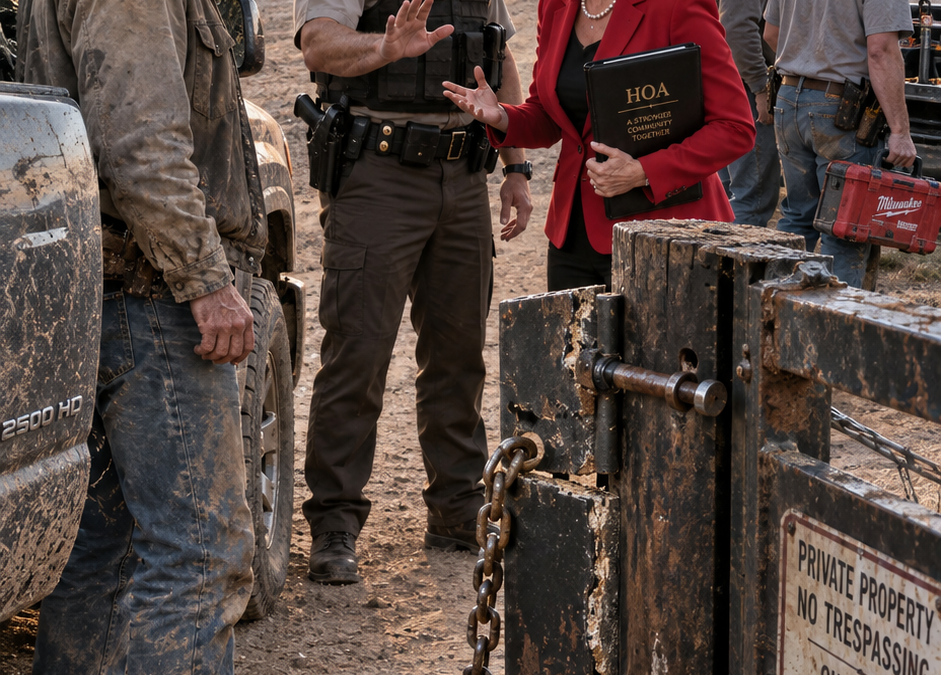
PART2
My name is Caleb Ward.
I was fifty-seven years old when Vanessa Pike decided the gate my family had used for decades was suddenly community property.
Ward Ranch had been in my family longer than Brierwood Ridge had been an idea.
My father bought the original parcel when the eastern boundary faced open scrub and a narrow county road.
Over time, he acquired two smaller tracts.
We repaired fences.
Dug stock ponds.
Built sheds.
Ran cattle.
Lost money some years.
Made enough in others.
That is ranching.
The east gate Vanessa wanted removed wasn’t ornamental.
It opened into a cattle lane running from the county road through the eastern pasture.
Feed trucks used it.
Livestock trailers used it.
Fence crews used it.
If something broke in the back pasture, that was usually how equipment got in.
I braced the damaged gate enough to close it, replaced the cut section of chain temporarily, then carried the HOA work order back to the house.
On the kitchen table, I spread out three documents.
The work order.
My deed.
The county parcel map.
The deed looked exactly the way I remembered.
Ward Ranch ended where I thought it ended.
The gate appeared inside the ranch parcel.
So did the cattle lane.
But my documents didn’t answer the question that mattered.
Why did Vanessa think Brierwood Ridge could use it?
That bothered me because she wasn’t behaving like someone inventing a right from nothing.
She was behaving like someone who had seen something.
Then I remembered the construction years.
Brierwood Ridge had gone up long after Dad bought the ranch.
At first, there were survey flags.
Then bulldozers.
Then utility trenches.
Then paved roads and houses.
For a period during construction, trucks from the development had used part of our eastern lane.
Not forever.
But often enough that I remembered concrete trucks throwing dust across the pasture.
Once, Dad came inside angry because one had blocked a cattle trailer.
Later, he said he’d “worked something out” with the developer.
At twenty-something years old, I hadn’t cared about the details.
I was busy with cattle.
Fences.
Equipment.
Whatever crisis ranching had produced that week.
Now that memory sat differently.
Had Dad signed something?
An easement?
A license?
Temporary access?
Had a construction arrangement from decades earlier somehow become permanent?
I went through his old files.
Dad trusted paper.
Probably more than people.
Tax records.
Closing documents.
Handwritten notes.
Receipts.
Old correspondence.
Maps.
Nothing I found said Brierwood Ridge HOA owned the lane.
Nothing gave the HOA control over my gate.
But not finding something in one farmhouse cabinet did not mean it didn’t exist.
That was where property disputes become dangerous.
People start assuming absence is proof.
I wasn’t going to do that.
I called the county recorder.
The clerk told me older subdivision documents might be indexed under the original developer’s name rather than the modern HOA.
I wrote the developer down.
Then called Nora Bell.
Nora was a surveyor I’d hired years before.
She had a reputation for being slow, exact, and deeply irritating to anyone hoping measurement would agree with their opinion.
Perfect.
I left her a message.
The certified letter arrived two days later.
Brierwood Ridge HOA.
Vanessa’s name at the bottom.
NOTICE OF OBSTRUCTION OF DESIGNATED EMERGENCY ACCESS
The letter ordered me to remove my gate within five business days.
Failure to comply could expose me to “all available legal and equitable remedies.”
I translated that into ordinary English.
Move the gate or we escalate.
I called Vanessa.
“Mr. Ward.”
“You sent me a notice.”
“Yes.”
“It says I’m blocking emergency access.”
“You are.”
“You still haven’t shown me the document giving the HOA a right across my land.”
“You have received sufficient notice of the board’s position.”
“I received a threat.”
A pause.
“The board has acted.”
That phrase mattered.
Not I acted.
The board acted.
“Send me the resolution.”
“You’ll receive the relevant materials.”
“All of them.”
Her voice cooled.
“We’re not going to litigate this over the phone.”
“Good. Put everything in writing.”
I hung up.
The next morning, the HOA emailed me a PDF.
EMERGENCY ACCESS RESOLUTION 26-14
The board declared the western emergency route necessary for wildfire evacuation, road blockage, and other emergencies.
I had no objection to the safety concern.
Wildfire was real.
Brierwood Ridge had one main paved entrance.
If fire cut that road, more than a hundred homes could face a bad problem.
The resolution authorized clearing, widening, and maintenance of something it called:
THE EXISTING WESTERN ACCESS CORRIDOR ADJACENT TO WARD RANCH
Adjacent.
Interesting word.
On the attached map, the route did not stay adjacent.
It entered through my gate and crossed my ranch lane.
I printed everything.
Work order.
Resolution.
Map.
A board vote made Vanessa’s position more serious.
It did not make the route theirs.
Around noon, I heard a diesel engine.
Different crew this time.
Survey rack on the truck.
Orange stakes.
One man was hammering a stake twenty feet inside my gate.
I pulled up.
“Who are you working for?”
“Brierwood Ridge.”
“What are you marking?”
“Emergency access alignment.”
“On private property?”
He looked toward the county road.
“We were given a layout.”
“By who?”
“Property management.”
“Stop.”
He stopped.
No argument.
Promising.
I called Vanessa.
“You sent another crew onto my ranch.”
“They are marking an established access route.”
“They are standing inside my fence.”
“The route crosses that area.”
“You still haven’t shown me a recorded right to cross it.”
“We sent the resolution.”
“A board resolution isn’t an easement.”
“We have supporting plans.”
“Send them.”
She exhaled sharply.
“You’re creating delays in a public safety project.”
“No. I’m asking whether your HOA owns the rights it claims.”
She hung up.
The crew foreman called his office, photographed the existing stake, then loaded the rest back into the truck.
After they left, I pulled the orange stake from the ground.
I kept it.
Not because one stake proved anything.
Because I had stopped trusting pieces of this dispute to remain where I found them.
Vanessa sent the plans that afternoon.
Six pages.
Most were ordinary subdivision engineering drawings.
Roads.
Utilities.
Drainage.
Lots.
Page four was different.
An old faded plan from the construction phase.
Along the western edge was a dashed route crossing toward Ward Ranch and connecting to the county road through the same entrance as my gate.
Beside it:
TEMP ACCESS
I sat back.
There it was.
A real route.
A real plan.
Vanessa had highlighted it in yellow.
Her email said:
This planning document confirms the long-established western access used by the community.
No.
It confirmed something had once existed.
That was not the same thing.
Temp access.
Not community access.
Not perpetual access.
Not HOA emergency easement.
Temporary.
I zoomed in on the title block.
Developer.
Engineering firm.
Revision dates.
County references.
Then I noticed:
A-1173
Not a drawing number.
Some kind of reference.
No A-1173 was attached.
I emailed Vanessa.
What is A-1173?
Twenty minutes later:
An archival reference associated with the original development plans.
I answered:
Please send the referenced document.
No reply.
An hour passed.
Then instead of A-1173, I received three attachments.
Fire safety memo.
Board minutes.
Contractor estimate.
The fire memo recommended a secondary evacuation route because Brierwood Ridge relied on one primary paved entrance.
Reasonable.
It listed the western connection as one option.
Another option existed entirely within HOA common property.
That route would connect internal streets to another county road.
It required new grading.
Drainage.
A reinforced crossing.
And substantially more money.
The board minutes were even more interesting.
Vanessa had presented my route as the “existing practical access” and said it could be opened quickly with minor clearing.
The alternate route would cost several times more.
There it was.
A legitimate safety problem.
Two possible solutions.
One expensive but completely inside HOA property.
One cheaper because the road was already there.
Only the cheaper one crossed my ranch.
I added those records to the pile.
The pattern had become clear.
Every HOA document assumed the same conclusion:
They already had the right.
But none of the documents proved it.
Except possibly whatever A-1173 was.
That reference became the center of the dispute.
I called Deputy Ortega.
Not to ask him to decide anything.
“Another crew came.”
“Did they damage property?”
“No. They stopped when I told them.”
“Good.”
“What does your original report cover?”
“The incident I responded to.”
“Nothing beyond that?”
“Correct. I can’t tell you who owns an easement.”
“Understood.”
“If another crew enters and you believe they’re trespassing or damaging property, call dispatch.”
“Okay.”
“Document everything.”
“I am.”
That evening, I started a formal log.
Date.
Time.
Who arrived.
Vehicle.
What was said.
Documents received.
Work attempted.
Damage.
Dad used to tell me:
“Write down what happened before somebody else writes it down for you.”
Good advice.
The county clerk called back about A-1173.
“I may have something.”
“What?”
“Old subdivision file. Digital index doesn’t show enough detail.”
“Can you send it?”
“You should probably come in if you want everything tied to that reference.”
“What time do you open?”
“Eight-thirty.”
“I’ll be there.”
Before bed, I walked down to the gate with a flashlight.
The damaged hinge leaned slightly.
Temporary chain looped through the post.
Small holes from the survey stakes remained along the lane.
For the first time, I tried to see the road the way Vanessa did.
Not as my cattle lane.
Not as Ward Ranch.
As the cheapest solution to Brierwood Ridge’s evacuation problem.
And that was when I understood the fight.
The HOA had proof that somebody once intended to use the route.
What I had not seen was proof they could use it now.
At 8:25 the next morning, I stood outside county records with a legal pad and Vanessa’s engineering sheet.
The clerk brought out a thin folder.
First document:
TEMPORARY CONSTRUCTION ACCESS AGREEMENT
Parties:
The original Brierwood developer.
My father.
The agreement described a strip near the eastern side of Ward Ranch.
It allowed construction traffic between the development and county road.
Same route.
I read the title again.
Temporary.
I didn’t pretend to interpret every clause.
I requested certified copies.
“What else is attached to A-1173?”
The clerk searched.
Another entry.
Later date.
COUNTY ROAD ACCEPTANCE — BRIERWOOD RIDGE PHASE III
I copied that too.
The dates stood out.
Access agreement first.
Road acceptance later.
Before leaving, I asked the clerk to search the parcel index for permanent easements benefiting Brierwood Ridge.
She searched:
Ward Ranch parcel.
My father’s name.
Mine.
Developer.
HOA.
“I’m not seeing one.”
“Nothing permanent across the east lane?”
“Not in what I’m seeing. But for a complete title opinion, get a title company or attorney.”
Exactly what I intended.
Nora Bell called while I was still in the parking lot.
“You still need a survey?”
“More than yesterday.”
“What do you need?”
“Gate location. Lane. Ranch boundary. HOA boundary.”
“Anything else?”
“Tell me whether the orange stake route follows a property line.”
“That I can answer.”
“And whether the HOA has a right?”
“That’s not surveying.”
“I know.”
“Good.”
She came that afternoon.
For nearly three hours, Nora moved across the eastern side of the ranch.
Old monuments.
Bearings.
Fence lines.
Road edge.
Gate posts.
Control points.
I followed until she politely suggested I stop asking questions while she was measuring.
I went back to repairing fence.
Near the end, she set a prism pole by the western gate post.
Checked her instrument.
Then checked again.
“The gate is inside Ward Ranch.”
“How far?”
“I’ll give exact numbers after processing, but comfortably inside.”
“And the lane?”
“Same.”
She pointed toward the orange stake holes.
“Those aren’t following a boundary.”
“What are they following?”
“Looks like a planned alignment.”
Meaning the HOA’s route.
A line somebody drew across private property.
Not a property line.
By late afternoon, I was sitting across from Evelyn Shaw.
Real estate attorney.
Farm transfers.
Boundary disputes.
Development agreements.
Two ranchers I trusted had recommended her.
She reviewed everything.
Work order.
HOA resolution.
Engineering sheet.
Temporary-access agreement.
County road acceptance.
Then she asked for more.
“Current deed.”
“I have it.”
“Prior deed.”
“I can get it.”
“Complete title history.”
“Okay.”
“Subdivision plat.”
“County has it.”
“All recorded easements.”
“Working on it.”
“HOA governing documents if available.”
I smiled.
“You’re not going to tell me I’m right?”
“No.”
Perfect.
“I think we should prove what exists instead of guessing what doesn’t.”
That was exactly what I wanted.
Over the next week, the fight became quieter.
No contractors.
No roadside shouting.
No dramatic phone calls.
Just records.
Title company.
Survey.
Subdivision plat.
Archived agreements.
Board minutes.
The title report came first.
Utility easements.
Drainage reservation elsewhere.
An old unrelated access matter.
What it did not show was a permanent Brierwood HOA access easement through my east gate.
I called Evelyn.
“So there isn’t one.”
“Careful.”
“You sound like Nora.”
“Smart surveyor.”
“What can we say?”
“There is nothing in this title report showing the permanent access right the HOA claims.”
“Good.”
“Not the same as saying we’re finished.”
Nora delivered the final survey the next morning.
One clean drawing.
Ward Ranch boundary.
Gate.
Cattle lane.
HOA common property.
Orange stake alignment.
The gate sat firmly inside my parcel.
The lane sat inside.
The HOA property line was east of both.
Location settled.
Now we needed meaning.
Tom Ellison helped with that.
Tom owned a home in Brierwood Ridge.
He had heard about the contractors and started asking questions.
Through him, we obtained the full board packet used when Resolution 26-14 was approved.
Inside was a consultant memo comparing emergency-route options.
Option One:
Existing Western Ranch Connection.
My lane.
Option Two:
New route entirely through Brierwood common property.
Option Two cost far more.
Earthwork.
Culvert.
Drainage.
Road base.
Reinforced crossing.
Option One needed gate removal, brush clearing, widening, and grading.
Cheap.
Already there.
One board member had asked the exact question that should have stopped everything.
Has permanent access been confirmed?
The minutes recorded Vanessa’s answer:
Existing development documents support continued use.
Evelyn circled the sentence.
“This matters.”
“Why?”
“Because now we know what the board was told.”
“That Vanessa relied on the old plan.”
“Yes.”
“Does it prove she knew the right was temporary?”
“No.”
Firmly.
“Don’t say that.”
“I wasn’t going to.”
“You were thinking it.”
“Maybe.”
“Thinking is free.”
She pointed at the record.
“What we can prove is that the board approved work based on an assumption about continued use.”
Fair.
We arranged everything chronologically.
Old developer gets temporary ranch access.
Engineering plan references access.
Subdivision roads later accepted by county.
Modern title report shows no permanent HOA easement.
Survey shows route inside Ward Ranch.
HOA chooses cheaper route.
Board told old development documents support continued use.
That was where we stood.
Then Evelyn called.
“Come in tomorrow.”
I did.
On her desk sat four documents.
Temporary access agreement.
County road acceptance.
Nora’s survey.
Title report.
She turned the old agreement toward me.
“Read this paragraph.”
I did.
Developer could use a defined route for construction traffic while Brierwood Ridge was being built.
Purpose limited to construction.
Then near the end:
ACCESS RIGHTS CREATED HEREIN SHALL TERMINATE UPON COMPLETION AND COUNTY ACCEPTANCE OF THE SUBDIVISION’S INTERNAL ROAD SYSTEM.
I looked at the road-acceptance document.
Decades old.
“Evelyn.”
“Keep reading.”
The county had accepted the subdivision roads.
The event named in the temporary agreement had happened.
Long ago.
“So it ended.”
“The right created by this agreement terminated according to its own language.”
“Completely?”
“As written, yes.”
No courtroom voice.
No dramatic pause.
Just an answer.
That made it better.
The engineering plan Vanessa highlighted was real.
The road was real.
My father had really granted access.
But it had been temporary.
The developer could use the lane while building the subdivision.
Then county acceptance ended the right.
Evelyn put the engineering sheet beside it.
“This shows historical use.”
“Not permanent HOA rights.”
“Correct.”
Then the title report.
“No replacement easement.”
“Nothing we’ve found.”
Then Nora’s survey.
“Physical route is inside your land.”
Four documents.
Four pieces.
Together:
The route existed.
Permission existed.
Permission was temporary.
Permission ended.
No permanent replacement appeared in title.
That was the entire case.
Simple enough to explain without legal jargon.
I leaned back.
“So they sent contractors onto my property using a right that expired decades ago.”
Evelyn raised one hand.
“That’s what the documents support.”
“Not fraud.”
“No.”
“Not forgery.”
“No.”
“Not proof Vanessa knew the agreement expired.”
“Correct.”
I nodded.
I didn’t need to make it bigger.
Truth was already large enough.
Maybe Vanessa misunderstood.
Maybe she had seen only the engineering plan.
Maybe a property manager summarized it badly.
Maybe she never read A-1173.
Whatever the reason, the property question was clear.
The old right was dead.
Evelyn drafted our demand.
Plain language.
Ward Ranch had not consented.
Survey confirmed route crossed ranch property.
Title report showed no current recorded HOA access easement.
Temporary construction agreement had limited purpose and duration.
County road acceptance triggered termination.
No contractor could enter, widen, clear, grade, or remove property without a new lawful basis or my written consent.
She attached only what mattered.
Agreement.
Road acceptance.
Title report.
Survey.
No speeches.
No insults.
No accusation Vanessa was a criminal.
Just one question:
What current legal instrument authorizes Brierwood Ridge HOA to enter Ward Ranch?
“Send it,” I said.
She did.
Four hours later, the property manager responded.
All field activity involving the western route was suspended pending legal review.
Suspended.
By them.
Not delayed by me.
Not obstructed.
Suspended.
The next morning, the first contractor called.
“We were told not to return.”
“Good.”
“I want to make sure you understand we worked off the authorization we were given.”
“I know.”
A pause.
“For what it’s worth, once the deputy stopped us, nobody on my crew wanted back on that ranch without something clearer.”
“Reasonable.”
We ended the call.
A week earlier, Vanessa had told me my permission was irrelevant.
Now her contractor would not cross the gate.
Her property manager had suspended work.
The HOA lawyer was reviewing a document nobody had apparently read before crews arrived.
Amazing what happens when historical records meet current liability.
Three days later, HOA counsel asked for a conference call.
Martin Keller.
He represented the association.
He made one point clear immediately.
“I represent Brierwood Ridge HOA. Not Ms. Pike individually.”
Interesting distinction.
Evelyn handled most of the conversation.
Martin confirmed contractor activity remained suspended.
He confirmed he’d reviewed:
Survey.
Title report.
Temporary agreement.
Road acceptance.
Board materials.
He did not claim the contractors could go back.
Instead:
“Give the board until Friday.”
That told me enough.
They were not preparing to bulldoze through.
They were figuring out how to unwind it.
Nora sent her final signed survey to both sides.
County records confirmed the road acceptance as an official development record.
Contractor’s insurer apparently got involved too.
The company told Evelyn it would not return to Ward Ranch without written confirmation of lawful access from HOA counsel or written permission from me.
Practical fight over.
No crew.
No grinder.
No stakes.
Just the board.
Friday evening, Brierwood held a special meeting.
I attended with Evelyn.
Vanessa sat at the front.
Dark red blazer.
Binder.
Chin up.
Same posture she’d had at my gate.
But the room was different.
Martin Keller sat beside the board chair.
He spoke first.
“Based on outside review, counsel has not identified a current recorded access right sufficient to support further construction activity across Ward Ranch.”
Silence.
Vanessa did not move.
Martin continued.
“I recommend rescinding authorization for work on the western ranch route unless and until a lawful property right is established.”
One board member turned toward Vanessa.
“Were we told title review was complete before we approved the contractors?”
She opened the binder.
“We had historical development records showing use.”
“That’s not what I asked.”
Exactly.
I had heard that sentence before.
Another board member leaned forward.
“Why were contractors sent before legal reviewed the actual access instrument?”
Vanessa’s voice sharpened.
“The wildfire risk required prompt action.”
No one argued with the risk.
That was important.
The safety concern was real.
The mistake was assuming urgency erased ownership.
Vanessa continued.
“The western route was represented in the original development materials.”
Martin interrupted carefully.
“The historical route existed. The issue is whether a current right exists.”
There it was.
Clean separation.
No one in the room had to choose between being pro-safety or pro-property.
They had to choose whether their HOA could solve a safety problem by using a neighboring ranch without permission.
The board voted.
Resolution 26-14 rescinded as applied to Ward Ranch.
Passed.
Martin handed Evelyn a draft agreement.
HOA would not enter, clear, widen, grade, or otherwise use my ranch route without a lawful current right or my written consent.
HOA proposed paying for:
Gate hinge repair.
Replacement chain.
New hardware.
Minor grading.
Disturbed soil restoration.
Survey expenses.
Reasonable legal expenses tied directly to the dispute.
I read Vanessa’s face.
For the first time since the contractor incident, she did not look angry at me.
She looked angry at the documents.
That was probably easier.
Documents can’t argue back.
The board chair asked Martin:
“Do we still have an emergency-access alternative?”
“Yes.”
“Which?”
“The common-property route.”
A resident near the back said:
“The expensive one.”
Nobody laughed.
But everyone heard it.
The safer legal option had always existed.
It simply cost more.
The meeting ended without screaming.
No dramatic showdown.
No sheriff.
No thunderstorm.
Just a board correcting its own mistake in public.
That was almost more satisfying.
Vanessa had arrived at my gate acting as though she personally controlled the future of the road.
Now she sat while her own board voted around her.
Outside, Evelyn held up the draft settlement.
“They’re prepared to fix the damage.”
“Good.”
“Enough?”
“Start.”
A week later, I received the final agreement.
Brierwood paid:
New hinge assembly.
Chain.
Hardware.
Gate-post reinforcement.
Surface repair.
Nora’s survey bill.
A negotiated portion of my legal expense.
In return, once repairs were complete, I agreed not to pursue a broader property-damage claim from the incident.
But the money wasn’t the part I cared about most.
The settlement required Brierwood to remove Ward Ranch from its emergency-access plan unless a future lawful agreement was reached.
And the board adopted a new policy.
Any project involving land outside HOA ownership required:
Parcel verification.
Title review.
Owner contact.
Legal confirmation of site control.
Written approval before contractors mobilized.
In other words:
Before sending a crew to cut somebody’s chain, check whether you own the road.
A surprisingly advanced concept.
Vanessa voted against part of the settlement.
The rest of the board passed it anyway.
That mattered.
She remained president briefly, but her unilateral fieldwork authority disappeared.
Then the next board cycle arrived.
She did not run again.
I never asked why.
Maybe embarrassment.
Maybe anger.
Maybe she’d simply realized the next board would not treat her certainty as legal analysis.
Didn’t matter.
I got my ranch back.
A local welder repaired the gate.
He pulled the bent hinge.
Reset it.
Reinforced the post.
Installed a heavier assembly than before.
When he finished, he swung the gate open and closed three times.
“Better than new.”
“It should be.”
He held up the old cut chain.
“You keeping this?”
“Yes.”
“Souvenir?”
“Evidence.”
He laughed.
Nora returned one last time.
She set two permanent reference markers near the east lane.
“Nobody should have trouble finding this boundary now.”
“You underestimate HOAs.”
She smiled.
“Fair.”
I stored everything in a fireproof cabinet.
Final survey.
Settlement.
Certified temporary-access agreement.
Road acceptance record.
Incident report.
Work order.
Board resolution.
Resolution rescission.
Why keep it after the dispute ended?
Because Dad had kept A-1173.
Not intentionally, maybe.
But enough records survived for me to prove what happened decades later.
The next owner deserved the same protection.
Brierwood Ridge still needed emergency access.
That problem did not disappear simply because my gate stayed.
So they went back to Option Two.
Their land.
Their project.
Their bill.
The common-property route required more engineering.
Grading.
Drainage.
Reinforced crossing.
Connection to the other county road.
It was expensive.
Naturally, some residents were angry.
Tom Ellison told me one man blamed me at a board meeting.
“If Ward would just cooperate, we wouldn’t have to spend this.”
Tom apparently answered:
“You mean if Ward would donate his ranch road?”
That ended the conversation.
A few months later, I drove past Brierwood and saw graders cutting the new access route.
Entirely inside HOA land.
Nobody was trespassing.
Nobody was cutting chains.
Nobody needed a sheriff.
Amazing how peaceful construction becomes when everybody knows who owns the dirt.
Back on my side of the line, cattle moved through the east pasture.
Feed truck used the ranch lane.
Gate opened.
Gate closed.
Ordinary.
That was what I wanted.
People assume satisfying endings require someone getting arrested.
Vanessa wasn’t arrested.
I never claimed she committed a crime.
There was no courtroom confession.
No judge pounding a gavel.
No million-dollar verdict.
There didn’t need to be.
The sheriff stopped the physical work.
The records stopped the legal claim.
The contractor stopped taking orders from the HOA.
The HOA’s lawyer stopped defending the route.
The board stopped backing Vanessa.
The ranch stayed mine.
That was enough.
What stayed with me was how quickly paperwork can turn an assumption into physical action.
Vanessa had seen a dashed line on an old engineering sheet.
Temp access.
Somewhere between that paper and my gate, “temporary construction access” became “community emergency route.”
Then a board resolution.
Then a work order.
Then two men with a grinder.
Each step looked more official than the one before it.
But authority had not increased.
Only confidence had.
That distinction matters.
Official paper can be wrong.
A board can misunderstand history.
A contractor can follow a bad instruction.
A president can sound certain.
A map can show a road that no longer carries a legal right.
You still have to read the underlying document.
If I had looked only at the engineering sheet, Vanessa’s argument would have seemed stronger.
The route was right there.
Dashed line.
County reference.
Developer markings.
But A-1173 changed everything.
The line pointed to an agreement.
The agreement contained an expiration condition.
The county file documented that condition.
The title report showed no permanent replacement.
The survey showed the gate stood inside Ward Ranch.
One layer deeper.
That’s all it took.
A few months after settlement, Martin Keller mailed a formal letter.
Probably unnecessary.
I appreciated it.
The HOA acknowledged that its review had not identified a current permanent access right across Ward Ranch and confirmed no association contractor would enter without lawful authorization.
I put that letter in the fireproof cabinet.
Right beside the cut chain.
Dad would’ve liked that.
He always believed good fences mattered.
Not because he disliked neighbors.
Because he understood boundaries prevented arguments.
He used to walk the ranch perimeter every spring.
Post by post.
Wire by wire.
If a fence sagged, we fixed it.
If brush covered a marker, he cleared it.
I once asked why he cared about a line nobody could see.
He said:
“The line is what keeps good neighbors good.”
At twenty, I thought that was just rancher talk.
At fifty-seven, I understood.
Brierwood’s residents weren’t my enemies.
Most of them didn’t know what Vanessa had authorized.
They wanted a safe evacuation route.
Reasonable.
I wanted a functioning ranch.
Also reasonable.
The conflict existed because someone tried to solve the first need by ignoring the second.
The common-property route eventually opened.
Brierwood held a little safety event.
Fire department vehicles tested it.
County emergency management reviewed it.
Tom invited me.
I almost declined.
Then I went.
Not to make a point.
Because I wanted to see whether it worked.
It did.
A fire engine came through cleanly.
Turn radius fine.
Reinforced crossing held.
Road connected exactly where it was supposed to.
Tom stood beside me.
“Expensive.”
“So I’ve heard.”
“Could’ve saved money using your road.”
“Could’ve saved even more money if I’d given them my ranch.”
He laughed.
“Fair.”
A woman standing nearby heard us.
She introduced herself as Laura Benson.
Brierwood resident.
“We were angry about the cost.”
“I know.”
“At you, some of us.”
“I know that too.”
She looked toward the new road.
“Then I read the documents.”
I didn’t say anything.
“My husband asked me what we’d have done if the HOA decided our backyard was the cheapest place for an access road.”
“And?”
“We stopped blaming you.”
That was enough.
Safety route built.
Ranch protected.
Maybe a few people learned something about easements.
Everyone survived.
One spring morning, I replaced the temporary chain with a proper lock.
Not because I expected Vanessa to return.
By then she had mostly disappeared from HOA business.
I did it because I was tired of looking at the reminder.
I kept the cut chain, though.
The grinder had left a bright gouge through one link.
I hung it on a nail inside the ranch office.
Every time I saw it, I thought about Vanessa’s first sentence.
Your permission is irrelevant.
No sentence in the entire dispute aged worse.
Because in the end, permission was the only thing she needed and did not have.
The developer had once had permission.
Temporary.
Dad gave it.
Then it ended.
That history mattered.
If Vanessa had come to me before hiring contractors and said:
“Caleb, wildfire planning has identified your ranch lane as one option. Would you discuss an easement?”
We could have talked.
Maybe I would have said no.
Maybe there was some arrangement worth considering.
Maybe temporary emergency-only access could have been designed.
Maybe not.
But we’d have started with reality.
Instead, she started with a grinder.
Bad negotiation technique.
A year later, I ran into Deputy Ortega at the feed store.
He recognized me near the fencing supplies.
“Gate still standing?”
“Better than ever.”
“HOA behaving?”
“Different president.”
He nodded.
“That’ll do it.”
I thanked him again for what he’d done.
He shook his head.
“I didn’t decide anything.”
“I know.”
“All I did was stop people from tearing apart disputed property until somebody showed paperwork.”
“That was enough.”
He smiled.
“Sometimes it is.”
Exactly.
He hadn’t ruled that I was right.
He didn’t need to.
He simply refused to let physical destruction continue while one side waved a work order and the other side claimed ownership.
That pause gave records time to catch up with confidence.
Without it, my gate might have been gone before I ever found A-1173.
That matters too.
Once a contractor removes something, people start arguing over restoration instead of permission.
Vanessa almost created facts on the ground.
Gate gone.
Road widened.
Route open.
Then suddenly the HOA could have said residents had begun relying on it.
Emergency planning had incorporated it.
Money had been spent.
Restoring it would create hardship.
The cleanest time to stop unauthorized work is before the work becomes history.
Ortega understood that.
The new Brierwood board apparently did too.
Their updated contractor checklist became almost comical in its thoroughness.
Tom showed me a copy.
Before any work beyond HOA property:
Confirm parcel.
Identify owner.
Confirm legal right.
Attach deed/easement/license.
Counsel review.
Owner notice.
Contractor acknowledgment.
I tapped the page.
“This entire checklist exists because of one gate.”
“Congratulations.”
“I’d rather have a plaque.”
“We can install one.”
“Not on my land.”
We laughed.
Life returned to normal.
Ranching does that.
Cows don’t care that you won a property dispute.
Fence breaks anyway.
Pump quits.
Calf gets sick.
Hay price rises.
The world keeps offering new problems.
I preferred those problems.
One autumn afternoon, I moved cattle through the east gate.
The repaired hinge swung clean.
Trailer followed.
Dust rose.
Beyond my fence, Brierwood’s new emergency lane curved across its own common property.
You could see part of it from the ridge.
Nobody needed my road.
Nobody ever had.
They had needed an affordable road.
That was different.
Affordability explains behavior.
It does not create ownership.
Vanessa’s mistake was treating cost savings like legal authority.
She had a legitimate problem.
Wildfire.
A legitimate goal.
Emergency access.
A legitimate historical clue.
Old temporary route.
Then she skipped the step that mattered.
Does the right still exist?
Had she asked that one question before hiring contractors, none of the rest would have happened.
No cut chain.
No sheriff.
No survey stakes.
No lawyers.
No special meeting.
No settlement.
Her own board would’ve seen the same expiration clause before authorizing the work.
Instead, she saw a map and stopped reading.
People do that with old documents.
They find the sentence they need and stop at the sentence that ends it.
Temporary access agreement.
Useful.
Until terminated upon county road acceptance.
Less useful.
Both sentences matter.
Dad understood that.
He had saved the paper.
I sometimes wondered whether he remembered signing it.
If he had still been alive, I would’ve asked.
He probably would’ve shrugged and said:
“Sure. Developer needed a road for a couple years.”
Then:
“Why?”
And when I explained Brierwood tried to claim the route permanently, he would’ve laughed until his coffee spilled.
He had no patience for people making permanent claims out of temporary favors.
Once, years ago, a neighbor borrowed our portable chute for a weekend and kept it for three months.
Dad finally drove over with the tractor and brought it home while the neighbor was at work.
When the man complained, Dad said:
“Borrowed isn’t another word for inherited.”
Same principle.
Different scale.
I kept one more item from the dispute.
The orange survey stake.
The first one the second crew hammered inside my gate.
It sits beside the cut chain.
The letters have faded.
It’s just a cheap wooden stake.
But it reminds me how easy authority can look from the outside.
A person wearing work boots arrives.
Drives a stake.
Suddenly the ground looks decided.
But the stake doesn’t own anything.
Neither does a work order.
Neither does an HOA vote.
Neither does a highlighted map.
Those things matter only when supported by an actual right.
That’s what Vanessa learned.
Or at least what her board learned.
The last time I spoke to her was months after she left the presidency.
We passed each other outside a county planning office.
She stopped.
“Caleb.”
“Vanessa.”
She looked tired.
Not defeated.
Just different.
“You got what you wanted.”
I shook my head.
“No.”
Her mouth tightened.
“The gate is there. The HOA built another road. We paid your legal fees.”
“I wanted you to ask before sending people onto my ranch.”
“We thought we had a right.”
“Then you should’ve checked.”
“We had an old access record.”
“You had half the story.”
She looked away.
“People were afraid of wildfire.”
“I know.”
“I was trying to solve it.”
“I know that too.”
That surprised her.
I continued.
“The problem wasn’t wanting emergency access.”
“Then what was it?”
“You decided urgency meant you could skip permission.”
She stared at me.
Maybe she disagreed.
Probably.
But she didn’t argue.
After a moment, she said:
“The other route cost the HOA a lot of money.”
“Yes.”
“You still think that was the right outcome?”
I thought about it.
“The right outcome was building the road on land the HOA controlled.”
She gave a faint, bitter laugh.
“Everything is simple to you.”
“No.”
I looked toward the parking lot.
“That’s why I read the documents.”
She walked away.
That was it.
No apology.
Didn’t need one.
A proper ending isn’t always two people agreeing.
Sometimes it’s one person losing the power to act on a bad assumption.
The Brierwood emergency route worked.
Ward Ranch remained intact.
The board changed its procedures.
My gate stayed.
Enough.
The following winter brought a wildfire scare.
Not inside Brierwood.
Several miles west.
Smoke drifted across the county.
Emergency crews staged near the subdivision.
The new access route was opened as a precaution.
Residents received evacuation instructions.
Nothing happened.
Fire shifted.
Still, the event proved something.
Brierwood had needed a second route.
Vanessa had been right about that.
She had been wrong about whose land she could use.
I think that distinction matters.
People like simple villains.
Reality is often messier.
A person can identify a real problem and still choose an unacceptable solution.
Safety does not automatically justify trespass.
Urgency does not erase title.
Good intentions do not create easements.
And a board vote cannot manufacture property rights that expired decades earlier.
The wildfire ended without reaching the subdivision.
Two days later, Tom texted me.
New road worked perfectly.
I responded:
Amazing what happens when you build it on land you own.
He sent back a laughing emoji.
I went outside.
Cold morning.
Cattle gathered by the hay feeder.
East gate closed.
Chain intact.
No contractors.
No red blazers.
No sheriff.
Just steel, wood, dust, and a boundary my father had respected long before anyone built Brierwood Ridge.
The dispute had started with Vanessa saying:
That entrance belongs to the community now.
It ended with her own lawyer confirming the HOA had no current recorded right to use it.
That difference between “now” and “no” cost Brierwood money.
Not because I was stubborn.
Because somebody chose to send a contractor before opening the file.
If there is anything I learned from the whole mess, it’s that historical use can be one of the most dangerous phrases in a property dispute.
People hear:
“We’ve used it before.”
Then mentally convert that into:
“We own the right forever.”
Not the same thing.
A favor can expire.
A license can expire.
A temporary construction agreement can expire.
A recorded easement may endure.
The language decides.
Not memory.
Not convenience.
Not how long a dashed line has sat on a drawing.
The document.
All of it.
Especially the last paragraph.
Dad’s old agreement had been sitting in county records for decades.
No secrets.
No conspiracy.
Anybody could have pulled it.
Vanessa’s own highlighted engineering sheet pointed directly to the reference.
She practically handed me the key.
All she needed to do was use it first.
Instead, she sent men with a grinder.
Bad paperwork creates expensive machinery problems.
The gate still stands today.
Red paint on the steel frame.
New hinge.
Heavy chain.
Nora’s markers nearby.
Every time I swing it open for a cattle trailer, I remember that morning.
The contractor’s wrench.
The cut chain.
Vanessa’s finger pointed toward my chest.
Then Ortega’s question.
“Do you have a document showing a recorded right of access?”
Everything after that came from her inability to answer.
Not immediately.
Not specifically.
Not with anything that survived close reading.
And that is the part I find most satisfying.
Vanessa had more people.
More letterhead.
More lawyers.
More meetings.
More contractors.
I had one ranch gate and an old reference number.
But property disputes don’t care who arrives with the bigger folder.
Eventually somebody has to read what is inside.
The temporary access had been real.
The expiration had been real too.
The route did not belong to Brierwood.
It belonged to Ward Ranch.
It always had.
And once everyone finally read the paperwork all the way to the end, the gate stayed exactly where my father left it.
Have you finished reading the story and want to read it again?
She Sent Contractors to Tear Down My Ranch Gate—Then the Sheriff Asked to See Her Proof
They cut my chain before sunrise.
The HOA president told me my permission no longer mattered.
Then the sheriff arrived and asked her for the one document she couldn’t produce.
By the time I reached the east gate, one hinge pin was already halfway out.
A cordless grinder lay in the dirt beside the chain the contractors had cut, and two men in work shirts stood on opposite sides of the gate as if they were halfway through dismantling a piece of equipment they’d bought at auction.
Except they hadn’t bought it.
And the gate wasn’t theirs.
Neither was the road behind it.
Neither was the ranch.
I stopped my truck hard enough to send a cloud of dust rolling toward them.
“What the hell are you doing?”
The older contractor lowered his wrench.
Before he could answer, a woman in a red blazer stepped out from beside a black SUV parked along the county road.
Vanessa Pike.
President of Brierwood Ridge Homeowners Association.
Forty-two years old, polished enough to look prepared for television even while standing in ranch dust, and carrying the same black leather folder I’d seen her bring to every argument she’d ever started.
She pointed at the gate.
“Emergency access work.”
“On my ranch?”
“That entrance serves Brierwood Ridge.”
“No. That entrance serves my east pasture.”
Her mouth tightened.
“The board has already determined otherwise.”
That was Vanessa’s favorite style of sentence.
No explanation.
No discussion.
The board decided.
Therefore reality had apparently been updated.
I walked closer.
The cut chain lay beside my boot.
“You sent contractors onto private property and told them to remove my gate.”
“It is obstructing a designated emergency route.”
“Designated by who?”
“Our association.”
I almost laughed.
“Brierwood Ridge doesn’t get to designate roads across Ward Ranch by holding a meeting.”
“You’re misunderstanding the legal history.”
“Then explain it.”
She opened the folder.
“I don’t need to stand in the road and give you a property-law seminar, Caleb.”
“Convenient.”
Behind her, the younger contractor looked uncomfortable.
The older one kept his wrench lowered.
Vanessa jabbed a finger toward the hinge.
“That gate needs to come down.”
I took out my phone.
“Nobody touches another bolt.”
Her eyes flashed.
“You have no right to interfere with authorized emergency access improvements.”
I stared at her.
“You had no right to send them onto my ranch.”
“That entrance belongs to the community now.”
There it was.
Not we believe we have an easement.
Not our lawyer says historical use may give us rights.
It belongs to the community now.
Like ownership was something an HOA president could pronounce into existence from a roadside.
I looked at the older contractor.
“You’ve seen the document giving them ownership or access rights?”
He glanced at Vanessa.
“We have a work order.”
“A work order from who?”
“Brierwood Ridge HOA.”
“That’s not what I asked.”
Vanessa stepped forward.
“Your permission is irrelevant.”
That was when I heard tires on gravel.
A sheriff’s cruiser rolled up behind Vanessa’s SUV.
She looked almost pleased.
Which told me she thought somebody had called law enforcement on me.
She was wrong about that too.
Deputy Luis Ortega stepped out.
He looked at me.
Then the contractors.
Then the half-dismantled gate.
Then the chain lying in the dirt.
“Mr. Ward?”
“I called.”
Vanessa turned toward him immediately.
“Deputy, this man is interfering with authorized emergency access work.”
Ortega lifted one hand.
“One at a time.”
He looked at me.
“What happened?”
“I drove down and found these men cutting the chain and removing the gate.”
He nodded toward the contractors.
“Who hired you?”
The older man handed over a clipboard.
“Brierwood Ridge HOA.”
I moved close enough to see the heading.
BRIERWOOD RIDGE — EMERGENCY ACCESS IMPROVEMENT
Three instructions:
REMOVE EXISTING GATE.
CLEAR ENTRANCE TO REQUIRED WIDTH.
PREPARE ACCESS LANE FOR EMERGENCY VEHICLES.
Project location:
WARD RANCH.
Vanessa tapped the page.
“There. That settles it.”
Deputy Ortega kept reading.
Then he looked at her.
“No.”
Her face changed slightly.
“No?”
“This tells me what the contractor was hired to do.”
He handed the clipboard back.
“It doesn’t tell me the HOA has a legal right to do it on his property.”
Vanessa crossed her arms.
“The association has records.”
“Do you have a court order?”
“No.”
“A recorded easement?”
“We have documentation establishing community access.”
“That’s not what I asked.”
Ortega looked at the damaged gate again.
“I’m not deciding title or easement rights standing on a gravel road. But Mr. Ward is objecting, there’s visible property damage, and you haven’t shown me authority that clearly lets this crew keep dismantling his gate during an active dispute.”
He turned toward the contractor.
“Stop the work until the property issue is documented.”
The older contractor nodded immediately.
“Understood.”
Vanessa spun toward him.
“You have an active contract.”
“And now we have an active property dispute.”
He pointed toward his truck.
“We’re done until your office clears it.”
The younger worker began packing tools.
Ten minutes earlier, Vanessa had arrived with contractors, a work order, and the absolute confidence of someone who thought official letterhead was a substitute for ownership.
Now the sheriff had an incident number, her contractor was leaving, and my gate was still standing.
Barely.
She closed the folder.
“This is temporary, Caleb.”
I picked up the cut chain.
“So is that damage.”
“You are blocking an emergency route serving more than a hundred homes.”
“I’m protecting a gate on my ranch.”
“The records say otherwise.”
That stopped me.
Not because I believed her.
Because she sounded like she believed herself.
Deputy Ortega told both of us the same thing before leaving.
“Resolve this through documents. Not another roadside confrontation.”
Good advice.
Vanessa got into her SUV.
Before driving away, she lowered the window.
“I suggest you check your deed.”
Then she disappeared uphill toward Brierwood Ridge.
I stood beside the crooked gate watching the dust settle.
The work order remained on the ground near the contractor’s tire tracks.
I picked it up.
They had entered my ranch into an HOA construction project as though the right to use it had already been settled.
That meant somewhere—inside a title file, engineering plan, board record, or decades-old agreement—there was something Vanessa believed justified what she’d done.
I intended to find it.
And if her certainty was based on paperwork, then paperwork was exactly where I was going to meet her.
PART2
My name is Caleb Ward.
I was fifty-seven years old when Vanessa Pike decided the gate my family had used for decades was suddenly community property.
Ward Ranch had been in my family longer than Brierwood Ridge had been an idea.
My father bought the original parcel when the eastern boundary faced open scrub and a narrow county road.
Over time, he acquired two smaller tracts.
We repaired fences.
Dug stock ponds.
Built sheds.
Ran cattle.
Lost money some years.
Made enough in others.
That is ranching.
The east gate Vanessa wanted removed wasn’t ornamental.
It opened into a cattle lane running from the county road through the eastern pasture.
Feed trucks used it.
Livestock trailers used it.
Fence crews used it.
If something broke in the back pasture, that was usually how equipment got in.
I braced the damaged gate enough to close it, replaced the cut section of chain temporarily, then carried the HOA work order back to the house.
On the kitchen table, I spread out three documents.
The work order.
My deed.
The county parcel map.
The deed looked exactly the way I remembered.
Ward Ranch ended where I thought it ended.
The gate appeared inside the ranch parcel.
So did the cattle lane.
But my documents didn’t answer the question that mattered.
Why did Vanessa think Brierwood Ridge could use it?
That bothered me because she wasn’t behaving like someone inventing a right from nothing.
She was behaving like someone who had seen something.
Then I remembered the construction years.
Brierwood Ridge had gone up long after Dad bought the ranch.
At first, there were survey flags.
Then bulldozers.
Then utility trenches.
Then paved roads and houses.
For a period during construction, trucks from the development had used part of our eastern lane.
Not forever.
But often enough that I remembered concrete trucks throwing dust across the pasture.
Once, Dad came inside angry because one had blocked a cattle trailer.
Later, he said he’d “worked something out” with the developer.
At twenty-something years old, I hadn’t cared about the details.
I was busy with cattle.
Fences.
Equipment.
Whatever crisis ranching had produced that week.
Now that memory sat differently.
Had Dad signed something?
An easement?
A license?
Temporary access?
Had a construction arrangement from decades earlier somehow become permanent?
I went through his old files.
Dad trusted paper.
Probably more than people.
Tax records.
Closing documents.
Handwritten notes.
Receipts.
Old correspondence.
Maps.
Nothing I found said Brierwood Ridge HOA owned the lane.
Nothing gave the HOA control over my gate.
But not finding something in one farmhouse cabinet did not mean it didn’t exist.
That was where property disputes become dangerous.
People start assuming absence is proof.
I wasn’t going to do that.
I called the county recorder.
The clerk told me older subdivision documents might be indexed under the original developer’s name rather than the modern HOA.
I wrote the developer down.
Then called Nora Bell.
Nora was a surveyor I’d hired years before.
She had a reputation for being slow, exact, and deeply irritating to anyone hoping measurement would agree with their opinion.
Perfect.
I left her a message.
The certified letter arrived two days later.
Brierwood Ridge HOA.
Vanessa’s name at the bottom.
NOTICE OF OBSTRUCTION OF DESIGNATED EMERGENCY ACCESS
The letter ordered me to remove my gate within five business days.
Failure to comply could expose me to “all available legal and equitable remedies.”
I translated that into ordinary English.
Move the gate or we escalate.
I called Vanessa.
“Mr. Ward.”
“You sent me a notice.”
“Yes.”
“It says I’m blocking emergency access.”
“You are.”
“You still haven’t shown me the document giving the HOA a right across my land.”
“You have received sufficient notice of the board’s position.”
“I received a threat.”
A pause.
“The board has acted.”
That phrase mattered.
Not I acted.
The board acted.
“Send me the resolution.”
“You’ll receive the relevant materials.”
“All of them.”
Her voice cooled.
“We’re not going to litigate this over the phone.”
“Good. Put everything in writing.”
I hung up.
The next morning, the HOA emailed me a PDF.
EMERGENCY ACCESS RESOLUTION 26-14
The board declared the western emergency route necessary for wildfire evacuation, road blockage, and other emergencies.
I had no objection to the safety concern.
Wildfire was real.
Brierwood Ridge had one main paved entrance.
If fire cut that road, more than a hundred homes could face a bad problem.
The resolution authorized clearing, widening, and maintenance of something it called:
THE EXISTING WESTERN ACCESS CORRIDOR ADJACENT TO WARD RANCH
Adjacent.
Interesting word.
On the attached map, the route did not stay adjacent.
It entered through my gate and crossed my ranch lane.
I printed everything.
Work order.
Resolution.
Map.
A board vote made Vanessa’s position more serious.
It did not make the route theirs.
Around noon, I heard a diesel engine.
Different crew this time.
Survey rack on the truck.
Orange stakes.
One man was hammering a stake twenty feet inside my gate.
I pulled up.
“Who are you working for?”
“Brierwood Ridge.”
“What are you marking?”
“Emergency access alignment.”
“On private property?”
He looked toward the county road.
“We were given a layout.”
“By who?”
“Property management.”
“Stop.”
He stopped.
No argument.
Promising.
I called Vanessa.
“You sent another crew onto my ranch.”
“They are marking an established access route.”
“They are standing inside my fence.”
“The route crosses that area.”
“You still haven’t shown me a recorded right to cross it.”
“We sent the resolution.”
“A board resolution isn’t an easement.”
“We have supporting plans.”
“Send them.”
She exhaled sharply.
“You’re creating delays in a public safety project.”
“No. I’m asking whether your HOA owns the rights it claims.”
She hung up.
The crew foreman called his office, photographed the existing stake, then loaded the rest back into the truck.
After they left, I pulled the orange stake from the ground.
I kept it.
Not because one stake proved anything.
Because I had stopped trusting pieces of this dispute to remain where I found them.
Vanessa sent the plans that afternoon.
Six pages.
Most were ordinary subdivision engineering drawings.
Roads.
Utilities.
Drainage.
Lots.
Page four was different.
An old faded plan from the construction phase.
Along the western edge was a dashed route crossing toward Ward Ranch and connecting to the county road through the same entrance as my gate.
Beside it:
TEMP ACCESS
I sat back.
There it was.
A real route.
A real plan.
Vanessa had highlighted it in yellow.
Her email said:
This planning document confirms the long-established western access used by the community.
No.
It confirmed something had once existed.
That was not the same thing.
Temp access.
Not community access.
Not perpetual access.
Not HOA emergency easement.
Temporary.
I zoomed in on the title block.
Developer.
Engineering firm.
Revision dates.
County references.
Then I noticed:
A-1173
Not a drawing number.
Some kind of reference.
No A-1173 was attached.
I emailed Vanessa.
What is A-1173?
Twenty minutes later:
An archival reference associated with the original development plans.
I answered:
Please send the referenced document.
No reply.
An hour passed.
Then instead of A-1173, I received three attachments.
Fire safety memo.
Board minutes.
Contractor estimate.
The fire memo recommended a secondary evacuation route because Brierwood Ridge relied on one primary paved entrance.
Reasonable.
It listed the western connection as one option.
Another option existed entirely within HOA common property.
That route would connect internal streets to another county road.
It required new grading.
Drainage.
A reinforced crossing.
And substantially more money.
The board minutes were even more interesting.
Vanessa had presented my route as the “existing practical access” and said it could be opened quickly with minor clearing.
The alternate route would cost several times more.
There it was.
A legitimate safety problem.
Two possible solutions.
One expensive but completely inside HOA property.
One cheaper because the road was already there.
Only the cheaper one crossed my ranch.
I added those records to the pile.
The pattern had become clear.
Every HOA document assumed the same conclusion:
They already had the right.
But none of the documents proved it.
Except possibly whatever A-1173 was.
That reference became the center of the dispute.
I called Deputy Ortega.
Not to ask him to decide anything.
“Another crew came.”
“Did they damage property?”
“No. They stopped when I told them.”
“Good.”
“What does your original report cover?”
“The incident I responded to.”
“Nothing beyond that?”
“Correct. I can’t tell you who owns an easement.”
“Understood.”
“If another crew enters and you believe they’re trespassing or damaging property, call dispatch.”
“Okay.”
“Document everything.”
“I am.”
That evening, I started a formal log.
Date.
Time.
Who arrived.
Vehicle.
What was said.
Documents received.
Work attempted.
Damage.
Dad used to tell me:
“Write down what happened before somebody else writes it down for you.”
Good advice.
The county clerk called back about A-1173.
“I may have something.”
“What?”
“Old subdivision file. Digital index doesn’t show enough detail.”
“Can you send it?”
“You should probably come in if you want everything tied to that reference.”
“What time do you open?”
“Eight-thirty.”
“I’ll be there.”
Before bed, I walked down to the gate with a flashlight.
The damaged hinge leaned slightly.
Temporary chain looped through the post.
Small holes from the survey stakes remained along the lane.
For the first time, I tried to see the road the way Vanessa did.
Not as my cattle lane.
Not as Ward Ranch.
As the cheapest solution to Brierwood Ridge’s evacuation problem.
And that was when I understood the fight.
The HOA had proof that somebody once intended to use the route.
What I had not seen was proof they could use it now.
At 8:25 the next morning, I stood outside county records with a legal pad and Vanessa’s engineering sheet.
The clerk brought out a thin folder.
First document:
TEMPORARY CONSTRUCTION ACCESS AGREEMENT
Parties:
The original Brierwood developer.
My father.
The agreement described a strip near the eastern side of Ward Ranch.
It allowed construction traffic between the development and county road.
Same route.
I read the title again.
Temporary.
I didn’t pretend to interpret every clause.
I requested certified copies.
“What else is attached to A-1173?”
The clerk searched.
Another entry.
Later date.
COUNTY ROAD ACCEPTANCE — BRIERWOOD RIDGE PHASE III
I copied that too.
The dates stood out.
Access agreement first.
Road acceptance later.
Before leaving, I asked the clerk to search the parcel index for permanent easements benefiting Brierwood Ridge.
She searched:
Ward Ranch parcel.
My father’s name.
Mine.
Developer.
HOA.
“I’m not seeing one.”
“Nothing permanent across the east lane?”
“Not in what I’m seeing. But for a complete title opinion, get a title company or attorney.”
Exactly what I intended.
Nora Bell called while I was still in the parking lot.
“You still need a survey?”
“More than yesterday.”
“What do you need?”
“Gate location. Lane. Ranch boundary. HOA boundary.”
“Anything else?”
“Tell me whether the orange stake route follows a property line.”
“That I can answer.”
“And whether the HOA has a right?”
“That’s not surveying.”
“I know.”
“Good.”
She came that afternoon.
For nearly three hours, Nora moved across the eastern side of the ranch.
Old monuments.
Bearings.
Fence lines.
Road edge.
Gate posts.
Control points.
I followed until she politely suggested I stop asking questions while she was measuring.
I went back to repairing fence.
Near the end, she set a prism pole by the western gate post.
Checked her instrument.
Then checked again.
“The gate is inside Ward Ranch.”
“How far?”
“I’ll give exact numbers after processing, but comfortably inside.”
“And the lane?”
“Same.”
She pointed toward the orange stake holes.
“Those aren’t following a boundary.”
“What are they following?”
“Looks like a planned alignment.”
Meaning the HOA’s route.
A line somebody drew across private property.
Not a property line.
By late afternoon, I was sitting across from Evelyn Shaw.
Real estate attorney.
Farm transfers.
Boundary disputes.
Development agreements.
Two ranchers I trusted had recommended her.
She reviewed everything.
Work order.
HOA resolution.
Engineering sheet.
Temporary-access agreement.
County road acceptance.
Then she asked for more.
“Current deed.”
“I have it.”
“Prior deed.”
“I can get it.”
“Complete title history.”
“Okay.”
“Subdivision plat.”
“County has it.”
“All recorded easements.”
“Working on it.”
“HOA governing documents if available.”
I smiled.
“You’re not going to tell me I’m right?”
“No.”
Perfect.
“I think we should prove what exists instead of guessing what doesn’t.”
That was exactly what I wanted.
Over the next week, the fight became quieter.
No contractors.
No roadside shouting.
No dramatic phone calls.
Just records.
Title company.
Survey.
Subdivision plat.
Archived agreements.
Board minutes.
The title report came first.
Utility easements.
Drainage reservation elsewhere.
An old unrelated access matter.
What it did not show was a permanent Brierwood HOA access easement through my east gate.
I called Evelyn.
“So there isn’t one.”
“Careful.”
“You sound like Nora.”
“Smart surveyor.”
“What can we say?”
“There is nothing in this title report showing the permanent access right the HOA claims.”
“Good.”
“Not the same as saying we’re finished.”
Nora delivered the final survey the next morning.
One clean drawing.
Ward Ranch boundary.
Gate.
Cattle lane.
HOA common property.
Orange stake alignment.
The gate sat firmly inside my parcel.
The lane sat inside.
The HOA property line was east of both.
Location settled.
Now we needed meaning.
Tom Ellison helped with that.
Tom owned a home in Brierwood Ridge.
He had heard about the contractors and started asking questions.
Through him, we obtained the full board packet used when Resolution 26-14 was approved.
Inside was a consultant memo comparing emergency-route options.
Option One:
Existing Western Ranch Connection.
My lane.
Option Two:
New route entirely through Brierwood common property.
Option Two cost far more.
Earthwork.
Culvert.
Drainage.
Road base.
Reinforced crossing.
Option One needed gate removal, brush clearing, widening, and grading.
Cheap.
Already there.
One board member had asked the exact question that should have stopped everything.
Has permanent access been confirmed?
The minutes recorded Vanessa’s answer:
Existing development documents support continued use.
Evelyn circled the sentence.
“This matters.”
“Why?”
“Because now we know what the board was told.”
“That Vanessa relied on the old plan.”
“Yes.”
“Does it prove she knew the right was temporary?”
“No.”
Firmly.
“Don’t say that.”
“I wasn’t going to.”
“You were thinking it.”
“Maybe.”
“Thinking is free.”
She pointed at the record.
“What we can prove is that the board approved work based on an assumption about continued use.”
Fair.
We arranged everything chronologically.
Old developer gets temporary ranch access.
Engineering plan references access.
Subdivision roads later accepted by county.
Modern title report shows no permanent HOA easement.
Survey shows route inside Ward Ranch.
HOA chooses cheaper route.
Board told old development documents support continued use.
That was where we stood.
Then Evelyn called.
“Come in tomorrow.”
I did.
On her desk sat four documents.
Temporary access agreement.
County road acceptance.
Nora’s survey.
Title report.
She turned the old agreement toward me.
“Read this paragraph.”
I did.
Developer could use a defined route for construction traffic while Brierwood Ridge was being built.
Purpose limited to construction.
Then near the end:
ACCESS RIGHTS CREATED HEREIN SHALL TERMINATE UPON COMPLETION AND COUNTY ACCEPTANCE OF THE SUBDIVISION’S INTERNAL ROAD SYSTEM.
I looked at the road-acceptance document.
Decades old.
“Evelyn.”
“Keep reading.”
The county had accepted the subdivision roads.
The event named in the temporary agreement had happened.
Long ago.
“So it ended.”
“The right created by this agreement terminated according to its own language.”
“Completely?”
“As written, yes.”
No courtroom voice.
No dramatic pause.
Just an answer.
That made it better.
The engineering plan Vanessa highlighted was real.
The road was real.
My father had really granted access.
But it had been temporary.
The developer could use the lane while building the subdivision.
Then county acceptance ended the right.
Evelyn put the engineering sheet beside it.
“This shows historical use.”
“Not permanent HOA rights.”
“Correct.”
Then the title report.
“No replacement easement.”
“Nothing we’ve found.”
Then Nora’s survey.
“Physical route is inside your land.”
Four documents.
Four pieces.
Together:
The route existed.
Permission existed.
Permission was temporary.
Permission ended.
No permanent replacement appeared in title.
That was the entire case.
Simple enough to explain without legal jargon.
I leaned back.
“So they sent contractors onto my property using a right that expired decades ago.”
Evelyn raised one hand.
“That’s what the documents support.”
“Not fraud.”
“No.”
“Not forgery.”
“No.”
“Not proof Vanessa knew the agreement expired.”
“Correct.”
I nodded.
I didn’t need to make it bigger.
Truth was already large enough.
Maybe Vanessa misunderstood.
Maybe she had seen only the engineering plan.
Maybe a property manager summarized it badly.
Maybe she never read A-1173.
Whatever the reason, the property question was clear.
The old right was dead.
Evelyn drafted our demand.
Plain language.
Ward Ranch had not consented.
Survey confirmed route crossed ranch property.
Title report showed no current recorded HOA access easement.
Temporary construction agreement had limited purpose and duration.
County road acceptance triggered termination.
No contractor could enter, widen, clear, grade, or remove property without a new lawful basis or my written consent.
She attached only what mattered.
Agreement.
Road acceptance.
Title report.
Survey.
No speeches.
No insults.
No accusation Vanessa was a criminal.
Just one question:
What current legal instrument authorizes Brierwood Ridge HOA to enter Ward Ranch?
“Send it,” I said.
She did.
Four hours later, the property manager responded.
All field activity involving the western route was suspended pending legal review.
Suspended.
By them.
Not delayed by me.
Not obstructed.
Suspended.
The next morning, the first contractor called.
“We were told not to return.”
“Good.”
“I want to make sure you understand we worked off the authorization we were given.”
“I know.”
A pause.
“For what it’s worth, once the deputy stopped us, nobody on my crew wanted back on that ranch without something clearer.”
“Reasonable.”
We ended the call.
A week earlier, Vanessa had told me my permission was irrelevant.
Now her contractor would not cross the gate.
Her property manager had suspended work.
The HOA lawyer was reviewing a document nobody had apparently read before crews arrived.
Amazing what happens when historical records meet current liability.
Three days later, HOA counsel asked for a conference call.
Martin Keller.
He represented the association.
He made one point clear immediately.
“I represent Brierwood Ridge HOA. Not Ms. Pike individually.”
Interesting distinction.
Evelyn handled most of the conversation.
Martin confirmed contractor activity remained suspended.
He confirmed he’d reviewed:
Survey.
Title report.
Temporary agreement.
Road acceptance.
Board materials.
He did not claim the contractors could go back.
Instead:
“Give the board until Friday.”
That told me enough.
They were not preparing to bulldoze through.
They were figuring out how to unwind it.
Nora sent her final signed survey to both sides.
County records confirmed the road acceptance as an official development record.
Contractor’s insurer apparently got involved too.
The company told Evelyn it would not return to Ward Ranch without written confirmation of lawful access from HOA counsel or written permission from me.
Practical fight over.
No crew.
No grinder.
No stakes.
Just the board.
Friday evening, Brierwood held a special meeting.
I attended with Evelyn.
Vanessa sat at the front.
Dark red blazer.
Binder.
Chin up.
Same posture she’d had at my gate.
But the room was different.
Martin Keller sat beside the board chair.
He spoke first.
“Based on outside review, counsel has not identified a current recorded access right sufficient to support further construction activity across Ward Ranch.”
Silence.
Vanessa did not move.
Martin continued.
“I recommend rescinding authorization for work on the western ranch route unless and until a lawful property right is established.”
One board member turned toward Vanessa.
“Were we told title review was complete before we approved the contractors?”
She opened the binder.
“We had historical development records showing use.”
“That’s not what I asked.”
Exactly.
I had heard that sentence before.
Another board member leaned forward.
“Why were contractors sent before legal reviewed the actual access instrument?”
Vanessa’s voice sharpened.
“The wildfire risk required prompt action.”
No one argued with the risk.
That was important.
The safety concern was real.
The mistake was assuming urgency erased ownership.
Vanessa continued.
“The western route was represented in the original development materials.”
Martin interrupted carefully.
“The historical route existed. The issue is whether a current right exists.”
There it was.
Clean separation.
No one in the room had to choose between being pro-safety or pro-property.
They had to choose whether their HOA could solve a safety problem by using a neighboring ranch without permission.
The board voted.
Resolution 26-14 rescinded as applied to Ward Ranch.
Passed.
Martin handed Evelyn a draft agreement.
HOA would not enter, clear, widen, grade, or otherwise use my ranch route without a lawful current right or my written consent.
HOA proposed paying for:
Gate hinge repair.
Replacement chain.
New hardware.
Minor grading.
Disturbed soil restoration.
Survey expenses.
Reasonable legal expenses tied directly to the dispute.
I read Vanessa’s face.
For the first time since the contractor incident, she did not look angry at me.
She looked angry at the documents.
That was probably easier.
Documents can’t argue back.
The board chair asked Martin:
“Do we still have an emergency-access alternative?”
“Yes.”
“Which?”
“The common-property route.”
A resident near the back said:
“The expensive one.”
Nobody laughed.
But everyone heard it.
The safer legal option had always existed.
It simply cost more.
The meeting ended without screaming.
No dramatic showdown.
No sheriff.
No thunderstorm.
Just a board correcting its own mistake in public.
That was almost more satisfying.
Vanessa had arrived at my gate acting as though she personally controlled the future of the road.
Now she sat while her own board voted around her.
Outside, Evelyn held up the draft settlement.
“They’re prepared to fix the damage.”
“Good.”
“Enough?”
“Start.”
A week later, I received the final agreement.
Brierwood paid:
New hinge assembly.
Chain.
Hardware.
Gate-post reinforcement.
Surface repair.
Nora’s survey bill.
A negotiated portion of my legal expense.
In return, once repairs were complete, I agreed not to pursue a broader property-damage claim from the incident.
But the money wasn’t the part I cared about most.
The settlement required Brierwood to remove Ward Ranch from its emergency-access plan unless a future lawful agreement was reached.
And the board adopted a new policy.
Any project involving land outside HOA ownership required:
Parcel verification.
Title review.
Owner contact.
Legal confirmation of site control.
Written approval before contractors mobilized.
In other words:
Before sending a crew to cut somebody’s chain, check whether you own the road.
A surprisingly advanced concept.
Vanessa voted against part of the settlement.
The rest of the board passed it anyway.
That mattered.
She remained president briefly, but her unilateral fieldwork authority disappeared.
Then the next board cycle arrived.
She did not run again.
I never asked why.
Maybe embarrassment.
Maybe anger.
Maybe she’d simply realized the next board would not treat her certainty as legal analysis.
Didn’t matter.
I got my ranch back.
A local welder repaired the gate.
He pulled the bent hinge.
Reset it.
Reinforced the post.
Installed a heavier assembly than before.
When he finished, he swung the gate open and closed three times.
“Better than new.”
“It should be.”
He held up the old cut chain.
“You keeping this?”
“Yes.”
“Souvenir?”
“Evidence.”
He laughed.
Nora returned one last time.
She set two permanent reference markers near the east lane.
“Nobody should have trouble finding this boundary now.”
“You underestimate HOAs.”
She smiled.
“Fair.”
I stored everything in a fireproof cabinet.
Final survey.
Settlement.
Certified temporary-access agreement.
Road acceptance record.
Incident report.
Work order.
Board resolution.
Resolution rescission.
Why keep it after the dispute ended?
Because Dad had kept A-1173.
Not intentionally, maybe.
But enough records survived for me to prove what happened decades later.
The next owner deserved the same protection.
Brierwood Ridge still needed emergency access.
That problem did not disappear simply because my gate stayed.
So they went back to Option Two.
Their land.
Their project.
Their bill.
The common-property route required more engineering.
Grading.
Drainage.
Reinforced crossing.
Connection to the other county road.
It was expensive.
Naturally, some residents were angry.
Tom Ellison told me one man blamed me at a board meeting.
“If Ward would just cooperate, we wouldn’t have to spend this.”
Tom apparently answered:
“You mean if Ward would donate his ranch road?”
That ended the conversation.
A few months later, I drove past Brierwood and saw graders cutting the new access route.
Entirely inside HOA land.
Nobody was trespassing.
Nobody was cutting chains.
Nobody needed a sheriff.
Amazing how peaceful construction becomes when everybody knows who owns the dirt.
Back on my side of the line, cattle moved through the east pasture.
Feed truck used the ranch lane.
Gate opened.
Gate closed.
Ordinary.
That was what I wanted.
People assume satisfying endings require someone getting arrested.
Vanessa wasn’t arrested.
I never claimed she committed a crime.
There was no courtroom confession.
No judge pounding a gavel.
No million-dollar verdict.
There didn’t need to be.
The sheriff stopped the physical work.
The records stopped the legal claim.
The contractor stopped taking orders from the HOA.
The HOA’s lawyer stopped defending the route.
The board stopped backing Vanessa.
The ranch stayed mine.
That was enough.
What stayed with me was how quickly paperwork can turn an assumption into physical action.
Vanessa had seen a dashed line on an old engineering sheet.
Temp access.
Somewhere between that paper and my gate, “temporary construction access” became “community emergency route.”
Then a board resolution.
Then a work order.
Then two men with a grinder.
Each step looked more official than the one before it.
But authority had not increased.
Only confidence had.
That distinction matters.
Official paper can be wrong.
A board can misunderstand history.
A contractor can follow a bad instruction.
A president can sound certain.
A map can show a road that no longer carries a legal right.
You still have to read the underlying document.
If I had looked only at the engineering sheet, Vanessa’s argument would have seemed stronger.
The route was right there.
Dashed line.
County reference.
Developer markings.
But A-1173 changed everything.
The line pointed to an agreement.
The agreement contained an expiration condition.
The county file documented that condition.
The title report showed no permanent replacement.
The survey showed the gate stood inside Ward Ranch.
One layer deeper.
That’s all it took.
A few months after settlement, Martin Keller mailed a formal letter.
Probably unnecessary.
I appreciated it.
The HOA acknowledged that its review had not identified a current permanent access right across Ward Ranch and confirmed no association contractor would enter without lawful authorization.
I put that letter in the fireproof cabinet.
Right beside the cut chain.
Dad would’ve liked that.
He always believed good fences mattered.
Not because he disliked neighbors.
Because he understood boundaries prevented arguments.
He used to walk the ranch perimeter every spring.
Post by post.
Wire by wire.
If a fence sagged, we fixed it.
If brush covered a marker, he cleared it.
I once asked why he cared about a line nobody could see.
He said:
“The line is what keeps good neighbors good.”
At twenty, I thought that was just rancher talk.
At fifty-seven, I understood.
Brierwood’s residents weren’t my enemies.
Most of them didn’t know what Vanessa had authorized.
They wanted a safe evacuation route.
Reasonable.
I wanted a functioning ranch.
Also reasonable.
The conflict existed because someone tried to solve the first need by ignoring the second.
The common-property route eventually opened.
Brierwood held a little safety event.
Fire department vehicles tested it.
County emergency management reviewed it.
Tom invited me.
I almost declined.
Then I went.
Not to make a point.
Because I wanted to see whether it worked.
It did.
A fire engine came through cleanly.
Turn radius fine.
Reinforced crossing held.
Road connected exactly where it was supposed to.
Tom stood beside me.
“Expensive.”
“So I’ve heard.”
“Could’ve saved money using your road.”
“Could’ve saved even more money if I’d given them my ranch.”
He laughed.
“Fair.”
A woman standing nearby heard us.
She introduced herself as Laura Benson.
Brierwood resident.
“We were angry about the cost.”
“I know.”
“At you, some of us.”
“I know that too.”
She looked toward the new road.
“Then I read the documents.”
I didn’t say anything.
“My husband asked me what we’d have done if the HOA decided our backyard was the cheapest place for an access road.”
“And?”
“We stopped blaming you.”
That was enough.
Safety route built.
Ranch protected.
Maybe a few people learned something about easements.
Everyone survived.
One spring morning, I replaced the temporary chain with a proper lock.
Not because I expected Vanessa to return.
By then she had mostly disappeared from HOA business.
I did it because I was tired of looking at the reminder.
I kept the cut chain, though.
The grinder had left a bright gouge through one link.
I hung it on a nail inside the ranch office.
Every time I saw it, I thought about Vanessa’s first sentence.
Your permission is irrelevant.
No sentence in the entire dispute aged worse.
Because in the end, permission was the only thing she needed and did not have.
The developer had once had permission.
Temporary.
Dad gave it.
Then it ended.
That history mattered.
If Vanessa had come to me before hiring contractors and said:
“Caleb, wildfire planning has identified your ranch lane as one option. Would you discuss an easement?”
We could have talked.
Maybe I would have said no.
Maybe there was some arrangement worth considering.
Maybe temporary emergency-only access could have been designed.
Maybe not.
But we’d have started with reality.
Instead, she started with a grinder.
Bad negotiation technique.
A year later, I ran into Deputy Ortega at the feed store.
He recognized me near the fencing supplies.
“Gate still standing?”
“Better than ever.”
“HOA behaving?”
“Different president.”
He nodded.
“That’ll do it.”
I thanked him again for what he’d done.
He shook his head.
“I didn’t decide anything.”
“I know.”
“All I did was stop people from tearing apart disputed property until somebody showed paperwork.”
“That was enough.”
He smiled.
“Sometimes it is.”
Exactly.
He hadn’t ruled that I was right.
He didn’t need to.
He simply refused to let physical destruction continue while one side waved a work order and the other side claimed ownership.
That pause gave records time to catch up with confidence.
Without it, my gate might have been gone before I ever found A-1173.
That matters too.
Once a contractor removes something, people start arguing over restoration instead of permission.
Vanessa almost created facts on the ground.
Gate gone.
Road widened.
Route open.
Then suddenly the HOA could have said residents had begun relying on it.
Emergency planning had incorporated it.
Money had been spent.
Restoring it would create hardship.
The cleanest time to stop unauthorized work is before the work becomes history.
Ortega understood that.
The new Brierwood board apparently did too.
Their updated contractor checklist became almost comical in its thoroughness.
Tom showed me a copy.
Before any work beyond HOA property:
Confirm parcel.
Identify owner.
Confirm legal right.
Attach deed/easement/license.
Counsel review.
Owner notice.
Contractor acknowledgment.
I tapped the page.
“This entire checklist exists because of one gate.”
“Congratulations.”
“I’d rather have a plaque.”
“We can install one.”
“Not on my land.”
We laughed.
Life returned to normal.
Ranching does that.
Cows don’t care that you won a property dispute.
Fence breaks anyway.
Pump quits.
Calf gets sick.
Hay price rises.
The world keeps offering new problems.
I preferred those problems.
One autumn afternoon, I moved cattle through the east gate.
The repaired hinge swung clean.
Trailer followed.
Dust rose.
Beyond my fence, Brierwood’s new emergency lane curved across its own common property.
You could see part of it from the ridge.
Nobody needed my road.
Nobody ever had.
They had needed an affordable road.
That was different.
Affordability explains behavior.
It does not create ownership.
Vanessa’s mistake was treating cost savings like legal authority.
She had a legitimate problem.
Wildfire.
A legitimate goal.
Emergency access.
A legitimate historical clue.
Old temporary route.
Then she skipped the step that mattered.
Does the right still exist?
Had she asked that one question before hiring contractors, none of the rest would have happened.
No cut chain.
No sheriff.
No survey stakes.
No lawyers.
No special meeting.
No settlement.
Her own board would’ve seen the same expiration clause before authorizing the work.
Instead, she saw a map and stopped reading.
People do that with old documents.
They find the sentence they need and stop at the sentence that ends it.
Temporary access agreement.
Useful.
Until terminated upon county road acceptance.
Less useful.
Both sentences matter.
Dad understood that.
He had saved the paper.
I sometimes wondered whether he remembered signing it.
If he had still been alive, I would’ve asked.
He probably would’ve shrugged and said:
“Sure. Developer needed a road for a couple years.”
Then:
“Why?”
And when I explained Brierwood tried to claim the route permanently, he would’ve laughed until his coffee spilled.
He had no patience for people making permanent claims out of temporary favors.
Once, years ago, a neighbor borrowed our portable chute for a weekend and kept it for three months.
Dad finally drove over with the tractor and brought it home while the neighbor was at work.
When the man complained, Dad said:
“Borrowed isn’t another word for inherited.”
Same principle.
Different scale.
I kept one more item from the dispute.
The orange survey stake.
The first one the second crew hammered inside my gate.
It sits beside the cut chain.
The letters have faded.
It’s just a cheap wooden stake.
But it reminds me how easy authority can look from the outside.
A person wearing work boots arrives.
Drives a stake.
Suddenly the ground looks decided.
But the stake doesn’t own anything.
Neither does a work order.
Neither does an HOA vote.
Neither does a highlighted map.
Those things matter only when supported by an actual right.
That’s what Vanessa learned.
Or at least what her board learned.
The last time I spoke to her was months after she left the presidency.
We passed each other outside a county planning office.
She stopped.
“Caleb.”
“Vanessa.”
She looked tired.
Not defeated.
Just different.
“You got what you wanted.”
I shook my head.
“No.”
Her mouth tightened.
“The gate is there. The HOA built another road. We paid your legal fees.”
“I wanted you to ask before sending people onto my ranch.”
“We thought we had a right.”
“Then you should’ve checked.”
“We had an old access record.”
“You had half the story.”
She looked away.
“People were afraid of wildfire.”
“I know.”
“I was trying to solve it.”
“I know that too.”
That surprised her.
I continued.
“The problem wasn’t wanting emergency access.”
“Then what was it?”
“You decided urgency meant you could skip permission.”
She stared at me.
Maybe she disagreed.
Probably.
But she didn’t argue.
After a moment, she said:
“The other route cost the HOA a lot of money.”
“Yes.”
“You still think that was the right outcome?”
I thought about it.
“The right outcome was building the road on land the HOA controlled.”
She gave a faint, bitter laugh.
“Everything is simple to you.”
“No.”
I looked toward the parking lot.
“That’s why I read the documents.”
She walked away.
That was it.
No apology.
Didn’t need one.
A proper ending isn’t always two people agreeing.
Sometimes it’s one person losing the power to act on a bad assumption.
The Brierwood emergency route worked.
Ward Ranch remained intact.
The board changed its procedures.
My gate stayed.
Enough.
The following winter brought a wildfire scare.
Not inside Brierwood.
Several miles west.
Smoke drifted across the county.
Emergency crews staged near the subdivision.
The new access route was opened as a precaution.
Residents received evacuation instructions.
Nothing happened.
Fire shifted.
Still, the event proved something.
Brierwood had needed a second route.
Vanessa had been right about that.
She had been wrong about whose land she could use.
I think that distinction matters.
People like simple villains.
Reality is often messier.
A person can identify a real problem and still choose an unacceptable solution.
Safety does not automatically justify trespass.
Urgency does not erase title.
Good intentions do not create easements.
And a board vote cannot manufacture property rights that expired decades earlier.
The wildfire ended without reaching the subdivision.
Two days later, Tom texted me.
New road worked perfectly.
I responded:
Amazing what happens when you build it on land you own.
He sent back a laughing emoji.
I went outside.
Cold morning.
Cattle gathered by the hay feeder.
East gate closed.
Chain intact.
No contractors.
No red blazers.
No sheriff.
Just steel, wood, dust, and a boundary my father had respected long before anyone built Brierwood Ridge.
The dispute had started with Vanessa saying:
That entrance belongs to the community now.
It ended with her own lawyer confirming the HOA had no current recorded right to use it.
That difference between “now” and “no” cost Brierwood money.
Not because I was stubborn.
Because somebody chose to send a contractor before opening the file.
If there is anything I learned from the whole mess, it’s that historical use can be one of the most dangerous phrases in a property dispute.
People hear:
“We’ve used it before.”
Then mentally convert that into:
“We own the right forever.”
Not the same thing.
A favor can expire.
A license can expire.
A temporary construction agreement can expire.
A recorded easement may endure.
The language decides.
Not memory.
Not convenience.
Not how long a dashed line has sat on a drawing.
The document.
All of it.
Especially the last paragraph.
Dad’s old agreement had been sitting in county records for decades.
No secrets.
No conspiracy.
Anybody could have pulled it.
Vanessa’s own highlighted engineering sheet pointed directly to the reference.
She practically handed me the key.
All she needed to do was use it first.
Instead, she sent men with a grinder.
Bad paperwork creates expensive machinery problems.
The gate still stands today.
Red paint on the steel frame.
New hinge.
Heavy chain.
Nora’s markers nearby.
Every time I swing it open for a cattle trailer, I remember that morning.
The contractor’s wrench.
The cut chain.
Vanessa’s finger pointed toward my chest.
Then Ortega’s question.
“Do you have a document showing a recorded right of access?”
Everything after that came from her inability to answer.
Not immediately.
Not specifically.
Not with anything that survived close reading.
And that is the part I find most satisfying.
Vanessa had more people.
More letterhead.
More lawyers.
More meetings.
More contractors.
I had one ranch gate and an old reference number.
But property disputes don’t care who arrives with the bigger folder.
Eventually somebody has to read what is inside.
The temporary access had been real.
The expiration had been real too.
The route did not belong to Brierwood.
It belonged to Ward Ranch.
It always had.
And once everyone finally read the paperwork all the way to the end, the gate stayed exactly where my father left it.








