𝗣𝗔𝗥𝗧 𝟮 She Gave Birth in a New Orleans Storm—By Dawn, One Tiny Puppy Had Somehow Refused to Die
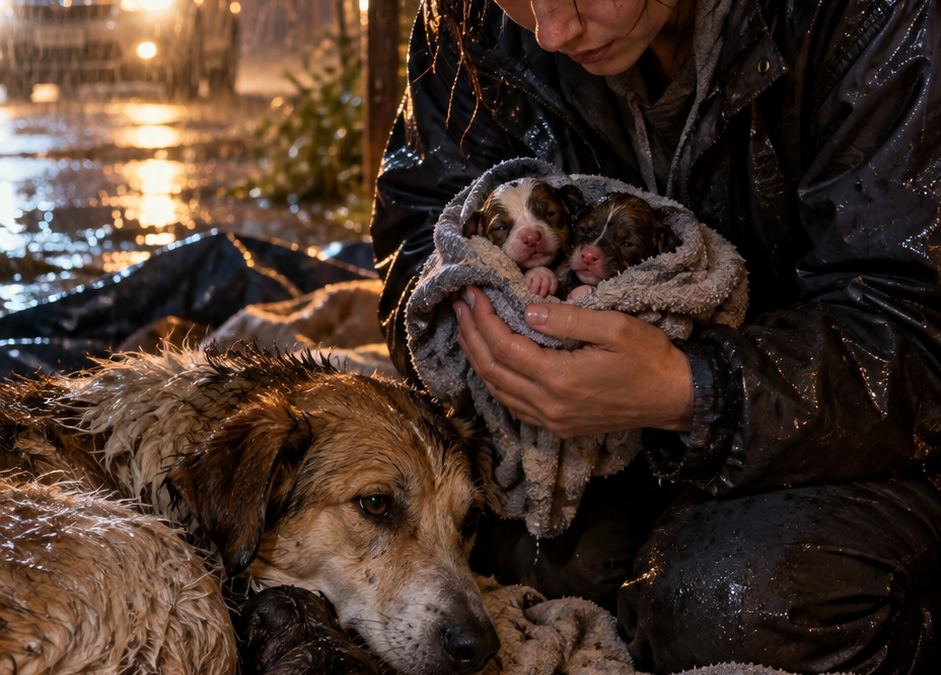
𝗣𝗔𝗥𝗧 𝟮
I stopped immediately.
There are moments in rescue when courage becomes stupidity if you take one step too many.
A terrified dog does not care that your intentions are good.
Good intentions still have hands.
Good intentions still approach.
Good intentions can still look exactly like whatever hurt them before.
So I stayed where I was.
Rain ran down my neck.
My jeans were soaked through.
The concrete beneath one knee felt like ice.
The shepherd watched me.
Her head was low over the puppies.
I opened the bag beside me and pulled out part of a hot dog.
Not ideal nutrition.
But rescue isn’t a cooking show.
Sometimes you work with whatever is in the cooler.
I tossed a small piece several feet away from her.
She didn’t move.
Another piece.
Closer.
Her nostrils flared.
She was starving.
I could see it.
But she refused to leave the puppies.
I slid the next piece along the pavement until it stopped near her front paw.
Her eyes remained on me.
Slowly, without lifting her body, she stretched her neck.
Snatched it.
Chewed once.
Then did something I didn’t expect.
Instead of swallowing the next piece I offered, she dropped it near the stronger puppy.
The puppy was far too young to eat it.
She didn’t understand that.
She only understood one thing.
Food belonged to her babies before it belonged to her.
I closed my eyes for a second.
“Of course it does,” I whispered.
She gave me another warning growl.
“Yeah, yeah. I’m still suspicious.”
The stronger puppy wriggled.
Its front paws kneaded blindly against her belly.
The weaker one remained near her hind leg.
I aimed my flashlight lower.
That was a mistake.
She lunged.
Not fully.
A bluff charge.
But her teeth snapped six inches from my hand.
I jerked backward.
My heart slammed hard enough to hurt.
“All right!”
She stood over the pups despite trembling so badly her back legs almost failed.
I raised both hands.
“You made your point.”
Her growl vibrated through the rain.
I could have called animal control and waited.
I could have tried to get a catch pole.
A crate.
Another rescuer.
Under normal circumstances, that might have been the responsible move.
But that puppy didn’t have normal-circumstances time.
Newborn puppies cannot regulate their body temperature well.
Cold is dangerous.
Wet and cold is worse.
Wet, cold, and weak after being born outdoors in a storm can turn fatal quickly.
I looked at the pup.
Then at the mother.
“We don’t have time for you to like me.”
Her ear twitched.
“So we’re going to have to settle for you not killing me.”
I eased one side of my jacket farther forward.
This time, I kept my eyes slightly lowered.
Less confrontational.
The jacket reached the stronger puppy first.
I worked the edge beneath him without touching the mother.
He squealed.
She snapped toward my sleeve.
I froze.
“I’m stopping.”
Her nose worked furiously.
She sniffed my hand.
Then the jacket.
Then me.
The growl continued.
But something changed.
It wasn’t acceptance.
Not yet.
It was hesitation.
In rescue, hesitation can be everything.
I moved the fabric another inch.
The jacket now covered part of both puppies.
Wind still pushed rain beneath it.
I leaned forward, using my shoulder as a wall.
The mother stared at me.
I stayed there.
A ridiculous human tent.
Rain pounding my back.
Arms shaking.
My flashlight lying sideways in the grass.
Minutes passed.
Maybe ten.
Maybe twenty.
Storm time is strange.
Everything stretches.
Thunder rolled farther away and then came back.
The stronger pup made a sound every few moments.
Tiny.
Sharp.
Alive.
The weaker puppy was nearly silent.
I leaned closer.
The mother growled.
“I know.”
I squinted.
The weaker pup’s side moved.
Barely.
“Come on.”
The shepherd looked down.
She nudged the baby.
Once.
Again.
Harder.
Nothing.
Then she made a sound I had never heard from her before.
Not a growl.
A whine.
Soft.
Broken.
A mother’s fear needs no translation.
I felt something twist inside my chest.
“You know too.”
She licked the puppy furiously.
Its tiny head rolled.
Still nothing.
She nudged again.
Then looked at me.
I will never claim dogs think exactly like people.
They don’t.
They have their own language.
Their own instincts.
Their own ways of understanding.
But I know what I saw in that moment.
She was scared.
And she was running out of options.
I reached forward.
She bared her teeth.
I stopped.
“Let me try.”
Growl.
“I know.”
I flattened my body lower.
“I’m not taking him.”
Her eyes burned into mine.
I extended two fingers beneath the jacket.
Her lips curled.
Closer.
The puppy was cold.
Even through wet fur, I could feel it.
I touched his side.
The mother snapped.
Her teeth closed so close to my knuckles I felt the air move.
I didn’t jerk away.
Every instinct in me screamed to.
I stayed still.
“Okay.”
She panted.
“Okay.”
My fingers remained against the puppy.
He did not react.
I looked at her.
“You can bite me.”
Her ears tilted.
“But if I leave him here, you’re going to lose him.”
The words meant nothing to her.
The tone didn’t.
Her breathing changed.
She glanced down.
Then back at me.
I moved.
Slow.
One finger beneath the puppy.
Then another.
I lifted him slightly.
She snarled.
I stopped again.
“You’re still touching him.”
I lowered him.
She immediately began licking his face.
“Good.”
I took a breath.
“You warm his face. I’ll warm the rest.”
This time when I slid my hand underneath, she did not strike.
Her jaws remained open.
Her teeth remained visible.
But she let me lift him.
The puppy weighed almost nothing.
That frightened me.
Newborn life is shockingly light.
You expect more substance.
More protection.
But there he was in my palm, barely more than warm breath should have weighed, except he wasn’t warm.
He was freezing.
I pulled open my shirt and placed him against my chest.
The shepherd lunged forward.
I turned sideways, keeping the puppy close enough that she could smell him.
“Right here.”
She pushed her nose against my arm.
Hard.
“I know.”
The stronger puppy cried beneath her.
She looked backward.
Then at the baby against me.
She was split in two.
Two pups.
One body.
One impossible choice.
“I’ll stay here.”
I cupped the weak pup inside my shirt.
His skin felt cold against my chest.
I rubbed him lightly with the dry inside of my T-shirt.
Not hard.
Steady stimulation.
His mouth opened.
Closed.
No cry.
“Come on, little man.”
The mother’s nose pressed against my wrist.
“Come on.”
Nothing.
I rubbed again.
The puppy coughed.
I froze.
A tiny sound.
More air than voice.
But sound.
The mother heard it.
Her entire body changed.
She shoved closer.
Her nose touched the puppy’s head.
She began licking him.
I laughed once.
A broken, frightened laugh.
“Yes.”
Another cough.
Then a faint squeak.
The mother whined.
I will never forget that sound.
Her earlier growls had been strong.
Defiant.
Dangerous.
That whine was naked relief.
I pulled the jacket around all of us.
The stronger pup squirmed underneath her.
The weak pup was still cold.
But alive.
“That’s one,” I whispered.
The shepherd leaned against my forearm.
For the first time, she wasn’t pushing me away.
She was trying to reach the puppy I held.
I lowered him.
She licked him.
I lifted him against her belly.
The stronger pup had found a nipple and was attempting to nurse.
Good.
Very good.
But the weak puppy couldn’t latch.
He opened his mouth.
Missed.
Tried again.
Slid sideways.
The mother repositioned.
He still couldn’t manage it.
I guided his head.
Her eyes followed my hand.
No growl.
That surprised me more than anything.
Thirty minutes earlier, she had nearly taken my fingers off for touching the fabric beneath them.
Now she watched me place her baby’s mouth against her body.
He latched.
Then lost it.
I tried again.
“Come on.”
His mouth closed around the nipple.
Nothing.
Then—
A faint pull.
Again.
I felt my eyes sting.
“You got it.”
His brother bumped him.
The weak pup lost his grip.
“Hey, bully.”
The stronger puppy squealed.
The mother began cleaning both.
I repositioned them.
I could no longer feel my knees.
My hands shook badly.
Not fear anymore.
Cold.
The storm had weakened to heavy rain.
But we had another problem.
The mother herself was fading.
Her breathing was too fast.
She had been exposed for hours.
She was thin.
Recently delivered.
Possibly dehydrated.
Possibly anemic.
Possibly dealing with retained placenta or complications I couldn’t see.
Getting the puppies warm would mean nothing if we lost their mother.
I reached slowly toward the bowl I had brought.
She stiffened.
“Water.”
I placed it beside her.
She smelled it.
Then drank.
Too fast.
I pulled it slightly away.
She growled.
I almost laughed.
“There you are.”
I gave it back after a moment.
She drank again.
Then again.
I offered more food.
This time she swallowed it.
Good.
“You need it.”
Another piece.
She ate.
The stronger puppy nursed.
The weak one made intermittent attempts.
Rain finally softened into a steady drizzle.
I checked my phone.
No signal.
Of course.
I shifted carefully.
The shepherd growled.
“Relax. My leg is dying.”
I moved maybe four inches.
Pain shot from my knee to my hip as circulation returned.
I bit down on a curse.
The mother watched suspiciously.
“You’ve been lying in mud for six hours and you’re judging my discomfort?”
Her tail moved.
At least I thought it did.
Maybe rain pushed it.
I chose to believe she was insulting me.
It made the situation less frightening.
I tried my phone again.
One bar.
I called Maya.
Maya ran a small rescue group I’d volunteered with for years.
She answered after three rings.
“Daniel?”
“Yeah.”
“Do you know what time it is?”
“No.”
“That’s never a good answer.”
“I need help.”
She was awake instantly.
“What happened?”
“German Shepherd. Just gave birth outside.”
“How many?”
“Two pups.”
“Alive?”
“One strong. One questionable.”
“Mother?”
“Protective. Exhausted. Thin.”
“Location?”
I told her.
“Can you move them?”
I looked at the dog.
She showed me a tooth.
“Define can.”
“Daniel.”
“Not safely yet.”
“Is she contained?”
“Fence on one side. Dumpster on the other.”
“You’re in the storm?”
“Yes.”
There was silence.
“You’re an idiot.”
“Useful observation.”
“I’ll call Dr. Romero and meet you.”
“Bring blankets.”
“Obviously.”
“And a crate.”
“Daniel.”
“What?”
“Don’t get bitten.”
I looked at the shepherd.
“No promises.”
Maya hung up.
I put my phone inside the driest pocket I had.
“Reinforcements.”
The mother blinked at me.
“You’re going to hate them too.”
The weak puppy finally latched again.
This time he stayed there for almost a minute.
Then two.
My hand hovered beneath him in case he slipped.
The mother lowered her head.
She looked exhausted beyond anything words can describe.
Her eyes began closing.
Then snapping open.
She was afraid to sleep.
I understood.
“You can rest.”
Her eyes opened.
“I’ve got them.”
She did not trust that.
Not fully.
But after another few minutes, her chin slowly settled against my sleeve.
I stopped breathing.
She had put her head on me.
Not affection.
Not friendship.
Necessity.
Still, trust often begins as necessity.
I stayed completely still.
Her eyes closed.
One minute.
Two.
Then thunder rolled in the distance.
Her head came up.
I felt strangely disappointed.
“Soon.”
The stronger puppy’s belly was beginning to round.
Excellent.
The weaker pup’s body felt warmer than before.
His movements were still slow.
But there were movements.
I checked his gums.
Pinkish.
Better than gray.
“Not bad.”
The mother sniffed my face.
Her nose nearly touched my chin.
“I’m trying.”
She looked back down.
I finally allowed myself to believe we might get all three out of there alive.
That hope scared me.
Rescue teaches you not to celebrate too early.
I’ve seen dogs rally and crash.
Puppies seem stronger until suddenly they aren’t.
Mothers survive births and decline hours later.
Nature doesn’t care whether you’ve become emotionally invested.
Still, hope arrived.
Small.
Dangerous.
Persistent.
Just like that puppy.
Maya arrived forty minutes later with Dr. Elena Romero.
They approached from the parking lot carrying blankets, medical supplies, and a large crate.
The shepherd heard them.
Her entire body snapped rigid.
The growl returned instantly.
“Easy,” I whispered.
Maya stopped twenty feet away.
“That her?”
“No, Maya. This is another lactating German Shepherd lying exactly where I told you.”
“Good. You’re still sarcastic.”
“Means I’m alive.”
Dr. Romero crouched.
“How long since delivery?”
“Unknown. Probably a few hours.”
“She standing?”
“Barely.”
“Bleeding?”
“Some, doesn’t look excessive.”
“Pups nursing?”
“One. The second started recently.”
Dr. Romero studied the situation.
“We need them warm.”
“I know.”
“We also need Mom examined.”
“She knows.”
The mother growled toward them.
Maya whispered, “She looks thrilled.”
“She loves company.”
Dr. Romero remained where she was.
No rush.
That was why I trusted her.
Some professionals look at frightened animals and see a problem to control.
Dr. Romero saw a frightened animal first.
She placed food on the ground.
Then sat.
We waited.
Ten minutes.
The mother watched her.
Maya moved to the opposite side and carefully extended a blanket toward me with a broom handle.
I caught it.
“Very dignified.”
“Shut up and take the blanket.”
I worked it beneath the puppies.
The mother tolerated it.
Progress.
Dr. Romero said, “Can you touch her?”
“Some.”
“Neck?”
I tried.
The mother’s lip lifted.
“Nope.”
“Back?”
I placed one hand on her shoulder.
She stiffened.
But allowed it.
“Good. Keep doing that.”
“Why?”
“So she associates your touch with nothing bad happening.”
My fingers moved slowly through the soaked fur.
The dog was freezing.
I felt every vertebra.
“She needs out of here.”
“I agree.”
“How?”
“Carry the puppies first.”
I looked at her.
Dr. Romero continued.
“She may follow.”
“Or remove my arm.”
“That too.”
“Glad we considered both possibilities.”
Maya sighed.
“Could you two not?”
Dr. Romero smiled.
“Daniel, she trusts you most.”
“Low bar.”
“You’re still the best option.”
I looked at the mother.
Her amber eyes met mine.
“All right.”
I wrapped both puppies together in a dry blanket.
She immediately rose.
Her growl exploded.
“Easy.”
I kept the bundle close to her nose.
She sniffed frantically.
“They’re here.”
I lifted them perhaps two inches.
She snapped toward my arm.
I stopped.
“Not leaving.”
Her breathing became frantic.
I lowered them.
She licked the blanket.
Again.
Dr. Romero said quietly, “Move only when she settles.”
We repeated the exercise.
Lift.
Pause.
Lower.
Lift.
Pause.
Hold.
Each time, her reaction became slightly smaller.
After several attempts, I stood halfway.
She stood too.
Her legs wobbled.
“You’re coming.”
I moved one step.
She followed.
Another.
She followed again.
Maya backed toward the vehicle.
I carried the puppies against my chest.
The mother walked so closely beside me that her shoulder touched my leg.
Not because she wanted comfort.
Because if I tried stealing her babies, she planned on climbing me like a tree.
Fair enough.
We reached the open side door of Maya’s rescue van.
The floor was lined with blankets.
A crate had been opened inside.
The mother stopped.
No.
Her entire body said it.
New space.
Metal.
Smells.
Trap.
I stepped inside first.
She didn’t follow.
I sat.
Placed the puppies on my lap.
The stronger one cried.
The mother took one step.
Stopped.
Another.
She stretched her neck.
“I know.”
I placed the babies on the floor just inside the door.
She jumped in.
Maya closed the outer door behind her.
The mother spun around.
Growling.
“Hey.”
She looked at me.
“I’m still here.”
I sat beside her.
Slowly, she returned to the pups.
We drove to Dr. Romero’s clinic.
I stayed in the back.
The mother never stopped watching me.
Every turn made her brace.
Every bump made her check the puppies.
The weak one remained wrapped against my chest for most of the trip.
The stronger puppy nursed intermittently.
We arrived shortly before dawn.
The clinic was warm.
So warm it almost hurt after hours outside.
Dr. Romero led us through a side entrance into a quiet treatment room.
No barking dogs.
No bright waiting area.
Just dim lights and clean blankets.
The mother refused to leave the van at first.
We moved the puppies.
She followed immediately.
Good.
Inside, we built a nest.
Heating pad beneath half the bedding.
Warm towels.
Dry blankets.
Puppies against their mother.
The shepherd shook violently.
As she dried, I finally saw how thin she really was.
Her hip bones protruded.
Her coat was patchy around the hindquarters.
There were old marks around her neck.
Probably from a collar or chain.
Maya saw them too.
“Damn.”
Dr. Romero said nothing.
She examined the puppies first.
The stronger one weighed just under a pound.
His temperature was low but climbing.
Good reflexes.
Strong suckle.
Dehydrated.
The weaker puppy made me afraid.
Dr. Romero listened to his chest.
Checked his mouth.
His temperature.
His heart rate.
“Well?”
“He’s very cold.”
“I know.”
“Very weak.”
“I know.”
“But he’s breathing.”
I looked at her.
“That’s your optimistic speech?”
“For now.”
She placed him inside a warmed incubator box with supplemental oxygen.
The mother panicked.
She rose and began pacing.
I blocked her from jumping off the exam table.
“It’s okay.”
She whined.
The sound broke me all over again.
“He’s right there.”
She could see him through the clear panel.
She pushed her nose against it.
The puppy moved.
Barely.
She scratched once at the box.
Dr. Romero said, “Let her stay close.”
We positioned her beside it while she nursed the stronger pup.
Then came her examination.
She didn’t appreciate that.
Temperature.
Heart.
Gums.
Abdomen.
Mammary glands.
She tolerated me touching her, but whenever Dr. Romero reached too quickly, the growl returned.
We worked slowly.
“She needs fluids,” Dr. Romero said.
“Can you do it?”
“Yes.”
She looked at me.
“But you’re probably going to hold her.”
“Fantastic.”
I sat on the floor with the mother’s shoulder against my chest.
Maya slipped a towel around her neck.
Dr. Romero placed the catheter.
The shepherd growled.
I rubbed her ear.
“You survived giving birth in a hurricane.”
She glared at me.
“Don’t let a little needle ruin your reputation.”
Maya snorted.
The dog tolerated the fluids.
Bloodwork showed dehydration, anemia, low blood sugar, and signs of malnutrition.
But no catastrophic infection.
No obvious retained fetus.
No severe hemorrhage.
That was good news.
For once, I accepted good news without asking what could go wrong next.
We fed her tiny amounts first.
She inhaled them.
Then stared at us.
Maya said, “That’s enough for now.”
The dog stared harder.
“She disagrees.”
“Her stomach needs time.”
“Tell her.”
Maya looked at the shepherd.
“No.”
The shepherd’s expression did not change.
I laughed.
“She doesn’t respect your authority.”
“Neither do you.”
“True.”
The sun came up while we sat there.
New Orleans after a storm has a strange kind of morning.
Everything looks scrubbed and wounded at the same time.
Branches in streets.
Water standing against curbs.
Sky impossibly blue.
From the clinic window, sunlight spread across the wet parking lot.
I had been awake almost twenty-four hours.
My clothes smelled like mud.
My knees hurt.
My back hurt.
Every finger was wrinkled from water.
None of it mattered.
I sat beside the incubator.
The weak puppy lay inside, breathing.
That was enough.
The shepherd finally fell asleep.
Not half asleep.
Not listening.
Really asleep.
Her head dropped onto my boot.
The stronger puppy slept against her belly.
Maya looked at me from across the room.
“Have you named her?”
“No.”
“She needs something for the paperwork.”
I looked down.
The shepherd’s black coat had begun drying.
There was something ancient about her face when she slept.
Serious.
Watchful even at rest.
“Inca.”
Maya tilted her head.
“Inca?”
“Yeah.”
“Why?”
“I don’t know.”
“Compelling origin story.”
“It fits.”
I looked down again.
“Inca.”
One ear twitched.
Maya smiled.
“Apparently she agrees.”
“What about the boys?”
“Too early.”
“You named Mom immediately.”
“She almost bit me three times. We’ve bonded.”
Maya laughed.
The weak puppy remained unnamed.
Naming him felt dangerous.
As though giving him a name meant believing too strongly that he would survive.
I hated myself for thinking that.
Around nine in the morning, his temperature finally began moving in the right direction.
At ten, his breathing improved.
At eleven, Dr. Romero took him out of the incubator and placed him against Inca.
She woke instantly.
Her nose touched him.
Then she began licking him so intensely we had to stop her from rolling him across the blanket.
“Easy, Mom.”
The puppy squeaked.
Inca froze.
He squeaked again.
Something changed in her face.
I know how ridiculous that sounds.
But it did.
She began whining softly.
The stronger pup woke and crawled toward the noise.
I guided the weak puppy toward a nipple.
He tried to latch.
Missed.
Tried again.
Inca turned her body slightly.
Helping him.
Third attempt.
Latch.
He began nursing.
Weakly.
But nursing.
Maya covered her mouth.
Dr. Romero smiled.
I looked away.
“What?” Maya asked.
“Nothing.”
“You’re crying.”
“I’m tired.”
“Sure.”
“I was in rain for six hours.”
“Rain usually gets your eyes from the outside.”
I pointed at her.
“Don’t ruin this.”
She laughed softly.
We named the stronger puppy Beau because Maya insisted every dog born in New Orleans should be allowed at least one excessively local name.
The weaker puppy became Finn.
Not because the name had meaning.
Because when I looked at him, that was the name I heard.
Beau was noisy.
Finn was quiet.
Beau pushed.
Finn persisted.
That difference remained as they grew.
For the first forty-eight hours, Finn scared us repeatedly.
His blood sugar dropped.
Then stabilized.
He struggled to nurse.
Then improved.
His temperature dipped.
Then rose.
Every small setback felt enormous.
Every tiny improvement felt miraculous.
Inca stayed with him constantly.
If we moved Finn for an examination, she watched every second.
She had accepted me.
Mostly.
She tolerated Maya.
She developed a cautious truce with Dr. Romero.
Everyone else was treated as a suspected kidnapper.
One veterinary technician stepped too close to the puppies on the second day.
Inca stood so fast that the technician nearly dropped a clipboard.
I said, “She has boundaries.”
The technician said, “She has knives in her mouth.”
“Also true.”
But the aggression wasn’t random.
That mattered.
Inca wasn’t vicious.
She was specific.
Approach her calmly—fine.
Touch her—maybe.
Reach toward her newborns without introduction—absolutely not.
Humans like to call animals difficult when they fail to behave conveniently.
I had heard it a thousand times.
Too aggressive.
Too stubborn.
Too fearful.
Too protective.
Sometimes those descriptions were accurate.
Often they were lazy translations.
What I saw in Inca was not aggression without purpose.
It was history.
She had learned nobody else would protect what was hers.
So she did.
We searched for an owner.
No microchip.
No collar.
No missing-dog report matching her description.
We posted notices through shelters and neighborhood groups.
Nothing.
Someone recognized her from an area near an abandoned rental property several blocks away.
A neighbor told us he had seen a shepherd chained there weeks before.
Then the tenants disappeared.
No forwarding address.
No dog.
Possibly Inca.
We couldn’t prove it.
But the marks on her neck made the story believable.
The idea that someone might have left a pregnant dog chained outside made me furious.
Maya saw my face.
“Don’t.”
“Don’t what?”
“Build a whole prosecution in your head without evidence.”
“I wasn’t.”
“You were.”
“I was building half a prosecution.”
“Daniel.”
“Fine.”
Inca didn’t care about prosecution.
She cared about her puppies.
For the first week, she barely left them.
We had to coax her outside.
She would relieve herself in record time, then drag us back toward the clinic door.
“Your children are still there,” I’d tell her.
She pulled harder.
“Relax.”
No relaxation.
Once she reached the room and saw them, her whole posture softened.
Every time.
By the second week, Beau had doubled his birth weight.
Finn lagged behind.
But he gained.
That was what mattered.
His eyes opened first.
The weak one.
The puppy we thought wouldn’t survive the storm opened his eyes before his stronger brother.
I was sitting on the floor when it happened.
Finn’s eyelids had been forming tiny cracks for hours.
Then one morning he looked up at the world for the first time.
Cloudy blue puppy eyes.
Completely unfocused.
I leaned close.
“That’s what nearly killed you.”
He sneezed.
“Fair review.”
Inca watched me.
“She agrees.”
Beau opened his eyes the next day.
Then chaos began.
Newborns became crawling potatoes.
Crawling potatoes became tiny dogs.
Beau learned to walk first.
Poorly.
He took three steps.
Fell sideways.
Barked.
Apparently offended by gravity.
Finn took longer.
His hind legs were weaker.
At first, he dragged them slightly.
I felt fear return.
Dr. Romero examined him.
“Give him time.”
“Are you sure?”
“No.”
I hated that answer.
She continued.
“But nothing suggests major neurological damage right now.”
“Right now.”
“Daniel.”
“What?”
“You’re borrowing problems from the future.”
I looked at Finn.
He was trying to climb over Beau.
“Occupational hazard.”
Over the next week, Finn’s legs strengthened.
First he stood.
Then wobbled.
Then walked.
Then, with absolutely no gratitude for the humans who had worried themselves sick over him, he began stealing food from Beau.
“That seems neurologically healthy,” Maya said.
“Unfortunately.”
Inca began changing too.
As the puppies grew stronger, she became less defensive.
She discovered toys.
The first one was a tennis ball.
I rolled it toward her.
She jumped backward.
I rolled it again.
She sniffed it.
Pawed it.
The ball moved.
She barked.
I laughed.
She glared at me.
“Sorry.”
She pawed it again.
It rolled across the room.
Ten minutes later, she was chasing it.
That moment hurt in a different way.
Until then, Inca had existed entirely as a mother.
Defender.
Provider.
Shield.
Watching her play reminded me that she was still a dog.
Young enough to chase a ball.
Young enough to have a life outside survival.
I wondered when someone had last allowed her to be that.
By week four, Beau and Finn were wrestling constantly.
Beau was heavier.
Finn was cleverer.
Beau attacked like a bulldozer.
Finn learned to hide behind Inca and ambush him.
Inca tolerated this for approximately six minutes at a time before standing up and walking away with the weary expression of every exhausted mother in history.
“Parenthood,” I said.
Maya nodded.
“She regrets nothing and everything.”
Finn followed Inca everywhere.
Beau followed whoever had food.
Their personalities became clearer every day.
And then came the question I had avoided.
“What happens when they’re ready?”
Maya asked it one evening.
The puppies were nearly six weeks old.
We were sitting outside the rescue facility while Beau tried to eat a leaf.
Finn was attacking my shoelace.
Inca lay beside my chair.
“What do you mean?”
“You know exactly what I mean.”
“No.”
“Adoption.”
I hated the word.
Maya noticed.
“Oh, no.”
“What?”
“You’re attached.”
“I’m a volunteer. Attachment happens.”
“Daniel.”
“Inca isn’t adoptable yet.”
“I didn’t say she was.”
“And the puppies need at least two more weeks.”
“I know.”
“So this conversation is premature.”
She smiled.
“You’re going to keep one.”
“No.”
“Two?”
“No.”
“Three?”
“Don’t be ridiculous.”
Inca rested her head on my foot.
Maya pointed.
“She’s already voted.”
“That is not legally binding.”
Finn climbed into my lap.
Maya raised her eyebrows.
“Second vote.”
Beau waddled over and bit the cuff of my jeans.
“That’s assault.”
“Third vote.”
I looked at all three.
“This is manipulation.”
“Correct.”
I had a house.
Fenced yard.
Stable schedule.
No other pets.
There was no practical reason I couldn’t adopt Inca.
The puppies were another matter.
Keeping an entire canine family isn’t always best simply because it feels sentimental.
Puppies eventually need individual attention.
Training.
Socialization.
Independent bonds.
Good homes mattered more than my reluctance to say goodbye.
So when they reached adoption age, we started reviewing applications.
I hated every applicant.
Not literally.
But emotionally?
Absolutely.
One family had a beautiful yard.
I decided the fence looked suspicious.
Another applicant had owned shepherds for twenty years.
I wondered if twenty-one years would have shown greater commitment.
A third family had children who had grown up around dogs.
Too cheerful.
Nobody should be trusted with that level of optimism.
Maya finally took the applications away from me.
“You’re impossible.”
“I have standards.”
“You rejected a veterinarian.”
“His work hours concerned me.”
“He owns the clinic.”
“Exactly. Very demanding.”
Maya stared.
“Go home.”
“I am helping.”
“No.”
Eventually, reason prevailed.
Mostly because Maya threatened to ban me from the adoption process.
Beau went to a family outside Baton Rouge.
A couple named Marcus and Elaine.
Two teenagers.
Large fenced property.
An older Labrador named June who had the patience of a saint.
They visited three times.
Beau loved them immediately.
Of course he did.
Traitor.
The day they took him home, Inca paced.
She searched the room.
She sniffed the blanket.
She looked at me.
I sat beside her.
“He’s okay.”
She walked toward the door.
“He’s okay.”
I didn’t know whether saying it helped her.
It helped me.
Marcus sent a photograph that evening.
Beau asleep on top of June.
Completely sprawled across her back.
I showed Inca my phone.
“See?”
She sniffed the screen.
Then licked it.
Close enough.
Finn was harder.
Not because applicants didn’t want him.
Because I did.
There.
That’s the truth.
The puppy I had held against my chest in the storm had become mine emotionally long before I admitted it.
Every time someone applied for him, I found some flaw.
Maya finally cornered me.
“Adopt him.”
“What?”
“Finn.”
“I can’t.”
“Why?”
“Because I volunteer here.”
“That has never stopped anybody.”
“It complicates things.”
“No. You’re complicating things.”
I looked toward the pen.
Finn was chewing a rope.
Inca lay nearby.
“What about her?”
Maya followed my gaze.
“What about her?”
“They’re bonded.”
“They’ll adjust.”
I looked at her.
Maya sighed.
“Oh.”
“What?”
“You don’t want Finn without Inca.”
I said nothing.
“You want both.”
“No.”
“Daniel.”
“No.”
Finn spotted me.
He ran.
Well, attempted to run.
His puppy legs moved faster than his judgment.
He crashed into my boot.
Inca followed.
Finn climbed onto my shoe.
Inca leaned against my knee.
Maya folded her arms.
“This is embarrassing.”
“I hate you.”
“You’ll need two crates.”
“I have a crate.”
“Two.”
“I haven’t agreed.”
“And puppy-proofing.”
“Maya.”
“Training classes.”
“Maya.”
“And good vacuum cleaner.”
I looked down at Finn.
He was asleep on my foot.
“Inca’s staying too.”
“I know.”
“How?”
“You’re obvious.”
“I’ve never owned a German Shepherd.”
“You’ve spent six weeks living at the rescue with one.”
“Different.”
“Correct. At your house you’ll get even less sleep.”
I laughed.
Then looked at Inca.
Her amber eyes met mine.
No fear.
Not anymore.
I remembered those same eyes in the storm.
Teeth flashing.
Rain running over her face.
Her body curved around two newborns as though she could physically keep death away.
“You want to come home?”
Her ears lifted.
Finn woke.
Maya whispered, “That’s binding.”
“Quiet.”
Inca leaned forward.
Her nose touched my hand.
That was the end of the discussion.
They came home three days later.
Finn adapted in approximately fifteen seconds.
He walked into my living room, peed on the rug, stole a dish towel, and fell asleep beneath the coffee table.
Confident ownership established.
Inca stood in the doorway.
She would not enter.
I sat inside.
“Take your time.”
She looked behind her.
Then forward.
The rescue facility had become safe.
My house was unknown.
Unknown had not treated her kindly before.
I waited.
Finn woke and stumbled toward her.
Inca looked at him.
Then crossed the threshold.
One paw.
Then another.
She sniffed every wall.
Every chair.
Every doorway.
When the refrigerator started, she jumped.
When the furnace clicked, she froze.
When a car door slammed outside, she ran toward Finn.
But she stayed.
That first night, Finn slept in a puppy pen beside my bed.
Inca refused the dog bed I had bought.
Instead, she lay on the floor between me and the bedroom door.
Guard position.
“Seriously?”
Her ears twitched.
“You survived the street. You’re allowed to sleep comfortably.”
Nothing.
I dragged the dog bed beside the door.
She stepped onto it.
Turned twice.
Lay down.
“Progress.”
At two in the morning, I woke with her nose six inches from my face.
“What?”
Her tail moved.
“Finn?”
I checked.
He was awake.
And chewing the pen.
Bathroom trip.
I carried him outside.
Inca came too.
The night was clear.
No rain.
No thunder.
Finn waddled through the grass.
Inca watched him.
I watched her.
One ordinary backyard.
One mother.
One surviving son.
No storm.
No dumpster.
No flooded asphalt.
Something inside me loosened.
“You did it.”
Inca looked up.
“I know you don’t understand.”
Her tail moved once.
“But you did.”
Finn finished his business and immediately attempted to eat grass.
“Your son is an idiot.”
Inca sighed.
We went inside.
The following months were loud.
Messy.
Expensive.
Perfect.
Finn grew into an absurdly handsome shepherd.
His ears went through a phase where one stood and the other collapsed.
Then the standing ear switched.
For several weeks he looked like his antenna reception depended on weather.
He grew quickly.
Too quickly.
By six months he no longer fit on my lap.
He disagreed.
He continued attempting to sit there anyway.
Inca gained nearly twenty pounds.
Her coat thickened.
Her muscles returned.
The scars beneath her neck fur became harder to find.
She learned basic obedience almost immediately.
Sit.
Down.
Wait.
Come.
Place.
Finn learned those too, though his interpretation of “wait” was more philosophical.
Training changed Inca.
Not because she needed to be controlled.
Because clear communication gave her confidence.
She no longer had to guess what I wanted.
And I learned to read her.
Ear position.
Tail.
Mouth.
Weight shift.
A dog’s body speaks constantly if a person bothers listening.
She still disliked strangers reaching over her head.
Fine.
Nobody had the right to do that.
She still became tense around chain-link fencing.
We avoided forcing her through it.
She still checked Finn whenever he made an unusual sound.
That never disappeared.
Motherhood had been burned into her.
One afternoon, when Finn was around eight months old, a thunderstorm rolled over New Orleans.
The first crack sent him barking toward the window.
Inca froze.
I watched her body lower.
The old fear returned.
Rain began hammering the roof.
For an instant, she was back behind that supermarket.
I could see it.
Her breathing sped up.
Her eyes searched.
Door.
Window.
Finn.
Me.
“Inca.”
She looked at me.
Finn trotted over.
He nudged her face.
Another thunderclap.
She flinched.
Then Finn dropped his front legs into a play bow.
Completely inappropriate.
Entirely Finn.
Inca stared at him.
He barked.
Tail wagging.
Another thunder roll.
Finn grabbed a rope toy.
He shoved it against her muzzle.
Inca blinked.
Then grabbed the other end.
I stood in the kitchen watching mother and son play tug-of-war while rain battered the windows.
My throat tightened.
She hadn’t forgotten the storm.
She had simply learned that not every storm ended the same way.
That mattered.
A year after I found them, Maya organized a small gathering at the rescue.
Beau’s family came.
I hadn’t seen him in months.
He jumped from their SUV looking enormous.
The tiny puppy who once fit against Inca’s belly had become seventy pounds of enthusiasm.
Inca saw him.
She froze.
So did Beau.
For one second, I wondered if they would recognize each other.
Then Beau ran.
Inca met him halfway.
The sound she made was somewhere between a bark and a whine.
Beau buried his face against her neck.
Finn joined them.
Three black-and-tan bodies circling.
Sniffing.
Jumping.
Marcus laughed.
“I guess they remember.”
I couldn’t answer immediately.
Elaine hugged me.
“Thank you for saving him.”
I shook my head.
“I kept rain off him.”
She glanced at Inca.
“She did the saving.”
Exactly.
We spent the afternoon watching them run.
Beau had grown broader than Finn.
Finn remained faster.
Inca supervised everything like a tired referee.
Eventually, all three collapsed beneath an oak tree.
Beau against one side of her.
Finn against the other.
Almost exactly as they had been on that first night.
Except now the grass was dry.
The sun was out.
Their bellies were full.
And nobody was fighting for the next breath.
Maya sat beside me.
“Worth getting soaked?”
I looked at her.
“Ask me when my knees stop hurting.”
“That happened a year ago.”
“I hold grudges.”
She laughed.
We watched Inca sleep.
“You know,” Maya said, “when you first called me, I thought we’d lose Finn.”
“So did I.”
“You never said that.”
“Didn’t help.”
“He was cold enough that…”
“I know.”
She stopped.
After a moment, she said, “You kept him alive until we could stabilize him.”
I looked at Inca.
“No.”
Maya rolled her eyes.
“Yes.”
“She let me.”
“That doesn’t make your part smaller.”
I considered that.
Rescue has a strange relationship with credit.
People always want one hero.
The person who finds the dog.
The veterinarian.
The foster.
The donor.
The adopter.
Reality doesn’t work that way.
A life is usually saved by a chain of people doing one necessary thing after another.
Someone makes the call.
Someone drives into the rain.
Someone gets bitten or nearly bitten.
Someone warms the animal.
Someone opens the clinic.
Someone pays the bill.
Someone fosters.
Someone trains.
Someone adopts.
No single link is the story.
And that night, the strongest link wasn’t me.
It was Inca.
She gave birth alone.
Cold.
Hungry.
Abandoned.
Terrified.
Then she wrapped herself around two puppies and decided the storm could take her before it took them.
Everything I did came after that decision.
A few weeks later, I found the old jacket.
The one from the storm.
It had been washed several times.
Still stained.
A tear ran down one sleeve where it had caught against the fence.
I almost threw it away.
Instead, I put it in a storage box.
Not because I’m sentimental about clothing.
Because sometimes an ordinary object becomes evidence.
Evidence that a terrible night happened.
And evidence that it ended.
Finn turned two.
Then three.
He became larger than Inca.
He never realized it.
Whenever something startled him, he still looked for her.
Whenever she slept, he often dropped beside her.
Beau visited occasionally.
Every reunion was chaos.
Inca aged slowly.
Gray began appearing around her muzzle.
I hated it.
Dogs should be exempt from time.
They aren’t.
One summer evening, I sat in the yard while Inca lay near my chair.
Finn was chasing something imaginary along the fence.
The air smelled like wet grass.
Not storm rain.
Just the soft rain that falls before sunset.
I reached down and scratched beneath her chin.
“You remember?”
Her eyes half closed.
“I do.”
Finn ran over.
Dropped a ball on my foot.
I threw it.
He chased it.
Inca watched.
There was peace in her face now.
Not the absence of history.
Peace does not require forgetting.
Maybe that’s what I had misunderstood for years.
Rescue isn’t about turning an animal into something untouched.
You can’t erase what happened.
You can’t return Inca to the dog she was before she was abandoned.
You can’t make Finn a puppy who wasn’t born cold in floodwater.
You can only give what comes next.
Safety.
Food.
Warmth.
Routine.
Choice.
Time.
Enough good days that the bad ones stop owning everything.
Rain began to fall slightly harder.
Finn returned with the ball.
Inca stood.
For a second, I wondered if she would go inside.
Instead, she stretched.
Walked into the yard.
And nudged the ball away from Finn.
He chased her.
I laughed.
“Inca!”
She ran.
Gray muzzle.
Bright eyes.
Tail high.
Finn tore after her.
Rain darkened both their coats.
Neither cared.
I sat beneath the porch roof and watched them.
Years earlier, rain had meant cold.
Danger.
Birth.
Fear.
A puppy whose breath was disappearing against my chest.
Now rain meant a game in the backyard.
Maybe that was healing.
Not forgetting the storm.
Learning that rain could become something else.
Later that night, Finn fell asleep across the foot of my bed.
Inca curled beside him.
I turned off the light.
A storm rumbled somewhere far from the city.
Finn’s paws twitched in his sleep.
Inca lifted her head.
Listened.
Then lowered it again.
Safe.
I lay there remembering that first night.
The supermarket loading dock.
The green grass nearly underwater.
Inca’s teeth flashing whenever I moved.
Beau crying against her belly.
Finn cold and silent in my palm.
My jacket stretched over us like the world’s worst shelter.
I remembered telling her, “You keep them. I’ll keep the rain off.”
At the time, I thought I was helping her save those puppies.
Years later, I understood what had really happened.
She had shown me what refusing to surrender looked like.
Not dramatically.
Not beautifully.
It looked exhausted.
Muddy.
Frightened.
Sometimes angry.
It looked like a mother using the last warmth in her body to cover her babies.
It looked like a newborn taking one more breath when the previous one had seemed like his last.
It looked like waiting.
Holding.
Trying again.
Morning did eventually come.
It always had.
I just hadn’t understood how long one night could be until I spent it holding a life that might not reach dawn.
Finn shifted in his sleep.
His back pressed against Inca.
She opened one eye.
I whispered, “Go back to sleep.”
She did.
The storm outside moved farther away.
The house remained warm.
And the German Shepherd mother I once found shivering in the rain slept beside the son we had almost lost, both of them breathing deeply in a home where neither would ever have to fight the weather alone again.
Have you finished reading the story and want to read it again?
She Gave Birth in a New Orleans Storm—By Dawn, One Tiny Puppy Had Somehow Refused to Die
I found her giving birth in the middle of a storm.
One puppy was crying.
The other was almost completely still.
My name is Daniel Mercer, and I was forty-six the night I found Inca behind a supermarket in New Orleans, curled around two newborn German Shepherd puppies while the sky seemed determined to drown the entire city.
I had gone out because someone called about a stray dog hiding near the loading area.
That was all I knew.
Stray dog.
Supermarket.
Storm.
I had answered worse calls.
At least I thought I had.
By the time I pulled into the back lot, rain was coming down so hard the windshield wipers were nearly useless. Water raced along the curb in muddy sheets, grocery bags spun through the drainage ditch, and every few seconds lightning turned the parking lot white.
I parked beside the loading dock and stepped into ankle-deep water.
“Inca?”
Of course, I didn’t know her name then.
I only knew there was supposed to be a shepherd somewhere behind the dumpsters.
I carried a flashlight in one hand and a bag of food in the other.
Then I heard the sound.
Not a bark.
Not a growl.
A tiny squeak.
I swung the flashlight toward the chain-link fence.
Something moved.
At first, all I saw was wet black-and-tan fur.
Then the dog lifted her head.
German Shepherd.
Young adult.
Female.
Soaked to the skin.
Her ribs stood out sharply beneath her coat.
She was lying in a patch of grass beside the fence, half submerged in runoff.
And beneath her belly were two newborn puppies.
I stopped.
One puppy was moving.
Barely.
The other looked like a small wet rag.
The mother saw me and transformed.
Her lips pulled back.
Her ears flattened.
A growl rolled from somewhere deep inside her chest.
I immediately lowered myself.
“All right.”
Her teeth flashed.
“I see you.”
Thunder cracked above us.
The stronger puppy squealed.
The mother curled tighter around both babies.
My stomach dropped.
They hadn’t been born yesterday.
They hadn’t been born that morning.
Judging by their wet cords and the mother’s condition, they had been born right there during the storm.
I had dealt with frightened dogs before.
Bitten dogs.
Abused dogs.
Dogs who wanted desperately to trust and had forgotten how.
But a mother with newborns was different.
Every instinct she possessed was telling her that I was one more danger in a night already full of them.
I put the food bag down.
“I’m not taking them.”
She growled harder.
“I’m not.”
The weaker puppy moved its mouth.
No sound came out.
I stared at it.
Its chest barely rose.
Rainwater ran across my face.
The mother lowered her head and nudged the puppy.
Nothing.
Then she looked at me again.
For a few seconds, neither of us moved.
The storm hammered against the metal loading dock.
Water streamed around her body.
One of her babies was fading.
And the only thing standing between me and that tiny life was a terrified mother who had every reason in the world not to trust a man walking toward her through the rain.
I pulled off my jacket.
Her growl sharpened.
“Easy.”
I placed it slowly on the ground between us.
No sudden movement.
No reaching.
No heroics.
Trust is not something you steal from a frightened animal.
You wait until they offer you one inch.
Then you prove you deserved it.
I pushed the jacket forward.
The wind caught the sleeve.
I pinned it beneath my hand.
The stronger puppy cried.
The weaker one didn’t.
That silence scared me more than the growl.
“Inca,” I whispered, although I still didn’t know what I would eventually call her.
“You keep them.”
I moved the jacket another inch.
“I’ll keep the rain away.”
She stared at me.
Her body shook.
Not just anger.
Cold.
Exhaustion.
Labor.
Fear.
She had already given everything she had.
Now she was being asked to decide whether the stranger kneeling in front of her was there to save her babies or steal them.
Lightning flashed.
The silent puppy’s tiny paw twitched.
That was enough.
I crawled closer.
And the mother showed me every tooth in her mouth.
PART2
I stopped immediately.
There are moments in rescue when courage becomes stupidity if you take one step too many.
A terrified dog does not care that your intentions are good.
Good intentions still have hands.
Good intentions still approach.
Good intentions can still look exactly like whatever hurt them before.
So I stayed where I was.
Rain ran down my neck.
My jeans were soaked through.
The concrete beneath one knee felt like ice.
The shepherd watched me.
Her head was low over the puppies.
I opened the bag beside me and pulled out part of a hot dog.
Not ideal nutrition.
But rescue isn’t a cooking show.
Sometimes you work with whatever is in the cooler.
I tossed a small piece several feet away from her.
She didn’t move.
Another piece.
Closer.
Her nostrils flared.
She was starving.
I could see it.
But she refused to leave the puppies.
I slid the next piece along the pavement until it stopped near her front paw.
Her eyes remained on me.
Slowly, without lifting her body, she stretched her neck.
Snatched it.
Chewed once.
Then did something I didn’t expect.
Instead of swallowing the next piece I offered, she dropped it near the stronger puppy.
The puppy was far too young to eat it.
She didn’t understand that.
She only understood one thing.
Food belonged to her babies before it belonged to her.
I closed my eyes for a second.
“Of course it does,” I whispered.
She gave me another warning growl.
“Yeah, yeah. I’m still suspicious.”
The stronger puppy wriggled.
Its front paws kneaded blindly against her belly.
The weaker one remained near her hind leg.
I aimed my flashlight lower.
That was a mistake.
She lunged.
Not fully.
A bluff charge.
But her teeth snapped six inches from my hand.
I jerked backward.
My heart slammed hard enough to hurt.
“All right!”
She stood over the pups despite trembling so badly her back legs almost failed.
I raised both hands.
“You made your point.”
Her growl vibrated through the rain.
I could have called animal control and waited.
I could have tried to get a catch pole.
A crate.
Another rescuer.
Under normal circumstances, that might have been the responsible move.
But that puppy didn’t have normal-circumstances time.
Newborn puppies cannot regulate their body temperature well.
Cold is dangerous.
Wet and cold is worse.
Wet, cold, and weak after being born outdoors in a storm can turn fatal quickly.
I looked at the pup.
Then at the mother.
“We don’t have time for you to like me.”
Her ear twitched.
“So we’re going to have to settle for you not killing me.”
I eased one side of my jacket farther forward.
This time, I kept my eyes slightly lowered.
Less confrontational.
The jacket reached the stronger puppy first.
I worked the edge beneath him without touching the mother.
He squealed.
She snapped toward my sleeve.
I froze.
“I’m stopping.”
Her nose worked furiously.
She sniffed my hand.
Then the jacket.
Then me.
The growl continued.
But something changed.
It wasn’t acceptance.
Not yet.
It was hesitation.
In rescue, hesitation can be everything.
I moved the fabric another inch.
The jacket now covered part of both puppies.
Wind still pushed rain beneath it.
I leaned forward, using my shoulder as a wall.
The mother stared at me.
I stayed there.
A ridiculous human tent.
Rain pounding my back.
Arms shaking.
My flashlight lying sideways in the grass.
Minutes passed.
Maybe ten.
Maybe twenty.
Storm time is strange.
Everything stretches.
Thunder rolled farther away and then came back.
The stronger pup made a sound every few moments.
Tiny.
Sharp.
Alive.
The weaker puppy was nearly silent.
I leaned closer.
The mother growled.
“I know.”
I squinted.
The weaker pup’s side moved.
Barely.
“Come on.”
The shepherd looked down.
She nudged the baby.
Once.
Again.
Harder.
Nothing.
Then she made a sound I had never heard from her before.
Not a growl.
A whine.
Soft.
Broken.
A mother’s fear needs no translation.
I felt something twist inside my chest.
“You know too.”
She licked the puppy furiously.
Its tiny head rolled.
Still nothing.
She nudged again.
Then looked at me.
I will never claim dogs think exactly like people.
They don’t.
They have their own language.
Their own instincts.
Their own ways of understanding.
But I know what I saw in that moment.
She was scared.
And she was running out of options.
I reached forward.
She bared her teeth.
I stopped.
“Let me try.”
Growl.
“I know.”
I flattened my body lower.
“I’m not taking him.”
Her eyes burned into mine.
I extended two fingers beneath the jacket.
Her lips curled.
Closer.
The puppy was cold.
Even through wet fur, I could feel it.
I touched his side.
The mother snapped.
Her teeth closed so close to my knuckles I felt the air move.
I didn’t jerk away.
Every instinct in me screamed to.
I stayed still.
“Okay.”
She panted.
“Okay.”
My fingers remained against the puppy.
He did not react.
I looked at her.
“You can bite me.”
Her ears tilted.
“But if I leave him here, you’re going to lose him.”
The words meant nothing to her.
The tone didn’t.
Her breathing changed.
She glanced down.
Then back at me.
I moved.
Slow.
One finger beneath the puppy.
Then another.
I lifted him slightly.
She snarled.
I stopped again.
“You’re still touching him.”
I lowered him.
She immediately began licking his face.
“Good.”
I took a breath.
“You warm his face. I’ll warm the rest.”
This time when I slid my hand underneath, she did not strike.
Her jaws remained open.
Her teeth remained visible.
But she let me lift him.
The puppy weighed almost nothing.
That frightened me.
Newborn life is shockingly light.
You expect more substance.
More protection.
But there he was in my palm, barely more than warm breath should have weighed, except he wasn’t warm.
He was freezing.
I pulled open my shirt and placed him against my chest.
The shepherd lunged forward.
I turned sideways, keeping the puppy close enough that she could smell him.
“Right here.”
She pushed her nose against my arm.
Hard.
“I know.”
The stronger puppy cried beneath her.
She looked backward.
Then at the baby against me.
She was split in two.
Two pups.
One body.
One impossible choice.
“I’ll stay here.”
I cupped the weak pup inside my shirt.
His skin felt cold against my chest.
I rubbed him lightly with the dry inside of my T-shirt.
Not hard.
Steady stimulation.
His mouth opened.
Closed.
No cry.
“Come on, little man.”
The mother’s nose pressed against my wrist.
“Come on.”
Nothing.
I rubbed again.
The puppy coughed.
I froze.
A tiny sound.
More air than voice.
But sound.
The mother heard it.
Her entire body changed.
She shoved closer.
Her nose touched the puppy’s head.
She began licking him.
I laughed once.
A broken, frightened laugh.
“Yes.”
Another cough.
Then a faint squeak.
The mother whined.
I will never forget that sound.
Her earlier growls had been strong.
Defiant.
Dangerous.
That whine was naked relief.
I pulled the jacket around all of us.
The stronger pup squirmed underneath her.
The weak pup was still cold.
But alive.
“That’s one,” I whispered.
The shepherd leaned against my forearm.
For the first time, she wasn’t pushing me away.
She was trying to reach the puppy I held.
I lowered him.
She licked him.
I lifted him against her belly.
The stronger pup had found a nipple and was attempting to nurse.
Good.
Very good.
But the weak puppy couldn’t latch.
He opened his mouth.
Missed.
Tried again.
Slid sideways.
The mother repositioned.
He still couldn’t manage it.
I guided his head.
Her eyes followed my hand.
No growl.
That surprised me more than anything.
Thirty minutes earlier, she had nearly taken my fingers off for touching the fabric beneath them.
Now she watched me place her baby’s mouth against her body.
He latched.
Then lost it.
I tried again.
“Come on.”
His mouth closed around the nipple.
Nothing.
Then—
A faint pull.
Again.
I felt my eyes sting.
“You got it.”
His brother bumped him.
The weak pup lost his grip.
“Hey, bully.”
The stronger puppy squealed.
The mother began cleaning both.
I repositioned them.
I could no longer feel my knees.
My hands shook badly.
Not fear anymore.
Cold.
The storm had weakened to heavy rain.
But we had another problem.
The mother herself was fading.
Her breathing was too fast.
She had been exposed for hours.
She was thin.
Recently delivered.
Possibly dehydrated.
Possibly anemic.
Possibly dealing with retained placenta or complications I couldn’t see.
Getting the puppies warm would mean nothing if we lost their mother.
I reached slowly toward the bowl I had brought.
She stiffened.
“Water.”
I placed it beside her.
She smelled it.
Then drank.
Too fast.
I pulled it slightly away.
She growled.
I almost laughed.
“There you are.”
I gave it back after a moment.
She drank again.
Then again.
I offered more food.
This time she swallowed it.
Good.
“You need it.”
Another piece.
She ate.
The stronger puppy nursed.
The weak one made intermittent attempts.
Rain finally softened into a steady drizzle.
I checked my phone.
No signal.
Of course.
I shifted carefully.
The shepherd growled.
“Relax. My leg is dying.”
I moved maybe four inches.
Pain shot from my knee to my hip as circulation returned.
I bit down on a curse.
The mother watched suspiciously.
“You’ve been lying in mud for six hours and you’re judging my discomfort?”
Her tail moved.
At least I thought it did.
Maybe rain pushed it.
I chose to believe she was insulting me.
It made the situation less frightening.
I tried my phone again.
One bar.
I called Maya.
Maya ran a small rescue group I’d volunteered with for years.
She answered after three rings.
“Daniel?”
“Yeah.”
“Do you know what time it is?”
“No.”
“That’s never a good answer.”
“I need help.”
She was awake instantly.
“What happened?”
“German Shepherd. Just gave birth outside.”
“How many?”
“Two pups.”
“Alive?”
“One strong. One questionable.”
“Mother?”
“Protective. Exhausted. Thin.”
“Location?”
I told her.
“Can you move them?”
I looked at the dog.
She showed me a tooth.
“Define can.”
“Daniel.”
“Not safely yet.”
“Is she contained?”
“Fence on one side. Dumpster on the other.”
“You’re in the storm?”
“Yes.”
There was silence.
“You’re an idiot.”
“Useful observation.”
“I’ll call Dr. Romero and meet you.”
“Bring blankets.”
“Obviously.”
“And a crate.”
“Daniel.”
“What?”
“Don’t get bitten.”
I looked at the shepherd.
“No promises.”
Maya hung up.
I put my phone inside the driest pocket I had.
“Reinforcements.”
The mother blinked at me.
“You’re going to hate them too.”
The weak puppy finally latched again.
This time he stayed there for almost a minute.
Then two.
My hand hovered beneath him in case he slipped.
The mother lowered her head.
She looked exhausted beyond anything words can describe.
Her eyes began closing.
Then snapping open.
She was afraid to sleep.
I understood.
“You can rest.”
Her eyes opened.
“I’ve got them.”
She did not trust that.
Not fully.
But after another few minutes, her chin slowly settled against my sleeve.
I stopped breathing.
She had put her head on me.
Not affection.
Not friendship.
Necessity.
Still, trust often begins as necessity.
I stayed completely still.
Her eyes closed.
One minute.
Two.
Then thunder rolled in the distance.
Her head came up.
I felt strangely disappointed.
“Soon.”
The stronger puppy’s belly was beginning to round.
Excellent.
The weaker pup’s body felt warmer than before.
His movements were still slow.
But there were movements.
I checked his gums.
Pinkish.
Better than gray.
“Not bad.”
The mother sniffed my face.
Her nose nearly touched my chin.
“I’m trying.”
She looked back down.
I finally allowed myself to believe we might get all three out of there alive.
That hope scared me.
Rescue teaches you not to celebrate too early.
I’ve seen dogs rally and crash.
Puppies seem stronger until suddenly they aren’t.
Mothers survive births and decline hours later.
Nature doesn’t care whether you’ve become emotionally invested.
Still, hope arrived.
Small.
Dangerous.
Persistent.
Just like that puppy.
Maya arrived forty minutes later with Dr. Elena Romero.
They approached from the parking lot carrying blankets, medical supplies, and a large crate.
The shepherd heard them.
Her entire body snapped rigid.
The growl returned instantly.
“Easy,” I whispered.
Maya stopped twenty feet away.
“That her?”
“No, Maya. This is another lactating German Shepherd lying exactly where I told you.”
“Good. You’re still sarcastic.”
“Means I’m alive.”
Dr. Romero crouched.
“How long since delivery?”
“Unknown. Probably a few hours.”
“She standing?”
“Barely.”
“Bleeding?”
“Some, doesn’t look excessive.”
“Pups nursing?”
“One. The second started recently.”
Dr. Romero studied the situation.
“We need them warm.”
“I know.”
“We also need Mom examined.”
“She knows.”
The mother growled toward them.
Maya whispered, “She looks thrilled.”
“She loves company.”
Dr. Romero remained where she was.
No rush.
That was why I trusted her.
Some professionals look at frightened animals and see a problem to control.
Dr. Romero saw a frightened animal first.
She placed food on the ground.
Then sat.
We waited.
Ten minutes.
The mother watched her.
Maya moved to the opposite side and carefully extended a blanket toward me with a broom handle.
I caught it.
“Very dignified.”
“Shut up and take the blanket.”
I worked it beneath the puppies.
The mother tolerated it.
Progress.
Dr. Romero said, “Can you touch her?”
“Some.”
“Neck?”
I tried.
The mother’s lip lifted.
“Nope.”
“Back?”
I placed one hand on her shoulder.
She stiffened.
But allowed it.
“Good. Keep doing that.”
“Why?”
“So she associates your touch with nothing bad happening.”
My fingers moved slowly through the soaked fur.
The dog was freezing.
I felt every vertebra.
“She needs out of here.”
“I agree.”
“How?”
“Carry the puppies first.”
I looked at her.
Dr. Romero continued.
“She may follow.”
“Or remove my arm.”
“That too.”
“Glad we considered both possibilities.”
Maya sighed.
“Could you two not?”
Dr. Romero smiled.
“Daniel, she trusts you most.”
“Low bar.”
“You’re still the best option.”
I looked at the mother.
Her amber eyes met mine.
“All right.”
I wrapped both puppies together in a dry blanket.
She immediately rose.
Her growl exploded.
“Easy.”
I kept the bundle close to her nose.
She sniffed frantically.
“They’re here.”
I lifted them perhaps two inches.
She snapped toward my arm.
I stopped.
“Not leaving.”
Her breathing became frantic.
I lowered them.
She licked the blanket.
Again.
Dr. Romero said quietly, “Move only when she settles.”
We repeated the exercise.
Lift.
Pause.
Lower.
Lift.
Pause.
Hold.
Each time, her reaction became slightly smaller.
After several attempts, I stood halfway.
She stood too.
Her legs wobbled.
“You’re coming.”
I moved one step.
She followed.
Another.
She followed again.
Maya backed toward the vehicle.
I carried the puppies against my chest.
The mother walked so closely beside me that her shoulder touched my leg.
Not because she wanted comfort.
Because if I tried stealing her babies, she planned on climbing me like a tree.
Fair enough.
We reached the open side door of Maya’s rescue van.
The floor was lined with blankets.
A crate had been opened inside.
The mother stopped.
No.
Her entire body said it.
New space.
Metal.
Smells.
Trap.
I stepped inside first.
She didn’t follow.
I sat.
Placed the puppies on my lap.
The stronger one cried.
The mother took one step.
Stopped.
Another.
She stretched her neck.
“I know.”
I placed the babies on the floor just inside the door.
She jumped in.
Maya closed the outer door behind her.
The mother spun around.
Growling.
“Hey.”
She looked at me.
“I’m still here.”
I sat beside her.
Slowly, she returned to the pups.
We drove to Dr. Romero’s clinic.
I stayed in the back.
The mother never stopped watching me.
Every turn made her brace.
Every bump made her check the puppies.
The weak one remained wrapped against my chest for most of the trip.
The stronger puppy nursed intermittently.
We arrived shortly before dawn.
The clinic was warm.
So warm it almost hurt after hours outside.
Dr. Romero led us through a side entrance into a quiet treatment room.
No barking dogs.
No bright waiting area.
Just dim lights and clean blankets.
The mother refused to leave the van at first.
We moved the puppies.
She followed immediately.
Good.
Inside, we built a nest.
Heating pad beneath half the bedding.
Warm towels.
Dry blankets.
Puppies against their mother.
The shepherd shook violently.
As she dried, I finally saw how thin she really was.
Her hip bones protruded.
Her coat was patchy around the hindquarters.
There were old marks around her neck.
Probably from a collar or chain.
Maya saw them too.
“Damn.”
Dr. Romero said nothing.
She examined the puppies first.
The stronger one weighed just under a pound.
His temperature was low but climbing.
Good reflexes.
Strong suckle.
Dehydrated.
The weaker puppy made me afraid.
Dr. Romero listened to his chest.
Checked his mouth.
His temperature.
His heart rate.
“Well?”
“He’s very cold.”
“I know.”
“Very weak.”
“I know.”
“But he’s breathing.”
I looked at her.
“That’s your optimistic speech?”
“For now.”
She placed him inside a warmed incubator box with supplemental oxygen.
The mother panicked.
She rose and began pacing.
I blocked her from jumping off the exam table.
“It’s okay.”
She whined.
The sound broke me all over again.
“He’s right there.”
She could see him through the clear panel.
She pushed her nose against it.
The puppy moved.
Barely.
She scratched once at the box.
Dr. Romero said, “Let her stay close.”
We positioned her beside it while she nursed the stronger pup.
Then came her examination.
She didn’t appreciate that.
Temperature.
Heart.
Gums.
Abdomen.
Mammary glands.
She tolerated me touching her, but whenever Dr. Romero reached too quickly, the growl returned.
We worked slowly.
“She needs fluids,” Dr. Romero said.
“Can you do it?”
“Yes.”
She looked at me.
“But you’re probably going to hold her.”
“Fantastic.”
I sat on the floor with the mother’s shoulder against my chest.
Maya slipped a towel around her neck.
Dr. Romero placed the catheter.
The shepherd growled.
I rubbed her ear.
“You survived giving birth in a hurricane.”
She glared at me.
“Don’t let a little needle ruin your reputation.”
Maya snorted.
The dog tolerated the fluids.
Bloodwork showed dehydration, anemia, low blood sugar, and signs of malnutrition.
But no catastrophic infection.
No obvious retained fetus.
No severe hemorrhage.
That was good news.
For once, I accepted good news without asking what could go wrong next.
We fed her tiny amounts first.
She inhaled them.
Then stared at us.
Maya said, “That’s enough for now.”
The dog stared harder.
“She disagrees.”
“Her stomach needs time.”
“Tell her.”
Maya looked at the shepherd.
“No.”
The shepherd’s expression did not change.
I laughed.
“She doesn’t respect your authority.”
“Neither do you.”
“True.”
The sun came up while we sat there.
New Orleans after a storm has a strange kind of morning.
Everything looks scrubbed and wounded at the same time.
Branches in streets.
Water standing against curbs.
Sky impossibly blue.
From the clinic window, sunlight spread across the wet parking lot.
I had been awake almost twenty-four hours.
My clothes smelled like mud.
My knees hurt.
My back hurt.
Every finger was wrinkled from water.
None of it mattered.
I sat beside the incubator.
The weak puppy lay inside, breathing.
That was enough.
The shepherd finally fell asleep.
Not half asleep.
Not listening.
Really asleep.
Her head dropped onto my boot.
The stronger puppy slept against her belly.
Maya looked at me from across the room.
“Have you named her?”
“No.”
“She needs something for the paperwork.”
I looked down.
The shepherd’s black coat had begun drying.
There was something ancient about her face when she slept.
Serious.
Watchful even at rest.
“Inca.”
Maya tilted her head.
“Inca?”
“Yeah.”
“Why?”
“I don’t know.”
“Compelling origin story.”
“It fits.”
I looked down again.
“Inca.”
One ear twitched.
Maya smiled.
“Apparently she agrees.”
“What about the boys?”
“Too early.”
“You named Mom immediately.”
“She almost bit me three times. We’ve bonded.”
Maya laughed.
The weak puppy remained unnamed.
Naming him felt dangerous.
As though giving him a name meant believing too strongly that he would survive.
I hated myself for thinking that.
Around nine in the morning, his temperature finally began moving in the right direction.
At ten, his breathing improved.
At eleven, Dr. Romero took him out of the incubator and placed him against Inca.
She woke instantly.
Her nose touched him.
Then she began licking him so intensely we had to stop her from rolling him across the blanket.
“Easy, Mom.”
The puppy squeaked.
Inca froze.
He squeaked again.
Something changed in her face.
I know how ridiculous that sounds.
But it did.
She began whining softly.
The stronger pup woke and crawled toward the noise.
I guided the weak puppy toward a nipple.
He tried to latch.
Missed.
Tried again.
Inca turned her body slightly.
Helping him.
Third attempt.
Latch.
He began nursing.
Weakly.
But nursing.
Maya covered her mouth.
Dr. Romero smiled.
I looked away.
“What?” Maya asked.
“Nothing.”
“You’re crying.”
“I’m tired.”
“Sure.”
“I was in rain for six hours.”
“Rain usually gets your eyes from the outside.”
I pointed at her.
“Don’t ruin this.”
She laughed softly.
We named the stronger puppy Beau because Maya insisted every dog born in New Orleans should be allowed at least one excessively local name.
The weaker puppy became Finn.
Not because the name had meaning.
Because when I looked at him, that was the name I heard.
Beau was noisy.
Finn was quiet.
Beau pushed.
Finn persisted.
That difference remained as they grew.
For the first forty-eight hours, Finn scared us repeatedly.
His blood sugar dropped.
Then stabilized.
He struggled to nurse.
Then improved.
His temperature dipped.
Then rose.
Every small setback felt enormous.
Every tiny improvement felt miraculous.
Inca stayed with him constantly.
If we moved Finn for an examination, she watched every second.
She had accepted me.
Mostly.
She tolerated Maya.
She developed a cautious truce with Dr. Romero.
Everyone else was treated as a suspected kidnapper.
One veterinary technician stepped too close to the puppies on the second day.
Inca stood so fast that the technician nearly dropped a clipboard.
I said, “She has boundaries.”
The technician said, “She has knives in her mouth.”
“Also true.”
But the aggression wasn’t random.
That mattered.
Inca wasn’t vicious.
She was specific.
Approach her calmly—fine.
Touch her—maybe.
Reach toward her newborns without introduction—absolutely not.
Humans like to call animals difficult when they fail to behave conveniently.
I had heard it a thousand times.
Too aggressive.
Too stubborn.
Too fearful.
Too protective.
Sometimes those descriptions were accurate.
Often they were lazy translations.
What I saw in Inca was not aggression without purpose.
It was history.
She had learned nobody else would protect what was hers.
So she did.
We searched for an owner.
No microchip.
No collar.
No missing-dog report matching her description.
We posted notices through shelters and neighborhood groups.
Nothing.
Someone recognized her from an area near an abandoned rental property several blocks away.
A neighbor told us he had seen a shepherd chained there weeks before.
Then the tenants disappeared.
No forwarding address.
No dog.
Possibly Inca.
We couldn’t prove it.
But the marks on her neck made the story believable.
The idea that someone might have left a pregnant dog chained outside made me furious.
Maya saw my face.
“Don’t.”
“Don’t what?”
“Build a whole prosecution in your head without evidence.”
“I wasn’t.”
“You were.”
“I was building half a prosecution.”
“Daniel.”
“Fine.”
Inca didn’t care about prosecution.
She cared about her puppies.
For the first week, she barely left them.
We had to coax her outside.
She would relieve herself in record time, then drag us back toward the clinic door.
“Your children are still there,” I’d tell her.
She pulled harder.
“Relax.”
No relaxation.
Once she reached the room and saw them, her whole posture softened.
Every time.
By the second week, Beau had doubled his birth weight.
Finn lagged behind.
But he gained.
That was what mattered.
His eyes opened first.
The weak one.
The puppy we thought wouldn’t survive the storm opened his eyes before his stronger brother.
I was sitting on the floor when it happened.
Finn’s eyelids had been forming tiny cracks for hours.
Then one morning he looked up at the world for the first time.
Cloudy blue puppy eyes.
Completely unfocused.
I leaned close.
“That’s what nearly killed you.”
He sneezed.
“Fair review.”
Inca watched me.
“She agrees.”
Beau opened his eyes the next day.
Then chaos began.
Newborns became crawling potatoes.
Crawling potatoes became tiny dogs.
Beau learned to walk first.
Poorly.
He took three steps.
Fell sideways.
Barked.
Apparently offended by gravity.
Finn took longer.
His hind legs were weaker.
At first, he dragged them slightly.
I felt fear return.
Dr. Romero examined him.
“Give him time.”
“Are you sure?”
“No.”
I hated that answer.
She continued.
“But nothing suggests major neurological damage right now.”
“Right now.”
“Daniel.”
“What?”
“You’re borrowing problems from the future.”
I looked at Finn.
He was trying to climb over Beau.
“Occupational hazard.”
Over the next week, Finn’s legs strengthened.
First he stood.
Then wobbled.
Then walked.
Then, with absolutely no gratitude for the humans who had worried themselves sick over him, he began stealing food from Beau.
“That seems neurologically healthy,” Maya said.
“Unfortunately.”
Inca began changing too.
As the puppies grew stronger, she became less defensive.
She discovered toys.
The first one was a tennis ball.
I rolled it toward her.
She jumped backward.
I rolled it again.
She sniffed it.
Pawed it.
The ball moved.
She barked.
I laughed.
She glared at me.
“Sorry.”
She pawed it again.
It rolled across the room.
Ten minutes later, she was chasing it.
That moment hurt in a different way.
Until then, Inca had existed entirely as a mother.
Defender.
Provider.
Shield.
Watching her play reminded me that she was still a dog.
Young enough to chase a ball.
Young enough to have a life outside survival.
I wondered when someone had last allowed her to be that.
By week four, Beau and Finn were wrestling constantly.
Beau was heavier.
Finn was cleverer.
Beau attacked like a bulldozer.
Finn learned to hide behind Inca and ambush him.
Inca tolerated this for approximately six minutes at a time before standing up and walking away with the weary expression of every exhausted mother in history.
“Parenthood,” I said.
Maya nodded.
“She regrets nothing and everything.”
Finn followed Inca everywhere.
Beau followed whoever had food.
Their personalities became clearer every day.
And then came the question I had avoided.
“What happens when they’re ready?”
Maya asked it one evening.
The puppies were nearly six weeks old.
We were sitting outside the rescue facility while Beau tried to eat a leaf.
Finn was attacking my shoelace.
Inca lay beside my chair.
“What do you mean?”
“You know exactly what I mean.”
“No.”
“Adoption.”
I hated the word.
Maya noticed.
“Oh, no.”
“What?”
“You’re attached.”
“I’m a volunteer. Attachment happens.”
“Daniel.”
“Inca isn’t adoptable yet.”
“I didn’t say she was.”
“And the puppies need at least two more weeks.”
“I know.”
“So this conversation is premature.”
She smiled.
“You’re going to keep one.”
“No.”
“Two?”
“No.”
“Three?”
“Don’t be ridiculous.”
Inca rested her head on my foot.
Maya pointed.
“She’s already voted.”
“That is not legally binding.”
Finn climbed into my lap.
Maya raised her eyebrows.
“Second vote.”
Beau waddled over and bit the cuff of my jeans.
“That’s assault.”
“Third vote.”
I looked at all three.
“This is manipulation.”
“Correct.”
I had a house.
Fenced yard.
Stable schedule.
No other pets.
There was no practical reason I couldn’t adopt Inca.
The puppies were another matter.
Keeping an entire canine family isn’t always best simply because it feels sentimental.
Puppies eventually need individual attention.
Training.
Socialization.
Independent bonds.
Good homes mattered more than my reluctance to say goodbye.
So when they reached adoption age, we started reviewing applications.
I hated every applicant.
Not literally.
But emotionally?
Absolutely.
One family had a beautiful yard.
I decided the fence looked suspicious.
Another applicant had owned shepherds for twenty years.
I wondered if twenty-one years would have shown greater commitment.
A third family had children who had grown up around dogs.
Too cheerful.
Nobody should be trusted with that level of optimism.
Maya finally took the applications away from me.
“You’re impossible.”
“I have standards.”
“You rejected a veterinarian.”
“His work hours concerned me.”
“He owns the clinic.”
“Exactly. Very demanding.”
Maya stared.
“Go home.”
“I am helping.”
“No.”
Eventually, reason prevailed.
Mostly because Maya threatened to ban me from the adoption process.
Beau went to a family outside Baton Rouge.
A couple named Marcus and Elaine.
Two teenagers.
Large fenced property.
An older Labrador named June who had the patience of a saint.
They visited three times.
Beau loved them immediately.
Of course he did.
Traitor.
The day they took him home, Inca paced.
She searched the room.
She sniffed the blanket.
She looked at me.
I sat beside her.
“He’s okay.”
She walked toward the door.
“He’s okay.”
I didn’t know whether saying it helped her.
It helped me.
Marcus sent a photograph that evening.
Beau asleep on top of June.
Completely sprawled across her back.
I showed Inca my phone.
“See?”
She sniffed the screen.
Then licked it.
Close enough.
Finn was harder.
Not because applicants didn’t want him.
Because I did.
There.
That’s the truth.
The puppy I had held against my chest in the storm had become mine emotionally long before I admitted it.
Every time someone applied for him, I found some flaw.
Maya finally cornered me.
“Adopt him.”
“What?”
“Finn.”
“I can’t.”
“Why?”
“Because I volunteer here.”
“That has never stopped anybody.”
“It complicates things.”
“No. You’re complicating things.”
I looked toward the pen.
Finn was chewing a rope.
Inca lay nearby.
“What about her?”
Maya followed my gaze.
“What about her?”
“They’re bonded.”
“They’ll adjust.”
I looked at her.
Maya sighed.
“Oh.”
“What?”
“You don’t want Finn without Inca.”
I said nothing.
“You want both.”
“No.”
“Daniel.”
“No.”
Finn spotted me.
He ran.
Well, attempted to run.
His puppy legs moved faster than his judgment.
He crashed into my boot.
Inca followed.
Finn climbed onto my shoe.
Inca leaned against my knee.
Maya folded her arms.
“This is embarrassing.”
“I hate you.”
“You’ll need two crates.”
“I have a crate.”
“Two.”
“I haven’t agreed.”
“And puppy-proofing.”
“Maya.”
“Training classes.”
“Maya.”
“And good vacuum cleaner.”
I looked down at Finn.
He was asleep on my foot.
“Inca’s staying too.”
“I know.”
“How?”
“You’re obvious.”
“I’ve never owned a German Shepherd.”
“You’ve spent six weeks living at the rescue with one.”
“Different.”
“Correct. At your house you’ll get even less sleep.”
I laughed.
Then looked at Inca.
Her amber eyes met mine.
No fear.
Not anymore.
I remembered those same eyes in the storm.
Teeth flashing.
Rain running over her face.
Her body curved around two newborns as though she could physically keep death away.
“You want to come home?”
Her ears lifted.
Finn woke.
Maya whispered, “That’s binding.”
“Quiet.”
Inca leaned forward.
Her nose touched my hand.
That was the end of the discussion.
They came home three days later.
Finn adapted in approximately fifteen seconds.
He walked into my living room, peed on the rug, stole a dish towel, and fell asleep beneath the coffee table.
Confident ownership established.
Inca stood in the doorway.
She would not enter.
I sat inside.
“Take your time.”
She looked behind her.
Then forward.
The rescue facility had become safe.
My house was unknown.
Unknown had not treated her kindly before.
I waited.
Finn woke and stumbled toward her.
Inca looked at him.
Then crossed the threshold.
One paw.
Then another.
She sniffed every wall.
Every chair.
Every doorway.
When the refrigerator started, she jumped.
When the furnace clicked, she froze.
When a car door slammed outside, she ran toward Finn.
But she stayed.
That first night, Finn slept in a puppy pen beside my bed.
Inca refused the dog bed I had bought.
Instead, she lay on the floor between me and the bedroom door.
Guard position.
“Seriously?”
Her ears twitched.
“You survived the street. You’re allowed to sleep comfortably.”
Nothing.
I dragged the dog bed beside the door.
She stepped onto it.
Turned twice.
Lay down.
“Progress.”
At two in the morning, I woke with her nose six inches from my face.
“What?”
Her tail moved.
“Finn?”
I checked.
He was awake.
And chewing the pen.
Bathroom trip.
I carried him outside.
Inca came too.
The night was clear.
No rain.
No thunder.
Finn waddled through the grass.
Inca watched him.
I watched her.
One ordinary backyard.
One mother.
One surviving son.
No storm.
No dumpster.
No flooded asphalt.
Something inside me loosened.
“You did it.”
Inca looked up.
“I know you don’t understand.”
Her tail moved once.
“But you did.”
Finn finished his business and immediately attempted to eat grass.
“Your son is an idiot.”
Inca sighed.
We went inside.
The following months were loud.
Messy.
Expensive.
Perfect.
Finn grew into an absurdly handsome shepherd.
His ears went through a phase where one stood and the other collapsed.
Then the standing ear switched.
For several weeks he looked like his antenna reception depended on weather.
He grew quickly.
Too quickly.
By six months he no longer fit on my lap.
He disagreed.
He continued attempting to sit there anyway.
Inca gained nearly twenty pounds.
Her coat thickened.
Her muscles returned.
The scars beneath her neck fur became harder to find.
She learned basic obedience almost immediately.
Sit.
Down.
Wait.
Come.
Place.
Finn learned those too, though his interpretation of “wait” was more philosophical.
Training changed Inca.
Not because she needed to be controlled.
Because clear communication gave her confidence.
She no longer had to guess what I wanted.
And I learned to read her.
Ear position.
Tail.
Mouth.
Weight shift.
A dog’s body speaks constantly if a person bothers listening.
She still disliked strangers reaching over her head.
Fine.
Nobody had the right to do that.
She still became tense around chain-link fencing.
We avoided forcing her through it.
She still checked Finn whenever he made an unusual sound.
That never disappeared.
Motherhood had been burned into her.
One afternoon, when Finn was around eight months old, a thunderstorm rolled over New Orleans.
The first crack sent him barking toward the window.
Inca froze.
I watched her body lower.
The old fear returned.
Rain began hammering the roof.
For an instant, she was back behind that supermarket.
I could see it.
Her breathing sped up.
Her eyes searched.
Door.
Window.
Finn.
Me.
“Inca.”
She looked at me.
Finn trotted over.
He nudged her face.
Another thunderclap.
She flinched.
Then Finn dropped his front legs into a play bow.
Completely inappropriate.
Entirely Finn.
Inca stared at him.
He barked.
Tail wagging.
Another thunder roll.
Finn grabbed a rope toy.
He shoved it against her muzzle.
Inca blinked.
Then grabbed the other end.
I stood in the kitchen watching mother and son play tug-of-war while rain battered the windows.
My throat tightened.
She hadn’t forgotten the storm.
She had simply learned that not every storm ended the same way.
That mattered.
A year after I found them, Maya organized a small gathering at the rescue.
Beau’s family came.
I hadn’t seen him in months.
He jumped from their SUV looking enormous.
The tiny puppy who once fit against Inca’s belly had become seventy pounds of enthusiasm.
Inca saw him.
She froze.
So did Beau.
For one second, I wondered if they would recognize each other.
Then Beau ran.
Inca met him halfway.
The sound she made was somewhere between a bark and a whine.
Beau buried his face against her neck.
Finn joined them.
Three black-and-tan bodies circling.
Sniffing.
Jumping.
Marcus laughed.
“I guess they remember.”
I couldn’t answer immediately.
Elaine hugged me.
“Thank you for saving him.”
I shook my head.
“I kept rain off him.”
She glanced at Inca.
“She did the saving.”
Exactly.
We spent the afternoon watching them run.
Beau had grown broader than Finn.
Finn remained faster.
Inca supervised everything like a tired referee.
Eventually, all three collapsed beneath an oak tree.
Beau against one side of her.
Finn against the other.
Almost exactly as they had been on that first night.
Except now the grass was dry.
The sun was out.
Their bellies were full.
And nobody was fighting for the next breath.
Maya sat beside me.
“Worth getting soaked?”
I looked at her.
“Ask me when my knees stop hurting.”
“That happened a year ago.”
“I hold grudges.”
She laughed.
We watched Inca sleep.
“You know,” Maya said, “when you first called me, I thought we’d lose Finn.”
“So did I.”
“You never said that.”
“Didn’t help.”
“He was cold enough that…”
“I know.”
She stopped.
After a moment, she said, “You kept him alive until we could stabilize him.”
I looked at Inca.
“No.”
Maya rolled her eyes.
“Yes.”
“She let me.”
“That doesn’t make your part smaller.”
I considered that.
Rescue has a strange relationship with credit.
People always want one hero.
The person who finds the dog.
The veterinarian.
The foster.
The donor.
The adopter.
Reality doesn’t work that way.
A life is usually saved by a chain of people doing one necessary thing after another.
Someone makes the call.
Someone drives into the rain.
Someone gets bitten or nearly bitten.
Someone warms the animal.
Someone opens the clinic.
Someone pays the bill.
Someone fosters.
Someone trains.
Someone adopts.
No single link is the story.
And that night, the strongest link wasn’t me.
It was Inca.
She gave birth alone.
Cold.
Hungry.
Abandoned.
Terrified.
Then she wrapped herself around two puppies and decided the storm could take her before it took them.
Everything I did came after that decision.
A few weeks later, I found the old jacket.
The one from the storm.
It had been washed several times.
Still stained.
A tear ran down one sleeve where it had caught against the fence.
I almost threw it away.
Instead, I put it in a storage box.
Not because I’m sentimental about clothing.
Because sometimes an ordinary object becomes evidence.
Evidence that a terrible night happened.
And evidence that it ended.
Finn turned two.
Then three.
He became larger than Inca.
He never realized it.
Whenever something startled him, he still looked for her.
Whenever she slept, he often dropped beside her.
Beau visited occasionally.
Every reunion was chaos.
Inca aged slowly.
Gray began appearing around her muzzle.
I hated it.
Dogs should be exempt from time.
They aren’t.
One summer evening, I sat in the yard while Inca lay near my chair.
Finn was chasing something imaginary along the fence.
The air smelled like wet grass.
Not storm rain.
Just the soft rain that falls before sunset.
I reached down and scratched beneath her chin.
“You remember?”
Her eyes half closed.
“I do.”
Finn ran over.
Dropped a ball on my foot.
I threw it.
He chased it.
Inca watched.
There was peace in her face now.
Not the absence of history.
Peace does not require forgetting.
Maybe that’s what I had misunderstood for years.
Rescue isn’t about turning an animal into something untouched.
You can’t erase what happened.
You can’t return Inca to the dog she was before she was abandoned.
You can’t make Finn a puppy who wasn’t born cold in floodwater.
You can only give what comes next.
Safety.
Food.
Warmth.
Routine.
Choice.
Time.
Enough good days that the bad ones stop owning everything.
Rain began to fall slightly harder.
Finn returned with the ball.
Inca stood.
For a second, I wondered if she would go inside.
Instead, she stretched.
Walked into the yard.
And nudged the ball away from Finn.
He chased her.
I laughed.
“Inca!”
She ran.
Gray muzzle.
Bright eyes.
Tail high.
Finn tore after her.
Rain darkened both their coats.
Neither cared.
I sat beneath the porch roof and watched them.
Years earlier, rain had meant cold.
Danger.
Birth.
Fear.
A puppy whose breath was disappearing against my chest.
Now rain meant a game in the backyard.
Maybe that was healing.
Not forgetting the storm.
Learning that rain could become something else.
Later that night, Finn fell asleep across the foot of my bed.
Inca curled beside him.
I turned off the light.
A storm rumbled somewhere far from the city.
Finn’s paws twitched in his sleep.
Inca lifted her head.
Listened.
Then lowered it again.
Safe.
I lay there remembering that first night.
The supermarket loading dock.
The green grass nearly underwater.
Inca’s teeth flashing whenever I moved.
Beau crying against her belly.
Finn cold and silent in my palm.
My jacket stretched over us like the world’s worst shelter.
I remembered telling her, “You keep them. I’ll keep the rain off.”
At the time, I thought I was helping her save those puppies.
Years later, I understood what had really happened.
She had shown me what refusing to surrender looked like.
Not dramatically.
Not beautifully.
It looked exhausted.
Muddy.
Frightened.
Sometimes angry.
It looked like a mother using the last warmth in her body to cover her babies.
It looked like a newborn taking one more breath when the previous one had seemed like his last.
It looked like waiting.
Holding.
Trying again.
Morning did eventually come.
It always had.
I just hadn’t understood how long one night could be until I spent it holding a life that might not reach dawn.
Finn shifted in his sleep.
His back pressed against Inca.
She opened one eye.
I whispered, “Go back to sleep.”
She did.
The storm outside moved farther away.
The house remained warm.
And the German Shepherd mother I once found shivering in the rain slept beside the son we had almost lost, both of them breathing deeply in a home where neither would ever have to fight the weather alone again.








