𝗙𝗨𝗟𝗟 𝗦𝗧𝗢𝗥𝗬 She Bit My Pants and Dragged Me Into the Snow—Her Sister Was Buried Beneath It
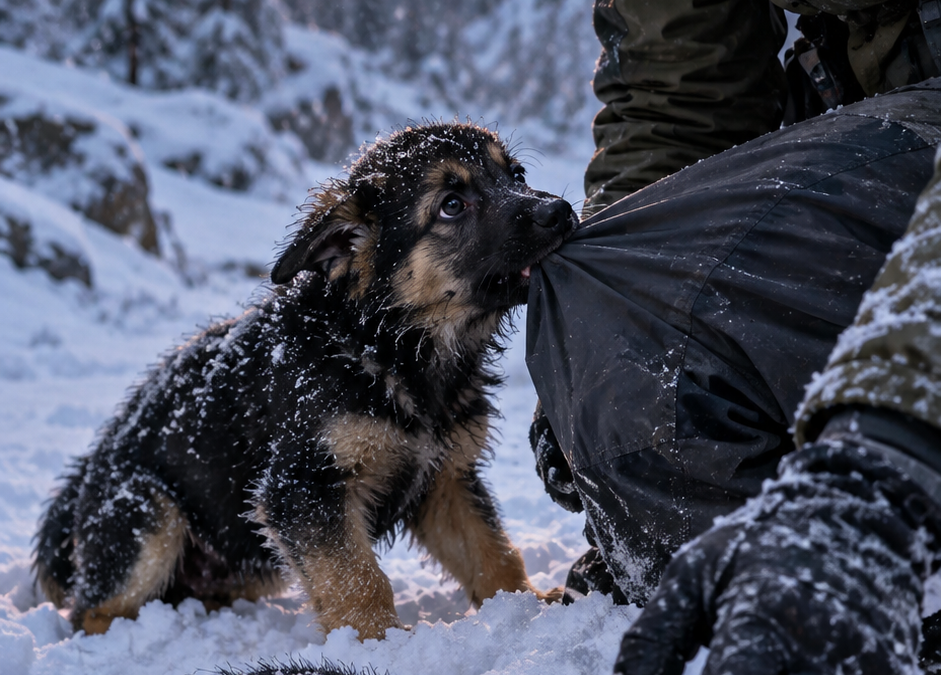
𝗙𝗨𝗟𝗟 𝗦𝗧𝗢𝗥𝗬
Getting the injured puppy out from beneath the branches took longer than I wanted.
Her back leg was pinned at an angle that made every medical instinct in me tighten.
I couldn’t simply pull.
If there was vascular damage, a fracture, crush injury, nerve compression—any careless movement could make things worse.
The first puppy paced beside me.
She whined whenever I stopped.
“I’m working.”
She barked.
“I understand your complaint.”
Another bark.
“You would be an exhausting nurse.”
The snow beneath the trapped puppy had hardened around the branch.
I removed my gloves and dug with bare hands.
Within seconds, my fingers burned.
Then numbed.
I found the section of wood pressing against her hind leg and lifted carefully.
It barely moved.
The puppy beside me attacked the snow around it.
Between the two of us, we cleared enough space to shift the branch sideways.
The trapped leg came free.
The injured puppy made a sound.
Weak.
Thin.
But unmistakably pain.
Good.
Strange thing to think.
But pain meant neurological response.
“Sorry.”
I checked her leg as carefully as I could.
Abnormal angle.
Swelling.
No obvious open fracture.
Pulse in the paw was difficult to assess in that cold.
We needed warmth.
Imaging.
Fluids.
Now.
The other puppy pressed her nose to her sister’s face.
Again.
Again.
Trying to wake her.
I looked at her.
“What do I call you?”
Her ears moved.
“Astra.”
No reason.
The name simply appeared.
Maybe because something about her felt bright and stubborn enough to belong to the sky.
I looked at the injured puppy.
“And you?”
Nothing.
“Vega.”
Astra licked Vega’s ear.
“Apparently approved.”
I wrapped Vega in my coat and lifted her.
Her head fell against my arm.
Too limp.
Astra immediately stood beside me.
“You follow.”
She did.
No leash.
No collar.
No hesitation.
Just a small shepherd walking against my leg while I carried the reason she had refused to leave the snow.
We emerged onto the path.
People looked now.
Of course they did.
A bleeding doctor carrying an unconscious puppy attracts more attention than a freezing puppy hidden beneath branches.
Two men in expensive winter coats slowed.
One looked at Vega.
“They’ll probably be fine.”
The other shrugged.
“Nature.”
I stopped.
I was tired.
Cold.
Afraid.
And perhaps not at my most diplomatic.
“No.”
Both looked at me.
“Not today.”
I kept walking.
Astra glanced at them.
Her ears flattened.
She didn’t bark.
She didn’t need to.
My car was parked near the trail entrance.
I put Vega gently across the passenger seat.
Astra jumped in before I could stop her.
She curled against her sister immediately.
I started the engine.
Heat.
Low at first.
Then warmer.
Gradual.
I called the nearest emergency veterinary clinic.
“Waverly Emergency Veterinary.”
“I’m a physician. Human medicine. I have a four-month-old German Shepherd with severe cold exposure and probable crush injury. Altered responsiveness.”
The receptionist became serious instantly.
“Still breathing?”
“Yes.”
“Bring her now.”
“I’m five minutes out.”
“Drive safely.”
That was optimistic.
I drove like every red light had personally insulted me.
Vega’s breathing remained shallow.
Astra licked her face every few seconds.
“Keep doing that.”
Astra looked at me.
“Seriously.”
The car heater blew warm air.
I placed two fingers against Vega’s ribs whenever traffic allowed.
Rise.
Fall.
Rise.
Too slow.
But there.
A memory came back.
I was twenty-one.
Young enough to believe medicine could solve anything if you moved fast enough.
House fire.
Emergency department.
Child brought in unconscious.
Dog brought in behind him.
The child survived.
The dog didn’t.
I had forgotten almost every detail except the dog’s eyes.
That afternoon, staring at Vega, the memory returned with cruel precision.
“No.”
Astra looked toward me.
“Not this one.”
Vega’s chest rose.
“I’m not doing this again.”
We reached the clinic.
I parked badly.
Half on the curb.
I carried Vega inside.
Astra followed so closely she almost stepped on my shoes.
The receptionist looked up.
I spoke before she could ask.
“Four months approximately. Severe hypothermia. Rear limb compression injury. Reduced responsiveness. Shallow breathing.”
A technician appeared immediately.
“Exam room two.”
They took Vega.
Astra panicked.
The moment the double doors closed, she exploded.
Bark.
Scratch.
Whine.
She threw herself against the glass.
“Hey!”
I crouched.
“Astra.”
She ignored me.
“She has to go with her.”
The receptionist looked uncertain.
“We usually don’t allow—”
“They’re bonded.”
“We don’t know that.”
“She dragged a stranger through half a park to find her.”
That ended the discussion.
A technician opened the door.
Astra shot through.
I followed.
Dr. Helen Lee stood over Vega.
She moved quickly.
Temperature.
Heart.
Lungs.
Gums.
IV access.
Oxygen.
Warming.
Astra stood on the floor, front paws against the table.
A technician tried to pull her back.
Astra growled.
Low.
Terrified.
I raised a hand.
“Let her see.”
Dr. Lee glanced at me.
“You’re a doctor?”
“Emergency medicine.”
“Then you know she can’t interfere.”
“I do.”
I crouched beside Astra.
“Here.”
I held her gently.
She trembled.
Not cold now.
Fear.
Vega lay beneath a warming system.
Small body.
Wet fur.
One shaved patch where the IV entered.
The injured rear leg looked worse under good lighting.
Dr. Lee examined it.
“Circulation is impaired.”
“How long?”
“Unknown.”
“Neurologic response?”
“Minimal right now.”
My stomach tightened.
“Could lose the leg?”
“Yes.”
Astra whined.
Dr. Lee looked at her.
Then at Vega.
“Main concern first is temperature and respiratory status.”
“Pneumonia?”
“Possible aspiration or cold-related complications. Her lungs sound rough.”
I nodded.
Human medicine had taught me the danger of translating knowledge too confidently across species.
So I did the hardest thing physicians ever do.
I shut up and let another doctor work.
Astra did not.
Every monitor beep made her ears twitch.
Every hand approaching Vega earned a suspicious stare.
When one technician adjusted the oxygen line, Astra growled.
“Astra.”
She looked at me.
“They’re helping.”
The growl stopped.
Dr. Lee glanced over.
“She listens to you.”
“Today.”
“Is she yours?”
“No.”
Astra pressed closer to my leg.
Dr. Lee raised an eyebrow.
“Noted.”
Minutes became an hour.
Vega’s temperature rose slowly.
Too slowly.
Her heart rhythm remained irregular.
She barely responded to stimulation.
Astra eventually climbed onto a padded stool beside the table.
She stretched her neck until her nose touched Vega’s ear.
Then she rested her forehead against her sister.
Still.
The room changed.
Nobody spoke.
Astra’s chest rose.
Fell.
Vega’s chest moved weakly beneath the blanket.
Astra breathed again.
Slow.
Steady.
Vega’s next breath seemed to follow.
Dr. Lee watched.
“She may be responding to her.”
I didn’t say anything.
Astra remained there.
Forehead against forehead.
Like she had decided that if Vega was going somewhere, she would pull her back one breath at a time.
Then Vega exhaled.
Long.
Too long.
The monitor changed.
I stood.
Dr. Lee moved immediately.
Astra barked.
One sharp sound.
Vega’s chest rose.
Nobody moved for half a second.
Then again.
A breath.
Uneven.
Weak.
But there.
Astra barked once more.
Vega’s ear twitched.
The technician beside me whispered, “Did you see that?”
“Yes.”
Dr. Lee adjusted oxygen.
“She’s still critical.”
“I know.”
“But that was better.”
I sat because my legs suddenly felt unreliable.
Hope is dangerous in emergency medicine.
You learn not to trust one good number.
One movement.
One response.
You wait for trends.
But I was no longer only a physician.
I was the idiot who had named two puppies less than an hour after meeting them.
So yes.
I hoped.
I stayed.
My hospital called.
Then called again.
Finally I answered.
“Marcus?”
My charge physician sounded annoyed.
“Where are you?”
“At an emergency veterinary clinic.”
Silence.
“What?”
“I need coverage.”
“You’re supposed to be here in forty minutes.”
“I know.”
“Are you hurt?”
“No.”
“Family emergency?”
I looked through the glass.
Astra lay beside Vega.
“Yes.”
There was another silence.
He had worked with me fifteen years.
He knew better than to ask whether I was exaggerating.
“I’ll handle it.”
“Thank you.”
“What happened?”
“I’ll explain later.”
I hung up.
Around early evening, Vega stabilized enough that Dr. Lee allowed herself a cautious breath.
“Temperature is moving.”
“How far?”
“Still low.”
“Heart?”
“Better.”
“Leg?”
“Later.”
Always later.
Medicine is triage disguised as patience.
Save what kills first.
Worry about what hurts second.
Astra refused food.
We offered water.
She drank a little.
Then returned to Vega.
I went outside briefly.
Snow had begun falling again.
The parking lot lights made every flake visible.
I stood with my hands in my pockets.
My coat was still around Vega.
I had forgotten.
Cold reached through my sweater.
A black SUV idled near the curb.
People came and went.
Normal life.
I thought about the two men in the park.
Nature.
I hated that word used as an excuse.
Nature didn’t leave puppies trapped beneath branches beside a public trail.
Nature wasn’t responsible for every act of abandonment humans preferred not to examine.
Sometimes “nature” was just a convenient way to make indifference sound philosophical.
I went back inside.
A woman in the waiting room glanced toward the treatment area.
“Are those the dogs from Lake of the Isles?”
I looked at her.
“I found them there.”
Her husband barely looked up from his phone.
“Strays?”
“Yes.”
He shrugged.
“City will handle it.”
I stared.
He looked up.
“What?”
“Nothing.”
I was learning that “nothing” was sometimes the safest answer I could give strangers.
Behind the glass, Astra raised her head.
That was where my attention belonged.
Not with people who had decided detachment was sophistication.
I returned to Vega.
At ten that night, Dr. Lee showed me the initial imaging.
No complete fracture.
That surprised me.
The branch had caused severe soft-tissue compression and likely nerve injury.
Circulation was returning.
Slowly.
That gave us a chance.
“Amputation?”
“Too soon to say.”
Astra sniffed Vega’s paw.
I whispered, “You hear that?”
Astra ignored me.
“She’s optimistic.”
Dr. Lee smiled.
“I said nothing of the sort.”
“Less pessimistic.”
“That I’ll accept.”
By midnight, the clinic quieted.
A nurse gave me a blanket.
Another handed me coffee.
I sat in the recovery area.
Astra curled around Vega.
Not beside.
Around.
Vega fit against her chest.
I watched them.
The sight opened another memory.
I was nine years old when I broke through ice near my grandparents’ cabin.
I remembered the shock.
Then darkness.
What I knew came mostly from my father’s retelling.
His German Shepherd, Leo, saw me disappear.
Ran onto the ice.
Grabbed my coat.
Pulled.
My father reached us.
I survived.
Leo became a legend in our family.
After medical school, residency, marriage, divorce, career—the memory blurred.
Until Astra.
A German Shepherd pulling someone back from somewhere they shouldn’t survive.
I looked down at my coffee.
“Apparently I owe your entire breed.”
Astra opened one eye.
Then closed it.
Around one thirty, Vega moved.
Small twitch.
Front paw.
Astra lifted her head.
Vega’s nose shifted.
Her eyes fluttered.
I stood slowly.
“Astra.”
The puppy was already awake.
Vega’s eyes opened.
Not fully.
Slits.
Unfocused.
Then closed.
Astra made a sound.
Not bark.
Not whine.
Something soft.
Vega opened them again.
This time longer.
Her gaze wandered.
Light.
Ceiling.
Then Astra.
Her nose moved.
Astra’s tail hit the blanket once.
Vega lifted her muzzle maybe half an inch.
Astra licked her.
My throat tightened.
“Welcome back.”
Vega’s head dropped.
But she stayed awake.
Dr. Lee arrived from another room.
Checked pupils.
Reflexes.
Monitor.
“Better.”
“Stable?”
“Stable enough for me to stop glaring at the monitor every ten seconds.”
“I’ll take it.”
By sunrise, Vega was conscious.
Weak.
Miserable.
But conscious.
Astra became impossible.
She wanted to touch every part of her sister simultaneously.
She licked her face.
Ear.
Neck.
Paw.
Vega attempted to move away.
Couldn’t.
I put one hand between them.
“Give her some dignity.”
Astra pushed around me.
Dr. Lee laughed.
“That’s the first time I’ve seen you smile.”
“I smile.”
“No.”
“I do.”
“No.”
Vega tried lifting her head.
Managed it.
Astra’s entire body wagged.
Tail.
Hips.
Everything.
“Easy.”
Vega’s eyes found mine.
Different from Astra’s.
Softer.
Confused.
Tired.
I extended one hand.
She smelled it.
Then rested her chin across my fingers.
I was done.
Emotionally destroyed.
Completely.
It took another week before both puppies could leave emergency care.
Vega’s recovery was slower.
Her rear leg regained some sensation.
Then more.
She could bear partial weight.
Dr. Lee warned us rehabilitation would be long.
Possibly months.
Maybe permanent weakness.
Astra didn’t care.
She adjusted immediately.
If Vega walked slowly, Astra circled back.
If Vega stopped, Astra stopped.
If Vega stumbled, Astra placed herself beside her.
I watched them outside the clinic one cold morning.
Fresh snow covered the sidewalk.
Astra bounced through it like she had invented winter.
Vega took careful steps.
Bandaged leg.
Uneven gait.
Astra ran ahead.
Turned.
Returned.
Walked shoulder to shoulder.
I sat on a bench.
Coffee in my hands.
A woman passing with a friend watched Vega limp.
“That one doesn’t look good.”
Her friend nodded.
“Probably won’t recover.”
Astra pressed against Vega.
Together, they crossed the yard.
I whispered, “You haven’t met her sister.”
The shelter system entered the story next.
I understood why.
The puppies needed legal placement.
No microchips.
No owner found.
No credible missing-dog reports.
We posted photographs.
Contacted animal control.
Waited.
Nothing.
Somebody had owned these puppies once.
Four-month-old shepherds do not materialize beneath Minneapolis snow.
Someone had fed them.
Handled them.
Then somehow both ended up outside.
Astra healthy enough to search.
Vega trapped and freezing.
I stopped trying to invent a version that would make me less angry.
The shelter agreed to coordinate their care while Vega rehabilitated.
Then came the problem.
Resources.
Shelters live inside mathematics nobody enjoys.
Kennel space.
Staff hours.
Medication.
Surgeries.
Physical therapy.
Food.
Foster homes.
Bonded pairs are harder.
Medical cases are harder.
Large-breed puppies become large-breed adults.
Everything good costs something.
I knew all of that intellectually.
Then I sat across from a shelter board and heard Astra and Vega turned into arithmetic.
A folding table stood between us.
Three board members.
A director.
Files.
Budgets.
Coffee.
“We appreciate what you’ve done, Dr. Hail.”
That sentence never leads anywhere enjoyable.
I folded my arms.
“Go on.”
The director opened Vega’s file.
“We’re at capacity.”
“I know.”
“Rehabilitation remains uncertain.”
“Improving.”
“Improving doesn’t mean uncomplicated.”
“I’m aware.”
“Bonded placement for two shepherds with one medical case could take months.”
“Then it takes months.”
A board member shifted.
“We have to consider allocation.”
There it was.
Allocation.
A clean word.
Very professional.
I used words like that myself in medicine.
Bed utilization.
Resource allocation.
Triage.
Words that help humans discuss terrible choices without collapsing beneath them.
“What exactly are you recommending?”
Nobody answered immediately.
That told me enough.
The director spoke carefully.
“We’re not recommending immediate euthanasia.”
Immediate.
I stared at him.
“But you’re considering it.”
“We’re considering all outcomes.”
Astra barked somewhere in the hallway.
One sharp sound.
I looked toward the door.
The director continued.
“You’re emotionally invested.”
“Of course I am.”
“That can make objective decisions difficult.”
I laughed once.
Not because anything was funny.
“You mean being attached to the animals makes me less qualified to recognize their value.”
“I’m saying our job is to consider every animal in the system.”
“I understand triage.”
“You’re not practicing human medicine here.”
“Exactly.”
He frowned.
I leaned forward.
“With patients, sometimes I have ten minutes, two beds, and three catastrophes. I understand impossible choices better than you think.”
The room went quiet.
“But Vega is improving.”
Nobody argued.
“Astra is healthy.”
Still nothing.
“They’re young.”
Silence.
“So don’t tell me this is about futility.”
A board member said, “It’s about probability.”
“No. It’s about convenience.”
“That’s unfair.”
“Maybe.”
I opened Vega’s latest report.
“Circulation restored. Weight bearing improving. No amputation currently indicated. No respiratory complications. Appetite normal.”
I opened Astra’s.
“Healthy.”
I looked around the table.
“You’re discussing ending two recoverable lives because finding them a home together might be inconvenient.”
“That isn’t what anyone said.”
“It’s exactly what the numbers say once you remove the polite vocabulary.”
A scrape sounded outside.
Then barking.
Astra.
Another scrape.
Someone shouted.
The door opened.
Astra charged into the room.
Behind her came Vega.
Slower.
Limping.
But moving.
A shelter technician followed.
“I’m so sorry—she slipped the gate—”
Astra had paper in her mouth.
She ran to me.
Dropped it.
I looked down.
A form.
Wet.
Torn.
Chewed.
The director stared.
“That’s the recommendation packet.”
I looked at Astra.
Then at him.
“She has notes.”
Nobody laughed at first.
Then one board member covered her mouth.
Vega reached me.
Placed her chin on my knee.
Astra planted herself beside her.
Two puppies.
One strong.
One healing.
Both alive.
I looked around the table.
“This is over.”
The director blinked.
“What?”
“I’m taking responsibility for them.”
“Dr. Hail—”
“Both.”
“You should think about—”
“I have.”
“Large working breed. Two dogs.”
“I know.”
“Medical expenses.”
“I know.”
“Training.”
“I know.”
“Long-term commitment.”
“I know exactly what those words mean.”
I placed my hand on Vega.
“She followed her sister through snow with a leg you were worried she might lose.”
Then Astra.
“And this one found a stranger and refused to let him walk away.”
I sat back.
“You’re telling me responsibility is difficult?”
The director closed the file.
For the first time, he looked embarrassed.
“Then we’ll need to discuss foster-to-adopt requirements.”
“Fine.”
“No promises until the legal hold clears.”
“Fine.”
“And you understand the costs.”
“Yes.”
Astra grabbed the chewed recommendation form.
The board member laughed.
“Apparently she wants a copy.”
“Evidence.”
The director looked at me.
“You enjoy this.”
“More than I expected.”
The legal process finished several days later.
No owner.
No chip.
No claim.
I became their guardian.
Officially.
Astra entered my house first.
Within four minutes, she had inspected every room.
Within six, she found the couch.
Within eight, she had decided the couch belonged to her.
Vega approached home differently.
Doorway.
Pause.
Sniff.
Step.
Pause.
She tested every room.
Every sound.
The furnace.
Refrigerator.
Upstairs neighbor.
Truck outside.
Astra kept returning to her.
Checking.
Always checking.
By evening, Vega found a patch of late winter sunlight beneath the living-room window.
She circled carefully.
Lowered herself.
Exhaled.
Astra jumped off the couch and lay beside her.
I stood in the kitchen.
For most of my adult life, I had lived alone.
Work made that easy.
Emergency medicine gives you plenty of excuses not to build a quiet life.
Odd shifts.
Overnights.
Weekends.
Holidays.
I had convinced myself solitude was practical.
Then two German Shepherd puppies occupied my living room and proved practical was sometimes another word for empty.
The next several weeks revolved around rehabilitation.
Vega had physical therapy.
Range-of-motion exercises.
Controlled walking.
Weight shifting.
Hydrotherapy later.
Astra attended everything even when unnecessary.
Separating them caused stress.
So most appointments included both.
During therapy, Astra would lie beside the mat and watch.
If Vega struggled, Astra stood.
If Vega vocalized, Astra approached.
The therapist eventually assigned Astra a job.
“Stay.”
Astra stayed.
“Watch.”
Astra watched.
“Good.”
She loved being included.
Vega progressed.
Toe touching.
Partial weight.
Fuller weight bearing.
Then several consecutive steps.
The day she walked ten feet without collapsing, I nearly celebrated in the rehabilitation center.
Vega looked unimpressed.
Astra looked ecstatic.
Her tail struck a chair repeatedly.
Whack.
Whack.
Whack.
The therapist laughed.
“Your assistant approves.”
“My assistant eats socks.”
“So do some nurses.”
“True.”
At home, their personalities separated.
Astra was fire.
Doorbell?
Investigation.
Squirrel?
Emergency.
Package delivery?
Federal matter.
Vega was quieter.
Thoughtful.
She watched before joining anything.
If I sat reading, Vega rested near my feet.
Astra dropped toys directly onto the book.
If I cooked, Vega waited at the doorway.
Astra performed quality control from beneath the counter.
If snow fell, Astra demanded the yard.
Vega hesitated.
The first snowfall after their rescue stopped her.
She stood at the open door.
Body rigid.
Astra ran outside.
Looked back.
Vega remained inside.
I sat on the floor.
“No rush.”
Astra returned.
Pressed her nose to Vega.
Then ran outside again.
Vega followed one step.
Stopped.
Another.
Snow beneath her paws.
She froze.
Astra bounced.
Ridiculous.
Joyful.
Completely lacking sensitivity.
Vega watched.
Then took another step.
Soon she was outside.
Not running.
Walking.
Astra stayed beside her.
That became their pattern.
Astra rushed toward life.
Vega followed when she was ready.
Spring came.
Vega’s limp improved.
Not gone.
Maybe it never completely would be.
Dr. Lee called it an excellent outcome.
I called it proof the board had nearly made a terrible decision.
Dr. Lee told me not to start fights with nonprofit administrators.
I told her conflict was one of my core competencies.
She told me I was exhausting.
Fair.
Their story spread locally after someone from the clinic posted a photograph—with my permission—of Astra sleeping with her head across Vega.
People asked about them.
Some offered donations toward Vega’s rehabilitation.
Others sent toys.
One elementary school mailed drawings.
Nearly every picture showed two black-and-tan dogs standing in snow.
In half the drawings, Astra had a superhero cape.
I framed one.
Astra tried to eat it.
Months passed.
I became increasingly aware of a difficult truth.
My life could support them.
Technically.
But my hospital schedule was brutal.
Long shifts.
Overnights.
Unexpected coverage.
I hired walkers.
Used daycare.
Adjusted schedules.
Still, I questioned whether I was giving two young shepherds the life they deserved.
They needed time.
Training.
Space.
Consistency.
More than I could always provide.
I hated the thought of letting them go.
Then I hated myself for making the decision about what I wanted instead of what they needed.
Dr. Lee was the one who forced me to say it aloud.
“You can love them and still decide another home is better.”
“They’ve already been abandoned.”
“You’re not abandoning them.”
“Feels like it.”
“Because you’re dramatic.”
“I work in emergency medicine.”
“Yes. Exactly.”
I stared at her.
She continued.
“Would you separate them?”
“No.”
“Then don’t.”
“That limits options.”
“Good. Limits bad options too.”
So we searched.
Slowly.
No urgency.
No shelter deadline.
No compromise on keeping them together.
Several families applied.
Some wanted Astra because she was confident.
Others wanted Vega because her recovery story touched them.
No.
Package deal.
One applicant had experience with shepherds but worked twelve-hour shifts.
No.
Another had a yard but no secure fence.
No.
Another wanted “outdoor dogs.”
Absolutely not.
Then the Bennett family visited.
Parents.
Two children.
Teenage son, Owen.
Eleven-year-old daughter, Claire.
Previous German Shepherd experience.
Fenced yard.
Flexible work.
They arrived prepared to stay fifteen minutes.
They stayed almost two hours.
Owen sat on the floor.
Astra climbed halfway into his lap despite being much too large for that plan.
Claire waited for Vega.
That mattered.
She didn’t call.
Didn’t reach.
Didn’t tempt her.
She simply sat.
Eventually Vega approached.
Sniffed her shoe.
Then her hand.
Claire remained still.
Vega rested her head on the girl’s knee.
I looked away.
Because I knew.
Astra chose quickly.
Vega confirmed.
Their parents looked at me.
“We’d take both.”
I already knew.
“They stay together.”
“Absolutely.”
“Vega has ongoing exercises.”
“We’ll learn.”
“Astra needs structure.”
“We know shepherds.”
“They’re not yard decorations.”
The father smiled.
“Neither are our kids.”
Fair answer.
“You understand they may have trauma responses?”
The mother nodded.
“Our last dog was a rescue.”
I looked toward Claire.
She was slowly brushing Vega’s shoulder.
Astra lay beside Owen.
For the first time, I imagined them leaving without feeling only panic.
That hurt.
Which probably meant it was right.
We did several visits.
Then an overnight.
Then a weekend.
Astra returned from the weekend exhausted and thrilled.
Vega walked straight into my living room, slept for four hours, and then waited near the door as if she expected the family to come back.
That told me everything.
Their permanent move happened on a clear morning.
Snow had mostly melted.
Patches remained beneath trees.
I packed their things.
Beds.
Food.
Medication.
Leashes.
Toys.
Medical records.
The ridiculous framed superhero drawing.
Astra tried to steal the rope toy before I finished.
“Can you give me five minutes?”
She wagged.
Vega watched.
The Bennett family arrived.
Claire hugged Vega.
Owen took Astra’s leash.
I crouched.
Astra immediately licked my face.
“Disgusting.”
Tail.
I held her head.
“You did good.”
She had no idea what I meant.
Or perhaps dogs understand tone better than language ever will.
I turned to Vega.
She approached slowly.
No fear.
Just that thoughtful way she did everything.
I placed my hand on her shoulder.
Her healed leg stood firmly beneath her.
“You too.”
Vega licked my wrist.
My throat tightened.
Claire noticed.
“You can visit whenever you want.”
That nearly finished me.
“Dangerous promise.”
She smiled.
“We mean it.”
They walked toward the car.
Astra jumped inside.
Of course.
Vega paused at the door.
She looked back.
Straight at me.
For one second, I was back in the snow.
Astra pulling my pants.
Branches.
A limp paw.
Cold fur.
A body I wasn’t sure would breathe again.
Then Vega turned.
Climbed into the car.
Astra immediately curled beside her.
The door closed.
The car pulled away.
I stood on the porch much longer than necessary.
The house became unbearably quiet.
I went inside.
Two empty dog beds.
A forgotten toy under the couch.
Black-and-tan fur everywhere despite aggressive vacuuming.
For the first time in months, nobody barked at the refrigerator.
I sat down.
And cried.
Not because I regretted it.
Because love does not become painless simply because you make the right decision.
Three days later, Claire sent a photograph.
Vega asleep on a couch.
Astra upside down beside her.
Caption:
THEY STOLE THE WHOLE COUCH.
I laughed.
Then another photo.
Both dogs running through the fenced yard.
Vega behind.
Astra circling back.
Exactly as always.
The next winter, I visited.
Snow covered the yard.
Astra saw me through the window.
Chaos.
She hit the door with both front paws.
Owen opened it.
Astra launched into me.
“Apparently training has failed.”
Owen laughed.
Vega came behind her.
Slower.
Still slight stiffness in the damaged leg.
But running.
Actually running.
She reached me.
Pressed her shoulder against my legs.
Astra wedged between us because emotional exclusivity was prohibited.
I knelt in the snow.
Two dogs.
Healthy.
Warm.
Home.
Claire called from the porch.
“Come inside before you freeze!”
I looked at Astra.
“You hear that?”
She licked my chin.
“Apparently we’ve learned nothing.”
Inside, photographs covered the refrigerator.
Dogs.
Kids.
Family hikes.
Vega sleeping beside Claire’s bed.
Astra wearing a birthday hat and looking offended.
There was one framed photograph on the mantel.
Astra and Vega lying together in the snow.
Not the day I found them.
Later.
Safe snow.
Play snow.
Home snow.
That distinction mattered.
The Bennett family kept the torn recommendation form too.
Someone at the shelter had saved what remained of it.
Claire framed it.
Underneath, she had written:
DENIED BY ASTRA.
I laughed so loudly both dogs barked.
That may have been my favorite part of the entire story.
The board had once looked at them and seen cost.
Difficulty.
Probability.
A bonded medical case occupying resources.
They weren’t monsters.
That matters.
Most institutional failures aren’t caused by cartoon villains.
They are caused by tired people making decisions inside systems built around scarcity.
But scarcity can make terrible choices sound reasonable.
Sometimes somebody has to say no.
Sometimes that somebody is a physician.
Sometimes it is a four-month-old German Shepherd puppy stealing paperwork.
Astra won.
Not because she understood policy.
Because she refused to abandon Vega.
From the moment she grabbed my pants, she had one objective.
My sister is there.
Follow me.
She never changed it.
Not when strangers passed.
Not when snow froze into her fur.
Not when clinic doors separated them.
Not when monitors beeped.
Not when Vega struggled to walk.
Not when adults at a folding table discussed percentages and budgets.
Astra’s answer remained the same.
No.
She stays.
Years later, Vega still carried a slight limp when tired.
Astra still slowed for her.
That never changed.
Sometimes Claire sent videos.
Astra racing across the yard.
Vega behind.
Then Astra noticing the distance.
Turning.
Going back.
Every time.
She could have run ahead.
She never did.
That may be the simplest definition of loyalty I’ve ever seen.
Not refusing to move.
Moving forward, then noticing someone you love has fallen behind and choosing to return.
I had spent decades in emergency medicine.
I had watched people live.
Watched people die.
I had learned anatomy.
Physiology.
Trauma protocols.
Airways.
Circulation.
Shock.
All the technical machinery that keeps bodies alive.
But Astra taught me something medicine never did.
Sometimes survival begins before treatment.
It begins when somebody notices you are missing.
When somebody refuses to leave.
When somebody makes enough noise that the world finally pays attention.
Vega survived because many people helped.
Dr. Lee.
Technicians.
Therapists.
Shelter staff.
The Bennett family.
Me.
But Astra was first.
She found the help.
She made me follow.
She stayed through the cold.
She guarded the treatment table.
She slept beside recovery.
She walked beside rehabilitation.
She protested separation.
She returned every time Vega fell behind.
One afternoon years after the rescue, I returned to Lake of the Isles alone.
Same trail.
Different winter.
Snow covered the ground.
Joggers passed.
People carried coffee.
I stood near the place where Astra had grabbed my pants.
Nothing marked it.
No plaque.
No sign.
No indication that one freezing puppy had once decided another puppy’s life was important enough to drag a complete stranger into the woods.
I walked off the trail.
The snow was shallower that year.
I found the trees.
Maybe the same branches.
Maybe not.
Memory rearranges landscapes.
I stood there for a while.
I thought about the first paw appearing beneath the snow.
Vega’s cold body.
Astra digging.
The way she looked at me.
Not asking politely.
Demanding.
Help her.
I smiled.
“You were terrifying.”
Wind moved through the branches.
No answer.
My phone buzzed.
Message from Claire.
Video.
I opened it.
Astra and Vega were in their backyard.
Snow falling.
Astra ran across the frame.
Vega followed.
Astra disappeared.
Then returned.
She bumped Vega’s shoulder.
They ran together.
At the end of the video, Claire laughed behind the camera.
“They still do everything together.”
I watched twice.
Then put my phone away.
For years, people asked me why I stopped that day.
Why I followed a strange puppy into deep snow.
The truth is less flattering than they expect.
I almost didn’t.
I was tired.
Cold.
Distracted.
Thinking about work.
Thinking about myself.
The heroic version of the story would say I saw a dog in distress and immediately understood.
I didn’t.
Astra had to bite my pants.
She had to pull.
Bark.
Run.
Come back.
Insist.
She did not trust human attention enough to ask once.
She knew better.
So she kept asking until someone listened.
That realization stayed with me.
How many forms of suffering are quiet?
How many disappear beneath snow because nobody bends down?
How many living things are dismissed because helping would interrupt the schedule we had planned?
Astra interrupted mine.
Thank God she did.
I walked back toward the main path.
The city moved beyond the trees.
Cars.
People.
Coffee.
Ordinary life.
My hands were warm inside my gloves.
Somewhere across town, two German Shepherds were probably occupying furniture they had been explicitly forbidden to use.
Vega had lived.
Her leg had survived.
Astra had gotten exactly what she demanded from me that first afternoon.
Her sister came home.
Together.
When people call Astra heroic, I agree.
But not because she performed one dramatic rescue.
The bite on my pants was only the beginning.
Her real courage was consistency.
She never decided Vega was too difficult.
Too expensive.
Too damaged.
Too slow.
She never asked what saving her would cost.
She simply knew her sister was underneath the snow.
And leaving without her was not an option.
Sometimes I still remember the moment Astra looked at me beside that buried mound.
Snow across her face.
Body shaking.
Paws bleeding from digging.
Eyes wild with desperation.
I hadn’t understood yet.
But she had.
She knew Vega was alive.
She knew Vega needed help.
She knew she couldn’t do it alone.
So she found someone.
Grabbed hold.
And refused to let go.
In the years since, I have treated thousands of emergencies.
But when I think about the purest plea for help I have ever witnessed, it didn’t come from an ambulance bay.
It didn’t come through a radio.
It didn’t come from a person.
It came from a four-month-old German Shepherd puppy standing in Minneapolis snow with her teeth locked around my pants.
And thank God—
she wouldn’t let go.
Have you finished reading the story and want to read it again?
She Bit My Pants and Dragged Me Into the Snow—Her Sister Was Buried Beneath It
The puppy sank her teeth into my pants and refused to let go.
She wasn’t attacking me.
She was trying to save someone I couldn’t see.
My name is Dr. Marcus Hail, and I was forty-five the day a four-month-old German Shepherd puppy dragged me off a walking path near Lake of the Isles in Minneapolis and into a patch of snow deep enough to hide a life.
I wasn’t supposed to be there long.
I was between shifts at the hospital, tired enough that the inside of my skull seemed to pulse with every heartbeat. I had grabbed coffee and taken a short detour through the park because I needed fifteen minutes where nobody was asking me for a diagnosis, an order, a signature, or an answer I didn’t have.
Minnesota winter had settled over everything.
The lake was rimmed with ice.
Snow covered the ground in smooth white layers.
Branches sagged beneath it.
People moved quickly along the cleared path, shoulders hunched against the cold.
I had barely taken five steps when something hit my leg.
I looked down.
A German Shepherd puppy had her teeth buried in the fabric of my scrub pants.
Not skin.
Fabric.
She pulled backward with everything she had.
“Hey!”
She released me.
Barked once.
Then grabbed my pants again.
She couldn’t have weighed more than twenty-five pounds.
Black-and-tan fur crusted with frost.
Snow packed between her toes.
Her body shook violently.
But her eyes were what stopped me.
Wide.
Wild.
Urgent.
Not aggression.
Not play.
She needed something.
A jogger passed.
I looked at him.
“Do you know this dog?”
Earbuds.
No reaction.
An older woman slowed briefly.
Then kept going.
The puppy released me again.
Barked sharply.
Ran toward the trees.
Stopped.
Looked back.
“Seriously?”
She barked again.
Then disappeared off the trail.
I don’t know why I followed.
Training, maybe.
Instinct.
Or perhaps because I spend my professional life watching people communicate fear without having the words for it.
That puppy was screaming.
Just not in a human language.
I pushed through knee-deep snow after her.
“A little warning would’ve been nice!”
Branches scraped my coat.
My coffee disappeared somewhere behind me.
The puppy didn’t care.
She plunged forward, stopped beside a cluster of low branches, and began digging.
Frantically.
Snow flew behind her.
She whined.
Scratched harder.
Then growled at the ground itself.
I heard something.
So faint I thought I imagined it.
A tiny cry.
I dropped to my knees.
Cold soaked through my scrubs instantly.
“What’s under there?”
The puppy pawed harder.
I swept snow aside with both hands.
Branches.
Packed ice.
More snow.
Then—
Fur.
Black and tan.
My heart stopped.
A paw appeared beneath the snow.
Limp.
I dug faster.
The first puppy pushed beside me.
She began licking the exposed paw.
“Easy.”
Another branch.
I shoved it aside.
And there she was.
Second German Shepherd puppy.
Smaller.
Half buried.
One rear leg twisted beneath a branch.
Eyes closed.
Lips pale.
Not moving.
I placed two fingers against her ribs.
Nothing.
Then—
Movement.
Tiny.
Slow.
A breath.
I swallowed.
“Alive.”
The first puppy whined and pressed herself against her sister.
I checked again.
Shallow respirations.
Cold beyond anything she should have survived.
The puppy beside me looked up.
And suddenly the whole encounter made sense.
She hadn’t chosen me because I looked kind.
She hadn’t grabbed my pants because she wanted attention.
She had been searching for anyone willing to stop.
And somehow, out of an entire Minneapolis park, she had found an emergency physician.
I slid my hands beneath the buried puppy.
Her body was frighteningly cold.
The healthy sister pushed closer.
“I know.”
I pulled off my coat.
Wrapped the injured puppy.
The first one immediately tried to climb into it with her.
“Okay.”
I looked at her.
“You’re coming too.”
She stared at me.
“You dragged me into this.”
Her tail moved once.
And that was how two abandoned German Shepherd puppies changed the entire direction of my life.
PART2
Getting the injured puppy out from beneath the branches took longer than I wanted.
Her back leg was pinned at an angle that made every medical instinct in me tighten.
I couldn’t simply pull.
If there was vascular damage, a fracture, crush injury, nerve compression—any careless movement could make things worse.
The first puppy paced beside me.
She whined whenever I stopped.
“I’m working.”
She barked.
“I understand your complaint.”
Another bark.
“You would be an exhausting nurse.”
The snow beneath the trapped puppy had hardened around the branch.
I removed my gloves and dug with bare hands.
Within seconds, my fingers burned.
Then numbed.
I found the section of wood pressing against her hind leg and lifted carefully.
It barely moved.
The puppy beside me attacked the snow around it.
Between the two of us, we cleared enough space to shift the branch sideways.
The trapped leg came free.
The injured puppy made a sound.
Weak.
Thin.
But unmistakably pain.
Good.
Strange thing to think.
But pain meant neurological response.
“Sorry.”
I checked her leg as carefully as I could.
Abnormal angle.
Swelling.
No obvious open fracture.
Pulse in the paw was difficult to assess in that cold.
We needed warmth.
Imaging.
Fluids.
Now.
The other puppy pressed her nose to her sister’s face.
Again.
Again.
Trying to wake her.
I looked at her.
“What do I call you?”
Her ears moved.
“Astra.”
No reason.
The name simply appeared.
Maybe because something about her felt bright and stubborn enough to belong to the sky.
I looked at the injured puppy.
“And you?”
Nothing.
“Vega.”
Astra licked Vega’s ear.
“Apparently approved.”
I wrapped Vega in my coat and lifted her.
Her head fell against my arm.
Too limp.
Astra immediately stood beside me.
“You follow.”
She did.
No leash.
No collar.
No hesitation.
Just a small shepherd walking against my leg while I carried the reason she had refused to leave the snow.
We emerged onto the path.
People looked now.
Of course they did.
A bleeding doctor carrying an unconscious puppy attracts more attention than a freezing puppy hidden beneath branches.
Two men in expensive winter coats slowed.
One looked at Vega.
“They’ll probably be fine.”
The other shrugged.
“Nature.”
I stopped.
I was tired.
Cold.
Afraid.
And perhaps not at my most diplomatic.
“No.”
Both looked at me.
“Not today.”
I kept walking.
Astra glanced at them.
Her ears flattened.
She didn’t bark.
She didn’t need to.
My car was parked near the trail entrance.
I put Vega gently across the passenger seat.
Astra jumped in before I could stop her.
She curled against her sister immediately.
I started the engine.
Heat.
Low at first.
Then warmer.
Gradual.
I called the nearest emergency veterinary clinic.
“Waverly Emergency Veterinary.”
“I’m a physician. Human medicine. I have a four-month-old German Shepherd with severe cold exposure and probable crush injury. Altered responsiveness.”
The receptionist became serious instantly.
“Still breathing?”
“Yes.”
“Bring her now.”
“I’m five minutes out.”
“Drive safely.”
That was optimistic.
I drove like every red light had personally insulted me.
Vega’s breathing remained shallow.
Astra licked her face every few seconds.
“Keep doing that.”
Astra looked at me.
“Seriously.”
The car heater blew warm air.
I placed two fingers against Vega’s ribs whenever traffic allowed.
Rise.
Fall.
Rise.
Too slow.
But there.
A memory came back.
I was twenty-one.
Young enough to believe medicine could solve anything if you moved fast enough.
House fire.
Emergency department.
Child brought in unconscious.
Dog brought in behind him.
The child survived.
The dog didn’t.
I had forgotten almost every detail except the dog’s eyes.
That afternoon, staring at Vega, the memory returned with cruel precision.
“No.”
Astra looked toward me.
“Not this one.”
Vega’s chest rose.
“I’m not doing this again.”
We reached the clinic.
I parked badly.
Half on the curb.
I carried Vega inside.
Astra followed so closely she almost stepped on my shoes.
The receptionist looked up.
I spoke before she could ask.
“Four months approximately. Severe hypothermia. Rear limb compression injury. Reduced responsiveness. Shallow breathing.”
A technician appeared immediately.
“Exam room two.”
They took Vega.
Astra panicked.
The moment the double doors closed, she exploded.
Bark.
Scratch.
Whine.
She threw herself against the glass.
“Hey!”
I crouched.
“Astra.”
She ignored me.
“She has to go with her.”
The receptionist looked uncertain.
“We usually don’t allow—”
“They’re bonded.”
“We don’t know that.”
“She dragged a stranger through half a park to find her.”
That ended the discussion.
A technician opened the door.
Astra shot through.
I followed.
Dr. Helen Lee stood over Vega.
She moved quickly.
Temperature.
Heart.
Lungs.
Gums.
IV access.
Oxygen.
Warming.
Astra stood on the floor, front paws against the table.
A technician tried to pull her back.
Astra growled.
Low.
Terrified.
I raised a hand.
“Let her see.”
Dr. Lee glanced at me.
“You’re a doctor?”
“Emergency medicine.”
“Then you know she can’t interfere.”
“I do.”
I crouched beside Astra.
“Here.”
I held her gently.
She trembled.
Not cold now.
Fear.
Vega lay beneath a warming system.
Small body.
Wet fur.
One shaved patch where the IV entered.
The injured rear leg looked worse under good lighting.
Dr. Lee examined it.
“Circulation is impaired.”
“How long?”
“Unknown.”
“Neurologic response?”
“Minimal right now.”
My stomach tightened.
“Could lose the leg?”
“Yes.”
Astra whined.
Dr. Lee looked at her.
Then at Vega.
“Main concern first is temperature and respiratory status.”
“Pneumonia?”
“Possible aspiration or cold-related complications. Her lungs sound rough.”
I nodded.
Human medicine had taught me the danger of translating knowledge too confidently across species.
So I did the hardest thing physicians ever do.
I shut up and let another doctor work.
Astra did not.
Every monitor beep made her ears twitch.
Every hand approaching Vega earned a suspicious stare.
When one technician adjusted the oxygen line, Astra growled.
“Astra.”
She looked at me.
“They’re helping.”
The growl stopped.
Dr. Lee glanced over.
“She listens to you.”
“Today.”
“Is she yours?”
“No.”
Astra pressed closer to my leg.
Dr. Lee raised an eyebrow.
“Noted.”
Minutes became an hour.
Vega’s temperature rose slowly.
Too slowly.
Her heart rhythm remained irregular.
She barely responded to stimulation.
Astra eventually climbed onto a padded stool beside the table.
She stretched her neck until her nose touched Vega’s ear.
Then she rested her forehead against her sister.
Still.
The room changed.
Nobody spoke.
Astra’s chest rose.
Fell.
Vega’s chest moved weakly beneath the blanket.
Astra breathed again.
Slow.
Steady.
Vega’s next breath seemed to follow.
Dr. Lee watched.
“She may be responding to her.”
I didn’t say anything.
Astra remained there.
Forehead against forehead.
Like she had decided that if Vega was going somewhere, she would pull her back one breath at a time.
Then Vega exhaled.
Long.
Too long.
The monitor changed.
I stood.
Dr. Lee moved immediately.
Astra barked.
One sharp sound.
Vega’s chest rose.
Nobody moved for half a second.
Then again.
A breath.
Uneven.
Weak.
But there.
Astra barked once more.
Vega’s ear twitched.
The technician beside me whispered, “Did you see that?”
“Yes.”
Dr. Lee adjusted oxygen.
“She’s still critical.”
“I know.”
“But that was better.”
I sat because my legs suddenly felt unreliable.
Hope is dangerous in emergency medicine.
You learn not to trust one good number.
One movement.
One response.
You wait for trends.
But I was no longer only a physician.
I was the idiot who had named two puppies less than an hour after meeting them.
So yes.
I hoped.
I stayed.
My hospital called.
Then called again.
Finally I answered.
“Marcus?”
My charge physician sounded annoyed.
“Where are you?”
“At an emergency veterinary clinic.”
Silence.
“What?”
“I need coverage.”
“You’re supposed to be here in forty minutes.”
“I know.”
“Are you hurt?”
“No.”
“Family emergency?”
I looked through the glass.
Astra lay beside Vega.
“Yes.”
There was another silence.
He had worked with me fifteen years.
He knew better than to ask whether I was exaggerating.
“I’ll handle it.”
“Thank you.”
“What happened?”
“I’ll explain later.”
I hung up.
Around early evening, Vega stabilized enough that Dr. Lee allowed herself a cautious breath.
“Temperature is moving.”
“How far?”
“Still low.”
“Heart?”
“Better.”
“Leg?”
“Later.”
Always later.
Medicine is triage disguised as patience.
Save what kills first.
Worry about what hurts second.
Astra refused food.
We offered water.
She drank a little.
Then returned to Vega.
I went outside briefly.
Snow had begun falling again.
The parking lot lights made every flake visible.
I stood with my hands in my pockets.
My coat was still around Vega.
I had forgotten.
Cold reached through my sweater.
A black SUV idled near the curb.
People came and went.
Normal life.
I thought about the two men in the park.
Nature.
I hated that word used as an excuse.
Nature didn’t leave puppies trapped beneath branches beside a public trail.
Nature wasn’t responsible for every act of abandonment humans preferred not to examine.
Sometimes “nature” was just a convenient way to make indifference sound philosophical.
I went back inside.
A woman in the waiting room glanced toward the treatment area.
“Are those the dogs from Lake of the Isles?”
I looked at her.
“I found them there.”
Her husband barely looked up from his phone.
“Strays?”
“Yes.”
He shrugged.
“City will handle it.”
I stared.
He looked up.
“What?”
“Nothing.”
I was learning that “nothing” was sometimes the safest answer I could give strangers.
Behind the glass, Astra raised her head.
That was where my attention belonged.
Not with people who had decided detachment was sophistication.
I returned to Vega.
At ten that night, Dr. Lee showed me the initial imaging.
No complete fracture.
That surprised me.
The branch had caused severe soft-tissue compression and likely nerve injury.
Circulation was returning.
Slowly.
That gave us a chance.
“Amputation?”
“Too soon to say.”
Astra sniffed Vega’s paw.
I whispered, “You hear that?”
Astra ignored me.
“She’s optimistic.”
Dr. Lee smiled.
“I said nothing of the sort.”
“Less pessimistic.”
“That I’ll accept.”
By midnight, the clinic quieted.
A nurse gave me a blanket.
Another handed me coffee.
I sat in the recovery area.
Astra curled around Vega.
Not beside.
Around.
Vega fit against her chest.
I watched them.
The sight opened another memory.
I was nine years old when I broke through ice near my grandparents’ cabin.
I remembered the shock.
Then darkness.
What I knew came mostly from my father’s retelling.
His German Shepherd, Leo, saw me disappear.
Ran onto the ice.
Grabbed my coat.
Pulled.
My father reached us.
I survived.
Leo became a legend in our family.
After medical school, residency, marriage, divorce, career—the memory blurred.
Until Astra.
A German Shepherd pulling someone back from somewhere they shouldn’t survive.
I looked down at my coffee.
“Apparently I owe your entire breed.”
Astra opened one eye.
Then closed it.
Around one thirty, Vega moved.
Small twitch.
Front paw.
Astra lifted her head.
Vega’s nose shifted.
Her eyes fluttered.
I stood slowly.
“Astra.”
The puppy was already awake.
Vega’s eyes opened.
Not fully.
Slits.
Unfocused.
Then closed.
Astra made a sound.
Not bark.
Not whine.
Something soft.
Vega opened them again.
This time longer.
Her gaze wandered.
Light.
Ceiling.
Then Astra.
Her nose moved.
Astra’s tail hit the blanket once.
Vega lifted her muzzle maybe half an inch.
Astra licked her.
My throat tightened.
“Welcome back.”
Vega’s head dropped.
But she stayed awake.
Dr. Lee arrived from another room.
Checked pupils.
Reflexes.
Monitor.
“Better.”
“Stable?”
“Stable enough for me to stop glaring at the monitor every ten seconds.”
“I’ll take it.”
By sunrise, Vega was conscious.
Weak.
Miserable.
But conscious.
Astra became impossible.
She wanted to touch every part of her sister simultaneously.
She licked her face.
Ear.
Neck.
Paw.
Vega attempted to move away.
Couldn’t.
I put one hand between them.
“Give her some dignity.”
Astra pushed around me.
Dr. Lee laughed.
“That’s the first time I’ve seen you smile.”
“I smile.”
“No.”
“I do.”
“No.”
Vega tried lifting her head.
Managed it.
Astra’s entire body wagged.
Tail.
Hips.
Everything.
“Easy.”
Vega’s eyes found mine.
Different from Astra’s.
Softer.
Confused.
Tired.
I extended one hand.
She smelled it.
Then rested her chin across my fingers.
I was done.
Emotionally destroyed.
Completely.
It took another week before both puppies could leave emergency care.
Vega’s recovery was slower.
Her rear leg regained some sensation.
Then more.
She could bear partial weight.
Dr. Lee warned us rehabilitation would be long.
Possibly months.
Maybe permanent weakness.
Astra didn’t care.
She adjusted immediately.
If Vega walked slowly, Astra circled back.
If Vega stopped, Astra stopped.
If Vega stumbled, Astra placed herself beside her.
I watched them outside the clinic one cold morning.
Fresh snow covered the sidewalk.
Astra bounced through it like she had invented winter.
Vega took careful steps.
Bandaged leg.
Uneven gait.
Astra ran ahead.
Turned.
Returned.
Walked shoulder to shoulder.
I sat on a bench.
Coffee in my hands.
A woman passing with a friend watched Vega limp.
“That one doesn’t look good.”
Her friend nodded.
“Probably won’t recover.”
Astra pressed against Vega.
Together, they crossed the yard.
I whispered, “You haven’t met her sister.”
The shelter system entered the story next.
I understood why.
The puppies needed legal placement.
No microchips.
No owner found.
No credible missing-dog reports.
We posted photographs.
Contacted animal control.
Waited.
Nothing.
Somebody had owned these puppies once.
Four-month-old shepherds do not materialize beneath Minneapolis snow.
Someone had fed them.
Handled them.
Then somehow both ended up outside.
Astra healthy enough to search.
Vega trapped and freezing.
I stopped trying to invent a version that would make me less angry.
The shelter agreed to coordinate their care while Vega rehabilitated.
Then came the problem.
Resources.
Shelters live inside mathematics nobody enjoys.
Kennel space.
Staff hours.
Medication.
Surgeries.
Physical therapy.
Food.
Foster homes.
Bonded pairs are harder.
Medical cases are harder.
Large-breed puppies become large-breed adults.
Everything good costs something.
I knew all of that intellectually.
Then I sat across from a shelter board and heard Astra and Vega turned into arithmetic.
A folding table stood between us.
Three board members.
A director.
Files.
Budgets.
Coffee.
“We appreciate what you’ve done, Dr. Hail.”
That sentence never leads anywhere enjoyable.
I folded my arms.
“Go on.”
The director opened Vega’s file.
“We’re at capacity.”
“I know.”
“Rehabilitation remains uncertain.”
“Improving.”
“Improving doesn’t mean uncomplicated.”
“I’m aware.”
“Bonded placement for two shepherds with one medical case could take months.”
“Then it takes months.”
A board member shifted.
“We have to consider allocation.”
There it was.
Allocation.
A clean word.
Very professional.
I used words like that myself in medicine.
Bed utilization.
Resource allocation.
Triage.
Words that help humans discuss terrible choices without collapsing beneath them.
“What exactly are you recommending?”
Nobody answered immediately.
That told me enough.
The director spoke carefully.
“We’re not recommending immediate euthanasia.”
Immediate.
I stared at him.
“But you’re considering it.”
“We’re considering all outcomes.”
Astra barked somewhere in the hallway.
One sharp sound.
I looked toward the door.
The director continued.
“You’re emotionally invested.”
“Of course I am.”
“That can make objective decisions difficult.”
I laughed once.
Not because anything was funny.
“You mean being attached to the animals makes me less qualified to recognize their value.”
“I’m saying our job is to consider every animal in the system.”
“I understand triage.”
“You’re not practicing human medicine here.”
“Exactly.”
He frowned.
I leaned forward.
“With patients, sometimes I have ten minutes, two beds, and three catastrophes. I understand impossible choices better than you think.”
The room went quiet.
“But Vega is improving.”
Nobody argued.
“Astra is healthy.”
Still nothing.
“They’re young.”
Silence.
“So don’t tell me this is about futility.”
A board member said, “It’s about probability.”
“No. It’s about convenience.”
“That’s unfair.”
“Maybe.”
I opened Vega’s latest report.
“Circulation restored. Weight bearing improving. No amputation currently indicated. No respiratory complications. Appetite normal.”
I opened Astra’s.
“Healthy.”
I looked around the table.
“You’re discussing ending two recoverable lives because finding them a home together might be inconvenient.”
“That isn’t what anyone said.”
“It’s exactly what the numbers say once you remove the polite vocabulary.”
A scrape sounded outside.
Then barking.
Astra.
Another scrape.
Someone shouted.
The door opened.
Astra charged into the room.
Behind her came Vega.
Slower.
Limping.
But moving.
A shelter technician followed.
“I’m so sorry—she slipped the gate—”
Astra had paper in her mouth.
She ran to me.
Dropped it.
I looked down.
A form.
Wet.
Torn.
Chewed.
The director stared.
“That’s the recommendation packet.”
I looked at Astra.
Then at him.
“She has notes.”
Nobody laughed at first.
Then one board member covered her mouth.
Vega reached me.
Placed her chin on my knee.
Astra planted herself beside her.
Two puppies.
One strong.
One healing.
Both alive.
I looked around the table.
“This is over.”
The director blinked.
“What?”
“I’m taking responsibility for them.”
“Dr. Hail—”
“Both.”
“You should think about—”
“I have.”
“Large working breed. Two dogs.”
“I know.”
“Medical expenses.”
“I know.”
“Training.”
“I know.”
“Long-term commitment.”
“I know exactly what those words mean.”
I placed my hand on Vega.
“She followed her sister through snow with a leg you were worried she might lose.”
Then Astra.
“And this one found a stranger and refused to let him walk away.”
I sat back.
“You’re telling me responsibility is difficult?”
The director closed the file.
For the first time, he looked embarrassed.
“Then we’ll need to discuss foster-to-adopt requirements.”
“Fine.”
“No promises until the legal hold clears.”
“Fine.”
“And you understand the costs.”
“Yes.”
Astra grabbed the chewed recommendation form.
The board member laughed.
“Apparently she wants a copy.”
“Evidence.”
The director looked at me.
“You enjoy this.”
“More than I expected.”
The legal process finished several days later.
No owner.
No chip.
No claim.
I became their guardian.
Officially.
Astra entered my house first.
Within four minutes, she had inspected every room.
Within six, she found the couch.
Within eight, she had decided the couch belonged to her.
Vega approached home differently.
Doorway.
Pause.
Sniff.
Step.
Pause.
She tested every room.
Every sound.
The furnace.
Refrigerator.
Upstairs neighbor.
Truck outside.
Astra kept returning to her.
Checking.
Always checking.
By evening, Vega found a patch of late winter sunlight beneath the living-room window.
She circled carefully.
Lowered herself.
Exhaled.
Astra jumped off the couch and lay beside her.
I stood in the kitchen.
For most of my adult life, I had lived alone.
Work made that easy.
Emergency medicine gives you plenty of excuses not to build a quiet life.
Odd shifts.
Overnights.
Weekends.
Holidays.
I had convinced myself solitude was practical.
Then two German Shepherd puppies occupied my living room and proved practical was sometimes another word for empty.
The next several weeks revolved around rehabilitation.
Vega had physical therapy.
Range-of-motion exercises.
Controlled walking.
Weight shifting.
Hydrotherapy later.
Astra attended everything even when unnecessary.
Separating them caused stress.
So most appointments included both.
During therapy, Astra would lie beside the mat and watch.
If Vega struggled, Astra stood.
If Vega vocalized, Astra approached.
The therapist eventually assigned Astra a job.
“Stay.”
Astra stayed.
“Watch.”
Astra watched.
“Good.”
She loved being included.
Vega progressed.
Toe touching.
Partial weight.
Fuller weight bearing.
Then several consecutive steps.
The day she walked ten feet without collapsing, I nearly celebrated in the rehabilitation center.
Vega looked unimpressed.
Astra looked ecstatic.
Her tail struck a chair repeatedly.
Whack.
Whack.
Whack.
The therapist laughed.
“Your assistant approves.”
“My assistant eats socks.”
“So do some nurses.”
“True.”
At home, their personalities separated.
Astra was fire.
Doorbell?
Investigation.
Squirrel?
Emergency.
Package delivery?
Federal matter.
Vega was quieter.
Thoughtful.
She watched before joining anything.
If I sat reading, Vega rested near my feet.
Astra dropped toys directly onto the book.
If I cooked, Vega waited at the doorway.
Astra performed quality control from beneath the counter.
If snow fell, Astra demanded the yard.
Vega hesitated.
The first snowfall after their rescue stopped her.
She stood at the open door.
Body rigid.
Astra ran outside.
Looked back.
Vega remained inside.
I sat on the floor.
“No rush.”
Astra returned.
Pressed her nose to Vega.
Then ran outside again.
Vega followed one step.
Stopped.
Another.
Snow beneath her paws.
She froze.
Astra bounced.
Ridiculous.
Joyful.
Completely lacking sensitivity.
Vega watched.
Then took another step.
Soon she was outside.
Not running.
Walking.
Astra stayed beside her.
That became their pattern.
Astra rushed toward life.
Vega followed when she was ready.
Spring came.
Vega’s limp improved.
Not gone.
Maybe it never completely would be.
Dr. Lee called it an excellent outcome.
I called it proof the board had nearly made a terrible decision.
Dr. Lee told me not to start fights with nonprofit administrators.
I told her conflict was one of my core competencies.
She told me I was exhausting.
Fair.
Their story spread locally after someone from the clinic posted a photograph—with my permission—of Astra sleeping with her head across Vega.
People asked about them.
Some offered donations toward Vega’s rehabilitation.
Others sent toys.
One elementary school mailed drawings.
Nearly every picture showed two black-and-tan dogs standing in snow.
In half the drawings, Astra had a superhero cape.
I framed one.
Astra tried to eat it.
Months passed.
I became increasingly aware of a difficult truth.
My life could support them.
Technically.
But my hospital schedule was brutal.
Long shifts.
Overnights.
Unexpected coverage.
I hired walkers.
Used daycare.
Adjusted schedules.
Still, I questioned whether I was giving two young shepherds the life they deserved.
They needed time.
Training.
Space.
Consistency.
More than I could always provide.
I hated the thought of letting them go.
Then I hated myself for making the decision about what I wanted instead of what they needed.
Dr. Lee was the one who forced me to say it aloud.
“You can love them and still decide another home is better.”
“They’ve already been abandoned.”
“You’re not abandoning them.”
“Feels like it.”
“Because you’re dramatic.”
“I work in emergency medicine.”
“Yes. Exactly.”
I stared at her.
She continued.
“Would you separate them?”
“No.”
“Then don’t.”
“That limits options.”
“Good. Limits bad options too.”
So we searched.
Slowly.
No urgency.
No shelter deadline.
No compromise on keeping them together.
Several families applied.
Some wanted Astra because she was confident.
Others wanted Vega because her recovery story touched them.
No.
Package deal.
One applicant had experience with shepherds but worked twelve-hour shifts.
No.
Another had a yard but no secure fence.
No.
Another wanted “outdoor dogs.”
Absolutely not.
Then the Bennett family visited.
Parents.
Two children.
Teenage son, Owen.
Eleven-year-old daughter, Claire.
Previous German Shepherd experience.
Fenced yard.
Flexible work.
They arrived prepared to stay fifteen minutes.
They stayed almost two hours.
Owen sat on the floor.
Astra climbed halfway into his lap despite being much too large for that plan.
Claire waited for Vega.
That mattered.
She didn’t call.
Didn’t reach.
Didn’t tempt her.
She simply sat.
Eventually Vega approached.
Sniffed her shoe.
Then her hand.
Claire remained still.
Vega rested her head on the girl’s knee.
I looked away.
Because I knew.
Astra chose quickly.
Vega confirmed.
Their parents looked at me.
“We’d take both.”
I already knew.
“They stay together.”
“Absolutely.”
“Vega has ongoing exercises.”
“We’ll learn.”
“Astra needs structure.”
“We know shepherds.”
“They’re not yard decorations.”
The father smiled.
“Neither are our kids.”
Fair answer.
“You understand they may have trauma responses?”
The mother nodded.
“Our last dog was a rescue.”
I looked toward Claire.
She was slowly brushing Vega’s shoulder.
Astra lay beside Owen.
For the first time, I imagined them leaving without feeling only panic.
That hurt.
Which probably meant it was right.
We did several visits.
Then an overnight.
Then a weekend.
Astra returned from the weekend exhausted and thrilled.
Vega walked straight into my living room, slept for four hours, and then waited near the door as if she expected the family to come back.
That told me everything.
Their permanent move happened on a clear morning.
Snow had mostly melted.
Patches remained beneath trees.
I packed their things.
Beds.
Food.
Medication.
Leashes.
Toys.
Medical records.
The ridiculous framed superhero drawing.
Astra tried to steal the rope toy before I finished.
“Can you give me five minutes?”
She wagged.
Vega watched.
The Bennett family arrived.
Claire hugged Vega.
Owen took Astra’s leash.
I crouched.
Astra immediately licked my face.
“Disgusting.”
Tail.
I held her head.
“You did good.”
She had no idea what I meant.
Or perhaps dogs understand tone better than language ever will.
I turned to Vega.
She approached slowly.
No fear.
Just that thoughtful way she did everything.
I placed my hand on her shoulder.
Her healed leg stood firmly beneath her.
“You too.”
Vega licked my wrist.
My throat tightened.
Claire noticed.
“You can visit whenever you want.”
That nearly finished me.
“Dangerous promise.”
She smiled.
“We mean it.”
They walked toward the car.
Astra jumped inside.
Of course.
Vega paused at the door.
She looked back.
Straight at me.
For one second, I was back in the snow.
Astra pulling my pants.
Branches.
A limp paw.
Cold fur.
A body I wasn’t sure would breathe again.
Then Vega turned.
Climbed into the car.
Astra immediately curled beside her.
The door closed.
The car pulled away.
I stood on the porch much longer than necessary.
The house became unbearably quiet.
I went inside.
Two empty dog beds.
A forgotten toy under the couch.
Black-and-tan fur everywhere despite aggressive vacuuming.
For the first time in months, nobody barked at the refrigerator.
I sat down.
And cried.
Not because I regretted it.
Because love does not become painless simply because you make the right decision.
Three days later, Claire sent a photograph.
Vega asleep on a couch.
Astra upside down beside her.
Caption:
THEY STOLE THE WHOLE COUCH.
I laughed.
Then another photo.
Both dogs running through the fenced yard.
Vega behind.
Astra circling back.
Exactly as always.
The next winter, I visited.
Snow covered the yard.
Astra saw me through the window.
Chaos.
She hit the door with both front paws.
Owen opened it.
Astra launched into me.
“Apparently training has failed.”
Owen laughed.
Vega came behind her.
Slower.
Still slight stiffness in the damaged leg.
But running.
Actually running.
She reached me.
Pressed her shoulder against my legs.
Astra wedged between us because emotional exclusivity was prohibited.
I knelt in the snow.
Two dogs.
Healthy.
Warm.
Home.
Claire called from the porch.
“Come inside before you freeze!”
I looked at Astra.
“You hear that?”
She licked my chin.
“Apparently we’ve learned nothing.”
Inside, photographs covered the refrigerator.
Dogs.
Kids.
Family hikes.
Vega sleeping beside Claire’s bed.
Astra wearing a birthday hat and looking offended.
There was one framed photograph on the mantel.
Astra and Vega lying together in the snow.
Not the day I found them.
Later.
Safe snow.
Play snow.
Home snow.
That distinction mattered.
The Bennett family kept the torn recommendation form too.
Someone at the shelter had saved what remained of it.
Claire framed it.
Underneath, she had written:
DENIED BY ASTRA.
I laughed so loudly both dogs barked.
That may have been my favorite part of the entire story.
The board had once looked at them and seen cost.
Difficulty.
Probability.
A bonded medical case occupying resources.
They weren’t monsters.
That matters.
Most institutional failures aren’t caused by cartoon villains.
They are caused by tired people making decisions inside systems built around scarcity.
But scarcity can make terrible choices sound reasonable.
Sometimes somebody has to say no.
Sometimes that somebody is a physician.
Sometimes it is a four-month-old German Shepherd puppy stealing paperwork.
Astra won.
Not because she understood policy.
Because she refused to abandon Vega.
From the moment she grabbed my pants, she had one objective.
My sister is there.
Follow me.
She never changed it.
Not when strangers passed.
Not when snow froze into her fur.
Not when clinic doors separated them.
Not when monitors beeped.
Not when Vega struggled to walk.
Not when adults at a folding table discussed percentages and budgets.
Astra’s answer remained the same.
No.
She stays.
Years later, Vega still carried a slight limp when tired.
Astra still slowed for her.
That never changed.
Sometimes Claire sent videos.
Astra racing across the yard.
Vega behind.
Then Astra noticing the distance.
Turning.
Going back.
Every time.
She could have run ahead.
She never did.
That may be the simplest definition of loyalty I’ve ever seen.
Not refusing to move.
Moving forward, then noticing someone you love has fallen behind and choosing to return.
I had spent decades in emergency medicine.
I had watched people live.
Watched people die.
I had learned anatomy.
Physiology.
Trauma protocols.
Airways.
Circulation.
Shock.
All the technical machinery that keeps bodies alive.
But Astra taught me something medicine never did.
Sometimes survival begins before treatment.
It begins when somebody notices you are missing.
When somebody refuses to leave.
When somebody makes enough noise that the world finally pays attention.
Vega survived because many people helped.
Dr. Lee.
Technicians.
Therapists.
Shelter staff.
The Bennett family.
Me.
But Astra was first.
She found the help.
She made me follow.
She stayed through the cold.
She guarded the treatment table.
She slept beside recovery.
She walked beside rehabilitation.
She protested separation.
She returned every time Vega fell behind.
One afternoon years after the rescue, I returned to Lake of the Isles alone.
Same trail.
Different winter.
Snow covered the ground.
Joggers passed.
People carried coffee.
I stood near the place where Astra had grabbed my pants.
Nothing marked it.
No plaque.
No sign.
No indication that one freezing puppy had once decided another puppy’s life was important enough to drag a complete stranger into the woods.
I walked off the trail.
The snow was shallower that year.
I found the trees.
Maybe the same branches.
Maybe not.
Memory rearranges landscapes.
I stood there for a while.
I thought about the first paw appearing beneath the snow.
Vega’s cold body.
Astra digging.
The way she looked at me.
Not asking politely.
Demanding.
Help her.
I smiled.
“You were terrifying.”
Wind moved through the branches.
No answer.
My phone buzzed.
Message from Claire.
Video.
I opened it.
Astra and Vega were in their backyard.
Snow falling.
Astra ran across the frame.
Vega followed.
Astra disappeared.
Then returned.
She bumped Vega’s shoulder.
They ran together.
At the end of the video, Claire laughed behind the camera.
“They still do everything together.”
I watched twice.
Then put my phone away.
For years, people asked me why I stopped that day.
Why I followed a strange puppy into deep snow.
The truth is less flattering than they expect.
I almost didn’t.
I was tired.
Cold.
Distracted.
Thinking about work.
Thinking about myself.
The heroic version of the story would say I saw a dog in distress and immediately understood.
I didn’t.
Astra had to bite my pants.
She had to pull.
Bark.
Run.
Come back.
Insist.
She did not trust human attention enough to ask once.
She knew better.
So she kept asking until someone listened.
That realization stayed with me.
How many forms of suffering are quiet?
How many disappear beneath snow because nobody bends down?
How many living things are dismissed because helping would interrupt the schedule we had planned?
Astra interrupted mine.
Thank God she did.
I walked back toward the main path.
The city moved beyond the trees.
Cars.
People.
Coffee.
Ordinary life.
My hands were warm inside my gloves.
Somewhere across town, two German Shepherds were probably occupying furniture they had been explicitly forbidden to use.
Vega had lived.
Her leg had survived.
Astra had gotten exactly what she demanded from me that first afternoon.
Her sister came home.
Together.
When people call Astra heroic, I agree.
But not because she performed one dramatic rescue.
The bite on my pants was only the beginning.
Her real courage was consistency.
She never decided Vega was too difficult.
Too expensive.
Too damaged.
Too slow.
She never asked what saving her would cost.
She simply knew her sister was underneath the snow.
And leaving without her was not an option.
Sometimes I still remember the moment Astra looked at me beside that buried mound.
Snow across her face.
Body shaking.
Paws bleeding from digging.
Eyes wild with desperation.
I hadn’t understood yet.
But she had.
She knew Vega was alive.
She knew Vega needed help.
She knew she couldn’t do it alone.
So she found someone.
Grabbed hold.
And refused to let go.
In the years since, I have treated thousands of emergencies.
But when I think about the purest plea for help I have ever witnessed, it didn’t come from an ambulance bay.
It didn’t come through a radio.
It didn’t come from a person.
It came from a four-month-old German Shepherd puppy standing in Minneapolis snow with her teeth locked around my pants.
And thank God—
she wouldn’t let go.








