𝗙𝗨𝗟𝗟 𝗦𝗧𝗢𝗥𝗬 Seat 8A Was Supposed to Take Me Home Quietly—Until the Cockpit Asked for a Combat Pilot
𝗙𝗨𝗟𝗟 𝗦𝗧𝗢𝗥𝗬
Because leaving immediately would have felt like admitting something I could not admit.
That the cockpit had beaten me.
That David’s death had changed the meaning of the thing I loved most.
So I climbed back in.
Again.
And again.
And again.
I passed every evaluation.
Flew every assigned mission.
Briefed younger pilots.
Completed night landings.
Accepted compliments.
Signed paperwork.
Smiled when required.
And every time the canopy came down, some part of me expected to hear David’s voice behind me.
Every time I looked at an empty back seat, I saw him.
Every time something minor malfunctioned, my body reacted before my mind did.
Eventually, the exhaustion became worse than the guilt.
So I requested separation.
I did not hold a ceremony.
I did not give a speech.
I packed my uniforms into boxes and moved three states away.
Then I became a waitress.
There was no dramatic reason for the job.
That was part of why I liked it.
People ordered food.
I brought food.
They ate.
They paid.
Problems had edges.
Coffee was cold.
Toast was burned.
Someone wanted ranch instead of blue cheese.
Nobody died because my hands were half a second late.
For eighteen months, I built a small ordinary life out of predictable things.
And then my mother called me at 11:07 on a Saturday night.
“Olivia?”
I knew immediately.
There was something about her voice.
Thin.
Controlled.
Too careful.
“What happened?”
“It’s your father.”
I stood up so fast that the kitchen chair behind me hit the floor.
“What happened?”
“He had a stroke.”
The room disappeared around me.
“How bad?”
“They don’t know yet.”
“Is he conscious?”
“Sometimes.”
“Can he talk?”
A pause.
“Not really.”
I closed my eyes.
My father had always been a talker.
The kind of man who could turn asking a cashier for directions into a ten-minute conversation.
When I was a child, I used to complain that he talked to everyone.
When I was seventeen, I told him it was embarrassing.
When I was thirty-six, the idea that he might never speak normally again felt like somebody had reached inside my chest and closed a fist.
My mother started crying quietly.
“I’m booking a flight,” I said.
“You don’t have to come tonight.”
“Mom.”
“I mean it. We’ll know more tomorrow.”
“I’m coming.”
Three days later, I was in seat 8A.
My father was stable, but the neurologists were still uncertain about the extent of the damage.
He had recognized my mother.
He had moved his right hand.
He had tried to speak and managed one sound.
That was all I knew.
I had spent the entire drive to the airport imagining the last conversation we’d had.
He had complained that his blood pressure pills made him tired.
I had told him to call his doctor.
He had said, “Yes, Lieutenant.”
I had rolled my eyes.
Then he said he loved me.
I said I loved him too.
A perfectly ordinary call.
Which was exactly why it terrified me.
You never know which ordinary conversation is going to become the one you replay.
By the time our flight leveled at cruising altitude, I had been awake almost twenty-four hours.
I shut my eyes.
The engine vibration moved through the cabin.
That sound had once meant home to me.
Now it meant memory.
Still, exhaustion eventually pulled me somewhere between sleep and awareness.
I don’t know how long I stayed there.
Later, I learned it was about ninety minutes.
I did not know that Captain Daniel Whitfield had pressed one hand against his chest.
I did not know that First Officer Ben Alvarez had looked over and seen confusion on his captain’s face.
I did not know Whitfield, already disoriented by a cardiac event, had reacted incorrectly to an engine warning.
I did not know he had shut down one of the aircraft’s two engines before losing consciousness.
I knew none of that.
Then the intercom crackled.
My eyes opened immediately.
There are tones you never forget.
The voice that came through the speaker was controlled, but the control itself told me something was wrong.
“Ladies and gentlemen, this is your first officer speaking.”
I sat straighter.
“We have a medical emergency involving a member of the flight crew.”
Around me, conversations stopped.
A man across the aisle lowered his tablet.
The woman in front of me turned her head toward the speaker.
“We are asking for assistance from any passenger with piloting experience. If there is a pilot aboard, particularly anyone with combat flight training, please identify yourself to a flight attendant immediately.”
For several seconds, nobody moved.
Combat flight training.
Those words did not belong in a routine passenger announcement.
And whoever had chosen them had chosen them for a reason.
My hands went flat against my thighs.
I stared at the seatback in front of me.
A familiar pressure built beneath my ribs.
Not fear exactly.
Recognition.
The same feeling I used to get when a radio call changed tone during a mission and everybody understood that whatever happened next would not resemble the briefing.
I could raise my hand.
I could stay still.
For three years, I had imagined that if anyone ever asked me to fly again, my answer would be simple.
No.
Not hesitation.
Not maybe.
No.
I was done.
I had built an entire life around being done.
A flight attendant appeared at the front of the cabin.
She moved quickly, asking questions row by row.
A private pilot raised his hand several seats behind me.
She spoke with him briefly.
Whatever he said did not solve the problem.
She continued.
My pulse climbed.
Row seven.
Then row eight.
She stopped beside me.
I looked toward the window.
Clouds.
Blue sky.
Nothing else.
“Ma’am?”
I turned.
She looked about forty-five, maybe fifty.
Professional uniform.
Hair pinned neatly.
But her eyes were frightened.
Not theatrically frightened.
The quieter kind.
The kind people get when they have been given responsibility without enough options.
“Ma’am, do you have any flying experience?”
There it was.
The question I had spent three years avoiding.
I could have said no.
Nobody on that aircraft knew me.
I was wearing jeans and a green sweater.
My Navy record might as well have belonged to another person.
Then I saw her hands.
They were shaking slightly.
And something inside me shifted.
Not healed.
Not disappeared.
Shifted.
“I’m a Navy pilot,” I said.
Her eyes widened.
“Active?”
“Former.”
“What did you fly?”
“Carrier-based strike aircraft.”
Her relief arrived so visibly that for one second I almost felt sorry for her.
Then she said, “Thank God.”
I unbuckled my seat belt.
She did not move.
“There is something else.”
My fingers stopped.
“What?”
“The captain collapsed.”
“Is the first officer conscious?”
“Yes.”
“Then why are you asking specifically for combat experience?”
Her face changed.
“The captain shut down an engine before he lost consciousness.”
For a second, I heard nothing.
Not the cabin.
Not the engines.
Not the frightened whispers starting around us.
Nothing.
A dead engine on a twin-engine passenger jet was serious but manageable.
A dead captain was serious but manageable.
The fact that the remaining pilot had asked specifically for someone accustomed to abnormal, high-pressure flying told me those were probably not the only problems.
I stood.
“Take me forward.”
Three hundred people watched me walk toward the cockpit.
I felt it.
That collective attention.
I had experienced something similar crossing carrier decks before difficult missions.
Except back then I wore a flight suit and everyone knew exactly why I was there.
Now I was simply a tired waitress in sneakers and a green sweater walking past rows of frightened strangers.
A little boy near the aisle looked up at me.
“Are you a pilot?”
His mother whispered his name sharply.
I kept moving.
The cockpit door opened.
The smell hit me first.
Electronics.
Coffee.
Warm air.
Plastic.
A cockpit has its own atmosphere.
Even an unfamiliar one.
My body recognized it instantly.
Captain Whitfield was slumped in his seat, harness holding him upright.
An off-duty nurse knelt beside him as best she could in the cramped space.
First Officer Ben Alvarez was flying.
He looked young.
Very young.
Later I learned he was twenty-six.
Third flight since upgrading to first officer.
At that moment, what mattered was that both of his hands were locked around the controls with enough tension to turn his knuckles white.
He looked at me.
“You’re the military pilot?”
“Olivia Carter. Nine years Navy.”
“What platform?”
I told him.
His face changed.
Not dramatically.
Just enough.
Military aviation credentials mean something specific to pilots.
Especially frightened pilots.
“Sit down,” he said.
I took the empty seat.
The first thing I did was not touch anything.
I looked.
Altitude.
Airspeed.
Heading.
Engine indications.
Warning systems.
Aircraft attitude.
Fuel.
Weather display.
Autopilot status.
One engine secured.
No fire warning.
The remaining engine stable.
The aircraft itself was flying.
That mattered.
I took one breath.
“Tell me exactly what happened.”
Ben swallowed.
“Captain Whitfield said he felt dizzy. Then we got a temperature warning. He reached for the shutdown control. I told him to wait because the indications didn’t match a fire. He shut it down anyway.”
“And then?”
“He grabbed his chest.”
The nurse looked over.
“He’s alive. Pulse is weak but regular.”
I nodded.
Ben continued.
“He lost consciousness thirty seconds later.”
“Autopilot?”
“Engaged.”
“ATC?”
“Emergency declared.”
“Nearest suitable field?”
“Being coordinated.”
“Good.”
He stared at me.
“Good?”
“You’re still flying the airplane.”
His breathing slowed slightly.
“That means we have something to work with.”
I had said versions of those words to young pilots before.
Focus on what still works.
Aviation emergencies become dangerous faster when your mind starts counting what you have lost instead of what remains.
Ben nodded.
“Okay.”
I looked at him.
“You’re flying. I’m assisting. We do one problem at a time.”
“Understood.”
For the first ten minutes, that was enough.
The aircraft was stable.
The single-engine condition was manageable.
ATC began vectoring us toward a larger airport with a long runway and emergency services.
The nurse kept Whitfield stable.
Ben’s breathing normalized.
My own body was doing something I had not expected.
Remembering.
Not intellectually.
Physically.
My eyes moved automatically.
My voice flattened into the old calm cadence.
Information separated itself into priorities.
Three years fell away.
I hated how natural it felt.
Then I noticed the hydraulic pressure.
It was low.
Not catastrophically.
Not yet.
But lower than it should have been.
“Ben.”
He looked.
I pointed.
His face tightened.
“That wasn’t there before.”
“I know.”
We watched the gauge.
Slow decline.
Not an electrical flicker.
Not a sensor spike.
A trend.
The kind of trend that makes every experienced pilot uncomfortable.
I checked the related indications.
The hydraulic system affected flight controls, steering, braking, and other critical systems.
The pressure loss was on the same side as the engine that had been shut down.
My stomach tightened.
“What caused the original temperature warning?” I asked.
“We didn’t establish it before the captain shut the engine down.”
“Could have been a localized overheat affecting the hydraulic line.”
Ben stared at the instruments.
“If that’s true—”
“Then the engine shutdown wasn’t the whole emergency.”
His breathing changed again.
I heard it before I saw his hands tighten.
“Ben.”
“I know.”
“Look at me.”
He did.
“Do not fly five minutes from now.”
His brow furrowed.
“What?”
“Fly this second. What do we have right now?”
He looked back at the panel.
“One stable engine.”
“Good.”
“Autopilot functioning.”
“Good.”
“Hydraulic pressure decreasing.”
“But not gone.”
He nodded.
“What else?”
“Weather is good at the diversion field.”
“Runway?”
“Long.”
“Emergency crews?”
“ATC says standing by.”
“Then that is our world. Not what might happen. What is happening.”
He released a breath.
I knew that look.
I’d seen it on junior pilots before combat sorties.
Fear becomes dangerous when it gets ahead of time.
Your brain starts crashing an aircraft that is still flying.
We began working the hydraulic problem.
Checklist.
Isolation.
Backup systems.
Confirm.
Cross-check.
No improvisation unless the checklist stopped matching reality.
Ben handled the aircraft.
I worked beside him.
At first, my hands felt slightly disconnected from me.
Then muscle memory returned with a cruelty I did not appreciate.
Everything felt familiar enough to hurt.
A switch.
A callout.
A warning tone.
David’s voice appeared in my head.
Not memory exactly.
Something closer to presence.
Check left side.
That was what he would have said.
Then he would have made some stupid joke about cafeteria meatloaf.
My chest tightened.
I forced my attention back to the instruments.
Not now.
David was dead.
Ben was alive.
Three hundred people behind me were alive.
That was the difference that mattered.
Air traffic control came over the radio.
“Flight 417, emergency services are in position. You are cleared direct for the approach.”
Ben responded.
His voice was better now.
Still tense.
But controlled.
When the radio went quiet, he glanced toward me.
“Can I ask you something?”
“Depends.”
“Were you scared in combat?”
I almost laughed.
Not because the question was funny.
Because it was so young.
So honest.
“Yes.”
He looked surprised.
“Every time?”
“Pretty much.”
“You don’t seem scared now.”
“I am.”
That surprised him more.
I looked through the windshield.
A layer of cloud sat far below us.
“My father had a stroke three days ago.”
Ben said nothing.
“I’m on this flight because I’m trying to get to his hospital.”
“I’m sorry.”
“I haven’t seen him yet.”
His eyes returned to the instruments.
I continued.
“So yes. I’m scared.”
“Of this?”
“Some of it.”
I swallowed.
“But mostly I’m scared I’ll spend the rest of my life knowing I was one flight away from seeing him and didn’t get there.”
Ben was quiet.
Then he said, “We’re getting you there.”
I looked at him.
He was still frightened.
But his hands had stopped shaking.
“First,” I said, “we get everybody there.”
He nodded.
“Right.”
The approach began.
We reviewed everything twice.
Landing configuration.
Emergency procedures.
Manual control considerations.
Hydraulic limitations.
Single-engine handling.
Braking alternatives.
I forced myself to slow down.
Speed feels productive during emergencies.
It often isn’t.
Fast mistakes are still mistakes.
Below us, the city became visible.
Then highways.
Buildings.
Industrial lots.
The runway appeared in the distance.
Long.
Straight.
Beautiful.
Emergency vehicles waited on both sides like small red toys.
Ben saw them.
“Oh, God.”
“What?”
“That’s a lot of trucks.”
“That’s a good thing.”
He laughed once.
A nervous, exhausted sound.
“Right.”
“Ben.”
“Yeah?”
“You have done well.”
He looked over.
I meant it.
He had.
A less disciplined pilot might have collapsed under the combination of an incapacitated captain, a shutdown engine, and a developing hydraulic failure.
Ben was inexperienced.
He was not weak.
Those were different things.
“You’re going to keep doing well,” I said.
He nodded.
We continued descending.
Then the hydraulic pressure dropped.
Fast.
Not the slow decline we’d been monitoring.
A sharp fall.
My entire body went cold.
Ben saw it.
“No.”
I checked the secondary indications.
The leak had worsened.
The backup braking plan we’d discussed depended on pressure we could no longer trust to remain available evenly.
We were seconds from the threshold.
No meaningful time for a new orbit.
No value in pretending the aircraft was in the condition we had planned for five minutes earlier.
This was where experience mattered.
Not because experience gives you answers.
Sometimes it doesn’t.
Experience teaches you how to choose while incomplete information is still arriving.
“Listen carefully,” I said.
Ben looked at me.
“We change the rollout plan.”
His face tightened.
“How?”
“We use the working engine for directional control where needed. Manual reversion. Braking only as available and only after we know what the aircraft is giving us.”
“What if it pulls?”
“We counter early.”
“What if the brakes don’t respond evenly?”
“We do not chase the first correction with a larger second correction.”
He nodded.
“Small inputs.”
“Exactly.”
The runway rushed toward us.
I placed my hands on the controls.
And suddenly I was back over black ocean.
Night.
Warning lights.
David behind me.
The memory hit so hard that for one second I could smell seawater.
My hands almost froze.
Then I heard Ben.
“Olivia?”
I blinked.
Daylight.
Commercial cockpit.
Runway.
Ben.
Three hundred passengers.
Not David.
Not the ocean.
Not three years ago.
Now.
“I’m here.”
We crossed the threshold.
A little fast.
Intentionally.
The aircraft wanted to yaw toward the failed side.
I felt it immediately.
“Hold.”
Ben managed thrust.
I corrected.
The main gear hit hard.
The impact slammed through the cockpit.
Behind us, hundreds of passengers cried out at once.
The aircraft pulled.
Hard.
There it was.
Exactly what we had expected.
Only stronger.
“Left correction.”
“Got it.”
“Easy.”
The nose wanted to wander.
Speed was bleeding.
Not fast enough.
Ben adjusted the working engine.
I countered the directional pull.
For one horrible moment, the centerline moved sideways beneath us.
Then came the most dangerous impulse any pilot can feel.
Overcorrect.
Fight harder.
Force the airplane.
I had seen pilots do it.
I had almost done it once as a lieutenant.
The aircraft does not care that you’re frightened.
Fear makes hands aggressive.
Aggressive hands make unstable machines worse.
“Small,” I said.
I don’t know whether I was speaking to Ben or myself.
“Small.”
We corrected.
The aircraft responded.
The centerline came back.
Speed falling.
Eighty knots.
Sixty.
Forty.
The hydraulic pressure was barely useful now.
But it did not matter as much.
We had momentum on our side.
Emergency vehicles began moving.
Twenty knots.
Ten.
Then nothing.
The aircraft stopped.
Not perfectly centered.
Not elegantly.
But upright.
Intact.
Alive.
For several seconds, neither Ben nor I moved.
I heard my own breathing through the headset.
The cockpit smelled warm.
The nurse behind us whispered, “Oh, thank God.”
Ben’s hands came off the controls slowly.
He looked at them as if he had never seen them before.
Then he looked at me.
“Did we just—”
“Yes.”
He laughed.
Then he covered his face with both hands.
The laugh broke apart.
I knew what was happening.
Adrenaline leaving.
The body asking permission to feel everything the mind had postponed.
I wanted to do the same.
Instead, I looked back at Captain Whitfield.
“How is he?”
The nurse checked again.
“Still with us.”
That was enough.
For the moment, enough had to be enough.
Airport firefighters reached the aircraft first.
Paramedics followed.
The cockpit became crowded with voices and equipment.
Captain Whitfield was removed carefully.
The nurse stayed beside him until the ambulance crew took over.
Before they carried him through the cockpit door, I saw his face clearly for the first time.
Gray.
Still.
Vulnerable.
A man whose entire career had probably been built around being the one everyone trusted, now completely dependent on strangers.
For some reason, that nearly broke me.
Maybe because my father was lying in another hospital in another state.
Maybe because helplessness has a way of recognizing itself.
Once the captain was gone, Ben and I were briefly alone.
He stared through the windshield at the emergency vehicles.
Then he said, “Thank you.”
Two words.
Nothing elaborate.
They were enough.
“You were flying the airplane before I got here,” I said.
“I don’t know if I could have landed it.”
“You didn’t have to find out.”
He shook his head.
“You don’t understand.”
I looked at him.
“When you sat down, I thought I was going to kill everybody.”
There are moments when reassurance becomes disrespectful.
I could have told him he was wrong.
I could have told him he had training.
I could have said he would have figured it out.
Instead, I told him the truth.
“I understand exactly what that feels like.”
He studied my face.
Then his eyes lowered.
“Why did you stop flying?”
There it was again.
The question.
For three years, I had learned how to redirect it.
Change the subject.
Offer a vague answer.
Smile.
Not today.
“My backseater died.”
Ben looked up immediately.
“Accident?”
“Mechanical failure.”
“I’m sorry.”
“So am I.”
He waited.
“I ejected,” I said. “He didn’t get out cleanly.”
His expression changed.
Now he understood something about the woman who had walked into his cockpit wearing a green sweater.
“Was it your fault?”
“No.”
The answer came automatically.
That was what the report said.
That was what every investigation had said.
Ben remained silent.
And maybe because I had just helped keep three hundred strangers alive, or maybe because I was too exhausted to lie anymore, I added,
“But knowing that and feeling that have never been the same thing.”
He nodded slowly.
“No,” he said. “I guess they wouldn’t be.”
That sentence reached me more deeply than every official assurance I had received after David died.
Not because Ben knew more.
He knew almost nothing.
But he had not tried to fix the contradiction.
He simply accepted it.
The aircraft door opened.
Cabin crew began organizing deplaning.
I stood.
My legs shook when I put weight on them.
That irritated me.
Then I almost laughed at myself.
I had just landed a crippled passenger jet after three years away from a cockpit, and apparently my pride was offended that my knees had opinions about it.
Ben stood too.
“Olivia.”
I turned.
“I hope your dad is okay.”
The words hit harder than I expected.
“Thank you.”
When I stepped into the cabin, everyone was quiet.
Not completely.
There were children crying.
People speaking into phones.
Someone praying.
But the cabin had the strange hushed atmosphere of a church after bad news.
Then someone near the front started clapping.
I hated it immediately.
Not because the gratitude was wrong.
Because I did not know where to put it.
Others joined.
I raised one hand awkwardly.
“Please don’t.”
That only made some of them cry.
A woman grabbed my hand as I passed.
“You saved my daughter.”
Her daughter looked about sixteen.
I looked at the mother.
“We had a good first officer.”
“You saved her.”
I had no answer.
A man farther back said, “Thank you.”
Then another.
Then another.
By the time I reached seat 8A, my chest hurt.
I grabbed my carry-on.
The little boy who had asked whether I was a pilot earlier stood beside his mother.
He looked at me.
“Were you?”
“Was I what?”
“A pilot.”
I almost said, “I used to be.”
That had been my standard answer.
Used to be.
Past tense.
Finished.
Instead, I said, “Yes.”
His face lit up.
I walked off the aircraft before I could think too much about why I had answered differently.
The terminal was chaos.
Emergency personnel.
Airline staff.
Airport police.
Passengers calling relatives.
Television crews had apparently heard about the emergency before we even reached the gate.
Someone from the airline took me into a quiet operations room before reporters could identify me.
I asked one question immediately.
“My connection.”
The manager blinked.
“Excuse me?”
“My connecting flight. I need to get home.”
He stared at me as though I had asked about a lunch reservation.
“You just landed Flight 417.”
“I am aware.”
“With a disabled engine and hydraulic failure.”
“Also aware.”
“Ms. Carter—”
“My father had a stroke.”
His expression changed.
“My connection leaves in less than two hours. I need to know whether I’m going to make it.”
Everything around him softened.
“Give me the flight number.”
I did.
He left the room.
I sat alone.
For the first time since the announcement, nobody needed anything from me.
That was when my hands started shaking.
Violently.
I locked them together.
It did not help.
The cockpit returned in fragments.
Warning light.
Hydraulic pressure.
Runway.
David.
Ocean.
Ben saying he thought he was going to kill everyone.
I leaned forward and pressed my forehead against my fists.
“Not now,” I whispered.
But there was no reason for my body to obey anymore.
The emergency was over.
So it collected its debt.
I cried.
Not loudly.
Not dramatically.
I cried the way exhausted people cry when there is nobody left to reassure.
For David.
For my father.
For Ben.
For three hundred strangers.
For myself.
I had spent three years believing the worst moment of my life proved something about flying.
Maybe even something about me.
Now I had returned to a cockpit under circumstances so absurd they almost felt cruel, and the cockpit had not taken anything from me.
It had asked something from me.
And I had been able to give it.
There was a knock.
I wiped my face.
A man in a dark airline uniform entered.
Late fifties.
Silver hair.
Captain’s bars.
He introduced himself as the airline’s regional chief pilot.
He sat across from me.
“Olivia Carter?”
“Yes.”
He held a tablet.
“I pulled your service record.”
I stiffened.
He must have noticed.
“I’m not press.”
“Good.”
“I won’t give your information to them.”
“Thank you.”
He studied the screen.
“Nine years naval aviation.”
I said nothing.
“Carrier operations.”
Nothing.
“Combat deployments.”
“Some.”
He looked at me over the tablet.
“Your record says you received an instructor qualification.”
“For a while.”
“Your first officer says you effectively managed the entire abnormal-procedure workload once you entered the cockpit.”
“Ben flew the airplane.”
“He says you kept him functional.”
“That is part of flying the airplane.”
The chief pilot smiled slightly.
“You sound like an instructor.”
“I was.”
He leaned back.
“Captain Whitfield is alive.”
My breath caught.
“They’ve transferred him to a cardiac center. The doctors are optimistic.”
I closed my eyes briefly.
“Good.”
“Very good.”
He continued.
“We have maintenance personnel looking at the aircraft. Preliminary information supports what you identified. The hydraulic problem appears related to the original overheat condition.”
I nodded.
He stared at me for a moment.
“Do you understand what you did today?”
“I helped land an airplane.”
“You helped prevent a catastrophic outcome involving roughly three hundred people.”
“I wasn’t alone.”
“I didn’t say you were.”
That silenced me.
He set the tablet down.
“I’m not interested in turning you into a hero for a press release.”
“Thank you.”
“I’m interested in the fact that somebody with your background hasn’t flown in three years.”
My jaw tightened.
“That is intentional.”
“I assumed.”
He waited.
I did not explain.
Then he said, “Whatever happened, I’m not asking.”
I looked at him.
“But I am going to ask one professional question.”
“What?”
“Have you ever considered coming back?”
My answer should have been immediate.
No.
It had always been immediate.
Someone once suggested I rent a small Cessna and fly around the pattern.
No.
A former squadron friend offered to get me simulator time.
No.
My father once asked whether I missed it.
I changed the subject.
But sitting there after Flight 417, I did not say no.
The chief pilot noticed.
Good pilots notice hesitation.
He did not push.
Finally I said, “I don’t know.”
“That’s different from no.”
“Yes.”
He nodded.
“Then keep the difference.”
The operations manager returned a few minutes later.
“We’re holding your connection.”
I stared at him.
“What?”
“Not indefinitely. But they’re aware of the situation.”
“You can do that?”
He smiled.
“Today? Apparently.”
I stood so quickly that the chief pilot laughed.
Before I left, he handed me a business card.
“No pressure.”
I took it.
“I mean that. Throw it away if you want. But if you ever decide you want to sit in a simulator, teach emergency procedures, ferry aircraft, fly passengers, anything—call me.”
I looked at the card.
Then slipped it into my pocket.
“I’ll think about it.”
This time, I meant it.
I reached my connection with twenty minutes to spare.
I was supposed to sleep.
I didn’t.
I watched clouds pass beneath the wing.
A year earlier, I would have closed the shade.
That evening, I walked into my father’s hospital room carrying the same bag I had shoved beneath seat 8A.
My mother was sitting beside him.
She stood when she saw me.
“Oh, Liv.”
She wrapped both arms around me.
I held her longer than I usually did.
Then I looked at my father.
He seemed smaller.
That frightened me more than anything on Flight 417.
My father had never been small.
Not physically.
Not emotionally.
He filled rooms.
Now he lay beneath a thin hospital blanket with wires attached to his chest and one side of his face slightly slack.
His eyes were closed.
I walked closer.
“Dad?”
His eyes opened.
They moved toward me.
For one terrible second, I was not sure he recognized me.
Then his right hand shifted.
Two fingers lifted.
The beginning of a salute.
I laughed and cried at the same time.
“Don’t you dare.”
His mouth moved.
No sound came.
I took his hand.
“I’m here.”
His fingers closed around mine.
Weak.
But deliberate.
“I’m sorry it took me so long.”
His brow furrowed.
My mother said, “He doesn’t know anything about your flight yet.”
I looked at her.
“Good.”
She stared.
“Olivia, the story is already on television.”
“What?”
“Some passengers talked.”
I groaned.
My father’s eyes narrowed slightly.
The old expression.
The one he used when he knew I was hiding something.
My mother smiled through tears.
“You may as well tell him.”
So I did.
Not everything.
Not the technical details.
Not David.
He already knew enough about David.
I told him the captain got sick.
I told him the airplane had problems.
I told him they needed another pilot.
I told him I helped.
When I finished, my father stared at me.
Then he squeezed my hand again.
His mouth moved.
This time a rough sound came out.
At first I couldn’t understand.
He tried again.
“F-fly.”
I froze.
My mother covered her mouth.
“Dad—”
He tried again.
“Fly.”
One word.
Broken.
Difficult.
Probably painful.
The first word I heard my father speak after his stroke was fly.
I lowered my head until my forehead touched his hand.
For three years, I had believed everyone wanted me to go back because they did not understand why I had left.
My father was different.
He had never pressured me.
After David died, he sat at my kitchen table for an entire weekend and never once told me what decision I should make.
When I left the Navy, he helped me move.
When I took the diner job, he never asked whether it was beneath me.
He only said, “Does it let you sleep?”
At the time, I told him yes.
He nodded.
“Then it’s good work.”
Now he looked at me from a hospital bed and said the one word I had refused to say to myself.
Fly.
I did not promise him anything.
I only held his hand.
Weeks passed.
My father improved slowly.
Speech therapy.
Physical therapy.
Frustration.
Small victories.
He regained more words.
Then sentences.
His first full sentence to me was exactly what I should have expected.
“That green sweater was ugly anyway.”
I laughed so hard I almost dropped the phone.
Captain Whitfield survived too.
Ben called me once.
He asked whether I had heard.
“I did.”
“He wants to talk to you when he’s stronger.”
“Tell him there’s nothing to apologize for.”
Ben was silent.
“I think he wants to thank you.”
“He doesn’t need to do that either.”
“You are terrible at accepting thanks.”
“I’ve been told.”
Then Ben said, “Are you flying again?”
I looked across my apartment.
The regional chief pilot’s business card had been sitting on my kitchen counter for three weeks.
Not in the trash.
Not in a drawer.
On the counter.
Every morning I saw it before work.
Every night I saw it when I came home.
“No,” I said.
A pause.
“Yet.”
Ben laughed softly.
“That’s progress.”
Maybe it was.
A few days later, I called the number.
The chief pilot answered personally.
“This is Daniel Mercer.”
“Captain Mercer, this is Olivia Carter.”
He did not pretend he had forgotten me.
“Olivia.”
“I want to ask about the simulator.”
“Any particular reason?”
“I want to know what happens when I get inside one and nobody’s life depends on me.”
He was quiet for exactly the right amount of time.
“Then we’ll find out.”
The first simulator session was terrible.
I wish I could say it was healing from the moment I sat down.
It wasn’t.
My hands sweated.
My heart raced.
When the simulated engines started, I almost stood up and walked out.
Mercer sat in the instructor station behind me.
He did not say, “You can do this.”
He did not say, “Remember who you are.”
He said, “Door is open if you want it.”
That mattered.
I stayed.
We taxied.
Took off.
Climbed.
Turned.
Landed.
Nothing failed.
Nobody died.
Afterward, I sat in silence.
Mercer asked, “How was it?”
“Awful.”
“Want to do it again?”
I stared at the dark simulator screens.
“Yes.”
So I did.
Again.
Then again.
Eventually, the fear changed shape.
It stopped feeling like a wall.
It became weather.
Something real.
Something deserving respect.
But something you could move through if you understood it.
I did not return to military flying.
I did not want that life back.
That surprised some people.
It did not surprise me.
Healing is not restoration.
Sometimes healing means accepting that the person you were before the worst thing happened is not waiting somewhere for you to become them again.
You become someone else.
The question is whether you let that new person become smaller.
I had.
For a while.
Then Flight 417 reminded me of something I had forgotten.
David’s death had changed me.
It had not erased what I knew.
My training was still mine.
My instincts were still mine.
The ability to steady a frightened pilot was still mine.
Leaving the Navy had been necessary.
Leaving every part of aviation behind had not been.
Several months after the emergency, I began teaching part-time at the airline’s training center.
Emergency procedure workshops.
Crew resource management.
Abnormal decision-making.
Young first officers mostly.
Pilots like Ben.
Pilots with excellent technical skills who had never yet experienced the moment when the checklist stopped feeling theoretical.
I never told them they should not be afraid.
That is terrible advice.
Fear is information.
I taught them to keep fear in its proper seat.
Present.
Acknowledged.
Never in command.
During my first class, I stood beside a simulator cockpit while fourteen pilots waited for me to begin.
For a moment, I saw David.
Not literally.
Memory.
He would have hated the tie I was wearing.
He would have made some comment about me becoming respectable.
I smiled.
One of the pilots noticed.
“Something funny, ma’am?”
“Old friend.”
Then I began.
“When something goes wrong in an aircraft, your first job is not to become heroic.”
They watched me.
“Your first job is to remain useful.”
I looked around the room.
“Heroes are usually something other people decide you were afterward. In the cockpit, you need to be boring. Methodical. Accurate. You solve what is happening now.”
A young pilot raised his hand.
“What if you don’t know whether you can handle it?”
I thought of seat 8A.
Green sweater.
My hands flat against my thighs.
The flight attendant asking if I had flying experience.
I thought of the ocean.
David.
Ben.
My father’s weak fingers forming a salute.
“You don’t need to know everything you’re capable of before the moment comes,” I said. “Sometimes the moment tells you.”
Nobody spoke.
I continued the class.
That evening, I drove home after sunset.
The sky was clear.
A passenger jet crossed high overhead, its lights moving steadily through the dark.
For years, whenever I heard an aircraft at night, my mind returned to the accident.
The failed system.
The ejection.
The water.
David.
That evening was different.
I still thought of David.
I probably always will.
But I also thought about Ben.
Captain Whitfield.
Three hundred passengers walking away from Flight 417.
My father learning to speak again.
I thought about the fact that grief had convinced me that continuing forward meant leaving everything behind.
It doesn’t.
Sometimes you carry things forward differently.
David would always be part of every cockpit I entered.
Not as punishment.
Not anymore.
As history.
As love.
As warning.
As the reason I understood more clearly than most pilots that behind every seat was a human being expected home by someone.
I stood beside my car and watched the distant aircraft until its lights disappeared.
Then I went home.
The next morning, I returned to the training center.
I put my bag down beside the simulator.
Checked the day’s lesson.
Sat in the cockpit.
And for the first time in three years, I placed my hands on the controls without wondering whether I still belonged there.
I didn’t belong to the cockpit.
I had finally understood that.
The cockpit belonged to no one.
But the knowledge I had earned there still belonged to me.
And I no longer needed to run from it.
Have you finished reading the story and want to read it again?
Seat 8A Was Supposed to Take Me Home Quietly—Until the Cockpit Asked for a Combat Pilot
I had spent three years making sure I would never sit behind aircraft controls again.
Then, ninety minutes into a flight I only took because my father was in a hospital bed, the intercom asked for a combat pilot.
By the time the flight attendant reached seat 8A, I already knew the life I had buried was coming back for me.
My name is Olivia Carter.
That morning, I chose the window seat because I did not want anyone sitting beside me to mistake silence for an invitation.
Seat 8A.
Window.
Green sweater.
Carry-on shoved beneath the seat in front of me.
Eyes closed before the safety demonstration was even finished.
I wasn’t really sleeping.
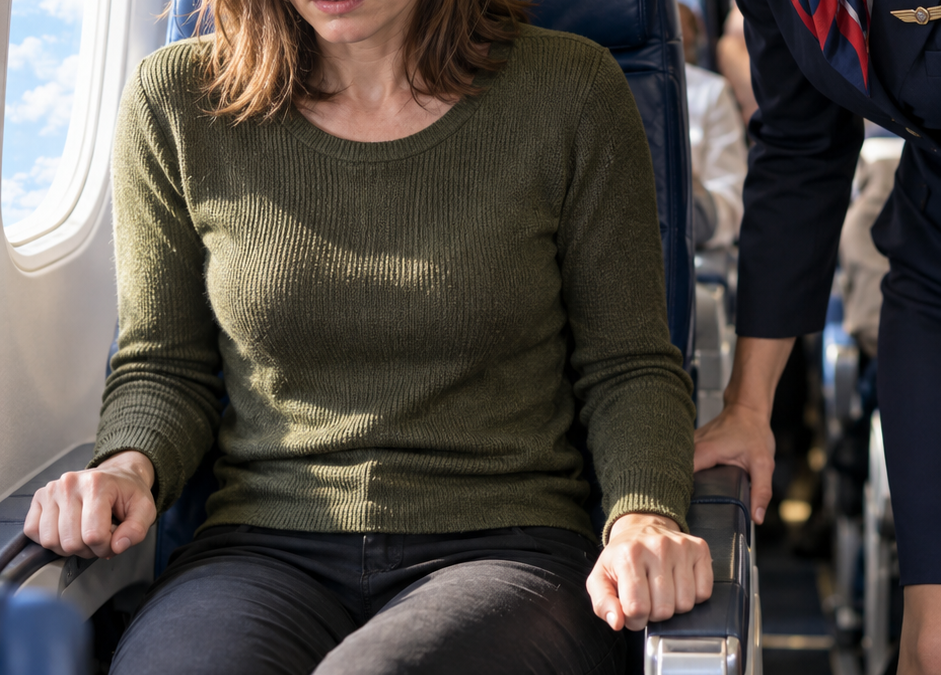
I was hiding.
There is a difference.
People usually leave sleeping passengers alone. They do not ask where you are going. They do not ask what you do for work. They do not notice when your hands tighten around the armrests during takeoff even though nothing about the takeoff is unusual.
Most importantly, they do not ask questions about who you used to be.
I had become very skilled at not being asked that question.
For the previous eighteen months, I had worked mornings at a diner three states away from the naval air station where nearly everyone I had known still wore flight suits.
I poured coffee.
Carried plates.
Learned which construction crews wanted their eggs over easy and which retired couples split one blueberry pancake every Thursday.
Nobody at the diner knew that before I started memorizing breakfast orders, I had spent nine years flying carrier-based strike aircraft for the United States Navy.
Nobody knew I had landed on pitching decks at night.
Nobody knew I had flown over places whose names rarely appeared in ordinary conversation.
Nobody knew I could read an instrument panel faster than most people could read a traffic light.
And nobody knew why I had stopped.
That was exactly how I wanted it.
For nine years, flying had been the cleanest thing in my life.
Not easy.
Never easy.
But clean.
The aircraft gave you information. The weather gave you information. Your instruments gave you information. Your body gave you information.
You processed it.
You made a decision.
You lived with the result.
There was something almost merciful about that kind of clarity.
I had been good at it.
Better than good, if I am being accurate.
Flying never felt like something I had learned. Training had refined me, sharpened me, disciplined me, but underneath all of that was something instinctive.
Some people can hear a piece of music once and understand where it is going.
Some people look at numbers and see relationships before anyone else sees them.
I could feel an aircraft.
I knew when a landing was wrong before the instruments finished proving it.
I could sense when a wingman was overloaded by the way his radio calls shortened.
I could make decisions under pressure without allowing the pressure to become part of the decision.
My squadron commander once told me, after a night carrier recovery that had sent two other aircraft diverting to shore, that I looked more comfortable in a cockpit than most people looked in their own kitchens.
At the time, I laughed.
I believed he was right.
Then came the night David Kaminsky died.
Three years later, I could still remember every second without wanting to.
That was the problem with trauma.
People thought memory softened with time.
Some memories did.
Others became polished.
Handled so often in the dark that every edge grew smoother and sharper at the same time.
David was my weapons systems officer.
My backseater.
Twenty-nine years old.
Terrible taste in music.
Unreasonable confidence in gas-station sushi.
A laugh that carried through a ready room even when he was trying to keep it quiet.
He had been married four years.
His daughter, Emma, had turned six months old two days before our final flight together.
He showed everyone the same photo of her constantly.
Emma lying on her stomach in a yellow onesie, her head lifted like she was personally offended by gravity.
I had seen that picture maybe fifty times.
I would have looked at it fifty more.
We were returning to the carrier after a routine night mission when the aircraft developed a control problem on final approach.
Mechanical.
Sudden.
Severe.
The investigation later reconstructed everything.
A failed component.
A maintenance chain.
A defect nobody had identified.
No pilot error.
No procedural violation.
No decision I should have made differently.
Those sentences appeared repeatedly in the final report.
They were supposed to matter.
Technically, they did.
Emotionally, they were useless.
When the aircraft became unrecoverable, I initiated ejection.
Mine functioned.
David’s did not function cleanly enough.
I hit the water hard.
He hit harder.
By the time the rescue helicopter reached us, there was nothing anyone could do.
I remember the rotor wash.
I remember freezing saltwater running down the back of my neck.
I remember a rescue swimmer shouting at me even though I could hear perfectly well.
Mostly, I remember looking toward the place where David should have been and understanding before anybody said anything that I was going to leave that ocean alone.
The Navy investigated for months.
Engineers reconstructed the failure.
Maintenance records were pulled.
Components were examined.
Audio was reviewed.
My actions were analyzed second by second.
Eventually, a senior officer sat across from me and told me what everyone else had already told me.
“Olivia, you did everything you could.”
I remember staring at him.
Then I asked the question I had asked myself every night.
“Everything?”
He understood what I meant.
“Yes.”
“Every possible thing?”
“Yes.”
“What if I’d called the ejection half a second earlier?”
He was quiet.
Not because he believed it would have changed anything.
Because he understood that facts and guilt speak different languages.
“Olivia,” he said, “the investigation is clear.”
I hated those words.
The investigation is clear.
As if clarity on paper could reach backward through time.
As if a sentence could pull David out of the water.
As if his wife could frame the report beside their daughter’s crib and feel better because the Navy had determined that nobody was at fault.
I continued flying for another eighteen months.
People sometimes found that difficult to understand.
If the accident hurt that badly, why keep flying?
Because leaving immediately would have felt like admitting something I could not admit.
That the cockpit had beaten me.
That David’s death had changed the meaning of the thing I loved most.
So I climbed back in.
Again.
And again.
And again.
I passed every evaluation.
Flew every assigned mission.
Briefed younger pilots.
Completed night landings.
Accepted compliments.
Signed paperwork.
Smiled when required.
And every time the canopy came down, some part of me expected to hear David’s voice behind me.
Every time I looked at an empty back seat, I saw him.
Every time something minor malfunctioned, my body reacted before my mind did.
Eventually, the exhaustion became worse than the guilt.
So I requested separation.
I did not hold a ceremony.
I did not give a speech.
I packed my uniforms into boxes and moved three states away.
Then I became a waitress.
There was no dramatic reason for the job.
That was part of why I liked it.
People ordered food.
I brought food.
They ate.
They paid.
Problems had edges.
Coffee was cold.
Toast was burned.
Someone wanted ranch instead of blue cheese.
Nobody died because my hands were half a second late.
For eighteen months, I built a small ordinary life out of predictable things.
And then my mother called me at 11:07 on a Saturday night.
“Olivia?”
I knew immediately.
There was something about her voice.
Thin.
Controlled.
Too careful.
“What happened?”
“It’s your father.”
I stood up so fast that the kitchen chair behind me hit the floor.
“What happened?”
“He had a stroke.”
The room disappeared around me.
“How bad?”
“They don’t know yet.”
“Is he conscious?”
“Sometimes.”
“Can he talk?”
A pause.
“Not really.”
I closed my eyes.
My father had always been a talker.
The kind of man who could turn asking a cashier for directions into a ten-minute conversation.
When I was a child, I used to complain that he talked to everyone.
When I was seventeen, I told him it was embarrassing.
When I was thirty-six, the idea that he might never speak normally again felt like somebody had reached inside my chest and closed a fist.
My mother started crying quietly.
“I’m booking a flight,” I said.
“You don’t have to come tonight.”
“Mom.”
“I mean it. We’ll know more tomorrow.”
“I’m coming.”
Three days later, I was in seat 8A.
My father was stable, but the neurologists were still uncertain about the extent of the damage.
He had recognized my mother.
He had moved his right hand.
He had tried to speak and managed one sound.
That was all I knew.
I had spent the entire drive to the airport imagining the last conversation we’d had.
He had complained that his blood pressure pills made him tired.
I had told him to call his doctor.
He had said, “Yes, Lieutenant.”
I had rolled my eyes.
Then he said he loved me.
I said I loved him too.
A perfectly ordinary call.
Which was exactly why it terrified me.
You never know which ordinary conversation is going to become the one you replay.
By the time our flight leveled at cruising altitude, I had been awake almost twenty-four hours.
I shut my eyes.
The engine vibration moved through the cabin.
That sound had once meant home to me.
Now it meant memory.
Still, exhaustion eventually pulled me somewhere between sleep and awareness.
I don’t know how long I stayed there.
Later, I learned it was about ninety minutes.
I did not know that Captain Daniel Whitfield had pressed one hand against his chest.
I did not know that First Officer Ben Alvarez had looked over and seen confusion on his captain’s face.
I did not know Whitfield, already disoriented by a cardiac event, had reacted incorrectly to an engine warning.
I did not know he had shut down one of the aircraft’s two engines before losing consciousness.
I knew none of that.
Then the intercom crackled.
My eyes opened immediately.
There are tones you never forget.
The voice that came through the speaker was controlled, but the control itself told me something was wrong.
“Ladies and gentlemen, this is your first officer speaking.”
I sat straighter.
“We have a medical emergency involving a member of the flight crew.”
Around me, conversations stopped.
A man across the aisle lowered his tablet.
The woman in front of me turned her head toward the speaker.
“We are asking for assistance from any passenger with piloting experience. If there is a pilot aboard, particularly anyone with combat flight training, please identify yourself to a flight attendant immediately.”
For several seconds, nobody moved.
Combat flight training.
Those words did not belong in a routine passenger announcement.
And whoever had chosen them had chosen them for a reason.
My hands went flat against my thighs.
I stared at the seatback in front of me.
A familiar pressure built beneath my ribs.
Not fear exactly.
Recognition.
The same feeling I used to get when a radio call changed tone during a mission and everybody understood that whatever happened next would not resemble the briefing.
I could raise my hand.
I could stay still.
For three years, I had imagined that if anyone ever asked me to fly again, my answer would be simple.
No.
Not hesitation.
Not maybe.
No.
I was done.
I had built an entire life around being done.
A flight attendant appeared at the front of the cabin.
She moved quickly, asking questions row by row.
A private pilot raised his hand several seats behind me.
She spoke with him briefly.
Whatever he said did not solve the problem.
She continued.
My pulse climbed.
Row seven.
Then row eight.
She stopped beside me.
I looked toward the window.
Clouds.
Blue sky.
Nothing else.
“Ma’am?”
I turned.
She looked about forty-five, maybe fifty.
Professional uniform.
Hair pinned neatly.
But her eyes were frightened.
Not theatrically frightened.
The quieter kind.
The kind people get when they have been given responsibility without enough options.
“Ma’am, do you have any flying experience?”
There it was.
The question I had spent three years avoiding.
I could have said no.
Nobody on that aircraft knew me.
I was wearing jeans and a green sweater.
My Navy record might as well have belonged to another person.
Then I saw her hands.
They were shaking slightly.
And something inside me shifted.
Not healed.
Not disappeared.
Shifted.
“I’m a Navy pilot,” I said.
Her eyes widened.
“Active?”
“Former.”
“What did you fly?”
“Carrier-based strike aircraft.”
Her relief arrived so visibly that for one second I almost felt sorry for her.
Then she said, “Thank God.”
I unbuckled my seat belt.
She did not move.
“There is something else.”
My fingers stopped.
“What?”
“The captain collapsed.”
“Is the first officer conscious?”
“Yes.”
“Then why are you asking specifically for combat experience?”
Her face changed.
“The captain shut down an engine before he lost consciousness.”
For a second, I heard nothing.
Not the cabin.
Not the engines.
Not the frightened whispers starting around us.
Nothing.
A dead engine on a twin-engine passenger jet was serious but manageable.
A dead captain was serious but manageable.
The fact that the remaining pilot had asked specifically for someone accustomed to abnormal, high-pressure flying told me those were probably not the only problems.
I stood.
“Take me forward.”
Three hundred people watched me walk toward the cockpit.
I felt it.
That collective attention.
I had experienced something similar crossing carrier decks before difficult missions.
Except back then I wore a flight suit and everyone knew exactly why I was there.
Now I was simply a tired waitress in sneakers and a green sweater walking past rows of frightened strangers.
A little boy near the aisle looked up at me.
“Are you a pilot?”
His mother whispered his name sharply.
I kept moving.
The cockpit door opened.
The smell hit me first.
Electronics.
Coffee.
Warm air.
Plastic.
A cockpit has its own atmosphere.
Even an unfamiliar one.
My body recognized it instantly.
Captain Whitfield was slumped in his seat, harness holding him upright.
An off-duty nurse knelt beside him as best she could in the cramped space.
First Officer Ben Alvarez was flying.
He looked young.
Very young.
Later I learned he was twenty-six.
Third flight since upgrading to first officer.
At that moment, what mattered was that both of his hands were locked around the controls with enough tension to turn his knuckles white.
He looked at me.
“You’re the military pilot?”
“Olivia Carter. Nine years Navy.”
“What platform?”
I told him.
His face changed.
Not dramatically.
Just enough.
Military aviation credentials mean something specific to pilots.
Especially frightened pilots.
“Sit down,” he said.
I took the empty seat.
The first thing I did was not touch anything.
I looked.
Altitude.
Airspeed.
Heading.
Engine indications.
Warning systems.
Aircraft attitude.
Fuel.
Weather display.
Autopilot status.
One engine secured.
No fire warning.
The remaining engine stable.
The aircraft itself was flying.
That mattered.
I took one breath.
“Tell me exactly what happened.”
Ben swallowed.
“Captain Whitfield said he felt dizzy. Then we got a temperature warning. He reached for the shutdown control. I told him to wait because the indications didn’t match a fire. He shut it down anyway.”
“And then?”
“He grabbed his chest.”
The nurse looked over.
“He’s alive. Pulse is weak but regular.”
I nodded.
Ben continued.
“He lost consciousness thirty seconds later.”
“Autopilot?”
“Engaged.”
“ATC?”
“Emergency declared.”
“Nearest suitable field?”
“Being coordinated.”
“Good.”
He stared at me.
“Good?”
“You’re still flying the airplane.”
His breathing slowed slightly.
“That means we have something to work with.”
I had said versions of those words to young pilots before.
Focus on what still works.
Aviation emergencies become dangerous faster when your mind starts counting what you have lost instead of what remains.
Ben nodded.
“Okay.”
I looked at him.
“You’re flying. I’m assisting. We do one problem at a time.”
“Understood.”
For the first ten minutes, that was enough.
The aircraft was stable.
The single-engine condition was manageable.
ATC began vectoring us toward a larger airport with a long runway and emergency services.
The nurse kept Whitfield stable.
Ben’s breathing normalized.
My own body was doing something I had not expected.
Remembering.
Not intellectually.
Physically.
My eyes moved automatically.
My voice flattened into the old calm cadence.
Information separated itself into priorities.
Three years fell away.
I hated how natural it felt.
Then I noticed the hydraulic pressure.
It was low.
Not catastrophically.
Not yet.
But lower than it should have been.
“Ben.”
He looked.
I pointed.
His face tightened.
“That wasn’t there before.”
“I know.”
We watched the gauge.
Slow decline.
Not an electrical flicker.
Not a sensor spike.
A trend.
The kind of trend that makes every experienced pilot uncomfortable.
I checked the related indications.
The hydraulic system affected flight controls, steering, braking, and other critical systems.
The pressure loss was on the same side as the engine that had been shut down.
My stomach tightened.
“What caused the original temperature warning?” I asked.
“We didn’t establish it before the captain shut the engine down.”
“Could have been a localized overheat affecting the hydraulic line.”
Ben stared at the instruments.
“If that’s true—”
“Then the engine shutdown wasn’t the whole emergency.”
His breathing changed again.
I heard it before I saw his hands tighten.
“Ben.”
“I know.”
“Look at me.”
He did.
“Do not fly five minutes from now.”
His brow furrowed.
“What?”
“Fly this second. What do we have right now?”
He looked back at the panel.
“One stable engine.”
“Good.”
“Autopilot functioning.”
“Good.”
“Hydraulic pressure decreasing.”
“But not gone.”
He nodded.
“What else?”
“Weather is good at the diversion field.”
“Runway?”
“Long.”
“Emergency crews?”
“ATC says standing by.”
“Then that is our world. Not what might happen. What is happening.”
He released a breath.
I knew that look.
I’d seen it on junior pilots before combat sorties.
Fear becomes dangerous when it gets ahead of time.
Your brain starts crashing an aircraft that is still flying.
We began working the hydraulic problem.
Checklist.
Isolation.
Backup systems.
Confirm.
Cross-check.
No improvisation unless the checklist stopped matching reality.
Ben handled the aircraft.
I worked beside him.
At first, my hands felt slightly disconnected from me.
Then muscle memory returned with a cruelty I did not appreciate.
Everything felt familiar enough to hurt.
A switch.
A callout.
A warning tone.
David’s voice appeared in my head.
Not memory exactly.
Something closer to presence.
Check left side.
That was what he would have said.
Then he would have made some stupid joke about cafeteria meatloaf.
My chest tightened.
I forced my attention back to the instruments.
Not now.
David was dead.
Ben was alive.
Three hundred people behind me were alive.
That was the difference that mattered.
Air traffic control came over the radio.
“Flight 417, emergency services are in position. You are cleared direct for the approach.”
Ben responded.
His voice was better now.
Still tense.
But controlled.
When the radio went quiet, he glanced toward me.
“Can I ask you something?”
“Depends.”
“Were you scared in combat?”
I almost laughed.
Not because the question was funny.
Because it was so young.
So honest.
“Yes.”
He looked surprised.
“Every time?”
“Pretty much.”
“You don’t seem scared now.”
“I am.”
That surprised him more.
I looked through the windshield.
A layer of cloud sat far below us.
“My father had a stroke three days ago.”
Ben said nothing.
“I’m on this flight because I’m trying to get to his hospital.”
“I’m sorry.”
“I haven’t seen him yet.”
His eyes returned to the instruments.
I continued.
“So yes. I’m scared.”
“Of this?”
“Some of it.”
I swallowed.
“But mostly I’m scared I’ll spend the rest of my life knowing I was one flight away from seeing him and didn’t get there.”
Ben was quiet.
Then he said, “We’re getting you there.”
I looked at him.
He was still frightened.
But his hands had stopped shaking.
“First,” I said, “we get everybody there.”
He nodded.
“Right.”
The approach began.
We reviewed everything twice.
Landing configuration.
Emergency procedures.
Manual control considerations.
Hydraulic limitations.
Single-engine handling.
Braking alternatives.
I forced myself to slow down.
Speed feels productive during emergencies.
It often isn’t.
Fast mistakes are still mistakes.
Below us, the city became visible.
Then highways.
Buildings.
Industrial lots.
The runway appeared in the distance.
Long.
Straight.
Beautiful.
Emergency vehicles waited on both sides like small red toys.
Ben saw them.
“Oh, God.”
“What?”
“That’s a lot of trucks.”
“That’s a good thing.”
He laughed once.
A nervous, exhausted sound.
“Right.”
“Ben.”
“Yeah?”
“You have done well.”
He looked over.
I meant it.
He had.
A less disciplined pilot might have collapsed under the combination of an incapacitated captain, a shutdown engine, and a developing hydraulic failure.
Ben was inexperienced.
He was not weak.
Those were different things.
“You’re going to keep doing well,” I said.
He nodded.
We continued descending.
Then the hydraulic pressure dropped.
Fast.
Not the slow decline we’d been monitoring.
A sharp fall.
My entire body went cold.
Ben saw it.
“No.”
I checked the secondary indications.
The leak had worsened.
The backup braking plan we’d discussed depended on pressure we could no longer trust to remain available evenly.
We were seconds from the threshold.
No meaningful time for a new orbit.
No value in pretending the aircraft was in the condition we had planned for five minutes earlier.
This was where experience mattered.
Not because experience gives you answers.
Sometimes it doesn’t.
Experience teaches you how to choose while incomplete information is still arriving.
“Listen carefully,” I said.
Ben looked at me.
“We change the rollout plan.”
His face tightened.
“How?”
“We use the working engine for directional control where needed. Manual reversion. Braking only as available and only after we know what the aircraft is giving us.”
“What if it pulls?”
“We counter early.”
“What if the brakes don’t respond evenly?”
“We do not chase the first correction with a larger second correction.”
He nodded.
“Small inputs.”
“Exactly.”
The runway rushed toward us.
I placed my hands on the controls.
And suddenly I was back over black ocean.
Night.
Warning lights.
David behind me.
The memory hit so hard that for one second I could smell seawater.
My hands almost froze.
Then I heard Ben.
“Olivia?”
I blinked.
Daylight.
Commercial cockpit.
Runway.
Ben.
Three hundred passengers.
Not David.
Not the ocean.
Not three years ago.
Now.
“I’m here.”
We crossed the threshold.
A little fast.
Intentionally.
The aircraft wanted to yaw toward the failed side.
I felt it immediately.
“Hold.”
Ben managed thrust.
I corrected.
The main gear hit hard.
The impact slammed through the cockpit.
Behind us, hundreds of passengers cried out at once.
The aircraft pulled.
Hard.
There it was.
Exactly what we had expected.
Only stronger.
“Left correction.”
“Got it.”
“Easy.”
The nose wanted to wander.
Speed was bleeding.
Not fast enough.
Ben adjusted the working engine.
I countered the directional pull.
For one horrible moment, the centerline moved sideways beneath us.
Then came the most dangerous impulse any pilot can feel.
Overcorrect.
Fight harder.
Force the airplane.
I had seen pilots do it.
I had almost done it once as a lieutenant.
The aircraft does not care that you’re frightened.
Fear makes hands aggressive.
Aggressive hands make unstable machines worse.
“Small,” I said.
I don’t know whether I was speaking to Ben or myself.
“Small.”
We corrected.
The aircraft responded.
The centerline came back.
Speed falling.
Eighty knots.
Sixty.
Forty.
The hydraulic pressure was barely useful now.
But it did not matter as much.
We had momentum on our side.
Emergency vehicles began moving.
Twenty knots.
Ten.
Then nothing.
The aircraft stopped.
Not perfectly centered.
Not elegantly.
But upright.
Intact.
Alive.
For several seconds, neither Ben nor I moved.
I heard my own breathing through the headset.
The cockpit smelled warm.
The nurse behind us whispered, “Oh, thank God.”
Ben’s hands came off the controls slowly.
He looked at them as if he had never seen them before.
Then he looked at me.
“Did we just—”
“Yes.”
He laughed.
Then he covered his face with both hands.
The laugh broke apart.
I knew what was happening.
Adrenaline leaving.
The body asking permission to feel everything the mind had postponed.
I wanted to do the same.
Instead, I looked back at Captain Whitfield.
“How is he?”
The nurse checked again.
“Still with us.”
That was enough.
For the moment, enough had to be enough.
Airport firefighters reached the aircraft first.
Paramedics followed.
The cockpit became crowded with voices and equipment.
Captain Whitfield was removed carefully.
The nurse stayed beside him until the ambulance crew took over.
Before they carried him through the cockpit door, I saw his face clearly for the first time.
Gray.
Still.
Vulnerable.
A man whose entire career had probably been built around being the one everyone trusted, now completely dependent on strangers.
For some reason, that nearly broke me.
Maybe because my father was lying in another hospital in another state.
Maybe because helplessness has a way of recognizing itself.
Once the captain was gone, Ben and I were briefly alone.
He stared through the windshield at the emergency vehicles.
Then he said, “Thank you.”
Two words.
Nothing elaborate.
They were enough.
“You were flying the airplane before I got here,” I said.
“I don’t know if I could have landed it.”
“You didn’t have to find out.”
He shook his head.
“You don’t understand.”
I looked at him.
“When you sat down, I thought I was going to kill everybody.”
There are moments when reassurance becomes disrespectful.
I could have told him he was wrong.
I could have told him he had training.
I could have said he would have figured it out.
Instead, I told him the truth.
“I understand exactly what that feels like.”
He studied my face.
Then his eyes lowered.
“Why did you stop flying?”
There it was again.
The question.
For three years, I had learned how to redirect it.
Change the subject.
Offer a vague answer.
Smile.
Not today.
“My backseater died.”
Ben looked up immediately.
“Accident?”
“Mechanical failure.”
“I’m sorry.”
“So am I.”
He waited.
“I ejected,” I said. “He didn’t get out cleanly.”
His expression changed.
Now he understood something about the woman who had walked into his cockpit wearing a green sweater.
“Was it your fault?”
“No.”
The answer came automatically.
That was what the report said.
That was what every investigation had said.
Ben remained silent.
And maybe because I had just helped keep three hundred strangers alive, or maybe because I was too exhausted to lie anymore, I added,
“But knowing that and feeling that have never been the same thing.”
He nodded slowly.
“No,” he said. “I guess they wouldn’t be.”
That sentence reached me more deeply than every official assurance I had received after David died.
Not because Ben knew more.
He knew almost nothing.
But he had not tried to fix the contradiction.
He simply accepted it.
The aircraft door opened.
Cabin crew began organizing deplaning.
I stood.
My legs shook when I put weight on them.
That irritated me.
Then I almost laughed at myself.
I had just landed a crippled passenger jet after three years away from a cockpit, and apparently my pride was offended that my knees had opinions about it.
Ben stood too.
“Olivia.”
I turned.
“I hope your dad is okay.”
The words hit harder than I expected.
“Thank you.”
When I stepped into the cabin, everyone was quiet.
Not completely.
There were children crying.
People speaking into phones.
Someone praying.
But the cabin had the strange hushed atmosphere of a church after bad news.
Then someone near the front started clapping.
I hated it immediately.
Not because the gratitude was wrong.
Because I did not know where to put it.
Others joined.
I raised one hand awkwardly.
“Please don’t.”
That only made some of them cry.
A woman grabbed my hand as I passed.
“You saved my daughter.”
Her daughter looked about sixteen.
I looked at the mother.
“We had a good first officer.”
“You saved her.”
I had no answer.
A man farther back said, “Thank you.”
Then another.
Then another.
By the time I reached seat 8A, my chest hurt.
I grabbed my carry-on.
The little boy who had asked whether I was a pilot earlier stood beside his mother.
He looked at me.
“Were you?”
“Was I what?”
“A pilot.”
I almost said, “I used to be.”
That had been my standard answer.
Used to be.
Past tense.
Finished.
Instead, I said, “Yes.”
His face lit up.
I walked off the aircraft before I could think too much about why I had answered differently.
The terminal was chaos.
Emergency personnel.
Airline staff.
Airport police.
Passengers calling relatives.
Television crews had apparently heard about the emergency before we even reached the gate.
Someone from the airline took me into a quiet operations room before reporters could identify me.
I asked one question immediately.
“My connection.”
The manager blinked.
“Excuse me?”
“My connecting flight. I need to get home.”
He stared at me as though I had asked about a lunch reservation.
“You just landed Flight 417.”
“I am aware.”
“With a disabled engine and hydraulic failure.”
“Also aware.”
“Ms. Carter—”
“My father had a stroke.”
His expression changed.
“My connection leaves in less than two hours. I need to know whether I’m going to make it.”
Everything around him softened.
“Give me the flight number.”
I did.
He left the room.
I sat alone.
For the first time since the announcement, nobody needed anything from me.
That was when my hands started shaking.
Violently.
I locked them together.
It did not help.
The cockpit returned in fragments.
Warning light.
Hydraulic pressure.
Runway.
David.
Ocean.
Ben saying he thought he was going to kill everyone.
I leaned forward and pressed my forehead against my fists.
“Not now,” I whispered.
But there was no reason for my body to obey anymore.
The emergency was over.
So it collected its debt.
I cried.
Not loudly.
Not dramatically.
I cried the way exhausted people cry when there is nobody left to reassure.
For David.
For my father.
For Ben.
For three hundred strangers.
For myself.
I had spent three years believing the worst moment of my life proved something about flying.
Maybe even something about me.
Now I had returned to a cockpit under circumstances so absurd they almost felt cruel, and the cockpit had not taken anything from me.
It had asked something from me.
And I had been able to give it.
There was a knock.
I wiped my face.
A man in a dark airline uniform entered.
Late fifties.
Silver hair.
Captain’s bars.
He introduced himself as the airline’s regional chief pilot.
He sat across from me.
“Olivia Carter?”
“Yes.”
He held a tablet.
“I pulled your service record.”
I stiffened.
He must have noticed.
“I’m not press.”
“Good.”
“I won’t give your information to them.”
“Thank you.”
He studied the screen.
“Nine years naval aviation.”
I said nothing.
“Carrier operations.”
Nothing.
“Combat deployments.”
“Some.”
He looked at me over the tablet.
“Your record says you received an instructor qualification.”
“For a while.”
“Your first officer says you effectively managed the entire abnormal-procedure workload once you entered the cockpit.”
“Ben flew the airplane.”
“He says you kept him functional.”
“That is part of flying the airplane.”
The chief pilot smiled slightly.
“You sound like an instructor.”
“I was.”
He leaned back.
“Captain Whitfield is alive.”
My breath caught.
“They’ve transferred him to a cardiac center. The doctors are optimistic.”
I closed my eyes briefly.
“Good.”
“Very good.”
He continued.
“We have maintenance personnel looking at the aircraft. Preliminary information supports what you identified. The hydraulic problem appears related to the original overheat condition.”
I nodded.
He stared at me for a moment.
“Do you understand what you did today?”
“I helped land an airplane.”
“You helped prevent a catastrophic outcome involving roughly three hundred people.”
“I wasn’t alone.”
“I didn’t say you were.”
That silenced me.
He set the tablet down.
“I’m not interested in turning you into a hero for a press release.”
“Thank you.”
“I’m interested in the fact that somebody with your background hasn’t flown in three years.”
My jaw tightened.
“That is intentional.”
“I assumed.”
He waited.
I did not explain.
Then he said, “Whatever happened, I’m not asking.”
I looked at him.
“But I am going to ask one professional question.”
“What?”
“Have you ever considered coming back?”
My answer should have been immediate.
No.
It had always been immediate.
Someone once suggested I rent a small Cessna and fly around the pattern.
No.
A former squadron friend offered to get me simulator time.
No.
My father once asked whether I missed it.
I changed the subject.
But sitting there after Flight 417, I did not say no.
The chief pilot noticed.
Good pilots notice hesitation.
He did not push.
Finally I said, “I don’t know.”
“That’s different from no.”
“Yes.”
He nodded.
“Then keep the difference.”
The operations manager returned a few minutes later.
“We’re holding your connection.”
I stared at him.
“What?”
“Not indefinitely. But they’re aware of the situation.”
“You can do that?”
He smiled.
“Today? Apparently.”
I stood so quickly that the chief pilot laughed.
Before I left, he handed me a business card.
“No pressure.”
I took it.
“I mean that. Throw it away if you want. But if you ever decide you want to sit in a simulator, teach emergency procedures, ferry aircraft, fly passengers, anything—call me.”
I looked at the card.
Then slipped it into my pocket.
“I’ll think about it.”
This time, I meant it.
I reached my connection with twenty minutes to spare.
I was supposed to sleep.
I didn’t.
I watched clouds pass beneath the wing.
A year earlier, I would have closed the shade.
That evening, I walked into my father’s hospital room carrying the same bag I had shoved beneath seat 8A.
My mother was sitting beside him.
She stood when she saw me.
“Oh, Liv.”
She wrapped both arms around me.
I held her longer than I usually did.
Then I looked at my father.
He seemed smaller.
That frightened me more than anything on Flight 417.
My father had never been small.
Not physically.
Not emotionally.
He filled rooms.
Now he lay beneath a thin hospital blanket with wires attached to his chest and one side of his face slightly slack.
His eyes were closed.
I walked closer.
“Dad?”
His eyes opened.
They moved toward me.
For one terrible second, I was not sure he recognized me.
Then his right hand shifted.
Two fingers lifted.
The beginning of a salute.
I laughed and cried at the same time.
“Don’t you dare.”
His mouth moved.
No sound came.
I took his hand.
“I’m here.”
His fingers closed around mine.
Weak.
But deliberate.
“I’m sorry it took me so long.”
His brow furrowed.
My mother said, “He doesn’t know anything about your flight yet.”
I looked at her.
“Good.”
She stared.
“Olivia, the story is already on television.”
“What?”
“Some passengers talked.”
I groaned.
My father’s eyes narrowed slightly.
The old expression.
The one he used when he knew I was hiding something.
My mother smiled through tears.
“You may as well tell him.”
So I did.
Not everything.
Not the technical details.
Not David.
He already knew enough about David.
I told him the captain got sick.
I told him the airplane had problems.
I told him they needed another pilot.
I told him I helped.
When I finished, my father stared at me.
Then he squeezed my hand again.
His mouth moved.
This time a rough sound came out.
At first I couldn’t understand.
He tried again.
“F-fly.”
I froze.
My mother covered her mouth.
“Dad—”
He tried again.
“Fly.”
One word.
Broken.
Difficult.
Probably painful.
The first word I heard my father speak after his stroke was fly.
I lowered my head until my forehead touched his hand.
For three years, I had believed everyone wanted me to go back because they did not understand why I had left.
My father was different.
He had never pressured me.
After David died, he sat at my kitchen table for an entire weekend and never once told me what decision I should make.
When I left the Navy, he helped me move.
When I took the diner job, he never asked whether it was beneath me.
He only said, “Does it let you sleep?”
At the time, I told him yes.
He nodded.
“Then it’s good work.”
Now he looked at me from a hospital bed and said the one word I had refused to say to myself.
Fly.
I did not promise him anything.
I only held his hand.
Weeks passed.
My father improved slowly.
Speech therapy.
Physical therapy.
Frustration.
Small victories.
He regained more words.
Then sentences.
His first full sentence to me was exactly what I should have expected.
“That green sweater was ugly anyway.”
I laughed so hard I almost dropped the phone.
Captain Whitfield survived too.
Ben called me once.
He asked whether I had heard.
“I did.”
“He wants to talk to you when he’s stronger.”
“Tell him there’s nothing to apologize for.”
Ben was silent.
“I think he wants to thank you.”
“He doesn’t need to do that either.”
“You are terrible at accepting thanks.”
“I’ve been told.”
Then Ben said, “Are you flying again?”
I looked across my apartment.
The regional chief pilot’s business card had been sitting on my kitchen counter for three weeks.
Not in the trash.
Not in a drawer.
On the counter.
Every morning I saw it before work.
Every night I saw it when I came home.
“No,” I said.
A pause.
“Yet.”
Ben laughed softly.
“That’s progress.”
Maybe it was.
A few days later, I called the number.
The chief pilot answered personally.
“This is Daniel Mercer.”
“Captain Mercer, this is Olivia Carter.”
He did not pretend he had forgotten me.
“Olivia.”
“I want to ask about the simulator.”
“Any particular reason?”
“I want to know what happens when I get inside one and nobody’s life depends on me.”
He was quiet for exactly the right amount of time.
“Then we’ll find out.”
The first simulator session was terrible.
I wish I could say it was healing from the moment I sat down.
It wasn’t.
My hands sweated.
My heart raced.
When the simulated engines started, I almost stood up and walked out.
Mercer sat in the instructor station behind me.
He did not say, “You can do this.”
He did not say, “Remember who you are.”
He said, “Door is open if you want it.”
That mattered.
I stayed.
We taxied.
Took off.
Climbed.
Turned.
Landed.
Nothing failed.
Nobody died.
Afterward, I sat in silence.
Mercer asked, “How was it?”
“Awful.”
“Want to do it again?”
I stared at the dark simulator screens.
“Yes.”
So I did.
Again.
Then again.
Eventually, the fear changed shape.
It stopped feeling like a wall.
It became weather.
Something real.
Something deserving respect.
But something you could move through if you understood it.
I did not return to military flying.
I did not want that life back.
That surprised some people.
It did not surprise me.
Healing is not restoration.
Sometimes healing means accepting that the person you were before the worst thing happened is not waiting somewhere for you to become them again.
You become someone else.
The question is whether you let that new person become smaller.
I had.
For a while.
Then Flight 417 reminded me of something I had forgotten.
David’s death had changed me.
It had not erased what I knew.
My training was still mine.
My instincts were still mine.
The ability to steady a frightened pilot was still mine.
Leaving the Navy had been necessary.
Leaving every part of aviation behind had not been.
Several months after the emergency, I began teaching part-time at the airline’s training center.
Emergency procedure workshops.
Crew resource management.
Abnormal decision-making.
Young first officers mostly.
Pilots like Ben.
Pilots with excellent technical skills who had never yet experienced the moment when the checklist stopped feeling theoretical.
I never told them they should not be afraid.
That is terrible advice.
Fear is information.
I taught them to keep fear in its proper seat.
Present.
Acknowledged.
Never in command.
During my first class, I stood beside a simulator cockpit while fourteen pilots waited for me to begin.
For a moment, I saw David.
Not literally.
Memory.
He would have hated the tie I was wearing.
He would have made some comment about me becoming respectable.
I smiled.
One of the pilots noticed.
“Something funny, ma’am?”
“Old friend.”
Then I began.
“When something goes wrong in an aircraft, your first job is not to become heroic.”
They watched me.
“Your first job is to remain useful.”
I looked around the room.
“Heroes are usually something other people decide you were afterward. In the cockpit, you need to be boring. Methodical. Accurate. You solve what is happening now.”
A young pilot raised his hand.
“What if you don’t know whether you can handle it?”
I thought of seat 8A.
Green sweater.
My hands flat against my thighs.
The flight attendant asking if I had flying experience.
I thought of the ocean.
David.
Ben.
My father’s weak fingers forming a salute.
“You don’t need to know everything you’re capable of before the moment comes,” I said. “Sometimes the moment tells you.”
Nobody spoke.
I continued the class.
That evening, I drove home after sunset.
The sky was clear.
A passenger jet crossed high overhead, its lights moving steadily through the dark.
For years, whenever I heard an aircraft at night, my mind returned to the accident.
The failed system.
The ejection.
The water.
David.
That evening was different.
I still thought of David.
I probably always will.
But I also thought about Ben.
Captain Whitfield.
Three hundred passengers walking away from Flight 417.
My father learning to speak again.
I thought about the fact that grief had convinced me that continuing forward meant leaving everything behind.
It doesn’t.
Sometimes you carry things forward differently.
David would always be part of every cockpit I entered.
Not as punishment.
Not anymore.
As history.
As love.
As warning.
As the reason I understood more clearly than most pilots that behind every seat was a human being expected home by someone.
I stood beside my car and watched the distant aircraft until its lights disappeared.
Then I went home.
The next morning, I returned to the training center.
I put my bag down beside the simulator.
Checked the day’s lesson.
Sat in the cockpit.
And for the first time in three years, I placed my hands on the controls without wondering whether I still belonged there.
I didn’t belong to the cockpit.
I had finally understood that.
The cockpit belonged to no one.
But the knowledge I had earned there still belonged to me.
And I no longer needed to run from it.








