𝗙𝗨𝗟𝗟 𝗦𝗧𝗢𝗥𝗬 Rebecca Sent an Excavator Down My Ranch Road Before Anyone Asked Who Owned the Ground Beneath It
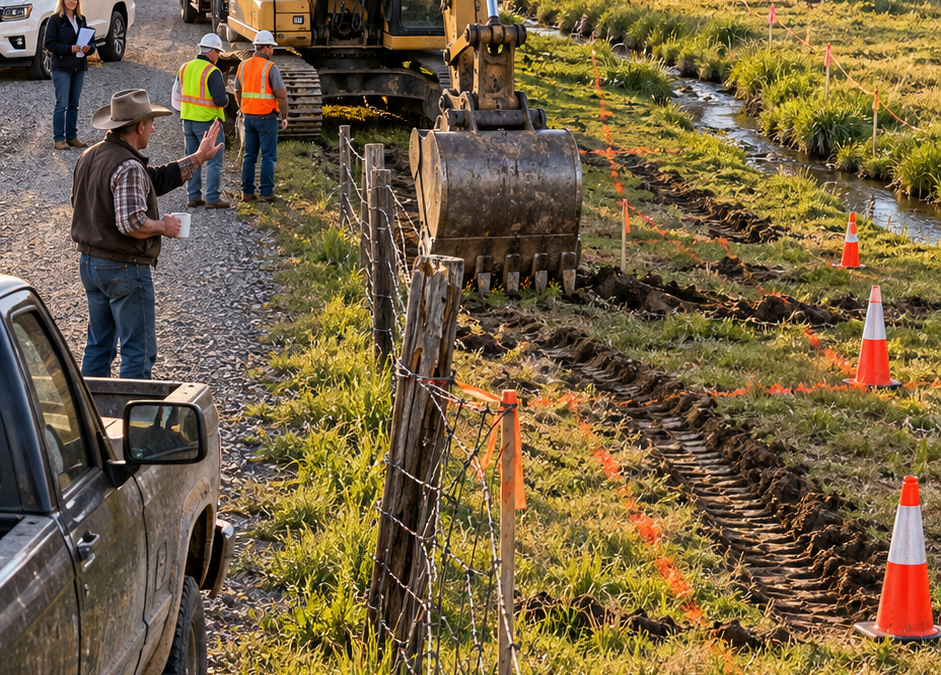
𝗙𝗨𝗟𝗟 𝗦𝗧𝗢𝗥𝗬
I stared at him. “You voted to take twelve feet of my pasture.”
“We voted to widen the community access.”
“My pasture isn’t community property.”
Howard opened his mouth, then stopped.
A sheriff’s cruiser had just turned onto the lane.
Someone had called. I didn’t know who yet. Maybe one of the workers, maybe Carl, maybe a neighbor from Silver Pines who saw equipment blocking the road. Whoever it was, I was grateful.
Deputy Marcus Reed stepped out.
He did not rush. He looked at the excavator, the clipped fence, the orange cones, Rebecca’s map, Howard’s nervous face, and my truck sitting exactly where it always sat beside the road.
Then he asked, “Who’s in charge here?”
Rebecca raised her hand.
“Silver Pines HOA authorized the work.”
Marcus nodded. “All right.”
She looked relieved.
Then he asked one simple question.
“Can you show me proof the HOA owns the road?”
Rebecca’s expression changed.
“We have access rights.”
“That’s not what I asked.”
The contractor supervisor slowly shut down the excavator completely.
Marcus held out his hand.
“Before anybody digs another inch, I want to see the deed, recorded right-of-way, or whatever document you believe gives you ownership.”
Rebecca looked at Howard.
Howard looked at the highlighted map.
And suddenly the loudest thing on my ranch was the cooling engine of an excavator nobody wanted to restart.
Rebecca did not have a deed.
She had a binder.
That distinction became obvious within two minutes.
She opened it across the hood of her SUV and pulled out meeting minutes, a traffic study, the contractor work order, and the same highlighted subdivision map. Deputy Reed looked through everything without changing expression.
Then he looked at her.
“Where’s the ownership document?”
“The map establishes secondary access.”
“It labels a road.”
“Exactly.”
He shook his head. “A label doesn’t tell me who owns the ground under it.”
Howard stepped forward. “The HOA has maintained this route before.”
I looked at him. “No, you haven’t.”
“We’ve paid for gravel.”
“When?”
He hesitated.
Rebecca answered for him. “Last spring.”
I almost laughed.
“Your landscaper dumped gravel at the Silver Pines entrance. That’s five hundred yards east of here.”
Carl nodded. “I watched them.”
Marcus wrote something down.
Then the contractor supervisor introduced himself.
“Ben Carter,” he said. “I need clarification too.”
Rebecca looked irritated. “On what?”
“My work order says HOA-owned secondary road.”
Marcus looked up. “Does it?”
Ben handed him the document.
There it was in black and white.
Property status: Silver Pines HOA common access.
I stared at Rebecca.
“You told the contractor you owned it.”
She folded her arms. “Our attorney advised that the HOA has rights.”
“Ownership rights?”
She did not answer.
Marcus pointed toward the excavator.
“Nobody moves equipment until this is sorted out.”
Rebecca immediately pulled out her phone.
While she argued with someone in a low, urgent voice, I walked to the western edge of the road. There was an old steel fence post near the ditch. My father had shown it to me years ago.
“Road line ends here,” he had told me.
The orange widening stake stood nearly eleven feet beyond it.
Inside my pasture.
Marcus came over. “What’s that post?”
“Old boundary reference. Not official, but it’s been there longer than Silver Pines.”
Carl stepped closer. “The original ranch fence used to follow that line.”
Rebecca ended her call.
“Our attorney is sending the easement.”
Marcus nodded. “Good.”
Ten minutes later, her phone buzzed.
She handed it to him.
A scanned document appeared on the screen.
Road Access Easement — 1994.
Rebecca pointed at the heading.
“There.”
Marcus read silently.
Then he looked at me. “Daniel, do you recognize the names Robert and Elaine Brooks?”
“My parents.”
The easement granted access across a twelve-foot gravel lane to the property east of our ranch—the land that eventually became Silver Pines.
Howard smiled.
“So we do have rights.”
Marcus kept reading.
“Hold on.”
He enlarged the final paragraph.
The easement allowed passage: passenger vehicles, farm vehicles, emergency access.
Then came the restriction.
No widening, relocation, paving, or alteration of the roadway without written consent of the servient landowner.
Nobody spoke.
Ben read it over Marcus’s shoulder.
“Do you have written consent?”
Rebecca looked at me.
I shook my head.
“No.”
Howard frowned. “But we’re not relocating it.”
Ben pointed toward the orange stakes. “You’re widening it.”
Rebecca’s jaw tightened.
“The easement language is thirty years old.”
Marcus looked at her. “Recorded restrictions don’t expire because they’re inconvenient.”
Then Carl noticed a number at the top of the document.
“Parcel reference,” he said.
I looked closer.
The easement crossed my parents’ original eighty-acre ranch, but the land had later been divided.
Marcus called County Records. A clerk named Susan Bell answered. He gave her the recording number and put the phone on speaker.
We waited.
Keyboard clicks came through the line.
Then Susan said, “Yes, Deputy. I have it.”
“Who owns the road corridor today?” Marcus asked.
Another pause.
“The underlying parcel is currently titled to Daniel Brooks.”
Rebecca stared at me.
Susan continued. “Silver Pines holds a non-exclusive access easement only.”
Marcus looked toward the silent excavator.
“So they can travel over it?”
“Correct.”
“Can they widen it?”
“Not according to the recorded instrument without the landowner’s written consent.”
Marcus thanked her.
Rebecca immediately said, “We need a wider road for safety.”
Marcus nodded toward me.
“Then ask him.”
Her eyes narrowed. “What if he refuses?”
Marcus looked at the twelve feet of pasture marked for excavation.
“Then you don’t send workers onto land you don’t own and start digging.”
Ben walked to his crew.
“Pack up.”
Rebecca stepped after him. “You’re under contract to widen an HOA-owned road.”
He held up the work order.
“Apparently, this isn’t one.”
Then Susan called back.
“Deputy, I found something else.”
Marcus put her on speaker again.
“What is it?”
“The 1994 easement has an attached survey.”
I saw Rebecca stiffen.
Susan continued. “Based on the dimensions, the HOA’s orange stakes aren’t just outside the permitted road width.”
She paused.
“They’re outside the easement corridor entirely.”
Her last sentence changed the entire argument.
Rebecca had spent the morning insisting Silver Pines was improving access. Now the county was saying part of the planned improvement wasn’t even inside that access.
Marcus asked Susan to email the survey.
My phone buzzed thirty seconds later.
The attachment showed a twelve-foot corridor measured from the old drainage ditch.
Not twenty-four feet.
Not thirty-six feet.
Twelve.
Ben looked at his crew.
“We were told to clear twelve feet on both sides of center.”
I stared at Rebecca. “That would make it thirty-six feet wide.”
Howard looked confused. “Our traffic report recommended twenty-four.”
Ben shook his head. “My field sheet says thirty-six.”
Rebecca turned sharply. “Show me.”
He retrieved a laminated construction drawing.
The road was shaded in gray. A dashed line marked the proposed clearing.
Thirty-six feet.
My fence.
Two cottonwoods.
Part of my irrigation ditch.
All inside the clearing zone.
Marcus looked at Rebecca.
“Who issued this?”
“Our HOA engineer,” she said. “Thomas Greer.”
Rebecca called him.
He arrived forty minutes later carrying rolled plans and looking uncomfortable before anyone said a word.
The moment he saw Ben’s field sheet, he frowned.
“This isn’t my final drawing.”
Ben held it up. “Your company logo is on it.”
“Logo, yes. Approval stamp, no.”
Rebecca crossed her arms. “You sent that to the board.”
“I sent a concept.”
Thomas unrolled his stamped plan on the hood of Ben’s truck. His design showed a twenty-four-foot emergency route, but a note in red sat beside the road alignment.
Property rights to be verified before any widening.
Marcus pointed at it.
“Was that verification completed?”
Thomas looked at Rebecca.
“I never received one.”
Howard’s face changed.
“You told us engineering cleared the corridor.”
Rebecca’s voice sharpened. “We had the easement.”
Thomas shook his head. “An access easement. I specifically asked whether it allowed widening.”
Rebecca said nothing.
Then Ben’s foreman called from the equipment trailer.
“Ben, you need to see this.”
He carried over a printed email attached to the work packet from Rebecca Sloan.
Subject: Brooks Road Clearing.
Proceed to full thirty-six-foot construction with existing access rights. Existing rights are sufficient. Avoid contacting landowner unless operationally necessary.
I read the last sentence twice.
Carl whistled softly.
Marcus looked at Rebecca.
“You planned to widen his road without discussing it with him?”
“We sent notice.”
“You sent me a traffic letter,” I said. “It never mentioned thirty-six feet.”
Howard took the email.
“I never saw this.”
Neither had Thomas.
Rebecca’s confidence finally cracked.
“We were under pressure to solve emergency access.”
Marcus glanced toward Silver Pines.
“From whom?”
Howard answered. “The fire district raised concerns about evacuation congestion.”
That sounded serious for about ten seconds.
Then a red pickup turned onto the lane.
A man wearing a county fire marshal jacket stepped out.
Howard blinked. “That’s Chief Warren.”
Apparently, Carl had called him.
Chief Samuel Warren walked over and looked at the equipment.
“Why are you widening Brooks Road?”
Rebecca answered quickly. “For the emergency access requirement.”
Samuel frowned. “What requirement?”
“The district requested a wider secondary route.”
“No, we didn’t.”
Silence.
Samuel opened his tablet.
“Our inspection recommended keeping the existing secondary access unobstructed.”
He looked at the gravel lane.
“This road already satisfies the emergency condition attached to the subdivision approval.”
Howard stared at Rebecca.
“You said they required twenty-four feet.”
Samuel shook his head.
“We recommended improving your main entrance traffic controls. Not his road. Your entrance.”
Then Thomas slowly unrolled another sheet.
“I think I know what happened.”
He showed us the original traffic concept.
Two options were marked.
Option A: Improve main Silver Pines entrance.
Option B: Explore Brooks Road widening, subject to landowner consent.
Someone had circled Option B in blue ink.
Beside it were Rebecca’s initials.
Howard looked at her.
“You chose the cheaper option?”
Rebecca snapped, “I chose the practical option.”
I looked at my fence marked for removal.
“Practical for who?”
Before she answered, Marcus noticed something near the excavator.
A pile of freshly cut wire.
He walked over.
My stomach tightened.
Part of my fence had already been clipped.
Ben’s face went pale.
“I told them not to start.”
The foreman shook his head. “That was done before you arrived.”
Marcus looked at Rebecca.
“Who was here first?”
Howard said nothing.
Rebecca did.
“I was.”
Marcus stared at the cut fence.
The dispute had just moved beyond paperwork.
Someone had already started taking my property apart.
Marcus did not accuse Rebecca of cutting the fence.
He asked Ben’s crew who had.
That was worse.
One worker raised his hand.
“I did.”
Ben turned toward him. “Why?”
The worker pointed at Rebecca.
“She told me the fence was inside HOA right-of-way.”
Rebecca immediately shook her head.
“I said the fence interfered with the widening.”
The worker frowned.
“You said, ‘Take it down before Daniel gets here.’”
Nobody spoke.
Marcus wrote that down.
Rebecca’s attorney was not there yet, and she suddenly seemed aware of that.
“Deputy, this is still a property access disagreement.”
Marcus looked at the cut wire.
Then Carl called from farther down the lane.
“Daniel.”
He was standing beside one of my cottonwoods.
A bright orange X had been sprayed across the trunk.
Then we saw the second one.
And the third.
My stomach tightened.
Those trees had shaded that road since I was a kid.
Ben looked horrified.
“Tree removal isn’t on my contract.”
Thomas checked the field sheet.
“It’s on this one. Three red circles mark the cottonwoods. Remove.”
I looked at Rebecca.
“You planned to cut my trees too?”
“They’re inside the improvement corridor.”
“No,” Susan Bell said through Marcus’s phone. She was still reviewing the attached survey. “They aren’t.”
Marcus put her back on speaker.
Susan described two permanent reference points from the 1994 survey. One was an iron pin near the ditch. The other was a brass cap beside an old stone drainage crossing.
I knew the stone crossing.
We walked there.
Thomas used a locator. A sharp tone sounded beneath six inches of soil. Ben carefully scraped dirt away with a hand shovel.
A brass cap appeared.
BROOKS PARCEL — 1994.
Thomas measured from it.
Then again.
The result was clear.
The existing gravel road sat inside the twelve-foot easement. The orange widening stakes extended deep onto my unrestricted land. The cottonwoods were not inside the easement at all.
Howard stared at Rebecca.
“How do we get thirty-six feet?”
She folded her arms.
“The board discussed creating a proper road.”
“Discussed?” I said. “You don’t own it.”
Then another vehicle arrived.
A silver sedan.
Rebecca’s attorney, Laura Mitchell.
She reviewed the easement before saying anything. Then she reviewed Rebecca’s email. Then the contractor field sheet.
Finally, she looked at her client.
“Did I ever tell you Silver Pines owned the underlying road?”
Rebecca hesitated.
“You said we had permanent access rights.”
Laura’s expression hardened. “That’s not ownership.”
Marcus noticed.
“So you advised her on this?”
“I advised the HOA that it possessed a non-exclusive access easement subject to recorded restrictions.”
Howard looked stunned.
“Rebecca told us legal cleared the widening.”
Laura turned toward him.
“I did not.”
Rebecca’s face reddened.
“The board needed a solution.”
Laura lowered her voice. “That doesn’t change my advice.”
Then Carl remembered something.
“The HOA meeting.”
Howard looked at him. “What?”
“Last month. You held it in the clubhouse. My sister lives in Silver Pines.”
Howard slowly nodded. “Meetings are recorded.”
Rebecca went still.
Howard pulled out his phone and called the HOA secretary.
Five minutes later, an audio file arrived.
We stood beside my cut fence listening to Rebecca’s voice come through clearly.
“If Brooks refuses permission, we proceed under existing HOA roadway rights. Once the improvements are completed, he’s unlikely to spend money reversing them.”
Even Laura closed her eyes.
Marcus replayed it.
Rebecca looked at me. “That was taken out of context.”
“What context makes it better?” I asked.
She had no answer.
Then Ben’s foreman approached holding a clipboard.
“There’s more.”
Attached to the work authorization was a handwritten instruction.
Start east end before 7 a.m. Remove fence first.
Initials: R.S.
Rebecca stared at it.
Marcus asked the worker who had cut my fence, “Was this the instruction you followed?”
“Yes.”
Marcus photographed the page.
Then he looked at me.
“Daniel, do you want the damage documented formally?”
I looked at the clipped wire, the marked trees, the orange stakes stretching across my pasture, and the excavator parked where no machine should have been.
“Yes.”
Rebecca stepped forward.
“You’re turning an HOA access issue into a criminal matter.”
Marcus remained calm.
“No, ma’am.”
He pointed toward the excavator sitting beyond the recorded easement.
“I’m documenting what happened after you were told to prove you owned land you were already altering.”
For the first time that morning, Rebecca had nothing left to call authorized.
Marcus photographed every cut wire, every orange stake, every painted tree, and every track beyond the recorded easement.
Then the neighbors started arriving.
Not because I had called them, but because Silver Pines had sent residents an alert saying emergency road improvement had been stopped by a neighboring landowner.
The first resident out of her car was Emily Foster.
She looked angry.
“Daniel, why are you blocking our evacuation road?”
Rebecca opened her mouth.
Howard beat her to it.
“Emily, the HOA doesn’t own this road.”
That stopped her.
“What?”
Chief Warren showed her the county approval on his tablet.
“Silver Pines already has compliant emergency access here. Nobody ordered this widening.”
Emily looked from him to Rebecca.
“The email said the fire district required it.”
“I never said that,” Warren replied.
Two more residents arrived.
Then five.
Rebecca’s problem was no longer just standing beside my fence.
It was spreading through her own neighborhood.
Laura Mitchell quietly asked Rebecca to stop discussing the matter publicly.
Rebecca ignored her.
“This project was approved by the board.”
Howard shook his head.
“We approved investigating improvements. You voted for the budget based on you saying legal and fire had cleared it.”
A woman near the back raised her phone.
“I have the meeting minutes.”
Her name was Megan Price, Silver Pines’s treasurer.
She pulled up the approved motion.
Howard read it aloud.
“Authorize engineering review and negotiation with Brooks property owner if additional width is required.”
Megan looked at me.
“Did anyone negotiate with you?”
“No.”
Rebecca snapped, “We sent notice.”
Megan stared at her.
“That’s not negotiation.”
Then Ben Carter received a call.
He walked away for several minutes.
When he returned, his expression had changed.
“My office found the bid request.”
Rebecca went still.
Ben handed Marcus his phone.
The original request from Silver Pines described the job as:
Widen HOA-owned secondary access road to thirty-six feet.
Laura looked directly at Rebecca.
“Who submitted that?”
Ben scrolled.
“Rebecca Sloan.”
The residents started talking at once.
Rebecca raised her voice.
“We believed the easement gave us control.”
Thomas Greer stepped forward.
“No.”
Everyone looked at him.
Thomas opened an email thread on his tablet.
“Three weeks ago, I told you the opposite.”
He read the message aloud.
“Existing easement permits passage only. Any widening requires Brooks’s consent or acquisition of additional property rights.”
Then he showed Rebecca’s reply.
Understood. Prepare concept anyway.
Howard stared at her.
“You knew.”
Rebecca’s face tightened.
“I knew Thomas had concerns.”
“That’s not what that says,” Howard replied.
Before she could answer, a pickup stopped near the county road.
An older man stepped out carrying a survey case.
Carl smiled.
“That’s Frank Dorsey.”
I recognized the name.
Frank had surveyed our ranch after my parents divided the property. He walked straight to the brass cap.
“Still there.”
“You remember this road?” Marcus asked.
Frank laughed softly. “I helped stake the easement.”
He pulled a faded field notebook from his case. The measurements matched Susan’s recorded survey exactly.
Twelve feet.
Then Frank pointed farther east.
“There’s another pin.”
We followed him toward Silver Pines.
The locator sounded beside a decorative stone entrance marker.
Frank dug carefully.
An iron pin appeared.
But something was wrong.
The new HOA landscaping wall sat nearly four feet over the easement boundary.
Thomas crouched beside it.
“That wall was built last year.”
Howard looked at Rebecca.
“You supervised that project too.”
Rebecca did not respond.
Frank measured again.
Then he looked toward the widened entrance shoulder.
“This isn’t the first time they’ve expanded beyond the corridor.”
Marcus turned to Laura.
“Looks like we may have more than today’s fence damage.”
Laura’s face hardened.
“Rebecca, don’t say anything else.”
But Megan had already found another record.
An HOA invoice from the previous summer.
Landscape wall — Brooks access improvement.
She looked up.
“We paid to build that wall.”
I stared at the stonework sitting partly on my land.
For months, I had assumed it belonged entirely inside Silver Pines. Rebecca had apparently been testing the boundary long before the excavator arrived.
Marcus looked down the road.
“Daniel, I think we need the county surveyor out here.”
Then Frank pointed at a fresh patch of concrete beside the wall.
“Definitely.”
Half buried beneath it was the top of another survey marker.
Someone had not merely built past the line.
Someone had poured concrete directly over the evidence showing where that line was.
The county surveyor arrived before noon.
Her name was Rachel Kim. She took one look at the concrete around the marker and told everyone to stay back.
“This gets documented before anybody touches it.”
Marcus photographed the area while Rachel compared Frank’s notebook with the recorded survey Susan had emailed. Then she measured from the brass cap again and again.
Finally, she painted a blue line across the ground.
It ran directly beneath the corner of the HOA landscaping wall.
Howard stared at it.
“That’s Daniel’s property.”
Rachel nodded.
“According to the recorded plat and the monuments I’m locating, yes.”
Rebecca’s attorney closed her folder.
The residents went quiet.
Then Rachel pointed toward the fresh concrete.
“Who poured this?”
Megan checked the invoice.
“Silver Pines landscaping.”
Howard called the company.
The owner, Paul Denton, arrived twenty minutes later. He remembered the job immediately.
“Rebecca was here,” he said.
Laura looked at her client.
Rebecca said nothing.
Paul continued, “We found a survey pin where the wall was supposed to go.”
Rachel asked, “What happened?”
Paul rubbed his jaw.
“I told Miss Sloan we should move the wall.”
Rebecca finally spoke.
“That’s not how I remember it.”
Paul pulled out his phone.
“I take site photos.”
He found one from the installation. The exposed survey marker was clearly visible. Another photo showed Rebecca standing beside it.
Then came a text message from Rebecca.
Keep the wall straight. Cover the old marker if necessary. Our map shows the corridor wider.
Howard stepped away from her.
Megan whispered, “Oh my God.”
Laura immediately said, “No one should speculate about intent.”
Marcus nodded. “Agreed.”
Then he photographed the message.
Rachel asked Paul whether the marker had been moved.
“No. We poured around it.”
“Good.”
She carefully removed loose concrete from the top.
A stamped identification number appeared.
Frank read it.
“That’s mine.”
The marker matched his 2003 survey.
The boundary had not changed.
The HOA had simply built over it.
Then another county vehicle arrived.
Code enforcement.
Inspector David Ortiz walked the wall, photographed the encroachment, and reviewed the road widening plans.
“Was a permit issued for work outside the HOA parcel?”
Thomas answered, “No.”
David looked toward the excavator.
“What about today’s grading?”
“No grading permit from my office.”
Rebecca snapped, “It’s maintenance of an existing road.”
David pointed at the stakes.
“Maintenance doesn’t add twenty-four feet of width.”
He placed a red notice on the excavator.
STOP WORK. PROPERTY AUTHORIZATION REQUIRED.
Then another notice on the landscaping wall.
ENCROACHMENT REVIEW PENDING.
Rebecca’s face went pale.
Residents started asking whether their HOA dues had paid for unauthorized construction.
Megan checked her tablet.
“Twenty-eight thousand for the wall.”
Howard looked at her.
“And today’s road project?”
“Sixty-four thousand approved.”
Emily Foster stared at Rebecca.
“You were spending ninety-two thousand dollars on land we don’t own?”
Rebecca shook her head. “That’s misleading.”
Then Marcus’s radio crackled.
Dispatch had reached the county transportation office. They had found the original Silver Pines development file.
Marcus listened.
Then he looked at me.
“What?” I asked.
He put the call on speaker.
A transportation planner named Kevin Shaw spoke.
“Silver Pines was approved with one condition concerning Brooks Road.”
Rebecca stiffened.
Kevin continued, “The HOA may use the existing twelve-foot easement for emergency passage, but all widening must occur only after acquiring additional recorded property rights.”
Howard closed his eyes.
“Is that written?” Marcus asked.
“Yes.”
“Was Silver Pines given a copy?”
“Yes, at final subdivision approval.”
Rebecca said quickly, “That was before my term.”
Kevin answered, “There’s also a more recent acknowledgment.”
Everyone looked at her.
“Last year, Silver Pines requested clarification about widening Brooks Road.”
My stomach tightened.
Kevin continued, “We responded in writing that the county would not approve expansion without Daniel Brooks’s consent and proof of additional property rights.”
Marcus asked the obvious question.
“Who submitted the request?”
Keyboard clicks came through the phone.
Then Kevin answered.
“Rebecca Sloan.”
Howard slowly turned toward her.
Rebecca had spent all morning claiming she believed the HOA already had authority.
Now the county had a letter proving she had asked that exact question a year earlier—and had already been told no.
Kevin Shaw emailed the county letter while we were still standing beside the excavator.
Marcus opened it on his tablet.
The date was eleven months earlier.
The recipient was Rebecca Sloan.
The language was not complicated.
Brooks Road is a privately owned roadway subject to a limited access easement. Silver Pines HOA has no authority to widen, relocate, or modify the corridor without recorded consent from the servient property owner.
Howard read it twice.
Then he looked at Rebecca.
“You knew exactly what this was.”
Rebecca’s attorney stepped between them.
“Howard, this isn’t helping.”
“No, Laura. I voted for sixty-four thousand dollars because she told us the county wanted this widened.”
Megan opened the HOA accounting portal.
“There’s something else.”
Rebecca turned sharply. “What?”
“The project deposit.”
Ben Carter looked over.
Megan continued, “Thirty-two thousand was paid last Friday.”
Ben nodded. “That’s correct.”
Howard asked, “Was it refundable?”
Ben hesitated.
“Normally, yes. Before mobilization.”
Rebecca’s expression tightened.
Megan looked at the invoice. “But the contract says non-refundable after site work begins.”
Nobody needed to explain why that mattered.
The fence had been cut before I arrived. Before Ben had authorized excavation. Before anyone had verified ownership.
Marcus looked toward the worker who admitted cutting it.
“What time did Miss Sloan tell you to remove the fence?”
“About 6:45.”
Ben checked his phone. “Our official start meeting was scheduled for 7:30.”
Howard stared at Rebecca.
“You needed work to begin.”
Rebecca snapped, “We had equipment booked.”
Megan’s voice was quieter.
“You needed the deposit locked in.”
Rebecca stopped talking.
Then Ben’s foreman brought over the crew tablet.
“I found our morning messages.”
One was from Rebecca at 6:31 a.m.
Start fence removal immediately. Do not wait for property owner.
Another followed at 6:36.
Visible site progress required this morning.
Laura closed her eyes again.
Marcus photographed both messages.
Then David Ortiz received a call from code enforcement. His office had located the landscaping wall permit from last year. He read the approved site plan.
“The wall was supposed to sit six feet inside HOA property.”
Rachel measured the actual wall.
“Four feet onto Daniel’s property.”
A ten-foot difference.
Thomas looked at the plan.
“This isn’t a construction error.”
Frank agreed.
“The whole wall was shifted.”
Paul Denton, the landscaper, nodded.
“Rebecca told us to keep it aligned with the road.”
David asked, “Did she give you a revised plan?”
Paul pulled a folded sheet from his truck.
“I kept everything.”
The drawing showed the wall moved toward my ranch. Across the bottom was handwritten:
Field adjustment approved — Sloan.
Howard whispered, “You’ve been moving improvements onto Daniel’s land for a year.”
Rebecca finally lost her composure.
“The original HOA parcel is too narrow at that corner. We needed usable space.”
There it was.
Not confusion.
Not emergency access.
Space.
Marcus did not react emotionally.
He simply wrote down her words.
Then a second sheriff’s cruiser arrived.
Sergeant Alicia Grant stepped out. Marcus briefed her quietly. She reviewed the county letter, contractor messages, cut fence, wall encroachment, and survey markers.
Then she approached Rebecca.
“Ma’am, did Mr. Brooks ever give you permission to widen his road?”
“No.”
“Did he authorize removal of his fence?”
Rebecca looked at Laura.
Laura answered carefully.
“My client is declining further questions.”
Alicia nodded.
“That’s her right.”
She turned to Ben.
“Your equipment stays where it is until you can remove it without additional disturbance.”
Ben agreed immediately.
Then Alicia looked at me.
“We’re documenting potential property damage and unauthorized entry. The county will handle land-use violations separately.”
Rebecca’s SUV suddenly seemed very small against the crowd around it.
Residents. Contractors. Surveyors. County officials. Two sheriff’s cruisers. A fire marshal. An attorney. All of them there because she expected an excavator to settle a question paperwork would not.
Then Megan’s phone buzzed.
She looked at the screen.
“Rebecca.”
Rebecca did not respond.
Megan turned the phone toward Howard.
“I found the board executive session recording from last year.”
Howard frowned. “What recording?”
“The meeting held three days after the county sent that letter.”
Rebecca’s face changed.
Megan pressed play.
Rebecca’s recorded voice came through clearly.
“We don’t need to purchase the additional strip if we establish the wider road first. Once it’s in regular community use, Brooks will have a much harder time forcing us back.”
Nobody moved.
Sergeant Grant looked at Marcus.
Marcus looked at me.
And suddenly the question was no longer whether Rebecca knew the HOA did not own my land.
The question was how long she had been planning to act like it did.
The recording ended.
Nobody rushed to speak.
Even Rebecca seemed to understand that another explanation would only make things worse.
Howard finally broke the silence.
“We’re calling an emergency board meeting.”
Rebecca looked at him.
“I’m the president.”
“Not for this meeting.”
Megan nodded. “Our bylaws allow three directors to call one.”
Two residents immediately volunteered the clubhouse.
Rebecca’s attorney touched her arm.
“You should leave.”
But Sergeant Grant stepped forward.
“She can leave after we finish documenting the equipment access and property damage.”
Rebecca’s face hardened.
“Am I being detained?”
“No.”
“Then I’m leaving.”
Alicia nodded.
“You’re free to go. The investigation continues whether you’re standing here or not.”
That stopped Rebecca for a second.
Then she climbed into her SUV.
Before she could pull away, another truck entered the lane. Silver Pines HOA lettering was printed on the door. The driver introduced himself as Thomas Avery, the board vice president. He had been traveling that morning.
Howard handed him the county letter, then the contractor emails, then the wall permit.
Thomas read everything without speaking.
Finally, he looked at the excavator.
“Who authorized mobilization?”
Megan answered, “Rebecca.”
“Who told the contractor this was HOA-owned?”
“Rebecca and the board,” she said carefully.
Howard shook his head. “We were told county and legal had cleared it.”
Thomas turned to Laura.
“Did you?”
“No.”
Chief Warren answered before Thomas could ask him.
“Neither did the fire district.”
Rebecca’s SUV remained parked.
She had not left.
Thomas walked toward her window.
“We’re suspending the road project.”
Rebecca lowered the glass.
“You can’t make that decision alone.”
“I’m not.”
He held up his phone.
“Four directors just voted.”
Her expression changed.
Thomas continued, “And you’re temporarily removed from project authority pending board review.”
Rebecca stared at him.
“You’ll regret stopping this.”
Thomas looked toward my cut fence.
“I already regret starting it.”
Ben Carter immediately called his office.
Within twenty minutes, a smaller recovery vehicle arrived to help back the excavator away without crossing farther into my pasture. I watched every movement. So did Marcus.
Then Rachel finished her preliminary survey. She drove blue stakes along the actual easement.
The line looked almost embarrassingly narrow compared with Rebecca’s orange construction stakes.
Twelve feet.
The HOA’s proposed clearing extended as much as twelve feet beyond the easement on each side.
David photographed both sets.
“That’s going in the report.”
Then Rachel reached the landscaping wall. She marked the encroaching section with blue paint.
“Thirty-seven feet of wall sits partly on your property,” she told me.
Thomas Avery stared at it.
“How do we fix this?”
I answered, “Put it where your approved permit says it belongs.”
He nodded.
No argument.
That surprised me more than anything Rebecca had done.
Then Howard asked the harder question.
“What about the road?”
“The road stays twelve feet,” I said.
“We still have emergency access,” Chief Warren added. “Exactly what you already had.”
Thomas looked at me.
“And if someday we genuinely need wider access?”
“Then you ask,” I said. “And negotiate if there’s a reason worth discussing.”
He nodded again.
Rebecca stepped out of her SUV.
“This is ridiculous. He’s controlling an entire neighborhood with twelve feet of gravel.”
I looked at her.
“No.”
I pointed at the recorded easement in Marcus’s hand.
“My parents gave your property access. They didn’t give it away.”
She started toward me.
Laura stopped her.
“Rebecca.”
This time, she listened.
Then Marcus received one final call from county records.
Susan had located the original deed creating the Silver Pines parent parcel. Marcus put her on speaker.
Susan read the notation aloud.
“Buyer acknowledges Brooks Road remains private property and acquires no ownership interest by use of the access easement.”
Thomas Avery looked stunned.
“That was in the original purchase?”
“Yes,” Susan said. “And every successor took title subject to it.”
Marcus lowered the phone.
Rebecca had tried to turn thirty years of permission into ownership.
But every document pointed the other direction.
The survey.
The deed.
The county letter.
The permit.
The meeting recordings.
Even her own emails.
Thomas looked at Ben.
“Cancel the widening.”
Then he looked at Rachel.
“Mark exactly what belongs to Silver Pines.”
Finally, he turned to me.
“We’ll repair the fence and move the wall.”
Rebecca stared at him.
Thomas did not look back.
The excavator engine started, but this time it was not moving toward my pasture.
It was leaving.
Three weeks later, the orange widening stakes were gone.
The blue survey stakes remained.
So did my twelve-foot gravel road.
Nothing about it looked dramatic.
That was the point.
The cottonwoods were still standing. My irrigation ditch was untouched. A new section of ranch fence followed the same line my family had maintained for decades.
Silver Pines paid for the repairs.
Not me.
Ben Carter’s crew returned once, but without excavators. They replaced the damaged fence under Rachel Kim’s survey marks while I watched.
Ben walked over afterward.
“For what it’s worth, Daniel, we changed our authorization process.”
“How?”
“No equipment moves until somebody verifies the person hiring us actually controls the property.”
I smiled. “Seems useful.”
He laughed. “Apparently.”
The landscaping wall took longer.
County code enforcement required Silver Pines to remove the thirty-seven-foot encroaching section and rebuild it according to the approved permit. I watched the stone come down one piece at a time. Frank Dorsey’s survey marker emerged from beneath the concrete, completely intact.
He cleaned the top with a brush.
“Twenty-three years,” he said. “Still where I put it.”
The HOA could not say the same about its wall.
At the emergency board meeting, Rebecca was removed as president.
Howard later told me the vote was not close.
Megan Price became interim president. The board also released the actual documents to residents—the county letter, the engineering warning, the contractor instructions, and the meeting recordings.
Once people saw the timeline, the story changed quickly.
I was not the rancher blocking an emergency road anymore.
I was the landowner whose fence had been cut because someone wanted to avoid asking permission.
Emily Foster came by one afternoon.
She looked embarrassed.
“I owe you an apology.”
“You believed what your HOA told you.”
“I should have asked more questions.”
“So should they.”
She looked down the gravel lane.
“We were told you hated Silver Pines.”
I laughed.
“I barely thought about Silver Pines until its excavator showed up in my pasture.”
That got a smile out of her.
The sheriff’s office finished documenting the property damage and forwarded its report for review. The county handled the permitting and encroachment issues separately. I did not need a dramatic courtroom scene.
The road itself had already answered the important question.
Silver Pines could use it.
They could not pretend they owned it.
Chief Warren later installed updated emergency route signs so residents would not misunderstand its purpose.
EMERGENCY ACCESS. PRIVATE ROAD. KEEP CLEAR.
That solved more confusion than Rebecca’s sixty-four-thousand-dollar widening project ever would have.
By early summer, the HOA improved its main entrance instead.
New traffic controls. Better signage. A wider turning area built entirely on property Silver Pines actually owned.
Funny how quickly construction moved when nobody had to argue about whose ground was underneath it.
Thomas Avery came by after the work finished.
“We should have done that first.”
“Your engineer suggested it first.”
He nodded. “I know.”
Then he handed me a copy of a new HOA policy. Any future project touching an easement or neighboring parcel required recorded property verification before board approval.
I folded it once.
“Probably cheaper than excavators and sheriff’s cruisers.”
“Definitely.”
Rebecca never came back to my ranch.
I heard she sold her Silver Pines home several months later.
I did not celebrate.
I did not need to.
One evening, I drove my pickup down Brooks Road while the sun dropped behind the cottonwoods. My tires followed the same gravel tracks my father’s truck had followed. The same narrow lane my grandfather had used. The same road Rebecca had tried to turn into a thirty-six-foot HOA corridor before I could stop her.
Near the entrance, I stopped beside the brass survey cap.
Fresh gravel surrounded it.
Nothing covered it now.
Carl pulled up behind me.
“Looks exactly like before.”
“Almost.”
He glanced toward Silver Pines. “You think they’ll try again?”
I looked at the new private road sign, then at the restored fence, then at the survey marker sitting exactly where the records said it belonged.
“No.”
“Because of the sheriff?”
“Partly.”
I started my truck.
“But mostly because now everybody knows the answer to the question he asked.”
Carl laughed.
“Proof they owned it.”
That was all Deputy Marcus Reed had requested.
Proof.
Rebecca had arrived with workers, machinery, contracts, maps, meeting votes, altered assumptions, and enough confidence to widen a road before I had finished my coffee.
But confidence was not ownership.
A board vote was not ownership.
A traffic study was not ownership.
An easement was not ownership.
And sending an excavator onto somebody else’s ranch did not turn permission into property.
Silver Pines still uses Brooks Road when emergency access is needed.
Exactly as my parents intended.
The road remains twelve feet wide.
Exactly as the recorded easement says.
And every time I drive it, past the cottonwoods Rebecca wanted cut and the fence she tried to remove before I came outside, I remember one thing my father told me when I was young.
“When you give someone a right to cross your land, make sure they understand you didn’t give them the land itself.”
Rebecca never understood that.
The county made sure everyone else did.
𝗧𝗛𝗘 𝗘𝗡𝗗
Rebecca Sent an Excavator Down My Ranch Road Before Anyone Asked Who Owned the Ground Beneath It
The excavator was already sitting on my grass before anyone bothered to ask whether the HOA had the right to be there. Twelve feet of my pasture had been marked for removal, three cottonwoods were painted for cutting, and my fence had already been clipped before I stepped outside with my coffee. Rebecca Sloan had arrived with a clipboard, a contractor, and enough confidence to turn permission into ownership—until the first deputy asked one question she could not answer.
“Sir, you need to move your truck. We’re widening this road today.”
That was the first thing the worker said to me.
Not good morning.
Not sorry about the equipment.
Not we need to discuss access.
Just move your truck.
I was standing at the edge of my gravel ranch road with a coffee mug still warm in my hand, staring at an excavator parked on grass my family had owned for decades. Three orange cones marked a crooked line almost twelve feet beyond the edge of the road. The line cut straight through my fence, past the irrigation ditch, and into the narrow strip of pasture where my cattle used to graze when I was a kid.
For a few seconds, I did not answer.
I was too busy looking at what they had already done.
A section of wire had been clipped near the south post. Fresh tire tracks curved off the gravel and onto my land. A worker was holding a roll of marking tape. Another man stood beside the excavator, waiting for someone to tell him whether he could lower the bucket.
I looked back at the first worker.
“My name’s Daniel Brooks,” I said. “Who told you to widen my road?”
He pointed toward a white SUV parked near the entrance.
“The HOA.”
That was when the driver’s door opened.
Rebecca Sloan stepped out.
She was the president of Silver Pines HOA, a subdivision that sat half a mile east of my ranch, connected to the county highway by a newer entrance road the developer had built when the first houses went up. Silver Pines was neat, expensive, and full of people who wanted country views without country inconvenience.
My gravel lane had existed long before Silver Pines.
My grandfather had used it for cattle trucks. My father had used it for tractors. I had used it for twenty-three years, ever since the ranch became mine.
It was not a neighborhood road.
It was Brooks Road.
My parents had granted a limited access easement across it years earlier so the land east of us could reach the highway in emergencies and for basic passage. That was the arrangement. Access, not ownership. Permission, not possession. A narrow gravel lane with a recorded restriction that had kept everything simple for nearly thirty years.
Until Rebecca decided simple did not suit her.
She walked toward me carrying a clipboard and wearing the expression of a woman who had already voted me irrelevant.
“Mr. Brooks,” she said. “We’ve notified you about the access improvements.”
“You mailed me a letter saying you were evaluating traffic.”
“And the evaluation is complete.”
She pointed down my road.
“We need twenty-four feet of usable width.”
I looked past her toward the excavator. “You have your own entrance.”
“It’s becoming congested.”
“That doesn’t make this yours.”
Rebecca opened her folder.
Inside was a highlighted subdivision map showing my ranch road connecting Silver Pines to the highway. Across the highlighted line were two words printed in bold:
Secondary Access.
I looked at the map.
Then at her.
“Where’s the deed?”
Her expression tightened.
“The HOA has access rights.”
“Access isn’t ownership.”
Behind us, the excavator started.
The bucket lowered toward my fence.
I raised my hand.
“Shut it off.”
The operator stopped.
Rebecca did not.
“Continue.”
The worker looked between us, uncertain.
I stepped directly in front of the machine.
“Nobody removes that fence.”
Rebecca’s voice sharpened. “Daniel, you’re obstructing authorized improvements.”
“On whose land?”
“The roadway corridor.”
“Whose roadway corridor?”
She did not answer.
Then my neighbor Carl Jensen pulled over in his old blue pickup. Carl had lived west of my ranch longer than Silver Pines had existed. He climbed out slowly, taking in the excavator, the cones, the clipped fence, and Rebecca’s clipboard.
“What are they doing?” he asked.
Rebecca answered before I could.
“Improving secondary emergency access.”
Carl looked at me.
“Through Daniel’s ranch?”
She gestured toward the gravel lane. “Along an existing road.”
Carl laughed once.
“Existing because his family built it.”
Rebecca turned away like she had not heard him.
The contractor’s supervisor walked over then. He was a square-shouldered man in a yellow vest, with a hard hat tucked under one arm and a face that had started confident but was getting less certain by the minute.
“Ma’am,” he said to Rebecca, “do you have the right-of-way paperwork?”
She held up the subdivision map.
He did not take it.
“I mean property authorization.”
Rebecca’s voice sharpened.
“Your company has the work order.”
“That isn’t what I asked.”
For the first time, she looked uncertain.
Then another HOA vehicle arrived.
A board member named Howard Mills stepped out, frowning before both feet hit the ground.
“Why haven’t they started?”
Rebecca pointed at me. “Daniel is refusing access.”
Howard looked at the road, then at me.
“We voted on this.”
I stared at him. “You voted to take twelve feet of my pasture.”
“We voted to widen the community access.”
“My pasture isn’t community property.”
Howard opened his mouth, then stopped.
A sheriff’s cruiser had just turned onto the lane.
Someone had called. I didn’t know who yet. Maybe one of the workers, maybe Carl, maybe a neighbor from Silver Pines who saw equipment blocking the road. Whoever it was, I was grateful.
Deputy Marcus Reed stepped out.
He did not rush. He looked at the excavator, the clipped fence, the orange cones, Rebecca’s map, Howard’s nervous face, and my truck sitting exactly where it always sat beside the road.
Then he asked, “Who’s in charge here?”
Rebecca raised her hand.
“Silver Pines HOA authorized the work.”
Marcus nodded. “All right.”
She looked relieved.
Then he asked one simple question.
“Can you show me proof the HOA owns the road?”
Rebecca’s expression changed.
“We have access rights.”
“That’s not what I asked.”
The contractor supervisor slowly shut down the excavator completely.
Marcus held out his hand.
“Before anybody digs another inch, I want to see the deed, recorded right-of-way, or whatever document you believe gives you ownership.”
Rebecca looked at Howard.
Howard looked at the highlighted map.
And suddenly the loudest thing on my ranch was the cooling engine of an excavator nobody wanted to restart.
Rebecca did not have a deed.
She had a binder.
That distinction became obvious within two minutes.
She opened it across the hood of her SUV and pulled out meeting minutes, a traffic study, the contractor work order, and the same highlighted subdivision map. Deputy Reed looked through everything without changing expression.
Then he looked at her.
“Where’s the ownership document?”
“The map establishes secondary access.”
“It labels a road.”
“Exactly.”
He shook his head. “A label doesn’t tell me who owns the ground under it.”
Howard stepped forward. “The HOA has maintained this route before.”
I looked at him. “No, you haven’t.”
“We’ve paid for gravel.”
“When?”
He hesitated.
Rebecca answered for him. “Last spring.”
I almost laughed.
“Your landscaper dumped gravel at the Silver Pines entrance. That’s five hundred yards east of here.”
Carl nodded. “I watched them.”
Marcus wrote something down.
Then the contractor supervisor introduced himself.
“Ben Carter,” he said. “I need clarification too.”
Rebecca looked irritated. “On what?”
“My work order says HOA-owned secondary road.”
Marcus looked up. “Does it?”
Ben handed him the document.
There it was in black and white.
Property status: Silver Pines HOA common access.
I stared at Rebecca.
“You told the contractor you owned it.”
She folded her arms. “Our attorney advised that the HOA has rights.”
“Ownership rights?”
She did not answer.
Marcus pointed toward the excavator.
“Nobody moves equipment until this is sorted out.”
Rebecca immediately pulled out her phone.
While she argued with someone in a low, urgent voice, I walked to the western edge of the road. There was an old steel fence post near the ditch. My father had shown it to me years ago.
“Road line ends here,” he had told me.
The orange widening stake stood nearly eleven feet beyond it.
Inside my pasture.
Marcus came over. “What’s that post?”
“Old boundary reference. Not official, but it’s been there longer than Silver Pines.”
Carl stepped closer. “The original ranch fence used to follow that line.”
Rebecca ended her call.
“Our attorney is sending the easement.”
Marcus nodded. “Good.”
Ten minutes later, her phone buzzed.
She handed it to him.
A scanned document appeared on the screen.
Road Access Easement — 1994.
Rebecca pointed at the heading.
“There.”
Marcus read silently.
Then he looked at me. “Daniel, do you recognize the names Robert and Elaine Brooks?”
“My parents.”
The easement granted access across a twelve-foot gravel lane to the property east of our ranch—the land that eventually became Silver Pines.
Howard smiled.
“So we do have rights.”
Marcus kept reading.
“Hold on.”
He enlarged the final paragraph.
The easement allowed passage: passenger vehicles, farm vehicles, emergency access.
Then came the restriction.
No widening, relocation, paving, or alteration of the roadway without written consent of the servient landowner.
Nobody spoke.
Ben read it over Marcus’s shoulder.
“Do you have written consent?”
Rebecca looked at me.
I shook my head.
“No.”
Howard frowned. “But we’re not relocating it.”
Ben pointed toward the orange stakes. “You’re widening it.”
Rebecca’s jaw tightened.
“The easement language is thirty years old.”
Marcus looked at her. “Recorded restrictions don’t expire because they’re inconvenient.”
Then Carl noticed a number at the top of the document.
“Parcel reference,” he said.
I looked closer.
The easement crossed my parents’ original eighty-acre ranch, but the land had later been divided.
Marcus called County Records. A clerk named Susan Bell answered. He gave her the recording number and put the phone on speaker.
We waited.
Keyboard clicks came through the line.
Then Susan said, “Yes, Deputy. I have it.”
“Who owns the road corridor today?” Marcus asked.
Another pause.
“The underlying parcel is currently titled to Daniel Brooks.”
Rebecca stared at me.
Susan continued. “Silver Pines holds a non-exclusive access easement only.”
Marcus looked toward the silent excavator.
“So they can travel over it?”
“Correct.”
“Can they widen it?”
“Not according to the recorded instrument without the landowner’s written consent.”
Marcus thanked her.
Rebecca immediately said, “We need a wider road for safety.”
Marcus nodded toward me.
“Then ask him.”
Her eyes narrowed. “What if he refuses?”
Marcus looked at the twelve feet of pasture marked for excavation.
“Then you don’t send workers onto land you don’t own and start digging.”
Ben walked to his crew.
“Pack up.”
Rebecca stepped after him. “You’re under contract to widen an HOA-owned road.”
He held up the work order.
“Apparently, this isn’t one.”
Then Susan called back.
“Deputy, I found something else.”
Marcus put her on speaker again.
“What is it?”
“The 1994 easement has an attached survey.”
I saw Rebecca stiffen.
Susan continued. “Based on the dimensions, the HOA’s orange stakes aren’t just outside the permitted road width.”
She paused.
“They’re outside the easement corridor entirely.”
Her last sentence changed the entire argument.
Rebecca had spent the morning insisting Silver Pines was improving access. Now the county was saying part of the planned improvement wasn’t even inside that access.
Marcus asked Susan to email the survey.
My phone buzzed thirty seconds later.
The attachment showed a twelve-foot corridor measured from the old drainage ditch.
Not twenty-four feet.
Not thirty-six feet.
Twelve.
Ben looked at his crew.
“We were told to clear twelve feet on both sides of center.”
I stared at Rebecca. “That would make it thirty-six feet wide.”
Howard looked confused. “Our traffic report recommended twenty-four.”
Ben shook his head. “My field sheet says thirty-six.”
Rebecca turned sharply. “Show me.”
He retrieved a laminated construction drawing.
The road was shaded in gray. A dashed line marked the proposed clearing.
Thirty-six feet.
My fence.
Two cottonwoods.
Part of my irrigation ditch.
All inside the clearing zone.
Marcus looked at Rebecca.
“Who issued this?”
“Our HOA engineer,” she said. “Thomas Greer.”
Rebecca called him.
He arrived forty minutes later carrying rolled plans and looking uncomfortable before anyone said a word.
The moment he saw Ben’s field sheet, he frowned.
“This isn’t my final drawing.”
Ben held it up. “Your company logo is on it.”
“Logo, yes. Approval stamp, no.”
Rebecca crossed her arms. “You sent that to the board.”
“I sent a concept.”
Thomas unrolled his stamped plan on the hood of Ben’s truck. His design showed a twenty-four-foot emergency route, but a note in red sat beside the road alignment.
Property rights to be verified before any widening.
Marcus pointed at it.
“Was that verification completed?”
Thomas looked at Rebecca.
“I never received one.”
Howard’s face changed.
“You told us engineering cleared the corridor.”
Rebecca’s voice sharpened. “We had the easement.”
Thomas shook his head. “An access easement. I specifically asked whether it allowed widening.”
Rebecca said nothing.
Then Ben’s foreman called from the equipment trailer.
“Ben, you need to see this.”
He carried over a printed email attached to the work packet from Rebecca Sloan.
Subject: Brooks Road Clearing.
Proceed to full thirty-six-foot construction with existing access rights. Existing rights are sufficient. Avoid contacting landowner unless operationally necessary.
I read the last sentence twice.
Carl whistled softly.
Marcus looked at Rebecca.
“You planned to widen his road without discussing it with him?”
“We sent notice.”
“You sent me a traffic letter,” I said. “It never mentioned thirty-six feet.”
Howard took the email.
“I never saw this.”
Neither had Thomas.
Rebecca’s confidence finally cracked.
“We were under pressure to solve emergency access.”
Marcus glanced toward Silver Pines.
“From whom?”
Howard answered. “The fire district raised concerns about evacuation congestion.”
That sounded serious for about ten seconds.
Then a red pickup turned onto the lane.
A man wearing a county fire marshal jacket stepped out.
Howard blinked. “That’s Chief Warren.”
Apparently, Carl had called him.
Chief Samuel Warren walked over and looked at the equipment.
“Why are you widening Brooks Road?”
Rebecca answered quickly. “For the emergency access requirement.”
Samuel frowned. “What requirement?”
“The district requested a wider secondary route.”
“No, we didn’t.”
Silence.
Samuel opened his tablet.
“Our inspection recommended keeping the existing secondary access unobstructed.”
He looked at the gravel lane.
“This road already satisfies the emergency condition attached to the subdivision approval.”
Howard stared at Rebecca.
“You said they required twenty-four feet.”
Samuel shook his head.
“We recommended improving your main entrance traffic controls. Not his road. Your entrance.”
Then Thomas slowly unrolled another sheet.
“I think I know what happened.”
He showed us the original traffic concept.
Two options were marked.
Option A: Improve main Silver Pines entrance.
Option B: Explore Brooks Road widening, subject to landowner consent.
Someone had circled Option B in blue ink.
Beside it were Rebecca’s initials.
Howard looked at her.
“You chose the cheaper option?”
Rebecca snapped, “I chose the practical option.”
I looked at my fence marked for removal.
“Practical for who?”
Before she answered, Marcus noticed something near the excavator.
A pile of freshly cut wire.
He walked over.
My stomach tightened.
Part of my fence had already been clipped.
Ben’s face went pale.
“I told them not to start.”
The foreman shook his head. “That was done before you arrived.”
Marcus looked at Rebecca.
“Who was here first?”
Howard said nothing.
Rebecca did.
“I was.”
Marcus stared at the cut fence.
The dispute had just moved beyond paperwork.
Someone had already started taking my property apart.
Marcus did not accuse Rebecca of cutting the fence.
He asked Ben’s crew who had.
That was worse.
One worker raised his hand.
“I did.”
Ben turned toward him. “Why?”
The worker pointed at Rebecca.
“She told me the fence was inside HOA right-of-way.”
Rebecca immediately shook her head.
“I said the fence interfered with the widening.”
The worker frowned.
“You said, ‘Take it down before Daniel gets here.’”
Nobody spoke.
Marcus wrote that down.
Rebecca’s attorney was not there yet, and she suddenly seemed aware of that.
“Deputy, this is still a property access disagreement.”
Marcus looked at the cut wire.
Then Carl called from farther down the lane.
“Daniel.”
He was standing beside one of my cottonwoods.
A bright orange X had been sprayed across the trunk.
Then we saw the second one.
And the third.
My stomach tightened.
Those trees had shaded that road since I was a kid.
Ben looked horrified.
“Tree removal isn’t on my contract.”
Thomas checked the field sheet.
“It’s on this one. Three red circles mark the cottonwoods. Remove.”
I looked at Rebecca.
“You planned to cut my trees too?”
“They’re inside the improvement corridor.”
“No,” Susan Bell said through Marcus’s phone. She was still reviewing the attached survey. “They aren’t.”
Marcus put her back on speaker.
Susan described two permanent reference points from the 1994 survey. One was an iron pin near the ditch. The other was a brass cap beside an old stone drainage crossing.
I knew the stone crossing.
We walked there.
Thomas used a locator. A sharp tone sounded beneath six inches of soil. Ben carefully scraped dirt away with a hand shovel.
A brass cap appeared.
BROOKS PARCEL — 1994.
Thomas measured from it.
Then again.
The result was clear.
The existing gravel road sat inside the twelve-foot easement. The orange widening stakes extended deep onto my unrestricted land. The cottonwoods were not inside the easement at all.
Howard stared at Rebecca.
“How do we get thirty-six feet?”
She folded her arms.
“The board discussed creating a proper road.”
“Discussed?” I said. “You don’t own it.”
Then another vehicle arrived.
A silver sedan.
Rebecca’s attorney, Laura Mitchell.
She reviewed the easement before saying anything. Then she reviewed Rebecca’s email. Then the contractor field sheet.
Finally, she looked at her client.
“Did I ever tell you Silver Pines owned the underlying road?”
Rebecca hesitated.
“You said we had permanent access rights.”
Laura’s expression hardened. “That’s not ownership.”
Marcus noticed.
“So you advised her on this?”
“I advised the HOA that it possessed a non-exclusive access easement subject to recorded restrictions.”
Howard looked stunned.
“Rebecca told us legal cleared the widening.”
Laura turned toward him.
“I did not.”
Rebecca’s face reddened.
“The board needed a solution.”
Laura lowered her voice. “That doesn’t change my advice.”
Then Carl remembered something.
“The HOA meeting.”
Howard looked at him. “What?”
“Last month. You held it in the clubhouse. My sister lives in Silver Pines.”
Howard slowly nodded. “Meetings are recorded.”
Rebecca went still.
Howard pulled out his phone and called the HOA secretary.
Five minutes later, an audio file arrived.
We stood beside my cut fence listening to Rebecca’s voice come through clearly.
“If Brooks refuses permission, we proceed under existing HOA roadway rights. Once the improvements are completed, he’s unlikely to spend money reversing them.”
Even Laura closed her eyes.
Marcus replayed it.
Rebecca looked at me. “That was taken out of context.”
“What context makes it better?” I asked.
She had no answer.
Then Ben’s foreman approached holding a clipboard.
“There’s more.”
Attached to the work authorization was a handwritten instruction.
Start east end before 7 a.m. Remove fence first.
Initials: R.S.
Rebecca stared at it.
Marcus asked the worker who had cut my fence, “Was this the instruction you followed?”
“Yes.”
Marcus photographed the page.
Then he looked at me.
“Daniel, do you want the damage documented formally?”
I looked at the clipped wire, the marked trees, the orange stakes stretching across my pasture, and the excavator parked where no machine should have been.
“Yes.”
Rebecca stepped forward.
“You’re turning an HOA access issue into a criminal matter.”
Marcus remained calm.
“No, ma’am.”
He pointed toward the excavator sitting beyond the recorded easement.
“I’m documenting what happened after you were told to prove you owned land you were already altering.”
For the first time that morning, Rebecca had nothing left to call authorized.
Marcus photographed every cut wire, every orange stake, every painted tree, and every track beyond the recorded easement.
Then the neighbors started arriving.
Not because I had called them, but because Silver Pines had sent residents an alert saying emergency road improvement had been stopped by a neighboring landowner.
The first resident out of her car was Emily Foster.
She looked angry.
“Daniel, why are you blocking our evacuation road?”
Rebecca opened her mouth.
Howard beat her to it.
“Emily, the HOA doesn’t own this road.”
That stopped her.
“What?”
Chief Warren showed her the county approval on his tablet.
“Silver Pines already has compliant emergency access here. Nobody ordered this widening.”
Emily looked from him to Rebecca.
“The email said the fire district required it.”
“I never said that,” Warren replied.
Two more residents arrived.
Then five.
Rebecca’s problem was no longer just standing beside my fence.
It was spreading through her own neighborhood.
Laura Mitchell quietly asked Rebecca to stop discussing the matter publicly.
Rebecca ignored her.
“This project was approved by the board.”
Howard shook his head.
“We approved investigating improvements. You voted for the budget based on you saying legal and fire had cleared it.”
A woman near the back raised her phone.
“I have the meeting minutes.”
Her name was Megan Price, Silver Pines’s treasurer.
She pulled up the approved motion.
Howard read it aloud.
“Authorize engineering review and negotiation with Brooks property owner if additional width is required.”
Megan looked at me.
“Did anyone negotiate with you?”
“No.”
Rebecca snapped, “We sent notice.”
Megan stared at her.
“That’s not negotiation.”
Then Ben Carter received a call.
He walked away for several minutes.
When he returned, his expression had changed.
“My office found the bid request.”
Rebecca went still.
Ben handed Marcus his phone.
The original request from Silver Pines described the job as:
Widen HOA-owned secondary access road to thirty-six feet.
Laura looked directly at Rebecca.
“Who submitted that?”
Ben scrolled.
“Rebecca Sloan.”
The residents started talking at once.
Rebecca raised her voice.
“We believed the easement gave us control.”
Thomas Greer stepped forward.
“No.”
Everyone looked at him.
Thomas opened an email thread on his tablet.
“Three weeks ago, I told you the opposite.”
He read the message aloud.
“Existing easement permits passage only. Any widening requires Brooks’s consent or acquisition of additional property rights.”
Then he showed Rebecca’s reply.
Understood. Prepare concept anyway.
Howard stared at her.
“You knew.”
Rebecca’s face tightened.
“I knew Thomas had concerns.”
“That’s not what that says,” Howard replied.
Before she could answer, a pickup stopped near the county road.
An older man stepped out carrying a survey case.
Carl smiled.
“That’s Frank Dorsey.”
I recognized the name.
Frank had surveyed our ranch after my parents divided the property. He walked straight to the brass cap.
“Still there.”
“You remember this road?” Marcus asked.
Frank laughed softly. “I helped stake the easement.”
He pulled a faded field notebook from his case. The measurements matched Susan’s recorded survey exactly.
Twelve feet.
Then Frank pointed farther east.
“There’s another pin.”
We followed him toward Silver Pines.
The locator sounded beside a decorative stone entrance marker.
Frank dug carefully.
An iron pin appeared.
But something was wrong.
The new HOA landscaping wall sat nearly four feet over the easement boundary.
Thomas crouched beside it.
“That wall was built last year.”
Howard looked at Rebecca.
“You supervised that project too.”
Rebecca did not respond.
Frank measured again.
Then he looked toward the widened entrance shoulder.
“This isn’t the first time they’ve expanded beyond the corridor.”
Marcus turned to Laura.
“Looks like we may have more than today’s fence damage.”
Laura’s face hardened.
“Rebecca, don’t say anything else.”
But Megan had already found another record.
An HOA invoice from the previous summer.
Landscape wall — Brooks access improvement.
She looked up.
“We paid to build that wall.”
I stared at the stonework sitting partly on my land.
For months, I had assumed it belonged entirely inside Silver Pines. Rebecca had apparently been testing the boundary long before the excavator arrived.
Marcus looked down the road.
“Daniel, I think we need the county surveyor out here.”
Then Frank pointed at a fresh patch of concrete beside the wall.
“Definitely.”
Half buried beneath it was the top of another survey marker.
Someone had not merely built past the line.
Someone had poured concrete directly over the evidence showing where that line was.
The county surveyor arrived before noon.
Her name was Rachel Kim. She took one look at the concrete around the marker and told everyone to stay back.
“This gets documented before anybody touches it.”
Marcus photographed the area while Rachel compared Frank’s notebook with the recorded survey Susan had emailed. Then she measured from the brass cap again and again.
Finally, she painted a blue line across the ground.
It ran directly beneath the corner of the HOA landscaping wall.
Howard stared at it.
“That’s Daniel’s property.”
Rachel nodded.
“According to the recorded plat and the monuments I’m locating, yes.”
Rebecca’s attorney closed her folder.
The residents went quiet.
Then Rachel pointed toward the fresh concrete.
“Who poured this?”
Megan checked the invoice.
“Silver Pines landscaping.”
Howard called the company.
The owner, Paul Denton, arrived twenty minutes later. He remembered the job immediately.
“Rebecca was here,” he said.
Laura looked at her client.
Rebecca said nothing.
Paul continued, “We found a survey pin where the wall was supposed to go.”
Rachel asked, “What happened?”
Paul rubbed his jaw.
“I told Miss Sloan we should move the wall.”
Rebecca finally spoke.
“That’s not how I remember it.”
Paul pulled out his phone.
“I take site photos.”
He found one from the installation. The exposed survey marker was clearly visible. Another photo showed Rebecca standing beside it.
Then came a text message from Rebecca.
Keep the wall straight. Cover the old marker if necessary. Our map shows the corridor wider.
Howard stepped away from her.
Megan whispered, “Oh my God.”
Laura immediately said, “No one should speculate about intent.”
Marcus nodded. “Agreed.”
Then he photographed the message.
Rachel asked Paul whether the marker had been moved.
“No. We poured around it.”
“Good.”
She carefully removed loose concrete from the top.
A stamped identification number appeared.
Frank read it.
“That’s mine.”
The marker matched his 2003 survey.
The boundary had not changed.
The HOA had simply built over it.
Then another county vehicle arrived.
Code enforcement.
Inspector David Ortiz walked the wall, photographed the encroachment, and reviewed the road widening plans.
“Was a permit issued for work outside the HOA parcel?”
Thomas answered, “No.”
David looked toward the excavator.
“What about today’s grading?”
“No grading permit from my office.”
Rebecca snapped, “It’s maintenance of an existing road.”
David pointed at the stakes.
“Maintenance doesn’t add twenty-four feet of width.”
He placed a red notice on the excavator.
STOP WORK. PROPERTY AUTHORIZATION REQUIRED.
Then another notice on the landscaping wall.
ENCROACHMENT REVIEW PENDING.
Rebecca’s face went pale.
Residents started asking whether their HOA dues had paid for unauthorized construction.
Megan checked her tablet.
“Twenty-eight thousand for the wall.”
Howard looked at her.
“And today’s road project?”
“Sixty-four thousand approved.”
Emily Foster stared at Rebecca.
“You were spending ninety-two thousand dollars on land we don’t own?”
Rebecca shook her head. “That’s misleading.”
Then Marcus’s radio crackled.
Dispatch had reached the county transportation office. They had found the original Silver Pines development file.
Marcus listened.
Then he looked at me.
“What?” I asked.
He put the call on speaker.
A transportation planner named Kevin Shaw spoke.
“Silver Pines was approved with one condition concerning Brooks Road.”
Rebecca stiffened.
Kevin continued, “The HOA may use the existing twelve-foot easement for emergency passage, but all widening must occur only after acquiring additional recorded property rights.”
Howard closed his eyes.
“Is that written?” Marcus asked.
“Yes.”
“Was Silver Pines given a copy?”
“Yes, at final subdivision approval.”
Rebecca said quickly, “That was before my term.”
Kevin answered, “There’s also a more recent acknowledgment.”
Everyone looked at her.
“Last year, Silver Pines requested clarification about widening Brooks Road.”
My stomach tightened.
Kevin continued, “We responded in writing that the county would not approve expansion without Daniel Brooks’s consent and proof of additional property rights.”
Marcus asked the obvious question.
“Who submitted the request?”
Keyboard clicks came through the phone.
Then Kevin answered.
“Rebecca Sloan.”
Howard slowly turned toward her.
Rebecca had spent all morning claiming she believed the HOA already had authority.
Now the county had a letter proving she had asked that exact question a year earlier—and had already been told no.
Kevin Shaw emailed the county letter while we were still standing beside the excavator.
Marcus opened it on his tablet.
The date was eleven months earlier.
The recipient was Rebecca Sloan.
The language was not complicated.
Brooks Road is a privately owned roadway subject to a limited access easement. Silver Pines HOA has no authority to widen, relocate, or modify the corridor without recorded consent from the servient property owner.
Howard read it twice.
Then he looked at Rebecca.
“You knew exactly what this was.”
Rebecca’s attorney stepped between them.
“Howard, this isn’t helping.”
“No, Laura. I voted for sixty-four thousand dollars because she told us the county wanted this widened.”
Megan opened the HOA accounting portal.
“There’s something else.”
Rebecca turned sharply. “What?”
“The project deposit.”
Ben Carter looked over.
Megan continued, “Thirty-two thousand was paid last Friday.”
Ben nodded. “That’s correct.”
Howard asked, “Was it refundable?”
Ben hesitated.
“Normally, yes. Before mobilization.”
Rebecca’s expression tightened.
Megan looked at the invoice. “But the contract says non-refundable after site work begins.”
Nobody needed to explain why that mattered.
The fence had been cut before I arrived. Before Ben had authorized excavation. Before anyone had verified ownership.
Marcus looked toward the worker who admitted cutting it.
“What time did Miss Sloan tell you to remove the fence?”
“About 6:45.”
Ben checked his phone. “Our official start meeting was scheduled for 7:30.”
Howard stared at Rebecca.
“You needed work to begin.”
Rebecca snapped, “We had equipment booked.”
Megan’s voice was quieter.
“You needed the deposit locked in.”
Rebecca stopped talking.
Then Ben’s foreman brought over the crew tablet.
“I found our morning messages.”
One was from Rebecca at 6:31 a.m.
Start fence removal immediately. Do not wait for property owner.
Another followed at 6:36.
Visible site progress required this morning.
Laura closed her eyes again.
Marcus photographed both messages.
Then David Ortiz received a call from code enforcement. His office had located the landscaping wall permit from last year. He read the approved site plan.
“The wall was supposed to sit six feet inside HOA property.”
Rachel measured the actual wall.
“Four feet onto Daniel’s property.”
A ten-foot difference.
Thomas looked at the plan.
“This isn’t a construction error.”
Frank agreed.
“The whole wall was shifted.”
Paul Denton, the landscaper, nodded.
“Rebecca told us to keep it aligned with the road.”
David asked, “Did she give you a revised plan?”
Paul pulled a folded sheet from his truck.
“I kept everything.”
The drawing showed the wall moved toward my ranch. Across the bottom was handwritten:
Field adjustment approved — Sloan.
Howard whispered, “You’ve been moving improvements onto Daniel’s land for a year.”
Rebecca finally lost her composure.
“The original HOA parcel is too narrow at that corner. We needed usable space.”
There it was.
Not confusion.
Not emergency access.
Space.
Marcus did not react emotionally.
He simply wrote down her words.
Then a second sheriff’s cruiser arrived.
Sergeant Alicia Grant stepped out. Marcus briefed her quietly. She reviewed the county letter, contractor messages, cut fence, wall encroachment, and survey markers.
Then she approached Rebecca.
“Ma’am, did Mr. Brooks ever give you permission to widen his road?”
“No.”
“Did he authorize removal of his fence?”
Rebecca looked at Laura.
Laura answered carefully.
“My client is declining further questions.”
Alicia nodded.
“That’s her right.”
She turned to Ben.
“Your equipment stays where it is until you can remove it without additional disturbance.”
Ben agreed immediately.
Then Alicia looked at me.
“We’re documenting potential property damage and unauthorized entry. The county will handle land-use violations separately.”
Rebecca’s SUV suddenly seemed very small against the crowd around it.
Residents. Contractors. Surveyors. County officials. Two sheriff’s cruisers. A fire marshal. An attorney. All of them there because she expected an excavator to settle a question paperwork would not.
Then Megan’s phone buzzed.
She looked at the screen.
“Rebecca.”
Rebecca did not respond.
Megan turned the phone toward Howard.
“I found the board executive session recording from last year.”
Howard frowned. “What recording?”
“The meeting held three days after the county sent that letter.”
Rebecca’s face changed.
Megan pressed play.
Rebecca’s recorded voice came through clearly.
“We don’t need to purchase the additional strip if we establish the wider road first. Once it’s in regular community use, Brooks will have a much harder time forcing us back.”
Nobody moved.
Sergeant Grant looked at Marcus.
Marcus looked at me.
And suddenly the question was no longer whether Rebecca knew the HOA did not own my land.
The question was how long she had been planning to act like it did.
The recording ended.
Nobody rushed to speak.
Even Rebecca seemed to understand that another explanation would only make things worse.
Howard finally broke the silence.
“We’re calling an emergency board meeting.”
Rebecca looked at him.
“I’m the president.”
“Not for this meeting.”
Megan nodded. “Our bylaws allow three directors to call one.”
Two residents immediately volunteered the clubhouse.
Rebecca’s attorney touched her arm.
“You should leave.”
But Sergeant Grant stepped forward.
“She can leave after we finish documenting the equipment access and property damage.”
Rebecca’s face hardened.
“Am I being detained?”
“No.”
“Then I’m leaving.”
Alicia nodded.
“You’re free to go. The investigation continues whether you’re standing here or not.”
That stopped Rebecca for a second.
Then she climbed into her SUV.
Before she could pull away, another truck entered the lane. Silver Pines HOA lettering was printed on the door. The driver introduced himself as Thomas Avery, the board vice president. He had been traveling that morning.
Howard handed him the county letter, then the contractor emails, then the wall permit.
Thomas read everything without speaking.
Finally, he looked at the excavator.
“Who authorized mobilization?”
Megan answered, “Rebecca.”
“Who told the contractor this was HOA-owned?”
“Rebecca and the board,” she said carefully.
Howard shook his head. “We were told county and legal had cleared it.”
Thomas turned to Laura.
“Did you?”
“No.”
Chief Warren answered before Thomas could ask him.
“Neither did the fire district.”
Rebecca’s SUV remained parked.
She had not left.
Thomas walked toward her window.
“We’re suspending the road project.”
Rebecca lowered the glass.
“You can’t make that decision alone.”
“I’m not.”
He held up his phone.
“Four directors just voted.”
Her expression changed.
Thomas continued, “And you’re temporarily removed from project authority pending board review.”
Rebecca stared at him.
“You’ll regret stopping this.”
Thomas looked toward my cut fence.
“I already regret starting it.”
Ben Carter immediately called his office.
Within twenty minutes, a smaller recovery vehicle arrived to help back the excavator away without crossing farther into my pasture. I watched every movement. So did Marcus.
Then Rachel finished her preliminary survey. She drove blue stakes along the actual easement.
The line looked almost embarrassingly narrow compared with Rebecca’s orange construction stakes.
Twelve feet.
The HOA’s proposed clearing extended as much as twelve feet beyond the easement on each side.
David photographed both sets.
“That’s going in the report.”
Then Rachel reached the landscaping wall. She marked the encroaching section with blue paint.
“Thirty-seven feet of wall sits partly on your property,” she told me.
Thomas Avery stared at it.
“How do we fix this?”
I answered, “Put it where your approved permit says it belongs.”
He nodded.
No argument.
That surprised me more than anything Rebecca had done.
Then Howard asked the harder question.
“What about the road?”
“The road stays twelve feet,” I said.
“We still have emergency access,” Chief Warren added. “Exactly what you already had.”
Thomas looked at me.
“And if someday we genuinely need wider access?”
“Then you ask,” I said. “And negotiate if there’s a reason worth discussing.”
He nodded again.
Rebecca stepped out of her SUV.
“This is ridiculous. He’s controlling an entire neighborhood with twelve feet of gravel.”
I looked at her.
“No.”
I pointed at the recorded easement in Marcus’s hand.
“My parents gave your property access. They didn’t give it away.”
She started toward me.
Laura stopped her.
“Rebecca.”
This time, she listened.
Then Marcus received one final call from county records.
Susan had located the original deed creating the Silver Pines parent parcel. Marcus put her on speaker.
Susan read the notation aloud.
“Buyer acknowledges Brooks Road remains private property and acquires no ownership interest by use of the access easement.”
Thomas Avery looked stunned.
“That was in the original purchase?”
“Yes,” Susan said. “And every successor took title subject to it.”
Marcus lowered the phone.
Rebecca had tried to turn thirty years of permission into ownership.
But every document pointed the other direction.
The survey.
The deed.
The county letter.
The permit.
The meeting recordings.
Even her own emails.
Thomas looked at Ben.
“Cancel the widening.”
Then he looked at Rachel.
“Mark exactly what belongs to Silver Pines.”
Finally, he turned to me.
“We’ll repair the fence and move the wall.”
Rebecca stared at him.
Thomas did not look back.
The excavator engine started, but this time it was not moving toward my pasture.
It was leaving.
Three weeks later, the orange widening stakes were gone.
The blue survey stakes remained.
So did my twelve-foot gravel road.
Nothing about it looked dramatic.
That was the point.
The cottonwoods were still standing. My irrigation ditch was untouched. A new section of ranch fence followed the same line my family had maintained for decades.
Silver Pines paid for the repairs.
Not me.
Ben Carter’s crew returned once, but without excavators. They replaced the damaged fence under Rachel Kim’s survey marks while I watched.
Ben walked over afterward.
“For what it’s worth, Daniel, we changed our authorization process.”
“How?”
“No equipment moves until somebody verifies the person hiring us actually controls the property.”
I smiled. “Seems useful.”
He laughed. “Apparently.”
The landscaping wall took longer.
County code enforcement required Silver Pines to remove the thirty-seven-foot encroaching section and rebuild it according to the approved permit. I watched the stone come down one piece at a time. Frank Dorsey’s survey marker emerged from beneath the concrete, completely intact.
He cleaned the top with a brush.
“Twenty-three years,” he said. “Still where I put it.”
The HOA could not say the same about its wall.
At the emergency board meeting, Rebecca was removed as president.
Howard later told me the vote was not close.
Megan Price became interim president. The board also released the actual documents to residents—the county letter, the engineering warning, the contractor instructions, and the meeting recordings.
Once people saw the timeline, the story changed quickly.
I was not the rancher blocking an emergency road anymore.
I was the landowner whose fence had been cut because someone wanted to avoid asking permission.
Emily Foster came by one afternoon.
She looked embarrassed.
“I owe you an apology.”
“You believed what your HOA told you.”
“I should have asked more questions.”
“So should they.”
She looked down the gravel lane.
“We were told you hated Silver Pines.”
I laughed.
“I barely thought about Silver Pines until its excavator showed up in my pasture.”
That got a smile out of her.
The sheriff’s office finished documenting the property damage and forwarded its report for review. The county handled the permitting and encroachment issues separately. I did not need a dramatic courtroom scene.
The road itself had already answered the important question.
Silver Pines could use it.
They could not pretend they owned it.
Chief Warren later installed updated emergency route signs so residents would not misunderstand its purpose.
EMERGENCY ACCESS. PRIVATE ROAD. KEEP CLEAR.
That solved more confusion than Rebecca’s sixty-four-thousand-dollar widening project ever would have.
By early summer, the HOA improved its main entrance instead.
New traffic controls. Better signage. A wider turning area built entirely on property Silver Pines actually owned.
Funny how quickly construction moved when nobody had to argue about whose ground was underneath it.
Thomas Avery came by after the work finished.
“We should have done that first.”
“Your engineer suggested it first.”
He nodded. “I know.”
Then he handed me a copy of a new HOA policy. Any future project touching an easement or neighboring parcel required recorded property verification before board approval.
I folded it once.
“Probably cheaper than excavators and sheriff’s cruisers.”
“Definitely.”
Rebecca never came back to my ranch.
I heard she sold her Silver Pines home several months later.
I did not celebrate.
I did not need to.
One evening, I drove my pickup down Brooks Road while the sun dropped behind the cottonwoods. My tires followed the same gravel tracks my father’s truck had followed. The same narrow lane my grandfather had used. The same road Rebecca had tried to turn into a thirty-six-foot HOA corridor before I could stop her.
Near the entrance, I stopped beside the brass survey cap.
Fresh gravel surrounded it.
Nothing covered it now.
Carl pulled up behind me.
“Looks exactly like before.”
“Almost.”
He glanced toward Silver Pines. “You think they’ll try again?”
I looked at the new private road sign, then at the restored fence, then at the survey marker sitting exactly where the records said it belonged.
“No.”
“Because of the sheriff?”
“Partly.”
I started my truck.
“But mostly because now everybody knows the answer to the question he asked.”
Carl laughed.
“Proof they owned it.”
That was all Deputy Marcus Reed had requested.
Proof.
Rebecca had arrived with workers, machinery, contracts, maps, meeting votes, altered assumptions, and enough confidence to widen a road before I had finished my coffee.
But confidence was not ownership.
A board vote was not ownership.
A traffic study was not ownership.
An easement was not ownership.
And sending an excavator onto somebody else’s ranch did not turn permission into property.
Silver Pines still uses Brooks Road when emergency access is needed.
Exactly as my parents intended.
The road remains twelve feet wide.
Exactly as the recorded easement says.
And every time I drive it, past the cottonwoods Rebecca wanted cut and the fence she tried to remove before I came outside, I remember one thing my father told me when I was young.
“When you give someone a right to cross your land, make sure they understand you didn’t give them the land itself.”
Rebecca never understood that.
The county made sure everyone else did.








