𝗙𝗨𝗟𝗟 𝗦𝗧𝗢𝗥𝗬 Only One Word Stood Between the Injured SEAL and the Hands Closing Around Him
𝗙𝗨𝗟𝗟 𝗦𝗧𝗢𝗥𝗬
Then his hand closed around empty air.
I looked at the movement again.
“Ethan, are you looking for your radio?”
His eyes snapped to mine.
The response lasted less than a second, but it was unmistakable.
“Okay,” I whispered. “You don’t have it. But you can hear me.”
His gaze remained on me.
Grant glanced at the monitor. “We need more than eye contact.”
“Then give him one thing at a time.”
I positioned myself so Ethan could see both Grant and me without moving his head.
“Dr. Grant needs to check your left shoulder. He won’t move until I tell you he’s moving.”
Ethan did not nod. He did not speak. But his searching hand went still.
Grant shifted his weight impatiently. “What are you waiting for?”
“For him to know where the next hand is coming from.”
I looked directly at Ethan. “One hand. Your left shoulder. You’ll see it the whole time.”
His breathing remained uneven, but he did not turn away.
I gave Grant a small nod.
Grant moved slowly, keeping his hand inside Ethan’s view.
“Six inches,” I said. “Four. Two.”
Ethan’s arm tensed.
“Hold.”
Grant froze before contact.
Ethan’s eyes left him and returned to me. His lips parted. The sound was so soft that Grant could not catch it.
I heard only the final word.
“Star.”
Something in my expression must have changed, because Grant looked at me sharply.
I did not repeat the word.
“I’m here,” I told Ethan.
His shoulder eased against the mattress just enough for Grant to make contact. Two fingers, light pressure, no sudden movement. Ethan flinched, but he did not strike the hand away.
Grant completed the fastest assessment he could and withdrew.
It was not enough. But it was the first successful contact anyone had made since Ethan came through the doors.
“Again,” Grant said.
“Not yet.”
“I need his chest and abdomen.”
“If we take that inch and turn it into a mile, we lose the only access he has given us.”
Grant held my gaze. The monitor continued its steady warning between us.
Then he turned to the team.
“No one approaches without announcing it. Stay in his sight.”
It was not trust—not yet. It was a strategy forced on us by a patient who had rejected every other one. The staff repositioned around the gurney, leaving me as the fixed point in Ethan’s view.
His fingers began searching the sheet again.
This time his lips moved with greater urgency.
I leaned close enough to hear, but not close enough to touch.
“North,” he breathed.
His eyes squeezed shut.
“Star.”
I went completely still.
I did not know what the words meant to him. They might have been a person, a position, a route, or the last fragment of a mission his mind believed he was still fighting. But I knew what I had seen. His body reacted to those words before he could explain them.
We had found a way to touch him once. That method was already reaching its limit, and Ethan’s condition would not wait while I conducted another careful experiment.
Grant stepped beside me. “What did he say?”
I kept my eyes on Ethan.
“Give me one more second.”
I watched his empty hand close again. I watched his gaze travel beyond the ceiling toward some invisible point he was trying to locate.
Then I made my choice.
“North Star.”
Ethan stopped moving.
The change was immediate and strangely small. His fingers opened. His shoulders settled against the mattress. His eyes found mine and stayed there.
Grant looked from him to me, but I offered no explanation I did not have.
“North Star,” I said again, more softly. “Look at me.”
He did.
For the first time, his attention did not break when someone moved beside the bed.
I lifted one empty hand where he could see it. “Dr. Grant needs to help you.”
Ethan’s gaze flicked toward Grant and returned to me. His breathing remained strained, but the defensive tension did not surge through his arms.
Grant understood the opening. He stepped forward.
My raised hand stopped him.
It was not a challenge to his authority. It was a boundary. Grant halted immediately.
I waited until Ethan was looking directly at me again. Then I lowered my hand.
Grant approached within Ethan’s view and placed two fingers against his neck. Ethan flinched but did not strike. Grant moved to the shoulder and then began the limited examination we had been unable to complete.
Ethan’s fingers curled once.
“North Star,” I said. “Eyes here.”
His gaze returned to mine.
Grant finished and stepped back.
“I need imaging and a full trauma assessment.”
I did not answer him immediately. I looked at Ethan.
“Can you let them move you if I stay where you can see me?”
Ethan swallowed. His lips barely moved.
“Stay.”
The single word carried more trust than I had earned and more responsibility than I wanted to admit.
“I’ll stay,” I said.
Grant turned to the team, and when he spoke again, he no longer treated me like one more nurse at the bedside.
“Set up around Bennett. Nobody blocks his view of her.”
Leah shifted the equipment to the opposite side. The resident Ethan had grabbed moved away from the head of the bed without being asked twice. The technician rolled the restraint cart back until the straps disappeared from Ethan’s direct sight.
I remained where he could see me while the others prepared for transport. I did not use the opening to push him further. The call sign had given us access. It had not given us permission to take everything at once.
Grant reached for the side rail and stopped before touching it. He looked at me.
I looked at Ethan.
“They need to move the bed now.”
Ethan’s hand tightened around the sheet. For a moment I thought he would disappear from us again.
Then his fingers slowly released.
He gave one shallow nod.
Grant lowered the rail.
No one celebrated. No one asked me what North Star meant. We simply moved.
As the gurney rolled through the trauma bay doors, I walked beside Ethan exactly where he could keep me in view. Grant cleared my path instead of taking the position at the head of the bed. Every hand that approached now waited until Ethan saw it. Every change in direction was announced. Every adjustment came one at a time.
It was slower than force would have been.
It was also working.
The doors to imaging opened, and cold air washed over us. The room smelled faintly of metal and disinfectant. The scanner waited in the center like a white tunnel, and the narrow table beside it made the next problem obvious.
Several people would have to touch Ethan at once.
The technologist reached automatically for the transfer sheet. Grant caught his forearm before I had to speak.
“Let him see you first.”
The technologist glanced at Grant, then moved into Ethan’s line of sight.
“Mr. Cole, we need to move you onto the scanner table.”
Ethan’s eyes went to the waiting hands.
I stepped close enough for him to find me without touching him.
“North Star.”
His gaze locked on mine.
“They have to move you all at once.”
His jaw tightened. He looked at each person around him, then back at me.
After several seconds, he gave one shallow nod.
“On three,” I said. “Three. Two. One.”
The team transferred him.
His fingers knotted in the sheet. Every muscle across his shoulders went rigid. A sound caught low in his throat, but he let them finish. The hands withdrew the instant he was settled.
I saw the next problem before anyone spoke.
The scan would separate us.
The technologist pointed toward the control room. “The room has to be clear.”
Ethan heard him.
His eyes went straight to me.
Until that moment, every piece of cooperation we had gained depended on my staying where he could see me. If that became a permanent rule, the scan ended there. More than that, I would have turned myself from a bridge into another restraint—the one person without whom he could not move forward.
I studied the observation window, the speaker, and the microphone at the console.
Then I went to the edge of the table.
“Ethan, I’m going behind that glass. You’ll still hear me.”
His hand tightened around the sheet.
I waited.
I did not promise he would feel safe. I did not tell him nothing bad would happen. He was injured, disoriented, and surrounded by strangers. False reassurance would have been one more thing taken from him.
So I stepped backward.
His breathing quickened.
I stopped long enough for him to locate the observation window. Then I took another step.
His fingers remained knotted in the sheet, but he did not reach for me.
He let me go.
The door closed between us.
Ethan turned his head toward the glass, although from the table he could probably see no more than our shapes reflected in it. I pressed the intercom key.
“I’m here.”
His shoulders lowered by a fraction.
The scanner began to move.
I used the intercom sparingly. “The table is moving.” Then, “You’re halfway through.” Then silence.
I gave him enough orientation to stay with the process, but I would not make my voice the process itself.
Beside me, Grant watched the images appear across the monitor. His concentration sharpened. He leaned closer to the screen, traced one section with his gaze, and then called the radiologist.
When the next set of images resolved, his posture changed.
“There.”
I looked at the screen, but I was watching him more than the shades of gray. The injury we had not been able to define in the trauma bay was visible now—a concealed internal injury, subtle enough to resist the first assessment and serious enough to change what happened next.
Grant picked up the phone and called the receiving team. His language was concise, stripped of everything that did not matter. He changed the treatment plan, requested more personnel, and made it clear that delay now carried a measurable cost.
When he hung up, he looked through the glass at Ethan.
“This only works if we keep the same access.”
I understood what he meant. More people would be waiting upstairs. More equipment. More contact. Less space for hesitation.
But I also heard the danger beneath his words.
Access could easily become dependency if we were careless.
The table slid out. Ethan immediately searched for the window.
I returned to the room, but I did not reclaim my position beside his shoulder. I stopped several feet away.
He found me and held my gaze for one second. Then, for the first time, he looked toward the technologist preparing his lines for transport.
Grant tucked the transport packet beneath the mattress and turned to me.
“You’re coming with us.”
It was not a question.
I met Ethan’s eyes and moved toward the door. Grant took the far side of the gurney, leaving the place beside Ethan open for me.
I read the route sheet once and handed it back to him.
“You carry that.”
Grant accepted it without comment.
I returned to Ethan’s side but stopped short of the place beside his shoulder that had become mine.
He searched for me anyway.
“Ethan.”
His eyes found me.
“I’m going with you. But when you can speak for yourself, they need to hear you.”
His fingers tightened around the sheet.
I let the silence remain. Trust did not mean answering for him before he failed to answer. It meant protecting the space in which he still could.
“Dr. Grant needs to examine you before we move,” I said. “He needs your permission, not mine.”
Ethan looked toward Grant.
For several seconds, nobody moved.
Then Ethan lifted two fingers and pointed weakly toward his left side.
Grant followed the gesture. “Here?”
Ethan nodded.
Grant stepped into view before touching him. He placed one hand where Ethan had indicated.
Ethan flinched hard. My breath caught, but I did not use the call sign.
Grant completed the brief examination and withdrew.
Ethan looked back at me. His lips moved.
“North Star.”
My hand stopped above the bedrail.
His voice was clearer now. I leaned closer, still careful not to touch him.
“What is North Star?” I asked.
His eyes drifted for a moment, following a memory beyond the ceiling.
“The voice,” he whispered.
“Whose voice?”
He swallowed. “Brought us home.”
His breathing roughened. “When we couldn’t see the way out.”
My fingers slowly closed around the rail.
The word had not calmed him because it belonged to me. It had reached him because somewhere inside the confusion, it marked a direction. A voice in darkness. A fixed point when everything else had become unfamiliar.
I could have kept using it. It would have made the hallway easier. It might have made the next team faster. Every time I said it, his attention returned to me.
That was exactly why I had to be careful.
“Then we save it,” I said, “for when you can’t find the way yourself.”
I released the rail and stepped half a pace back.
Grant had been about to place a hand on Ethan’s shoulder. Instead, he moved where Ethan could see him.
“Ethan, we need to take you upstairs for treatment. Are you okay with us moving you?”
Ethan looked instinctively at me.
I gave him no nod to copy and no answer to borrow. I simply stayed.
His gaze returned to Grant.
Then he nodded.
Grant released the brake.
At the doorway, another nurse reached toward the tubing near Ethan’s arm. She stopped herself and looked at me.
I looked at Ethan.
She understood.
“Mr. Cole, may I adjust your IV?”
Ethan watched her hand. His breathing tightened once.
Then he nodded.
The adjustment took only seconds. I never moved closer.
We continued down the corridor. Grant walked beside me instead of ahead of the bed.
“Keeping him focused on you would be faster,” he said quietly.
“Faster for us.”
Grant looked at Ethan as another nurse announced herself before checking the portable monitor. He said nothing more.
The treatment room waited at the far end of the hall. Its double doors opened before we reached them, revealing a larger team, brighter lights, and more equipment than Ethan had faced downstairs. There would be no distance in that room. People would need to stand on both sides of him. Some steps, once begun, could not be interrupted safely.
Ethan’s grip tightened again.
This time he did not search only for me.
He looked at Grant. He looked at the waiting staff. Then he looked back at me.
I remained close enough to use the one phrase that could still cut through the darkness if he lost his way.
But I did not say it.
Ethan turned toward the team and lifted his chin once.
Grant stopped the gurney before the threshold.
“Ethan, once we begin, some parts of this cannot be interrupted safely.”
Ethan’s gaze moved past him into the crowded room and returned to me.
I stepped into his line of sight.
“They need to treat you. I’ll stay where you can find me. But while you can answer for yourself, they ask before they touch you.”
Then I looked at Grant.
“If he pulls away and he can still respond, give him the chance to respond.”
Grant glanced toward the room. He knew waiting forever was not an option. I was not asking him to wait forever.
“Announce contact before you make it,” he told the team. “Bennett stays where he can see her. We escalate only if it becomes medically necessary.”
The staff adjusted their positions.
Nothing about Ethan’s treatment had become easy. The injury remained. The danger remained. What had changed was the condition under which we would begin.
I looked back at Ethan. “That’s what I can give you.”
His grip loosened slightly.
Grant signaled forward, and the gurney crossed the threshold.
I walked beside it.
A physician moved toward Ethan’s chest, stopped where he could see her, and explained what she needed to do. Ethan flinched at the first contact but allowed it. Another clinician approached from the opposite side and did the same.
I gave no instructions. I had already made the decision that mattered. The call sign would not become permission the team could borrow from me whenever Ethan became difficult to reach.
Grant began the next stage of treatment.
Ethan’s breathing shortened as the number of hands around him increased. His gaze moved from Grant to the equipment and then back to me.
“Ethan.”
His eyes held mine.
“Stay with your name as long as you can.”
His jaw tightened.
He tried.
I could see the effort in the way his fingers pressed flat against the mattress instead of closing around the sheet. Another necessary contact came. He recoiled and then caught himself.
Grant paused only long enough to let him understand what was happening.
Ethan gave the smallest nod.
They continued.
My hand rested on the rail near his, close but deliberately separate. North Star remained available to me. Saying it would have made the room quieter. It would have made everyone’s job easier.
I kept it unspoken.
There is a temptation in medicine to call obedience cooperation. A quiet patient looks safer. A still patient lets us work faster. When every second matters, it becomes easy to measure success by how little resistance stands between our hands and the injury.
But Ethan’s resistance was not defiance. It was the last alarm system of a man whose mind had lost the border between danger and care.
If I silenced that alarm too early, I would not be protecting him. I would only be making him convenient.
Grant looked at me as the team approached the point where delay would soon carry consequences of its own.
“If he stops being able to answer,” I said, “I’ll make the call.”
Grant held my gaze for a beat, then nodded.
That was the commitment I had made. I had asked the room to preserve Ethan’s agency for as long as he possessed it. Now I had accepted responsibility for recognizing the moment when preserving it could no longer mean waiting.
Ethan’s eyes drifted, found me again, and stayed there.
Then his fingers lifted from the mattress just as two clinicians moved toward him.
I saw the change before either of them touched him.
His eyes stopped seeing the room.
His breathing broke into short, uneven pulls. A hand entered his peripheral vision, and his arm snapped inward defensively.
Grant froze.
The team could still step back. They could also restrain Ethan and continue. The unfinished procedure demanded movement, but Ethan was still fighting to remain present.
“Ethan.”
His eyes passed over me without recognition.
I kept my hand on the rail instead of reaching for him.
“Look at me.”
Nothing.
Grant waited beside the table. The monitors continued their warning. Nobody in that room needed me to explain what each lost second meant.
Ethan turned sharply away from another approaching hand.
I could keep using his name and hope he found his way back. Or I could use the one thing I had refused to spend for our convenience.
I stepped directly into his line of sight.
“North Star.”
Ethan went still.
Not calm. Still.
His eyes locked onto mine.
“North Star, stay with me. Let them help you.”
His raised hand remained between his body and the nearest clinician.
The team waited.
I waited with them.
I had promised that if Ethan could choose, the choice would remain his. The call sign could reach him. It could not become permission on his behalf.
He looked at the hand beside him, then at Grant, then back at me.
His fingers trembled once.
Slowly, deliberately, he lowered his arm.
He opened his hand against the mattress.
“Okay,” he whispered.
Grant moved first, exactly as promised, keeping his hands where Ethan could see them. The others followed.
This time Ethan did not fight the contact.
When tension pulled through his shoulders, I stayed in front of him, but I did not repeat the call sign. He had already answered it. Now he was answering them.
Grant worked quickly. The team moved around the permission Ethan had given instead of taking control from him. I remained within his sight until the critical work was finished and the sharpest alarm on the monitor finally softened.
Only then did Grant step back.
The room that had been unable to place one hand on Ethan had treated him with several at once.
Not one restraint had been fastened.
Ethan’s breathing began to settle. His eyes remained open and present.
Grant removed his gloves and reached toward the bedrail. Then he stopped himself.
“Ethan.”
Ethan looked at him.
Grant waited.
After a moment, Ethan gave a tired nod.
Only then did Grant lower the rail.
My hand still rested on the opposite side, inches from Ethan’s. I did not close the distance.
He looked at me and then at the people around him.
No one moved without asking. No one looked toward the restraint cart. For the first time since he arrived, the hands surrounding him were waiting for his permission instead of preparing to overcome him.
The next nurse approached from Ethan’s left and stopped where he could see her.
“Mr. Cole, I need to check your IV.”
Ethan looked at her hand, then at her face.
“Okay.”
I stood two feet away and said nothing.
The nurse completed the check and withdrew. Ethan’s eyes shifted toward me, but there was no panic in the movement now. He was no longer silently asking me to translate the entire room.
I pulled a chair closer to the wall instead of the bedside and sat down.
Grant noticed the distance. He did not ask me to return to Ethan’s immediate line of sight. He took the chart to the opposite side and spoke directly to him.
“We’re finished with the urgent part. I’d like to check your breathing again in a few minutes.”
Ethan nodded.
Grant wrote something and paused.
“If you need us to stop, tell us.”
Ethan watched him for a moment. “I will.”
Grant nodded as if that answer mattered, because it did.
The room gradually emptied. Equipment was rolled away. The discarded restraint straps remained untouched on the distant cart, a solution we had been seconds from using and no longer needed.
I watched Ethan’s right hand resting open on the blanket.
Earlier, that hand had searched for a radio that was not there. Then it had risen against every person who came near him. Now it simply lay still.
The blanket had slipped near his feet. I stood to straighten it, but before reaching down, I stopped.
“Can I?”
Ethan looked at my hand.
A faint breath escaped him, almost a laugh, though exhaustion took most of the sound away.
He nodded.
I pulled the blanket into place and started to withdraw.
His hand moved.
Not fast this time.
His fingers touched the back of mine.
I stopped.
He could have let go immediately. He did not. Slowly, Ethan turned his palm upward and closed his hand around mine.
I did not tighten my grip first. I let him decide the pressure, the distance, and the length of the contact.
Grant had returned to the doorway. He saw Ethan holding my hand but made no comment. When another nurse arrived with medication, he quietly stepped aside so she could speak directly to Ethan rather than through me.
She explained what she had brought and why.
Ethan listened. “Give me a second.”
She waited.
He looked at the syringe, then at her face. “All right.”
Only after she moved away did he release my hand.
“North Star,” he murmured.
I looked at him.
He shook his head faintly, as if correcting himself.
“Claire.”
Something tightened behind my ribs.
I had been called by my name thousands of times in those halls—by doctors who needed an instrument, by patients who needed water, by families who needed an answer I could not always give. But Ethan spoke it like a man placing a marker on a map. Not a call sign. Not a rescue frequency. A person standing in a real room.
“I’m here,” I said.
He closed his eyes.
His hand remained open on the blanket between us.
Grant entered, but he did not reclaim control of the space. He placed the chart within my reach, took the chair on the other side of the bed, and waited while Ethan rested.
For several minutes, the only sounds were the monitor, the ventilation system, and the muted movement beyond the door.
The old call sign had gone quiet.
What remained was a room where no one needed it to remember how to approach him.
When Grant performed the next routine check, he stopped at the bedside.
“Ethan, may I?”
Ethan opened his eyes and nodded.
Grant listened to his breathing, withdrew his hand, and stepped away. No one needed me to translate the permission. No one needed me to hold the room together.
I looked toward the doorway.
I could have stayed beside the bed and remained the safest point in Ethan’s field of vision. It would have been easy for both of us. After what we had survived together in the last hour, leaving felt almost cruel.
But there was nothing left to protect by making myself necessary.
My fingers paused against the back of the chair. Then I pushed it quietly toward the wall.
Ethan watched me.
“I’m going to finish my round,” I said.
A small tension returned to his face. Safety did not become permanent because one crisis had passed. His eyes flicked toward the doorway and back to me.
I waited.
I had spent the last hour deciding when to speak for him, when to guard his choice, and when one old phrase could bring him back. Now the kindest thing I could do was refuse to make myself the only person he believed he could survive without.
His fingers curled once against the blanket.
I could have sat down again.
Instead, I remained standing and let him decide what came next.
“Claire.”
His voice was quiet but clear.
“Yes?”
“Will you come back?”
I gave one small nod. “I’m still your nurse.”
He released a slow breath.
“Okay.”
His hand relaxed.
I turned toward the door. Behind me, Grant picked up the chart and moved to the bedside, but he did not fill the space I had left. He waited until Ethan looked at him before speaking.
I reached the threshold.
“Claire.”
I turned once more.
Ethan was looking directly at me—not searching past me, not gripping the sheet, not reaching for a voice from somewhere else.
I rested one hand against the doorframe.
“Ethan.”
He gave me a tired nod.
No call sign. No borrowed permission.
I returned the nod and walked into the hall.
For the next two hours, I finished the work waiting for me. I changed a dressing in the recovery wing, helped an older Marine call his daughter, and sat with a young corpsman while he tried not to be afraid of the surgery scheduled for morning. I kept moving because hospitals do not pause around a single story, no matter how much of you it carries away.
Still, each time I passed the central desk, I checked Ethan’s monitor from a distance.
His pressure steadied.
His breathing settled.
No security alert came from his room. No restraint order appeared in his chart.
Near the end of my shift, I returned.
The lights had been lowered. Grant was gone, replaced by Leah, who stood beside the bed explaining the next medication. She was positioned where Ethan could see her. Her hand remained still until he answered.
“Go ahead,” he said.
She administered the medication, thanked him, and stepped back.
Only then did Ethan notice me in the doorway.
His expression did not change much. He was still pale, still exhausted, still carrying pain that the medication could only reduce. But his right hand rested loose beside him.
“You came back,” he said.
“I said I would.”
I moved into the room and stopped near the chair against the wall.
He glanced at it. “You can bring that closer.”
I did, but I left a deliberate space between the chair and the bed.
For a while, neither of us spoke.
Then Ethan looked toward the dark window. “North Star wasn’t a person.”
I waited.
“It was a voice over the radio,” he said. “We were moving through a place where the lights were gone. Dust so thick we couldn’t see more than a few feet. Our route disappeared. Everything sounded close, even when it wasn’t.”
His fingers flexed once against the blanket.
“The voice kept giving us one direction at a time. Left clear. Hold. Move. Stop. Nothing we didn’t need. Nothing we couldn’t do.”
I remembered the fragments he had whispered on the gurney.
Left. Clear.
“That was the call sign?” I asked.
He nodded. “North Star.”
“Did the voice bring you out?”
His eyes remained on the window. “All of us who could still walk.”
Grief passed across his face so quickly that I might have missed it if I had been watching the monitor.
I did not ask who had not walked out.
“When I heard you,” he continued, “I thought I was back there. I knew the room wasn’t right, but my body didn’t.”
“That happens.”
“I almost hurt your resident.”
“You stopped his hand.”
“I could have broken his wrist.”
“But you didn’t.”
His gaze shifted to me. “You weren’t afraid?”
I considered lying. Patients often ask questions when what they want is comfort, and comfort is easy to confuse with certainty.
“I was afraid of several things,” I said. “I was afraid we would miss your injury. I was afraid forcing you would make you disappear from us completely. And when your pressure kept falling, I was afraid I had asked Dr. Grant for ten seconds we couldn’t afford.”
“But not afraid of me.”
“Not in the way you mean.”
He studied my face.
“You were reacting to hands you couldn’t place,” I said. “That did not make you harmless. It also did not make you the enemy.”
His eyes closed for a moment.
When he opened them again, some of the shame had left his face.
“You stopped using it,” he said.
“The call sign?”
He nodded. “You could have kept saying it.”
“Yes.”
“Why didn’t you?”
I looked at the untouched restraint straps still parked beyond the doorway. Someone would collect them soon and return them to the cabinet as if they had never been part of our choices.
“Because you trusted that voice,” I said. “Trust is not the same thing as permission. If I used it every time the room needed you to comply, I would have turned something that once guided you home into another way to control you.”
Ethan was silent.
“I needed you alive,” I continued. “But I also needed you to still belong to yourself when we were finished helping you.”
His throat moved as he swallowed.
For a long moment, he stared at the blanket.
“Most people don’t wait,” he said.
“Sometimes we can’t.”
“You did.”
“Until waiting would have hurt you.”
He gave a faint nod. “And then you used it.”
“To help you find the choice. Not to make it for you.”
The distinction seemed small when spoken aloud. In the trauma bay, it had been the difference between several hands pinning him down and one trembling hand opening voluntarily against a mattress.
Ethan looked toward me again.
“Thank you, Claire.”
My name sounded different this time. It was not a landmark he needed in order to survive the room. It was simply my name.
“You’re welcome.”
Leah returned to check the monitor. She stopped inside his view.
“Mr. Cole, may I adjust the cuff?”
Have you finished reading the story and want to read it again?
Only One Word Stood Between the Injured SEAL and the Hands Closing Around Him
Every hand that reached for Ethan Cole became an enemy. The trauma team was seconds away from restraining him, and I was the only person he could still see. Then he whispered a name I had no right to turn into a command.
“Don’t touch him.”
My voice cut across Trauma Bay Three just as three sets of gloved hands closed in around the wounded Navy SEAL.
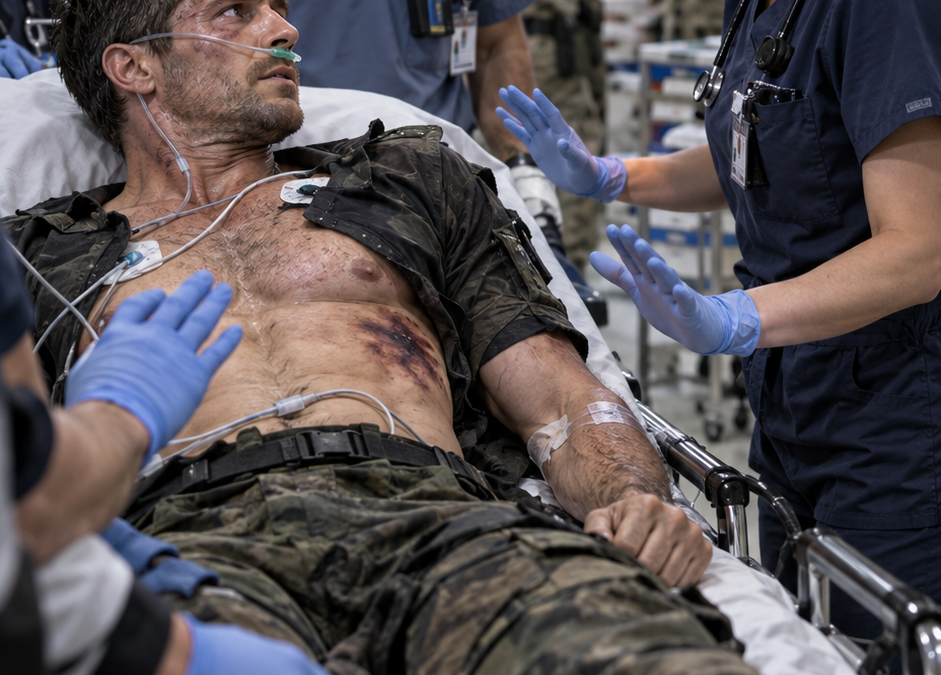
Until that instant, Ethan Cole had barely moved. He lay on the gurney beneath the hard white lights, his face drained of color, his dark hair damp with sweat, his combat shirt cut from collar to waist. A bruise was spreading beneath the edge of the remaining fabric along his left side. The monitor above him kept up a clipped, urgent rhythm, while the oxygen line beneath his nose trembled with every shallow breath.
He looked exhausted enough to disappear into the mattress.
Then a resident reached for his shoulder.
Ethan’s entire body snapped tight. His right hand shot up, caught the resident by the wrist, and stopped him inches from Ethan’s chest. The movement was so fast that the resident made a startled sound before any of us understood what had happened.
There was no anger in Ethan’s face. No threat. His open eyes did not even seem to register the young doctor whose wrist he held.
His body had acted without him.
“Cole. Ethan.” Dr. Michael Grant moved into his field of vision but kept his hands low. “Look at me. You’re at Harbor Point Military Medical Center. You’re safe.”
Ethan did not release the resident.
His gaze moved across the ceiling, the light, the open door, and the hands gathered around him. He was seeing each object, but he was not seeing the room. His breathing came in short, measured pulls, the kind of breathing a man used when panic was a luxury he believed he could not afford.
“Ease your hand open,” Grant said. “Nobody here is going to hurt you.”
For half a second, Ethan’s fingers tightened.
Then they opened.
The resident stumbled backward, clutching his wrist to his chest. A medic immediately stepped in from the opposite side to secure the loose monitor lead. Ethan recoiled before the man made contact. He twisted hard enough to pull the other leads taut and send a warning tone through the bay.
“Back off,” Grant ordered.
Everyone retreated.
Everyone except me.
I remained near the foot of the gurney, far enough away that I was not a physical threat and close enough to see the details the monitor could not show me. My hands stayed open at my sides. I made no attempt to soothe him, adjust him, or claim his attention.
Grant looked from Ethan to me. “We need access. Now.”
I knew that. We still had not completed a reliable examination of Ethan’s chest or abdomen. We had one IV placed in the field, but no one had been able to check whether it had shifted during transport. His blood pressure had fallen twice since the paramedics brought him through the doors. The numbers were not catastrophic yet, but they were moving in the wrong direction.
The problem was that every necessary action looked like an attack to the man on the bed.
Ethan’s fingers opened and closed against the sheet. His eyes flicked toward the exit again, then tracked the position of every person around him. His lips moved.
I could not hear the words.
One of our nurses, Leah, announced herself before reaching slowly toward his IV line from the left.
“Mr. Cole, I’m checking your arm.”
His forearm snapped inward before her fingers touched the tubing.
Leah withdrew at once. Another nurse tried from the opposite side after giving him the same warning. Ethan reacted even faster.
Three approaches. Three different people. Not one of them had managed more than a second of contact without his body treating the hand itself as a threat.
Grant studied the monitor and then the parts of Ethan we still had not examined. I knew the calculation taking place behind his eyes. I had worked with him for four years. He was careful, decisive, and almost impossible to rattle. He also understood that a patient’s fear did not stop internal bleeding.
“We may have to restrain him,” he said.
A technician opened the lower cabinet.
The dry rasp of a nylon strap sliding free changed Ethan immediately.
His breathing accelerated. His fingers dug into the sheet. The muscles along his jaw locked, and his gaze fixed on something far beyond the room.
I stepped sideways—not toward him, only into the edge of his vision.
“Ethan.”
Nothing.
I lowered my voice. “I’m not going to touch you.”
His eyes moved toward me for less than a second.
It was enough.
“Ethan, my name is Claire. You don’t have to do anything yet.”
His gaze slipped away, but the tendons in his neck eased slightly.
Grant checked the monitor again. “We don’t have time to wait for him to settle down.”
“I know.”
“Then I need to examine him.”
I looked around the bed. Every person there was trained. Every hand waiting to move was necessary. None of them meant Ethan harm.
Intent was not the problem.
“Every time someone reaches for him, we lose him,” I said.
Grant’s jaw tightened. “He’s injured, Nurse Bennett. We don’t get to negotiate with that.”
“No. But we can stop making it worse.”
Ethan whispered again.
I tilted my head. The sound was faint, perhaps two syllables, broken by his breathing. His right hand moved across the sheet, fingers closing around empty air.
At first I thought he was reaching for a person. Then I noticed the shape of the movement. His thumb angled inward. His fingers curled, released, and curled again as if expecting a piece of equipment to be there.
I shifted six inches until he could see me without turning his head.
“Don’t come from behind him,” I told the team. “Stay where he can see you.”
Grant looked at me. “Why?”
“He reacts before contact when the hand comes from outside his sight.”
Grant glanced at the resident Ethan had grabbed, then toward the medic who had approached from his blind side. He lifted one hand and held the team where they were.
Ethan’s grip on the sheet loosened.
I saw it. So did Grant.
I stayed exactly where I was. The worst thing I could have done was treat that small opening as an invitation to move closer.
“What do you need?” Grant asked.
“Ten seconds.”
“For what?”
My gaze moved to the restraint straps and returned to Ethan. “Ten seconds when nobody touches him.”
Grant looked at the monitor. We still had no full assessment, no dependable access beyond the field line, and no diagnosis that explained why Ethan’s pressure kept declining. Ten seconds was not a dramatic amount of time in most rooms.
In a trauma bay, it could be expensive.
Still, Grant raised his hand higher.
The room stopped.
No one adjusted Ethan. No one reached across him. No one tried to take advantage of his brief stillness. For the first time since the doors had opened, he was surrounded by people who desperately needed to touch him, and not one of us did.
His eyes found mine.
This time, they stayed.
“Stay with my voice,” I said.
Ten seconds became five before his body answered the silence. His breathing slowed by a fraction, but his right hand continued opening against the sheet and closing around nothing.
“Claire,” Grant warned quietly. “His pressure is falling.”
I nodded once. I had asked for time. I could not pretend the time had no cost.
“Come into his sight first,” I said.
Grant moved to the side of the gurney where Ethan could see him. His palms remained open.
“Ethan, I’m Dr. Grant. I’m going to place one hand on your shoulder.”
The instant he lifted his hand, Ethan’s breathing sharpened. His fingers clenched.
I raised my palm. “Stop.”
Grant stopped.
He did it without arguing, not because the danger had passed, but because the last ten seconds had given us the first useful response since Ethan arrived.
Ethan’s lips moved again. I leaned slightly toward the sound, careful not to lean toward his body.
“Left,” he rasped. “Clear.”
Then his hand closed around empty air.
I looked at the movement again.
“Ethan, are you looking for your radio?”
His eyes snapped to mine.
The response lasted less than a second, but it was unmistakable.
“Okay,” I whispered. “You don’t have it. But you can hear me.”
His gaze remained on me.
Grant glanced at the monitor. “We need more than eye contact.”
“Then give him one thing at a time.”
I positioned myself so Ethan could see both Grant and me without moving his head.
“Dr. Grant needs to check your left shoulder. He won’t move until I tell you he’s moving.”
Ethan did not nod. He did not speak. But his searching hand went still.
Grant shifted his weight impatiently. “What are you waiting for?”
“For him to know where the next hand is coming from.”
I looked directly at Ethan. “One hand. Your left shoulder. You’ll see it the whole time.”
His breathing remained uneven, but he did not turn away.
I gave Grant a small nod.
Grant moved slowly, keeping his hand inside Ethan’s view.
“Six inches,” I said. “Four. Two.”
Ethan’s arm tensed.
“Hold.”
Grant froze before contact.
Ethan’s eyes left him and returned to me. His lips parted. The sound was so soft that Grant could not catch it.
I heard only the final word.
“Star.”
Something in my expression must have changed, because Grant looked at me sharply.
I did not repeat the word.
“I’m here,” I told Ethan.
His shoulder eased against the mattress just enough for Grant to make contact. Two fingers, light pressure, no sudden movement. Ethan flinched, but he did not strike the hand away.
Grant completed the fastest assessment he could and withdrew.
It was not enough. But it was the first successful contact anyone had made since Ethan came through the doors.
“Again,” Grant said.
“Not yet.”
“I need his chest and abdomen.”
“If we take that inch and turn it into a mile, we lose the only access he has given us.”
Grant held my gaze. The monitor continued its steady warning between us.
Then he turned to the team.
“No one approaches without announcing it. Stay in his sight.”
It was not trust—not yet. It was a strategy forced on us by a patient who had rejected every other one. The staff repositioned around the gurney, leaving me as the fixed point in Ethan’s view.
His fingers began searching the sheet again.
This time his lips moved with greater urgency.
I leaned close enough to hear, but not close enough to touch.
“North,” he breathed.
His eyes squeezed shut.
“Star.”
I went completely still.
I did not know what the words meant to him. They might have been a person, a position, a route, or the last fragment of a mission his mind believed he was still fighting. But I knew what I had seen. His body reacted to those words before he could explain them.
We had found a way to touch him once. That method was already reaching its limit, and Ethan’s condition would not wait while I conducted another careful experiment.
Grant stepped beside me. “What did he say?”
I kept my eyes on Ethan.
“Give me one more second.”
I watched his empty hand close again. I watched his gaze travel beyond the ceiling toward some invisible point he was trying to locate.
Then I made my choice.
“North Star.”
Ethan stopped moving.
The change was immediate and strangely small. His fingers opened. His shoulders settled against the mattress. His eyes found mine and stayed there.
Grant looked from him to me, but I offered no explanation I did not have.
“North Star,” I said again, more softly. “Look at me.”
He did.
For the first time, his attention did not break when someone moved beside the bed.
I lifted one empty hand where he could see it. “Dr. Grant needs to help you.”
Ethan’s gaze flicked toward Grant and returned to me. His breathing remained strained, but the defensive tension did not surge through his arms.
Grant understood the opening. He stepped forward.
My raised hand stopped him.
It was not a challenge to his authority. It was a boundary. Grant halted immediately.
I waited until Ethan was looking directly at me again. Then I lowered my hand.
Grant approached within Ethan’s view and placed two fingers against his neck. Ethan flinched but did not strike. Grant moved to the shoulder and then began the limited examination we had been unable to complete.
Ethan’s fingers curled once.
“North Star,” I said. “Eyes here.”
His gaze returned to mine.
Grant finished and stepped back.
“I need imaging and a full trauma assessment.”
I did not answer him immediately. I looked at Ethan.
“Can you let them move you if I stay where you can see me?”
Ethan swallowed. His lips barely moved.
“Stay.”
The single word carried more trust than I had earned and more responsibility than I wanted to admit.
“I’ll stay,” I said.
Grant turned to the team, and when he spoke again, he no longer treated me like one more nurse at the bedside.
“Set up around Bennett. Nobody blocks his view of her.”
Leah shifted the equipment to the opposite side. The resident Ethan had grabbed moved away from the head of the bed without being asked twice. The technician rolled the restraint cart back until the straps disappeared from Ethan’s direct sight.
I remained where he could see me while the others prepared for transport. I did not use the opening to push him further. The call sign had given us access. It had not given us permission to take everything at once.
Grant reached for the side rail and stopped before touching it. He looked at me.
I looked at Ethan.
“They need to move the bed now.”
Ethan’s hand tightened around the sheet. For a moment I thought he would disappear from us again.
Then his fingers slowly released.
He gave one shallow nod.
Grant lowered the rail.
No one celebrated. No one asked me what North Star meant. We simply moved.
As the gurney rolled through the trauma bay doors, I walked beside Ethan exactly where he could keep me in view. Grant cleared my path instead of taking the position at the head of the bed. Every hand that approached now waited until Ethan saw it. Every change in direction was announced. Every adjustment came one at a time.
It was slower than force would have been.
It was also working.
The doors to imaging opened, and cold air washed over us. The room smelled faintly of metal and disinfectant. The scanner waited in the center like a white tunnel, and the narrow table beside it made the next problem obvious.
Several people would have to touch Ethan at once.
The technologist reached automatically for the transfer sheet. Grant caught his forearm before I had to speak.
“Let him see you first.”
The technologist glanced at Grant, then moved into Ethan’s line of sight.
“Mr. Cole, we need to move you onto the scanner table.”
Ethan’s eyes went to the waiting hands.
I stepped close enough for him to find me without touching him.
“North Star.”
His gaze locked on mine.
“They have to move you all at once.”
His jaw tightened. He looked at each person around him, then back at me.
After several seconds, he gave one shallow nod.
“On three,” I said. “Three. Two. One.”
The team transferred him.
His fingers knotted in the sheet. Every muscle across his shoulders went rigid. A sound caught low in his throat, but he let them finish. The hands withdrew the instant he was settled.
I saw the next problem before anyone spoke.
The scan would separate us.
The technologist pointed toward the control room. “The room has to be clear.”
Ethan heard him.
His eyes went straight to me.
Until that moment, every piece of cooperation we had gained depended on my staying where he could see me. If that became a permanent rule, the scan ended there. More than that, I would have turned myself from a bridge into another restraint—the one person without whom he could not move forward.
I studied the observation window, the speaker, and the microphone at the console.
Then I went to the edge of the table.
“Ethan, I’m going behind that glass. You’ll still hear me.”
His hand tightened around the sheet.
I waited.
I did not promise he would feel safe. I did not tell him nothing bad would happen. He was injured, disoriented, and surrounded by strangers. False reassurance would have been one more thing taken from him.
So I stepped backward.
His breathing quickened.
I stopped long enough for him to locate the observation window. Then I took another step.
His fingers remained knotted in the sheet, but he did not reach for me.
He let me go.
The door closed between us.
Ethan turned his head toward the glass, although from the table he could probably see no more than our shapes reflected in it. I pressed the intercom key.
“I’m here.”
His shoulders lowered by a fraction.
The scanner began to move.
I used the intercom sparingly. “The table is moving.” Then, “You’re halfway through.” Then silence.
I gave him enough orientation to stay with the process, but I would not make my voice the process itself.
Beside me, Grant watched the images appear across the monitor. His concentration sharpened. He leaned closer to the screen, traced one section with his gaze, and then called the radiologist.
When the next set of images resolved, his posture changed.
“There.”
I looked at the screen, but I was watching him more than the shades of gray. The injury we had not been able to define in the trauma bay was visible now—a concealed internal injury, subtle enough to resist the first assessment and serious enough to change what happened next.
Grant picked up the phone and called the receiving team. His language was concise, stripped of everything that did not matter. He changed the treatment plan, requested more personnel, and made it clear that delay now carried a measurable cost.
When he hung up, he looked through the glass at Ethan.
“This only works if we keep the same access.”
I understood what he meant. More people would be waiting upstairs. More equipment. More contact. Less space for hesitation.
But I also heard the danger beneath his words.
Access could easily become dependency if we were careless.
The table slid out. Ethan immediately searched for the window.
I returned to the room, but I did not reclaim my position beside his shoulder. I stopped several feet away.
He found me and held my gaze for one second. Then, for the first time, he looked toward the technologist preparing his lines for transport.
Grant tucked the transport packet beneath the mattress and turned to me.
“You’re coming with us.”
It was not a question.
I met Ethan’s eyes and moved toward the door. Grant took the far side of the gurney, leaving the place beside Ethan open for me.
I read the route sheet once and handed it back to him.
“You carry that.”
Grant accepted it without comment.
I returned to Ethan’s side but stopped short of the place beside his shoulder that had become mine.
He searched for me anyway.
“Ethan.”
His eyes found me.
“I’m going with you. But when you can speak for yourself, they need to hear you.”
His fingers tightened around the sheet.
I let the silence remain. Trust did not mean answering for him before he failed to answer. It meant protecting the space in which he still could.
“Dr. Grant needs to examine you before we move,” I said. “He needs your permission, not mine.”
Ethan looked toward Grant.
For several seconds, nobody moved.
Then Ethan lifted two fingers and pointed weakly toward his left side.
Grant followed the gesture. “Here?”
Ethan nodded.
Grant stepped into view before touching him. He placed one hand where Ethan had indicated.
Ethan flinched hard. My breath caught, but I did not use the call sign.
Grant completed the brief examination and withdrew.
Ethan looked back at me. His lips moved.
“North Star.”
My hand stopped above the bedrail.
His voice was clearer now. I leaned closer, still careful not to touch him.
“What is North Star?” I asked.
His eyes drifted for a moment, following a memory beyond the ceiling.
“The voice,” he whispered.
“Whose voice?”
He swallowed. “Brought us home.”
His breathing roughened. “When we couldn’t see the way out.”
My fingers slowly closed around the rail.
The word had not calmed him because it belonged to me. It had reached him because somewhere inside the confusion, it marked a direction. A voice in darkness. A fixed point when everything else had become unfamiliar.
I could have kept using it. It would have made the hallway easier. It might have made the next team faster. Every time I said it, his attention returned to me.
That was exactly why I had to be careful.
“Then we save it,” I said, “for when you can’t find the way yourself.”
I released the rail and stepped half a pace back.
Grant had been about to place a hand on Ethan’s shoulder. Instead, he moved where Ethan could see him.
“Ethan, we need to take you upstairs for treatment. Are you okay with us moving you?”
Ethan looked instinctively at me.
I gave him no nod to copy and no answer to borrow. I simply stayed.
His gaze returned to Grant.
Then he nodded.
Grant released the brake.
At the doorway, another nurse reached toward the tubing near Ethan’s arm. She stopped herself and looked at me.
I looked at Ethan.
She understood.
“Mr. Cole, may I adjust your IV?”
Ethan watched her hand. His breathing tightened once.
Then he nodded.
The adjustment took only seconds. I never moved closer.
We continued down the corridor. Grant walked beside me instead of ahead of the bed.
“Keeping him focused on you would be faster,” he said quietly.
“Faster for us.”
Grant looked at Ethan as another nurse announced herself before checking the portable monitor. He said nothing more.
The treatment room waited at the far end of the hall. Its double doors opened before we reached them, revealing a larger team, brighter lights, and more equipment than Ethan had faced downstairs. There would be no distance in that room. People would need to stand on both sides of him. Some steps, once begun, could not be interrupted safely.
Ethan’s grip tightened again.
This time he did not search only for me.
He looked at Grant. He looked at the waiting staff. Then he looked back at me.
I remained close enough to use the one phrase that could still cut through the darkness if he lost his way.
But I did not say it.
Ethan turned toward the team and lifted his chin once.
Grant stopped the gurney before the threshold.
“Ethan, once we begin, some parts of this cannot be interrupted safely.”
Ethan’s gaze moved past him into the crowded room and returned to me.
I stepped into his line of sight.
“They need to treat you. I’ll stay where you can find me. But while you can answer for yourself, they ask before they touch you.”
Then I looked at Grant.
“If he pulls away and he can still respond, give him the chance to respond.”
Grant glanced toward the room. He knew waiting forever was not an option. I was not asking him to wait forever.
“Announce contact before you make it,” he told the team. “Bennett stays where he can see her. We escalate only if it becomes medically necessary.”
The staff adjusted their positions.
Nothing about Ethan’s treatment had become easy. The injury remained. The danger remained. What had changed was the condition under which we would begin.
I looked back at Ethan. “That’s what I can give you.”
His grip loosened slightly.
Grant signaled forward, and the gurney crossed the threshold.
I walked beside it.
A physician moved toward Ethan’s chest, stopped where he could see her, and explained what she needed to do. Ethan flinched at the first contact but allowed it. Another clinician approached from the opposite side and did the same.
I gave no instructions. I had already made the decision that mattered. The call sign would not become permission the team could borrow from me whenever Ethan became difficult to reach.
Grant began the next stage of treatment.
Ethan’s breathing shortened as the number of hands around him increased. His gaze moved from Grant to the equipment and then back to me.
“Ethan.”
His eyes held mine.
“Stay with your name as long as you can.”
His jaw tightened.
He tried.
I could see the effort in the way his fingers pressed flat against the mattress instead of closing around the sheet. Another necessary contact came. He recoiled and then caught himself.
Grant paused only long enough to let him understand what was happening.
Ethan gave the smallest nod.
They continued.
My hand rested on the rail near his, close but deliberately separate. North Star remained available to me. Saying it would have made the room quieter. It would have made everyone’s job easier.
I kept it unspoken.
There is a temptation in medicine to call obedience cooperation. A quiet patient looks safer. A still patient lets us work faster. When every second matters, it becomes easy to measure success by how little resistance stands between our hands and the injury.
But Ethan’s resistance was not defiance. It was the last alarm system of a man whose mind had lost the border between danger and care.
If I silenced that alarm too early, I would not be protecting him. I would only be making him convenient.
Grant looked at me as the team approached the point where delay would soon carry consequences of its own.
“If he stops being able to answer,” I said, “I’ll make the call.”
Grant held my gaze for a beat, then nodded.
That was the commitment I had made. I had asked the room to preserve Ethan’s agency for as long as he possessed it. Now I had accepted responsibility for recognizing the moment when preserving it could no longer mean waiting.
Ethan’s eyes drifted, found me again, and stayed there.
Then his fingers lifted from the mattress just as two clinicians moved toward him.
I saw the change before either of them touched him.
His eyes stopped seeing the room.
His breathing broke into short, uneven pulls. A hand entered his peripheral vision, and his arm snapped inward defensively.
Grant froze.
The team could still step back. They could also restrain Ethan and continue. The unfinished procedure demanded movement, but Ethan was still fighting to remain present.
“Ethan.”
His eyes passed over me without recognition.
I kept my hand on the rail instead of reaching for him.
“Look at me.”
Nothing.
Grant waited beside the table. The monitors continued their warning. Nobody in that room needed me to explain what each lost second meant.
Ethan turned sharply away from another approaching hand.
I could keep using his name and hope he found his way back. Or I could use the one thing I had refused to spend for our convenience.
I stepped directly into his line of sight.
“North Star.”
Ethan went still.
Not calm. Still.
His eyes locked onto mine.
“North Star, stay with me. Let them help you.”
His raised hand remained between his body and the nearest clinician.
The team waited.
I waited with them.
I had promised that if Ethan could choose, the choice would remain his. The call sign could reach him. It could not become permission on his behalf.
He looked at the hand beside him, then at Grant, then back at me.
His fingers trembled once.
Slowly, deliberately, he lowered his arm.
He opened his hand against the mattress.
“Okay,” he whispered.
Grant moved first, exactly as promised, keeping his hands where Ethan could see them. The others followed.
This time Ethan did not fight the contact.
When tension pulled through his shoulders, I stayed in front of him, but I did not repeat the call sign. He had already answered it. Now he was answering them.
Grant worked quickly. The team moved around the permission Ethan had given instead of taking control from him. I remained within his sight until the critical work was finished and the sharpest alarm on the monitor finally softened.
Only then did Grant step back.
The room that had been unable to place one hand on Ethan had treated him with several at once.
Not one restraint had been fastened.
Ethan’s breathing began to settle. His eyes remained open and present.
Grant removed his gloves and reached toward the bedrail. Then he stopped himself.
“Ethan.”
Ethan looked at him.
Grant waited.
After a moment, Ethan gave a tired nod.
Only then did Grant lower the rail.
My hand still rested on the opposite side, inches from Ethan’s. I did not close the distance.
He looked at me and then at the people around him.
No one moved without asking. No one looked toward the restraint cart. For the first time since he arrived, the hands surrounding him were waiting for his permission instead of preparing to overcome him.
The next nurse approached from Ethan’s left and stopped where he could see her.
“Mr. Cole, I need to check your IV.”
Ethan looked at her hand, then at her face.
“Okay.”
I stood two feet away and said nothing.
The nurse completed the check and withdrew. Ethan’s eyes shifted toward me, but there was no panic in the movement now. He was no longer silently asking me to translate the entire room.
I pulled a chair closer to the wall instead of the bedside and sat down.
Grant noticed the distance. He did not ask me to return to Ethan’s immediate line of sight. He took the chart to the opposite side and spoke directly to him.
“We’re finished with the urgent part. I’d like to check your breathing again in a few minutes.”
Ethan nodded.
Grant wrote something and paused.
“If you need us to stop, tell us.”
Ethan watched him for a moment. “I will.”
Grant nodded as if that answer mattered, because it did.
The room gradually emptied. Equipment was rolled away. The discarded restraint straps remained untouched on the distant cart, a solution we had been seconds from using and no longer needed.
I watched Ethan’s right hand resting open on the blanket.
Earlier, that hand had searched for a radio that was not there. Then it had risen against every person who came near him. Now it simply lay still.
The blanket had slipped near his feet. I stood to straighten it, but before reaching down, I stopped.
“Can I?”
Ethan looked at my hand.
A faint breath escaped him, almost a laugh, though exhaustion took most of the sound away.
He nodded.
I pulled the blanket into place and started to withdraw.
His hand moved.
Not fast this time.
His fingers touched the back of mine.
I stopped.
He could have let go immediately. He did not. Slowly, Ethan turned his palm upward and closed his hand around mine.
I did not tighten my grip first. I let him decide the pressure, the distance, and the length of the contact.
Grant had returned to the doorway. He saw Ethan holding my hand but made no comment. When another nurse arrived with medication, he quietly stepped aside so she could speak directly to Ethan rather than through me.
She explained what she had brought and why.
Ethan listened. “Give me a second.”
She waited.
He looked at the syringe, then at her face. “All right.”
Only after she moved away did he release my hand.
“North Star,” he murmured.
I looked at him.
He shook his head faintly, as if correcting himself.
“Claire.”
Something tightened behind my ribs.
I had been called by my name thousands of times in those halls—by doctors who needed an instrument, by patients who needed water, by families who needed an answer I could not always give. But Ethan spoke it like a man placing a marker on a map. Not a call sign. Not a rescue frequency. A person standing in a real room.
“I’m here,” I said.
He closed his eyes.
His hand remained open on the blanket between us.
Grant entered, but he did not reclaim control of the space. He placed the chart within my reach, took the chair on the other side of the bed, and waited while Ethan rested.
For several minutes, the only sounds were the monitor, the ventilation system, and the muted movement beyond the door.
The old call sign had gone quiet.
What remained was a room where no one needed it to remember how to approach him.
When Grant performed the next routine check, he stopped at the bedside.
“Ethan, may I?”
Ethan opened his eyes and nodded.
Grant listened to his breathing, withdrew his hand, and stepped away. No one needed me to translate the permission. No one needed me to hold the room together.
I looked toward the doorway.
I could have stayed beside the bed and remained the safest point in Ethan’s field of vision. It would have been easy for both of us. After what we had survived together in the last hour, leaving felt almost cruel.
But there was nothing left to protect by making myself necessary.
My fingers paused against the back of the chair. Then I pushed it quietly toward the wall.
Ethan watched me.
“I’m going to finish my round,” I said.
A small tension returned to his face. Safety did not become permanent because one crisis had passed. His eyes flicked toward the doorway and back to me.
I waited.
I had spent the last hour deciding when to speak for him, when to guard his choice, and when one old phrase could bring him back. Now the kindest thing I could do was refuse to make myself the only person he believed he could survive without.
His fingers curled once against the blanket.
I could have sat down again.
Instead, I remained standing and let him decide what came next.
“Claire.”
His voice was quiet but clear.
“Yes?”
“Will you come back?”
I gave one small nod. “I’m still your nurse.”
He released a slow breath.
“Okay.”
His hand relaxed.
I turned toward the door. Behind me, Grant picked up the chart and moved to the bedside, but he did not fill the space I had left. He waited until Ethan looked at him before speaking.
I reached the threshold.
“Claire.”
I turned once more.
Ethan was looking directly at me—not searching past me, not gripping the sheet, not reaching for a voice from somewhere else.
I rested one hand against the doorframe.
“Ethan.”
He gave me a tired nod.
No call sign. No borrowed permission.
I returned the nod and walked into the hall.
For the next two hours, I finished the work waiting for me. I changed a dressing in the recovery wing, helped an older Marine call his daughter, and sat with a young corpsman while he tried not to be afraid of the surgery scheduled for morning. I kept moving because hospitals do not pause around a single story, no matter how much of you it carries away.
Still, each time I passed the central desk, I checked Ethan’s monitor from a distance.
His pressure steadied.
His breathing settled.
No security alert came from his room. No restraint order appeared in his chart.
Near the end of my shift, I returned.
The lights had been lowered. Grant was gone, replaced by Leah, who stood beside the bed explaining the next medication. She was positioned where Ethan could see her. Her hand remained still until he answered.
“Go ahead,” he said.
She administered the medication, thanked him, and stepped back.
Only then did Ethan notice me in the doorway.
His expression did not change much. He was still pale, still exhausted, still carrying pain that the medication could only reduce. But his right hand rested loose beside him.
“You came back,” he said.
“I said I would.”
I moved into the room and stopped near the chair against the wall.
He glanced at it. “You can bring that closer.”
I did, but I left a deliberate space between the chair and the bed.
For a while, neither of us spoke.
Then Ethan looked toward the dark window. “North Star wasn’t a person.”
I waited.
“It was a voice over the radio,” he said. “We were moving through a place where the lights were gone. Dust so thick we couldn’t see more than a few feet. Our route disappeared. Everything sounded close, even when it wasn’t.”
His fingers flexed once against the blanket.
“The voice kept giving us one direction at a time. Left clear. Hold. Move. Stop. Nothing we didn’t need. Nothing we couldn’t do.”
I remembered the fragments he had whispered on the gurney.
Left. Clear.
“That was the call sign?” I asked.
He nodded. “North Star.”
“Did the voice bring you out?”
His eyes remained on the window. “All of us who could still walk.”
Grief passed across his face so quickly that I might have missed it if I had been watching the monitor.
I did not ask who had not walked out.
“When I heard you,” he continued, “I thought I was back there. I knew the room wasn’t right, but my body didn’t.”
“That happens.”
“I almost hurt your resident.”
“You stopped his hand.”
“I could have broken his wrist.”
“But you didn’t.”
His gaze shifted to me. “You weren’t afraid?”
I considered lying. Patients often ask questions when what they want is comfort, and comfort is easy to confuse with certainty.
“I was afraid of several things,” I said. “I was afraid we would miss your injury. I was afraid forcing you would make you disappear from us completely. And when your pressure kept falling, I was afraid I had asked Dr. Grant for ten seconds we couldn’t afford.”
“But not afraid of me.”
“Not in the way you mean.”
He studied my face.
“You were reacting to hands you couldn’t place,” I said. “That did not make you harmless. It also did not make you the enemy.”
His eyes closed for a moment.
When he opened them again, some of the shame had left his face.
“You stopped using it,” he said.
“The call sign?”
He nodded. “You could have kept saying it.”
“Yes.”
“Why didn’t you?”
I looked at the untouched restraint straps still parked beyond the doorway. Someone would collect them soon and return them to the cabinet as if they had never been part of our choices.
“Because you trusted that voice,” I said. “Trust is not the same thing as permission. If I used it every time the room needed you to comply, I would have turned something that once guided you home into another way to control you.”
Ethan was silent.
“I needed you alive,” I continued. “But I also needed you to still belong to yourself when we were finished helping you.”
His throat moved as he swallowed.
For a long moment, he stared at the blanket.
“Most people don’t wait,” he said.
“Sometimes we can’t.”
“You did.”
“Until waiting would have hurt you.”
He gave a faint nod. “And then you used it.”
“To help you find the choice. Not to make it for you.”
The distinction seemed small when spoken aloud. In the trauma bay, it had been the difference between several hands pinning him down and one trembling hand opening voluntarily against a mattress.
Ethan looked toward me again.
“Thank you, Claire.”
My name sounded different this time. It was not a landmark he needed in order to survive the room. It was simply my name.
“You’re welcome.”
Leah returned to check the monitor. She stopped inside his view.
“Mr. Cole, may I adjust the cuff?”








