𝗙𝗨𝗟𝗟 𝗦𝗧𝗢𝗥𝗬 Officer Hail Needed Ninety-Six Seconds of Darkness to Destroy My Life
𝗙𝗨𝗟𝗟 𝗦𝗧𝗢𝗥𝗬
The language was almost identical.
Experienced officers often use similar terminology when writing reports. Standardized wording, by itself, doesn’t prove misconduct.
But what troubled me was the combination of circumstances.
The recording gaps.
The disputed searches.
The nearly identical locations where evidence had supposedly been found.
And the fact that each defendant had insisted the drugs appeared in the vehicle only after Hail searched it.
I read Marcus’s original complaint again.
One sentence stayed with me.
“I watched him take something out of his pocket, but nobody believed me.”
I leaned back in my chair.
For almost twenty years, I had stood in courtrooms telling juries that evidence mattered more than assumptions.
I had questioned witnesses whose memories were unreliable and examined reports whose conclusions weren’t supported by their underlying facts.
I believed in holding people accountable for crimes they had committed.
But I believed just as strongly that the government had an obligation not to punish innocent people.
A prosecutor who stops asking whether the evidence is trustworthy has forgotten the purpose of the job.
I was still examining the files when someone knocked on my open door.
Elena Ruiz stepped inside.
She was an experienced federal investigator with a reputation for finding information other people had overlooked.
She carried another folder.
“I found something.”
I looked up.
“Tell me it’s good news.”
“Depends on what you call good.”
She placed the folder beside Marcus’s file.
“Another complaint against Travis Hail. Three years old.”
I opened it.
The complainant was a former delivery driver who reported that Hail had stopped him during an overnight route, ordered him to stand behind the patrol car, and searched his delivery vehicle.
The driver claimed narcotics appeared in the vehicle after Hail had already inspected the same area.
His complaint had been closed as unsubstantiated.
I turned the page.
Then I stopped.
“Elena.”
“I know.”
“His body camera malfunctioned?”
She nodded.
I looked toward the other three files.
Marcus Bell’s recording contained a seven-minute gap.
Denise Walker’s video stopped before the search.
Jordan Ellis had no usable footage.
And now the delivery driver’s complaint described another malfunction during a disputed search.
I laid all four files side by side.
“How many cases has Hail handled in the last five years?”
Elena opened her notebook.
“Enough that reviewing all of them is going to be difficult.”
“How many contain camera interruptions?”
“That’s what I’m still trying to establish.”
I rubbed my forehead.
One malfunction could be an equipment problem.
Two could indicate inadequate maintenance.
Four incidents accompanied by nearly identical accusations raised questions that could no longer be ignored.
“Has Internal Affairs ever conducted a broader review?”
“Not that I’ve found.”
“Who supervised him during these incidents?”
“Lieutenant Grant Mercer.”
“Get me every maintenance report, equipment replacement request, evidence inventory, and complaint involving Hail’s searches.”
Elena pulled out a chair.
“Naomi, before we go further, there’s something you should understand.”
I looked at her.
“If we’re right, this won’t stop with one officer.”
“I know.”
“Every conviction connected to questionable evidence will have to be reconsidered.”
“I know.”
“And the department is going to ask why nobody saw it earlier.”
I looked down at Marcus Bell’s photograph.
He was standing beside his wife and two young daughters outside their home.
The photograph had been submitted with his post-conviction petition.
The family was smiling.
I wondered how long it had been since they had taken another picture like that.
“Then they can ask,” I said.
Elena studied me for a moment.
Then she reached into her bag and removed a small recording device.
“Our internal evidence team approved this as a precaution for your field work. It’s discreet, and the recording can be independently preserved.”
She showed me how to secure it beneath the seam of my coat.
I examined the lens.
It was barely larger than a shirt button.
“Do you seriously think I’ll need this?”
“Probably not.”
I clipped it into place.
Neither of us imagined that the device would become the most important piece of evidence in the investigation.
Forty-eight hours later, I was driving home along Highway 17.
I had spent another exhausting day with Elena, reviewing arrest reports and comparing evidence inventories.
By the time I left the office, rain had settled into a steady curtain over Asheford.
I remember feeling unusually tired.
Not simply because of the long hours.
The files had begun affecting me in ways I hadn’t expected.
Denise Walker’s statement described her son’s reaction when police officers came to their home.
He had asked whether his mother would be taken away again.
Marcus Bell’s wife explained that their daughters stopped inviting friends over because they were ashamed of what people were saying about their father.
Jordan Ellis’s mother had written that her son barely spoke anymore.
I had read countless victim impact statements throughout my career.
But these were families describing damage they believed the justice system itself had inflicted.
I kept wondering how many times someone had looked at an officer’s report, accepted it without question, and moved on.
My phone was in its holder when I turned onto the highway.
I noticed the recording device clipped beneath my coat and checked that it was active.
Elena had suggested keeping it ready while we were handling the sensitive review.
I didn’t expect to need it.
Then I saw flashing lights in my rearview mirror.
Red.
Blue.
Red again.
My first thought was that an emergency vehicle needed to pass.
I checked my speed, signaled, and moved onto the shoulder.
The police cruiser followed.
I brought my sedan to a complete stop and placed both hands on the steering wheel.
Rain tapped against the roof.
I watched the driver’s door of the cruiser open.
A uniformed officer stepped out and approached my window.
When he came close enough for the streetlight to illuminate his face, I recognized him.
Travis Hail.
For a moment, my heartbeat seemed to stop.
Of all the officers patrolling Highway 17 that night, the man whose arrest reports had occupied my desk for two days was approaching my vehicle.
He stopped beside my window and raised his flashlight.
“License and registration.”
I lowered the glass and handed him both.
“Good evening, Officer. May I ask why you stopped me?”
He looked at my license.
Then at my face.
“You drifted toward the center line.”
I knew I hadn’t crossed the line.
But I also knew arguing about the stop would accomplish little.
“Understood.”
His flashlight moved through the interior of my vehicle.
He examined the passenger seat, the back seat, and the center console.
“Where are you coming from?”
“Work.”
“What kind of work?”
I paused.
“Is there a problem with my license, Officer?”
His expression hardened.
“I’m asking the questions.”
I nodded.
He returned to his patrol car.
For several minutes, I sat alone beneath the flashing lights.
I could hear rain running down the windshield.
My hands remained on the steering wheel.
I thought about calling Elena.
But I wanted to understand what Hail was doing before taking any action that might escalate the situation.
He returned with my documents.
“This car yours?”
“Yes.”
“Anything illegal inside?”
“No.”
He leaned toward the open window.
Then he drew back slightly.
“I’m detecting an unusual odor.”
The words were so familiar that I felt a chill despite the warm air inside my car.
Marcus.
Denise.
Jordan.
The same justification.
The same sequence.
The same officer.
I looked at him.
“What odor?”
“Don’t play games with me.”
“I’m asking what you’re smelling.”
“Something suspicious.”
He pointed toward the shoulder.
“Step out of the vehicle.”
I felt the first real surge of fear.
“I don’t consent to a search, Officer. I’d also like a supervisor present.”
He stared at me.
“You can request one after you get out.”
I opened the door slowly.
Rain struck my face as I stepped onto the shoulder.
“Keep your hands where I can see them.”
I complied.
He directed me to stand several feet behind my sedan while he began searching.
I watched him open the passenger door.
He examined the front seat.
The glove compartment.
The storage compartment beneath the dashboard.
Then he moved to the driver’s side.
I couldn’t see every movement, but I could see enough to know he was inspecting areas that had already been checked.
His official body camera was recording.
The green indicator glowed steadily beneath the rain.
Then he looked toward me.
Our eyes met.
He reached toward the camera.
The light disappeared.
I stared.
“Officer, did you turn off your body camera?”
He didn’t look up.
“Technical problem.”
“Is it recording?”
“I already told you. Equipment fails.”
I felt my hands grow cold.
Every instinct told me to challenge him.
To identify myself.
To tell him that I knew about the earlier complaints.
To demand that he stop the search and call a supervisor immediately.
But another part of me understood what might happen if I revealed my identity before he completed whatever he intended to do.
He could abandon the search.
He could turn the camera back on.
He could claim I had misunderstood his movements.
And the next person he stopped might be another Marcus Bell.
Another Denise Walker.
Another Jordan Ellis.
I was terrified by that possibility.
I was also terrified of remaining silent.
I had spent almost twenty years working inside the legal system.
I knew how quickly an arrest could become a criminal charge and how much damage could be done before a false accusation was corrected.
A prosecutor’s title offered no protection against handcuffs on an empty highway.
And I had no guarantee that my hidden recording device would capture what I needed.
But it was still active.
I could feel its small housing beneath my coat.
So I watched.
Hail approached the passenger door again.
He positioned his body carefully.
His left shoulder angled toward the dashboard.
His right arm moved toward the inside of his jacket.
His fingers disappeared for a moment.
When they emerged, he appeared to be holding something small.
I concentrated on the movement.
He leaned into the vehicle.
His hand moved toward the center console.
He paused.
Then withdrew it.
Ninety-six seconds.
That was how long his official body camera remained dark.
Ninety-six seconds during which he believed the roadside belonged entirely to him.
Ninety-six seconds in which the truth depended on whether anyone could see what he was doing.
When he finally stepped away, he reached toward his camera.
The green indicator returned.
Then he leaned inside my car and announced that he had found something.
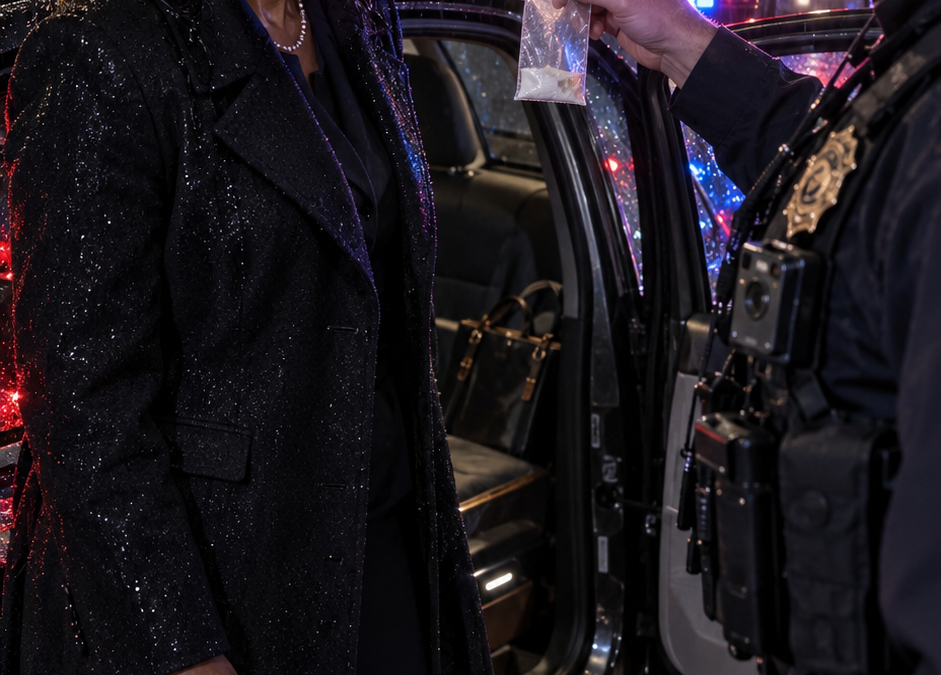
He lifted the small transparent pouch.
“Well, look at this.”
My mouth went dry.
“Where did you find that?”
“Center console.”
“That’s not mine.”
He smiled.
“Everybody says that.”
He held the pouch up again.
“You’re in serious trouble.”
I looked at his body camera.
“Is it working now?”
He shrugged.
“Seems to be.”
Then he turned toward his cruiser and called dispatch.
I listened as he reported a vehicle search resulting in the discovery of suspected narcotics.
His voice was calm.
Professional.
Almost bored.
He gave the location, my vehicle information, and the circumstances of the stop.
He stated that he had searched the car after detecting a suspicious odor.
He didn’t mention the period when his camera had gone dark.
He didn’t mention reaching toward his jacket.
He didn’t mention returning to the same console he had already inspected.
I could have interrupted him.
Instead, I listened.
I wanted every statement preserved.
Because there is a difference between a person making a mistake and a person deliberately creating a false record.
And Travis Hail was about to make his version of events official.
He detained me and transported me to the Asheford precinct.
I sat in the rear of his patrol car, looking through the rain-streaked window as we drove back toward the city.
For the first time in my professional life, I understood the physical experience of being transported as a criminal suspect.
The locked door.
The narrow seat.
The inability to decide where you were going.
The knowledge that somebody else’s written account could determine what happened next.
I thought about Marcus Bell sitting in that same position after leaving work.
I thought about Denise Walker wondering who would pick up her son.
And I thought about Jordan Ellis, eighteen years old, frightened, and completely unfamiliar with the machinery that was beginning to surround him.
Hail seemed pleased with himself.
He had no idea who I was.
I hadn’t told him.
He continued talking as though the encounter had been an ordinary traffic stop.
At the precinct, he led me to a chair near the front desk.
A younger officer named Daniel Price was completing paperwork.
Hail placed the evidence pouch on the desk.
“Possession case off Highway 17.”
Price looked at the pouch.
“Another one?”
Hail shrugged.
“Busy night.”
I studied Price’s expression.
There was something cautious in the way he looked at Hail.
Something I would remember later.
Hail sat at a computer and began typing his report.
I watched him record the alleged traffic violation.
The suspicious odor.
My supposed nervousness.
The search.
The discovery of the pouch inside my center console.
His fingers moved quickly.
He seemed familiar with every sentence.
When he reached the section concerning his body camera, he paused.
Then he selected a technical malfunction code.
I felt my stomach tighten again.
He had turned the camera off with his own hand.
I had watched him.
Now he was entering an official explanation that concealed what had happened.
Price approached.
“Camera problem again?”
Hail glanced up.
“Cut out during the search. Started working afterward.”
“Did you report it to equipment control?”
“I’ll handle it.”
Price hesitated.
Then nodded.
Hail printed the report.
He signed his name beneath the completed statement.
I watched the pen move across the paper.
That signature mattered.
He had now committed himself to a written version of the stop that conflicted with the recording beneath my coat.
He prepared the evidence inventory and assigned the pouch a seal number.
Then he asked Price to acknowledge receiving the item.
Price examined the form.
He initialed only the custody section.
He didn’t certify the search narrative or claim to have witnessed the discovery.
I noticed the distinction immediately.
Hail looked toward me.
“Anything you want to add before I finish?”
I met his eyes.
“I want to contact my attorney.”
He leaned back.
“That’s it?”
“That’s it.”
He looked almost disappointed.
I realized he had expected me to argue.
Perhaps he wanted me to threaten him so he could describe my behavior as aggressive.
Perhaps he wanted another statement he could add to his report.
I gave him nothing.
When I was permitted a telephone call, I dialed Elena Ruiz from memory.
She answered after two rings.
“Naomi?”
“I need you at the morning hearing.”
Her voice changed.
“What happened?”
“Bring the files we reviewed.”
There was a pause.
Then she asked the question I had been waiting for.
“Are you safe?”
“Yes.”
“Do you still have the recording?”
I looked across the room.
Hail was signing the final page of his report.
“Yes.”
Elena inhaled sharply.
“Don’t tell him anything else. I’ll arrange independent preservation.”
I ended the call.
Hail looked up.
“Your lawyer coming?”
“Yes.”
“Good. Maybe they’ll explain how serious this is.”
I looked at the evidence pouch sitting beside his paperwork.
“I understand exactly how serious it is.”
He laughed.
“Then you should’ve thought about that before carrying drugs.”
I said nothing.
Inside, I was struggling to control the anger rising through my fear.
I wanted to tell him about the years I had spent prosecuting people who manipulated evidence.
I wanted to tell him that I had personally reviewed cases in which a single false statement destroyed an innocent person’s life.
But the recording had already captured the part of the night he believed nobody would see.
And I needed to protect it.
When the opportunity came, the device and its original file were secured through the investigator and my attorney, with its identifying information and transfer history documented.
I was exhausted by the time morning arrived.
My clothes still smelled faintly of rain.
I hadn’t slept.
And I had spent the night thinking about what might happen if the recording failed.
What if the angle wasn’t clear enough?
What if the file had been damaged?
What if Hail’s attorney claimed it was incomplete or misleading?
For the first time in years, I found myself experiencing the same uncertainty that had haunted so many defendants whose cases I had examined.
Knowing the truth didn’t guarantee anyone would believe it.
At nine fifteen the following morning, I entered a courtroom before Judge Rebecca Sloan.
Hail sat several seats away, holding a folder containing his report.
He looked composed.
Almost relaxed.
I suspected he believed the hearing would proceed exactly like every other hearing connected to his arrests.
A defendant.
A police report.
A sealed evidence pouch.
A judge reviewing the allegations.
He had no reason to think the next few minutes would be different.
Judge Sloan began examining the docket.
Then the clerk called my name.
“Naomi Carter.”
The judge looked down at the file.
She stopped.
Then she looked toward me.
“Ms. Carter?”
I stood.
“Good morning, Your Honor.”
Her expression changed.
For a moment, I saw surprise.
Then concern.
She turned toward the prosecutor assigned to the hearing.
“Before we proceed, I want the record to reflect that Ms. Carter is the chief federal prosecutor for this district.”
Hail’s head turned sharply.
He stared at me.
I watched recognition slowly develop into confusion.
Then disbelief.
His eyes moved toward his report.
I knew what he was thinking.
He had arrested a federal prosecutor.
But his report was signed.
The evidence was sealed.
And he still believed nobody had seen what happened during those ninety-six seconds.
Judge Sloan addressed me.
“Do you have counsel present?”
“Yes, Your Honor.”
I gestured toward the back of the courtroom.
Elena stood beside an independent federal attorney.
The attorney carried a slim case folder.
Elena carried the recording.
Judge Sloan looked toward Hail.
“Officer, your report states that you discovered suspected narcotics during a vehicle search after your body camera experienced a technical malfunction.”
“Yes, Your Honor.”
“And you stand by that report?”
He hesitated.
Only briefly.
“Yes.”
I felt something settle inside me.
He had been given another opportunity to correct the record.
He had chosen not to.
Judge Sloan turned toward my attorney.
“You indicated there’s additional evidence relevant to this stop?”
“Yes, Your Honor.”
The attorney requested permission to present the independently preserved recording.
Hail looked up.
“What recording?”
Nobody answered him immediately.
Elena connected the secured device to the courtroom system.
A timestamp appeared on the monitor.
Judge Sloan compared it with Hail’s report.
The times matched.
The lights dimmed.
And the recording began.
I watched myself standing beside my sedan in the rain.
Hail moved through the passenger compartment.
His official body camera indicator was visible.
Then his hand reached toward the device.
The green light disappeared.
Hail shifted in his chair.
On the screen, he moved toward the passenger door.
His hand disappeared near the inside of his jacket.
When it emerged, a small object was visible between his fingers.
He leaned into the vehicle.
His hand moved toward the center console.
Then he withdrew it.
For several seconds, nobody spoke.
The recording continued.
Hail switched his official camera back on.
He searched the same area again.
Then he lifted the transparent pouch and announced that he had discovered suspected narcotics.
His own voice filled the courtroom.
“Well, look at this.”
I saw his jaw tighten.
The recording continued through his call to dispatch.
Through my denial.
Through his description of the search.
Then the screen went dark.
The silence that followed was unlike anything I had experienced in court.
I had witnessed dramatic evidence presentations before.
I had seen defendants cry, witnesses collapse, and jurors struggle to conceal their reactions.
But that morning, the most powerful thing in the courtroom was the absence of noise.
Judge Sloan looked toward Hail.
“Officer, does this recording appear to cover the period missing from your body camera?”
He swallowed.
“I’d need to examine the original file and its chain of custody.”
Elena spoke.
“The original was preserved promptly, Your Honor. The metadata, device information, and transfer history are documented.”
The judge nodded.
She looked down at Hail’s report.
Then back at the monitor.
“The evidence supporting this arrest is now seriously disputed.”
My attorney requested immediate review of the recording and relief from the restrictions imposed following my detention.
Judge Sloan granted the appropriate requests and directed that the disputed evidence be preserved for further proceedings.
The implications were obvious.
But I wasn’t thinking only about my case.
I stood.
“Your Honor, may I say something?”
She looked toward me.
“Briefly, Ms. Carter.”
“This recording may be relevant to other cases involving the same officer.”
Hail turned sharply.
I looked toward Elena.
She placed four folders on the table.
Marcus Bell.
Denise Walker.
Jordan Ellis.
The former delivery driver’s complaint.
Each file contained a different person.
A different arrest.
A different allegation.
But all four described disputed searches involving Travis Hail.
And all four involved missing or unusable camera footage.
Hail stared at the folders.
For the first time since the traffic stop, I saw genuine fear in his expression.
Not the fear of someone who had made an innocent mistake.
The fear of someone realizing that evidence he believed had disappeared might finally be examined.
I looked directly at him.
“Now we need to talk about the others.”
The hearing ended with my detention-related restrictions lifted and the contested evidence placed under independent review.
Hail’s department suspended him and required him to surrender his badge and equipment while the investigation proceeded.
I walked out of the courtroom with Elena beside me.
For several minutes, neither of us spoke.
Then she stopped in the corridor.
“Naomi.”
I turned.
She looked at me carefully.
“Are you all right?”
I had been asked that question several times since the stop.
I had answered yes every time.
But standing in that hallway, with the worst immediate danger finally behind me, I realized how frightened I had been.
My hands began to shake.
Elena took my arm.
“Come sit down.”
I shook my head.
“If I sit down, I’m going to start crying.”
“Then cry.”
That was all it took.
I leaned against the wall and covered my face.
I cried because I had spent the previous night wondering whether my career might be destroyed by something I hadn’t done.
I cried because a police officer had looked me in the eye and deliberately lied.
And I cried because I finally understood how helpless Marcus, Denise, and Jordan must have felt when nobody believed them.
Elena stood beside me until I could breathe normally again.
Then she handed me a tissue.
“We have work to do.”
I nodded.
“Start with the evidence logs.”
By that afternoon, federal investigators had begun securing the records associated with Hail’s arrests.
His body-camera maintenance reports.
Equipment replacement requests.
Evidence room access logs.
Search reports.
Internal Affairs complaints.
Dispatch records.
Supervisory reviews.
Everything that could help establish whether the conduct captured on my recording had occurred before.
The investigation quickly expanded beyond the four cases we had initially identified.
Several recording interruptions had been classified as ordinary equipment failures without meaningful follow-up.
Some had occurred immediately before evidence was supposedly discovered.
Others involved searches that defendants had challenged from the beginning.
The pattern became increasingly difficult to explain as coincidence.
But Elena insisted on caution.
“We can’t assume every case is fraudulent just because Hail handled it.”
“I know.”
“We need to establish what happened in each one.”
“Then that’s what we’ll do.”
The first breakthrough involved Marcus Bell.
Investigators compared Hail’s arrest report with dispatch records and discovered that the timeline didn’t match.
According to Hail’s written statement, he had searched Marcus’s vehicle and discovered narcotics during a specific period.
But dispatch records placed him somewhere else during part of that interval.
The inconsistency didn’t prove the entire arrest had been fabricated.
But it undermined the reliability of his account.
Then investigators examined Denise Walker’s case.
The evidence seal assigned to her arrest had been issued before Hail claimed the search occurred.
That discrepancy required an explanation.
Hail’s original report provided none.
Jordan Ellis’s case revealed another irregularity.
Evidence storage records showed that Hail had accessed the property room twice during the week of Jordan’s arrest without documenting a reason.
Again, no single discrepancy established everything.
But together, the records began telling a story that Hail’s reports had concealed.
Elena brought the findings to my office.
I spread them across the table.
“How many other unexplained evidence room entries?”
“We’re still reviewing.”
“Any witnesses?”
“One retired officer has agreed to speak.”
I looked up.
“What does he know?”
“He questioned Hail about repeated camera failures several years ago.”
“What happened?”
“He says Lieutenant Mercer told him to stop creating problems for the unit.”
I leaned back.
There it was again.
A complaint.
A warning.
Someone deciding that investigating misconduct would be more inconvenient than ignoring it.
Lieutenant Grant Mercer was called in for questioning.
His answers were cautious.
He claimed that body-camera failures were common and that the department had limited resources for investigating equipment problems.
But the maintenance records told a more complicated story.
Repeated warnings had reached his desk.
Several complaints specifically alleged that Hail had turned off his camera before discovering evidence.
Most had been closed without a broader review.
Mercer had not necessarily participated in fabricating evidence.
But the investigation raised serious questions about his failure to respond to patterns that should have triggered scrutiny.
Meanwhile, the former delivery driver whose complaint had been dismissed three years earlier agreed to speak with investigators again.
I met him in a conference room with Elena present.
He was in his forties, with tired eyes and hands roughened by years of physical work.
He sat across from us and studied the documents on the table.
“I already told Internal Affairs what happened.”
“I know,” I said.
“They said there wasn’t enough evidence.”
“I’ve read your complaint.”
He looked at me skeptically.
“And?”
“And I believe it deserves another examination.”
He leaned back.
“You know what that man did to me?”
I waited.
“He made me feel like I was crazy.”
His voice tightened.
“I kept telling people I saw his hand go into his pocket. I saw him lean inside my truck. Then he came back holding that bag.”
He shook his head.
“Everybody said I was remembering it wrong.”
He looked at me.
“After a while, I started wondering if I was.”
I felt a painful tightening in my chest.
“What happened to your job?”
He gave a humorless laugh.
“Lost it. Delivery company didn’t want somebody with a drug case driving their trucks.”
“I’m sorry.”
He looked down at his hands.
“Sorry doesn’t pay back three years.”
“No,” I said. “It doesn’t.”
For the first time, he seemed to believe that I wasn’t trying to offer him a comforting phrase.
I wasn’t.
There was nothing I could say that would return the time he had lost.
But we could examine the evidence that had been used against him.
And we could make sure the investigation didn’t depend solely on whether someone considered him credible.
As the review progressed, I made a decision that surprised several of my colleagues.
I removed myself from direct control of the prosecution against Hail.
Gregory, our office’s senior counsel, questioned the decision.
“Naomi, nobody knows these cases better than you.”
“That’s exactly why I shouldn’t personally direct the prosecution.”
“You’re one of the victims.”
“And I’m the chief federal prosecutor. If I make the charging decisions, his attorneys will argue that this is retaliation.”
He considered that.
“I can arrange an independent team.”
“Do it.”
I wanted Hail held accountable.
But I wanted the case to survive scrutiny without depending on my title, my anger, or the authority of my office.
An independent federal prosecution team took over.
Elena continued coordinating the evidence review under the proper investigative structure.
I provided my recording, gave a detailed statement, and cooperated as a witness.
For the first time in years, I experienced the justice system from a position in which I wasn’t directing the proceedings.
I found it humbling.
Sometimes I wanted to call the prosecutors and demand updates.
Sometimes I wanted to tell them which witness to interview next.
But I understood why I needed to remain outside those decisions.
The integrity of the investigation mattered more than my desire to control its pace.
The process took months.
As additional evidence emerged, attorneys began challenging convictions and plea agreements connected to Hail’s disputed searches.
Marcus Bell’s case was one of the first to receive relief.
His conviction was vacated after the court reviewed the newly discovered evidence and the problems with Hail’s testimony.
I was in my office when Elena called.
“Marcus is cleared.”
I closed my eyes.
“Has anyone told his family?”
“His attorney is with them now.”
I thought about the photograph of Marcus standing beside his wife and daughters.
“Good.”
But when I met Marcus several days later, he didn’t look like a man celebrating.
He looked exhausted.
He had spent months fighting to convince people that he was innocent.
Now a court had finally acknowledged that his conviction could not stand.
Yet he still had to explain the gap in his employment history.
He still had to repair relationships damaged by accusations that never should have been made.
And he still had to rebuild his confidence in a world that had once accepted an officer’s word over his own.
We sat together in a quiet conference room.
“How are your daughters?” I asked.
He smiled faintly.
“They’re good.”
“Have you told them?”
He nodded.
“My oldest asked if that means people will stop calling me a criminal.”
I felt my throat tighten.
“What did you say?”
“I told her I hope so.”
He looked at me.
“Miss Carter, I appreciate everything you’ve done. But I don’t know how to get those years back.”
I couldn’t give him an answer.
Because there wasn’t one.
Denise Walker’s case was dismissed after the evidence supporting the charge was determined to be unreliable.
She called Elena first.
Then she asked to speak with me.
When I answered, she was crying.
“They dropped it.”
“I heard.”
“They actually dropped it.”
“Yes.”
For several seconds, she couldn’t speak.
Then she whispered something I will never forget.
“My son can stop being scared now.”
I sat at my desk, staring at the courthouse across the street.
I thought about all the nights Denise must have spent wondering whether her child would be taken away from her because of a charge she insisted was false.
I thought about the job she had lost.
The bills she couldn’t pay.
The neighbors who had whispered.
The friends who had slowly stopped calling.
And the shame she had carried while trying to convince people she wasn’t a criminal.
“I’m glad,” I said.
She began crying harder.
Jordan Ellis was allowed to withdraw his plea after the review undermined the reliability of the evidence in his case.
He came to my office with his mother.
He was nineteen by then.
Older than the boy in the arrest photograph.
But when he sat across from me, I could still see the uncertainty of someone who had learned far too early that the justice system could become frightening when you lacked the resources to defend yourself.
His mother held his hand.
“Tell her what you told me.”
Jordan looked embarrassed.
“Mom.”
“Please.”
He looked toward me.
“I was supposed to start college.”
I nodded.
“I know.”
“After the arrest, I figured there wasn’t any point.”
His voice grew quieter.
“Everybody said I should just take the deal and get it over with. My lawyer said fighting it could take months, maybe longer.”
He looked down.
“So I did.”
I waited.
“Then I started thinking maybe I really was the kind of person they said I was.”
His mother began crying.
Jordan stared at the floor.
“Even though I knew I hadn’t done anything.”
I had prosecuted defendants who were genuinely guilty.
I had watched people deny responsibility despite overwhelming evidence.
But I had also watched innocent people become overwhelmed by the cost of proving their innocence.
Jordan’s words reminded me how destructive that pressure could be.
He looked up.
“Do you think I can still go to college?”
“Yes,” I said. “I do.”
His mother squeezed his hand.
For the first time since entering my office, he smiled.
It was a small smile.
But it was real.
As these cases were reconsidered, Hail’s own legal situation became increasingly serious.
The independent prosecutors brought charges involving evidence tampering, falsification of official records, obstruction, and false statements.
His attorney argued that the Highway 17 recording depicted an isolated incident that could not fairly characterize an entire career.
The prosecution disagreed.
They presented the video alongside maintenance reports, evidence inventories, dispatch records, witness testimony, and the repeated irregularities identified in earlier cases.
The pattern mattered.
Not because every allegation against Hail was automatically true.
But because independent records repeatedly contradicted the explanations he had provided.
The trial began several months after my traffic stop.
I testified about what happened on Highway 17.
I described the rain.
The flashing lights.
Hail’s claim that I had drifted toward the center line.
His assertion that he detected an unusual odor.
The search.
And the moment his body camera went dark.
Then I explained why I had remained silent while watching his hand move toward my center console.
The defense attorney approached me during cross-examination.
“Ms. Carter, before this traffic stop, you were already investigating my client.”
“I was reviewing cases involving him.”
“So you were looking for misconduct.”
“I was examining evidence.”
“You had a concealed recording device in your coat.”
“Yes.”
“And you activated it before the stop.”
“Yes.”
He glanced toward the jury.
“Isn’t it possible you wanted Officer Hail to make a mistake?”
I looked directly at him.
“I wanted to understand why several unrelated people had reported similar experiences involving his searches.”
“That wasn’t my question.”
“No. I did not want him to fabricate evidence against me.”
The attorney returned to his notes.
“You could have identified yourself as a federal prosecutor at any point.”
“Yes.”
“Why didn’t you?”
“Because my occupation wasn’t relevant to whether his search was lawful or whether the evidence he claimed to find was genuine.”
He paused.
“But you knew your position could influence how he treated you.”
“That’s precisely why I chose not to rely on it.”
The courtroom was quiet.
He continued.
“You stood there and allowed him to continue searching.”
“I complied with his instructions.”
“You watched him reach into his jacket.”
“Yes.”
“And instead of confronting him, you kept recording.”
“Yes.”
He looked toward the jury.
“So you deliberately allowed the situation to develop.”
I considered the wording.
“I didn’t control Officer Hail’s actions. I didn’t ask him to turn off his camera. I didn’t ask him to reach into his jacket. I didn’t ask him to place anything inside my vehicle.”
I looked back at the attorney.
“Those decisions were his.”
He moved to another subject.
He questioned the recording angle.
The possibility of technical distortion.
The time stamp.
The chain of custody.
Each issue had been examined by forensic specialists.
The original recording had been preserved, its metadata documented, and its transfer history established.
The prosecutors presented the relevant technical evidence.
But the most important testimony came from the people who had spent years insisting that something was wrong.
Marcus Bell described his stop.
Denise Walker explained what happened after her arrest.
Jordan Ellis told the jury why he had accepted a plea agreement.
The former delivery driver repeated the account that Internal Affairs had once dismissed.
A retired officer testified that he had raised concerns about Hail’s camera failures and had been discouraged from pursuing them.
The jury heard evidence that went far beyond my recording.
They saw the pattern that had emerged when investigators finally examined the records together.
Hail sat beside his attorney throughout the proceedings.
He no longer wore the uniform that had given him so much authority on Highway 17.
He no longer controlled which documents would be entered into the record.
And he no longer had the ability to dismiss a witness simply because the witness lacked his badge.
The trial lasted several days.
The jury deliberated for less than a day.
When they returned, I was sitting several rows behind Marcus, Denise, and Jordan.
The courtroom rose.
Hail stood beside his attorney.
I watched his face as the clerk began reading the verdicts.
Guilty.
The word was spoken calmly.
Then it was repeated as the remaining verdicts were announced.
I had imagined that moment many times.
I thought I would feel relief.
Perhaps satisfaction.
Instead, I felt an overwhelming sadness.
Because the verdict confirmed what the evidence had shown.
A police officer had used the authority entrusted to him to manufacture criminal allegations.
And the people he targeted had been forced to fight against an institution that should have protected them.
Hail’s conviction was important.
But it could not undo what he had done.
At sentencing, the court considered the evidence, the nature of the offenses, and the harm inflicted on the people whose cases had been affected.
Hail’s attorney again argued that his client had served the community for years and deserved consideration for his prior record.
The prosecutors emphasized that the misconduct was deliberate and had consequences extending far beyond a single traffic stop.
Hail was sentenced to prison.
When the sentence was announced, he lowered his head.
I watched him for several seconds.
Then I looked toward Marcus.
He sat beside his wife.
Denise held her son’s hand.
Jordan stared straight ahead.
No one cheered.
The moment was too complicated for celebration.
Hail had lost his badge and his freedom.
But the people he had harmed were still carrying years of damage.
Outside the courthouse, reporters gathered behind a row of microphones.
Cameras pointed toward the entrance.
I stepped outside with Elena beside me.
The afternoon was warm and dry.
Cars moved through downtown Asheford. A city bus stopped at the corner. Somewhere nearby, a construction crew was working, and the ordinary noise of the city continued as though nothing extraordinary had happened.
A reporter called my name.
“Ms. Carter, do you feel vindicated?”
I looked toward Marcus, Denise, and Jordan.
They were standing a few feet away.
For months, their names had occupied files on my desk.
Now they were people standing in sunlight, no longer trapped inside the version of events Travis Hail had written about them.
I turned back toward the cameras.
“Vindicated isn’t the word I would use.”
The microphones moved closer.
“This was never about proving that I was important enough to be believed.”
I paused.
“The question is what happens when someone doesn’t have my position, my resources, or access to evidence that can expose the truth.”
Marcus lowered his eyes.
Denise squeezed her son’s hand.
I continued.
“Officer Hail’s misconduct wasn’t wrong because he happened to target a federal prosecutor. It was wrong because he used his authority to create false evidence against people who trusted the justice system to protect them.”
A reporter asked whether the hidden recording had saved my career.
“It certainly helped establish what happened to me.”
I looked toward the courthouse doors.
“But it also gave investigators a reason to examine the people who came before me.”
I had spent months thinking about the ninety-six seconds when Hail believed his camera was off.
For him, that absence of recording had represented freedom from accountability.
For me, it had become the beginning of something far larger than my own case.
In the weeks following the sentencing, Asheford announced changes to its body-camera procedures, evidence handling requirements, and misconduct complaint review process.
Recording interruptions during searches would require documented supervisory review.
Evidence handling irregularities would trigger independent examination.
Repeated complaints involving the same officer could no longer be closed without consideration of whether they formed a broader pattern.
Lieutenant Grant Mercer resigned before his disciplinary hearing was completed.
Several other supervisors were reassigned while the department reviewed earlier failures.
I welcomed those changes.
But I also knew that policies written after a scandal were only meaningful if people continued enforcing them when public attention disappeared.
The department could purchase better cameras.
It could update evidence storage systems.
It could require additional signatures.
But none of those measures would matter if supervisors continued treating legitimate misconduct complaints as inconveniences.
Accountability required more than equipment.
It required people willing to ask difficult questions before another person’s life was destroyed.
My own life gradually returned to something resembling normal.
I went back to work.
I resumed reviewing cases, meeting with investigators, and preparing for court.
But I was different.
Before Highway 17, I had believed I understood the emotional weight of criminal accusations.
I had sat across from frightened defendants and desperate families.
I had seen people cry when they were charged and others collapse when they heard a guilty verdict.
But I had never personally experienced the moment when an officer deliberately created evidence against me.
I had never sat in a police precinct listening to someone calmly describe a crime I hadn’t committed.
And I had never spent a night wondering whether my own knowledge of the law would be enough to protect me from a false accusation.
That experience changed the way I approached my work.
I asked more questions.
I examined gaps in recordings more carefully.
I insisted that prosecutors review evidence that contradicted an officer’s report instead of dismissing it as an inconvenience.
And whenever someone described a defendant’s allegation as unbelievable simply because the defendant was accused of a crime, I remembered standing in the rain while Travis Hail switched off his camera.
I remembered how confidently he had smiled.
How easily he had written the report.
How little concern he had shown for the possibility that he was destroying an innocent person’s future.
Several months after the sentencing, I received a letter from Marcus Bell.
He had found another job.
The pay wasn’t as good as the position he had lost, but he was rebuilding his career.
His wife had returned to school.
His daughters were doing well.
He enclosed a family photograph.
All four of them stood together in their backyard, smiling beneath the afternoon sun.
On the back, Marcus had written a short message.
“Thank you for giving my daughters their father back.”
I sat at my desk with the photograph in my hands.
I wanted to tell him that I hadn’t given him anything.
He had always been their father.
He had always deserved to be treated fairly.
But I understood what he meant.
The conviction had taken more than his employment.
It had taken his confidence, damaged his reputation, and forced his family to live beneath an accusation they couldn’t escape.
Now he could begin rebuilding.
Denise returned to work after her case was dismissed.
She eventually found another position at a medical office.
Her son was accepted into a summer science program.
When she called to tell me, she was so excited that she could barely finish a sentence.
“He wants to study medicine,” she said.
“That’s wonderful.”
She laughed.
“Now he’s telling me I need to start saving for medical school.”
I smiled.
“Sounds like you’ve got your work cut out for you.”
Then her voice softened.
“Naomi, I never thought we’d get here.”
I closed my eyes.
“I’m glad you did.”
Jordan enrolled in community college.
He sent me a photograph of his student identification card.
I looked at it for a long time.
He was smiling.
It was such a simple thing.
A young man beginning the education he had planned before a false criminal accusation changed his life.
There was no dramatic courtroom speech attached to that photograph.
No television interview.
No headlines.
Just a student holding a card with his name on it.
To me, that was one of the most meaningful outcomes of the entire investigation.
The former delivery driver also began pursuing remedies for the damage caused by his wrongful arrest.
His case remained complicated.
Some records were incomplete.
Some witnesses had moved away.
And some of the harm he suffered could never be measured accurately.
But for the first time in years, the evidence supporting his original complaint was being examined seriously.
When we last spoke, he told me he had stopped questioning his own memory.
“I knew what I saw,” he said.
“Yes,” I answered. “You did.”
That mattered.
Because one of the cruelest consequences of fabricated evidence is the way it can force innocent people to doubt themselves.
They know what happened.
They remember the moment.
They remember what they saw.
But when an official report contradicts them and everyone around them accepts the report, certainty can gradually become uncertainty.
The former delivery driver had spent three years wondering whether anyone would ever believe him.
Now the evidence had given him back something that no court order could fully describe.
The confidence to trust his own memory.
One evening, several months after Hail’s sentencing, I found myself driving along Highway 17 again.
I had stayed late at the office.
The city lights were already visible in the distance, and the highway was nearly empty.
But this time, the road was dry.
There was no rain striking the windshield.
No flashing police lights behind me.
No voice ordering me to step out of the vehicle.
As I approached the stretch of road where Hail had stopped me, I felt my hands tighten around the steering wheel.
I hadn’t expected the memory to return so vividly.
I could almost hear the rain again.
I could see the red and blue lights reflecting across the wet pavement.
I remembered standing behind my sedan, watching Hail’s right hand disappear near the inside pocket of his jacket.
And I remembered the terrible calculation I had made.
Should I identify myself?
Should I confront him?
Should I stop him before he could place the evidence inside my car?
Or should I let him finish, knowing that other people’s lives might depend on what the recording revealed?
I slowed as I passed the shoulder.
For several seconds, I looked toward the place where my car had been parked.
I remembered the ninety-six seconds.
For Hail, those seconds had been an opportunity to control the truth.
For me, they had been an opportunity to preserve it.
But neither of us had been the first person to stand on that highway wondering whether anyone would believe what happened.
Marcus had been there.
Denise had been there.
Jordan had been there.
And somewhere beyond the cases we had examined, there might have been others whose complaints had never reached anyone willing to investigate.
I continued driving.
The road stretched ahead beneath the evening sky.
I no longer wore the hidden recording device beneath my coat.
The investigation had ended.
Hail was in prison.
The disputed convictions had been reconsidered.
And the department had begun implementing safeguards intended to prevent similar misconduct.
But the lessons of that night remained with me.
A uniform can command attention.
A badge can create an appearance of authority.
An official report can appear convincing simply because it carries a signature and a government seal.
Yet none of those things can change what actually happened.
Travis Hail had spent years believing his position allowed him to determine which version of events would survive.
He controlled the searches.
He wrote the reports.
He explained the recording gaps.
And when people challenged him, he relied on the assumption that his word would be accepted over theirs.
That confidence had protected him for far too long.
But it had also made him careless.
He believed ninety-six seconds without an official recording meant ninety-six seconds without accountability.
He never imagined that the woman standing beside the road had another camera recording everything he thought nobody could see.
And he never imagined that the evidence from those ninety-six seconds would lead investigators back through years of complaints that had been dismissed, convictions that had been questioned, and lives that had been quietly destroyed.
I had entered Highway 17 that night as a prosecutor reviewing a disturbing pattern.
I left it as a witness who finally understood the fear experienced by the people whose files had been sitting on my desk.
That understanding changed me more than any professional achievement ever had.
Because justice is not proven by how severely a system punishes the guilty.
It is also measured by how carefully that system protects the innocent, how willingly it examines its own mistakes, and how seriously it listens when someone without power says the official story is wrong.
As I drove toward home, I thought about the photograph Marcus had sent me, Denise’s son preparing for his future, and Jordan holding his new college identification card.
Those were the images I wanted to remember.
Not Hail in handcuffs.
Not the courtroom verdict.
Not even the moment the recording exposed his lie.
I wanted to remember the people who finally had the opportunity to rebuild the lives that had been taken from them.
And as the lights of Asheford appeared in the distance, I realized that the most important thing we had recovered wasn’t my reputation or even the missing footage.
It was the truth that Marcus, Denise, Jordan, and the others had been telling all along.
For years, Travis Hail’s badge had given his version of events the appearance of unquestionable authority.
But when his account was finally examined against independent evidence, that authority could no longer protect the lie.
The badge was gone.
The false records had been challenged.
The people he thought nobody would believe had finally been heard.
And the ninety-six seconds he believed belonged entirely to him had become the evidence that brought his years of misconduct to an end.








