𝗣𝗔𝗥𝗧 𝟮 Nobody Wanted the Blind Puppy With a Pirate Patch—Until a Pit Bull Became His Eyes
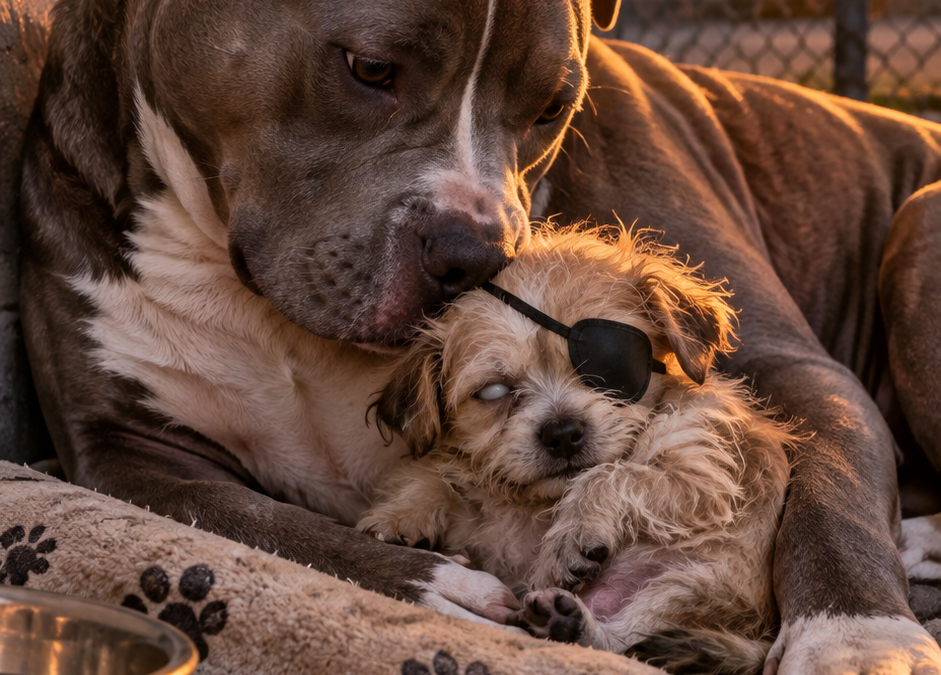
PART2
The first time I understood what Tyson was doing, I thought it was coincidence.
We had both dogs outside in the small exercise yard behind the shelter.
Zach was learning the basic layout.
Water bowl under the tree.
Bench near the fence.
Ramp leading back inside.
Mulch near the rear gate.
Concrete strip along the building.
He knew none of it yet.
He moved like somebody walking through a dark room filled with furniture.
Three steps.
Stop.
Sniff.
Listen.
Two steps.
Bump.
Reset.
Tyson walked several feet ahead.
At first, I assumed he was simply wandering.
Then Zach started drifting toward a large flower pot.
Tyson turned.
Walked back.
Placed his shoulder between Zach and the pot.
Zach bumped gently into him instead.
Tyson moved sideways.
Zach followed.
They continued.
I stared.
“Did you just do that?”
Tyson ignored me.
A few minutes later, Zach veered toward the fence.
Tyson blocked him again.
Not aggressively.
Not even obviously.
He simply put his body where Zach shouldn’t go.
Zach touched him.
Turned.
Continued.
The next day, same thing.
Then again.
Within a week, it became undeniable.
Tyson was guiding him.
Not perfectly.
Not like a trained service animal.
But intentionally enough that everyone noticed.
He would walk ahead.
Stop.
Wait.
Zach listened.
Followed.
If Zach lost direction, Tyson returned.
A nose to the shoulder.
A body against his path.
A quiet huff.
Zach responded.
The two dogs developed a language none of us had designed.
Sound.
Scent.
Contact.
Patience.
One afternoon, it took them almost fifteen minutes to travel ten yards.
That doesn’t sound impressive until you understand what ten yards meant to Zach.
Open space confused him.
Walls were easier because he could follow them.
A yard had no boundaries he could immediately touch.
Just air.
Sound.
Smell.
Tyson walked toward the water bowl.
Zach followed.
Halfway there, the puppy turned too far left.
Tyson circled back.
Nudged.
Waited.
Zach corrected.
Then stopped again.
Tyson stopped too.
Eventually, Zach reached the bowl.
His nose touched the rim.
Water splashed.
He drank.
His tail exploded.
Full wag.
Fast.
Proud.
I stood beside the fence pretending to write notes on a clipboard.
I wasn’t writing anything.
My eyes had gone blurry.
I had been volunteering at the shelter for years, but I had intentionally avoided getting emotionally attached.
That was not accidental.
Three years earlier, I had lost my wife to cancer.
Claire.
Thirty-eight years together compressed into eighteen months of appointments, scans, treatment plans, hopeful language, cautious language, then the kind of silence doctors use when hope becomes dishonest.
She died at home.
I was holding her hand.
Afterward, people told me grief softened with time.
That wasn’t how it felt.
Grief changed shape.
At first it was loud.
Then quiet.
Then it became architecture.
I built my life around it.
Work.
Shelter.
Home.
Same routes.
Same grocery store.
Same coffee.
No big changes.
No new attachments.
I could clean kennels because kennels didn’t ask me to imagine the future.
I could repair fencing because fences didn’t die.
I could transport food.
Pick up donations.
Fix broken hinges.
Practical things.
Safe things.
I didn’t foster.
I didn’t adopt.
I definitely didn’t fall in love with animals who might someday be gone.
Then Zach arrived.
Blind.
Clumsy.
Wearing that ridiculous pirate patch.
Tail wagging whenever he heard me.
And Tyson, who had suffered plenty himself, looked at this puppy and apparently decided fear wasn’t a reason to walk away.
That was inconvenient.
Emotionally speaking.
One afternoon, I crouched beside Zach.
He was sitting in the sunlight near the fence.
His face pointed slightly past me.
“Hey.”
His ears turned.
I touched the ground first so he would hear where my hand was.
Then scratched gently under his chin.
“You don’t have to figure all this out alone.”
His tail moved.
I laughed softly.
“Easy for you to say.”
He leaned toward my hand.
Tyson was lying three feet away.
Watching.
“Between you and me,” I told him, “that dog is making the rest of us look bad.”
Tyson yawned.
Zach’s blindness was permanent.
That fact took time to settle.
The veterinarian believed at least part of the damage might have been congenital.
One eye also showed evidence of old trauma.
Whether someone caused it intentionally, whether it came from an accident, whether neglect made it worse—we could not know.
I learned not to fill unknown spaces with the worst story possible.
Reality was already enough.
Zach could not see.
He never would.
The question became:
What could he learn instead?
Blind dogs adapt through scent mapping, sound, texture, routine, memory.
We began building those systems around him.
A textured mat before doorways.
Different surfaces around water.
Consistent furniture placement.
Verbal cues.
“Step.”
“Wait.”
“Left.”
“Right.”
“Careful.”
Tyson remained part of everything.
Eventually I added a small bell to Tyson’s collar.
Nothing loud.
Just a soft metallic jingle.
The change in Zach was immediate.
The first time Tyson moved, Zach’s ears snapped forward.
Jingle.
He stood.
Jingle.
He followed.
Tyson turned.
Jingle.
Zach corrected.
It was as though somebody had drawn a moving line through the dark.
For the first time, Zach could track Tyson without needing constant physical contact.
His confidence grew.
Slowly.
One morning, I opened the kennel gate.
Tyson walked into the yard.
Zach remained inside.
Usually I guided him over the metal threshold because the change in surface unsettled him.
That day, I waited.
“Come on, buddy.”
Zach stretched one paw forward.
Touched metal.
Pulled back.
Tyson heard.
He stopped outside.
Then gave one low huff.
Not a bark.
Just sound.
Zach’s ears lifted.
He tried again.
Paw.
Metal.
Second paw.
His back feet remained inside.
Tyson’s bell moved.
Jingle.
Zach stepped forward.
All four paws crossed.
He was outside.
By himself.
I almost cheered.
Didn’t.
Too much noise could ruin the moment.
Instead I whispered, “Good.”
His tail started.
Zach stood in the sun.
Couldn’t see it.
But he could feel it.
His nose lifted.
Warm air.
Grass.
Tyson.
Freedom.
He walked.
A little crooked.
But forward.
Families kept coming.
Nobody chose Zach.
That was the hardest part.
They weren’t cruel.
Most were honest.
“Will he need special care?”
“Yes.”
“Can he be left alone?”
“With proper setup, eventually.”
“Will he run into things?”
“Sometimes.”
“Can he use stairs?”
“With training.”
“Will his blindness get worse?”
“He’s already completely blind.”
That answer always created a pause.
Then came:
“We’ll think about it.”
They rarely did.
One father stared at Zach for a long time.
His daughter knelt outside the kennel.
Zach wagged.
The man asked, “Can he play normally?”
“Depends what you mean by normally.”
“He can’t fetch, right?”
“He can.”
The man looked skeptical.
“We use scented or noisy toys.”
“Oh.”
He watched Zach bump into the edge of his bed.
Then looked toward another puppy.
“I think we want something easier.”
I wanted to be angry.
Instead, I said, “That’s fair.”
Because it was.
A dog should not be adopted out of guilt.
Especially a disabled one.
Zach needed someone prepared for his actual life.
Not someone moved by a sad story for forty-eight hours.
Still, after the family left, Zach sat facing the kennel gate.
Listening.
Tyson came over.
Pressed his shoulder into him.
Zach leaned.
That tiny movement became their ritual.
No drama.
No rescue montage.
Just:
I’m here.
One afternoon, a delivery driver dropped a metal hose rack in the yard.
The crash was enormous.
Zach jumped.
His front legs tangled.
He fell sideways.
Panic hit instantly.
He scrambled toward nowhere.
Hit the fence.
Yelped.
“Zach!”
Before I reached him, Tyson did.
The Pit Bull placed himself between Zach and the fallen rack.
Then pressed his side against the puppy.
Zach trembled.
Hard.
Tyson stayed.
Thirty seconds.
One minute.
Zach’s breathing slowed.
I crouched.
“Easy.”
Tyson looked at me.
I realized then that his role was bigger than navigation.
He wasn’t merely Zach’s guide.
He was safety.
The world could surprise Zach at any moment because he couldn’t see danger approaching.
Tyson gave those moments shape.
A familiar body.
A smell.
A sound.
A place to orient.
That night, Zach slept with his head across Tyson’s front leg.
I stood outside their kennel.
“Good night, boys.”
Zach’s tail thumped without his head lifting.
He knew my voice now.
That did something to me.
I stayed longer at the shelter.
Every week, a little longer.
I told myself it was because Zach needed consistency.
Truth was, I needed him too.
He began memorizing the yard.
We helped him build a map through texture and scent.
Cedar mulch near one edge.
Rubber mat before the ramp.
Smooth concrete near the door.
Grass in the center.
Lavender planted near the bench.
Water near the oak.
Tyson’s bell became moving reference.
Within weeks, Zach could travel familiar routes with almost no collision.
He still made mistakes.
He walked into a bucket once.
Stopped.
Backed up.
Sniffed it thoroughly.
Then walked around.
The next day, he avoided it.
Memory.
Another morning, he ran directly into the water trough.
Not hard.
Just enough to put both front paws in.
Everyone gasped.
Zach sneezed.
Then wagged violently.
Tyson stood beside him looking offended on his behalf.
I laughed until my stomach hurt.
Zach climbed out.
Shook water everywhere.
Then tried again.
That was his greatest skill.
Trying again.
He did not interpret mistakes the way humans do.
He didn’t sit beside the trough thinking:
I failed.
Everyone saw.
Maybe I’m not capable.
Maybe I shouldn’t try again.
He simply collected information.
Water there.
Okay.
Next time, turn sooner.
Simple.
I envied that.
Claire’s illness had trained me to fear attachment.
Zach’s blindness seemed to have trained him to trust repetition instead.
Step.
Bump.
Learn.
Step again.
One afternoon, he found a tennis ball by smell.
Old rubber.
Dust.
Dog saliva.
He pawed at it.
Missed.
Tried again.
Hit it.
Ball rolled.
Zach chased the sound.
Wrong direction at first.
Tyson went after the ball.
Brought it back.
Dropped it near Zach.
The puppy sniffed.
Found it.
Pawed again.
Soon they had invented their own game.
Tyson retrieved.
Zach located.
Tyson moved it.
Zach chased.
Not conventional fetch.
Better.
Their game.
Then Zach ran.
Not toward Tyson.
Not after a sound.
He just ran.
Across the yard.
Full speed.
My heart stopped.
“Zach!”
He veered.
Missed the bench.
Avoided the tree.
Then caught the garden hose with one paw and somersaulted.
Every person near the fence flinched.
Zach landed on his back.
All four paws in the air.
Silence.
Then—
Bark!
One loud, ridiculous bark.
Tail whipping.
The staff erupted in laughter.
Tyson trotted over.
Licked Zach’s ear once.
Zach rolled upright.
Then took off again.
I leaned against the fence.
My eyes stung.
A blind puppy was running through a world he couldn’t see because he trusted that if he fell, falling would not be the end.
That lesson stayed.
Then came adoption Saturday.
Too many people.
Too much sound.
Children.
Balloons.
Shoes.
Voices bouncing through concrete corridors.
Doors opening.
Doors closing.
Dogs barking.
Zach entered the yard already overwhelmed.
His ears moved constantly.
Left.
Right.
Back.
Forward.
He couldn’t separate individual sounds.
His usual map disappeared beneath noise.
Tyson wore the bell.
But every collar jingled.
Every key ring sounded similar.
I saw Zach freeze.
Tail low.
“Easy.”
I approached slowly.
He heard me.
Turned toward my voice.
Then a child saw him.
“Pirate puppy!”
Six or seven years old.
Excited.
Fast.
He ran.
I stood.
“Wait—”
Too late.
The boy reached Zach from behind.
Touched his shoulder.
Zach panicked.
No aggression.
Pure reflex.
He jumped sideways.
Hit the fence.
Scrambled backward.
Collided with a crate.
A sound came from him that made every hair on my arms rise.
Fear.
Tyson appeared immediately.
Positioned himself between the boy and Zach.
No growl.
No teeth.
Just body.
Wall.
The child stopped.
His father grabbed his shoulder.
“Sorry.”
“He’s blind,” I said.
The father looked embarrassed.
“We didn’t know.”
“He needs warning before touch.”
The mother pulled the child closer.
“Come on. Let’s see the other puppies.”
And they left.
Zach stayed inside the crate.
Tyson lay across the opening.
I sat several feet away.
I wanted to be angry.
At the boy.
Parents.
Shelter event.
Noise.
World.
But a child had made a mistake.
That was all.
The real damage came from what it triggered.
For several days, Zach regressed.
He stayed closer to his crate.
Moved less.
His tail lowered.
Tyson stopped encouraging exploration.
Instead, he guarded.
Too much.
If Zach lay down, Tyson curled around him.
If Zach hesitated, Tyson blocked the world.
Kind.
But not always helpful.
Safety can become a cage too.
One morning, I found Zach under the bench outside.
Tyson stood by the gate.
For once they were separated.
I called.
“Zach.”
His ear moved.
“Come here.”
No movement.
Again.
“Zach.”
He stood.
One step.
Stopped.
His head lowered.
I stopped calling.
That was important.
I walked several feet away.
Sat in the dirt.
Turned sideways.
No pressure.
Then I started talking.
Not training.
Not commands.
Just talking.
“I get it.”
Zach listened.
“I know what it’s like to decide staying small feels safer.”
His ears moved.
“After Claire died, everybody told me I needed to get back out there.”
One step toward me.
“I hated that phrase.”
Another.
“Get back out there.”
Zach sniffed.
“Like grief was bad weather and all I needed was an umbrella.”
He came closer.
“I stopped answering people.”
Another step.
“Stopped going places.”
He was near my knee now.
“I told myself I liked being alone.”
Zach touched my shoulder with his nose.
I froze.
“I lied.”
He pressed his head into my lap.
That was when I cried.
Quietly.
Not because he was blind.
Not because nobody adopted him.
Because I finally understood how much of my own life I had spent sitting under a metaphorical bench waiting for the world to become safe enough.
Tyson came over.
Lay on my boot.
Zach stayed against me.
Three damaged creatures in Sacramento dirt.
Fantastic support group.
I laughed through tears.
“Look at us.”
Tyson sighed.
“Judgmental.”
That afternoon, Zach walked back into the yard.
The next day, farther.
By the end of the week, he was following Tyson again.
But something had changed.
Tyson began giving him more distance.
Whether instinct or something he learned from us, I don’t know.
He stopped blocking every potential mistake.
He let Zach solve things.
Bump.
Pause.
Correct.
Learn.
Blindness did not mean fragility.
We had to stop confusing the two.
One afternoon, Zach crossed half the yard alone.
He used scent.
Windchimes.
Texture.
He avoided the hose.
Turned near the metal post.
Found water.
Tyson remained thirty feet away.
Watching.
I sat near the fence.
Zach drank.
Then turned.
Walked back.
No guide.
No collision.
When he reached me, his tail started.
“You know where you are.”
Thump.
“You actually know.”
He pressed into my leg.
Tyson walked over afterward.
Not to rescue.
To join.
That difference meant everything.
The following morning, I called from the back gate.
“Zach.”
He stood across the yard.
Tyson beside him.
Usually the bell moved first.
Not that day.
Zach moved.
One cautious step.
Then another.
His ears locked onto my voice.
I called again.
“Come on.”
He accelerated.
Not graceful.
Blind puppy running toward sound is equal parts inspiring and terrifying.
“Easy!”
Too late.
Zach half-ran across the yard.
Avoided the tree.
Corrected near the hose.
Then bumped gently into my shin.
I dropped down.
“You did it.”
His tail hammered.
“You did it.”
I held his chest.
Heart racing.
Behind him, Tyson stood quietly.
He didn’t follow.
He hadn’t needed to.
Something inside me shifted.
For months, I had been thinking about what kind of person might adopt Zach.
Patient.
Experienced.
Home layout stable.
Able to manage blindness.
Willing to keep Tyson involved somehow.
Then the absurdity finally became clear.
Zach already had people.
Me.
And he already had a dog.
Tyson.
The only person pretending otherwise was me.
That evening, I sat on the shelter bench with both dogs.
Zach against my leg.
Tyson across my feet.
The sun dropped behind the fence.
“I need to tell you something.”
Tyson opened one eye.
“Zach can’t see my dramatic expression.”
Nothing.
“Helpful.”
I looked at the puppy.
“You’re not staying here.”
His ear moved.
“You’re coming home.”
Tyson lifted his head.
I scratched his neck.
“And apparently you are too.”
Tail.
“You’ve engineered this entire situation.”
Tyson leaned against my knee.
I laughed.
“Claire would’ve loved you idiots.”
That sentence hurt.
Then it didn’t.
Or rather, it hurt differently.
For years, saying her name aloud inside a happy moment had felt disloyal.
As if happiness belonged to the life before her death and grief belonged to everything after.
But grief and love aren’t competing systems.
Claire could be gone.
I could miss her.
And I could still bring two ridiculous dogs home.
Both truths fit.
Adoption paperwork sat in my truck for three days.
I told nobody.
I read it at night.
Closed it.
Opened it.
Signed everything except the final line.
Cowardice is surprisingly administrative.
Finally, Friday morning, I carried the forms into the shelter office.
Our intake manager looked at me.
“What’s that?”
“You know.”
She smiled.
“Both?”
“Obviously.”
“You sure?”
“No.”
Her smile disappeared.
I laughed.
“That’s why I know it’s real.”
I signed.
Zach.
Tyson.
Mine.
Or perhaps I had finally agreed to become theirs.
We loaded the truck that afternoon.
Tyson jumped inside first.
Zach stood beside the open door.
The step was high.
He pawed forward.
Nothing.
Pulled back.
I reached to lift him.
Then stopped.
He could do it.
Tyson turned from inside the truck.
Gave one low chuff.
Zach’s ears lifted.
He placed his paws on the edge.
Pushed.
Jumped.
Terrible angle.
Half sideways.
I caught his hip just enough to prevent a fall.
He landed beside Tyson.
Tail exploding.
“You had that.”
Tyson sniffed him.
Zach pressed shoulder to shoulder.
The ride home was quiet.
Bell.
Road noise.
Zach’s tail thumping occasionally against the seat.
When I opened my front door, I realized I had spent years preserving the house like a museum.
Claire’s mug in the cabinet.
Her gardening gloves still on a shelf.
One sweater I never moved.
Furniture in the same places.
Silence.
Then Tyson entered.
Sniff.
Room.
Room.
Room.
Zach followed slowly.
Baseboard.
Carpet.
Wall.
Doorframe.
I had prepared.
Textured mats.
Blocked stairs.
Padding on sharp corners.
Food bowls fixed in one place.
Bell on the back door.
I kept furniture unchanged.
Tyson guided.
Kitchen.
Living room.
Hallway.
Backyard.
Zach mapped everything.
That first evening, he walked into the coffee table twice.
The second time, he barked at it.
I laughed.
“Fair.”
By the third day, he avoided it.
Within two weeks, he moved through the house better than some sighted visitors.
The backyard became his kingdom.
Tyson’s bell showed him moving reference.
Windchimes marked the porch.
Lavender marked one corner.
Mulch another.
Zach ran.
Really ran.
No fence collision.
No panic.
He knew where things belonged.
One morning, I stood at the kitchen window watching him chase a squeaky ball by sound.
Tyson carried it.
Dropped.
Zach found.
Pounced.
Missed.
Pounced again.
Success.
I imagined Claire beside me.
She would have laughed.
Probably cried.
Then bought Zach an eye patch with skulls on it.
The thought made me smile.
I didn’t feel guilty.
That surprised me.
The dogs didn’t cure grief.
I would hate anyone telling the story that way.
Claire was still dead.
Missing her still hurt.
Some dates were impossible.
Some songs ruined whole afternoons.
The dogs didn’t erase any of it.
They changed what surrounded it.
Before them, grief had occupied almost every room.
Now there was barking.
Nails on hardwood.
Dog hair.
Chewed toys.
Food bowls.
Training.
Appointments.
Responsibility.
Noise.
Life.
Zach became more independent every month.
He learned verbal cues.
“Step.”
He lifted paws higher.
“Wait.”
Stopped.
“Left.”
Turned.
“Right.”
Turned.
“Careful.”
Slowed.
Tyson remained his anchor but no longer his entire navigation system.
That was beautiful.
Healthy dependence becoming partnership.
Sometimes Tyson walked ahead.
Sometimes Zach did.
One day I removed the bell briefly to wash his collar.
Zach noticed immediately.
He stood in the hallway.
Listened.
No jingle.
Tyson approached.
Touched him.
Zach relaxed.
I bought two bells.
Never again.
Months passed.
We returned to the shelter for visits.
Zach knew the place by smell before we entered.
Tail.
Excitement.
No fear.
The staff cried when he walked across the yard independently.
One volunteer crouched.
“Pirate puppy.”
Zach found her by voice.
Pressed into her hands.
Tyson stayed several yards back.
Watching.
The shelter still had his old adoption card in storage.
BLIND.
SPECIAL NEEDS.
NEEDS EXPERIENCED HOME.
I looked at it.
All true.
Yet incomplete.
It said nothing about his joy.
Nothing about memory.
Nothing about the way he could locate a tennis ball by smell.
Nothing about his ability to make strangers slow down.
Nothing about how he trusted with his whole body once trust was earned.
We see labels because labels are fast.
Blind.
Pit Bull.
Rescue.
Special needs.
Bereaved.
Widower.
Damaged.
Difficult.
Useful sometimes.
Dangerous when mistaken for the whole person or animal.
Tyson taught me that too.
People saw Pit Bull.
He behaved like a patient old teacher trapped inside a young muscular dog.
People saw blind puppy.
Zach behaved like an explorer with terrible steering.
People saw widower.
I had behaved like someone whose life was finished.
We were all more complicated.
One year after adoption, Zach no longer wore the original black patch.
The damaged eye had required surgery, and the patch became unnecessary except occasionally for protection during recovery.
I kept it.
Folded in a drawer.
Not because blindness was something to celebrate.
Because it reminded me how people first saw him.
Pirate puppy.
Poor thing.
Too much work.
Then I looked at the dog racing through my backyard and laughed.
Too much work?
Absolutely.
Too much dog hair?
Without question.
Worth it?
Every day.
Tyson aged into his role with ridiculous dignity.
He would wait near steps.
Stand at doorways.
Give small vocal cues.
If Zach became overstimulated somewhere unfamiliar, Tyson touched him.
No command from me.
Just instinct refined through repetition.
The most remarkable thing was how often Tyson stepped back.
That mattered.
A bad guide creates dependence.
A good one builds confidence.
Tyson seemed to understand.
In familiar places, he let Zach lead.
When Zach solved a problem, Tyson didn’t interfere.
When Zach got lost, Tyson returned.
There is a human lesson in that.
Love is not doing everything for someone.
Sometimes it is staying close enough that they can fail safely.
One winter afternoon, rain hit the windows hard.
Thunder rolled.
Zach hated sudden storms.
Not because he could see lightning.
Because thunder made the world enormous.
He paced.
Tyson approached.
Lay beside him.
I sat on the floor.
Zach pressed between us.
Three bodies.
Same old arrangement.
Fear came.
Nobody demanded it leave.
Eventually it did.
That was home.
Not a place without fear.
A place where fear didn’t mean being alone.
Years later, Zach became remarkably confident around children once introductions were handled correctly.
We never allowed surprise touching.
Children learned:
Say his name.
Let him smell your hand.
Touch shoulder or chest.
Don’t grab his head.
Don’t approach silently from behind.
Watching children learn how to meet him changed the whole interaction.
Instead of asking:
“What’s wrong with him?”
They began asking:
“How does he know where I am?”
Then:
“Can he hear better?”
“Does he dream pictures?”
“Does he know what I look like?”
Wonderful questions.
We didn’t always have answers.
One little girl asked me, “Does Zach know Tyson is gray?”
I smiled.
“No.”
“Then what does he think Tyson looks like?”
That stayed with me.
I looked at Tyson.
Zach knew him by smell.
Footsteps.
Breath.
Warmth.
Bell.
Touch.
Maybe appearance was the least important thing Zach knew about him.
“He knows who Tyson is,” I said.
The girl nodded as if that made complete sense.
Maybe it did.
Tyson eventually became older first.
Gray around the muzzle.
Slower.
Arthritis.
The bell still jingled.
But softer because he no longer moved quickly.
Then something beautiful happened.
Zach started waiting for him.
On walks, the blind dog sometimes moved ahead.
He knew our neighborhood through scent and sound.
Then he would stop.
Listen.
Bell behind.
Too far.
Zach waited.
Tyson caught up.
They continued.
I noticed the reversal one morning and nearly stopped walking.
Years earlier, Tyson had waited for Zach at every doorway.
Now Zach waited for him.
No sight required.
Only love.
When Tyson eventually died, he was old enough that we had time to understand it was coming.
He slept more.
Ate less.
Stopped wanting long walks.
Zach stayed near him.
Always.
The last morning, Tyson lay on his bed in the living room.
Zach rested beside him.
No bell.
We had removed the collar because Tyson was uncomfortable.
Zach kept touching him with his nose.
Checking.
I sat on the floor.
Hand on each dog.
My grief for Claire returned with terrifying clarity.
I thought I couldn’t survive another goodbye.
That had been the reason I avoided love.
Yet here I was.
Loving.
And therefore losing.
Again.
Tyson died peacefully.
At home.
My hand on his chest.
Zach pressed against his side.
Afterward, Zach searched.
Not frantically.
But constantly.
Rooms.
Bed.
Backyard.
Doorway.
Listening for a bell that never sounded.
That was brutal.
For several days, I wore Tyson’s old bell on my wrist.
Not to trick Zach.
To help transition.
He heard it.
Came close.
Smelled my hand.
He knew immediately I wasn’t Tyson.
Of course he did.
But the sound seemed to comfort him.
Eventually I hung the bell beside the back door.
Zach would touch it with his nose before going outside.
Sometimes it jingled.
His ears lifted.
Then he continued.
Grief became part of his map.
Just as it had become part of mine.
We kept walking.
That was what Tyson had taught us.
Not avoidance.
Not forgetting.
Forward.
Slow if necessary.
Stop when needed.
But forward.
Years after Zach first arrived at the shelter, I took him back for an anniversary event.
People still called him Pirate.
He was older.
Broad-chested.
Confident.
The milky eye remained.
The blindness remained.
His tail still wagged.
A family entered with a blind puppy of their own.
Different breed.
Tiny.
Terrified.
The mother looked exhausted.
“We don’t know if we can do this.”
I understood.
I didn’t tell her it was easy.
It wasn’t.
I didn’t tell her love solves everything.
It doesn’t.
I introduced her to Zach.
The puppy heard him.
Moved closer.
Zach sniffed.
Then lay down.
The little puppy pressed against him.
I almost laughed.
Full circle.
The woman watched.
“How does he live like this?”
I looked around the yard.
Windchimes.
Textured mats.
Familiar routes.
People who knew how to approach him.
“By learning.”
“And you?”
“Same.”
She stared at Zach.
“He seems happy.”
“He is.”
“How?”
That question.
As if joy required perfect circumstances.
I thought about Tyson.
Claire.
Grief.
Blindness.
Fear.
Second chances.
“Because happiness isn’t the same thing as having nothing wrong.”
She looked at me.
“It’s having enough that’s right.”
Zach’s tail thumped.
The little blind puppy crawled closer.
I sat nearby.
For years, people had said nobody wanted Zach.
That wasn’t exactly true.
Tyson wanted him from the beginning.
Not as a project.
Not as a tragedy.
Not as a special-needs case.
He simply wanted to stay beside him.
And eventually, because Tyson stayed, Zach learned the world could be trusted.
Then because Zach trusted, I learned something too.
Claire’s death had convinced me love always ends in loss.
Technically, that is true.
Everything ends.
Tyson did.
Someday Zach would.
Someday I would.
But I had misunderstood the conclusion.
If love ends in loss, that does not mean love was a mistake.
It means something mattered.
For three years after Claire, I had tried to protect myself by avoiding anything that might matter too much.
Then a blind puppy walked directly into my legs.
Literally.
He ruined the strategy.
Good.
The last original bell from Tyson’s collar still hangs beside my back door.
Zach knows exactly where it is.
Sometimes before we go outside, he nudges it.
Jingle.
Then waits.
I open the door.
He steps into the yard.
No Tyson guiding.
No bell moving ahead.
Just Zach.
Nose lifted.
Ears working.
Memory everywhere.
He knows the path.
Knows the fence.
Knows the tree.
Knows where sunlight warms the patio even though he has never seen sunlight once in his life.
He runs.
Sometimes still into the hose if I forget to move it.
Then he barks at me like I committed a crime.
Fair.
I sit on the porch.
Listen to his paws.
The dog who was once rejected because he couldn’t see now navigates a whole life through things the rest of us overlook.
Scent.
Sound.
Warmth.
Routine.
Trust.
He never saw Tyson.
Not once.
Never saw the broad gray head beside him.
Never saw the Pit Bull stand between him and danger.
Never saw the bell collar.
Never saw Tyson waiting at the ramp.
But Zach knew him more completely than many people ever know each other.
He knew:
That sound means follow.
That shoulder means stop.
That breath means safe.
That body means I’m not alone.
Maybe sight was never the important part.
I think about the families who passed Zach.
I don’t blame them.
Most were looking for a dog they understood.
Zach required learning a new language.
Tyson already spoke it.
Before any of us did.
That was his unbelievable gift.
He didn’t give Zach vision.
He gave him confidence.
He didn’t remove darkness.
He showed him darkness could still contain companionship.
He didn’t prevent every collision.
He stayed close enough for Zach to keep trying after one.
That is why, when people ask what the Pit Bull did that was so extraordinary, I don’t tell them about one dramatic act.
There wasn’t one.
No fire.
No cliff.
No single rescue moment.
Tyson did something harder.
He stayed.
Day after day.
Step after step.
Until a blind puppy stopped believing the world ended wherever he couldn’t see.
And somewhere along the way, the two of them did the same thing for me.
Zach never saw my face.
Never saw the grief in it.
Never saw how different the house looked after Claire died.
Never saw photographs of her.
Never saw me cry the first time he crossed the yard alone.
Yet somehow he found every part of me I had tried to hide.
Tyson taught Zach how to trust the world.
Zach taught me how to enter it again.
And even now, when I hear the little bell by the back door ring and Zach’s paws move confidently across the floor, I still think about the puppy people called unwanted.
Blind.
Broken.
Too difficult.
The puppy who couldn’t see a future.
Turns out he didn’t need to.
He just needed someone willing to walk beside him until he learned there was one.
Have you finished reading the story and want to read it again?
Nobody Wanted the Blind Puppy With a Pirate Patch—Until a Pit Bull Became His Eyes
Nobody wanted the blind puppy.
He kept waiting anyway.
Then a rescued Pit Bull decided he would never walk alone again.
The first thing I noticed about Zach was the black cloth tied around his head.
It covered one eye like a pirate patch.
The other eye was open, cloudy and pale, but it never focused on anything.
Not faces.
Not movement.
Not light.
Zach was a five-month-old German Shepherd puppy, and by the time someone found him wandering near an industrial park outside Sacramento, he had already learned how unforgiving a world built for sight could be.
His paws were scraped raw.
His ribs showed beneath dusty black-and-tan fur.
He had small cuts along his muzzle and shoulders, probably from walking into fencing, scrap metal, curbs, or whatever else he had encountered while trying to navigate alone.
He had no collar.
No microchip.
No identification.
Just the eye patch.
Someone had tied it carefully enough that I sometimes wondered whether they had once tried to help him.
Maybe they had covered an injured eye.
Maybe they had taken him to a veterinarian and lost hope.
Maybe they had simply hidden what they didn’t want to see anymore.
We never found out.
By the time Zach arrived at our shelter, both eyes were beyond saving.
One was severely damaged.
The other had advanced nerve deterioration.
Our veterinarian examined him twice because nobody wanted to be the person who said the final words.
“He’s completely blind.”
I remember standing beside the examination table.
Zach was facing the wrong direction.
His tail wagged anyway.
“Nothing?”
“Not functional vision.”
“Shadows?”
“No.”
“Light?”
“Probably not enough to use.”
I looked at him.
He turned toward my voice.
Tail.
Thump.
Thump.
Thump.
That was Zach.
The world had gone dark before he was old enough to understand what darkness meant.
He still greeted it like it might contain something good.
At Brave Shelter, he moved slowly.
Nose first.
Paw second.
Pause.
Listen.
Another paw.
Then sometimes—
Bump.
Wall.
He would freeze.
Shake his head.
Back up.
Try again.
Families noticed the pirate patch immediately.
Children loved it.
“Look, Mom! Pirate puppy!”
Adults asked the next question.
“What happened to him?”
“He’s blind.”
Then came the expression I learned to hate.
Not cruelty.
Pity.
A soft smile.
A sad little exhale.
“Oh.”
Then they moved on.
Golden Retrievers.
Labradoodles.
Healthy shepherds.
Puppies that chased tennis balls and stared directly into cameras.
Zach would sit facing slightly away from them, listening to footsteps disappear.
His tail might wag once.
Then stop.
I told myself he didn’t understand rejection.
Maybe that made it easier for me.
Then Tyson started staying beside him.
Tyson was a Pit Bull, about a year and a half old.
Stocky.
Gray-and-white chest.
Big head.
Quiet eyes.
He had arrived at the shelter months earlier half starved and terrified of sudden movement.
By the time Zach came, Tyson had become one of our calmest dogs.
And for reasons none of us understood, he chose the blind puppy immediately.
The first time Zach walked into Tyson, the Pit Bull didn’t move.
Zach bumped against his side.
Stopped.
Sniffed.
Tyson turned his head.
Touched Zach’s shoulder with his nose.
Then lay back down.
Zach leaned against him.
That was all.
No dramatic beginning.
No instant miracle.
Just one rescued dog deciding another frightened dog could use a place to rest.
Within a week, Tyson had become something none of us had trained him to be.
Zach’s eyes.
PART2
The first time I understood what Tyson was doing, I thought it was coincidence.
We had both dogs outside in the small exercise yard behind the shelter.
Zach was learning the basic layout.
Water bowl under the tree.
Bench near the fence.
Ramp leading back inside.
Mulch near the rear gate.
Concrete strip along the building.
He knew none of it yet.
He moved like somebody walking through a dark room filled with furniture.
Three steps.
Stop.
Sniff.
Listen.
Two steps.
Bump.
Reset.
Tyson walked several feet ahead.
At first, I assumed he was simply wandering.
Then Zach started drifting toward a large flower pot.
Tyson turned.
Walked back.
Placed his shoulder between Zach and the pot.
Zach bumped gently into him instead.
Tyson moved sideways.
Zach followed.
They continued.
I stared.
“Did you just do that?”
Tyson ignored me.
A few minutes later, Zach veered toward the fence.
Tyson blocked him again.
Not aggressively.
Not even obviously.
He simply put his body where Zach shouldn’t go.
Zach touched him.
Turned.
Continued.
The next day, same thing.
Then again.
Within a week, it became undeniable.
Tyson was guiding him.
Not perfectly.
Not like a trained service animal.
But intentionally enough that everyone noticed.
He would walk ahead.
Stop.
Wait.
Zach listened.
Followed.
If Zach lost direction, Tyson returned.
A nose to the shoulder.
A body against his path.
A quiet huff.
Zach responded.
The two dogs developed a language none of us had designed.
Sound.
Scent.
Contact.
Patience.
One afternoon, it took them almost fifteen minutes to travel ten yards.
That doesn’t sound impressive until you understand what ten yards meant to Zach.
Open space confused him.
Walls were easier because he could follow them.
A yard had no boundaries he could immediately touch.
Just air.
Sound.
Smell.
Tyson walked toward the water bowl.
Zach followed.
Halfway there, the puppy turned too far left.
Tyson circled back.
Nudged.
Waited.
Zach corrected.
Then stopped again.
Tyson stopped too.
Eventually, Zach reached the bowl.
His nose touched the rim.
Water splashed.
He drank.
His tail exploded.
Full wag.
Fast.
Proud.
I stood beside the fence pretending to write notes on a clipboard.
I wasn’t writing anything.
My eyes had gone blurry.
I had been volunteering at the shelter for years, but I had intentionally avoided getting emotionally attached.
That was not accidental.
Three years earlier, I had lost my wife to cancer.
Claire.
Thirty-eight years together compressed into eighteen months of appointments, scans, treatment plans, hopeful language, cautious language, then the kind of silence doctors use when hope becomes dishonest.
She died at home.
I was holding her hand.
Afterward, people told me grief softened with time.
That wasn’t how it felt.
Grief changed shape.
At first it was loud.
Then quiet.
Then it became architecture.
I built my life around it.
Work.
Shelter.
Home.
Same routes.
Same grocery store.
Same coffee.
No big changes.
No new attachments.
I could clean kennels because kennels didn’t ask me to imagine the future.
I could repair fencing because fences didn’t die.
I could transport food.
Pick up donations.
Fix broken hinges.
Practical things.
Safe things.
I didn’t foster.
I didn’t adopt.
I definitely didn’t fall in love with animals who might someday be gone.
Then Zach arrived.
Blind.
Clumsy.
Wearing that ridiculous pirate patch.
Tail wagging whenever he heard me.
And Tyson, who had suffered plenty himself, looked at this puppy and apparently decided fear wasn’t a reason to walk away.
That was inconvenient.
Emotionally speaking.
One afternoon, I crouched beside Zach.
He was sitting in the sunlight near the fence.
His face pointed slightly past me.
“Hey.”
His ears turned.
I touched the ground first so he would hear where my hand was.
Then scratched gently under his chin.
“You don’t have to figure all this out alone.”
His tail moved.
I laughed softly.
“Easy for you to say.”
He leaned toward my hand.
Tyson was lying three feet away.
Watching.
“Between you and me,” I told him, “that dog is making the rest of us look bad.”
Tyson yawned.
Zach’s blindness was permanent.
That fact took time to settle.
The veterinarian believed at least part of the damage might have been congenital.
One eye also showed evidence of old trauma.
Whether someone caused it intentionally, whether it came from an accident, whether neglect made it worse—we could not know.
I learned not to fill unknown spaces with the worst story possible.
Reality was already enough.
Zach could not see.
He never would.
The question became:
What could he learn instead?
Blind dogs adapt through scent mapping, sound, texture, routine, memory.
We began building those systems around him.
A textured mat before doorways.
Different surfaces around water.
Consistent furniture placement.
Verbal cues.
“Step.”
“Wait.”
“Left.”
“Right.”
“Careful.”
Tyson remained part of everything.
Eventually I added a small bell to Tyson’s collar.
Nothing loud.
Just a soft metallic jingle.
The change in Zach was immediate.
The first time Tyson moved, Zach’s ears snapped forward.
Jingle.
He stood.
Jingle.
He followed.
Tyson turned.
Jingle.
Zach corrected.
It was as though somebody had drawn a moving line through the dark.
For the first time, Zach could track Tyson without needing constant physical contact.
His confidence grew.
Slowly.
One morning, I opened the kennel gate.
Tyson walked into the yard.
Zach remained inside.
Usually I guided him over the metal threshold because the change in surface unsettled him.
That day, I waited.
“Come on, buddy.”
Zach stretched one paw forward.
Touched metal.
Pulled back.
Tyson heard.
He stopped outside.
Then gave one low huff.
Not a bark.
Just sound.
Zach’s ears lifted.
He tried again.
Paw.
Metal.
Second paw.
His back feet remained inside.
Tyson’s bell moved.
Jingle.
Zach stepped forward.
All four paws crossed.
He was outside.
By himself.
I almost cheered.
Didn’t.
Too much noise could ruin the moment.
Instead I whispered, “Good.”
His tail started.
Zach stood in the sun.
Couldn’t see it.
But he could feel it.
His nose lifted.
Warm air.
Grass.
Tyson.
Freedom.
He walked.
A little crooked.
But forward.
Families kept coming.
Nobody chose Zach.
That was the hardest part.
They weren’t cruel.
Most were honest.
“Will he need special care?”
“Yes.”
“Can he be left alone?”
“With proper setup, eventually.”
“Will he run into things?”
“Sometimes.”
“Can he use stairs?”
“With training.”
“Will his blindness get worse?”
“He’s already completely blind.”
That answer always created a pause.
Then came:
“We’ll think about it.”
They rarely did.
One father stared at Zach for a long time.
His daughter knelt outside the kennel.
Zach wagged.
The man asked, “Can he play normally?”
“Depends what you mean by normally.”
“He can’t fetch, right?”
“He can.”
The man looked skeptical.
“We use scented or noisy toys.”
“Oh.”
He watched Zach bump into the edge of his bed.
Then looked toward another puppy.
“I think we want something easier.”
I wanted to be angry.
Instead, I said, “That’s fair.”
Because it was.
A dog should not be adopted out of guilt.
Especially a disabled one.
Zach needed someone prepared for his actual life.
Not someone moved by a sad story for forty-eight hours.
Still, after the family left, Zach sat facing the kennel gate.
Listening.
Tyson came over.
Pressed his shoulder into him.
Zach leaned.
That tiny movement became their ritual.
No drama.
No rescue montage.
Just:
I’m here.
One afternoon, a delivery driver dropped a metal hose rack in the yard.
The crash was enormous.
Zach jumped.
His front legs tangled.
He fell sideways.
Panic hit instantly.
He scrambled toward nowhere.
Hit the fence.
Yelped.
“Zach!”
Before I reached him, Tyson did.
The Pit Bull placed himself between Zach and the fallen rack.
Then pressed his side against the puppy.
Zach trembled.
Hard.
Tyson stayed.
Thirty seconds.
One minute.
Zach’s breathing slowed.
I crouched.
“Easy.”
Tyson looked at me.
I realized then that his role was bigger than navigation.
He wasn’t merely Zach’s guide.
He was safety.
The world could surprise Zach at any moment because he couldn’t see danger approaching.
Tyson gave those moments shape.
A familiar body.
A smell.
A sound.
A place to orient.
That night, Zach slept with his head across Tyson’s front leg.
I stood outside their kennel.
“Good night, boys.”
Zach’s tail thumped without his head lifting.
He knew my voice now.
That did something to me.
I stayed longer at the shelter.
Every week, a little longer.
I told myself it was because Zach needed consistency.
Truth was, I needed him too.
He began memorizing the yard.
We helped him build a map through texture and scent.
Cedar mulch near one edge.
Rubber mat before the ramp.
Smooth concrete near the door.
Grass in the center.
Lavender planted near the bench.
Water near the oak.
Tyson’s bell became moving reference.
Within weeks, Zach could travel familiar routes with almost no collision.
He still made mistakes.
He walked into a bucket once.
Stopped.
Backed up.
Sniffed it thoroughly.
Then walked around.
The next day, he avoided it.
Memory.
Another morning, he ran directly into the water trough.
Not hard.
Just enough to put both front paws in.
Everyone gasped.
Zach sneezed.
Then wagged violently.
Tyson stood beside him looking offended on his behalf.
I laughed until my stomach hurt.
Zach climbed out.
Shook water everywhere.
Then tried again.
That was his greatest skill.
Trying again.
He did not interpret mistakes the way humans do.
He didn’t sit beside the trough thinking:
I failed.
Everyone saw.
Maybe I’m not capable.
Maybe I shouldn’t try again.
He simply collected information.
Water there.
Okay.
Next time, turn sooner.
Simple.
I envied that.
Claire’s illness had trained me to fear attachment.
Zach’s blindness seemed to have trained him to trust repetition instead.
Step.
Bump.
Learn.
Step again.
One afternoon, he found a tennis ball by smell.
Old rubber.
Dust.
Dog saliva.
He pawed at it.
Missed.
Tried again.
Hit it.
Ball rolled.
Zach chased the sound.
Wrong direction at first.
Tyson went after the ball.
Brought it back.
Dropped it near Zach.
The puppy sniffed.
Found it.
Pawed again.
Soon they had invented their own game.
Tyson retrieved.
Zach located.
Tyson moved it.
Zach chased.
Not conventional fetch.
Better.
Their game.
Then Zach ran.
Not toward Tyson.
Not after a sound.
He just ran.
Across the yard.
Full speed.
My heart stopped.
“Zach!”
He veered.
Missed the bench.
Avoided the tree.
Then caught the garden hose with one paw and somersaulted.
Every person near the fence flinched.
Zach landed on his back.
All four paws in the air.
Silence.
Then—
Bark!
One loud, ridiculous bark.
Tail whipping.
The staff erupted in laughter.
Tyson trotted over.
Licked Zach’s ear once.
Zach rolled upright.
Then took off again.
I leaned against the fence.
My eyes stung.
A blind puppy was running through a world he couldn’t see because he trusted that if he fell, falling would not be the end.
That lesson stayed.
Then came adoption Saturday.
Too many people.
Too much sound.
Children.
Balloons.
Shoes.
Voices bouncing through concrete corridors.
Doors opening.
Doors closing.
Dogs barking.
Zach entered the yard already overwhelmed.
His ears moved constantly.
Left.
Right.
Back.
Forward.
He couldn’t separate individual sounds.
His usual map disappeared beneath noise.
Tyson wore the bell.
But every collar jingled.
Every key ring sounded similar.
I saw Zach freeze.
Tail low.
“Easy.”
I approached slowly.
He heard me.
Turned toward my voice.
Then a child saw him.
“Pirate puppy!”
Six or seven years old.
Excited.
Fast.
He ran.
I stood.
“Wait—”
Too late.
The boy reached Zach from behind.
Touched his shoulder.
Zach panicked.
No aggression.
Pure reflex.
He jumped sideways.
Hit the fence.
Scrambled backward.
Collided with a crate.
A sound came from him that made every hair on my arms rise.
Fear.
Tyson appeared immediately.
Positioned himself between the boy and Zach.
No growl.
No teeth.
Just body.
Wall.
The child stopped.
His father grabbed his shoulder.
“Sorry.”
“He’s blind,” I said.
The father looked embarrassed.
“We didn’t know.”
“He needs warning before touch.”
The mother pulled the child closer.
“Come on. Let’s see the other puppies.”
And they left.
Zach stayed inside the crate.
Tyson lay across the opening.
I sat several feet away.
I wanted to be angry.
At the boy.
Parents.
Shelter event.
Noise.
World.
But a child had made a mistake.
That was all.
The real damage came from what it triggered.
For several days, Zach regressed.
He stayed closer to his crate.
Moved less.
His tail lowered.
Tyson stopped encouraging exploration.
Instead, he guarded.
Too much.
If Zach lay down, Tyson curled around him.
If Zach hesitated, Tyson blocked the world.
Kind.
But not always helpful.
Safety can become a cage too.
One morning, I found Zach under the bench outside.
Tyson stood by the gate.
For once they were separated.
I called.
“Zach.”
His ear moved.
“Come here.”
No movement.
Again.
“Zach.”
He stood.
One step.
Stopped.
His head lowered.
I stopped calling.
That was important.
I walked several feet away.
Sat in the dirt.
Turned sideways.
No pressure.
Then I started talking.
Not training.
Not commands.
Just talking.
“I get it.”
Zach listened.
“I know what it’s like to decide staying small feels safer.”
His ears moved.
“After Claire died, everybody told me I needed to get back out there.”
One step toward me.
“I hated that phrase.”
Another.
“Get back out there.”
Zach sniffed.
“Like grief was bad weather and all I needed was an umbrella.”
He came closer.
“I stopped answering people.”
Another step.
“Stopped going places.”
He was near my knee now.
“I told myself I liked being alone.”
Zach touched my shoulder with his nose.
I froze.
“I lied.”
He pressed his head into my lap.
That was when I cried.
Quietly.
Not because he was blind.
Not because nobody adopted him.
Because I finally understood how much of my own life I had spent sitting under a metaphorical bench waiting for the world to become safe enough.
Tyson came over.
Lay on my boot.
Zach stayed against me.
Three damaged creatures in Sacramento dirt.
Fantastic support group.
I laughed through tears.
“Look at us.”
Tyson sighed.
“Judgmental.”
That afternoon, Zach walked back into the yard.
The next day, farther.
By the end of the week, he was following Tyson again.
But something had changed.
Tyson began giving him more distance.
Whether instinct or something he learned from us, I don’t know.
He stopped blocking every potential mistake.
He let Zach solve things.
Bump.
Pause.
Correct.
Learn.
Blindness did not mean fragility.
We had to stop confusing the two.
One afternoon, Zach crossed half the yard alone.
He used scent.
Windchimes.
Texture.
He avoided the hose.
Turned near the metal post.
Found water.
Tyson remained thirty feet away.
Watching.
I sat near the fence.
Zach drank.
Then turned.
Walked back.
No guide.
No collision.
When he reached me, his tail started.
“You know where you are.”
Thump.
“You actually know.”
He pressed into my leg.
Tyson walked over afterward.
Not to rescue.
To join.
That difference meant everything.
The following morning, I called from the back gate.
“Zach.”
He stood across the yard.
Tyson beside him.
Usually the bell moved first.
Not that day.
Zach moved.
One cautious step.
Then another.
His ears locked onto my voice.
I called again.
“Come on.”
He accelerated.
Not graceful.
Blind puppy running toward sound is equal parts inspiring and terrifying.
“Easy!”
Too late.
Zach half-ran across the yard.
Avoided the tree.
Corrected near the hose.
Then bumped gently into my shin.
I dropped down.
“You did it.”
His tail hammered.
“You did it.”
I held his chest.
Heart racing.
Behind him, Tyson stood quietly.
He didn’t follow.
He hadn’t needed to.
Something inside me shifted.
For months, I had been thinking about what kind of person might adopt Zach.
Patient.
Experienced.
Home layout stable.
Able to manage blindness.
Willing to keep Tyson involved somehow.
Then the absurdity finally became clear.
Zach already had people.
Me.
And he already had a dog.
Tyson.
The only person pretending otherwise was me.
That evening, I sat on the shelter bench with both dogs.
Zach against my leg.
Tyson across my feet.
The sun dropped behind the fence.
“I need to tell you something.”
Tyson opened one eye.
“Zach can’t see my dramatic expression.”
Nothing.
“Helpful.”
I looked at the puppy.
“You’re not staying here.”
His ear moved.
“You’re coming home.”
Tyson lifted his head.
I scratched his neck.
“And apparently you are too.”
Tail.
“You’ve engineered this entire situation.”
Tyson leaned against my knee.
I laughed.
“Claire would’ve loved you idiots.”
That sentence hurt.
Then it didn’t.
Or rather, it hurt differently.
For years, saying her name aloud inside a happy moment had felt disloyal.
As if happiness belonged to the life before her death and grief belonged to everything after.
But grief and love aren’t competing systems.
Claire could be gone.
I could miss her.
And I could still bring two ridiculous dogs home.
Both truths fit.
Adoption paperwork sat in my truck for three days.
I told nobody.
I read it at night.
Closed it.
Opened it.
Signed everything except the final line.
Cowardice is surprisingly administrative.
Finally, Friday morning, I carried the forms into the shelter office.
Our intake manager looked at me.
“What’s that?”
“You know.”
She smiled.
“Both?”
“Obviously.”
“You sure?”
“No.”
Her smile disappeared.
I laughed.
“That’s why I know it’s real.”
I signed.
Zach.
Tyson.
Mine.
Or perhaps I had finally agreed to become theirs.
We loaded the truck that afternoon.
Tyson jumped inside first.
Zach stood beside the open door.
The step was high.
He pawed forward.
Nothing.
Pulled back.
I reached to lift him.
Then stopped.
He could do it.
Tyson turned from inside the truck.
Gave one low chuff.
Zach’s ears lifted.
He placed his paws on the edge.
Pushed.
Jumped.
Terrible angle.
Half sideways.
I caught his hip just enough to prevent a fall.
He landed beside Tyson.
Tail exploding.
“You had that.”
Tyson sniffed him.
Zach pressed shoulder to shoulder.
The ride home was quiet.
Bell.
Road noise.
Zach’s tail thumping occasionally against the seat.
When I opened my front door, I realized I had spent years preserving the house like a museum.
Claire’s mug in the cabinet.
Her gardening gloves still on a shelf.
One sweater I never moved.
Furniture in the same places.
Silence.
Then Tyson entered.
Sniff.
Room.
Room.
Room.
Zach followed slowly.
Baseboard.
Carpet.
Wall.
Doorframe.
I had prepared.
Textured mats.
Blocked stairs.
Padding on sharp corners.
Food bowls fixed in one place.
Bell on the back door.
I kept furniture unchanged.
Tyson guided.
Kitchen.
Living room.
Hallway.
Backyard.
Zach mapped everything.
That first evening, he walked into the coffee table twice.
The second time, he barked at it.
I laughed.
“Fair.”
By the third day, he avoided it.
Within two weeks, he moved through the house better than some sighted visitors.
The backyard became his kingdom.
Tyson’s bell showed him moving reference.
Windchimes marked the porch.
Lavender marked one corner.
Mulch another.
Zach ran.
Really ran.
No fence collision.
No panic.
He knew where things belonged.
One morning, I stood at the kitchen window watching him chase a squeaky ball by sound.
Tyson carried it.
Dropped.
Zach found.
Pounced.
Missed.
Pounced again.
Success.
I imagined Claire beside me.
She would have laughed.
Probably cried.
Then bought Zach an eye patch with skulls on it.
The thought made me smile.
I didn’t feel guilty.
That surprised me.
The dogs didn’t cure grief.
I would hate anyone telling the story that way.
Claire was still dead.
Missing her still hurt.
Some dates were impossible.
Some songs ruined whole afternoons.
The dogs didn’t erase any of it.
They changed what surrounded it.
Before them, grief had occupied almost every room.
Now there was barking.
Nails on hardwood.
Dog hair.
Chewed toys.
Food bowls.
Training.
Appointments.
Responsibility.
Noise.
Life.
Zach became more independent every month.
He learned verbal cues.
“Step.”
He lifted paws higher.
“Wait.”
Stopped.
“Left.”
Turned.
“Right.”
Turned.
“Careful.”
Slowed.
Tyson remained his anchor but no longer his entire navigation system.
That was beautiful.
Healthy dependence becoming partnership.
Sometimes Tyson walked ahead.
Sometimes Zach did.
One day I removed the bell briefly to wash his collar.
Zach noticed immediately.
He stood in the hallway.
Listened.
No jingle.
Tyson approached.
Touched him.
Zach relaxed.
I bought two bells.
Never again.
Months passed.
We returned to the shelter for visits.
Zach knew the place by smell before we entered.
Tail.
Excitement.
No fear.
The staff cried when he walked across the yard independently.
One volunteer crouched.
“Pirate puppy.”
Zach found her by voice.
Pressed into her hands.
Tyson stayed several yards back.
Watching.
The shelter still had his old adoption card in storage.
BLIND.
SPECIAL NEEDS.
NEEDS EXPERIENCED HOME.
I looked at it.
All true.
Yet incomplete.
It said nothing about his joy.
Nothing about memory.
Nothing about the way he could locate a tennis ball by smell.
Nothing about his ability to make strangers slow down.
Nothing about how he trusted with his whole body once trust was earned.
We see labels because labels are fast.
Blind.
Pit Bull.
Rescue.
Special needs.
Bereaved.
Widower.
Damaged.
Difficult.
Useful sometimes.
Dangerous when mistaken for the whole person or animal.
Tyson taught me that too.
People saw Pit Bull.
He behaved like a patient old teacher trapped inside a young muscular dog.
People saw blind puppy.
Zach behaved like an explorer with terrible steering.
People saw widower.
I had behaved like someone whose life was finished.
We were all more complicated.
One year after adoption, Zach no longer wore the original black patch.
The damaged eye had required surgery, and the patch became unnecessary except occasionally for protection during recovery.
I kept it.
Folded in a drawer.
Not because blindness was something to celebrate.
Because it reminded me how people first saw him.
Pirate puppy.
Poor thing.
Too much work.
Then I looked at the dog racing through my backyard and laughed.
Too much work?
Absolutely.
Too much dog hair?
Without question.
Worth it?
Every day.
Tyson aged into his role with ridiculous dignity.
He would wait near steps.
Stand at doorways.
Give small vocal cues.
If Zach became overstimulated somewhere unfamiliar, Tyson touched him.
No command from me.
Just instinct refined through repetition.
The most remarkable thing was how often Tyson stepped back.
That mattered.
A bad guide creates dependence.
A good one builds confidence.
Tyson seemed to understand.
In familiar places, he let Zach lead.
When Zach solved a problem, Tyson didn’t interfere.
When Zach got lost, Tyson returned.
There is a human lesson in that.
Love is not doing everything for someone.
Sometimes it is staying close enough that they can fail safely.
One winter afternoon, rain hit the windows hard.
Thunder rolled.
Zach hated sudden storms.
Not because he could see lightning.
Because thunder made the world enormous.
He paced.
Tyson approached.
Lay beside him.
I sat on the floor.
Zach pressed between us.
Three bodies.
Same old arrangement.
Fear came.
Nobody demanded it leave.
Eventually it did.
That was home.
Not a place without fear.
A place where fear didn’t mean being alone.
Years later, Zach became remarkably confident around children once introductions were handled correctly.
We never allowed surprise touching.
Children learned:
Say his name.
Let him smell your hand.
Touch shoulder or chest.
Don’t grab his head.
Don’t approach silently from behind.
Watching children learn how to meet him changed the whole interaction.
Instead of asking:
“What’s wrong with him?”
They began asking:
“How does he know where I am?”
Then:
“Can he hear better?”
“Does he dream pictures?”
“Does he know what I look like?”
Wonderful questions.
We didn’t always have answers.
One little girl asked me, “Does Zach know Tyson is gray?”
I smiled.
“No.”
“Then what does he think Tyson looks like?”
That stayed with me.
I looked at Tyson.
Zach knew him by smell.
Footsteps.
Breath.
Warmth.
Bell.
Touch.
Maybe appearance was the least important thing Zach knew about him.
“He knows who Tyson is,” I said.
The girl nodded as if that made complete sense.
Maybe it did.
Tyson eventually became older first.
Gray around the muzzle.
Slower.
Arthritis.
The bell still jingled.
But softer because he no longer moved quickly.
Then something beautiful happened.
Zach started waiting for him.
On walks, the blind dog sometimes moved ahead.
He knew our neighborhood through scent and sound.
Then he would stop.
Listen.
Bell behind.
Too far.
Zach waited.
Tyson caught up.
They continued.
I noticed the reversal one morning and nearly stopped walking.
Years earlier, Tyson had waited for Zach at every doorway.
Now Zach waited for him.
No sight required.
Only love.
When Tyson eventually died, he was old enough that we had time to understand it was coming.
He slept more.
Ate less.
Stopped wanting long walks.
Zach stayed near him.
Always.
The last morning, Tyson lay on his bed in the living room.
Zach rested beside him.
No bell.
We had removed the collar because Tyson was uncomfortable.
Zach kept touching him with his nose.
Checking.
I sat on the floor.
Hand on each dog.
My grief for Claire returned with terrifying clarity.
I thought I couldn’t survive another goodbye.
That had been the reason I avoided love.
Yet here I was.
Loving.
And therefore losing.
Again.
Tyson died peacefully.
At home.
My hand on his chest.
Zach pressed against his side.
Afterward, Zach searched.
Not frantically.
But constantly.
Rooms.
Bed.
Backyard.
Doorway.
Listening for a bell that never sounded.
That was brutal.
For several days, I wore Tyson’s old bell on my wrist.
Not to trick Zach.
To help transition.
He heard it.
Came close.
Smelled my hand.
He knew immediately I wasn’t Tyson.
Of course he did.
But the sound seemed to comfort him.
Eventually I hung the bell beside the back door.
Zach would touch it with his nose before going outside.
Sometimes it jingled.
His ears lifted.
Then he continued.
Grief became part of his map.
Just as it had become part of mine.
We kept walking.
That was what Tyson had taught us.
Not avoidance.
Not forgetting.
Forward.
Slow if necessary.
Stop when needed.
But forward.
Years after Zach first arrived at the shelter, I took him back for an anniversary event.
People still called him Pirate.
He was older.
Broad-chested.
Confident.
The milky eye remained.
The blindness remained.
His tail still wagged.
A family entered with a blind puppy of their own.
Different breed.
Tiny.
Terrified.
The mother looked exhausted.
“We don’t know if we can do this.”
I understood.
I didn’t tell her it was easy.
It wasn’t.
I didn’t tell her love solves everything.
It doesn’t.
I introduced her to Zach.
The puppy heard him.
Moved closer.
Zach sniffed.
Then lay down.
The little puppy pressed against him.
I almost laughed.
Full circle.
The woman watched.
“How does he live like this?”
I looked around the yard.
Windchimes.
Textured mats.
Familiar routes.
People who knew how to approach him.
“By learning.”
“And you?”
“Same.”
She stared at Zach.
“He seems happy.”
“He is.”
“How?”
That question.
As if joy required perfect circumstances.
I thought about Tyson.
Claire.
Grief.
Blindness.
Fear.
Second chances.
“Because happiness isn’t the same thing as having nothing wrong.”
She looked at me.
“It’s having enough that’s right.”
Zach’s tail thumped.
The little blind puppy crawled closer.
I sat nearby.
For years, people had said nobody wanted Zach.
That wasn’t exactly true.
Tyson wanted him from the beginning.
Not as a project.
Not as a tragedy.
Not as a special-needs case.
He simply wanted to stay beside him.
And eventually, because Tyson stayed, Zach learned the world could be trusted.
Then because Zach trusted, I learned something too.
Claire’s death had convinced me love always ends in loss.
Technically, that is true.
Everything ends.
Tyson did.
Someday Zach would.
Someday I would.
But I had misunderstood the conclusion.
If love ends in loss, that does not mean love was a mistake.
It means something mattered.
For three years after Claire, I had tried to protect myself by avoiding anything that might matter too much.
Then a blind puppy walked directly into my legs.
Literally.
He ruined the strategy.
Good.
The last original bell from Tyson’s collar still hangs beside my back door.
Zach knows exactly where it is.
Sometimes before we go outside, he nudges it.
Jingle.
Then waits.
I open the door.
He steps into the yard.
No Tyson guiding.
No bell moving ahead.
Just Zach.
Nose lifted.
Ears working.
Memory everywhere.
He knows the path.
Knows the fence.
Knows the tree.
Knows where sunlight warms the patio even though he has never seen sunlight once in his life.
He runs.
Sometimes still into the hose if I forget to move it.
Then he barks at me like I committed a crime.
Fair.
I sit on the porch.
Listen to his paws.
The dog who was once rejected because he couldn’t see now navigates a whole life through things the rest of us overlook.
Scent.
Sound.
Warmth.
Routine.
Trust.
He never saw Tyson.
Not once.
Never saw the broad gray head beside him.
Never saw the Pit Bull stand between him and danger.
Never saw the bell collar.
Never saw Tyson waiting at the ramp.
But Zach knew him more completely than many people ever know each other.
He knew:
That sound means follow.
That shoulder means stop.
That breath means safe.
That body means I’m not alone.
Maybe sight was never the important part.
I think about the families who passed Zach.
I don’t blame them.
Most were looking for a dog they understood.
Zach required learning a new language.
Tyson already spoke it.
Before any of us did.
That was his unbelievable gift.
He didn’t give Zach vision.
He gave him confidence.
He didn’t remove darkness.
He showed him darkness could still contain companionship.
He didn’t prevent every collision.
He stayed close enough for Zach to keep trying after one.
That is why, when people ask what the Pit Bull did that was so extraordinary, I don’t tell them about one dramatic act.
There wasn’t one.
No fire.
No cliff.
No single rescue moment.
Tyson did something harder.
He stayed.
Day after day.
Step after step.
Until a blind puppy stopped believing the world ended wherever he couldn’t see.
And somewhere along the way, the two of them did the same thing for me.
Zach never saw my face.
Never saw the grief in it.
Never saw how different the house looked after Claire died.
Never saw photographs of her.
Never saw me cry the first time he crossed the yard alone.
Yet somehow he found every part of me I had tried to hide.
Tyson taught Zach how to trust the world.
Zach taught me how to enter it again.
And even now, when I hear the little bell by the back door ring and Zach’s paws move confidently across the floor, I still think about the puppy people called unwanted.
Blind.
Broken.
Too difficult.
The puppy who couldn’t see a future.
Turns out he didn’t need to.
He just needed someone willing to walk beside him until he learned there was one.








