𝗙𝗨𝗟𝗟 𝗦𝗧𝗢𝗥𝗬 No One Wanted the Old Rottweiler Who Carried His Dead Owner’s Blue Coat—Until One Woman Stopped at His Cage
𝗣𝗔𝗥𝗧 𝟮
I looked at Bruno.
“But don’t wash it.”
Denise followed my gaze.
Then she understood.
“Smell.”
“Exactly.”
A dog’s world is built around scent in a way ours isn’t.
To us, that coat was an old piece of fabric.
To Bruno, it was still his person.
We inspected it carefully.
No parasites.
Nothing dangerous.
So we left it alone.
That decision became more important than any of us could have known.
For the first several days, Bruno barely left the coat.
He ate if his bowl was placed near it.
He drank.
He allowed us to walk him.
But he always returned quickly.
Whenever someone opened the kennel door, he looked past us toward the hallway.
Every single time.
At first, I thought he was afraid we were taking him somewhere else.
Then I realized what he was doing.
He was checking to see if someone had come.
When I clipped on his leash, he would walk slowly beside me down the corridor.
At every doorway, his head lifted.
In the lobby, he would stop and look toward the entrance.
I could almost hear the question in him.
Is he here?
I hated that question because I knew the answer.
No.
He wasn’t.
And he never would be.
The first week, I spent more time with Bruno than I probably should have.
Shelter work does not give you the luxury of devoting yourself to one animal.
There are cages to clean.
Medication schedules.
Adoption meetings.
Behavior assessments.
Phone calls.
Stray intakes.
Emergencies.
The work is endless.
Still, whenever I had five free minutes, I found myself near Bruno’s kennel.
Sometimes I sat outside.
Sometimes I went in.
He never demanded affection.
That was what struck me most.
Many dogs, once they realize a person is willing to sit on the floor with them, immediately come closer.
Bruno didn’t.
He would watch me.
Then look at the coat.
Sometimes, after ten or fifteen minutes, he would move close enough that our shoulders touched.
That was all.
I learned not to ask for more.
One afternoon, about two weeks after he arrived, I sat beside him while rain tapped against the shelter roof.
He had the blue coat between his front paws.
I reached out and touched the sleeve.
Bruno’s head came up immediately.
I froze.
“Okay.”
I pulled my hand back.
“I’m not taking it.”
He watched me.
“I promise.”
Slowly, he lowered his head again.
That was the first time I understood how deeply he had attached meaning to it.
It wasn’t simply familiar.
It was his connection to what he had lost.
I wondered what his life had been like before.
We knew almost nothing about the owner beyond basic records.
An older man.
Lived alone.
No immediate relatives willing or able to take Bruno.
Neighbors said the dog had been with him for years.
That was all.
But you could read some lives backward through a dog.
Bruno had never been neglected.
His nails had been kept trimmed.
He understood basic commands.
He was house-trained.
He never guarded food.
Never snapped when the veterinarian examined painful joints.
When you said “stay,” he stayed.
When you said “easy,” he slowed down.
When someone entered his space suddenly, he didn’t flinch.
This was not a dog who had lived in fear.
He had been loved.
That fact made his grief harder to watch.
Weeks passed.
We listed Bruno for adoption.
We took photographs.
We wrote a profile.
“Senior Rottweiler. Gentle. Calm. Loyal. Best suited for a quiet home.”
We didn’t mention the coat at first.
Then I insisted that we should.
“People need to know.”
One staff member frowned.
“Know what?”
“That he comes with it.”
“It’s just a coat.”
“No, it isn’t.”
She looked at me.
I nodded toward his kennel.
“It’s part of him now.”
So we updated the notes.
Bruno and his blue coat.
Then people started meeting him.
The first couple looked promising.
A middle-aged husband and wife.
They had owned Rottweilers before.
They stood outside his kennel, smiling.
“He’s beautiful,” the woman said.
Her husband nodded.
“Look at that face.”
Bruno looked back at them calmly.
They asked if they could meet him.
I brought him into one of our quiet rooms.
He behaved perfectly.
Sat when asked.
Accepted treats gently.
Allowed the woman to stroke his head.
For fifteen minutes, I thought maybe this was it.
Then the husband asked the question.
“How old?”
“Probably eleven.”
His expression changed.
Not dramatically.
Just enough.
“Eleven?”
“Approximately.”
The wife looked at Bruno.
“How long do Rottweilers usually live?”
There it was.
The question behind the question.
How much time would we get?
I gave them the honest answer.
“Every dog is different. He’s already a senior.”
The woman looked at her husband.
He looked at the floor.
Then she said quietly, “We were hoping for something younger.”
I nodded.
“I understand.”
And I did.
That was the hardest part.
Most people who walked away from Bruno weren’t cruel.
They weren’t heartless.
They were afraid.
Afraid to love an animal they might lose too soon.
Afraid of veterinary bills.
Afraid of grief.
I understood every reason.
But understanding didn’t stop me from watching Bruno walk back to his kennel and lie down on the blue coat again.
Another family came.
They had two children.
The kids loved him.
One boy sat on the floor and Bruno rested his chin on his knee.
For a few minutes, I watched the mother soften.
Then she asked his age.
Her face changed.
“That’s old, right?”
“For his breed, yes.”
She looked toward her husband.
They whispered.
The children protested when they left.
Bruno watched them disappear through the lobby.
Then turned back toward me.
“I’m sorry.”
He walked beside me without complaint.
Again.
And again.
And again.
People admired him.
People said what a wonderful dog he was.
People told us he deserved a good home.
Then they chose someone younger.
A Labrador puppy.
A shepherd mix barely a year old.
A small terrier with years ahead.
I couldn’t blame them.
But every time Bruno was passed over, the word “deserves” started to bother me more.
He deserves a home.
People said it constantly.
But deserving something and receiving it are two very different things.
By the second month, Bruno seemed to understand the shelter routine.
He knew breakfast came early.
He knew which staff members brought treats.
He knew when it was time for his arthritis medication.
He knew which door led outside.
But the blue coat never moved far from him.
Some mornings, we found him sleeping with his entire body curled around it.
Other days, he carried it into the small exercise yard.
He would lay it in the sun and sit beside it.
Once, I watched him press his nose deep into the collar.
He inhaled.
Then he closed his eyes.
I turned away.
Denise was beside me.
“Still smells like him?”
“I hope so.”
She folded her arms.
“How long does scent last?”
“I don’t know.”
“Long enough, maybe.”
I looked back at Bruno.
“Not forever.”
That thought stayed with me.
Not forever.
Nothing lasts forever.
Not a scent.
Not a coat.
Not a body.
Not even memory exactly as it was.
Maybe that was why Bruno guarded it so carefully.
He was protecting something that was already disappearing.
By the third month, we began discussing what came next.
Our shelter had a separate senior-care program.
It wasn’t a bad place.
I want to be clear about that.
The dogs there were cared for.
They had larger shared spaces.
Soft beds.
Medical attention.
Outdoor time.
Volunteers who spent hours sitting with them.
But it was different from the adoption wing.
Most dogs transferred there stayed.
Sometimes for months.
Sometimes for years.
Until the end.
It was not a home.
It was a place designed to make the absence of one as gentle as possible.
One Monday morning, our director called me into her office.
“Sloan, sit down.”
I already knew.
“This is about Bruno.”
She nodded.
“We need his kennel.”
I looked toward the window.
“We have three dogs coming in from a seizure case tomorrow.”
“I know.”
“And his adoption interest has been…”
“Almost nothing.”
She sighed.
“I hate it too.”
“When?”
“Thursday.”
I looked at her.
“That’s three days.”
“I know.”
“Can we give him another week?”
“Sloan.”
“Just one.”
“We’ve already extended him twice.”
I leaned back.
She softened.
“The senior wing isn’t punishment.”
“I know.”
“He’ll be comfortable.”
“I know.”
“He’ll have people around him.”
“I know.”
She waited.
I rubbed my forehead.
“What happens to the coat?”
“It goes with him.”
“Good.”
“Sloan.”
I looked at her.
“You can’t save every animal from every ending.”
I hated when people said things like that because they were true.
Truth does not automatically make something easier to accept.
“I know.”
But walking out of her office, I felt something I couldn’t explain.
Not denial.
Not even optimism.
Just a strange sense that Bruno’s story wasn’t finished.
I had no evidence.
No reason.
Nothing except that feeling.
His transfer was scheduled for Thursday morning.
Tuesday afternoon, a young woman walked into the shelter.
I noticed her because she came alone and because she didn’t immediately ask for puppies.
Most people had preferences.
Size.
Breed.
Age.
Color.
Energy level.
She didn’t.
The receptionist asked, “What kind of dog are you looking for?”
The woman thought for a moment.
“I don’t know.”
“Large? Small?”
“I honestly don’t know.”
“Puppy? Adult?”
She shook her head.
“I think I’ll know when I see them.”
She had dark hair pulled loosely behind her shoulders.
Probably in her early thirties.
Quiet voice.
No dramatic enthusiasm.
No shopping-list attitude.
I liked her immediately.
One of our volunteers started showing her around.
I returned to my work.
About twenty minutes later, I happened to be near the end of the kennel corridor.
The woman was coming toward me.
She stopped at each enclosure.
Smiled.
Sometimes knelt.
Asked questions.
But she moved on.
Then she reached Bruno.
He was in his usual place.
Back corner.
Blue coat between his paws.
The moment she looked into the kennel, she stopped.
Completely.
Not the way people stop because they see a beautiful dog.
Not because they are deciding whether to ask a question.
She froze.
Her face lost its color.
Her eyes moved from Bruno to the coat.
Back to Bruno.
Then to the coat again.
Bruno lifted his head.
For several seconds, neither moved.
I approached.
“Are you okay?”
She didn’t answer.
Her hand rose to her mouth.
Tears filled her eyes so suddenly that I became concerned.
“Ma’am?”
She looked at me.
“I…”
Her voice broke.
She turned toward the kennel.
Bruno was now sitting upright.
“I know this dog.”
Everything inside me went still.
“What?”
She wiped her face.
“I know him.”
I looked from her to Bruno.
“You’re sure?”
“Yes.”
She stepped closer.
“Oh my God.”
Bruno stood.
Slowly.
His aging hips made the movement stiff.
He approached the bars.
The woman knelt.
Her hand trembled as she held it toward him.
He sniffed her fingers.
She began crying harder.
“Bruno.”
His ears moved.
I felt the hair rise on my arms.
“You know his name.”
She nodded.
“I used to live next door.”
“When?”
“Years ago.”
She looked at me.
“When I was younger. My parents owned the house next to Mr. Keller’s.”
That was the owner’s last name.
I had seen it in Bruno’s intake file.
“Mr. Keller was his owner?”
“Yes.”
She looked back at Bruno.
“They were always together.”
I unlocked the kennel.
“Do you want to come inside?”
She nodded.
The moment the door opened, something remarkable happened.
Bruno did not rush toward her.
That wasn’t his way.
Instead, he turned around.
Walked to the back.
Picked up the blue coat.
Then came back.
The woman stared at him.
“I remember that.”
She sat on the floor.
“That blue coat.”
Her voice shook.
“Mr. Keller wore it every fall.”
I sat outside the kennel entrance.
“Tell me.”
She touched the coat but did not take it.
“When I was a teenager, my bedroom window faced their yard. Mr. Keller was already older then. Widowed, I think. He spent hours outside.”
She smiled through tears.
“Always fixing something that probably didn’t need fixing.”
I smiled.
“And Bruno?”
“Everywhere he was.”
She looked at the old dog.
“Always.”
Bruno lowered himself beside her.
She continued.
“If Mr. Keller weeded the garden, Bruno lay between the rows. If he worked in the garage, Bruno slept near the door. If he sat on the porch, Bruno sat beside him.”
Her hand moved slowly along Bruno’s head.
“In the fall, Mr. Keller wore this exact coat.”
She touched the frayed sleeve.
“I remember the patch.”
My heart tightened.
“You recognize the patch?”
“My mother repaired it.”
I stared at her.
“Seriously?”
She laughed softly.
“Mr. Keller was terrible with a needle. Mom saw him trying to sew the sleeve one afternoon and went over to help.”
She traced the mismatched blue stitching.
“This is hers.”
For a moment, none of us spoke.
The shelter noises continued around us.
Dogs barking.
Metal bowls moving.
A phone ringing somewhere in the front.
But that kennel felt separated from everything else.
The woman looked at Bruno.
“There were cold evenings when Mr. Keller would sit on the porch, and if Bruno lay beside him, he would sometimes take this coat off and drape part of it over the dog.”
I closed my eyes briefly.
Suddenly, Bruno sleeping on it made even more sense.
“He probably still associates it with warmth.”
“With him.”
“Yes.”
She began crying again.
“I heard Mr. Keller died.”
“When?”
“Months ago.”
She looked ashamed.
“I had already moved away. My parents sold the house years ago. I heard from an old neighbor, but no one knew what happened to Bruno.”
She swallowed.
“I kept thinking about him.”
Bruno shifted closer.
“I thought maybe a relative took him.”
“No.”
She lowered her head.
“I should have looked.”
“You didn’t know.”
“I could have.”
“You didn’t know where he was.”
“I still should have tried.”
There was guilt in her voice that I recognized.
People often believe grief gives us perfect hindsight.
It doesn’t.
It only gives us a longer list of things we wish we had done.
“What is your name?” I asked.
“Emily.”
“Emily, he was safe here.”
She looked at me.
“But he was alone.”
“Yes.”
I wasn’t going to lie.
Bruno stood again.
Picked up the coat.
Then he did something I had never seen him do.
He carried it toward Emily.
Stopped in front of her.
And dropped it at her knees.
Emily went completely still.
So did I.
The coat had fallen partly across her shoes.
Bruno sat.
He looked at her.
She covered her mouth.
“Oh, Bruno.”
I don’t believe dogs think in sentences the way we do.
I don’t believe he was literally saying what we wanted him to say.
But I know what I saw.
For three months, that coat had been his most guarded possession.
He slept on it.
Carried it.
Watched anyone who touched it.
And now he had placed it in front of someone connected to the life he had lost.
Emily reached down.
“Can I?”
She looked at me.
I nodded.
“Let him decide.”
She lifted one sleeve.
Bruno didn’t stop her.
She raised the coat to her face.
For one second, she pressed it against her cheek.
Then she put it down and wrapped both arms around him.
Bruno leaned into her.
His massive head settled against her shoulder.
His eyes closed.
Emily sobbed.
Not loud.
Not theatrical.
The kind of crying that comes from somewhere years deep.
“I’m sorry,” she whispered.
Bruno remained still.
“I’m so sorry I didn’t find you sooner.”
I stood and stepped away.
Some moments do not need witnesses standing too close.
When I returned several minutes later, Emily was still sitting on the floor.
Bruno was lying beside her.
One of his paws rested on the blue coat.
She looked up.
“I want him.”
I didn’t answer immediately.
“I mean it.”
“I believe you.”
“Can I adopt him?”
“Yes, but I need to tell you everything first.”
She nodded.
“Tell me.”
“He’s old.”
“I know.”
“Probably eleven, maybe older.”
“Okay.”
“He has arthritis.”
“I can manage that.”
“He’ll need medication.”
“Okay.”
“Large senior dogs can have expensive medical needs.”
“I understand.”
“We can’t tell you whether he has three years or three months.”
Emily looked down at him.
“I don’t care.”
I hesitated.
She met my eyes.
“No. That’s not what I mean.”
Her voice softened.
“I care how long he has. Of course I do. But I’m not refusing him because the answer might hurt me.”
That sentence went straight through me.
She stroked Bruno’s ear.
“Everyone loses someone eventually.”
Her eyes filled again.
“He already lost his person.”
She looked at me.
“I don’t want him spending whatever time he has left believing no one remembers who he was.”
I sat beside her.
“His transfer is Thursday.”
“Transfer?”
“Senior wing.”
“What does that mean?”
I explained.
She listened quietly.
Then she said, “Then we’re two days early.”
I smiled.
“Looks that way.”
The adoption process still had to happen.
We couldn’t simply hand over a dog because the story was beautiful.
Applications mattered.
Housing.
Veterinary references.
Lifestyle.
Safety.
We did everything exactly as we would for anyone else.
Emily answered every question.
She lived in a small house with a fenced yard.
Worked partly from home.
No other pets.
Had experience with large dogs.
Her landlord wasn’t an issue because she owned the property.
When I mentioned mobility support, she asked what kind of ramps might help Bruno get into a car.
When I explained arthritis management, she wrote down the medication name.
When I told her senior dogs sometimes wake at night or struggle with stairs, she didn’t flinch.
Our director reviewed the application.
She looked at me.
“This is the neighbor?”
“Former neighbor.”
“She recognizes the coat?”
“Her mother repaired the sleeve.”
The director took off her glasses.
“You’re kidding.”
“No.”
She looked through the office window toward Bruno’s kennel.
Emily was sitting outside it.
Bruno’s head was against the bars near her hand.
The director smiled.
“Approve it.”
I exhaled.
That afternoon, we prepared Bruno to leave.
I expected the blue coat to complicate things.
It didn’t.
When Emily picked up the leash, Bruno stood.
I opened the kennel door.
He walked out carrying the coat.
People gathered quietly in the hallway.
Denise whispered, “Look at him.”
I did.
His head was higher.
Not dramatically.
But enough.
For months, he had walked our corridors like a dog moving through a place that wasn’t his.
That day, he walked beside Emily with purpose.
At the front desk, she signed the final paperwork.
I knelt beside Bruno.
“Well, old man.”
He looked at me.
I scratched the side of his neck.
“You finally did it.”
Emily smiled.
“He waited long enough.”
I looked at her.
“Promise me something.”
“Anything.”
“Don’t wash the coat unless you absolutely have to.”
She nodded immediately.
“I won’t.”
“Eventually, the scent will fade.”
Her eyes softened.
“But not the memory.”
“No.”
I stood.
“Not that.”
Outside, Emily opened the rear door of her car.
Bruno looked at it.
Then at her.
She patted the seat.
“Come on, boy.”
He tried to climb in but his hips failed him.
She didn’t make a fuss.
She simply slid one arm beneath his chest and helped lift him.
He settled on the seat.
Then she placed the blue coat beside him.
Bruno pulled it closer with one paw.
I had to look away for a moment.
Emily closed the door.
Before she got into the driver’s seat, she hugged me.
“Thank you.”
“You found him.”
“You kept him safe.”
“We tried.”
She stepped back.
“I wish Mr. Keller knew.”
I looked through the window at Bruno.
“Maybe the best part of him already does.”
She smiled through tears.
Then got into the car.
As she pulled away, Bruno lifted his head and looked back at the shelter.
For a second, our eyes met through the glass.
Then he turned toward Emily.
She reached one hand backward between the seats.
He rested his head against it.
I cried after they left.
I wish I could tell you that shelter workers don’t do that.
We do.
Sometimes privately.
Sometimes in storage rooms.
Sometimes in cars after shifts.
Sometimes standing in plain sight because there’s no point pretending.
But those weren’t sad tears.
Not completely.
For three months, I had watched people see Bruno’s age before they saw Bruno.
Emily had seen his history.
That made all the difference.
A week later, she called.
I answered immediately.
“How is he?”
She laughed.
“You could at least say hello first.”
“Hello. How is he?”
“He’s asleep in my kitchen.”
“Good sign.”
“He snores.”
“He did that here too.”
“I thought something was wrong the first night.”
“Nope. That’s just Bruno.”
She told me about his first days.
The first night, he had wandered through the house checking every room.
Then he’d found the back door and sat there for nearly an hour.
Emily opened it.
He walked into the yard.
Stood beneath an old maple tree.
Then returned inside.
The next morning, he carried the blue coat outside.
Placed it on the grass.
Lay beside it.
Emily sat with him.
“He looked peaceful,” she said.
“He likes being outside.”
“I remember.”
Her voice softened.
“Mr. Keller had a garden.”
“Do you?”
“Not yet.”
I smiled.
“Sounds like you’re about to.”
She laughed.
“Apparently.”
Over the following months, Emily sent updates.
Sometimes photos.
Bruno sleeping near a window.
Bruno stretched across the kitchen floor.
Bruno wearing a ridiculous red scarf Emily had bought him for winter.
Bruno beside the blue coat.
Always somewhere nearby.
She planted a small garden in the spring.
Nothing elaborate.
Tomatoes.
Herbs.
A few flowers.
Bruno sat beside her while she worked.
When she sent me the picture, I stared at it for a long time.
The old dog was lying beneath the shade.
Emily knelt in the soil.
Beside him lay the blue coat.
It was so easy to imagine another yard.
Another garden.
Another person bending over the earth while Bruno watched.
The pattern of his life had returned.
Not identically.
It couldn’t.
But gently enough that I hoped he recognized it.
Sometimes, Emily called just to tell me small things.
“He barked at a squirrel today.”
“Good.”
“He stole a piece of toast.”
“Even better.”
“He refused to come inside because it was sunny.”
“Very Rottweiler.”
“He fell asleep with his head in my lap.”
At that, I usually became quiet.
Months passed.
Bruno slowed down.
We all knew he would.
Senior dogs do not become young because they are loved.
Love is powerful.
But it isn’t magic.
It doesn’t reverse arthritis.
It doesn’t restore aging organs.
It doesn’t bargain with time.
What it can do is make the remaining time matter.
Almost a year after Bruno’s adoption, my phone rang near the end of a shift.
Emily.
The moment I saw her name, something in me knew.
I answered.
“Hi.”
Silence.
Then a shaky breath.
“Sloan.”
I sat down.
“Tell me.”
“Bruno died last night.”
I closed my eyes.
For a few seconds, I couldn’t speak.
“Was he in pain?”
“No.”
That mattered.
More than anything else, that mattered.
She cried softly.
“He was sleeping.”
“Where?”
“Beside my bed.”
I covered my mouth.
“And the coat?”
Her voice broke.
“He had it.”
Of course he did.
“He’d been tired all day,” Emily said. “But he ate dinner. He went outside. He sat in the yard for a while.”
I listened.
“He brought the coat out with him.”
She stopped.
I waited.
“I sat beside him.”
“What did you do?”
“Nothing.”
She laughed weakly through her tears.
“We just sat.”
I pictured it.
An old dog.
A woman who remembered.
A blue coat.
Evening settling over a yard.
“He came inside after sunset,” she continued. “He lay down next to my bed. I put the coat beside him.”
Her breathing trembled.
“This morning, he was gone.”
“I’m sorry.”
“He looked peaceful.”
“Then believe that.”
She was quiet.
“I do.”
We both cried.
But beneath the grief was something else.
Relief.
Gratitude.
The strange comfort of knowing that the ending, though painful, had not been lonely.
After we hung up, I walked to the kennel where Bruno had once lived.
Another dog occupied it now.
Young.
Energetic.
Tail hammering against the wall.
I smiled at him.
But in my mind, I still saw Bruno in the back corner.
Blue coat beneath his head.
Waiting.
I thought about his months with us.
How many people had passed.
How many had said he was wonderful.
How many had walked away because they were afraid of how soon they might lose him.
And then Emily had arrived.
She had known exactly what she was accepting.
An old dog.
A grieving dog.
A dog with history.
A dog whose heart already belonged partly to someone who was gone.
She didn’t ask him to forget.
That may have been the greatest gift she gave him.
People sometimes think adoption means beginning with a clean slate.
It doesn’t always.
Some animals come to us with whole lives behind them.
Homes.
People.
Routines.
Losses.
Memories.
You don’t erase those things by loving them.
You join them.
Emily joined Bruno’s story at the point where it could have ended quietly in a senior shelter wing.
Instead, he got one more home.
One more garden.
One more person sitting beside him.
One more lap for his head.
One more voice calling his name.
He never had to surrender the blue coat.
And because Emily remembered Mr. Keller, he never had to live in a world where his first life disappeared completely.
A few weeks after Bruno died, Emily came back to the shelter.
She carried a paper bag.
I hugged her.
“You okay?”
“Some days.”
“That’s normal.”
She looked toward the kennel hallway.
“I almost couldn’t come in.”
“I understand.”
She handed me the bag.
Inside was a photograph.
Bruno lying in the yard.
His head gray.
Eyes half closed.
Blue coat beneath one paw.
Emily had written something on the back.
I read it.
He was remembered. He was loved. He went home twice.
I had to sit down.
Emily sat beside me.
“There’s something else.”
She reached into the bag.
For one terrible second, I thought she had brought the coat.
I wasn’t ready for that.
But she pulled out only a small square of blue fabric.
“The coat?”
She nodded.
“It finally started falling apart.”
I touched the fabric.
“What did you do with the rest?”
“I kept it.”
“Good.”
“I cut a tiny piece from an inside seam.”
She handed it to me.
“I thought maybe you’d want it.”
I looked at her.
“You should keep this.”
“I have enough.”
She smiled.
“You were part of his story too.”
I couldn’t answer.
I folded the small square carefully and put it in my desk drawer.
It is still there.
I don’t show it to everyone.
I don’t need to.
But on difficult days, I sometimes open that drawer.
Shelter work can wear down your faith.
You see neglect.
Abandonment.
People surrender animals because they are old.
Because they’re inconvenient.
Because they got sick.
Because someone moved.
Because someone had a baby.
Because someone lost patience.
And if you’re not careful, you begin remembering only the people who walked away.
Bruno reminds me to remember the ones who stop.
The ones who kneel down.
The ones who look at an old dog and do not ask first, “How much time do I get?”
The ones who ask, “What can I give him with the time he has?”
That is a different kind of love.
Maybe a braver kind.
I still think about Mr. Keller too.
I never knew him.
But I know enough.
He raised a dog who loved him so deeply that months after his death, the smell of an old coat was enough to make Bruno feel close to him.
That says something about the life they shared.
Perhaps more than any obituary could.
I imagine Mr. Keller on his porch.
Older man.
Cold fall afternoon.
Blue coat open around his shoulders.
Bruno beside him.
Maybe he scratches the dog’s head.
Maybe they say nothing.
That’s the thing about dogs.
They make silence feel complete.
And perhaps years later, when Bruno lay in Emily’s garden with that same coat beside him, some part of him returned to those afternoons.
I hope so.
People occasionally ask whether dogs remember their owners after death.
I don’t know the scientific answer in the exact way they’re asking.
But I know what I saw.
I watched Bruno smell that coat every day.
I watched him look toward doors.
I watched him carry the only object he chose from the house.
I watched his entire body change when a woman from his old life said his name.
If that isn’t memory, I don’t know what is.
And if memory can carry love forward, perhaps loss is not the absolute ending we fear.
Maybe it is a change in form.
The person disappears.
The routine disappears.
The familiar footsteps stop.
But something remains.
A smell.
A habit.
A place on the porch.
A blue coat.
A dog waiting beside it.
I have worked with hundreds of animals.
Many eventually blur together.
Bruno never will.
Not because his story was the saddest.
It wasn’t.
Not because his ending was miraculous.
He still died.
Age still claimed him.
Nothing about adoption changed that.
What made his story extraordinary was simpler.
He was remembered.
At the exact moment the world seemed to have forgotten who he had been, someone looked at him and said:
I know you.
I remember your home.
I remember your person.
I remember that coat.
You are not just an old dog in a shelter.
You belong to a story.
And now you belong with me.
That was enough.
More than enough.
Sometimes, new volunteers ask me about the little blue fabric square in my desk.
If I have time, I tell them.
I tell them about the old Rottweiler who came through intake carrying a man’s coat.
I tell them about the months he waited.
About the families who passed by.
About the transfer scheduled for Thursday.
Then I tell them about Tuesday.
About a young woman named Emily.
About the moment she stopped.
About the way Bruno carried the coat to her and dropped it at her feet.
They usually cry.
I usually do too.
And then I tell them what I believe Bruno taught me.
Don’t decide what an animal needs simply by looking at how much life you think it has left.
A year can matter.
Six months can matter.
A week can matter.
One safe night can matter.
Love is not measured only by duration.
It is measured by what fills the time.
Bruno’s final year contained a garden.
Warm rooms.
Slow walks.
Someone waiting when he woke.
Someone sitting beside him when he was tired.
Someone who understood why he needed an old blue coat close to his body.
Someone who didn’t ask him to stop loving the man who came before.
And when the end arrived, Bruno did not leave this world behind shelter bars.
He was not listening to unfamiliar footsteps.
He was not wondering whether anyone remembered him.
He was home.
He was beside the person who had chosen him.
The coat was with him.
And he slept.
There are worse endings.
There are also few better ones.
My name is Sloan.
I still work at the same shelter.
Every day, I walk past kennels filled with dogs waiting for someone to stop.
Some are young.
Some old.
Some terrified.
Some hopeful.
Whenever I reach the senior dogs, I slow down.
I remember Bruno.
And whenever someone tells me, “I don’t know if I can adopt an older dog. I’d be afraid of losing them too soon,” I never shame them.
I understand.
Loss hurts because love mattered.
But sometimes I tell them about a dog who almost spent his final days in a retirement wing because everyone was afraid of how little time he might have.
Then someone chose him anyway.
She loved him for one year.
Not ten.
Not fifteen.
One.
And for Bruno, that year meant the difference between being cared for and being home.
There is a difference.
A shelter can provide food.
Medicine.
Warmth.
Safety.
We can offer kindness.
We can protect an animal from suffering.
But home is something else.
Home is knowing whose footsteps are coming down the hallway.
Home is having a favorite corner.
Home is being expected at dinner.
Home is having someone notice if you haven’t moved in an hour.
Home is hearing your name spoken by one familiar voice.
Home is being remembered.
Bruno lost one home.
For months, he carried its memory in his mouth.
Then one Tuesday afternoon, his past walked into our shelter and recognized him.
He didn’t get his old life back.
No one can.
But he got something gentler.
Someone who respected what had been lost and still gave him something new.
I don’t know what happens after animals die.
I don’t know whether there is a place where old dogs become young again.
I don’t know whether there is a porch somewhere beyond what we can see.
But sometimes I allow myself to imagine one.
Mr. Keller is sitting there in that faded blue coat.
Maybe the weather is cool.
Maybe there is a garden.
Maybe he hears something coming up the path.
Heavy paws.
Faster than they used to be.
He looks up.
Bruno is running toward him.
No arthritis.
No stiff hips.
No shelter walls.
No waiting.
Mr. Keller stands.
Bruno reaches him.
And after all those months of carrying the coat, after all that waiting, after one last beautiful year in another home, the old dog finally finds the person whose scent he refused to forget.
If that place exists, I like to think Bruno did not arrive there frightened.
I like to think he knew exactly where he was going.
Because someone on earth had already taught him something important before he left.
That being loved by someone new does not mean betraying someone you lost.
That remembering is not the same as refusing to live.
And that sometimes the heart is large enough to have more than one home.
Bruno had two.
The first belonged to Mr. Keller.
The second belonged to Emily.
And between them was a blue coat that carried him from one life into another.
I still have that tiny square of fabric in my drawer.
Sometimes I take it out.
It doesn’t smell like anything anymore.
Time took care of that.
But when I hold it, I don’t need the scent.
I remember.
And maybe that was always the point.
The coat was never important because it could preserve someone forever.
Nothing can.
It mattered because for a while, it helped one grieving dog carry love through the part of life where the person he loved was gone.
Then, when the coat could no longer do that alone, someone arrived who could.
Someone stopped.
Someone remembered.
Someone stayed.
And in the end, that was all Bruno had ever needed.
Have you finished reading the story and want to read it again?
No One Wanted the Old Rottweiler Who Carried His Dead Owner’s Blue Coat—Until One Woman Stopped at His Cage
The old Rottweiler arrived at our shelter carrying a faded blue coat in his mouth, the last thing in the world that still smelled like the man he had loved.
For months, families stopped at his kennel, admired his gentle eyes, asked his age, and walked away the moment they realized how little time he might have left.
Then, two days before we were supposed to move him permanently into our senior-animal wing, a young woman froze in front of his cage, stared at the coat, and whispered five words that changed everything: “I know who he is.”
My name is Sloan, and I have worked in animal rescue long enough to know that every dog comes through our doors carrying something invisible.
Some arrive carrying fear.
Some carry hunger.
Some carry the habits of a home they still expect to return to.
Some arrive angry because anger is the only language they learned before they reached us.
Others arrive so desperate for affection that they press themselves against the kennel bars whenever footsteps pass, as if one human hand could erase everything that happened before.
And then there are dogs who arrive carrying grief.
Those are the ones people often misunderstand.
They don’t necessarily cry.
They don’t always refuse food.
They don’t spend every second whimpering in a corner.
Sometimes grief is quieter than that.
Sometimes it looks like waiting.
Sometimes it looks like staring at a door.
Sometimes it looks like an old dog falling asleep with his nose buried in a coat that no one else understands.
That was him.
A large Rottweiler with a broad chest, graying muzzle, cloudy brown eyes, and the heavy, deliberate movements of a dog whose body had already carried him through most of a lifetime.
I first saw him on a cold morning in early fall.
One of our intake workers called me from the front.
“Sloan?”
There was something in her voice.
Not panic.
Not urgency.
Just sadness.
“What is it?”
“You should come see this.”
I finished cleaning the food bowls in my section and walked toward intake.
The moment I reached the doorway, I saw him.
He stood beside two animal-control officers.
His head was low.
His leash hung loose because he wasn’t pulling.
He wasn’t resisting.
He wasn’t trying to escape.
He simply stood there.
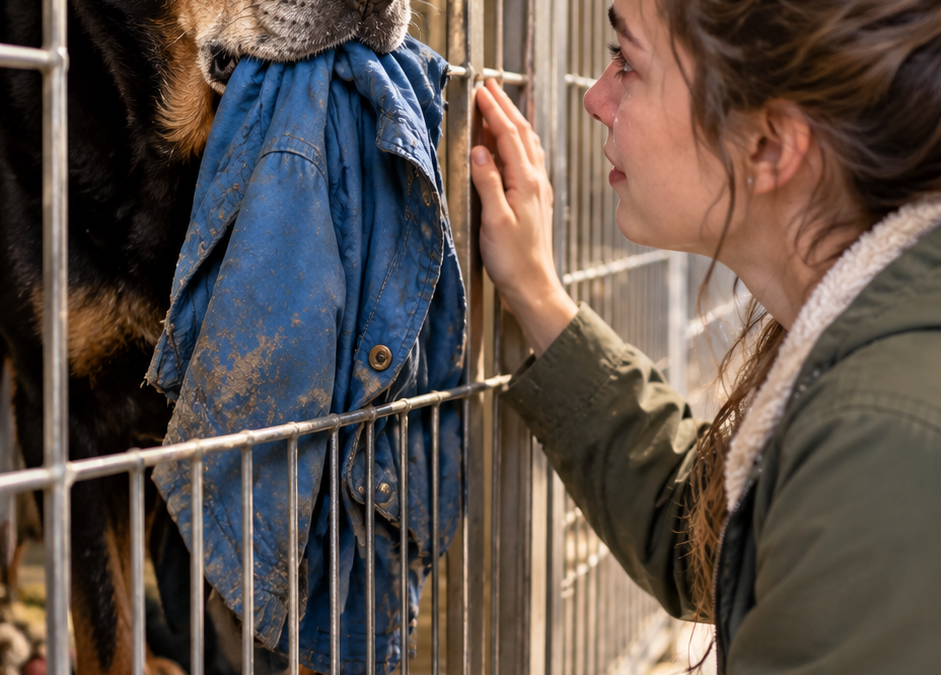
And clamped gently between his jaws was an old blue coat.
It was a man’s coat.
Heavy canvas.
Faded at the shoulders.
Worn thin at the cuffs.
One pocket had been repaired with mismatched blue thread.
The dog held it carefully, not like a toy, but like something fragile.
One of the officers looked at me.
“Owner died at home.”
I looked at the dog.
“How long ago?”
“A couple days.”
My stomach tightened.
“And the dog?”
“Stayed in the house.”
“Alone?”
The officer nodded.
“A neighbor finally called after noticing no one had come or gone.”
I crouched several feet away.
The dog watched me.
He did not growl.
Didn’t wag his tail.
Didn’t move.
“What happened when you went in?”
The officer sighed.
“He was beside the owner’s bed.”
I looked at the coat.
“And that?”
“When we tried to lead him out, he walked to a chair, grabbed it, and followed us.”
“Did you try taking it away?”
“Once.”
“What happened?”
“Nothing aggressive.”
He glanced at the Rottweiler.
“He just wouldn’t let go.”
I understood immediately.
“Then don’t.”
The officer nodded.
“That was our thought.”
I moved closer.
“Hey, big guy.”
His eyes shifted toward me.
There was something about his expression that stopped me from reaching for him.
Not fear.
Not distrust.
It was as if his attention was only partially in the room.
The rest of him was somewhere else.
Back in that house.
Beside that bed.
Waiting for someone to wake up.
I stood.
“Do we know his name?”
The officer checked the paperwork.
“Bruno.”
I looked at him again.
“Bruno.”
One ear moved.
That was the first reaction he had given me.
I knelt again.
“Okay, Bruno. We’re going to take care of you.”
He stared at me.
Of course, I had no idea whether he believed me.
Maybe he didn’t understand why he had been taken from the only home he’d known.
Maybe he was still waiting for his owner to follow.
Maybe every new room was only somewhere he had to wait until the man returned.
We processed him slowly.
Our veterinarian examined him.
He was old.
Older than most people looking to adopt wanted.
We estimated somewhere between ten and twelve, although with a large breed like a Rottweiler, numbers mattered less than condition.
His hips were stiff.
He had arthritis.
His teeth showed years of use.
His heart was still strong enough.
His blood work wasn’t perfect, but there was nothing immediately catastrophic.
Mostly, he was simply old.
Old and grieving.
When we prepared a kennel for him, I expected him to resist entering.
He didn’t.
He walked inside.
Then he turned around, placed the blue coat on the floor, circled twice, and lay down on it.
His head rested across one sleeve.
He closed his eyes.
I stood outside the kennel for a long time.
One of my coworkers, Denise, stopped beside me.
“Poor guy.”
“Yeah.”
“Think he’ll settle?”
“I don’t know.”
She looked at the coat.
“Should we wash that?”
“No.”
She glanced at me.
“It’s probably dirty.”
“I know.”
“Could have fleas.”
“We’ll check it.”
I looked at Bruno.
“But don’t wash it.”
Denise followed my gaze.
Then she understood.
“Smell.”
“Exactly.”
A dog’s world is built around scent in a way ours isn’t.
To us, that coat was an old piece of fabric.
To Bruno, it was still his person.
We inspected it carefully.
No parasites.
Nothing dangerous.
So we left it alone.
That decision became more important than any of us could have known.
For the first several days, Bruno barely left the coat.
He ate if his bowl was placed near it.
He drank.
He allowed us to walk him.
But he always returned quickly.
Whenever someone opened the kennel door, he looked past us toward the hallway.
Every single time.
At first, I thought he was afraid we were taking him somewhere else.
Then I realized what he was doing.
He was checking to see if someone had come.
When I clipped on his leash, he would walk slowly beside me down the corridor.
At every doorway, his head lifted.
In the lobby, he would stop and look toward the entrance.
I could almost hear the question in him.
Is he here?
I hated that question because I knew the answer.
No.
He wasn’t.
And he never would be.
The first week, I spent more time with Bruno than I probably should have.
Shelter work does not give you the luxury of devoting yourself to one animal.
There are cages to clean.
Medication schedules.
Adoption meetings.
Behavior assessments.
Phone calls.
Stray intakes.
Emergencies.
The work is endless.
Still, whenever I had five free minutes, I found myself near Bruno’s kennel.
Sometimes I sat outside.
Sometimes I went in.
He never demanded affection.
That was what struck me most.
Many dogs, once they realize a person is willing to sit on the floor with them, immediately come closer.
Bruno didn’t.
He would watch me.
Then look at the coat.
Sometimes, after ten or fifteen minutes, he would move close enough that our shoulders touched.
That was all.
I learned not to ask for more.
One afternoon, about two weeks after he arrived, I sat beside him while rain tapped against the shelter roof.
He had the blue coat between his front paws.
I reached out and touched the sleeve.
Bruno’s head came up immediately.
I froze.
“Okay.”
I pulled my hand back.
“I’m not taking it.”
He watched me.
“I promise.”
Slowly, he lowered his head again.
That was the first time I understood how deeply he had attached meaning to it.
It wasn’t simply familiar.
It was his connection to what he had lost.
I wondered what his life had been like before.
We knew almost nothing about the owner beyond basic records.
An older man.
Lived alone.
No immediate relatives willing or able to take Bruno.
Neighbors said the dog had been with him for years.
That was all.
But you could read some lives backward through a dog.
Bruno had never been neglected.
His nails had been kept trimmed.
He understood basic commands.
He was house-trained.
He never guarded food.
Never snapped when the veterinarian examined painful joints.
When you said “stay,” he stayed.
When you said “easy,” he slowed down.
When someone entered his space suddenly, he didn’t flinch.
This was not a dog who had lived in fear.
He had been loved.
That fact made his grief harder to watch.
Weeks passed.
We listed Bruno for adoption.
We took photographs.
We wrote a profile.
“Senior Rottweiler. Gentle. Calm. Loyal. Best suited for a quiet home.”
We didn’t mention the coat at first.
Then I insisted that we should.
“People need to know.”
One staff member frowned.
“Know what?”
“That he comes with it.”
“It’s just a coat.”
“No, it isn’t.”
She looked at me.
I nodded toward his kennel.
“It’s part of him now.”
So we updated the notes.
Bruno and his blue coat.
Then people started meeting him.
The first couple looked promising.
A middle-aged husband and wife.
They had owned Rottweilers before.
They stood outside his kennel, smiling.
“He’s beautiful,” the woman said.
Her husband nodded.
“Look at that face.”
Bruno looked back at them calmly.
They asked if they could meet him.
I brought him into one of our quiet rooms.
He behaved perfectly.
Sat when asked.
Accepted treats gently.
Allowed the woman to stroke his head.
For fifteen minutes, I thought maybe this was it.
Then the husband asked the question.
“How old?”
“Probably eleven.”
His expression changed.
Not dramatically.
Just enough.
“Eleven?”
“Approximately.”
The wife looked at Bruno.
“How long do Rottweilers usually live?”
There it was.
The question behind the question.
How much time would we get?
I gave them the honest answer.
“Every dog is different. He’s already a senior.”
The woman looked at her husband.
He looked at the floor.
Then she said quietly, “We were hoping for something younger.”
I nodded.
“I understand.”
And I did.
That was the hardest part.
Most people who walked away from Bruno weren’t cruel.
They weren’t heartless.
They were afraid.
Afraid to love an animal they might lose too soon.
Afraid of veterinary bills.
Afraid of grief.
I understood every reason.
But understanding didn’t stop me from watching Bruno walk back to his kennel and lie down on the blue coat again.
Another family came.
They had two children.
The kids loved him.
One boy sat on the floor and Bruno rested his chin on his knee.
For a few minutes, I watched the mother soften.
Then she asked his age.
Her face changed.
“That’s old, right?”
“For his breed, yes.”
She looked toward her husband.
They whispered.
The children protested when they left.
Bruno watched them disappear through the lobby.
Then turned back toward me.
“I’m sorry.”
He walked beside me without complaint.
Again.
And again.
And again.
People admired him.
People said what a wonderful dog he was.
People told us he deserved a good home.
Then they chose someone younger.
A Labrador puppy.
A shepherd mix barely a year old.
A small terrier with years ahead.
I couldn’t blame them.
But every time Bruno was passed over, the word “deserves” started to bother me more.
He deserves a home.
People said it constantly.
But deserving something and receiving it are two very different things.
By the second month, Bruno seemed to understand the shelter routine.
He knew breakfast came early.
He knew which staff members brought treats.
He knew when it was time for his arthritis medication.
He knew which door led outside.
But the blue coat never moved far from him.
Some mornings, we found him sleeping with his entire body curled around it.
Other days, he carried it into the small exercise yard.
He would lay it in the sun and sit beside it.
Once, I watched him press his nose deep into the collar.
He inhaled.
Then he closed his eyes.
I turned away.
Denise was beside me.
“Still smells like him?”
“I hope so.”
She folded her arms.
“How long does scent last?”
“I don’t know.”
“Long enough, maybe.”
I looked back at Bruno.
“Not forever.”
That thought stayed with me.
Not forever.
Nothing lasts forever.
Not a scent.
Not a coat.
Not a body.
Not even memory exactly as it was.
Maybe that was why Bruno guarded it so carefully.
He was protecting something that was already disappearing.
By the third month, we began discussing what came next.
Our shelter had a separate senior-care program.
It wasn’t a bad place.
I want to be clear about that.
The dogs there were cared for.
They had larger shared spaces.
Soft beds.
Medical attention.
Outdoor time.
Volunteers who spent hours sitting with them.
But it was different from the adoption wing.
Most dogs transferred there stayed.
Sometimes for months.
Sometimes for years.
Until the end.
It was not a home.
It was a place designed to make the absence of one as gentle as possible.
One Monday morning, our director called me into her office.
“Sloan, sit down.”
I already knew.
“This is about Bruno.”
She nodded.
“We need his kennel.”
I looked toward the window.
“We have three dogs coming in from a seizure case tomorrow.”
“I know.”
“And his adoption interest has been…”
“Almost nothing.”
She sighed.
“I hate it too.”
“When?”
“Thursday.”
I looked at her.
“That’s three days.”
“I know.”
“Can we give him another week?”
“Sloan.”
“Just one.”
“We’ve already extended him twice.”
I leaned back.
She softened.
“The senior wing isn’t punishment.”
“I know.”
“He’ll be comfortable.”
“I know.”
“He’ll have people around him.”
“I know.”
She waited.
I rubbed my forehead.
“What happens to the coat?”
“It goes with him.”
“Good.”
“Sloan.”
I looked at her.
“You can’t save every animal from every ending.”
I hated when people said things like that because they were true.
Truth does not automatically make something easier to accept.
“I know.”
But walking out of her office, I felt something I couldn’t explain.
Not denial.
Not even optimism.
Just a strange sense that Bruno’s story wasn’t finished.
I had no evidence.
No reason.
Nothing except that feeling.
His transfer was scheduled for Thursday morning.
Tuesday afternoon, a young woman walked into the shelter.
I noticed her because she came alone and because she didn’t immediately ask for puppies.
Most people had preferences.
Size.
Breed.
Age.
Color.
Energy level.
She didn’t.
The receptionist asked, “What kind of dog are you looking for?”
The woman thought for a moment.
“I don’t know.”
“Large? Small?”
“I honestly don’t know.”
“Puppy? Adult?”
She shook her head.
“I think I’ll know when I see them.”
She had dark hair pulled loosely behind her shoulders.
Probably in her early thirties.
Quiet voice.
No dramatic enthusiasm.
No shopping-list attitude.
I liked her immediately.
One of our volunteers started showing her around.
I returned to my work.
About twenty minutes later, I happened to be near the end of the kennel corridor.
The woman was coming toward me.
She stopped at each enclosure.
Smiled.
Sometimes knelt.
Asked questions.
But she moved on.
Then she reached Bruno.
He was in his usual place.
Back corner.
Blue coat between his paws.
The moment she looked into the kennel, she stopped.
Completely.
Not the way people stop because they see a beautiful dog.
Not because they are deciding whether to ask a question.
She froze.
Her face lost its color.
Her eyes moved from Bruno to the coat.
Back to Bruno.
Then to the coat again.
Bruno lifted his head.
For several seconds, neither moved.
I approached.
“Are you okay?”
She didn’t answer.
Her hand rose to her mouth.
Tears filled her eyes so suddenly that I became concerned.
“Ma’am?”
She looked at me.
“I…”
Her voice broke.
She turned toward the kennel.
Bruno was now sitting upright.
“I know this dog.”
Everything inside me went still.
“What?”
She wiped her face.
“I know him.”
I looked from her to Bruno.
“You’re sure?”
“Yes.”
She stepped closer.
“Oh my God.”
Bruno stood.
Slowly.
His aging hips made the movement stiff.
He approached the bars.
The woman knelt.
Her hand trembled as she held it toward him.
He sniffed her fingers.
She began crying harder.
“Bruno.”
His ears moved.
I felt the hair rise on my arms.
“You know his name.”
She nodded.
“I used to live next door.”
“When?”
“Years ago.”
She looked at me.
“When I was younger. My parents owned the house next to Mr. Keller’s.”
That was the owner’s last name.
I had seen it in Bruno’s intake file.
“Mr. Keller was his owner?”
“Yes.”
She looked back at Bruno.
“They were always together.”
I unlocked the kennel.
“Do you want to come inside?”
She nodded.
The moment the door opened, something remarkable happened.
Bruno did not rush toward her.
That wasn’t his way.
Instead, he turned around.
Walked to the back.
Picked up the blue coat.
Then came back.
The woman stared at him.
“I remember that.”
She sat on the floor.
“That blue coat.”
Her voice shook.
“Mr. Keller wore it every fall.”
I sat outside the kennel entrance.
“Tell me.”
She touched the coat but did not take it.
“When I was a teenager, my bedroom window faced their yard. Mr. Keller was already older then. Widowed, I think. He spent hours outside.”
She smiled through tears.
“Always fixing something that probably didn’t need fixing.”
I smiled.
“And Bruno?”
“Everywhere he was.”
She looked at the old dog.
“Always.”
Bruno lowered himself beside her.
She continued.
“If Mr. Keller weeded the garden, Bruno lay between the rows. If he worked in the garage, Bruno slept near the door. If he sat on the porch, Bruno sat beside him.”
Her hand moved slowly along Bruno’s head.
“In the fall, Mr. Keller wore this exact coat.”
She touched the frayed sleeve.
“I remember the patch.”
My heart tightened.
“You recognize the patch?”
“My mother repaired it.”
I stared at her.
“Seriously?”
She laughed softly.
“Mr. Keller was terrible with a needle. Mom saw him trying to sew the sleeve one afternoon and went over to help.”
She traced the mismatched blue stitching.
“This is hers.”
For a moment, none of us spoke.
The shelter noises continued around us.
Dogs barking.
Metal bowls moving.
A phone ringing somewhere in the front.
But that kennel felt separated from everything else.
The woman looked at Bruno.
“There were cold evenings when Mr. Keller would sit on the porch, and if Bruno lay beside him, he would sometimes take this coat off and drape part of it over the dog.”
I closed my eyes briefly.
Suddenly, Bruno sleeping on it made even more sense.
“He probably still associates it with warmth.”
“With him.”
“Yes.”
She began crying again.
“I heard Mr. Keller died.”
“When?”
“Months ago.”
She looked ashamed.
“I had already moved away. My parents sold the house years ago. I heard from an old neighbor, but no one knew what happened to Bruno.”
She swallowed.
“I kept thinking about him.”
Bruno shifted closer.
“I thought maybe a relative took him.”
“No.”
She lowered her head.
“I should have looked.”
“You didn’t know.”
“I could have.”
“You didn’t know where he was.”
“I still should have tried.”
There was guilt in her voice that I recognized.
People often believe grief gives us perfect hindsight.
It doesn’t.
It only gives us a longer list of things we wish we had done.
“What is your name?” I asked.
“Emily.”
“Emily, he was safe here.”
She looked at me.
“But he was alone.”
“Yes.”
I wasn’t going to lie.
Bruno stood again.
Picked up the coat.
Then he did something I had never seen him do.
He carried it toward Emily.
Stopped in front of her.
And dropped it at her knees.
Emily went completely still.
So did I.
The coat had fallen partly across her shoes.
Bruno sat.
He looked at her.
She covered her mouth.
“Oh, Bruno.”
I don’t believe dogs think in sentences the way we do.
I don’t believe he was literally saying what we wanted him to say.
But I know what I saw.
For three months, that coat had been his most guarded possession.
He slept on it.
Carried it.
Watched anyone who touched it.
And now he had placed it in front of someone connected to the life he had lost.
Emily reached down.
“Can I?”
She looked at me.
I nodded.
“Let him decide.”
She lifted one sleeve.
Bruno didn’t stop her.
She raised the coat to her face.
For one second, she pressed it against her cheek.
Then she put it down and wrapped both arms around him.
Bruno leaned into her.
His massive head settled against her shoulder.
His eyes closed.
Emily sobbed.
Not loud.
Not theatrical.
The kind of crying that comes from somewhere years deep.
“I’m sorry,” she whispered.
Bruno remained still.
“I’m so sorry I didn’t find you sooner.”
I stood and stepped away.
Some moments do not need witnesses standing too close.
When I returned several minutes later, Emily was still sitting on the floor.
Bruno was lying beside her.
One of his paws rested on the blue coat.
She looked up.
“I want him.”
I didn’t answer immediately.
“I mean it.”
“I believe you.”
“Can I adopt him?”
“Yes, but I need to tell you everything first.”
She nodded.
“Tell me.”
“He’s old.”
“I know.”
“Probably eleven, maybe older.”
“Okay.”
“He has arthritis.”
“I can manage that.”
“He’ll need medication.”
“Okay.”
“Large senior dogs can have expensive medical needs.”
“I understand.”
“We can’t tell you whether he has three years or three months.”
Emily looked down at him.
“I don’t care.”
I hesitated.
She met my eyes.
“No. That’s not what I mean.”
Her voice softened.
“I care how long he has. Of course I do. But I’m not refusing him because the answer might hurt me.”
That sentence went straight through me.
She stroked Bruno’s ear.
“Everyone loses someone eventually.”
Her eyes filled again.
“He already lost his person.”
She looked at me.
“I don’t want him spending whatever time he has left believing no one remembers who he was.”
I sat beside her.
“His transfer is Thursday.”
“Transfer?”
“Senior wing.”
“What does that mean?”
I explained.
She listened quietly.
Then she said, “Then we’re two days early.”
I smiled.
“Looks that way.”
The adoption process still had to happen.
We couldn’t simply hand over a dog because the story was beautiful.
Applications mattered.
Housing.
Veterinary references.
Lifestyle.
Safety.
We did everything exactly as we would for anyone else.
Emily answered every question.
She lived in a small house with a fenced yard.
Worked partly from home.
No other pets.
Had experience with large dogs.
Her landlord wasn’t an issue because she owned the property.
When I mentioned mobility support, she asked what kind of ramps might help Bruno get into a car.
When I explained arthritis management, she wrote down the medication name.
When I told her senior dogs sometimes wake at night or struggle with stairs, she didn’t flinch.
Our director reviewed the application.
She looked at me.
“This is the neighbor?”
“Former neighbor.”
“She recognizes the coat?”
“Her mother repaired the sleeve.”
The director took off her glasses.
“You’re kidding.”
“No.”
She looked through the office window toward Bruno’s kennel.
Emily was sitting outside it.
Bruno’s head was against the bars near her hand.
The director smiled.
“Approve it.”
I exhaled.
That afternoon, we prepared Bruno to leave.
I expected the blue coat to complicate things.
It didn’t.
When Emily picked up the leash, Bruno stood.
I opened the kennel door.
He walked out carrying the coat.
People gathered quietly in the hallway.
Denise whispered, “Look at him.”
I did.
His head was higher.
Not dramatically.
But enough.
For months, he had walked our corridors like a dog moving through a place that wasn’t his.
That day, he walked beside Emily with purpose.
At the front desk, she signed the final paperwork.
I knelt beside Bruno.
“Well, old man.”
He looked at me.
I scratched the side of his neck.
“You finally did it.”
Emily smiled.
“He waited long enough.”
I looked at her.
“Promise me something.”
“Anything.”
“Don’t wash the coat unless you absolutely have to.”
She nodded immediately.
“I won’t.”
“Eventually, the scent will fade.”
Her eyes softened.
“But not the memory.”
“No.”
I stood.
“Not that.”
Outside, Emily opened the rear door of her car.
Bruno looked at it.
Then at her.
She patted the seat.
“Come on, boy.”
He tried to climb in but his hips failed him.
She didn’t make a fuss.
She simply slid one arm beneath his chest and helped lift him.
He settled on the seat.
Then she placed the blue coat beside him.
Bruno pulled it closer with one paw.
I had to look away for a moment.
Emily closed the door.
Before she got into the driver’s seat, she hugged me.
“Thank you.”
“You found him.”
“You kept him safe.”
“We tried.”
She stepped back.
“I wish Mr. Keller knew.”
I looked through the window at Bruno.
“Maybe the best part of him already does.”
She smiled through tears.
Then got into the car.
As she pulled away, Bruno lifted his head and looked back at the shelter.
For a second, our eyes met through the glass.
Then he turned toward Emily.
She reached one hand backward between the seats.
He rested his head against it.
I cried after they left.
I wish I could tell you that shelter workers don’t do that.
We do.
Sometimes privately.
Sometimes in storage rooms.
Sometimes in cars after shifts.
Sometimes standing in plain sight because there’s no point pretending.
But those weren’t sad tears.
Not completely.
For three months, I had watched people see Bruno’s age before they saw Bruno.
Emily had seen his history.
That made all the difference.
A week later, she called.
I answered immediately.
“How is he?”
She laughed.
“You could at least say hello first.”
“Hello. How is he?”
“He’s asleep in my kitchen.”
“Good sign.”
“He snores.”
“He did that here too.”
“I thought something was wrong the first night.”
“Nope. That’s just Bruno.”
She told me about his first days.
The first night, he had wandered through the house checking every room.
Then he’d found the back door and sat there for nearly an hour.
Emily opened it.
He walked into the yard.
Stood beneath an old maple tree.
Then returned inside.
The next morning, he carried the blue coat outside.
Placed it on the grass.
Lay beside it.
Emily sat with him.
“He looked peaceful,” she said.
“He likes being outside.”
“I remember.”
Her voice softened.
“Mr. Keller had a garden.”
“Do you?”
“Not yet.”
I smiled.
“Sounds like you’re about to.”
She laughed.
“Apparently.”
Over the following months, Emily sent updates.
Sometimes photos.
Bruno sleeping near a window.
Bruno stretched across the kitchen floor.
Bruno wearing a ridiculous red scarf Emily had bought him for winter.
Bruno beside the blue coat.
Always somewhere nearby.
She planted a small garden in the spring.
Nothing elaborate.
Tomatoes.
Herbs.
A few flowers.
Bruno sat beside her while she worked.
When she sent me the picture, I stared at it for a long time.
The old dog was lying beneath the shade.
Emily knelt in the soil.
Beside him lay the blue coat.
It was so easy to imagine another yard.
Another garden.
Another person bending over the earth while Bruno watched.
The pattern of his life had returned.
Not identically.
It couldn’t.
But gently enough that I hoped he recognized it.
Sometimes, Emily called just to tell me small things.
“He barked at a squirrel today.”
“Good.”
“He stole a piece of toast.”
“Even better.”
“He refused to come inside because it was sunny.”
“Very Rottweiler.”
“He fell asleep with his head in my lap.”
At that, I usually became quiet.
Months passed.
Bruno slowed down.
We all knew he would.
Senior dogs do not become young because they are loved.
Love is powerful.
But it isn’t magic.
It doesn’t reverse arthritis.
It doesn’t restore aging organs.
It doesn’t bargain with time.
What it can do is make the remaining time matter.
Almost a year after Bruno’s adoption, my phone rang near the end of a shift.
Emily.
The moment I saw her name, something in me knew.
I answered.
“Hi.”
Silence.
Then a shaky breath.
“Sloan.”
I sat down.
“Tell me.”
“Bruno died last night.”
I closed my eyes.
For a few seconds, I couldn’t speak.
“Was he in pain?”
“No.”
That mattered.
More than anything else, that mattered.
She cried softly.
“He was sleeping.”
“Where?”
“Beside my bed.”
I covered my mouth.
“And the coat?”
Her voice broke.
“He had it.”
Of course he did.
“He’d been tired all day,” Emily said. “But he ate dinner. He went outside. He sat in the yard for a while.”
I listened.
“He brought the coat out with him.”
She stopped.
I waited.
“I sat beside him.”
“What did you do?”
“Nothing.”
She laughed weakly through her tears.
“We just sat.”
I pictured it.
An old dog.
A woman who remembered.
A blue coat.
Evening settling over a yard.
“He came inside after sunset,” she continued. “He lay down next to my bed. I put the coat beside him.”
Her breathing trembled.
“This morning, he was gone.”
“I’m sorry.”
“He looked peaceful.”
“Then believe that.”
She was quiet.
“I do.”
We both cried.
But beneath the grief was something else.
Relief.
Gratitude.
The strange comfort of knowing that the ending, though painful, had not been lonely.
After we hung up, I walked to the kennel where Bruno had once lived.
Another dog occupied it now.
Young.
Energetic.
Tail hammering against the wall.
I smiled at him.
But in my mind, I still saw Bruno in the back corner.
Blue coat beneath his head.
Waiting.
I thought about his months with us.
How many people had passed.
How many had said he was wonderful.
How many had walked away because they were afraid of how soon they might lose him.
And then Emily had arrived.
She had known exactly what she was accepting.
An old dog.
A grieving dog.
A dog with history.
A dog whose heart already belonged partly to someone who was gone.
She didn’t ask him to forget.
That may have been the greatest gift she gave him.
People sometimes think adoption means beginning with a clean slate.
It doesn’t always.
Some animals come to us with whole lives behind them.
Homes.
People.
Routines.
Losses.
Memories.
You don’t erase those things by loving them.
You join them.
Emily joined Bruno’s story at the point where it could have ended quietly in a senior shelter wing.
Instead, he got one more home.
One more garden.
One more person sitting beside him.
One more lap for his head.
One more voice calling his name.
He never had to surrender the blue coat.
And because Emily remembered Mr. Keller, he never had to live in a world where his first life disappeared completely.
A few weeks after Bruno died, Emily came back to the shelter.
She carried a paper bag.
I hugged her.
“You okay?”
“Some days.”
“That’s normal.”
She looked toward the kennel hallway.
“I almost couldn’t come in.”
“I understand.”
She handed me the bag.
Inside was a photograph.
Bruno lying in the yard.
His head gray.
Eyes half closed.
Blue coat beneath one paw.
Emily had written something on the back.
I read it.
He was remembered. He was loved. He went home twice.
I had to sit down.
Emily sat beside me.
“There’s something else.”
She reached into the bag.
For one terrible second, I thought she had brought the coat.
I wasn’t ready for that.
But she pulled out only a small square of blue fabric.
“The coat?”
She nodded.
“It finally started falling apart.”
I touched the fabric.
“What did you do with the rest?”
“I kept it.”
“Good.”
“I cut a tiny piece from an inside seam.”
She handed it to me.
“I thought maybe you’d want it.”
I looked at her.
“You should keep this.”
“I have enough.”
She smiled.
“You were part of his story too.”
I couldn’t answer.
I folded the small square carefully and put it in my desk drawer.
It is still there.
I don’t show it to everyone.
I don’t need to.
But on difficult days, I sometimes open that drawer.
Shelter work can wear down your faith.
You see neglect.
Abandonment.
People surrender animals because they are old.
Because they’re inconvenient.
Because they got sick.
Because someone moved.
Because someone had a baby.
Because someone lost patience.
And if you’re not careful, you begin remembering only the people who walked away.
Bruno reminds me to remember the ones who stop.
The ones who kneel down.
The ones who look at an old dog and do not ask first, “How much time do I get?”
The ones who ask, “What can I give him with the time he has?”
That is a different kind of love.
Maybe a braver kind.
I still think about Mr. Keller too.
I never knew him.
But I know enough.
He raised a dog who loved him so deeply that months after his death, the smell of an old coat was enough to make Bruno feel close to him.
That says something about the life they shared.
Perhaps more than any obituary could.
I imagine Mr. Keller on his porch.
Older man.
Cold fall afternoon.
Blue coat open around his shoulders.
Bruno beside him.
Maybe he scratches the dog’s head.
Maybe they say nothing.
That’s the thing about dogs.
They make silence feel complete.
And perhaps years later, when Bruno lay in Emily’s garden with that same coat beside him, some part of him returned to those afternoons.
I hope so.
People occasionally ask whether dogs remember their owners after death.
I don’t know the scientific answer in the exact way they’re asking.
But I know what I saw.
I watched Bruno smell that coat every day.
I watched him look toward doors.
I watched him carry the only object he chose from the house.
I watched his entire body change when a woman from his old life said his name.
If that isn’t memory, I don’t know what is.
And if memory can carry love forward, perhaps loss is not the absolute ending we fear.
Maybe it is a change in form.
The person disappears.
The routine disappears.
The familiar footsteps stop.
But something remains.
A smell.
A habit.
A place on the porch.
A blue coat.
A dog waiting beside it.
I have worked with hundreds of animals.
Many eventually blur together.
Bruno never will.
Not because his story was the saddest.
It wasn’t.
Not because his ending was miraculous.
He still died.
Age still claimed him.
Nothing about adoption changed that.
What made his story extraordinary was simpler.
He was remembered.
At the exact moment the world seemed to have forgotten who he had been, someone looked at him and said:
I know you.
I remember your home.
I remember your person.
I remember that coat.
You are not just an old dog in a shelter.
You belong to a story.
And now you belong with me.
That was enough.
More than enough.
Sometimes, new volunteers ask me about the little blue fabric square in my desk.
If I have time, I tell them.
I tell them about the old Rottweiler who came through intake carrying a man’s coat.
I tell them about the months he waited.
About the families who passed by.
About the transfer scheduled for Thursday.
Then I tell them about Tuesday.
About a young woman named Emily.
About the moment she stopped.
About the way Bruno carried the coat to her and dropped it at her feet.
They usually cry.
I usually do too.
And then I tell them what I believe Bruno taught me.
Don’t decide what an animal needs simply by looking at how much life you think it has left.
A year can matter.
Six months can matter.
A week can matter.
One safe night can matter.
Love is not measured only by duration.
It is measured by what fills the time.
Bruno’s final year contained a garden.
Warm rooms.
Slow walks.
Someone waiting when he woke.
Someone sitting beside him when he was tired.
Someone who understood why he needed an old blue coat close to his body.
Someone who didn’t ask him to stop loving the man who came before.
And when the end arrived, Bruno did not leave this world behind shelter bars.
He was not listening to unfamiliar footsteps.
He was not wondering whether anyone remembered him.
He was home.
He was beside the person who had chosen him.
The coat was with him.
And he slept.
There are worse endings.
There are also few better ones.
My name is Sloan.
I still work at the same shelter.
Every day, I walk past kennels filled with dogs waiting for someone to stop.
Some are young.
Some old.
Some terrified.
Some hopeful.
Whenever I reach the senior dogs, I slow down.
I remember Bruno.
And whenever someone tells me, “I don’t know if I can adopt an older dog. I’d be afraid of losing them too soon,” I never shame them.
I understand.
Loss hurts because love mattered.
But sometimes I tell them about a dog who almost spent his final days in a retirement wing because everyone was afraid of how little time he might have.
Then someone chose him anyway.
She loved him for one year.
Not ten.
Not fifteen.
One.
And for Bruno, that year meant the difference between being cared for and being home.
There is a difference.
A shelter can provide food.
Medicine.
Warmth.
Safety.
We can offer kindness.
We can protect an animal from suffering.
But home is something else.
Home is knowing whose footsteps are coming down the hallway.
Home is having a favorite corner.
Home is being expected at dinner.
Home is having someone notice if you haven’t moved in an hour.
Home is hearing your name spoken by one familiar voice.
Home is being remembered.
Bruno lost one home.
For months, he carried its memory in his mouth.
Then one Tuesday afternoon, his past walked into our shelter and recognized him.
He didn’t get his old life back.
No one can.
But he got something gentler.
Someone who respected what had been lost and still gave him something new.
I don’t know what happens after animals die.
I don’t know whether there is a place where old dogs become young again.
I don’t know whether there is a porch somewhere beyond what we can see.
But sometimes I allow myself to imagine one.
Mr. Keller is sitting there in that faded blue coat.
Maybe the weather is cool.
Maybe there is a garden.
Maybe he hears something coming up the path.
Heavy paws.
Faster than they used to be.
He looks up.
Bruno is running toward him.
No arthritis.
No stiff hips.
No shelter walls.
No waiting.
Mr. Keller stands.
Bruno reaches him.
And after all those months of carrying the coat, after all that waiting, after one last beautiful year in another home, the old dog finally finds the person whose scent he refused to forget.
If that place exists, I like to think Bruno did not arrive there frightened.
I like to think he knew exactly where he was going.
Because someone on earth had already taught him something important before he left.
That being loved by someone new does not mean betraying someone you lost.
That remembering is not the same as refusing to live.
And that sometimes the heart is large enough to have more than one home.
Bruno had two.
The first belonged to Mr. Keller.
The second belonged to Emily.
And between them was a blue coat that carried him from one life into another.
I still have that tiny square of fabric in my drawer.
Sometimes I take it out.
It doesn’t smell like anything anymore.
Time took care of that.
But when I hold it, I don’t need the scent.
I remember.
And maybe that was always the point.
The coat was never important because it could preserve someone forever.
Nothing can.
It mattered because for a while, it helped one grieving dog carry love through the part of life where the person he loved was gone.
Then, when the coat could no longer do that alone, someone arrived who could.
Someone stopped.
Someone remembered.
Someone stayed.
And in the end, that was all Bruno had ever needed.








