𝗣𝗔𝗥𝗧 𝟮 No One in the Trauma Bay Knew Why the Quiet Nurse’s Hands Stopped Shaking When Five SEALs Arrived
𝗣𝗔𝗥𝗧 𝟮
The staff scattered.
Residents pulled gowns over their heads. Nurses shoved carts into position. Tina opened airway kits and checked seals. Denise called the blood bank, radiology, respiratory therapy, neurosurgery, and every physician she could reach despite the storm.
I stood at the instrument table with my hands wrapped around its steel edge.
Deep inside me, an old switch clicked.
I did not want to hear it.
I had come to Riverside because I wanted rules, medication schedules, assigned beds, and physicians whose names appeared above mine on the chain of command. I wanted work where someone else made the final decision. I wanted to believe that if I never took control again, no one could die because my hands had chosen wrong.
But the body remembers before the mind agrees.
I counted available oxygen ports. I mapped the distance between each bed and the surgical carts. I checked the rapid infuser, chest tube trays, cricothyrotomy kits, tourniquets, hemostatic gauze, and the location of every unit of emergency blood.
I knew which corridor could move a patient fastest to imaging if the main hall flooded with staff.
I knew where everyone stood.
I knew who would freeze first.
The ambulance doors slammed open seven minutes later.
The sound punched through the hospital.
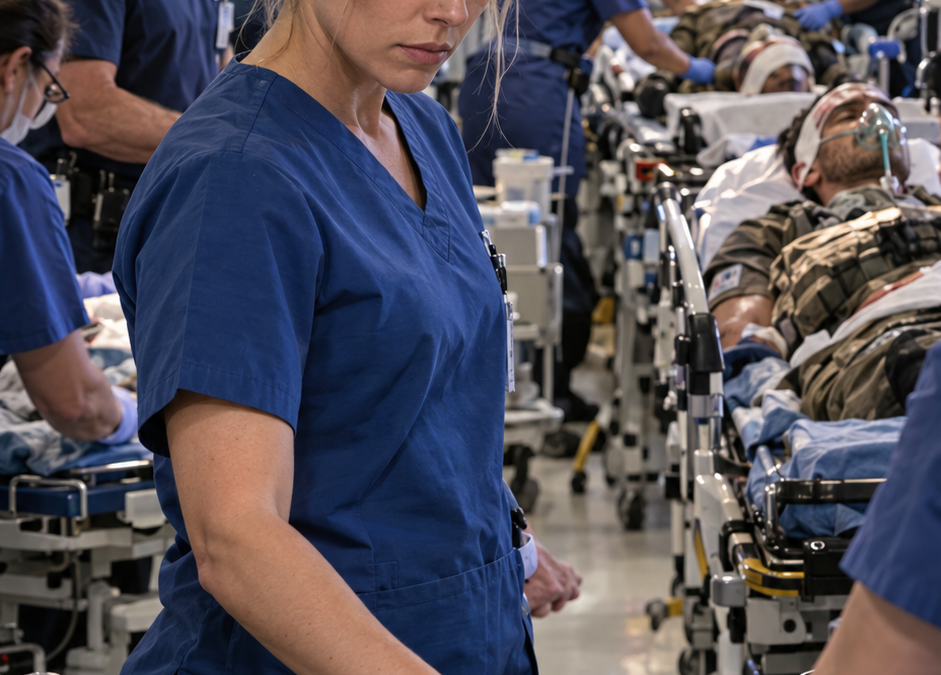
Stretchers crashed into the trauma bay one after another, wheels shrieking against the floor. Camouflage uniforms were soaked dark with rain and blood. Medics shouted vital signs over one another. Monitors began alarming before the patients were fully inside.
Someone called for oxygen.
Someone else yelled that a pressure bag had ruptured.
The air filled with the metallic smell of blood, wet fabric, antiseptic, and fear.
In the center of it, Tina looked at me and froze.
My right hand had stopped shaking.
Not gradually.
Not because I had controlled it.
The tremor was simply gone.
My fingers rested against the instrument tray, steady as stone.
Kessler took command in three seconds.
“Report one at a time.”
The lead paramedic, a drenched man named Foster, held a clipboard in one hand and wiped blood from his cheek with the other.
“Transport truck rolled twice. Five active-duty personnel, all in full gear. They were pinned for forty minutes before extrication.”
He pointed toward the first stretcher.
“Bed One, Senior Chief Jack Dunning. Severe facial trauma, blood obstructing the airway. Two failed intubation attempts in the truck.”
The second.
“Petty Officer Cole Hendricks. Abdominal pain, distention, pressure falling despite fluids.”
The third.
“Petty Officer Dane Mercer. Blunt chest impact. He was talking at the scene, became confused during transport.”
The fourth.
“Petty Officer Sam Kowalski. Open fracture, left leg. Tourniquet in place seventy-one minutes.”
The fifth.
“Lieutenant Tyler Grant. Head trauma. Stopped responding ten minutes ago.”
Kessler pointed without hesitation.
“Bell, airway on Bed One. Lynn, take Bed Five. I have the abdomen on Bed Two. Nurses divide between them.”
His hands went immediately to Hendricks’s rigid abdomen.
That left Beds Three and Four without a physician.
A resident attached a monitor to Dane Mercer, glanced at the first numbers, and hurried to help with Kowalski’s leg.
No one looked at Mercer again.
I stood at the instrument table holding a steel tray.
My body wanted to move.
My mind ordered it to remain still.
Stay with supplies.
Stay within scope.
Stay where Kessler put you.
Then I looked at Bed Three.
Dane Mercer lay unnaturally still. A blue tint had begun creeping across his lips. The veins in his neck stood out like cords. His left chest rose with each desperate breath.
His right side barely moved.
Two seconds.
That was all it took.
Treat what kills first.
Airway. Breathing. Bleeding.
I had once taught that sequence to men twice my size while rounds struck concrete outside the walls.
Mercer was developing a tension pneumothorax. Air was trapped inside the right side of his chest, building pressure with every breath, collapsing the lung and beginning to crush the heart and the remaining good lung.
He had minutes.
Maybe less.
His eyes rolled toward me, wide and terrified. He looked barely thirty. A wedding ring gleamed on his hand beneath a stripe of blood.
“Dr. Bell,” I called.
Bell did not hear me. He had his fingers in Dunning’s bloody mouth, trying to clear the airway enough to see past shattered tissue.
I turned toward Kessler.
“Dr. Kessler, Bed Three has a tension pneumothorax.”
He did not look up from Hendricks.
“Instruments, Ror. I do not have time for your opinions.”
Foster remained near the entrance with his clipboard. His eyes narrowed as he looked from Mercer to me, but he said nothing.
Mercer’s monitor shrieked.
Blood pressure: seventy over forty.
Oxygen saturation: seventy-eight percent.
Heart rate: one hundred thirty-eight and climbing.
The room narrowed around the sound.
For one brutal instant, it was not Riverside anymore.
It was a warehouse outside Baltimore. Cold concrete beneath my knees. Gunfire echoing through corrugated walls. Danny Lell’s blood running between my fingers while I called for an evacuation route that no longer existed.
I had known what to do.
I had done it.
I had still been too late.
Afterward, I made myself a promise that felt like punishment and protection at the same time.
Never again.
Never my hands.
Never another life that depended on me choosing the next move.
Mercer’s pressure dropped to sixty.
He looked at me.
The promise broke.
I set down the tray.
Somewhere far back in memory, a voice barked instructions over gunfire. I had answered that voice hundreds of times. I answered it again without speaking.
I pushed my sleeves above my elbows.
The shiny burn scar encircling my right forearm appeared beneath the lights.
Tina saw it. Her eyes widened.
I did not notice.
I tore open a sterile pack and snapped on gloves in one practiced movement. My fingers found the second intercostal space at the midclavicular line, just above the third rib.
“Mercer, look at me.”
His frightened eyes found mine.
“This will hurt. You are going to breathe anyway.”
I drove the fourteen-gauge catheter in.
A violent hiss of trapped air escaped.
Mercer’s chest heaved.
The monitor changed almost at once. His pressure climbed toward ninety over sixty. His oxygen saturation rose through the eighties and reached ninety-one.
Tina stared at me.
“Megan, what did you just do?”
“Bought him time.”
My voice no longer sounded like the one I used at the nurses’ station. It was flat, certain, and loud enough to cut through the bay.
“I need a chest tube kit. Now.”
Tina ran.
Around us, the noise dropped by a fraction. People had noticed the pressure change. They had noticed Mercer’s color returning. They had noticed me.
None of them understood what they were seeing.
Tina had worked trauma for fifteen years. I saw the disbelief on her face when she returned with the kit and watched my hands move.
I painted the fifth intercostal space with antiseptic. I made a two-centimeter incision along the upper edge of the rib, swept a gloved finger inside to clear the path, and guided a thirty-two-French chest tube along the track toward the apex.
Blood and air rushed into the drainage chamber.
Four hundred milliliters in seconds.
Then the flow slowed.
Mercer’s right lung began to expand. His pressure climbed to one hundred over sixty-eight. I checked the tube, listened for breath sounds on both sides, secured it with heavy silk, and sealed the site beneath a dressing.
The entire procedure took less than ninety seconds.
His eyelids fluttered.
He looked straight up at me.
“Ma’am,” he rasped, “am I dying?”
“Not tonight.”
I held his gaze while fastening the final strip of tape.
“Breathe slowly. I’ve got you.”
Across the bay, Kessler finally looked up.
Confusion crossed his face first.
Then fury.
He moved toward me in four long strides, leaving a resident maintaining pressure on Hendricks’s abdomen.
“What in God’s name do you think you are doing?”
I did not turn away from Mercer.
“Confirming the tube is secure.”
“Step away from that patient right now. You are outside your scope of practice, outside my orders, and outside any protection this hospital can give you.”
“Look at the monitor.”
The calm in my voice stopped him more effectively than shouting would have.
He looked.
Blood pressure: one hundred over sixty-eight.
Oxygen saturation: ninety-six percent.
A pink, breathing man lay where a blue one had been dying less than two minutes earlier.
Kessler’s mouth opened.
Nothing came out.
“Who ordered that chest tube?” he finally demanded.
“Nobody.”
“You performed an invasive procedure without a physician’s order?”
“He was dying.”
Something flickered behind Kessler’s anger.
It looked a great deal like fear.
The bay had gone nearly silent around us. Nurses stared. Residents stared. Foster still stood near the doors, watching me with the expression of a man rearranging every conclusion he had formed since arriving.
Alan Witkin, the hospital’s risk manager, appeared in the doorway with a phone pressed to his ear.
“Dr. Kessler, legal needs a physician’s name attached to every invasive procedure. A registered nurse cannot be performing surgery.”
I looked at him.
“Then write my name.”
Witkin blinked.
“And write this, too,” I said. “Every patient in this room is still alive.”
His mouth opened and closed.
No one had ever spoken to him that way.
Before Kessler could answer, Bed One erupted with alarms.
Senior Chief Dunning’s oxygen saturation plunged from seventy-one to sixty-eight, then sixty-four.
“I can’t see anything,” Bell shouted. “There’s too much blood. Three attempts and I still can’t identify the cords.”
Dunning’s lips turned dark blue.
His heart rate began to slow.
Kessler could not move. His patient, Hendricks, was bleeding into his abdomen, and Kessler’s hands were the only thing controlling the torn vessels until an operating room opened.
“Surgical airway kit!” Kessler roared. “Somebody perform a cricothyrotomy.”
No one moved.
Bell’s face had gone gray. “I’ve never done one on a living patient.”
The words hung in the air for half a second.
That was too long.
I walked toward Bed One.
Something happened to my body as I crossed the floor. My shoulders rolled back. My spine straightened. The protective stoop I had worn for eighteen months slid away like a borrowed coat.
“Move, Dr. Bell.”
He stared at me.
“Hold his head steady. Suction on my mark.”
Bell moved aside.
Denise Pruitt pressed one hand to her chest.
Tina stepped in beside me without being asked. “Suction ready.”
“Ror!” Kessler shouted. “I forbid this. You place one finger on that man and I will end your career.”
I did not raise my voice.
“Your patient is bleeding beneath your hands, Dr. Kessler. Mine is out of air. One of us has to work.”
His mouth snapped shut.
I found the notch of Dunning’s thyroid cartilage with my index finger and moved down to the soft depression of the cricothyroid membrane. My left hand steadied the larynx.
“Suction.”
Tina cleared the field.
I made a short horizontal incision through skin and membrane, rotated the blade, passed the bougie, and guided a size-six cuffed tube over it.
Twelve seconds.
“Bag him.”
Bell squeezed the ventilation bag.
The oxygen saturation climbed.
Sixty-four.
Sixty-nine.
Eighty-three.
Ninety-four.
Ninety-eight.
Clean square waves rose across the capnography monitor. Dunning’s chest lifted and fell. His heart rate recovered toward ninety.
For one suspended moment, no one in the room breathed.
Then everyone did.
Dr. Lynn looked across from Bed Five. “Who is she?”
No one answered.
Bell stared at the airway, then at me. “Where did you learn to do that?”
“Later.”
I was already moving toward Bed Four.
Kessler stood over Hendricks with his hands inside the open abdominal field. All color had left his face.
He had controlled that trauma bay for twenty-two years. He had built his authority on the certainty that the surgeon always knew more than the person standing beside him.
In three minutes, I had broken that certainty twice.
Sam Kowalski’s tourniquet sat too low on his thigh and had worked loose during transport. Blood continued seeping around the open fracture. The strap had been in place for seventy-one minutes, but the faint pulse in his foot told me it had never fully stopped arterial flow.
It was the worst kind of reassurance: a treatment that looked complete while the patient kept bleeding beneath it.
I took a fresh tourniquet from the kit and placed it high on his thigh.
“Kowalski, this will hurt.”
His face was gray, but his eyes opened.
“Do it,” he said.
I tightened the windlass until the bleeding stopped and his foot paled. I wrote the application time on the strap, cut away the failed tourniquet, and packed the wound with hemostatic gauze.
Kowalski groaned and reached blindly toward the edge of the bed.
I gave him my forearm rather than my hand.
He gripped the burn scar through my glove.
“Stay with me,” I said. “Your team is still here.”
His fingers tightened once.
Across the bay, Dr. Lynn’s voice changed.
“Left pupil is blown. He’s herniating.”
I did not turn away from Kowalski’s wound.
“Raise his head thirty degrees. Hypertonic saline, three percent, two hundred fifty milliliters over ten minutes. Call neurosurgery again and tell them his pupil changed.”
There was a brief silence.
Dr. Lynn was a veteran surgeon nearly twice my age.
Then I heard the bed move.
“Raise him,” she ordered. “Get the saline.”
She had followed my instruction exactly.
I looked up.
Kessler was watching me over the edge of his mask.
He had nothing to say.
For the first time since I had met him, Raymond Kessler had nothing to say.
The next three hours did not feel like time. They felt like a series of threats arriving one breath before disaster.
The operating rooms were occupied by storm-related emergencies. Roads remained flooded. Naval Medical could not send a team. Riverside had to become something it had never been designed to be: a holding line for five critically injured special operators with nowhere else to go.
I moved where the danger was greatest.
I hung two units of O-negative blood on the rapid infuser for Cole Hendricks while Kessler worked to control the abdominal bleeding. I pushed one gram of calcium through his second line and prepared tranexamic acid.
“One gram TXA,” I said. “He is still within the window.”
Kessler did not ask who had authorized it.
“Give it,” he said.
The words struck me harder than they should have.
It was the first time he had listened to me without making me prove I deserved to speak.
Hendricks’s pressure rose and sagged again. A resident reached for another saline bag.
“Stop.”
Everyone looked at me.
I pointed to the blood products. “Blood only. More saline will dilute what clotting function he has left.”
Kessler glanced at the numbers, then at the pale blood collecting through suction.
“She’s right. Blood only.”
The resident lowered the saline.
At Bed One, Dunning’s airway remained secure, but the tube shifted each time the team repositioned him. I assigned Bell to guard it with both hands whenever anyone moved the stretcher.
“If that airway comes out, you may not get it back,” I told him.
Bell nodded. He no longer looked embarrassed by what he had not known. Fear had become focus.
At Bed Three, Mercer’s drainage chamber went unexpectedly quiet.
I checked the tubing before the monitor could alarm. A clot had begun to obstruct the line. I cleared the problem, watched the fluid move again, and listened as breath sounds remained equal enough to buy him more time.
His eyes opened.
“Still not dying?” he whispered.
“You’re very demanding.”
The corner of his mouth moved. “Occupational hazard.”
“Still not tonight.”
His gaze drifted toward the other beds. “My team?”
I looked across the room.
Dunning was ventilating. Hendricks still had a pressure. Kowalski’s bleeding had stopped. Grant’s pupil remained dangerous, but Dr. Lynn and the neurosurgeon on the phone were fighting for every minute.
“All five of you are here,” I said.
It was the only promise I could honestly give him.
At Bed Four, Kowalski’s pain broke through medication. His face tightened, but he refused to make a sound because he could hear the chaos around his teammates.
“You do not have to be quiet for them,” I told him.
“They need the room more than I do.”
“Your bleeding nearly killed you.”
“Nearly.”
He was trying to smile.
I adjusted the blanket without disturbing the leg. “Let us do our jobs.”
His expression softened. “Yes, ma’am.”
I moved back to Lieutenant Grant as Dr. Lynn assessed his pupil again. The hypertonic saline had bought us a narrow improvement, but the danger remained. We elevated him, controlled ventilation, repeated neurological checks, and kept his blood pressure from falling low enough to starve his injured brain.
The neurosurgeon remained trapped on the opposite side of the flooded bridge. He guided Dr. Lynn by phone while we prepared for the possibility that she would have to perform a procedure she had not done in years.
“Megan,” Tina said quietly beside me, “how far do you think we can hold him?”
“Until transport opens.”
“And if it doesn’t?”
I looked at Grant’s monitor.
“Then we hold him until it does.”
That was how tactical medicine worked. You did not bargain with the distance to definitive care. You kept the patient alive for the next minute, then the minute after that, until the impossible route became possible again.
I called out changes before alarms announced them.
A rising heart rate at Bed Four.
A pale nail bed at Bed Two.
A waveform beginning to flatten at Bed One.
A drainage chamber too still at Bed Three.
A pupil response at Bed Five so small that Dr. Lynn checked it twice before believing me.
The team began responding to my voice without looking toward Kessler first.
That should have frightened me.
Instead, the room became clearer.
There were no titles inside the pattern of those monitors. No insults, reputations, or whispered names. There were only problems, resources, time, and the people willing to move.
Slowly, Kessler stopped ordering me back to the instrument table.
Slowly, he began asking what I saw.
“Ror, Bed Three?”
“Holding. Drainage controlled. Saturation ninety-five.”
“Bed Five?”
“No further pupil change. Pressure adequate.”
“Hendricks?”
I touched two fingers to the pulse at the side of Hendricks’s neck and studied the monitor.
“He needs the operating room the moment it clears.”
“Agreed.”
One word.
Not an apology. Not yet.
But it was the first crack in the wall between us.
Thunder struck directly overhead.
The trauma bay lights went dark for half a second before the generators caught.
The instrument tray rattled.
I looked down and saw both my hands shaking.
The bay vanished.
For a heartbeat I saw the Baltimore warehouse again—the flash of a weapon through dust, Danny falling, the emergency lights dying above us. I smelled burning insulation. I heard him trying to breathe through blood.
My fingers curled into fists.
In for four.
Out for four.
I knew five men needed the woman I had been moments earlier. I also knew I could not command my nervous system to forget what it had survived.
The tremor worsened.
Tina stepped closer.
She did not ask if I was all right. She did not draw attention to my hands or offer to take over. She simply stood at my shoulder the way a partner stands beside another partner when the ground becomes uncertain.
“Bed Three is holding,” she said quietly.
I focused on her voice.
“Bed One’s airway is secure.”
I opened my hands.
“Bed Four has no breakthrough bleeding.”
The room returned piece by piece.
I took another breath.
“Thank you,” I whispered.
Tina nodded once. “Tell me where you need me.”
The tremor did not disappear completely.
I worked anyway.
That was the moment I finally understood something I had failed to learn during every operation, every certification, and every sleepless night after Danny died.
The steady hand and the shaking hand were not two different people.
They were both mine.
For years, I had believed competence was real only when fear vanished. I had treated every tremor as proof that I no longer belonged near a crisis. But courage had never been the absence of the body’s memory.
It was choosing the next necessary action while the memory screamed.
I picked up the instrument Kessler needed.
My hand trembled once as I passed it to him.
He took it without looking at the tremor.
“Clamp,” he said.
I placed it in his palm.
“Thank you, Nurse Ror.”
It was the first time he had ever thanked me.
I did not have time to answer.
At the end of the third hour, the storm began to break.
The rain weakened against the windows. The wind lost its howl. A transport coordinator burst through the doors and raised one hand above her head.
“Flight corridor is opening. Naval Medical has two helicopters inbound and a third staging behind them.”
No one cheered.
We were too tired, and there was still too much to do.
Over the roof came the first deep, rhythmic thump of rotors.
The sound grew until it vibrated through the walls.
One by one, the five stretchers left the trauma bay.
Senior Chief Jack Dunning went first, ventilated through the airway I had cut while Bell guarded the tube with both hands.
Lieutenant Tyler Grant followed, head elevated, pupil monitored, Dr. Lynn beside him with the neurosurgeon still on speaker.
Cole Hendricks rolled out with blood running through the rapid infuser and Kessler holding pressure until the transport team took over.
Sam Kowalski left with the new tourniquet timed and secure, his wound packed, his pulse protected as well as the injury allowed.
Dane Mercer went last.
As the flight crew locked his stretcher into place, he found me near the doors.
“Ma’am.”
I stepped closer.
His voice remained weak, but his color was good.
“You said not tonight.”
“I did.”
He raised his hand just enough for the wedding ring to catch the light.
“My wife is going to like you.”
“Go make sure she gets the chance to tell me herself.”
His eyes closed, but the faint smile remained.
Five stretchers crossed the helipad.
Five monitors continued to pulse.
Five men were alive.
When the doors shut behind the final transport team, the trauma bay became painfully quiet.
Blood streaked the floor. Open packaging covered the counters. Used equipment filled bins along the walls. For three hours, the room had held all the noise of survival.
Now every person inside it seemed to hear their own breathing.
The danger was over.
My hands began shaking again.
Harder than before.
I sat on a supply crate in the corner and tucked them beneath my thighs before anyone could see.
The old instinct returned at once.
Become small.
Disappear before the questions begin.
The trauma bay doors opened.
A tall officer in a soaked Navy uniform entered with rain still shining across his shoulders. A hospital corpsman followed him carrying a trauma bag.
The officer looked first at the blood-streaked floor, then at the empty beds.
“Commander Nathan Reed,” he said. “Those men are mine. Who treated them?”
The corpsman was already reading the copies of the charts left at the station. His eyes moved faster with each page.
“Sir,” he said, “whoever placed these interventions knew exactly what those teams needed.”
He looked at the chest tube entry, the surgical airway, the tourniquet correction, and the medications logged for Hendricks.
“I want to shake that person’s hand.”
Nobody spoke.
Every face in the room turned toward me.
I felt the attention before I looked up.
Tina’s eyes were wet. Bell appeared stunned. Dr. Lynn held her surgical cap in both hands. Foster, the paramedic, gave me the smallest nod, as if confirming a suspicion he had carried since Bed Three.
Alan Witkin stood near the doorway with his phone lowered at his side.
Kessler walked toward me slowly.
The man who ruled Riverside’s operating rooms looked like someone approaching a witness stand.
“Nurse Ror.”
His voice was hoarse.
I pulled my hands farther beneath my legs.
“Yes, doctor?”
“Who are you?”
“Megan Ror. Registered nurse.”
“No.”
He shook his head.
“A registered nurse does not do what I watched tonight. Not with that speed. Not with those hands.”
His gaze moved toward the airway kit, the drainage chamber, and the empty stretchers.
“Who are you?”
For eighteen months, I had prepared lies for that question.
I had told people I worked in another hospital before Riverside. I had blamed the scars on accidents. I had described the tremor as an old nerve injury. Each answer contained enough truth to survive casual interest and enough falsehood to keep anyone from looking closer.
But there was blood beneath my nails despite the gloves. Five men were alive because the person I had hidden refused to stay buried.
Another lie would have insulted all of us.
I looked down at my scarred hands.
Then I raised my eyes to Commander Reed.
He studied my posture, the exposed burn scar around my forearm, and the old marks across my fingers.
“Doctor,” he said quietly, “I have trained beside federal tactical teams. I know how their medics work. Nobody learns to cut an airway like that in a classroom.”
The room waited.
I drew a slow breath.
“Special Agent Megan Ror,” I said. “Bureau of Alcohol, Tobacco, Firearms and Explosives. Special Response Team.”
A murmur passed through the staff.
Tina covered her mouth.
I kept going before fear could stop me.
“I served as the team medic for nine years. More than two hundred operations. High-risk warrants, barricades, explosive scenes, mass-casualty response, and field medicine in places where an ambulance could not reach us.”
Dr. Bell stared at me. “Why did you leave?”
The question opened a door I had held shut for eighteen months.
I saw Danny again—not the blood this time, but the man before it. Laughing over terrible coffee. Calling me Professor because I corrected the way he packed gauze during drills. Promising his daughter he would be home before she lost her first tooth.
“My partner was Danny Lell,” I said. “During our last operation, he was shot inside a warehouse in Baltimore. The extraction route collapsed. I controlled one wound and missed another until his pressure was already gone.”
My voice nearly failed.
“He bled out in my hands.”
No one moved.
“I turned in my badge the next week. I thought if I hid inside ordinary scrubs, followed orders, and never made the final decision again, I could never fail anyone that way.”
My hands shook beneath me.
I pulled them free.
The tremor was visible to everyone now.
“I was wrong,” I said. “Hiding did not bring Danny back. It only made me absent from the lives I might still have helped.”
Commander Reed stepped forward.
He straightened to attention.
The corpsman beside him did the same.
“Agent Ror,” Reed said, “five of my men are alive because you stopped hiding. That is not failure. That is the mission.”
The words struck someplace in me no apology had ever reached.
I lowered my eyes because I could not hold his gaze and keep breathing at the same time.
For years, I had replayed Danny’s death as a verdict. I had never allowed myself to remember the people I had treated before him, the agents who came home, or the civilians who survived because our team entered when everyone else was running out.
One loss had become the definition of every skill I possessed.
Commander Reed had placed five living men on the other side of that memory.
Kessler remained silent for a long time.
Then he cleared his throat so the entire room could hear him.
“Nurse Ror, I told you to hold retractors.”
I looked up.
“I told you not to think. I humiliated you for catching a medication error that could have killed a patient.”
His eyes moved across the staff.
“I was wrong about the penicillin. I was wrong about her hands. And I was wrong about what authority means in a trauma room.”
No one seemed prepared for those words, least of all me.
Kessler faced me again.
“I owe you an apology.”
He did not say if anyone was offended. He did not hide behind pressure, policy, or misunderstanding.
“I am sorry.”
My throat tightened.
“Thank you, doctor.”
He turned toward the residents and nurses.
“Every person in this bay owes her thanks. Starting now, when a nurse says a patient is crashing, nobody on my team dismisses the warning because of the title on the badge. We evaluate the patient. That is policy.”
Alan Witkin quietly lowered his phone into his pocket.
For once, risk management had nothing useful to add.
Commander Reed reached into his uniform and offered me a card.
“The Navy would be fortunate to have you as an instructor, Agent Ror. Knowledge like yours could save people long after tonight.”
I looked at the card.
For a moment, I imagined leaving Riverside. I imagined walking into a training room where nobody knew me as weak, where my scars would be credentials instead of questions, where the nine years I had hidden could become the first line of my introduction.
Then I looked at Tina.
She was crying and smiling at once.
I looked at Bell, who had admitted he did not know how to perform the airway and then trusted me enough to move aside. I looked at Dr. Lynn, who had followed an instruction from a nurse because her patient needed it. I looked at Kessler, standing without the armor of his certainty.
Finally, I looked around the room where I had spent eighteen months making myself invisible.
“Thank you, Commander,” I said. “But I’m staying.”
Reed watched me carefully.
“This floor is where I belong. I just won’t work here with my head down anymore.”
A small smile touched his face. He placed the card on the counter anyway.
“In case you ever change your mind.”
Kessler looked at me.
“Then you will never hold a retractor in my operating room again.”
The room became still.
For half a second, the old fear returned.
Then he added, “Unless you choose to.”
The laugh that escaped Tina broke the tension. Bell looked down, smiling. Even Dr. Lynn let out a tired breath that sounded almost amused.
For the first time in eighteen months, I smiled in front of them.
Thunder murmured far out over the water.
My shoulders flinched.
My hands trembled.
I did not hide either one.
Before dawn, Naval Medical called Riverside with an update. All five men had arrived alive. Dunning’s airway remained secure. Mercer’s lung was holding. Kowalski had gone directly into vascular and orthopedic surgery. Grant was in neurosurgery. Hendricks was receiving the operation he had needed from the moment he entered our bay.
There were no promises beyond that.
In medicine, survival is often measured one doorway at a time.
We had carried them to the next one.
The day shift arrived to find a trauma bay still marked by the night. Staff moved quietly around the cleanup. Nobody mocked my hands. Nobody called me the shaky one.
Tina found me at the nurses’ station with Commander Reed’s card beside the corrected penicillin order.
“You really stayed,” she said.
“I said I would.”
“Are you sure?”
I looked through the glass toward the rooms filling with morning light.
“For the first time in a while.”
She nodded toward my chair. It faced the exit as always.
“Are you going to turn it around?”
I considered the question.
Then I sat down exactly where it was.
“Not today.”
Tina smiled.
Healing did not mean pretending the exits no longer mattered. It did not erase the warehouse, return Danny to his daughter, or stop my body from reacting when thunder sounded like gunfire.
It meant I no longer confused a scar with a surrender.
Weeks later, Dr. Kessler’s new policy appeared in every trauma room at Riverside. It was simple: any team member could call for an immediate reassessment when a patient showed signs of deterioration. The physician remained responsible for the treatment decision, but no warning could be dismissed without evaluation.
My name was not on the policy.
I preferred it that way.
The point had never been to replace one unquestioned voice with another. The point was to build a room where the patient mattered more than the rank of the person who noticed the danger.
Kessler changed, though not all at once. Men like him rarely transform in a single night. He still demanded precision. He still terrified new residents. But when a nurse questioned an order, he looked at the chart before he looked at the badge.
Sometimes he even said thank you.
Dr. Bell began practicing emergency surgical airways in simulation until his hands could find the landmarks without hesitation. Dr. Lynn asked me to review tactical mass-casualty protocols with the trauma staff. I agreed on one condition: nobody in the class would be allowed to treat fear as incompetence.
Tina sat in the front row.
My hands shook during the first lesson.
I taught anyway.
Three months after the storm, an envelope arrived at the nurses’ station with no return address, only my name written across the front.
Inside was a photograph of five men standing together outside a rehabilitation building. Dunning had a healing scar at his throat. Mercer stood beside him with one arm around his wife. Kowalski leaned on crutches. Grant wore dark glasses against the sun. Hendricks looked thinner but stood under his own strength.
On the back, each man had signed his name.
Dane Mercer had written one additional line beneath the others.
You were right. Not that night.
Have you finished reading the story and want to read it again?
No One in the Trauma Bay Knew Why the Quiet Nurse’s Hands Stopped Shaking When Five SEALs Arrived
The entire hospital knew me as the nurse whose hands shook. When five dying SEALs arrived during the worst storm of the year, no one expected me to step beyond the instrument table. They did not know the sound of those monitors had just awakened the woman I had buried eighteen months earlier.
“You do not question my orders, Nurse Ror. Not in front of my residents.”
Dr. Raymond Kessler’s voice cracked across the nurses’ station like a whip, turning every head within twenty feet.
I kept my eyes on the chart in my hands.
My cobalt-blue scrubs hung loosely from my narrow frame. Strands of ash-blonde hair had already escaped the messy bun at the back of my head, though it was not yet noon. Beneath the fluorescent lights, my right hand trembled against the clipboard.
I pressed it flat.
That only made the shaking travel into my wrist.
Ten minutes earlier, I had noticed a penicillin infusion ordered for a postoperative patient whose chart carried a severe penicillin allergy in three separate places. I had checked the name, the room number, the medication, and the prescribing physician twice. Then I had approached Dr. Kessler and quietly asked whether he intended to write the order.
That was my entire crime.
Kessler took the chart from me and held it against the counter.
“You hold retractors,” he said. “You hang IV bags. You follow the treatment plan. You do not think for me.”
Around us, residents pretended to study computer screens. Nurses lowered their eyes and kept working. Nobody wanted to become part of the lesson he was making out of me.
“Yes, doctor,” I said.
He uncapped his pen, crossed out the order, and wrote a replacement.
He did not acknowledge the allergy. He did not thank me. Dr. Kessler never thanked anyone for preventing a mistake he believed should not have been possible.
At fifty-eight, he was the chief of surgery at Riverside Regional Trauma Center, and he ran his operating rooms the way some men ran private kingdoms. His residents did not suggest. His nurses did not question. Everyone waited for him to decide what reality was, even when the chart said otherwise.
He handed the clipboard back.
“Fix your hands, Ror,” he added over his shoulder. “A nurse who shakes is a liability in my operating room.”
The shame landed exactly where he intended it to.
I tucked my right hand beneath the clipboard and said nothing.
I had worked at Riverside for eighteen months. In that time, I had never argued with Dr. Kessler. I had never raised my voice at a physician, volunteered a personal story, or corrected anyone who called me timid.
The staff had names for me.
The quiet one.
The strange one.
When they thought I could not hear, a few residents called me the shaky one.
Sometimes they imitated the tremor behind my back. I always knew when they were doing it because the laughter stopped as soon as I entered the room.
I let them believe whatever made me easier to overlook.
Being small was safer than being seen.
I was thirty-four, five feet six, and lean from running before dawn on the nights I managed to sleep. A pale scar cut through my left eyebrow. Smaller marks crossed my hands, white pinpricks and thin lines that I blamed on kitchen accidents whenever anyone asked.
Nobody at Riverside had seen the burn scar wrapped around my right forearm. I kept my sleeves pulled down even in summer.
I ate lunch alone. I never joined the Friday drinks. I did not have photographs on my locker door or stories about college roommates, old boyfriends, or family holidays. At home, I wedged a wooden chair beneath the doorknob before bed. At three most mornings, I woke drenched in sweat, staring into darkness and counting seconds I could never get back.
Four seconds to recognize the arterial bleed.
Six to reach the kit.
Eleven before Danny stopped answering me.
I had spent years learning how quickly a life could disappear. Then I had spent eighteen months pretending I knew nothing more dangerous than how to change a dressing.
“He was wrong.”
Tina Brooks appeared beside me after Kessler disappeared into the surgical corridor. She was the charge nurse, fifteen years into trauma care, with the calm eyes of a woman who could tell the difference between a bad shift and a catastrophe before anyone else smelled smoke.
I placed the corrected chart in the rack. “About what?”
“About you. About the medication. You probably saved that man’s life.”
“The order was corrected.”
“Because you caught it.”
“It doesn’t matter.”
“It matters to me.”
Tina waited until I looked at her. She had a way of standing quietly enough that silence became harder than honesty.
“Can I ask you something?” she said.
“You can ask.”
“Why do you always sit facing the door?”
My face went blank before I could stop it.
Tina nodded toward the break room. “Every lunch. Every staff meeting. Even when the only open chair has its back to the exit, you move it.”
“Habit.”
It was not a habit.
It was a rule.
Know the exits. Know the hands. Know who moves first. Never stand where a closing door can trap you. Never let someone approach from the blind side. Never assume the quiet person in the corner is harmless.
Rules kept people alive until the day they did not.
Tina studied me for another moment. I could tell she wanted to ask about the scars on my hands, the way I caught a falling tray without looking, or why a slamming door could empty the color from my face.
She let it go.
That kindness nearly hurt more than Kessler’s cruelty.
Thunder rolled over the building.
The windows trembled in their frames, and the lights above the nurses’ station flickered once.
My shoulders jerked.
The clipboard slipped half an inch before I caught it.
I drew air in through my nose for four counts and released it for four. The exercise had been taught to me as a way to slow the body when the mind could not. Some nights it worked.
That afternoon, the tremor in my hand only grew worse.
Rain had battered the coast since dusk the previous evening. By noon, flash-flood warnings covered three counties. Roads along the lower marshes had disappeared beneath brown water. Helicopters were grounded. The wind drove sheets of rain sideways against the hospital glass.
Behind us, the dedicated trauma line rang.
Nurse manager Denise Pruitt grabbed the receiver.
I watched her face change.
“How many?” she asked.
She listened, turned toward the rest of us, and went pale.
“Medic Nine is ten minutes out. Military transport rolled on the coastal highway after a tanker jackknifed in front of it. Five patients. All critical.”
The station erupted into movement.
“Military?” Kessler asked as he returned from the corridor.
Denise covered the receiver. “Navy SEALs. One team coming back from a night exercise.”
Dr. Marcus Bell, the youngest emergency attending on shift, checked the regional transport board on his phone.
“Every helicopter in the area is grounded,” he said. “The bridge to Naval Medical is underwater. We can’t transfer by road, either. Not for hours.”
Kessler’s expression hardened.
For the first time that day, he sounded like a surgeon instead of a king.
“Then we keep them alive here. Open the full trauma bay. Two surgeons, one emergency attending, every nurse and resident we can spare.”
He began assigning positions with a speed that reminded everyone why he still held the title.
“Dr. Lynn, gown up. Bell, airway. Pruitt, blood bank and staffing. Brooks, run the floor.”
His gaze reached me.
“Ror, instruments and supplies. Stay out of the way.”
“Yes, doctor.”
I said it the way I always did—quiet, obedient, small.
No one heard what I whispered after he turned away.
“One surgeon cannot hold five.”
The staff scattered.
Residents pulled gowns over their heads. Nurses shoved carts into position. Tina opened airway kits and checked seals. Denise called the blood bank, radiology, respiratory therapy, neurosurgery, and every physician she could reach despite the storm.
I stood at the instrument table with my hands wrapped around its steel edge.
Deep inside me, an old switch clicked.
I did not want to hear it.
I had come to Riverside because I wanted rules, medication schedules, assigned beds, and physicians whose names appeared above mine on the chain of command. I wanted work where someone else made the final decision. I wanted to believe that if I never took control again, no one could die because my hands had chosen wrong.
But the body remembers before the mind agrees.
I counted available oxygen ports. I mapped the distance between each bed and the surgical carts. I checked the rapid infuser, chest tube trays, cricothyrotomy kits, tourniquets, hemostatic gauze, and the location of every unit of emergency blood.
I knew which corridor could move a patient fastest to imaging if the main hall flooded with staff.
I knew where everyone stood.
I knew who would freeze first.
The ambulance doors slammed open seven minutes later.
The sound punched through the hospital.
Stretchers crashed into the trauma bay one after another, wheels shrieking against the floor. Camouflage uniforms were soaked dark with rain and blood. Medics shouted vital signs over one another. Monitors began alarming before the patients were fully inside.
Someone called for oxygen.
Someone else yelled that a pressure bag had ruptured.
The air filled with the metallic smell of blood, wet fabric, antiseptic, and fear.
In the center of it, Tina looked at me and froze.
My right hand had stopped shaking.
Not gradually.
Not because I had controlled it.
The tremor was simply gone.
My fingers rested against the instrument tray, steady as stone.
Kessler took command in three seconds.
“Report one at a time.”
The lead paramedic, a drenched man named Foster, held a clipboard in one hand and wiped blood from his cheek with the other.
“Transport truck rolled twice. Five active-duty personnel, all in full gear. They were pinned for forty minutes before extrication.”
He pointed toward the first stretcher.
“Bed One, Senior Chief Jack Dunning. Severe facial trauma, blood obstructing the airway. Two failed intubation attempts in the truck.”
The second.
“Petty Officer Cole Hendricks. Abdominal pain, distention, pressure falling despite fluids.”
The third.
“Petty Officer Dane Mercer. Blunt chest impact. He was talking at the scene, became confused during transport.”
The fourth.
“Petty Officer Sam Kowalski. Open fracture, left leg. Tourniquet in place seventy-one minutes.”
The fifth.
“Lieutenant Tyler Grant. Head trauma. Stopped responding ten minutes ago.”
Kessler pointed without hesitation.
“Bell, airway on Bed One. Lynn, take Bed Five. I have the abdomen on Bed Two. Nurses divide between them.”
His hands went immediately to Hendricks’s rigid abdomen.
That left Beds Three and Four without a physician.
A resident attached a monitor to Dane Mercer, glanced at the first numbers, and hurried to help with Kowalski’s leg.
No one looked at Mercer again.
I stood at the instrument table holding a steel tray.
My body wanted to move.
My mind ordered it to remain still.
Stay with supplies.
Stay within scope.
Stay where Kessler put you.
Then I looked at Bed Three.
Dane Mercer lay unnaturally still. A blue tint had begun creeping across his lips. The veins in his neck stood out like cords. His left chest rose with each desperate breath.
His right side barely moved.
Two seconds.
That was all it took.
Treat what kills first.
Airway. Breathing. Bleeding.
I had once taught that sequence to men twice my size while rounds struck concrete outside the walls.
Mercer was developing a tension pneumothorax. Air was trapped inside the right side of his chest, building pressure with every breath, collapsing the lung and beginning to crush the heart and the remaining good lung.
He had minutes.
Maybe less.
His eyes rolled toward me, wide and terrified. He looked barely thirty. A wedding ring gleamed on his hand beneath a stripe of blood.
“Dr. Bell,” I called.
Bell did not hear me. He had his fingers in Dunning’s bloody mouth, trying to clear the airway enough to see past shattered tissue.
I turned toward Kessler.
“Dr. Kessler, Bed Three has a tension pneumothorax.”
He did not look up from Hendricks.
“Instruments, Ror. I do not have time for your opinions.”
Foster remained near the entrance with his clipboard. His eyes narrowed as he looked from Mercer to me, but he said nothing.
Mercer’s monitor shrieked.
Blood pressure: seventy over forty.
Oxygen saturation: seventy-eight percent.
Heart rate: one hundred thirty-eight and climbing.
The room narrowed around the sound.
For one brutal instant, it was not Riverside anymore.
It was a warehouse outside Baltimore. Cold concrete beneath my knees. Gunfire echoing through corrugated walls. Danny Lell’s blood running between my fingers while I called for an evacuation route that no longer existed.
I had known what to do.
I had done it.
I had still been too late.
Afterward, I made myself a promise that felt like punishment and protection at the same time.
Never again.
Never my hands.
Never another life that depended on me choosing the next move.
Mercer’s pressure dropped to sixty.
He looked at me.
The promise broke.
I set down the tray.
Somewhere far back in memory, a voice barked instructions over gunfire. I had answered that voice hundreds of times. I answered it again without speaking.
I pushed my sleeves above my elbows.
The shiny burn scar encircling my right forearm appeared beneath the lights.
Tina saw it. Her eyes widened.
I did not notice.
I tore open a sterile pack and snapped on gloves in one practiced movement. My fingers found the second intercostal space at the midclavicular line, just above the third rib.
“Mercer, look at me.”
His frightened eyes found mine.
“This will hurt. You are going to breathe anyway.”
I drove the fourteen-gauge catheter in.
A violent hiss of trapped air escaped.
Mercer’s chest heaved.
The monitor changed almost at once. His pressure climbed toward ninety over sixty. His oxygen saturation rose through the eighties and reached ninety-one.
Tina stared at me.
“Megan, what did you just do?”
“Bought him time.”
My voice no longer sounded like the one I used at the nurses’ station. It was flat, certain, and loud enough to cut through the bay.
“I need a chest tube kit. Now.”
Tina ran.
Around us, the noise dropped by a fraction. People had noticed the pressure change. They had noticed Mercer’s color returning. They had noticed me.
None of them understood what they were seeing.
Tina had worked trauma for fifteen years. I saw the disbelief on her face when she returned with the kit and watched my hands move.
I painted the fifth intercostal space with antiseptic. I made a two-centimeter incision along the upper edge of the rib, swept a gloved finger inside to clear the path, and guided a thirty-two-French chest tube along the track toward the apex.
Blood and air rushed into the drainage chamber.
Four hundred milliliters in seconds.
Then the flow slowed.
Mercer’s right lung began to expand. His pressure climbed to one hundred over sixty-eight. I checked the tube, listened for breath sounds on both sides, secured it with heavy silk, and sealed the site beneath a dressing.
The entire procedure took less than ninety seconds.
His eyelids fluttered.
He looked straight up at me.
“Ma’am,” he rasped, “am I dying?”
“Not tonight.”
I held his gaze while fastening the final strip of tape.
“Breathe slowly. I’ve got you.”
Across the bay, Kessler finally looked up.
Confusion crossed his face first.
Then fury.
He moved toward me in four long strides, leaving a resident maintaining pressure on Hendricks’s abdomen.
“What in God’s name do you think you are doing?”
I did not turn away from Mercer.
“Confirming the tube is secure.”
“Step away from that patient right now. You are outside your scope of practice, outside my orders, and outside any protection this hospital can give you.”
“Look at the monitor.”
The calm in my voice stopped him more effectively than shouting would have.
He looked.
Blood pressure: one hundred over sixty-eight.
Oxygen saturation: ninety-six percent.
A pink, breathing man lay where a blue one had been dying less than two minutes earlier.
Kessler’s mouth opened.
Nothing came out.
“Who ordered that chest tube?” he finally demanded.
“Nobody.”
“You performed an invasive procedure without a physician’s order?”
“He was dying.”
Something flickered behind Kessler’s anger.
It looked a great deal like fear.
The bay had gone nearly silent around us. Nurses stared. Residents stared. Foster still stood near the doors, watching me with the expression of a man rearranging every conclusion he had formed since arriving.
Alan Witkin, the hospital’s risk manager, appeared in the doorway with a phone pressed to his ear.
“Dr. Kessler, legal needs a physician’s name attached to every invasive procedure. A registered nurse cannot be performing surgery.”
I looked at him.
“Then write my name.”
Witkin blinked.
“And write this, too,” I said. “Every patient in this room is still alive.”
His mouth opened and closed.
No one had ever spoken to him that way.
Before Kessler could answer, Bed One erupted with alarms.
Senior Chief Dunning’s oxygen saturation plunged from seventy-one to sixty-eight, then sixty-four.
“I can’t see anything,” Bell shouted. “There’s too much blood. Three attempts and I still can’t identify the cords.”
Dunning’s lips turned dark blue.
His heart rate began to slow.
Kessler could not move. His patient, Hendricks, was bleeding into his abdomen, and Kessler’s hands were the only thing controlling the torn vessels until an operating room opened.
“Surgical airway kit!” Kessler roared. “Somebody perform a cricothyrotomy.”
No one moved.
Bell’s face had gone gray. “I’ve never done one on a living patient.”
The words hung in the air for half a second.
That was too long.
I walked toward Bed One.
Something happened to my body as I crossed the floor. My shoulders rolled back. My spine straightened. The protective stoop I had worn for eighteen months slid away like a borrowed coat.
“Move, Dr. Bell.”
He stared at me.
“Hold his head steady. Suction on my mark.”
Bell moved aside.
Denise Pruitt pressed one hand to her chest.
Tina stepped in beside me without being asked. “Suction ready.”
“Ror!” Kessler shouted. “I forbid this. You place one finger on that man and I will end your career.”
I did not raise my voice.
“Your patient is bleeding beneath your hands, Dr. Kessler. Mine is out of air. One of us has to work.”
His mouth snapped shut.
I found the notch of Dunning’s thyroid cartilage with my index finger and moved down to the soft depression of the cricothyroid membrane. My left hand steadied the larynx.
“Suction.”
Tina cleared the field.
I made a short horizontal incision through skin and membrane, rotated the blade, passed the bougie, and guided a size-six cuffed tube over it.
Twelve seconds.
“Bag him.”
Bell squeezed the ventilation bag.
The oxygen saturation climbed.
Sixty-four.
Sixty-nine.
Eighty-three.
Ninety-four.
Ninety-eight.
Clean square waves rose across the capnography monitor. Dunning’s chest lifted and fell. His heart rate recovered toward ninety.
For one suspended moment, no one in the room breathed.
Then everyone did.
Dr. Lynn looked across from Bed Five. “Who is she?”
No one answered.
Bell stared at the airway, then at me. “Where did you learn to do that?”
“Later.”
I was already moving toward Bed Four.
Kessler stood over Hendricks with his hands inside the open abdominal field. All color had left his face.
He had controlled that trauma bay for twenty-two years. He had built his authority on the certainty that the surgeon always knew more than the person standing beside him.
In three minutes, I had broken that certainty twice.
Sam Kowalski’s tourniquet sat too low on his thigh and had worked loose during transport. Blood continued seeping around the open fracture. The strap had been in place for seventy-one minutes, but the faint pulse in his foot told me it had never fully stopped arterial flow.
It was the worst kind of reassurance: a treatment that looked complete while the patient kept bleeding beneath it.
I took a fresh tourniquet from the kit and placed it high on his thigh.
“Kowalski, this will hurt.”
His face was gray, but his eyes opened.
“Do it,” he said.
I tightened the windlass until the bleeding stopped and his foot paled. I wrote the application time on the strap, cut away the failed tourniquet, and packed the wound with hemostatic gauze.
Kowalski groaned and reached blindly toward the edge of the bed.
I gave him my forearm rather than my hand.
He gripped the burn scar through my glove.
“Stay with me,” I said. “Your team is still here.”
His fingers tightened once.
Across the bay, Dr. Lynn’s voice changed.
“Left pupil is blown. He’s herniating.”
I did not turn away from Kowalski’s wound.
“Raise his head thirty degrees. Hypertonic saline, three percent, two hundred fifty milliliters over ten minutes. Call neurosurgery again and tell them his pupil changed.”
There was a brief silence.
Dr. Lynn was a veteran surgeon nearly twice my age.
Then I heard the bed move.
“Raise him,” she ordered. “Get the saline.”
She had followed my instruction exactly.
I looked up.
Kessler was watching me over the edge of his mask.
He had nothing to say.
For the first time since I had met him, Raymond Kessler had nothing to say.
The next three hours did not feel like time. They felt like a series of threats arriving one breath before disaster.
The operating rooms were occupied by storm-related emergencies. Roads remained flooded. Naval Medical could not send a team. Riverside had to become something it had never been designed to be: a holding line for five critically injured special operators with nowhere else to go.
I moved where the danger was greatest.
I hung two units of O-negative blood on the rapid infuser for Cole Hendricks while Kessler worked to control the abdominal bleeding. I pushed one gram of calcium through his second line and prepared tranexamic acid.
“One gram TXA,” I said. “He is still within the window.”
Kessler did not ask who had authorized it.
“Give it,” he said.
The words struck me harder than they should have.
It was the first time he had listened to me without making me prove I deserved to speak.
Hendricks’s pressure rose and sagged again. A resident reached for another saline bag.
“Stop.”
Everyone looked at me.
I pointed to the blood products. “Blood only. More saline will dilute what clotting function he has left.”
Kessler glanced at the numbers, then at the pale blood collecting through suction.
“She’s right. Blood only.”
The resident lowered the saline.
At Bed One, Dunning’s airway remained secure, but the tube shifted each time the team repositioned him. I assigned Bell to guard it with both hands whenever anyone moved the stretcher.
“If that airway comes out, you may not get it back,” I told him.
Bell nodded. He no longer looked embarrassed by what he had not known. Fear had become focus.
At Bed Three, Mercer’s drainage chamber went unexpectedly quiet.
I checked the tubing before the monitor could alarm. A clot had begun to obstruct the line. I cleared the problem, watched the fluid move again, and listened as breath sounds remained equal enough to buy him more time.
His eyes opened.
“Still not dying?” he whispered.
“You’re very demanding.”
The corner of his mouth moved. “Occupational hazard.”
“Still not tonight.”
His gaze drifted toward the other beds. “My team?”
I looked across the room.
Dunning was ventilating. Hendricks still had a pressure. Kowalski’s bleeding had stopped. Grant’s pupil remained dangerous, but Dr. Lynn and the neurosurgeon on the phone were fighting for every minute.
“All five of you are here,” I said.
It was the only promise I could honestly give him.
At Bed Four, Kowalski’s pain broke through medication. His face tightened, but he refused to make a sound because he could hear the chaos around his teammates.
“You do not have to be quiet for them,” I told him.
“They need the room more than I do.”
“Your bleeding nearly killed you.”
“Nearly.”
He was trying to smile.
I adjusted the blanket without disturbing the leg. “Let us do our jobs.”
His expression softened. “Yes, ma’am.”
I moved back to Lieutenant Grant as Dr. Lynn assessed his pupil again. The hypertonic saline had bought us a narrow improvement, but the danger remained. We elevated him, controlled ventilation, repeated neurological checks, and kept his blood pressure from falling low enough to starve his injured brain.
The neurosurgeon remained trapped on the opposite side of the flooded bridge. He guided Dr. Lynn by phone while we prepared for the possibility that she would have to perform a procedure she had not done in years.
“Megan,” Tina said quietly beside me, “how far do you think we can hold him?”
“Until transport opens.”
“And if it doesn’t?”
I looked at Grant’s monitor.
“Then we hold him until it does.”
That was how tactical medicine worked. You did not bargain with the distance to definitive care. You kept the patient alive for the next minute, then the minute after that, until the impossible route became possible again.
I called out changes before alarms announced them.
A rising heart rate at Bed Four.
A pale nail bed at Bed Two.
A waveform beginning to flatten at Bed One.
A drainage chamber too still at Bed Three.
A pupil response at Bed Five so small that Dr. Lynn checked it twice before believing me.
The team began responding to my voice without looking toward Kessler first.
That should have frightened me.
Instead, the room became clearer.
There were no titles inside the pattern of those monitors. No insults, reputations, or whispered names. There were only problems, resources, time, and the people willing to move.
Slowly, Kessler stopped ordering me back to the instrument table.
Slowly, he began asking what I saw.
“Ror, Bed Three?”
“Holding. Drainage controlled. Saturation ninety-five.”
“Bed Five?”
“No further pupil change. Pressure adequate.”
“Hendricks?”
I touched two fingers to the pulse at the side of Hendricks’s neck and studied the monitor.
“He needs the operating room the moment it clears.”
“Agreed.”
One word.
Not an apology. Not yet.
But it was the first crack in the wall between us.
Thunder struck directly overhead.
The trauma bay lights went dark for half a second before the generators caught.
The instrument tray rattled.
I looked down and saw both my hands shaking.
The bay vanished.
For a heartbeat I saw the Baltimore warehouse again—the flash of a weapon through dust, Danny falling, the emergency lights dying above us. I smelled burning insulation. I heard him trying to breathe through blood.
My fingers curled into fists.
In for four.
Out for four.
I knew five men needed the woman I had been moments earlier. I also knew I could not command my nervous system to forget what it had survived.
The tremor worsened.
Tina stepped closer.
She did not ask if I was all right. She did not draw attention to my hands or offer to take over. She simply stood at my shoulder the way a partner stands beside another partner when the ground becomes uncertain.
“Bed Three is holding,” she said quietly.
I focused on her voice.
“Bed One’s airway is secure.”
I opened my hands.
“Bed Four has no breakthrough bleeding.”
The room returned piece by piece.
I took another breath.
“Thank you,” I whispered.
Tina nodded once. “Tell me where you need me.”
The tremor did not disappear completely.
I worked anyway.
That was the moment I finally understood something I had failed to learn during every operation, every certification, and every sleepless night after Danny died.
The steady hand and the shaking hand were not two different people.
They were both mine.
For years, I had believed competence was real only when fear vanished. I had treated every tremor as proof that I no longer belonged near a crisis. But courage had never been the absence of the body’s memory.
It was choosing the next necessary action while the memory screamed.
I picked up the instrument Kessler needed.
My hand trembled once as I passed it to him.
He took it without looking at the tremor.
“Clamp,” he said.
I placed it in his palm.
“Thank you, Nurse Ror.”
It was the first time he had ever thanked me.
I did not have time to answer.
At the end of the third hour, the storm began to break.
The rain weakened against the windows. The wind lost its howl. A transport coordinator burst through the doors and raised one hand above her head.
“Flight corridor is opening. Naval Medical has two helicopters inbound and a third staging behind them.”
No one cheered.
We were too tired, and there was still too much to do.
Over the roof came the first deep, rhythmic thump of rotors.
The sound grew until it vibrated through the walls.
One by one, the five stretchers left the trauma bay.
Senior Chief Jack Dunning went first, ventilated through the airway I had cut while Bell guarded the tube with both hands.
Lieutenant Tyler Grant followed, head elevated, pupil monitored, Dr. Lynn beside him with the neurosurgeon still on speaker.
Cole Hendricks rolled out with blood running through the rapid infuser and Kessler holding pressure until the transport team took over.
Sam Kowalski left with the new tourniquet timed and secure, his wound packed, his pulse protected as well as the injury allowed.
Dane Mercer went last.
As the flight crew locked his stretcher into place, he found me near the doors.
“Ma’am.”
I stepped closer.
His voice remained weak, but his color was good.
“You said not tonight.”
“I did.”
He raised his hand just enough for the wedding ring to catch the light.
“My wife is going to like you.”
“Go make sure she gets the chance to tell me herself.”
His eyes closed, but the faint smile remained.
Five stretchers crossed the helipad.
Five monitors continued to pulse.
Five men were alive.
When the doors shut behind the final transport team, the trauma bay became painfully quiet.
Blood streaked the floor. Open packaging covered the counters. Used equipment filled bins along the walls. For three hours, the room had held all the noise of survival.
Now every person inside it seemed to hear their own breathing.
The danger was over.
My hands began shaking again.
Harder than before.
I sat on a supply crate in the corner and tucked them beneath my thighs before anyone could see.
The old instinct returned at once.
Become small.
Disappear before the questions begin.
The trauma bay doors opened.
A tall officer in a soaked Navy uniform entered with rain still shining across his shoulders. A hospital corpsman followed him carrying a trauma bag.
The officer looked first at the blood-streaked floor, then at the empty beds.
“Commander Nathan Reed,” he said. “Those men are mine. Who treated them?”
The corpsman was already reading the copies of the charts left at the station. His eyes moved faster with each page.
“Sir,” he said, “whoever placed these interventions knew exactly what those teams needed.”
He looked at the chest tube entry, the surgical airway, the tourniquet correction, and the medications logged for Hendricks.
“I want to shake that person’s hand.”
Nobody spoke.
Every face in the room turned toward me.
I felt the attention before I looked up.
Tina’s eyes were wet. Bell appeared stunned. Dr. Lynn held her surgical cap in both hands. Foster, the paramedic, gave me the smallest nod, as if confirming a suspicion he had carried since Bed Three.
Alan Witkin stood near the doorway with his phone lowered at his side.
Kessler walked toward me slowly.
The man who ruled Riverside’s operating rooms looked like someone approaching a witness stand.
“Nurse Ror.”
His voice was hoarse.
I pulled my hands farther beneath my legs.
“Yes, doctor?”
“Who are you?”
“Megan Ror. Registered nurse.”
“No.”
He shook his head.
“A registered nurse does not do what I watched tonight. Not with that speed. Not with those hands.”
His gaze moved toward the airway kit, the drainage chamber, and the empty stretchers.
“Who are you?”
For eighteen months, I had prepared lies for that question.
I had told people I worked in another hospital before Riverside. I had blamed the scars on accidents. I had described the tremor as an old nerve injury. Each answer contained enough truth to survive casual interest and enough falsehood to keep anyone from looking closer.
But there was blood beneath my nails despite the gloves. Five men were alive because the person I had hidden refused to stay buried.
Another lie would have insulted all of us.
I looked down at my scarred hands.
Then I raised my eyes to Commander Reed.
He studied my posture, the exposed burn scar around my forearm, and the old marks across my fingers.
“Doctor,” he said quietly, “I have trained beside federal tactical teams. I know how their medics work. Nobody learns to cut an airway like that in a classroom.”
The room waited.
I drew a slow breath.
“Special Agent Megan Ror,” I said. “Bureau of Alcohol, Tobacco, Firearms and Explosives. Special Response Team.”
A murmur passed through the staff.
Tina covered her mouth.
I kept going before fear could stop me.
“I served as the team medic for nine years. More than two hundred operations. High-risk warrants, barricades, explosive scenes, mass-casualty response, and field medicine in places where an ambulance could not reach us.”
Dr. Bell stared at me. “Why did you leave?”
The question opened a door I had held shut for eighteen months.
I saw Danny again—not the blood this time, but the man before it. Laughing over terrible coffee. Calling me Professor because I corrected the way he packed gauze during drills. Promising his daughter he would be home before she lost her first tooth.
“My partner was Danny Lell,” I said. “During our last operation, he was shot inside a warehouse in Baltimore. The extraction route collapsed. I controlled one wound and missed another until his pressure was already gone.”
My voice nearly failed.
“He bled out in my hands.”
No one moved.
“I turned in my badge the next week. I thought if I hid inside ordinary scrubs, followed orders, and never made the final decision again, I could never fail anyone that way.”
My hands shook beneath me.
I pulled them free.
The tremor was visible to everyone now.
“I was wrong,” I said. “Hiding did not bring Danny back. It only made me absent from the lives I might still have helped.”
Commander Reed stepped forward.
He straightened to attention.
The corpsman beside him did the same.
“Agent Ror,” Reed said, “five of my men are alive because you stopped hiding. That is not failure. That is the mission.”
The words struck someplace in me no apology had ever reached.
I lowered my eyes because I could not hold his gaze and keep breathing at the same time.
For years, I had replayed Danny’s death as a verdict. I had never allowed myself to remember the people I had treated before him, the agents who came home, or the civilians who survived because our team entered when everyone else was running out.
One loss had become the definition of every skill I possessed.
Commander Reed had placed five living men on the other side of that memory.
Kessler remained silent for a long time.
Then he cleared his throat so the entire room could hear him.
“Nurse Ror, I told you to hold retractors.”
I looked up.
“I told you not to think. I humiliated you for catching a medication error that could have killed a patient.”
His eyes moved across the staff.
“I was wrong about the penicillin. I was wrong about her hands. And I was wrong about what authority means in a trauma room.”
No one seemed prepared for those words, least of all me.
Kessler faced me again.
“I owe you an apology.”
He did not say if anyone was offended. He did not hide behind pressure, policy, or misunderstanding.
“I am sorry.”
My throat tightened.
“Thank you, doctor.”
He turned toward the residents and nurses.
“Every person in this bay owes her thanks. Starting now, when a nurse says a patient is crashing, nobody on my team dismisses the warning because of the title on the badge. We evaluate the patient. That is policy.”
Alan Witkin quietly lowered his phone into his pocket.
For once, risk management had nothing useful to add.
Commander Reed reached into his uniform and offered me a card.
“The Navy would be fortunate to have you as an instructor, Agent Ror. Knowledge like yours could save people long after tonight.”
I looked at the card.
For a moment, I imagined leaving Riverside. I imagined walking into a training room where nobody knew me as weak, where my scars would be credentials instead of questions, where the nine years I had hidden could become the first line of my introduction.
Then I looked at Tina.
She was crying and smiling at once.
I looked at Bell, who had admitted he did not know how to perform the airway and then trusted me enough to move aside. I looked at Dr. Lynn, who had followed an instruction from a nurse because her patient needed it. I looked at Kessler, standing without the armor of his certainty.
Finally, I looked around the room where I had spent eighteen months making myself invisible.
“Thank you, Commander,” I said. “But I’m staying.”
Reed watched me carefully.
“This floor is where I belong. I just won’t work here with my head down anymore.”
A small smile touched his face. He placed the card on the counter anyway.
“In case you ever change your mind.”
Kessler looked at me.
“Then you will never hold a retractor in my operating room again.”
The room became still.
For half a second, the old fear returned.
Then he added, “Unless you choose to.”
The laugh that escaped Tina broke the tension. Bell looked down, smiling. Even Dr. Lynn let out a tired breath that sounded almost amused.
For the first time in eighteen months, I smiled in front of them.
Thunder murmured far out over the water.
My shoulders flinched.
My hands trembled.
I did not hide either one.
Before dawn, Naval Medical called Riverside with an update. All five men had arrived alive. Dunning’s airway remained secure. Mercer’s lung was holding. Kowalski had gone directly into vascular and orthopedic surgery. Grant was in neurosurgery. Hendricks was receiving the operation he had needed from the moment he entered our bay.
There were no promises beyond that.
In medicine, survival is often measured one doorway at a time.
We had carried them to the next one.
The day shift arrived to find a trauma bay still marked by the night. Staff moved quietly around the cleanup. Nobody mocked my hands. Nobody called me the shaky one.
Tina found me at the nurses’ station with Commander Reed’s card beside the corrected penicillin order.
“You really stayed,” she said.
“I said I would.”
“Are you sure?”
I looked through the glass toward the rooms filling with morning light.
“For the first time in a while.”
She nodded toward my chair. It faced the exit as always.
“Are you going to turn it around?”
I considered the question.
Then I sat down exactly where it was.
“Not today.”
Tina smiled.
Healing did not mean pretending the exits no longer mattered. It did not erase the warehouse, return Danny to his daughter, or stop my body from reacting when thunder sounded like gunfire.
It meant I no longer confused a scar with a surrender.
Weeks later, Dr. Kessler’s new policy appeared in every trauma room at Riverside. It was simple: any team member could call for an immediate reassessment when a patient showed signs of deterioration. The physician remained responsible for the treatment decision, but no warning could be dismissed without evaluation.
My name was not on the policy.
I preferred it that way.
The point had never been to replace one unquestioned voice with another. The point was to build a room where the patient mattered more than the rank of the person who noticed the danger.
Kessler changed, though not all at once. Men like him rarely transform in a single night. He still demanded precision. He still terrified new residents. But when a nurse questioned an order, he looked at the chart before he looked at the badge.
Sometimes he even said thank you.
Dr. Bell began practicing emergency surgical airways in simulation until his hands could find the landmarks without hesitation. Dr. Lynn asked me to review tactical mass-casualty protocols with the trauma staff. I agreed on one condition: nobody in the class would be allowed to treat fear as incompetence.
Tina sat in the front row.
My hands shook during the first lesson.
I taught anyway.
Three months after the storm, an envelope arrived at the nurses’ station with no return address, only my name written across the front.
Inside was a photograph of five men standing together outside a rehabilitation building. Dunning had a healing scar at his throat. Mercer stood beside him with one arm around his wife. Kowalski leaned on crutches. Grant wore dark glasses against the sun. Hendricks looked thinner but stood under his own strength.
On the back, each man had signed his name.
Dane Mercer had written one additional line beneath the others.
You were right. Not that night.








