𝗣𝗔𝗥𝗧 𝟮 No One in That House Understood Why My Father Was So Calm
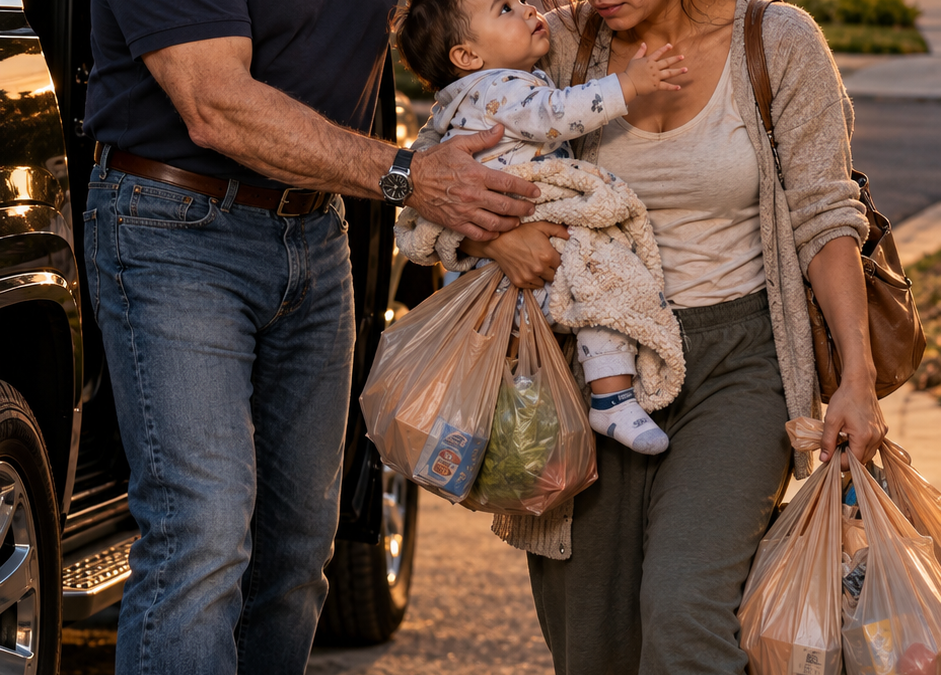
𝗣𝗔𝗥𝗧 𝟮
There was nothing hostile in his voice.
That almost made it worse.
Diane looked at the grocery bags in his hands.
“I thought Camila was taking the bus.”
I stared at her.
“The bus?”
She shifted.
“You said you were going to the grocery store.”
“You knew I was walking.”
“I assumed you would take the bus back.”
“There isn’t a direct bus.”
Diane crossed her arms.
“Well, I can’t keep track of every route in town.”
Dad said nothing.
He simply picked up the grocery bags.
Diane looked toward my SUV, then back at him.
“We should probably go inside.”
Ethan appeared behind her in the doorway.
My husband looked exhausted.
The last six months had hollowed him out. He had lost weight. There were shadows under his eyes. His hair was uncombed, and his T-shirt looked like he had slept in it.
“Cam?”
His gaze fell to my ankle.
“What happened?”
“I twisted it near the store.”
“You walked?”
Diane sighed.
“Apparently.”
Ethan’s face changed.
“Mom, you said Camila had plans.”
“I said she was going shopping.”
“You had the car.”
“I had errands.”
Dad stepped onto the porch.
“Could somebody help with the baby?”
Ethan moved immediately.
“Of course.”
He opened the rear door and gently lifted Noah from the car seat. Our son barely stirred before settling against his father’s chest.
For one painful second, I saw the man I had married.
Tender.
Careful.
Protective when no one was challenging him.
That made everything harder.
Because Ethan was not cruel.
He was frightened.
And fear, I had learned, could make people weak in ways that injured everyone around them.
We went inside.
Dad placed the groceries on the kitchen counter. Diane’s husband, Robert, came in from the den, startled by the company. He was quieter than Diane, a retired accountant with soft hands, tired eyes, and the habit of disappearing behind newspapers whenever conflict entered the room.
“Michael,” he said, recognizing my father from the wedding.
“Robert.”
They shook hands.
“I didn’t realize you were in town.”
“Neither did Camila,” Dad said.
I looked at him.
He had not told me he was coming.
Diane noticed too.
“Why are you here?”
“Conference at Fort Adams tomorrow. I arrived early and thought I would surprise my daughter.” His eyes met mine. “I suppose I did.”
Diane gave a stiff smile.
“Well, you certainly did.”
We gathered around the kitchen island.
No one sat.
Dad leaned against the counter.
“I’d like to understand something.”
Diane straightened.
Ethan closed his eyes.
I whispered, “Dad.”
He lifted one hand slightly.
Not to silence me.
To reassure me.
“I don’t intend to argue,” he said. “I just want the facts.”
Diane’s chin rose.
“About what?”
“The vehicle.”
She looked toward the driveway.
“What about it?”
“Camila says she bought it after Noah was born.”
“Technically, Ethan bought it. His name is on the registration.”
“Because my credit score was better at the time,” Ethan said quietly.
Everyone turned toward him.
He stared at the floor.
“Camila put down the deposit.”
My heart stopped.
Dad asked, “And who makes the payments?”
Ethan swallowed.
“Camila.”
Diane looked irritated.
“From their joint account.”
“No,” I said.
My own voice surprised me.
Everyone looked at me.
I continued before fear could close my throat.
“From my freelance income. The car payment comes from the account I had before Ethan and I got married.”
Diane stared at me as if I had broken some unspoken household law by correcting her.
“That money is household money.”
“Some of it is,” I said. “The SUV payment is mine.”
Robert shifted uncomfortably.
Diane looked at him, then back at me.
“Regardless, you are staying here because you are struggling financially. Everyone in this house has had to make adjustments.”
Dad nodded once.
“That’s reasonable.”
Diane seemed relieved.
Then he added, “But taking transportation from the person caring for an infant seems like an odd adjustment.”
“I didn’t take anything.”
“You had the keys.”
“I needed the vehicle.”
“So did Camila.”
“I had a doctor’s appointment, dry cleaning, and groceries for the weekend.”
“The doctor is important,” Dad said.
That caught her off guard.
“But after that,” he continued, “could you have brought the SUV back?”
Diane did not answer.
Dad was not raising his voice.
He was not cornering her.
He was simply removing every excuse one at a time.
Finally, Diane said, “I don’t think you understand what it has been like having them here.”
Ethan flinched.
Robert looked toward the window.
Diane’s voice changed. It became less sharp and more tired.
“We thought it would be two weeks. It has been four months. Ethan barely talks to us. Camila works from the dining room. There are toys everywhere. Noah wakes up early. Our lives changed overnight.”
I stared at her.
It was the first time she had said the truth plainly.
Before that, she had criticized small things.
A bottle near the sink.
A blanket on the sofa.
My laptop charger under the dining table.
A pacifier on the coffee table.
Maybe the little criticisms had been easier than admitting what she meant.
She did not want us there anymore.
Dad asked, “Did you tell them that?”
Diane hesitated.
“No.”
Robert spoke then.
“We should have.”
Diane turned toward him.
He sighed.
“We should have been honest.”
Something flickered in her eyes.
Betrayal.
Then exhaustion.
Robert continued.
“We offered because they needed help, and we meant it. But the house is smaller than it looks.”
Ethan laughed once without humor.
“Why didn’t you tell me?”
“Because you already felt terrible about losing your job,” Robert said. “You stopped sleeping. You were applying everywhere. Every rejection made you worse. Your mother thought if we complained, you would think we were disappointed in you.”
Ethan’s mouth tightened.
“I already thought that.”
The room fell silent.
Diane looked at her son.
“You did?”
Ethan finally lifted his eyes.
“Every day.”
For months, Ethan had interpreted every correction as judgment.
Diane had interpreted every silence as ingratitude.
I had tried to absorb both sides.
None of us had said what we meant.
Dad looked at me.
“And Camila?”
Ethan’s face filled with shame.
“I thought she was handling everything better than I was.”
A bitter laugh escaped me.
“Why?”
“Because you kept saying you were fine.”
That hurt because it was true.
I had said it so many times the words no longer meant anything.
Dad pulled out a chair.
“Maybe everyone should sit.”
This time, we did.
Noah slept in the portable crib near the living room while Robert made coffee no one wanted. Diane sat across from me, her hands folded too tightly on the table.
For the first time since we moved into that house, she looked uncertain.
“Camila,” she said, “I didn’t realize you were hurt.”
“It happened today.”
“I mean…” She stopped. “I didn’t realize you felt trapped.”
My eyes stung.
“I didn’t know how to explain it.”
“You could have told me.”
“I tried.”
Her face tightened.
“When?”
“The morning you moved my work things off the dining table.”
“I needed the space.”
“I know. I said I was falling behind because I didn’t have somewhere consistent to work.”
Diane looked down.
“I thought you were criticizing the house.”
“I wasn’t.”
I took a breath.
“And when you started keeping the SUV keys in your purse, I asked whether we could make a schedule.”
“You said it like I needed permission.”
“No,” I said. “I asked because I never knew when I could leave.”
Diane opened her mouth.
Then closed it.
I saw the moment she began replaying our conversations differently.
Robert set down the coffee pot.
“There is something else.”
Everyone looked at him.
He turned to Ethan.
“Your mother and I were going to talk to you tonight.”
Diane stiffened.
“Robert.”
“No. This is probably the right time.”
Ethan leaned forward.
“About what?”
Robert disappeared into the den and returned with a manila envelope.
He placed it on the table.
My stomach tightened before I even knew why.
“What is that?” Ethan asked.
“A letter,” Robert said.
“From who?”
Robert looked at his son.
“Dalton Engineering.”
Ethan went pale.
Dalton Engineering had been Ethan’s old company. Six months earlier, they had downsized almost a third of their workforce, and Ethan had been one of the project coordinators let go. He had come home that day holding a cardboard box and wearing the face of a man who had been told he was unnecessary.
“They sent something here?” he asked.
“It came yesterday.”
Ethan reached for the envelope.
Then he stopped.
It had already been opened.
“Why is this open?”
Diane looked deeply uncomfortable.
“I opened it by mistake.”
“Our names don’t look alike.”
“I was distracted.”
He pulled out the letter.
His eyes moved across the page.
Then stopped.
“What?” I asked.
Robert lowered himself into a chair.
“The company wants him back.”
I blinked.
“What?”
Ethan looked stunned.
“It’s not my old job.”
Dad watched quietly.
Ethan kept reading.
“They’re forming a new logistics division.” His hand trembled. “They want me to interview for senior operations manager.”
A smile broke across my face.
“Ethan.”
But he did not smile.
His eyes stayed on the page.
Then he looked at his mother.
“When were you going to give me this?”
Diane’s face lost color.
“Tonight.”
“Why not yesterday?”
“I wanted to talk to your father first.”
“About my job?”
“No.”
She looked toward Robert.
He said nothing.
That was when I understood there was more.
Ethan placed the letter on the table with painful care.
“Mom.”
Diane pressed her palms together.
“When you lost your job, you blamed yourself for everything. You barely ate. You stopped seeing your friends. Every rejection letter made it worse.”
“Okay.”
“The position at Dalton would require relocation.”
I looked at the letter.
The headquarters address was two states away.
Diane continued, her voice smaller now.
“I knew if I handed you the letter, you would immediately start thinking about leaving.”
Ethan’s expression hardened.
“That is my decision.”
“I know.”
“Do you?”
She looked wounded.
“I was afraid.”
“What?”
“I was afraid you would take Camila and Noah and move six hours away.”
No one spoke.
Diane looked toward the living room where Noah slept.
“I spent thirty years wishing you lived closer,” she said. “Then suddenly you were here every morning.”
A sad little smile trembled across her face.
“Even the noise. I complained about the toys and the bottles. Then sometimes, when the house was quiet, I realized how much I liked hearing Noah laugh upstairs.”
The anger inside me shifted.
It did not disappear.
It changed shape.
Diane had been controlling. Unfair. Thoughtless.
But underneath it all was something more ordinary than malice.
She was afraid of losing people.
And because she did not know how to admit that fear, she tried to make staying feel inevitable.
Dad finally spoke.
“Fear has a strange way of disguising itself as certainty.”
Diane looked at him.
He continued, “You tell yourself you are protecting something when you are really trying to control the outcome.”
She nodded slowly.
“I suppose I did.”
Ethan stared at the letter.
“The interview is Thursday.”
“Then you’ll go,” Diane said.
He looked up.
She swallowed.
“If you want to.”
I reached under the table and took his hand.
For the first time in months, he squeezed mine without hesitation.
Dad stood.
“I think Camila needs that ankle looked at.”
Ethan rose immediately.
“I’ll take her.”
Diane glanced toward the driveway.
“I’ll give you the keys.”
The words sounded simple.
But everyone understood their meaning.
She walked to the entryway, opened her handbag, and returned with the SUV keys.
Then she placed them in my palm.
Her fingers lingered for half a second.
“I’m sorry,” she said.
It was not enough to erase four difficult months.
But it was a beginning.
Then Robert cleared his throat.
“There is actually one more thing.”
I looked at him.
He reached into the manila envelope and pulled out a second page.
“I don’t think anyone noticed this.”
Ethan took it.
At the bottom of the letter, beneath the interview information, was a handwritten note from his former vice president.
Ethan read it silently.
His eyes widened.
“What does it say?” I asked.
He looked at me.
“They didn’t just contact me.”
He handed me the page.
The note read:
Your wife contacted me last month regarding one of her consulting clients. During that conversation, she mentioned your work on the Moreno distribution project. We reviewed the old files. You were right about the restructuring plan, Ethan. We should have listened.
I froze.
Ethan stared at me.
“Camila?”
“I didn’t know,” I said.
And I meant it.
I had contacted Dalton’s former vice president, Aaron Wells, as part of a freelance consulting project. One of my clients was evaluating a regional warehouse transition, and Dalton had handled something similar years before. During the call, Aaron had asked how Ethan was doing. I had answered politely at first.
Then he had said something that still burned in my memory.
“Ethan was a good man. Shame about the layoff.”
Not a good employee.
A good man.
As if his career had already been turned into a kind memorial.
I remembered my fingers tightening around the phone.
“He was more than good,” I had said.
Aaron had paused.
So I told him what I knew.
Not as a wife begging for favor.
Not as a woman trying to get her husband rehired.
I told him because Ethan had carried the blame for six months, and I was tired of watching him shrink beneath it.
I told Aaron about the Moreno distribution project.
I told him Ethan had warned Dalton that consolidating shipments through the Northlake hub would create delays, increase fuel costs, overload dispatch, and risk the Moreno Foods contract. I told him Ethan had stayed late building a revised route model. I told him his supervisor had dismissed it because corporate had already committed to the restructuring plan.
Ethan had never said all of that in one sitting.
He had told me in fragments.
At midnight.
In the shower.
While staring at rejection emails.
While rocking Noah back to sleep.
“I should have pushed harder,” he would whisper.
“I should have made them listen.”
“I saw it coming, Cam.”
Six months of shame had been built around the belief that he had failed.
But what if he had been right?
“What exactly did they discover?” Ethan asked.
His voice was quiet.
The whole kitchen seemed to hold its breath.
I looked at the note again.
“I only told Aaron what you told me.”
Ethan shook his head.
“That doesn’t answer the question.”
Dad turned to Robert.
“Was there anything else in the envelope?”
Robert hesitated.
Then he reached inside and pulled out several folded pages.
“I thought these were attachments.”
Ethan took them so quickly the paper bent in his hands.
His eyes moved over the first page.
Then the second.
Then the third.
I watched the color drain from his face.
“What is it?” I whispered.
He did not answer.
Dad came around the table and stood beside him. Not close enough to take over. Just close enough to steady the room.
Ethan swallowed.
“It’s an internal review.”
Diane leaned forward.
“Of what?”
“The Moreno account.”
Robert rubbed both hands over his face.
“Oh, God.”
Ethan kept reading.
His lips parted slightly, but no sound came out.
Then he sat down as if his knees had failed.
“Ethan,” I said.
He put the pages on the table.
“They lost the contract.”
Nobody moved.
“The Moreno Foods contract?” I asked.
He nodded.
“When?”
“Two months after the layoffs.”
I covered my mouth.
Ethan laughed once, but there was no humor in it. It was the sound a person makes when grief and vindication arrive together and neither one knows where to stand.
“They lost Moreno because of the exact delays I warned them about.”
Dad reached for the report.
“May I?”
Ethan nodded.
My father read fast. He had spent his life absorbing reports written by people who tried to hide problems inside passive language. I watched his eyes sharpen as he moved through the pages.
No one interrupted him.
When he finished, he set the report down.
“This says Dalton initiated an internal review after Moreno terminated the renewal option. Dispatch delays increased by twenty-eight percent after the Northlake consolidation. Fuel costs rose beyond projection. Customer escalations tripled in the first quarter.”
Ethan closed his eyes.
Dad continued, “And there is an appendix referencing an alternate route model submitted before implementation.”
“My model,” Ethan said.
“Your model,” Dad confirmed.
Diane pressed one hand against her chest.
“They knew?”
Ethan opened his eyes.
“They knew enough to attach it.”
Robert stared at the papers.
“Why would they lay you off if you were right?”
Ethan’s jaw tightened.
“Because being right at the wrong time makes people uncomfortable.”
For the first time that night, my father’s voice carried something harder.
“Because institutions sometimes punish the person who identifies the problem before they admit the problem exists.”
The room changed when he said that.
Diane looked at him more carefully.
Maybe she finally heard something in his voice that did not belong to an ordinary family disagreement.
Robert noticed it too.
“Michael,” he said slowly, “Camila mentioned you were in town for a conference.”
Dad looked at him.
“Yes.”
“At Fort Adams?”
“Yes.”
Robert’s eyes moved toward the military pass visible through the front window of Dad’s SUV.
Then back to his face.
“I don’t think I ever asked what you do.”
Diane looked irritated.
“Robert, this is hardly the time—”
“I am asking because I think I should know.”
Dad did not hesitate.
“I’m in the Army.”
Ethan gave a tired laugh.
“Dad, everybody knows that.”
My father looked at him.
“No. They know I served.”
Diane’s expression shifted.
Robert asked the question carefully.
“What rank?”
Dad was quiet for a moment.
Then he said, “General.”
The kitchen went silent.
Diane blinked.
“A general?”
“Four-star,” Ethan said softly.
Diane turned to him.
“You knew?”
“He walked me down the aisle, Mom. His dress uniform had four stars on it.”
“I thought…” She stopped, embarrassed. “I thought those were ceremonial.”
For the first time all night, my father almost smiled.
“They were not.”
Diane looked as if the floor had moved beneath her.
Not because my father suddenly had power. He had always had it.
Because she realized he had chosen not to use it.
He had sat in her kitchen, listened to her excuses, asked for facts, and accepted coffee he did not want, all while carrying a rank that could have intimidated everyone in the room if he had chosen to place it between us.
He hadn’t.
That made his restraint more powerful than any raised voice.
Dad looked at Ethan.
“Do you want my professional opinion?”
Ethan swallowed.
“Yes, sir.”
“Do not ‘sir’ me at this table. I’m your father-in-law.”
Ethan nodded.
Dad tapped the report.
“This is not charity. This is risk correction. Dalton is trying to rebuild a division after ignoring a warning that cost them a major account. They found the warning. They found the person who made it. Now they want that person in the room before they make the next mistake.”
Ethan stared at the papers like he was afraid they might vanish.
“I thought I was fired because I wasn’t good enough.”
Dad’s expression softened.
“Sometimes people lose jobs because companies make bad decisions. Sometimes good people get caught under collapsing structures and convince themselves they caused the collapse.”
Ethan put one hand over his eyes.
I wanted to go to him, but for once, I waited.
This was not a moment I could rescue him from.
He needed to stand inside it.
Diane’s voice trembled.
“I didn’t know.”
Ethan dropped his hand.
“You didn’t ask.”
She flinched.
He looked at her, and for the first time in months, his voice did not sound tired. It sounded clear.
“You didn’t ask what happened at Dalton. You asked whether I had applied somewhere else. You asked whether I had followed up. You asked whether I had considered temporary work. You asked whether I was being realistic. But you never asked what I lost.”
Diane’s eyes filled with tears.
“I was trying to help.”
“You were trying to manage me.”
The words landed hard.
Robert lowered his head.
Diane pressed her lips together, fighting the instinct to defend herself.
Ethan continued.
“And then you managed Camila because I let you.”
My throat tightened.
He turned to me.
“I let you carry this house. I let you carry Noah. I let you carry me. And when my mother took your keys, I told myself it was easier not to make it worse.”
His face twisted.
“But it was already worse.”
I could barely breathe.
“I didn’t need you to fight everyone,” I whispered. “I needed you to stand beside me.”
He nodded, tears shining in his eyes.
“I know.”
For months, I had imagined a confrontation like that.
In my imagination, I was louder. Diane was crueler. Ethan either defended me perfectly or failed me completely. My father arrived like thunder and ended everything with one devastating sentence.
But real life was not that clean.
Real life sat around a kitchen table with coffee cooling in untouched mugs.
Real life had a sleeping baby in the next room.
Real life had people who loved each other and still hurt each other because love without courage can become another kind of harm.
Dad looked around the table.
“Here is what will happen tonight,” he said.
Diane stiffened, but she did not interrupt.
“Camila’s ankle will be evaluated. Ethan will drive her and Noah. The SUV keys will remain with Camila unless she chooses otherwise. Tomorrow, Ethan will call Dalton and confirm the interview. After that, this family will make decisions out loud instead of hiding them inside criticism and silence.”
No one argued.
Not because he was a general.
Because every word he said was reasonable.
Diane wiped at her eyes.
“And if they move?”
Dad looked at her.
“Then you love them from six hours away.”
Her face crumpled.
“I don’t know how.”
I surprised myself by answering.
“You learn.”
She looked at me.
“I am sorry,” she said again.
This time, the words sounded less like a door cracked open and more like a person stepping through it.
“I need to say something,” I told her.
She nodded.
“If we stay tonight, it is not because everything is fixed. It is because Noah is asleep and my ankle hurts and I don’t want to make decisions while I’m angry.”
“I understand.”
“No,” I said gently. “I don’t think you do. Not yet.”
Her eyes lowered.
I continued.
“You made me feel like a guest in every room and a burden in every conversation. You took the keys because you could. Maybe you were scared. Maybe you were overwhelmed. But I need you to understand that fear does not give you the right to control my movement.”
Diane covered her mouth.
Ethan reached for my hand again.
This time, I let him.
“I am not trying to take your son from you,” I said. “I am trying to keep my family from disappearing inside your fear.”
Diane nodded, crying silently now.
Robert put a hand on her shoulder.
“I think we both owe you an apology,” he said.
His voice shook.
“I should have stepped in sooner. I saw more than I admitted.”
That hurt in a different way.
Because Robert’s quietness had always seemed harmless.
Now I understood silence had weight too.
Dad looked at him.
“Most people see more than they admit.”
Robert accepted that without defending himself.
Ethan stood.
“I’m taking Camila to urgent care.”
Diane rose quickly.
“I’ll get Noah’s bag.”
“No,” Ethan said.
She stopped.
The word had not been loud.
But it was firm.
“I’ll get it.”
Something passed between them.
A boundary.
Small, but real.
Diane sat back down.
Ethan went upstairs, and for a minute only the adults remained in the kitchen.
My father came to my side.
“You all right?”
I looked at the keys in my palm.
“No.”
He nodded.
“That is an honest answer.”
I laughed softly through tears.
“It feels terrible.”
“Most honest answers do at first.”
A few minutes later, Ethan returned with Noah’s diaper bag over one shoulder. He looked different somehow. Not fixed. Not healed. But awake.
He lifted Noah from the portable crib, and our son stirred, blinking sleepily.
“Hey, buddy,” Ethan whispered. “We’re going to get Mom checked out.”
Diane stood near the hallway, wringing her hands.
“Will you call me when you know what they say?”
I looked at Ethan.
He looked at me.
Then he answered, “We will text you.”
It was kind.
It was also different.
At urgent care, I learned my ankle was sprained, not broken. The nurse wrapped it, gave me instructions to stay off it as much as possible, and looked at Ethan with the stern authority of someone who had no interest in family complexity.
“She needs help,” the nurse said. “Real help. Not ‘let me know if you need anything’ help.”
Ethan nodded.
“Yes, ma’am.”
On the drive back, Noah slept again, and for a long time neither of us spoke.
Then Ethan pulled into an empty parking lot near a closed pharmacy and turned off the engine.
I looked at him.
“What are you doing?”
“I need to say this before we go back.”
My stomach tightened.
He stared at the steering wheel.
“When I lost my job, I felt like I had failed you before I even got home. You were holding Noah when I walked in, and I remember thinking, ‘I cannot tell her everything just became heavier.’”
My eyes filled again.
“So I tried to make it look like I was handling it,” he said. “Then every rejection made me feel smaller. And the smaller I felt, the quieter I got.”
He looked at me then.
“But my silence put you in the middle of everything. My mother’s fear. My father’s avoidance. My shame. The bills. The baby. The car. All of it.”
I wiped my cheek.
“I kept waiting for you to notice.”
“I did notice,” he said. “That’s the worst part. I noticed and convinced myself I was too broken to help.”
The honesty hurt.
But it also mattered.
“I don’t know how to trust you with this yet,” I said.
He nodded.
“I know.”
“I love you.”
His face tightened.
“I love you too.”
“But love cannot be the only thing holding us together.”
“I know,” he whispered.
I looked toward the dark pharmacy windows.
“If we move for this job, I need us to move as partners. Not as people running from your mother. Not as people pretending the last four months did not happen.”
“Yes.”
“And if you don’t get the job?”
“Then I keep applying. And I get temporary work. And we find a place we can afford, even if it’s smaller than what we had before.”
I looked at him.
“You mean that?”
He nodded.
“I called myself a provider, but I forgot that providing is not only money. It is safety. It is truth. It is showing up when things are uncomfortable.”
For the first time in months, I saw him clearly.
Not as the man who had failed me.
Not as the man I needed to forgive quickly so everyone else could feel better.
As a man standing at the edge of who he had been and who he still had a chance to become.
I reached for his hand.
“Then show me.”
He held my hand like it was something he did not deserve but intended to earn.
“I will.”
When we returned to the house, Dad was still there.
He was sitting with Robert in the living room, both of them holding untouched cups of coffee. Diane was folding baby blankets that did not need folding.
She looked up when we came in.
“What did they say?”
“Sprained,” Ethan said. “She needs to stay off it.”
“I can help,” Diane said quickly.
Then she stopped herself.
“If Camila wants me to.”
That was the first time she asked instead of assumed.
I nodded slowly.
“Thank you.”
It was not forgiveness.
But it was a start.
That night, Ethan slept on the floor beside the bed so Noah and I could have more space. Every time I shifted, he woke and asked if I needed ice, water, medicine, anything.
By morning, Diane had placed the SUV keys on the kitchen counter beside my coffee mug.
Not in her purse.
Not on a hook only she used.
On the counter.
Where everyone could see them.
Ethan called Dalton at nine.
His voice shook at first, but it steadied by the end.
“Yes,” he said. “I can be there Thursday.”
When he hung up, he looked at me like a man who had been handed a rope after months of sinking.
“They’re sending travel details.”
Diane was standing near the sink.
Her face tightened at the word travel, but she did not protest.
Instead, she said, “Do you need your suit pressed?”
Ethan looked at her for a long moment.
Then he said, “I can handle it.”
She nodded.
“Okay.”
The interview changed everything, but not all at once.
Ethan drove two states away that Thursday. My father stayed in town long enough to take me and Noah to a follow-up appointment, buy groceries, and install a better lock on the bedroom door after I joked that privacy was starting to feel like a luxury.
He did not lecture me.
He did not tell me what to do.
But before he left for Fort Adams, he stood beside my SUV and handed me a small card.
It had a phone number written on it.
“What is this?”
“A family attorney I trust.”
My stomach dropped.
“Dad—”
“You may never need it,” he said. “But options matter. When people feel trapped, they make decisions based on fear. I want you making decisions based on facts.”
I turned the card over in my hand.
“Do you think I should leave Ethan?”
Dad looked toward the house.
“I think you should never again stay anywhere because you believe you have no way out.”
The answer stayed with me.
Ethan returned from the interview two days later.
He looked exhausted.
He also looked alive.
Dalton did not offer him the job that day. They asked for a second interview. Then a third. They flew him back again and had him meet with the new division director.
Each time, he came home with more of himself restored.
Not because a company had validated him.
Because the lie that he had failed alone had finally cracked.
Three weeks later, the offer came.
Senior operations manager.
Relocation assistance.
A salary higher than the one he had lost.
A start date in thirty days.
Ethan read the email three times before handing me the phone.
I read it once, then sat down because my legs felt weak.
Diane cried when he told her.
Robert cried too, though he tried to hide it by cleaning his glasses.
No one pretended it was simple.
That was the difference.
Diane said, “I am happy for you.”
Then she took a breath and added, “And I am sad for me.”
Ethan hugged her.
Both things were true.
A month later, we moved into a small rental townhouse six hours away. It had two bedrooms, a narrow kitchen, and a dining nook just big enough for my desk. The first thing Ethan did was put a small hook by the back door.
Then he hung my SUV keys on it.
“Your keys,” he said.
I looked at them for a long moment.
Such a small thing.
Metal on a hook.
But to me, it sounded like a lock opening.
Diane changed too, though slowly. She called before visiting. She asked instead of announced. Sometimes she still slipped, especially when she missed Noah and tried to cover sadness with advice. But now Ethan caught it before I had to.
“Mom,” he would say, gentle but firm. “Ask us. Don’t tell us.”
And she would stop.
Sometimes she apologized.
Sometimes she needed a minute.
But she stopped.
Robert became quieter in a better way. Not avoidant. Reflective. He sent Ethan articles about logistics and mailed Noah little board books with handwritten notes inside the covers.
My father returned to his work, but he called every Sunday evening. Not to inspect my life. Not to command it.
Just to ask better questions.
“How are you really?”
“Do you feel safe?”
“What do you need that you have not said out loud?”
At first, those questions made me cry.
Then they made me stronger.
Ethan’s first year at Dalton was not perfect. No job is. But he walked into that new division with the calm of a man who had learned something expensive about silence. He spoke up. He documented concerns. He listened when junior staff noticed problems. He refused to become the kind of manager who punished inconvenient truth.
One evening, almost a year after my father found me limping on that sidewalk, Ethan came home carrying Noah on his shoulders. Our son was nearly two by then, laughing wildly and gripping his father’s hair.
I was at my desk, finishing a client proposal.
The SUV keys hung by the door.
My ankle had healed months earlier, but sometimes when it rained, it still ached.
Memory was like that too.
Healed did not always mean untouched.
Ethan set Noah down and came to stand beside me.
“Dalton renewed Moreno today,” he said.
I turned.
“What?”
He smiled, but his eyes were bright.
“The new route model worked. Moreno signed a three-year renewal.”
For a second, neither of us spoke.
Then I stood and wrapped my arms around him.
I thought about the kitchen table in Diane’s house.
The open envelope.
The handwritten note.
The way Ethan’s hands shook when he realized he had not imagined the warning signs.
I thought about my father standing there, calm enough to let the truth do its work.
And I thought about myself on that sidewalk, carrying too much, hurting too badly, still trying to convince myself I was fine.
I was not fine that day.
But I was found.
Not rescued like a helpless person.
Found like someone who had gone too quiet for too long.
Later that night, after Noah was asleep, I stood by the back door and looked at the keys.
Ethan came up behind me.
“You okay?”
I nodded.
Then I changed my mind.
“No,” I said softly. “But I’m honest.”
He kissed the side of my head.
“That’s better than fine.”
He was right.
Fine was the word I had used to survive.
Honest was the word that helped me live.
And every time I picked up those keys, I remembered the night my father opened the passenger door and told me to get in.
I remembered how afraid I had been of making everyone angry.
I remembered how calmly he drove toward the house where I had been disappearing.
Most of all, I remembered what he taught every person in that kitchen without raising his voice.
Power was not the same thing as control.
Love was not the same thing as possession.
And peace that required one person to suffer silently was never peace at all.
𝗧𝗛𝗘 𝗘𝗡𝗗
No One in That House Understood Why My Father Was So Calm
I was limping home with my eleven-month-old son on one hip and grocery bags cutting into my hands when my father pulled over beside me.
At first, I thought the black SUV slowing beside the curb was just another car easing around the bend in the neighborhood road. I lowered my eyes and kept walking, embarrassed by the way I must have looked. My left ankle was swollen, my hair had fallen loose from its clip, and Noah’s warm little body was pressed against my shoulder while I tried not to cry in the middle of a public sidewalk.
Then the driver’s window rolled down.
“Camila?”
My breath caught.
I looked over and froze.
“Dad…”
General Michael Carter climbed out before I could pretend I was fine. Even in jeans and a plain navy polo shirt, my father had the bearing of a man who had spent most of his life being watched by soldiers who trusted him to stay calm when everything around them broke apart.
But the expression on his face changed the instant he saw me.
His eyes went first to Noah.
Then to the grocery bags cutting red marks into my fingers.
Then to my ankle.
“What happened?”
I tried to smile, because that was what I had learned to do in the Harrison house. Smile. Soften. Explain less. Make myself smaller before someone else could remind me I was taking up too much space.
“I’m fine,” I said.
Dad did not move.
He had spent thirty-five years listening to soldiers say those exact words when they were bleeding, exhausted, terrified, or ashamed.
He did not believe me for a second.
“Where’s your car?”
The question was so simple that it almost broke me.
I looked down at the sidewalk.
“My mother-in-law took it.”
His face went still.
“The SUV you bought after Noah was born?”
I nodded.
“It’s registered in Ethan’s name,” I said quietly. “Diane says that since we’re living in her house, she decides who gets to use it.”
For several seconds, my father said nothing.
That was worse than if he had shouted.
His jaw tightened just enough for me to notice.
“Let me understand this,” he said. “You bought that SUV. You make the payments. And you are walking home with my grandson and groceries because someone decided you did not deserve to drive your own vehicle?”
The shame rose so fast I could barely swallow.
“Ethan lost his job six months ago,” I whispered. “We couldn’t keep the apartment. His parents offered to let us stay with them until we got back on our feet.”
Dad looked at me for a long moment.
“And this is how they’ve been treating you?”
I wanted to defend them. I wanted to defend Ethan. I wanted to say it was complicated, because it was. Nothing in that house had started with cruelty. It had started with fear, disappointment, money, and pride.
But I could not make words come out.
My silence answered him.
Dad took the grocery bags from my hands, then reached for Noah. My son lifted his head, blinked at the familiar deep voice, and smiled like the world had suddenly become safe again.
My father’s expression softened as Noah touched his cheek.
Then he opened the passenger door.
“Get in.”
“Dad—”
“I don’t want another argument.”
His voice was quiet, but there was no space inside it for refusal.
I eased myself into the seat, wincing when my ankle shifted. Dad buckled Noah into the child seat himself, careful with the straps, careful with his hands, careful in a way that made tears burn behind my eyes.
As he closed the rear door, I noticed the military access pass hanging beneath his mirror.
Most people would have ignored it.
The Harrisons certainly would have.
To them, my father was just an older man who had shown up at an inconvenient time.
They had no idea that the man driving me home had commanded soldiers across continents.
They had no idea that he had spent decades learning how to enter rooms where everyone was lying, afraid, or hiding something important.
They had no idea that when Michael Carter stopped asking polite questions and started asking for facts, people usually told the truth.
As we drove toward Ethan’s parents’ house, my heartbeat grew louder than the engine.
“You don’t have to do this,” I said.
Dad kept both hands on the wheel.
“I’m not doing anything yet.”
“That’s not comforting.”
A faint smile moved across his face and disappeared.
“Good.”
I stared out the window at the passing houses.
“She’ll say I’m ungrateful.”
“She can say that.”
“She’ll say we’re living under her roof.”
“That’s true.”
“She’ll threaten to throw us out.”
“Then we’ll discuss where you and Noah are sleeping tonight.”
My chest tightened.
“And Ethan?”
Dad glanced at me then.
Not sharply. Not with judgment.
With the kind of sadness that made it impossible to hide.
“Where is Ethan in all this, Camila?”
I pressed my lips together.
That question hurt more than the one about the car.
Because Ethan was not a monster.
If he had been, leaving would have been easier.
He was the man who had held my hand through thirty hours of labor, who cried before I did when Noah took his first breath, who used to leave notes in my laptop bag when I had client meetings. He was the man who could make me laugh in grocery store aisles and knew how I liked my coffee without asking.
But he was also the man who had grown quieter after losing his job.
The man who stopped meeting my eyes when his mother corrected me.
The man who kept saying, “She doesn’t mean it that way,” until the sentence felt less like comfort and more like a locked door.
“He’s ashamed,” I said.
Dad nodded once.
“Shame can explain silence. It does not excuse abandonment.”
I turned toward the window before he could see my face crumble.
By the time my father’s SUV turned onto the narrow street where Ethan’s parents lived, my ankle was throbbing in time with my pulse.
The Harrison house stood halfway down the block, porch light glowing against the early evening. The silver SUV sat in the driveway.
My SUV.
The one I had saved for after Noah was born because I was tired of lifting an infant carrier into a two-door car in the rain. The one I had put the deposit on. The one I paid for every month from freelance contracts I worked on while Noah napped.
Seeing it there, polished and untouched, did something strange to me.
It made everything I had been minimizing feel undeniable.
Dad parked behind it and turned off the engine.
“I should have told you sooner,” I whispered.
He looked at the house.
“Maybe.”
That was not the answer I expected.
He turned to me.
“But I also should have asked better questions. When you told me you and Ethan were moving in here, I asked whether you needed money. You said no. I took that answer at face value.”
“You were overseas.”
“I still had a phone.”
“Dad—”
“And you are thirty-two years old,” he continued gently. “You shouldn’t have to report every difficult day to your father.”
His expression softened.
“But being independent does not mean disappearing when life gets hard.”
That sentence nearly undid me.
For months, I had mistaken endurance for strength.
If I could keep the peace, things would improve.
If I could avoid another disagreement, things would calm down.
If I could help Ethan find work, he would come back to himself.
If I could be grateful enough, Diane would stop seeing me as a burden.
Instead, my world had become smaller.
One room to sleep in.
One corner of the dining room to work in, unless Diane needed the table.
One car I paid for but could not always use.
One husband who loved me, but not loudly enough to protect me.
Dad opened his door.
“Stay here a minute.”
“What are you doing?”
“Getting the groceries.”
The plainness of it made a broken laugh escape me.
He looked over.
“What?”
“I thought you were about to say something dramatic.”
“I’ve spent most of my professional life avoiding unnecessary drama.”
Then he stepped outside.
That was when I understood something important.
My father was not walking into that house as General Michael Carter.
He was not bringing rank into someone else’s kitchen.
He was walking in as my dad.
Somehow, that made me more nervous.
Before he could reach the trunk, the front door opened.
Diane Harrison stepped onto the porch.
My mother-in-law was sixty-one, always perfectly dressed, even at home. Her silver-blond hair sat neatly at her shoulders, and her cardigan matched her shoes as if she had planned the combination that morning and never once become tired.
Her eyes moved from my father to his SUV.
Then to me.
She came down the porch steps.
“Camila?”
I opened my door carefully and lowered my swollen foot to the driveway.
She noticed.
For one second, real concern crossed her face.
Then something guarded replaced it.
“Where have you been?”
Before I could answer, Dad spoke.
“Michael Carter.”
He extended his hand.
Diane looked at it, then took it.
“Camila’s father?”
“That’s right.”
“I’m Diane.”
“I know.”
There was nothing hostile in his voice.
That almost made it worse.
Diane looked at the grocery bags in his hands.
“I thought Camila was taking the bus.”
I stared at her.
“The bus?”
She shifted.
“You said you were going to the grocery store.”
“You knew I was walking.”
“I assumed you would take the bus back.”
“There isn’t a direct bus.”
Diane crossed her arms.
“Well, I can’t keep track of every route in town.”
Dad said nothing.
He simply picked up the grocery bags.
Diane looked toward my SUV, then back at him.
“We should probably go inside.”
Ethan appeared behind her in the doorway.
My husband looked exhausted.
The last six months had hollowed him out. He had lost weight. There were shadows under his eyes. His hair was uncombed, and his T-shirt looked like he had slept in it.
“Cam?”
His gaze fell to my ankle.
“What happened?”
“I twisted it near the store.”
“You walked?”
Diane sighed.
“Apparently.”
Ethan’s face changed.
“Mom, you said Camila had plans.”
“I said she was going shopping.”
“You had the car.”
“I had errands.”
Dad stepped onto the porch.
“Could somebody help with the baby?”
Ethan moved immediately.
“Of course.”
He opened the rear door and gently lifted Noah from the car seat. Our son barely stirred before settling against his father’s chest.
For one painful second, I saw the man I had married.
Tender.
Careful.
Protective when no one was challenging him.
That made everything harder.
Because Ethan was not cruel.
He was frightened.
And fear, I had learned, could make people weak in ways that injured everyone around them.
We went inside.
Dad placed the groceries on the kitchen counter. Diane’s husband, Robert, came in from the den, startled by the company. He was quieter than Diane, a retired accountant with soft hands, tired eyes, and the habit of disappearing behind newspapers whenever conflict entered the room.
“Michael,” he said, recognizing my father from the wedding.
“Robert.”
They shook hands.
“I didn’t realize you were in town.”
“Neither did Camila,” Dad said.
I looked at him.
He had not told me he was coming.
Diane noticed too.
“Why are you here?”
“Conference at Fort Adams tomorrow. I arrived early and thought I would surprise my daughter.” His eyes met mine. “I suppose I did.”
Diane gave a stiff smile.
“Well, you certainly did.”
We gathered around the kitchen island.
No one sat.
Dad leaned against the counter.
“I’d like to understand something.”
Diane straightened.
Ethan closed his eyes.
I whispered, “Dad.”
He lifted one hand slightly.
Not to silence me.
To reassure me.
“I don’t intend to argue,” he said. “I just want the facts.”
Diane’s chin rose.
“About what?”
“The vehicle.”
She looked toward the driveway.
“What about it?”
“Camila says she bought it after Noah was born.”
“Technically, Ethan bought it. His name is on the registration.”
“Because my credit score was better at the time,” Ethan said quietly.
Everyone turned toward him.
He stared at the floor.
“Camila put down the deposit.”
My heart stopped.
Dad asked, “And who makes the payments?”
Ethan swallowed.
“Camila.”
Diane looked irritated.
“From their joint account.”
“No,” I said.
My own voice surprised me.
Everyone looked at me.
I continued before fear could close my throat.
“From my freelance income. The car payment comes from the account I had before Ethan and I got married.”
Diane stared at me as if I had broken some unspoken household law by correcting her.
“That money is household money.”
“Some of it is,” I said. “The SUV payment is mine.”
Robert shifted uncomfortably.
Diane looked at him, then back at me.
“Regardless, you are staying here because you are struggling financially. Everyone in this house has had to make adjustments.”
Dad nodded once.
“That’s reasonable.”
Diane seemed relieved.
Then he added, “But taking transportation from the person caring for an infant seems like an odd adjustment.”
“I didn’t take anything.”
“You had the keys.”
“I needed the vehicle.”
“So did Camila.”
“I had a doctor’s appointment, dry cleaning, and groceries for the weekend.”
“The doctor is important,” Dad said.
That caught her off guard.
“But after that,” he continued, “could you have brought the SUV back?”
Diane did not answer.
Dad was not raising his voice.
He was not cornering her.
He was simply removing every excuse one at a time.
Finally, Diane said, “I don’t think you understand what it has been like having them here.”
Ethan flinched.
Robert looked toward the window.
Diane’s voice changed. It became less sharp and more tired.
“We thought it would be two weeks. It has been four months. Ethan barely talks to us. Camila works from the dining room. There are toys everywhere. Noah wakes up early. Our lives changed overnight.”
I stared at her.
It was the first time she had said the truth plainly.
Before that, she had criticized small things.
A bottle near the sink.
A blanket on the sofa.
My laptop charger under the dining table.
A pacifier on the coffee table.
Maybe the little criticisms had been easier than admitting what she meant.
She did not want us there anymore.
Dad asked, “Did you tell them that?”
Diane hesitated.
“No.”
Robert spoke then.
“We should have.”
Diane turned toward him.
He sighed.
“We should have been honest.”
Something flickered in her eyes.
Betrayal.
Then exhaustion.
Robert continued.
“We offered because they needed help, and we meant it. But the house is smaller than it looks.”
Ethan laughed once without humor.
“Why didn’t you tell me?”
“Because you already felt terrible about losing your job,” Robert said. “You stopped sleeping. You were applying everywhere. Every rejection made you worse. Your mother thought if we complained, you would think we were disappointed in you.”
Ethan’s mouth tightened.
“I already thought that.”
The room fell silent.
Diane looked at her son.
“You did?”
Ethan finally lifted his eyes.
“Every day.”
For months, Ethan had interpreted every correction as judgment.
Diane had interpreted every silence as ingratitude.
I had tried to absorb both sides.
None of us had said what we meant.
Dad looked at me.
“And Camila?”
Ethan’s face filled with shame.
“I thought she was handling everything better than I was.”
A bitter laugh escaped me.
“Why?”
“Because you kept saying you were fine.”
That hurt because it was true.
I had said it so many times the words no longer meant anything.
Dad pulled out a chair.
“Maybe everyone should sit.”
This time, we did.
Noah slept in the portable crib near the living room while Robert made coffee no one wanted. Diane sat across from me, her hands folded too tightly on the table.
For the first time since we moved into that house, she looked uncertain.
“Camila,” she said, “I didn’t realize you were hurt.”
“It happened today.”
“I mean…” She stopped. “I didn’t realize you felt trapped.”
My eyes stung.
“I didn’t know how to explain it.”
“You could have told me.”
“I tried.”
Her face tightened.
“When?”
“The morning you moved my work things off the dining table.”
“I needed the space.”
“I know. I said I was falling behind because I didn’t have somewhere consistent to work.”
Diane looked down.
“I thought you were criticizing the house.”
“I wasn’t.”
I took a breath.
“And when you started keeping the SUV keys in your purse, I asked whether we could make a schedule.”
“You said it like I needed permission.”
“No,” I said. “I asked because I never knew when I could leave.”
Diane opened her mouth.
Then closed it.
I saw the moment she began replaying our conversations differently.
Robert set down the coffee pot.
“There is something else.”
Everyone looked at him.
He turned to Ethan.
“Your mother and I were going to talk to you tonight.”
Diane stiffened.
“Robert.”
“No. This is probably the right time.”
Ethan leaned forward.
“About what?”
Robert disappeared into the den and returned with a manila envelope.
He placed it on the table.
My stomach tightened before I even knew why.
“What is that?” Ethan asked.
“A letter,” Robert said.
“From who?”
Robert looked at his son.
“Dalton Engineering.”
Ethan went pale.
Dalton Engineering had been Ethan’s old company. Six months earlier, they had downsized almost a third of their workforce, and Ethan had been one of the project coordinators let go. He had come home that day holding a cardboard box and wearing the face of a man who had been told he was unnecessary.
“They sent something here?” he asked.
“It came yesterday.”
Ethan reached for the envelope.
Then he stopped.
It had already been opened.
“Why is this open?”
Diane looked deeply uncomfortable.
“I opened it by mistake.”
“Our names don’t look alike.”
“I was distracted.”
He pulled out the letter.
His eyes moved across the page.
Then stopped.
“What?” I asked.
Robert lowered himself into a chair.
“The company wants him back.”
I blinked.
“What?”
Ethan looked stunned.
“It’s not my old job.”
Dad watched quietly.
Ethan kept reading.
“They’re forming a new logistics division.” His hand trembled. “They want me to interview for senior operations manager.”
A smile broke across my face.
“Ethan.”
But he did not smile.
His eyes stayed on the page.
Then he looked at his mother.
“When were you going to give me this?”
Diane’s face lost color.
“Tonight.”
“Why not yesterday?”
“I wanted to talk to your father first.”
“About my job?”
“No.”
She looked toward Robert.
He said nothing.
That was when I understood there was more.
Ethan placed the letter on the table with painful care.
“Mom.”
Diane pressed her palms together.
“When you lost your job, you blamed yourself for everything. You barely ate. You stopped seeing your friends. Every rejection letter made it worse.”
“Okay.”
“The position at Dalton would require relocation.”
I looked at the letter.
The headquarters address was two states away.
Diane continued, her voice smaller now.
“I knew if I handed you the letter, you would immediately start thinking about leaving.”
Ethan’s expression hardened.
“That is my decision.”
“I know.”
“Do you?”
She looked wounded.
“I was afraid.”
“What?”
“I was afraid you would take Camila and Noah and move six hours away.”
No one spoke.
Diane looked toward the living room where Noah slept.
“I spent thirty years wishing you lived closer,” she said. “Then suddenly you were here every morning.”
A sad little smile trembled across her face.
“Even the noise. I complained about the toys and the bottles. Then sometimes, when the house was quiet, I realized how much I liked hearing Noah laugh upstairs.”
The anger inside me shifted.
It did not disappear.
It changed shape.
Diane had been controlling. Unfair. Thoughtless.
But underneath it all was something more ordinary than malice.
She was afraid of losing people.
And because she did not know how to admit that fear, she tried to make staying feel inevitable.
Dad finally spoke.
“Fear has a strange way of disguising itself as certainty.”
Diane looked at him.
He continued, “You tell yourself you are protecting something when you are really trying to control the outcome.”
She nodded slowly.
“I suppose I did.”
Ethan stared at the letter.
“The interview is Thursday.”
“Then you’ll go,” Diane said.
He looked up.
She swallowed.
“If you want to.”
I reached under the table and took his hand.
For the first time in months, he squeezed mine without hesitation.
Dad stood.
“I think Camila needs that ankle looked at.”
Ethan rose immediately.
“I’ll take her.”
Diane glanced toward the driveway.
“I’ll give you the keys.”
The words sounded simple.
But everyone understood their meaning.
She walked to the entryway, opened her handbag, and returned with the SUV keys.
Then she placed them in my palm.
Her fingers lingered for half a second.
“I’m sorry,” she said.
It was not enough to erase four difficult months.
But it was a beginning.
Then Robert cleared his throat.
“There is actually one more thing.”
I looked at him.
He reached into the manila envelope and pulled out a second page.
“I don’t think anyone noticed this.”
Ethan took it.
At the bottom of the letter, beneath the interview information, was a handwritten note from his former vice president.
Ethan read it silently.
His eyes widened.
“What does it say?” I asked.
He looked at me.
“They didn’t just contact me.”
He handed me the page.
The note read:
Your wife contacted me last month regarding one of her consulting clients. During that conversation, she mentioned your work on the Moreno distribution project. We reviewed the old files. You were right about the restructuring plan, Ethan. We should have listened.
I froze.
Ethan stared at me.
“Camila?”
“I didn’t know,” I said.
And I meant it.
I had contacted Dalton’s former vice president, Aaron Wells, as part of a freelance consulting project. One of my clients was evaluating a regional warehouse transition, and Dalton had handled something similar years before. During the call, Aaron had asked how Ethan was doing. I had answered politely at first.
Then he had said something that still burned in my memory.
“Ethan was a good man. Shame about the layoff.”
Not a good employee.
A good man.
As if his career had already been turned into a kind memorial.
I remembered my fingers tightening around the phone.
“He was more than good,” I had said.
Aaron had paused.
So I told him what I knew.
Not as a wife begging for favor.
Not as a woman trying to get her husband rehired.
I told him because Ethan had carried the blame for six months, and I was tired of watching him shrink beneath it.
I told Aaron about the Moreno distribution project.
I told him Ethan had warned Dalton that consolidating shipments through the Northlake hub would create delays, increase fuel costs, overload dispatch, and risk the Moreno Foods contract. I told him Ethan had stayed late building a revised route model. I told him his supervisor had dismissed it because corporate had already committed to the restructuring plan.
Ethan had never said all of that in one sitting.
He had told me in fragments.
At midnight.
In the shower.
While staring at rejection emails.
While rocking Noah back to sleep.
“I should have pushed harder,” he would whisper.
“I should have made them listen.”
“I saw it coming, Cam.”
Six months of shame had been built around the belief that he had failed.
But what if he had been right?
“What exactly did they discover?” Ethan asked.
His voice was quiet.
The whole kitchen seemed to hold its breath.
I looked at the note again.
“I only told Aaron what you told me.”
Ethan shook his head.
“That doesn’t answer the question.”
Dad turned to Robert.
“Was there anything else in the envelope?”
Robert hesitated.
Then he reached inside and pulled out several folded pages.
“I thought these were attachments.”
Ethan took them so quickly the paper bent in his hands.
His eyes moved over the first page.
Then the second.
Then the third.
I watched the color drain from his face.
“What is it?” I whispered.
He did not answer.
Dad came around the table and stood beside him. Not close enough to take over. Just close enough to steady the room.
Ethan swallowed.
“It’s an internal review.”
Diane leaned forward.
“Of what?”
“The Moreno account.”
Robert rubbed both hands over his face.
“Oh, God.”
Ethan kept reading.
His lips parted slightly, but no sound came out.
Then he sat down as if his knees had failed.
“Ethan,” I said.
He put the pages on the table.
“They lost the contract.”
Nobody moved.
“The Moreno Foods contract?” I asked.
He nodded.
“When?”
“Two months after the layoffs.”
I covered my mouth.
Ethan laughed once, but there was no humor in it. It was the sound a person makes when grief and vindication arrive together and neither one knows where to stand.
“They lost Moreno because of the exact delays I warned them about.”
Dad reached for the report.
“May I?”
Ethan nodded.
My father read fast. He had spent his life absorbing reports written by people who tried to hide problems inside passive language. I watched his eyes sharpen as he moved through the pages.
No one interrupted him.
When he finished, he set the report down.
“This says Dalton initiated an internal review after Moreno terminated the renewal option. Dispatch delays increased by twenty-eight percent after the Northlake consolidation. Fuel costs rose beyond projection. Customer escalations tripled in the first quarter.”
Ethan closed his eyes.
Dad continued, “And there is an appendix referencing an alternate route model submitted before implementation.”
“My model,” Ethan said.
“Your model,” Dad confirmed.
Diane pressed one hand against her chest.
“They knew?”
Ethan opened his eyes.
“They knew enough to attach it.”
Robert stared at the papers.
“Why would they lay you off if you were right?”
Ethan’s jaw tightened.
“Because being right at the wrong time makes people uncomfortable.”
For the first time that night, my father’s voice carried something harder.
“Because institutions sometimes punish the person who identifies the problem before they admit the problem exists.”
The room changed when he said that.
Diane looked at him more carefully.
Maybe she finally heard something in his voice that did not belong to an ordinary family disagreement.
Robert noticed it too.
“Michael,” he said slowly, “Camila mentioned you were in town for a conference.”
Dad looked at him.
“Yes.”
“At Fort Adams?”
“Yes.”
Robert’s eyes moved toward the military pass visible through the front window of Dad’s SUV.
Then back to his face.
“I don’t think I ever asked what you do.”
Diane looked irritated.
“Robert, this is hardly the time—”
“I am asking because I think I should know.”
Dad did not hesitate.
“I’m in the Army.”
Ethan gave a tired laugh.
“Dad, everybody knows that.”
My father looked at him.
“No. They know I served.”
Diane’s expression shifted.
Robert asked the question carefully.
“What rank?”
Dad was quiet for a moment.
Then he said, “General.”
The kitchen went silent.
Diane blinked.
“A general?”
“Four-star,” Ethan said softly.
Diane turned to him.
“You knew?”
“He walked me down the aisle, Mom. His dress uniform had four stars on it.”
“I thought…” She stopped, embarrassed. “I thought those were ceremonial.”
For the first time all night, my father almost smiled.
“They were not.”
Diane looked as if the floor had moved beneath her.
Not because my father suddenly had power. He had always had it.
Because she realized he had chosen not to use it.
He had sat in her kitchen, listened to her excuses, asked for facts, and accepted coffee he did not want, all while carrying a rank that could have intimidated everyone in the room if he had chosen to place it between us.
He hadn’t.
That made his restraint more powerful than any raised voice.
Dad looked at Ethan.
“Do you want my professional opinion?”
Ethan swallowed.
“Yes, sir.”
“Do not ‘sir’ me at this table. I’m your father-in-law.”
Ethan nodded.
Dad tapped the report.
“This is not charity. This is risk correction. Dalton is trying to rebuild a division after ignoring a warning that cost them a major account. They found the warning. They found the person who made it. Now they want that person in the room before they make the next mistake.”
Ethan stared at the papers like he was afraid they might vanish.
“I thought I was fired because I wasn’t good enough.”
Dad’s expression softened.
“Sometimes people lose jobs because companies make bad decisions. Sometimes good people get caught under collapsing structures and convince themselves they caused the collapse.”
Ethan put one hand over his eyes.
I wanted to go to him, but for once, I waited.
This was not a moment I could rescue him from.
He needed to stand inside it.
Diane’s voice trembled.
“I didn’t know.”
Ethan dropped his hand.
“You didn’t ask.”
She flinched.
He looked at her, and for the first time in months, his voice did not sound tired. It sounded clear.
“You didn’t ask what happened at Dalton. You asked whether I had applied somewhere else. You asked whether I had followed up. You asked whether I had considered temporary work. You asked whether I was being realistic. But you never asked what I lost.”
Diane’s eyes filled with tears.
“I was trying to help.”
“You were trying to manage me.”
The words landed hard.
Robert lowered his head.
Diane pressed her lips together, fighting the instinct to defend herself.
Ethan continued.
“And then you managed Camila because I let you.”
My throat tightened.
He turned to me.
“I let you carry this house. I let you carry Noah. I let you carry me. And when my mother took your keys, I told myself it was easier not to make it worse.”
His face twisted.
“But it was already worse.”
I could barely breathe.
“I didn’t need you to fight everyone,” I whispered. “I needed you to stand beside me.”
He nodded, tears shining in his eyes.
“I know.”
For months, I had imagined a confrontation like that.
In my imagination, I was louder. Diane was crueler. Ethan either defended me perfectly or failed me completely. My father arrived like thunder and ended everything with one devastating sentence.
But real life was not that clean.
Real life sat around a kitchen table with coffee cooling in untouched mugs.
Real life had a sleeping baby in the next room.
Real life had people who loved each other and still hurt each other because love without courage can become another kind of harm.
Dad looked around the table.
“Here is what will happen tonight,” he said.
Diane stiffened, but she did not interrupt.
“Camila’s ankle will be evaluated. Ethan will drive her and Noah. The SUV keys will remain with Camila unless she chooses otherwise. Tomorrow, Ethan will call Dalton and confirm the interview. After that, this family will make decisions out loud instead of hiding them inside criticism and silence.”
No one argued.
Not because he was a general.
Because every word he said was reasonable.
Diane wiped at her eyes.
“And if they move?”
Dad looked at her.
“Then you love them from six hours away.”
Her face crumpled.
“I don’t know how.”
I surprised myself by answering.
“You learn.”
She looked at me.
“I am sorry,” she said again.
This time, the words sounded less like a door cracked open and more like a person stepping through it.
“I need to say something,” I told her.
She nodded.
“If we stay tonight, it is not because everything is fixed. It is because Noah is asleep and my ankle hurts and I don’t want to make decisions while I’m angry.”
“I understand.”
“No,” I said gently. “I don’t think you do. Not yet.”
Her eyes lowered.
I continued.
“You made me feel like a guest in every room and a burden in every conversation. You took the keys because you could. Maybe you were scared. Maybe you were overwhelmed. But I need you to understand that fear does not give you the right to control my movement.”
Diane covered her mouth.
Ethan reached for my hand again.
This time, I let him.
“I am not trying to take your son from you,” I said. “I am trying to keep my family from disappearing inside your fear.”
Diane nodded, crying silently now.
Robert put a hand on her shoulder.
“I think we both owe you an apology,” he said.
His voice shook.
“I should have stepped in sooner. I saw more than I admitted.”
That hurt in a different way.
Because Robert’s quietness had always seemed harmless.
Now I understood silence had weight too.
Dad looked at him.
“Most people see more than they admit.”
Robert accepted that without defending himself.
Ethan stood.
“I’m taking Camila to urgent care.”
Diane rose quickly.
“I’ll get Noah’s bag.”
“No,” Ethan said.
She stopped.
The word had not been loud.
But it was firm.
“I’ll get it.”
Something passed between them.
A boundary.
Small, but real.
Diane sat back down.
Ethan went upstairs, and for a minute only the adults remained in the kitchen.
My father came to my side.
“You all right?”
I looked at the keys in my palm.
“No.”
He nodded.
“That is an honest answer.”
I laughed softly through tears.
“It feels terrible.”
“Most honest answers do at first.”
A few minutes later, Ethan returned with Noah’s diaper bag over one shoulder. He looked different somehow. Not fixed. Not healed. But awake.
He lifted Noah from the portable crib, and our son stirred, blinking sleepily.
“Hey, buddy,” Ethan whispered. “We’re going to get Mom checked out.”
Diane stood near the hallway, wringing her hands.
“Will you call me when you know what they say?”
I looked at Ethan.
He looked at me.
Then he answered, “We will text you.”
It was kind.
It was also different.
At urgent care, I learned my ankle was sprained, not broken. The nurse wrapped it, gave me instructions to stay off it as much as possible, and looked at Ethan with the stern authority of someone who had no interest in family complexity.
“She needs help,” the nurse said. “Real help. Not ‘let me know if you need anything’ help.”
Ethan nodded.
“Yes, ma’am.”
On the drive back, Noah slept again, and for a long time neither of us spoke.
Then Ethan pulled into an empty parking lot near a closed pharmacy and turned off the engine.
I looked at him.
“What are you doing?”
“I need to say this before we go back.”
My stomach tightened.
He stared at the steering wheel.
“When I lost my job, I felt like I had failed you before I even got home. You were holding Noah when I walked in, and I remember thinking, ‘I cannot tell her everything just became heavier.’”
My eyes filled again.
“So I tried to make it look like I was handling it,” he said. “Then every rejection made me feel smaller. And the smaller I felt, the quieter I got.”
He looked at me then.
“But my silence put you in the middle of everything. My mother’s fear. My father’s avoidance. My shame. The bills. The baby. The car. All of it.”
I wiped my cheek.
“I kept waiting for you to notice.”
“I did notice,” he said. “That’s the worst part. I noticed and convinced myself I was too broken to help.”
The honesty hurt.
But it also mattered.
“I don’t know how to trust you with this yet,” I said.
He nodded.
“I know.”
“I love you.”
His face tightened.
“I love you too.”
“But love cannot be the only thing holding us together.”
“I know,” he whispered.
I looked toward the dark pharmacy windows.
“If we move for this job, I need us to move as partners. Not as people running from your mother. Not as people pretending the last four months did not happen.”
“Yes.”
“And if you don’t get the job?”
“Then I keep applying. And I get temporary work. And we find a place we can afford, even if it’s smaller than what we had before.”
I looked at him.
“You mean that?”
He nodded.
“I called myself a provider, but I forgot that providing is not only money. It is safety. It is truth. It is showing up when things are uncomfortable.”
For the first time in months, I saw him clearly.
Not as the man who had failed me.
Not as the man I needed to forgive quickly so everyone else could feel better.
As a man standing at the edge of who he had been and who he still had a chance to become.
I reached for his hand.
“Then show me.”
He held my hand like it was something he did not deserve but intended to earn.
“I will.”
When we returned to the house, Dad was still there.
He was sitting with Robert in the living room, both of them holding untouched cups of coffee. Diane was folding baby blankets that did not need folding.
She looked up when we came in.
“What did they say?”
“Sprained,” Ethan said. “She needs to stay off it.”
“I can help,” Diane said quickly.
Then she stopped herself.
“If Camila wants me to.”
That was the first time she asked instead of assumed.
I nodded slowly.
“Thank you.”
It was not forgiveness.
But it was a start.
That night, Ethan slept on the floor beside the bed so Noah and I could have more space. Every time I shifted, he woke and asked if I needed ice, water, medicine, anything.
By morning, Diane had placed the SUV keys on the kitchen counter beside my coffee mug.
Not in her purse.
Not on a hook only she used.
On the counter.
Where everyone could see them.
Ethan called Dalton at nine.
His voice shook at first, but it steadied by the end.
“Yes,” he said. “I can be there Thursday.”
When he hung up, he looked at me like a man who had been handed a rope after months of sinking.
“They’re sending travel details.”
Diane was standing near the sink.
Her face tightened at the word travel, but she did not protest.
Instead, she said, “Do you need your suit pressed?”
Ethan looked at her for a long moment.
Then he said, “I can handle it.”
She nodded.
“Okay.”
The interview changed everything, but not all at once.
Ethan drove two states away that Thursday. My father stayed in town long enough to take me and Noah to a follow-up appointment, buy groceries, and install a better lock on the bedroom door after I joked that privacy was starting to feel like a luxury.
He did not lecture me.
He did not tell me what to do.
But before he left for Fort Adams, he stood beside my SUV and handed me a small card.
It had a phone number written on it.
“What is this?”
“A family attorney I trust.”
My stomach dropped.
“Dad—”
“You may never need it,” he said. “But options matter. When people feel trapped, they make decisions based on fear. I want you making decisions based on facts.”
I turned the card over in my hand.
“Do you think I should leave Ethan?”
Dad looked toward the house.
“I think you should never again stay anywhere because you believe you have no way out.”
The answer stayed with me.
Ethan returned from the interview two days later.
He looked exhausted.
He also looked alive.
Dalton did not offer him the job that day. They asked for a second interview. Then a third. They flew him back again and had him meet with the new division director.
Each time, he came home with more of himself restored.
Not because a company had validated him.
Because the lie that he had failed alone had finally cracked.
Three weeks later, the offer came.
Senior operations manager.
Relocation assistance.
A salary higher than the one he had lost.
A start date in thirty days.
Ethan read the email three times before handing me the phone.
I read it once, then sat down because my legs felt weak.
Diane cried when he told her.
Robert cried too, though he tried to hide it by cleaning his glasses.
No one pretended it was simple.
That was the difference.
Diane said, “I am happy for you.”
Then she took a breath and added, “And I am sad for me.”
Ethan hugged her.
Both things were true.
A month later, we moved into a small rental townhouse six hours away. It had two bedrooms, a narrow kitchen, and a dining nook just big enough for my desk. The first thing Ethan did was put a small hook by the back door.
Then he hung my SUV keys on it.
“Your keys,” he said.
I looked at them for a long moment.
Such a small thing.
Metal on a hook.
But to me, it sounded like a lock opening.
Diane changed too, though slowly. She called before visiting. She asked instead of announced. Sometimes she still slipped, especially when she missed Noah and tried to cover sadness with advice. But now Ethan caught it before I had to.
“Mom,” he would say, gentle but firm. “Ask us. Don’t tell us.”
And she would stop.
Sometimes she apologized.
Sometimes she needed a minute.
But she stopped.
Robert became quieter in a better way. Not avoidant. Reflective. He sent Ethan articles about logistics and mailed Noah little board books with handwritten notes inside the covers.
My father returned to his work, but he called every Sunday evening. Not to inspect my life. Not to command it.
Just to ask better questions.
“How are you really?”
“Do you feel safe?”
“What do you need that you have not said out loud?”
At first, those questions made me cry.
Then they made me stronger.
Ethan’s first year at Dalton was not perfect. No job is. But he walked into that new division with the calm of a man who had learned something expensive about silence. He spoke up. He documented concerns. He listened when junior staff noticed problems. He refused to become the kind of manager who punished inconvenient truth.
One evening, almost a year after my father found me limping on that sidewalk, Ethan came home carrying Noah on his shoulders. Our son was nearly two by then, laughing wildly and gripping his father’s hair.
I was at my desk, finishing a client proposal.
The SUV keys hung by the door.
My ankle had healed months earlier, but sometimes when it rained, it still ached.
Memory was like that too.
Healed did not always mean untouched.
Ethan set Noah down and came to stand beside me.
“Dalton renewed Moreno today,” he said.
I turned.
“What?”
He smiled, but his eyes were bright.
“The new route model worked. Moreno signed a three-year renewal.”
For a second, neither of us spoke.
Then I stood and wrapped my arms around him.
I thought about the kitchen table in Diane’s house.
The open envelope.
The handwritten note.
The way Ethan’s hands shook when he realized he had not imagined the warning signs.
I thought about my father standing there, calm enough to let the truth do its work.
And I thought about myself on that sidewalk, carrying too much, hurting too badly, still trying to convince myself I was fine.
I was not fine that day.
But I was found.
Not rescued like a helpless person.
Found like someone who had gone too quiet for too long.
Later that night, after Noah was asleep, I stood by the back door and looked at the keys.
Ethan came up behind me.
“You okay?”
I nodded.
Then I changed my mind.
“No,” I said softly. “But I’m honest.”
He kissed the side of my head.
“That’s better than fine.”
He was right.
Fine was the word I had used to survive.
Honest was the word that helped me live.
And every time I picked up those keys, I remembered the night my father opened the passenger door and told me to get in.
I remembered how afraid I had been of making everyone angry.
I remembered how calmly he drove toward the house where I had been disappearing.
Most of all, I remembered what he taught every person in that kitchen without raising his voice.
Power was not the same thing as control.
Love was not the same thing as possession.
And peace that required one person to suffer silently was never peace at all.








